

SIST EN 14125:2025/oprA1:2026
(Amendment)Thermoplastic and flexible metal pipework for underground installation at petrol filling stations
- Abstract
This document specifies requirements for underground pipework systems used to transfer liquid fuels and their vapours at petrol filling stations. Minimum performance requirements covering fitness for purpose, safety and environmental protection are given.
This document is applicable to pipework made from thermoplastics, which can include some degree of reinforcement, and to flexible metal pipework. It does not apply to fibre reinforced thermosets, commonly referred to as glass fibre reinforced plastic (GRP), nor to rigid metals.
This document is applicable to:
- delivery pipes from tanks to dispensers, including positive pressure, vacuum suction and siphon modes;
- fill pipes from road tankers to tanks;
- vapour recovery and vent pipework;
- pipework for secondary containment;
- fittings.
It does not apply to pipework for use with liquefied petroleum gas.
- Status
- Not Published
- Public Enquiry End Date
- 02-Aug-2026
- Technical Committee
- TLP - Pressure vessels
- Current Stage
- 4020 - Public enquire (PE) (Adopted Project)
- Start Date
- 04-Jun-2026
- Due Date
- 22-Oct-2026
- Completion Date
- 08-Oct-2026

SIST EN 14125:2025/oprA1:2026 is the Slovenian publication of the CEN draft amendment EN 14125:2025/prA1:2026, published by SIST. It updates the European standard for thermoplastic and flexible metal pipework for underground installation at petrol filling stations, and it is used by manufacturers, test laboratories, specifiers and installers working on underground fuel-station pipework.
What does SIST EN 14125:2025/oprA1:2026 specify?
SIST EN 14125:2025/oprA1:2026 is a draft amendment to EN 14125:2025. The underlying standard specifies requirements for underground pipework systems that transfer liquid fuels and their vapours at petrol filling stations, with minimum performance requirements for fitness for purpose, safety and environmental protection.
The base standard applies to thermoplastic pipework, including some reinforced constructions, and to flexible metal pipework. It excludes fibre reinforced thermosets, commonly called GRP, rigid metals, and pipework used with liquefied petroleum gas.
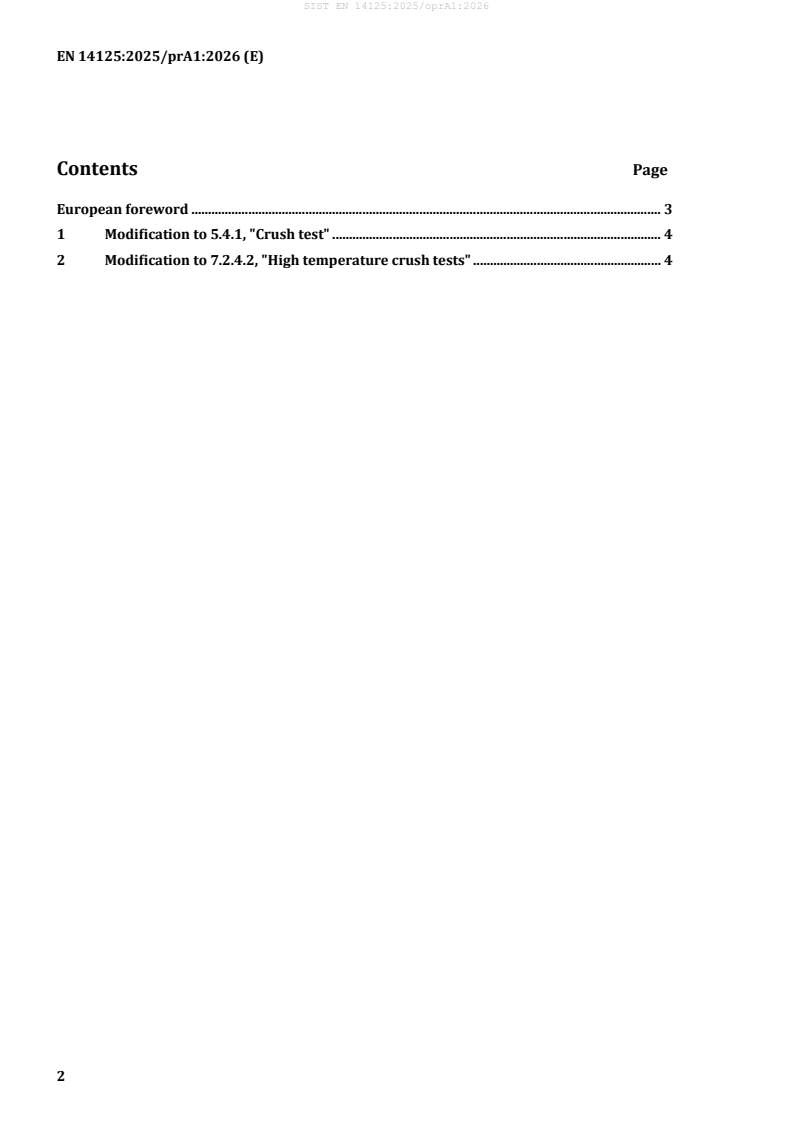
This amendment document is short and focused. It contains a European foreword and two modification clauses:
| Clause | What it covers |
|---|---|
| 1 | Modification to 5.4.1, “Crush test” |
| 2 | Modification to 7.2.4.2, “High temperature crush tests” |
What are the key requirements of SIST EN 14125:2025/oprA1:2026?
SIST EN 14125:2025/oprA1:2026 does not introduce a full new test programme; it adjusts how two existing test clauses are worded. In practice, the amendment is about making the test application clearer so that conformity assessment is applied to the right product elements.
1. The crush test wording in 5.4.1 is limited to pipes only
SIST EN 14125:2025/oprA1:2026 adds an explicit “applicable for pipes only” note to the recovery criterion in 5.4.1. The practical effect is that the specified recovery requirement is not treated as a fittings requirement.
For users, this matters when planning type tests and reviewing test reports. A laboratory or manufacturer should read the clause as applying that part of the crush test to pipes, not to fittings.
2. The high temperature crush test wording in 7.2.4.2 is narrowed
SIST EN 14125:2025/oprA1:2026 deletes “and each fitting” from the second paragraph of 7.2.4.2. The practical effect is that the paragraph is no longer written as if it automatically covers every fitting in the same way as the pipes.
This matters for product certification and internal quality checks. It affects which components are included in the high temperature crush test sequence and how the result is documented.
3. The amendment keeps the focus on underground fuel-station pipework
SIST EN 14125:2025/oprA1:2026 still sits within the scope of underground pipework for petrol filling stations. It continues to support the same overall product family as EN 14125:2025, but with clearer test wording.
That means readers should use it together with the base standard, not as a stand-alone product specification.
What terms does SIST EN 14125:2025/oprA1:2026 define?
- Thermoplastic - a pipe material category used in the standard, including versions with some reinforcement.
- Flexible metal pipework - metal pipework designed for underground installation with flexibility in service and installation.
- Delivery pipes - pipes that carry fuel from tanks to dispensers, including positive pressure, vacuum suction and siphon modes.
- Fill pipes - pipes that transfer fuel from road tankers to tanks.
- Vapour recovery - pipework used to handle vapours associated with fuel transfer.
- Secondary containment - pipework intended to provide an additional barrier around the primary pipe.
- Crush test - the test in clause 5.4.1 used to assess how the pipe recovers after being crushed.
- High temperature crush tests - the tests in clause 7.2.4.2 carried out under elevated temperature conditions.
Who uses SIST EN 14125:2025/oprA1:2026?
SIST EN 14125:2025/oprA1:2026 is used by people who design, make, test and approve underground fuel-station pipework. Manufacturers use it to align product testing and technical files with the European standard.
Testing laboratories use it to apply the correct crush-test wording. Certification bodies, inspectors and quality managers use it when checking whether pipes and fittings are covered by the relevant test clause. Buyers, installers and system designers use it when selecting pipework for petrol filling stations.
What changed in SIST EN 14125:2025/oprA1:2026 from the previous edition?
SIST EN 14125:2025/oprA1:2026 modifies EN 14125:2025 in two places:
- In 5.4.1, the crush test recovery criterion is marked as applicable for pipes only.
- In 7.2.4.2, the words “and each fitting” are deleted from the second paragraph.
These changes tighten the wording of the test clauses so that the intended product coverage is clearer.
Which standards are used with SIST EN 14125:2025/oprA1:2026?
- EN 14125:2025 - the base European Standard that this amendment modifies and on which the updated test wording depends.
What does the SIST EN 14125:2025/oprA1:2026 document contain?
SIST EN 14125:2025/oprA1:2026 is a short amendment text rather than a full product standard. It includes a European foreword, then two clauses that amend existing text in the base standard.
Clause 1 gives the change to 5.4.1, “Crush test”. Clause 2 gives the change to 7.2.4.2, “High temperature crush tests”. The document is structured for direct use when updating the base standard, reviewing test procedures, or revising technical documentation.
Relations
- Effective Date
- 01-Jul-2026
Get Certified
Connect with accredited certification bodies for this standard

DIN CERTCO
DIN Group product certification.

Element Materials Technology
Materials testing and product certification.
ABS Group Brazil
ABS Group certification services in Brazil.
Sponsored listings
Frequently Asked Questions
SIST EN 14125:2025/oprA1:2026 is a draft published by the Slovenian Institute for Standardization (SIST). Its full title is "Thermoplastic and flexible metal pipework for underground installation at petrol filling stations". This standard covers: This document specifies requirements for underground pipework systems used to transfer liquid fuels and their vapours at petrol filling stations. Minimum performance requirements covering fitness for purpose, safety and environmental protection are given. This document is applicable to pipework made from thermoplastics, which can include some degree of reinforcement, and to flexible metal pipework. It does not apply to fibre reinforced thermosets, commonly referred to as glass fibre reinforced plastic (GRP), nor to rigid metals. This document is applicable to: - delivery pipes from tanks to dispensers, including positive pressure, vacuum suction and siphon modes; - fill pipes from road tankers to tanks; - vapour recovery and vent pipework; - pipework for secondary containment; - fittings. It does not apply to pipework for use with liquefied petroleum gas.
This document specifies requirements for underground pipework systems used to transfer liquid fuels and their vapours at petrol filling stations. Minimum performance requirements covering fitness for purpose, safety and environmental protection are given. This document is applicable to pipework made from thermoplastics, which can include some degree of reinforcement, and to flexible metal pipework. It does not apply to fibre reinforced thermosets, commonly referred to as glass fibre reinforced plastic (GRP), nor to rigid metals. This document is applicable to: - delivery pipes from tanks to dispensers, including positive pressure, vacuum suction and siphon modes; - fill pipes from road tankers to tanks; - vapour recovery and vent pipework; - pipework for secondary containment; - fittings. It does not apply to pipework for use with liquefied petroleum gas.
SIST EN 14125:2025/oprA1:2026 is classified under the following ICS (International Classification for Standards) categories: 23.040.10 - Iron and steel pipes; 75.200 - Petroleum products and natural gas handling equipment; 83.140.30 - Plastics pipes and fittings for non fluid use. The ICS classification helps identify the subject area and facilitates finding related standards.
SIST EN 14125:2025/oprA1:2026 has the following relationships with other standards: It is inter standard links to SIST EN 14125:2025. Understanding these relationships helps ensure you are using the most current and applicable version of the standard.
SIST EN 14125:2025/oprA1:2026 is available in PDF format for immediate download after purchase. The document can be added to your cart and obtained through the secure checkout process. Digital delivery ensures instant access to the complete standard document.
Standards Content (Sample)
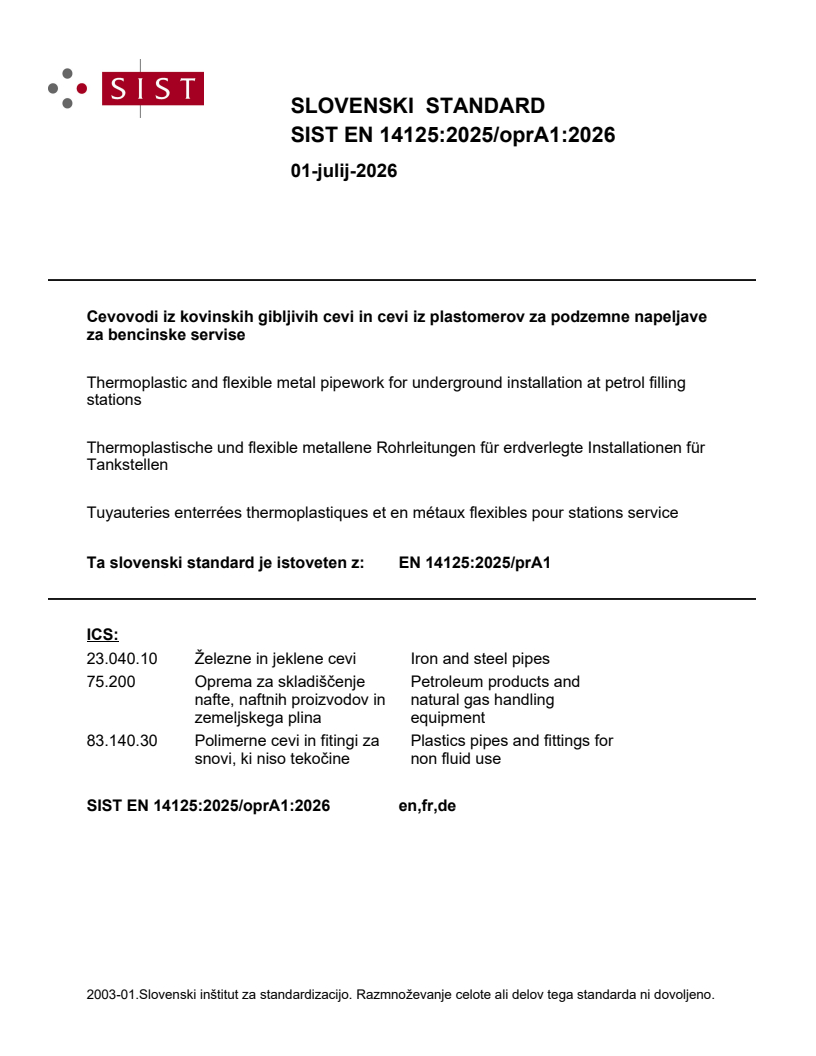
SLOVENSKI STANDARD
01-julij-2026
Cevovodi iz kovinskih gibljivih cevi in cevi iz plastomerov za podzemne napeljave
za bencinske servise
Thermoplastic and flexible metal pipework for underground installation at petrol filling
stations
Thermoplastische und flexible metallene Rohrleitungen für erdverlegte Installationen für
Tankstellen
Tuyauteries enterrées thermoplastiques et en métaux flexibles pour stations service
Ta slovenski standard je istoveten z: EN 14125:2025/prA1
ICS:
23.040.10 Železne in jeklene cevi Iron and steel pipes
75.200 Oprema za skladiščenje Petroleum products and
nafte, naftnih proizvodov in natural gas handling
zemeljskega plina equipment
83.140.30 Polimerne cevi in fitingi za Plastics pipes and fittings for
snovi, ki niso tekočine non fluid use
2003-01.Slovenski inštitut za standardizacijo. Razmnoževanje celote ali delov tega standarda ni dovoljeno.
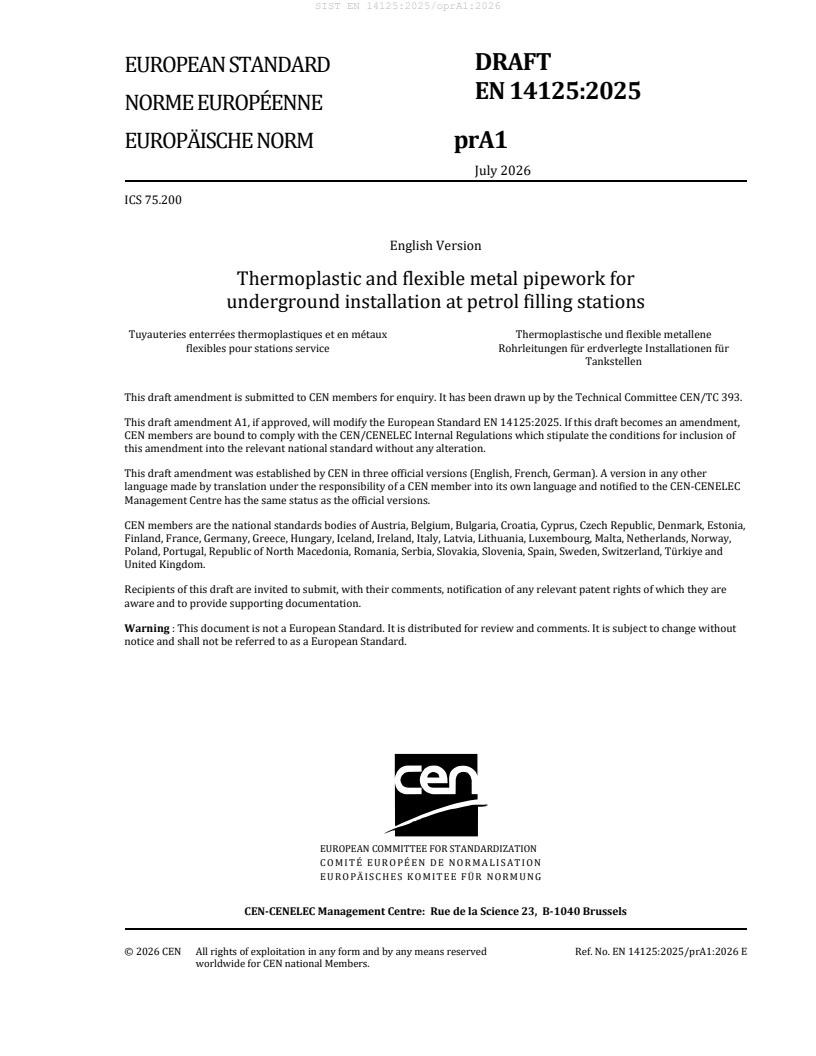
DRAFT
EUROPEAN STANDARD
EN 14125:2025
NORME EUROPÉENNE
EUROPÄISCHE NORM
prA1
July 2026
ICS 75.200
English Version
Thermoplastic and flexible metal pipework for
underground installation at petrol filling stations
Tuyauteries enterrées thermoplastiques et en métaux Thermoplastische und flexible metallene
flexibles pour stations service Rohrleitungen für erdverlegte Installationen für
Tankstellen
This draft amendment is submitted to CEN members for enquiry. It has been drawn up by the Technical Committee CEN/TC 393.
This draft amendment A1, if approved, will modify the European Standard EN 14125:2025. If this draft becomes an amendment,
CEN members are bound to comply with the CEN/CENELEC Internal Regulations which stipulate the conditions for inclusion of
this amendment into the relevant national standard without any alteration.
This draft amendment was established by CEN in three official versions (English, French, German). A version in any other
language made by translation under the responsibility of a CEN member into its own language and notified to the CEN-CENELEC
Management Centre has the same status as the official versions.
CEN members are the national standards bodies of Austria, Belgium, Bulgaria, Croatia, Cyprus, Czech Republic, Denmark, Estonia,
Finland, France, Germany, Greece
...