

SIST EN 50549-2:2019
(Main)Requirements for generating plants to be connected in parallel with distribution networks - Part 2: Connection to a MV distribution network - Generating plants up to and including Type B
General Information
- Abstract
This standard provides technical requirements for the connection of generating plants up to and including Type B which can be operated in parallel with a public MV distribution network. They are intended to be used as a technical reference for connection agreements between DSOs and electricity producers and to demonstrate compliance with COMMISSION REGULATION (EU) 2016/631 (Requirements for Generators).
- Status
- Published
- Public Enquiry End Date
- 17-Aug-2017
- Publication Date
- 18-Mar-2019
- Technical Committee
- NTF - Electricity energy supply systems
- Current Stage
- 6100 - Translation of adopted SIST standards (Adopted Project)
- Start Date
- 06-Mar-2024
- Due Date
- 05-Mar-2025
- Completion Date
- 29-Jan-2026
Buy Documents




Overview
EN 50549-2:2019 - "Requirements for generating plants to be connected in parallel with distribution networks - Part 2: Connection to a MV distribution network - Generating plants up to and including Type B" (CENELEC/CLC) defines technical requirements for connecting generating plants to a medium-voltage (MV) distribution network. It is intended as a technical reference for DSOs (distribution system operators) and electricity producers and is used to demonstrate compliance with COMMISSION REGULATION (EU) 2016/631 (RfG). The standard supersedes CLC/TS 50549-2:2015 and provides functional descriptions to be implemented in products and connection agreements.
Key Topics
EN 50549-2:2019 covers a comprehensive set of technical requirements and testable functions, including:
- Connection schemes and interface switchgear - guidance on selection and coordination of switchgear at the MV interface.
- Normal operating ranges - operating frequency and continuous voltage ranges for generating plants.
- Immunity to disturbances - requirements for ROCOF (rate of change of frequency) immunity, Under-Voltage Ride Through (UVRT) and Over-Voltage Ride Through (OVRT).
- Active response to frequency deviations - controls for overfrequency and underfrequency response, including LFSM-U for energy storage systems where applicable.
- Voltage and reactive power control - reactive power capability, voltage support strategies and voltage-related active power curtailment.
- Short-circuit current contribution - required fault current behavior of generating plants.
- Interface protection and loss-of-mains/islanding detection - protection functions, VT requirements, digital inputs and anti-islanding measures.
- Connection, synchronization and reconnection - automatic reconnection after tripping, starting and stopping generation, and synchronization rules.
- EMC, power quality and remote information exchange - interoperability, monitoring and communication requirements.
- Informative annexes - interconnection guidance, parameter tables, national requirement listings, islanding strategies and relationship to the RfG.
Applications
This standard is practical for:
- DSOs and system planners developing connection agreements and grid codes for MV-connected generation.
- Power plant developers and owners of Type A/B distributed generation and battery energy storage systems seeking compliance.
- Manufacturers and integrators of inverters, protection relays and interface equipment to design compliant products.
- Test laboratories and certification bodies verifying conformance with EU grid connection requirements.
Adopting EN 50549-2 helps ensure safe, interoperable and grid-supportive operation of MV-connected generating plants, reduce islanding risks and align local grid practices with EU regulation.
Related Standards
- COMMISSION REGULATION (EU) 2016/631 (RfG) - grid code requirements for generators
- EN 50549-1 - companion part covering LV connection and common requirements
- EN 50438 - earlier guidance for distributed generation connections
Keywords: EN 50549-2:2019, MV distribution network, Type B generating plants, DSO connection requirements, RfG compliance, interface protection, UVRT, OVRT, reactive power, islanding detection.
Relations
- Effective Date
- 01-Apr-2019
- Effective Date
- 03-Feb-2026
- Effective Date
- 01-Feb-2024
- Effective Date
- 07-Jun-2022
- Effective Date
- 16-Mar-2021
Buy Documents
Get Certified
Connect with accredited certification bodies for this standard

IMQ S.p.A. (Certification)
Italian electrical product certification.

SLG Prüf- und Zertifizierungs GmbH
German testing and certification body.

UL Solutions
Global safety science company with testing, inspection and certification.
Sponsored listings
Frequently Asked Questions
SIST EN 50549-2:2019 is a standard published by the Slovenian Institute for Standardization (SIST). Its full title is "Requirements for generating plants to be connected in parallel with distribution networks - Part 2: Connection to a MV distribution network - Generating plants up to and including Type B". This standard covers: This standard provides technical requirements for the connection of generating plants up to and including Type B which can be operated in parallel with a public MV distribution network. They are intended to be used as a technical reference for connection agreements between DSOs and electricity producers and to demonstrate compliance with COMMISSION REGULATION (EU) 2016/631 (Requirements for Generators).
This standard provides technical requirements for the connection of generating plants up to and including Type B which can be operated in parallel with a public MV distribution network. They are intended to be used as a technical reference for connection agreements between DSOs and electricity producers and to demonstrate compliance with COMMISSION REGULATION (EU) 2016/631 (Requirements for Generators).
SIST EN 50549-2:2019 is classified under the following ICS (International Classification for Standards) categories: 29.160.20 - Generators; 29.240.01 - Power transmission and distribution networks in general. The ICS classification helps identify the subject area and facilitates finding related standards.
SIST EN 50549-2:2019 has the following relationships with other standards: It is inter standard links to SIST-TS CLC/TS 50549-2:2015, SIST EN 50549-10:2023, SIST EN 50549-2:2019/A1:2024, SIST EN 50549-2:2019/AC:2019, SIST EN 50549-2:2019/A1:2024. Understanding these relationships helps ensure you are using the most current and applicable version of the standard.
SIST EN 50549-2:2019 is associated with the following European legislation: EU Directives/Regulations: 2016/631, 2021-01-2083; Standardization Mandates: M/490. When a standard is cited in the Official Journal of the European Union, products manufactured in conformity with it benefit from a presumption of conformity with the essential requirements of the corresponding EU directive or regulation.
SIST EN 50549-2:2019 is available in PDF format for immediate download after purchase. The document can be added to your cart and obtained through the secure checkout process. Digital delivery ensures instant access to the complete standard document.
Standards Content (Sample)
SLOVENSKI STANDARD
01-april-2019
Nadomešča:
SIST-TS CLC/TS 50549-2:2015
Zahteve za vzporedno vezavo generatorskih postrojev z razdelilnim omrežjem - 2.
del: Vezava s srednjenapetostnim razdelilnim omrežjem do vključno tipa B
Requirements for generating plants to be connected in parallel with distribution networks
- Part 2: Connection to a MV distribution network - Generating plants up to and including
Type B
Anforderungen für zum Parallelbetrieb mit einem Verteilnetz vorgesehene
Erzeugungsanlagen – Teil 2: Anschluss an das Mittelspannungsverteilnetz für
Erzeugungsanlagen bis einschließlich Typ B
Exigences relatives aux centrales électriques destinées à être raccordées en parallèle à
des réseaux de distribution - Partie 2: Raccordement à un réseau de distribution MT -
Centrales électriques jusqu’au Type B inclus
Ta slovenski standard je istoveten z: EN 50549-2:2019
ICS:
29.160.20 Generatorji Generators
29.240.01 Omrežja za prenos in Power transmission and
distribucijo električne energije distribution networks in
na splošno general
2003-01.Slovenski inštitut za standardizacijo. Razmnoževanje celote ali delov tega standarda ni dovoljeno.
EUROPEAN STANDARD EN 50549-2
NORME EUROPÉENNE
EUROPÄISCHE NORM
February 2019
ICS 29.160.20 Supersedes CLC/TS 50549-2:2015
English Version
Requirements for generating plants to be connected in parallel
with distribution networks - Part 2: Connection to a MV
distribution network - Generating plants up to and including Type
B
Exigences relatives aux centrales électriques destinées à Anforderungen für zum Parallelbetrieb mit einem Verteilnetz
être raccordées en parallèle à des réseaux de distribution - vorgesehene Erzeugungsanlagen - Teil 2: Anschluss an
Partie 2: Raccordement à un réseau de distribution MT - das Mittelspannungsverteilnetz für Erzeugungsanlagen bis
Centrales électriques jusqu'au Type B inclus einschließlich Typ B
This European Standard was approved by CENELEC on 2018-08-09. CENELEC members are bound to comply with the CEN/CENELEC
Internal Regulations which stipulate the conditions for giving this European Standard the status of a national standard without any alteration.
Up-to-date lists and bibliographical references concerning such national standards may be obtained on application to the CEN-CENELEC
Management Centre or to any CENELEC member.
This European Standard exists in three official versions (English, French, German). A version in any other language made by translation
under the responsibility of a CENELEC member into its own language and notified to the CEN-CENELEC Management Centre has the
same status as the official versions.
CENELEC members are the national electrotechnical committees of Austria, Belgium, Bulgaria, Croatia, Cyprus, the Czech Republic,
Denmark, Estonia, Finland, Former Yugoslav Republic of Macedonia, France, Germany, Greece, Hungary, Iceland, Ireland, Italy, Latvia,
Lithuania, Luxembourg, Malta, the Netherlands, Norway, Poland, Portugal, Romania, Serbia, Slovakia, Slovenia, Spain, Sweden,
Switzerland, Turkey and the United Kingdom.
European Committee for Electrotechnical Standardization
Comité Européen de Normalisation Electrotechnique
Europäisches Komitee für Elektrotechnische Normung
CEN-CENELEC Management Centre: Rue de la Science 23, B-1040 Brussels
© 2019 CENELEC All rights of exploitation in any form and by any means reserved worldwide for CENELEC Members.
Ref. No. EN 50549-2:2019 E
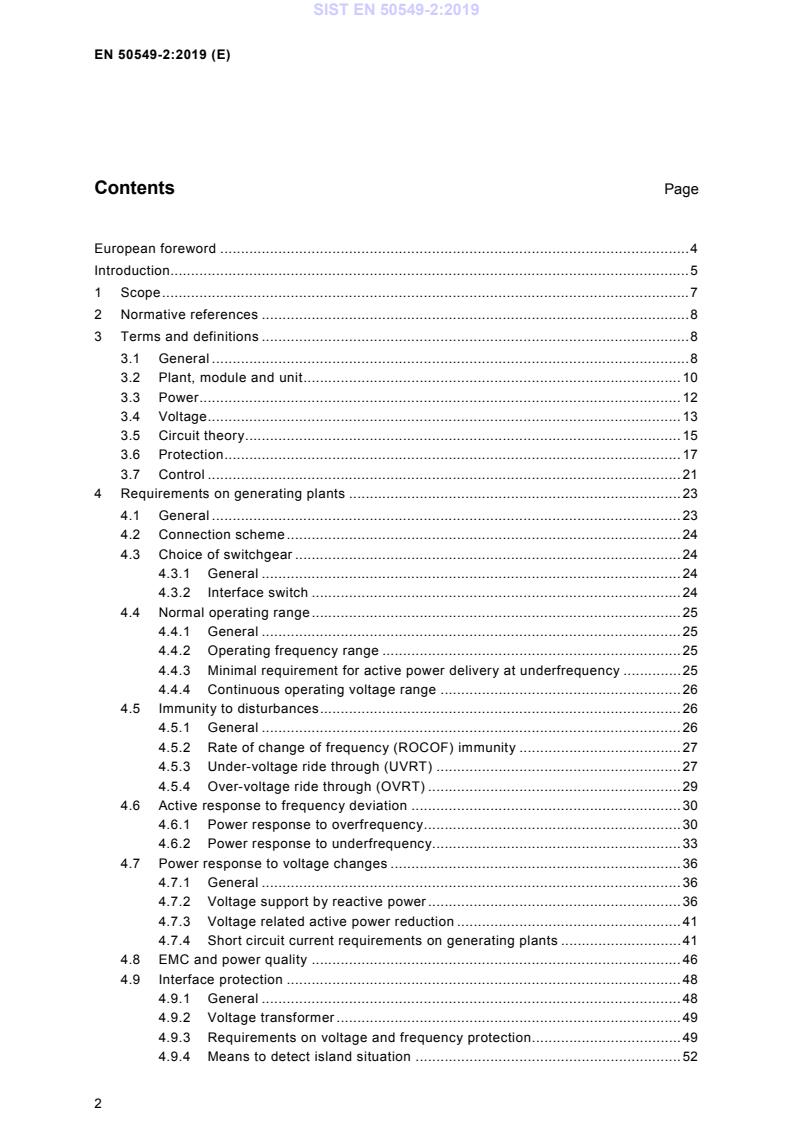
Contents Page
European foreword . 4
Introduction. 5
1 Scope . 7
2 Normative references . 8
3 Terms and definitions . 8
3.1 General . 8
3.2 Plant, module and unit . 10
3.3 Power . 12
3.4 Voltage . 13
3.5 Circuit theory . 15
3.6 Protection . 17
3.7 Control . 21
4 Requirements on generating plants . 23
4.1 General . 23
4.2 Connection scheme . 24
4.3 Choice of switchgear . 24
4.3.1 General . 24
4.3.2 Interface switch . 24
4.4 Normal operating range . 25
4.4.1 General . 25
4.4.2 Operating frequency range . 25
4.4.3 Minimal requirement for active power delivery at underfrequency . 25
4.4.4 Continuous operating voltage range . 26
4.5 Immunity to disturbances . 26
4.5.1 General . 26
4.5.2 Rate of change of frequency (ROCOF) immunity . 27
4.5.3 Under-voltage ride through (UVRT) . 27
4.5.4 Over-voltage ride through (OVRT) . 29
4.6 Active response to frequency deviation . 30
4.6.1 Power response to overfrequency . 30
4.6.2 Power response to underfrequency. 33
4.7 Power response to voltage changes . 36
4.7.1 General . 36
4.7.2 Voltage support by reactive power . 36
4.7.3 Voltage related active power reduction . 41
4.7.4 Short circuit current requirements on generating plants . 41
4.8 EMC and power quality . 46
4.9 Interface protection . 48
4.9.1 General . 48
4.9.2 Voltage transformer . 49
4.9.3 Requirements on voltage and frequency protection . 49
4.9.4 Means to detect island situation . 52
4.9.5 Digital input to the interface protection . 53
4.10 Connection and starting to generate electrical power. 53
4.10.1 General . 53
4.10.2 Automatic reconnection after tripping . 54
4.10.3 Starting to generate electrical power . 54
4.10.4 Synchronization . 54
4.11 Ceasing and reduction of active power on set point . 55
4.11.1 Ceasing active power . 55
4.11.2 Reduction of active power on set point . 55
4.12 Remote information exchange . 55
Annex A (informative) Interconnection guidance . 56
A.1 General . 56
A.2 Network integration . 56
A.3 Clusters of single-phase generating units . 57
Annex B (informative) Remote information exchange . 58
Annex C (informative) Parameter Table . 62
Annex D (informative) List of national requirements applicable for generating plants . 67
Annex E (informative) Loss of Mains and overall power system security . 69
Annex F (informative) Examples of protection strategies . 70
F.1 Introduction . 70
F.1.1 General . 70
F.1.2 Generalities . 70
F.1.3 Detection of unwanted islands . 70
F.1.4 Problems with uncontrolled islanding in MV networks . 71
F.1.4.1 Safety . 71
F.1.4.2 Grid parameters . 71
F.1.4.3 Reclosing operations . 71
F.1.4.4 Protection of islands against overcurrents . 71
F.1.4.5 Protection against phase to earth faults . 71
F.2 Example strategy 1 . 72
F.3 Example strategy 2 . 75
Annex G (normative) Abbreviations . 77
Annex H (informative) Relationship between this European standard and the
COMMISSION REGULATION (EU) 2016/631 . 78
Bibliography . 79
European foreword
This document (EN 50549-2:2019) has been prepared by CLC/TC 8X “System aspects of electrical
energy supply”.
The following dates are fixed:
• latest date by which this document has to be (dop) 2019-08-01
implemented at national level by publication
of an identical national standard or by
endorsement
• latest date by which the national standards (dow) 2022-02-01
conflicting with this document have to
be withdrawn
This document supersedes CLC/TS 50549-2:2015.
This European Standard relates to both the RfG European Network Code and current technical market
needs. Its purpose is to give detailed description of functions to be implemented in products.
This European Standard is also intended to serve as a technical reference for the definition of national
requirements where the RfG European Network Code requirements allow flexible implementation. The
specified requirements are solely technical requirements; economic issues regarding, e.g. the bearing
of cost are not in the scope of this document.
CLC/TC 8X plans future standardization work in order to ensure the compatibility of this European
Standard (EN) with the evolution of the legal framework.
Attention is drawn to the possibility that some of the elements of this document may be the subject of
patent rights. CENELEC shall not be held responsible for identifying any or all such patent rights.
Introduction
1. Foreword
This Explanatory Note explains the rationale behind the content and structure of EN 50549-1 and EN
50549-2. Due to the unique relationship between COMMISSION REGULATION 2016/631 (RfG) and
the EN 50549 Series, and based on the comments received at the enquiry stage of FprEN 50549-1
and FprEN 50549-2, TC8X WG03 decided to draft this explanatory note in order to provide national
committees and the wider public with an understanding of these rationale
2. Increased Scope of EN 50549 in relation to RfG
In the tradition of EN 50438, TC8X WG03 intended, in writing of FprEN 50549, to include all
capabilities of generating plants that are needed to operate these in parallel to distribution networks.
This includes issues necessary for a stable distribution network management as well as the
management of the interconnected system. As RfG is focused on the interconnected system, it is
logical that, taking into account further needs for distribution network management, further aspects are
included.
3. Introduction of “Responsible party”
During the national implementation process of COMMISSION REGULATION (EU) 2016/631, different
types of responsible parties play a role in the refinement of the non-exhaustive requirements. In each
member country, the National Regulatory Authority approves this national implementation. Depending
on the national regulatory framework, this might result in a variety of documents: national laws,
decrees or regulations, technical specifications, or requirements of transmission and distribution
system operators. Therefore, as explained in the scope, EN 50549-1 and EN 50549-2 refer to the
“responsible party” where requirements have to be defined by an actor other than the DSO. However
when a generating plant is built and connected to the distribution network, typically the distribution
system operator provides the plant developer all the technical requirements to be fulfilled.
4. Use of terms
Terms and definitions are selected to achieve consistency with EN 60050, IEV (cf.
www.electropedia.org) and CENELEC terminology, recognizing that terms in COMMISSION
REGULATION (EU) 2016/631 may deviate.
5. Additional requirements for distribution system management
The following requirements are stated in EN 50549 for distribution system management reasons,
which might not be required in RfG or if required in RfG, are not required for type A. As Directive
714/2009 8(7) limits the scope of RfG to issues effecting the cross border trade of electricity,
requirements included solely for the need of distribution system management are considered beyond
the scope of RfG.
– Connection scheme and Coordination of switch gear,
– Voltage operating range,
– Reactive power capability and control modes,
– Voltage related active power reduction,
– Interface protection including the detection of island situations,
– Connection and reconnection to the grid,
– Generation curtailment,
– Remote information exchange,
6. Additional requirements for stability of the interconnected system
Additionally, requirements relevant for the stability of the interconnected systems are included in case
of over voltage ride through (OVRT) as this is not dealt with in RfG. Due to the long duration of RfG
development and the fast development of decentralised generation in Europe robustness to voltage
swells is considered to be of high importance, but apparently could not be included into RfG.
As electrical energy storage system (EESS), are excluded from the scope of RfG, but are included in
the scope of the EN 50549 Series, EN 50549 also includes the further requirement of active power
frequency response to under frequency (LFSM-U) to electrical energy storage systems. This
requirement is considered of great importance in view of the expected fast increase of electrical
energy storage for the next years and is considered not to affect the cost of electrical energy storage
systems if considered during their design.
7. Details on the operation of the LFSM-O
During the enquiry stage, some comments reported that certain details in the chapter regarding the
operation of the LFSM-O (e.g. intentional delay, operation with deactivation threshold) were violating
the RfG. These topics have been further evaluated consulting the European Stakeholder Committee
(ESC-GC) and TC8X WG03 could not conclude in the same way. The fact that these operations are
not foreseen in the RfG is considered not sufficient to state any violation. Therefore these details are
kept with additional information on their use.
8. Implementation of UVRT and LFSM-U to avoid legal conflict with RfG
Under Voltage Ride Through (UVRT) requirements are defined in RfG for modules type B, type C and
type D. There is no mentioning of this topic for type A modules.
Nevertheless UVRT is seen as an important requirement in some member states even for small
generation modules like type A.
From a legal point of view there are two contradicting opinions on whether it is allowed or forbidden to
require UVRT for type A modules.
– Opinion 1: It can be required because the topic is not dealt with for type A modules.
– Option 2: It cannot be required because the topic UVRT is dealt within the RfG. Not mentioning
UVRT for type A in RfG therefore means that it cannot be required for type A modules.
As long as there is no clarification on this legal issue Cenelec does not have the possibility to require
UVRT for type A modules. This is the reason why in EN 50549-1 and 50549-2 the UVRT
functionalities for type A generating plants are not defined as requirements (shall) but as a
recommendation (should).
This same explanation can be applied to the requirements regarding Limited Frequency Sensitive
Mode - Underfrequency (LFSM-U). In RfG, this LFSM-U is solely defined for type C and type D
modules. In EN 50549, LFSM-U is defined as a recommendation (should) for generating modules of
type A and type B. The sole exception is electrical energy storage systems having a requirement
(shall) but these systems are not within the scope of the RfG.
9. Annex H - Relationship between this European standard and the COMMISSION
REGULATION (EU) 2016/631.
Manufacturers of generating units and plants shall comply with all relevant EU Directives and
Regulations. For the specific function of connecting the generating plant with the electric system the
reference regulation is COMMISSION REGULATION (EU) 2016/631 (NC RfG).
Since the EN 50549-1 and −2 are covering all technical requirements for type A and type B generating
units, modules and plants, it is considered helpful to provide the information which clause of the
standard supports which article of the RfG in a structured informative annex within the standard.
For other EU Directives and Regulations (e.g. LVD, MD or GAR) it is a formal task given to CCMC to
include such an informative Annex ZZ based on a standardization request from the EU. It is finally
reviewed by the new approach consultant (NAC) for the relevant Directive or Regulation, prior to the
listing of the standard in the official journal of the EU (OJEU) providing then “presumption of
conformity”. This means that if a product is compliant with the standard, the Directive or Regulations is
fulfilled too.
CLC TC 8X is fully aware, that this official procedure is not included in the RfG. Therefore CLC TC 8X
WG3 drafted Annex H. In Annex H the relationship between the clauses and the articles is shown. It is
considered, that generating plants compliant with the clauses of the standards are also compliant with
the articles in the RfG. Of course, this does not provide “presumption of conformity” as a listed
standard in the OJEU would provide. Nevertheless it will be helpful for the industry when performing
the conformity assessment against RfG.
1 Scope
This document specifies the technical requirements for the protection functions and the operational
capabilities for generating plants, intended to operate in parallel with MV distribution networks.
For practical reasons this document refers to the responsible party where requirements have to be
defined by an actor other than the DSO, e.g. TSO, member state, regulatory authorities according to
the legal framework. Typically the DSO will inform the producer about these requirements.
NOTE 1 This includes European network codes and their national implementation, as well as additional
national regulations.
NOTE 2 Additional national requirements especially for the connection to the distribution network and the
operation of the generating plant may apply.
The requirements of this document apply, irrespective of the kind of energy source and irrespective of
the presence of loads in the producer’s network, to generating plants, generating modules, electrical
machinery and electronic equipment that meet all of the following conditions:
– converting any energy source into AC electricity;
– generating modules capacity of type B or smaller according to COMMISSION REGULATION (EU)
2016/631 while considering national implementation for the decision regarding power limits
between A and B types and B and C types;
– connected to and operated in parallel with an AC MV distribution network.
NOTE 3 Generating plants connected to a LV distribution network fall into the scope of EN 50549-1.
NOTE 4 Electrical energy storage systems (EESS) in meeting the conditions above are included
If generating modules of different type (A or B) are combined in one plant, different requirements apply
for the different modules based on the type of each module.
EXAMPLE: If a generating plant consists of multiple generating modules (see 3.2.1), according to
COMMISSION REGLUATION (EU) 2016/631 the situation might occur, that some generating modules
are of type A and some are of type B.
Unless specified otherwise by the DSO and the responsible party, generating plants with a maximum
apparent power up to 150 kVA can, as alternative to the requirements of this document, comply with
EN 50549-1. A different threshold may be defined by the DSO and the responsible party.
This document recognizes the existence of specific technical requirements (e.g. grid codes) of the
DSO or another responsible party within a member state and these must be complied with.
Excluded from the scope are:
• the selection and evaluation of the point of connection;
• power system impact assessment e.g. assessment of effects on power quality, local voltage
increase, impact on line protections operation;
• connection assessment, the set of technical verifications made as part of the planning of the
connection;
• island operation of generating plants, both intentional and unintentional, where no part of the
distribution network is involved;
• four-quadrant rectifier of drives feeding breaking energy back into the distribution network for
limited duration with no internal source of primary energy;
• uninterruptible power supply with duration of parallel operation limited to 100 ms;
NOTE 5 Parallel operation due to maintenance of uninterruptible power supply units is not seen as part of
normal UPS operation and therefore not considered in this EN.
• requirements for the safety of personnel as they are already adequately covered by existing
European Standards.
• the connection of a generating unit, module or plant into a DC network
2 Normative references
The following documents are referred to in the text in such a way that some or all of their content
constitutes requirements of this document. For dated references, only the edition cited applies. For
undated references, the latest edition of the referenced document (including any amendments)
applies.
EN 60044-2, Instrument transformers — Part 2: Inductive voltage transformers (IEC 60044-2)
EN 60044-7, Instrument transformers — Part 7: Electronic voltage transformers (IEC 60044-7)
EN 60255-127, Measuring relays and protection equipment — Part 127: Functional requirements for
over/under voltage protection (IEC 60255-127)
EN 61000-4-30, Electromagnetic compatibility (EMC) — Part 4-30: Testing and measurement
techniques — Power quality measurement methods (IEC 61000-4-30)
EN 61869-3, Instrument transformers — Part 3: Additional requirements for inductive voltage
transformers (IEC 61869-3)
3 Terms and definitions
For the purposes of this document, the following terms and definitions apply.
ISO and IEC maintain terminological databases for use in standardization at the following addresses:
• IEC Electropedia: available at http://www.electropedia.org/
• ISO Online browsing platform: available at http://www.iso.org/obp
Note: Terms and definitions are selected to achieve consistency with IEV (cf. www.electropedia.org)
and CENELEC terminology, recognizing that terms in COMMISSION REGULATION (EU) 2016/631
may deviate.
3.1 General
3.1.1
distribution network
AC electrical network, including closed distribution networks, for the distribution of electrical power
from and to third parties connected to it, to and from a transmission or another distribution network, for
which a DSO is responsible
Note 1 to entry: A distribution network does not include the producer’s network
3.1.2
closed distribution network
system which distributes electricity within an industrial, commercial or shared services site, that is
geographically confined, and does not supply households customers (without excluding the option of a
small number of households served by the system that have an employment or similar associations
with the owner of the system)
Note 1 to entry: A closed distribution network will either be used to integrate the production processes of the
network users for specific or technical reasons or distribute electricity primarily to the operator of the closed
distribution network or his related undertakings
[SOURCE: Directive 2009/72/EC, article 28, modified]
3.1.3
distribution system operator
DSO
natural or legal person responsible for the distribution of electrical power to final customers and for
operating, ensuring the maintenance of and, if necessary, developing the distribution network in a
given area
Note 1 to entry: As this document is applicable to distribution grids, DSO is used for relevant system operator
according to article 2 (13) of COMMISSION REGULATION 2016/631.
Note 2 to entry: In some countries, the distribution network operator (DNO) fulfils the role of the DSO.
3.1.4
transmission system operator
natural or legal person responsible for operating, ensuring the maintenance of and, if necessary,
developing the transmission system in a given area and, where applicable, its interconnections with
other power systems, and for ensuring the long-term ability of the power system to meet reasonable
demands for the transmission of electricity
3.1.5
responsible party
party, that according to the legal framework is responsible to define requirements or parameters
according to COMMISSION REGLUALTION 2016/631 e.g. TSO, member state, regulatory authority
3.1.6
low voltage (LV) distribution network
electric distribution network with a voltage whose nominal r.m.s. value is Un ≤ 1 kV
3.1.7
medium voltage (MV) distribution network
electric distribution network with a voltage whose nominal r.m.s. value is 1 kV < U ≤ 36 kV
n
Note 1 to entry: Because of existing network structures, the upper boundary of MV can be different in some
countries.
3.1.8
power system stability
capability of a power system to regain a steady state, characterized by the synchronous operation of
the generating plants after a disturbance
[SOURCE: IEV 603-03-01]
3.1.9
producer
natural or legal person who already has connected or is planning to connect an electricity generating
plant to a distribution network
3.1.10
producer’s network
AC electrical installations downstream from the point of connection operated by the producer for
internal distribution of electricity
Note 1 to entry: When the internal distribution network is identical to an electrical network of a customer having
his own generating plant, where one or more generating units are connected to this internal distribution network
behind a point of connection, then this network may be also referred as prosumer’s network
3.1.11
downstream
direction in which the active power would flow if no generating units, connected to the distribution
network, were running
3.1.12
point of connection
POC
reference point on the electric power system where the user’s electrical facility is connected
Note 1 to entry: For the purpose of this standard, the electric power system is the distribution network.
[SOURCE: IEV 617-04-01 modified]
3.1.13
operating in parallel with the distribution network
situation where the generating plant is connected to a distribution network and operating
3.1.14
temporary operation in parallel with the distribution network
conditions in which the generating plant is connected during defined short periods to a distribution
network to maintain the continuity of the supply and to facilitate testing
3.1.15
nominal value
value of a quantity used to designate and identify a component, device, equipment, or system
Note to entry: The nominal value is generally a rounded value.
[SOURCE: IEV 151-16-09]
3.2 Plant, module and unit
3.2.1
generating module
either a generating unit of synchronous generating technology or the sum of all generating units of
non-synchronous generating technology connected to a common point of connection including all
elements needed to feed electric power to the distribution grid
Note 1 to entry: In some documents this can mean a power-generating module
Note 2 to entry: Generating modules in the context of this document can be of type A or type B according to the
definition of COMMISSION REGULATION 2016/631, article 5
NSGT: non-synchronous generating technology
NSGT NSGT SGT SGT
Unit Unit Unit Unit
SGT: synchronous generating technology
NSGT SGT
SGT
Module Module
Module
Plant
POC
Distribution Network
Figure 1 — Generating module at a common POC
3.2.2
generating plant
sum of generating modules connected at one point of connection, including auxiliaries and all
connection equipment
Note 1 to entry: In some documents this can mean a power-generating plant
Note 2 to entry: This definition is intended to be used for verification of compliance to the technical requirements
of this standard. It may be different to the legal definition of a plant.
3.2.3
generating unit
smallest set of installations which can generate electrical energy running independently and which can
feed this energy into a distribution network
Note 1 to entry: In some documents this can mean a power-generating unit
Note 2 to entry: For example, a combined cycle gas turbine (CCGT) consisting of a gas turbine and a steam
turbine or an installation of an internal combustion engine (ICE) followed by an organic rankine cycle (ORC)
machine are considered both as a single generating unit.
Note 3 to entry: If a generating unit is a combination of technologies leading to different requirements, this has to
be resolved case by case.
Note 4 to entry: A electrical energy storage EES operating in electricity generation mode and AC connected to the
distribution network is considered to be a generating unit.
3.2.4
void
3.2.5
void
3.2.6
synchronous generating technology
technology where a generating unit is based on a synchronous machine which is directly coupled to
an electric power system
3.2.7
non-synchronous generating technology
technology where a generating unit is connected non-synchronously to an electric power system
EXAMPLE induction machine (non-synchronously connected in COMMISSION REGULATION 2016/631),
converter based technology (connected through power electronics in COMMISSION REGULATION 2016/631)
3.2.8
cogeneration
combined heat and power
CHP
combined generation of electricity and heat by an energy conversion system and the concurrent use of
the electric and thermal energy from the conversion system
3.2.9
electrical energy storage system
EES system
EESS
grid-integrated installation with defined electrical boundaries, comprising of at least one EES, whose
purpose is to extract electrical energy from an electric power system, store this energy internally in
some manner and inject electrical energy into an electrical power system and which includes civil
engineering works, energy conversion equipment and related ancillary equipment.
Note 1 to entry: The EES system is controlled and coordinated to provide services to the electric power system
operators or to the electric power system users.
Note 2 to entry: In some cases, an EES system may require an additional energy source during its discharge,
providing more energy to the electric power system than the energy it stored.
[SOURCE: IEC 62933-1 ED1]
3.2.10
electrical energy storage
EES
installation able to absorb electrical energy, to store it for a certain amount of time and to release
electrical energy during which energy conversion processes may be included
EXAMPLE A device that absorbs AC electrical energy to produce hydrogen by electrolysis, stores the hydrogen,
and uses that gas to produce AC electrical energy is an EES.
Note 1 to entry: EES may be used also to indicate the activity of an apparatus described in the definition during
performing its own functionality.
[SOURCE: IEC 62933-1 ED1]
3.3 Power
3.3.1
active power
P
under periodic conditions, mean value, taken over one period T, of the instantaneous power p
T
P= ptd
∫
T
Note 1 to entry: Under sinusoidal conditions, the active power is the real part of the complex power S, thus P = Re
S.
Note 2 to entry: The coherent SI unit for active power is watt, W.
[SOURCE: IEV 131-11-42]
3.3.2
design active power
P
D
maximum AC active power output at an active factor of 0,95 or the active factor specified by the DSO
or the responsible party for a certain generating plant or generating technology
3.3.3
maximum active power
P
max
maximum continuous active power, measured in a 10 min average, which a generating unit or the sum
of all the generating units in a generating plant can produce, minus any loads associated solely with
facilitating the operation of that generating plant and not fed into the network as specified in the
connection agreement or as agreed between the DSO and the generating plant operator
3.3.5
momentary active power
P
M
actual AC active power output at a certain instant
3.3.6
available active power
P
A
maximum AC active power available from the primary energy source after power conversion subject to
the availability and magnitude of that primary energy source at the relevant time
Note 1 to entry: The available active power considers all constraints regarding e.g. the primary energy source or
the availability of a heat sink for CHP.
3.3.7
rated current
maximum continuous AC output current which a generating unit or generating plant is designed to
achieve under normal operating conditions
3.3.8
maximum apparent power
S
max
maximum AC apparent power output, measured in a 10 min average, that the generating unit or the
sum of all the generating units in a generating plant is designed to achieve under normal operating
conditions
3.3.9
primary energy source
non-electric energy source supplying an electric generating unit
Note 1 to entry: Examples of primary energy sources include natural gas, wind and solar energy. These sources
can be utilized, e.g. by gas turbines, wind turbines and photovoltaic cells.
3.4 Voltage
3.4.1
nominal voltage
U
n
voltage by which a supply network is designated or identified and to which certain operating
characteristics are referred
3.4.2
nominal frequency
f
n
frequency used to designate and identify equipment or a power system
Note 1 to entry: For the purpose of this standard, the nominal frequency f is 50 Hz.
n
[SOURCE: IEV 151-16-09, modified]
3.4.3
declared supply voltage
U
C
supply voltage UC agreed by the power system operator and the network user
Note 1 to entry: Generally declared supply voltage UC is the nominal voltage Un but it may be different according
to the agreement between the DSO and the network user.
[SOURCE: EN 50160]
3.4.4
reference voltage
value specified as the base on which residual voltage, thresholds and other values are expressed in
per unit or percentage terms
Note 1 to entry: For the purpose of this standard, the reference voltage is the nominal voltage or the declared
voltage of the distribution network.
[SOURCE: EN 50160:2010, 3.18, modified]
3.4.5
voltage change
variation of the r.m.s. value of a voltage between two consecutive levels sustained for definite but
unspecified durations
[SOURCE: IEV 161-08-01, modified]
3.4.7
under-voltage ride through
UVRT
ability of a generating unit or generating plant to stay connected during voltage dips
Note 1 to entry: In some documents the expression low voltage ride through (LVRT) is used for the same concept.
3.4.8
over-voltage ride through
OVRT
ability of a generating unit or generating plant to stay connected during voltage swells
Note 1 to entry: In some documents the expression high voltage ride through (HVRT) is used for the same
concept.
3.5 Circuit theory
3.5.1
active factor
for a two-terminal element or a two-terminal circuit under sinusoidal conditions, ratio of the active
power to the apparent power
Note 1 to entry: In a three phase system, this is referring to the positive sequence component of the fundamental.
Note 2 to entry: The active factor is equal to the cosine of the displacement angle.
[SOURCE: IEV 131-11-49, modified]
3.5.2
displacement angle
φ
under sinusoidal conditions, phase difference between the voltage applied to a linear two-terminal
element or two-terminal circuit and the electric current in the element or circuit
Note 1 to entry: In a three phase system, this is referring to the positive sequence component of the fundamental.
Note 2 to entry: The cosine of the displacement angle is the active factor.
[SOURCE: IEV 131-11-48, modified]
3.5.3
power factor
under periodic conditions, ratio of the absolute value of the active power P to the apparent power S:
P
λ=
S
Note 1 to entry: Under sinusoidal conditions, the power factor is the absolute value of the active factor.
[SOURCE: IEV 131-11-46]
3.5.4
fundamental components of a three-phase system
3.5.4.1
phasor
representation of a sinusoidal integral quantity by a complex quantity whose argument is equal to the
initial phase and whose modulus is equal to the root-mean-square value
Note 1 to entry: For a quantity a(t) = A √2 cos(ωt +Ө ) the phasor is A exp jӨ .
0 0
Note 2 to entry: The similar representation with the modulus equal to the amplitude is called “amplitude phasor”.
Note 3 to entry: A phasor can also be represented graphically.
[SOURCE: IEV 131-11-26, modified]
3.5.4.2
positive sequence component of the fundamental
for a three-phase system with phases L1, L2 and L3, the symmetrical sinusoidal three-phase set of
voltages or currents having frequency equal to the fundamental frequency and which is defined by the
following complex mathematical expression:
X = (X + aX + a X )
1 L1 L2 L3
where
j2π/3
a = e is the 120 degree operator,
X , X and X are the complex expressions of the fundamental frequency phase quantities
L1 L2 L3
concerned, that is, current or voltage phasors
Note 1 to entry: In a balanced harmonic-free system, only positive sequence component of the fundamental
jθ j(θ+4 /3) j(θ+2 /3)
exists. For example, if phase voltage phasors are symmetrical UL1 = Ue , UL2 = Ue π and UL3 = Ue π
jθ j2 /3 j(θ+4 /3) j4 /3 j(θ+2 /3) jθ jθ jθ jθ
then U1 = (Ue + e π Ue π + e π Ue π )/3 = (Ue + Ue + Ue )/3 = Ue
[SOURCE: IEV 448-11-27]
3.5.4.3
negative sequence component of the fundamental
for a three-phase system with phases L1, L2 and L3, the symmetrical sinusoidal three-phase set of
voltages or currents having frequency equal to the fundamental frequency and which is defined by the
following complex mathematical expression:
X = (X + a X + aX )
2 L1 L2 L3
where
j2π/3
a = e is the 120 degree operator
X , X and X are the complex expressions of the fundamental frequency phase quantities
L1 L2 L3
concerned, that is, current or voltage phasors
Note 1 to entry: Negative sequence voltage or current components may be significant only when the voltages or
jθ
currents, respectively, are unbalanced. For example, if phase voltage phasors are symmetrical UL1 = Ue ,
j(θ+4 /3) j(θ+2 /3) jθ j4 /3 j(θ+4 /3) j2 /3
UL2 = Ue π and UL3 = Ue π then the negative sequence component U2 = (Ue + e π Ue π + e π
j(θ+2 /3) jθ j2 /3 j4 /3
Ue π )/3 = Ue (1 + e π + e π )/3 = 0.
[SOURCE: IEV 448-11-28]
3.5.4.4
zero sequence component of the fundamental
for a three-phase system with phases L1, L2
...
SIST EN 50549-2
SL O V EN S K I
S T ANDAR D april 2019
Zahteve za vzporedno vezavo proizvodnih postrojev z distribucijskim
omrežjem – 2. del: Vezava s srednjenapetostnim distribucijskim omrežjem –
Proizvodni postroji do vključno tipa B
Requirements for generating plants to be connected in parallel with distribution
networks – Part 2: Connection to a MV distribution network – Generating plants
up to and including Type B
Exigences relatives aux centrales électriques destinées à être raccordées en
parallèle à des réseaux de distribution – Partie 2: Raccordement à un réseau de
distribution MT – Centrales électriques jusqu'au Type B inclus
Anforderungen für zum Parallelbetrieb mit einem Verteilnetz vorgesehene
Erzeugungsanlagen – Teil 2: Anschluss an das Mittelspannungsverteilnetz für
Erzeugungsanlagen bis einschließlich Typ B
Referenčna oznaka
ICS 29.160.20 SIST EN 50549-2:2019 (sl, en)
Nadaljevanje na straneh II in III ter od 1 do 165
2026-02. Slovenski inštitut za standardizacijo. Razmnoževanje ali kopiranje celote ali delov tega dokumenta ni dovoljeno.
SIST EN 50549-2 : 2019
NACIONALNI UVOD
Standard SIST EN 50549-2 (sl, en), Zahteve za vzporedno vezavo proizvodnih postrojev z
distribucijskim omrežjem – 2. del: Vezava s srednjenapetostnim distribucijskim omrežjem – Proizvodni
postroji do vključno tipa B, 2019, ima status slovenskega standarda in je istoveten z evropskim
standardom EN 50549-2 (en), Requirements for generating plants to be connected in parallel with
distribution networks – Part 2: Connection to a MV distribution network – Generating plants up to and
including Type B, 2019.
Ta dokument nadomešča SIST-TS CLC/TS 50549-2:2015.
NACIONALNI PREDGOVOR
Evropski standard EN 50549-2:2019 je pripravil tehnični odbor Evropskega komiteja za standardizacijo
v elektrotehniki CLC/TC 8X Sistemski vidiki oskrbe z električno energijo.
Slovenski standard SIST EN 50549-2:2019 je prevod angleškega besedila EN 50549-2:2019.V primeru
spora glede besedila slovenskega prevoda je odločilen izvirni evropski standard v angleškem jeziku.
Slovensko izdajo je pripravil tehnični odbor SIST/TC NTF Oskrba z električno energijo.
Odločitev za privzem tega standarda je 1. aprila 2019 sprejel tehnični odbor SIST/TC NTF Oskrba z
električno energijo.
ZVEZA S STANDARDI
S privzemom tega evropskega standarda veljajo za omenjeni namen referenčnih standardov vsi
standardi, navedeni v izvirniku, razen tistih, ki so že sprejeti v nacionalno standardizacijo:
SIST EN 60044-2 Merilni transformatorji – 2. del: Induktivni napetostniki (IEC 60044-2)
SIST EN 60044-7 Merilni transformatorji – 7. del: Elektronski napetostniki (IEC 60044-7)
SIST EN 60255-127 Merilni releji in zaščitna oprema – 127. del: Funkcijske zahteve za pre- in
podnapetostno zaščito (IEC 60255-127)
SIST EN 61000-4-30 Elektromagnetna združljivost (EMC) – 4-30. del: Preskusne in merilne tehnike
– Metode merjenja kakovosti napetosti (IEC 61000-4-30)
SIST EN 61869-3 Instrumentni transformatorji – 3. del: Posebne zahteve za induktivne
napetostne transformatorje (IEC 61869-3)
OSNOVA ZA IZDAJO STANDARDA
– privzem standarda EN 50549-2:2019
PREDHODNA IZDAJA
– SIST-TS CLC/TS 50549-2:2015, Zahteve za priklop generatorjev za toke nad 16 A na fazo – 2. del:
Priklop na srednjenapetostni distribucijski sistem
OPOMBE
– Povsod, kjer se v besedilu standarda uporablja izraz "evropski standard", v SIST EN 50549-2:2019
to pomeni "slovenski standard".
– Nacionalni uvod in nacionalni predgovor nista sestavni del standarda.
II
SIST EN 50119 : 2020
– Ta nacionalni dokument je istoveten z EN 50549-2:2019 in je objavljen z dovoljenjem
CEN-CENELEC
Upravni center
Rue de la Science 23
B-1040 Bruselj
This national document is identical with EN 50549-2:2019 and is published with the permission of
CEN-CENELEC
Management Centre
Rue de la Science 23
B-1040 Brussels
III
SIST EN 50549-2 : 2019
(prazna stran)
IV
EVROPSKI STANDARD EN 50549-2
EUROPEAN STANDARD
februar 2019
NORME EUROPÉENNE
EUROPÄISCHE NORM
ICS 29.160.20
Slovenska izdaja
Zahteve za vzporedno vezavo proizvodnih postrojev z distribucijskim
omrežjem – 2. del: Vezava s srednjenapetostnim distribucijskim omrežjem
– Proizvodni postroji do vključno tipa B
Requirements for generating plants Exigences relatives aux centrales Anforderungen für zum
to be connected in parallel with électriques destinées à être Parallelbetrieb mit einem Verteilnetz
distribution networks – Part 2: raccordées en parallèle à des vorgesehene Erzeugungsanlagen –
Connection to a MV distribution réseaux de distribution – Partie 2: Teil 2: Anschluss an das
network – Generating plants up to Raccordement à un réseau de Mittelspannungsverteilnetz für
and including Type B distribution MT – Centrales Erzeugungsanlagen bis
électriques jusqu'au Type B inclus einschließlich Typ B
Ta evropski standard je CENELEC odobril 9. avgusta 2018. Člani CEN morajo izpolnjevati notranje
predpise CEN/CENELEC, ki določajo pogoje, pod katerimi dobi ta standard status nacionalnega
standarda brez kakršnihkoli sprememb.
Seznami najnovejših izdaj teh nacionalnih standardov in njihovi bibliografski podatki so na voljo pri
Upravnem centru CEN-CENELEC ali članih CENELEC.
Ta evropski standard obstaja v treh uradnih izdajah (angleški, francoski in nemški). Izdaje v drugih
jezikih, ki jih člani CENELEC na lastno odgovornost prevedejo in izdajo ter prijavijo pri Upravnem centru
CEN-CENELEC, veljajo kot uradne izdaje.
Člani CENELEC so nacionalni elektrotehniški komiteji Avstrije, Belgije, Bolgarije, Cipra, Češke
republike, Danske, Estonije, Finske, Francije, Grčije, Hrvaške, Islandije, Irske, Italije, Latvije, Litve,
Luksemburga, Madžarske, Malte, Nekdanje jugoslovanske republike Makedonije, Nemčije,
Nizozemske, Norveške, Poljske, Portugalske, Romunije, Srbije, Slovaške, Slovenije, Španije, Švedske,
Švice, Turčije in Združenega kraljestva.
CENELEC
Evropski komite za standardizacijo v elektrotehniki
European Committee for Electrotechnical Standardization
Comité Européen de Normalisation Electrotechnique
Europäisches Komitee für Elektrotechnische Normung
Upravni center: Rue de la Science 23, B-1040 Bruselj
© 2019 CENELEC Vse pravice do uporabe v kakršnikoli obliki in s kakršnimikoli Ref. oznaka EN 50549-2:2019 E
sredstvi so po vsem svetu pridržane za članice CENELEC.
SIST EN 50549-2 : 2019
Evropski predgovor . 8
Uvod . 10
1 Področje uporabe . 16
2 Zveze s standardi . 18
3 Izrazi in definicije . 18
3.1 Splošno . 18
3.2 Postroj, modul in enota . 22
3.3 Moč . 26
3.4 Napetost . 28
3.5 Teorija vezij . 30
3.6 Zaščita . 34
3.7 Krmiljenje . 42
4 Zahteve za proizvodne postroje . 46
4.1 Splošno . 46
4.2 Shema priključitve . 48
4.3 Izbira stikalne naprave . 48
4.3.1 Splošno . 48
4.3.2 Stikalo na ločilnem mestu . 48
4.4 Normalno območje obratovanja . 50
4.4.1 Splošno . 50
4.4.2 Frekvenčno območje obratovanja . 50
4.4.3 Minimalna zahteva za oddajanje delovne moči pri podfrekvenci . 50
4.4.4 Napetostno območje neprekinjenega obratovanja . 52
4.5 Odpornost proti motnjam . 54
4.5.1 Splošno . 54
4.5.2 Stopnja odpornosti proti spreminjanju frekvence (ROCOF) . 54
4.5.3 Podnapetostno obratovanje (UVRT) . 54
4.5.4 Nadnapetostno obratovanje (OVRT) . 58
4.6 Aktivni odziv na odstopanje frekvence. 60
4.6.1 Odziv električne moči na nadfrekvenco . 60
4.6.2 Odziv električne moči na podfrekvenco . 68
4.7 Odziv električne moči na spremembe napetosti . 72
4.7.1 Splošno . 72
4.7.2 Napetostna podpora z jalovo močjo . 72
4.7.3 Zmanjšanje delovne moči v povezavi z napetostjo . 82
4.7.4 Zahteve glede toka kratkega stika v proizvodnih postrojih . 82
4.8 EMC in kakovost električne energije . 94
4.9 Zaščita na ločilnem mestu . 96
4.9.1 Splošno . 96
4.9.2 Napetostni transformator, napetostnik . 98
SIST EN 50549-2 : 2019
European foreword . 9
Introduction . 11
1 Scope . 17
2 Normative references . 19
3 Terms and definitions . 19
3.1 General . 19
3.2 Plant, module and unit . 23
3.3 Power . 27
3.4 Voltage . 29
3.5 Circuit theory . 31
3.6 Protection . 35
3.7 Control . 43
4 Requirements on generating plants . 47
4.1 General . 47
4.2 Connection scheme . 49
4.3 Choice of switchgear. 49
4.3.1 General . 49
4.3.2 Interface switch . 49
4.4 Normal operating range . 51
4.4.1 General . 51
4.4.2 Operating frequency range . 51
4.4.3 Minimal requirement for active power delivery at underfrequency . 51
4.4.4 Continuous operating voltage range . 53
4.5 Immunity to disturbances . 55
4.5.1 General . 55
4.5.2 Rate of change of frequency (ROCOF) immunity . 55
4.5.3 Under-voltage ride through (UVRT) . 55
4.5.4 Over-voltage ride through (OVRT) . 59
4.6 Active response to frequency deviation . 61
4.6.1 Power response to overfrequency . 61
4.6.2 Power response to underfrequency . 69
4.7 Power response to voltage changes . 73
4.7.1 General . 73
4.7.2 Voltage support by reactive power . 73
4.7.3 Voltage related active power reduction . 83
4.7.4 Short circuit current requirements on generating plants . 83
4.8 EMC and power quality . 95
4.9 Interface protection . 97
4.9.1 General . 97
4.9.2 Voltage transformer . 99
SIST EN 50549-2 : 2019
4.9.3 Zahteve za napetostno in frekvenčno zaščito . 100
4.9.4 Načini ugotavljanja stanja otočnega obratovanja . 106
4.9.5 Digitalni vhod v zaščito na ločilnem mestu . 108
4.10 Priključitev in začetek proizvodnje električne energije . 108
4.10.1 Splošno . 108
4.10.2 Samodejni ponovni vklop po izklopu . 108
4.10.3 Začetek proizvodnje električne energije . 110
4.10.4 Sinhronizacija . 110
4.11 Prekinitev in zmanjšanje delovne moči na nastavljeni točki . 110
4.11.1 Prekinitev delovne moči . 110
4.11.2 Zmanjšanje delovne moči na nastavljeni točki . 110
4.12 Daljinska izmenjava informacij . 112
Dodatek A (informativni): Navodila za priključitev . 114
A.1 Splošno . 114
A.2 Omrežna integracija . 114
A.3 Skupine enofaznih proizvodnih enot . 116
Dodatek B (informativni): Daljinska izmenjava informacij . 118
Dodatek C (informativni): Preglednica parametrov . 126
Dodatek D (informativni): Seznam nacionalnih zahtev, ki veljajo za proizvodne
postroj . 136
Dodatek E (informativni): Izpad omrežja in splošna varnost elektroenergetskega
sistema . 140
Dodatek F (informativni): Primeri zaščitnih strategij. 144
F.1 Uvod . 144
F.1.1 Splošno . 144
F.1.2 Splošne vsebine . 144
F.1.3 Odkrivanje neželenih otokov . 144
F.1.4 Težave z nenadzorovanim otočenjem v srednjenapetostnih omrežjih . 146
F.1.4.1 Varnost . 146
F.1.4.2 Značilnosti napetosti omrežja . 146
F.1.4.3 Delovanje ponovnega vklopa . 146
F.1.4.4 Zaščita otokov pred nadtoki . 146
F.1.4.5 Zaščita pred okvarami med fazo in zemljo . 146
F.2 Primer strategije 1 . 148
F.3 Primer strategije 2 . 154
Dodatek G (normativni): Kratice . 158
Dodatek H (informativni): Razmerje med tem evropskim standardom in Uredbo
Komisije (EU) 2016/631 . 160
SIST EN 50549-2 : 2019
4.9.3 Requirements on voltage and frequency protection . 101
4.9.4 Means to detect island situation . 107
4.9.5 Digital input to the interface protection . 109
4.10 Connection and starting to generate electrical power . 109
4.10.1 General . 109
4.10.2 Automatic reconnection after tripping . 109
4.10.3 Starting to generate electrical power . 111
4.10.4 Synchronization . 111
4.11 Ceasing and reduction of active power on set point . 111
4.11.1 Ceasing active power . 111
4.11.2 Reduction of active power on set point . 111
4.12 Remote information exchange . 113
Anex A (informative) Interconnection guidance . 115
A.1 General . 115
A.2 Network integration . 115
A.3 Clusters of single-phase generating units . 117
Anex B (informative) Remote information exchange . 119
Anex C (informative) Parameter Table . 127
Anex D (informative) List of national requirements applicable for generating
plants . 137
Anex E (informative) Loss of Mains and overall power system security . 141
Anex F (informative) Examples of protection strategies . 145
F.1 Introduction . 145
F.1.1 General . 145
F.1.2 Generalities . 145
F.1.3 Detection of unwanted islands . 145
F.1.4 Problems with uncontrolled islanding in MV networks . 147
F.1.4.1 Safety . 147
F.1.4.2 Grid parameters . 147
F.1.4.3 Reclosing operations . 147
F.1.4.4 Protection of islands against overcurrents . 147
F.1.4.5 Protection against phase to earth faults . 147
F.2 Example strategy 1 . 149
F.3 Example strategy 2 . 155
Anex G (normative) Abbreviations . 159
Anex H (informative) Relationship between this European standard and the
COMMISSION REGULATION (EU) 2016/631 . 161
SIST EN 50549-2 : 2019
Viri in literatura . 162
SIST EN 50549-2 : 2019
Bibliography . 163
SIST EN 50549-2 : 2019
Evropski predgovor
Ta dokument (EN 50549-2:2019) je pripravil tehnični odbor CLC/TC 8X "Sistemski vidiki oskrbe z
električno energijo".
Določena sta naslednja datuma:
– zadnji datum, do katerega mora dobiti ta dokument (dop) 2019-08-01
status nacionalnega standarda z objavo istovetnega
besedila ali z razglasitvijo
– zadnji datum, do katerega je treba razveljaviti (dow) 2022-02-01
nacionalne standarde, ki so v nasprotju s tem
dokumentom
Ta dokument nadomešča CLC/TS 50549-2:2015.
Ta evropski standard se nanaša tako na evropski omrežni kodeks RfG kot na trenutne tehnične potrebe
trga. Njegov namen je podrobno opisati funkcije, ki jih je treba uveljaviti pri izdelkih.
Ta evropski standard naj bi služil tudi kot tehnična referenca za opredelitev nacionalnih zahtev, kadar
zahteve evropskega omrežnega kodeksa RfG omogočajo prilagodljivo izvajanje. Navedene zahteve so
izključno tehnične zahteve; ekonomska vprašanja v zvezi z npr. stroški niso vključena v področje
uporabe tega dokumenta.
Tehnični odbor CLC/TC 8X načrtuje nadaljevanje dela na področju standardizacije, da bi zagotovil
združljivost tega evropskega standarda (EN) z razvojem pravnega okvira.
Opozoriti je treba na možnost, da so nekateri elementi tega dokumenta lahko predmet patentnih pravic.
IEC ne prevzema odgovornosti za prepoznavanje nobene ali vseh takih patentnih pravic.
SIST EN 50549-2 : 2019
European foreword
This document (EN 50549-2:2019) has been prepared by CLC/TC 8X "System aspects of electrical energy
supply".
The following dates are fixed:
– latest date by which this document has to be (dop) 2019-08-01
implemented at national level by publication of an
identical national standard or by endorsement
– latest date by which the national standards
(dow) 2022-02-01
conflicting with this document have to be withdrawn
This document supersedes CLC/TS 50549-2:2015.
This European Standard relates to both the RfG European Network Code and current technical market
needs. Its purpose is to give detailed description of functions to be implemented in products.
This European Standard is also intended to serve as a technical reference for the definition of national
requirements where the RfG European Network Code requirements allow flexible implementation. The
specified requirements are solely technical requirements; economic issues regarding, e.g. the bearing
of cost are not in the scope of this document.
CLC/TC 8X plans future standardization work in order to ensure the compatibility of this European
Standard (EN) with the evolution of the legal framework.
Attention is drawn to the possibility that some of the elements of this document may be the subject of
patent rights. CENELEC shall not be held responsible for identifying any or all such patent rights.
SIST EN 50549-2 : 2019
Uvod
1) Predgovor
Ta razlagalna opomba pojasnjuje utemeljitev vsebine in strukture EN 50549-1 in prEN 50549-2.
Zaradi edinstvenega odnosa med Uredbo Komisije 2016/631 (RfG) in skupino standardov EN
50549 ter na podlagi pripomb, prejetih na stopnji poizvedbe FprEN 50549-1 in FprEN 50549-2, se
je TC 8X WG 03 odločil zasnovati to pojasnilo, da bi nacionalnim odborom in širši javnosti zagotovil
razumevanje teh razlogov.
2) Razširjeno področje uporabe EN 50549 glede na RfG
V skladu s standardom EN 50438 je TC 8X WG 03 nameraval pri pisanju prEN 50549 vključiti vanj
vse zmogljivosti proizvodnih postrojev, ki so potrebne za njihovo delovanje vzporedno z
distribucijskimi omrežji. To vključuje vprašanja, potrebna za stabilno upravljanje distribucijskega
omrežja in tudi za upravljanje sistema interkonekcije. Ker je RfG osredotočen na sistem
interkonekcije, je logično, da se ob upoštevanju nadaljnjih potreb po upravljanju distribucijskega
omrežja vključijo še drugi vidiki.
3) Uvedba "odgovorne stranke"
Med nacionalnim procesom izvajanja Uredbe Komisije (EU) 2016/631 imajo vlogo pri
izpopolnjevanju neizčrpnih zahtev različne vrste odgovornih strank. V vsaki državi članici nacionalni
regulativni organ odobri to nacionalno izvajanje. Glede na nacionalni regulativni okvir bi na tej
podlagi tako lahko nastali različni dokumenti: nacionalni zakoni, uredbe ali predpisi, tehnične
specifikacije ali zahteve operaterjev prenosnih in distribucijskih sistemov. Zato se, kot je razloženo
v področju uporabe, EN 50549-1 in EN 50549-2 nanašata na "odgovorno stranko", kjer mora
zahteve opredeliti drug deležnik in ne operater distribucijskega sistema). Ko pa je proizvodni postroj
(elektrarna) zgrajen in priključen na distribucijsko omrežje, navadno operater distribucijskega
sistema priskrbi razvijalcu postroja vse tehnične zahteve, ki jih je treba izpolniti.
4) Uporaba izrazov
Izrazi in definicije so izbrani tako, da so skladni z EN 60050, IEV (prim. www.electropedia.org) in
terminologijo CENELEC, ob zavedanju, da se izrazi v Uredbi Komisije (EU) 2016/631 lahko
razlikujejo.
5) Dodatne zahteve za upravljanje distribucijskega sistema
V EN 50549 so zaradi razlogov pri upravljanju distribucijskega sistema navedene naslednje
zahteve, ki morda niso potrebne v RfG oziroma, če so potrebne v RfG, niso potrebne za tip A. Ker
Direktiva 714/2009 8(7) omejuje področje uporabe RfG na vprašanja pri čezmejni trgovini z
električno energijo, se zahteve, vključene izključno za potrebe upravljanja distribucijskega sistema,
obravnavajo zunaj področja uporabe RfG:
– shema priključitve in usklajevanje stikalne opreme,
– napetostno območje delovanja,
– zmogljivost jalove moči in načini nadzora,
– zmanjšanje delovne moči glede na napetost,
– zaščita na ločilnem mestu, vključno z odkrivanjem otočnih situacij,
– priključitev in ponovni vklop omrežja,
– zmanjšanje proizvodnje,
– izmenjava informacij na daljavo
SIST EN 50549-2 : 2019
Introduction
1) Foreword
This Explanatory Note explains the rationale behind the content and structure of EN 50549-1 and
EN 50549-2. Due to the unique relationship between COMMISSION REGULATION 2016/631
(RfG) and the EN 50549 Series, and based on the comments received at the enquiry stage of
FprEN 50549-1 and FprEN 50549-2, TC8X WG03 decided to draft this explanatory note in order to
provide national committees and the wider public with an understanding of these rationale
2) Increased Scope of EN 50549 in relation to RfG
In the tradition of EN 50438, TC8X WG03 intended, in writing of FprEN 50549, to include all
capabilities of generating plants that are needed to operate these in parallel to distribution networks.
This includes issues necessary for a stable distribution network management as well as the
management of the interconnected system. As RfG is focused on the interconnected system, it is
logical that, taking into account further needs for distribution network management, further aspects
are included.
3) Introduction of "Responsible party"
During the national implementation process of COMMISSION REGULATION (EU) 2016/631,
different types of responsible parties play a role in the refinement of the non-exhaustive
requirements. In each member country, the National Regulatory Authority approves this national
implementation. Depending on the national regulatory framework, this might result in a variety of
documents: national laws, decrees or regulations, technical specifications, or requirements of
transmission and distribution system operators. Therefore, as explained in the scope, EN 50549-1
and EN 50549-2 refer to the "responsible party" where requirements have to be defined by an actor
other than the DSO. However when a generating plant is built and connected to the distribution
network, typically the distribution system operator provides the plant developer all the technical
requirements to be fulfilled.
4) Use of terms
Terms and definitions are selected to achieve consistency with EN 60050, IEV (cf.
www.electropedia.org) and CENELEC terminology, recognizing that terms in COMMISSION
REGULATION (EU) 2016/631 may deviate.
5) Additional requirements for distribution system management
The following requirements are stated in EN 50549 for distribution system management reasons,
which might not be required in RfG or if required in RfG, are not required for type A. As Directive
714/2009 8(7) limits the scope of RfG to issues effecting the cross border trade of electricity,
requirements included solely for the need of distribution system management are considered
beyond the scope of RfG.
– Connection scheme and Coordination of switch gear,
– Voltage operating range,
– Reactive power capability and control modes,
– Voltage related active power reduction,
– Interface protection including the detection of island situations,
– Connection and reconnection to the grid,
– Generation curtailment,
– Remote information exchange,
SIST EN 50549-2 : 2019
6) Dodatne zahteve za stabilnost sistema interkonekcije
Dodatno so vključene zahteve za stabilnost sistema interkonekcije v primeru obratovanja v stanju
nadnapetosti (OVRT), saj tega RfG ne obravnava. Zaradi dolgotrajnega razvoja RfG in hitrega
razvoja razpršene proizvodnje v Evropi je odpornost proti porastom napetosti zelo pomembna,
vendar je očitno ni bilo mogoče vključiti v RfG.
Ker so sistemi za shranjevanje električne energije (EESS) izključeni iz področja uporabe RfG,
vendar so vključeni v področje uporabe skupine standardov EN 50549, vključuje EN 50549 tudi
dodatno zahtevo po odzivanju delovne moči omrežne frekvence na podfrekvenco (LFSM-U)
sistemov za shranjevanje električne energije. Ta zahteva je zelo pomembna glede na pričakovano
hitro rast shranjevanja električne energije v naslednjih letih in se šteje, da ne bo vplivala na stroške
sistemov za shranjevanje električne energije, če bo upoštevana že pri njihovi zasnovi.
7) Podrobnosti o delovanju LFSM-O
V fazi poizvedovanja so nekateri komentarji poročali, da nekatere podrobnosti v poglavju o
delovanju LFSM-O (npr. namerna zamuda, obratovanje z dezaktivacijskim pragom) kršijo RfG. Te
teme so bile dodatno ovrednotene v posvetovanju z Evropskim odborom deležnikov (ESC-GC) in
delovna skupina TC 8X WG 03 ni mogla sklepati na enak način. Dejstvo, da te operacije v RfG niso
predvidene, se ne šteje za zadostnega za navedbo katerekoli kršitve. Zato se ti podatki hranijo z
dodatnimi informacijami o njihovi uporabi.
8) Izvajanje UVRT in LFSM-U za izogibanje pravnemu sporu z RfG
Zahteve za podnapetostno obratovanje (UVRT) so opredeljene v RfG za module tipa B, tipa C in
tipa D. Za module tipa A se ta tema ne omenja.
Kljub temu se UVRT v nekaterih državah članicah obravnava kot pomembna zahteva tudi pri
majhnih proizvodnih modulih (malih elektrarnah), kot je tip A.
S pravnega vidika obstajata dve nasprotujoči si mnenji o tem, ali je dovoljeno ali prepovedano
zahtevati UVRT za module tipa A:
– mnenje 1: se lahko zahteva, ker tema ni obravnavana za module tipa A;
– mnenje 2: ni mogoče zahtevati, ker se tema UVRT obravnava v okviru RfG. Poleg tega UVRT
za tip A v RfG zato pomeni, da ga za module tipa A ni mogoče zahtevati.
Dokler ni pojasnil glede tega pravnega vprašanja, CENELEC nima možnosti zahtevati UVRT za
module tipa A. To je razlog, zakaj v EN 50549-1 in 50549-2 funkcionalnosti UVRT za proizvodne
postroje tipa A niso opredeljene kot zahteve (morajo), ampak kot priporočila (naj).
Enako razlago je mogoče uporabiti za zahteve, ki se nanašajo na omejeni frekvenčno občutljivi
način – podfrekvenco (LFSM-U). V RfG je ta LFSM-U določen izključno za module tipa C in tipa D.
V EN 50549 je LFSM-U opredeljen kot priporočilo (naj) za proizvodne module tipa A in tipa B. Edina
izjema so sistemi za shranjevanje električne energije, za katere velja zahteva (morajo), vendar ti
sistemi ne spadajo v področje uporabe RfG.
9) Dodatek H – Razmerje med tem evropskim standardom in Uredbo Komisije (EU) 2016/631
Proizvajalci proizvodnih enot in postrojev morajo upoštevati vse ustrezne direktive in predpise EU.
Za posebno funkcijo povezovanja proizvodnega postroja z električnim sistemom je referenčni
predpis Uredba Komisije (EU) 2016/631 (NC RfG).
SIST EN 50549-2 : 2019
6) Additional requirements for stability of the interconnected system
Additionally, requirements relevant for the stability of the interconnected systems are included in
case of over voltage ride through (OVRT) as this is not dealt with in RfG. Due to the long duration
of RfG development and the fast development of decentralised generation in Europe robustness to
voltage swells is considered to be of high importance, but apparently could not be included into
RfG.
As electrical energy storage system (EESS), are excluded from the scope of RfG, but are included
in the scope of the EN 50549 Series, EN 50549 also includes the further requirement of active
power frequency response to under frequency (LFSM-U) to electrical energy storage systems. This
requirement is considered of great importance in view of the expected fast increase of electrical
energy storage for the next years and is considered not to affect the cost of electrical energy storage
systems if considered during their design.
7) Details on the operation of the LFSM-O
During the enquiry stage, some comments reported that certain details in the chapter regarding the
operation of the LFSM-O (e.g. intentional delay, operation with deactivation threshold) were
violating the RfG. These topics have been further evaluated consulting the European Stakeholder
Committee (ESC-GC) and TC8X WG03 could not conclude in the same way. The fact that these
operations are not foreseen in the RfG is considered not sufficient to state any violation. Therefore
these details are kept with additional information on their use.
8) Implementation of UVRT and LFSM-U to avoid legal conflict with RfG
Under Voltage Ride Through (UVRT) requirements are defined in RfG for modules type B, type C
and type D. There is no mentioning of this topic for type A modules.
Nevertheless UVRT is seen as an important requirement in some member states even for small
generation modules like type A.
From a legal point of view there are two contradicting opinions on whether it is allowed or forbidden
to require UVRT for type A modules.
– Opinion 1: It can be required because the topic is not dealt with for type A modules.
– Option 2: It cannot be required because the topic UVRT is dealt within the RfG. Not mentioning
UVRT for type A in RfG therefore means that it cannot be required for type A modules.
As long as there is no clarification on this legal issue CENELEC does not have the possibility to
require UVRT for type A modules. This is the reason why in EN 50549-1 and 50549-2 the UVRT
functionalities for type A generating plants are not defined as requirements (shall) but as a
recommendation (should).
This same explanation can be applied to the requirements regarding Limited Frequency Sensitive
Mode - Underfrequency (LFSM-U). In RfG, this LFSM-U is solely defined for type C and type D
modules. In EN 50549, LFSM-U is defined as a recommendation (should) for generating modules
of type A and type B. The sole exception is electrical energy storage systems having a requirement
(shall) but these systems are not within the scope of the RfG.
9) Annex H - Relationship between this European standard and the COMMISSION
REGULATION (EU) 2016/631.
Manufacturers of generating units and plants shall comply with all relevant EU Directives and
Regulations. For the specific function of connecting the generating plant with the electric system
the reference regulation is COMMISSION REGULATION (EU) 2016/631 (NC RfG).
SIST EN 50549-2 : 2019
Ker standarda EN 50549-1 in -2 zajemata vse tehnične zahteve za proizvodne enote, module in
postroje tipov A in B, se šteje, da je koristno zagotoviti informacije, katera določba standarda
podpira kateri člen RfG v strukturiranem informativnem dodatku v okviru standarda.
Za druge direktive in uredbe EU (npr. LVD, MD ali GAR) je uradna n
...