

SIST EN 1991-1-5:2004
(Main)Eurocode 1: Actions on structures - Part 1-5: General actions - Thermal actions
- Abstract
(1) EN 1991-1-5 gives principles and rules for calculating thermal actions on buildings, bridges and other structures including their structural elements. Principles needed for cladding and other appendages of buildings are also provided.
(2) This Part describes the changes in the temperature of structural elements. Characteristic values of thermal actions are presented for use in the design of structures which are exposed to daily and seasonal climatic changes. Structures not so exposed may not need to be considered for thermal actions.
(3) Structures in which thermal actions are mainly a function of their use (e.g. cooling towers, silos, tanks, warm and cold storage facilities, hot and cold services etc) are treated in Section 7. Chimneys are treated in EN 13084-1.
- Status
- Published
- Publication Date
- 31-Aug-2004
- Technical Committee
- KON - Structures
- Current Stage
- 6100 - Translation of adopted SIST standards (Adopted Project)
- Start Date
- 17-Nov-2009
- Due Date
- 16-Nov-2010
- Completion Date
- 18-Aug-2010
Buy Documents






SIST EN 1991-1-5:2004 is the Slovenian adoption of EN 1991-1-5:2003, published by SIST as part of Eurocode 1 on actions on structures. It specifies how to determine thermal actions on buildings, bridges and other structures, including cladding and appendages, for use in structural design.
The standard is aimed at designers, clients, contractors, and relevant authorities who need to assess temperature effects from climatic and operational conditions and turn them into design actions.
What does SIST EN 1991-1-5:2004 specify?
SIST EN 1991-1-5:2004 gives principles and rules for calculating thermal actions on structures exposed to daily and seasonal temperature change, and it also covers structures whose temperatures are driven by use. It organizes the subject into general rules plus separate sections for buildings, bridges, and industrial chimneys, pipelines, silos, tanks and cooling towers.
| Annex | What it covers |
|---|---|
| Annex A | Isotherms of national minimum and maximum shade air temperatures |
| Annex B | Temperature differences for various surfacing depths |
| Annex C | Coefficients of linear expansion |
| Annex D | Temperature profiles in buildings and other construction works |
The scope excludes nothing by name, but it directs users to other standards for special cases such as chimneys and fire-related thermal actions.
What are the key requirements of SIST EN 1991-1-5:2004?
SIST EN 1991-1-5:2004 treats thermal actions as variable indirect actions and requires characteristic values unless another value is stated. In practice, this means temperature effects are part of the load model and must be included wherever they can affect ultimate or serviceability limit states.
General design rules
Section 3 requires thermal actions to be assessed for each relevant design situation and says thermal movement must not cause overstressing. Designers can achieve this either by providing movement joints or by including the effects directly in the structural design.
Section 4 explains that a temperature profile can be split into a uniform temperature component, two linear difference components, and a non-linear difference component. This matters because different parts of the profile create different stresses, and some parts may be self-equilibrated while others produce global effects.
Buildings
Section 5 requires climatic and operational temperature effects on buildings to be based on shade air temperature, solar radiation, and project-specific operating conditions. The standard defines the uniform component as the difference between the element temperature and the initial temperature at restraint, and it also calls for local effects at supports and fixings where relevant.
Section 5.3 points users to thermal transmission theory in Annex D and to indicative inner and outer temperatures for above-ground and underground parts. For practice, this means the designer must choose temperatures from national data where available, or use the default indicative values and temperature profiles given by the standard.
Bridges
Section 6 groups bridge decks into steel, composite, and concrete types, and it requires both a uniform bridge temperature component and temperature difference components. It also gives two ways to treat vertical temperature differences: an equivalent linear approach or an approach that includes non-linear effects.
For bridges, the standard also requires site minimum and maximum shade air temperatures to be derived from isotherms, then converted into minimum and maximum uniform bridge temperature components. Annex B and the bridge tables provide surfacing-dependent temperature differences, so deck build-up and surface finish affect the thermal load.
Industrial chimneys, pipelines, silos, tanks and cooling towers
Section 7 requires both climatic and process-related thermal actions to be considered where relevant. It distinguishes shade air temperature, process temperatures such as flue gas or heated liquids, and element temperature, and it asks for both uniform and linearly varying components for each layer.
For pipelines, silos, tanks and cooling towers, the standard also considers a stepped temperature component around the circumference. In practice, this captures uneven heating or cooling around the shell, which can drive local and overall thermal effects.
What terms does SIST EN 1991-1-5:2004 define?
- Thermal actions - actions arising from temperature field changes within a structure or structural element over time.
- Shade air temperature - air temperature measured in a Stevenson screen, used as the climatic reference temperature.
- Maximum shade air temperature, Tmax - the maximum hourly shade air temperature value with an annual probability of exceedance of 0,02.
- Minimum shade air temperature, Tmin - the minimum hourly shade air temperature value with an annual probability of exceedance of 0,02.
- Initial temperature, T0 - the temperature of a structural element when restraint becomes relevant.
- Cladding - the weatherproof membrane of a building, usually carrying self weight and/or wind actions.
- Uniform temperature component - the cross-section constant temperature change that drives expansion or contraction.
- Temperature difference component - the part of a temperature profile describing temperature differences between surfaces and in-depth points.
Who uses SIST EN 1991-1-5:2004?
SIST EN 1991-1-5:2004 is intended for clients, designers, contractors and relevant authorities. Engineers use it to calculate thermal loads for buildings, bridges, chimneys, pipelines, silos, tanks and cooling towers, and quality or approval teams use it when checking whether a design has properly allowed for thermal movement, restraint and temperature gradients.
What changed in SIST EN 1991-1-5:2004 from the previous edition?
SIST EN 1991-1-5:2004 supersedes ENV 1991-2-5:1997. The foreword places it within the first generation of Eurocodes and notes that Annexes A and B are normative, while Annexes C and D are informative.
Which standards are used with SIST EN 1991-1-5:2004?
- EN 1990:2002 - provides the basis of structural design and the general assumptions and rules that apply here.
- prEN 1991-1-6 - covers actions during execution, relevant when thermal assumptions differ during construction.
- EN 13084-1 - gives requirements for free-standing industrial chimneys and is referenced for chimney thermal actions.
- EN 1991-1-2 - covers thermal actions induced by fire, which are outside the climatic and operational scope here.
- EN 1991-2 - is referenced for railway bridge interaction effects.
- EN 1991-4 - is referenced for silo effects linked to shrinkage against stiff solid contents.
- EN 1992-1999 - are the companion Eurocode design parts used together with this standard for structural design.
- ISO 2394, ISO 3898, ISO 8930 - supply general reliability principles, notation and equivalent terms used in the definitions and symbols.
What does the SIST EN 1991-1-5:2004 document contain?
The document contains general rules, symbols, and definitions, followed by clause-by-clause guidance for buildings, bridges, and industrial structures. It includes methods for determining temperatures, temperature profiles, surfacing effects, bridge deck temperature ranges, and temperature differences in piers and shell-type structures.
Annex A provides national minimum and maximum shade air temperature adjustments, including exceedance probability and height effects. Annex B gives surfacing-depth-dependent temperature difference data for bridge decks. Annex C lists coefficients of linear expansion for common materials, and Annex D shows how temperature profiles can be derived using thermal transmission theory.
Relations
- Refers
kSIST FprEN 1991-1-6:2025 - Eurocode 1 - Actions on structures - Part 1-6: Actions during execution - Effective Date
- 25-Mar-2026
- Refers
SIST ISO 8930:1999 - General principles on reliability for structures -- List of equivalent terms - Effective Date
- 09-Feb-2026
- Effective Date
- 28-Jan-2026
- Effective Date
- 28-Jan-2026
- Effective Date
- 28-Jan-2026
- Effective Date
- 28-Jan-2026
- Effective Date
- 28-Jan-2026
- Effective Date
- 19-May-2026
- Effective Date
- 09-Feb-2026
- Effective Date
- 09-Feb-2026
- Effective Date
- 28-Jan-2026
- Effective Date
- 28-Jan-2026
- Effective Date
- 01-Jun-2009
- Effective Date
- 14-Oct-2020
Buy Documents
Get Certified
Connect with accredited certification bodies for this standard

DIBt (Deutsches Institut für Bautechnik)
German Institute for Building Technology.

DIN CERTCO
DIN Group product certification.

Aboma Certification B.V.
Specialized in construction, metal, and transport sectors.
Sponsored listings
Frequently Asked Questions
SIST EN 1991-1-5:2004 is a standard published by the Slovenian Institute for Standardization (SIST). Its full title is "Eurocode 1: Actions on structures - Part 1-5: General actions - Thermal actions". This standard covers: (1) EN 1991-1-5 gives principles and rules for calculating thermal actions on buildings, bridges and other structures including their structural elements. Principles needed for cladding and other appendages of buildings are also provided. (2) This Part describes the changes in the temperature of structural elements. Characteristic values of thermal actions are presented for use in the design of structures which are exposed to daily and seasonal climatic changes. Structures not so exposed may not need to be considered for thermal actions. (3) Structures in which thermal actions are mainly a function of their use (e.g. cooling towers, silos, tanks, warm and cold storage facilities, hot and cold services etc) are treated in Section 7. Chimneys are treated in EN 13084-1.
(1) EN 1991-1-5 gives principles and rules for calculating thermal actions on buildings, bridges and other structures including their structural elements. Principles needed for cladding and other appendages of buildings are also provided. (2) This Part describes the changes in the temperature of structural elements. Characteristic values of thermal actions are presented for use in the design of structures which are exposed to daily and seasonal climatic changes. Structures not so exposed may not need to be considered for thermal actions. (3) Structures in which thermal actions are mainly a function of their use (e.g. cooling towers, silos, tanks, warm and cold storage facilities, hot and cold services etc) are treated in Section 7. Chimneys are treated in EN 13084-1.
SIST EN 1991-1-5:2004 is classified under the following ICS (International Classification for Standards) categories: 91.010.30 - Technical aspects. The ICS classification helps identify the subject area and facilitates finding related standards.
SIST EN 1991-1-5:2004 has the following relationships with other standards: It is inter standard links to kSIST FprEN 1991-1-6:2025, SIST ISO 8930:1999, SIST EN 1991-1-6:2005, SIST EN 13084-1:2025, SIST EN 1990:2004, SIST EN 13508-2:2003, SIST EN 15618:2009, SIST-TS CLC/TS 50711:2026, SIST EN 50583-1:2016, SIST EN 50583-2:2016, SIST EN 1994-2:2005, SIST-TS CEN/TS 19103:2022, SIST EN 1991-1-5:2004/AC:2009, kSIST FprEN 1991-1-5:2024. Understanding these relationships helps ensure you are using the most current and applicable version of the standard.
SIST EN 1991-1-5:2004 is associated with the following European legislation: EU Directives/Regulations: 2005-01-4408, 305/2011, 89/106/EEC; Standardization Mandates: M/265, M/BC/CEN/89/11. When a standard is cited in the Official Journal of the European Union, products manufactured in conformity with it benefit from a presumption of conformity with the essential requirements of the corresponding EU directive or regulation.
SIST EN 1991-1-5:2004 is available in PDF format for immediate download after purchase. The document can be added to your cart and obtained through the secure checkout process. Digital delivery ensures instant access to the complete standard document.
Standards Content (Sample)
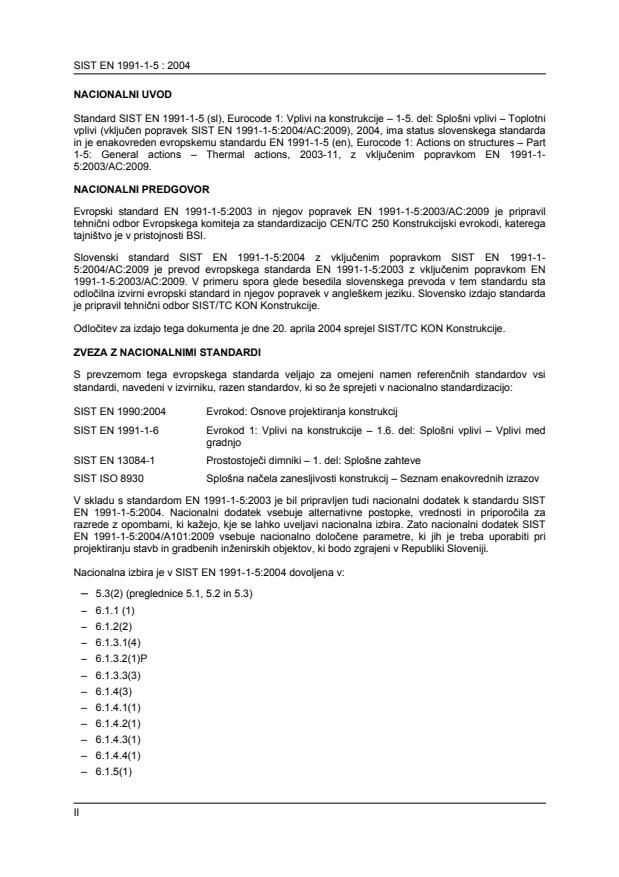
2003-01.Slovenski inštitut za standardizacijo. Razmnoževanje celote ali delov tega standarda ni dovoljeno.Eurocode 1: Actions on structures - Part 1-5: General actions - Thermal actionsEurocode 1: Vplivi na konstrukcije - 1-5. del: Splošni vplivi – Toplotni vpliviEurocode 1: - Actions sur les structures - Partie 1-5: Actions générales - Actions thermiquesEurocode 1: Einwirkungen auf Tragwerke - Teil 1-5: Allgemeine Einwirkungen - TemperatureinwirkungenTa slovenski standard je istoveten z:EN 1991-1-5:2003SIST EN 1991-1-5:2004en91.010.30Technical aspectsICS:SLOVENSKI
STANDARDSIST EN 1991-1-5:200401-september-2004
EUROPEAN STANDARDNORME EUROPÉENNEEUROPÄISCHE NORMEN 1991-1-5November 2003ICS 91.010.30Supersedes ENV 1991-2-5:1997English versionEurocode 1: Actions on structures - Part 1-5: General actions -Thermal actionsEurocode 1: Actions sur les structures - Partie 1-5: Actionsgénérales – Actions thermiquesThis European Standard was approved by CEN on 18 September 2003.CEN members are bound to comply with the CEN/CENELEC Internal Regulations which stipulate the conditions for giving this EuropeanStandard the status of a national standard without any alteration. Up-to-date lists and bibliographical references concerning such nationalstandards may be obtained on application to the Management Centre or to any CEN member.This European Standard exists in three official versions (English, French, German). A version in any other language made by translationunder the responsibility of a CEN member into its own language and notified to the Management Centre has the same status as the officialversions.CEN members are the national standards bodies of Austria, Belgium, Czech Republic, Denmark, Finland, France, Germany, Greece,Hungary, Iceland, Ireland, Italy, Luxembourg, Malta, Netherlands, Norway, Portugal, Slovakia, Spain, Sweden, Switzerland and UnitedKingdom.EUROPEAN COMMITTEE FOR STANDARDIZATIONCOMITÉ EUROPÉEN DE NORMALISATIONEUROPÄISCHES KOMITEE FÜR NORMUNGManagement Centre: rue de Stassart, 36
B-1050 Brussels© 2003 CENAll rights of exploitation in any form and by any means reservedworldwide for CEN national Members.Ref. No. EN 1991-1-5:2003 E
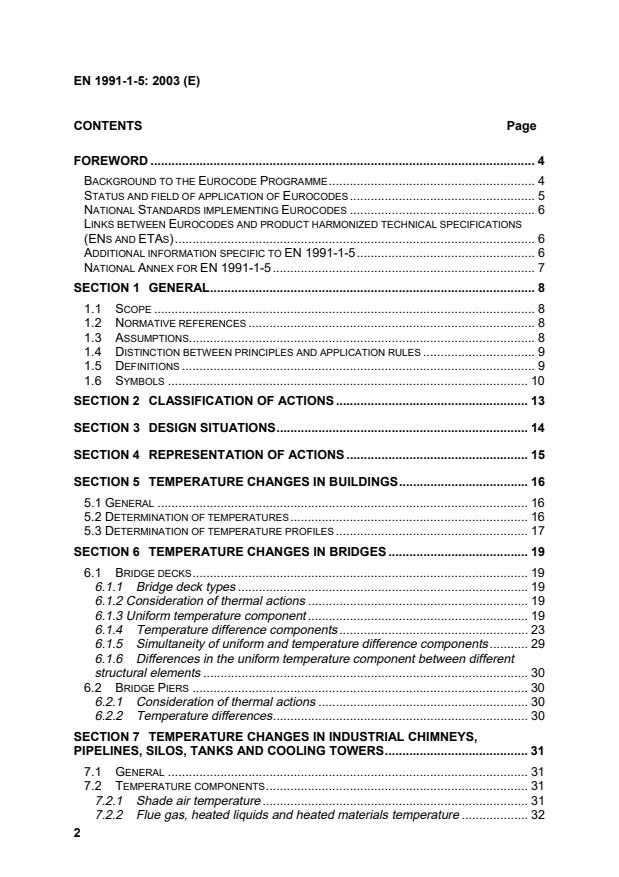
EN 1991-1-5: 2003 (E)2CONTENTS
PageFOREWORD.4BACKGROUND TO THE EUROCODE PROGRAMME.4STATUS AND FIELD OF APPLICATION OF EUROCODES.5NATIONAL STANDARDS IMPLEMENTING EUROCODES.6LINKS BETWEEN EUROCODES AND PRODUCT HARMONIZED TECHNICAL SPECIFICATIONS(ENS AND ETAS).6ADDITIONAL INFORMATION SPECIFIC TO EN 1991-1-5.6NATIONAL ANNEX FOR EN 1991-1-5.7SECTION 1GENERAL.81.1SCOPE.81.2NORMATIVE REFERENCES.81.3ASSUMPTIONS.81.4DISTINCTION BETWEEN PRINCIPLES AND APPLICATION RULES.91.5DEFINITIONS.91.6SYMBOLS.10SECTION 2CLASSIFICATION OF ACTIONS.13SECTION 3DESIGN SITUATIONS.14SECTION 4REPRESENTATION OF ACTIONS.15SECTION 5TEMPERATURE CHANGES IN BUILDINGS.165.1 GENERAL.165.2 DETERMINATION OF TEMPERATURES.165.3 DETERMINATION OF TEMPERATURE PROFILES.17SECTION 6TEMPERATURE CHANGES IN BRIDGES.196.1BRIDGE DECKS.196.1.1Bridge deck types.196.1.2 Consideration of thermal actions.196.1.3 Uniform temperature component.196.1.4Temperature difference components.236.1.5Simultaneity of uniform and temperature difference components.296.1.6Differences in the uniform temperature component between differentstructural elements.306.2BRIDGE PIERS.306.2.1Consideration of thermal actions.306.2.2Temperature differences.30SECTION 7TEMPERATURE CHANGES IN INDUSTRIAL CHIMNEYS,PIPELINES, SILOS, TANKS AND COOLING TOWERS.317.1GENERAL.317.2TEMPERATURE COMPONENTS.317.2.1Shade air temperature.317.2.2Flue gas, heated liquids and heated materials temperature.32
EN 1991-1-5: 2003 (E)37.2.3Element temperature.327.3CONSIDERATION OF TEMPERATURE COMPONENTS.327.4DETERMINATION OF TEMPERATURE COMPONENTS.327.5VALUES OF TEMPERATURE COMPONENTS (INDICATIVE VALUES).337.6SIMULTANEITY OF TEMPERATURE COMPONENTS.33ANNEX A (NORMATIVE)
ISOTHERMS OF NATIONAL MINIMUM AND MAXIMUMSHADE AIR TEMPERATURES.36A.1GENERAL.36A.2MAXIMUM AND MINIMUM SHADE AIR TEMPERATURE VALUES WITH AN ANNUALPROBABILITY OF BEING EXCEEDED P OTHER THAN 0,02.36ANNEX B (NORMATIVE)
TEMPERATURE DIFFERENCES FOR VARIOUSSURFACING DEPTHS.39ANNEX C (INFORMATIVE)
COEFFICIENTS OF LINEAR EXPANSION.42ANNEX D (INFORMATIVE)
TEMPERATURE PROFILES IN BUILDINGS ANDOTHER CONSTRUCTION WORKS.44BIBLIOGRAPHY.46
EN 1991-1-5: 2003 (E)4ForewordThis document (EN 1991-1-5) has been prepared by Technical CommitteeCEN/TC250 "Structural Eurocodes", the secretariat of which is held by BSI. This European Standard shall be given the status of a national standard, either bypublication of an identical text or by endorsement, at the latest by May 2004, andconflicting national standards shall be withdrawn at the latest by March 2010.Annexes A and B are normative. Annexes C and D are informative.This document supersedes ENV 1991-2-5:1997.According to the CEN/CENELEC Internal Regulations, the national standardsorganizations of the following countries are bound to implement this EuropeanStandard: Austria, Belgium, Czech Republic, Denmark, Finland, France, Germany,Greece, Hungary, Iceland, Ireland, Italy, Luxembourg, Malta, Netherlands, Norway,Portugal, Slovakia, Spain, Sweden, Switzerland and the United Kingdom.Background to the Eurocode ProgrammeIn 1975, the Commission of the European Communities decided on an actionprogramme in the field of construction, based on article 95 of the treaty. Theobjective of the programme was the elimination of technical obstacles to trade andthe harmonization of technical specifications.Within this action programme, the Commission took the initiative to establish a set ofharmonised technical rules for the design of construction works which, in a firststage, would serve as an alternative to the national rules in force in the MemberStates and, ultimately, would replace them.For fifteen years, the Commission, with the help of a Steering Committee withRepresentatives of Member States, conducted the development of the Eurocodesprogramme, which led to the first generation of European codes in the 1980's.In 1989, the Commission and the Member States of the EU and EFTA decided, onthe basis of an agreement between the Commission and CEN, to transfer thepreparation and the publication of the Eurocodes to CEN through a series ofmandates, in order to provide them with a future status of European Standard (EN).This links de facto the Eurocode with the provisions of all the Council's Directivesand/or Commission's Decisions dealing with European Standards (e.g. the CouncilDirective 89/106/EEC on construction products - CPD - and Council Directives93/37/EEC, 92/50/EEC and 89/440/EEC on public works and services and equivalentEFTA Directives initiated in pursuit of settings up the internal market).The Structural Eurocode programme comprises the following standards generallyconsisting of a number of Parts:
EN 1991-1-5: 2003 (E)5EN 1990Eurocode:Basis of Structural DesignEN 1991Eurocode 1:Actions on structuresEN 1992Eurocode 2:Design of concrete structuresEN 1993Eurocode 3:Design of steel structuresEN 1994Eurocode 4:Design of composite steel and concrete structuresEN 1995Eurocode 5:Design of timber structuresEN 1996Eurocode 6:Design of masonry structuresEN 1997Eurocode 7:Geotechnical designEN 1998Eurocode 8:Design of structures for earthquake resistanceEN 1999Eurocode 9:Design of aluminium alloy structuresEurocode standards recognize the responsibility of regulatory authorities in eachMember State and have safeguarded their right to determine values related toregulatory safety matters at national level where these continue to vary from State toState.Status and field of application of EurocodesThe Member States of the EU and EFTA recognize that Eurocodes serve asreference documents for the following purposes:– as a means of providing compliance of building and civil engineering works withthe essential requirements of Council Directive 89/106/EEC, particularly EssentialRequirement No1 - Mechanical resistance and stability - and EssentialRequirement No2 - Safety in case of fire;– as a basis for specifying contracts for construction works and related engineeringservices;– as a framework for drawing up harmonized technical specifications forconstruction products (ENs and ETAs)The Eurocodes, as far as they concern the construction works themselves, have adirect relationship with the Interpretative Documents referred to in Article 12 of theCPD, although they are of a different nature from harmonized product standards.Therefore, technical aspects arising from the Eurocodes work need to be adequatelyconsidered by CEN Technical Committees and/or EOTA Working Groups working onproduct standards with a view to achieving a full compatibility of these technicalspecifications with the Eurocodes.The Eurocode standards provide common structural design rules for everyday usefor the design of whole structures and component products of both a traditional andan innovative nature. Unusual forms of construction design conditions are notspecifically covered and additional expert consideration will be required by thedesigner in such cases.
EN 1991-1-5: 2003 (E)6National Standards implementing EurocodesThe National Standards implementing Eurocodes will comprise the full text of theEurocode (including any annexes), as published by CEN, which may be preceded bya National title page and National foreword, and may be followed by a National annex(informative).The National annex (informative) may only contain information on those parameterswhich are left open in the Eurocode for national choice, known as NationallyDetermined parameters, to be used for the design of buildings and civil engineeringworks to be constructed in the country concerned, i.e.:– values and/or classes where alternatives are given in the Eurocode,– values to be used where a symbol only is given in the Eurocode,– country specific data (geographical, climatic, etc.), e.g. snow map,– the procedure to be used where alternative procedures are given in the ENEurocode.It may also contain– decisions on the application of informative annexes,– references to non-contradictory complementary information to assist the user toapply the Eurocode.Links between Eurocodes and product harmonized technical specifications(ENs and ETAs)There is a need for consistency between the harmonized technical specifications forconstruction products and the technical rules for works. Furthermore, all theinformation accompanying the CE Marking of the construction products which refer toEurocodes should clearly mention which Nationally Determined Parameters havebeen taken into account.Additional information specific to EN 1991-1-5EN 1991-1-5 gives design guidance for thermal actions arising from climatic andoperational conditions on buildings and civil engineering works.Information on thermal actions induced by fire is given in EN 1991-1-2. EN 1991-1-5 is intended for clients, designers, contractors and relevant authorities.
EN 1991-1-5 is intended to be used with EN 1990, the other Parts of EN 1991 andEN 1992-1999 for the design of structures. In the case of bridges, the National annexes specify whether the general non-linearor the simplified linear temperature components should be used in designcalculations.
EN 1991-1-5: 2003 (E)7In the case of chimneys, references should be made to EN 13084-1 for thermalactions from operating processes.National annex for EN 1991-1-5This standard gives alternative procedures, values and recommendations for classeswith notes indicating where national choices may have to be made. Therefore theNational Standard implementing EN 1991-1-5 should have a National annexcontaining all Nationally Determined Parameters to be used for the design ofbuildings and civil engineering works to be constructed in the relevant country.National choice is allowed in EN 1991-1-5 through clauses:- 5.3(2) (Tables 5.1, 5.2 and 5.3)- 6.1.1 (1)- 6.1.2(2)- 6.1.3.1(4)- 6.1.3.2(1)- 6.1.3.3(3)- 6.1.4(3)- 6.1.4.1(1)- 6.1.4.2(1)- 6.1.4.3(1)- 6.1.4.4(1)- 6.1.5(1)- 6.1.6(1)- 6.2.1(1)P- 6.2.2(1)- 6.2.2(2)- 7.2.1(1)- 7.5(3)- 7.5(4)- A.1(1)- A.1(3)- A.2(2)- B(1) (Tables B.1, B.2 and B.3)
EN 1991-1-5: 2003 (E)8Section 1General1.1Scope(1) EN 1991-1-5 gives principles and rules for calculating thermal actions onbuildings, bridges and other structures including their structural elements. Principlesneeded for cladding and other appendages of buildings are also provided.(2) This Part describes the changes in the temperature of structural elements.Characteristic values of thermal actions are presented for use in the design ofstructures which are exposed to daily and seasonal climatic changes. Structures notso exposed may not need to be considered for thermal actions.(3) Structures in which thermal actions are mainly a function of their use (e.g. coolingtowers, silos, tanks, warm and cold storage facilities, hot and cold services etc) aretreated in Section 7. Chimneys are treated in EN 13084-1.1.2Normative references This European Standard incorporates, by dated or undated reference, provisionsfrom other publications. These normative references are cited at the appropriateplaces in the text and the publications are listed hereafter. For dated references,subsequent amendments to or revisions of any of these publications apply to thisEuropean Standard only when incorporated in it by amendment or revision. Forundated references the latest edition of the publication referred to applies (includingamendments).EN 1990:2002Eurocode: Basis of structural designprEN 1991-1-6Eurocode 1: Actions on structuresPart 1.6: General actions - Actions during executionEN 13084-1Free-standing industrial chimneysPart 1: General requirementsISO 2394General principles on reliability for structuresISO 3898Bases of design of structures - Notations. General symbolsISO 8930General principles on reliability for structures. List of equivalent terms 1.3Assumptions(1)P The general assumptions of EN 1990 also apply to this Part.
EN 1991-1-5: 2003 (E)91.4Distinction between principles and application rules(1)P The rules in EN 1990:2002, 1.4 also apply to this Part.1.5Terms and definitionsFor the purposes of this European Standard, the definitions given in EN 1990,ISO 2394, ISO 3898 and ISO 8930 and the following apply.1.5.1thermal actionsthermal actions on a structure or a structural element are those actions that arisefrom the changes of temperature fields within a specified time interval1.5.2shade air temperaturethe shade air temperature is the temperature measured by thermometers placed in awhite painted louvred wooden box known as a “Stevenson screen”1.5.3maximum shade air temperature Tmaxvalue of maximum shade air temperature with an annual probability of beingexceeded of 0,02 (equivalent to a mean return period of 50 years), based on themaximum hourly values recorded1.5.4minimum shade air temperature Tminvalue of minimum shade air temperature with an annual probability of beingexceeded of 0,02 (equivalent to a mean return period of 50 years), based on theminimum hourly values recorded1.5.5initial temperature T0the temperature of a structural element at the relevant stage of its restraint(completion)1.5.6claddingthe part of the building which provides a weatherproof membrane. Generally claddingwill only carry self weight and/or wind actions1.5.7uniform temperature componentthe temperature, constant over the cross section, which governs the expansion orcontraction of an element or structure (for bridges this is often defined as the“effective” temperature, but the term “uniform” has been adopted in this part)
...
Contents
- Predgovor
- 1 Splošno
- 1.1 Področje uporabe
- 1.2 Zveze z drugimi standardi
- 1.3 Predpostavke
- 1.4 Razlika med načeli in pravili
- 1.5 Izrazi in definicije
- 1.5.1 toplotni vpliv
- 1.5.2 temperatura zraka v senci
- 1.5.3 najvišja temperatura zraka v senci T
- 1.5.4 najnižja temperatura zraka v senci T
- 1.5.5 začetna temperatura T
- 1.5.6 obloga
- 1.5.7 enakomerna komponenta temperature
- 1.5.8 spremenljiva komponenta temperature
- 1.6 Simboli
- 2 Razvrstitev vplivov
- 3 Projektna stanja
- 4 Predstavitev vplivov
- 5 Temperaturne spremembe v stavbah
- 5.1 Splošno
- 5.2 Določitev temperatur
- 5.3 Določitev porazdelitve temperature
- 6 Temperaturne spremembe v mostovih
- 6.1 Prekladne konstrukcije mostov (krovi)
- 2. Betonski krov na jeklenem
- 6.2 Mostni stebri
- 7 Temperaturne spremembe v industrijskih dimnikih, cevovodih, silosih, rezervoarjih
- 7.1 Splošno
- 7.2 Komponente temperature
- 7.3 Upoštevanje komponent temperature
- 7.4 Določitev komponent temperature
- 7.5 Vrednosti komponent temperature (indikativne vrednosti)
- 7.6 Sočasnost komponent temperature
- Dodatek A
- Dodatek B
- Dodatek C
- Dodatek D
Predgovor
Ta dokument (EN 1991-1-5) je pripravil tehnični odbor CEN/TC 250 Konstrukcijski evrokodi, katerega sekretariat je na BSI.
Ta evropski standard mora dobiti status nacionalnega standarda bodisi z objavo istovetnega besedila ali z razglasitvijo najpozneje maja 2004, nasprotujoče nacionalne standarde pa je treba razveljaviti najpozneje marca 2010.
Dodatka A in B sta normativna. Dodatka C in D sta informativna.
Ta dokument nadomešča ENV 1991-2-5:1997.
Po notranjih predpisih CEN/CENELEC so dolžne ta evropski standard privzeti nacionalne organizacije za standarde naslednjih držav: Avstrije, Belgije, Češke republike, Danske, Finske, Francije, Grčije, Irske, Islandije, Italije, Luksemburga, Madžarske, Malte, Nemčije, Nizozemske, Norveške, Portugalske, Slovaške, Španije, Švedske, Švice in Združenega kraljestva.
Ozadje programa evrokodov
Komisija Evropskih skupnosti se je v letu 1975 na podlagi 95. člena Rimske pogodbe odločila, da sprejme akcijski program na področju gradbeništva. Cilj programa je bil odstraniti tehnične ovire pri trgovanju in uskladiti tehnične specifikacije.
Znotraj tega programa je Komisija spodbudila pripravo niza usklajenih tehničnih pravil za projektiranje gradbenih objektov, ki bi se sprva uporabljali kot alternativa različnim pravilom, veljavnim v posameznih državah članicah, končno pa bi jih nadomestila v celoti. Komisija je s pomočjo upravnega odbora, v katerem so bili predstavniki držav članic, petnajst let vodila razvoj programa evrokodov, katerega rezultat je bila prva generacija evrokodov v osemdesetih letih 20. stoletja. Leta 1989 so se Komisija in države članice EU in EFTA odločile, da na podlagi dogovora med Komisijo in CEN z več pooblastili prenesejo pripravo in objavljanje evrokodov na CEN, da bi evrokodi v prihodnje imeli status evropskih standardov (EN). To je evrokode dejansko povezalo z določbami vseh direktiv Sveta in/ali odločbami Komisije, ki se nanašajo na evropske standarde (npr. Direktiva Sveta 89/106/EGS o gradbenih proizvodih (CPD) in direktive Sveta 93/37/EGS, 92/50/EGS ter 89/440/EGS o javnih delih in storitvah ter ustrezne direktive EFTA, ki so bile sprejete za uveljavitev notranjega trga). Program konstrukcijskih evrokodov obsega naslednje standarde, ki imajo na splošno več delov:
EN 1990 Evrokod: Osnove projektiranja konstrukcij EN 1991 Evrokod 1: Vplivi na konstrukcije EN 1992 Evrokod 2: Projektiranje betonskih konstrukcij EN 1993 Evrokod 3: Projektiranje jeklenih konstrukcij EN 1994 Evrokod 4: Projektiranje sovprežnih jeklenih in betonskih konstrukcij EN 1995 Evrokod 5: Projektiranje lesenih konstrukcij EN 1996 Evrokod 6: Projektiranje zidanih konstrukcij EN 1997 Evrokod 7: Geotehnično projektiranje EN 1997 Evrokod 8: Projektiranje potresnoodpornih konstrukcij EN 1997 Evrokod 9: Projektiranje aluminijskih konstrukcij Evrokodi priznavajo odgovornost pristojnih oblasti v vsaki državi članici in jim dopuščajo pravico, da vrednosti, povezane z varnostjo, določajo na nacionalni ravni, od države do države različno.
SIST EN 1995-1-5 : 2004 Status in področje veljavnosti evrokodov
Članice EU in EFTA priznavajo evrokode kot referenčne dokumente za naslednje namene:
- kot način za dokazovanje ustreznosti stavb in inženirskih objektov bistvenim zahtevam Direktive Sveta 89/106/EGS, zlasti bistveni zahtevi št. 1 »Mehanska odpornost in stabilnost« in bistveni zahtevi št. 2 »Varnost pri požaru«;
- kot podlago za specifikacijo pogodb za izvedbo gradbenih objektov in spremljajoče inženirske storitve;
- kot okvir za pripravo harmoniziranih tehničnih specifikacij za gradbene proizvode (EN in ETA).
Kjer se evrokodi nanašajo na gradbene objekte, so neposredno povezani z razlagalnimi dokumenti, navedenimi v 12. členu Direktive o gradbenih proizvodih (CPD), čeprav je njihova narava drugačna od narave harmoniziranih standardov za proizvode. Zato morajo tehnični odbori CEN in/ali delovne skupine EOTA, ki pripravljajo standarde za proizvode, upoštevati tehnične vidike evrokodov, da bi s tem dosegli popolno usklajenost tehničnih specifikacij z evrokodi.
Evrokodi vsebujejo skupna pravila za vsakdanjo rabo pri projektiranju konstrukcij kot celote ali le konstrukcijskih delov, tako tradicionalnih kot inovativnih. Evrokodi ne vsebujejo posebnih določil za nenavadne oblike konstrukcij ali nenavadne projektne pogoje. V teh primerih je potrebno sodelovanje z izvedenci.
Nacionalne izdaje evrokodov Nacionalna izdaja evrokoda vsebuje poleg celotnega besedila evrokoda (z vsemi dodatki), kot ga je objavil CEN, tudi morebitno nacionalno naslovnico, nacionalni predgovor in nacionalni dodatek. Nacionalni dodatek lahko vsebuje le podatke o parametrih, ki so v evrokodu navedeni kot nacionalno določeni parametri (NDP). Ti parametri veljajo za projektiranje konstrukcij stavb in gradbenih inženirskih objektov v državi, v kateri bodo zgrajeni. To so:
- vrednosti in/ali razredi, kjer evrokodi dopuščajo alternative;
- vrednosti, kjer evrokodi navajajo le simbole;
- podatki, specifični za državo (geografski, podnebni itn.), kot je npr. karta snega;
- postopek, če jih evrokod dopušča več.
Vsebuje lahko tudi:
- odločitve o uporabi informativnih dodatkov;
- napotke o dodatnih informacijah, ki niso v nasprotju z evrokodi, za pomoč uporabniku. Zveze med evrokodi in harmoniziranimi tehničnimi specifikacijami (EN in ETA) za proizvode Harmonizirane tehnične specifikacije za gradbene proizvode morajo biti usklajene s tehničnimi pravili za objekte. Nadalje morajo navodila, povezana z označevanjem CE gradbenih proizvodov, ki se sklicujejo na evrokode, natančno določiti, katere nacionalno predpisane parametre upoštevajo. Dodatne informacije o EN 1991-1-5 EN 1991-1-5 vsebuje navodila za upoštevanje toplotnih vplivov, nastalih v podnebnih in obratovalnih pogojih pri projektiranju konstrukcij stavb in inženirskih objektov. Podatki o toplotnih vplivih, povzročenih pri požaru, so dani v EN 1991-1-2. EN 1991-1-5 je namenjen naročnikom, projektantom, izvajalcem in oblastem. EN 1991-1-5 je namenjen uporabi z EN 1990, drugimi deli EN 1991 in EN 1992 do EN 1999 za projektiranje konstrukcij.
SIST EN 1991-1-5 : 2004
Za mostove je v nacionalnem dodatku določeno, ali naj se pri projektnih računih uporabi splošna nelinearna ali poenostavljene linearne komponente temperature. Pri dimnikih se za toplotne vplive pri obratovanju upošteva EN 13084-1. Nacionalni dodatek k EN 1991-1-5 Ta standard vsebuje alternativne postopke, vrednosti in priporočila za razrede z opombami, ki kažejo, kje se lahko uveljavi nacionalna izbira. Zato naj imajo nacionalne izdaje EN 1991-1-5 nacionalni dodatek, ki vsebuje vse nacionalno določene parametre, ki jih je treba uporabiti pri projektiranju stavb in gradbenih inženirskih objektov, ki bodo zgrajeni v tej državi. Nacionalna izbira je v EN 1991-1-5 dovoljena v:
- 5.3 (2) (preglednice 5.1, 5.2 in 5.3) – 6.1.6(1)
- 6.1.1(1) – 6.2.1(1)P
- 6.1.2(2) – 6.2.2(1)
- 6.1.3.1(4) – 6.2.2(2)
- 6.1.3.2(1)P – 7.2.1(1)P
- 6.1.3.3(3) – 7.5(3)
- 6.1.4(3) – 7.5(4)
- 6.1.4.1(1) – A.1(1)
- 6.1.4.2(1) – A.1(3)
- 6.1.4.3(1) – A.2(2)
- 6.1.4.4(1) – B(1) (preglednice B.1, B.2 in B.3)
- 6.1.5(1)
1 Splošno
1.1 Področje uporabe
(1) EN 1991-1-5 podaja načela in pravila za račun toplotnih vplivov na stavbe, mostove in druge konstrukcije ter na njihove elemente. Vsebuje tudi načela za obloge in druge sestavine stavb. (2) Ta del standarda opisuje spremembe temperature konstrukcijskih elementov. Predstavljene so karakteristične vrednosti toplotnih vplivov za projektiranje konstrukcij, ki so izpostavljene dnevnim in sezonskim podnebnim spremembam. Pri konstrukcijah, ki takim vplivom niso izpostavljene, ni nujno treba upoštevati toplotnih vplivov.
(3) Konstrukcije, pri katerih so toplotni vplivi posledica njihove uporabe (npr. hladilni stolpi, silosi, vsebniki, topla in hladna skladišča, ogrevalne in hladilne komore itd.), so obravnavane v 7. poglavju. Dimniki so obravnavani v EN 13084-1.
1.2 Zveze z drugimi standardi
Ta evropski standard vključuje z datiranim ali nedatiranim sklicevanjem določila iz drugih publikacij. Sklicevanja na standarda so navedena na ustreznih mestih v besedilu, publikacije pa so naštete spodaj. Pri datiranih sklicevanjih se pri uporabi tega evropskega standarda upoštevajo poznejša dopolnila ali spremembe katerekoli od navedenih publikacij le, če so z dopolnilom ali spremembo vključene vanj. Pri nedatiranih sklicevanjih se uporablja zadnja izdaja publikacije (vključno z dopolnili). EN 1990:2002 Evrokod: Osnove projektiranja konstrukcij prEN 1991-1-6 Evrokod 1: Vplivi na konstrukcije – 1.6. del: Splošni vplivi – Vplivi med gradnjo
SIST EN 1995-1-5 : 2004 EN 13084-1 Prostostoječi dimniki – 1. del: Splošne zahteve ISO 2394 Splošna načela zanesljivosti konstrukcij ISO 3898 Osnove projektiranja konstrukcij – Sistem oznak – Splošne oznake ISO 8930 Splošna načela zanesljivosti konstrukcij – Seznam enakovrednih izrazov
1.3 Predpostavke
(1)P Splošne predpostavke v EN 1990 veljajo tudi v tem standardu.
1.4 Razlika med načeli in pravili
(1)P Pravila v EN 1990:2002 – 1.4 veljajo tudi v tem standardu.
1.5 Izrazi in definicije
V tem evropskem standardu veljajo definicije, dane v EN 1990, ISO 2394, ISO 3898 in ISO 8930 ter v nadaljevanju.
1.5.1 toplotni vpliv
toplotni vplivi na konstrukcijo ali konstrukcijski element so vplivi, ki nastanejo zaradi spremembe temperaturnega polja znotraj določenega časovnega obdobja
1.5.2 temperatura zraka v senci
temperatura zraka v senci je temperatura, merjena s termometrom, postavljenim v belo pobarvani vremenski hišici, v angleščini poimenovani "Stevenson screen"
1.5.3 najvišja temperatura zraka v senci T
max vrednost najvišje temperature zraka v senci z letno verjetnostjo 0,02, da bo presežena (kar je enakovredno srednji povratni dobi 50 let), temelječa na največjih izmerjenih urnih vrednostih
1.5.4 najnižja temperatura zraka v senci T
min vrednost najnižje temperature zraka v senci z letno verjetnostjo 0,02, da bo presežena (kar je enakovredno srednji povratni dobi 50 let), temelječa na najnižjih izmerjenih urnih vrednostih
1.5.5 začetna temperatura T
temperatura konstrukcijskega elementa ob vgraditvi
1.5.6 obloga
del stavbe, ki predstavlja vremensko odporno opno. Na splošno obloga prenaša le lastno težo in/ali vplive vetra
1.5.7 enakomerna komponenta temperature
temperatura, enakomerna po prečnem prerezu, ki vpliva na raztezke ali skrčke elementa ali konstrukcije (za mostove je pogosto določena kot "efektivna" temperatura, toda v tem standardu je privzet izraz "enakomerna")
1.5.8 spremenljiva komponenta temperature
del porazdelitve temperature po konstrukcijskem elementu, ki predstavlja temperaturno razliko med zunanjostjo elementa in katerokoli notranjo točko
SIST EN 1991-1-5 : 2004
1.6 Simboli
(1) V tem standardu se uporabljajo simboli, navedeni v nadaljevanju.
OPOMBA: Uporabljajo se oznake po ISO 3898.
(2) Osnovni seznam oznak je naveden v EN 1990, v nadaljevanju navedene oznake veljajo za ta standard.
Velike latinske črke R toplotna odpornost konstrukcijskega elementa R toplotna odpornost na notranji površini in R toplotna odpornost na zunanji površini out T najvišja temperatura zraka v senci z letno verjetnostjo 0,02, da bo presežena max (enakovredno srednji povratni dobi 50 let) T najnižja temperatura zraka v senci z letno verjetnostjo 0,02, da bo presežena min (enakovredno srednji povratni dobi 50 let) T najvišja temperatura zraka v senci z letno verjetnostjo p, da bo presežena (enakovredno max,p srednji povratni dobi 1/p let) T najnižja temperatura zraka v senci z letno verjetnostjo p, da bo presežena (enakovredno min,p srednji povratni dobi 1/p let) T najvišja enakomerna komponenta temperature mostu e,max T najnižja enakomerna komponenta temperature mostu e,min T začetna temperatura elementa ob vgraditvi
T temperatura zraka na notranji strani in T temperatura zraka na zunanji strani out ∆T , ∆T , vrednosti temperaturnih razlik zaradi segrevanja ali ohlajanja 1 2 ∆T , ∆T 3 4 ∆T enakomerna komponenta temperature U ∆T največja sprememba enakomerne komponente temperature mostu, ki povzroča raztezke N,exp (T ≥ T ) e,max 0 ∆T največja sprememba enakomerne komponente temperature mostu, ki povzroča skrčke N,con (T ≤ T ) e,min 0 ∆T celotna sprememba enakomerne komponente temperature mostu N ∆T linearno spremenljiva komponenta temperature M ∆T linearno spremenljiva komponenta temperature zaradi segrevanja M,heat ∆T linearno spremenljiva komponenta temperature zaradi ohlajanja M,cool ∆T nelinearno spremenljiva komponenta temperature E ∆T vsota linearno in nelinearno spremenljive komponente temperature ∆T temperaturna razlika med različnimi deli konstrukcije, dana z razliko med povprečnimi p temperaturami teh delov Male latinske črke h višina prečnega prereza k , k , k , koeficienti za račun najvišje (najnižje) temperature zraka v senci z letno verjetnostjo p, 1 2 3 k da bo presežena, kadar ta ni enaka 0,02
SIST EN 1995-1-5 : 2004 k površinski faktor za linearno spremenljivo komponento temperature sur p letna verjetnost, da najvišja (najnižja) temperatura zraka v senci ne bo presežena (enakovredno srednji povratni dobi 1/p let) u, c oblikovni in velikostni parameter porazdelitve najvišje (najnižje) temperature zraka v senci
Male grške črke koeficient linearnega raztezka (1/°C) α T λ toplotna prevodnost redukcijski faktor enakomerne komponente temperature za kombinacijo s spremenljivo ω N komponento temperature redukcijski faktor spremenljive komponente temperature za kombinacijo z enakomerno ω M komponento temperature
2 Razvrstitev vplivov
(1)P Toplotne vplive je treba razvrstiti kot spremenljive in posredne vplive, glej EN 1990:2002, 1.5.3 in 4.1.1.
(2) Vse vrednosti toplotnih vplivov v tem standardu so karakteristične vrednosti, razen če ni določeno drugače.
(3) Karakteristične vrednosti toplotnih vplivov, dane v tem standardu, so vrednosti z letno verjetnostjo 0,02, da bodo presežene, razen če ni določeno drugače, npr. za začasna projektna stanja.
OPOMBA: Za začasna projektna stanja se pripadajoče vrednosti toplotnih vplivov izračunajo po metodi, dani v A.2.
3 Projektna stanja
(1)P Toplotne vplive je treba določiti za vsako ustrezno projektno stanje, določeno v skladu z EN 1990.
OPOMBA: Pri konstrukcijah, ki niso izpostavljene dnevnim in sezonskim podnebnim ali obratovalnim spremembam temperature, ni treba upoštevati toplotnih vplivov.
(2)P Pri elementih nosilnih konstrukcij je treba bodisi s predvidenjem pomičnih vozlišč ali z upoštevanjem toplotnih vplivov pri projektiranju preveriti, ali je zagotovljeno, da premiki zaradi toplotnih vplivov ne povzročajo prenapetosti konstrukcije.
4 Predstavitev vplivov
(1) Dnevne in sezonske spremembe temperature zraka v senci, sončno sevanje, odbojno sevanje itd. povzročajo spremembe temperaturne porazdelitve znotraj posameznih elementov konstrukcije. (2) Velikost toplotnih vplivov je odvisna od krajevnih podnebnih razmer, orientacije konstrukcije, njene celotne mase, obdelave (oblog pri stavbah), pri stavbah pa tudi od načina ogrevanja in prezračevanja ter toplotne izolacije.
(3) Porazdelitev temperature znotraj posameznega konstrukcijskega elementa se lahko razdeli na štiri bistvene komponente, ki so prikazane na sliki 4.1 in so:
a) enakomerna komponenta temperature ∆T ; U b) linearno spremenljiva komponenta temperature okoli osi z ∆T ; MY c) linearno spremenljiva komponenta temperature okoli osi y ∆T ; MZ
SIST EN 1991-1-5 : 2004
d) nelinearno spremenljiva komponenta temperature ∆T . Ta povzroča s seboj uravnotežen E sistem napetosti, ki ne povzroča nobenega učinka obtežbe na element.
Težišče
Slika 4.1: Diagramski prikaz komponent temperaturne porazdelitve
(4) Deformacije in zato kakršnekoli rezultirajoče napetosti so odvisne od geometrije in robnih pogojev obravnavanega elementa in fizikalnih lastnosti uporabljenega materiala. Če se pri sovprežju uporabijo materiali z različnimi linearnimi koeficienti raztezka, se upoštevajo toplotni učinki.
(5) Pri računu toplotnih učinkov se uporabi koeficient linearnega raztezka za material.
OPOMBA: Koeficienti linearnega raztezka za izbrane navadno uporabljene materiale so dani v dodatku C.
5 Temperaturne spremembe v stavbah
5.1 Splošno
(1)P Toplotne vplive na stavbe zaradi podnebnih in obratovalnih temperaturnih sprememb je treba upoštevati pri projektiranju stavb, če obstaja možnost, da bi bila mejna stanja nosilnosti ali uporabnosti presežena zaradi toplotnih premikov in/ali napetosti.
OPOMBA 1: Na prostorninske spremembe in/ali napetosti zaradi temperaturnih sprememb lahko vplivajo tudi:
a) sence sosednjih stavb, b) uporaba različnih materialov z različnimi koeficienti toplotnega raztezka in toplotno prevodnostjo, c) uporaba različnih oblik prečnih prerezov z različno enakomerno temperaturo.
OPOMBA 2: Na prostorninske spremembe elementov lahko vplivajo tudi vlaga in drugi okoljski dejavniki.
5.2 Določitev temperatur
(1) Toplotni vplivi na stavbe zaradi podnebnih in obratovalnih temperaturnih sprememb se določijo v skladu z načeli in pravili v tem poglavju z upoštevanjem nacionalnih (regionalnih) podatkov in izkušenj.
(2)P Toplotne učinke je treba določiti z upoštevanjem sprememb temperature zraka v senci in sončnega sevanja. Obratovalne učinke (zaradi segrevanja, tehnoloških ali industrijskih procesov) je treba upoštevati v skladu s posameznim projektom.
(3)P V skladu s komponentami temperature, danimi v 4. poglavju, je treba podnebne in obratovalne toplotne vplive na konstrukcijski element določiti z uporabo naslednjih temeljnih veličin:
SIST EN 1995-1-5 : 2004 a) enakomerne komponente temperature ∆T , ki je dana z razliko med povprečno temperaturo U elementa T in njegovo začetno temperaturo T ;
b) linearno spremenljive komponente temperature, ki je dana z razliko ∆T med temperaturama M na zunanji in notranji površini prečnega prereza ali na površinah posameznih plasti; c) temperaturne razlike ∆T različnih delov konstrukcije, ki je dana z razliko povprečnih p temperatur teh delov.
OPOMBA: Vrednosti ∆T in ∆T se lahko določijo za posamezen projekt. M p
(4) Poleg ∆T , ∆T in ∆T se, kjer je to primerno (npr. pri podporah ali pritrditvah konstrukcijskih in U M p obložnih elementov), upoštevajo tudi krajevni vplivi. Ustrezna predstavitev toplotnih vplivov se določi z upoštevanjem lokacije stavbe in konstrukcijskih detajlov.
(5) Enakomerna komponenta temperature konstrukcijskega elementa ∆T je določena kot:
U
∆T = T – T (5.1) U 0
kjer je T povprečna temperatura konstrukcijskega elementa zaradi podnebnih temperatur pozimi ali poleti in zaradi obratovalnih temperatur
(6) Veličine ∆T , ∆T , ∆T in T se določijo v skladu z načeli, predpisanimi v 5.3, in uporabo U M p regionalnih podatkov. Če regionalni podatki niso na voljo, se uporabijo pravila v 5.3.
...