

SIST EN 302 065-3-1 V3.2.1:2025
(Main)Short Range Devices (SRD) using Ultra Wide Band technology (UWB) - Harmonised standard for access to radio spectrum - Part 3: UWB devices installed in motor and railway vehicles - Sub-part 1: Requirements for UWB devices for vehicular access systems within 3,8 GHz to 4,2 GHz or 6 GHz to 8,5 GHz
General Information
- Abstract
The present document specifies technical requirements, limits and test methods for equipment employing UWB for
vehicular access devices installed in motor and railway vehicles in the frequency ranges 3,8 GHz to 4,2 GHz and
6,0 GHz to 8,5 GHz.
These equipment types are intended to be utilized for vehicle access, vehicle immobilization and extended vehicle
access control functionalities (like closing windows or remotely starting the car).
Further details of the covered EUT can be found in clause 4.2.
NOTE: The relationship between the present document and essential requirements of article 3.2 of
Directive 2014/53/EU [i.1] is given in annex A.
- Status
- Published
- Public Enquiry End Date
- 28-Feb-2025
- Publication Date
- 10-Mar-2025
- Technical Committee
- MOC - Mobile Communications
- Current Stage
- 6060 - National Implementation/Publication (Adopted Project)
- Start Date
- 03-Mar-2025
- Due Date
- 08-May-2025
- Completion Date
- 11-Mar-2025
- Directive
- 2014/53/EU - Directive 2014/53/EU of The European Parliament and of the Council of 16 April 2014 on the harmonisation of the laws of the Member States relating to the making available on the market of radio equipment and repealing Directive 1999/5/ECOJ Ref: 14.8.2025, OJ L OJ Date: 14-Aug-2025
Buy Documents
ETSI EN 302 065-3-1 V3.1.0 (2021-07) - Short Range Devices (SRD) using Ultra Wide Band technology (UWB); Harmonised standard for access to radio spectrum; Part 3: UWB devices installed in motor and railway vehicles Sub-part 1: Requirements for UWB devices for vehicular access systems
ETSI EN 302 065-3-1 V3.1.1 (2024-07) - Short Range Devices (SRD) using Ultra Wide Band technology (UWB); Harmonised standard for access to radio spectrum; Part 3: UWB devices installed in motor and railway vehicles; Sub-part 1:Requirements for UWB devices for vehicular access systems within 3,8 GHz to 4,2 GHz or 6 GHz to 8,5 GHz
ETSI EN 302 065-3-1 V3.2.0 (2024-12) - Short Range Devices (SRD) using Ultra Wide Band technology (UWB); Harmonised standard for access to radio spectrum; Part 3: UWB devices installed in motor and railway vehicles; Sub-part 1:Requirements for UWB devices for vehicular access systems within 3,8 GHz to 4,2 GHz or 6 GHz to 8,5 GHz
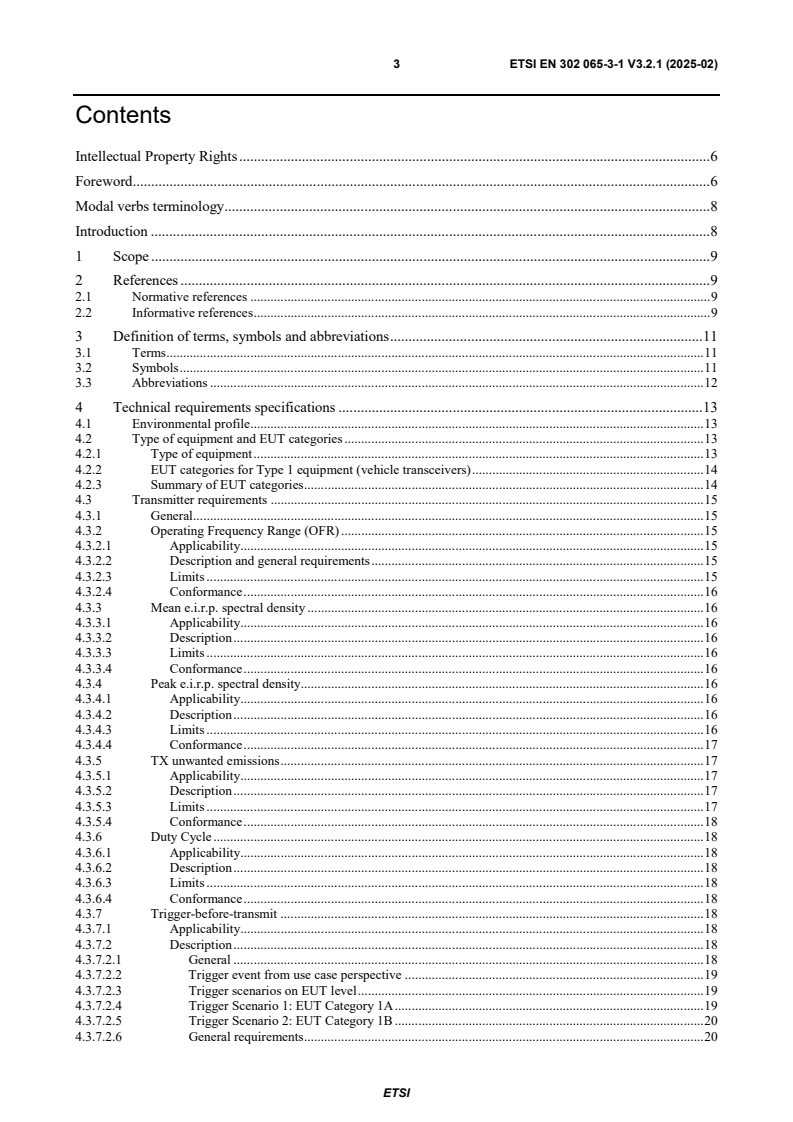
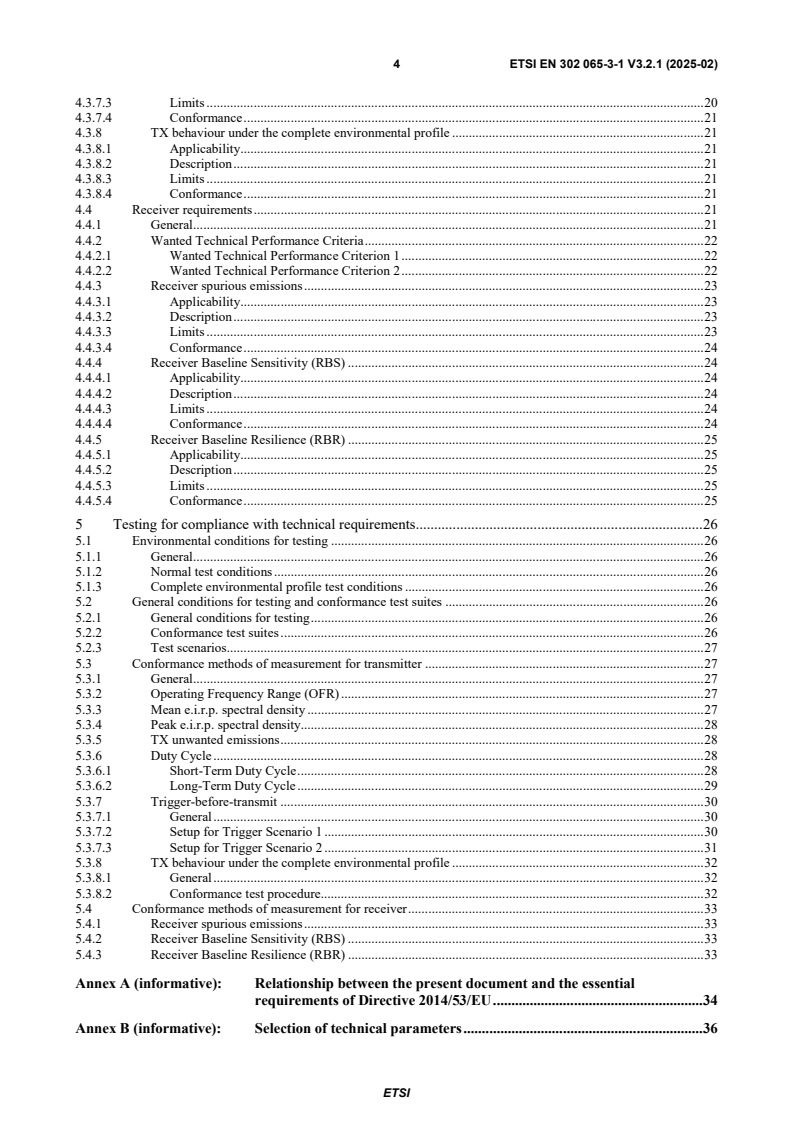
ETSI EN 302 065-3-1 V3.2.1 (2025-02) - Short Range Devices (SRD) using Ultra Wide Band technology (UWB); Harmonised standard for access to radio spectrum; Part 3: UWB devices installed in motor and railway vehicles; Sub-part 1:Requirements for UWB devices for vehicular access systems within 3,8 GHz to 4,2 GHz or 6 GHz to 8,5 GHz

Overview
SIST EN 302 065-3-1 V3.2.1:2025 is a harmonised European standard specifying the technical requirements and test methods for short-range devices (SRD) that use ultra wide band (UWB) technology in motor and railway vehicles. This standard focuses on vehicular access systems operating within the frequency ranges of 3,8 GHz to 4,2 GHz and 6 GHz to 8,5 GHz. Developed by the Slovenian Institute for Standardization (SIST), it aligns with the essential requirements of the Radio Equipment Directive (2014/53/EU), enabling manufacturers to demonstrate compliance and market their UWB vehicle access equipment across the European Union.
The document addresses UWB-enabled devices intended for:
- Vehicle access (e.g. keyless entry)
- Vehicle immobilization
- Extended vehicle access controls (e.g. automatic window closing, remote start functions)
Key Topics
Technical Requirements for Vehicular UWB Devices
- Defines limits and test methods for UWB transmitters and receivers in vehicles
- Specifies operational frequency ranges: 3,8 GHz - 4,2 GHz and 6 GHz - 8,5 GHz
- Addresses mean and peak equivalent isotropically radiated power (e.i.r.p.) densities
- Details unwanted emission controls and duty cycle restrictions
- Includes requirements for “trigger-before-transmit” mechanisms, which ensure transmissions only occur following defined triggers to minimize interference
Testing and Conformance
- Outlines procedures for measuring transmitter and receiver properties
- Includes compliance evaluation under both normal and extreme environmental conditions
- Specifies test scenarios to ensure robust performance in on-board vehicle installations
Regulatory Alignment
- Supports presumption of conformity to Article 3.2 of the Radio Equipment Directive by meeting radio spectrum requirements
- Developed according to a Commission standardisation request, enabling compliance with relevant EU legislation
- References established ETSI measurement techniques for UWB devices
Applications
UWB Technological Applications in Vehicles
- Keyless entry systems: Secure and convenient access with improved protection against signal interception and relay attacks
- Vehicle immobilization: Enables or disables vehicle operation, adding a critical layer of theft deterrence
- Extended access control: Facilitates features beyond entry, such as remote starting, trunk opening, or window control
- Applicable in both passenger vehicles and railway rolling stock
Industry Benefits
- Ensures reliable interoperability of UWB-based vehicular access systems
- Supports innovation in automotive electronics by providing a clear regulatory path for new features
- Reduces radio interference risk, supporting the safe co-existence with other radio services
Related Standards
Manufacturers and developers applying SIST EN 302 065-3-1 V3.2.1:2025 should be familiar with the following related documents:
- ETSI EN 303 883-1: Measurement techniques for transmitter requirements in SRD and UWB devices
- ETSI EN 303 883-2: Measurement techniques for receiver requirements in SRD and UWB devices
- ETSI TS 103 941: Environmental test setups for SRD and UWB devices
- ETSI TR 103 416: System reference document on UWB vehicular access systems
- Radio Equipment Directive (2014/53/EU): Essential conformity requirements for placing radio equipment on the market
Other relevant harmonised standards under the EN 302 065 series address UWB devices for generic, location tracking, material sensing, and on-board aircraft applications.
Keywords: UWB, ultra wide band, short range devices, vehicular access, radio standard, frequency band, vehicle immobilization, access control, automotive, railway, spectrum compliance, SRD, Directive 2014/53/EU, harmonised standard, SIST EN 302 065-3-1.
Buy Documents
ETSI EN 302 065-3-1 V3.1.0 (2021-07) - Short Range Devices (SRD) using Ultra Wide Band technology (UWB); Harmonised standard for access to radio spectrum; Part 3: UWB devices installed in motor and railway vehicles Sub-part 1: Requirements for UWB devices for vehicular access systems
ETSI EN 302 065-3-1 V3.1.1 (2024-07) - Short Range Devices (SRD) using Ultra Wide Band technology (UWB); Harmonised standard for access to radio spectrum; Part 3: UWB devices installed in motor and railway vehicles; Sub-part 1:Requirements for UWB devices for vehicular access systems within 3,8 GHz to 4,2 GHz or 6 GHz to 8,5 GHz
ETSI EN 302 065-3-1 V3.2.0 (2024-12) - Short Range Devices (SRD) using Ultra Wide Band technology (UWB); Harmonised standard for access to radio spectrum; Part 3: UWB devices installed in motor and railway vehicles; Sub-part 1:Requirements for UWB devices for vehicular access systems within 3,8 GHz to 4,2 GHz or 6 GHz to 8,5 GHz
ETSI EN 302 065-3-1 V3.2.1 (2025-02) - Short Range Devices (SRD) using Ultra Wide Band technology (UWB); Harmonised standard for access to radio spectrum; Part 3: UWB devices installed in motor and railway vehicles; Sub-part 1:Requirements for UWB devices for vehicular access systems within 3,8 GHz to 4,2 GHz or 6 GHz to 8,5 GHz
Get Certified
Connect with accredited certification bodies for this standard

TÜV Rheinland
TÜV Rheinland is a leading international provider of technical services.

TÜV SÜD
TÜV SÜD is a trusted partner of choice for safety, security and sustainability solutions.

DEKRA Certification Inc.
DEKRA US certification services.
Sponsored listings
Frequently Asked Questions
SIST EN 302 065-3-1 V3.2.1:2025 is a standard published by the Slovenian Institute for Standardization (SIST). Its full title is "Short Range Devices (SRD) using Ultra Wide Band technology (UWB) - Harmonised standard for access to radio spectrum - Part 3: UWB devices installed in motor and railway vehicles - Sub-part 1: Requirements for UWB devices for vehicular access systems within 3,8 GHz to 4,2 GHz or 6 GHz to 8,5 GHz". This standard covers: The present document specifies technical requirements, limits and test methods for equipment employing UWB for vehicular access devices installed in motor and railway vehicles in the frequency ranges 3,8 GHz to 4,2 GHz and 6,0 GHz to 8,5 GHz. These equipment types are intended to be utilized for vehicle access, vehicle immobilization and extended vehicle access control functionalities (like closing windows or remotely starting the car). Further details of the covered EUT can be found in clause 4.2. NOTE: The relationship between the present document and essential requirements of article 3.2 of Directive 2014/53/EU [i.1] is given in annex A.
The present document specifies technical requirements, limits and test methods for equipment employing UWB for vehicular access devices installed in motor and railway vehicles in the frequency ranges 3,8 GHz to 4,2 GHz and 6,0 GHz to 8,5 GHz. These equipment types are intended to be utilized for vehicle access, vehicle immobilization and extended vehicle access control functionalities (like closing windows or remotely starting the car). Further details of the covered EUT can be found in clause 4.2. NOTE: The relationship between the present document and essential requirements of article 3.2 of Directive 2014/53/EU [i.1] is given in annex A.
SIST EN 302 065-3-1 V3.2.1:2025 is classified under the following ICS (International Classification for Standards) categories: 33.060.99 - Other equipment for radiocommunications; 43.040.15 - Car informatics. On board computer systems. The ICS classification helps identify the subject area and facilitates finding related standards.
SIST EN 302 065-3-1 V3.2.1:2025 is associated with the following European legislation: EU Directives/Regulations: 2014/53/EU. When a standard is cited in the Official Journal of the European Union, products manufactured in conformity with it benefit from a presumption of conformity with the essential requirements of the corresponding EU directive or regulation.
SIST EN 302 065-3-1 V3.2.1:2025 is available in PDF format for immediate download after purchase. The document can be added to your cart and obtained through the secure checkout process. Digital delivery ensures instant access to the complete standard document.
Standards Content (Sample)
Draft ETSI EN 302 065-3-1 V3.1.0 (2021-07)
HARMONISED EUROPEAN STANDARD
Short Range Devices (SRD)
using Ultra Wide Band technology (UWB);
Harmonised standard for access to radio spectrum;
Part 3: UWB devices installed in motor and railway vehicles
Sub-part 1: Requirements for UWB devices
for vehicular access systems
2 Draft ETSI EN 302 065-3-1 V3.1.0 (2021-07)
Reference
REN/ERM-TGUWB-150-3-1
Keywords
harmonised standard, SRD, UWB
ETSI
650 Route des Lucioles
F-06921 Sophia Antipolis Cedex - FRANCE
Tel.: +33 4 92 94 42 00 Fax: +33 4 93 65 47 16
Siret N° 348 623 562 00017 - APE 7112B
Association à but non lucratif enregistrée à la
Sous-Préfecture de Grasse (06) N° w061004871
Important notice
The present document can be downloaded from:
http://www.etsi.org/standards-search
The present document may be made available in electronic versions and/or in print. The content of any electronic and/or
print versions of the present document shall not be modified without the prior written authorization of ETSI. In case of any
existing or perceived difference in contents between such versions and/or in print, the prevailing version of an ETSI
deliverable is the one made publicly available in PDF format at www.etsi.org/deliver.
Users of the present document should be aware that the document may be subject to revision or change of status.
Information on the current status of this and other ETSI documents is available at
https://portal.etsi.org/TB/ETSIDeliverableStatus.aspx
If you find errors in the present document, please send your comment to one of the following services:
https://portal.etsi.org/People/CommiteeSupportStaff.aspx
Notice of disclaimer & limitation of liability
The information provided in the present deliverable is directed solely to professionals who have the appropriate degree of
experience to understand and interpret its content in accordance with generally accepted engineering or
other professional standard and applicable regulations.
No recommendation as to products and services or vendors is made or should be implied.
In no event shall ETSI be held liable for loss of profits or any other incidental or consequential damages.
Any software contained in this deliverable is provided "AS IS" with no warranties, express or implied, including but not
limited to, the warranties of merchantability, fitness for a particular purpose and non-infringement of intellectual property
rights and ETSI shall not be held liable in any event for any damages whatsoever (including, without limitation, damages
for loss of profits, business interruption, loss of information, or any other pecuniary loss) arising out of or related to the use
of or inability to use the software.
Copyright Notification
No part may be reproduced or utilized in any form or by any means, electronic or mechanical, including photocopying and
microfilm except as authorized by written permission of ETSI.
The content of the PDF version shall not be modified without the written authorization of ETSI.
The copyright and the foregoing restriction extend to reproduction in all media.
© ETSI 2021.
All rights reserved.
ETSI
3 Draft ETSI EN 302 065-3-1 V3.1.0 (2021-07)
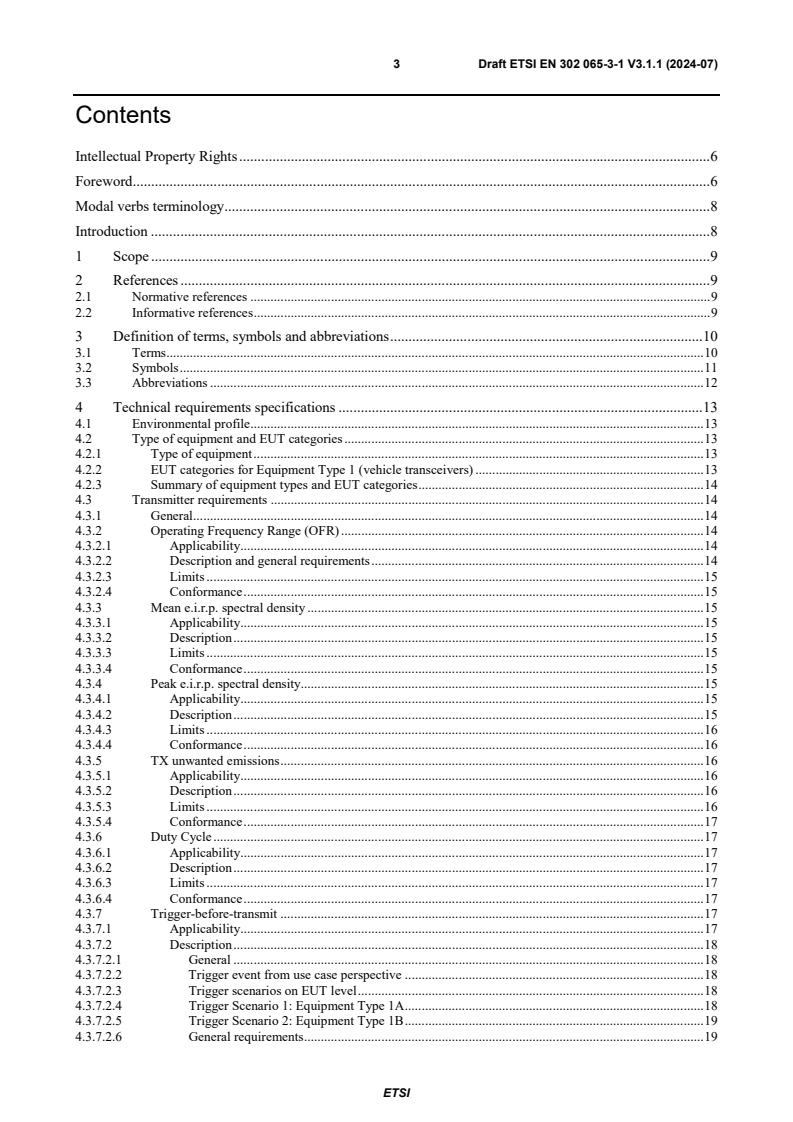
Contents
Intellectual Property Rights . 6
Foreword . 6
Modal verbs terminology . 7
Introduction . 7
1 Scope . 8
2 References . 8
2.1 Normative references . 8
2.2 Informative references . 9
3 Definition of terms, symbols and abbreviations . 10
3.1 Terms . 10
3.2 Symbols . 11
3.3 Abbreviations . 11
4 Technical requirements specifications . 12
4.1 Environmental profile . 12
4.2 Transmitter requirements . 12
4.2.1 General . 12
4.2.2 Operating Frequency Range (OFR) . 12
4.2.2.1 Applicability. 12
4.2.2.2 Description and general requirements . 12
4.2.2.3 Limits . 12
4.2.2.4 Conformance . 12
4.2.3 Mean e.i.r.p. spectral density . 12
4.2.3.1 Applicability. 12
4.2.3.2 Description . 12
4.2.3.3 Limits . 12
4.2.3.4 Conformance . 13
4.2.4 Peak e.i.r.p. spectral density. 13
4.2.4.1 Applicability. 13
4.2.4.2 Description . 13
4.2.4.3 Limits . 13
4.2.4.4 Conformance . 13
4.2.5 TX unwanted emissions . 13
4.2.5.1 Applicability. 13
4.2.5.2 Description . 13
4.2.5.3 Limits . 13
4.2.5.4 Conformance . 14
4.2.6 Duty Cycle . 14
4.2.6.1 Applicability. 14
4.2.6.2 Description . 14
4.2.6.3 Limits . 14
4.2.6.4 Conformance . 15
4.2.7 Trigger-before-transmit . 15
4.2.7.1 Applicability. 15
4.2.7.2 Description . 15
4.2.7.2.1 General . 15
4.2.7.2.2 Trigger event from use case perspective . 15
4.2.7.2.3 Trigger scenarios on EUT level . 16
4.2.7.2.4 Trigger Scenario 1: EUT is Responder Device . 16
4.5.7.2.5 Trigger Scenario 2: EUT is Initiator Device . 16
4.2.7.2.6 General requirements . 17
4.2.7.3 Limits . 17
4.2.7.4 Conformance . 18
4.3 Receiver requirements . 18
4.3.1 General . 18
ETSI
4 Draft ETSI EN 302 065-3-1 V3.1.0 (2021-07)
4.3.2 Wanted Technical Performance Criteria . 18
4.3.2.1 Wanted Technical Performance Criterion 1 . 18
4.3.2.2 Wanted Technical Performance Criterion 2 . 19
4.3.3 Receiver spurious emissions . 20
4.3.3.1 Applicability. 20
4.3.3.2 Description . 20
4.3.3.3 Limits . 20
4.3.3.4 Conformance . 21
4.3.4 Receiver Baseline Sensitivity (RBS) . 21
4.3.4.1 Applicability. 21
4.3.4.2 Description . 21
4.3.4.3 Limits . 21
4.3.4.4 Conformance . 21
4.3.5 Receiver Baseline Resilience (RBR) . 21
4.3.5.1 Applicability. 21
4.3.5.2 Description . 22
4.3.5.3 Limits . 22
4.3.5.4 Conformance . 22
5 Testing for compliance with technical requirements . 22
5.1 Environmental conditions for testing . 22
5.2 General conditions for testing . 23
5.3 Conformance test suites . 23
5.3.1 General . 23
5.3.2 Test scenarios . 23
5.4 Conformance methods of measurement for transmitter . 23
5.4.1 General . 23
5.4.2 Operating Frequency Range (OFR) . 23
5.4.3 Mean e.i.r.p. spectral density . 24
5.4.4 Peak e.i.r.p. spectral density. 24
5.4.5 TX unwanted emissions . 24
5.4.6 Duty Cycle . 24
5.4.6.1 Short-Term Duty Cycle . 24
5.4.6.2 Long-Term Duty Cycle . 24
5.4.7 Trigger-before-transmit . 25
5.4.7.1 General . 25
5.4.7.2 Setup for Trigger Scenario 1 . 25
5.4.7.3 Setup for Trigger Scenario 2 . 26
5.5 Conformance methods of measurement for receiver . 27
5.5.1 Receiver Spurious Emissions . 27
5.5.2 Receiver Baseline Sensitivity (RBS) . 27
5.5.3 Receiver Baseline Resilience (RBR) . 28
Annex A (informative): Relationship between the present document and the essential
requirements of Directive 2014/53/EU . 29
Annex B (informative): General conditions for testing, measurement uncertainty and
interpretation of the measurement results . 31
Annex C (informative): Trigger-before-transmit . 32
C.1 Trigger behaviour . 32
C.2 Justification for trigger-before-transmit limits . 32
Annex D (informative): RBR Limits Derivation . 34
D.1 General . 34
D.2 Relevant interferers - Frequency Band 3,8 GHz to 4,2 GHz . 34
D.2.1 Relevant interferers . 34
D.2.2 Limits for equipment type 1 . 34
D.2.3 Limits for equipment type 2 . 34
ETSI
5 Draft ETSI EN 302 065-3-1 V3.1.0 (2021-07)
D.3 Relevant interferers - Frequency Band 6,0 GHz to 8,5 GHz . 34
D.3.1 Relevant interferers . 34
D.3.2 Limits for equipment type 1 . 35
D.3.3 Limits for equipment type 2 . 35
D.4 Strong interferers . 36
D.4.1 WAS/RLAN in 5 925 MHz to 6 425 MHz . 36
D.4.2 Limits for equipment type 1 and equipment type 2 . 36
Annex E (informative): Bibliography . 37
Annex F (informative): Change history . 38
History . 39
ETSI
6 Draft ETSI EN 302 065-3-1 V3.1.0 (2021-07)
Intellectual Property Rights
Essential patents
IPRs essential or potentially essential to normative deliverables may have been declared to ETSI. The declarations
pertaining to these essential IPRs, if any, are publicly available for ETSI members and non-members, and can be
found in ETSI SR 000 314: "Intellectual Property Rights (IPRs); Essential, or potentially Essential, IPRs notified to
ETSI in respect of ETSI standards", which is available from the ETSI Secretariat. Latest updates are available on the
ETSI Web server (https://ipr.etsi.org/).
Pursuant to the ETSI Directives including the ETSI IPR Policy, no investigation regarding the essentiality of IPRs,
including IPR searches, has been carried out by ETSI. No guarantee can be given as to the existence of other IPRs not
referenced in ETSI SR 000 314 (or the updates on the ETSI Web server) which are, or may be, or may become,
essential to the present document.
Trademarks
The present document may include trademarks and/or tradenames which are asserted and/or registered by their owners.
ETSI claims no ownership of these except for any which are indicated as being the property of ETSI, and conveys no
right to use or reproduce any trademark and/or tradename. Mention of those trademarks in the present document does
not constitute an endorsement by ETSI of products, services or organizations associated with those trademarks.
DECT™, PLUGTESTS™, UMTS™ and the ETSI logo are trademarks of ETSI registered for the benefit of its
Members. 3GPP™ and LTE™ are trademarks of ETSI registered for the benefit of its Members and of the 3GPP
Organizational Partners. oneM2M™ logo is a trademark of ETSI registered for the benefit of its Members and of the ®
oneM2M Partners. GSM and the GSM logo are trademarks registered and owned by the GSM Association. ®
BLUETOOTH is a trademark registered and owned by Bluetooth SIG, Inc.
Foreword
This draft Harmonised European Standard (EN) has been produced by ETSI Technical Committee Electromagnetic
compatibility and Radio spectrum Matters (ERM), and is now submitted for the combined Public Enquiry and Vote
phase of the ETSI standards EN Approval Procedure.
The present document has been prepared under the Commission's standardisation request C(2015) 5376 final [i.2] to
provide one voluntary means of conforming to the essential requirements of Directive 2014/53/EU on the harmonisation
of the laws of the Member States relating to the making available on the market of radio equipment and repealing
Directive 1999/5/EC [i.1].
Once the present document is cited in the Official Journal of the European Union under that Directive, compliance with
the normative clauses of the present document given in Table A.1 confers, within the limits of the scope of the present
document, a presumption of conformity with the corresponding essential requirements of that Directive and associated
EFTA regulations.
Proposed national transposition dates
Date of latest announcement of this EN (doa): 3 months after ETSI publication
Date of latest publication of new National Standard
or endorsement of this EN (dop/e): 6 months after doa
Date of withdrawal of any conflicting National Standard (dow): 18 months after doa
ETSI
7 Draft ETSI EN 302 065-3-1 V3.1.0 (2021-07)
Modal verbs terminology
In the present document "shall", "shall not", "should", "should not", "may", "need not", "will", "will not", "can" and
"cannot" are to be interpreted as described in clause 3.2 of the ETSI Drafting Rules (Verbal forms for the expression of
provisions).
"must" and "must not" are NOT allowed in ETSI deliverables except when used in direct citation.
Introduction
For the case of the present document, the applicable harmonised standard has been ETSI EN 302 065-3 [i.12], for UWB
devices for ground based vehicular applications, which was published in the OJEU without restriction at 10 March 2017
[i.9] and then published at 5 February 2020 [i.10] with the following restriction:
• "This harmonised standard does not set out technical specifications for 'trigger before-transmit techniques'.
Implementing Decision (EU) 2019/785, however, imposes, as of 16 November 2019, technical requirements to
be used within the bands 3,8-4.2 GHz and 6-8,5 GHz for vehicular access systems using trigger-before
transmit. Therefore compliance with this harmonised standard does not ensure compliance with Decision (EU)
2019/785 and accordingly does not confer a presumption of conformity with those essential requirements set
out in Article 3 (2) of Directive 2014/53/EU which relate to 'trigger-before-transmit techniques'".
In order to consider the above points, ETSI ERM TGUWB decided to develop more specific standards; for the present
document this means instead of a generic ETSI EN 302 065-3 standard for all road and rail vehicles applications, an
ETSI EN 302 065-3-1 for UWB devices for vehicular access systems. Other sub-parts for UWB devices installed in
motor and railway vehicles may follow (ETSI EN 302 065-3-x).
More details on the changes of the present document to previous versions are provided in Annex F.
ETSI
8 Draft ETSI EN 302 065-3-1 V3.1.0 (2021-07)
1 Scope
The present document specifies technical characteristics and methods of measurements for equipment employing UWB
devices for vehicle access systems, which use pulse based, packet oriented UWB signals for data transfer and/or
distance bounding and/or localization purpose.
EXAMPLE: Radio equipment employing UWB technology for vehicle access systems is equipment intended to
be utilized for vehicle access, vehicle immobilization and extended vehicle access control
functionalities (like closing windows or remotely starting the car).
Following types of equipment are covered by the present document:
1) Equipment Type 1: Vehicle transceivers, which meet the conditions below:
a) Vehicle transceivers communicate on a "trigger-before-transmit" basis with:
i) vehicle ID devices (equipment type 2); and/or
ii) other vehicle transceivers (equipment type 1); and/or
iii) other UWB devices (e.g. smartphones).
b) Vehicle transceivers are installed in the vehicle.
c) Vehicle transceivers are capable of operating in the permitted frequency range as specified in Table 1
with either an integral antenna or a Radio Frequency (RF) output connection and dedicated antenna.
2) Equipment type 2: Vehicle ID devices (e.g. key fobs), which meet the conditions below:
a) Vehicle ID devices are handheld devices.
b) Vehicle ID devices communicate with vehicle transceivers (equipment type 1).
c) Vehicle ID devices are paired with one specific vehicle and are an accessory to this vehicle.
d) Vehicle ID devices are capable of operating in the permitted frequency range as specified in Table 1
using an integral antenna.
NOTE 1: Other UWB devices - like UWB enabled smartphones - are not covered by the present document.
The permitted frequency bands are defined in Table 1.
Table 1: Permitted frequency bands for vehicular access systems
Frequency Band Application
Transmit and Receive 3,8 GHz to 4,2 GHz vehicular access
Transmit and Receive 6,0 GHz to 8,5 GHz vehicular access
NOTE 2: Permitted frequency bands are based on ECC/DEC/(06)04 [i.4], Annex 1.2, Table 3.
NOTE 3: The relationship between the present document and essential requirements of article 3.2 of Directive
2014/53/EU [i.1] is given in Annex A.
2 References
2.1 Normative references
References are either specific (identified by date of publication and/or edition number or version number) or
non-specific. For specific references, only the cited version applies. For non-specific references, the latest version of the
referenced document (including any amendments) applies.
ETSI
9 Draft ETSI EN 302 065-3-1 V3.1.0 (2021-07)
Referenced documents which are not found to be publicly available in the expected location might be found at
https://docbox.etsi.org/Reference/.
NOTE: While any hyperlinks included in this clause were valid at the time of publication, ETSI cannot guarantee
their long term validity.
The following referenced documents are necessary for the application of the present document.
[1] ETSI EN 303 883-1 (V1.2.1) (02-2021): "Short Range Devices (SRD) and Ultra Wide Band
(UWB); Part 1: Measurement techniques for transmitter requirements".
[2] ETSI EN 303 883-2 (V1.2.1) (02-2021): "Short Range Devices (SRD) and Ultra Wide Band
(UWB); Part 2: Measurement techniques for receiver requirements".
2.2 Informative references
References are either specific (identified by date of publication and/or edition number or version number) or
non-specific. For specific references, only the cited version applies. For non-specific references, the latest version of the
referenced document (including any amendments) applies.
NOTE: While any hyperlinks included in this clause were valid at the time of publication, ETSI cannot guarantee
their long term validity.
The following referenced documents are not necessary for the application of the present document but they assist the
user with regard to a particular subject area.
[i.1] Directive 2014/53/EU of the European Parliament and of the Council of 16 April 2014 on the
harmonisation of the laws of the Member States relating to the making available on the market of
radio equipment and repealing Directive 1999/5/EC (RE-Directive).
[i.2] Commission implementing Decision C(2015) 5376 final of 4.8.2015 on a standardisation request
to the European Committee for Electrotechnical Standardisation and to the European
Telecommunications Standards Institute as regards radio equipment in support of Directive
2014/53/EU of the European Parliament and of the Council.
[i.3] ETSI TR 103 416 (V1.1.1) (07-2016): "System Reference document (SRdoc); Short Range
Devices (SRD) using Ultra Wide Band (UWB); Technical characteristics and spectrum
requirements for UWB based vehicular access systems for operation in the 3,4 GHz to 4,8 GHz
and 6 GHz to 8,5 GHz frequency ranges".
[i.4] ECC Decision (06)04 of 24 March 2006 on the Harmonised Use, Exemption From Individual
Licensing And Free Circulation Of Devices Using Ultra-Wideband (UWB) Technology In Bands
Below 10.6 GHz (ECC/Dec/(06)04). Amended On 6 July 2007, Amended 9 December 2011 and
Amended On 8 March 2019.
[i.5] ETSI TS 103 361 (V1.1.1) (03-2016): "Short Range Devices (SRD) using Ultra Wide Band
technology (UWB); Receiver technical requirements, parameters and measurement procedures to
fulfil the requirements of the Directive 2014/53/EU".
[i.6] ECC Report 278 (27 April 2018): "Specific UWB applications in the band 3.4-4.8 GHz and
6.0-8.5 GHz: Location tracking and sensor applications (LTA) for vehicular access systems".
[i.7] Commission implementing decision (EU) 2019/785 of 14 May 2019 on the harmonisation of radio
spectrum for equipment using ultra-wideband technology in the Union and repealing Decision
2007/131/EC.
[i.8] Directive 1999/5/EC (9 March 1999) on radio equipment and telecommunications terminal
equipment and the mutual recognition of their conformity.
ETSI
10 Draft ETSI EN 302 065-3-1 V3.1.0 (2021-07)
[i.9] Official Journal of the European Union, 13.7.2018: "Commission communication in the
framework of the implementation of Directive 1999/5/EC of the European Parliament and of the
Council on radio equipment and telecommunications terminal equipment and the mutual
recognition of their conformity and Directive 2014/53/EU of the European Parliament and of the
Council on the harmonisation of the laws of the Member States relating to the making available on
the market of radio equipment and repealing Directive 1999/5/EC".
NOTE: Available at https://eur-lex.europa.eu/legal-
content/EN/TXT/PDF/?uri=uriserv:OJ.C_.2018.246.01.0023.01.ENG.
[i.10] Commission Implementing Decision (EU) 2020/167 of 5 February 2020 on the harmonised
standards for radio equipment drafted in support of Directive 2014/53/EU of the European
Parliament and of the Council.
NOTE: Available at https://eur-lex.europa.eu/legal-content/EN/TXT/PDF/?uri=CELEX:32020D0167&from=EN.
[i.11] ECC/DEC/(20)/01: "ECC Decision of 20 November 2020 on the harmonised use of the frequency
band 5945-6425 MHz for Wireless Access Systems including Radio Local Area Networks
(WAS/RLAN)".
[i.12] ETSI EN 302 065-3 (V2.1.1): "Short Range Devices (SRD) using Ultra Wide Band technology
(UWB); Harmonised Standard covering the essential requirements of article 3.2 of the Directive
2014/53/EU; Part 3: Requirements for UWB devices for ground based vehicular applications".
3 Definition of terms, symbols and abbreviations
3.1 Terms
For the purposes of the present document, the terms given in ETSI EN 303 883-1 [1], ETSI EN 303 883-2 [2] and the
following apply:
control equipment: equipment capable of sending control messages to the EUT, as well as receiving responses to that
control command or other status messages, in order to setup the EUT and perform a measurement procedure
control message: one or more commands used to control or configure the EUT
NOTE: Typically submitted on a specific, non-UWB control interface, like CAN-bus interface.
EUT trigger event: trigger event on EUT level
NOTE: Which is used for measurement procedures in the present document.
initiator: EUT role in an UWB transmission sequence: EUT initiates UWB transmissions upon a system trigger event
NOTE: For more details see clause 4.2.7.2.
message: sequence or exchange of two or more packets in order to transfer information, in particular to generate a
ranging information (Time-of-Flight between EUT and companion device)
packet: used to refer to an UWB data frame or aggregated pulse sequence, that is sent over the air
NOTE: Typically, one packet represents a continuous T time.
on
responder: EUT role in an UWB transmission sequence: EUT responds to an UWB transmission (received UWB
packet)
NOTE: For more details see clause 4.2.7.2.
system trigger event: trigger event on system level; usually out of scope for EUT
Time-of-Flight (ToF): travel time of the radio signal between transmitter and receiver
ETSI
11 Draft ETSI EN 302 065-3-1 V3.1.0 (2021-07)
Trigger-Before-Transmit (TBT): mitigation technique as required for vehicular access systems
NOTE: See ECC/DEC/(06)04 [i.4].
vehicle transceiver: UWB enabled unit, installed in the vehicle
3.2 Symbols
For the purposes of the present document, the symbols given in ETSI EN 303 883-1 [1], ETSI EN 303 883-2 [2] and the
following apply:
T cease time, until a transmitter ceases transmission after a trigger event
cease
T cumulated Ton time
on_cum
TBT Trigger-Before-Transmit timeout (cease time after EUT trigger)
timeout
TBT Trigger-Before-Transmit On-Time within any 10 s window after first EUT trigger
On-Time
f lowest frequency of the operating frequency range
L
f highest frequency of the operating frequency range
H
F Lower frequency for the spurious emissions test
LOWER
F Upper frequency for the spurious emissions test
UPPER
X Boundary value for determination of spurious domain
TXUE
3.3 Abbreviations
For the purposes of the present document, the abbreviations given in ETSI EN 303 883-1 [1], ETSI EN 303 883-2 [2]
and the following apply: ®
Low Energy
BLE Bluetooth
CW Continuous Wave
EC European Commission
ECC European Communication Committee
EFTA European Free Trade Association
EN European Norm
ERM Electromagnetic compatibility and Radio spectrum Matters
EU European Union
EUT Equipment Under Test
LDC Low Duty Cycle
MSR Message Success Rate
NFC Near Field Communication
NLOS Non Line Of Sight
OFR Operating Frequency Range
OJEU Official Journal of the European Union
RBR Receiver Baseline Resilience
RBS Receiver Baseline Sensitivity
RBW Resolution BandWidth
RF Radio Frequency
RP Radiated Power
RTTE Radio and Telecommunications Terminal Equipment (Directive 1999/5/EC)
RX Receiver
s second (unit)
TBT Trigger-Before-Transmit
TG Task Group
TGUWB Task Group Ultra Wide Band
ToF Time-of-Flight
TR Technical Report
TS Technical Specification
TX Transmitter
TXUE Transmitter Unwanted Emission
UWB Ultra Wide Band
VLP Very Low Power
ETSI
12 Draft ETSI EN 302 065-3-1 V3.1.0 (2021-07)
4 Technical requirements specifications
4.1 Environmental profile
The technical requirements of the present document apply under the environmental profile for operation of the
equipment, which shall be in accordance with its intended use. The equipment shall comply with all the technical
requirements of the present document at all times when operating within the boundary limits of the operational
environmental profile defined by its intended use.
4.2 Transmitter requirements
4.2.1 General
The transmitter requirements shall be tested per EUT. Assessment of Low Duty Cycle and trigger-before-transmit are
related to the transmissions per EUT.
NOTE: EUT is not the vehicle.
4.2.2 Operating Frequency Range (OFR)
4.2.2.1 Applicability
This requirement shall apply to all EUTs with transmit functionality.
4.2.2.2 Description and general requirements
Operating frequency range is defined in clause 5.2.1 of ETSI EN 303 883-1 [1].
4.2.2.3 Limits
The OFR (all frequencies between f and f ) shall be within the permitted frequency range (see Table 1).
L H
The OFR shall be at least 50 MHz.
NOTE: The minimum OFR requirement comes from the EC Decision on UWB [i.7], Article 2 (a).
4.2.2.4 Conformance
The conformance test for OFR shall be as defined in clause 5.4.2.
4.2.3 Mean e.i.r.p. spectral density
4.2.3.1 Applicability
This requirement shall apply to all EUTs with transmit functionality.
4.2.3.2 Description
The mean e.i.r.p. is described in clause 5.3.2 of ETSI EN 303 883-1 [1].
4.2.3.3 Limits
Within the OFR the mean e.i.r.p. spectral density shall not exceed the limits in Table 2.
ETSI
13 Draft ETSI EN 302 065-3-1 V3.1.0 (2021-07)
Table 2: Mean e.i.r.p. spectral density limits
Frequency range Maximum mean e.i.r.p. spectral density
3,8 GHz to 4,2 GHz -41,3 dBm/MHz
6,0 GHz to 8,5 GHz -41,3 dBm/MHz
4.2.3.4 Conformance
The conformance test for mean e.i.r.p. spectral density shall be as defined in clause 5.4.3.
4.2.4 Peak e.i.r.p. spectral density
4.2.4.1 Applicability
This requirement shall apply to all EUTs with transmit functionality.
4.2.4.2 Description
The Peak e.i.r.p. is defined in clause 5.3.4 of ETSI EN 303 883-1 [1].
4.2.4.3 Limits
The Peak e.i.r.p. spectral density shall not exceed the limits in Table 3.
Table 3: Peak e.i.r.p. spectral density limits
Frequency range Maximum peak e.i.r.p. (defined in 50 MHz)
3,8 GHz to 4,2 GHz 0 dBm
6,0 GHz to 8,5 GHz 0 dBm
4.2.4.4 Conformance
The conformance test for peak e.i.r.p. spectral density shall be as defined in clause 5.4.4.
4.2.5 TX unwanted emissions
4.2.5.1 Applicability
This requirement shall apply to all EUTs with transmit functionality.
4.2.5.2 Description
See ETSI EN 303 883-1 [1], clause 5.5.1.
4.2.5.3 Limits
The TX unwanted emissions shall be assessed based on ETSI EN 303 883-1 [1], clause 5.5.2.
The spurious emission limits are defined in Table 4.
ETSI
14 Draft ETSI EN 302 065-3-1 V3.1.0 (2021-07)
Table 4: Spurious emissions limits
Frequency range Limit values for TXUE
-54 dBm/100 kHz
87,5 MHz ≤ f ≤ 118 MHz
-54 dBm/100 kHz
174 MHz ≤ f ≤ 230 MHz
470 MHz ≤ f ≤ 694 MHz -54 dBm/100 kHz
-36 dBm/100 kHz
otherwise in band 30 MHz ≤ f < 1 000 MHz
-30 dBm/1 MHz
1 000 MHz ≤ f ≤ Fupper (see Table 5)
NOTE: Not applicable for RP emissions within the OFR.
The lower and upper frequency for the spurious emissions test based on the EUT OFR shall comply with Table 5.
Table 5: Lower and upper frequency for the spurious emissions test based on the EUT OFR
Fundamental frequency range Frequency range for measurements
defined by f and f (note 2)
L H Lower frequency (FLOWER) Upper frequency (FUPPER)
th
3,8 GHz to 4,2 GHz 30 MHz 5 harmonic (note 1)
6,0 GHz to 8,5 GHz 30 MHz 26 GHz
NOTE 1: F is the stated harmonic of f (the upper edge of the OFR, which is measured in clause 4.2.2).
UPPER H
NOTE 2: FLOWER has to be selected based on fL and FUPPER based on fH (fL and fH can be measured according to
clause 4.2.2); for receive only devices fH and fL of the related EUT/companion device shall be used.
Based in TXUE specification of 50 % (see clause 5.4.5) there is no OOB-domain for EUT in UWB-mode. Therefore, an
OOB domain is not applicable.
4.2.5.4 Conformance
The conformance test for TX unwanted emissions shall be as defined in clause 5.4.5.
4.2.6 Duty Cycle
4.2.6.1 Applicability
This requirement shall apply to:
• all equipment Type 1 (vehicle transceivers);
• all equipment Type 2 (vehicle ID devices), if operated in the band 3,8 GHz to 4,2 GHz.
4.2.6.2 Description
See ETSI EN 303 883-1 [1], clause 5.11.1.
4.2.6.3 Limits
The measured Duty Cycle shall comply with the limits in Table 6.
ETSI
15 Draft ETSI EN 302 065-3-1 V3.1.0 (2021-07)
Table 6: Duty Cycle Limits
Limits Remarks
Ton max = 5 ms Short-term duty-cycle requirements for Tobs = 1 s:
Toff mean ≥ 38 ms (averaged over 1 s)
• Σ Toff > 950 ms sets the duty-cycle limit to 5 % (see note 2 and
Σ T > 950 ms per s
off note 3)
• Toff mean ≥ 38 ms implicitly limits the number of On-Periods and
thus the achievable duty-cycle for short T times
on
Σ T < 18 s per hour Long-term duty-cycle requirement for T = 3 600 s
on obs
• Σ T < 18 s sets the duty-cycle limit per hour to 0,5 %
on
NOTE 1: The limits are based on the "Low Duty Cycle" requirements in ECC/DEC/(06)04 [i.4], Annex 2.
NOTE 2: 5 % Duty-Cycle can only be achieved with T times larger than 2 ms (and max. 5 ms).
on
NOTE 3: The limits allow a Short-Term Duty-Cycle of up to 5 %. Devices with Ton < 2 ms cannot exploit this Short-
Term Duty-Cycle of 5 %, as Toff mean is the limiting factor. The resulting Short-Term Duty-Cycle for those
devices is then considerably smaller than 5 %.
EXAMPLE:
Examples for the maximum possible Duty-Cycle for a given T (and shortest feasible T _ ):
on off mean
- T = 5 ms, T = 95 ms LDC = 5,0 % (10 On-Periods in 1 s)
on off_mean
- T = 2 ms, T = 38,00 ms LDC = 5,0 % (25 On-Periods in 1
...
Draft ETSI EN 302 065-3-1 V3.1.1 (2024-07)
HARMONISED EUROPEAN STANDARD
Short Range Devices (SRD)
using Ultra Wide Band technology (UWB);
Harmonised standard for access to radio spectrum;
Part 3: UWB devices installed in motor and railway vehicles;
Sub-part 1: Requirements for UWB devices for vehicular
access systems within 3,8 GHz to 4,2 GHz or 6 GHz to 8,5 GHz
2 Draft ETSI EN 302 065-3-1 V3.1.1 (2024-07)
Reference
REN/ERM-TGUWB-150-3-1
Keywords
harmonised standard, SRD, UWB
ETSI
650 Route des Lucioles
F-06921 Sophia Antipolis Cedex - FRANCE
Tel.: +33 4 92 94 42 00 Fax: +33 4 93 65 47 16
Siret N° 348 623 562 00017 - APE 7112B
Association à but non lucratif enregistrée à la
Sous-Préfecture de Grasse (06) N° w061004871
Important notice
The present document can be downloaded from:
https://www.etsi.org/standards-search
The present document may be made available in electronic versions and/or in print. The content of any electronic and/or
print versions of the present document shall not be modified without the prior written authorization of ETSI. In case of any
existing or perceived difference in contents between such versions and/or in print, the prevailing version of an ETSI
deliverable is the one made publicly available in PDF format at www.etsi.org/deliver.
Users of the present document should be aware that the document may be subject to revision or change of status.
Information on the current status of this and other ETSI documents is available at
https://portal.etsi.org/TB/ETSIDeliverableStatus.aspx
If you find errors in the present document, please send your comment to one of the following services:
https://portal.etsi.org/People/CommiteeSupportStaff.aspx
If you find a security vulnerability in the present document, please report it through our
Coordinated Vulnerability Disclosure Program:
https://www.etsi.org/standards/coordinated-vulnerability-disclosure
Notice of disclaimer & limitation of liability
The information provided in the present deliverable is directed solely to professionals who have the appropriate degree of
experience to understand and interpret its content in accordance with generally accepted engineering or
other professional standard and applicable regulations.
No recommendation as to products and services or vendors is made or should be implied.
In no event shall ETSI be held liable for loss of profits or any other incidental or consequential damages.
Any software contained in this deliverable is provided "AS IS" with no warranties, express or implied, including but not
limited to, the warranties of merchantability, fitness for a particular purpose and non-infringement of intellectual property
rights and ETSI shall not be held liable in any event for any damages whatsoever (including, without limitation, damages
for loss of profits, business interruption, loss of information, or any other pecuniary loss) arising out of or related to the use
of or inability to use the software.
Copyright Notification
No part may be reproduced or utilized in any form or by any means, electronic or mechanical, including photocopying and
microfilm except as authorized by written permission of ETSI.
The content of the PDF version shall not be modified without the written authorization of ETSI.
The copyright and the foregoing restriction extend to reproduction in all media.
© ETSI 2024.
All rights reserved.
ETSI
3 Draft ETSI EN 302 065-3-1 V3.1.1 (2024-07)
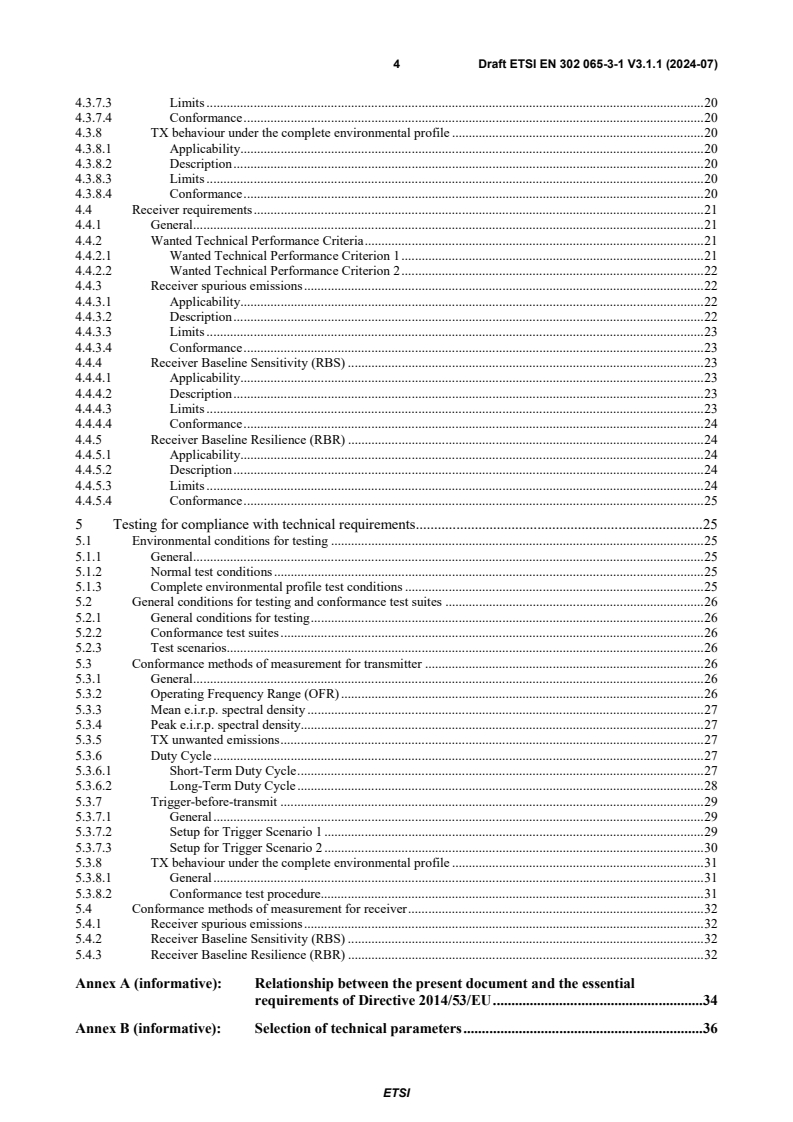
Contents
Intellectual Property Rights . 6
Foreword . 6
Modal verbs terminology . 8
Introduction . 8
1 Scope . 9
2 References . 9
2.1 Normative references . 9
2.2 Informative references . 9
3 Definition of terms, symbols and abbreviations . 10
3.1 Terms . 10
3.2 Symbols . 11
3.3 Abbreviations . 12
4 Technical requirements specifications . 13
4.1 Environmental profile . 13
4.2 Type of equipment and EUT categories . 13
4.2.1 Type of equipment . 13
4.2.2 EUT categories for Equipment Type 1 (vehicle transceivers) . 13
4.2.3 Summary of equipment types and EUT categories . 14
4.3 Transmitter requirements . 14
4.3.1 General . 14
4.3.2 Operating Frequency Range (OFR) . 14
4.3.2.1 Applicability. 14
4.3.2.2 Description and general requirements . 14
4.3.2.3 Limits . 15
4.3.2.4 Conformance . 15
4.3.3 Mean e.i.r.p. spectral density . 15
4.3.3.1 Applicability. 15
4.3.3.2 Description . 15
4.3.3.3 Limits . 15
4.3.3.4 Conformance . 15
4.3.4 Peak e.i.r.p. spectral density. 15
4.3.4.1 Applicability. 15
4.3.4.2 Description . 15
4.3.4.3 Limits . 16
4.3.4.4 Conformance . 16
4.3.5 TX unwanted emissions . 16
4.3.5.1 Applicability. 16
4.3.5.2 Description . 16
4.3.5.3 Limits . 16
4.3.5.4 Conformance . 17
4.3.6 Duty Cycle . 17
4.3.6.1 Applicability. 17
4.3.6.2 Description . 17
4.3.6.3 Limits . 17
4.3.6.4 Conformance . 17
4.3.7 Trigger-before-transmit . 17
4.3.7.1 Applicability. 17
4.3.7.2 Description . 18
4.3.7.2.1 General . 18
4.3.7.2.2 Trigger event from use case perspective . 18
4.3.7.2.3 Trigger scenarios on EUT level . 18
4.3.7.2.4 Trigger Scenario 1: Equipment Type 1A . 18
4.3.7.2.5 Trigger Scenario 2: Equipment Type 1B . 19
4.3.7.2.6 General requirements . 19
ETSI
4 Draft ETSI EN 302 065-3-1 V3.1.1 (2024-07)
4.3.7.3 Limits . 20
4.3.7.4 Conformance . 20
4.3.8 TX behaviour under the complete environmental profile . 20
4.3.8.1 Applicability. 20
4.3.8.2 Description . 20
4.3.8.3 Limits . 20
4.3.8.4 Conformance . 20
4.4 Receiver requirements . 21
4.4.1 General . 21
4.4.2 Wanted Technical Performance Criteria . 21
4.4.2.1 Wanted Technical Performance Criterion 1 . 21
4.4.2.2 Wanted Technical Performance Criterion 2 . 22
4.4.3 Receiver spurious emissions . 22
4.4.3.1 Applicability. 22
4.4.3.2 Description . 22
4.4.3.3 Limits . 23
4.4.3.4 Conformance . 23
4.4.4 Receiver Baseline Sensitivity (RBS) . 23
4.4.4.1 Applicability. 23
4.4.4.2 Description . 23
4.4.4.3 Limits . 23
4.4.4.4 Conformance . 24
4.4.5 Receiver Baseline Resilience (RBR) . 24
4.4.5.1 Applicability. 24
4.4.5.2 Description . 24
4.4.5.3 Limits . 24
4.4.5.4 Conformance . 25
5 Testing for compliance with technical requirements . 25
5.1 Environmental conditions for testing . 25
5.1.1 General . 25
5.1.2 Normal test conditions . 25
5.1.3 Complete environmental profile test conditions . 25
5.2 General conditions for testing and conformance test suites . 26
5.2.1 General conditions for testing . 26
5.2.2 Conformance test suites . 26
5.2.3 Test scenarios . 26
5.3 Conformance methods of measurement for transmitter . 26
5.3.1 General . 26
5.3.2 Operating Frequency Range (OFR) . 26
5.3.3 Mean e.i.r.p. spectral density . 27
5.3.4 Peak e.i.r.p. spectral density. 27
5.3.5 TX unwanted emissions . 27
5.3.6 Duty Cycle . 27
5.3.6.1 Short-Term Duty Cycle . 27
5.3.6.2 Long-Term Duty Cycle . 28
5.3.7 Trigger-before-transmit . 29
5.3.7.1 General . 29
5.3.7.2 Setup for Trigger Scenario 1 . 29
5.3.7.3 Setup for Trigger Scenario 2 . 30
5.3.8 TX behaviour under the complete environmental profile . 31
5.3.8.1 General . 31
5.3.8.2 Conformance test procedure. 31
5.4 Conformance methods of measurement for receiver . 32
5.4.1 Receiver spurious emissions . 32
5.4.2 Receiver Baseline Sensitivity (RBS) . 32
5.4.3 Receiver Baseline Resilience (RBR) . 32
Annex A (informative): Relationship between the present document and the essential
requirements of Directive 2014/53/EU . 34
Annex B (informative): Selection of technical parameters . 36
ETSI
5 Draft ETSI EN 302 065-3-1 V3.1.1 (2024-07)
Annex C (informative): Trigger-before-transmit . 38
C.1 Trigger behaviour . 38
C.2 Justification for trigger-before-transmit limits . 38
Annex D (informative): RBR Limits Derivation . 40
D.1 General . 40
D.2 Relevant interferers - Frequency Band 3,8 GHz to 4,2 GHz . 40
D.2.1 Relevant interferers . 40
D.2.2 Limits for Equipment Type 1 . 40
D.2.3 Limits for Equipment Type 2 . 40
D.3 Relevant interferers - Frequency Band 6,0 GHz to 8,5 GHz . 40
D.3.1 Relevant interferers . 40
D.3.2 Limits for Equipment Type 1 . 41
D.3.3 Limits for Equipment Type 2 . 41
D.4 Strong interferers . 42
D.4.1 WAS/RLAN in 5 925 MHz to 6 425 MHz . 42
D.4.2 Limits for Equipment Type 1 and Equipment Type 2 . 42
Annex E (informative): Bibliography . 43
Annex F (informative): Change history . 44
History . 45
ETSI
6 Draft ETSI EN 302 065-3-1 V3.1.1 (2024-07)
Intellectual Property Rights
Essential patents
IPRs essential or potentially essential to normative deliverables may have been declared to ETSI. The declarations
pertaining to these essential IPRs, if any, are publicly available for ETSI members and non-members, and can be
found in ETSI SR 000 314: "Intellectual Property Rights (IPRs); Essential, or potentially Essential, IPRs notified to
ETSI in respect of ETSI standards", which is available from the ETSI Secretariat. Latest updates are available on the
ETSI Web server (https://ipr.etsi.org).
Pursuant to the ETSI Directives including the ETSI IPR Policy, no investigation regarding the essentiality of IPRs,
including IPR searches, has been carried out by ETSI. No guarantee can be given as to the existence of other IPRs not
referenced in ETSI SR 000 314 (or the updates on the ETSI Web server) which are, or may be, or may become,
essential to the present document.
Trademarks
The present document may include trademarks and/or tradenames which are asserted and/or registered by their owners.
ETSI claims no ownership of these except for any which are indicated as being the property of ETSI, and conveys no
right to use or reproduce any trademark and/or tradename. Mention of those trademarks in the present document does
not constitute an endorsement by ETSI of products, services or organizations associated with those trademarks.
DECT™, PLUGTESTS™, UMTS™ and the ETSI logo are trademarks of ETSI registered for the benefit of its
Members. 3GPP™ and LTE™ are trademarks of ETSI registered for the benefit of its Members and of the 3GPP
Organizational Partners. oneM2M™ logo is a trademark of ETSI registered for the benefit of its Members and of the ®
oneM2M Partners. GSM and the GSM logo are trademarks registered and owned by the GSM Association. ®
BLUETOOTH is a trademark registered and owned by Bluetooth SIG, Inc.
Foreword
This draft Harmonised European Standard (EN) has been produced by ETSI Technical Committee Electromagnetic
compatibility and Radio spectrum Matters (ERM), and is now submitted for the combined Public Enquiry and Vote
phase of the ETSI Standardisation Request deliverable Approval Procedure.
The present document has been prepared under the Commission's standardisation request C(2015) 5376 final [i.2] to
provide one voluntary means of conforming to the essential requirements of Directive 2014/53/EU on the harmonisation
of the laws of the Member States relating to the making available on the market of radio equipment and repealing
Directive 1999/5/EC [i.1].
Once the present document is cited in the Official Journal of the European Union under that Directive, compliance with
the normative clauses of the present document given in Table A.1 confers, within the limits of the scope of the present
document, a presumption of conformity with the corresponding essential requirements of that Directive and associated
EFTA regulations.
The present document is part 3, sub-part 1 of a multi-part deliverable covering Short Range Devices (SRD) using Ultra
Wide Band technology (UWB); Harmonised standard for access to radio spectrum, as identified below:
Part 1: "Generic UWB devices":
Sub-part 1: "Communication devices within 3,1 GHz to 4,8 GHz using LDC mitigation or within the 6 GHz to
8,5 GHz".
Part 2: "Ultra Wide Band location tracking devices":
Sub-part 1: "Requirements for devices within 6 GHz to 8,5 GHz";
Sub-part 2: "Requirements for devices in the frequency band between 3,1 GHz to 4,8 GHz utilizing LDC
mitigation technique";
ETSI
7 Draft ETSI EN 302 065-3-1 V3.1.1 (2024-07)
Sub-part 3: "Requirements for fixed infrastructure UWB based localization systems in the frequency band
between 3,1 GHz to 4,8 GHz deploying Detect-And-Avoid (DAA) mitigation technique";
Sub-part 4: "Requirements for fixed outdoor devices within 6,0 GHz to 8,5 GHz";
Sub-part 5: "Requirements for enhanced indoor devices within 6,0 GHz to 8,5 GHz".
Part 3: "UWB devices installed in motor and railway vehicles":
Sub-part 1: "Requirements for UWB devices for vehicular access systems within 3,8 GHz to 4,2 GHz
or 6 GHz to 8,5 GHz";
Sub-part 2: "Requirements for location tracking devices installed in rail and road vehicles operating in the
frequency range of 3,1 GHz to 4,8 GHz or 6,0 GHz to 8,5 GHz";
Sub-part 3: "Requirements for UWB radiodetermination applications operating within 6,0 GHz to 8,5 GHz".
Part 4: "Material Sensing devices":
Sub-part 1: "Building material analysis below 10,6 GHz";
Sub-part 2: "UWB Material Sensing devices for Security Scanning";
Sub-part 3: "Ground humidity and condition sensor below 10,6 GHz";
Sub-part 4: "Exterior material sensing applications for ground based vehicles below 10,6 GHz";
Sub-part 5: "UWB surveillance devices for parking lot sensors below 10,6 GHz".
Part 5: "Devices using UWB technology onboard aircraft";
Part 6: "Ultra Wide Band radio-determination for radar sensing devices":
Sub-part 1: "Requirements for presence detection applications within 6,0 GHz to 8,5 GHz";
Sub-part 2: "Requirements for generic UWB through-air non-contact vital signs applications within 6,0 GHz
to 8,5 GHz";
Sub-part 3: "Requirements for fixed outdoor presence detection devices within 6,0 GHz to 8,5 GHz";
Sub-part 4: "Requirements for fixed outdoor through-air non-contact vital signs applications within 6,0 GHz to
8,5 GHz";
Sub-part 5: "Requirements for enhanced indoor presence detection devices within 6,0 GHz to 8,5 GHz";
Sub-part 6: "Requirements for enhanced indoor through-air non-contact vital signs applications within
6,0 GHz to 8,5 GHz".
NOTE: Part 4, sub-parts 2 (UWB Material Sensing devices for Security Scanning), 3 (Ground humidity and
condition sensor below 10,6 GHz) and 5 (UWB surveillance devices for parking lot sensors below
10,6 GHz) of this multi-part deliverable are under discussion (change WI) or will be stopped.
Proposed national transposition dates
Date of latest announcement of this EN (doa): 3 months after ETSI publication
Date of latest publication of new National Standard
or endorsement of this EN (dop/e): 6 months after doa
Date of withdrawal of any conflicting National Standard (dow): 18 months after doa
ETSI
8 Draft ETSI EN 302 065-3-1 V3.1.1 (2024-07)
Modal verbs terminology
In the present document "shall", "shall not", "should", "should not", "may", "need not", "will", "will not", "can" and
"cannot" are to be interpreted as described in clause 3.2 of the ETSI Drafting Rules (Verbal forms for the expression of
provisions).
"must" and "must not" are NOT allowed in ETSI deliverables except when used in direct citation.
Introduction
For the case of the present document, the applicable harmonised standard has been ETSI EN 302 065-3 [i.12], for UWB
devices for ground based vehicular applications, which was published in the OJEU without restriction at
10 March 2017 [i.9] and then published at 5 February 2020 [i.10] with the following restriction:
• "This harmonised standard does not set out technical specifications for 'trigger before-transmit techniques'.
Implementing Decision (EU) 2019/785, however, imposes, as of 16 November 2019, technical requirements to
be used within the bands 3,8-4.2 GHz and 6-8,5 GHz for vehicular access systems using trigger-before
transmit. Therefore compliance with this harmonised standard does not ensure compliance with Decision (EU)
2019/785 and accordingly does not confer a presumption of conformity with those essential requirements set
out in Article 3 (2) of Directive 2014/53/EU which relate to 'trigger-before-transmit techniques'".
In order to consider the above points, ETSI ERM TGUWB decided to develop more specific standards; for the present
document this means instead of a generic ETSI EN 302 065-3 [i.12] standard for all road and rail vehicles applications,
an ETSI EN 302 065-3-1 for UWB devices for vehicular access systems. Other sub-parts for UWB devices installed in
motor and railway vehicles may follow (ETSI EN 302 065-3-x).
More details on the changes of the present document to previous versions are provided in annex F.
ETSI
9 Draft ETSI EN 302 065-3-1 V3.1.1 (2024-07)
1 Scope
The present document specifies technical requirements, limits and test methods for equipment employing UWB for
vehicular access devices installed in motor and railway vehicles in the frequency ranges 3,8 GHz to 4,2 GHz and
6,0 GHz to 8,5 GHz.
These equipment types are intended to be utilized for vehicle access, vehicle immobilization and extended vehicle
access control functionalities (like closing windows or remotely starting the car).
Further details of the covered EUT can be found in clause 4.2 in the present document.
NOTE: The relationship between the present document and essential requirements of article 3.2 of
Directive 2014/53/EU [i.1] is given in annex A.
2 References
2.1 Normative references
References are either specific (identified by date of publication and/or edition number or version number) or
non-specific. For specific references, only the cited version applies. For non-specific references, the latest version of the
referenced document (including any amendments) applies.
Referenced documents which are not found to be publicly available in the expected location might be found at
https://docbox.etsi.org/Reference/.
NOTE: While any hyperlinks included in this clause were valid at the time of publication, ETSI cannot guarantee
their long term validity.
The following referenced documents are necessary for the application of the present document.
[1] ETSI EN 303 883-1 (V2.1.1) (06-2024): "Short Range Devices (SRD) and Ultra Wide Band
(UWB); Part 1: Measurement techniques for transmitter requirements".
[2] ETSI EN 303 883-2 (V2.1.1) (06-2024): "Short Range Devices (SRD) and Ultra Wide Band
(UWB); Part 2: Measurement techniques for receiver requirements".
[3] ETSI TS 103 941 (V1.1.1) (01-2024): "Short Range Devices (SRD) and Ultra Wide Band (UWB);
Measurement setups and specifications for testing under full environmental profile (normal and
extreme environmental conditions)".
2.2 Informative references
References are either specific (identified by date of publication and/or edition number or version number) or
non-specific. For specific references, only the cited version applies. For non-specific references, the latest version of the
referenced document (including any amendments) applies.
NOTE: While any hyperlinks included in this clause were valid at the time of publication, ETSI cannot guarantee
their long term validity.
The following referenced documents are not necessary for the application of the present document but they assist the
user with regard to a particular subject area.
[i.1] Directive 2014/53/EU of the European Parliament and of the Council of 16 April 2014 on the
harmonisation of the laws of the Member States relating to the making available on the market of
radio equipment and repealing Directive 1999/5/EC (RE-Directive).
[i.2] Commission implementing Decision C(2015) 5376 final of 4.8.2015 on a standardisation request
to the European Committee for Electrotechnical Standardisation and to the European
Telecommunications Standards Institute as regards radio equipment in support of
Directive 2014/53/EU of the European Parliament and of the Council.
ETSI
10 Draft ETSI EN 302 065-3-1 V3.1.1 (2024-07)
[i.3] ETSI TR 103 416 (V1.1.1) (07-2016): "System Reference document (SRdoc); Short Range
Devices (SRD) using Ultra Wide Band (UWB); Technical characteristics and spectrum
requirements for UWB based vehicular access systems for operation in the 3,4 GHz to 4,8 GHz
and 6 GHz to 8,5 GHz frequency ranges".
[i.4] ECC/DEC/(06)04: "ECC Decision of 24 March 2006 on the harmonised use, exemption from
individual licensing and free circulation of devices using Ultra-Wideband (UWB) technology in
bands below 10.6 GHz (ECC Decision (06)04), amended on 6 July 2007, amended
9 December 2011, amended on 8 March 2019 and amended 18 November 2022".
[i.5] ETSI TS 103 361 (V1.1.1) (03-2016): "Short Range Devices (SRD) using Ultra Wide Band
technology (UWB); Receiver technical requirements, parameters and measurement procedures to
fulfil the requirements of the Directive 2014/53/EU".
[i.6] ECC Report 278 (27 April 2018): "Specific UWB applications in the band 3.4-4.8 GHz and
6.0-8.5 GHz: Location tracking and sensor applications (LTA) for vehicular access systems".
[i.7] Commission Implementing Decision (EU) 2024/1467 of 27 May 2024 amending Implementing
Decision (EU) 2019/785 on the harmonisation of radio spectrum for equipment using ultra-
wideband technology in the Union.
[i.8] Directive 1999/5/EC of the European Parliament and of the Council of 9 March 1999 on radio
equipment and telecommunications terminal equipment and the mutual recognition of their
conformity.
[i.9] Official Journal of the European Union, 13.7.2018: "Commission communication in the
framework of the implementation of Directive 1999/5/EC of the European Parliament and of the
Council on radio equipment and telecommunications terminal equipment and the mutual
recognition of their conformity and Directive 2014/53/EU of the European Parliament and of the
Council on the harmonisation of the laws of the Member States relating to the making available on
the market of radio equipment and repealing Directive 1999/5/EC".
[i.10] Commission Implementing Decision (EU) 2020/167 of 5 February 2020 on the harmonised
standards for radio equipment drafted in support of Directive 2014/53/EU of the European
Parliament and of the Council.
[i.11] ECC/DEC/(20)/01: "ECC Decision of 20 November 2020 on the harmonised use of the frequency
band 5945-6425 MHz for Wireless Access Systems including Radio Local Area Networks
(WAS/RLAN)".
[i.12] ETSI EN 302 065-3 (V2.1.1): "Short Range Devices (SRD) using Ultra Wide Band technology
(UWB); Harmonised Standard covering the essential requirements of article 3.2 of the Directive
2014/53/EU; Part 3: Requirements for UWB devices for ground based vehicular applications".
[i.13] ETSI EG 203 336 (V1.2.1): "Guide for the selection of technical parameters for the production of
Harmonised Standards covering article 3.1(b) and article 3.2 of Directive 2014/53/EU".
[i.14] ETSI TS 103 567 (V1.1.1): "Requirements on signal interferer handling".
3 Definition of terms, symbols and abbreviations
3.1 Terms
For the purposes of the present document, the terms given in ETSI EN 303 883-1 [1], ETSI EN 303 883-2 [2] and the
following apply:
control equipment: equipment capable of sending control messages to the EUT, as well as receiving responses to that
control command or other status messages, in order to setup the EUT and perform a measurement procedure
control message: one or more commands used to control or configure the EUT
NOTE: Typically submitted on a specific, non-UWB control interface, like CAN-bus interface.
ETSI
11 Draft ETSI EN 302 065-3-1 V3.1.1 (2024-07)
EUT trigger event: trigger event on EUT level
NOTE: Which is used for measurement procedures in the present document.
initiator: EUT role in an UWB transmission sequence: EUT initiates UWB transmissions upon a system trigger event
NOTE: For more details see clause 4.3.7.2.
message: sequence or exchange of two or more packets in order to transfer information, in particular to generate a
ranging information (Time-of-Flight between EUT and companion device)
packet: used to refer to an UWB data frame or aggregated pulse sequence, that is sent over the air
NOTE: Typically, one packet represents a continuous T time.
on
receiver spurious emissions: receiver unwanted emissions that emanate from the EUT. Receiver spurious emissions
are generated internally by the receiver or result from the interaction of the RX coupling with the TX signal
responder: EUT role in an UWB transmission sequence: EUT responds to an UWB transmission (received UWB
packet)
NOTE: For more details see clause 4.3.7.2.
system trigger event: trigger event on system level; usually out of scope for EUT
Time-of-Flight (ToF): travel time of the radio signal between transmitter and receiver
Trigger-Before-Transmit (TBT): mitigation technique as required for vehicular access systems
NOTE: See ECC/DEC/(06)04 [i.4].
vehicle transceiver: UWB enabled unit, installed in the vehicle
3.2 Symbols
For the purposes of the present document, the symbols given in ETSI EN 303 883-1 [1], ETSI EN 303 883-2 [2] and the
following apply:
d Measurement distance from the EUT to the test antenna
D Recommended measurement distance for the Receiver Baseline Sensitivity (RBS) test
d Sensitivity degradation
g
delta Θ Delta of the elevation angle Θ
delta Φ Delta of the azimuth angle Φ
f Centre frequency of wanted signal
c
f highest frequency of the operating frequency range
H
f lowest frequency of the operating frequency range
L
F Lower frequency for the spurious emissions test
LOWER
F Upper frequency for the spurious emissions test
UPPER
OFR Maximum possible OFR (Operating frequency range)
max
P Sensitivity @ EUT
@EUT
P Maximum signal level in duty-cycle measurement
max
P Threshold level
thres
s Second (unit)
t Highest temperature
high
t Lowest temperature
low
t Temperature steps for TX behaviour under the complete environment
steps
T cease time, until a transmitter ceases transmission after a trigger event
cease
T Disregard time
dis
T Observation time
obs
T Time interval between two consecutive bursts when the UWB emission is kept idle
off
T Duration of a burst irrespective of the number of pulses contained
on
T cumulated Ton time
on_cum
T Mean T
off mean off
T Maximum T time
on max on
ETSI
12 Draft ETSI EN 302 065-3-1 V3.1.1 (2024-07)
TBT Trigger-Before-Transmit timeout (cease time after EUT trigger)
timeout
TBT Trigger-Before-Transmit On-Time within any 10 s window after first EUT trigger
On-Time
X Parameter to specify the OFR of the emission
X Boundary value for determination of spurious domain
TXUE
3.3 Abbreviations
For the purposes of the present document, the abbreviations given in ETSI EN 303 883-1 [1], ETSI EN 303 883-2 [2]
and the following apply: ®
BLE Bluetooth Low Energy
BW BandWidth
CW Continuous Wave
DC Duty Cycle
EC European Commission
ECC European Communication Committee
EFTA European Free Trade Association
EIRP Equivalent Isotropically Radiated Power
EN European Norm
ERM Electromagnetic compatibility and Radio spectrum Matters
ETSI EG ETSI Guide
ETSI European Telecommunications Standards Institute
EU European Union
EUT Equipment Under Test
ID IDentification
LDC Low Duty Cycle
MSR Message Success Rate
NFC Near Field Communication
NLOS Non Line Of Sight
OFR Operating Frequency Range
OJEU Official Journal of the European Union
OOB Out Of band
RBR Receiver Baseline Resilience
RBS Receiver Baseline Sensitivity
RBW Resolution BandWidth
RF Radio Frequency
RLAN Radio Local Area Network
RMS Root Mean Square
RP Radiated Power
RTTE Radio and Telecommunications Terminal Equipment (Directive 1999/5/EC)
RX Receiver
SRD Short Range Device
TBT Trigger-Before-Transmit
TG Task Group
TGUWB Task Group Ultra Wide Band
ToF Time-of-Flight
TR Technical Report
TS Technical Specification
TX Transmitter
TXUE Transmitter Unwanted Emission
UWB Ultra Wide Band
VBW Video BandWidth
VLP Very Low Power
WAS Wireless Access Systems
ETSI
13 Draft ETSI EN 302 065-3-1 V3.1.1 (2024-07)
4 Technical requirements specifications
4.1 Environmental profile
The technical requirements of the present document apply under the environmental profile for operation of the
equipment, which shall be in accordance with its intended use. The equipment shall comply with all the technical
requ
...
Final draft ETSI EN 302 065-3-1 V3.2.0 (2024-12)
HARMONISED EUROPEAN STANDARD
Short Range Devices (SRD)
using Ultra Wide Band technology (UWB);
Harmonised standard for access to radio spectrum;
Part 3: UWB devices installed in motor and railway vehicles;
Sub-part 1: Requirements for UWB devices for vehicular
access systems within 3,8 GHz to 4,2 GHz or 6 GHz to 8,5 GHz
2 Final draft ETSI EN 302 065-3-1 V3.2.0 (2024-12)
Reference
REN/ERM-TGUWB-150-3-1
Keywords
harmonised standard, SRD, UWB
ETSI
650 Route des Lucioles
F-06921 Sophia Antipolis Cedex - FRANCE
Tel.: +33 4 92 94 42 00 Fax: +33 4 93 65 47 16
Siret N° 348 623 562 00017 - APE 7112B
Association à but non lucratif enregistrée à la
Sous-Préfecture de Grasse (06) N° w061004871
Important notice
The present document can be downloaded from the
ETSI Search & Browse Standards application.
The present document may be made available in electronic versions and/or in print. The content of any electronic and/or
print versions of the present document shall not be modified without the prior written authorization of ETSI. In case of any
existing or perceived difference in contents between such versions and/or in print, the prevailing version of an ETSI
deliverable is the one made publicly available in PDF format on ETSI deliver repository.
Users should be aware that the present document may be revised or have its status changed,
this information is available in the Milestones listing.
If you find errors in the present document, please send your comments to
the relevant service listed under Committee Support Staff.
If you find a security vulnerability in the present document, please report it through our
Coordinated Vulnerability Disclosure (CVD) program.
Notice of disclaimer & limitation of liability
The information provided in the present deliverable is directed solely to professionals who have the appropriate degree of
experience to understand and interpret its content in accordance with generally accepted engineering or
other professional standard and applicable regulations.
No recommendation as to products and services or vendors is made or should be implied.
In no event shall ETSI be held liable for loss of profits or any other incidental or consequential damages.
Any software contained in this deliverable is provided "AS IS" with no warranties, express or implied, including but not
limited to, the warranties of merchantability, fitness for a particular purpose and non-infringement of intellectual property
rights and ETSI shall not be held liable in any event for any damages whatsoever (including, without limitation, damages
for loss of profits, business interruption, loss of information, or any other pecuniary loss) arising out of or related to the use
of or inability to use the software.
Copyright Notification
No part may be reproduced or utilized in any form or by any means, electronic or mechanical, including photocopying and
microfilm except as authorized by written permission of ETSI.
The content of the PDF version shall not be modified without the written authorization of ETSI.
The copyright and the foregoing restriction extend to reproduction in all media.
© ETSI 2024.
All rights reserved.
ETSI
3 Final draft ETSI EN 302 065-3-1 V3.2.0 (2024-12)
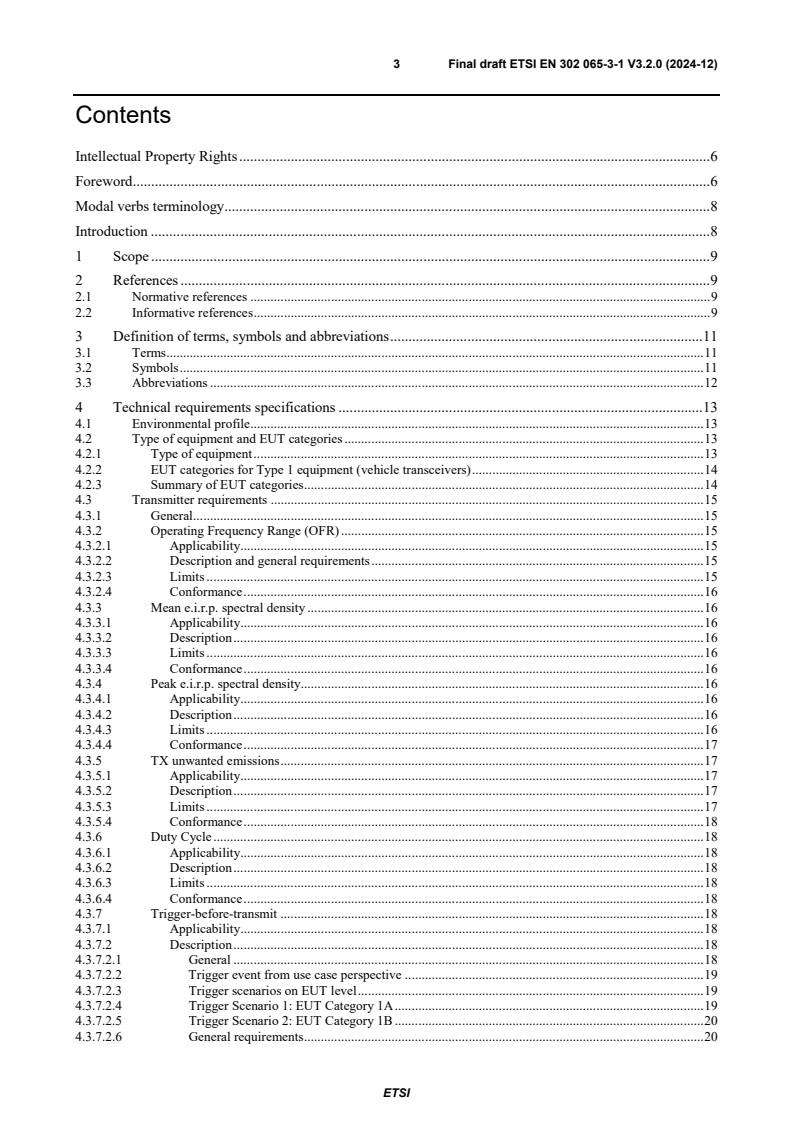
Contents
Intellectual Property Rights . 6
Foreword . 6
Modal verbs terminology . 8
Introduction . 8
1 Scope . 9
2 References . 9
2.1 Normative references . 9
2.2 Informative references . 9
3 Definition of terms, symbols and abbreviations . 11
3.1 Terms . 11
3.2 Symbols . 11
3.3 Abbreviations . 12
4 Technical requirements specifications . 13
4.1 Environmental profile . 13
4.2 Type of equipment and EUT categories . 13
4.2.1 Type of equipment . 13
4.2.2 EUT categories for Type 1 equipment (vehicle transceivers) . 14
4.2.3 Summary of EUT categories . 14
4.3 Transmitter requirements . 15
4.3.1 General . 15
4.3.2 Operating Frequency Range (OFR) . 15
4.3.2.1 Applicability. 15
4.3.2.2 Description and general requirements . 15
4.3.2.3 Limits . 15
4.3.2.4 Conformance . 16
4.3.3 Mean e.i.r.p. spectral density . 16
4.3.3.1 Applicability. 16
4.3.3.2 Description . 16
4.3.3.3 Limits . 16
4.3.3.4 Conformance . 16
4.3.4 Peak e.i.r.p. spectral density. 16
4.3.4.1 Applicability. 16
4.3.4.2 Description . 16
4.3.4.3 Limits . 16
4.3.4.4 Conformance . 17
4.3.5 TX unwanted emissions . 17
4.3.5.1 Applicability. 17
4.3.5.2 Description . 17
4.3.5.3 Limits . 17
4.3.5.4 Conformance . 18
4.3.6 Duty Cycle . 18
4.3.6.1 Applicability. 18
4.3.6.2 Description . 18
4.3.6.3 Limits . 18
4.3.6.4 Conformance . 18
4.3.7 Trigger-before-transmit . 18
4.3.7.1 Applicability. 18
4.3.7.2 Description . 18
4.3.7.2.1 General . 18
4.3.7.2.2 Trigger event from use case perspective . 19
4.3.7.2.3 Trigger scenarios on EUT level . 19
4.3.7.2.4 Trigger Scenario 1: EUT Category 1A . 19
4.3.7.2.5 Trigger Scenario 2: EUT Category 1B . 20
4.3.7.2.6 General requirements . 20
ETSI
4 Final draft ETSI EN 302 065-3-1 V3.2.0 (2024-12)
4.3.7.3 Limits . 20
4.3.7.4 Conformance . 21
4.3.8 TX behaviour under the complete environmental profile . 21
4.3.8.1 Applicability. 21
4.3.8.2 Description . 21
4.3.8.3 Limits . 21
4.3.8.4 Conformance . 21
4.4 Receiver requirements . 21
4.4.1 General . 21
4.4.2 Wanted Technical Performance Criteria . 22
4.4.2.1 Wanted Technical Performance Criterion 1 . 22
4.4.2.2 Wanted Technical Performance Criterion 2 . 22
4.4.3 Receiver spurious emissions . 23
4.4.3.1 Applicability. 23
4.4.3.2 Description . 23
4.4.3.3 Limits . 23
4.4.3.4 Conformance . 24
4.4.4 Receiver Baseline Sensitivity (RBS) . 24
4.4.4.1 Applicability. 24
4.4.4.2 Description . 24
4.4.4.3 Limits . 24
4.4.4.4 Conformance . 24
4.4.5 Receiver Baseline Resilience (RBR) . 25
4.4.5.1 Applicability. 25
4.4.5.2 Description . 25
4.4.5.3 Limits . 25
4.4.5.4 Conformance . 25
5 Testing for compliance with technical requirements . 26
5.1 Environmental conditions for testing . 26
5.1.1 General . 26
5.1.2 Normal test conditions . 26
5.1.3 Complete environmental profile test conditions . 26
5.2 General conditions for testing and conformance test suites . 26
5.2.1 General conditions for testing . 26
5.2.2 Conformance test suites . 26
5.2.3 Test scenarios . 27
5.3 Conformance methods of measurement for transmitter . 27
5.3.1 General . 27
5.3.2 Operating Frequency Range (OFR) . 27
5.3.3 Mean e.i.r.p. spectral density . 27
5.3.4 Peak e.i.r.p. spectral density. 28
5.3.5 TX unwanted emissions . 28
5.3.6 Duty Cycle . 28
5.3.6.1 Short-Term Duty Cycle . 28
5.3.6.2 Long-Term Duty Cycle . 29
5.3.7 Trigger-before-transmit . 30
5.3.7.1 General . 30
5.3.7.2 Setup for Trigger Scenario 1 . 30
5.3.7.3 Setup for Trigger Scenario 2 . 31
5.3.8 TX behaviour under the complete environmental profile . 32
5.3.8.1 General . 32
5.3.8.2 Conformance test procedure. 32
5.4 Conformance methods of measurement for receiver . 33
5.4.1 Receiver spurious emissions . 33
5.4.2 Receiver Baseline Sensitivity (RBS) . 33
5.4.3 Receiver Baseline Resilience (RBR) . 33
Annex A (informative): Relationship between the present document and the essential
requirements of Directive 2014/53/EU . 34
Annex B (informative): Selection of technical parameters . 36
ETSI
5 Final draft ETSI EN 302 065-3-1 V3.2.0 (2024-12)
Annex C (informative): Trigger-before-transmit . 38
C.1 Trigger behaviour . 38
C.2 Justification for trigger-before-transmit limits . 38
Annex D (informative): RBR Limits Derivation . 40
D.1 General . 40
D.2 Relevant interferers - Frequency Band 3,8 GHz to 4,2 GHz . 40
D.2.1 Relevant interferers . 40
D.2.2 Limits for Equipment Type 1 . 40
D.2.3 Limits for Equipment Type 2 . 40
D.3 Relevant interferers - Frequency Band 6,0 GHz to 8,5 GHz . 40
D.3.1 Relevant interferers . 40
D.3.2 Limits for Equipment Type 1 . 41
D.3.3 Limits for Equipment Type 2 . 41
D.4 Strong interferers . 42
D.4.1 WAS/RLAN in 5 925 MHz to 6 425 MHz . 42
D.4.2 Limits for Equipment Type 1 and Equipment Type 2 . 42
Annex E (informative): Bibliography . 43
Annex F (informative): Change history . 44
History . 45
ETSI
6 Final draft ETSI EN 302 065-3-1 V3.2.0 (2024-12)
Intellectual Property Rights
Essential patents
IPRs essential or potentially essential to normative deliverables may have been declared to ETSI. The declarations
pertaining to these essential IPRs, if any, are publicly available for ETSI members and non-members, and can be
found in ETSI SR 000 314: "Intellectual Property Rights (IPRs); Essential, or potentially Essential, IPRs notified to
ETSI in respect of ETSI standards", which is available from the ETSI Secretariat. Latest updates are available on the
ETSI IPR online database.
Pursuant to the ETSI Directives including the ETSI IPR Policy, no investigation regarding the essentiality of IPRs,
including IPR searches, has been carried out by ETSI. No guarantee can be given as to the existence of other IPRs not
referenced in ETSI SR 000 314 (or the updates on the ETSI Web server) which are, or may be, or may become,
essential to the present document.
Trademarks
The present document may include trademarks and/or tradenames which are asserted and/or registered by their owners.
ETSI claims no ownership of these except for any which are indicated as being the property of ETSI, and conveys no
right to use or reproduce any trademark and/or tradename. Mention of those trademarks in the present document does
not constitute an endorsement by ETSI of products, services or organizations associated with those trademarks.
DECT™, PLUGTESTS™, UMTS™ and the ETSI logo are trademarks of ETSI registered for the benefit of its
Members. 3GPP™, LTE™ and 5G™ logo are trademarks of ETSI registered for the benefit of its Members and of the
3GPP Organizational Partners. oneM2M™ logo is a trademark of ETSI registered for the benefit of its Members and of ®
the oneM2M Partners. GSM and the GSM logo are trademarks registered and owned by the GSM Association. ®
BLUETOOTH is a trademark registered and owned by Bluetooth SIG, Inc.
Foreword
This final draft Harmonised European Standard (EN) has been produced by ETSI Technical Committee
Electromagnetic compatibility and Radio spectrum Matters (ERM), and is now submitted for the Vote phase of the
ETSI Standardisation Request deliverable Approval Procedure (SRdAP).
The present document has been prepared under the Commission's standardisation request C(2015) 5376 final [i.2] to
provide one voluntary means of conforming to the essential requirements of Directive 2014/53/EU on the harmonisation
of the laws of the Member States relating to the making available on the market of radio equipment and repealing
Directive 1999/5/EC [i.1].
Once the present document is cited in the Official Journal of the European Union under that Directive, compliance with
the normative clauses of the present document given in Table A.1 confers, within the limits of the scope of the present
document, a presumption of conformity with the corresponding essential requirements of that Directive and associated
EFTA regulations.
The present document is part 3, sub-part 1 of a multi-part deliverable covering Short Range Devices (SRD) using Ultra
Wide Band technology (UWB); Harmonised standard for access to radio spectrum, as identified below:
Part 1: "Generic UWB devices":
Sub-part 1: "Communication devices within 3,1 GHz to 4,8 GHz using LDC mitigation or within the 6 GHz to
8,5 GHz".
Part 2: "Ultra Wide Band location tracking devices":
Sub-part 1: "Requirements for devices within 6 GHz to 8,5 GHz";
Sub-part 2: "Requirements for devices in the frequency band between 3,1 GHz to 4,8 GHz utilizing LDC
mitigation technique";
ETSI
7 Final draft ETSI EN 302 065-3-1 V3.2.0 (2024-12)
Sub-part 3: "Requirements for fixed infrastructure UWB based localization systems in the frequency band
between 3,1 GHz to 4,8 GHz deploying Detect-And-Avoid (DAA) mitigation technique";
Sub-part 4: "Requirements for fixed outdoor devices within 6,0 GHz to 8,5 GHz";
Sub-part 5: "Requirements for enhanced indoor devices within 6,0 GHz to 8,5 GHz".
Part 3: "UWB devices installed in motor and railway vehicles":
Sub-part 1: "Requirements for UWB devices for vehicular access systems within 3,8 GHz to 4,2 GHz
or 6 GHz to 8,5 GHz";
Sub-part 2: "Requirements for location tracking devices installed in rail and road vehicles operating in the
frequency range of 3,1 GHz to 4,8 GHz or 6,0 GHz to 8,5 GHz";
Sub-part 3: "Requirements for UWB radiodetermination applications operating within 6,0 GHz to 8,5 GHz".
Part 4: "Material Sensing devices":
Sub-part 1: "Building material analysis below 10,6 GHz";
Sub-part 2: "UWB Material Sensing devices for Security Scanning";
Sub-part 3: "Ground humidity and condition sensor;
Sub-part 4: "Exterior material sensing applications for ground based vehicles below 10,6 GHz";
Sub-part 5: "UWB surveillance devices for parking lot sensors below 10,6 GHz".
Part 5: "Devices using UWB technology onboard aircraft";
Part 6: "Ultra Wide Band radio-determination for radar sensing devices":
Sub-part 1: "Requirements for presence detection applications within 6,0 GHz to 8,5 GHz";
Sub-part 2: "Requirements for generic UWB through-air non-contact vital signs applications within 6,0 GHz
to 8,5 GHz";
Sub-part 3: "Requirements for fixed outdoor presence detection devices within 6,0 GHz to 8,5 GHz";
Sub-part 4: "Requirements for fixed outdoor through-air non-contact vital signs applications within 6,0 GHz to
8,5 GHz";
Sub-part 5: "Requirements for enhanced indoor presence detection devices within 6,0 GHz to 8,5 GHz";
Sub-part 6: "Requirements for enhanced indoor through-air non-contact vital signs applications within
6,0 GHz to 8,5 GHz".
NOTE 1: The list above shows the planned multi-part deliverable, at the time, when the present document was
finalized.
NOTE 2: Part 4, sub-parts 2 (UWB Material Sensing devices for Security Scanning), 3 (Ground humidity and
condition sensor below 10,6 GHz) and 5 (UWB surveillance devices for parking lot sensors
below 10,6 GHz) of this multi-part deliverable are under discussion (change WI) or will be stopped.
Proposed national transposition dates
Date of latest announcement of this EN (doa): 3 months after ETSI publication
Date of latest publication of new National Standard
or endorsement of this EN (dop/e): 6 months after doa
Date of withdrawal of any conflicting National Standard (dow): 18 months after doa
ETSI
8 Final draft ETSI EN 302 065-3-1 V3.2.0 (2024-12)
Modal verbs terminology
In the present document "shall", "shall not", "should", "should not", "may", "need not", "will", "will not", "can" and
"cannot" are to be interpreted as described in clause 3.2 of the ETSI Drafting Rules (Verbal forms for the expression of
provisions).
"must" and "must not" are NOT allowed in ETSI deliverables except when used in direct citation.
Introduction
For the present document, the applicable harmonised standard has been ETSI EN 302 065-3 [i.12], for UWB devices for
ground based vehicular applications, which was published in the OJEU without restriction at 10 March 2017 [i.9] and
then published at 5 February 2020 [i.10] with the following restriction:
• "This harmonised standard does not set out technical specifications for 'trigger before-transmit techniques'.
Implementing Decision (EU) 2019/785, however, imposes, as of 16 November 2019, technical requirements to
be used within the bands 3,8-4.2 GHz and 6-8,5 GHz for vehicular access systems using trigger-before
transmit. Therefore, compliance with this harmonised standard does not ensure compliance with Decision
(EU) 2019/785 and accordingly does not confer a presumption of conformity with those essential requirements
set out in Article 3 (2) of Directive 2014/53/EU which relate to 'trigger-before-transmit techniques'".
In order to consider the above points, ETSI ERM TGUWB decided to develop more specific standards; for the present
document this means instead of a generic ETSI EN 302 065-3 [i.12] standard for all road and rail vehicles applications,
an ETSI EN 302 065-3-1 for UWB devices for vehicular access systems. Other sub-parts for UWB devices installed in
motor and railway vehicles may follow (ETSI EN 302 065-3-x).
More details on the changes of the present document to previous versions are provided in annex F.
ETSI
9 Final draft ETSI EN 302 065-3-1 V3.2.0 (2024-12)
1 Scope
The present document specifies technical requirements, limits and test methods for equipment employing UWB for
vehicular access devices installed in motor and railway vehicles in the frequency ranges 3,8 GHz to 4,2 GHz and
6,0 GHz to 8,5 GHz.
These equipment types are intended to be utilized for vehicle access, vehicle immobilization and extended vehicle
access control functionalities (like closing windows or remotely starting the car).
Further details of the covered EUT can be found in clause 4.2.
NOTE: The relationship between the present document and essential requirements of article 3.2 of
Directive 2014/53/EU [i.1] is given in annex A.
2 References
2.1 Normative references
References are either specific (identified by date of publication and/or edition number or version number) or
non-specific. For specific references, only the cited version applies. For non-specific references, the latest version of the
referenced document (including any amendments) applies.
Referenced documents which are not found to be publicly available in the expected location might be found in the
ETSI docbox.
NOTE: While any hyperlinks included in this clause were valid at the time of publication, ETSI cannot guarantee
their long term validity.
The following referenced documents are necessary for the application of the present document.
[1] ETSI EN 303 883-1 (V2.1.1) (08-2024): "Short Range Devices (SRD) and Ultra Wide Band
(UWB); Part 1: Measurement techniques for transmitter requirements".
[2] ETSI EN 303 883-2 (V2.1.1) (08-2024): "Short Range Devices (SRD) and Ultra Wide Band
(UWB); Part 2: Measurement techniques for receiver requirements".
[3] ETSI TS 103 941 (V1.1.1) (01-2024): "Short Range Devices (SRD) and Ultra Wide Band (UWB);
Measurement setups and specifications for testing under full environmental profile (normal and
extreme environmental conditions)".
2.2 Informative references
References are either specific (identified by date of publication and/or edition number or version number) or
non-specific. For specific references, only the cited version applies. For non-specific references, the latest version of the
referenced document (including any amendments) applies.
NOTE: While any hyperlinks included in this clause were valid at the time of publication, ETSI cannot guarantee
their long term validity.
The following referenced documents are not necessary for the application of the present document, but they assist the
user with regard to a particular subject area.
[i.1] Directive 2014/53/EU of the European Parliament and of the Council of 16 April 2014 on the
harmonisation of the laws of the Member States relating to the making available on the market of
radio equipment and repealing Directive 1999/5/EC (RE-Directive).
[i.2] Commission implementing Decision C(2015) 5376 final of 4.8.2015 on a standardisation request
to the European Committee for Electrotechnical Standardisation and to the European
Telecommunications Standards Institute as regards radio equipment in support of
Directive 2014/53/EU of the European Parliament and of the Council.
ETSI
10 Final draft ETSI EN 302 065-3-1 V3.2.0 (2024-12)
[i.3] ETSI TR 103 416 (V1.1.1) (07-2016): "System Reference document (SRdoc); Short Range
Devices (SRD) using Ultra Wide Band (UWB); Technical characteristics and spectrum
requirements for UWB based vehicular access systems for operation in the 3,4 GHz to 4,8 GHz
and 6 GHz to 8,5 GHz frequency ranges".
[i.4] ECC/DEC/(06)04: "ECC Decision of 24 March 2006 on the harmonised use, exemption from
individual licensing and free circulation of devices using Ultra-Wideband (UWB) technology in
bands below 10.6 GHz (ECC Decision (06)04), amended on 6 July 2007, amended
9 December 2011, amended on 8 March 2019 and amended 18 November 2022".
[i.5] ETSI TS 103 361 (V1.1.1) (03-2016): "Short Range Devices (SRD) using Ultra Wide Band
technology (UWB); Receiver technical requirements, parameters and measurement procedures to
fulfil the requirements of the Directive 2014/53/EU".
[i.6] ECC Report 278 (27 April 2018): "Specific UWB applications in the band 3.4-4.8 GHz and
6.0-8.5 GHz: Location tracking and sensor applications (LTA) for vehicular access systems".
[i.7] Commission Implementing Decision (EU) 2024/1467 of 27 May 2024 amending Implementing
Decision (EU) 2019/785 on the harmonisation of radio spectrum for equipment using
ultra-wideband technology in the Union.
[i.8] Directive 1999/5/EC of the European Parliament and of the Council of 9 March 1999 on radio
equipment and telecommunications terminal equipment and the mutual recognition of their
conformity.
[i.9] Official Journal of the European Union, 13.7.2018: "Commission communication in the
framework of the implementation of Directive 1999/5/EC of the European Parliament and of the
Council on radio equipment and telecommunications terminal equipment and the mutual
recognition of their conformity and Directive 2014/53/EU of the European Parliament and of the
Council on the harmonisation of the laws of the Member States relating to the making available on
the market of radio equipment and repealing Directive 1999/5/EC".
[i.10] Commission Implementing Decision (EU) 2020/167 of 5 February 2020 on the harmonised
standards for radio equipment drafted in support of Directive 2014/53/EU of the European
Parliament and of the Council.
[i.11] ECC/DEC/(20)/01: "ECC Decision of 20 November 2020 on the harmonised use of the frequency
band 5945-6425 MHz for Wireless Access Systems including Radio Local Area Networks
(WAS/RLAN)".
[i.12] ETSI EN 302 065-3 (V2.1.1): "Short Range Devices (SRD) using Ultra Wide Band technology
(UWB); Harmonised Standard covering the essential requirements of article 3.2 of the
Directive 2014/53/EU; Part 3: Requirements for UWB devices for ground based vehicular
applications".
[i.13] ETSI EG 203 336 (V1.2.1): "Guide for the selection of technical parameters for the production of
Harmonised Standards covering article 3.1(b) and article 3.2 of Directive 2014/53/EU".
[i.14] ETSI TS 103 567 (V1.1.1): "Requirements on signal interferer handling".
[i.15] ERC Recommendation 74-01: "Unwanted emissions in the spurious domain", Approved 1998,
Corrected 23 May 2022.
ETSI
11 Final draft ETSI EN 302 065-3-1 V3.2.0 (2024-12)
3 Definition of terms, symbols and abbreviations
3.1 Terms
For the purposes of the present document, the terms given in ETSI EN 303 883-1 [1], ETSI EN 303 883-2 [2] and the
following apply:
control equipment: equipment capable of sending control messages to the EUT, as well as receiving responses to that
control command or other status messages, in order to setup the EUT and perform a measurement procedure
control message: one or more commands used to control or configure the EUT
NOTE: Typically submitted on a specific, non-UWB control interface, like CAN-bus interface.
EUT trigger event: trigger event on EUT level
NOTE: Which is used for measurement procedures in the present document.
initiator: EUT role in an UWB transmission sequence in which the EUT initiates UWB transmission upon a system
trigger event
NOTE: For more details see clause 4.3.7.2.
message: sequence or exchange of two or more packets in order to transfer information, in particular to generate a
ranging information
NOTE: Time-of-Flight between EUT and companion device.
packet: used to refer to an UWB data frame or aggregated pulse sequence, that is sent over the air
NOTE: Typically, one packet represents a continuous T time.
on
receiver spurious emissions: receiver unwanted emissions that emanate from the EUT
NOTE: Receiver spurious emissions are generated internally by the receiver or result from the interaction of the
RX coupling with the TX signal.
responder: EUT role in an UWB transmission sequence in which the EUT responds to an UWB transmission
NOTE: Typically an UWB transmission is a received UWB packet (for more details see clause 4.3.7.2.).
system trigger event: trigger event on system level
NOTE: Usually out of scope for EUT.
Time-of-Flight (ToF): travel time of the radio signal between transmitter and receiver
Trigger-Before-Transmit (TBT): mitigation technique as required for vehicular access systems
NOTE: See ECC/DEC/(06)04 [i.4].
vehicle transceiver: UWB enabled unit, installed in the vehicle
3.2 Symbols
For the purposes of the present document, the symbols given in ETSI EN 303 883-1 [1], ETSI EN 303 883-2 [2] and the
following apply:
d Measurement distance from the EUT to the test antenna
D Recommended measurement distance for the Receiver Baseline Sensitivity (RBS) test
d Sensitivity degradation
g
delta Θ Delta of the elevation angle Θ
delta Φ Delta of the azimuth angle Φ
ETSI
12 Final draft ETSI EN 302 065-3-1 V3.2.0 (2024-12)
f Centre frequency of wanted signal
c
f Highest frequency of the operating frequency range
H
Lowest frequency of the operating frequency range
fL
F Lower frequency for the spurious emissions test
LOWER
FUPPER Upper frequency for the spurious emissions test
OFR Maximum possible Operating Frequency Range (OFR)
max
P Sensitivity @ EUT
@EUT
P Maximum signal level in duty-cycle measurement
max
Threshold level
Pthres
s Second (unit)
t Highest temperature
high
t Lowest temperature
low
t Temperature steps for TX behaviour under the complete environment
steps
T Cease time, until a transmitter ceases transmission after a trigger event
cease
Disregard time
Tdis
T Observation time
obs
T Time interval between two consecutive bursts when the UWB emission is kept idle
off
T Duration of a burst irrespective of the number of pulses contained
on
T cumulated Ton time
on_cum
T Mean T
off mean off
Maximum T time
Ton max on
TBT Trigger-Before-Transmit timeout (cease time after EUT trigger)
timeout
TBT Trigger-Before-Transmit On-Time within any 10 s window after first EUT trigger
On-Time
X Parameter to specify the OFR of the emission
X Boundary value for determination of spurious domain
TXUE
3.3 Abbreviations
For the purposes of the present document, the abbreviations given in ETSI EN 303 883-1 [1], ETSI EN 303 883-2 [2]
and the following apply: ®
BLE Bluetooth Low Energy
BW BandWidth
CW Continuous Wave
DC Duty Cycle
EC European Commission
ECC European Communication Committee
EFTA European Free Trade Association
EIRP Equivalent Isotropically Radiated Power
EN European Norm
ERM Electromagnetic compatibility and Radio spectrum Matters
EG ETSI Guide
ETSI European Telecommunications Standards Institute
EU European Union
EUT Equipment Under Test
ID IDentification
LDC Low Duty Cycle
MSR Message Success Rate
NFC Near Field Communication
NLOS Non Line Of Sight
OFR Operating Frequency Range
OJEU Official Journal of the European Union
OOB Out Of band
RBR Receiver Baseline Resilience
RBS Receiver Baseline Sensitivity
RBW Resolution BandWidth
RF Radio Frequency
RLAN Radio Local Area Network
RMS Root Mean Square
RP Radiated Power
RTTE Radio and Telecommunications Terminal Equipment (Directive 1999/5/EC)
ETSI
13 Final draft ETSI EN 302 065-3-1 V3.2.0 (2024-12)
RX Receiver
SRD Short Range Device
TBT Trigger-Before-Transmit
TG Task Group
TGUWB Task Group Ultra Wide Band
ToF Time-of-Flight
TR Technical Report
TS Technical Specification
TX Transmitter
TXUE Transmitter Unwanted Emission
UWB Ultra Wide Band
VBW Video BandWidth
VLP Very Low Power
WAS Wireless Access Systems
4 Technical requirements specifications
4.1 Environmental profile
The technical requirements of the present document apply under the environ
...
ETSI EN 302 065-3-1 V3.2.1 (2025-02)
HARMONISED EUROPEAN STANDARD
Short Range Devices (SRD)
using Ultra Wide Band technology (UWB);
Harmonised standard for access to radio spectrum;
Part 3: UWB devices installed in motor and railway vehicles;
Sub-part 1: Requirements for UWB devices for vehicular
access systems within 3,8 GHz to 4,2 GHz or 6 GHz to 8,5 GHz
2 ETSI EN 302 065-3-1 V3.2.1 (2025-02)
Reference
REN/ERM-TGUWB-150-3-1
Keywords
harmonised standard, SRD, UWB
ETSI
650 Route des Lucioles
F-06921 Sophia Antipolis Cedex - FRANCE
Tel.: +33 4 92 94 42 00 Fax: +33 4 93 65 47 16
Siret N° 348 623 562 00017 - APE 7112B
Association à but non lucratif enregistrée à la
Sous-Préfecture de Grasse (06) N° w061004871
Important notice
The present document can be downloaded from the
ETSI Search & Browse Standards application.
The present document may be made available in electronic versions and/or in print. The content of any electronic and/or
print versions of the present document shall not be modified without the prior written authorization of ETSI. In case of any
existing or perceived difference in contents between such versions and/or in print, the prevailing version of an ETSI
deliverable is the one made publicly available in PDF format on ETSI deliver repository.
Users should be aware that the present document may be revised or have its status changed,
this information is available in the Milestones listing.
If you find errors in the present document, please send your comments to
the relevant service listed under Committee Support Staff.
If you find a security vulnerability in the present document, please report it through our
Coordinated Vulnerability Disclosure (CVD) program.
Notice of disclaimer & limitation of liability
The information provided in the present deliverable is directed solely to professionals who have the appropriate degree of
experience to understand and interpret its content in accordance with generally accepted engineering or
other professional standard and applicable regulations.
No recommendation as to products and services or vendors is made or should be implied.
In no event shall ETSI be held liable for loss of profits or any other incidental or consequential damages.
Any software contained in this deliverable is provided "AS IS" with no warranties, express or implied, including but not
limited to, the warranties of merchantability, fitness for a particular purpose and non-infringement of intellectual property
rights and ETSI shall not be held liable in any event for any damages whatsoever (including, without limitation, damages
for loss of profits, business interruption, loss of information, or any other pecuniary loss) arising out of or related to the use
of or inability to use the software.
Copyright Notification
No part may be reproduced or utilized in any form or by any means, electronic or mechanical, including photocopying and
microfilm except as authorized by written permission of ETSI.
The content of the PDF version shall not be modified without the written authorization of ETSI.
The copyright and the foregoing restriction extend to reproduction in all media.
© ETSI 2025.
All rights reserved.
ETSI
3 ETSI EN 302 065-3-1 V3.2.1 (2025-02)
Contents
Intellectual Property Rights . 6
Foreword . 6
Modal verbs terminology . 8
Introduction . 8
1 Scope . 9
2 References . 9
2.1 Normative references . 9
2.2 Informative references . 9
3 Definition of terms, symbols and abbreviations . 11
3.1 Terms . 11
3.2 Symbols . 11
3.3 Abbreviations . 12
4 Technical requirements specifications . 13
4.1 Environmental profile . 13
4.2 Type of equipment and EUT categories . 13
4.2.1 Type of equipment . 13
4.2.2 EUT categories for Type 1 equipment (vehicle transceivers) . 14
4.2.3 Summary of EUT categories . 14
4.3 Transmitter requirements . 15
4.3.1 General . 15
4.3.2 Operating Frequency Range (OFR) . 15
4.3.2.1 Applicability. 15
4.3.2.2 Description and general requirements . 15
4.3.2.3 Limits . 15
4.3.2.4 Conformance . 16
4.3.3 Mean e.i.r.p. spectral density . 16
4.3.3.1 Applicability. 16
4.3.3.2 Description . 16
4.3.3.3 Limits . 16
4.3.3.4 Conformance . 16
4.3.4 Peak e.i.r.p. spectral density. 16
4.3.4.1 Applicability. 16
4.3.4.2 Description . 16
4.3.4.3 Limits . 16
4.3.4.4 Conformance . 17
4.3.5 TX unwanted emissions . 17
4.3.5.1 Applicability. 17
4.3.5.2 Description . 17
4.3.5.3 Limits . 17
4.3.5.4 Conformance . 18
4.3.6 Duty Cycle . 18
4.3.6.1 Applicability. 18
4.3.6.2 Description . 18
4.3.6.3 Limits . 18
4.3.6.4 Conformance . 18
4.3.7 Trigger-before-transmit . 18
4.3.7.1 Applicability. 18
4.3.7.2 Description . 18
4.3.7.2.1 General . 18
4.3.7.2.2 Trigger event from use case perspective . 19
4.3.7.2.3 Trigger scenarios on EUT level . 19
4.3.7.2.4 Trigger Scenario 1: EUT Category 1A . 19
4.3.7.2.5 Trigger Scenario 2: EUT Category 1B . 20
4.3.7.2.6 General requirements . 20
ETSI
4 ETSI EN 302 065-3-1 V3.2.1 (2025-02)
4.3.7.3 Limits . 20
4.3.7.4 Conformance . 21
4.3.8 TX behaviour under the complete environmental profile . 21
4.3.8.1 Applicability. 21
4.3.8.2 Description . 21
4.3.8.3 Limits . 21
4.3.8.4 Conformance . 21
4.4 Receiver requirements . 21
4.4.1 General . 21
4.4.2 Wanted Technical Performance Criteria . 22
4.4.2.1 Wanted Technical Performance Criterion 1 . 22
4.4.2.2 Wanted Technical Performance Criterion 2 . 22
4.4.3 Receiver spurious emissions . 23
4.4.3.1 Applicability. 23
4.4.3.2 Description . 23
4.4.3.3 Limits . 23
4.4.3.4 Conformance . 24
4.4.4 Receiver Baseline Sensitivity (RBS) . 24
4.4.4.1 Applicability. 24
4.4.4.2 Description . 24
4.4.4.3 Limits . 24
4.4.4.4 Conformance . 24
4.4.5 Receiver Baseline Resilience (RBR) . 25
4.4.5.1 Applicability. 25
4.4.5.2 Description . 25
4.4.5.3 Limits . 25
4.4.5.4 Conformance . 25
5 Testing for compliance with technical requirements . 26
5.1 Environmental conditions for testing . 26
5.1.1 General . 26
5.1.2 Normal test conditions . 26
5.1.3 Complete environmental profile test conditions . 26
5.2 General conditions for testing and conformance test suites . 26
5.2.1 General conditions for testing . 26
5.2.2 Conformance test suites . 26
5.2.3 Test scenarios . 27
5.3 Conformance methods of measurement for transmitter . 27
5.3.1 General . 27
5.3.2 Operating Frequency Range (OFR) . 27
5.3.3 Mean e.i.r.p. spectral density . 27
5.3.4 Peak e.i.r.p. spectral density. 28
5.3.5 TX unwanted emissions . 28
5.3.6 Duty Cycle . 28
5.3.6.1 Short-Term Duty Cycle . 28
5.3.6.2 Long-Term Duty Cycle . 29
5.3.7 Trigger-before-transmit . 30
5.3.7.1 General . 30
5.3.7.2 Setup for Trigger Scenario 1 . 30
5.3.7.3 Setup for Trigger Scenario 2 . 31
5.3.8 TX behaviour under the complete environmental profile . 32
5.3.8.1 General . 32
5.3.8.2 Conformance test procedure. 32
5.4 Conformance methods of measurement for receiver . 33
5.4.1 Receiver spurious emissions . 33
5.4.2 Receiver Baseline Sensitivity (RBS) . 33
5.4.3 Receiver Baseline Resilience (RBR) . 33
Annex A (informative): Relationship between the present document and the essential
requirements of Directive 2014/53/EU . 34
Annex B (informative): Selection of technical parameters . 36
ETSI
5 ETSI EN 302 065-3-1 V3.2.1 (2025-02)
Annex C (informative): Trigger-before-transmit . 38
C.1 Trigger behaviour . 38
C.2 Justification for trigger-before-transmit limits . 38
Annex D (informative): RBR Limits Derivation . 40
D.1 General . 40
D.2 Relevant interferers - Frequency Band 3,8 GHz to 4,2 GHz . 40
D.2.1 Relevant interferers . 40
D.2.2 Limits for Equipment Type 1 . 40
D.2.3 Limits for Equipment Type 2 . 40
D.3 Relevant interferers - Frequency Band 6,0 GHz to 8,5 GHz . 40
D.3.1 Relevant interferers . 40
D.3.2 Limits for Equipment Type 1 . 41
D.3.3 Limits for Equipment Type 2 . 41
D.4 Strong interferers . 42
D.4.1 WAS/RLAN in 5 925 MHz to 6 425 MHz . 42
D.4.2 Limits for Equipment Type 1 and Equipment Type 2 . 42
Annex E (informative): Bibliography . 43
Annex F (informative): Change history . 44
History . 45
ETSI
6 ETSI EN 302 065-3-1 V3.2.1 (2025-02)
Intellectual Property Rights
Essential patents
IPRs essential or potentially essential to normative deliverables may have been declared to ETSI. The declarations
pertaining to these essential IPRs, if any, are publicly available for ETSI members and non-members, and can be
found in ETSI SR 000 314: "Intellectual Property Rights (IPRs); Essential, or potentially Essential, IPRs notified to
ETSI in respect of ETSI standards", which is available from the ETSI Secretariat. Latest updates are available on the
ETSI IPR online database.
Pursuant to the ETSI Directives including the ETSI IPR Policy, no investigation regarding the essentiality of IPRs,
including IPR searches, has been carried out by ETSI. No guarantee can be given as to the existence of other IPRs not
referenced in ETSI SR 000 314 (or the updates on the ETSI Web server) which are, or may be, or may become,
essential to the present document.
Trademarks
The present document may include trademarks and/or tradenames which are asserted and/or registered by their owners.
ETSI claims no ownership of these except for any which are indicated as being the property of ETSI, and conveys no
right to use or reproduce any trademark and/or tradename. Mention of those trademarks in the present document does
not constitute an endorsement by ETSI of products, services or organizations associated with those trademarks.
DECT™, PLUGTESTS™, UMTS™ and the ETSI logo are trademarks of ETSI registered for the benefit of its
Members. 3GPP™, LTE™ and 5G™ logo are trademarks of ETSI registered for the benefit of its Members and of the
3GPP Organizational Partners. oneM2M™ logo is a trademark of ETSI registered for the benefit of its Members and of ®
the oneM2M Partners. GSM and the GSM logo are trademarks registered and owned by the GSM Association. ®
BLUETOOTH is a trademark registered and owned by Bluetooth SIG, Inc.
Foreword
This Harmonised European Standard (EN) has been produced by ETSI Technical Committee Electromagnetic
compatibility and Radio spectrum Matters (ERM).
The present document has been prepared under the Commission's standardisation request C(2015) 5376 final [i.2] to
provide one voluntary means of conforming to the essential requirements of Directive 2014/53/EU on the harmonisation
of the laws of the Member States relating to the making available on the market of radio equipment and repealing
Directive 1999/5/EC [i.1].
Once the present document is cited in the Official Journal of the European Union under that Directive, compliance with
the normative clauses of the present document given in Table A.1 confers, within the limits of the scope of the present
document, a presumption of conformity with the corresponding essential requirements of that Directive and associated
EFTA regulations.
The present document is part 3, sub-part 1 of a multi-part deliverable covering Short Range Devices (SRD) using Ultra
Wide Band technology (UWB); Harmonised standard for access to radio spectrum, as identified below:
Part 1: "Generic UWB devices":
Sub-part 1: "Communication devices within 3,1 GHz to 4,8 GHz using LDC mitigation or within the 6 GHz to
8,5 GHz".
Part 2: "Ultra Wide Band location tracking devices":
Sub-part 1: "Requirements for devices within 6 GHz to 8,5 GHz";
Sub-part 2: "Requirements for devices in the frequency band between 3,1 GHz to 4,8 GHz utilizing LDC
mitigation technique";
Sub-part 3: "Requirements for fixed infrastructure UWB based localization systems in the frequency band
between 3,1 GHz to 4,8 GHz deploying Detect-And-Avoid (DAA) mitigation technique";
ETSI
7 ETSI EN 302 065-3-1 V3.2.1 (2025-02)
Sub-part 4: "Requirements for fixed outdoor devices within 6,0 GHz to 8,5 GHz";
Sub-part 5: "Requirements for enhanced indoor devices within 6,0 GHz to 8,5 GHz".
Part 3: "UWB devices installed in motor and railway vehicles":
Sub-part 1: "Requirements for UWB devices for vehicular access systems within 3,8 GHz to 4,2 GHz
or 6 GHz to 8,5 GHz";
Sub-part 2: "Requirements for location tracking devices installed in rail and road vehicles operating in the
frequency range of 3,1 GHz to 4,8 GHz or 6,0 GHz to 8,5 GHz";
Sub-part 3: "Requirements for UWB radiodetermination applications operating within 6,0 GHz to 8,5 GHz".
Part 4: "Material Sensing devices":
Sub-part 1: "Building material analysis operating within 30 MHz to 10,6 GHz";
Sub-part 2: "UWB Material Sensing devices for Security Scanning";
Sub-part 3: "Ground humidity and condition sensor;
Sub-part 4: "Exterior material sensing applications for ground based vehicles below 10,6 GHz";
Sub-part 5: "UWB surveillance devices for parking lot sensors below 10,6 GHz".
Part 5: "Devices using UWB technology onboard aircraft";
Part 6: "Ultra Wide Band radio-determination for radar sensing devices":
Sub-part 1: "Requirements for presence detection applications within 6,0 GHz to 8,5 GHz";
Sub-part 2: "Requirements for generic UWB through-air non-contact vital signs applications within 6,0 GHz
to 8,5 GHz";
Sub-part 3: "Requirements for fixed outdoor presence detection devices within 6,0 GHz to 8,5 GHz";
Sub-part 4: "Requirements for fixed outdoor through-air non-contact vital signs applications within 6,0 GHz to
8,5 GHz";
Sub-part 5: "Requirements for enhanced indoor presence detection devices within 6,0 GHz to 8,5 GHz";
Sub-part 6: "Requirements for enhanced indoor through-air non-contact vital signs applications within
6,0 GHz to 8,5 GHz".
NOTE 1: The list above shows the planned multi-part deliverable, at the time, when the present document was
finalized.
NOTE 2: Part 4, sub-parts 2 (UWB Material Sensing devices for Security Scanning), 3 (Ground humidity and
condition sensor below 10,6 GHz) and 5 (UWB surveillance devices for parking lot sensors
below 10,6 GHz) of this multi-part deliverable are under discussion (change WI) or will be stopped.
National transposition dates
Date of adoption of this EN: 18 February 2025
Date of latest announcement of this EN (doa): 31 May 2025
Date of latest publication of new National Standard
or endorsement of this EN (dop/e): 30 November 2025
Date of withdrawal of any conflicting National Standard (dow): 30 November 2026
ETSI
UWB devices installed in motor and railway vehicles ma8y follow ETSI EN 302 065-3-1 V3.2.1 (2025-02)
Modal verbs terminology
In the present document "shall", "shall not", "should", "should not", "may", "need not", "will", "will not", "can" and
"cannot" are to be interpreted as described in clause 3.2 of the ETSI Drafting Rules (Verbal forms for the expression of
provisions).
"must" and "must not" are NOT allowed in ETSI deliverables except when used in direct citation.
Introduction
For the present document, the applicable harmonised standard has been ETSI EN 302 065-3 [i.12], for UWB devices for
ground based vehicular applications, which was published in the OJEU without restriction at 10 March 2017 [i.9] and
then published at 5 February 2020 [i.10] with the following restriction:
• "This harmonised standard does not set out technical specifications for 'trigger before-transmit techniques'.
Implementing Decision (EU) 2019/785, however, imposes, as of 16 November 2019, technical requirements to
be used within the bands 3,8-4.2 GHz and 6-8,5 GHz for vehicular access systems using trigger-before
transmit. Therefore, compliance with this harmonised standard does not ensure compliance with Decision
(EU) 2019/785 and accordingly does not confer a presumption of conformity with those essential requirements
set out in Article 3 (2) of Directive 2014/53/EU which relate to 'trigger-before-transmit techniques'".
In order to consider the above points, ETSI ERM TGUWB decided to develop more specific standards; for the present
document this means instead of a generic ETSI EN 302 065-3 [i.12] standard for all road and rail vehicles applications,
an ETSI EN 302 065-3-1 for UWB devices for vehicular access systems. Other sub-parts for UWB devices installed in
motor and railway vehicles may follow (ETSI EN 302 065-3-x).
More details on the changes of the present document to previous versions are provided in annex F.
ETSI
. 9 ETSI EN 302 065-3-1 V3.2.1 (2025-02)
1 Scope
The present document specifies technical requirements, limits and test methods for equipment employing UWB for
vehicular access devices installed in motor and railway vehicles in the frequency ranges 3,8 GHz to 4,2 GHz and
6,0 GHz to 8,5 GHz.
These equipment types are intended to be utilized for vehicle access, vehicle immobilization and extended vehicle
access control functionalities (like closing windows or remotely starting the car).
Further details of the covered EUT can be found in clause 4.2.
NOTE: The relationship between the present document and essential requirements of article 3.2 of
Directive 2014/53/EU [i.1] is given in annex A.
2 References
2.1 Normative references
References are either specific (identified by date of publication and/or edition number or version number) or
non-specific. For specific references, only the cited version applies. For non-specific references, the latest version of the
referenced document (including any amendments) applies.
Referenced documents which are not found to be publicly available in the expected location might be found in the
ETSI docbox.
NOTE: While any hyperlinks included in this clause were valid at the time of publication, ETSI cannot guarantee
their long term validity.
The following referenced documents are necessary for the application of the present document.
[1] ETSI EN 303 883-1 (V2.1.1) (08-2024): "Short Range Devices (SRD) and Ultra Wide Band
(UWB); Part 1: Measurement techniques for transmitter requirements".
[2] ETSI EN 303 883-2 (V2.1.1) (08-2024): "Short Range Devices (SRD) and Ultra Wide Band
(UWB); Part 2: Measurement techniques for receiver requirements".
[3] ETSI TS 103 941 (V1.1.1) (01-2024): "Short Range Devices (SRD) and Ultra Wide Band (UWB);
Measurement setups and specifications for testing under full environmental profile (normal and
extreme environmental conditions)".
2.2 Informative references
References are either specific (identified by date of publication and/or edition number or version number) or
non-specific. For specific references, only the cited version applies. For non-specific references, the latest version of the
referenced document (including any amendments) applies.
NOTE: While any hyperlinks included in this clause were valid at the time of publication, ETSI cannot guarantee
their long term validity.
The following referenced documents are not necessary for the application of the present document, but they assist the
user with regard to a particular subject area.
[i.1] Directive 2014/53/EU of the European Parliament and of the Council of 16 April 2014 on the
harmonisation of the laws of the Member States relating to the making available on the market of
radio equipment and repealing Directive 1999/5/EC (RE-Directive).
[i.2] Commission implementing Decision C(2015) 5376 final of 4.8.2015 on a standardisation request
to the European Committee for Electrotechnical Standardisation and to the European
Telecommunications Standards Institute as regards radio equipment in support of
Directive 2014/53/EU of the European Parliament and of the Council.
ETSI
. 10 ETSI EN 302 065-3-1 V3.2.1 (2025-02)
[i.3] ETSI TR 103 416 (V1.1.1) (07-2016): "System Reference document (SRdoc); Short Range
Devices (SRD) using Ultra Wide Band (UWB); Technical characteristics and spectrum
requirements for UWB based vehicular access systems for operation in the 3,4 GHz to 4,8 GHz
and 6 GHz to 8,5 GHz frequency ranges".
[i.4] ECC/DEC/(06)04: "ECC Decision of 24 March 2006 on the harmonised use, exemption from
individual licensing and free circulation of devices using Ultra-Wideband (UWB) technology in
bands below 10.6 GHz (ECC Decision (06)04), amended on 6 July 2007, amended
9 December 2011, amended on 8 March 2019 and amended 18 November 2022".
[i.5] ETSI TS 103 361 (V1.1.1) (03-2016): "Short Range Devices (SRD) using Ultra Wide Band
technology (UWB); Receiver technical requirements, parameters and measurement procedures to
fulfil the requirements of the Directive 2014/53/EU".
[i.6] ECC Report 278 (27 April 2018): "Specific UWB applications in the band 3.4-4.8 GHz and
6.0-8.5 GHz: Location tracking and sensor applications (LTA) for vehicular access systems".
[i.7] Commission Implementing Decision (EU) 2024/1467 of 27 May 2024 amending Implementing
Decision (EU) 2019/785 on the harmonisation of radio spectrum for equipment using
ultra-wideband technology in the Union.
[i.8] Directive 1999/5/EC of the European Parliament and of the Council of 9 March 1999 on radio
equipment and telecommunications terminal equipment and the mutual recognition of their
conformity.
[i.9] Official Journal of the European Union, 13.7.2018: "Commission communication in the
framework of the implementation of Directive 1999/5/EC of the European Parliament and of the
Council on radio equipment and telecommunications terminal equipment and the mutual
recognition of their conformity and Directive 2014/53/EU of the European Parliament and of the
Council on the harmonisation of the laws of the Member States relating to the making available on
the market of radio equipment and repealing Directive 1999/5/EC".
[i.10] Commission Implementing Decision (EU) 2020/167 of 5 February 2020 on the harmonised
standards for radio equipment drafted in support of Directive 2014/53/EU of the European
Parliament and of the Council.
[i.11] ECC/DEC/(20)/01: "ECC Decision of 20 November 2020 on the harmonised use of the frequency
band 5945-6425 MHz for Wireless Access Systems including Radio Local Area Networks
(WAS/RLAN)".
[i.12] ETSI EN 302 065-3 (V2.1.1): "Short Range Devices (SRD) using Ultra Wide Band technology
(UWB); Harmonised Standard covering the essential requirements of article 3.2 of the
Directive 2014/53/EU; Part 3: Requirements for UWB devices for ground based vehicular
applications".
[i.13] ETSI EG 203 336 (V1.2.1): "Guide for the selection of technical parameters for the production of
Harmonised Standards covering article 3.1(b) and article 3.2 of Directive 2014/53/EU".
[i.14] ETSI TS 103 567 (V1.1.1): "Requirements on signal interferer handling".
[i.15] ERC Recommendation 74-01: "Unwanted emissions in the spurious domain", Approved 1998,
Corrected 23 May 2022.
ETSI
. 11 ETSI EN 302 065-3-1 V3.2.1 (2025-02)
3 Definition of terms, symbols and abbreviations
3.1 Terms
For the purposes of the present document, the terms given in ETSI EN 303 883-1 [1], ETSI EN 303 883-2 [2] and the
following apply:
control equipment: equipment capable of sending control messages to the EUT, as well as receiving responses to that
control command or other status messages, in order to setup the EUT and perform a measurement procedure
control message: one or more commands used to control or configure the EUT
NOTE: Typically submitted on a specific, non-UWB control interface, like CAN-bus interface.
EUT trigger event: trigger event on EUT level
NOTE: Which is used for measurement procedures in the present document.
initiator: EUT role in an UWB transmission sequence in which the EUT initiates UWB transmission upon a system
trigger event
NOTE: For more details see clause 4.3.7.2.
message: sequence or exchange of two or more packets in order to transfer information, in particular to generate a
ranging information
NOTE: Time-of-Flight between EUT and companion device.
packet: used to refer to an UWB data frame or aggregated pulse sequence, that is sent over the air
NOTE: Typically, one packet represents a continuous T time.
on
receiver spurious emissions: receiver unwanted emissions that emanate from the EUT
NOTE: Receiver spurious emissions are generated internally by the receiver or result from the interaction of the
RX coupling with the TX signal.
responder: EUT role in an UWB transmission sequence in which the EUT responds to an UWB transmission
NOTE: Typically an UWB transmission is a received UWB packet (for more details see clause 4.3.7.2.).
system trigger event: trigger event on system level
NOTE: Usually out of scope for EUT.
Time-of-Flight (ToF): travel time of the radio signal between transmitter and receiver
Trigger-Before-Transmit (TBT): mitigation technique as required for vehicular access systems
NOTE: See ECC/DEC/(06)04 [i.4].
vehicle transceiver: UWB enabled unit, installed in the vehicle
3.2 Symbols
For the purposes of the present document, the symbols given in ETSI EN 303 883-1 [1], ETSI EN 303 883-2 [2] and the
following apply:
d Measurement distance from the EUT to the test/measurement antenna
D Recommended measurement distance for the Receiver Baseline Sensitivity (RBS) test
d Sensitivity degradation
g
delta Θ Delta of the elevation angle Θ
delta Φ Delta of the azimuth angle Φ
ETSI
. 12 ETSI EN 302 065-3-1 V3.2.1 (2025-02)
f Centre frequency of wanted signal
c
f Highest frequency of the operating frequency range
H
f Lowest frequency of the operating frequency range
L
F Lower frequency for the spurious emissions test
LOWER
FUPPER Upper frequency for the spurious emissions test
OFR Maximum possible Operating Frequency Range (OFR)
max
P Sensitivity @ EUT
@EUT
P Maximum signal level in duty-cycle measurement
max
P Threshold level
thres
s Second (unit)
t Highest temperature
high
t Lowest temperature
low
t Temperature steps for TX behaviour under the complete environment
steps
T Cease time, until a transmitter ceases transmission after a trigger event
cease
T Disregard time
dis
T Observation time
obs
T Time interval between two consecutive bursts when the UWB emission is kept idle
off
T Duration of a burst irrespective of the number of pulses contained
on
T cumulated Ton time
on_cum
T Mean T
off mean off
T Maximum T time
on max on
TBT Trigger-Before-Transmit timeout (cease time after EUT trigger)
timeout
TBT Trigger-Before-Transmit On-Time within any 10 s window after first EUT trigger
On-Time
X Parameter to specify the OFR of the emission
X Boundary value for determination of spurious domain
TXUE
3.3 Abbreviations
For the purposes of the present document, the abbreviations given in ETSI EN 303 883-1 [1], ETSI EN 303 883-2 [2]
and the following apply: ®
BLE Bluetooth Low Energy
BW BandWidth
CW Continuous Wave
DC Duty Cycle
EC European Commission
ECC European Communication Committee
EFTA European Free Trade Association
EIRP Equivalent Isotropically Radiated Power
EN European Norm
ERM Electromagnetic compatibility and Radio spectrum Matters
EG ETSI Guide
ETSI European Telecommunications Standards Institute
EU European Union
EUT Equipment Under Test
ID IDentification
LDC Low Duty Cycle
MSR Message Success Rate
NFC Near Field Communication
NLOS Non Line Of Sight
OFR Operating Frequency Range
OJEU Official Journal of the European Union
OOB Out Of band
RBR Receiver Baseline Resilience
RBS Receiver Baseline Sensitivity
RBW Resolution BandWidth
RF Radio Frequency
RLAN Radio Local Area Network
RMS Root Mean Square
RP Radiated Power
RSE Receiver Spurious Emission
ETSI
. 13 ETSI EN 302 065-3-1 V3.2.1 (2025-02)
RTTE Radio and Telecommunications Terminal Equipment (Directive 1999/5/EC)
RX Receiver
SRD Short Range Device
TBT Trigger-Before-Transmit
TG Task Group
TGUWB Task Group Ultra Wide Band
ToF Time-of-Flight
TR Technical Report
TS Technical Specification
TX Transmitter
TXUE Transmitter Unwanted Emission
UWB Ultra Wide Band
VBW Video BandWidth
VLP Very Low Power
WAS Wireless Access Systems
4 Technical requirements specifications
4.1 Environmental profile
The technical requirements of the present document apply under the environmental profile for operation of the
equipment, which shall be in accordance with its intended use, but as a minimum, shall be that specifi
...
SLOVENSKI STANDARD
01-maj-2025
Naprave kratkega dosega (SRD), ki uporabljajo ultra širokopasovno (UWB)
tehnologijo - Harmonizirani standard za dostop do radijskega spektra - 3. del:
Naprave UWB, vgrajene v motorna in železniška vozila - 1. poddel: Zahteve za ultra
širokopasovne (UWB) naprave za avtomobilske sisteme za dostop v območju od
3,8 GHz do 4,2 GHz ali od 6 GHz do 8,5 GHz
Short Range Devices (SRD) using Ultra Wide Band technology (UWB) - Harmonised
standard for access to radio spectrum - Part 3: UWB devices installed in motor and
railway vehicles - Sub-part 1: Requirements for UWB devices for vehicular access
systems within 3,8 GHz to 4,2 GHz or 6 GHz to 8,5 GHz
Ta slovenski standard je istoveten z: ETSI EN 302 065-3-1 V3.2.1 (2025-02)
ICS:
33.060.99 Druga oprema za radijske Other equipment for
komunikacije radiocommunications
43.040.15 Avtomobilska informatika. Car informatics. On board
Vgrajeni računalniški sistemi computer systems
2003-01.Slovenski inštitut za standardizacijo. Razmnoževanje celote ali delov tega standarda ni dovoljeno.
ETSI EN 302 065-3-1 V3.2.1 (2025-02)
HARMONISED EUROPEAN STANDARD
Short Range Devices (SRD)
using Ultra Wide Band technology (UWB);
Harmonised standard for access to radio spectrum;
Part 3: UWB devices installed in motor and railway vehicles;
Sub-part 1: Requirements for UWB devices for vehicular
access systems within 3,8 GHz to 4,2 GHz or 6 GHz to 8,5 GHz
2 ETSI EN 302 065-3-1 V3.2.1 (2025-02)
Reference
REN/ERM-TGUWB-150-3-1
Keywords
harmonised standard, SRD, UWB
ETSI
650 Route des Lucioles
F-06921 Sophia Antipolis Cedex - FRANCE
Tel.: +33 4 92 94 42 00 Fax: +33 4 93 65 47 16
Siret N° 348 623 562 00017 - APE 7112B
Association à but non lucratif enregistrée à la
Sous-Préfecture de Grasse (06) N° w061004871
Important notice
The present document can be downloaded from the
ETSI Search & Browse Standards application.
The present document may be made available in electronic versions and/or in print. The content of any electronic and/or
print versions of the present document shall not be modified without the prior written authorization of ETSI. In case of any
existing or perceived difference in contents between such versions and/or in print, the prevailing version of an ETSI
deliverable is the one made publicly available in PDF format on ETSI deliver repository.
Users should be aware that the present document may be revised or have its status changed,
this information is available in the Milestones listing.
If you find errors in the present document, please send your comments to
the relevant service listed under Committee Support Staff.
If you find a security vulnerability in the present document, please report it through our
Coordinated Vulnerability Disclosure (CVD) program.
Notice of disclaimer & limitation of liability
The information provided in the present deliverable is directed solely to professionals who have the appropriate degree of
experience to understand and interpret its content in accordance with generally accepted engineering or
other professional standard and applicable regulations.
No recommendation as to products and services or vendors is made or should be implied.
In no event shall ETSI be held liable for loss of profits or any other incidental or consequential damages.
Any software contained in this deliverable is provided "AS IS" with no warranties, express or implied, including but not
limited to, the warranties of merchantability, fitness for a particular purpose and non-infringement of intellectual property
rights and ETSI shall not be held liable in any event for any damages whatsoever (including, without limitation, damages
for loss of profits, business interruption, loss of information, or any other pecuniary loss) arising out of or related to the use
of or inability to use the software.
Copyright Notification
No part may be reproduced or utilized in any form or by any means, electronic or mechanical, including photocopying and
microfilm except as authorized by written permission of ETSI.
The content of the PDF version shall not be modified without the written authorization of ETSI.
The copyright and the foregoing restriction extend to reproduction in all media.
© ETSI 2025.
All rights reserved.
ETSI
3 ETSI EN 302 065-3-1 V3.2.1 (2025-02)
Contents
Intellectual Property Rights . 6
Foreword . 6
Modal verbs terminology . 8
Introduction . 8
1 Scope . 9
2 References . 9
2.1 Normative references . 9
2.2 Informative references . 9
3 Definition of terms, symbols and abbreviations . 11
3.1 Terms . 11
3.2 Symbols . 11
3.3 Abbreviations . 12
4 Technical requirements specifications . 13
4.1 Environmental profile . 13
4.2 Type of equipment and EUT categories . 13
4.2.1 Type of equipment . 13
4.2.2 EUT categories for Type 1 equipment (vehicle transceivers) . 14
4.2.3 Summary of EUT categories . 14
4.3 Transmitter requirements . 15
4.3.1 General . 15
4.3.2 Operating Frequency Range (OFR) . 15
4.3.2.1 Applicability. 15
4.3.2.2 Description and general requirements . 15
4.3.2.3 Limits . 15
4.3.2.4 Conformance . 16
4.3.3 Mean e.i.r.p. spectral density . 16
4.3.3.1 Applicability. 16
4.3.3.2 Description . 16
4.3.3.3 Limits . 16
4.3.3.4 Conformance . 16
4.3.4 Peak e.i.r.p. spectral density. 16
4.3.4.1 Applicability. 16
4.3.4.2 Description . 16
4.3.4.3 Limits . 16
4.3.4.4 Conformance . 17
4.3.5 TX unwanted emissions . 17
4.3.5.1 Applicability. 17
4.3.5.2 Description . 17
4.3.5.3 Limits . 17
4.3.5.4 Conformance . 18
4.3.6 Duty Cycle . 18
4.3.6.1 Applicability. 18
4.3.6.2 Description . 18
4.3.6.3 Limits . 18
4.3.6.4 Conformance . 18
4.3.7 Trigger-before-transmit . 18
4.3.7.1 Applicability. 18
4.3.7.2 Description . 18
4.3.7.2.1 General . 18
4.3.7.2.2 Trigger event from use case perspective . 19
4.3.7.2.3 Trigger scenarios on EUT level . 19
4.3.7.2.4 Trigger Scenario 1: EUT Category 1A . 19
4.3.7.2.5 Trigger Scenario 2: EUT Category 1B . 20
4.3.7.2.6 General requirements . 20
ETSI
4 ETSI EN 302 065-3-1 V3.2.1 (2025-02)
4.3.7.3 Limits . 20
4.3.7.4 Conformance . 21
4.3.8 TX behaviour under the complete environmental profile . 21
4.3.8.1 Applicability. 21
4.3.8.2 Description . 21
4.3.8.3 Limits . 21
4.3.8.4 Conformance . 21
4.4 Receiver requirements . 21
4.4.1 General . 21
4.4.2 Wanted Technical Performance Criteria . 22
4.4.2.1 Wanted Technical Performance Criterion 1 . 22
4.4.2.2 Wanted Technical Performance Criterion 2 . 22
4.4.3 Receiver spurious emissions . 23
4.4.3.1 Applicability. 23
4.4.3.2 Description . 23
4.4.3.3 Limits . 23
4.4.3.4 Conformance . 24
4.4.4 Receiver Baseline Sensitivity (RBS) . 24
4.4.4.1 Applicability. 24
4.4.4.2 Description . 24
4.4.4.3 Limits . 24
4.4.4.4 Conformance . 24
4.4.5 Receiver Baseline Resilience (RBR) . 25
4.4.5.1 Applicability. 25
4.4.5.2 Description . 25
4.4.5.3 Limits . 25
4.4.5.4 Conformance . 25
5 Testing for compliance with technical requirements . 26
5.1 Environmental conditions for testing . 26
5.1.1 General . 26
5.1.2 Normal test conditions . 26
5.1.3 Complete environmental profile test conditions . 26
5.2 General conditions for testing and conformance test suites . 26
5.2.1 General conditions for testing . 26
5.2.2 Conformance test suites . 26
5.2.3 Test scenarios . 27
5.3 Conformance methods of measurement for transmitter . 27
5.3.1 General . 27
5.3.2 Operating Frequency Range (OFR) . 27
5.3.3 Mean e.i.r.p. spectral density . 27
5.3.4 Peak e.i.r.p. spectral density. 28
5.3.5 TX unwanted emissions . 28
5.3.6 Duty Cycle . 28
5.3.6.1 Short-Term Duty Cycle . 28
5.3.6.2 Long-Term Duty Cycle . 29
5.3.7 Trigger-before-transmit . 30
5.3.7.1 General . 30
5.3.7.2 Setup for Trigger Scenario 1 . 30
5.3.7.3 Setup for Trigger Scenario 2 . 31
5.3.8 TX behaviour under the complete environmental profile . 32
5.3.8.1 General . 32
5.3.8.2 Conformance test procedure. 32
5.4 Conformance methods of measurement for receiver . 33
5.4.1 Receiver spurious emissions . 33
5.4.2 Receiver Baseline Sensitivity (RBS) . 33
5.4.3 Receiver Baseline Resilience (RBR) . 33
Annex A (informative): Relationship between the present document and the essential
requirements of Directive 2014/53/EU . 34
Annex B (informative): Selection of technical parameters . 36
ETSI
5 ETSI EN 302 065-3-1 V3.2.1 (2025-02)
Annex C (informative): Trigger-before-transmit . 38
C.1 Trigger behaviour . 38
C.2 Justification for trigger-before-transmit limits . 38
Annex D (informative): RBR Limits Derivation . 40
D.1 General . 40
D.2 Relevant interferers - Frequency Band 3,8 GHz to 4,2 GHz . 40
D.2.1 Relevant interferers . 40
D.2.2 Limits for Equipment Type 1 . 40
D.2.3 Limits for Equipment Type 2 . 40
D.3 Relevant interferers - Frequency Band 6,0 GHz to 8,5 GHz . 40
D.3.1 Relevant interferers . 40
D.3.2 Limits for Equipment Type 1 . 41
D.3.3 Limits for Equipment Type 2 . 41
D.4 Strong interferers . 42
D.4.1 WAS/RLAN in 5 925 MHz to 6 425 MHz . 42
D.4.2 Limits for Equipment Type 1 and Equipment Type 2 . 42
Annex E (informative): Bibliography . 43
Annex F (informative): Change history . 44
History . 45
ETSI
6 ETSI EN 302 065-3-1 V3.2.1 (2025-02)
Intellectual Property Rights
Essential patents
IPRs essential or potentially essential to normative deliverables may have been declared to ETSI. The declarations
pertaining to these essential IPRs, if any, are publicly available for ETSI members and non-members, and can be
found in ETSI SR 000 314: "Intellectual Property Rights (IPRs); Essential, or potentially Essential, IPRs notified to
ETSI in respect of ETSI standards", which is available from the ETSI Secretariat. Latest updates are available on the
ETSI IPR online database.
Pursuant to the ETSI Directives including the ETSI IPR Policy, no investigation regarding the essentiality of IPRs,
including IPR searches, has been carried out by ETSI. No guarantee can be given as to the existence of other IPRs not
referenced in ETSI SR 000 314 (or the updates on the ETSI Web server) which are, or may be, or may become,
essential to the present document.
Trademarks
The present document may include trademarks and/or tradenames which are asserted and/or registered by their owners.
ETSI claims no ownership of these except for any which are indicated as being the property of ETSI, and conveys no
right to use or reproduce any trademark and/or tradename. Mention of those trademarks in the present document does
not constitute an endorsement by ETSI of products, services or organizations associated with those trademarks.
DECT™, PLUGTESTS™, UMTS™ and the ETSI logo are trademarks of ETSI registered for the benefit of its
Members. 3GPP™, LTE™ and 5G™ logo are trademarks of ETSI registered for the benefit of its Members and of the
3GPP Organizational Partners. oneM2M™ logo is a trademark of ETSI registered for the benefit of its Members and of ®
the oneM2M Partners. GSM and the GSM logo are trademarks registered and owned by the GSM Association. ®
BLUETOOTH is a trademark registered and owned by Bluetooth SIG, Inc.
Foreword
This Harmonised European Standard (EN) has been produced by ETSI Technical Committee Electromagnetic
compatibility and Radio spectrum Matters (ERM).
The present document has been prepared under the Commission's standardisation request C(2015) 5376 final [i.2] to
provide one voluntary means of conforming to the essential requirements of Directive 2014/53/EU on the harmonisation
of the laws of the Member States relating to the making available on the market of radio equipment and repealing
Directive 1999/5/EC [i.1].
Once the present document is cited in the Official Journal of the European Union under that Directive, compliance with
the normative clauses of the present document given in Table A.1 confers, within the limits of the scope of the present
document, a presumption of conformity with the corresponding essential requirements of that Directive and associated
EFTA regulations.
The present document is part 3, sub-part 1 of a multi-part deliverable covering Short Range Devices (SRD) using Ultra
Wide Band technology (UWB); Harmonised standard for access to radio spectrum, as identified below:
Part 1: "Generic UWB devices":
Sub-part 1: "Communication devices within 3,1 GHz to 4,8 GHz using LDC mitigation or within the 6 GHz to
8,5 GHz".
Part 2: "Ultra Wide Band location tracking devices":
Sub-part 1: "Requirements for devices within 6 GHz to 8,5 GHz";
Sub-part 2: "Requirements for devices in the frequency band between 3,1 GHz to 4,8 GHz utilizing LDC
mitigation technique";
Sub-part 3: "Requirements for fixed infrastructure UWB based localization systems in the frequency band
between 3,1 GHz to 4,8 GHz deploying Detect-And-Avoid (DAA) mitigation technique";
ETSI
7 ETSI EN 302 065-3-1 V3.2.1 (2025-02)
Sub-part 4: "Requirements for fixed outdoor devices within 6,0 GHz to 8,5 GHz";
Sub-part 5: "Requirements for enhanced indoor devices within 6,0 GHz to 8,5 GHz".
Part 3: "UWB devices installed in motor and railway vehicles":
Sub-part 1: "Requirements for UWB devices for vehicular access systems within 3,8 GHz to 4,2 GHz
or 6 GHz to 8,5 GHz";
Sub-part 2: "Requirements for location tracking devices installed in rail and road vehicles operating in the
frequency range of 3,1 GHz to 4,8 GHz or 6,0 GHz to 8,5 GHz";
Sub-part 3: "Requirements for UWB radiodetermination applications operating within 6,0 GHz to 8,5 GHz".
Part 4: "Material Sensing devices":
Sub-part 1: "Building material analysis operating within 30 MHz to 10,6 GHz";
Sub-part 2: "UWB Material Sensing devices for Security Scanning";
Sub-part 3: "Ground humidity and condition sensor;
Sub-part 4: "Exterior material sensing applications for ground based vehicles below 10,6 GHz";
Sub-part 5: "UWB surveillance devices for parking lot sensors below 10,6 GHz".
Part 5: "Devices using UWB technology onboard aircraft";
Part 6: "Ultra Wide Band radio-determination for radar sensing devices":
Sub-part 1: "Requirements for presence detection applications within 6,0 GHz to 8,5 GHz";
Sub-part 2: "Requirements for generic UWB through-air non-contact vital signs applications within 6,0 GHz
to 8,5 GHz";
Sub-part 3: "Requirements for fixed outdoor presence detection devices within 6,0 GHz to 8,5 GHz";
Sub-part 4: "Requirements for fixed outdoor through-air non-contact vital signs applications within 6,0 GHz to
8,5 GHz";
Sub-part 5: "Requirements for enhanced indoor presence detection devices within 6,0 GHz to 8,5 GHz";
Sub-part 6: "Requirements for enhanced indoor through-air non-contact vital signs applications within
6,0 GHz to 8,5 GHz".
NOTE 1: The list above shows the planned multi-part deliverable, at the time, when the present document was
finalized.
NOTE 2: Part 4, sub-parts 2 (UWB Material Sensing devices for Security Scanning), 3 (Ground humidity and
condition sensor below 10,6 GHz) and 5 (UWB surveillance devices for parking lot sensors
below 10,6 GHz) of this multi-part deliverable are under discussion (change WI) or will be stopped.
National transposition dates
Date of adoption of this EN: 18 February 2025
Date of latest announcement of this EN (doa): 31 May 2025
Date of latest publication of new National Standard
or endorsement of this EN (dop/e): 30 November 2025
Date of withdrawal of any conflicting National Standard (dow): 30 November 2026
ETSI
UWB devices installed in motor and railway vehicles ma8y follow ETSI EN 302 065-3-1 V3.2.1 (2025-02)
Modal verbs terminology
In the present document "shall", "shall not", "should", "should not", "may", "need not", "will", "will not", "can" and
"cannot" are to be interpreted as described in clause 3.2 of the ETSI Drafting Rules (Verbal forms for the expression of
provisions).
"must" and "must not" are NOT allowed in ETSI deliverables except when used in direct citation.
Introduction
For the present document, the applicable harmonised standard has been ETSI EN 302 065-3 [i.12], for UWB devices for
ground based vehicular applications, which was published in the OJEU without restriction at 10 March 2017 [i.9] and
then published at 5 February 2020 [i.10] with the following restriction:
• "This harmonised standard does not set out technical specifications for 'trigger before-transmit techniques'.
Implementing Decision (EU) 2019/785, however, imposes, as of 16 November 2019, technical requirements to
be used within the bands 3,8-4.2 GHz and 6-8,5 GHz for vehicular access systems using trigger-before
transmit. Therefore, compliance with this harmonised standard does not ensure compliance with Decision
(EU) 2019/785 and accordingly does not confer a presumption of conformity with those essential requirements
set out in Article 3 (2) of Directive 2014/53/EU which relate to 'trigger-before-transmit techniques'".
In order to consider the above points, ETSI ERM TGUWB decided to develop more specific standards; for the present
document this means instead of a generic ETSI EN 302 065-3 [i.12] standard for all road and rail vehicles applications,
an ETSI EN 302 065-3-1 for UWB devices for vehicular access systems. Other sub-parts for UWB devices installed in
motor and railway vehicles may follow (ETSI EN 302 065-3-x).
More details on the changes of the present document to previous versions are provided in annex F.
ETSI
. 9 ETSI EN 302 065-3-1 V3.2.1 (2025-02)
1 Scope
The present document specifies technical requirements, limits and test methods for equipment employing UWB for
vehicular access devices installed in motor and railway vehicles in the frequency ranges 3,8 GHz to 4,2 GHz and
6,0 GHz to 8,5 GHz.
These equipment types are intended to be utilized for vehicle access, vehicle immobilization and extended vehicle
access control functionalities (like closing windows or remotely starting the car).
Further details of the covered EUT can be found in clause 4.2.
NOTE: The relationship between the present document and essential requirements of article 3.2 of
Directive 2014/53/EU [i.1] is given in annex A.
2 References
2.1 Normative references
References are either specific (identified by date of publication and/or edition number or version number) or
non-specific. For specific references, only the cited version applies. For non-specific references, the latest version of the
referenced document (including any amendments) applies.
Referenced documents which are not found to be publicly available in the expected location might be found in the
ETSI docbox.
NOTE: While any hyperlinks included in this clause were valid at the time of publication, ETSI cannot guarantee
their long term validity.
The following referenced documents are necessary for the application of the present document.
[1] ETSI EN 303 883-1 (V2.1.1) (08-2024): "Short Range Devices (SRD) and Ultra Wide Band
(UWB); Part 1: Measurement techniques for transmitter requirements".
[2] ETSI EN 303 883-2 (V2.1.1) (08-2024): "Short Range Devices (SRD) and Ultra Wide Band
(UWB); Part 2: Measurement techniques for receiver requirements".
[3] ETSI TS 103 941 (V1.1.1) (01-2024): "Short Range Devices (SRD) and Ultra Wide Band (UWB);
Measurement setups and specifications for testing under full environmental profile (normal and
extreme environmental conditions)".
2.2 Informative references
References are either specific (identified by date of publication and/or edition number or version number) or
non-specific. For specific references, only the cited version applies. For non-specific references, the latest version of the
referenced document (including any amendments) applies.
NOTE: While any hyperlinks included in this clause were valid at the time of publication, ETSI cannot guarantee
their long term validity.
The following referenced documents are not necessary for the application of the present document, but they assist the
user with regard to a particular subject area.
[i.1] Directive 2014/53/EU of the European Parliament and of the Council of 16 April 2014 on the
harmonisation of the laws of the Member States relating to the making available on the market of
radio equipment and repealing Directive 1999/5/EC (RE-Directive).
[i.2] Commission implementing Decision C(2015) 5376 final of 4.8.2015 on a standardisation request
to the European Committee for Electrotechnical Standardisation and to the European
Telecommunications Standards Institute as regards radio equipment in support of
Directive 2014/53/EU of the European Parliament and of the Council.
ETSI
. 10 ETSI EN 302 065-3-1 V3.2.1 (2025-02)
[i.3] ETSI TR 103 416 (V1.1.1) (07-2016): "System Reference document (SRdoc); Short Range
Devices (SRD) using Ultra Wide Band (UWB); Technical characteristics and spectrum
requirements for UWB based vehicular access systems for operation in the 3,4 GHz to 4,8 GHz
and 6 GHz to 8,5 GHz frequency ranges".
[i.4] ECC/DEC/(06)04: "ECC Decision of 24 March 2006 on the harmonised use, exemption from
individual licensing and free circulation of devices using Ultra-Wideband (UWB) technology in
bands below 10.6 GHz (ECC Decision (06)04), amended on 6 July 2007, amended
9 December 2011, amended on 8 March 2019 and amended 18 November 2022".
[i.5] ETSI TS 103 361 (V1.1.1) (03-2016): "Short Range Devices (SRD) using Ultra Wide Band
technology (UWB); Receiver technical requirements, parameters and measurement procedures to
fulfil the requirements of the Directive 2014/53/EU".
[i.6] ECC Report 278 (27 April 2018): "Specific UWB applications in the band 3.4-4.8 GHz and
6.0-8.5 GHz: Location tracking and sensor applications (LTA) for vehicular access systems".
[i.7] Commission Implementing Decision (EU) 2024/1467 of 27 May 2024 amending Implementing
Decision (EU) 2019/785 on the harmonisation of radio spectrum for equipment using
ultra-wideband technology in the Union.
[i.8] Directive 1999/5/EC of the European Parliament and of the Council of 9 March 1999 on radio
equipment and telecommunications terminal equipment and the mutual recognition of their
conformity.
[i.9] Official Journal of the European Union, 13.7.2018: "Commission communication in the
framework of the implementation of Directive 1999/5/EC of the European Parliament and of the
Council on radio equipment and telecommunications terminal equipment and the mutual
recognition of their conformity and Directive 2014/53/EU of the European Parliament and of the
Council on the harmonisation of the laws of the Member States relating to the making available on
the market of radio equipment and repealing Directive 1999/5/EC".
[i.10] Commission Implementing Decision (EU) 2020/167 of 5 February 2020 on the harmonised
standards for radio equipment drafted in support of Directive 2014/53/EU of the European
Parliament and of the Council.
[i.11] ECC/DEC/(20)/01: "ECC Decision of 20 November 2020 on the harmonised use of the frequency
band 5945-6425 MHz for Wireless Access Systems including Radio Local Area Networks
(WAS/RLAN)".
[i.12] ETSI EN 302 065-3 (V2.1.1): "Short Range Devices (SRD) using Ultra Wide Band technology
(UWB); Harmonised Standard covering the essential requirements of article 3.2 of the
Directive 2014/53/EU; Part 3: Requirements for UWB devices for ground based vehicular
applications".
[i.13] ETSI EG 203 336 (V1.2.1): "Guide for the selection of technical parameters for the production of
Harmonised Standards covering article 3.1(b) and article 3.2 of Directive 2014/53/EU".
[i.14] ETSI TS 103 567 (V1.1.1): "Requirements on signal interferer handling".
[i.15] ERC Recommendation 74-01: "Unwanted emissions in the spurious domain", Approved 1998,
Corrected 23 May 2022.
ETSI
. 11 ETSI EN 302 065-3-1 V3.2.1 (2025-02)
3 Definition of terms, symbols and abbreviations
3.1 Terms
For the purposes of the present document, the terms given in ETSI EN 303 883-1 [1], ETSI EN 303 883-2 [2] and the
following apply:
control equipment: equipment capable of sending control messages to the EUT, as well as receiving responses to that
control command or other status messages, in order to setup the EUT and perform a measurement procedure
control message: one or more commands used to control or configure the EUT
NOTE: Typically submitted on a specific, non-UWB control interface, like CAN-bus interface.
EUT trigger event: trigger event on EUT level
NOTE: Which is used for measurement procedures in the present document.
initiator: EUT role in an UWB transmission sequence in which the EUT initiates UWB transmission upon a system
trigger event
NOTE: For more details see clause 4.3.7.2.
message: sequence or exchange of two or more packets in order to transfer information, in particular to generate a
ranging information
NOTE: Time-of-Flight between EUT and companion device.
packet: used to refer to an UWB data frame or aggregated pulse sequence, that is sent over the air
NOTE: Typically, one packet represents a continuous T time.
on
receiver spurious emissions: receiver unwanted emissions that emanate from the EUT
NOTE: Receiver spurious emissions are generated internally by the receiver or result from the interaction of the
RX coupling with the TX signal.
responder: EUT role in an UWB transmission sequence in which the EUT responds to an UWB transmission
NOTE: Typically an UWB transmission is a received UWB packet (for more details see clause 4.3.7.2.).
system trigger event: trigger event on system level
NOTE: Usually out of scope for EUT.
Time-of-Flight (ToF): travel time of the radio signal between transmitter and receiver
Trigger-Before-Transmit (TBT): mitigation technique as required for vehicular access systems
NOTE: See ECC/DEC/(06)04 [i.4].
vehicle transceiver: UWB enabled unit, installed in the vehicle
3.2 Symbols
For the purposes of the present document, the symbols given in ETSI EN 303 883-1 [1], ETSI EN 303 883-2 [2] and the
following apply:
d Measurement distance from the EUT to the test/measurement antenna
D Recommended measurement distance for the Receiver Baseline Sensitivity (RBS) test
d Sensitivity degradation
g
delta Θ Delta of the elevation angle Θ
delta Φ Delta of the azimuth angle Φ
ETSI
. 12 ETSI EN 302 065-3-1 V3.2.1 (2025-02)
f Centre frequency of wanted signal
c
f Highest frequency of the operating frequency range
H
f Lowest frequency of the operating frequency range
L
F Lower frequency for the spurious emissions test
LOWER
FUPPER Upper frequency for the spurious emissions test
OFR Maximum possible Operating Frequency Range (OFR)
max
P Sensitivity @ EUT
@EUT
P Maximum signal level in duty-cycle measurement
max
P Threshold level
thres
s Second (unit)
t Highest temperature
high
t Lowest temperature
low
t Temperature steps for TX behaviour under the complete environment
steps
T Cease time, until a transmitter ceases transmission after a trigger event
cease
T Disregard time
dis
T Observation time
obs
T Time interval between two consecutive bursts when the UWB emission is kept idle
off
T Duration of a burst irrespective of the number of pulses contained
on
T cumulated Ton time
on_cum
T Mean T
off mean off
T Maximum T time
on max on
TBT Trigger-Before-Transmit timeout (cease time after EUT trigger)
timeout
TBT Trigger-Before-Transmit On-Time within any 10 s window after first EUT trigger
On-Time
X Parameter to specify the OFR of the emission
X Boundary value for determination of spurious domain
TXUE
3.3 Abbreviations
For the purposes of the present document, the abbreviations given in ETSI EN 303 883-1 [1], E
...