

SIST EN 18060:2025
(Main)Road vehicles - Rechargeable batteries with internal energy storage - Performance and durability of alkali-Ion (Li-Ion, Na-Ion), Pb, NiMH and combined chemistries EV modules and batteries
General Information
- Abstract
The standard shall describe the necessary steps and conditions for the measurement of the parameters, which are relevant for rechargeable batteries with internal energy storage used for road vehicles. The parameters shall reflect current industry practice for the applications based on existing international standards. The standard shall consider the most appropriate metric based on application and the objective of the metric to enable comparison of electrical performance between different models/products on the market. It shall in particular take into account the following:
- rated capacity (in Ah);
- rated power (in W);
- internal resistance (in ꭥ);
- energy round trip efficiency (in %).
The measurement tests of the standard shall be relevant for batteries, battery packs, and battery modules intended for the following applications:
- motor vehicles, including M and N categories referred to in Article 2 of Regulation (EU) 2018/858 of the European Parliament and of the Council with traction battery;
- L-category vehicles referred to in Article 2 of Regulation EU 168/2013 of the European Parliament and of the Council with traction battery of more than 25kg.
- Status
- Published
- Public Enquiry End Date
- 11-Jun-2024
- Publication Date
- 21-Oct-2025
- Technical Committee
- CEV - Electric passenger and commercial vehicles
- Current Stage
- 6060 - National Implementation/Publication (Adopted Project)
- Start Date
- 17-Oct-2025
- Due Date
- 22-Dec-2025
- Completion Date
- 22-Oct-2025
- Directive
- 2023/1542 - Regulation (EU) 2023/1542 of the European Parliament and of the Council of 12 July 2023 concerning batteries and waste batteries, amending Directive 2008/98/EC and Regulation (EU) 2019/1020 and repealing Directive 2006/66/EC (Text with EEA relevance)OJ Ref: L 16.9.2026 OJ Date: 16-Sep-2026

Overview
EN 18060:2025 (CEN) defines test procedures and calculation methods for the performance and durability of rechargeable batteries used in road vehicles. It covers alkali‑ion chemistries (for example Li‑Ion, Na‑Ion), Pb, NiMH and combined chemistries for battery cells, modules, packs and complete EV battery systems. The standard is aimed at consistent measurement of electrical performance so different products on the market can be compared reliably.
Key topics and requirements
EN 18060:2025 specifies test protocols, preconditioning and reporting for parameters that reflect current industry practice:
- Rated capacity (Ah) and capacity fade (%) - procedures to determine initial capacity and loss over cycles
- Rated power (W) and power fade (%) - methods to measure deliverable power and degradation
- Internal resistance (in ꭥ as used in the document) and internal resistance increase (%) - measurement and tracking of changes that affect performance and thermal behaviour
- Energy round‑trip efficiency (%) and its fade - charge/discharge energy efficiency assessment
- Expected lifetime expressed as number of reference cycles
- Test sequences included: preconditioning cycles, standard cycle (SC), partly‑charged device under test (DUT) procedures, nominal power and energy ratio determinations
- Reporting requirements and Annex A for simplified tests when batteries are re‑used, remanufactured or prepared for repurposing
The document also includes defined terms (battery, battery pack/module/system, BMS, BCU) aligned to EU regulation terminology and an informative Annex ZA linking EN 18060 to EU battery legislation (e.g., Regulation (EU) 2023/1542).
Practical applications and who uses it
EN 18060:2025 is practical for:
- Vehicle manufacturers (OEMs) comparing battery packs/modules for vehicle integration and procurement
- Battery producers and module suppliers demonstrating product performance and durability
- Independent test laboratories performing repeatable EV battery performance tests
- Regulators and conformity assessors aligning manufacturer claims with standardized metrics
- Remanufacturers and repurposing operations using Annex A simplified tests to evaluate second‑life batteries
Use cases include supplier selection, warranty validation, benchmarking EV modules, verifying power/energy claims, supporting EU regulatory compliance, and planning battery reuse or remanufacturing.
Related standards and context
- Prepared by CEN/TC 301 (Road vehicles) and aligned with EU regulatory vocabulary (Regulation (EU) 2023/1542).
- Terminology references: IEC Electropedia and ISO online resources are referenced for consistency of terms.
Keywords: EN 18060:2025, rechargeable batteries, EV modules, battery performance, battery durability, Li‑Ion, Na‑Ion, Pb, NiMH, rated capacity, internal resistance, energy round‑trip efficiency, battery testing, CEN.
Get Certified
Connect with accredited certification bodies for this standard

TÜV Rheinland
TÜV Rheinland is a leading international provider of technical services.

TÜV SÜD
TÜV SÜD is a trusted partner of choice for safety, security and sustainability solutions.

DEKRA Certification Inc.
DEKRA US certification services.
Sponsored listings
Frequently Asked Questions
SIST EN 18060:2025 is a standard published by the Slovenian Institute for Standardization (SIST). Its full title is "Road vehicles - Rechargeable batteries with internal energy storage - Performance and durability of alkali-Ion (Li-Ion, Na-Ion), Pb, NiMH and combined chemistries EV modules and batteries". This standard covers: The standard shall describe the necessary steps and conditions for the measurement of the parameters, which are relevant for rechargeable batteries with internal energy storage used for road vehicles. The parameters shall reflect current industry practice for the applications based on existing international standards. The standard shall consider the most appropriate metric based on application and the objective of the metric to enable comparison of electrical performance between different models/products on the market. It shall in particular take into account the following: - rated capacity (in Ah); - rated power (in W); - internal resistance (in ꭥ); - energy round trip efficiency (in %). The measurement tests of the standard shall be relevant for batteries, battery packs, and battery modules intended for the following applications: - motor vehicles, including M and N categories referred to in Article 2 of Regulation (EU) 2018/858 of the European Parliament and of the Council with traction battery; - L-category vehicles referred to in Article 2 of Regulation EU 168/2013 of the European Parliament and of the Council with traction battery of more than 25kg.
The standard shall describe the necessary steps and conditions for the measurement of the parameters, which are relevant for rechargeable batteries with internal energy storage used for road vehicles. The parameters shall reflect current industry practice for the applications based on existing international standards. The standard shall consider the most appropriate metric based on application and the objective of the metric to enable comparison of electrical performance between different models/products on the market. It shall in particular take into account the following: - rated capacity (in Ah); - rated power (in W); - internal resistance (in ꭥ); - energy round trip efficiency (in %). The measurement tests of the standard shall be relevant for batteries, battery packs, and battery modules intended for the following applications: - motor vehicles, including M and N categories referred to in Article 2 of Regulation (EU) 2018/858 of the European Parliament and of the Council with traction battery; - L-category vehicles referred to in Article 2 of Regulation EU 168/2013 of the European Parliament and of the Council with traction battery of more than 25kg.
SIST EN 18060:2025 is classified under the following ICS (International Classification for Standards) categories: 29.220.20 - Acid secondary cells and batteries; 29.220.30 - Alkaline secondary cells and batteries; 29.220.99 - Other cells and batteries; 43.040.10 - Electrical and electronic equipment; 43.120 - Electric road vehicles. The ICS classification helps identify the subject area and facilitates finding related standards.
SIST EN 18060:2025 is associated with the following European legislation: EU Directives/Regulations: 2023/1542; Standardization Mandates: M/579, M/579 Amd 1. When a standard is cited in the Official Journal of the European Union, products manufactured in conformity with it benefit from a presumption of conformity with the essential requirements of the corresponding EU directive or regulation.
SIST EN 18060:2025 is available in PDF format for immediate download after purchase. The document can be added to your cart and obtained through the secure checkout process. Digital delivery ensures instant access to the complete standard document.
Standards Content (Sample)
SLOVENSKI STANDARD
01-december-2025
Cestna vozila - Polnilne baterije z notranjim shranjevanjem energije - Zmogljivost
in trajnost modulov in baterij za električna vozila z alkalnimi-ionskimi (Li-Ion, Na-
Ion), Pb, NiMH in kombiniranimi kemijskimi sestavinami
Road vehicles - Rechargeable batteries with internal energy storage - Performance and
durability of alkali-Ion (Li-Ion, Na-Ion), Pb, NiMH and combined chemistries EV modules
and batteries
Straßenfahrzeuge - Wiederaufladbare Batterien mit internem Speicher - Unmittelbare
Leistung von Modulen und Batterien für Elektrofahrzeuge mit Li-Ion, Pb, NiMH und
kombinierter Chemie
Véhicules routiers - Batteries rechargeables avec stockage interne d'énergie -
Performance des modules et batteries alcali-ion (Li-Ion, Na-Ion), Pb, NiMH et chimies
combinées pour véhicules électriques
Ta slovenski standard je istoveten z: EN 18060:2025
ICS:
29.220.99 Drugi členi in baterije Other cells and batteries
43.120 Električna cestna vozila Electric road vehicles
2003-01.Slovenski inštitut za standardizacijo. Razmnoževanje celote ali delov tega standarda ni dovoljeno.
EN 18060
EUROPEAN STANDARD
NORME EUROPÉENNE
October 2025
EUROPÄISCHE NORM
ICS 29.220.20; 43.120
English Version
Road vehicles - Rechargeable batteries with internal
energy storage - Performance and durability of alkali-Ion
(Li-Ion, Na-Ion), Pb, NiMH and combined chemistries EV
modules and batteries
Véhicules routiers - Batteries rechargeables avec Straßenfahrzeuge - Wiederaufladbare Batterien mit
stockage interne d'énergie - Performance et durabilité internem Speicher - Unmittelbare Leistung von
des modules et batteries alcalins-ion (Li-Ion, Na-Ion), Modulen und Batterien für Elektrofahrzeuge mit Li-Ion,
Pb, NiMH et des chimies combinées pour véhicules Pb, NiMH und kombinierter Chemie
électriques
This European Standard was approved by CEN on 27 July 2025.
CEN members are bound to comply with the CEN/CENELEC Internal Regulations which stipulate the conditions for giving this
European Standard the status of a national standard without any alteration. Up-to-date lists and bibliographical references
concerning such national standards may be obtained on application to the CEN-CENELEC Management Centre or to any CEN
member.
This European Standard exists in three official versions (English, French, German). A version in any other language made by
translation under the responsibility of a CEN member into its own language and notified to the CEN-CENELEC Management
Centre has the same status as the official versions.
CEN members are the national standards bodies of Austria, Belgium, Bulgaria, Croatia, Cyprus, Czech Republic, Denmark, Estonia,
Finland, France, Germany, Greece, Hungary, Iceland, Ireland, Italy, Latvia, Lithuania, Luxembourg, Malta, Netherlands, Norway,
Poland, Portugal, Republic of North Macedonia, Romania, Serbia, Slovakia, Slovenia, Spain, Sweden, Switzerland, Türkiye and
United Kingdom.
EUROPEAN COMMITTEE FOR STANDARDIZATION
COMITÉ EUROPÉEN DE NORMALISATION
EUROPÄISCHES KOMITEE FÜR NORMUNG
CEN-CENELEC Management Centre: Rue de la Science 23, B-1040 Brussels
© 2025 CEN All rights of exploitation in any form and by any means reserved Ref. No. EN 18060:2025 E
worldwide for CEN national Members.
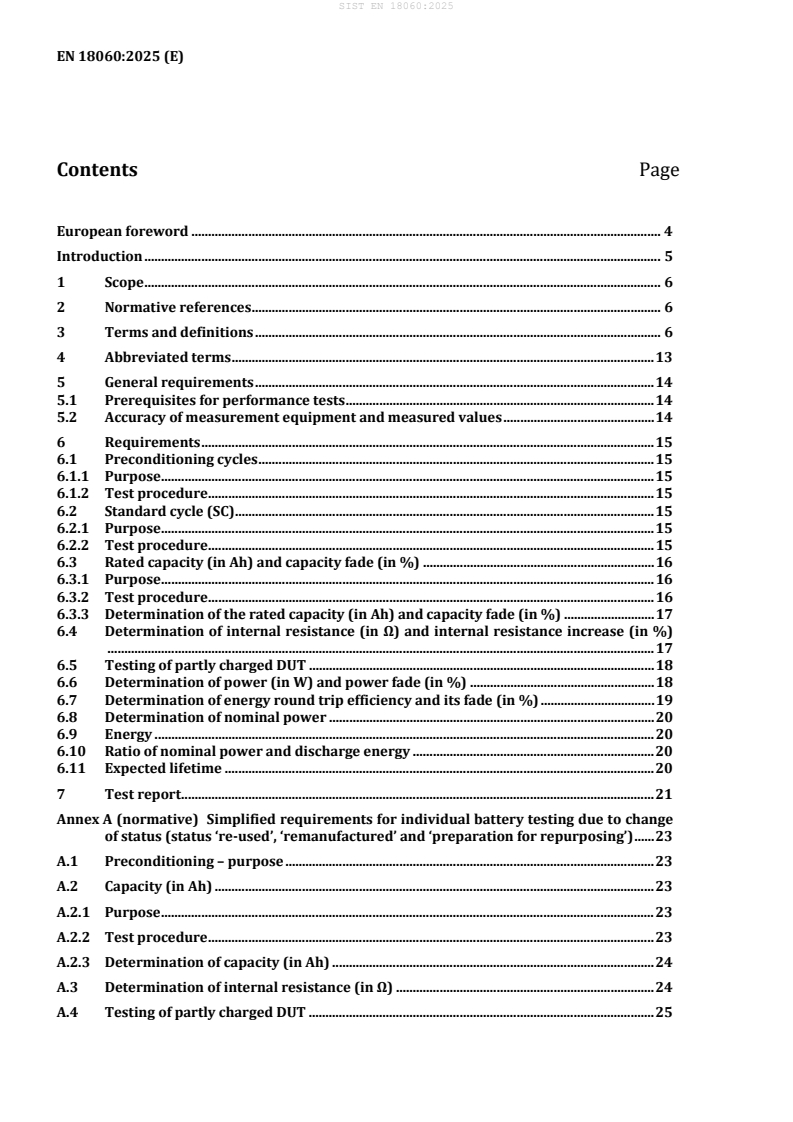
Contents Page
European foreword . 4
Introduction . 5
1 Scope . 6
2 Normative references . 6
3 Terms and definitions . 6
4 Abbreviated terms . 13
5 General requirements . 14
5.1 Prerequisites for performance tests . 14
5.2 Accuracy of measurement equipment and measured values . 14
6 Requirements . 15
6.1 Preconditioning cycles . 15
6.1.1 Purpose . 15
6.1.2 Test procedure . 15
6.2 Standard cycle (SC) . 15
6.2.1 Purpose . 15
6.2.2 Test procedure . 15
6.3 Rated capacity (in Ah) and capacity fade (in %) . 16
6.3.1 Purpose . 16
6.3.2 Test procedure . 16
6.3.3 Determination of the rated capacity (in Ah) and capacity fade (in %) . 17
6.4 Determination of internal resistance (in Ω) and internal resistance increase (in %)
................................................................................................................................................................... 17
6.5 Testing of partly charged DUT . 18
6.6 Determination of power (in W) and power fade (in %) . 18
6.7 Determination of energy round trip efficiency and its fade (in %) . 19
6.8 Determination of nominal power . 20
6.9 Energy . 20
6.10 Ratio of nominal power and discharge energy . 20
6.11 Expected lifetime . 20
7 Test report . 21
Annex A (normative) Simplified requirements for individual battery testing due to change
of status (status ‘re-used’, ‘remanufactured’ and ‘preparation for repurposing’) . 23
A.1 Preconditioning – purpose . 23
A.2 Capacity (in Ah) . 23
A.2.1 Purpose . 23
A.2.2 Test procedure . 23
A.2.3 Determination of capacity (in Ah) . 24
A.3 Determination of internal resistance (in Ω) . 24
A.4 Testing of partly charged DUT . 25
A.5 Determination of power (in W) . 25
A.6 Determination of energy round trip efficiency (in %) . 26
A.7 Determination of estimated remaining lifetime . 26
Annex ZA (informative) Relationship between this European Standard and the requirements
of Regulation (EU) 2023/1542 of the European Parliament and of the Council of 12
July 2023 concerning batteries and waste batteries, amending Directive 2008/98/EC
and Regulation (EU) 2019/1020 and repealing Directive 2006/66/EC aimed to be
covered . 27
Bibliography . 29
European foreword
This document (EN 18060:2025) has been prepared by Technical Committee CEN/TC 301 “Road
vehicles”, the secretariat of which is held by DIN.
This European Standard shall be given the status of a national standard, either by publication of an
identical text or by endorsement, at the latest by April 2026, and conflicting national standards shall be
withdrawn at the latest by April 2026.
Attention is drawn to the possibility that some of the elements of this document may be the subject of
patent rights. CEN shall not be held responsible for identifying any or all such patent rights.
This document has been prepared under a standardization request addressed to CEN by the European
Commission. The Standing Committee of the EFTA States subsequently approves these requests for its
Member States.
For the relationship with EU Legislation, see informative Annex ZA, which is an integral part of this
document.
Any feedback and questions on this document should be directed to the users’ national standards body.
A complete listing of these bodies can be found on the CEN website. According to the CEN-CENELEC
Internal Regulations, the national standards organisations of the following countries are bound to
implement this European Standard: Austria, Belgium, Bulgaria, Croatia, Cyprus, Czech Republic,
Denmark, Estonia, Finland, France, Germany, Greece, Hungary, Iceland, Ireland, Italy, Latvia, Lithuania,
Luxembourg, Malta, Netherlands, Norway, Poland, Portugal, Republic of North Macedonia, Romania,
Serbia, Slovakia, Slovenia, Spain, Sweden, Switzerland, Türkiye and the United Kingdom
Introduction
The European Commission published the standardization request M/579 to the European
standardization organisations as regards to performance and durability requirements for batteries.
Battery systems are an efficient energy storage system for electrically propelled vehicles. The
performance requirements for electric road vehicles battery systems are significantly different from
those batteries used for consumer electronics or stationary energy storage. The state of charge window
that is accessible for the vehicle application is defined by durability and safety requirements.
This document provides specific performance test procedures for EV batteries.
It enables vehicle manufacturers to choose test procedures to evaluate the characteristics of EV battery
systems, battery packs, battery modules and battery cells for their specific requirements.
This document specifies test procedures for alkali-Ion (Li-ion, Na-ion), Pb, NiMH and combined
chemistries for EV battery systems, battery packs, battery modules and battery cells to obtain
performance and durability values for rated capacity, power, internal resistance, and energy round trip
efficiency.
1 Scope
This document describes the performance and durability test procedures and calculation methods for
alkali-ion (for example Li-ion, Na-ion), Pb, NiMH and combined chemistries EV battery systems, battery
packs, battery modules and battery cells. This document considers the most appropriate metric based on
application for electrical performance between different models/products on the market. It specifies
performance test procedures and calculation methods to obtain performance and durability values for:
— rated capacity (in Ah) and capacity fade (in %);
— power (in W) and power fade (in %);
— internal resistance (in ꭥ) and internal resistance increase (in %);
— energy round trip efficiency and its fade (in %);
— expected lifetime (number of reference cycles).
2 Normative references
There are no normative references in this document.
3 Terms and definitions
For the purposes of this document, the following terms and definitions apply.
ISO and IEC maintain terminological databases for use in standardization at the following addresses:
• IEC Electropedia available at http://www.electropedia.org/
• ISO Online browsing platform: available at http://www.iso.org/obp
3.1
battery
device delivering electrical energy generated by direct conversion of chemical energy, having internal or
external storage, and consisting of one or more non-rechargeable or rechargeable battery cells, modules
or of packs of them, and includes a battery that has been subject to preparation for re-use, preparation
for repurposing, repurposing, or remanufacturing
[SOURCE: Regulation (EU) 2023/1542]
3.2
battery cell
basic functional unit in a battery, composed of electrodes, electrolyte, container, terminals and, if
applicable, separators, and containing the active materials the reaction of which generates electrical
energy
[SOURCE: Regulation (EU) 2023/1542]
3.3
battery control unit
BCU
electronic device that controls, manages, detects or calculates electric and thermal functions of the
battery system (3.9) and that provides communication between the battery system and other vehicle
controllers
[SOURCE: ISO 12405-4:2018, 3.1]
3.4
battery electric vehicle
BEV
vehicle equipped with a powertrain containing exclusively electric machines as propulsion energy
converters and exclusively rechargeable electric energy storage systems as propulsion energy storage
systems
[SOURCE: UNECE Global technical regulation No. 15 on Worldwide harmonized Light vehicles Test
Procedures]
3.5
battery management system
BMS
electronic device that controls or manages the electric and thermal functions of the battery in order to
ensure the battery’s safety, performance and service life, manages and stores the data for the parameters
for determining the battery’s state of health and expected lifetime and communicates with the vehicle,
light means of transport or appliance in which the battery is incorporated, or with a public or private
charging infrastructure
[SOURCE: Regulation (EU) 2023/1542]
3.6
battery manufacturer
any natural or legal person who manufactures a battery or has a battery designed or manufactured, and
markets that battery under its own name or trademark or puts it into service for its own purposes
[SOURCE: Regulation (EU) 2023/1542]
3.7
battery module
set of battery cells that are connected together or encapsulated within an outer casing to protect the cells
against external impact, and which is meant to be used either alone or in combination with other modules
Note 1 to entry: Battery modules may or may not include parts of the BMS such as sensors and/or electronics.
Note 2 to entry: Battery module encapsulation can also manage internal stress from the cells.
Note 3 to entry: Battery module is a voluntary design feature of an EV battery.
[SOURCE: Regulation (EU) 2023/1542]
3.8
battery pack
set of battery cells or modules that are connected together or encapsulated within an outer casing to form
a complete unit which is not meant to be split up or opened by the end-user
[SOURCE: Regulation (EU) 2023/1542]
3.9
battery producer
manufacturer, importer or distributor or other natural or legal person who, irrespective of the selling
technique used, including by means of distance contracts, either:
(i) is established in a Member State and manufactures batteries under its own name or trademark, or has
batteries designed or manufactured and supplies them for the first time under its own name or
trademark, including those incorporated in appliances, light means of transport or other vehicles, within
the territory of that Member State;
(ii) is established in a Member State and resells within the territory of that Member State, under its own
name or trademark, batteries, including those incorporated in appliances, light means of transport or
other vehicles, manufactured by others, on which the name or trademark of those other manufacturers
does not appear;
(iii) is established in a Member State and supplies for the first time in that Member State on a professional
basis, batteries, including those incorporated in appliances, light means of transport or other vehicles,
from another Member State or from a third country; or
(iv) sells batteries, including those incorporated in appliances, light means of transport or other vehicles,
by means of distance contract directly to end-users, whether or not they are private households, in a
Member State, and is established in another Member State or in a third country
Note 1 to entry: Distance contracts as defined in Article 2, point (7), of Directive 2011/83/EU (definition 46 in EU
Battery Regulation.
[SOURCE: Regulation (EU) 2023/1542]
3.10
battery system
energy storage device that includes cells or cell assemblies or battery pack(s) (3.8) as well as electrical
circuits and electronics
Note 1 to entry: Examples of electronics are the BCU and contactors.
[SOURCE: ISO 12405-4:2018, 3.3]
3.11
capacity fade
decrease over time and upon usage in the amount of charge that a battery can deliver at the rated current,
with respect to the original rated capacity
Note 1 to entry: The EU regulation 2023/1542 states in Annex IV rated voltage instead of rated current under
reference conditions
Note 2 to entry: The test for capacity fade is defined in 6.3.3.
[SOURCE: Regulation (EU) 2023/1542]
3.12
charge level
ratio of available charged capacity in relation to actual capacity at the time of assessment
Note 1 to entry: Actual capacity means the amount of charge that a fully charged battery can deliver.
3.13
charge rate
amount of electric current at which a cell or battery is charged
C
r
Note 1 to entry: The charge current is expressed as the reference current I = where C is the rated capacity
t r
n
declared by the manufacturer and n is the time base in hours for which the rated capacity is declared.
3.14
combined battery and capacitor systems
systems combining both battery component and capacitor component which are used to supply electric
energy
3.15
combined chemistry cells
cells with more than one electrochemical system inside the same cell to support different types of
operating conditions and improve performance characteristics
Note 1 to entry: Combined chemistry cells can also be denoted as hybrid cells.
Note 2 to entry: A composite electrode material is not per definition the same as a combined chemistry cell.
Note 3 to entry: Combined chemistry cells may comprise a battery component and an electrochemical capacitor
component.
3.16
combined chemistry modules
modules with a selection of cells with more than one cell chemistry within or between cells
3.17
combined chemistry packs and systems
packs and systems combining different cell chemistries or cell designs or cell assembly configurations
within or between modules or cells
3.18
device under test
DUT
battery system, battery pack, battery module or battery cell
[SOURCE: ISO 12405-4:2018, 3.7, modified — “battery module” added]
3.19
electric vehicle battery
EV battery
battery that is specifically designed to provide electric power for traction in hybrid or electric vehicles of
category L as provided for in Regulation (EU) No 168/2013, that weighs more than 25 kg, or a battery
that is specifically designed to provide electric power for the traction in hybrid or electric vehicles of
categories M, N or O as provided in Regulation (EU) 2018/858
[SOURCE: Regulation (EU) 2023/1542]
3.20
energy round trip efficiency
ratio of the net energy delivered by a battery during a discharge test to the total energy required to
restore the initial state of charge by a standard charge
Note 1 to entry: Net energy is the useful electrical energy at the terminals of the DUT.
[SOURCE: Regulation (EU) 2023/1542]
3.21
high-energy battery pack and system
battery pack (3.7) and battery system (3.9) using cells, which have the numerical ratio between maximum
allowed electric power output and electric energy output at a 1C discharge rate at RT lower than 10
Note 1 to entry: Typically, high-energy battery packs and systems are designed for applications in BEVs and OVC-
HEVs.
[SOURCE: ISO 12405-4:2018, 3.12]
3.22
high-power battery pack and system
battery pack (3.7) and battery system (3.9) using cells, for which the numerical ratio between maximum
allowed electric power output and electric energy output at a 1C discharge rate at RT equal to or higher
than 10
Note 1 to entry: Typically, high-power battery packs and systems are designed for applications in NOVC-HEVs.
[SOURCE: ISO 12405-4:2018, 3.13]
3.23
internal resistance
opposition to the flow of current within a cell or a battery under reference conditions, that is, the sum of
electronic resistance and ionic resistance to the contribution to total effective resistance including
inductive/capacitive properties
Note 1 to entry: The internal resistance is expressed in Ω and defined in 6.4.
[SOURCE: Regulation (EU) 2023/1542]
3.24
internal resistance increase
increase over time and upon usage of the internal resistance of a battery, with respect to the original
internal resistance
[SOURCE: Regulation (EU) 2023/1542]
3.25
not off-vehicle charging hybrid electric vehicle
NOVC-HEV
hybrid electric vehicle that cannot be charged from an external source
[SOURCE: UNECE Global technical regulation No. 15 on Worldwide harmonized Light vehicles Test
Procedures]
3.26
off-vehicle charging hybrid electric vehicle
OVC-HEV
hybrid electric vehicle that can be charged from an external source
[SOURCE: UNECE Global technical regulation No. 15 on Worldwide harmonized Light vehicles Test
Procedures]
3.27
operating charge level window
limited portion of the electrochemical charge level window that is available and used in an application,
to meet attribute requirements defined by the system design
Note 1 to entry: The operating charge level window is defined by the OEM.
Note 2 to entry: Different electric vehicle architectures, e.g. mHEV, HEV, PHEV and BEV, operate at different charge
level windows to optimize vehicle performance and battery durability.
3.28
power
amount of energy that a battery is capable to provide over a given period under reference conditions
Note 1 to entry: The power is expressed in W.
[SOURCE: Regulation (EU) 2023/1542]
3.29
power fade
decrease over time and upon usage in the amount of power that a battery can deliver at the rated current
under reference conditions
Note 1 to entry: The EU regulation states rated voltage instead of rated current under reference condition.
Note 2 to entry: The test for power fade is defined in 6.6.
[SOURCE: Regulation (EU) 2023/1542]
3.30
preparation for repurposing
operation, by which a waste battery, or parts thereof, is prepared so that it can be used for a different
purpose or application than that for which it was originally designed
[SOURCE: Regulation (EU) 2023/1542]
3.31
rated capacity
total number of ampere-hours (Ah) that can be withdrawn from a fully charged battery under reference
conditions
[SOURCE: Regulation (EU) 2023/1542]
3.32
remanufacturing
technical operation on a used battery that includes the disassembly and evaluation of all its battery cells
and modules and the use of a certain number of battery cells and modules that are new, used or recovered
from waste, or other battery components, to restore the battery capacity to at least 90 % of the original
rated capacity, and where the state of health of all individual battery cells does not differ more than 3 %
between cells, and results in the battery being used for the same purpose or application than the one for
which the battery was originally designed
[SOURCE: Regulation (EU) 2023/1542]
3.33
repurposing
operation that results in a battery, that is not a waste battery, or parts thereof being used for a purpose
or application other than that for which the battery was originally designed
[SOURCE: Regulation (EU) 2023/1542]
3.34
re-use
operation by which products or components that are not waste are used again for the same purpose for
which they were conceived
[SOURCE: Directive 2008/98/EC of the European Parliament and of the Council of 19 November 2008 on
waste and repealing certain Directives]
3.35
room temperature
RT
temperature of (23 ±5) °C
[SOURCE: ISO 21498-2:2021, 6.1.8]
3.36
status of the battery
information on the historical and actual use of the battery
Note 1 to entry: During the battery life the status of the battery will change and can be assigned one of the following
status: 'original’, ‘repurposed’, ‘re-used’, 'remanufactured' or ‘waste’.
Note 2 to entry: A battery has the status 'original' before it is assigned another status (re-used, remanufactured
etc…) and when the battery is placed on the EU market. When exactly that happens, depends on the supply chain (a
battery in an imported vehicle is normally only placed on the EU market once the vehicle is imported, but a battery
that is sold within the EU from a battery manufacturer to a vehicle manufacturer is normally placed on the EU
market as a result of that sale).
Note 3 to entry: The note 1 is coming from regulation (EU) 2023/1542.
3.37
technic
...