


IEC 31010:2009
(Main)Risk management — Risk assessment techniques
Risk management — Risk assessment techniques
IEC 31010:2009 is a dual logo IEC/ISO, single prefix IEC, supporting standard for ISO 31000 and provides guidance on selection and application of systematic techniques for risk assessment. This standard is not intended for certification, regulatory or contractual use. NOTE: This standard does not deal specifically with safety. It is a generic risk management standard and any references to safety are purely of an informative nature. Guidance on the introduction of safety aspects into IEC standards is laid down in ISO/IEC Guide 51.
Gestion des risques — Techniques d'évaluation des risques
CEI 31010:2009 est un logo double CEI/ISO, préfixe seul CEI, norme d'accompagnement de l'ISO 31000 et fournit des lignes directrices permettant de choisir et d'appliquer des techniques systématiques d'évaluation des risques. La présente norme n'est pas destinée à être utilisée à des fins de certification, de réglementation ou contractuelles. NOTE: La présente norme ne traite pas spécifiquement de la sécurité. C'est une norme générale de gestion des risques et toute référence à la sécurité est purement de nature informative. Les lignes directrices sur l'introduction des aspects de sécurité dans les normes CEI est définie dans le Guide ISO/CEI 51.
Obvladovanje tveganja - Tehnike ocenjevanja tveganj
Ta mednarodni standard je podporni standard za ISO 31000 in zagotavlja vodilo za izbor in uporabo sistematičnih tehnik ocenjevanja tveganja. Ocenjevanje tveganja, ki poteka v skladu s tem standardom, prispeva k drugim dejavnostim upravljanja tveganja. Vpeljana je uporaba nabora tehnik s specifičnim sklicevanjem na druge mednarodne standarde, kjer sta koncept in uporaba tehnik podrobneje opisana. Ta standard ne zagotavlja posebnih meril za prepoznavanje potrebe po analizi tveganja niti ne določa vrste metode analize tveganja, ki je potrebna za določeno vrsto uporabe.
General Information
- Status
- Withdrawn
- Publication Date
- 30-Nov-2009
- Withdrawal Date
- 30-Nov-2009
- Technical Committee
- ISO/TC 262 - Risk management
- Drafting Committee
- ISO/TC 262 - Risk management
- Current Stage
- 9599 - Withdrawal of International Standard
- Start Date
- 17-Jun-2019
- Completion Date
- 14-Feb-2026
Relations
- Effective Date
- 09-Feb-2026
- Effective Date
- 09-Feb-2026
- Referred By
EN ISO 22315:2018 - Societal security - Mass evacuation - Guidelines for planning (ISO 22315:2014) - Effective Date
- 09-Feb-2026
- Effective Date
- 09-Feb-2026
- Effective Date
- 13-Aug-2016

Get Certified
Connect with accredited certification bodies for this standard

BSI Group
BSI (British Standards Institution) is the business standards company that helps organizations make excellence a habit.

Bureau Veritas
Bureau Veritas is a world leader in laboratory testing, inspection and certification services.

DNV
DNV is an independent assurance and risk management provider.
Sponsored listings
Frequently Asked Questions
IEC 31010:2009 is a standard published by the International Organization for Standardization (ISO). Its full title is "Risk management — Risk assessment techniques". This standard covers: IEC 31010:2009 is a dual logo IEC/ISO, single prefix IEC, supporting standard for ISO 31000 and provides guidance on selection and application of systematic techniques for risk assessment. This standard is not intended for certification, regulatory or contractual use. NOTE: This standard does not deal specifically with safety. It is a generic risk management standard and any references to safety are purely of an informative nature. Guidance on the introduction of safety aspects into IEC standards is laid down in ISO/IEC Guide 51.
IEC 31010:2009 is a dual logo IEC/ISO, single prefix IEC, supporting standard for ISO 31000 and provides guidance on selection and application of systematic techniques for risk assessment. This standard is not intended for certification, regulatory or contractual use. NOTE: This standard does not deal specifically with safety. It is a generic risk management standard and any references to safety are purely of an informative nature. Guidance on the introduction of safety aspects into IEC standards is laid down in ISO/IEC Guide 51.
IEC 31010:2009 is classified under the following ICS (International Classification for Standards) categories: 03.100.01 - Company organization and management in general. The ICS classification helps identify the subject area and facilitates finding related standards.
IEC 31010:2009 has the following relationships with other standards: It is inter standard links to EN ISO 19345-2:2019, EN ISO 16923:2018, EN ISO 22315:2018, EN ISO 16924:2018, IEC 31010:2019. Understanding these relationships helps ensure you are using the most current and applicable version of the standard.
IEC 31010:2009 is available in PDF format for immediate download after purchase. The document can be added to your cart and obtained through the secure checkout process. Digital delivery ensures instant access to the complete standard document.
Standards Content (Sample)
IEC/ISO 31010
Edition 1.0 2009-11
INTERNATIONAL
STANDARD
NORME
INTERNATIONALE
colour
inside
Risk management – Risk assessment techniques
Gestion des risques – Techniques d'évaluation des risques
IEC/iSO 31010:2009
All rights reserved. Unless otherwise specified, no part of this publication may be reproduced or utilized in any form or by
any means, electronic or mechanical, including photocopying and microfilm, without permission in writing from either IEC or
IEC's member National Committee in the country of the requester.
If you have any questions about IEC copyright or have an enquiry about obtaining additional rights to this publication,
please contact the address below or your local IEC member National Committee for further information.
Droits de reproduction réservés. Sauf indication contraire, aucune partie de cette publication ne peut être reproduite
ni utilisée sous quelque forme que ce soit et par aucun procédé, électronique ou mécanique, y compris la photocopie
et les microfilms, sans l'accord écrit de la CEI ou du Comité national de la CEI du pays du demandeur.
Si vous avez des questions sur le copyright de la CEI ou si vous désirez obtenir des droits supplémentaires sur cette
publication, utilisez les coordonnées ci-après ou contactez le Comité national de la CEI de votre pays de résidence.
IEC Central Office
3, rue de Varembé
CH-1211 Geneva 20
Switzerland
Email: inmail@iec.ch
Web: www.iec.ch
About the IEC
The International Electrotechnical Commission (IEC) is the leading global organization that prepares and publishes
International Standards for all electrical, electronic and related technologies.
About IEC publications
The technical content of IEC publications is kept under constant review by the IEC. Please make sure that you have the
latest edition, a corrigenda or an amendment might have been published.
ƒ Catalogue of IEC publications: www.iec.ch/searchpub
The IEC on-line Catalogue enables you to search by a variety of criteria (reference number, text, technical committee,…).
It also gives information on projects, withdrawn and replaced publications.
ƒ IEC Just Published: www.iec.ch/online_news/justpub
Stay up to date on all new IEC publications. Just Published details twice a month all new publications released. Available
on-line and also by email.
ƒ Electropedia: www.electropedia.org
The world's leading online dictionary of electronic and electrical terms containing more than 20 000 terms and definitions
in English and French, with equivalent terms in additional languages. Also known as the International Electrotechnical
Vocabulary online.
ƒ Customer Service Centre: www.iec.ch/webstore/custserv
If you wish to give us your feedback on this publication or need further assistance, please visit the Customer Service
Centre FAQ or contact us:
Email: csc@iec.ch
Tel.: +41 22 919 02 11
Fax: +41 22 919 03 00
A propos de la CEI
La Commission Electrotechnique Internationale (CEI) est la première organisation mondiale qui élabore et publie des
normes internationales pour tout ce qui a trait à l'électricité, à l'électronique et aux technologies apparentées.
A propos des publications CEI
Le contenu technique des publications de la CEI est constamment revu. Veuillez vous assurer que vous possédez
l’édition la plus récente, un corrigendum ou amendement peut avoir été publié.
ƒ Catalogue des publications de la CEI: www.iec.ch/searchpub/cur_fut-f.htm
Le Catalogue en-ligne de la CEI vous permet d’effectuer des recherches en utilisant différents critères (numéro de référence,
texte, comité d’études,…). Il donne aussi des informations sur les projets et les publications retirées ou remplacées.
ƒ Just Published CEI: www.iec.ch/online_news/justpub
Restez informé sur les nouvelles publications de la CEI. Just Published détaille deux fois par mois les nouvelles
publications parues. Disponible en-ligne et aussi par email.
ƒ Electropedia: www.electropedia.org
Le premier dictionnaire en ligne au monde de termes électroniques et électriques. Il contient plus de 20 000 termes et
définitions en anglais et en français, ainsi que les termes équivalents dans les langues additionnelles. Egalement appelé
Vocabulaire Electrotechnique International en ligne.
ƒ Service Clients: www.iec.ch/webstore/custserv/custserv_entry-f.htm
Si vous désirez nous donner des commentaires sur cette publication ou si vous avez des questions, visitez le FAQ du
Service clients ou contactez-nous:
Email: csc@iec.ch
Tél.: +41 22 919 02 11
Fax: +41 22 919 03 00
IEC/ISO 31010
Edition 1.0 2009-11
INTERNATIONAL
STANDARD
NORME
INTERNATIONALE
colour
inside
Risk management – Risk assessment techniques
Gestion des risques – Techniques d'évaluation des risques
INTERNATIONAL
ELECTROTECHNICAL
COMMISSION
COMMISSION
ELECTROTECHNIQUE
PRICE CODE
INTERNATIONALE
XD
CODE PRIX
ICS 03.100.01 ISBN 2-8318-1068-2
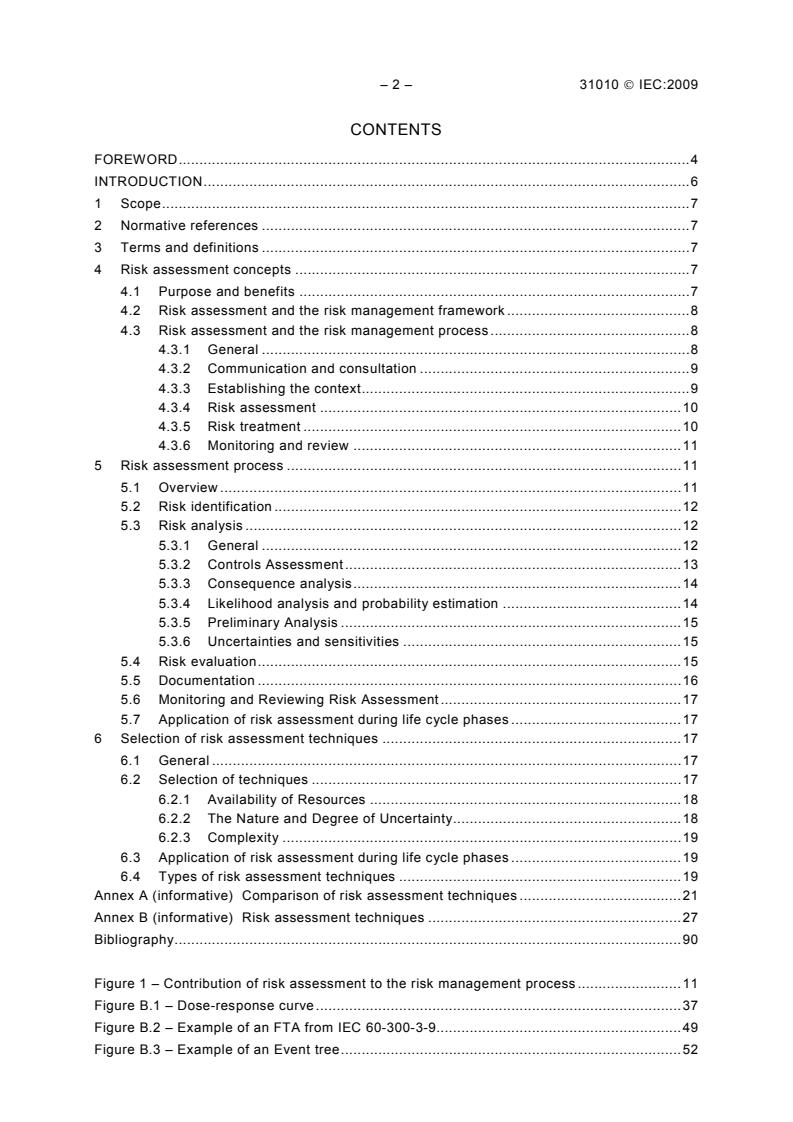
– 2 – 31010 © IEC:2009
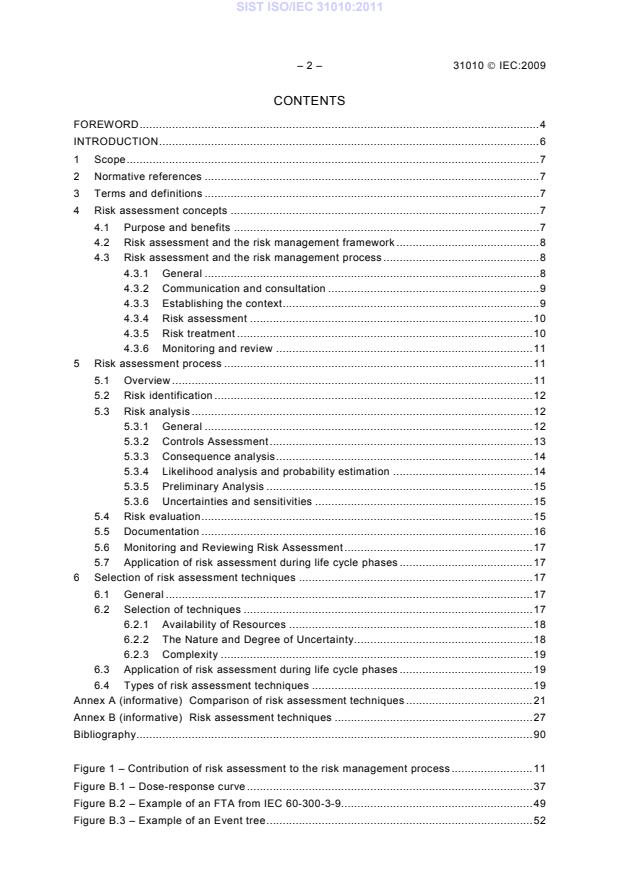
CONTENTS
FOREWORD.4
INTRODUCTION.6
1 Scope.7
2 Normative references .7
3 Terms and definitions .7
4 Risk assessment concepts .7
4.1 Purpose and benefits .7
4.2 Risk assessment and the risk management framework .8
4.3 Risk assessment and the risk management process .8
4.3.1 General .8
4.3.2 Communication and consultation .9
4.3.3 Establishing the context.9
4.3.4 Risk assessment .10
4.3.5 Risk treatment .10
4.3.6 Monitoring and review .11
5 Risk assessment process .11
5.1 Overview .11
5.2 Risk identification .12
5.3 Risk analysis .12
5.3.1 General .12
5.3.2 Controls Assessment.13
5.3.3 Consequence analysis.14
5.3.4 Likelihood analysis and probability estimation .14
5.3.5 Preliminary Analysis .15
5.3.6 Uncertainties and sensitivities .15
5.4 Risk evaluation.15
5.5 Documentation .16
5.6 Monitoring and Reviewing Risk Assessment.17
5.7 Application of risk assessment during life cycle phases .17
6 Selection of risk assessment techniques .17
6.1 General .17
6.2 Selection of techniques .17
6.2.1 Availability of Resources .18
6.2.2 The Nature and Degree of Uncertainty.18
6.2.3 Complexity .19
6.3 Application of risk assessment during life cycle phases .19
6.4 Types of risk assessment techniques .19
Annex A (informative) Comparison of risk assessment techniques .21
Annex B (informative) Risk assessment techniques .27
Bibliography.90
Figure 1 – Contribution of risk assessment to the risk management process .11
Figure B.1 – Dose-response curve.37
Figure B.2 – Example of an FTA from IEC 60-300-3-9.49
Figure B.3 – Example of an Event tree.52
31010 © IEC:2009 – 3 –
Figure B.4 – Example of Cause-consequence analysis .55
Figure B.5 – Example of Ishikawa or Fishbone diagram .57
Figure B.6 – Example of tree formulation of cause-and-effect analysis.58
Figure B.7 – Example of Human reliability assessment .64
Figure B.8 – Example Bow tie diagram for unwanted consequences .66
Figure B.9 – Example of System Markov diagram .70
Figure B.10 – Example of State transition diagram.71
Figure B.11 – Sample Bayes’ net .77
Figure B.12 – The ALARP concept.79
Figure B.13 – Part example of a consequence criteria table.84
Figure B.14 – Part example of a risk ranking matrix .84
Figure B.15 – Part example of a probability criteria matrix .85
Table A.1 – Applicability of tools used for risk assessment .22
Table A.2 – Attributes of a selection of risk assessment tools .23
Table B.1 – Example of possible HAZOP guidewords .34
Table B.2 – Markov matrix .70
Table B.3 – Final Markov matrix.72
Table B.4 – Example of Monte Carlo Simulation .74
Table B.5 – Bayes’ table data .77
Table B.6 – Prior probabilities for nodes A and B .77
Table B.7 – Conditional probabilities for node C with node A and node B defined .77
Table B.8 – Conditional probabilities for node D with node A and node C defined .78
Table B.9 – Posterior probability for nodes A and B with node D and Node C defined .78
Table B.10 – Posterior probability for node A with node D and node C defined .78
– 4 – 31010 © IEC:2009
INTERNATIONAL ELECTROTECHNICAL COMMISSION
____________
RISK MANAGEMENT –
RISK ASSESSMENT TECHNIQUES
FOREWORD
1) The International Electrotechnical Commission (IEC) is a worldwide organization for standardization comprising
all national electrotechnical committees (IEC National Committees). The object of IEC is to promote
international co-operation on all questions concerning standardization in the electrical and electronic fields. To
this end and in addition to other activities, IEC publishes International Standards, Technical Specifications,
Technical Reports, Publicly Available Specifications (PAS) and Guides (hereafter referred to as “IEC
Publication(s)”). Their preparation is entrusted to technical committees; any IEC National Committee interested
in the subject dealt with may participate in this preparatory work. International, governmental and non-
governmental organizations liaising with the IEC also participate in this preparation. IEC collaborates closely
with the International Organization for Standardization (ISO) in accordance with conditions determined by
agreement between the two organizations.
2) The formal decisions or agreements of IEC on technical matters express, as nearly as possible, an international
consensus of opinion on the relevant subjects since each technical committee has representation from all
interested IEC National Committees.
3) IEC Publications have the form of recommendations for international use and are accepted by IEC National
Committees in that sense. While all reasonable efforts are made to ensure that the technical content of IEC
Publications is accurate, IEC cannot be held responsible for the way in which they are used or for any
misinterpretation by any end user.
4) In order to promote international uniformity, IEC National Committees undertake to apply IEC Publications
transparently to the maximum extent possible in their national and regional publications. Any divergence
between any IEC Publication and the corresponding national or regional publication shall be clearly indicated in
the latter.
5) IEC itself does not provide any attestation of conformity. Independent certification bodies provide conformity
assessment services and, in some areas, access to IEC marks of conformity. IEC is not responsible for any
services carried out by independent certification bodies.
6) All users should ensure that they have the latest edition of this publication.
7) No liability shall attach to IEC or its directors, employees, servants or agents including individual experts and
members of its technical committees and IEC National Committees for any personal injury, property damage or
other damage of any nature whatsoever, whether direct or indirect, or for costs (including legal fees) and
expenses arising out of the publication, use of, or reliance upon, this IEC Publication or any other IEC
Publications.
8) Attention is drawn to the Normative references cited in this publication. Use of the referenced publications is
indispensable for the correct application of this publication.
9) Attention is drawn to the possibility that some of the elements of this IEC Publication may be the subject of
patent rights. IEC shall not be held responsible for identifying any or all such patent rights.
International standard IEC/ISO 31010 has been prepared by IEC technical committee 56:
Dependability together with the ISO TMB “Risk management” working group.
The text of this standard is based on the following documents:
FDIS Rapport de vote
56/1329/FDIS 56/1346/RVD
Full information on the voting for the approval of this standard can be found in the report on
voting indicated in the above table. In ISO, the standard has been approved by 17 member
bodies out of 18 having cast a vote.
This publication has been drafted in accordance with the ISO/IEC Directives, Part 2.
31010 © IEC:2009 – 5 –
The committee has decided that the contents of this publication will remain unchanged until
the maintenance result date indicated on the IEC web site under "http://webstore.iec.ch" in
the data related to the specific publication. At this date, the publication will be
• reconfirmed;
• withdrawn;
• replaced by a revised edition;
• amended.
IMPORTANT – The 'colour inside' logo on the cover page of this publication indicates that it
contains colours which are considered to be useful for the correct understanding of its
contents. Users should therefore print this document using a colour printer.
– 6 – 31010 © IEC:2009
INTRODUCTION
Organizations of all types and sizes face a range of risks that may affect the achievement of
their objectives.
These objectives may relate to a range of the organization's activities, from strategic
initiatives to its operations, processes and projects, and be reflected in terms of societal,
environmental, technological, safety and security outcomes, commercial, financial and
economic measures, as well as social, cultural, political and reputation impacts.
All activities of an organization involve risks that should be managed. The risk management
process aids decision making by taking account of uncertainty and the possibility of future
events or circumstances (intended or unintended) and their effects on agreed objectives.
Risk management includes the application of logical and systematic methods for
• communicating and consulting throughout this process;
• establishing the context for identifying, analysing, evaluating, treating risk associated with
any activity, process, function or product;
• monitoring and reviewing risks;
• reporting and recording the results appropriately.
Risk assessment is that part of risk management which provides a structured process that
identifies how objectives may be affected, and analyses the risk in term of consequences and
their probabilities before deciding on whether further treatment is required.
Risk assessment attempts to answer the following fundamental questions:
• what can happen and why (by risk identification)?
• what are the consequences?
• what is the probability of their future occurrence?
• are there any factors that mitigate the consequence of the risk or that reduce the
probability of the risk?
Is the level of risk tolerable or acceptable and does it require further treatment? This standard
is intended to reflect current good practices in selection and utilization of risk assessment
techniques, and does not refer to new or evolving concepts which have not reached a
satisfactory level of professional consensus.
This standard is general in nature, so that it may give guidance across many industries and
types of system. There may be more specific standards in existence within these industries
that establish preferred methodologies and levels of assessment for particular applications. If
these standards are in harmony with this standard, the specific standards will generally be
sufficient.
31010 © IEC:2009 – 7 –
RISK MANAGEMENT –
RISK ASSESSMENT TECHNIQUES
1 Scope
This International Standard is a supporting standard for ISO 31000 and provides guidance on
selection and application of systematic techniques for risk assessment.
Risk assessment carried out in accordance with this standard contributes to other risk
management activities.
The application of a range of techniques is introduced, with specific references to other
international standards where the concept and application of techniques are described in
greater detail.
This standard is not intended for certification, regulatory or contractual use.
This standard does not provide specific criteria for identifying the need for risk analysis, nor
does it specify the type of risk analysis method that is required for a particular application.
This standard does not refer to all techniques, and omission of a technique from this standard
does not mean it is not valid. The fact that a method is applicable to a particular circumstance
does not mean that the method should necessarily be applied.
NOTE This standard does not deal specifically with safety. It is a generic risk management standard and any
references to safety are purely of an informative nature. Guidance on the introduction of safety aspects into IEC
standards is laid down in ISO/IEC Guide 51.
2 Normative references
The following referenced documents are indispensable for the application of this document.
For dated references, only the edition cited applies. For undated references, the latest edition
of the referenced document (including any amendments) applies.
ISO/IEC Guide 73, Risk management – Vocabulary – Guidelines for use in standards
ISO 31000, Risk management – Principles and guidelines
3 Terms and definitions
For the purposes of this document, the terms and definitions of ISO/IEC Guide 73 apply.
4 Risk assessment concepts
4.1 Purpose and benefits
The purpose of risk assessment is to provide evidence-based information and analysis to
make informed decisions on how to treat particular risks and how to select between options.
Some of the principal benefits of performing risk assessment include:
• understanding the risk and its potential impact upon objectives;
– 8 – 31010 © IEC:2009
• providing information for decision makers;
• contributing to the understanding of risks, in order to assist in selection of treatment
options;
• identifying the important contributors to risks and weak links in systems and organizations;
• comparing of risks in alternative systems, technologies or approaches;
• communicating risks and uncertainties;
• assisting with establishing priorities;
• contributing towards incident prevention based upon post-incident investigation;
• selecting different forms of risk treatment;
• meeting regulatory requirements;
• providing information that will help evaluate whether the risk should be accepted when
compared with pre-defined criteria;
• assessing risks for end-of-life disposal.
4.2 Risk assessment and the risk management framework
This standard assumes that the risk assessment is performed within the framework and
process of risk management described in ISO 31000.
A risk management framework provides the policies, procedures and organizational
arrangements that will embed risk management throughout the organization at all levels.
As part of this framework, the organization should have a policy or strategy for deciding when
and how risks should be assessed.
In particular, those carrying out risk assessments should be clear about
• the context and objectives of the organization,
• the extent and type of risks that are tolerable, and how unacceptable risks are to be
treated,
• how risk assessment integrates into organizational processes,
• methods and techniques to be used for risk assessment, and their contribution to the risk
management process,
• accountability, responsibility and authority for performing risk assessment,
• resources available to carry out risk assessment,
• how the risk assessment will be reported and reviewed.
4.3 Risk assessment and the risk management process
4.3.1 General
Risk assessment comprises the core elements of the risk management process which are
defined in ISO 31000 and contain the following elements:
• communication and consultation;
• establishing the context;
• risk assessment (comprising risk identification, risk analysis and risk evaluation);
• risk treatment;
• monitoring and review.
Risk assessment is not a stand-alone activity and should be fully integrated into the other
components in the risk management process.
31010 © IEC:2009 – 9 –
4.3.2 Communication and consultation
Successful risk assessment is dependent on effective communication and consultation with
stakeholders.
Involving stakeholders in the risk management process will assist in
• developing a communication plan,
• defining the context appropriately,
• ensuring that the interests of stakeholders are understood and considered,
• bringing together different areas of expertise for identifying and analysing risk,
• ensuring that different views are appropriately considered in evaluating risks,
• ensuring that risks are adequately identified,
• securing endorsement and support for a treatment plan.
Stakeholders should contribute to the interfacing of the risk assessment process with other
management disciplines, including change management, project and programme management,
and also financial management.
4.3.3 Establishing the context
Establishing the context defines the basic parameters for managing risk and sets the scope
and criteria for the rest of the process. Establishing the context includes considering internal
and external parameters relevant to the organization as a whole, as well as the background to
the particular risks being assessed.
In establishing the context, the risk assessment objectives, risk criteria, and risk assessment
programme are determined and agreed.
For a specific risk assessment, establishing the context should include the definition of the
external, internal and risk management context and classification of risk criteria:
a) Establishing the external context involves familiarization with the environment in which the
organization and the system operates including :
• cultural, political, legal, regulatory, financial, economic and competitive environment
factors, whether international, national, regional or local;
• key drivers and trends having impact on the objectives of the organization; and
• perceptions and values of external stakeholders.
b) Establishing the internal context involves understanding
• capabilities of the organization in terms of resources and knowledge,
• information flows and decision-making processes,
• internal stakeholders,
• objectives and the strategies that are in place to achieve them,
• perceptions, values and culture,
• policies and processes,
• standards and reference models adopted by the organization, and
• structures (e.g. governance, roles and accountabilities).
c) Establishing the context of the risk management process includes
• defining accountabilities and responsibilities,
• defining the extent of the risk management activities to be carried out, including
specific inclusions and exclusions,
– 10 – 31010 © IEC:2009
• defining the extent of the project, process, function or activity in terms of time and
location,
• defining the relationships between a particular project or activity and other projects or
activities of the organization,
• defining the risk assessment methodologies,
• defining the risk criteria,
• defining how risk management performance is evaluated,
• identifying and specifying the decisions and actions that have to be made, and
• identifying scoping or framing studies needed, their extent, objectives and the
resources required for such studies.
d) Defining risk criteria involves deciding
• the nature and types of consequences to be included and how they will be measured,
• the way in which probabilities are to be expressed,
• how a level of risk will be determined,
• the criteria by which it will be decided when a risk needs treatment,
• the criteria for deciding when a risk is acceptable and/or tolerable,
• whether and how combinations of risks will be taken into account.
Criteria can be based on sources such as
• agreed process objectives,
• criteria identified in specifications,
• general data sources,
• generally accepted industry criteria such as safety integrity levels,
• organizational risk appetite,
• legal and other requirements for specific equipment or applications.
4.3.4 Risk assessment
Risk assessment is the overall process of risk identification, risk analysis and risk evaluation.
Risks can be assessed at an organizational level, at a departmental level, for projects,
individual activities or specific risks. Different tools and techniques may be appropriate in
different contexts.
Risk assessment provides an understanding of risks, their causes, consequences and their
probabilities. This provides input to decisions about:
• whether an activity should be undertaken;
• how to maximize opportunities;
• whether risks need to be treated;
• choosing between options with different risks;
• prioritizing risk treatment options;
• the most appropriate selection of risk treatment strategies that will bring adverse risks to a
tolerable level.
4.3.5 Risk treatment
Having completed a risk assessment, risk treatment involves selecting and agreeing to one or
more relevant options for changing the probability of occurrence, the effect of risks, or both,
and implementing these options.
31010 © IEC:2009 – 11 –
This is followed by a cyclical process of reassessing the new level of risk, with a view to
determining its tolerability against the criteria previously set, in order to decide whether
further treatment is required.
4.3.6 Monitoring and review
As part of the risk management process, risks and controls should be monitored and reviewed
on a regular basis to verify that
• assumptions about risks remain valid;
• assumptions on which the risk assessment is based, including the external and internal
context, remain valid;
• expected results are being achieved;
• results of risk assessment are in line with actual experience;
• risk assessment techniques are being properly applied;
• risk treatments are effective.
Accountability for monitoring and performing reviews should be established.
5 Risk assessment process
5.1 Overview
Risk assessment provides decision-makers and responsible parties with an improved
understanding of risks that could affect achievement of objectives, and the adequacy and
effectiveness of controls already in place. This provides a basis for decisions about the most
appropriate approach to be used to treat the risks. The output of risk assessment is an input
to the decision-making processes of the organization.
Risk assessment is the overall process of risk identification, risk analysis and risk evaluation
(see Figure 1). The manner in which this process is applied is dependent not only on the
context of the risk management process but also on the methods and techniques used to
carry out the risk assessment.
Establishing the context
Risk assessment
Risk identification
Monitoring
Communication
Risk analysis
and
and
review
consultation
Risk evaluation
Risk treatment
IEC 2061/09
Figure 1 – Contribution of risk assessment to the risk management process
– 12 – 31010 © IEC:2009
Risk assessment may require a multidisciplinary approach since risks may cover a wide range
of causes and consequences.
5.2 Risk identification
Risk identification is the process of finding, recognizing and recording risks.
The purpose of risk identification is to identify what might happen or what situations might
exist that might affect the achievement of the objectives of the system or organization. Once a
risk is identified, the organization should identify any existing controls such as design
features, people, processes and systems.
The risk identification process includes identifying the causes and source of the risk (hazard
in the context of physical harm), events, situations or circumstances which could have a
material impact upon objectives and the nature of that impact
Risk identification methods can include:
• evidence based methods, examples of which are check-lists and reviews of historical
data;
• systematic team approaches where a team of experts follow a systematic process to
identify risks by means of a structured set of prompts or questions;
• inductive reasoning techniques such as HAZOP.
Various supporting techniques can be used to improve accuracy and completeness in risk
identification, including brainstorming, and Delphi methodology.
Irrespective of the actual techniques employed, it is important that due recognition is given to
human and organizational factors when identifying risk. Hence, deviations of human and
organizational factors from the expected should be included in the risk identification process
as well as "hardware” or “software” events.
5.3 Risk analysis
5.3.1 General
Risk analysis is about developing an understanding of the risk. It provides an input to risk
assessment and to decisions about whether risks need to be treated and about the most
appropriate treatment strategies and methods.
Risk analysis consists of determining the consequences and their probabilities for identified
risk events, taking into account the presence (or not) and the effectiveness of any existing
controls. The consequences and their probabilities are then combined to determine a level of
risk.
Risk analysis involves consideration of the causes and sources of risk, their consequences
and the probability that those consequences can occur. Factors that affect consequences and
probability should be identified. An event can have multiple consequences and can affect
multiple objectives. Existing risk controls and their effectiveness should be taken into account.
Various methods for these analyses are described in Annex B. More than one technique may
be required for complex applications.
Risk analysis normally includes an estimation of the range of potential consequences that
might arise from an event, situation or circumstance, and their associated probabilities, in
order to measure the level of risk. However in some instances, such as where the
consequences are likely to be insignificant, or the probability is expected to be extremely low,
a single parameter estimate may be sufficient for a decision to be made
31010 © IEC:2009 – 13 –
In some circumstances, a consequence can occur as a result of a range of different events or
conditions, or where the specific event is not identified. In this case, the focus of risk
assessment is on analysing the importance and vulnerability of components of the system
with a view to defining treatments which relate to levels of protection or recovery strategies.
Methods used in analysing risks can be qualitative, semi-quantitative or quantitative. The
degree of detail required will depend upon the particular application, the availability of reliable
data and the decision-making needs of the organization. Some methods and the degree of
detail of the analysis may be prescribed by legislation.
Qualitative assessment defines consequence, probability and level of risk by significance
levels such as “high”, “medium” and “low”, may combine consequence and probability, and
evaluates the resultant level of risk against qualitative criteria.
Semi-quantitative methods use numerical rating scales for consequence and probability and
combine them to produce a level of risk using a formula. Scales may be linear or logarithmic,
or have some other relationship; formulae used can also vary.
Quantitative analysis estimates practical values for consequences and their probabilities, and
produces values of the level of risk in specific units defined when developing the context. Full
quantitative analysis may not always be possible or desirable due to insufficient information
about the system or activity being analysed, lack of data, influence of human factors, etc. or
because the effort of quantitative analysis is not warranted or required. In such
circumstances, a comparative semi-quantitative or qualitative ranking of risks by specialists,
knowledgeable in their respective field, may still be effective.
In cases where the analysis is qualitative, there should be a clear explanation of all the terms
employed and the basis for all criteria should be recorded.
Even where full quantification has been carried out, it needs to be recognized that the levels
of risk calculated are estimates. Care should be taken to ensure that they are not attributed a
level of accuracy and precision inconsistent with the accuracy of the data and methods
employed.
Levels of risk should be expressed in the most suitable terms for that type of risk and in a
form that aids risk evaluation. In some instances, the magnitude of a risk can be expressed as
a probability distribution over a range of consequences.
5.3.2 Controls assessment
The level of risk will depend on the adequacy and effectiveness of existing controls.
Questions to be addressed include:
• what are the existing controls for a particular risk?
• are those controls capable of adequately treating the risk so that it is controlled to a level
that is tolerable?
• in practice, are the controls operating in the manner intended and can they be
demonstrated to be effective when required?
These questions can only be answered with confidence if there are proper documentation and
assurance processes in place.
The level of effectiveness for a particular control, or suite of related controls, may be
expressed qualitatively, semi-quantitatively or quantitatively. In most cases, a high level of
accuracy is not warranted. However, it may be valuable to express and record a measure of
risk control effectiveness so that judgments can be made on whether effort is best expended
in improving a control or providing a different risk treatment.
– 14 – 31010 © IEC:2009
5.3.3 Consequence analysis
Consequence analysis determines the nature and type of impact which could occur assuming
that a particular event situation or circumstance has occurred. An event may have a range of
impacts of different magnitudes, and affect a range of different objectives and different
stakeholders. The types of consequence to be analysed and the stakeholders affected will
have been decided when the context was established.
Consequence analysis can vary from a simple description of outcomes to detailed quantitative
modelling or vulnerability analysis.
Impacts may have a low consequence but high probability, or a high consequence and low
probability, or some intermediate outcome. In some cases, it is appropriate to focus on risks
with potentially very large outcomes, as these are often of greatest concern to managers. In
other cases, it may be important to analyse both high and low consequence risks separately.
For example, a frequent but low-impact (or chronic) problem may have large cumulative or
long-term effects. In addition, the treatment actions for dealing with these two distinct kinds of
risks are often quite different, so it is useful to analyse them separately.
Consequence analysis can involve:
• taking into consideration existing controls to treat the consequences, together with all
relevant contributory factors that have an effect on the consequences;
• relating the consequences of the risk to the original objectives;
• considering both immediate consequences and those that may arise after a certain time
has elapsed, if this is consistent with the scope of the assessment;
• considering secondary consequences, such as those impacting upon associated systems,
activities, equipment or organizations.
5.3.4 Likelihood analysis and probability estimation
Three general approaches are commonly employed to estimate probability; they may be used
individually or jointly:
a) The use of relevant historical data to identify events or situations which have occurred in
the past and hence be able to extrapolate the probability of their occurrence in the future.
The data used should be relevant to the type of system, facility, organization or activity
being considered and also to the operational standards of the organization involved. If
historically there is a very low frequency of occurrence, then any estimate of probability
will be very uncertain. This applies especially for zero occurrences, when one cannot
assume the event, situation or circumstance will not occur in the future.
b) Probability forecasts using predictive techniques such as fault tree analysis and event tree
analysis (see Annex B). When historical data are unavailable or inadequate, it is
necessary to derive probability by analysis of the system, activity, equipment or
organization and its associated failure or success states. Numerical data for equipment,
humans, organizations and systems from operational experience, or published data
sources are then combined to produce an estimate of the probability of the top event.
When using predictive techniques, it is important to ensure that due allowance has been
made in the analysis for the possibility of common mode failures involving the co-
incidental failure of a number of different parts or components within the system arising
from the same cause. Simulation techniques may be required to generate probability of
equipment and structural failures due to ageing and other degradation processes, by
calculating the effects of uncertainties.
c) Expert opinion can be used in a systematic and structured process to estimate probability.
Expert judgements should draw upon all relevant available information including historical,
system-specific, organizational-specific, experimental, design, etc. There are a number of
formal methods for eliciting expert judgement which provide an aid to the formulation of
appropriate questions. The methods available include the Delphi approach, paired
comparisons, category rating and absolute probability judgements.
31010 © IEC:2009 – 15 –
5.3.5 Preliminary analysis
Risks may be screened in order to identify the most significant risks, or to exclude less
significant or minor risks from further analysis. The purpose is to ensure that resources will be
focussed on the most important risks. Care should be taken not to screen out low risks which
occur frequently and have a significant cumulative effect
Screening should be based on criteria defined in the context. The preliminary analysis
determines one or more of the following courses of action:
• decide to treat risks without further assessment;
• set aside insignificant risks which would not justify treatment;
• proceed with more detailed risk assessment.
The initial assumptions and results should be documented.
5.3.6 Uncertainties and sensitivities
There are often considerable uncertainties associated with the analysis of risk. An
understanding of uncertainties is necessary to interpret and communicate risk analysis results
effectively. The analysis of uncertainties associated with data, methods and models used to
identify and analyse risk plays an important part in their application. Uncertainty analysis
involves the determination of the variation or imprecision in the results, resulting from the
collective variation in the parameters and assumptions used to define the results. An area
closely related to uncertainty analysis is sensitivity analysis.
Sensitivity analysis involves the determination of the size and significance of the magnitude of
risk to changes in individual input parameters. It is used to identify th
...
SLOVENSKI STANDARD
01-april-2011
Obvladovanje tveganja - Tehnike ocenjevanja tveganj
Risk management - Risk assessment techniques
Gestion des risques - Techniques d'évaluation des risques
Ta slovenski standard je istoveten z: ISO/IEC 31010:2009
ICS:
03.100.01 Organizacija in vodenje Company organization and
podjetja na splošno management in general
2003-01.Slovenski inštitut za standardizacijo. Razmnoževanje celote ali delov tega standarda ni dovoljeno.
IEC/ISO 31010
Edition 1.0 2009-11
INTERNATIONAL
STANDARD
NORME
INTERNATIONALE
colour
inside
Risk management – Risk assessment techniques
Gestion des risques – Techniques d'évaluation des risques
INTERNATIONAL
ELECTROTECHNICAL
COMMISSION
COMMISSION
ELECTROTECHNIQUE
PRICE CODE
INTERNATIONALE
XD
CODE PRIX
ICS 03.100.01 ISBN 2-8318-1068-2
– 2 – 31010 © IEC:2009
CONTENTS
FOREWORD.4
INTRODUCTION.6
1 Scope.7
2 Normative references .7
3 Terms and definitions .7
4 Risk assessment concepts .7
4.1 Purpose and benefits .7
4.2 Risk assessment and the risk management framework .8
4.3 Risk assessment and the risk management process .8
4.3.1 General .8
4.3.2 Communication and consultation .9
4.3.3 Establishing the context.9
4.3.4 Risk assessment .10
4.3.5 Risk treatment .10
4.3.6 Monitoring and review .11
5 Risk assessment process .11
5.1 Overview .11
5.2 Risk identification .12
5.3 Risk analysis .12
5.3.1 General .12
5.3.2 Controls Assessment.13
5.3.3 Consequence analysis.14
5.3.4 Likelihood analysis and probability estimation .14
5.3.5 Preliminary Analysis .15
5.3.6 Uncertainties and sensitivities .15
5.4 Risk evaluation.15
5.5 Documentation .16
5.6 Monitoring and Reviewing Risk Assessment.17
5.7 Application of risk assessment during life cycle phases .17
6 Selection of risk assessment techniques .17
6.1 General .17
6.2 Selection of techniques .17
6.2.1 Availability of Resources .18
6.2.2 The Nature and Degree of Uncertainty.18
6.2.3 Complexity .19
6.3 Application of risk assessment during life cycle phases .19
6.4 Types of risk assessment techniques .19
Annex A (informative) Comparison of risk assessment techniques .21
Annex B (informative) Risk assessment techniques .27
Bibliography.90
Figure 1 – Contribution of risk assessment to the risk management process .11
Figure B.1 – Dose-response curve.37
Figure B.2 – Example of an FTA from IEC 60-300-3-9.49
Figure B.3 – Example of an Event tree.52
31010 © IEC:2009 – 3 –
Figure B.4 – Example of Cause-consequence analysis .55
Figure B.5 – Example of Ishikawa or Fishbone diagram .57
Figure B.6 – Example of tree formulation of cause-and-effect analysis.58
Figure B.7 – Example of Human reliability assessment .64
Figure B.8 – Example Bow tie diagram for unwanted consequences .66
Figure B.9 – Example of System Markov diagram .70
Figure B.10 – Example of State transition diagram.71
Figure B.11 – Sample Bayes’ net .77
Figure B.12 – The ALARP concept.79
Figure B.13 – Part example of a consequence criteria table.84
Figure B.14 – Part example of a risk ranking matrix .84
Figure B.15 – Part example of a probability criteria matrix .85
Table A.1 – Applicability of tools used for risk assessment .22
Table A.2 – Attributes of a selection of risk assessment tools .23
Table B.1 – Example of possible HAZOP guidewords .34
Table B.2 – Markov matrix .70
Table B.3 – Final Markov matrix.72
Table B.4 – Example of Monte Carlo Simulation .74
Table B.5 – Bayes’ table data .77
Table B.6 – Prior probabilities for nodes A and B .77
Table B.7 – Conditional probabilities for node C with node A and node B defined .77
Table B.8 – Conditional probabilities for node D with node A and node C defined .78
Table B.9 – Posterior probability for nodes A and B with node D and Node C defined .78
Table B.10 – Posterior probability for node A with node D and node C defined .78
– 4 – 31010 © IEC:2009
INTERNATIONAL ELECTROTECHNICAL COMMISSION
____________
RISK MANAGEMENT –
RISK ASSESSMENT TECHNIQUES
FOREWORD
1) The International Electrotechnical Commission (IEC) is a worldwide organization for standardization comprising
all national electrotechnical committees (IEC National Committees). The object of IEC is to promote
international co-operation on all questions concerning standardization in the electrical and electronic fields. To
this end and in addition to other activities, IEC publishes International Standards, Technical Specifications,
Technical Reports, Publicly Available Specifications (PAS) and Guides (hereafter referred to as “IEC
Publication(s)”). Their preparation is entrusted to technical committees; any IEC National Committee interested
in the subject dealt with may participate in this preparatory work. International, governmental and non-
governmental organizations liaising with the IEC also participate in this preparation. IEC collaborates closely
with the International Organization for Standardization (ISO) in accordance with conditions determined by
agreement between the two organizations.
2) The formal decisions or agreements of IEC on technical matters express, as nearly as possible, an international
consensus of opinion on the relevant subjects since each technical committee has representation from all
interested IEC National Committees.
3) IEC Publications have the form of recommendations for international use and are accepted by IEC National
Committees in that sense. While all reasonable efforts are made to ensure that the technical content of IEC
Publications is accurate, IEC cannot be held responsible for the way in which they are used or for any
misinterpretation by any end user.
4) In order to promote international uniformity, IEC National Committees undertake to apply IEC Publications
transparently to the maximum extent possible in their national and regional publications. Any divergence
between any IEC Publication and the corresponding national or regional publication shall be clearly indicated in
the latter.
5) IEC itself does not provide any attestation of conformity. Independent certification bodies provide conformity
assessment services and, in some areas, access to IEC marks of conformity. IEC is not responsible for any
services carried out by independent certification bodies.
6) All users should ensure that they have the latest edition of this publication.
7) No liability shall attach to IEC or its directors, employees, servants or agents including individual experts and
members of its technical committees and IEC National Committees for any personal injury, property damage or
other damage of any nature whatsoever, whether direct or indirect, or for costs (including legal fees) and
expenses arising out of the publication, use of, or reliance upon, this IEC Publication or any other IEC
Publications.
8) Attention is drawn to the Normative references cited in this publication. Use of the referenced publications is
indispensable for the correct application of this publication.
9) Attention is drawn to the possibility that some of the elements of this IEC Publication may be the subject of
patent rights. IEC shall not be held responsible for identifying any or all such patent rights.
International standard IEC/ISO 31010 has been prepared by IEC technical committee 56:
Dependability together with the ISO TMB “Risk management” working group.
The text of this standard is based on the following documents:
FDIS Rapport de vote
56/1329/FDIS 56/1346/RVD
Full information on the voting for the approval of this standard can be found in the report on
voting indicated in the above table. In ISO, the standard has been approved by 17 member
bodies out of 18 having cast a vote.
This publication has been drafted in accordance with the ISO/IEC Directives, Part 2.
31010 © IEC:2009 – 5 –
The committee has decided that the contents of this publication will remain unchanged until
the maintenance result date indicated on the IEC web site under "http://webstore.iec.ch" in
the data related to the specific publication. At this date, the publication will be
• reconfirmed;
• withdrawn;
• replaced by a revised edition;
• amended.
IMPORTANT – The 'colour inside' logo on the cover page of this publication indicates that it
contains colours which are considered to be useful for the correct understanding of its
contents. Users should therefore print this document using a colour printer.
– 6 – 31010 © IEC:2009
INTRODUCTION
Organizations of all types and sizes face a range of risks that may affect the achievement of
their objectives.
These objectives may relate to a range of the organization's activities, from strategic
initiatives to its operations, processes and projects, and be reflected in terms of societal,
environmental, technological, safety and security outcomes, commercial, financial and
economic measures, as well as social, cultural, political and reputation impacts.
All activities of an organization involve risks that should be managed. The risk management
process aids decision making by taking account of uncertainty and the possibility of future
events or circumstances (intended or unintended) and their effects on agreed objectives.
Risk management includes the application of logical and systematic methods for
• communicating and consulting throughout this process;
• establishing the context for identifying, analysing, evaluating, treating risk associated with
any activity, process, function or product;
• monitoring and reviewing risks;
• reporting and recording the results appropriately.
Risk assessment is that part of risk management which provides a structured process that
identifies how objectives may be affected, and analyses the risk in term of consequences and
their probabilities before deciding on whether further treatment is required.
Risk assessment attempts to answer the following fundamental questions:
• what can happen and why (by risk identification)?
• what are the consequences?
• what is the probability of their future occurrence?
• are there any factors that mitigate the consequence of the risk or that reduce the
probability of the risk?
Is the level of risk tolerable or acceptable and does it require further treatment? This standard
is intended to reflect current good practices in selection and utilization of risk assessment
techniques, and does not refer to new or evolving concepts which have not reached a
satisfactory level of professional consensus.
This standard is general in nature, so that it may give guidance across many industries and
types of system. There may be more specific standards in existence within these industries
that establish preferred methodologies and levels of assessment for particular applications. If
these standards are in harmony with this standard, the specific standards will generally be
sufficient.
31010 © IEC:2009 – 7 –
RISK MANAGEMENT –
RISK ASSESSMENT TECHNIQUES
1 Scope
This International Standard is a supporting standard for ISO 31000 and provides guidance on
selection and application of systematic techniques for risk assessment.
Risk assessment carried out in accordance with this standard contributes to other risk
management activities.
The application of a range of techniques is introduced, with specific references to other
international standards where the concept and application of techniques are described in
greater detail.
This standard is not intended for certification, regulatory or contractual use.
This standard does not provide specific criteria for identifying the need for risk analysis, nor
does it specify the type of risk analysis method that is required for a particular application.
This standard does not refer to all techniques, and omission of a technique from this standard
does not mean it is not valid. The fact that a method is applicable to a particular circumstance
does not mean that the method should necessarily be applied.
NOTE This standard does not deal specifically with safety. It is a generic risk management standard and any
references to safety are purely of an informative nature. Guidance on the introduction of safety aspects into IEC
standards is laid down in ISO/IEC Guide 51.
2 Normative references
The following referenced documents are indispensable for the application of this document.
For dated references, only the edition cited applies. For undated references, the latest edition
of the referenced document (including any amendments) applies.
ISO/IEC Guide 73, Risk management – Vocabulary – Guidelines for use in standards
ISO 31000, Risk management – Principles and guidelines
3 Terms and definitions
For the purposes of this document, the terms and definitions of ISO/IEC Guide 73 apply.
4 Risk assessment concepts
4.1 Purpose and benefits
The purpose of risk assessment is to provide evidence-based information and analysis to
make informed decisions on how to treat particular risks and how to select between options.
Some of the principal benefits of performing risk assessment include:
• understanding the risk and its potential impact upon objectives;
– 8 – 31010 © IEC:2009
• providing information for decision makers;
• contributing to the understanding of risks, in order to assist in selection of treatment
options;
• identifying the important contributors to risks and weak links in systems and organizations;
• comparing of risks in alternative systems, technologies or approaches;
• communicating risks and uncertainties;
• assisting with establishing priorities;
• contributing towards incident prevention based upon post-incident investigation;
• selecting different forms of risk treatment;
• meeting regulatory requirements;
• providing information that will help evaluate whether the risk should be accepted when
compared with pre-defined criteria;
• assessing risks for end-of-life disposal.
4.2 Risk assessment and the risk management framework
This standard assumes that the risk assessment is performed within the framework and
process of risk management described in ISO 31000.
A risk management framework provides the policies, procedures and organizational
arrangements that will embed risk management throughout the organization at all levels.
As part of this framework, the organization should have a policy or strategy for deciding when
and how risks should be assessed.
In particular, those carrying out risk assessments should be clear about
• the context and objectives of the organization,
• the extent and type of risks that are tolerable, and how unacceptable risks are to be
treated,
• how risk assessment integrates into organizational processes,
• methods and techniques to be used for risk assessment, and their contribution to the risk
management process,
• accountability, responsibility and authority for performing risk assessment,
• resources available to carry out risk assessment,
• how the risk assessment will be reported and reviewed.
4.3 Risk assessment and the risk management process
4.3.1 General
Risk assessment comprises the core elements of the risk management process which are
defined in ISO 31000 and contain the following elements:
• communication and consultation;
• establishing the context;
• risk assessment (comprising risk identification, risk analysis and risk evaluation);
• risk treatment;
• monitoring and review.
Risk assessment is not a stand-alone activity and should be fully integrated into the other
components in the risk management process.
31010 © IEC:2009 – 9 –
4.3.2 Communication and consultation
Successful risk assessment is dependent on effective communication and consultation with
stakeholders.
Involving stakeholders in the risk management process will assist in
• developing a communication plan,
• defining the context appropriately,
• ensuring that the interests of stakeholders are understood and considered,
• bringing together different areas of expertise for identifying and analysing risk,
• ensuring that different views are appropriately considered in evaluating risks,
• ensuring that risks are adequately identified,
• securing endorsement and support for a treatment plan.
Stakeholders should contribute to the interfacing of the risk assessment process with other
management disciplines, including change management, project and programme management,
and also financial management.
4.3.3 Establishing the context
Establishing the context defines the basic parameters for managing risk and sets the scope
and criteria for the rest of the process. Establishing the context includes considering internal
and external parameters relevant to the organization as a whole, as well as the background to
the particular risks being assessed.
In establishing the context, the risk assessment objectives, risk criteria, and risk assessment
programme are determined and agreed.
For a specific risk assessment, establishing the context should include the definition of the
external, internal and risk management context and classification of risk criteria:
a) Establishing the external context involves familiarization with the environment in which the
organization and the system operates including :
• cultural, political, legal, regulatory, financial, economic and competitive environment
factors, whether international, national, regional or local;
• key drivers and trends having impact on the objectives of the organization; and
• perceptions and values of external stakeholders.
b) Establishing the internal context involves understanding
• capabilities of the organization in terms of resources and knowledge,
• information flows and decision-making processes,
• internal stakeholders,
• objectives and the strategies that are in place to achieve them,
• perceptions, values and culture,
• policies and processes,
• standards and reference models adopted by the organization, and
• structures (e.g. governance, roles and accountabilities).
c) Establishing the context of the risk management process includes
• defining accountabilities and responsibilities,
• defining the extent of the risk management activities to be carried out, including
specific inclusions and exclusions,
– 10 – 31010 © IEC:2009
• defining the extent of the project, process, function or activity in terms of time and
location,
• defining the relationships between a particular project or activity and other projects or
activities of the organization,
• defining the risk assessment methodologies,
• defining the risk criteria,
• defining how risk management performance is evaluated,
• identifying and specifying the decisions and actions that have to be made, and
• identifying scoping or framing studies needed, their extent, objectives and the
resources required for such studies.
d) Defining risk criteria involves deciding
• the nature and types of consequences to be included and how they will be measured,
• the way in which probabilities are to be expressed,
• how a level of risk will be determined,
• the criteria by which it will be decided when a risk needs treatment,
• the criteria for deciding when a risk is acceptable and/or tolerable,
• whether and how combinations of risks will be taken into account.
Criteria can be based on sources such as
• agreed process objectives,
• criteria identified in specifications,
• general data sources,
• generally accepted industry criteria such as safety integrity levels,
• organizational risk appetite,
• legal and other requirements for specific equipment or applications.
4.3.4 Risk assessment
Risk assessment is the overall process of risk identification, risk analysis and risk evaluation.
Risks can be assessed at an organizational level, at a departmental level, for projects,
individual activities or specific risks. Different tools and techniques may be appropriate in
different contexts.
Risk assessment provides an understanding of risks, their causes, consequences and their
probabilities. This provides input to decisions about:
• whether an activity should be undertaken;
• how to maximize opportunities;
• whether risks need to be treated;
• choosing between options with different risks;
• prioritizing risk treatment options;
• the most appropriate selection of risk treatment strategies that will bring adverse risks to a
tolerable level.
4.3.5 Risk treatment
Having completed a risk assessment, risk treatment involves selecting and agreeing to one or
more relevant options for changing the probability of occurrence, the effect of risks, or both,
and implementing these options.
31010 © IEC:2009 – 11 –
This is followed by a cyclical process of reassessing the new level of risk, with a view to
determining its tolerability against the criteria previously set, in order to decide whether
further treatment is required.
4.3.6 Monitoring and review
As part of the risk management process, risks and controls should be monitored and reviewed
on a regular basis to verify that
• assumptions about risks remain valid;
• assumptions on which the risk assessment is based, including the external and internal
context, remain valid;
• expected results are being achieved;
• results of risk assessment are in line with actual experience;
• risk assessment techniques are being properly applied;
• risk treatments are effective.
Accountability for monitoring and performing reviews should be established.
5 Risk assessment process
5.1 Overview
Risk assessment provides decision-makers and responsible parties with an improved
understanding of risks that could affect achievement of objectives, and the adequacy and
effectiveness of controls already in place. This provides a basis for decisions about the most
appropriate approach to be used to treat the risks. The output of risk assessment is an input
to the decision-making processes of the organization.
Risk assessment is the overall process of risk identification, risk analysis and risk evaluation
(see Figure 1). The manner in which this process is applied is dependent not only on the
context of the risk management process but also on the methods and techniques used to
carry out the risk assessment.
Establishing the context
Risk assessment
Risk identification
Monitoring
Communication
Risk analysis
and
and
review
consultation
Risk evaluation
Risk treatment
IEC 2061/09
Figure 1 – Contribution of risk assessment to the risk management process
– 12 – 31010 © IEC:2009
Risk assessment may require a multidisciplinary approach since risks may cover a wide range
of causes and consequences.
5.2 Risk identification
Risk identification is the process of finding, recognizing and recording risks.
The purpose of risk identification is to identify what might happen or what situations might
exist that might affect the achievement of the objectives of the system or organization. Once a
risk is identified, the organization should identify any existing controls such as design
features, people, processes and systems.
The risk identification process includes identifying the causes and source of the risk (hazard
in the context of physical harm), events, situations or circumstances which could have a
material impact upon objectives and the nature of that impact
Risk identification methods can include:
• evidence based methods, examples of which are check-lists and reviews of historical
data;
• systematic team approaches where a team of experts follow a systematic process to
identify risks by means of a structured set of prompts or questions;
• inductive reasoning techniques such as HAZOP.
Various supporting techniques can be used to improve accuracy and completeness in risk
identification, including brainstorming, and Delphi methodology.
Irrespective of the actual techniques employed, it is important that due recognition is given to
human and organizational factors when identifying risk. Hence, deviations of human and
organizational factors from the expected should be included in the risk identification process
as well as "hardware” or “software” events.
5.3 Risk analysis
5.3.1 General
Risk analysis is about developing an understanding of the risk. It provides an input to risk
assessment and to decisions about whether risks need to be treated and about the most
appropriate treatment strategies and methods.
Risk analysis consists of determining the consequences and their probabilities for identified
risk events, taking into account the presence (or not) and the effectiveness of any existing
controls. The consequences and their probabilities are then combined to determine a level of
risk.
Risk analysis involves consideration of the causes and sources of risk, their consequences
and the probability that those consequences can occur. Factors that affect consequences and
probability should be identified. An event can have multiple consequences and can affect
multiple objectives. Existing risk controls and their effectiveness should be taken into account.
Various methods for these analyses are described in Annex B. More than one technique may
be required for complex applications.
Risk analysis normally includes an estimation of the range of potential consequences that
might arise from an event, situation or circumstance, and their associated probabilities, in
order to measure the level of risk. However in some instances, such as where the
consequences are likely to be insignificant, or the probability is expected to be extremely low,
a single parameter estimate may be sufficient for a decision to be made
31010 © IEC:2009 – 13 –
In some circumstances, a consequence can occur as a result of a range of different events or
conditions, or where the specific event is not identified. In this case, the focus of risk
assessment is on analysing the importance and vulnerability of components of the system
with a view to defining treatments which relate to levels of protection or recovery strategies.
Methods used in analysing risks can be qualitative, semi-quantitative or quantitative. The
degree of detail required will depend upon the particular application, the availability of reliable
data and the decision-making needs of the organization. Some methods and the degree of
detail of the analysis may be prescribed by legislation.
Qualitative assessment defines consequence, probability and level of risk by significance
levels such as “high”, “medium” and “low”, may combine consequence and probability, and
evaluates the resultant level of risk against qualitative criteria.
Semi-quantitative methods use numerical rating scales for consequence and probability and
combine them to produce a level of risk using a formula. Scales may be linear or logarithmic,
or have some other relationship; formulae used can also vary.
Quantitative analysis estimates practical values for consequences and their probabilities, and
produces values of the level of risk in specific units defined when developing the context. Full
quantitative analysis may not always be possible or desirable due to insufficient information
about the system or activity being analysed, lack of data, influence of human factors, etc. or
because the effort of quantitative analysis is not warranted or required. In such
circumstances, a comparative semi-quantitative or qualitative ranking of risks by specialists,
knowledgeable in their respective field, may still be effective.
In cases where the analysis is qualitative, there should be a clear explanation of all the terms
employed and the basis for all criteria should be recorded.
Even where full quantification has been carried out, it needs to be recognized that the levels
of risk calculated are estimates. Care should be taken to ensure that they are not attributed a
level of accuracy and precision inconsistent with the accuracy of the data and methods
employed.
Levels of risk should be expressed in the most suitable terms for that type of risk and in a
form that aids risk evaluation. In some instances, the magnitude of a risk can be expressed as
a probability distribution over a range of consequences.
5.3.2 Controls assessment
The level of risk will depend on the adequacy and effectiveness of existing controls.
Questions to be addressed include:
• what are the existing controls for a particular risk?
• are those controls capable of adequately treating the risk so that it is controlled to a level
that is tolerable?
• in practice, are the controls operating in the manner intended and can they be
demonstrated to be effective when required?
These questions can only be answered with confidence if there are proper documentation and
assurance processes in place.
The level of effectiveness for a particular control, or suite of related controls, may be
expressed qualitatively, semi-quantitatively or quantitatively. In most cases, a high level of
accuracy is not warranted. However, it may be valuable to express and record a measure of
risk control effectiveness so that judgments can be made on whether effort is best expended
in improving a control or providing a different risk treatment.
– 14 – 31010 © IEC:2009
5.3.3 Consequence analysis
Consequence analysis determines the nature and type of impact which could occur assuming
that a particular event situation or circumstance has occurred. An event may have a range of
impacts of different magnitudes, and affect a range of different objectives and different
stakeholders. The types of consequence to be analysed and the stakeholders affected will
have been decided when the context was established.
Consequence analysis can vary from a simple description of outcomes to detailed quantitative
modelling or vulnerability analysis.
Impacts may have a low consequence but high probability, or a high consequence and low
probability, or some intermediate outcome. In some cases, it is appropriate to focus on risks
with potentially very large outcomes, as these are often of greatest concern to managers. In
other cases, it may be important to analyse both high and low consequence risks separately.
For example, a frequent but low-impact (or chronic) problem may have large cumulative or
long-term effects. In addition, the treatment actions for dealing with these two distinct kinds of
risks are often quite different, so it is useful to analyse them separately.
Consequence analysis can involve:
• taking into consideration existing controls to treat the consequences, together with all
relevant contributory factors that have an effect on the consequences;
• relating the consequences of the risk to the original objectives;
• considering both immediate consequences and those that may arise after a certain time
has elapsed, if this is consistent with the scope of the assessment;
• considering secondary consequences, such as those impacting upon associated systems,
activities, equipment or organizations.
5.3.4 Likelihood analysis and probability estimation
Three general approaches are commonly employed to estimate probability; they may be used
individually or jointly:
a) The use of relevant historical data to identify events or situations which have occurred in
the past and hence be able to extrapolate the probability of their occurrence in the future.
The data used should be relevant to the type of system, facility, organization or activity
being considered and also to the operational standards of the organization involved. If
historically there is a very low frequency of occurrence, then any estimate of probability
will be very uncertain. This applies especially for zero occurrences, when one cannot
assume the event, situation or circumstance will not occur in the future.
b) Probability forecasts using predictive techniques such as fault tree analysis and event tree
analysis (see Annex B). When historical data are unavailable or inadequate, it is
necessary to derive probability by analysis of the system, activity, equipment or
organization and its associated failure or success states. Numerical data for equipment,
humans, organizations and systems from operational experience, or published data
sources are then combined to produce an estimate of the probability of the top event.
When using predictive techniques, it is important to ensure that due allowance has been
made in the analysis for the possibility of common mode failures involving the co-
incidental failure of a number of different parts or components within the system arising
from the same cause. Simulation techniques may be required to generate probability of
equipment and structural failures due to ageing and other degradation processes, by
calculating the effects of uncertainties.
c) Expert opinion can be used in a systematic and structured process to estimate probability.
Expert judgements should draw upon all relevant available information including historical,
system-specific, organizational-specific, experimental, design, etc. There are a number of
formal methods for eliciting expert judgement which provide an aid to the formulation of
appropriate questions. The methods available include the Delphi approach, paired
comparisons, category rating and absolute probability judgements.
31010 © IEC:2009 – 15 –
5.3.5 Preliminary analysis
Risks may be screened in order to identify the most significant risks, or to exclude less
significant or minor risks from further analysis. The purpose is to ensure that resources will be
focussed on the most important risks. Care should be taken not to screen out low risks which
occur frequently and have a significant cumulative effect
Screening should be based on criteria defined in the context. The preliminary analysis
determines one or more of the following courses of action:
• decide to treat risks without further assessment;
• set aside insignificant risks which would not justify treatment;
• proceed with more detailed risk assessment.
The initial assumptions and results should be documented.
5.3.6 Uncertainties and sensitivities
There are often considerable uncertainties associated with the analysis of risk. An
understanding of uncertainties is necessary to interpret and communicate risk analysis results
effectively. The analysis of uncertainties associated with data, methods and models used to
identify and analyse risk plays an important part in their application. Uncertainty analysis
involves the determination of the variation or imprecision in the results, resulting from the
collective variation in the parameters and assumptions used to define the results. An area
closely related to uncertainty analysis is sensitivity analysis.
Sensitivity analysis involves the determination of the size and significance of the magnitude of
risk to changes in individual input parameters. It is used to identify those data which need to
be accurate, and those which are less sensitive and hence have less effect upon overall
accuracy.
The completeness and accuracy of the risk analysis should be stated as fully as possible.
Sources of uncertainty should be identified where possible and should address both data and
model/method uncertainties. Parameters to which the analysis is sensitive and the degree of
sensitivity should be stated.
5.4 Risk evaluation
Risk evaluation involves comparing estimated levels of risk with risk criteria defined when the
context was established, in order to determine the significance of the level and type of risk.
Risk evaluation uses the understanding of risk obtained during risk analysis to make decisions
about future actions. Ethical, legal, financial and other considerations, including perceptions
of risk, are also inputs to the decision.
Decisions may include:
• whether a risk needs treatment;
• priorities for treatment;
• whether an activity should be undertaken;
• which of a number of paths should be followed.
The nature of the decisions that need to be made and the criteria which will be used to make
those decisions were decided when establishing the context but they need to be revisited in
more detail at this stage now that more is known about the particular risks identified.
The simplest framework for defining risk criteria is a single level which divides risks that need
treatment from those which do not. This gives attractively simple results but does not reflect
– 16 – 31010 © IEC:2009
the uncertainties involved both in estimating risks and in defining the boundary between those that
need treatment and those that do not.
The decision about whether and how to treat the risk may depend on the costs and benefits of
taking the risk and the costs and benefits of implementing improved controls.
A common approach is to divide risks into three bands:
a) an upper band where the level of risk is regarded as intolerable whatever benefits the
activity may bring, and risk treatment is essential whatever its cost;
b) a middle band (or ‘grey’ area) where costs and benefits, are taken into account and
opportunities balanced against potential consequences;
c) a lower band where the level of risk is regarded as negligible, or so small that no risk
treatment measures are needed.
The ‘as low as reasonably practicable’ or ALARP criteria system used in safety applications
follows this approach, where, in the middle band, there is a sliding scale for low risks where
costs and benefits can be directly compared, whereas for high risks the potential for harm
must be reduced, until the cost of further reduction is entirely disproportionate to the safety
benefit gained.
5.5 Documentation
The risk assessment process should be documented together with the results of the
assessment. Risks should be expressed in understandable terms, and the units in which the
level of risk is expressed should be clear.
The extent of the report will depend on the objectives and scope of the assessment. Except
for very simple assessments, the documentation can include:
• objectives and scope;
• description of relevant parts of the system and their functions;
• a summary of the external and internal context of the organization and how it relates to
the situation, system or circumstances being assessed;
• risk criteria applied and their justification;
• limitations, assumptions and justification of hypotheses;
• assessment methodology;
• risk identification results;
• data, assumptions and their sources and validation;
• risk analysis results and their eval
...
Questions, Comments and Discussion
Ask us and Technical Secretary will try to provide an answer. You can facilitate discussion about the standard in here.
Loading comments...