

IEC 31010:2019
(Main)Risk management — Risk assessment techniques
General Information
- Abstract
IEC 31010:2019 is published as a double logo standard with ISO and provides guidance on the selection and application of techniques for assessing risk in a wide range of situations. The techniques are used to assist in making decisions where there is uncertainty, to provide information about particular risks and as part of a process for managing risk. The document provides summaries of a range of techniques, with references to other documents where the techniques are described in more detail. This second edition cancels and replaces the first edition published in 2009. This edition constitutes a technical revision. This edition includes the following significant technical changes with respect to the previous edition: more detail is given on the process of planning, implementing, verifying and validating the use of the techniques; the number and range of application of the techniques has been increased; the concepts covered in ISO 31000 are no longer repeated in this standard. Keywords: uncertainty, risk management
- Status
- Published
- Publication Date
- 16-Jun-2019
- Technical Committee
- ISO/TC 262 - Risk management
- Drafting Committee
- ISO/TC 262 - Risk management
- Current Stage
- 9060 - Close of review
- Completion Date
- 02-Dec-2029
Overview
IEC 31010:2019 - Risk management - Risk assessment techniques (published as a double‑logo IEC/ISO standard) provides practical guidance on selecting and applying a wide range of risk assessment techniques to support decision‑making under uncertainty. The second edition (2019) replaces the 2009 edition and is a technical revision that expands the number and range of techniques, adds more detail on planning, implementation, verification and validation, and no longer repeats concepts covered in ISO 31000. The standard summarizes methods and points to further sources where techniques are described in more depth.
Key topics and technical content
- Purpose and scope: Guidance on how to define assessment objectives, context and stakeholder engagement.
- Implementing assessments: Planning the assessment; collecting and managing information; developing and validating models.
- Application of techniques: Identifying risks; determining sources, causes and drivers; analysing controls; estimating likelihood and consequences; exploring interactions and dependencies.
- Review and use of results: Verification, validation, sensitivity and uncertainty analysis; monitoring, reporting and applying results to decisions.
- Selecting techniques: Criteria and categorization to choose methods appropriate to scope, data quality and decision needs.
- Annexes with technique descriptions: Summaries of many methods, including (but not limited to) FMEA/FMECA, HAZOP, Bow‑tie, LOPA, FTA/ETA, Bayesian analysis and networks, Monte Carlo simulation, Markov analysis, human reliability analysis (HRA), scenario analysis, ALARP/SFAIRP, value‑at‑risk (VaR/CVaR), cost–benefit analysis, multi‑criteria analysis, risk registers and risk matrices.
Practical applications
IEC 31010 is designed to be applied wherever structured risk assessment is needed to support decisions under uncertainty:
- Safety engineering and process safety reviews (HAZOP, LOPA, FMEA).
- Environmental and ecological risk modelling (Bayesian networks, Monte Carlo).
- Financial and operational risk analysis (VaR, CVaR, scenario analysis).
- Cybersecurity and privacy impact assessments (DPIA/PIA techniques).
- Business continuity and resilience planning (business impact analysis, consequence/likelihood matrices).
- Project risk assessments and regulatory compliance.
Who should use this standard
- Risk managers and enterprise risk teams
- Safety, reliability and process engineers
- Compliance officers and auditors
- Environmental scientists and cybersecurity/privacy practitioners
- Project managers and consultants who need to select and apply appropriate risk assessment methods
Related standards and keywords
- Related: ISO 31000 (risk management framework and principles) - IEC 31010 focuses specifically on assessment techniques and omits ISO 31000 conceptual material.
- SEO keywords: risk assessment techniques, risk management, uncertainty, ISO 31000, risk matrix, FMEA, HAZOP, Bow‑tie, Monte Carlo, Bayesian networks, ALARP.
IEC 31010:2019 is a practical reference for selecting, applying and validating risk assessment techniques to produce robust, transparent information for decision‑making under uncertainty.
Relations
- Effective Date
- 13-Aug-2016
Get Certified
Connect with accredited certification bodies for this standard

BSI Group
BSI (British Standards Institution) is the business standards company that helps organizations make excellence a habit.

Bureau Veritas
Bureau Veritas is a world leader in laboratory testing, inspection and certification services.

DNV
DNV is an independent assurance and risk management provider.
Sponsored listings
Frequently Asked Questions
IEC 31010:2019 is a standard published by the International Organization for Standardization (ISO). Its full title is "Risk management — Risk assessment techniques". This standard covers: IEC 31010:2019 is published as a double logo standard with ISO and provides guidance on the selection and application of techniques for assessing risk in a wide range of situations. The techniques are used to assist in making decisions where there is uncertainty, to provide information about particular risks and as part of a process for managing risk. The document provides summaries of a range of techniques, with references to other documents where the techniques are described in more detail. This second edition cancels and replaces the first edition published in 2009. This edition constitutes a technical revision. This edition includes the following significant technical changes with respect to the previous edition: more detail is given on the process of planning, implementing, verifying and validating the use of the techniques; the number and range of application of the techniques has been increased; the concepts covered in ISO 31000 are no longer repeated in this standard. Keywords: uncertainty, risk management
IEC 31010:2019 is published as a double logo standard with ISO and provides guidance on the selection and application of techniques for assessing risk in a wide range of situations. The techniques are used to assist in making decisions where there is uncertainty, to provide information about particular risks and as part of a process for managing risk. The document provides summaries of a range of techniques, with references to other documents where the techniques are described in more detail. This second edition cancels and replaces the first edition published in 2009. This edition constitutes a technical revision. This edition includes the following significant technical changes with respect to the previous edition: more detail is given on the process of planning, implementing, verifying and validating the use of the techniques; the number and range of application of the techniques has been increased; the concepts covered in ISO 31000 are no longer repeated in this standard. Keywords: uncertainty, risk management
IEC 31010:2019 is classified under the following ICS (International Classification for Standards) categories: 03.100.01 - Company organization and management in general. The ICS classification helps identify the subject area and facilitates finding related standards.
IEC 31010:2019 has the following relationships with other standards: It is inter standard links to IEC 31010:2009. Understanding these relationships helps ensure you are using the most current and applicable version of the standard.
IEC 31010:2019 is available in PDF format for immediate download after purchase. The document can be added to your cart and obtained through the secure checkout process. Digital delivery ensures instant access to the complete standard document.
Standards Content (Sample)
IEC 31010
Edition 2.0 2019-06
INTERNATIONAL
STANDARD
NORME
INTERNATIONALE
colour
inside
Risk management – Risk assessment techniques
Management du risque – Techniques d'appréciation du risque
All rights reserved. Unless otherwise specified, no part of this publication may be reproduced or utilized in any form
or by any means, electronic or mechanical, including photocopying and microfilm, without permission in writing from
either IEC or IEC's member National Committee in the country of the requester. If you have any questions about IEC
copyright or have an enquiry about obtaining additional rights to this publication, please contact the address below or
your local IEC member National Committee for further information.
Droits de reproduction réservés. Sauf indication contraire, aucune partie de cette publication ne peut être reproduite ni
utilisée sous quelque forme que ce soit et par aucun procédé, électronique ou mécanique, y compris la photocopie et
les microfilms, sans l'accord écrit de l'IEC ou du Comité national de l'IEC du pays du demandeur. Si vous avez des
questions sur le copyright de l'IEC ou si vous désirez obtenir des droits supplémentaires sur cette publication, utilisez
les coordonnées ci-après ou contactez le Comité national de l'IEC de votre pays de résidence.
IEC Central Office Tel.: +41 22 919 02 11
3, rue de Varembé info@iec.ch
CH-1211 Geneva 20 www.iec.ch
Switzerland
About the IEC
The International Electrotechnical Commission (IEC) is the leading global organization that prepares and publishes
International Standards for all electrical, electronic and related technologies.
About IEC publications
The technical content of IEC publications is kept under constant review by the IEC. Please make sure that you have the
latest edition, a corrigendum or an amendment might have been published.
IEC publications search - webstore.iec.ch/advsearchform Electropedia - www.electropedia.org
The advanced search enables to find IEC publications by a The world's leading online dictionary on electrotechnology,
variety of criteria (reference number, text, technical containing more than 22 000 terminological entries in English
committee,…). It also gives information on projects, replaced and French, with equivalent terms in 16 additional languages.
and withdrawn publications. Also known as the International Electrotechnical Vocabulary
(IEV) online.
IEC Just Published - webstore.iec.ch/justpublished
Stay up to date on all new IEC publications. Just Published IEC Glossary - std.iec.ch/glossary
details all new publications released. Available online and once 67 000 electrotechnical terminology entries in English and
a month by email. French extracted from the Terms and Definitions clause of IEC
publications issued since 2002. Some entries have been
IEC Customer Service Centre - webstore.iec.ch/csc collected from earlier publications of IEC TC 37, 77, 86 and
If you wish to give us your feedback on this publication or need CISPR.
further assistance, please contact the Customer Service
Centre: sales@iec.ch.
A propos de l'IEC
La Commission Electrotechnique Internationale (IEC) est la première organisation mondiale qui élabore et publie des
Normes internationales pour tout ce qui a trait à l'électricité, à l'électronique et aux technologies apparentées.
A propos des publications IEC
Le contenu technique des publications IEC est constamment revu. Veuillez vous assurer que vous possédez l’édition la
plus récente, un corrigendum ou amendement peut avoir été publié.
Recherche de publications IEC - Le premier dictionnaire d'électrotechnologie en ligne au monde,
webstore.iec.ch/advsearchform avec plus de 22 000 articles terminologiques en anglais et en
La recherche avancée permet de trouver des publications IEC français, ainsi que les termes équivalents dans 16 langues
en utilisant différents critères (numéro de référence, texte, additionnelles. Egalement appelé Vocabulaire
comité d’études,…). Elle donne aussi des informations sur les Electrotechnique International (IEV) en ligne.
projets et les publications remplacées ou retirées.
Glossaire IEC - std.iec.ch/glossary
IEC Just Published - webstore.iec.ch/justpublished 67 000 entrées terminologiques électrotechniques, en anglais
Restez informé sur les nouvelles publications IEC. Just et en français, extraites des articles Termes et Définitions des
Published détaille les nouvelles publications parues. publications IEC parues depuis 2002. Plus certaines entrées
Disponible en ligne et une fois par mois par email. antérieures extraites des publications des CE 37, 77, 86 et
CISPR de l'IEC.
Service Clients - webstore.iec.ch/csc
Si vous désirez nous donner des commentaires sur cette
publication ou si vous avez des questions contactez-nous:
sales@iec.ch.
Electropedia - www.electropedia.org
IEC 31010
Edition 2.0 2019-06
INTERNATIONAL
STANDARD
NORME
INTERNATIONALE
colour
inside
Risk management – Risk assessment techniques
Management du risque – Techniques d'appréciation du risque
INTERNATIONAL
ELECTROTECHNICAL
COMMISSION
COMMISSION
ELECTROTECHNIQUE
INTERNATIONALE
ICS 03.100.01 ISBN 978-2-8322-6989-3
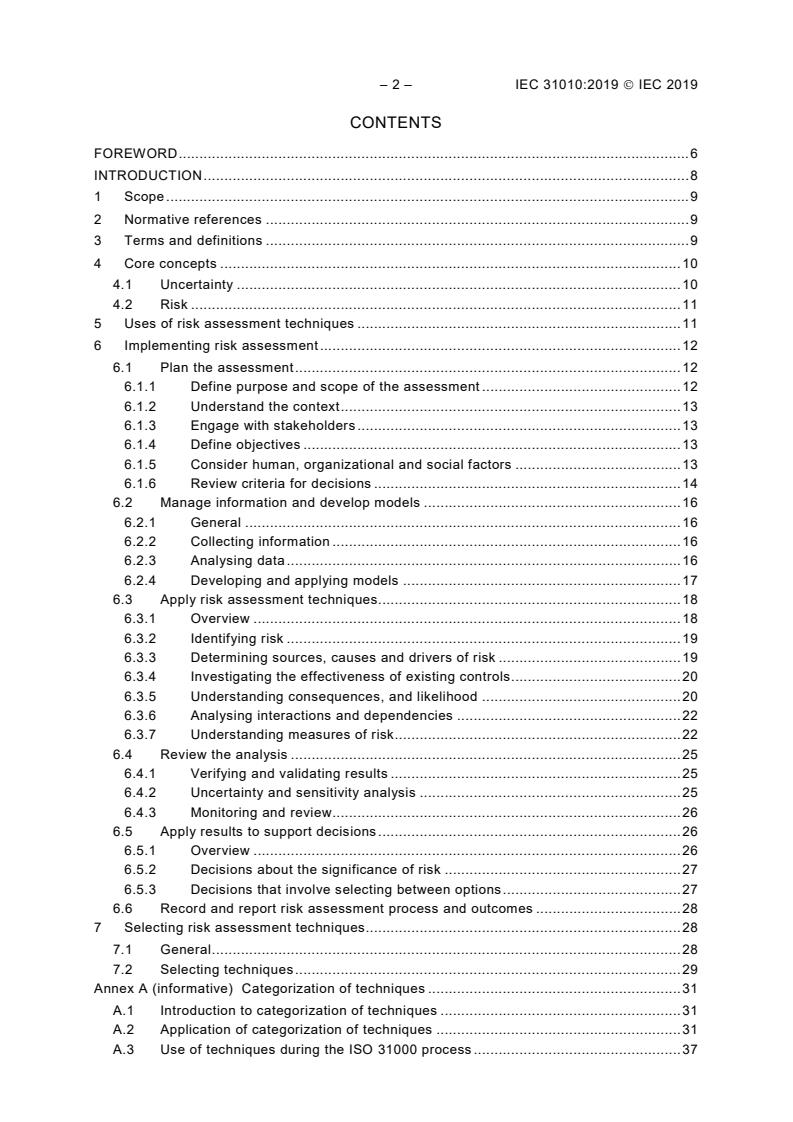
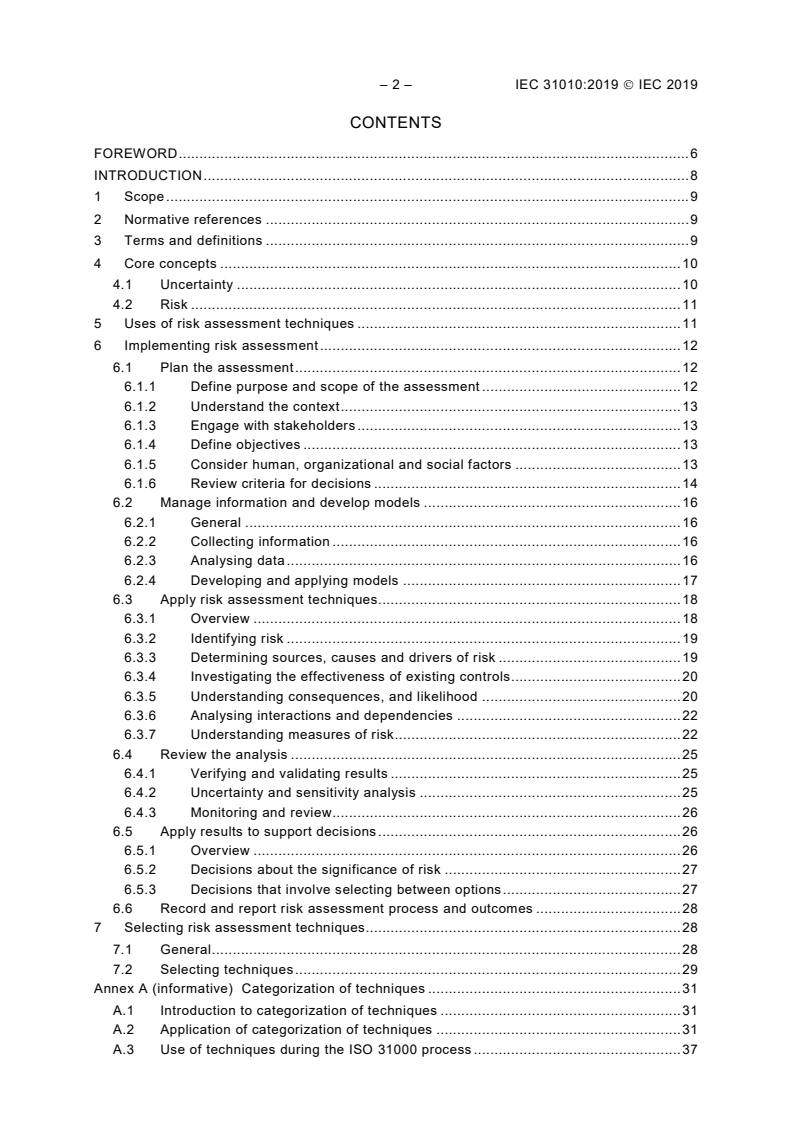
– 2 – IEC 31010:2019 IEC 2019
CONTENTS
FOREWORD . 6
INTRODUCTION . 8
1 Scope . 9
2 Normative references . 9
3 Terms and definitions . 9
4 Core concepts . 10
4.1 Uncertainty . 10
4.2 Risk . 11
5 Uses of risk assessment techniques . 11
6 Implementing risk assessment . 12
6.1 Plan the assessment . 12
6.1.1 Define purpose and scope of the assessment . 12
6.1.2 Understand the context . 13
6.1.3 Engage with stakeholders . 13
6.1.4 Define objectives . 13
6.1.5 Consider human, organizational and social factors . 13
6.1.6 Review criteria for decisions . 14
6.2 Manage information and develop models . 16
6.2.1 General . 16
6.2.2 Collecting information . 16
6.2.3 Analysing data . 16
6.2.4 Developing and applying models . 17
6.3 Apply risk assessment techniques. 18
6.3.1 Overview . 18
6.3.2 Identifying risk . 19
6.3.3 Determining sources, causes and drivers of risk . 19
6.3.4 Investigating the effectiveness of existing controls . 20
6.3.5 Understanding consequences, and likelihood . 20
6.3.6 Analysing interactions and dependencies . 22
6.3.7 Understanding measures of risk . 22
6.4 Review the analysis . 25
6.4.1 Verifying and validating results . 25
6.4.2 Uncertainty and sensitivity analysis . 25
6.4.3 Monitoring and review . 26
6.5 Apply results to support decisions . 26
6.5.1 Overview . 26
6.5.2 Decisions about the significance of risk . 27
6.5.3 Decisions that involve selecting between options . 27
6.6 Record and report risk assessment process and outcomes . 28
7 Selecting risk assessment techniques. 28
7.1 General . 28
7.2 Selecting techniques . 29
Annex A (informative) Categorization of techniques . 31
A.1 Introduction to categorization of techniques . 31
A.2 Application of categorization of techniques . 31
A.3 Use of techniques during the ISO 31000 process . 37
Annex B (informative) Description of techniques . 40
B.1 Techniques for eliciting views from stakeholders and experts. 40
B.1.1 General . 40
B.1.2 Brainstorming . 40
B.1.3 Delphi technique . 42
B.1.4 Nominal group technique . 43
B.1.5 Structured or semi-structured interviews . 44
B.1.6 Surveys . 45
B.2 Techniques for identifying risk. 46
B.2.1 General . 46
B.2.2 Checklists, classifications and taxonomies . 47
B.2.3 Failure modes and effects analysis (FMEA) and failure modes, effects
and criticality analysis (FMECA) . 49
B.2.4 Hazard and operability (HAZOP) studies . 50
B.2.5 Scenario analysis . 52
B.2.6 Structured what if technique (SWIFT) . 54
B.3 Techniques for determining sources, causes and drivers of risk . 55
B.3.1 General . 55
B.3.2 Cindynic approach . 56
B.3.3 Ishikawa analysis (fishbone) method . 58
B.4 Techniques for analysing controls . 60
B.4.1 General . 60
B.4.2 Bow tie analysis . 60
B.4.3 Hazard analysis and critical control points (HACCP) . 62
B.4.4 Layers of protection analysis (LOPA) . 64
B.5 Techniques for understanding consequences and likelihood . 66
B.5.1 General . 66
B.5.2 Bayesian analysis . 66
B.5.3 Bayesian networks and influence diagrams . 68
B.5.4 Business impact analysis (BIA) . 70
B.5.5 Cause-consequence analysis (CCA) . 72
B.5.6 Event tree analysis (ETA) . 74
B.5.7 Fault tree analysis (FTA) . 76
B.5.8 Human reliability analysis (HRA) . 78
B.5.9 Markov analysis . 79
B.5.10 Monte Carlo simulation . 81
B.5.11 Privacy impact analysis (PIA) / data protection impact analysis (DPIA) . 83
B.6 Techniques for analysing dependencies and interactions . 85
B.6.1 Causal mapping . 85
B.6.2 Cross impact analysis . 87
B.7 Techniques that provide a measure of risk . 89
B.7.1 Toxicological risk assessment. 89
B.7.2 Value at risk (VaR) . 91
B.7.3 Conditional value at risk (CVaR) or expected shortfall (ES) . 93
B.8 Techniques for evaluating the significance of risk . 94
B.8.1 General . 94
B.8.2 As low as reasonably practicable (ALARP) and so far as is reasonably
practicable (SFAIRP) . 94
– 4 – IEC 31010:2019 IEC 2019
B.8.3 Frequency-number (F-N) diagrams . 96
B.8.4 Pareto charts . 98
B.8.5 Reliability centred maintenance (RCM) . 100
B.8.6 Risk indices . 102
B.9 Techniques for selecting between options . 103
B.9.1 General . 103
B.9.2 Cost/benefit analysis (CBA) . 104
B.9.3 Decision tree analysis . 106
B.9.4 Game theory . 107
B.9.5 Multi-criteria analysis (MCA) . 109
B.10 Techniques for recording and reporting . 111
B.10.1 General . 111
B.10.2 Risk registers . 112
B.10.3 Consequence/likelihood matrix (risk matrix or heat map) . 113
B.10.4 S-curves . 117
Bibliography . 119
Figure A.1 – Application of techniques in the ISO 31000 risk management process [3] . 37
Figure B.1 – Example Ishikawa (fishbone) diagram . 59
Figure B.2 – Example of Bowtie . 61
Figure B.3 – A Bayesian network showing a simplified version of a real ecological
problem: modelling native fish populations in Victoria, Australia . 69
Figure B.4 – Example of cause-consequence diagram . 73
Figure B.5 – Example of event tree analysis . 75
Figure B.6 – Example of fault tree . 77
Figure B.7 – Example of Markov diagram . 80
Figure B.8 – Example of dose response curve . 89
Figure B.9 – Distribution of value . 91
Figure B.10 – Detail of loss region VaR values . 91
Figure B.11 – VaR and CVaR for possible loss portfolio . 93
Figure B.12 – ALARP diagram . 95
Figure B.13 – Sample F-N diagram . 97
Figure B.14 – Example of a Pareto chart . 98
Figure B.15 – Part example of table defining consequence scales . 114
Figure B.16 – Part example of a likelihood scale . 114
Figure B.17 – Example of consequence/likelihood matrix . 115
Figure B.18 – Probability distribution function and cumulative distribution function. 117
Table A.1 – Characteristics of techniques . 31
Table A.2 – Techniques and indicative characteristics . 32
Table A.3 – Applicability of techniques to the ISO 31000 process . 38
Table B.1 – Examples of basic guidewords and their generic meanings . 51
Table B.2 – Table of deficits for each stakeholder . 57
Table B.3 – Table of dissonances between stakeholders . 57
Table B.4 – Example of Markov matrix . 80
Table B.5 – Examples of systems to which Markov analysis can be applied . 81
Table B.6 – An example of RCM task selection . 101
Table B.7 – Example of a game matrix . 108
– 6 – IEC 31010:2019 IEC 2019
INTERNATIONAL ELECTROTECHNICAL COMMISSION
____________
RISK MANAGEMENT –
RISK ASSESSMENT TECHNIQUES
FOREWORD
1) The International Electrotechnical Commission (IEC) is a worldwide organization for standardization comprising
all national electrotechnical committees (IEC National Committees). The object of IEC is to promote international
co-operation on all questions concerning standardization in the electrical and electronic fields. To this end and
in addition to other activities, IEC publishes International Standards, Technical Specifications, Technical Reports,
Publicly Available Specifications (PAS) and Guides (hereafter referred to as "IEC Publication(s)"). Their
preparation is entrusted to technical committees; any IEC National Committee interested in the subject dealt with
may participate in this preparatory work. International, governmental and non-governmental organizations liaising
with the IEC also participate in this preparation. IEC collaborates closely with the International Organization for
Standardization (ISO) in accordance with conditions determined by agreement between the two organizations.
2) The formal decisions or agreements of IEC on technical matters express, as nearly as possible, an international
consensus of opinion on the relevant subjects since each technical committee has representation from all
interested IEC National Committees.
3) IEC Publications have the form of recommendations for international use and are accepted by IEC National
Committees in that sense. While all reasonable efforts are made to ensure that the technical content of IEC
Publications is accurate, IEC cannot be held responsible for the way in which they are used or for any
misinterpretation by any end user.
4) In order to promote international uniformity, IEC National Committees undertake to apply IEC Publications
transparently to the maximum extent possible in their national and regional publications. Any divergence between
any IEC Publication and the corresponding national or regional publication shall be clearly indicated in the latter.
5) IEC itself does not provide any attestation of conformity. Independent certification bodies provide conformity
assessment services and, in some areas, access to IEC marks of conformity. IEC is not responsible for any
services carried out by independent certification bodies.
6) All users should ensure that they have the latest edition of this publication.
7) No liability shall attach to IEC or its directors, employees, servants or agents including individual experts and
members of its technical committees and IEC National Committees for any personal injury, property damage or
other damage of any nature whatsoever, whether direct or indirect, or for costs (including legal fees) and
expenses arising out of the publication, use of, or reliance upon, this IEC Publication or any other IEC
Publications.
8) Attention is drawn to the Normative references cited in this publication. Use of the referenced publications is
indispensable for the correct application of this publication.
9) Attention is drawn to the possibility that some of the elements of this IEC Publication may be the subject of patent
rights. IEC shall not be held responsible for identifying any or all such patent rights.
International Standard IEC 31010 has been prepared by IEC technical committee 56:
Dependability, in co-operation with ISO technical committee 262: Risk management.
It is published as a double logo standard.
This second edition cancels and replaces the first edition published in 2009. This edition
constitutes a technical revision.
This edition includes the following significant technical changes with respect to the previous
edition:
• more detail is given on the process of planning, implementing, verifying and validating the
use of the techniques;
• the number and range of application of the techniques has been increased;
• the concepts covered in ISO 31000 are no longer repeated in this standard.
The text of this International Standard is based on the following documents of IEC:
FDIS Report on voting
56/1837/FDIS 56/1845/RVD
Full information on the voting for the approval of this International Standard can be found in the
report on voting indicated in the above table. In ISO, the standard has been approved by 44 P
members out of 46 having cast a vote.
This document has been drafted in accordance with the ISO/IEC Directives, Part 2.
The committee has decided that the contents of this document will remain unchanged until the
stability date indicated on the IEC website under "http://webstore.iec.ch" in the data related to
the specific document. At this date, the document will be
• reconfirmed,
• withdrawn,
• replaced by a revised edition, or
• amended.
IMPORTANT – The 'colour inside' logo on the cover page of this publication indicates
that it contains colours which are considered to be useful for the correct understanding
of its contents. Users should therefore print this document using a colour printer.
– 8 – IEC 31010:2019 IEC 2019
INTRODUCTION
This document provides guidance on the selection and application of various techniques that
can be used to help improve the way uncertainty is taken into account and to help understand
risk.
The techniques are used:
• where further understanding is required about what risk exists or about a particular risk;
• within a decision where a range of options each involving risk need to be compared or
optimized;
• within a risk management process leading to actions to treat risk.
The techniques are used within the risk assessment steps of identifying, analysing and
evaluating risk as described in ISO 31000, and more generally whenever there is a need to
understand uncertainty and its effects.
The techniques described in this document can be used in a wide range of settings, however
the majority originated in the technical domain. Some techniques are similar in concept but
have different names and methodologies that reflect the history of their development in different
sectors. Techniques have evolved over time and continue to evolve, and many can be used in
a broad range of situations outside their original application. Techniques can be adapted,
combined and applied in new ways or extended to satisfy current and future needs.
This document is an introduction to selected techniques and compares their possible
applications, benefits and limitations. It also provides references to sources of more detailed
information.
The potential audience for this document is:
• anyone involved in assessing or managing risk;
• people who are involved in developing guidance that sets out how risk is to be assessed in
specific contexts;
• people who need to make decisions where there is uncertainty including:
– those who commission or evaluate risk assessments,
– those who need to understand the outcomes of assessments, and
– those who have to choose assessment techniques to meet particular needs.
Organizations that are required to conduct risk assessments for compliance or conformance
purposes would benefit from using appropriate formal and standardized risk assessment
techniques.
RISK MANAGEMENT –
RISK ASSESSMENT TECHNIQUES
1 Scope
This International Standard provides guidance on the selection and application of techniques
for assessing risk in a wide range of situations. The techniques are used to assist in making
decisions where there is uncertainty, to provide information about particular risks and as part
of a process for managing risk. The document provides summaries of a range of techniques,
with references to other documents where the techniques are described in more detail.
2 Normative references
The following documents are referred to in the text in such a way that some or all of their content
constitutes requirements of this document. For dated references, only the edition cited applies.
For undated references, the latest edition of the referenced document (including any
amendments) applies.
ISO Guide 73:2009, Risk management – Vocabulary
ISO 31000:2018, Risk management – Guidelines
3 Terms and definitions
For the purposes of this document, the terms and definitions given in ISO 31000:2018,
ISO Guide 73:2009 and the following apply.
ISO and IEC maintain terminological databases for use in standardization at the following
addresses:
• IEC Electropedia: available at http://www.electropedia.org/
• ISO Online browsing platform: available at http://www.iso.org/obp
3.1
likelihood
chance of something happening
Note 1 to entry: In risk management terminology, the word "likelihood" is used to refer to the chance of something
happening, whether defined, measured or determined objectively or subjectively, qualitatively or quantitatively, and
described using general terms or mathematically (such as a probability or a frequency over a given time period).
Note 2 to entry: The English term "likelihood" does not have a direct equivalent in some languages; instead, the
equivalent of the term "probability" is often used. However, in English, "probability" is often narrowly interpreted as
a mathematical term. Therefore, in risk management terminology, "likelihood" is used with the intent that it should
have the same broad interpretation as the term "probability" has in many languages other than English.
[SOURCE: ISO 31000:2018, 3.7]
3.2
opportunity
combination of circumstances expected to be favourable to objectives
Note 1 to entry: An opportunity is a positive situation in which gain is likely and over which one has a fair level of
control.
– 10 – IEC 31010:2019 IEC 2019
Note 2 to entry: An opportunity to one party may pose a threat to another.
Note 3 to entry: Taking or not taking an opportunity are both sources of risk.
3.3
probability
measure of the chance of occurrence expressed as a number between 0 and 1, where 0 is
impossibility and 1 is absolute certainty
Note 1 to entry: See definition 3.1, Note 2 to entry.
3.4
risk driver
driver of risk
factor that has a major influence on risk
3.5
threat
potential source of danger, harm, or other undesirable outcome
Note 1 to entry: A threat is a negative situation in which loss is likely and over which one has relatively little control.
Note 2 to entry: A threat to one party may pose an opportunity to another.
4 Core concepts
4.1 Uncertainty
Uncertainty is a term which embraces many underlying concepts. Many attempts have been
made, and continue to be developed, to categorize types of uncertainty including:
• uncertainty which recognizes the intrinsic variability of some phenomena, and that cannot
be reduced by further research; for example, throwing dice (sometimes referred to as
aleatory uncertainty);
• uncertainty which generally results from a lack of knowledge and that therefore can be
reduced by gathering more data, by refining models, improving sampling techniques, etc.
(sometimes referred to as epistemic uncertainty).
Other commonly recognized forms of uncertainty include:
• linguistic uncertainty, which recognizes the vagueness and ambiguity inherent in spoken
languages;
• decision uncertainty, which has particular relevance to risk management strategies, and
which identifies uncertainty associated with value systems, professional judgement,
company values and societal norms.
Examples of uncertainty include:
• uncertainty as to the truth of assumptions, including presumptions about how people or
systems might behave;
• variability in the parameters on which a decision is to be based;
• uncertainty in the validity or accuracy of models which have been established to make
predictions about the future;
• events (including changes in circumstances or conditions) whose occurrence, character or
consequences are uncertain;
• uncertainty associated with disruptive events;
• the uncertain outcomes of systemic issues, such as shortages of competent staff, that can
have wide ranging impacts which cannot be clearly defined;
• lack of knowledge which arises when uncertainty is recognized but not fully understood;
• unpredictability;
• uncertainty arising from the limitations of the human mind, for example in understanding
complex data, predicting situations with long-term consequences or making bias-free
judgments.
Not all uncertainty is able to be understood and the significance of uncertainty might be hard or
impossible to define or influence. However, a recognition that uncertainty exists in a specific
context enables early warning systems to be put in place to detect change in a proactive and
timely manner and make arrangements to build resilience to cope with unexpected
circumstances.
4.2 Risk
Risk includes the effects of any of the forms of uncertainty described in 4.1 on objectives. The
uncertainty may lead to positive or negative consequences or both.
Risk is often described in terms of risk sources, potential events, their consequences and their
likelihoods. An event can have multiple causes and lead to multiple consequences.
Consequences can have a number of discrete values, be continuous variables or be unknown.
Consequences may not be discernible or measurable at first, but may accumulate over time.
Sources of risk can include inherent variability, or uncertainties related to a range of factors
including human behaviour and organizational structures or societal influences for which it can
be difficult to predict any particular event that might occur. It follows that risk cannot always be
tabulated easily as a set of events, their consequences and their likelihoods.
Risk assessment techniques aim to help people understand uncertainty and the associated risk
in this broad, complex and diverse context, for the purpose of supporting better-informed
decisions and actions.
5 Uses of risk assessment techniques
The techniques described in this document provide a means to improve understanding of
uncertainty and its implications for decisions and actions.
ISO 31000 describes principles for managing risk and the foundations and organizational
arrangements that enable risk to be managed. It specifies a process that enables risk to be
recognized, understood and modified as necessary, according to criteria that are established
as part of the process. Risk assessment techniques can be applied within this structured
approach which involves establishing context, assessing risk and treating risk, along with
ongoing monitoring, review, communication and consultation, recording and reporting. This
process is illustrated in Figure A.1 which also shows examples of where within the process
techniques can be applied.
In the ISO 31000 process, risk assessment involves identifying risks, analysing them, and using
the understanding gained from the analysis to evaluate risk by drawing conclusions about their
comparative significance in relation to the objectives and performance thresholds of the
organization. This process provides inputs into decisions about whether treatment is required,
priorities for treatment and the actions intended to treat risk. In practice an iterative approach
is applied.
Risk assessment techniques described in this document are used
• where further understanding is required about what risks exist or about a particular risk;
• within a risk management process leading to actions to treat risk;
• within a decision where a range of options each involving risk needs to be compared or
optimized.
– 12 – IEC 31010:2019 IEC 2019
In particular, the techniques can be used to:
• provide structured information to support decisions and actions where there is uncertainty;
• clarify the implications of assumptions on the achievement of objectives;
• compare multiple options, systems, technologies or approaches, etc. where there is
multifaceted uncertainty around each option;
• assist in defining realistic strategic and operational objectives;
• help determine an organization's risk criteria, such as risk limits, risk appetite or risk bearing
capacity;
• take risk into account when setting or reviewing priorities;
• recognize and understand risk, including risk that could have extreme outcomes;
• understand which uncertainties matter most to an organization's objectives and provide a
rationale for what should be done about them;
• recognize and exploit opportunities more successfully;
• articulate the factors that contribute to risk and why they are important;
• identify effective and efficient risk treatment actions;
• determine the modifying effect of proposed risk treatments, including any change in the
nature or magnitude of risk;
• communicate about risk and its implications;
• learn from failure and successes in order to improve the way risk is managed;
• demonstrate that regulatory and other requirements have been satisfied.
The way in which risk is assessed depends on the situation's complexity and novelty, and the
level of relevant knowledge and understanding.
• In the simplest case, when there is nothing new or unusual about a situation, risk is well
understood, with no major stakeholder implications or consequences are not significant,
then actions are likely to be decided according to established rules and procedures and
previous assessments of risk.
• For very novel, complex or challenging issues, where there is high uncertainty and little
experience, there is little information on which to base assessment and conventional
techniques of analysis might not be useful or meaningful. This also applies to circumstances
where stakeholders hold strongly divergent views. In these cases, multiple techniques might
be used to gain a partial understanding of risk, with judgements then made in the context of
organizational and societal values, and stakeholder views.
The techniques described in this document have greatest application in situations between
these two extremes where the complexity is moderate and there is some information available
on which to base the assessment.
6 Implementing risk assessment
6.1 Plan the assessment
6.1.1 Define purpose and scope of the assessment
The purpose of the assessment should be established, including identifying the decisions or
actions to which it relates, the decision makers, stakeholders, and the timing and nature of the
output required (for example whether qualitative, semi-quantitative or quantitative information
is required).
The scope, depth and level of detail of the assessment should be defined, with a description of
what is included, and excluded. The types of consequence to be included in the assessment
should be defined. Any conditions, assumptions, constraints or necessary resources relevant
to the assessment activity should also be specified.
6.1.2 Understand the context
When undertaking a risk assessment those involved should be aware of the broader
circumstances in which decisions and actions based on their assessment will be made. This
includes understanding the internal and external issues that contribute to the context of the
organization as well as wider societal and environmental aspects. Any relevant context
statement should be reviewed and checked to see that it is current and appropriate.
Understanding the bigger picture is particularly important where there is significant complexity.
6.1.3 Engage with stakeholders
Stakeholders and those who are likely to be able to contribute useful knowledge or relevant
views should be identified and their perspectives considered, whether or not they are included
as participants in the assessment. Appropriate involvement of stakeholders helps ensure that
the information on which risk assessment is based is valid and applicable and that stakeholders
understand the reasons behind decisions. Involvement of stakeholders can:
• provide information that enables the context of the assessment to be understood;
• bring together different areas of knowledge and expertise for more effectively identifying
and understanding risk;
• provide relevant expertise for use of the techniques;
• enable stakeholder interests to be understood and considered;
• provide input to the process of determining whether risk is acceptable particularly when the
stakeholders are impacted;
• fulfil any requirements for people to be informed or consulted;
• obtain support for the outputs and decisions arising from risk assessment;
• identify gaps in knowledge that need to be addressed prior to and/or during risk assessment.
It should be decided how outputs and outcomes of risk assessment are to be reliably, accurately
and transparently communicated to relevant stakeholders.
Techniques for eliciting views from stakeholders and experts are described in Clause B.1.
6.1.4 Define objectives
The objectives of the specific system or process for which risk is to be assessed should be
defined and where practicable documented. This will facilitate identification of risk and
understanding its implications.
To the extent practicable the objectives should be:
• specific to the subject of the assessment;
• measurable either qualitatively or quantitatively;
• achievable within the constraints imposed by the context;
• relevant to the larger goals or context of the organization;
• achievable within a stated time frame.
6.1.5 Consider human, organizational and social factors
Human, organizational and social factors should be considered explicitly and taken into account
as appropriate. Human aspects are relevant to risk assessment in the following ways:
– 14 – IEC 31010:2019 IEC 2019
• as a source of uncertainty;
• through influences on the way in which techniques are selected and applied;
• in the ways that information is interpreted and used (for example because of differing
perceptions of risk).
Human performance (whether above or below expe
...
IEC 31010
Edition 2.0 2019-06
INTERNATIONAL
STANDARD
NORME
INTERNATIONALE
colour
inside
Risk management – Risk assessment techniques
Management du risque – Techniques d'appréciation du risque
All rights reserved. Unless otherwise specified, no part of this publication may be reproduced or utilized in any form
or by any means, electronic or mechanical, including photocopying and microfilm, without permission in writing from
either IEC or IEC's member National Committee in the country of the requester. If you have any questions about IEC
copyright or have an enquiry about obtaining additional rights to this publication, please contact the address below or
your local IEC member National Committee for further information.
Droits de reproduction réservés. Sauf indication contraire, aucune partie de cette publication ne peut être reproduite ni
utilisée sous quelque forme que ce soit et par aucun procédé, électronique ou mécanique, y compris la photocopie et
les microfilms, sans l'accord écrit de l'IEC ou du Comité national de l'IEC du pays du demandeur. Si vous avez des
questions sur le copyright de l'IEC ou si vous désirez obtenir des droits supplémentaires sur cette publication, utilisez
les coordonnées ci-après ou contactez le Comité national de l'IEC de votre pays de résidence.
IEC Central Office Tel.: +41 22 919 02 11
3, rue de Varembé info@iec.ch
CH-1211 Geneva 20 www.iec.ch
Switzerland
About the IEC
The International Electrotechnical Commission (IEC) is the leading global organization that prepares and publishes
International Standards for all electrical, electronic and related technologies.
About IEC publications
The technical content of IEC publications is kept under constant review by the IEC. Please make sure that you have the
latest edition, a corrigendum or an amendment might have been published.
IEC publications search - webstore.iec.ch/advsearchform Electropedia - www.electropedia.org
The advanced search enables to find IEC publications by a The world's leading online dictionary on electrotechnology,
variety of criteria (reference number, text, technical containing more than 22 000 terminological entries in English
committee,…). It also gives information on projects, replaced and French, with equivalent terms in 16 additional languages.
and withdrawn publications. Also known as the International Electrotechnical Vocabulary
(IEV) online.
IEC Just Published - webstore.iec.ch/justpublished
Stay up to date on all new IEC publications. Just Published IEC Glossary - std.iec.ch/glossary
details all new publications released. Available online and once 67 000 electrotechnical terminology entries in English and
a month by email. French extracted from the Terms and Definitions clause of IEC
publications issued since 2002. Some entries have been
IEC Customer Service Centre - webstore.iec.ch/csc collected from earlier publications of IEC TC 37, 77, 86 and
If you wish to give us your feedback on this publication or need CISPR.
further assistance, please contact the Customer Service
Centre: sales@iec.ch.
A propos de l'IEC
La Commission Electrotechnique Internationale (IEC) est la première organisation mondiale qui élabore et publie des
Normes internationales pour tout ce qui a trait à l'électricité, à l'électronique et aux technologies apparentées.
A propos des publications IEC
Le contenu technique des publications IEC est constamment revu. Veuillez vous assurer que vous possédez l’édition la
plus récente, un corrigendum ou amendement peut avoir été publié.
Recherche de publications IEC - Le premier dictionnaire d'électrotechnologie en ligne au monde,
webstore.iec.ch/advsearchform avec plus de 22 000 articles terminologiques en anglais et en
La recherche avancée permet de trouver des publications IEC français, ainsi que les termes équivalents dans 16 langues
en utilisant différents critères (numéro de référence, texte, additionnelles. Egalement appelé Vocabulaire
comité d’études,…). Elle donne aussi des informations sur les Electrotechnique International (IEV) en ligne.
projets et les publications remplacées ou retirées.
Glossaire IEC - std.iec.ch/glossary
IEC Just Published - webstore.iec.ch/justpublished 67 000 entrées terminologiques électrotechniques, en anglais
Restez informé sur les nouvelles publications IEC. Just et en français, extraites des articles Termes et Définitions des
Published détaille les nouvelles publications parues. publications IEC parues depuis 2002. Plus certaines entrées
Disponible en ligne et une fois par mois par email. antérieures extraites des publications des CE 37, 77, 86 et
CISPR de l'IEC.
Service Clients - webstore.iec.ch/csc
Si vous désirez nous donner des commentaires sur cette
publication ou si vous avez des questions contactez-nous:
sales@iec.ch.
Electropedia - www.electropedia.org
IEC 31010
Edition 2.0 2019-06
INTERNATIONAL
STANDARD
NORME
INTERNATIONALE
colour
inside
Risk management – Risk assessment techniques
Management du risque – Techniques d'appréciation du risque
INTERNATIONAL
ELECTROTECHNICAL
COMMISSION
COMMISSION
ELECTROTECHNIQUE
INTERNATIONALE
ICS 03.100.01 ISBN 978-2-8322-6989-3
– 2 – IEC 31010:2019 IEC 2019
CONTENTS
FOREWORD . 6
INTRODUCTION . 8
1 Scope . 9
2 Normative references . 9
3 Terms and definitions . 9
4 Core concepts . 10
4.1 Uncertainty . 10
4.2 Risk . 11
5 Uses of risk assessment techniques . 11
6 Implementing risk assessment . 12
6.1 Plan the assessment . 12
6.1.1 Define purpose and scope of the assessment . 12
6.1.2 Understand the context . 13
6.1.3 Engage with stakeholders . 13
6.1.4 Define objectives . 13
6.1.5 Consider human, organizational and social factors . 13
6.1.6 Review criteria for decisions . 14
6.2 Manage information and develop models . 16
6.2.1 General . 16
6.2.2 Collecting information . 16
6.2.3 Analysing data . 16
6.2.4 Developing and applying models . 17
6.3 Apply risk assessment techniques. 18
6.3.1 Overview . 18
6.3.2 Identifying risk . 19
6.3.3 Determining sources, causes and drivers of risk . 19
6.3.4 Investigating the effectiveness of existing controls . 20
6.3.5 Understanding consequences, and likelihood . 20
6.3.6 Analysing interactions and dependencies . 22
6.3.7 Understanding measures of risk . 22
6.4 Review the analysis . 25
6.4.1 Verifying and validating results . 25
6.4.2 Uncertainty and sensitivity analysis . 25
6.4.3 Monitoring and review . 26
6.5 Apply results to support decisions . 26
6.5.1 Overview . 26
6.5.2 Decisions about the significance of risk . 27
6.5.3 Decisions that involve selecting between options . 27
6.6 Record and report risk assessment process and outcomes . 28
7 Selecting risk assessment techniques. 28
7.1 General . 28
7.2 Selecting techniques . 29
Annex A (informative) Categorization of techniques . 31
A.1 Introduction to categorization of techniques . 31
A.2 Application of categorization of techniques . 31
A.3 Use of techniques during the ISO 31000 process . 37
Annex B (informative) Description of techniques . 40
B.1 Techniques for eliciting views from stakeholders and experts. 40
B.1.1 General . 40
B.1.2 Brainstorming . 40
B.1.3 Delphi technique . 42
B.1.4 Nominal group technique . 43
B.1.5 Structured or semi-structured interviews . 44
B.1.6 Surveys . 45
B.2 Techniques for identifying risk. 46
B.2.1 General . 46
B.2.2 Checklists, classifications and taxonomies . 47
B.2.3 Failure modes and effects analysis (FMEA) and failure modes, effects
and criticality analysis (FMECA) . 49
B.2.4 Hazard and operability (HAZOP) studies . 50
B.2.5 Scenario analysis . 52
B.2.6 Structured what if technique (SWIFT) . 54
B.3 Techniques for determining sources, causes and drivers of risk . 55
B.3.1 General . 55
B.3.2 Cindynic approach . 56
B.3.3 Ishikawa analysis (fishbone) method . 58
B.4 Techniques for analysing controls . 60
B.4.1 General . 60
B.4.2 Bow tie analysis . 60
B.4.3 Hazard analysis and critical control points (HACCP) . 62
B.4.4 Layers of protection analysis (LOPA) . 64
B.5 Techniques for understanding consequences and likelihood . 66
B.5.1 General . 66
B.5.2 Bayesian analysis . 66
B.5.3 Bayesian networks and influence diagrams . 68
B.5.4 Business impact analysis (BIA) . 70
B.5.5 Cause-consequence analysis (CCA) . 72
B.5.6 Event tree analysis (ETA) . 74
B.5.7 Fault tree analysis (FTA) . 76
B.5.8 Human reliability analysis (HRA) . 78
B.5.9 Markov analysis . 79
B.5.10 Monte Carlo simulation . 81
B.5.11 Privacy impact analysis (PIA) / data protection impact analysis (DPIA) . 83
B.6 Techniques for analysing dependencies and interactions . 85
B.6.1 Causal mapping . 85
B.6.2 Cross impact analysis . 87
B.7 Techniques that provide a measure of risk . 89
B.7.1 Toxicological risk assessment. 89
B.7.2 Value at risk (VaR) . 91
B.7.3 Conditional value at risk (CVaR) or expected shortfall (ES) . 93
B.8 Techniques for evaluating the significance of risk . 94
B.8.1 General . 94
B.8.2 As low as reasonably practicable (ALARP) and so far as is reasonably
practicable (SFAIRP) . 94
– 4 – IEC 31010:2019 IEC 2019
B.8.3 Frequency-number (F-N) diagrams . 96
B.8.4 Pareto charts . 98
B.8.5 Reliability centred maintenance (RCM) . 100
B.8.6 Risk indices . 102
B.9 Techniques for selecting between options . 103
B.9.1 General . 103
B.9.2 Cost/benefit analysis (CBA) . 104
B.9.3 Decision tree analysis . 106
B.9.4 Game theory . 107
B.9.5 Multi-criteria analysis (MCA) . 109
B.10 Techniques for recording and reporting . 111
B.10.1 General . 111
B.10.2 Risk registers . 112
B.10.3 Consequence/likelihood matrix (risk matrix or heat map) . 113
B.10.4 S-curves . 117
Bibliography . 119
Figure A.1 – Application of techniques in the ISO 31000 risk management process [3] . 37
Figure B.1 – Example Ishikawa (fishbone) diagram . 59
Figure B.2 – Example of Bowtie . 61
Figure B.3 – A Bayesian network showing a simplified version of a real ecological
problem: modelling native fish populations in Victoria, Australia . 69
Figure B.4 – Example of cause-consequence diagram . 73
Figure B.5 – Example of event tree analysis . 75
Figure B.6 – Example of fault tree . 77
Figure B.7 – Example of Markov diagram . 80
Figure B.8 – Example of dose response curve . 89
Figure B.9 – Distribution of value . 91
Figure B.10 – Detail of loss region VaR values . 91
Figure B.11 – VaR and CVaR for possible loss portfolio . 93
Figure B.12 – ALARP diagram . 95
Figure B.13 – Sample F-N diagram . 97
Figure B.14 – Example of a Pareto chart . 98
Figure B.15 – Part example of table defining consequence scales . 114
Figure B.16 – Part example of a likelihood scale . 114
Figure B.17 – Example of consequence/likelihood matrix . 115
Figure B.18 – Probability distribution function and cumulative distribution function. 117
Table A.1 – Characteristics of techniques . 31
Table A.2 – Techniques and indicative characteristics . 32
Table A.3 – Applicability of techniques to the ISO 31000 process . 38
Table B.1 – Examples of basic guidewords and their generic meanings . 51
Table B.2 – Table of deficits for each stakeholder . 57
Table B.3 – Table of dissonances between stakeholders . 57
Table B.4 – Example of Markov matrix . 80
Table B.5 – Examples of systems to which Markov analysis can be applied . 81
Table B.6 – An example of RCM task selection . 101
Table B.7 – Example of a game matrix . 108
– 6 – IEC 31010:2019 IEC 2019
INTERNATIONAL ELECTROTECHNICAL COMMISSION
____________
RISK MANAGEMENT –
RISK ASSESSMENT TECHNIQUES
FOREWORD
1) The International Electrotechnical Commission (IEC) is a worldwide organization for standardization comprising
all national electrotechnical committees (IEC National Committees). The object of IEC is to promote international
co-operation on all questions concerning standardization in the electrical and electronic fields. To this end and
in addition to other activities, IEC publishes International Standards, Technical Specifications, Technical Reports,
Publicly Available Specifications (PAS) and Guides (hereafter referred to as "IEC Publication(s)"). Their
preparation is entrusted to technical committees; any IEC National Committee interested in the subject dealt with
may participate in this preparatory work. International, governmental and non-governmental organizations liaising
with the IEC also participate in this preparation. IEC collaborates closely with the International Organization for
Standardization (ISO) in accordance with conditions determined by agreement between the two organizations.
2) The formal decisions or agreements of IEC on technical matters express, as nearly as possible, an international
consensus of opinion on the relevant subjects since each technical committee has representation from all
interested IEC National Committees.
3) IEC Publications have the form of recommendations for international use and are accepted by IEC National
Committees in that sense. While all reasonable efforts are made to ensure that the technical content of IEC
Publications is accurate, IEC cannot be held responsible for the way in which they are used or for any
misinterpretation by any end user.
4) In order to promote international uniformity, IEC National Committees undertake to apply IEC Publications
transparently to the maximum extent possible in their national and regional publications. Any divergence between
any IEC Publication and the corresponding national or regional publication shall be clearly indicated in the latter.
5) IEC itself does not provide any attestation of conformity. Independent certification bodies provide conformity
assessment services and, in some areas, access to IEC marks of conformity. IEC is not responsible for any
services carried out by independent certification bodies.
6) All users should ensure that they have the latest edition of this publication.
7) No liability shall attach to IEC or its directors, employees, servants or agents including individual experts and
members of its technical committees and IEC National Committees for any personal injury, property damage or
other damage of any nature whatsoever, whether direct or indirect, or for costs (including legal fees) and
expenses arising out of the publication, use of, or reliance upon, this IEC Publication or any other IEC
Publications.
8) Attention is drawn to the Normative references cited in this publication. Use of the referenced publications is
indispensable for the correct application of this publication.
9) Attention is drawn to the possibility that some of the elements of this IEC Publication may be the subject of patent
rights. IEC shall not be held responsible for identifying any or all such patent rights.
International Standard IEC 31010 has been prepared by IEC technical committee 56:
Dependability, in co-operation with ISO technical committee 262: Risk management.
It is published as a double logo standard.
This second edition cancels and replaces the first edition published in 2009. This edition
constitutes a technical revision.
This edition includes the following significant technical changes with respect to the previous
edition:
• more detail is given on the process of planning, implementing, verifying and validating the
use of the techniques;
• the number and range of application of the techniques has been increased;
• the concepts covered in ISO 31000 are no longer repeated in this standard.
The text of this International Standard is based on the following documents of IEC:
FDIS Report on voting
56/1837/FDIS 56/1845/RVD
Full information on the voting for the approval of this International Standard can be found in the
report on voting indicated in the above table. In ISO, the standard has been approved by 44 P
members out of 46 having cast a vote.
This document has been drafted in accordance with the ISO/IEC Directives, Part 2.
The committee has decided that the contents of this document will remain unchanged until the
stability date indicated on the IEC website under "http://webstore.iec.ch" in the data related to
the specific document. At this date, the document will be
• reconfirmed,
• withdrawn,
• replaced by a revised edition, or
• amended.
IMPORTANT – The 'colour inside' logo on the cover page of this publication indicates
that it contains colours which are considered to be useful for the correct understanding
of its contents. Users should therefore print this document using a colour printer.
– 8 – IEC 31010:2019 IEC 2019
INTRODUCTION
This document provides guidance on the selection and application of various techniques that
can be used to help improve the way uncertainty is taken into account and to help understand
risk.
The techniques are used:
• where further understanding is required about what risk exists or about a particular risk;
• within a decision where a range of options each involving risk need to be compared or
optimized;
• within a risk management process leading to actions to treat risk.
The techniques are used within the risk assessment steps of identifying, analysing and
evaluating risk as described in ISO 31000, and more generally whenever there is a need to
understand uncertainty and its effects.
The techniques described in this document can be used in a wide range of settings, however
the majority originated in the technical domain. Some techniques are similar in concept but
have different names and methodologies that reflect the history of their development in different
sectors. Techniques have evolved over time and continue to evolve, and many can be used in
a broad range of situations outside their original application. Techniques can be adapted,
combined and applied in new ways or extended to satisfy current and future needs.
This document is an introduction to selected techniques and compares their possible
applications, benefits and limitations. It also provides references to sources of more detailed
information.
The potential audience for this document is:
• anyone involved in assessing or managing risk;
• people who are involved in developing guidance that sets out how risk is to be assessed in
specific contexts;
• people who need to make decisions where there is uncertainty including:
– those who commission or evaluate risk assessments,
– those who need to understand the outcomes of assessments, and
– those who have to choose assessment techniques to meet particular needs.
Organizations that are required to conduct risk assessments for compliance or conformance
purposes would benefit from using appropriate formal and standardized risk assessment
techniques.
RISK MANAGEMENT –
RISK ASSESSMENT TECHNIQUES
1 Scope
This International Standard provides guidance on the selection and application of techniques
for assessing risk in a wide range of situations. The techniques are used to assist in making
decisions where there is uncertainty, to provide information about particular risks and as part
of a process for managing risk. The document provides summaries of a range of techniques,
with references to other documents where the techniques are described in more detail.
2 Normative references
The following documents are referred to in the text in such a way that some or all of their content
constitutes requirements of this document. For dated references, only the edition cited applies.
For undated references, the latest edition of the referenced document (including any
amendments) applies.
ISO Guide 73:2009, Risk management – Vocabulary
ISO 31000:2018, Risk management – Guidelines
3 Terms and definitions
For the purposes of this document, the terms and definitions given in ISO 31000:2018,
ISO Guide 73:2009 and the following apply.
ISO and IEC maintain terminological databases for use in standardization at the following
addresses:
• IEC Electropedia: available at http://www.electropedia.org/
• ISO Online browsing platform: available at http://www.iso.org/obp
3.1
likelihood
chance of something happening
Note 1 to entry: In risk management terminology, the word "likelihood" is used to refer to the chance of something
happening, whether defined, measured or determined objectively or subjectively, qualitatively or quantitatively, and
described using general terms or mathematically (such as a probability or a frequency over a given time period).
Note 2 to entry: The English term "likelihood" does not have a direct equivalent in some languages; instead, the
equivalent of the term "probability" is often used. However, in English, "probability" is often narrowly interpreted as
a mathematical term. Therefore, in risk management terminology, "likelihood" is used with the intent that it should
have the same broad interpretation as the term "probability" has in many languages other than English.
[SOURCE: ISO 31000:2018, 3.7]
3.2
opportunity
combination of circumstances expected to be favourable to objectives
Note 1 to entry: An opportunity is a positive situation in which gain is likely and over which one has a fair level of
control.
– 10 – IEC 31010:2019 IEC 2019
Note 2 to entry: An opportunity to one party may pose a threat to another.
Note 3 to entry: Taking or not taking an opportunity are both sources of risk.
3.3
probability
measure of the chance of occurrence expressed as a number between 0 and 1, where 0 is
impossibility and 1 is absolute certainty
Note 1 to entry: See definition 3.1, Note 2 to entry.
3.4
risk driver
driver of risk
factor that has a major influence on risk
3.5
threat
potential source of danger, harm, or other undesirable outcome
Note 1 to entry: A threat is a negative situation in which loss is likely and over which one has relatively little control.
Note 2 to entry: A threat to one party may pose an opportunity to another.
4 Core concepts
4.1 Uncertainty
Uncertainty is a term which embraces many underlying concepts. Many attempts have been
made, and continue to be developed, to categorize types of uncertainty including:
• uncertainty which recognizes the intrinsic variability of some phenomena, and that cannot
be reduced by further research; for example, throwing dice (sometimes referred to as
aleatory uncertainty);
• uncertainty which generally results from a lack of knowledge and that therefore can be
reduced by gathering more data, by refining models, improving sampling techniques, etc.
(sometimes referred to as epistemic uncertainty).
Other commonly recognized forms of uncertainty include:
• linguistic uncertainty, which recognizes the vagueness and ambiguity inherent in spoken
languages;
• decision uncertainty, which has particular relevance to risk management strategies, and
which identifies uncertainty associated with value systems, professional judgement,
company values and societal norms.
Examples of uncertainty include:
• uncertainty as to the truth of assumptions, including presumptions about how people or
systems might behave;
• variability in the parameters on which a decision is to be based;
• uncertainty in the validity or accuracy of models which have been established to make
predictions about the future;
• events (including changes in circumstances or conditions) whose occurrence, character or
consequences are uncertain;
• uncertainty associated with disruptive events;
• the uncertain outcomes of systemic issues, such as shortages of competent staff, that can
have wide ranging impacts which cannot be clearly defined;
• lack of knowledge which arises when uncertainty is recognized but not fully understood;
• unpredictability;
• uncertainty arising from the limitations of the human mind, for example in understanding
complex data, predicting situations with long-term consequences or making bias-free
judgments.
Not all uncertainty is able to be understood and the significance of uncertainty might be hard or
impossible to define or influence. However, a recognition that uncertainty exists in a specific
context enables early warning systems to be put in place to detect change in a proactive and
timely manner and make arrangements to build resilience to cope with unexpected
circumstances.
4.2 Risk
Risk includes the effects of any of the forms of uncertainty described in 4.1 on objectives. The
uncertainty may lead to positive or negative consequences or both.
Risk is often described in terms of risk sources, potential events, their consequences and their
likelihoods. An event can have multiple causes and lead to multiple consequences.
Consequences can have a number of discrete values, be continuous variables or be unknown.
Consequences may not be discernible or measurable at first, but may accumulate over time.
Sources of risk can include inherent variability, or uncertainties related to a range of factors
including human behaviour and organizational structures or societal influences for which it can
be difficult to predict any particular event that might occur. It follows that risk cannot always be
tabulated easily as a set of events, their consequences and their likelihoods.
Risk assessment techniques aim to help people understand uncertainty and the associated risk
in this broad, complex and diverse context, for the purpose of supporting better-informed
decisions and actions.
5 Uses of risk assessment techniques
The techniques described in this document provide a means to improve understanding of
uncertainty and its implications for decisions and actions.
ISO 31000 describes principles for managing risk and the foundations and organizational
arrangements that enable risk to be managed. It specifies a process that enables risk to be
recognized, understood and modified as necessary, according to criteria that are established
as part of the process. Risk assessment techniques can be applied within this structured
approach which involves establishing context, assessing risk and treating risk, along with
ongoing monitoring, review, communication and consultation, recording and reporting. This
process is illustrated in Figure A.1 which also shows examples of where within the process
techniques can be applied.
In the ISO 31000 process, risk assessment involves identifying risks, analysing them, and using
the understanding gained from the analysis to evaluate risk by drawing conclusions about their
comparative significance in relation to the objectives and performance thresholds of the
organization. This process provides inputs into decisions about whether treatment is required,
priorities for treatment and the actions intended to treat risk. In practice an iterative approach
is applied.
Risk assessment techniques described in this document are used
• where further understanding is required about what risks exist or about a particular risk;
• within a risk management process leading to actions to treat risk;
• within a decision where a range of options each involving risk needs to be compared or
optimized.
– 12 – IEC 31010:2019 IEC 2019
In particular, the techniques can be used to:
• provide structured information to support decisions and actions where there is uncertainty;
• clarify the implications of assumptions on the achievement of objectives;
• compare multiple options, systems, technologies or approaches, etc. where there is
multifaceted uncertainty around each option;
• assist in defining realistic strategic and operational objectives;
• help determine an organization's risk criteria, such as risk limits, risk appetite or risk bearing
capacity;
• take risk into account when setting or reviewing priorities;
• recognize and understand risk, including risk that could have extreme outcomes;
• understand which uncertainties matter most to an organization's objectives and provide a
rationale for what should be done about them;
• recognize and exploit opportunities more successfully;
• articulate the factors that contribute to risk and why they are important;
• identify effective and efficient risk treatment actions;
• determine the modifying effect of proposed risk treatments, including any change in the
nature or magnitude of risk;
• communicate about risk and its implications;
• learn from failure and successes in order to improve the way risk is managed;
• demonstrate that regulatory and other requirements have been satisfied.
The way in which risk is assessed depends on the situation's complexity and novelty, and the
level of relevant knowledge and understanding.
• In the simplest case, when there is nothing new or unusual about a situation, risk is well
understood, with no major stakeholder implications or consequences are not significant,
then actions are likely to be decided according to established rules and procedures and
previous assessments of risk.
• For very novel, complex or challenging issues, where there is high uncertainty and little
experience, there is little information on which to base assessment and conventional
techniques of analysis might not be useful or meaningful. This also applies to circumstances
where stakeholders hold strongly divergent views. In these cases, multiple techniques might
be used to gain a partial understanding of risk, with judgements then made in the context of
organizational and societal values, and stakeholder views.
The techniques described in this document have greatest application in situations between
these two extremes where the complexity is moderate and there is some information available
on which to base the assessment.
6 Implementing risk assessment
6.1 Plan the assessment
6.1.1 Define purpose and scope of the assessment
The purpose of the assessment should be established, including identifying the decisions or
actions to which it relates, the decision makers, stakeholders, and the timing and nature of the
output required (for example whether qualitative, semi-quantitative or quantitative information
is required).
The scope, depth and level of detail of the assessment should be defined, with a description of
what is included, and excluded. The types of consequence to be included in the assessment
should be defined. Any conditions, assumptions, constraints or necessary resources relevant
to the assessment activity should also be specified.
6.1.2 Understand the context
When undertaking a risk assessment those involved should be aware of the broader
circumstances in which decisions and actions based on their assessment will be made. This
includes understanding the internal and external issues that contribute to the context of the
organization as well as wider societal and environmental aspects. Any relevant context
statement should be reviewed and checked to see that it is current and appropriate.
Understanding the bigger picture is particularly important where there is significant complexity.
6.1.3 Engage with stakeholders
Stakeholders and those who are likely to be able to contribute useful knowledge or relevant
views should be identified and their perspectives considered, whether or not they are included
as participants in the assessment. Appropriate involvement of stakeholders helps ensure that
the information on which risk assessment is based is valid and applicable and that stakeholders
understand the reasons behind decisions. Involvement of stakeholders can:
• provide information that enables the context of the assessment to be understood;
• bring together different areas of knowledge and expertise for more effectively identifying
and understanding risk;
• provide relevant expertise for use of the techniques;
• enable stakeholder interests to be understood and considered;
• provide input to the process of determining whether risk is acceptable particularly when the
stakeholders are impacted;
• fulfil any requirements for people to be informed or consulted;
• obtain support for the outputs and decisions arising from risk assessment;
• identify gaps in knowledge that need to be addressed prior to and/or during risk assessment.
It should be decided how outputs and outcomes of risk assessment are to be reliably, accurately
and transparently communicated to relevant stakeholders.
Techniques for eliciting views from stakeholders and experts are described in Clause B.1.
6.1.4 Define objectives
The objectives of the specific system or process for which risk is to be assessed should be
defined and where practicable documented. This will facilitate identification of risk and
understanding its implications.
To the extent practicable the objectives should be:
• specific to the subject of the assessment;
• measurable either qualitatively or quantitatively;
• achievable within the constraints imposed by the context;
• relevant to the larger goals or context of the organization;
• achievable within a stated time frame.
6.1.5 Consider human, organizational and social factors
Human, organizational and social factors should be considered explicitly and taken into account
as appropriate. Human aspects are relevant to risk assessment in the following ways:
– 14 – IEC 31010:2019 IEC 2019
• as a source of uncertainty;
• through influences on the way in which techniques are selected and applied;
• in the ways that information is interpreted and used (for example because of differing
perceptions of risk).
Human performance (whether above or below expe
...