


ISO/TR 13570:2001
(Main)Guidelines for the application of the ISO 7176 series on wheelchairs
Guidelines for the application of the ISO 7176 series on wheelchairs
Lignes directrices pour l'application de la série ISO 7176 sur les fauteuils roulants
General Information
- Status
- Withdrawn
- Publication Date
- 17-Jan-2001
- Withdrawal Date
- 17-Jan-2001
- Technical Committee
- ISO/TC 173/SC 1 - Wheelchairs
- Drafting Committee
- ISO/TC 173/SC 1 - Wheelchairs
- Current Stage
- 9599 - Withdrawal of International Standard
- Start Date
- 20-Apr-2005
- Completion Date
- 12-Feb-2026
Relations
- Consolidated By
ISO 16187:2013 - Footwear and footwear components — Test method to assess antibacterial activity - Effective Date
- 06-Jun-2022
- Effective Date
- 15-Apr-2008
Get Certified
Connect with accredited certification bodies for this standard

BSI Group
BSI (British Standards Institution) is the business standards company that helps organizations make excellence a habit.

TÜV Rheinland
TÜV Rheinland is a leading international provider of technical services.

TÜV SÜD
TÜV SÜD is a trusted partner of choice for safety, security and sustainability solutions.
Sponsored listings
Frequently Asked Questions
ISO/TR 13570:2001 is a technical report published by the International Organization for Standardization (ISO). Its full title is "Guidelines for the application of the ISO 7176 series on wheelchairs". This standard covers: Guidelines for the application of the ISO 7176 series on wheelchairs
Guidelines for the application of the ISO 7176 series on wheelchairs
ISO/TR 13570:2001 is classified under the following ICS (International Classification for Standards) categories: 11.180.10 - Aids and adaptation for moving. The ICS classification helps identify the subject area and facilitates finding related standards.
ISO/TR 13570:2001 has the following relationships with other standards: It is inter standard links to ISO 16187:2013, ISO/TR 13570-1:2005. Understanding these relationships helps ensure you are using the most current and applicable version of the standard.
ISO/TR 13570:2001 is available in PDF format for immediate download after purchase. The document can be added to your cart and obtained through the secure checkout process. Digital delivery ensures instant access to the complete standard document.
Standards Content (Sample)
TECHNICAL ISO/TR
REPORT 13570
First edition
2001-01-15
Guidelines for the application of the
ISO 7176 series on wheelchairs
Lignes directrices pour l'application de la série ISO 7176 sur les fauteuils
roulants
Reference number
©
ISO 2001
PDF disclaimer
This PDF file may contain embedded typefaces. In accordance with Adobe's licensing policy, this file may be printed or viewed but shall not
be edited unless the typefaces which are embedded are licensed to and installed on the computer performing the editing. In downloading this
file, parties accept therein the responsibility of not infringing Adobe's licensing policy. The ISO Central Secretariat accepts no liability in this
area.
Adobe is a trademark of Adobe Systems Incorporated.
Details of the software products used to create this PDF file can be found in the General Info relative to the file; the PDF-creation parameters
were optimized for printing. Every care has been taken to ensure that the file is suitable for use by ISO member bodies. In the unlikely event
that a problem relating to it is found, please inform the Central Secretariat at the address given below.
All rights reserved. Unless otherwise specified, no part of this publication may be reproduced or utilized in any form or by any means, electronic
or mechanical, including photocopying and microfilm, without permission in writing from either ISO at the address below or ISO's member body
in the country of the requester.
ISO copyright office
Case postale 56 � CH-1211 Geneva 20
Tel. + 41 22 749 01 11
Fax + 41 22 749 09 47
E-mail copyright@iso.ch
Web www.iso.ch
Printed in Switzerland
ii © ISO 2001 – All rights reserved
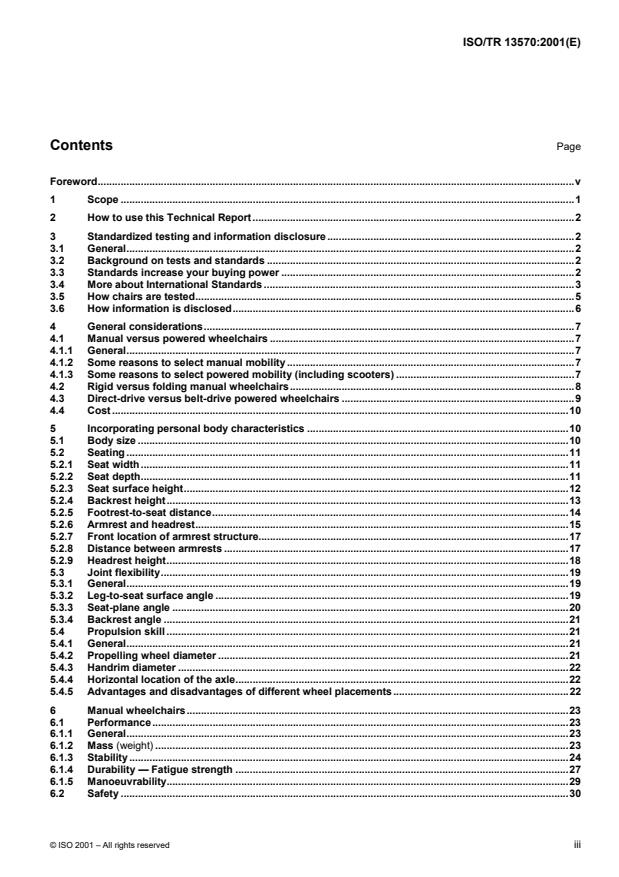
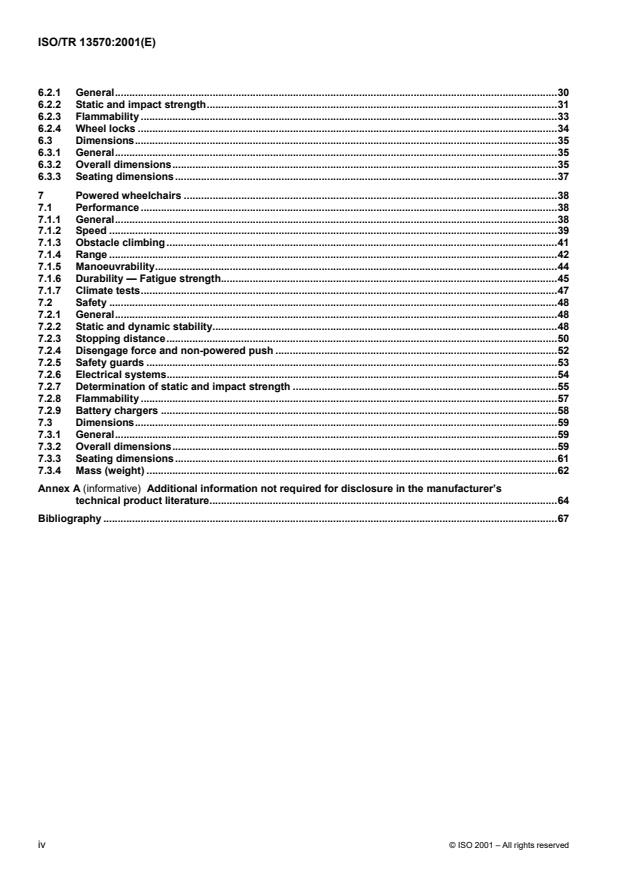
Contents Page
Foreword.v
1 Scope .1
2 How to use this Technical Report.2
3 Standardized testing and information disclosure.2
3.1 General.2
3.2 Background on tests and standards .2
3.3 Standards increase your buying power .2
3.4 More about International Standards .3
3.5 How chairs are tested.5
3.6 How information is disclosed.6
4 General considerations.7
4.1 Manual versus powered wheelchairs .7
4.1.1 General.7
4.1.2 Some reasons to select manual mobility .7
4.1.3 Some reasons to select powered mobility (including scooters) .7
4.2 Rigid versus folding manual wheelchairs.8
4.3 Direct-drive versus belt-drive powered wheelchairs .9
4.4 Cost .10
5 Incorporating personal body characteristics .10
5.1 Body size .10
5.2 Seating .11
5.2.1 Seat width.11
5.2.2 Seat depth.11
5.2.3 Seat surface height.12
5.2.4 Backrest height.13
5.2.5 Footrest-to-seat distance.14
5.2.6 Armrest and headrest.15
5.2.7 Front location of armrest structure.17
5.2.8 Distance between armrests .17
5.2.9 Headrest height.18
5.3 Joint flexibility.19
5.3.1 General.19
5.3.2 Leg-to-seat surface angle .19
5.3.3 Seat-plane angle .20
5.3.4 Backrest angle .21
5.4 Propulsion skill .21
5.4.1 General.21
5.4.2 Propelling wheel diameter .21
5.4.3 Handrim diameter .22
5.4.4 Horizontal location of the axle.22
5.4.5 Advantages and disadvantages of different wheel placements.22
6 Manual wheelchairs.23
6.1 Performance.23
6.1.1 General.23
6.1.2 Mass (weight) .23
6.1.3 Stability.24
6.1.4 Durability — Fatigue strength .27
6.1.5 Manoeuvrability.29
6.2 Safety .30
6.2.1 General.30
6.2.2 Static and impact strength.31
6.2.3 Flammability .33
6.2.4 Wheel locks .34
6.3 Dimensions.35
6.3.1 General.35
6.3.2 Overall dimensions.35
6.3.3 Seating dimensions .37
7 Powered wheelchairs .38
7.1 Performance .38
7.1.1 General.38
7.1.2 Speed .39
7.1.3 Obstacle climbing .41
7.1.4 Range .42
7.1.5 Manoeuvrability.44
7.1.6 Durability — Fatigue strength.45
7.1.7 Climate tests.47
7.2 Safety .48
7.2.1 General.48
7.2.2 Static and dynamic stability.48
7.2.3 Stopping distance.50
7.2.4 Disengage force and non-powered push .52
7.2.5 Safety guards .53
7.2.6 Electrical systems.54
7.2.7 Determination of static and impact strength .55
7.2.8 Flammability .57
7.2.9 Battery chargers .58
7.3 Dimensions.59
7.3.1 General.59
7.3.2 Overall dimensions.59
7.3.3 Seating dimensions .61
7.3.4 Mass (weight) .62
Annex A (informative) Additional information not required for disclosure in the manufacturer’s
technical product literature.64
Bibliography .67
iv © ISO 2001 – All rights reserved
Foreword
ISO (the International Organization for Standardization) is a worldwide federation of national standards bodies (ISO
member bodies). The work of preparing International Standards is normally carried out through ISO technical
committees. Each member body interested in a subject for which a technical committee has been established has
the right to be represented on that committee. International organizations, governmental and non-governmental, in
liaison with ISO, also take part in the work. ISO collaborates closely with the International Electrotechnical
Commission (IEC) on all matters of electrotechnical standardization.
International Standards are drafted in accordance with the rules given in the ISO/IEC Directives, Part 3.
The main task of technical committees is to prepare International Standards. Draft International Standards adopted
by the technical committees are circulated to the member bodies for voting. Publication as an International
Standard requires approval by at least 75 % of the member bodies casting a vote.
In exceptional circumstances, when a technical committee has collected data of a different kind from that which is
normally published as an International Standard ("state of the art", for example), it may decide by a simple majority
vote of its participating members to publish a Technical Report. A Technical Report is entirely informative in nature
and does not have to be reviewed until the data it provides are considered to be no longer valid or useful.
Attention is drawn to the possibility that some of the elements of this Technical Report may be the subject of patent
rights. ISO shall not be held responsible for identifying any or all such patent rights.
ISO/TR 13570, was prepared by Technical Committee ISO/TC 173, Technical systems and aids for disabled or
handicapped persons, Subcommittee SC 1, Wheelchairs.
This Technical Report is based on the book:
A Guide to Wheelchair Selection: How to Use the ANSI/RESNA Wheelchair Standards to Buy a Wheelchair
written by Peter Axelson, Jean Minkel and Denise Chesney, published in 1994 by the Paralyzed Veterans of
America, Washington, DC, USA.
TECHNICAL REPORT ISO/TR 13570:2001(E)
Guidelines for the the application of the ISO 7176 series on
wheelchairs
1 Scope
The purpose of this Technical Report is to explain how you can use the International Standards on wheelchairs to
select your next wheelchair. The actual standards are very technical and, at first glance, you may not understand
how this information will help you select a wheelchair or scooter. This Technical Report is meant to help you
understand the purpose for and content of International Standards on wheelchairs.
This Technical Report is divided into six clauses.
a) How to use this Technical Report.
b) Standardized testing and information disclosure: Provides background information on standardized testing of
wheelchairs. Discusses how chairs are tested and how information is disclosed.
c) General considerations: Discusses general considerations related to choosing a powered or manual
wheelchair.
d) Incorporating personal body characteristics: Relates your physical characteristics to the fit of a chair, either
manual or powered.
e) Manual wheelchairs: Discusses manual wheelchair test procedures.
f) Powered wheelchairs: Discusses powered wheelchair test procedures; focuses on three- and four-wheeled
scooters as well as full-sized powered wheelchairs.
In the manual and powered wheelchair sections, the test procedures are grouped into three categories:
� performance,
� safety, and
� dimensions.
For each test procedure, this Technical Report includes
� reasons why you might need this information,
� a brief description of the standardized test procedure,
� how the results of the test will be disclosed in the manufacturer’s technical product literature, and
� how to interpret the results of the test for your own situation.
2 How to use this Technical Report
If you are an experienced rider, you may know which elements of performance, safety and dimension are important
to you. If not, or if you are a novice, we highly recommend that you involve other knowledgeable people in selecting
your wheelchair. Many rehabilitation specialists have the expertise and training in using these standards and can
help you select an appropriate wheelchair.
An excellent approach to the wheelchair selection process is to set priorities based on your mobility and seating
needs. Setting priorities will help you identify the features that are most important to you and those on which you
are willing to compromise. For example, if you live in a small apartment and need to fit your wheelchair into the
boot (trunk) of your car, you will probably want to look specifically at the overall dimensions, foldability, and weight
of the wheelchair. On the other hand, if you use a van and have an accessible apartment or home, you may not
need a folding wheelchair. This Technical Report will help you understand the test results that pertain to the factors
most important to you. Armed with this information, you will be able to accurately compare products and make an
informed purchasing decision.
3 Standardized testing and information disclosure
3.1 General
Purchasing a wheelchair can be a harrowing experience and finding the right chair among so many choices might
seem impossible. Comparing wheelchair characteristics and performance has been difficult in the past because
manufacturers used different standards and procedures to measure and test their chairs. For example, one
manufacturer measured seat width from the outside of the seat rails, another measured from inside the rails, and a
third measured the distance between the armrest panels. Thus, if you requested a chair with a seat width of
18 inches, the actual distance from the outside of the seat rails could be anywhere from 17 inches to 19 inches.
This inconsistency, as well as a general concern for user safety, led to the development of standardized wheelchair
measurements and test procedures. The results of these procedures will provide you with the information you need
for true comparison shopping.
3.2 Background on tests and standards
The ISO Technical Committee on wheelchairs has been working to provide consumers with objective information
about the characteristics and performance of wheelchairs. The committee includes rehabilitation engineers,
wheelchair manufacturers, agency representatives, wheelchair users, and wheelchair prescribers.
The standards developed by the committee consist of a number of test procedures that apply to all wheelchairs and
some that apply only to powered wheelchairs, including scooters. The test procedures are detailed instructions on
how to perform the tests or measurements on wheelchairs. Some of the test procedures suggest minimum
performance criteria for durability and safety, while others disclose the results of the tests for comparison purposes.
The information obtained from the tests is designed to help you make better-educated selections. See Figure 1.
The standardized test procedures also allow you to compare the test results of wheelchairs from different
manufacturers. Since many of the test procedures set minimum performance levels, they also help manufacturers
produce better products.
3.3 Standards increase your buying power
The standards are voluntary: manufacturers are not required by law to use the test procedures. However, if
consumers start using the results as a basis for wheelchair selection, the manufacturers who do not use the
standards may lose sales. The US Department of Veterans Affairs (VA), the single largest purchaser of wheelchairs
in the United States, is adopting the standards for future wheelchair purchasing. Marketplace pressure will most
likely encourage overall compliance with the standards.
2 © ISO 2001 – All rights reserved
Figure 1 — Finding the right chair among so many choices might seem impossible
3.4 More about International Standards
To gain the maximum benefit from the standardized testing, both consumers and professionals must understand
how to use the information.
The following is a list of the test standards, listed by their ISO number designation, that apply to all wheelchairs,
with a brief description of the test procedure.
ISO 6440:1985, Wheelchairs — Nomenclature, terms and definitions. This part establishes the terms and
definitions used in the test procedures.
ISO 7193:1985, Wheelchairs — Maximum overall dimensions. This part establishes suggested maximum
dimensions of a chair for other organizations to use as guidelines for architectural accessibility.
ISO 7176-1:1999, Wheelchairs — Part 1: Determination of static stability. This test determines how stable the
wheelchair is when it is resting on a sloped surface.
ISO 7176-3:1988, Wheelchairs — Part 3: Determination of efficiency of brakes. This test determines how well
the wheel locks (parking brakes) prevent the wheelchair from rolling on a sloped surface. This test
also determines the minimum stopping distance of a powered wheelchair at its maximum speed.
ISO 7176-5:1986, Wheelchairs — Part 5: Determination of overall dimensions, mass and turning space. This
part addresses the overall length, width, height, folded width, mass and turnaround space of the
chair.
ISO 7176-7:1998, Wheelchairs — Part 7: Measurement of seating and wheel dimensions. This part addresses
the dimensional information needed to fit a chair to a rider. Standard methods of measurement
eliminate the problems that result from variations in measurement methods.
ISO 7176-8:1998, Wheelchairs — Part 8: Requirements and test methods for static, impact and fatigue
strengths. This part addresses the strength and durability of a wheelchair.
ISO 7176-11:1992, Wheelchairs — Part 11: Test dummies. This part addresses the dimensional and mass
(weight) specifications of the dummies to be used when conducting the tests.
ISO 7176-13:1989, Wheelchairs — Part 13: Determination of coefficient of friction of test surfaces. This test
describes the roughness or slipperiness of the surface to be used for testing.
ISO 7176-15:1996, Wheelchairs — Part 15: Requirements for information disclosure, documentation and
labelling. This part tells what information manufacturers are required to disclose and how it should
be disclosed in their product literature, if they choose to comply with the standards.
ISO 7176-16:1997, Wheelchairs — Part 16: Resistance to ignition of upholstered parts — Requirements and
test methods. This test addresses the extent to which upholstery will burn and how fire retardant the
upholstery is.
1)
ISO 7176-19:— , Wheelchairs — Part 19: Wheeled mobility devices for use in motor vehicles. This part sets
out the design and performance requirements, and associated test methods, for wheelchairs that are
intended for use as a seat in a motor vehicle.
1)
ISO 7176-20:— , Wheelchairs — Part 20: Determination of the performance of stand-up type wheelchairs.
This part addresses the performance of a manual or powered wheelchair that has a mode to assist
the occupant and support the occupant while in the standing position.
ISO 7176-22:2000, Wheelchairs — Part 22: Set-up procedures. This part specifies the procedures for
configuring and adjusting a wheelchair prior to testing.
1)
ISO 7176-23:— , Wheelchairs — Part 23: Attendant-operated stair-climbing devices — Requirements and
test methods. This part determines the performance of stair climbing devices that are operated by
an attendant.
1)
ISO 7176-24:— , Wheelchairs — Part 24: User-operated stair-climbing devices — Requirements and test
methods. This part determines the performance of stair-climbing devices that are operated by the
occupant.
The following is a list of test procedures that apply to powered wheelchairs only:
ISO 7176-2:1990, Wheelchairs — Part 2: Determination of dynamic stability of electric wheelchairs. This part
addresses how stable a powered wheelchair is in the rearward, forward and lateral directions when it
is driven.
ISO 7176-4:1997, Wheelchairs — Part 4: Energy consumption of electric wheelchairs and scooters for
determination of theoretical distance range. This test addresses the energy consumption of a
powered wheelchair on a standardized track.
1)
ISO 7176-6:— , Wheelchairs — Part 6: Determination of maximum speed, acceleration and deceleration of
electric wheelchairs. This part addresses the maximum speed in forward and reverse. It also
determines the minimum time from stationary to maximum speed (acceleration) and from maximum
speed to a complete stop (retardation).
1)
ISO 7176-9:— , Wheelchairs — Part 9: Climatic tests for electric wheelchairs. This part addresses the effects
of rain and temperature changes on the functioning of a powered wheelchair.
1) To be published.
4 © ISO 2001 – All rights reserved
ISO 7176-10:1988, Wheelchairs — Part 10: Determination of obstacle-climbing ability of electric
wheelchairs. This test determines how high an obstacle a powered wheelchair can climb over.
ISO 7176-14:1997, Wheelchairs — Part 14: Power and control systems for electric wheelchairs —
Requirements and test methods. This test addresses safety, how well the fail-safe braking
mechanism works, the force required to actuate the controls, and other issues related specifically to
powered wheelchairs.
1)
ISO 7176-21:— , Wheelchairs — Part 21: Electromagnetic compatibility of electrically powered wheelchairs
and motorized scooters — Requirements and test methods This part addresses the
electromagnetic emissions and electromagnetic immunity of powered wheelchairs, including
scooters.
3.5 How chairs are tested
The International Standards on wheelchairs are specific instructions on how to perform the test procedures. Some
of the test procedures have minimum performance requirements, including flammability and climatic tests, static
and impact strength tests, and power and control systems tests for powered wheelchairs. The results of the
minimum performance tests are either pass or fail. These tests ensure minimum performance and safety of the
product. See Figure 2.
Figure 2 — Testing of wheelchairs has become more sophisticated over the years
Most of the test procedures are performance tests that produce quantified information about a chair. The results
give information for comparison purposes only; there is no pass or fail determination. These comparisons are
meaningful because, for the first time, each manufacturer uses the same tests. Until now, different manufacturers
described their wheelchairs using different terms. By comparing test results of different chairs, you can begin
comparative wheelchair shopping.
Most of the tests are conducted with a test dummy in the chair to represent the weight of a person. The results for
chairs tested in this “loaded” condition more closely approximate the fit and performance of a chair when it is
actually occupied. Your own body size, body proportions riding style may affect the actual fit and performance of a
chair.
For wheelchair components that are adjustable, the manufacturer adjusts the wheelchair configuration and controls
to obtain the extreme range of outcomes for a specific test procedure. For example, rear axle position and other
adjustable features affect the stability of a chair. In this case, the manufacturer tests the wheelchair with its rear
wheels and other adjustable features in both the least and most stable configurations. These results give a range of
tipping angles that reflects the least stable and most stable configurations that can be obtained by adjusting the
rear wheels and other features of the wheelchair. On a powered wheelchair with an adjustable controller, the
manufacturer will disclose a range of stopping distances to reflect the adjustability of speed and retardation
(deceleration).
3.6 How information is disclosed
Manufacturers that wish to comply with the International Standards on wheelchairs must comply with ISO 7176-15,
which specifies which test results must be contained in the pre-sale technical product literature. A list of the
additional tests that the manufacturer is required to perform is contained in annex A. The manufacturer is not
required to disclose the results of these additional tests in the technical product literature, but the consumer can
request this information. See Figure 3.
Figure 3 — To be in compliance with the ISO test procedures, manufacturers are required to disclose
certain information about the chair in their pre-sale technical product literature
The test results of particular procedures are disclosed as performance values, which at first may have little or no
meaning to you. For example, a manufacturer may disclose the rear-tipping angle of a wheelchair, but there is no
minimum performance value available for comparison at this time. However, you can look up the tip angle or the
range of tip angles for a specific wheelchair with which you have experience, then look at the tip angles of other
wheelchairs and figure out how these chairs will perform compared with the chair you know. For example, suppose
your current wheelchair has a rear tip angle of four degrees. You can determine if the wheelchair you are
considering is more or less tippy than your current chair by finding out if its rear tip angle is greater or less then four
degrees. As you gain experience using one wheelchair, the information about other wheelchairs will become more
meaningful to you.
NOTE The performance ratings are usually based on testing only one wheelchair. The results disclosed represent the
maximum performance of a new wheelchair tested without failure. The performance you get from your wheelchair will vary
depending on your body size and proportion, physical strength, abilities, skills and riding habits and on environmental
conditions.
6 © ISO 2001 – All rights reserved
4 General considerations
4.1 Manual versus powered wheelchairs
4.1.1 General
Rehabilitation programmes used to emphasize that if it was possible for you to push a manual wheelchair, you
should do so. The saying was “Useit or loseit.” However, many people with marginal ability to use a manual
wheelchair find that they deplete all their energy resources just trying to get where they want to go. Once they get
there, they have no energy left to do what they want to do. Worse yet, people with 20 or 30 years of experience
pushing a manual wheelchair realise that their shoulders are worn out as a result of the years of “using it” and not
“losing it.” Should healthy manual wheelchair riders spend some time in a powered wheelchair? To answer this
question, do some self-examination. Ask yourself which type of mobility meets your needs. See Figure 4.
Figure 4 — In some environments, a manual wheelchair may not leave you with the energy that you will
need when you get to your destination
4.1.2 Some reasons to select manual mobility
You have sufficient upper body strength and overall endurance to propel your wheelchair all day.
Reducing the weight or increasing the manoeuvrability of the wheelchair would enhance your independence.
Some of your daily activities are easier to perform in a manual chair.
A manual wheelchair is smaller, lighter and less expensive to maintain and repair.
You are not experiencing chronic pain in your arms or shoulders.
4.1.3 Some reasons to select powered mobility (including scooters)
You have insufficient endurance or functional ability to propel a manual wheelchair independently.
You need to conserve energy during long-distance wheeling to work or school.
Powered mobility would enable you to be more independent in your daily living, work and recreational activities.
You have access to personal or public transportation that accommodates a full-sized powered chair or scooter for
longer distance travel.
Many powered wheelchair riders have a manual wheelchair to use when a powered wheelchair is inconvenient.
When travelling, a powered wheelchair user may use a manual wheelchair and have a person help with mobility.
Other users may rely on a manual wheelchair at home and at work and use a powered wheelchair for travelling to
and from work. There is something to be said for the use of a powered wheelchair to prevent overuse of the
shoulder muscles, although this option is not often discussed. Financial considerations are important as well, since
powered wheelchairs are expensive. Whether the primary wheelchair is powered or manual, a backup manual
wheelchair should be available in the event of breakdown of the main wheelchair.
4.2 Rigid versus folding manual wheelchairs
If you plan to use a manual wheelchair, the first decision you have to make is whether it should be rigid or folding.
Nonfolding fixed-frame chairs are more rigid, whereas folding chairs tend to have a little more flex in the frame. This
flex can be an advantage when you are travelling over slightly uneven surfaces, because all the wheels of the chair
tend to stay on the ground. When you use a rigid wheelchair on an uneven surface, one wheel often lifts off the
ground. However, on a hard floor surface, a rigid-frame chair gives a more responsive feeling, since all the energy
you expend goes into propulsion and none goes into flexing the frame of the chair. Many people prefer the
aesthetics of a rigid frame (see Figure 5), although both types are available in lightweight models and in a variety of
colours. Some of the advantages and disadvantages are listed in Table 1.
Figure 5 — Getting a folding wheelchair into and out of a car can be quicker than a rigid-frame chair.
However, many riders prefer the performance of a rigid-frame chair on hard surface floors
Table 1 — Rigid versus folding wheelchairs
Advantages Disadvantages
Rigid frame
� Frame design requires fewer � Requires removal of quick-release rear
components and thus has more wheels for loading into car
strength for a given mass
� May feel bumpier on uneven surfaces
� Usually a lighter chair than a similarly
� Does not fold into as small a package
equipped folding chair
for stowing in car or aeroplane
� Fewer removable parts
� Required to meet National Wheelchair
Basketball Association specifications
� Seat-to-back angle is often adjustable
Folding
� Folds into compact package for � More moving, adjustable, and
frame
stowing in car or aeroplane removable components
� Flexes to enable all four wheels to stay � May not meet rider’s sports or leisure
on the ground when riding on uneven activity needs
surfaces
� Seat-to-back angle usually not
� Can be folded and stowed without adjustable
removing parts
� Lateral stability can decrease as the
chair flexes or starts to fold
8 © ISO 2001 – All rights reserved
4.3 Direct-drive versus belt-drive powered wheelchairs
When the motors are mounted directly to the drive wheels with only gears in between, the system is called a direct-
drive system. When belts connect the motors to the drive wheels, the system is called a belt-drive system. Most
wheelchairs are only available one way or the other. Keep in mind when comparing two scooters that one may
have a direct-drive system while the other may have a belt-drive system. Full-sized powered chairs are also
manufactured with either a direct-drive or a belt-drive system.
Like the rigid-frame manual wheelchair, the direct-drive system has no flex or slack. The drive wheels respond
directly to the actions of the motors. The belt, on the other hand, introduces a slight delay between the action of the
motor and the wheel. Depending on your trunk balance, you may find the delay in a belt-driven chair provides a
more comfortable ride. Unfortunately, belts can slip if they are not properly adjusted or if they are wet, and the rear
wheels will not always respond when you want them to. You must look at the advantages of direct drive versus belt
drive and make the best choice for your needs and your environment. See Figure 6.
Figure 6 — Many users choose lower maintenance direct-drive chairs despite some drawbacks
Some of the advantages and disadvantages of the two drive systems are listed in Table 2.
Table 2 — Direct-drive versus belt-drive powered wheelchairs
Advantages Disadvantages
Direct drive � Requires little maintenance � Can be noisy during operation
� No exposed parts to get dirty � Gears wear if not properly lubricated
wear
Belt drive � Belts can be easily replaced � Chair will drive in a circle if a belt
breaks
� Generally quiet during operation
� Belts can slip when wet, reducing
� Canprovide asmoothride
control
� Generally requires more maintenance
� May require adjustments if there is a
change in temperature
� Belts can be noisy during start-up
4.4 Cost
Seating and mobility professionals can provide a thorough clinical evaluation of your needs, environment, size and
functional strengths and limitations to help you choose the appropriate wheelchair. In addition, the rehabilitation
facility may have a variety of wheelchairs on hand to demonstrate the “latest and greatest” in design and
components. A proper clinical evaluation and knowledge of available components may prevent costly mistakes.
Many wheelchair users have received chairs that did not fit or did not meet their functional needs as a result of an
uninformed decision. In most cases, the rehabilitation centre will assemble and adjust the chair to fit you, and
training is often available through the centre or the wheelchair supplier to help you learn the performance
characteristics of the chair.
If you feel you can bypass seating and mobility professionals because you have enough personal experience, you
may be able to save money by purchasing the wheelchair directly from a mail order house or with cash through a
local supplier. As with any mail-order purchase, you will forgo local support, including warranty repairs, assembly,
set-up and adjustment to fit your body, abilities and skills. Such a purchase also will not include training, which you
might need if the new wheelchair has very different performance characteristics from your previous one.
5 Incorporating personal body characteristics
5.1 Body size
Just knowing your height and weight is not enough to determine the appropriate dimensions of your wheelchair. In
order to achieve the best fit, you also need to know the dimensions of your body in a seated position. When
measuring your body size, it is helpful to sit in a wheelchair that is as close to the correct size as possible. If you
are ordering a wheelchair with sling upholstery, you should be measured while sitting in a chair with sling
upholstery. If you are ordering a wheelchair with rigid seat and back surfaces, you should be measured sitting in a
wheelchair with a rigid seat and back, or at least on a surface with similar characteristics. If you will be using a seat
cushion, sit on the same type and size of cushion you will use in the new chair. Be sure to consider the seat
cushion as part of your body while making the measurements. If you sit on a cushion that is lower or higher than
the one you will be using in your new chair, the measurements will be incorrect.
The measurements you will use are
� seat width,
� seat depth,
� seat surface height,
� backrest height, and
� footrest-to-seat distance.
If you use armrests and/or a headrest you will need to know
� armrest height,
� front of armrest to backrest distance,
� armrest length,
� front location of armrest structure,
� distance between armrests, and
� headrest height.
10 © ISO 2001 – All rights reserved
Until now, figuring the dimensions of a wheelchair to fit an individual used to be a nightmare, because there was no
standard measurement method. Each manufacturer had his own way of making measurements. Also, all
manufacturers measured their chairs empty, although the size of the chair may change when a person sits in it.
The fabric seat and back upholstery may give, pulling the two sides of the chair together, thus changing its size.
The ISO test procedures require that the wheelchair be measured “loaded” with a weighted test dummy. The test
dummy sizes represent the size and mass of the intended rider: large adult [100 kg (220 lbs)], adult [75 kg
(165 lbs)], small adult [50 kg (110 lbs)] and child [25 kg (55 lbs)]. Specifying a chair to fit you will be much more
accurate when working with dimensions that represent the size of an occupied chair. Although figuring out the
dimensions of a wheelchair can still
...
Questions, Comments and Discussion
Ask us and Technical Secretary will try to provide an answer. You can facilitate discussion about the standard in here.
Loading comments...