

ISO/TS 16840-15:2024
(Main)Wheelchair seating — Part 15: Selection, placement and fixation of flexible postural support devices in seating
General Information
- Abstract
This document specifies requirements for the selection, placement and fixation of flexible postural support devices within seating devices and systems and to chairs, including wheelchairs and bathroom equipment. Seating devices can be involved in one or more situations, including hoists, static seating, wheelchair seating, shower chairs, etc. The devices enable the seated person (the occupant) to be positioned to maximize their functional activities in a safe environment. These requirements are formulated to achieve a balance of posture maintenance and safety. This document covers flexible positioning supports (padded or otherwise) used for postural positioning and/or safety. It does not cover belts and harnesses used in transportation for restraint, postural support devices made from rigid materials such as metal, wood, or hard plastics, or postural support devices designed solely for use in sports-related seating.
- Status
- Published
- Publication Date
- 22-Apr-2024
- Technical Committee
- ISO/TC 173/SC 1 - Wheelchairs
- Drafting Committee
- ISO/TC 173/SC 1/WG 11 - Wheelchair seating
- Current Stage
- 6060 - International Standard published
- Start Date
- 23-Apr-2024
- Due Date
- 17-Mar-2023
- Completion Date
- 23-Apr-2024

Overview
ISO/TS 16840-15:2024 - Wheelchair seating - Part 15: Selection, placement and fixation of flexible postural support devices in seating - specifies requirements and guidance for selecting, placing and fixing flexible postural support devices (PSDs) within seating systems (including wheelchairs, static seating, shower chairs and hoists). The document focuses on padded or flexible positioning supports used for postural positioning and safety to help occupants achieve functional activities while maintaining a safe posture. It explicitly excludes rigid postural supports, vehicle restraint belts/harnesses and sports-only supports.
Key topics and technical requirements
- Aims and principles: Distinguishes positioning versus restraint, and balances posture maintenance with occupant safety. Addresses paediatric considerations and material selection.
- Safety considerations: Guidance on PSD–body interface, forces on bony prominences, physiological impacts, interaction with medical devices and skeletal development (including hips).
- Selection, placement and fixation: Requirements for where and how to place pelvic, trunk, head, leg, foot and arm flexible supports, including:
- Pelvic supports (anterior, inferior, lateral, posterior; 2‑point and 4‑point systems)
- Trunk supports (anterior - fixed/dynamic, circumferential chest, shoulder supports; lateral and posterior supports)
- Flexible leg and foot supports (medial thigh, posterior lower leg, circumferential ankle, superior foot)
- Flexible head and arm supports
- Attachment and mounting: Safe methods for securing PSDs to seating and supporting structures; includes informative annex on mounting devices.
- Materials and testing: Considerations for material performance, pressure distribution, closure systems (e.g., hook-and-loop), and testing requirements.
- Transportation & paediatric needs: Guidance on use during transport and specific requirements for children (hip development).
- Documentation: Product labelling, fitting instructions, instructions for use and disclosure information to support safe selection and fitting.
- Informative annexes: Measurement of person/device, operability vs. occupant dexterity, strangulation risk prevention, hook‑and‑loop placement.
Applications and who should use this standard
ISO/TS 16840-15:2024 is practical for:
- Seating and wheelchair manufacturers - to design and validate flexible PSDs and attachment systems.
- Clinicians and seating specialists (OTs, PTs) - to select and position supports that optimize posture and function.
- Rehabilitation engineers and designers - for integration of PSDs into seating systems and accessories.
- Procurement and regulatory bodies - to assess product safety, labelling and conformance.
- Testing laboratories - for developing test protocols related to materials, attachments and safety.
Related standards
- Part of the ISO 16840 series on wheelchair seating. Consult the ISO website for other parts in the series and complementary standards addressing wheelchair dimensions, testing and transportation.
Keywords: ISO/TS 16840-15:2024, wheelchair seating, flexible postural support devices, selection placement fixation, postural positioning, pelvic support, trunk supports, seating safety.
Get Certified
Connect with accredited certification bodies for this standard

BSI Group
BSI (British Standards Institution) is the business standards company that helps organizations make excellence a habit.

TÜV Rheinland
TÜV Rheinland is a leading international provider of technical services.

TÜV SÜD
TÜV SÜD is a trusted partner of choice for safety, security and sustainability solutions.
Sponsored listings
Frequently Asked Questions
ISO/TS 16840-15:2024 is a technical specification published by the International Organization for Standardization (ISO). Its full title is "Wheelchair seating — Part 15: Selection, placement and fixation of flexible postural support devices in seating". This standard covers: This document specifies requirements for the selection, placement and fixation of flexible postural support devices within seating devices and systems and to chairs, including wheelchairs and bathroom equipment. Seating devices can be involved in one or more situations, including hoists, static seating, wheelchair seating, shower chairs, etc. The devices enable the seated person (the occupant) to be positioned to maximize their functional activities in a safe environment. These requirements are formulated to achieve a balance of posture maintenance and safety. This document covers flexible positioning supports (padded or otherwise) used for postural positioning and/or safety. It does not cover belts and harnesses used in transportation for restraint, postural support devices made from rigid materials such as metal, wood, or hard plastics, or postural support devices designed solely for use in sports-related seating.
This document specifies requirements for the selection, placement and fixation of flexible postural support devices within seating devices and systems and to chairs, including wheelchairs and bathroom equipment. Seating devices can be involved in one or more situations, including hoists, static seating, wheelchair seating, shower chairs, etc. The devices enable the seated person (the occupant) to be positioned to maximize their functional activities in a safe environment. These requirements are formulated to achieve a balance of posture maintenance and safety. This document covers flexible positioning supports (padded or otherwise) used for postural positioning and/or safety. It does not cover belts and harnesses used in transportation for restraint, postural support devices made from rigid materials such as metal, wood, or hard plastics, or postural support devices designed solely for use in sports-related seating.
ISO/TS 16840-15:2024 is classified under the following ICS (International Classification for Standards) categories: 11.180.10 - Aids and adaptation for moving. The ICS classification helps identify the subject area and facilitates finding related standards.
ISO/TS 16840-15:2024 is available in PDF format for immediate download after purchase. The document can be added to your cart and obtained through the secure checkout process. Digital delivery ensures instant access to the complete standard document.
Standards Content (Sample)
Technical
Specification
ISO/TS 16840-15
First edition
Wheelchair seating —
2024-04
Part 15:
Selection, placement and fixation
of flexible postural support devices
in seating
Sièges de fauteuils roulants —
Partie 15: Choix, mise en place et fixation des dispositifs de
soutien postural dans les sièges
Reference number
© ISO 2024
All rights reserved. Unless otherwise specified, or required in the context of its implementation, no part of this publication may
be reproduced or utilized otherwise in any form or by any means, electronic or mechanical, including photocopying, or posting on
the internet or an intranet, without prior written permission. Permission can be requested from either ISO at the address below
or ISO’s member body in the country of the requester.
ISO copyright office
CP 401 • Ch. de Blandonnet 8
CH-1214 Vernier, Geneva
Phone: +41 22 749 01 11
Email: copyright@iso.org
Website: www.iso.org
Published in Switzerland
ii
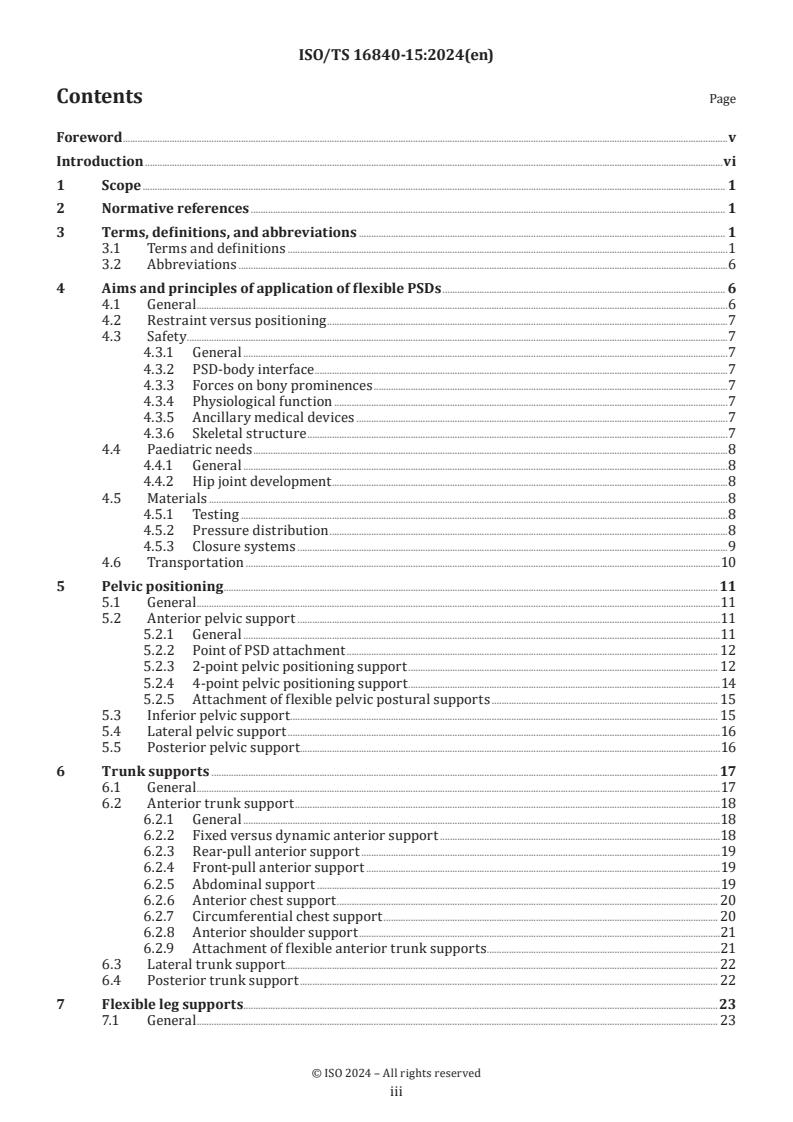
Contents Page
Foreword .v
Introduction .vi
1 Scope . 1
2 Normative references . 1
3 Terms, definitions, and abbreviations . 1
3.1 Terms and definitions .1
3.2 Abbreviations .6
4 Aims and principles of application of flexible PSDs . 6
4.1 General .6
4.2 Restraint versus positioning .7
4.3 Safety.7
4.3.1 General .7
4.3.2 PSD-body interface .7
4.3.3 Forces on bony prominences .7
4.3.4 Physiological function .7
4.3.5 Ancillary medical devices .7
4.3.6 Skeletal structure .7
4.4 Paediatric needs .8
4.4.1 General .8
4.4.2 Hip joint development .8
4.5 Materials .8
4.5.1 Testing .8
4.5.2 Pressure distribution .8
4.5.3 Closure systems .9
4.6 Transportation .10
5 Pelvic positioning .11
5.1 General .11
5.2 Anterior pelvic support .11
5.2.1 General .11
5.2.2 Point of PSD attachment . 12
5.2.3 2-point pelvic positioning support . 12
5.2.4 4-point pelvic positioning support .14
5.2.5 Attachment of flexible pelvic postural supports . 15
5.3 Inferior pelvic support . 15
5.4 Lateral pelvic support .16
5.5 Posterior pelvic support.16
6 Trunk supports . 17
6.1 General .17
6.2 Anterior trunk support .18
6.2.1 General .18
6.2.2 Fixed versus dynamic anterior support .18
6.2.3 Rear-pull anterior support .19
6.2.4 Front-pull anterior support .19
6.2.5 Abdominal support .19
6.2.6 Anterior chest support . 20
6.2.7 Circumferential chest support . 20
6.2.8 Anterior shoulder support .21
6.2.9 Attachment of flexible anterior trunk supports .21
6.3 Lateral trunk support . . . 22
6.4 Posterior trunk support . 22
7 Flexible leg supports . .23
7.1 General . 23
iii
7.2 Medial thigh support . 23
7.3 Posterior lower leg support. 23
8 Flexible foot supports .24
8.1 General .24
8.2 Circumferential ankle support .24
8.3 Superior foot support . 25
8.4 Attachment of flexible foot supports to equipment . 25
8.4.1 General . 25
8.4.2 Circumferential ankle support . 25
8.4.3 Superior foot support . 25
9 Flexible head supports .26
9.1 General . 26
9.2 Anterior head support . 26
9.3 Attachment of anterior head supports to equipment . 26
10 Flexible arm supports .26
10.1 General . 26
11 Disclosure information .27
11.1 Product labelling .27
11.2 Fitting instructions . 28
11.3 Instructions for use . 29
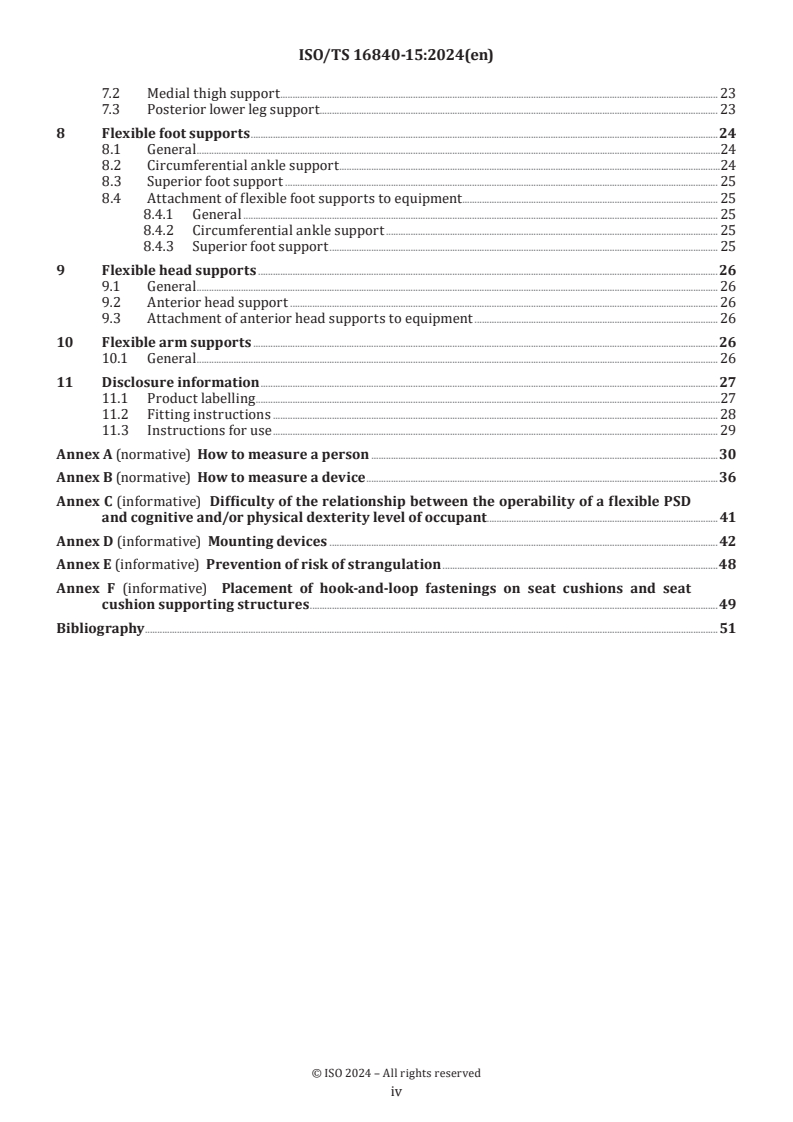
Annex A (normative) How to measure a person .30
Annex B (normative) How to measure a device .36
Annex C (informative) Difficulty of the relationship between the operability of a flexible PSD
and cognitive and/or physical dexterity level of occupant. 41
Annex D (informative) Mounting devices .42
Annex E (informative) Prevention of risk of strangulation .48
Annex F (informative) Placement of hook-and-loop fastenings on seat cushions and seat
cushion supporting structures .49
Bibliography .51
iv
Foreword
ISO (the International Organization for Standardization) is a worldwide federation of national standards
bodies (ISO member bodies). The work of preparing International Standards is normally carried out through
ISO technical committees. Each member body interested in a subject for which a technical committee
has been established has the right to be represented on that committee. International organizations,
governmental and non-governmental, in liaison with ISO, also take part in the work. ISO collaborates closely
with the International Electrotechnical Commission (IEC) on all matters of electrotechnical standardization.
The procedures used to develop this document and those intended for its further maintenance are described
in the ISO/IEC Directives, Part 1. In particular, the different approval criteria needed for the different types
of ISO document should be noted. This document was drafted in accordance with the editorial rules of the
ISO/IEC Directives, Part 2 (see www.iso.org/directives).
ISO draws attention to the possibility that the implementation of this document may involve the use of (a)
patent(s). ISO takes no position concerning the evidence, validity or applicability of any claimed patent
rights in respect thereof. As of the date of publication of this document, ISO had not received notice of (a)
patent(s) which may be required to implement this document. However, implementers are cautioned that
this may not represent the latest information, which may be obtained from the patent database available at
www.iso.org/patents. ISO shall not be held responsible for identifying any or all such patent rights.
Any trade name used in this document is information given for the convenience of users and does not
constitute an endorsement.
For an explanation of the voluntary nature of standards, the meaning of ISO specific terms and expressions
related to conformity assessment, as well as information about ISO's adherence to the World Trade
Organization (WTO) principles in the Technical Barriers to Trade (TBT), see www.iso.org/iso/foreword.html.
This document was prepared by Technical Committee ISO/TC 173, Assistive products, Subcommittee SC 1,
Wheelchairs.
A list of all parts in the ISO 16840 series can be found on the ISO website.
Any feedback or questions on this document should be directed to the user’s national standards body. A
complete listing of these bodies can be found at www.iso.org/members.html.
v
Introduction
Postural support devices, such as positioning supports, are typically used to provide increased postural
stability and/or to maintain or correct the occupant’s posture, in order to help maintain and increase day-
to-day functionality for the individual. Postural support devices can also help to reduce the development
of skeletal deformities, or to correct them. These devices, having postural support purposes, are not to be
confused with belts and similar devices designed to act as vehicular occupant restraints. Postural support
devices may improve the occupant’s safety in other ways, especially when used to prevent falls in or out of
the seating system.
In the US, Axelson reported that deaths from strangulation had occurred due to wheelchair occupants
[1]
slipping down in their chairs as a result of inappropriate placement of pelvic positioning belts . In the UK,
the records of the MHRA (Medicines and Healthcare Products Regulatory Agency) show that, over a 15-
year period, there had been four reported deaths and 17 serious injuries involving, or attributed to, pelvic
postural support devices or anterior trunk postural support devices. These deaths are thought to have
occurred as a result of inappropriate placement or adjustment of the supports, or their failure.
There appears to be confusion as to best practice in the selection and fixation of flexible postural support
[2]
devices (e.g. the updated MHRA recommendations in the UK ), and the reasons why postural supports need
to be placed and adjusted according to the occupant’s needs. This document has been produced to specify
these criteria to be applied to positioning supports when used in seating systems and chairs, including
wheelchairs and bathroom equipment (such as shower chairs), and, where applicable, hoists. This document
has been created to support clinicians, engineers, carers, manufacturers, retailers and repairers.
NOTE 1 In this document, nomenclature has been based on ISO 7176-26 and ISO 16840-1. Thus, a support described
as a positioning support can have the name adapted to include a description of its function based on the part of the
body to which it is applied: e.g. a pelvic positioning support helps to position the pelvis, but might not be applied
directly to the pelvis (e.g. the thighs) to achieve this. On the other hand, an anterior pelvic support would be applied
anterior to the pelvis.
NOTE 2 Positioning support placement can differ based on clinical and risk assessment.
vi
Technical Specification ISO/TS 16840-15:2024(en)
Wheelchair seating —
Part 15:
Selection, placement and fixation of flexible postural support
devices in seating
1 Scope
This document specifies requirements for the selection, placement and fixation of flexible postural support
devices within seating devices and systems and to chairs, including wheelchairs and bathroom equipment.
Seating devices can be involved in one or more situations, including hoists, static seating, wheelchair seating,
shower chairs, etc. The devices enable the seated person (the occupant) to be positioned to maximize their
functional activities in a safe environment. These requirements are formulated to achieve a balance of
posture maintenance and safety.
This document covers flexible positioning supports (padded or otherwise) used for postural positioning
and/or safety. It does not cover belts and harnesses used in transportation for restraint, postural support
devices made from rigid materials such as metal, wood, or hard plastics, or postural support devices
designed solely for use in sports-related seating.
2 Normative references
The following documents are referred to in the text in such a way that some or all of their content constitutes
requirements of this document. For dated references, only the edition cited applies. For undated references,
the latest edition of the referenced document (including any amendments) applies.
ISO 7000:2019, Graphical symbols for use on equipment — Registered symbols
ISO 7176-26:2007, Wheelchairs — Part 26: Vocabulary
ISO 15223-1:2021, Medical devices — Symbols to be used with information to be supplied by the manufacturer —
Part 1: General requirements
ISO 16840-1, Wheelchair seating — Part 1: Vocabulary, reference axis convention and measures for body
segments, posture and postural support surfaces
ISO 16840-3, Wheelchair seating — Part 3: Determination of static, impact, and repetitive load strengths for
postural support devices
ISO 16840-10, Wheelchair seating — Part 10: Resistance to ignition of postural support devices — Requirements
and test method
3 Terms, definitions, and abbreviations
3.1 Terms and definitions
For the purposes of this document, the terms and definitions given in ISO 7176-26:2007, ISO 16840-1 and the
following apply.
ISO and IEC maintain terminology databases for use in standardization at the following addresses:
— ISO Online browsing platform: available at https:// www .iso .org/ obp
— IEC Electropedia: available at https:// www .electropedia .org/
3.1.1
support
3.1.1.1
anterior support
postural support device (3.1.5.2) intended to be in contact with the anterior surface of a body segment
EXAMPLE Anterior head support, anterior lower leg support, anterior pelvic support, anterior shoulder support,
anterior trunk support, and anterior upper arm support.
Note 1 to entry: The anterior surface is based on the anterior surface when the person is seated in a typical upright
sitting position.
Note 2 to entry: The term can include the part of the anatomy receiving the support.
Note 3 to entry: The following are deprecated terms: anterior head strap, forehead strap, forehead support, headband,
knee block, knee strap, lap belt, pelvic stabilizer, pelvic strap, safety belt, seat belt, sub-ASIS bar, backpack strap,
shoulder bar, shoulder hook, shoulder retractor, shoulder strap, anterior thoracic support, butterfly strap, butterfly
harness, chest harness, chest strap, H-strap, harness, spiderman strap, Y-strap, humeral strap.
[SOURCE: ISO 7176-26:2007, 4.7.23, modified — Examples and Notes to entry have been updated.]
3.1.1.2
circumferential support
postural support device (3.1.5.2) which supports a body segment on at least three sides from at least three
directions
EXAMPLE Circumferential ankle support, circumferential chest support, circumferential neck support, and
circumferential wrist support.
Note 1 to entry: The term can include the part of the anatomy receiving the support.
Note 2 to entry: The following are deprecated terms: ankle strap, cervical collar, circumferential cervical support,
collar, Houdini strap.
[SOURCE: ISO 7176-26:2007, 4.7.29, modified — Examples and Notes to entry have been updated.]
3.1.1.3
inferior support
postural support device (3.1.5.2) intended to be in contact with the inferior surface of a body segment
EXAMPLE Inferior lower leg support, inferior pelvic support, and inferior thigh support.
Note 1 to entry: The inferior surface is based on the inferior surface when the person is seated in a typical upright
sitting position
Note 2 to entry: The term can include the part of the anatomy receiving the support.
Note 3 to entry: The following are deprecated terms: stump support, obliquity pad, thigh wedge.
Note 4 to entry: An inferior support usually applies to the buttocks and thighs, and is used with, or as part of, a seat
cushion.
[SOURCE: ISO 7176-26:2007, 4.7.28, modified — Examples and Notes to entry have been updated.]
3.1.1.4
lateral support
postural support device (3.1.5.2) intended to be in contact with the lateral surface of a body segment
EXAMPLE Lateral head support, lateral knee support, lateral lower leg support, lateral pelvic support, lateral
trunk support, lateral upper arm support, and lateral thigh support.
Note 1 to entry: The term can include the part of the anatomy receiving the support.
Note 2 to entry: The following are deprecated terms: head side support, lateral headrest, adductor pad, adductor
strap, calf strap, calf support, leg block, leg guide, leg pad, leg strap, leg rest pad, hip block, hip guide, hip pad, lateral
hip support, body side support, lateral, lateral support on its own, lateral pad, lateral thoracic pad, lateral thoracic
support, scoliosis pad, side cushion, trunk pad, humeral block, protractor, adductor pad, adductor wedge, leg block, leg
pad, leg strap, thigh block, thigh strap.
[SOURCE: ISO 7176-26:2007, 4.7.26, modified — Examples and Notes to entry have been updated.]
3.1.1.5
medial support
postural support device (3.1.5.2) intended to be in contact with the medial surface of a body segment
EXAMPLE Medial knee support, medial lower leg support, and medial thigh support.
Note 1 to entry: The term can include the part of the anatomy receiving the support.
Note 2 to entry: The following are deprecated terms: pommel, adduction strap, adductor pad, adductor wedge, leg
adductor support, leg dividing support, wedge, wedge pad.
[SOURCE: ISO 7176-26:2007, 4.7.25, modified — Examples and Notes to entry have been updated.]
3.1.1.6
posterior support
postural support device (3.1.5.2) intended to be in contact with the posterior surface of a body segment
EXAMPLE Posterior foot support, posterior head support, posterior lower leg support, posterior lumbar support,
posterior sacral support, and posterior upper arm support.
Note 1 to entry: The posterior surface is based on the posterior surface when the person is seated in a typical upright
sitting position.
Note 2 to entry: The term can include the part of the anatomy receiving the support.
Note 3 to entry: The following are deprecated terms: heel cup, heel loop, heel strap, calf pad, calf panel, calf strap, calf
support, leg strap, leg support, leg rest pad, lower leg support, posterior leg support, lower leg support, lumbar pad,
lumbar roll, posterior pelvic support, elbow block, humeral block, protractor.
[SOURCE: ISO 7176-26:2007, 4.7.24, modified — Examples and Notes to entry have been updated.]
3.1.1.7
superior support
postural support device (3.1.5.2) intended to be in contact with the superior surface of a body segment
EXAMPLE Superior foot support, superior forearm support, and superior thigh support.
Note 1 to entry: The superior surface is based on the superior surface when the person is seated in a typical upright
sitting position.
Note 2 to entry: The term can include the part of the anatomy receiving the support.
Note 3 to entry: The following are deprecated terms: toe cup, toe loop, forearm hook, forearm strap, leg strap, thigh strap.
[SOURCE: ISO 7176-26:2007, 4.7.27, modified — Examples and Notes to entry have been updated.]
3.1.2
linear support surface measures
Note 1 to entry: Where the support’s local axis is referred to, the axis system is that used in A clinical application guide
[3]
to standardized wheelchair seating measures of the body and seating support surfaces .
Note 2 to entry: When describing the width (3.1.2.4) and depth (3.1.2.1) of an item used in the horizontal plane, the
width dimension is expressed before the depth dimension.
Note 3 to entry: When describing the width and length (3.1.2.2) of an item used in the vertical plane and viewed from
the front, the width dimension is expressed before the length dimension.
3.1.2.1
depth
linear dimension of a seating support surface measured along or parallel to the support’s local horizontal X axis
Note 1 to entry: This is the measure from the back to the front of the item.
3.1.2.2
length
linear dimension of a seating support surface measured along or parallel to the support’s local vertical (Y) axis
3.1.2.3
thickness
dimension measured perpendicular to a seating support surface
3.1.2.4
width
linear dimension of a seating support surface measured along or parallel to the support’s local horizontal
(Z) axis
Note 1 to entry: This is the measure from one lateral side to the other when viewed from the front.
Note 2 to entry: When describing a postural support device (3.1.5.2) (PSD), width is stated prior to a second dimension
such as depth (3.1.2.1).
3.1.2.5
height
distance from a top point on a seating support surface to a specified reference horizontal surface, measured
along the vertical (Y) axis of the seating support surface, and at right angles to its horizontal (Z) axis
3.1.2.6
vertical height
gravitational vertical distance from the highest point on a seating support surface to a specified reference
horizontal surface
Note 1 to entry: The vertical height (3.1.2.5) often does not equate to the height when a seating support surface is not
in an upright sitting position.
3.1.3
posture
3.1.3.1
fixed posture
non-reducible posture
position at one or more joints where there is no passive range of motion in any direction
Note 1 to entry: This is a clinically related term and application.
3.1.3.2
flexible posture
reducible posture
position at one or more joints where there is passive range of motion in one or more directions
Note 1 to entry: Clinically this is usually applied to movement towards a more neutral reference posture.
3.1.4
occupant
DEPRECATED: user
person supported by the wheelchair seating system
[SOURCE: ISO 7176-26:2007, 4.2.2]
3.1.5
support device
3.1.5.1
flexible postural support device
flexible PSD
postural support device (3.1.5.2) that is capable of conforming to the shape of the anatomy when applied to
the occupant (3.1.4)
Note 1 to entry: This includes any component of a flexible postural support device which can in itself be non-flexible,
such as a frame mount or adjustment buckle.
3.1.5.2
postural support device
PSD
structure, attached to a seat or chair, which has a surface that comes in contact with the occupant’s (3.1.4)
body and is used either to support, correct or stabilize the occupant’s sitting posture
Note 1 to entry: The structure of the terms is such that the terms describe the application rather than the construction of
each device. Therefore, many of the terms describe both flexible and non-flexible solutions amongst the deprecated terms.
Note 2 to entry: Postural support device is also referred to in this document as positioning support or postural
support.
[SOURCE: ISO 7176-26:2007, 4.7.3, modified — The deprecated term “postural support” has been removed.
In the definition, “wheelchair” has been changed to “a seat or a chair” and “modify or accommodate” has
been changed to “support, correct or stabilize”. Example has been removed. Notes to entry have been added.]
3.1.6
restraints
3.1.6.1
restraint
measure or condition that keeps someone or something under control
3.1.6.2
occupant restraint
vehicular occupant restraint
system or device intended to restrain a motor-vehicle occupant (3.1.4) during an impact in order to prevent
ejection, and prevent or minimize contact with the vehicle interior components and other occupants
Note 1 to entry: Securement points may be located on hardware components that are permanently or temporarily
fastened to a wheelchair.
[SOURCE: ISO 7176-26:2007, 4.11.16, modified — The preferred term “vehicular occupant restraint” has
been added.]
3.1.6.3
protective restraint
device, including, but not limited to, a wristlet, anklet, vest, mitt, straight jacket, body/limb holder, or other
type of strap that is intended for medical purposes and that limits the occupant’s (3.1.4) movements to the
extent necessary for treatment, examination, or protection of the occupant or others
[4]
[SOURCE: FDA Code of Federal Regulations Title 21, modified — “Patient” has been replaced by “occupant”.]
3.2 Abbreviations
For the purpose of this document, the following abbreviations apply.
ASIS anterior superior iliac spine
PEG percutaneous endoscopic gastrostomy
PSIS posterior superior iliac spine
4 Aims and principles of application of flexible PSDs
4.1 General
Flexible PSDs are designed to control body movements, either blocking, minimising or guiding movements
of specific body segments to achieve desired outcomes, including safety. Typical outcomes include increased
sitting stability, maintained or corrected posture, increased reach, enhanced propulsion of a mobility device,
and maintenance of a desired seated position for safety purposes. In many cases, the purpose of a flexible
PSD can be a combination of one or all of these factors.
NOTE 1 This can also apply to abdominal compression devices to improve exhalation which are attached to the
seating system (see 6.2.5). In this case, there can be safety considerations as to the effect on the device that a change in
seated position can incur.
NOTE 2 Often impairments and activity limitations can be addressed by optimizing the seating system’s angular and
linear dimensions specific to the occupant. Only thereafter should flexible PSDs be added to compliment the system.
A flexible PSD shall be prescribed for stability when the primary purpose is to stabilize part of the body, in
static or dynamic situations, to enhance function in other parts (e.g. to stabilize the lower body segments in
order to increase the ability to reach outside the base of support or prevent forwards sliding, or to stabilize
one arm for an occupant with dystonia to enable functioning of the other arm). This shall be achieved by
restricting movement of the related body segment (e.g. using a pelvic postural support in conjunction with
an anterior flexible trunk support to enable a powered wheelchair occupant to navigate uneven terrain
safely).
NOTE 3 Where the occupant’s posture is assessed to be flexible, a flexible PSD can be used in conjunction with
other PSDs to improve postural alignment by applying a combination of corrective forces. In turn, this can reduce
strain on joints and internal organs and help prevent further secondary complications (such as contractures, pressure
injuries or respiratory complications) as well as increase comfort and function.
NOTE 4 Where the occupant’s posture is assessed as being fixed, a flexible postural support device can be used
in conjunction with other PSDs to support and maintain the optimal achievable and tolerable posture by applying a
combination of maintaining forces. This can help prevent further postural decline.
The occupant should be assessed as to the correct style of PSD to be prescribed, and measured in accordance
with Annex A so that the correct size of PSD is prescribed in accordance with Annex B.
A flexible PSD shall be prescribed for safety when the primary purpose is to protect the occupant from
injury (e.g. to prevent falling from the seat).
NOTE 5 This can be achieved by limiting movement of one or more body segments.
Where the occupant is unable to remove the device independently, by consequence or design, prior to
prescription a risk assessment shall be carried out to ascertain whether the device can be considered a
restraint (see 4.2 and Annex C).
Seating systems and chairs shall be prescribed which have space available to mount PSDs in the positions
required by this document.
4.2 Restraint versus positioning
‘Restraint’ is a term that has contextually different meanings and connotations. For this reason, RESNA
(Rehabilitation Engineering and Assistive Technology Society of North America) has produced a position
paper on restraints. This includes clarification on the differences between supports and restraints and the
[5]
respective purposes of vehicular occupant restraints and protective restraints (see RESNA, 2013 ).
If a pelvic positioning support can be perceived as a restraint, the decision to use the support should be
made by an interdisciplinary team, including carers, with the justification documented. The justification
shall show that appropriate thought was given to alternative interventions, including, but not limited to,
contracture management, tone management, and therapeutic intervention to address behavioural issues.
Decisions shall, where practicable, be taken with the consent of the occupant, in the best interests of the
occupant to ensure safety and function.
Any desired outcome resulting from the limitation of movement shall also be documented (e.g. to minimize the
risk of falls). It shall also be documented where there is an aim to restrict movement in one part of the body, in
order to facilitate greater function in another (e.g. stabilization of the trunk to improve functional reach).
Where positioning supports are determined as being the best method of postural management, a
comprehensive clinical assessment shall be carried out demonstrating that the support is essential to
achieve an appropriate postural position.
4.3 Safety
4.3.1 General
The health risks and benefits of the use of a PSD shall be assessed.
4.3.2 PSD-body interface
The risk to the occupant’s skin integrity from where the PSD interfaces with the body shall be assessed and
minimized.
4.3.3 Forces on bony prominences
The risk of increasing pressure and shear forces from bony prominences such as the ischial tuberosities,
ASISs, PSISs, iliac crests and sternum on the tissues covering these parts of the body shall be assessed and
minimized.
4.3.4 Physiological function
The impact on breathing, swallowing, vision, digestive function, cardiovascular function, bladder function,
etc. shall be assessed and optimized.
4.3.5 Ancillary medical devices
The positioning of PSDs shall not impede the positioning and function of catheters, pumps, or other ancillary
medical devices.
4.3.6 Skeletal structure
The forces applied through the positioning of PSDs shall not create or lead to worsening of skeletal
deformities.
4.4 Paediatric needs
4.4.1 General
The needs of a child with a developing skeleton and function means that the positioning of supports to
accommodate growth and development requires particular attention and therefore should be reviewed
regularly.
NOTE 1 The frequency of review depends on the age of the child, the child’s rate of growth and the rate of change of
the causes of their need for supports.
4.4.2 Hip joint development
The hip joint, or acetabulofemoral joint, is the joint between the head of the femur and the acetabulum. Its
primary function is to support the body’s weight and aid balance in standing. The development of both the
acetabulum and the head of the femur depends on weight-bearing activities and walking during childhood.
In a non-ambulatory child, the hip joint is under-developed, and is extremely vulnerable to dislocation. In
individuals with cerebral palsy in particular, hip subluxation or dislocation can be common during the
teenage years. In some cases, corrective surgery is required.
When applying a PSD, the impact of the applied force on the hip joint shall be taken into account.
EXAMPLE A medial (to lateral) strap (to encourage abduction) places an abducting/external rotation force on the
hip. This can be painful when the hip is subluxed or dislocated.
NOTE 1 Even when a person has been previously ambulant, a long-term disability causing weakness and muscle tone
changes around the hip joint can increase the chance of hip dislocation. Changes in range of motion are also common.
A full physical assessment should be carried out prior to prescription of a flexible PSD to understand fully
the abilities and limitations in range of motion.
NOTE 2 Differentiating between the hip range of motion and posterior pelvic tilt in particular is critical for optimal
positioning.
NOTE 3 Where the seat to back support angle of the seat is too acute for the individual to tolerate due to limitations
in hip flexion range of motion, applying a postural support to hold the individual in that position can be painful.
The natural angle of the femur is at 5° of abduction from the midline. The cushion, and any medial and lateral
thigh s
...