

ISO/PAS 8800:2024
(Main)Road vehicles — Safety and artificial intelligence
General Information
- Abstract
This document applies to safety-related systems that include one or more electrical and/or electronic (E/E) systems that use AI technology and that is installed in series production road vehicles, excluding mopeds. It does not address unique E/E systems in special vehicles, such as E/E systems designed for drivers with disabilities. This document addresses the risk of undesired safety-related behaviour at the vehicle level due to output insufficiencies, systematic errors and random hardware errors of AI elements within the vehicle. This includes interactions with AI elements that are not part of the vehicle itself but that can have a direct or indirect impact on vehicle safety. EXAMPLE 1 Examples of AI elements within the vehicle include the trained AI model and AI system. EXAMPLE 2 Direct impact on safety can be due to object detection by elements external to the vehicle. EXAMPLE 3 Indirect impact on safety can be due to field monitoring by elements external to the vehicle. The development of AI elements that are not part of the vehicle is not within the scope of this document. These elements can conform to domain-specific safety guidance. This document can be used as a reference where such domain-specific guidance does not exist. This document describes safety-related properties of AI systems that can be used to construct a convincing safety assurance claim for the absence of unreasonable risk. This document does not provide specific guidelines for software tools that use AI methods. This document focuses primarily on a subclass of AI methods defined as machine learning (ML). Although it covers the principles of established and well-understood classes of ML, it does not focus on the details of any specific AI methods e.g. deep neural networks.
- Status
- Published
- Publication Date
- 12-Dec-2024
- Current Stage
- 6060 - International Standard published
- Start Date
- 13-Dec-2024
- Due Date
- 10-Jun-2025
- Completion Date
- 13-Dec-2024

Overview
ISO/PAS 8800:2024 - Road vehicles - Safety and artificial intelligence provides guidance for safety-related electrical/electronic (E/E) systems in series-production road vehicles (excluding mopeds and unique E/E systems for special vehicles). The specification focuses on AI-enabled systems - primarily machine learning (ML) methods - and on managing the risk of undesired safety-related behaviour at the vehicle level caused by AI output insufficiencies, systematic errors, or random hardware faults. It also covers interactions with AI elements outside the vehicle when they directly or indirectly affect vehicle safety.
Key topics and technical requirements
- AI safety lifecycle & management
- Objectives, prerequisites and general requirements for AI safety management and life-cycle processes.
- Assurance arguments
- Construction and evaluation of safety assurance claims for AI systems; evidence categories and structuring of arguments.
- Derivation of AI safety requirements
- Workflows for deriving and refining safety requirements for supervised ML, including input-space definition, metrics and thresholds.
- Architecture and technology selection
- Selection of AI technologies, architectural measures and development practices to mitigate AI-specific risks.
- Data-related requirements
- Dataset life cycle, dataset safety analysis, dataset design, implementation, verification, validation and maintenance.
- Verification, validation and testing
- AI/ML-specific V&V challenges, component testing, integration testing, virtual vs physical testing, and performance evaluation.
- Safety analysis
- Scope and techniques for safety analyses, including error/fault models, root-cause classes and safety-impact classification.
- Standards mapping
- Guidance on applying ISO 26262 and mapping abstraction layers with ISO/IEC 22989 and other domain guidance.
Practical applications and users
Who will use ISO/PAS 8800:
- OEMs and vehicle system architects - to integrate AI elements into safe vehicle architectures.
- Functional safety engineers - to derive AI safety requirements and structure assurance arguments.
- ML engineers and data teams - for dataset lifecycle practices, validation and metrics design.
- Verification & validation (V&V) teams - for planning AI-specific testing and safety validation strategies.
- Suppliers and integrators - to select AI technologies and define development measures that support safety claims.
- Regulators and auditors - as a reference for assessing the safety assurance of AI-enabled vehicle functions.
Practical uses include designing safety cases, defining dataset requirements, selecting architectures and mitigation measures, planning V&V campaigns (virtual and physical), and performing AI-specific safety analyses.
Related standards
- ISO 26262 - functional safety for road vehicles (application guidance and mapping).
- ISO/IEC 22989 - foundational AI system concepts and terminology (abstraction mapping).
- Domain-specific safety guidance for AI elements not part of the vehicle (referenced where available).
Keywords: ISO/PAS 8800, AI safety, road vehicles, machine learning, assurance argument, dataset lifecycle, verification and validation, functional safety.
Get Certified
Connect with accredited certification bodies for this standard

TÜV Rheinland
TÜV Rheinland is a leading international provider of technical services.

TÜV SÜD
TÜV SÜD is a trusted partner of choice for safety, security and sustainability solutions.

DEKRA Certification Inc.
DEKRA US certification services.
Sponsored listings
Frequently Asked Questions
ISO/PAS 8800:2024 is a technical specification published by the International Organization for Standardization (ISO). Its full title is "Road vehicles — Safety and artificial intelligence". This standard covers: This document applies to safety-related systems that include one or more electrical and/or electronic (E/E) systems that use AI technology and that is installed in series production road vehicles, excluding mopeds. It does not address unique E/E systems in special vehicles, such as E/E systems designed for drivers with disabilities. This document addresses the risk of undesired safety-related behaviour at the vehicle level due to output insufficiencies, systematic errors and random hardware errors of AI elements within the vehicle. This includes interactions with AI elements that are not part of the vehicle itself but that can have a direct or indirect impact on vehicle safety. EXAMPLE 1 Examples of AI elements within the vehicle include the trained AI model and AI system. EXAMPLE 2 Direct impact on safety can be due to object detection by elements external to the vehicle. EXAMPLE 3 Indirect impact on safety can be due to field monitoring by elements external to the vehicle. The development of AI elements that are not part of the vehicle is not within the scope of this document. These elements can conform to domain-specific safety guidance. This document can be used as a reference where such domain-specific guidance does not exist. This document describes safety-related properties of AI systems that can be used to construct a convincing safety assurance claim for the absence of unreasonable risk. This document does not provide specific guidelines for software tools that use AI methods. This document focuses primarily on a subclass of AI methods defined as machine learning (ML). Although it covers the principles of established and well-understood classes of ML, it does not focus on the details of any specific AI methods e.g. deep neural networks.
This document applies to safety-related systems that include one or more electrical and/or electronic (E/E) systems that use AI technology and that is installed in series production road vehicles, excluding mopeds. It does not address unique E/E systems in special vehicles, such as E/E systems designed for drivers with disabilities. This document addresses the risk of undesired safety-related behaviour at the vehicle level due to output insufficiencies, systematic errors and random hardware errors of AI elements within the vehicle. This includes interactions with AI elements that are not part of the vehicle itself but that can have a direct or indirect impact on vehicle safety. EXAMPLE 1 Examples of AI elements within the vehicle include the trained AI model and AI system. EXAMPLE 2 Direct impact on safety can be due to object detection by elements external to the vehicle. EXAMPLE 3 Indirect impact on safety can be due to field monitoring by elements external to the vehicle. The development of AI elements that are not part of the vehicle is not within the scope of this document. These elements can conform to domain-specific safety guidance. This document can be used as a reference where such domain-specific guidance does not exist. This document describes safety-related properties of AI systems that can be used to construct a convincing safety assurance claim for the absence of unreasonable risk. This document does not provide specific guidelines for software tools that use AI methods. This document focuses primarily on a subclass of AI methods defined as machine learning (ML). Although it covers the principles of established and well-understood classes of ML, it does not focus on the details of any specific AI methods e.g. deep neural networks.
ISO/PAS 8800:2024 is classified under the following ICS (International Classification for Standards) categories: 43.040.10 - Electrical and electronic equipment; 43.040.15 - Car informatics. On board computer systems. The ICS classification helps identify the subject area and facilitates finding related standards.
ISO/PAS 8800:2024 is available in PDF format for immediate download after purchase. The document can be added to your cart and obtained through the secure checkout process. Digital delivery ensures instant access to the complete standard document.
Standards Content (Sample)
Publicly
Available
Specification
ISO/PAS 8800
First edition
Road vehicles — Safety and artificial
2024-12
intelligence
Véhicules routiers — Sécurité et intelligence artificielle
Reference number
© ISO 2024
All rights reserved. Unless otherwise specified, or required in the context of its implementation, no part of this publication may
be reproduced or utilized otherwise in any form or by any means, electronic or mechanical, including photocopying, or posting on
the internet or an intranet, without prior written permission. Permission can be requested from either ISO at the address below
or ISO’s member body in the country of the requester.
ISO copyright office
CP 401 • Ch. de Blandonnet 8
CH-1214 Vernier, Geneva
Phone: +41 22 749 01 11
Email: copyright@iso.org
Website: www.iso.org
Published in Switzerland
ii
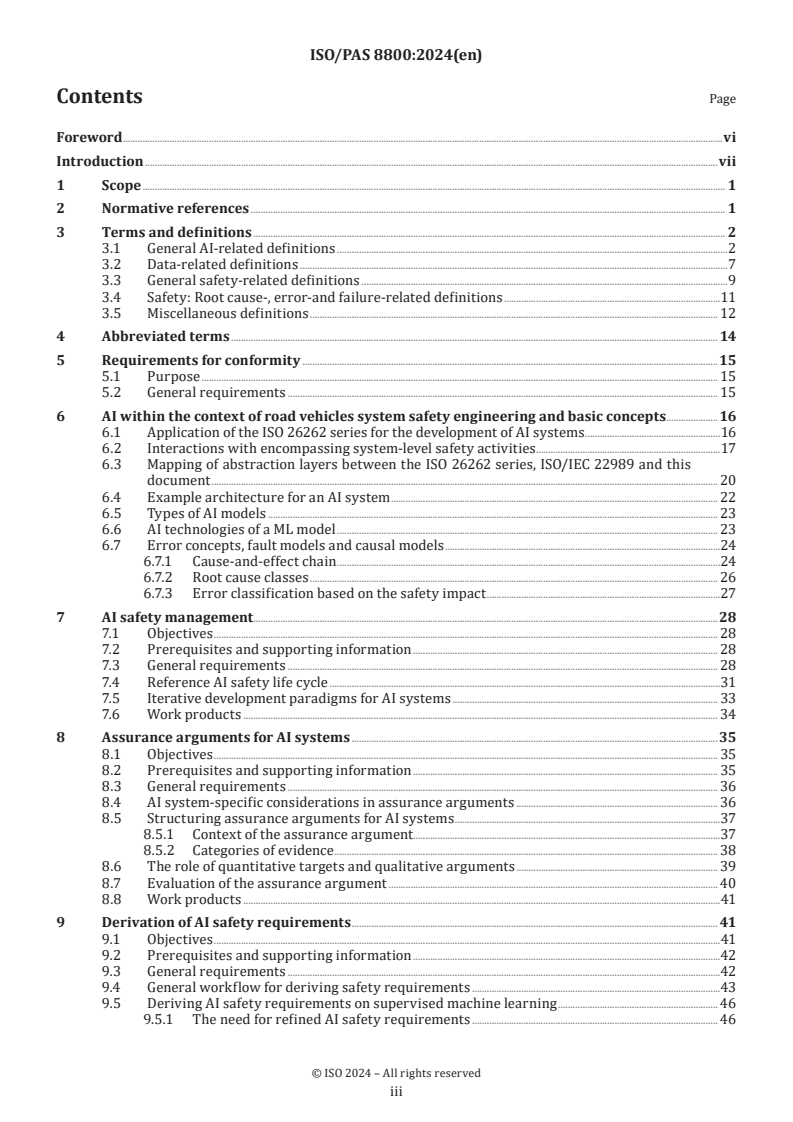
Contents Page
Foreword .vi
Introduction .vii
1 Scope . 1
2 Normative references . 1
3 Terms and definitions . 2
3.1 General AI-related definitions .2
3.2 Data-related definitions .7
3.3 General safety-related definitions .9
3.4 Safety: Root cause-, error-and failure-related definitions .11
3.5 Miscellaneous definitions . 12
4 Abbreviated terms . 14
5 Requirements for conformity .15
5.1 Purpose . 15
5.2 General requirements . 15
6 AI within the context of road vehicles system safety engineering and basic concepts .16
6.1 Application of the ISO 26262 series for the development of AI systems .16
6.2 Interactions with encompassing system-level safety activities .17
6.3 Mapping of abstraction layers between the ISO 26262 series, ISO/IEC 22989 and this
document . 20
6.4 Example architecture for an AI system . 22
6.5 Types of AI models . 23
6.6 AI technologies of a ML model . 23
6.7 Error concepts, fault models and causal models .24
6.7.1 Cause-and-effect chain . .24
6.7.2 Root cause classes . 26
6.7.3 Error classification based on the safety impact .27
7 AI safety management . .28
7.1 Objectives . 28
7.2 Prerequisites and supporting information . 28
7.3 General requirements . 28
7.4 Reference AI safety life cycle .31
7.5 Iterative development paradigms for AI systems . 33
7.6 Work products . 34
8 Assurance arguments for AI systems .35
8.1 Objectives . 35
8.2 Prerequisites and supporting information . 35
8.3 General requirements . 36
8.4 AI system-specific considerations in assurance arguments . 36
8.5 Structuring assurance arguments for AI systems .37
8.5.1 Context of the assurance argument.37
8.5.2 Categories of evidence . 38
8.6 The role of quantitative targets and qualitative arguments . 39
8.7 Evaluation of the assurance argument . 40
8.8 Work products .41
9 Derivation of AI safety requirements . 41
9.1 Objectives .41
9.2 Prerequisites and supporting information .42
9.3 General requirements .42
9.4 General workflow for deriving safety requirements .43
9.5 Deriving AI safety requirements on supervised machine learning . 46
9.5.1 The need for refined AI safety requirements . 46
iii
9.5.2 Derivation of refined AI safety requirements to manage uncertainty .47
9.5.3 Refinement of the input space definition for AI safety lifecycle . 50
9.5.4 Restricting the occurrence of AI output insufficiencies . 50
9.5.5 Metrics, measurements and threshold design . 54
9.5.6 Considerations for deriving safety requirements . 55
9.6 Work products . 56
10 Selection of AI technologies, architectural and development measures .56
10.1 Objectives . 56
10.2 Prerequisites . 56
10.3 General requirements . 56
10.4 Architecture and development process design or refinement .57
10.5 Examples of architectural and development measures for AI systems . 58
10.6 Work products .62
11 Data-related considerations .62
11.1 Objectives .62
11.2 Prerequisites and supporting information .62
11.3 General requirements .62
11.4 Dataset life cycle . 63
11.4.1 Datasets and the AI safety lifecycle . 63
11.4.2 Reference dataset lifecycle . 64
11.4.3 Dataset safety analysis . 65
11.4.4 Dataset requirements development .71
11.4.5 Dataset design .74
11.4.6 Dataset implementation . 75
11.4.7 Dataset verification. 75
11.4.8 Dataset validation .76
11.4.9 Dataset maintenance . 77
11.5 Work products . 77
12 Verification and validation of the AI system .78
12.1 Objectives . 78
12.2 Prerequisites and supporting information . 78
12.3 General requirements . 78
12.4 AI/ML specific challenges to verification and validation . 80
12.5 Verification and validation of the AI system . 81
12.5.1 Scope of verification and validation of the AI system . 81
12.5.2 AI component testing . 84
12.5.3 Methods for testing the AI component . 86
12.5.4 AI system integration and verification. 88
12.5.5 Virtual testing vs physical testing . 88
12.5.6 Evaluation of the safety-related performance of the AI system . 89
12.5.7 AI system safety validation . 90
12.6 Work products .91
13 Safety analysis of AI systems .91
13.1 Objectives .91
13.2 Prerequisites and supporting information . 92
13.3 General requirements . 92
13.4 Safety analysis of the AI system . 93
13.4.1 Scope of the AI safety analysis . 93
13.4.2 Safety analysis based on the results of testing . 95
13.4.3 Safety analysis techniques . 95
13.5 Work products . 97
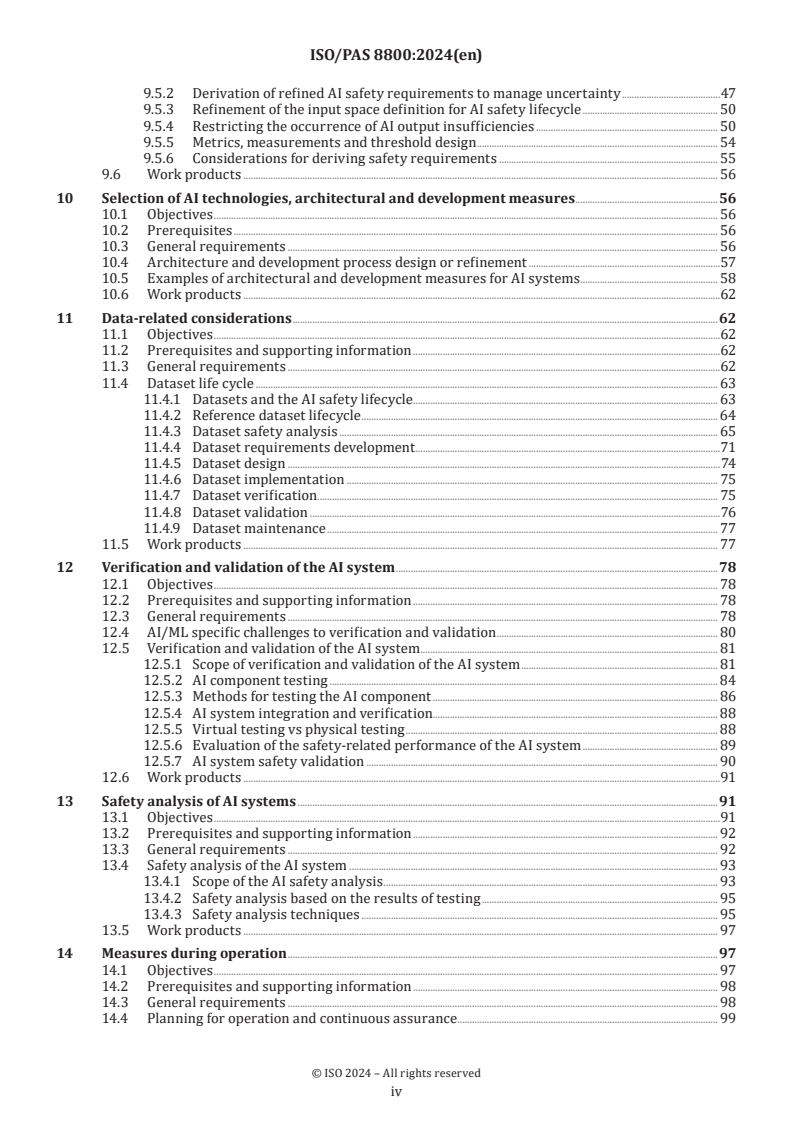
14 Measures during operation .97
14.1 Objectives . 97
14.2 Prerequisites and supporting information . 98
14.3 General requirements . 98
14.4 Planning for operation and continuous assurance . 99
iv
14.4.1 Safety risk of the AI system during operation phase . 99
14.4.2 Safety activities during the operation phase . 99
14.5 Continual, periodic re-evaluation of the assurance argument . 100
14.6 Measures to assure safety of the AI system during operation . 101
14.6.1 General . 101
14.6.2 Technical safety measures . 101
14.6.3 Safe operation guidance and misuse prevention in the field . 102
14.7 Field data collection . 103
14.8 Evaluation and continuous development . 104
14.8.1 Field risk evaluation . 104
14.8.2 Countermeasures addressing field risk . 105
14.8.3 AI re-training, re-validation, re-approval and re-deployment. 105
14.9 Work products . 106
15 Confidence in use of AI development frameworks and software tools used for AI model
development .106
15.1 Objectives . 106
15.2 Prerequisites and supporting information . 107
15.3 General requirements . 107
15.4 Confidence in the use of AI development frameworks . 107
15.5 Confidence in the use of tools used to support the AI-safety lifecycle . 109
15.6 Principles for data-driven AI model training and evaluation .110
15.7 Work products .110
Annex A (informative) Overview and workflow of this document .111
Annex B (informative) Example assurance argument structure for an AI system .116
Annex C (informative) ISO 26262 gap analysis for ML .130
Annex D (informative) Detailed considerations on safety-related properties of AI systems .137
Annex E (informative) STAMP/STPA example .139
Annex F (informative) Identification of software units within NN-based systems .144
Annex G (informative) Architectural and development measures for AI systems .147
Annex H (informative) Typical performance metrics for machine learning .162
Bibliography .167
v
Foreword
ISO (the International Organization for Standardization) is a worldwide federation of national standards
bodies (ISO member bodies). The work of preparing International Standards is normally carried out through
ISO technical committees. Each member body interested in a subject for which a technical committee
has been established has the right to be represented on that committee. International organizations,
governmental and non-governmental, in liaison with ISO, also take part in the work. ISO collaborates closely
with the International Electrotechnical Commission (IEC) on all matters of electrotechnical standardization.
The procedures used to develop this document and those intended for its further maintenance are described
in the ISO/IEC Directives, Part 1. In particular, the different approval criteria needed for the different types
of ISO document should be noted. This document was drafted in accordance with the editorial rules of the
ISO/IEC Directives, Part 2 (see www.iso.org/directives).
ISO draws attention to the possibility that the implementation of this document may involve the use of (a)
patent(s). ISO takes no position concerning the evidence, validity or applicability of any claimed patent
rights in respect thereof. As of the date of publication of this document, ISO had not received notice of (a)
patent(s) which may be required to implement this document. However, implementers are cautioned that
this may not represent the latest information, which may be obtained from the patent database available at
www.iso.org/patents. ISO shall not be held responsible for identifying any or all such patent rights.
Any trade name used in this document is information given for the convenience of users and does not
constitute an endorsement.
For an explanation of the voluntary nature of standards, the meaning of ISO specific terms and expressions
related to conformity assessment, as well as information about ISO's adherence to the World Trade
Organization (WTO) principles in the Technical Barriers to Trade (TBT), see www.iso.org/iso/foreword.html.
This document was prepared by Technical Committee ISO/TC 22, Road vehicles, Subcommittee SC 32,
Electrical and electronic components and general system aspects.
Any feedback or questions on this document should be directed to the user’s national standards body. A
complete listing of these bodies can be found at www.iso.org/members.html.
vi
Introduction
The purpose of this document is to provide industry-specific guidance on the use of AI systems in safety-
related functions. It is not restricted to specific AI methods or specific vehicle functions.
This document defines a framework for managing AI safety that tailors or extends existing approaches
currently defined in the ISO 26262 series and in ISO 21448.
Functional safety-related risks associated with malfunctioning behaviour of an AI system are addressed by
tailoring or extending relevant clauses from ISO 26262-series.
The risks related to functional insufficiencies in the AI system are addressed by extending the concepts and
guidance provided by ISO 21448. A causal model for understanding the sources of functional insufficiencies
in the AI system is proposed. The model is used to derive a set of safety requirements on the AI system as
well as a set of risk reduction measures.
NOTE 1 ISO 21448 is applicable to intended functionalities where proper situational awareness is essential to safety
and where such situational awareness is derived from sensors and processing algorithms, especially functionalities
of emergency intervention systems and systems with ISO/SAE PAS 22736 levels 1 to 5 for driving automation. It is
therefore possible that systems utilize AI technologies that do not fall within the scope of ISO 21448.
EXAMPLE 1 ISO 21448 does not apply to the development of an engine control unit that uses AI to optimize its
performance whereas this document does.
This document recognizes that due to the wide range of applications of AI and associated safety requirements,
as well as the rapidly evolving state-of-the-art, it is not possible to provide detailed requirements on the
process or product characteristics required to achieve an acceptably low level of residual risk associated
with the use of AI systems. Therefore, in addition to providing guidance for tailoring or extending the
ISO 26262 series and ISO 21448, this document focuses on the principles that support the creation of
a project-specific assurance argument for the safety of the AI elements within on-board vehicle systems.
This includes proposing risk reduction measures during the design and operation phases using an iterative
approach to reducing risk as outlined in ISO/IEC Guide 51.
Hazard analysis and risk analysis are beyond the scope of this document. These are considered a part of the
vehicle level systems safety engineering activities described in the ISO 26262 series and ISO 21448, or in
application of specific standards such as ISO TS 5083.
ISO/IEC TR 5469 provides generic guidance for the application of AI technologies as part of safety functions,
independent of specific industry sectors. Many of the concepts outlined in ISO/IEC TR 5469 can be applied
in the context of road vehicles. There is therefore a close relationship to concepts described within this
document and ISO/IEC TR 5469.
ISO/IEC TR 5469 provides classification schemes to determine the safety requirements on the AI/ML
function. These include the usage level and AI technology class.
The usage level is related to the nature of the task being performed by the engineered AI system.
NOTE 2 The usage levels are described in ISO/IEC TR 5469:2024, 6.2.
The technology class is related to the problem complexity and the transferability of existing standards to
demonstrating an adequate level of safety based on properties of the target function and the AI technology used.
NOTE 3 For the technology classes, see ISO/IEC TR 5469:2024, 6.2.
This document does not explicitly call out the classes and usage levels of ISO/IEC TR 5469.
EXAMPLE 2 For some AI technology, the application of ISO 26262 is deemed to be sufficient. This corresponds to
Class I of ISO/IEC TR 5469.
The guidance outlined within this document is relevant for all usage of AI for which safety requirements can
foreseeably be allocated either through:
a) the use of AI for the functionality itself;
vii
b) the use of AI as a safety mechanism.
NOTE 4 These usages correspond to the usage levels A1, A2, C of ISO/IEC TR 5469. In all cases, the applicability
of the guidance provided within this document can be determined by the allocation of safety requirements to the AI
technology, whereas the usage levels of ISO/IEC TR 5469 can be used to support the requirements elicitation process.
This document is aligned with standards and documents developed by ISO/IEC JTC1/SC42. AI-specific
definitions are used from ISO/IEC 22989, unless in conflict with safety-specific definitions.
Other documents developed within ISO/IEC JTC1/SC42 can be used to provide additional guidance on
specific aspects of AI that are relevant to safety-related properties. Examples of such documents include
ISO/IEC TR 24027 and ISO/IEC TR 24029-1.
This document harmonizes the concepts already described in ISO 21448:2022, Annex D.2 and
1)
ISO/TS 5083:20— , Annex B whilst extending these with specific guidance regarding the definition of safety
requirements of machine learning (ML), ML safety analyses and the creation of associated safety evidence
during the development and deployment lifecycle.
ISO/TS 5083:20—, Annex B is an application of this document to automated driving systems (ADS).
The relationship with the above-mentioned documents is summarized in Table 1–1.
Table 1–1 — How this document relates to other publications on AI safety
Publication Relationship with this document
AI-specific definitions are used from ISO/IEC 22989,
unless in conflict with safety-specific definitions. Safe-
ISO/IEC 22989
ty-related properties are a subset of generic AI properties
described in ISO/IEC 22989.
This document does not explicitly call out the classes and
usage levels of ISO/IEC TR 5469. This document consid-
ers and adapts to road vehicles the general framework
ISO/IEC TR 5469 described in ISO/IEC TR 5469 on safety properties, vir-
tual testing and physical testing, confidence in use of AI
development frameworks and architectural redundancy
patterns.
This document is a tailoring or extension of ISO 26262 for
ISO 26262
AI elements of the system. See Clause 5 for details.
This document is a tailoring or extension of ISO 21448 for
ISO 21448
AI elements of the system. See Clause 5 for details.
ISO TS 5083:20—, Annex B is an application of this docu-
ISO TS 5083:20—
ment to automated driving systems (ADS).
This document adds the following contents with respect to the documents listed in Table 1-1:
— tailoring or extensions of ISO 26262 and ISO 21448 required specifically for AI elements of the system
(referred to as AI systems);
— a conceptual model for reasoning about errors and their causes specific to AI systems;
— a reference AI safety lifecycle;
— the safety assurance argument for AI systems;
— a method for deriving AI safety requirements for AI systems;
— considerations for the design of safe AI systems;
— considerations on data management for the AI systems;
1) Under preparation. Stage at the time of publication: ISO/DTS 5083.
viii
— a verification and validation strategy for AI systems;
— a safety analysis approach for AI systems (focused on insufficiencies);
— activities during operation required to ensure the continuous AI safety.
ix
Publicly Available Specification ISO/PAS 8800:2024(en)
Road vehicles — Safety and artificial intelligence
1 Scope
This document applies to safety-related systems that include one or more electrical and/or electronic (E/E)
systems that use AI technology and that is installed in series production road vehicles, excluding mopeds.
It does not address unique E/E systems in special vehicles, such as E/E systems designed for drivers with
disabilities.
This document addresses the risk of undesired safety-related behaviour at the vehicle level due to output
insufficiencies, systematic errors and random hardware errors of AI elements within the vehicle. This
includes interactions with AI elements that are not part of the vehicle itself but that can have a direct or
indirect impact on vehicle safety.
EXAMPLE 1 Examples of AI elements within the vehicle include the trained AI model and AI system.
EXAMPLE 2 Direct impact on safety can be due to object detection by elements external to the vehicle.
EXAMPLE 3 Indirect impact on safety can be due to field monitoring by elements external to the vehicle.
The development of AI elements that are not part of the vehicle is not within the scope of this document.
These elements can conform to domain-specific safety guidance. This document can be used as a reference
where such domain-specific guidance does not exist.
This document describes safety-related properties of AI systems that can be used to construct a convincing
safety assurance claim for the absence of unreasonable risk.
This document does not provide specific guidelines for software tools that use AI methods.
This document focuses primarily on a subclass of AI methods defined as machine learning (ML). Although it
covers the principles of established and well-understood classes of ML, it does not focus on the details of any
specific AI methods e.g. deep neural networks.
2 Normative references
The following documents are referred to in the text in such a way that some or all of their content constitutes
requirements of this document. For dated references, only the edition cited applies. For undated references,
the latest edition of the referenced document (including any amendments) applies.
ISO 21448:2022, Road vehicles — Safety of the intended functionality
ISO 26262-1:2018, Road vehicles — Functional safety — Part 1: Vocabulary
ISO 26262-2:2018, Road vehicles — Functional safety — Part 2: Management of functional safety
ISO 26262-6:2018, Road vehicles — Functional safety — Part 6: Product development at the software level
ISO 26262-8:2018, Road vehicles — Functional safety — Part 8: Supporting processes
ISO/IEC 22989:2022, Information technology — Artificial intelligence — Artificial intelligence concepts and
terminology
3 Terms and definitions
For the purposes of this document, the terms and definitions given in ISO 26262-1, ISO 21448, ISO/IEC 22989
and the following apply.
ISO and IEC maintain terminology databases for use in standardization at the following addresses:
— ISO Online browsing platform: available at https:// www .iso .org/ obp
— IEC Electropedia: available at https:// www .electropedia .org/
3.1 General AI-related definitions
3.1.1
AI component
element of an AI system (3.1.17)
EXAMPLE 1 An AI pre-processing (3.1.11) component.
EXAMPLE 2 An AI post-processing (3.1.9) component.
EXAMPLE 3 An AI model (3.1.7).
EXAMPLE 4 A conventional software component inside an AI system.
Note 1 to entry: AI components that are not AI models or that do not contain AI models are not developed according to
this document. The integration of these components with AI components that are AI models or that contain AI models
is performed according to this document.
Note 2 to entry: See 6.3 for an elaboration of the relationship of the different abstraction layers of the ISO 26262 series,
ISO/IEC 22989 and this document with each other.
[SOURCE: ISO/IEC 22989:2022, 3.1.2, modified to be consistent with ISO 26262-1 definitions —"Functional
element" was replaced with "element", reworded to not use “construct”, examples and Notes to entry
were added.]
3.1.2
AI controllability
ability of an external agent to control the AI element (3.1.3), its output or the behaviour of the item influenced
by the AI output in order to prevent harm
EXAMPLE Before setting a pulse-width modulation (PWM) signal of an actor determined by an AI model (3.1.7),
the PWM output is limited by a simple threshold or the consumer substitutes the PWM signal with an approximate
physical model.
Note 1 to entry: An external agent is a person or an element not belonging to the AI system (3.1.17).
3.1.3
AI element
AI component (3.1.1) or AI system (3.1.17)
Note 1 to entry: An AI element can refer to a subset of components (3.5.2) within an AI system that provide related
functionality.
Note 2 to entry: See 6.3 for an elaboration of the relationship of the different abstraction layers of the ISO 26262 series
ISO/IEC 22989 and this document with each other.
3.1.4
AI explainability
property of an AI system (3.1.17) to express important factors influencing the AI system's outputs in a way
that humans can understand
EXAMPLE The AI system can be explainable by natural language or by visualizing feature attribution methods
like gradient-based heat/saliency maps.
3.1.5
AI generalization
ability of an AI model (3.1.7) to adapt and perform well on previously unseen data during inference
3.1.6
AI method
type of AI model (3.1.7)
EXAMPLE 1 Deep neural network.
EXAMPLE 2 K-nearest neighbour.
EXAMPLE 3 Support vector machine.
3.1.7
AI model
construct containing logical operations, arithmetical operations or a combination of both to generate an
inference or prediction based on input data or information without being completely defined by human
knowledge
Note 1 to entry: Inference is using a model to understand the relation between predictors and a target. Prediction is
using a model to generate a prediction (values close to the real seen or unseen targets) based on the inputs.
3.1.8
AI model validation
evaluation of the performance of different AI model (3.1.7) candidates through testing
Note 1 to entry: There are three terms, "AI model validation", "validation" and "safety validation", that are distinguished
in this document. AI model validation originates from the validation data used by the AI community, validation
originates from classic system development and safety validation originates from the ISO 26262 series.
Note 2 to entry: The AI model validation is executed using the AI validation dataset.
3.1.9
AI post-processing
any processing that is applied to the output of an AI model (3.1.7) for the purpose of mapping the raw
output/s to a more contextually relevant and consumable format
EXAMPLE 1 A non-maximum suppression and thresholding for a bounding-box generation that serves to remove
bounding boxes of low relevance and duplicates.
EXAMPLE 2 The outputs of a mixture density network are combined with a physical model (a hybrid model).
Note 1 to entry: AI post-processing also includes any data conversion that is used to bring the output into a common
format for better comparability.
Note 2 to entry: AI post-processing can have a positive or a negative impact on the safety-related properties of the
output of the AI system (3.1.17).
3.1.10
AI predictability
ability of the AI system (3.1.17) to produce trusted predictions
Note 1 to entry: Trusted predictions means that the predications are accurate and that this claim is supported by
statistical evidence.
3.1.11
AI pre-processing
any processing that is applied to the input of an AI model (3.1.7)
3.1.12
AI reliability
ability of the AI element (3.1.3) to perform the AI task (3.1.18) without AI error (3.4.1) under stated conditions
and for a specified period of time
3.1.13
AI resilience
ability of the AI element (3.1.3) to recover and continue performing the AI task (3.1.18) after the occurrence
of an AI err
...