

ISO 14224:2016
(Main)Petroleum, petrochemical and natural gas industries — Collection and exchange of reliability and maintenance data for equipment
General Information
- Abstract
ISO 14224:2016 provides a comprehensive basis for the collection of reliability and maintenance (RM) data in a standard format for equipment in all facilities and operations within the petroleum, natural gas and petrochemical industries during the operational life cycle of equipment. It describes data collection principles and associated terms and definitions that constitute a "reliability language" that can be useful for communicating operational experience. The failure modes defined in the normative part of this International Standard can be used as a "reliability thesaurus" for various quantitative as well as qualitative applications. This International Standard also describes data quality control and assurance practices to provide guidance for the user. Standardization of data collection practices facilitates the exchange of information between parties, e.g. plants, owners, manufacturers and contractors. This International Standard establishes requirements that any in-house or commercially available RM data system is required to meet when designed for RM data exchange. Examples, guidelines and principles for the exchange and merging of such RM data are addressed. This International Standard also provides a framework and guidelines for establishing performance objectives and requirements for equipment reliability and availability performance. Annex A contains a summary of equipment that is covered by this International Standard. ISO 14224:2016 defines a minimum amount of data that is required to be collected, and it focuses on two main issues: - data requirements for the categories of data to be collected for use in various analysis methodologies; - standardized data format to facilitate the exchange of reliability and maintenance data between plants, owners, manufacturers and contractors. The following main categories of data are to be collected: a) equipment data, e.g. equipment taxonomy, equipment attributes; b) failure data, e.g. failure cause, failure consequence; c) maintenance data, e.g. maintenance action, resources used, maintenance consequence, down time. NOTE Clause 9 gives further details on data content and data format. The main areas where such data are used are the following: 1) reliability, e.g. failure events and failure mechanisms; 2) availability/efficiency, e.g. equipment availability, system availability, plant production availability; 3) maintenance, e.g. corrective and preventive maintenance, maintenance plan, maintenance supportability; 4) safety and environment, e.g. equipment failures with adverse consequences for safety and/or environment. ISO 14224:2016 does not apply to the following: i. data on (direct) cost issues; ii. data from laboratory testing and manufacturing (e.g. accelerated lifetime testing), see also 5.2; iii. complete equipment data sheets (only data seen relevant for assessing the reliability performance are included); iv. additional on-service data that an operator, on an individual basis, can consider useful for operation and maintenance; v. methods for analysing and applying RM data (however, principles for how to calculate some basic reliability and maintenance parameters are included in the annexes).
- Status
- Published
- Publication Date
- 15-Sep-2016
- Technical Committee
- ISO/TC 67 - Materials, equipment and offshore structures for petroleum, petrochemical and natural gas industries
- Drafting Committee
- ISO/TC 67/WG 4 - Reliability Engineering and technology
- Current Stage
- 9093 - International Standard confirmed
- Start Date
- 24-Feb-2022
- Completion Date
- 29-Aug-2026
Buy Documents
ISO 14224:2016 - Petroleum, petrochemical and natural gas industries -- Collection and exchange of reliability and maintenance data for equipment
ISO 14224:2016 - Petroleum, petrochemical and natural gas industries — Collection and exchange of reliability and maintenance data for equipment/5/2016
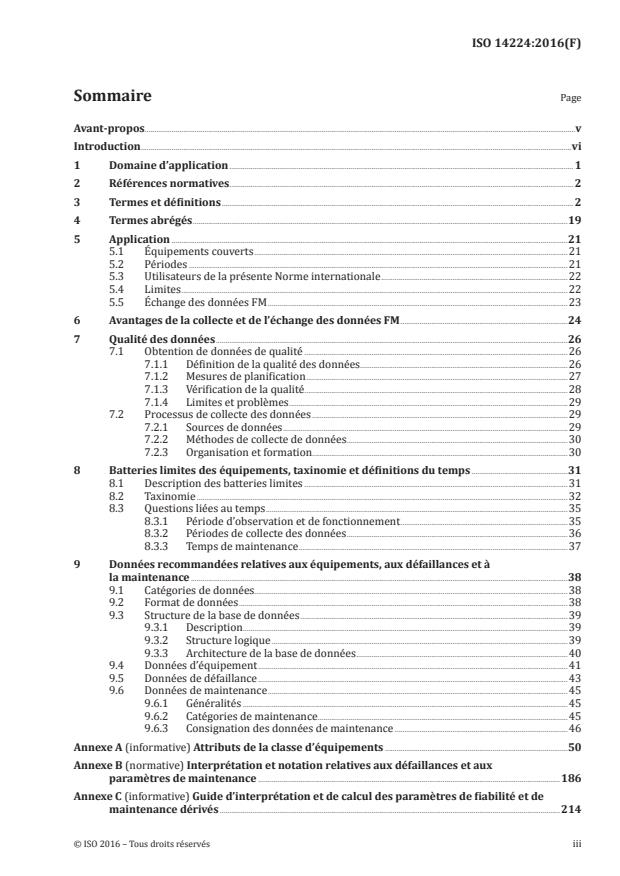
ISO 14224:2016 - Industries du pétrole, de la pétrochimie et du gaz naturel -- Collecte et échange de données de fiabilité et de maintenance des équipements
ISO 14224:2016 - Industries du pétrole, de la pétrochimie et du gaz naturel — Collecte et échange de données de fiabilité et de maintenance des équipements/30/2017
Overview
ISO 14224:2016 - Petroleum, petrochemical and natural gas industries - specifies a standardized approach for the collection and exchange of reliability and maintenance (RM) data for equipment during the operational life cycle. Developed by ISO/TC 67, the standard defines a common "reliability language" (terms, definitions and failure-mode thesaurus), minimum data requirements, data quality control practices, and requirements that RM data systems must meet to enable consistent data exchange between plants, owners, manufacturers and contractors.
Key topics and requirements
- Data categories and minimum data set: equipment data (taxonomy and attributes), failure data (cause, consequence, detection), and maintenance data (actions, resources, downtime).
- Standardized data format and database structure: logical database architecture and reporting formats to facilitate merging and exchange of RM data.
- Equipment boundary, taxonomy and timeline definitions: consistent definitions of equipment scope, operating/surveillance periods, and maintenance time accounting.
- Failure modes and reliability thesaurus: normative failure-mode lists to support both quantitative and qualitative analyses.
- Data quality control and assurance: planning, verification, training and limitations to ensure usable RM datasets.
- System requirements for data exchange: criteria that in-house or commercial RM data systems must satisfy for interoperability.
- Guidance on derived parameters: annexes provide interpretation and calculation guidance for reliability, availability and maintainability metrics (e.g., failure rate estimation, MTTR, MDT).
- Scope exclusions: the standard does not cover direct cost data, laboratory/manufacturing test data (e.g., accelerated tests), full equipment data sheets, or specific analysis methods (though basic calculation principles are included).
Applications and users
ISO 14224:2016 is used to:
- Standardize RM data capture across facilities to support benchmarking and learning.
- Provide input data for reliability engineering, availability/efficiency studies, maintenance planning, safety and environmental risk assessments.
- Support procurement and supplier feedback by enabling comparable failure and maintenance records.
Typical users:
- Reliability, maintenance and asset integrity engineers
- Maintenance planners and supervisors
- Operations managers and HSE professionals
- Data managers, software vendors and OEMs involved in RM databases
- Owners, operators and contractors in petroleum, petrochemical and natural gas sectors
Related standards and context
- Developed under ISO/TC 67, ISO 14224 complements broader asset management, safety and data-exchange practices in the energy industries. It is intended to integrate with organizations’ RM processes and information systems to improve equipment availability, maintainability and safety performance.
Keywords: ISO 14224:2016, reliability and maintenance data, RM data exchange, equipment taxonomy, failure modes, data quality, petroleum industry, petrochemical, natural gas.
Relations
- Effective Date
- 09-Feb-2026
- Effective Date
- 09-Feb-2026
- Effective Date
- 09-Feb-2026
- Effective Date
- 12-Feb-2026
- Effective Date
- 08-Jun-2013
Buy Documents
ISO 14224:2016 - Petroleum, petrochemical and natural gas industries -- Collection and exchange of reliability and maintenance data for equipment
ISO 14224:2016 - Petroleum, petrochemical and natural gas industries — Collection and exchange of reliability and maintenance data for equipment/5/2016
ISO 14224:2016 - Industries du pétrole, de la pétrochimie et du gaz naturel -- Collecte et échange de données de fiabilité et de maintenance des équipements
ISO 14224:2016 - Industries du pétrole, de la pétrochimie et du gaz naturel — Collecte et échange de données de fiabilité et de maintenance des équipements/30/2017
Get Certified
Connect with accredited certification bodies for this standard

Element Materials Technology
Materials testing and product certification.

ABS Group Brazil
ABS Group certification services in Brazil.

ABS Quality Evaluations Inc.
American Bureau of Shipping quality certification.
Sponsored listings
Frequently Asked Questions
ISO 14224:2016 is a standard published by the International Organization for Standardization (ISO). Its full title is "Petroleum, petrochemical and natural gas industries — Collection and exchange of reliability and maintenance data for equipment". This standard covers: ISO 14224:2016 provides a comprehensive basis for the collection of reliability and maintenance (RM) data in a standard format for equipment in all facilities and operations within the petroleum, natural gas and petrochemical industries during the operational life cycle of equipment. It describes data collection principles and associated terms and definitions that constitute a "reliability language" that can be useful for communicating operational experience. The failure modes defined in the normative part of this International Standard can be used as a "reliability thesaurus" for various quantitative as well as qualitative applications. This International Standard also describes data quality control and assurance practices to provide guidance for the user. Standardization of data collection practices facilitates the exchange of information between parties, e.g. plants, owners, manufacturers and contractors. This International Standard establishes requirements that any in-house or commercially available RM data system is required to meet when designed for RM data exchange. Examples, guidelines and principles for the exchange and merging of such RM data are addressed. This International Standard also provides a framework and guidelines for establishing performance objectives and requirements for equipment reliability and availability performance. Annex A contains a summary of equipment that is covered by this International Standard. ISO 14224:2016 defines a minimum amount of data that is required to be collected, and it focuses on two main issues: - data requirements for the categories of data to be collected for use in various analysis methodologies; - standardized data format to facilitate the exchange of reliability and maintenance data between plants, owners, manufacturers and contractors. The following main categories of data are to be collected: a) equipment data, e.g. equipment taxonomy, equipment attributes; b) failure data, e.g. failure cause, failure consequence; c) maintenance data, e.g. maintenance action, resources used, maintenance consequence, down time. NOTE Clause 9 gives further details on data content and data format. The main areas where such data are used are the following: 1) reliability, e.g. failure events and failure mechanisms; 2) availability/efficiency, e.g. equipment availability, system availability, plant production availability; 3) maintenance, e.g. corrective and preventive maintenance, maintenance plan, maintenance supportability; 4) safety and environment, e.g. equipment failures with adverse consequences for safety and/or environment. ISO 14224:2016 does not apply to the following: i. data on (direct) cost issues; ii. data from laboratory testing and manufacturing (e.g. accelerated lifetime testing), see also 5.2; iii. complete equipment data sheets (only data seen relevant for assessing the reliability performance are included); iv. additional on-service data that an operator, on an individual basis, can consider useful for operation and maintenance; v. methods for analysing and applying RM data (however, principles for how to calculate some basic reliability and maintenance parameters are included in the annexes).
ISO 14224:2016 provides a comprehensive basis for the collection of reliability and maintenance (RM) data in a standard format for equipment in all facilities and operations within the petroleum, natural gas and petrochemical industries during the operational life cycle of equipment. It describes data collection principles and associated terms and definitions that constitute a "reliability language" that can be useful for communicating operational experience. The failure modes defined in the normative part of this International Standard can be used as a "reliability thesaurus" for various quantitative as well as qualitative applications. This International Standard also describes data quality control and assurance practices to provide guidance for the user. Standardization of data collection practices facilitates the exchange of information between parties, e.g. plants, owners, manufacturers and contractors. This International Standard establishes requirements that any in-house or commercially available RM data system is required to meet when designed for RM data exchange. Examples, guidelines and principles for the exchange and merging of such RM data are addressed. This International Standard also provides a framework and guidelines for establishing performance objectives and requirements for equipment reliability and availability performance. Annex A contains a summary of equipment that is covered by this International Standard. ISO 14224:2016 defines a minimum amount of data that is required to be collected, and it focuses on two main issues: - data requirements for the categories of data to be collected for use in various analysis methodologies; - standardized data format to facilitate the exchange of reliability and maintenance data between plants, owners, manufacturers and contractors. The following main categories of data are to be collected: a) equipment data, e.g. equipment taxonomy, equipment attributes; b) failure data, e.g. failure cause, failure consequence; c) maintenance data, e.g. maintenance action, resources used, maintenance consequence, down time. NOTE Clause 9 gives further details on data content and data format. The main areas where such data are used are the following: 1) reliability, e.g. failure events and failure mechanisms; 2) availability/efficiency, e.g. equipment availability, system availability, plant production availability; 3) maintenance, e.g. corrective and preventive maintenance, maintenance plan, maintenance supportability; 4) safety and environment, e.g. equipment failures with adverse consequences for safety and/or environment. ISO 14224:2016 does not apply to the following: i. data on (direct) cost issues; ii. data from laboratory testing and manufacturing (e.g. accelerated lifetime testing), see also 5.2; iii. complete equipment data sheets (only data seen relevant for assessing the reliability performance are included); iv. additional on-service data that an operator, on an individual basis, can consider useful for operation and maintenance; v. methods for analysing and applying RM data (however, principles for how to calculate some basic reliability and maintenance parameters are included in the annexes).
ISO 14224:2016 is classified under the following ICS (International Classification for Standards) categories: 75.180.01 - Equipment for petroleum and natural gas industries in general; 75.200 - Petroleum products and natural gas handling equipment. The ICS classification helps identify the subject area and facilitates finding related standards.
ISO 14224:2016 has the following relationships with other standards: It is inter standard links to EN ISO 20815:2018, EN ISO 15663:2021, CEN ISO/TS 3250:2022, EN ISO 14224:2016, ISO 14224:2006. Understanding these relationships helps ensure you are using the most current and applicable version of the standard.
ISO 14224:2016 is available in PDF format for immediate download after purchase. The document can be added to your cart and obtained through the secure checkout process. Digital delivery ensures instant access to the complete standard document.
Standards Content (Sample)
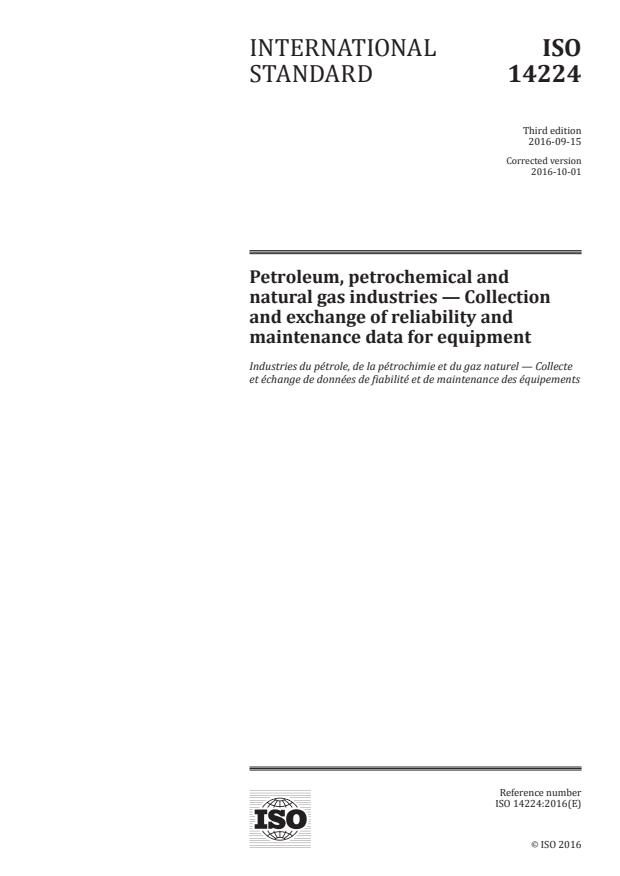
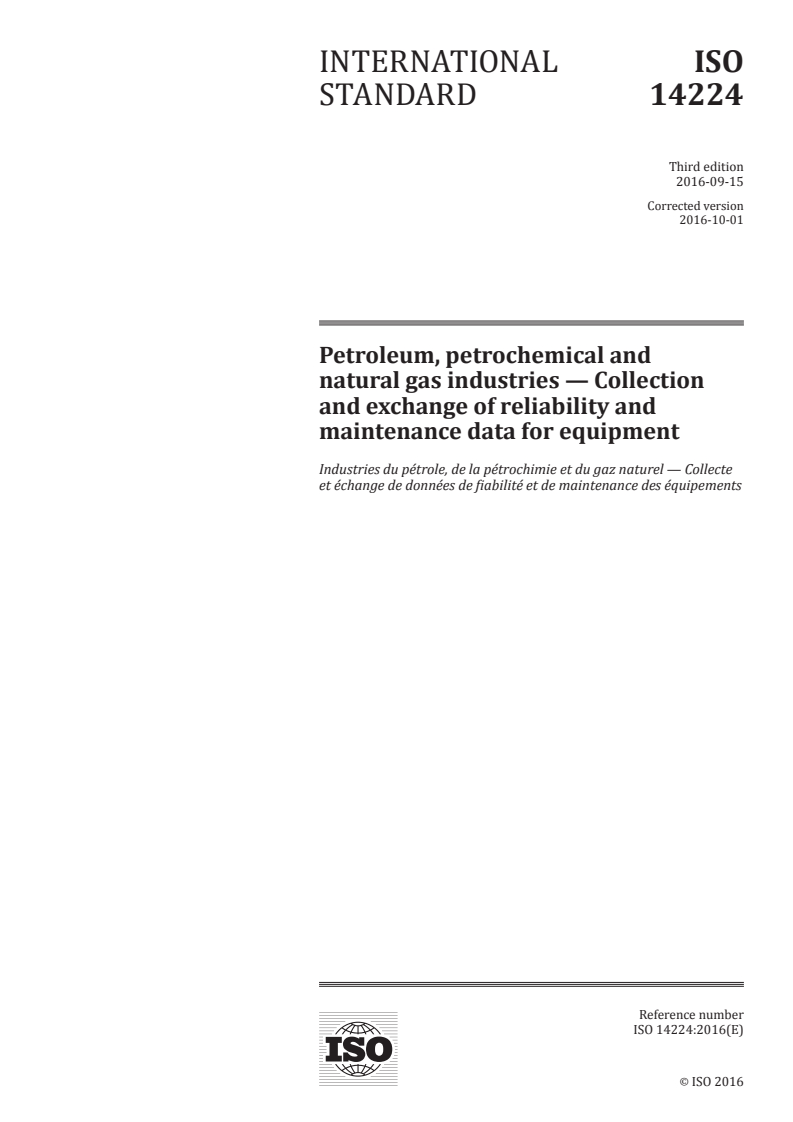
INTERNATIONAL ISO
STANDARD 14224
Third edition
2016-09-15
Corrected version
2016-10-01
Petroleum, petrochemical and
natural gas industries — Collection
and exchange of reliability and
maintenance data for equipment
Industries du pétrole, de la pétrochimie et du gaz naturel — Collecte
et échange de données de fiabilité et de maintenance des équipements
Reference number
©
ISO 2016
© ISO 2016, Published in Switzerland
All rights reserved. Unless otherwise specified, no part of this publication may be reproduced or utilized otherwise in any form
or by any means, electronic or mechanical, including photocopying, or posting on the internet or an intranet, without prior
written permission. Permission can be requested from either ISO at the address below or ISO’s member body in the country of
the requester.
ISO copyright office
Ch. de Blandonnet 8 • CP 401
CH-1214 Vernier, Geneva, Switzerland
Tel. +41 22 749 01 11
Fax +41 22 749 09 47
copyright@iso.org
www.iso.org
ii © ISO 2016 – All rights reserved
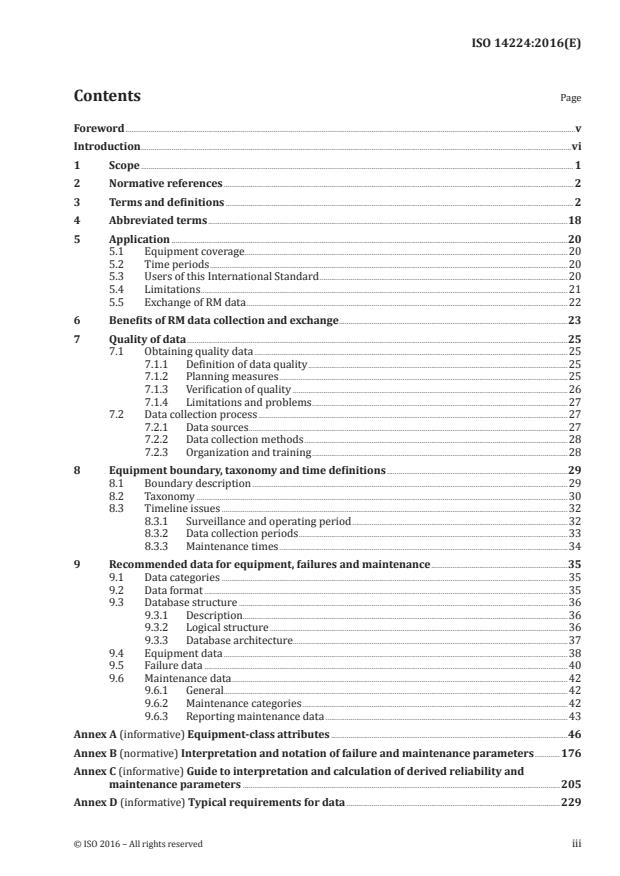
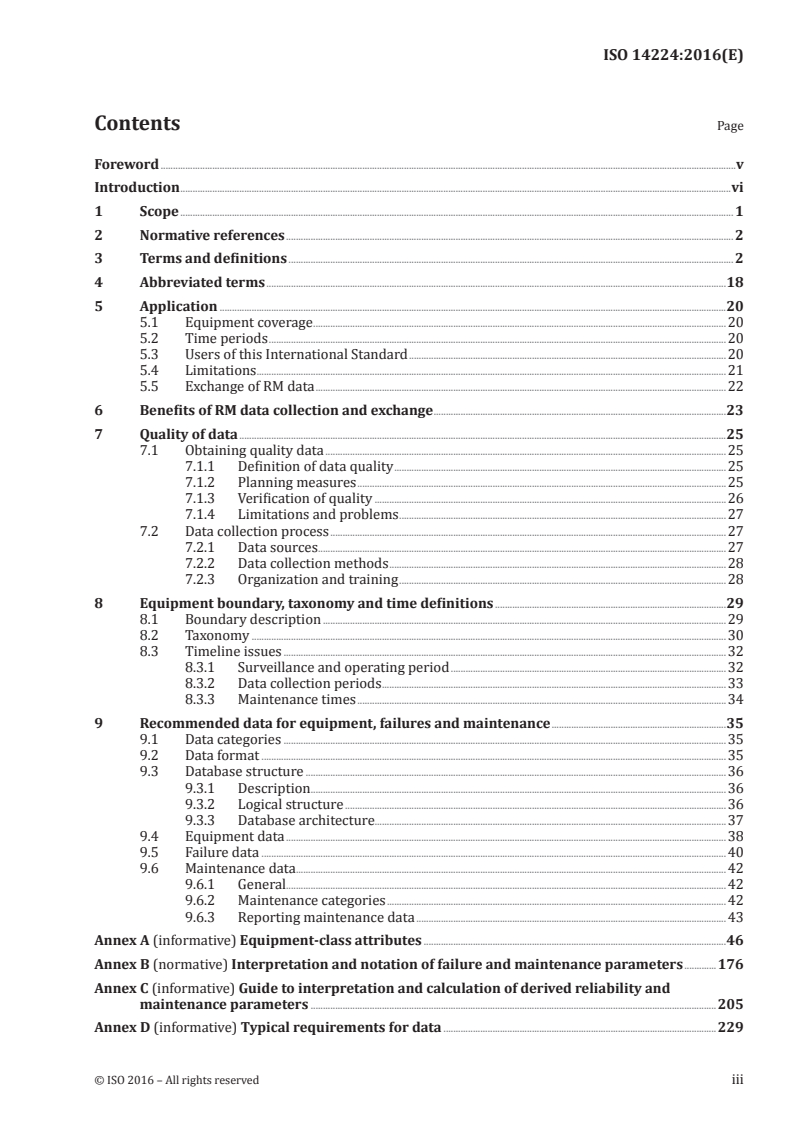
Contents Page
Foreword .v
Introduction .vi
1 Scope . 1
2 Normative references . 2
3 Terms and definitions . 2
4 Abbreviated terms .18
5 Application .20
5.1 Equipment coverage .20
5.2 Time periods .20
5.3 Users of this International Standard .20
5.4 Limitations .21
5.5 Exchange of RM data .22
6 Benefits of RM data collection and exchange .23
7 Quality of data .25
7.1 Obtaining quality data .25
7.1.1 Definition of data quality .25
7.1.2 Planning measures .25
7.1.3 Verification of quality .26
7.1.4 Limitations and problems .27
7.2 Data collection process .27
7.2.1 Data sources .27
7.2.2 Data collection methods .28
7.2.3 Organization and training .28
8 Equipment boundary, taxonomy and time definitions .29
8.1 Boundary description .29
8.2 Taxonomy .30
8.3 Timeline issues .32
8.3.1 Surveillance and operating period .32
8.3.2 Data collection periods .33
8.3.3 Maintenance times .34
9 Recommended data for equipment, failures and maintenance .35
9.1 Data categories .35
9.2 Data format .35
9.3 Database structure .36
9.3.1 Description . . .36
9.3.2 Logical structure .36
9.3.3 Database architecture.37
9.4 Equipment data .38
9.5 Failure data .40
9.6 Maintenance data.42
9.6.1 General.42
9.6.2 Maintenance categories .42
9.6.3 Reporting maintenance data .43
Annex A (informative) Equipment-class attributes .46
Annex B (normative) Interpretation and notation of failure and maintenance parameters .176
Annex C (informative) Guide to interpretation and calculation of derived reliability and
maintenance parameters .205
Annex D (informative) Typical requirements for data .229
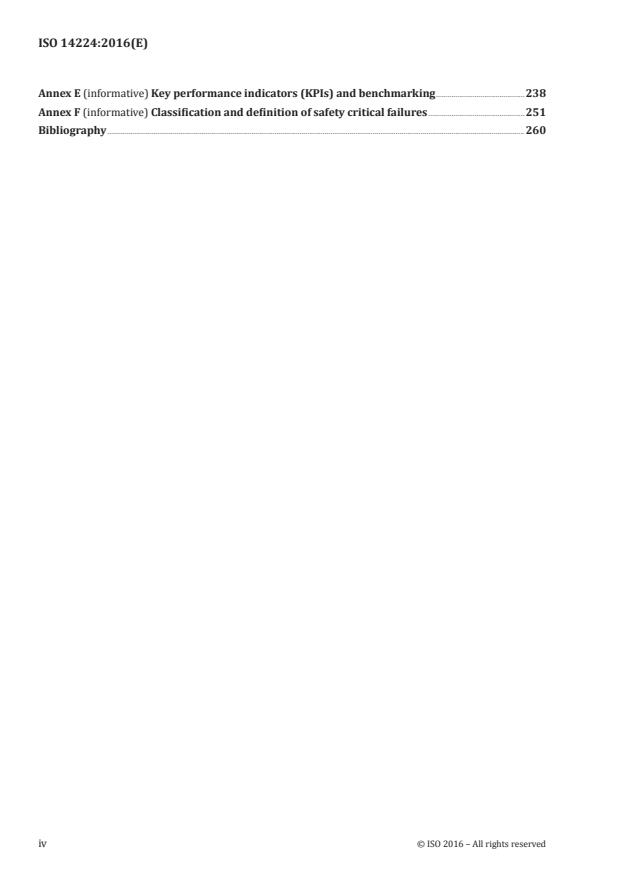
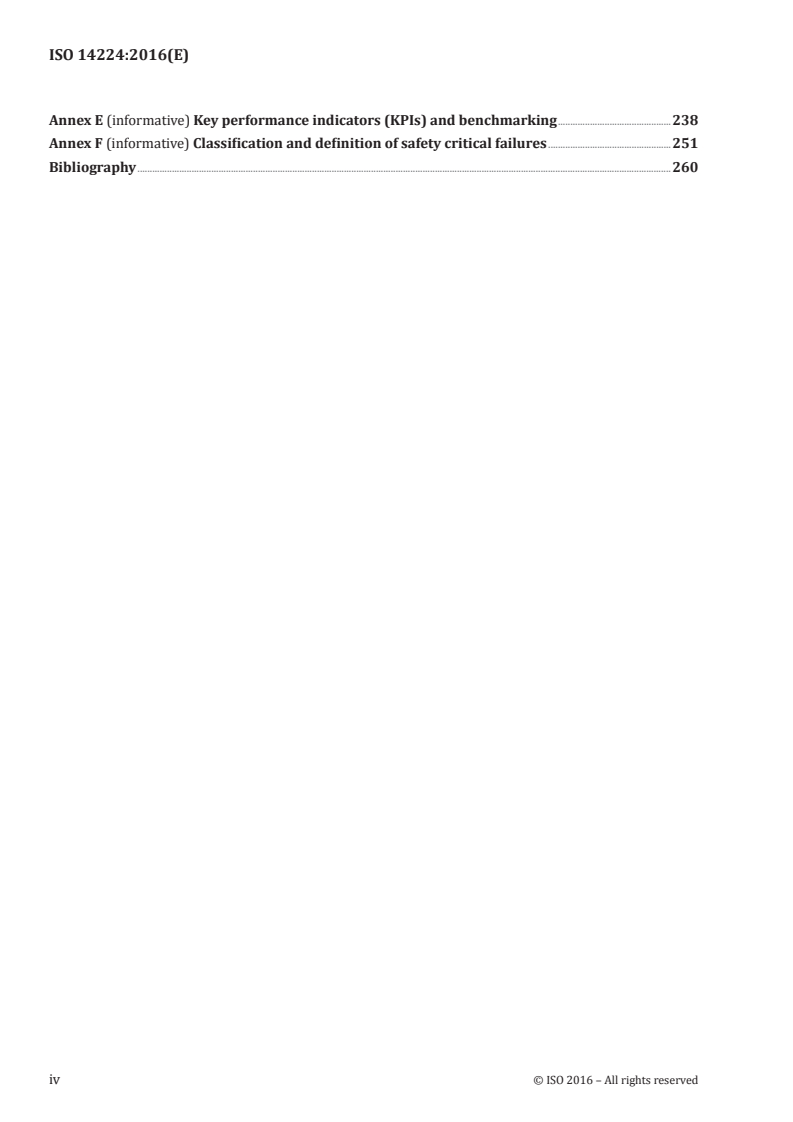
Annex E (informative) Key performance indicators (KPIs) and benchmarking .238
Annex F (informative) Classification and definition of safety critical failures .251
Bibliography .260
iv © ISO 2016 – All rights reserved
Foreword
ISO (the International Organization for Standardization) is a worldwide federation of national standards
bodies (ISO member bodies). The work of preparing International Standards is normally carried out
through ISO technical committees. Each member body interested in a subject for which a technical
committee has been established has the right to be represented on that committee. International
organizations, governmental and non-governmental, in liaison with ISO, also take part in the work.
ISO collaborates closely with the International Electrotechnical Commission (IEC) on all matters of
electrotechnical standardization.
The procedures used to develop this document and those intended for its further maintenance are
described in the ISO/IEC Directives, Part 1. In particular the different approval criteria needed for the
different types of ISO documents should be noted. This document was drafted in accordance with the
editorial rules of the ISO/IEC Directives, Part 2. www.iso.org/directives
Attention is drawn to the possibility that some of the elements of this document may be the subject of
patent rights. ISO shall not be held responsible for identifying any or all such patent rights. Details of
any patent rights identified during the development of the document will be in the Introduction and/or
on the ISO list of patent declarations received. www.iso.org/patents
Any trade name used in this document is information given for the convenience of users and does not
constitute an endorsement.
For an explanation on the meaning of ISO specific terms and expressions related to conformity
assessment, as well as information about ISO’s adherence to the WTO principles in the Technical
Barriers to Trade (TBT) see the following URL: Foreword - Supplementary information
The committee responsible for this document is Technical Committee ISO/TC 67, Materials, equipment
and offshore structures for petroleum, petrochemical and natural gas industries.
This third edition cancels and replaces the second edition (ISO 14224:2006), which has been technically
revised. The main changes are:
— Clause 3 — several new definitions;
— Clauses 8 and 9 — changes in some figures and tables;
— Annex A — new equipment classes;
— Annex B — associated new and aligned failure modes;
— Annex C — some changes and new subclauses, e.g. C.3.4 and C.7;
— Annex D — new subclause D.5;
— Annex E — new KPIs;
— Annex F — alignment with ISO/TR 12489:2013.
This corrected version of ISO 14224:2016 incorporates various editorial corrections.
Introduction
This International Standard has been prepared based on the previous edition (ISO 14224:2006),
experience gained through its use, and know-how and best practices shared through the international
development process.
In the petroleum, petrochemical and natural gas industries, great attention is being paid to safety,
availability, reliability and maintainability of equipment. The industry annual cost of equipment
unavailability is very large, although many plant owners have improved the availability of their
operating facilities by addressing this challenge. A stronger emphasis has recently been put on cost-
effective design and maintenance for new plants and existing installations among more industrial
parties. In this respect, data on failures, failure mechanisms and maintenance related to these industrial
facilities and its operations have become more important. It is necessary that this information is used
by, and communicated between, the various parties and its disciplines, within the same company or
between companies. Various analysis methodologies are used to estimate the risk of hazards to people
and environment, or to analyse plant or system performance. For such analyses to be effective and
decisive, equipment reliability and maintenance (RM) data are vital.
These analyses require a clear understanding of the equipment’s technical characteristics, its operating
and environmental conditions, its potential failures and its maintenance activities. It can be necessary
to have data covering several years of operation before sufficient data have been accumulated to
give confident analysis results and relevant decision support. It is necessary, therefore, to view data
collection as a long-term activity, planned and executed with appropriate goals in mind. At the same
time, clarity as to the causes of failures is key to prioritizing and implementing corrective actions that
result in sustainable improvements in availability, leading to improved profitability and safety.
Data collection is an investment. Data standardization, when combined with enhanced data-
management systems that allow electronic collection and transfer of data, can result in improved
quality of data for reliability and maintenance. A cost-effective way of optimizing data requirements
is through industry co-operation. To make it possible to collect, exchange and analyse data based on
common viewpoints, a standard is required. Standardization of data collection practices facilitates the
exchange of information between relevant parties e.g. plants, owners, manufacturers and contractors
throughout the world.
vi © ISO 2016 – All rights reserved
INTERNATIONAL STANDARD ISO 14224:2016(E)
Petroleum, petrochemical and natural gas industries —
Collection and exchange of reliability and maintenance
data for equipment
1 Scope
This International Standard provides a comprehensive basis for the collection of reliability and
maintenance (RM) data in a standard format for equipment in all facilities and operations within the
petroleum, natural gas and petrochemical industries during the operational life cycle of equipment. It
describes data collection principles and associated terms and definitions that constitute a “reliability
language” that can be useful for communicating operational experience. The failure modes defined in
the normative part of this International Standard can be used as a “reliability thesaurus” for various
quantitative as well as qualitative applications. This International Standard also describes data quality
control and assurance practices to provide guidance for the user.
Standardization of data collection practices facilitates the exchange of information between parties, e.g.
plants, owners, manufacturers and contractors. This International Standard establishes requirements
that any in-house or commercially available RM data system is required to meet when designed for
RM data exchange. Examples, guidelines and principles for the exchange and merging of such RM data
are addressed. This International Standard also provides a framework and guidelines for establishing
performance objectives and requirements for equipment reliability and availability performance.
Annex A contains a summary of equipment that is covered by this International Standard.
This International Standard defines a minimum amount of data that is required to be collected, and it
focuses on two main issues:
— data requirements for the categories of data to be collected for use in various analysis methodologies;
— standardized data format to facilitate the exchange of reliability and maintenance data between
plants, owners, manufacturers and contractors.
The following main categories of data are to be collected:
a) equipment data, e.g. equipment taxonomy, equipment attributes;
b) failure data, e.g. failure cause, failure consequence;
c) maintenance data, e.g. maintenance action, resources used, maintenance consequence, down time.
NOTE Clause 9 gives further details on data content and data format.
The main areas where such data are used are the following:
1) reliability, e.g. failure events and failure mechanisms;
2) availability/efficiency, e.g. equipment availability, system availability, plant production availability;
3) maintenance, e.g. corrective and preventive maintenance, maintenance plan, maintenance
supportability;
4) safety and environment, e.g. equipment failures with adverse consequences for safety and/or
environment.
This International Standard does not apply to the following:
i. data on (direct) cost issues;
ii. data from laboratory testing and manufacturing (e.g. accelerated lifetime testing), see also 5.2;
iii. complete equipment data sheets (only data seen relevant for assessing the reliability performance
are included);
iv. additional on-service data that an operator, on an individual basis, can consider useful for operation
and maintenance;
v. methods for analysing and applying RM data (however, principles for how to calculate some basic
reliability and maintenance parameters are included in the annexes).
2 Normative references
The following documents, in whole or in part, are normatively referenced in this document and are
indispensable for its application. For dated references, only the edition cited applies. For undated
references, the latest edition of the referenced document (including any amendments) applies.
ISO 20815:2008, Petroleum, petrochemical and natural gas industries — Production assurance and
reliability management
3 Terms and definitions
For the purposes of this document, the following terms and definitions apply.
NOTE Some derived RM parameters, which can be calculated from collected RM data covered by this
International Standard, are contained in Annex C. References to Annex C are given as deemed appropriate.
3.1
active maintenance time
duration of a maintenance action, excluding logistic delay
Note 1 to entry: Technical delays are included in the active maintenance time.
Note 2 to entry: See Figure 4 and Annex C for a more detailed description and interpretation of maintenance
times. See also ISO/TR 12489:2013, Figure 5.
Note 3 to entry: A maintenance action can be carried out while the item is performing a required function.
[SOURCE: IEC 60050-192:2015, 192-07-04, modified – Notes 2 and 3 to entry have been added.]
3.2
active repair time
effective time to achieve repair of an item
Note 1 to entry: See also ISO/TR 12489:2013, Figures 5 and 6.
Note 2 to entry: See also definition of “mean active repair time (MART)” in ISO/TR 12489:2013, 3.1.34, that is
defined as “expected active repair time”.
3.3
availability
ability to be in a state to perform as required
Note 1 to entry: See Annex C for a more detailed description and interpretation of availability.
Note 2 to entry: Further terms are given in ISO/TR 12489:2013.
[SOURCE: IEC 60050-192:2015, 192-01-23, modified – Notes 1 and 2 to entry have been added.]
3.4
boundary
interface between an item and its surroundings
2 © ISO 2016 – All rights reserved
3.5
common cause failures
failures of multiple items, which would otherwise be considered independent of one another, resulting
from a single cause
Note 1 to entry: Common cause failures can also be common mode failures.
Note 2 to entry: The potential for common cause failures reduces the effectiveness of system redundancy.
Note 3 to entry: It is generally accepted that the failures occur simultaneously or within a short time of each other.
Note 4 to entry: Components that fail due to a shared cause normally fail in the same functional mode. The term
common mode is therefore sometimes used. It is, however, not considered to be a precise term for communicating
the characteristics that describe a common cause failure.
Note 5 to entry: See also ISO/TR 12489:2013, 3.2.14 and 5.4.2.
Note 6 to entry: See also C.1.6
[SOURCE: IEC 60050-192:2015, 192-03-18, modified – Notes 3-6 to entry have been added.]
3.6
common mode failures
failures of different items characterized by the same failure mode
Note 1 to entry: Common mode failures can have different causes.
Note 2 to entry: Common mode failures can also be common cause failures (3.5).
Note 3 to entry: The potential for common mode failures reduces the effectiveness of system redundancy.
[SOURCE: IEC 60050-192:2015, 192-03-19, modified]
3.7
condition-based maintenance
CBM
preventive maintenance based on the assessment of physical condition
Note 1 to entry: The condition assessment can be by operator observation, conducted according to a schedule, or
by condition monitoring of system parameters.
[SOURCE: IEC 60050-192:2015, 192-06-07, modified]
3.8
corrective maintenance
maintenance carried out after fault detection to effect restoration
Note 1 to entry: Corrective maintenance of software invariably involves some modification
Note 2 to entry: See also ISO/TR 12489:2013, Figures 5 and 6, which illustrate terms used for quantifying
corrective maintenance.
[SOURCE: IEC 60050-192:2015, 192-06-06, modified – Note 2 to entry has been added.]
3.9
critical failure
failure of an equipment unit that causes an immediate cessation of the ability to perform a required
function
Note 1 to entry: Includes failures requiring immediate action towards cessation of performing the function, even
though actual operation can continue for a short period of time. A critical failure results in an unscheduled repair.
Note 2 to entry: See also definition of “critical dangerous failure” and “critical safe failure” in ISO/TR 12489:2013,
3.2.4 and 3.2.7, respectively.
3.10
cycle
operation and subsequent release/reset
[SOURCE: IEC 60050-444:2002, 444-02-11]
3.11
degraded failure
failure that does not cease the fundamental function(s), but compromises one or several functions
Note 1 to entry: The failure can be gradual, partial or both. The function can be compromised by any combination
of reduced, increased or erratic outputs. An immediate repair can normally be delayed but, in time, such failures
can develop into a critical failure if corrective actions are not taken.
3.12
demand
activation of the function (includes functional, operational and test activation)
Note 1 to entry: See C.1.3 for a more detailed description.
Note 2 to entry: Annex F.3 gives a list of safety critical equipment which are subject to periodic testing.
Note 3 to entry: See also relevant definitions in ISO/TR 12489:2013: “mean time to demand (MTTD)” is defined
in 3.1.38, “failure due to demand” is defined in 3.2.13, and “demand mode of operation safety system” is defined
in 3.3.1.
3.13
design life
planned usage time for the total system
Note 1 to entry: It is important not to confuse design life with the ‘mean time to failure’ (MTTF), which is
comprised of several items that might be allowed to fail within the design life of the system as long as repair or
replacement is feasible.
[SOURCE: ISO 20815:2008, 3.1.5]
3.14
detection method
method or activity by which a failure is discovered
Note 1 to entry: A categorization of detection methods (e.g. periodic testing or continuous condition monitoring)
is shown in Table B.4.
3.15
down state
unavailable state
internally disabled state
internal disabled state
state of being unable to perform as required, due to internal fault, or preventive
maintenance
Note 1 to entry: Down state relates to unavailability of the item.
Note 2 to entry: The adjectives “down” or “unavailable” designate an item in a down state.
Note 3 to entry: See also Table 4 and Figure 4.
Note 4 to entry: See also ISO/TR 12489:2013, Figures 5 and 6.
[SOURCE: IEC 60050-192:2015, 192-02-20, modified – Notes 3 and 4 to entry have been added.]
4 © ISO 2016 – All rights reserved
3.16
down time
time interval during which an item is in a down state
Note 1 to entry: The down time includes all the delays between the item failure and the restoration of its service.
Down time can be either planned or unplanned (see Table 4).
Note 2 to entry: Mean downtime is in IEC 60050-192, 192-08-10, defined as the ‘expectation of the down time’.
[SOURCE: IEC 60050-192:2015, 192-02-21, modified - Notes 1 and 2 to entry have been added.]
3.17
downstream
business category most commonly used in the petroleum industry to describe post-production
processes
EXAMPLE Refining, transportation and marketing of petroleum products
Note 1 to entry: See also A.1.4 for further details.
3.18
equipment class
class of similar type of equipment units (e.g. all pumps)
Note 1 to entry: Annex A contains equipment-specific data for the equipment covered in this International
Standard.
3.19
equipment data
technical, operational and environmental parameters characterizing the design and use of an
equipment unit
3.20
equipment type
particular feature of the design which is significantly different from the other design(s) within the same
equipment class
3.21
equipment unit
specific equipment within an equipment class as defined by its boundary
Note 1 to entry: Equipment unit is given at level 6 of the equipment taxonomy classification with taxonomic levels
shown in Figure 3.
3.22
error
discrepancy between a computed, observed or measured value or condition and the true, specified or
theoretically correct value or condition
Note 1 to entry: An error within a system can be caused by failure of one or more of its components, or by the
activation of a systematic fault.
Note 2 to entry: An error can be caused by a faulty item, e.g. a computing error made by faulty computer
equipment.
Note 3 to entry: In this International Standard, error is also specifically used for software and human errors.
[SOURCE: IEC 60050-192:2015, 192-03-02, modified – Notes 2 and 3 to entry have been added.]
3.23
failure
loss of ability to perform as required
Note 1 to entry: A failure of an item is an event that results in a fault of that item: see fault (3.22).
Note 2 to entry: A failure of an item is an event, as distinct from a fault of an item, which is a state [source:
ISO/TR 12489:2013].
Note 3 to entry: This concept as defined does not apply to items consisting of software only.
Note 4 to entry: See Table B.1, and also F.2 and F.3.
[SOURCE: IEC 60050-192:2015, 192-03-01, modified – Notes 2 through 4 to entry have been added.]
3.24
failure cause
root cause
set of circumstances that leads to failure
Note 1 to entry: A failure cause can originate during specification, design, manufacture, installation, operation or
maintenance of an item.
Note 2 to entry: See also B.2.3 and Table B.3, which define failure causes for all equipment classes.
[SOURCE: IEC 60050-192:2015, 192-03-11, modified – Note 2 to entry has been added.]
3.25
failure data
data characterizing the occurrence of a failure event
Note 1 to entry: See also Table 6.
3.26
failure due to demand
failure occurring on demand
Note 1 to entry: See further details in ISO/TR 12489:2013, 3.2.13.
[SOURCE: ISO/TR 12489:2013, modified – Note 1 to entry has been added.]
3.27
failure frequency
unconditional failure intensity; conditional probability per unit of time that the item fails between t and
t + dt, provided that it was working at time 0
Note 1 to entry: Another term used for failure frequency is “rate of occurrence”.
Note 2 to entry: See also ISO/TR 12489:2013, 3.1.22 and 3.1.23.
[SOURCE: ISO/TR 12489:2013, modified – Notes 1 and 2 to entry have been added.]
3.28
failure impact
effect of a failure on an equipment’s function(s) or on the plant
Note 1 to entry: On the equipment level, failure impact can be classified in three classes (critical, degraded,
incipient); see definitions of “critical failure” (3.9), “degraded failure” (3.11) and “incipient failure” (3.40).
Classification of failure impact on taxonomy levels 3 to 5 (see Figure 3) is shown in Table 3.
Note 2 to entry: Classification of failure impact on taxonomy levels 4 and 5 (see Figure 3) is shown in Table 3. See
also C.1.10.
6 © ISO 2016 – All rights reserved
3.29
failure mechanism
process that leads to failure
Note 1 to entry: The process can be physical, chemical, logical, or a combination thereof.
Note 2 to entry: See also B.2.2 and Table B.2, which define failure causes for all equipment classes.
[SOURCE: IEC 60050-192:2015, 192-03-12, modified – Note 2 to entry has been added.]
3.30
failure mode
manner in which failure occurs
Note 1 to entry: See also the tables in B.2.6, on the relevant failure modes which defines failure modes to be used
for each equipment class
Note 2 to entry: Analysis might require data collection to be established on different taxonomy levels, see Table 3.
[SOURCE: IEC 60050-192:2015, 192-03-17, modified – Notes 1 and 2 to entry have been added.]
3.31
failure on demand
failure likely to be observed when a demand occurs
Note 1 to entry: Failure on demand includes the failures occurred before the demand and the failures due to
the demand.
Note 2 to entry: See also C.6 on testing for hidden failures in safety systems.
Note 3 to entry: See also definition on failure due to demand (3.26).
Note 4 to entry: See ISO/TR 12489:2013, 3.1.15 for definition of the probability of failure on demand (PFD).
Note 5 to entry: Different failure modes are used to reflect failure on demand (see the tables in B.2.6).
[SOURCE: ISO/TR 12489:2013, modified – Notes 1 through 5 to entry have been added.]
3.32
failure rate
conditional probability per unit of time that the item fails between t and t + dt, provided that it has been
working over [0, t]
Note 1 to entry: See also definition of failure rate in ISO/TR 12489:2013, 3.1.18.
Note 2 to entry: See also definition of failure rate in IEC 60050-192:2015, 192-05-06 (instantaneous failure rate).
[SOURCE: ISO/TR 12489:2013, modified – Notes 1 and 2 to entry have been added.]
3.33
fault
inability to perform as required, due to an internal state
Note 1 to entry: A fault of an item results from a failure, either of the item itself, or from a deficiency in an earlier
stage of the life cycle, such as specification, design, manufacture or maintenance. See latent fault (3.44).
Note 2 to entry: A fault is often a result of a failure of the item itself but the state can exist without a failure (see
ISO 20815:2008, 3.1.14).
Note 3 to entry: See also ISO/TR 12489:2013, 3.2.2.
[SOURCE: IEC 60050-192:2015, 192-04-01, modified – Notes 2 and 3 to entry have been added.]
3.34
generic reliability data
reliability data covering families of similar equipment
Note 1 to entry: See Annex D.5 and Table D.5.
3.35
hidden failure
failure that is not immediately evident to operations and maintenance personnel
Note 1 to entry: Equipment failures that occurred at an earlier point of time, but were first observed at demand,
fall into this category. Such failures are first revealed when the relevant functionality is tested (activated).
Note 2 to entry: See definition with notes to entry in ISO/TR 12489:2013, 3.2.11.
Note 3 to entry: See also latent fault (3.44).
3.36
human error
discrepancy between the human action taken or omitted and that intended
EXAMPLE Performing an incorrect action; omitting a required action.
Note 1 to entry: Discrepancy with intention is considered essential in determining human error (see [303]).
Note 2 to entry: The term “human error” is often attributed in hindsight to a human decision, action or inaction
considered to be an initiator or contributory cause of a negative outcome such as loss or harm.
Note 3 to entry: In human reliability assessment human error is defined as any member of a set of human actions
or activities that exceeds some limit of acceptability, this being an out of tolerance action or failure to act where
the limits of performance are defined by the system (see [298]).
Note 4 to entry: See also IEC 62508:2010 for further details.
Note 5 to entry: See also ISO/TR 12489:2013, 5.5.2.
[SOURCE: IEC 60050-192:2015, 192-03-14, modified – Notes 1 through 5 to entry have been added.]
3.37
human fatigue
loss of physiological and psychological function as a result of extended wakefulness, heavy work,
excessive stimulation, illness or stress
Note 1 to entry: Human fatigue can be related to some of the failure causes in Table B.3, e.g. operating error.
[SOURCE: Moore-Ede M.:2009, modified – Note 1 to entry has been added.]
3.38
idle state
non-operating up state during non-required time
Note 1 to entry: The adjective “idle” designates an item in an idle state.
Note 2 to entry: In some applications, an item in an idle state has some functioning subsystems, and is therefore
considered to be operating.
Note 3 to entry: The non-operating time comprises the idle time, the stand-by time and the externally disabled time
[SOURCE: IEC 60050-192:2015, 192-02-14, modified – Note 3 to entry has been added.]
8 © ISO 2016 – All rights reserved
3.39
idle time
time interval for which the item is in an idle state
[SOURCE: IEC 60050-192:2015, 192-02-15]
3.40
incipient failure
imperfection in the state or condition of an item so that a degraded or critical failure might (or might
not) eventually be the expected result if corrective actions are not taken
Note 1 to entry: The recording of incipient failure requires some criteria for when a fault of this nature requires
registration as opposed to a state/condition where no corrective actions are required.
3.41
indenture level
level of subdivision of an item from the point of view of maintenance action
3.42
integrity
ability of a barrier to function as required when needed
Note 1 to entry: See 3.1.2 in ISO/TR 12489:2013 for definition of safety integrity.
Note 2 to entry: There are different definitions of integrity: plant, asset, system, pipeline, well (see ISO 16530-1:—
, 2.73), mechanical, safety (see ISO/TR 12489:2013, 3.1.2), structural and technical.
3.43
item
subject being considered
Note 1 to entry: The item can be an individual part, component, device, functional unit, equipment, subsystem,
or system.
Note 2 to entry: The item may consist of hardware, software, people or any combination thereof.
Note 3 to entry: In this International Standard, the common term “item” is used on all taxonomy levels 6 to 9 in
Figure 3. See also 3.30, which defines a specific item level.
[SOURCE: IEC 60050-192:2015, 192-01-01, modified – Note 3 to entry has been added.]
3.44
latent fault
undetected fault
fault that has not become apparent
Note 1 to entry: A latent fault can eventually be revealed by preventive maintenance or by a system failure.
[SOURCE: IEC 60050-192:2015, 192-04-08, modified]
3.45
life cycle
series of identifiable stages through which an item goes, from its conception to disposal
Note 1 to entry: See 5.2 for the purpose of data collection.
Note 2 to entry: See also ISO 20815:2008, Table 2 for the purpose of production assurance.
[SOURCE: IEC 60050-192:2015, 192-01-09, modified – Notes 1-2 to entry have been added.]
3.46
logistic delay
delay, excluding administrative delay, incurred for the provision of resources needed for a maintenance
action to proceed or continue
Note 1 to entry: Logistic delays can be due to, for example, travelling to unattended installations, pending
arrival of spare parts, specialists, test equipment and information, and delays due to unsuitable environmental
conditions (e.g. waiting on weather).
Note 2 to entry: See also ISO/TR 12489:2013, Figure 5.
[SOURCE: IEC 60050-192:2015, 192-07-13, modified – Notes 1 and 2 to entry have been added.]
3.47
maintainability
ability to be retained in, or restored to a state to perform as required, under given
conditions of use and maintenance
Note 1 to entry: Given conditions would include aspects that affect maintainability, such as: location for
maintenance, accessibility, maintenance procedures and maintenance resources.
Note 2 to entry: Maintainability can be quantified using appropriate measures. See IEC 60050-192:2015,
192-07-Maintainability and maintenance support: measures.
Note 3 to entry: See Annex C for a more detailed definition and interpretation of maintainability.
[SOURCE: IEC 60050-192:2015, 192-01-27, modified – Note 3 to entry has been added.]
3.48
maintainable item
item that constitutes a part or an assembly of parts that is normally the lowest level in the equipment
hierarchy during maintenance
3.49
maintenance
combination of all technical and management actions intended to retain an item in, or restore it to, a
state in which it can perform as required
Note 1 to entry: See also definition of “maintenance” in ISO/TR 12489:2013, 3.4.1.
[SOURCE: IEC 60050-192:2015, 192-06-01, modified – Note 1 to entry has been added.]
3.50
maintenance concept
definition of the maintenance objectives, line of maintenance, indenture levels, maintenance levels,
maintenance support, and their interrelationships
Note 1 to entry: The maintenance policy provides the basis for maintenance planning, determining supportability
requirements, and developing logistic support.
Note 2 to entry: See also ISO/TR 12489:2013, 3.4.2.
[SOURCE: IEC 60050-192:2015, 192-06-02, modified – Note 2 to entry has been added.]
3.51
maintenance data
data characterizing the maintenance action planned or done
Note 1 to entry: Refers to the type of data dealt with in this International Standard.
Note 2 to entry: See also 9.6.3, Table 8.
Note 3 to entry: See also ISO/TR 12489:2013, Clause 3.
10 © ISO 2016 – All rights reserved
3.52
maintenance impact
effect of the maintenance on the plant or equipment’s function(s)
Note 1 to entry: On the equipment level, two classes of impact are defined: critical and non-critical. On plant level,
three classes are defined: total, partial or zero impact.
3.53
maintenance man-hours
accumulated duration of the individual maintenance times used by all maintenance personnel for a
given type of maintenance action or over a given time interval
Note 1 to entry: Maintenance man-hours are expressed in units of hours.
Note 2 to entry: As several people can work at the same time, man-hours are not directly related to other
parameters like the “mean time to repair” and “mean down time”.
3.54
maintenance plan
structured and documented set of tasks that include the activities, procedures, resources and the time
scale required to carry out maintenance
Note 1 to entry: See also ISO/TR 12489:2013, 3.4.6.
[SOURCE: EN 13306:2010, 2.5, modified – Note 1 to entry has been added.]
3.55
maintenance record
part of maintenance documentation that contains all failures, faults and maintenance information
relating to an item
Note 1 to entry: This record can also include maintenance costs, item availability or up time and any other data
where relevant.
3.56
maintenance supportability
supportability
ability to be supported to sustain the required availability with a defined operational
profile and given logistic and maintenance resources
Note 1 to entry: Supportability of an item results from the inherent maintainability (3.47), combined with factors
external to the item that affect the relative ease of providing the required maintenance and logistic support.
Note 2 to entry: See Annex C for further details regarding the interpretation of maintainability.
[SOURCE: IEC 60050-192:2015, 192-01-31, modified – Note 2 to entry has been added.]
3.57
mean cycles to failure
MCTF
expected number of cycles before the item fails
Note 1 to entry: See also C.3.4.
Note 2 to entry: Refer to definition of cycle (3.10).
3.58
mean number of cycles
expected number of cycles per time unit
Note 1 to entry: See also C.3.4.
Note 2 to entry: Refer to definition of cycle (3.10).
3.59
mean active repair time
MART
expected active repair time
Note 1 to entry: The MART is the expected effective time to repair.
Note 2 to entry: See also definition of active repair time
[SOURCE: ISO/TR 12489:2013, 3.1.34, modified – Note 2 to entry has been added.]
3.60
mean elapsed time between failures
METBF
expected elapsed time between successive failures of a repairable item
Note 1 to entry: See further details in ISO/TR 12489:2013, 3.1.30.
Note 2 to entry: IEC 60050-192:2015, 192-05-13 defines mean operating time between failures (abbreviated by
MTBF or MOTBF) as “expectation of the duration of the operating time between failures”.
Note 3 to entry: See also Annex C.
3.61
mean overall repairing time
MRT
expected time to achieve the following actions:
• the time spent before starting the repair; and,
• the effective time to repair; and,
• the time before the item is made available to be put back into operation
Note 1 to entry: See ISO/TR 12489:2013, Figures 5 to 7.
[SOURCE: ISO/TR 12489:2013, 3.1.33]
3.62
mean time to failure
MTTF
expected time before the item fails
Note 1 to entry: See further details in ISO/TR 12489:2013, 3.1.29.
Note 2 to entry: IEC 60050-192:2015, 192-05-11, defines MTTF as ”expectation of the operating time to failure”.
Note 3 to entry: See also Annex C.
[SOURCE: ISO/TR 12489:2013, 3.1.29, modified – Notes 1 through 3 to entry have been added.]
3.63
mean time to repair
MTTR
expected time to achieve the repair of a failed item
Note 1 to entry: See further details in ISO/TR 12489:2013, 3.1.31.
Note 2 to entry: IEC 60050-192:2015 defines the term as “expectation of the time to restoration”.
Note 3 to entry
...
INTERNATIONAL ISO
STANDARD 14224
Third edition
2016-09-15
Corrected version
2016-10-01
Petroleum, petrochemical and
natural gas industries — Collection
and exchange of reliability and
maintenance data for equipment
Industries du pétrole, de la pétrochimie et du gaz naturel — Collecte
et échange de données de fiabilité et de maintenance des équipements
Reference number
©
ISO 2016
© ISO 2016, Published in Switzerland
All rights reserved. Unless otherwise specified, no part of this publication may be reproduced or utilized otherwise in any form
or by any means, electronic or mechanical, including photocopying, or posting on the internet or an intranet, without prior
written permission. Permission can be requested from either ISO at the address below or ISO’s member body in the country of
the requester.
ISO copyright office
Ch. de Blandonnet 8 • CP 401
CH-1214 Vernier, Geneva, Switzerland
Tel. +41 22 749 01 11
Fax +41 22 749 09 47
copyright@iso.org
www.iso.org
ii © ISO 2016 – All rights reserved
Contents Page
Foreword .v
Introduction .vi
1 Scope . 1
2 Normative references . 2
3 Terms and definitions . 2
4 Abbreviated terms .18
5 Application .20
5.1 Equipment coverage .20
5.2 Time periods .20
5.3 Users of this International Standard .20
5.4 Limitations .21
5.5 Exchange of RM data .22
6 Benefits of RM data collection and exchange .23
7 Quality of data .25
7.1 Obtaining quality data .25
7.1.1 Definition of data quality .25
7.1.2 Planning measures .25
7.1.3 Verification of quality .26
7.1.4 Limitations and problems .27
7.2 Data collection process .27
7.2.1 Data sources .27
7.2.2 Data collection methods .28
7.2.3 Organization and training .28
8 Equipment boundary, taxonomy and time definitions .29
8.1 Boundary description .29
8.2 Taxonomy .30
8.3 Timeline issues .32
8.3.1 Surveillance and operating period .32
8.3.2 Data collection periods .33
8.3.3 Maintenance times .34
9 Recommended data for equipment, failures and maintenance .35
9.1 Data categories .35
9.2 Data format .35
9.3 Database structure .36
9.3.1 Description . . .36
9.3.2 Logical structure .36
9.3.3 Database architecture.37
9.4 Equipment data .38
9.5 Failure data .40
9.6 Maintenance data.42
9.6.1 General.42
9.6.2 Maintenance categories .42
9.6.3 Reporting maintenance data .43
Annex A (informative) Equipment-class attributes .46
Annex B (normative) Interpretation and notation of failure and maintenance parameters .176
Annex C (informative) Guide to interpretation and calculation of derived reliability and
maintenance parameters .205
Annex D (informative) Typical requirements for data .229
Annex E (informative) Key performance indicators (KPIs) and benchmarking .238
Annex F (informative) Classification and definition of safety critical failures .251
Bibliography .260
iv © ISO 2016 – All rights reserved
Foreword
ISO (the International Organization for Standardization) is a worldwide federation of national standards
bodies (ISO member bodies). The work of preparing International Standards is normally carried out
through ISO technical committees. Each member body interested in a subject for which a technical
committee has been established has the right to be represented on that committee. International
organizations, governmental and non-governmental, in liaison with ISO, also take part in the work.
ISO collaborates closely with the International Electrotechnical Commission (IEC) on all matters of
electrotechnical standardization.
The procedures used to develop this document and those intended for its further maintenance are
described in the ISO/IEC Directives, Part 1. In particular the different approval criteria needed for the
different types of ISO documents should be noted. This document was drafted in accordance with the
editorial rules of the ISO/IEC Directives, Part 2. www.iso.org/directives
Attention is drawn to the possibility that some of the elements of this document may be the subject of
patent rights. ISO shall not be held responsible for identifying any or all such patent rights. Details of
any patent rights identified during the development of the document will be in the Introduction and/or
on the ISO list of patent declarations received. www.iso.org/patents
Any trade name used in this document is information given for the convenience of users and does not
constitute an endorsement.
For an explanation on the meaning of ISO specific terms and expressions related to conformity
assessment, as well as information about ISO’s adherence to the WTO principles in the Technical
Barriers to Trade (TBT) see the following URL: Foreword - Supplementary information
The committee responsible for this document is Technical Committee ISO/TC 67, Materials, equipment
and offshore structures for petroleum, petrochemical and natural gas industries.
This third edition cancels and replaces the second edition (ISO 14224:2006), which has been technically
revised. The main changes are:
— Clause 3 — several new definitions;
— Clauses 8 and 9 — changes in some figures and tables;
— Annex A — new equipment classes;
— Annex B — associated new and aligned failure modes;
— Annex C — some changes and new subclauses, e.g. C.3.4 and C.7;
— Annex D — new subclause D.5;
— Annex E — new KPIs;
— Annex F — alignment with ISO/TR 12489:2013.
This corrected version of ISO 14224:2016 incorporates various editorial corrections.
Introduction
This International Standard has been prepared based on the previous edition (ISO 14224:2006),
experience gained through its use, and know-how and best practices shared through the international
development process.
In the petroleum, petrochemical and natural gas industries, great attention is being paid to safety,
availability, reliability and maintainability of equipment. The industry annual cost of equipment
unavailability is very large, although many plant owners have improved the availability of their
operating facilities by addressing this challenge. A stronger emphasis has recently been put on cost-
effective design and maintenance for new plants and existing installations among more industrial
parties. In this respect, data on failures, failure mechanisms and maintenance related to these industrial
facilities and its operations have become more important. It is necessary that this information is used
by, and communicated between, the various parties and its disciplines, within the same company or
between companies. Various analysis methodologies are used to estimate the risk of hazards to people
and environment, or to analyse plant or system performance. For such analyses to be effective and
decisive, equipment reliability and maintenance (RM) data are vital.
These analyses require a clear understanding of the equipment’s technical characteristics, its operating
and environmental conditions, its potential failures and its maintenance activities. It can be necessary
to have data covering several years of operation before sufficient data have been accumulated to
give confident analysis results and relevant decision support. It is necessary, therefore, to view data
collection as a long-term activity, planned and executed with appropriate goals in mind. At the same
time, clarity as to the causes of failures is key to prioritizing and implementing corrective actions that
result in sustainable improvements in availability, leading to improved profitability and safety.
Data collection is an investment. Data standardization, when combined with enhanced data-
management systems that allow electronic collection and transfer of data, can result in improved
quality of data for reliability and maintenance. A cost-effective way of optimizing data requirements
is through industry co-operation. To make it possible to collect, exchange and analyse data based on
common viewpoints, a standard is required. Standardization of data collection practices facilitates the
exchange of information between relevant parties e.g. plants, owners, manufacturers and contractors
throughout the world.
vi © ISO 2016 – All rights reserved
INTERNATIONAL STANDARD ISO 14224:2016(E)
Petroleum, petrochemical and natural gas industries —
Collection and exchange of reliability and maintenance
data for equipment
1 Scope
This International Standard provides a comprehensive basis for the collection of reliability and
maintenance (RM) data in a standard format for equipment in all facilities and operations within the
petroleum, natural gas and petrochemical industries during the operational life cycle of equipment. It
describes data collection principles and associated terms and definitions that constitute a “reliability
language” that can be useful for communicating operational experience. The failure modes defined in
the normative part of this International Standard can be used as a “reliability thesaurus” for various
quantitative as well as qualitative applications. This International Standard also describes data quality
control and assurance practices to provide guidance for the user.
Standardization of data collection practices facilitates the exchange of information between parties, e.g.
plants, owners, manufacturers and contractors. This International Standard establishes requirements
that any in-house or commercially available RM data system is required to meet when designed for
RM data exchange. Examples, guidelines and principles for the exchange and merging of such RM data
are addressed. This International Standard also provides a framework and guidelines for establishing
performance objectives and requirements for equipment reliability and availability performance.
Annex A contains a summary of equipment that is covered by this International Standard.
This International Standard defines a minimum amount of data that is required to be collected, and it
focuses on two main issues:
— data requirements for the categories of data to be collected for use in various analysis methodologies;
— standardized data format to facilitate the exchange of reliability and maintenance data between
plants, owners, manufacturers and contractors.
The following main categories of data are to be collected:
a) equipment data, e.g. equipment taxonomy, equipment attributes;
b) failure data, e.g. failure cause, failure consequence;
c) maintenance data, e.g. maintenance action, resources used, maintenance consequence, down time.
NOTE Clause 9 gives further details on data content and data format.
The main areas where such data are used are the following:
1) reliability, e.g. failure events and failure mechanisms;
2) availability/efficiency, e.g. equipment availability, system availability, plant production availability;
3) maintenance, e.g. corrective and preventive maintenance, maintenance plan, maintenance
supportability;
4) safety and environment, e.g. equipment failures with adverse consequences for safety and/or
environment.
This International Standard does not apply to the following:
i. data on (direct) cost issues;
ii. data from laboratory testing and manufacturing (e.g. accelerated lifetime testing), see also 5.2;
iii. complete equipment data sheets (only data seen relevant for assessing the reliability performance
are included);
iv. additional on-service data that an operator, on an individual basis, can consider useful for operation
and maintenance;
v. methods for analysing and applying RM data (however, principles for how to calculate some basic
reliability and maintenance parameters are included in the annexes).
2 Normative references
The following documents, in whole or in part, are normatively referenced in this document and are
indispensable for its application. For dated references, only the edition cited applies. For undated
references, the latest edition of the referenced document (including any amendments) applies.
ISO 20815:2008, Petroleum, petrochemical and natural gas industries — Production assurance and
reliability management
3 Terms and definitions
For the purposes of this document, the following terms and definitions apply.
NOTE Some derived RM parameters, which can be calculated from collected RM data covered by this
International Standard, are contained in Annex C. References to Annex C are given as deemed appropriate.
3.1
active maintenance time
duration of a maintenance action, excluding logistic delay
Note 1 to entry: Technical delays are included in the active maintenance time.
Note 2 to entry: See Figure 4 and Annex C for a more detailed description and interpretation of maintenance
times. See also ISO/TR 12489:2013, Figure 5.
Note 3 to entry: A maintenance action can be carried out while the item is performing a required function.
[SOURCE: IEC 60050-192:2015, 192-07-04, modified – Notes 2 and 3 to entry have been added.]
3.2
active repair time
effective time to achieve repair of an item
Note 1 to entry: See also ISO/TR 12489:2013, Figures 5 and 6.
Note 2 to entry: See also definition of “mean active repair time (MART)” in ISO/TR 12489:2013, 3.1.34, that is
defined as “expected active repair time”.
3.3
availability
ability to be in a state to perform as required
Note 1 to entry: See Annex C for a more detailed description and interpretation of availability.
Note 2 to entry: Further terms are given in ISO/TR 12489:2013.
[SOURCE: IEC 60050-192:2015, 192-01-23, modified – Notes 1 and 2 to entry have been added.]
3.4
boundary
interface between an item and its surroundings
2 © ISO 2016 – All rights reserved
3.5
common cause failures
failures of multiple items, which would otherwise be considered independent of one another, resulting
from a single cause
Note 1 to entry: Common cause failures can also be common mode failures.
Note 2 to entry: The potential for common cause failures reduces the effectiveness of system redundancy.
Note 3 to entry: It is generally accepted that the failures occur simultaneously or within a short time of each other.
Note 4 to entry: Components that fail due to a shared cause normally fail in the same functional mode. The term
common mode is therefore sometimes used. It is, however, not considered to be a precise term for communicating
the characteristics that describe a common cause failure.
Note 5 to entry: See also ISO/TR 12489:2013, 3.2.14 and 5.4.2.
Note 6 to entry: See also C.1.6
[SOURCE: IEC 60050-192:2015, 192-03-18, modified – Notes 3-6 to entry have been added.]
3.6
common mode failures
failures of different items characterized by the same failure mode
Note 1 to entry: Common mode failures can have different causes.
Note 2 to entry: Common mode failures can also be common cause failures (3.5).
Note 3 to entry: The potential for common mode failures reduces the effectiveness of system redundancy.
[SOURCE: IEC 60050-192:2015, 192-03-19, modified]
3.7
condition-based maintenance
CBM
preventive maintenance based on the assessment of physical condition
Note 1 to entry: The condition assessment can be by operator observation, conducted according to a schedule, or
by condition monitoring of system parameters.
[SOURCE: IEC 60050-192:2015, 192-06-07, modified]
3.8
corrective maintenance
maintenance carried out after fault detection to effect restoration
Note 1 to entry: Corrective maintenance of software invariably involves some modification
Note 2 to entry: See also ISO/TR 12489:2013, Figures 5 and 6, which illustrate terms used for quantifying
corrective maintenance.
[SOURCE: IEC 60050-192:2015, 192-06-06, modified – Note 2 to entry has been added.]
3.9
critical failure
failure of an equipment unit that causes an immediate cessation of the ability to perform a required
function
Note 1 to entry: Includes failures requiring immediate action towards cessation of performing the function, even
though actual operation can continue for a short period of time. A critical failure results in an unscheduled repair.
Note 2 to entry: See also definition of “critical dangerous failure” and “critical safe failure” in ISO/TR 12489:2013,
3.2.4 and 3.2.7, respectively.
3.10
cycle
operation and subsequent release/reset
[SOURCE: IEC 60050-444:2002, 444-02-11]
3.11
degraded failure
failure that does not cease the fundamental function(s), but compromises one or several functions
Note 1 to entry: The failure can be gradual, partial or both. The function can be compromised by any combination
of reduced, increased or erratic outputs. An immediate repair can normally be delayed but, in time, such failures
can develop into a critical failure if corrective actions are not taken.
3.12
demand
activation of the function (includes functional, operational and test activation)
Note 1 to entry: See C.1.3 for a more detailed description.
Note 2 to entry: Annex F.3 gives a list of safety critical equipment which are subject to periodic testing.
Note 3 to entry: See also relevant definitions in ISO/TR 12489:2013: “mean time to demand (MTTD)” is defined
in 3.1.38, “failure due to demand” is defined in 3.2.13, and “demand mode of operation safety system” is defined
in 3.3.1.
3.13
design life
planned usage time for the total system
Note 1 to entry: It is important not to confuse design life with the ‘mean time to failure’ (MTTF), which is
comprised of several items that might be allowed to fail within the design life of the system as long as repair or
replacement is feasible.
[SOURCE: ISO 20815:2008, 3.1.5]
3.14
detection method
method or activity by which a failure is discovered
Note 1 to entry: A categorization of detection methods (e.g. periodic testing or continuous condition monitoring)
is shown in Table B.4.
3.15
down state
unavailable state
internally disabled state
internal disabled state
state of being unable to perform as required, due to internal fault, or preventive
maintenance
Note 1 to entry: Down state relates to unavailability of the item.
Note 2 to entry: The adjectives “down” or “unavailable” designate an item in a down state.
Note 3 to entry: See also Table 4 and Figure 4.
Note 4 to entry: See also ISO/TR 12489:2013, Figures 5 and 6.
[SOURCE: IEC 60050-192:2015, 192-02-20, modified – Notes 3 and 4 to entry have been added.]
4 © ISO 2016 – All rights reserved
3.16
down time
time interval during which an item is in a down state
Note 1 to entry: The down time includes all the delays between the item failure and the restoration of its service.
Down time can be either planned or unplanned (see Table 4).
Note 2 to entry: Mean downtime is in IEC 60050-192, 192-08-10, defined as the ‘expectation of the down time’.
[SOURCE: IEC 60050-192:2015, 192-02-21, modified - Notes 1 and 2 to entry have been added.]
3.17
downstream
business category most commonly used in the petroleum industry to describe post-production
processes
EXAMPLE Refining, transportation and marketing of petroleum products
Note 1 to entry: See also A.1.4 for further details.
3.18
equipment class
class of similar type of equipment units (e.g. all pumps)
Note 1 to entry: Annex A contains equipment-specific data for the equipment covered in this International
Standard.
3.19
equipment data
technical, operational and environmental parameters characterizing the design and use of an
equipment unit
3.20
equipment type
particular feature of the design which is significantly different from the other design(s) within the same
equipment class
3.21
equipment unit
specific equipment within an equipment class as defined by its boundary
Note 1 to entry: Equipment unit is given at level 6 of the equipment taxonomy classification with taxonomic levels
shown in Figure 3.
3.22
error
discrepancy between a computed, observed or measured value or condition and the true, specified or
theoretically correct value or condition
Note 1 to entry: An error within a system can be caused by failure of one or more of its components, or by the
activation of a systematic fault.
Note 2 to entry: An error can be caused by a faulty item, e.g. a computing error made by faulty computer
equipment.
Note 3 to entry: In this International Standard, error is also specifically used for software and human errors.
[SOURCE: IEC 60050-192:2015, 192-03-02, modified – Notes 2 and 3 to entry have been added.]
3.23
failure
loss of ability to perform as required
Note 1 to entry: A failure of an item is an event that results in a fault of that item: see fault (3.22).
Note 2 to entry: A failure of an item is an event, as distinct from a fault of an item, which is a state [source:
ISO/TR 12489:2013].
Note 3 to entry: This concept as defined does not apply to items consisting of software only.
Note 4 to entry: See Table B.1, and also F.2 and F.3.
[SOURCE: IEC 60050-192:2015, 192-03-01, modified – Notes 2 through 4 to entry have been added.]
3.24
failure cause
root cause
set of circumstances that leads to failure
Note 1 to entry: A failure cause can originate during specification, design, manufacture, installation, operation or
maintenance of an item.
Note 2 to entry: See also B.2.3 and Table B.3, which define failure causes for all equipment classes.
[SOURCE: IEC 60050-192:2015, 192-03-11, modified – Note 2 to entry has been added.]
3.25
failure data
data characterizing the occurrence of a failure event
Note 1 to entry: See also Table 6.
3.26
failure due to demand
failure occurring on demand
Note 1 to entry: See further details in ISO/TR 12489:2013, 3.2.13.
[SOURCE: ISO/TR 12489:2013, modified – Note 1 to entry has been added.]
3.27
failure frequency
unconditional failure intensity; conditional probability per unit of time that the item fails between t and
t + dt, provided that it was working at time 0
Note 1 to entry: Another term used for failure frequency is “rate of occurrence”.
Note 2 to entry: See also ISO/TR 12489:2013, 3.1.22 and 3.1.23.
[SOURCE: ISO/TR 12489:2013, modified – Notes 1 and 2 to entry have been added.]
3.28
failure impact
effect of a failure on an equipment’s function(s) or on the plant
Note 1 to entry: On the equipment level, failure impact can be classified in three classes (critical, degraded,
incipient); see definitions of “critical failure” (3.9), “degraded failure” (3.11) and “incipient failure” (3.40).
Classification of failure impact on taxonomy levels 3 to 5 (see Figure 3) is shown in Table 3.
Note 2 to entry: Classification of failure impact on taxonomy levels 4 and 5 (see Figure 3) is shown in Table 3. See
also C.1.10.
6 © ISO 2016 – All rights reserved
3.29
failure mechanism
process that leads to failure
Note 1 to entry: The process can be physical, chemical, logical, or a combination thereof.
Note 2 to entry: See also B.2.2 and Table B.2, which define failure causes for all equipment classes.
[SOURCE: IEC 60050-192:2015, 192-03-12, modified – Note 2 to entry has been added.]
3.30
failure mode
manner in which failure occurs
Note 1 to entry: See also the tables in B.2.6, on the relevant failure modes which defines failure modes to be used
for each equipment class
Note 2 to entry: Analysis might require data collection to be established on different taxonomy levels, see Table 3.
[SOURCE: IEC 60050-192:2015, 192-03-17, modified – Notes 1 and 2 to entry have been added.]
3.31
failure on demand
failure likely to be observed when a demand occurs
Note 1 to entry: Failure on demand includes the failures occurred before the demand and the failures due to
the demand.
Note 2 to entry: See also C.6 on testing for hidden failures in safety systems.
Note 3 to entry: See also definition on failure due to demand (3.26).
Note 4 to entry: See ISO/TR 12489:2013, 3.1.15 for definition of the probability of failure on demand (PFD).
Note 5 to entry: Different failure modes are used to reflect failure on demand (see the tables in B.2.6).
[SOURCE: ISO/TR 12489:2013, modified – Notes 1 through 5 to entry have been added.]
3.32
failure rate
conditional probability per unit of time that the item fails between t and t + dt, provided that it has been
working over [0, t]
Note 1 to entry: See also definition of failure rate in ISO/TR 12489:2013, 3.1.18.
Note 2 to entry: See also definition of failure rate in IEC 60050-192:2015, 192-05-06 (instantaneous failure rate).
[SOURCE: ISO/TR 12489:2013, modified – Notes 1 and 2 to entry have been added.]
3.33
fault
inability to perform as required, due to an internal state
Note 1 to entry: A fault of an item results from a failure, either of the item itself, or from a deficiency in an earlier
stage of the life cycle, such as specification, design, manufacture or maintenance. See latent fault (3.44).
Note 2 to entry: A fault is often a result of a failure of the item itself but the state can exist without a failure (see
ISO 20815:2008, 3.1.14).
Note 3 to entry: See also ISO/TR 12489:2013, 3.2.2.
[SOURCE: IEC 60050-192:2015, 192-04-01, modified – Notes 2 and 3 to entry have been added.]
3.34
generic reliability data
reliability data covering families of similar equipment
Note 1 to entry: See Annex D.5 and Table D.5.
3.35
hidden failure
failure that is not immediately evident to operations and maintenance personnel
Note 1 to entry: Equipment failures that occurred at an earlier point of time, but were first observed at demand,
fall into this category. Such failures are first revealed when the relevant functionality is tested (activated).
Note 2 to entry: See definition with notes to entry in ISO/TR 12489:2013, 3.2.11.
Note 3 to entry: See also latent fault (3.44).
3.36
human error
discrepancy between the human action taken or omitted and that intended
EXAMPLE Performing an incorrect action; omitting a required action.
Note 1 to entry: Discrepancy with intention is considered essential in determining human error (see [303]).
Note 2 to entry: The term “human error” is often attributed in hindsight to a human decision, action or inaction
considered to be an initiator or contributory cause of a negative outcome such as loss or harm.
Note 3 to entry: In human reliability assessment human error is defined as any member of a set of human actions
or activities that exceeds some limit of acceptability, this being an out of tolerance action or failure to act where
the limits of performance are defined by the system (see [298]).
Note 4 to entry: See also IEC 62508:2010 for further details.
Note 5 to entry: See also ISO/TR 12489:2013, 5.5.2.
[SOURCE: IEC 60050-192:2015, 192-03-14, modified – Notes 1 through 5 to entry have been added.]
3.37
human fatigue
loss of physiological and psychological function as a result of extended wakefulness, heavy work,
excessive stimulation, illness or stress
Note 1 to entry: Human fatigue can be related to some of the failure causes in Table B.3, e.g. operating error.
[SOURCE: Moore-Ede M.:2009, modified – Note 1 to entry has been added.]
3.38
idle state
non-operating up state during non-required time
Note 1 to entry: The adjective “idle” designates an item in an idle state.
Note 2 to entry: In some applications, an item in an idle state has some functioning subsystems, and is therefore
considered to be operating.
Note 3 to entry: The non-operating time comprises the idle time, the stand-by time and the externally disabled time
[SOURCE: IEC 60050-192:2015, 192-02-14, modified – Note 3 to entry has been added.]
8 © ISO 2016 – All rights reserved
3.39
idle time
time interval for which the item is in an idle state
[SOURCE: IEC 60050-192:2015, 192-02-15]
3.40
incipient failure
imperfection in the state or condition of an item so that a degraded or critical failure might (or might
not) eventually be the expected result if corrective actions are not taken
Note 1 to entry: The recording of incipient failure requires some criteria for when a fault of this nature requires
registration as opposed to a state/condition where no corrective actions are required.
3.41
indenture level
level of subdivision of an item from the point of view of maintenance action
3.42
integrity
ability of a barrier to function as required when needed
Note 1 to entry: See 3.1.2 in ISO/TR 12489:2013 for definition of safety integrity.
Note 2 to entry: There are different definitions of integrity: plant, asset, system, pipeline, well (see ISO 16530-1:—
, 2.73), mechanical, safety (see ISO/TR 12489:2013, 3.1.2), structural and technical.
3.43
item
subject being considered
Note 1 to entry: The item can be an individual part, component, device, functional unit, equipment, subsystem,
or system.
Note 2 to entry: The item may consist of hardware, software, people or any combination thereof.
Note 3 to entry: In this International Standard, the common term “item” is used on all taxonomy levels 6 to 9 in
Figure 3. See also 3.30, which defines a specific item level.
[SOURCE: IEC 60050-192:2015, 192-01-01, modified – Note 3 to entry has been added.]
3.44
latent fault
undetected fault
fault that has not become apparent
Note 1 to entry: A latent fault can eventually be revealed by preventive maintenance or by a system failure.
[SOURCE: IEC 60050-192:2015, 192-04-08, modified]
3.45
life cycle
series of identifiable stages through which an item goes, from its conception to disposal
Note 1 to entry: See 5.2 for the purpose of data collection.
Note 2 to entry: See also ISO 20815:2008, Table 2 for the purpose of production assurance.
[SOURCE: IEC 60050-192:2015, 192-01-09, modified – Notes 1-2 to entry have been added.]
3.46
logistic delay
delay, excluding administrative delay, incurred for the provision of resources needed for a maintenance
action to proceed or continue
Note 1 to entry: Logistic delays can be due to, for example, travelling to unattended installations, pending
arrival of spare parts, specialists, test equipment and information, and delays due to unsuitable environmental
conditions (e.g. waiting on weather).
Note 2 to entry: See also ISO/TR 12489:2013, Figure 5.
[SOURCE: IEC 60050-192:2015, 192-07-13, modified – Notes 1 and 2 to entry have been added.]
3.47
maintainability
ability to be retained in, or restored to a state to perform as required, under given
conditions of use and maintenance
Note 1 to entry: Given conditions would include aspects that affect maintainability, such as: location for
maintenance, accessibility, maintenance procedures and maintenance resources.
Note 2 to entry: Maintainability can be quantified using appropriate measures. See IEC 60050-192:2015,
192-07-Maintainability and maintenance support: measures.
Note 3 to entry: See Annex C for a more detailed definition and interpretation of maintainability.
[SOURCE: IEC 60050-192:2015, 192-01-27, modified – Note 3 to entry has been added.]
3.48
maintainable item
item that constitutes a part or an assembly of parts that is normally the lowest level in the equipment
hierarchy during maintenance
3.49
maintenance
combination of all technical and management actions intended to retain an item in, or restore it to, a
state in which it can perform as required
Note 1 to entry: See also definition of “maintenance” in ISO/TR 12489:2013, 3.4.1.
[SOURCE: IEC 60050-192:2015, 192-06-01, modified – Note 1 to entry has been added.]
3.50
maintenance concept
definition of the maintenance objectives, line of maintenance, indenture levels, maintenance levels,
maintenance support, and their interrelationships
Note 1 to entry: The maintenance policy provides the basis for maintenance planning, determining supportability
requirements, and developing logistic support.
Note 2 to entry: See also ISO/TR 12489:2013, 3.4.2.
[SOURCE: IEC 60050-192:2015, 192-06-02, modified – Note 2 to entry has been added.]
3.51
maintenance data
data characterizing the maintenance action planned or done
Note 1 to entry: Refers to the type of data dealt with in this International Standard.
Note 2 to entry: See also 9.6.3, Table 8.
Note 3 to entry: See also ISO/TR 12489:2013, Clause 3.
10 © ISO 2016 – All rights reserved
3.52
maintenance impact
effect of the maintenance on the plant or equipment’s function(s)
Note 1 to entry: On the equipment level, two classes of impact are defined: critical and non-critical. On plant level,
three classes are defined: total, partial or zero impact.
3.53
maintenance man-hours
accumulated duration of the individual maintenance times used by all maintenance personnel for a
given type of maintenance action or over a given time interval
Note 1 to entry: Maintenance man-hours are expressed in units of hours.
Note 2 to entry: As several people can work at the same time, man-hours are not directly related to other
parameters like the “mean time to repair” and “mean down time”.
3.54
maintenance plan
structured and documented set of tasks that include the activities, procedures, resources and the time
scale required to carry out maintenance
Note 1 to entry: See also ISO/TR 12489:2013, 3.4.6.
[SOURCE: EN 13306:2010, 2.5, modified – Note 1 to entry has been added.]
3.55
maintenance record
part of maintenance documentation that contains all failures, faults and maintenance information
relating to an item
Note 1 to entry: This record can also include maintenance costs, item availability or up time and any other data
where relevant.
3.56
maintenance supportability
supportability
ability to be supported to sustain the required availability with a defined operational
profile and given logistic and maintenance resources
Note 1 to entry: Supportability of an item results from the inherent maintainability (3.47), combined with factors
external to the item that affect the relative ease of providing the required maintenance and logistic support.
Note 2 to entry: See Annex C for further details regarding the interpretation of maintainability.
[SOURCE: IEC 60050-192:2015, 192-01-31, modified – Note 2 to entry has been added.]
3.57
mean cycles to failure
MCTF
expected number of cycles before the item fails
Note 1 to entry: See also C.3.4.
Note 2 to entry: Refer to definition of cycle (3.10).
3.58
mean number of cycles
expected number of cycles per time unit
Note 1 to entry: See also C.3.4.
Note 2 to entry: Refer to definition of cycle (3.10).
3.59
mean active repair time
MART
expected active repair time
Note 1 to entry: The MART is the expected effective time to repair.
Note 2 to entry: See also definition of active repair time
[SOURCE: ISO/TR 12489:2013, 3.1.34, modified – Note 2 to entry has been added.]
3.60
mean elapsed time between failures
METBF
expected elapsed time between successive failures of a repairable item
Note 1 to entry: See further details in ISO/TR 12489:2013, 3.1.30.
Note 2 to entry: IEC 60050-192:2015, 192-05-13 defines mean operating time between failures (abbreviated by
MTBF or MOTBF) as “expectation of the duration of the operating time between failures”.
Note 3 to entry: See also Annex C.
3.61
mean overall repairing time
MRT
expected time to achieve the following actions:
• the time spent before starting the repair; and,
• the effective time to repair; and,
• the time before the item is made available to be put back into operation
Note 1 to entry: See ISO/TR 12489:2013, Figures 5 to 7.
[SOURCE: ISO/TR 12489:2013, 3.1.33]
3.62
mean time to failure
MTTF
expected time before the item fails
Note 1 to entry: See further details in ISO/TR 12489:2013, 3.1.29.
Note 2 to entry: IEC 60050-192:2015, 192-05-11, defines MTTF as ”expectation of the operating time to failure”.
Note 3 to entry: See also Annex C.
[SOURCE: ISO/TR 12489:2013, 3.1.29, modified – Notes 1 through 3 to entry have been added.]
3.63
mean time to repair
MTTR
expected time to achieve the repair of a failed item
Note 1 to entry: See further details in ISO/TR 12489:2013, 3.1.31.
Note 2 to entry: IEC 60050-192:2015 defines the term as “expectation of the time to restoration”.
Note 3 to entry
...
NORME ISO
INTERNATIONALE 14224
Troisième édition
2016-09
Industries du pétrole, de la
pétrochimie et du gaz naturel —
Collecte et échange de données
de fiabilité et de maintenance des
équipements
Petroleum, petrochemical and natural gas industries — Collection
and exchange of reliability and maintenance data for equipment
Numéro de référence
©
ISO 2016
DOCUMENT PROTÉGÉ PAR COPYRIGHT
© ISO 2016, Publié en Suisse
Droits de reproduction réservés. Sauf indication contraire, aucune partie de cette publication ne peut être reproduite ni utilisée
sous quelque forme que ce soit et par aucun procédé, électronique ou mécanique, y compris la photocopie, l’affichage sur
l’internet ou sur un Intranet, sans autorisation écrite préalable. Les demandes d’autorisation peuvent être adressées à l’ISO à
l’adresse ci-après ou au comité membre de l’ISO dans le pays du demandeur.
ISO copyright office
Ch. de Blandonnet 8 • CP 401
CH-1214 Vernier, Geneva, Switzerland
Tel. +41 22 749 01 11
Fax +41 22 749 09 47
copyright@iso.org
www.iso.org
ii © ISO 2016 – Tous droits réservés
Sommaire Page
Avant-propos .v
Introduction .vi
1 Domaine d’application . 1
2 Références normatives . 2
3 Termes et définitions . 2
4 Termes abrégés .19
5 Application .21
5.1 Équipements couverts .21
5.2 Périodes .21
5.3 Utilisateurs de la présente Norme internationale .22
5.4 Limites .22
5.5 Échange des données FM .23
6 Avantages de la collecte et de l’échange des données FM .24
7 Qualité des données .26
7.1 Obtention de données de qualité .26
7.1.1 Définition de la qualité des données . .26
7.1.2 Mesures de planification .27
7.1.3 Vérification de la qualité.28
7.1.4 Limites et problèmes .29
7.2 Processus de collecte des données .29
7.2.1 Sources de données .29
7.2.2 Méthodes de collecte de données .30
7.2.3 Organisation et formation.30
8 Batteries limites des équipements, taxinomie et définitions du temps .31
8.1 Description des batteries limites .31
8.2 Taxinomie .32
8.3 Questions liées au temps .35
8.3.1 Période d’observation et de fonctionnement .35
8.3.2 Périodes de collecte des données .36
8.3.3 Temps de maintenance .37
9 Données recommandées relatives aux équipements, aux défaillances et à
la maintenance .38
9.1 Catégories de données.38
9.2 Format de données .38
9.3 Structure de la base de données .39
9.3.1 Description . . .39
9.3.2 Structure logique .39
9.3.3 Architecture de la base de données .40
9.4 Données d’équipement .41
9.5 Données de défaillance .43
9.6 Données de maintenance .45
9.6.1 Généralités .45
9.6.2 Catégories de maintenance .45
9.6.3 Consignation des données de maintenance .46
Annexe A (informative) Attributs de la classe d’équipements .50
Annexe B (normative) Interprétation et notation relatives aux défaillances et aux
paramètres de maintenance .186
Annexe C (informative) Guide d’interprétation et de calcul des paramètres de fiabilité et de
maintenance dérivés .214
Annexe D (informative) Exigences types pour les données .240
Annexe E (informative) Indicateurs clés de performance (ICP) et évaluation concurrentielle
des performances (benchmarking) .249
Annexe F (informative) Classification et définition des défaillances critiques du point de
vue de la sécurité .263
Bibliographie .272
iv © ISO 2016 – Tous droits réservés
Avant-propos
L’ISO (Organisation internationale de normalisation) est une fédération mondiale d’organismes
nationaux de normalisation (comités membres de l’ISO). L’élaboration des Normes internationales est
en général confiée aux comités techniques de l’ISO. Chaque comité membre intéressé par une étude
a le droit de faire partie du comité technique créé à cet effet. Les organisations internationales,
gouvernementales et non gouvernementales, en liaison avec l’ISO participent également aux travaux.
L’ISO collabore étroitement avec la Commission électrotechnique internationale (IEC) en ce qui
concerne la normalisation électrotechnique.
Les procédures utilisées pour élaborer le présent document et celles destinées à sa mise à jour sont
décrites dans les Directives ISO/IEC, Partie 1. Il convient, en particulier de prendre note des différents
critères d’approbation requis pour les différents types de documents ISO. Le présent document a été
rédigé conformément aux règles de rédaction données dans les Directives ISO/IEC, Partie 2 (voir http://
www .iso .org/ directives).
L’attention est attirée sur le fait que certains des éléments du présent document peuvent faire l’objet de
droits de propriété intellectuelle ou de droits analogues. L’ISO ne saurait être tenue pour responsable
de ne pas avoir identifié de tels droits de propriété et averti de leur existence. Les détails concernant
les références aux droits de propriété intellectuelle ou autres droits analogues identifiés lors de
l’élaboration du document sont indiqués dans l’Introduction et/ou dans la liste des déclarations de
brevets reçues par l’ISO (voir www .iso .org/ brevets).
Les appellations commerciales éventuellement mentionnées dans le présent document sont données
pour information, par souci de commodité, à l’intention des utilisateurs et ne sauraient constituer un
engagement.
Pour une explication de la nature volontaire des normes, la signification des termes et expressions
spécifiques de l’ISO liés à l’évaluation de la conformité, ou pour toute information au sujet de l’adhésion
de l’ISO aux principes de l’Organisation mondiale du commerce (OMC) concernant les obstacles
techniques au commerce (OTC), voir le lien suivant: w w w . i s o .org/ avant -propos.
Le présent document a été élaboré par le comité technique l’ISO/TC 67, Matériel, équipement et structures
en mer pour les industries pétrolière, pétrochimique et du gaz naturel.
Cette troisième édition annule et remplace la deuxième édition (ISO 14224:2006), qui a fait l’objet d’une
révision technique. Les principales modifications sont les suivantes:
— Article 3 — intégration de nouvelles définitions;
— Articles 8 et 9 — modifications de certaines figures et de certains tableaux;
— Annexe A — prise en compte de nouvelles classes d’équipements;
— Annexe B — ajustement et intégration de nouveaux modes de défaillances;
— Annexe C — intégration de quelques modifications et ajout de nouveaux paragraphes, par
exemple C.3.4 et C.7;
— Annexe D — nouveau paragraphe D.5;
— Annexe E — intégration de nouveaux ICP;
— Annexe F — alignement avec l’ISO/TR 12489:2013.
La présente version française de l’ISO 14224:2016 correspond à la version anglaise corrigée du
2016-10-01.
Introduction
La présente Norme internationale s’appuie sur la précédente édition (ISO 14224:2006) et a été élaborée
sur la base de l’expérience pratique, du savoir-faire et des bonnes pratiques partagés dans le cadre du
processus international d’élaboration de la présente révision de norme.
Les industriels du pétrole, de la pétrochimie et du gaz naturel prêtent une attention toute particulière à
la sécurité, à la disponibilité, à la fiabilité et à la maintenabilité des équipements. Bien que de nombreux
propriétaires d’installations aient amélioré la fiabilité de leurs installations en service, le coût annuel
engendré par l’indisponibilité des équipements est considérable. De plus en plus d’industriels mettent
aujourd’hui l’accent sur la rentabilité de la conception et la maintenance des installations, que celles-
ci soient nouvelles ou existantes. À cet égard, les données de défaillance et de maintenance relatives
à ces installations et à leurs opérations ont pris davantage d’importance. Il est nécessaire que ces
informations soient utilisées et échangées au sein des diverses parties et disciplines, que ce soit au sein
d’une même entreprise ou entre plusieurs entreprises. Diverses méthodes d’analyses sont utilisées pour
estimer les risques encourus par les personnes et l’environnement ou pour analyser la performance
de l’installation ou du système. Afin que ces analyses soient efficaces et précieuses pour le circuit
décisionnel, les données de fiabilité et de maintenance (FM) sont alors essentielles.
Ces analyses requièrent une connaissance précise des caractéristiques techniques de l’équipement,
de ses conditions d’exploitation et de l’environnement de ce dernier, de ses éventuelles défaillances
et, enfin, des activités de maintenance pratiquées sur cet équipement. La construction d’une base de
données doit pouvoir s’appuyer sur du retour d’expérience couvrant plusieurs années afin de collecter
suffisamment de données et ainsi obtenir des résultats d’analyse fiables et pertinents pour la prise de
décision. Par conséquent, la collecte de données doit être envisagée comme une activité prévue sur le
long terme et devant répondre à des objectifs ciblés. Parallèlement à cela, il est essentiel de disposer
de causes de défaillance clairement définies pour pouvoir définir des priorités et mettre en œuvre des
actions correctives qui engendreront des améliorations durables en termes de disponibilité et, par voie
de conséquence, des améliorations en termes de rentabilité et de sécurité.
La collecte de données constitue un investissement. La qualité des données de fiabilité et de maintenance
peut être améliorée grâce à la normalisation et grâce à de meilleurs systèmes de gestion des données
permettant la collecte et le transfert électronique des données. La coopération entre industriels est un
des moyens les plus rentables pour optimiser les exigences liées aux données. À cet effet, une norme
est indispensable pour permettre la collecte, l’échange et l’analyse des données sur une base commune.
La normalisation des procédures de collecte de données facilite l’échange des informations, sur le plan
mondial, entre les parties concernées telles que les installations, les propriétaires, les fabricants et les
sous-traitants.
vi © ISO 2016 – Tous droits réservés
NORME INTERNATIONALE ISO 14224:2016(F)
Industries du pétrole, de la pétrochimie et du gaz
naturel — Collecte et échange de données de fiabilité et de
maintenance des équipements
1 Domaine d’application
La présente Norme internationale fournit une base globale pour la collecte de données de fiabilité
et maintenance (FM) en format normalisé pour les équipements utilisés dans toutes installations et
exploitations des industries du pétrole, de la pétrochimie et du gaz naturel et pendant le cycle de vie
utile de l’équipement. Elle décrit les principes de la collecte de données ainsi que les termes et définitions
associés qui constituent la base d’un «langage propre à la fiabilité» utile pour transmettre l’expérience
acquise sur le terrain. La partie normative de la présente Norme internationale définit les modes de
défaillance pouvant être utilisés comme un «thésaurus de la fiabilité» pour diverses applications tant
sur le plan quantitatif que sur le plan qualitatif. En outre, la présente Norme internationale décrit les
pratiques de contrôle et d’assurance qualité des données afin de guider l’utilisateur.
La normalisation des procédures de collecte de données facilite l’échange des informations notamment
entre les installations, les propriétaires, les fabricants et les sous-traitants. La présente Norme
internationale définit les exigences auxquelles doit satisfaire tout système de données FM destinées
à être échangées, qu’il soit interne ou disponible dans le commerce. Elle présente également des
exemples/lignes directrices/principes portant sur l’échange et la fusion de ces données FM. La présente
Norme internationale est également un excellent support pour la définition des objectifs et des
exigences de performance en termes de fiabilité et de disponibilité des équipements et donne des lignes
directrices à ce sujet.
L’Annexe A récapitule les équipements couverts par la présente Norme internationale.
La présente Norme internationale spécifie une quantité minimale de paramètres à collecter et met
l’accent sur deux aspects principaux:
— les exigences applicables au type de données à collecter et à utiliser selon les différentes méthodes
d’analyse;
— le format de données normalisé permettant de faciliter l’échange de données FM entre installations,
propriétaires, fabricants et sous-traitants.
Les principales catégories de données à collecter sont les suivantes:
a) les données relatives à l’équipement, par exemple la taxinomie de l’équipement, les attributs de
l’équipement;
b) les données de défaillance, par exemple la cause de la défaillance, la conséquence de la défaillance;
c) les données de maintenance, par exemple le type d’action réalisé, les ressources utilisées, la
conséquence de la maintenance, le temps d’indisponibilité.
NOTE L’Article 9 donne des détails supplémentaires sur le contenu et le format des données.
Les prinpaux domaines dans lesquels ces données seront utilisées sont les suivants:
1) fiabilité, par exemple événements de défaillance et mécanismes de défaillance;
2) disponibilité/efficacité, par exemple disponibilité d’un équipement, disponibilité d’un système,
disponibilité de production d’une installation;
3) maintenance, par exemple maintenance corrective et préventive, plan de maintenance,
supportabilité de maintenance;
4) sécurité et environnement, par exemple défaillances d’équipement ayant des conséquences
défavorables sur la sécurité et/ou l’environnement.
La présente Norme internationale ne couvre pas:
i. les données relatives aux problématiques de coûts (directs);
ii. les données relatives aux essais et à la fabrication en laboratoire (par exemple les essais de durée
de vie accélérés), voir également 5.2;
iii. les fiches techniques complètes de l’équipement (sont incluses uniquement les données considérées
comme pertinentes pour l’évaluation des performances de fiabilité);
iv. des données d’exploitation additionnelles qu’un opérateur en particulier pourrait considérer
comme utiles pour l’exploitation et la maintenance;
v. les méthodes d’analyse et d’application des données FM (toutefois, les annexes présentent des
principes de calculs de certains paramètres de base de fiabilité et de maintenance).
2 Références normatives
Les documents ci-après, dans leur intégralité ou non, sont des références normatives indispensables à
l’application du présent document. Pour les références datées, seule l’édition citée s’applique. Pour les
références non datées, la dernière édition du document de référence s’applique (y compris les éventuels
amendements).
ISO 20815:2008, Industries du pétrole, de la pétrochimie et du gaz naturel — Assurance de la production et
management de la fiabilité
3 Termes et définitions
Pour les besoins du présent document, les termes et les définitions suivants s’appliquent.
NOTE Certains paramètres FM dérivés pouvant être calculés à partir des données FM collectées et couvertes
par la présente Norme internationale figurent à l’Annexe C. La liste de définitions ci-après fait référence à
l’Annexe C à chaque fois que cela est approprié.
3.1
temps de maintenance active
durée d’une tâche de maintenance, hors délai logistique
Note 1 à l’article: Les délais techniques sont inclus dans le temps de maintenance active.
Note 2 à l’article: Voir Figure 4 et Annexe C pour une description et une interprétation plus détaillées des temps
de maintenance. Voir également ISO/TR 12489:2013, Figure 5.
Note 3 à l’article: Une opération de maintenance peut être effectuée pendant que l’entité assure une fonction
requise.
[SOURCE: IEC 60050-192:2015, 192-07-04, modifiée – Les notes 2 et 3 à l’article ont été ajoutées.]
3.2
temps de réparation active
temps réellement consacré à la réparation d’une entité
Note 1 à l’article: Voir également ISO/TR 12489:2013, Figures 5 et 6.
2 © ISO 2016 – Tous droits réservés
Note 2 à l’article: Voir également la définition de «temps moyen de réparation active (MART)» dans
l’ISO/TR 12489:2013, 3.1.34, qui est défini comme «temps prévu de réparation active».
3.3
disponibilité
aptitude à être en état de fonctionner tel que requis
Note 1 à l’article: Voir Annexe C pour une description et une interprétation plus détaillées de la disponibilité.
Note 2 à l’article: D’autres termes sont donnés dans l’ISO/TR 12489:2013.
[SOURCE: IEC 60050-192:2015, 192-01-23, modifiée – Les notes 1 et 2 à l’article ont été ajoutées.]
3.4
batterie limite
interface entre une entité et son environnement
3.5
défaillances de cause commune
défaillances de différentes entités, qui résultent d’une cause unique, mais auraient pu être considérées
comme indépendantes
Note 1 à l’article: Les défaillances de cause commune peuvent également être des défaillances de mode commun.
Note 2 à l’article: L’éventualité de défaillances de cause commune réduit l’efficacité de la redondance du système.
Note 3 à l’article: Il est généralement accepté que les défaillances se produisent simultanément ou qu’un court
laps de temps les sépare.
Note 4 à l’article: Une défaillance de cause commune affecte généralement les composants dans le même mode de
fonctionnement. Le terme mode commun est alors généralement employé. Toutefois, ce terme n’est pas considéré
comme étant assez précis pour décrire les caractéristiques d’une défaillance de cause commune.
Note 5 à l’article: Voir également ISO/TR 12489:2013, 3.2.14 et 5.4.2.
Note 6 à l’article: Voir également C.1.6.
[SOURCE: IEC 60050-192:2015, 192-03-18, modifiée – Les notes 3 à 6 à l’article ont été ajoutées.]
3.6
défaillances de mode commun
défaillances des différentes entités caractérisées par le même mode de défaillance
Note 1 à l’article: Les défaillances de mode commun peuvent avoir des causes différentes.
Note 2 à l’article: Les défaillances de mode commun peuvent également être des défaillances de cause
commune (3.5).
Note 3 à l’article: L’éventualité de défaillances de mode commun réduit l’efficacité de la redondance du système.
[SOURCE: IEC 60050-192:2015, 192-03-19, modifiée]
3.7
maintenance conditionnelle
CBM
maintenance préventive reposant sur l’évaluation de la condition physique
Note 1 à l’article: La condition peut être évaluée par l’observation d’un opérateur, réalisée selon un échéancier, ou
par la surveillance d’état des paramètres du système.
[SOURCE: IEC 60050-192:2015, 192-06-07, modifiée]
3.8
maintenance corrective
maintenance effectuée après une détection de panne pour procéder à un rétablissement
Note 1 à l’article: La maintenance corrective de logiciel implique invariablement certaines modifications.
Note 2 à l’article: Voir également ISO/TR 12489:2013, Figures 5 et 6, qui illustrent les termes utilisés pour
quantifier la maintenance corrective.
[SOURCE: IEC 60050-192:2015, 192-06-06, modifiée – La note 2 à l’article a été ajoutée.]
3.9
défaillance critique
défaillance d’un équipement qui le rend immédiatement inapte à accomplir la fonction requise
Note 1 à l’article: Inclut les défaillances nécessitant une action immédiate entraînant l’arrêt de la fonction même
si le fonctionnement réel peut continuer pendant une courte période. Une défaillance critique nécessite une
réparation non planifiée.
Note 2 à l’article: Voir également la définition de «défaillance dangereuse critique» et de «défaillance dangereuse
sûre» dans l’ISO/TR 12489:2013, 3.2.4 et 3.2.7, respectivement.
3.10
manœuvre
passage à l’état de travail, suivi du passage à l’état de repos
[SOURCE: IEC 60050-444:2002, 444-02-11]
3.11
défaillance dégradée
défaillance n’entraînant pas l’arrêt de la ou des fonctions fondamentales mais qui compromet une ou
plusieurs fonctions
Note 1 à l’article: La défaillance peut être progressive, partielle ou les deux à la fois. La fonction peut être
compromise par une combinaison de rendements faibles, accrus ou irréguliers. Il est généralement possible de
repousser une réparation immédiate mais, à la longue, de telles défaillances peuvent devenir des défaillances
critiques si aucune action corrective n’est effectuée.
3.12
sollicitation
activation de la fonction (tant en opération qu’au cours d’un essai)
Note 1 à l’article: Voir C.1.3 pour une description plus détaillée.
Note 2 à l’article: L’Annexe F.3 fournit une liste des équipements critiques pour la sécurité qui sont soumis à des
essais périodiques.
Note 3 à l’article: Voir également les définitions correspondantes dans l’ISO/TR 12489:2013: le «temps moyen
avant sollicitation» (MTTD) est défini en 3.1.38, la «défaillance due à la sollicitation» est définie en 3.2.13, et le
«mode de sollicitation du système de sécurité» est défini en 3.3.1.
3.13
durée de vie de conception
durée d’utilisation planifiée pour l’ensemble du système
Note 1 à l’article: Il est important de ne pas confondre la durée de vie de conception avec le «temps moyen de
fonctionnement avant défaillance» (MTTF) du système qui comporte plusieurs entités autorisées à tomber en
panne durant la durée de vie de conception tant que la réparation ou le remplacement est faisable.
[SOURCE: ISO 20815:2008, 3.1.5]
4 © ISO 2016 – Tous droits réservés
3.14
méthode de détection
méthode ou activité qui permet de déceler une défaillance
Note 1 à l’article: Une catégorisation des méthodes de détection (par exemple essais périodiques ou surveillance
continue) est présentée dans le Tableau B.4.
3.15
état d’indisponibilité
état d’incapacité interne
état ne permettant pas de fonctionner tel que requis, par suite d’une panne interne ou de
la maintenance préventive
Note 1 à l’article: L’état d’indisponibilité est lié à l’indisponibilité de l’entité.
Note 2 à l’article: L’adjectif «indisponible» qualifie une entité dans un état d’indisponibilité.
Note 3 à l’article: Voir également Tableau 4 et Figure 4.
Note 4 à l’article: Voir également ISO/TR 12489:2013, Figures 5 et 6.
[SOURCE: IEC 60050-192:2015, 192-02-20, modifiée – Les notes 3 et 4 à l’article ont été ajoutées.]
3.16
temps d’indisponibilité
intervalle de temps pendant lequel une entité est en état d’indisponibilité
Note 1 à l’article: Le temps d’indisponibilité comprend tous les délais survenus entre la défaillance de l’entité et sa
remise en fonctionnement. Le temps d’indisponibilité peut être programmé ou non (voir Tableau 4).
Note 2 à l’article: Dans l’IEC 60050-192, 192-08-10, le temps moyen d’indisponibilité est défini comme l’«espérance
mathématique de la durée du temps d’indisponibilité».
[SOURCE: IEC 60050-192:2015, 192-02-21, modifiée - Les notes 1 et 2 à l’article ont été ajoutées.]
3.17
secteur aval
catégorie d’activité de l’industrie du pétrole la plus couramment utilisée pour décrire les procédés de
post-production
EXEMPLE Raffinage, transport et commercialisation des produits pétroliers.
Note 1 à l’article: Voir également A.1.4 pour des détails supplémentaires.
3.18
classe d’équipements
classe groupant les équipements de même type (toutes les pompes, par exemple)
Note 1 à l’article: L’Annexe A contient les données propres à l’équipement couvertes par la présente Norme
internationale.
3.19
données d’équipement
paramètres techniques, opérationnels et environnementaux caractérisant la conception et l’utilisation
d’un équipement
3.20
type d’équipement
caractère particulier d’un équipement qui le différencie significativement des autres au sein d’une
même classe d’équipements
3.21
équipement
équipement particulier compris dans une classe d’équipements comme défini dans le cadre de sa
batterie limite
Note 1 à l’article: Un équipement est donné au niveau 6 de la classification taxinomique des équipements qui
comprend plusieurs niveaux de taxinomie comme illustré en Figure 3.
3.22
erreur
écart ou discordance entre une valeur ou une condition calculée, observée ou mesurée, et la valeur ou la
condition vraie, prescrite ou théoriquement correcte
Note 1 à l’article: Une erreur dans un système peut être causée par une défaillance d’un ou de plusieurs de ses
composants ou par l’activation d’une panne systématique.
Note 2 à l’article: Une erreur peut être causée par une entité en panne, par exemple une erreur de calcul générée
par un ordinateur défectueux.
Note 3 à l’article: Dans la présente Norme internationale, le terme «erreur» est également utilisé pour désigner
des erreurs logicielles et humaines.
[SOURCE: IEC 60050-192:2015, 192-03-02, modifiée – Les notes 2 et 3 à l’article ont été ajoutées.]
3.23
défaillance
perte de l’aptitude à fonctionner tel que requis
Note 1 à l’article: La défaillance d’une entité est un événement qui provoque une panne de cette entité:
voir panne (3.22).
Note 2 à l’article: La défaillance d’une entité est événement distinct de la panne d’une entité, laquelle correspond
à un état [source: ISO/TR 12489:2013].
Note 3 à l’article: La notion de défaillance, telle qu’elle est définie, ne s’applique pas à une entité constituée
seulement de logiciel.
Note 4 à l’article: Voir Tableau B.1, ainsi que F.2 et F.3.
[SOURCE: IEC 60050-192:2015, 192-03-01, modifiée – Les notes 2 à 4 à l’article ont été ajoutées.]
3.24
cause de défaillance
cause première
ensemble de circonstances qui entraîne une défaillance
Note 1 à l’article: La cause d’une défaillance peut trouver son origine pendant la spécification, la conception, la
fabrication, l’installation, l’exploitation ou la maintenance d’une entité.
Note 2 à l’article: Voir également B.2.3 et Tableau B.3, qui définissent les causes de défaillance de toutes les classes
d’équipements.
[SOURCE: IEC 60050-192:2015, 192-03-11, modifiée – La note 2 à l’article a été ajoutée.]
3.25
données de défaillance
données caractérisant l’occurrence d’un événement de défaillance
Note 1 à l’article: Voir également Tableau 6.
6 © ISO 2016 – Tous droits réservés
3.26
défaillance due à la sollicitation
défaillance survenant à la sollicitation
Note 1 à l’article: Pour des détails supplémentaires, voir ISO/TR 12489:2013, 3.2.13.
[SOURCE: ISO/TR 12489:2013, modifiée – La note 1 à l’article a été ajoutée.]
3.27
fréquence de défaillance
intensité inconditionnelle de défaillance; probabilité conditionnelle par unité de temps pour que
la défaillance de l’entité se produise entre les instants t et t + dt, sachant que l’entité était en état de
marche à l’instant 0
Note 1 à l’article: Le terme «taux d’occurrence» est également utilisé pour désigner la fréquence de défaillance.
Note 2 à l’article: Voir également ISO/TR 12489:2013, 3.1.22 et 3.1.23.
[SOURCE: ISO/TR 12489:2013, modifiée – Les notes 1 et 2 à l’article ont été ajoutées.]
3.28
conséquence de la défaillance
effet de la défaillance sur une ou plusieurs fonctions d’un équipement ou sur une installation
Note 1 à l’article: Une conséquence d’une défaillance au niveau d’un équipement peut être classée dans trois
classes (critique, dégradée, naissante); voir définitions de «défaillance critique» (3.9), de «défaillance dégradée»
(3.11) de «défaillance naissante» (3.40). La classification de la conséquence d’une défaillance sur les niveaux de
taxinomie 3 à 5 (voir Figure 3) est indiquée dans le Tableau 3.
Note 2 à l’article: La classification de la conséquence d’une défaillance sur les niveaux de taxinomie 4 et 5
(voir Figure 3) est indiquée dans le Tableau 3. Voir également C.1.10.
3.29
mécanisme de défaillance
processus entraînant une défaillance
Note 1 à l’article: Il peut s’agir d’un processus physique, chimique ou logique, ou d’une de leurs combinaisons.
Note 2 à l’article: Voir également B.2.2 et Tableau B.2, qui définissent les causes de défaillance de toutes les classes
d’équipements.
[SOURCE: IEC 60050-192:2015, 192-03-12, modifiée – La note 2 à l’article a été ajoutée.]
3.30
mode de défaillance
manière selon laquelle une défaillance se produit
Note 1 à l’article: Voir également les tableaux en B.2.6, concernant les modes de défaillance correspondants qui
définissent les modes de défaillance à utiliser pour chaque classe d’équipements.
Note 2 à l’article: L’analyse pourrait nécessiter une collecte de données à différents niveaux de taxinomie
(voir Tableau 3).
[SOURCE: IEC 60050-192:2015, 192-03-17, modifiée – Les notes 1 et 2 à l’article ont été ajoutées.]
3.31
défaillance à la sollicitation
défaillance susceptible d’être observée en cas de sollicitation
Note 1 à l’article: La défaillance à la sollicitation comprend les défaillances survenues avant la sollicitation et les
défaillances dues à la sollicitation.
Note 2 à l’article: Voir également C.6 pour les essais relatifs aux défaillances cachées dans le cadre de systèmes de
sécurité.
Note 3 à l’article: Voir également la définition de la défaillance due à la sollicitation (3.26).
Note 4 à l’article: Voir ISO/TR 12489:2013, 3.1.15 pour la définition de la probabilité de défaillance à la
sollicitation (PFD).
Note 5 à l’article: Différents modes de défaillance sont utilisés pour refléter une défaillance à la demande (voir les
tableaux en B.2.6).
[SOURCE: ISO/TR 12489:2013, modifiée – Les notes 1 à 5 à l’article ont été ajoutées.]
3.32
taux de défaillance
probabilité conditionnelle par unité de temps pour que la défaillance de l’entité se produise entre t et t +
dt, sachant que l’entité était en état de marche sur l’intervalle de temps [0, t]
Note 1 à l’article: Voir également la définition du taux de défaillance dans l’ISO/TR 12489:2013, 3.1.18.
Note 2 à l’article: Voir également la définition du taux de défaillance dans l’IEC 60050-192:2015, 192-05-06 (taux
instantané de défaillance).
[SOURCE: ISO/TR 12489:2013, modifiée – Les notes 1 et 2 à l’article ont été ajoutées.]
3.33
panne
inaptitude à fonctionner tel que requis, due à un état interne
Note 1 à l’article: La panne d’une entité est due soit à une défaillance de l’entité elle-même, soit à une imperfection
lors d’une étape précédente du cycle de vie, telle que la spécification, la conception, la fabrication ou la
maintenance. Voir panne latente (3.44).
Note 2 à l’article: Une panne est souvent la conséquence d’une défaillance de l’entité elle-même, mais cet état peut
exister sans défaillance préalable (voir ISO 20815:2008, 3.1.14).
Note 3 à l’article: Voir également ISO/TR 12489:2013, 3.2.2.
[SOURCE: IEC 60050-192:2015, 192-04-01, modifiée – Les notes 2 et 3 à l’article ont été ajoutées.]
3.34
données de fiabilité génériques
données de fiabilité couvrant les familles d’équipements similaires
Note 1 à l’article: Voir Annexe D.5 et Tableau D.5.
3.35
défaillance cachée
défaillance qui n’est pas immédiatement détectée par le personnel d’exploitation et de maintenance
Note 1 à l’article: Les défaillances d’équipements qui se sont produites antérieurement à la sollicitation et ont
été observées lors de celle-ci tombent dans cette catégorie. De telles défaillances sont d’abord détectées lors de
l’essai (activation) fonctionnel correspondant.
Note 2 à l’article: Voir la définition avec les notes à l’article dans l’ISO/TR 12489:2013, 3.2.11.
Note 3 à l’article: Voir également panne latente (3.44).
3.36
erreur humaine
discordance entre l’action humaine effectuée ou omise et l’action prévue ou requise
EXEMPLE Action incorrecte, omission d’une action requise.
Note 1 à l’article: La discordance délibérée est considérée comme indispensable pour déterminer l’erreur
humaine (voir [303]).
8 © ISO 2016 – Tous droits réservés
Note 2 à l’article: Le terme «erreur humaine» est souvent attribué rétrospectivement à une décision, à une action
ou à une inaction humaine considérée comme étant un initiateur ou une cause concourante d’un résultat négatif
tel qu’une perte ou un préjudice.
Note 3 à l’article: Dans l’évaluation de la fiabilité humaine, l’erreur humaine est définie comme un élément d’un
ensemble d’actions ou d’activités humaines qui dépasse une certaine limite d’acceptabilité, cet élément étant une
action hors tolérance ou une incapacité d’agir lorsque les limites de performance sont définies par le système
(voir [298]).
Note 4 à l’article: Voir également IEC 62508:2010 pour des détails supplémentaires.
Note 5 à l’article: Voir également ISO/TR 12489:2013, 5.5.2.
[SOURCE: IEC 60050-192:2015, 192-03-14, modifiée – Les notes 1 à 5 à l’article ont été ajoutées.]
3.37
fatigue humaine
perte de fonction physiologique et psychologique résultant d’un état de veille prolongée, d’un travail
pénible, d’une stimulation excessive, d’une maladie ou d’une contrainte (stress)
Note 1 à l’article: La fatigue humaine peut être reliée à certaines des causes de défaillance indiquées dans le
Tableau B.3, par exemple erreur opératoire.
[SOURCE: Moore-Ede M.:2009, modifiée – La note 1 à l’article a été ajoutée.]
3.38
état vacant
état de disponibilité et de non-fonctionnement pendant une période non requise
Note 1 à l’article: L’adjectif «vacant» qualifie une entité se trouvant dans un état vacant.
Note 2 à l’article: Dans certaines applications, une entité dans un état vacant dont certaines sous-entités
fonctionnent serait considérée comme en fonctionnement.
Note 3 à l’article: Le temps de non-fonctionnement comprend le temps mort (période vacante), le temps d’attente
et le temps d’incapacité externe.
[SOURCE: IEC 60050-192:2015, 192-02-14, modifiée – La note 3 à l’article a été ajoutée.]
3.39
temps mort
période vacante
intervalle de temps pendant lequel une entité est dans un état vacant
[SOURCE: IEC 60050-192:2015, 192-02-15]
3.40
défaillance naissante
imperfection de l’état d’une entité pouvant, à la longue, entraîner une défaillance dégradée ou une
défaillance critique si aucune action corrective n’est entreprise
Note 1 à l’article: L’enregistrement d’une défaillance naissante requiert certains critères pour des situations dans
lesquelles une panne de cette nature doit être consignée contrairement à un état/une condition ne nécessitant
aucune action corrective.
3.41
niveau dans l’arborescence
niveau de subdivision d’une entité du point de vue d’une opération de maintenance
3.42
intégrité
aptitude d’une barrière à fonctionner tel que requis lorsque nécessaire
Note 1 à l’article: Voir 3.1.2 de l’ISO/TR 12489:2013 pour la définition d’intégrité de sécurité.
Note 2 à l’article: Il existe différentes définitions liées à l’intégrité: installation, biens, système, canalisation, puits
(voir ISO 16530-1:—, 2.73), mécanique, sécurité (voir ISO/TR 12489:2013, 3.1.2), structure et technique.
3.43
entité
sujet que l’on considère
Note 1 à l’article: L’entité peut être une pièce isolée, un composant, un dispositif, une unité fonctionnelle, un
équipement, un sous-système ou un système.
Note 2 à l’article: L’entité peut être composée de matériel, de logiciel, de personnel ou d’une quelconque de leurs
combinaisons.
Note 3 à l’article: Dans la présente Norme internationale, le terme courant «entité» est utilisé à tous les niveaux
de taxinomie 6 à 9 de la Figure 3. Pour une définition du niveau propre à l’entité, voir également 3.30.
[SOURCE: IEC 60050-192:2015, 192-01-01, modifiée – La note 3 à l’article a été ajoutée.]
3.44
panne latente
panne non détectée
panne qui n’est pas devenue apparente
Note 1 à l’article: Une panne latente peut finalement être révélée par une maintenance préventive ou par une
défaillance du système.
[SOURCE: IEC 60050-192:2015, 192-04-08, modifiée]
3.45
cycle de vie
suite des étapes identifiables que traverse une entité, de sa conception à sa mise au rebut
Note 1 à l’article: Voir 5.2 pour les aspects relatifs à la collecte de données.
Note 2 à l’article: Voir également ISO 20815:2008, Tableau 2, pour les aspects relatifs à l’assurance de la
production.
[SOURCE: IEC 60050-192:2015, 192-01-09, modifiée – Les notes 1 et 2 à l’article ont été ajoutées.]
3.46
délai logistique
délai, hors délai administratif, consacré à se procurer les ressources nécessaires pour entreprendre ou
poursuivre une tâche de maintenance
Note 1 à l’article: Les délais logistiques peuvent être dus, par exemple, à des déplacements vers des installations
non surveillées, à l’attente de l’arrivée de pièces de rechange, de spécialistes, d’équipements de test ou
d’informations ou à des conditions d’environnement non appropriées (par exemple l’attente de conditions
météorologiques appropriées).
Note 2 à l’article: Voir également ISO/TR 12489:2013, Figure 5.
[SOURCE: IEC 60050-192:20
...
NORME ISO
INTERNATIONALE 14224
Troisième édition
2016-09
Industries du pétrole, de la
pétrochimie et du gaz naturel —
Collecte et échange de données
de fiabilité et de maintenance des
équipements
Petroleum, petrochemical and natural gas industries — Collection
and exchange of reliability and maintenance data for equipment
Numéro de référence
©
ISO 2016
DOCUMENT PROTÉGÉ PAR COPYRIGHT
© ISO 2016, Publié en Suisse
Droits de reproduction réservés. Sauf indication contraire, aucune partie de cette publication ne peut être reproduite ni utilisée
sous quelque forme que ce soit et par aucun procédé, électronique ou mécanique, y compris la photocopie, l’affichage sur
l’internet ou sur un Intranet, sans autorisation écrite préalable. Les demandes d’autorisation peuvent être adressées à l’ISO à
l’adresse ci-après ou au comité membre de l’ISO dans le pays du demandeur.
ISO copyright office
Ch. de Blandonnet 8 • CP 401
CH-1214 Vernier, Geneva, Switzerland
Tel. +41 22 749 01 11
Fax +41 22 749 09 47
copyright@iso.org
www.iso.org
ii © ISO 2016 – Tous droits réservés
Sommaire Page
Avant-propos .v
Introduction .vi
1 Domaine d’application . 1
2 Références normatives . 2
3 Termes et définitions . 2
4 Termes abrégés .19
5 Application .21
5.1 Équipements couverts .21
5.2 Périodes .21
5.3 Utilisateurs de la présente Norme internationale .22
5.4 Limites .22
5.5 Échange des données FM .23
6 Avantages de la collecte et de l’échange des données FM .24
7 Qualité des données .26
7.1 Obtention de données de qualité .26
7.1.1 Définition de la qualité des données . .26
7.1.2 Mesures de planification .27
7.1.3 Vérification de la qualité.28
7.1.4 Limites et problèmes .29
7.2 Processus de collecte des données .29
7.2.1 Sources de données .29
7.2.2 Méthodes de collecte de données .30
7.2.3 Organisation et formation.30
8 Batteries limites des équipements, taxinomie et définitions du temps .31
8.1 Description des batteries limites .31
8.2 Taxinomie .32
8.3 Questions liées au temps .35
8.3.1 Période d’observation et de fonctionnement .35
8.3.2 Périodes de collecte des données .36
8.3.3 Temps de maintenance .37
9 Données recommandées relatives aux équipements, aux défaillances et à
la maintenance .38
9.1 Catégories de données.38
9.2 Format de données .38
9.3 Structure de la base de données .39
9.3.1 Description . . .39
9.3.2 Structure logique .39
9.3.3 Architecture de la base de données .40
9.4 Données d’équipement .41
9.5 Données de défaillance .43
9.6 Données de maintenance .45
9.6.1 Généralités .45
9.6.2 Catégories de maintenance .45
9.6.3 Consignation des données de maintenance .46
Annexe A (informative) Attributs de la classe d’équipements .50
Annexe B (normative) Interprétation et notation relatives aux défaillances et aux
paramètres de maintenance .186
Annexe C (informative) Guide d’interprétation et de calcul des paramètres de fiabilité et de
maintenance dérivés .214
Annexe D (informative) Exigences types pour les données .240
Annexe E (informative) Indicateurs clés de performance (ICP) et évaluation concurrentielle
des performances (benchmarking) .249
Annexe F (informative) Classification et définition des défaillances critiques du point de
vue de la sécurité .263
Bibliographie .272
iv © ISO 2016 – Tous droits réservés
Avant-propos
L’ISO (Organisation internationale de normalisation) est une fédération mondiale d’organismes
nationaux de normalisation (comités membres de l’ISO). L’élaboration des Normes internationales est
en général confiée aux comités techniques de l’ISO. Chaque comité membre intéressé par une étude
a le droit de faire partie du comité technique créé à cet effet. Les organisations internationales,
gouvernementales et non gouvernementales, en liaison avec l’ISO participent également aux travaux.
L’ISO collabore étroitement avec la Commission électrotechnique internationale (IEC) en ce qui
concerne la normalisation électrotechnique.
Les procédures utilisées pour élaborer le présent document et celles destinées à sa mise à jour sont
décrites dans les Directives ISO/IEC, Partie 1. Il convient, en particulier de prendre note des différents
critères d’approbation requis pour les différents types de documents ISO. Le présent document a été
rédigé conformément aux règles de rédaction données dans les Directives ISO/IEC, Partie 2 (voir http://
www .iso .org/ directives).
L’attention est attirée sur le fait que certains des éléments du présent document peuvent faire l’objet de
droits de propriété intellectuelle ou de droits analogues. L’ISO ne saurait être tenue pour responsable
de ne pas avoir identifié de tels droits de propriété et averti de leur existence. Les détails concernant
les références aux droits de propriété intellectuelle ou autres droits analogues identifiés lors de
l’élaboration du document sont indiqués dans l’Introduction et/ou dans la liste des déclarations de
brevets reçues par l’ISO (voir www .iso .org/ brevets).
Les appellations commerciales éventuellement mentionnées dans le présent document sont données
pour information, par souci de commodité, à l’intention des utilisateurs et ne sauraient constituer un
engagement.
Pour une explication de la nature volontaire des normes, la signification des termes et expressions
spécifiques de l’ISO liés à l’évaluation de la conformité, ou pour toute information au sujet de l’adhésion
de l’ISO aux principes de l’Organisation mondiale du commerce (OMC) concernant les obstacles
techniques au commerce (OTC), voir le lien suivant: w w w . i s o .org/ avant -propos.
Le présent document a été élaboré par le comité technique l’ISO/TC 67, Matériel, équipement et structures
en mer pour les industries pétrolière, pétrochimique et du gaz naturel.
Cette troisième édition annule et remplace la deuxième édition (ISO 14224:2006), qui a fait l’objet d’une
révision technique. Les principales modifications sont les suivantes:
— Article 3 — intégration de nouvelles définitions;
— Articles 8 et 9 — modifications de certaines figures et de certains tableaux;
— Annexe A — prise en compte de nouvelles classes d’équipements;
— Annexe B — ajustement et intégration de nouveaux modes de défaillances;
— Annexe C — intégration de quelques modifications et ajout de nouveaux paragraphes, par
exemple C.3.4 et C.7;
— Annexe D — nouveau paragraphe D.5;
— Annexe E — intégration de nouveaux ICP;
— Annexe F — alignement avec l’ISO/TR 12489:2013.
La présente version française de l’ISO 14224:2016 correspond à la version anglaise corrigée du
2016-10-01.
Introduction
La présente Norme internationale s’appuie sur la précédente édition (ISO 14224:2006) et a été élaborée
sur la base de l’expérience pratique, du savoir-faire et des bonnes pratiques partagés dans le cadre du
processus international d’élaboration de la présente révision de norme.
Les industriels du pétrole, de la pétrochimie et du gaz naturel prêtent une attention toute particulière à
la sécurité, à la disponibilité, à la fiabilité et à la maintenabilité des équipements. Bien que de nombreux
propriétaires d’installations aient amélioré la fiabilité de leurs installations en service, le coût annuel
engendré par l’indisponibilité des équipements est considérable. De plus en plus d’industriels mettent
aujourd’hui l’accent sur la rentabilité de la conception et la maintenance des installations, que celles-
ci soient nouvelles ou existantes. À cet égard, les données de défaillance et de maintenance relatives
à ces installations et à leurs opérations ont pris davantage d’importance. Il est nécessaire que ces
informations soient utilisées et échangées au sein des diverses parties et disciplines, que ce soit au sein
d’une même entreprise ou entre plusieurs entreprises. Diverses méthodes d’analyses sont utilisées pour
estimer les risques encourus par les personnes et l’environnement ou pour analyser la performance
de l’installation ou du système. Afin que ces analyses soient efficaces et précieuses pour le circuit
décisionnel, les données de fiabilité et de maintenance (FM) sont alors essentielles.
Ces analyses requièrent une connaissance précise des caractéristiques techniques de l’équipement,
de ses conditions d’exploitation et de l’environnement de ce dernier, de ses éventuelles défaillances
et, enfin, des activités de maintenance pratiquées sur cet équipement. La construction d’une base de
données doit pouvoir s’appuyer sur du retour d’expérience couvrant plusieurs années afin de collecter
suffisamment de données et ainsi obtenir des résultats d’analyse fiables et pertinents pour la prise de
décision. Par conséquent, la collecte de données doit être envisagée comme une activité prévue sur le
long terme et devant répondre à des objectifs ciblés. Parallèlement à cela, il est essentiel de disposer
de causes de défaillance clairement définies pour pouvoir définir des priorités et mettre en œuvre des
actions correctives qui engendreront des améliorations durables en termes de disponibilité et, par voie
de conséquence, des améliorations en termes de rentabilité et de sécurité.
La collecte de données constitue un investissement. La qualité des données de fiabilité et de maintenance
peut être améliorée grâce à la normalisation et grâce à de meilleurs systèmes de gestion des données
permettant la collecte et le transfert électronique des données. La coopération entre industriels est un
des moyens les plus rentables pour optimiser les exigences liées aux données. À cet effet, une norme
est indispensable pour permettre la collecte, l’échange et l’analyse des données sur une base commune.
La normalisation des procédures de collecte de données facilite l’échange des informations, sur le plan
mondial, entre les parties concernées telles que les installations, les propriétaires, les fabricants et les
sous-traitants.
vi © ISO 2016 – Tous droits réservés
NORME INTERNATIONALE ISO 14224:2016(F)
Industries du pétrole, de la pétrochimie et du gaz
naturel — Collecte et échange de données de fiabilité et de
maintenance des équipements
1 Domaine d’application
La présente Norme internationale fournit une base globale pour la collecte de données de fiabilité
et maintenance (FM) en format normalisé pour les équipements utilisés dans toutes installations et
exploitations des industries du pétrole, de la pétrochimie et du gaz naturel et pendant le cycle de vie
utile de l’équipement. Elle décrit les principes de la collecte de données ainsi que les termes et définitions
associés qui constituent la base d’un «langage propre à la fiabilité» utile pour transmettre l’expérience
acquise sur le terrain. La partie normative de la présente Norme internationale définit les modes de
défaillance pouvant être utilisés comme un «thésaurus de la fiabilité» pour diverses applications tant
sur le plan quantitatif que sur le plan qualitatif. En outre, la présente Norme internationale décrit les
pratiques de contrôle et d’assurance qualité des données afin de guider l’utilisateur.
La normalisation des procédures de collecte de données facilite l’échange des informations notamment
entre les installations, les propriétaires, les fabricants et les sous-traitants. La présente Norme
internationale définit les exigences auxquelles doit satisfaire tout système de données FM destinées
à être échangées, qu’il soit interne ou disponible dans le commerce. Elle présente également des
exemples/lignes directrices/principes portant sur l’échange et la fusion de ces données FM. La présente
Norme internationale est également un excellent support pour la définition des objectifs et des
exigences de performance en termes de fiabilité et de disponibilité des équipements et donne des lignes
directrices à ce sujet.
L’Annexe A récapitule les équipements couverts par la présente Norme internationale.
La présente Norme internationale spécifie une quantité minimale de paramètres à collecter et met
l’accent sur deux aspects principaux:
— les exigences applicables au type de données à collecter et à utiliser selon les différentes méthodes
d’analyse;
— le format de données normalisé permettant de faciliter l’échange de données FM entre installations,
propriétaires, fabricants et sous-traitants.
Les principales catégories de données à collecter sont les suivantes:
a) les données relatives à l’équipement, par exemple la taxinomie de l’équipement, les attributs de
l’équipement;
b) les données de défaillance, par exemple la cause de la défaillance, la conséquence de la défaillance;
c) les données de maintenance, par exemple le type d’action réalisé, les ressources utilisées, la
conséquence de la maintenance, le temps d’indisponibilité.
NOTE L’Article 9 donne des détails supplémentaires sur le contenu et le format des données.
Les prinpaux domaines dans lesquels ces données seront utilisées sont les suivants:
1) fiabilité, par exemple événements de défaillance et mécanismes de défaillance;
2) disponibilité/efficacité, par exemple disponibilité d’un équipement, disponibilité d’un système,
disponibilité de production d’une installation;
3) maintenance, par exemple maintenance corrective et préventive, plan de maintenance,
supportabilité de maintenance;
4) sécurité et environnement, par exemple défaillances d’équipement ayant des conséquences
défavorables sur la sécurité et/ou l’environnement.
La présente Norme internationale ne couvre pas:
i. les données relatives aux problématiques de coûts (directs);
ii. les données relatives aux essais et à la fabrication en laboratoire (par exemple les essais de durée
de vie accélérés), voir également 5.2;
iii. les fiches techniques complètes de l’équipement (sont incluses uniquement les données considérées
comme pertinentes pour l’évaluation des performances de fiabilité);
iv. des données d’exploitation additionnelles qu’un opérateur en particulier pourrait considérer
comme utiles pour l’exploitation et la maintenance;
v. les méthodes d’analyse et d’application des données FM (toutefois, les annexes présentent des
principes de calculs de certains paramètres de base de fiabilité et de maintenance).
2 Références normatives
Les documents ci-après, dans leur intégralité ou non, sont des références normatives indispensables à
l’application du présent document. Pour les références datées, seule l’édition citée s’applique. Pour les
références non datées, la dernière édition du document de référence s’applique (y compris les éventuels
amendements).
ISO 20815:2008, Industries du pétrole, de la pétrochimie et du gaz naturel — Assurance de la production et
management de la fiabilité
3 Termes et définitions
Pour les besoins du présent document, les termes et les définitions suivants s’appliquent.
NOTE Certains paramètres FM dérivés pouvant être calculés à partir des données FM collectées et couvertes
par la présente Norme internationale figurent à l’Annexe C. La liste de définitions ci-après fait référence à
l’Annexe C à chaque fois que cela est approprié.
3.1
temps de maintenance active
durée d’une tâche de maintenance, hors délai logistique
Note 1 à l’article: Les délais techniques sont inclus dans le temps de maintenance active.
Note 2 à l’article: Voir Figure 4 et Annexe C pour une description et une interprétation plus détaillées des temps
de maintenance. Voir également ISO/TR 12489:2013, Figure 5.
Note 3 à l’article: Une opération de maintenance peut être effectuée pendant que l’entité assure une fonction
requise.
[SOURCE: IEC 60050-192:2015, 192-07-04, modifiée – Les notes 2 et 3 à l’article ont été ajoutées.]
3.2
temps de réparation active
temps réellement consacré à la réparation d’une entité
Note 1 à l’article: Voir également ISO/TR 12489:2013, Figures 5 et 6.
2 © ISO 2016 – Tous droits réservés
Note 2 à l’article: Voir également la définition de «temps moyen de réparation active (MART)» dans
l’ISO/TR 12489:2013, 3.1.34, qui est défini comme «temps prévu de réparation active».
3.3
disponibilité
aptitude à être en état de fonctionner tel que requis
Note 1 à l’article: Voir Annexe C pour une description et une interprétation plus détaillées de la disponibilité.
Note 2 à l’article: D’autres termes sont donnés dans l’ISO/TR 12489:2013.
[SOURCE: IEC 60050-192:2015, 192-01-23, modifiée – Les notes 1 et 2 à l’article ont été ajoutées.]
3.4
batterie limite
interface entre une entité et son environnement
3.5
défaillances de cause commune
défaillances de différentes entités, qui résultent d’une cause unique, mais auraient pu être considérées
comme indépendantes
Note 1 à l’article: Les défaillances de cause commune peuvent également être des défaillances de mode commun.
Note 2 à l’article: L’éventualité de défaillances de cause commune réduit l’efficacité de la redondance du système.
Note 3 à l’article: Il est généralement accepté que les défaillances se produisent simultanément ou qu’un court
laps de temps les sépare.
Note 4 à l’article: Une défaillance de cause commune affecte généralement les composants dans le même mode de
fonctionnement. Le terme mode commun est alors généralement employé. Toutefois, ce terme n’est pas considéré
comme étant assez précis pour décrire les caractéristiques d’une défaillance de cause commune.
Note 5 à l’article: Voir également ISO/TR 12489:2013, 3.2.14 et 5.4.2.
Note 6 à l’article: Voir également C.1.6.
[SOURCE: IEC 60050-192:2015, 192-03-18, modifiée – Les notes 3 à 6 à l’article ont été ajoutées.]
3.6
défaillances de mode commun
défaillances des différentes entités caractérisées par le même mode de défaillance
Note 1 à l’article: Les défaillances de mode commun peuvent avoir des causes différentes.
Note 2 à l’article: Les défaillances de mode commun peuvent également être des défaillances de cause
commune (3.5).
Note 3 à l’article: L’éventualité de défaillances de mode commun réduit l’efficacité de la redondance du système.
[SOURCE: IEC 60050-192:2015, 192-03-19, modifiée]
3.7
maintenance conditionnelle
CBM
maintenance préventive reposant sur l’évaluation de la condition physique
Note 1 à l’article: La condition peut être évaluée par l’observation d’un opérateur, réalisée selon un échéancier, ou
par la surveillance d’état des paramètres du système.
[SOURCE: IEC 60050-192:2015, 192-06-07, modifiée]
3.8
maintenance corrective
maintenance effectuée après une détection de panne pour procéder à un rétablissement
Note 1 à l’article: La maintenance corrective de logiciel implique invariablement certaines modifications.
Note 2 à l’article: Voir également ISO/TR 12489:2013, Figures 5 et 6, qui illustrent les termes utilisés pour
quantifier la maintenance corrective.
[SOURCE: IEC 60050-192:2015, 192-06-06, modifiée – La note 2 à l’article a été ajoutée.]
3.9
défaillance critique
défaillance d’un équipement qui le rend immédiatement inapte à accomplir la fonction requise
Note 1 à l’article: Inclut les défaillances nécessitant une action immédiate entraînant l’arrêt de la fonction même
si le fonctionnement réel peut continuer pendant une courte période. Une défaillance critique nécessite une
réparation non planifiée.
Note 2 à l’article: Voir également la définition de «défaillance dangereuse critique» et de «défaillance dangereuse
sûre» dans l’ISO/TR 12489:2013, 3.2.4 et 3.2.7, respectivement.
3.10
manœuvre
passage à l’état de travail, suivi du passage à l’état de repos
[SOURCE: IEC 60050-444:2002, 444-02-11]
3.11
défaillance dégradée
défaillance n’entraînant pas l’arrêt de la ou des fonctions fondamentales mais qui compromet une ou
plusieurs fonctions
Note 1 à l’article: La défaillance peut être progressive, partielle ou les deux à la fois. La fonction peut être
compromise par une combinaison de rendements faibles, accrus ou irréguliers. Il est généralement possible de
repousser une réparation immédiate mais, à la longue, de telles défaillances peuvent devenir des défaillances
critiques si aucune action corrective n’est effectuée.
3.12
sollicitation
activation de la fonction (tant en opération qu’au cours d’un essai)
Note 1 à l’article: Voir C.1.3 pour une description plus détaillée.
Note 2 à l’article: L’Annexe F.3 fournit une liste des équipements critiques pour la sécurité qui sont soumis à des
essais périodiques.
Note 3 à l’article: Voir également les définitions correspondantes dans l’ISO/TR 12489:2013: le «temps moyen
avant sollicitation» (MTTD) est défini en 3.1.38, la «défaillance due à la sollicitation» est définie en 3.2.13, et le
«mode de sollicitation du système de sécurité» est défini en 3.3.1.
3.13
durée de vie de conception
durée d’utilisation planifiée pour l’ensemble du système
Note 1 à l’article: Il est important de ne pas confondre la durée de vie de conception avec le «temps moyen de
fonctionnement avant défaillance» (MTTF) du système qui comporte plusieurs entités autorisées à tomber en
panne durant la durée de vie de conception tant que la réparation ou le remplacement est faisable.
[SOURCE: ISO 20815:2008, 3.1.5]
4 © ISO 2016 – Tous droits réservés
3.14
méthode de détection
méthode ou activité qui permet de déceler une défaillance
Note 1 à l’article: Une catégorisation des méthodes de détection (par exemple essais périodiques ou surveillance
continue) est présentée dans le Tableau B.4.
3.15
état d’indisponibilité
état d’incapacité interne
état ne permettant pas de fonctionner tel que requis, par suite d’une panne interne ou de
la maintenance préventive
Note 1 à l’article: L’état d’indisponibilité est lié à l’indisponibilité de l’entité.
Note 2 à l’article: L’adjectif «indisponible» qualifie une entité dans un état d’indisponibilité.
Note 3 à l’article: Voir également Tableau 4 et Figure 4.
Note 4 à l’article: Voir également ISO/TR 12489:2013, Figures 5 et 6.
[SOURCE: IEC 60050-192:2015, 192-02-20, modifiée – Les notes 3 et 4 à l’article ont été ajoutées.]
3.16
temps d’indisponibilité
intervalle de temps pendant lequel une entité est en état d’indisponibilité
Note 1 à l’article: Le temps d’indisponibilité comprend tous les délais survenus entre la défaillance de l’entité et sa
remise en fonctionnement. Le temps d’indisponibilité peut être programmé ou non (voir Tableau 4).
Note 2 à l’article: Dans l’IEC 60050-192, 192-08-10, le temps moyen d’indisponibilité est défini comme l’«espérance
mathématique de la durée du temps d’indisponibilité».
[SOURCE: IEC 60050-192:2015, 192-02-21, modifiée - Les notes 1 et 2 à l’article ont été ajoutées.]
3.17
secteur aval
catégorie d’activité de l’industrie du pétrole la plus couramment utilisée pour décrire les procédés de
post-production
EXEMPLE Raffinage, transport et commercialisation des produits pétroliers.
Note 1 à l’article: Voir également A.1.4 pour des détails supplémentaires.
3.18
classe d’équipements
classe groupant les équipements de même type (toutes les pompes, par exemple)
Note 1 à l’article: L’Annexe A contient les données propres à l’équipement couvertes par la présente Norme
internationale.
3.19
données d’équipement
paramètres techniques, opérationnels et environnementaux caractérisant la conception et l’utilisation
d’un équipement
3.20
type d’équipement
caractère particulier d’un équipement qui le différencie significativement des autres au sein d’une
même classe d’équipements
3.21
équipement
équipement particulier compris dans une classe d’équipements comme défini dans le cadre de sa
batterie limite
Note 1 à l’article: Un équipement est donné au niveau 6 de la classification taxinomique des équipements qui
comprend plusieurs niveaux de taxinomie comme illustré en Figure 3.
3.22
erreur
écart ou discordance entre une valeur ou une condition calculée, observée ou mesurée, et la valeur ou la
condition vraie, prescrite ou théoriquement correcte
Note 1 à l’article: Une erreur dans un système peut être causée par une défaillance d’un ou de plusieurs de ses
composants ou par l’activation d’une panne systématique.
Note 2 à l’article: Une erreur peut être causée par une entité en panne, par exemple une erreur de calcul générée
par un ordinateur défectueux.
Note 3 à l’article: Dans la présente Norme internationale, le terme «erreur» est également utilisé pour désigner
des erreurs logicielles et humaines.
[SOURCE: IEC 60050-192:2015, 192-03-02, modifiée – Les notes 2 et 3 à l’article ont été ajoutées.]
3.23
défaillance
perte de l’aptitude à fonctionner tel que requis
Note 1 à l’article: La défaillance d’une entité est un événement qui provoque une panne de cette entité:
voir panne (3.22).
Note 2 à l’article: La défaillance d’une entité est événement distinct de la panne d’une entité, laquelle correspond
à un état [source: ISO/TR 12489:2013].
Note 3 à l’article: La notion de défaillance, telle qu’elle est définie, ne s’applique pas à une entité constituée
seulement de logiciel.
Note 4 à l’article: Voir Tableau B.1, ainsi que F.2 et F.3.
[SOURCE: IEC 60050-192:2015, 192-03-01, modifiée – Les notes 2 à 4 à l’article ont été ajoutées.]
3.24
cause de défaillance
cause première
ensemble de circonstances qui entraîne une défaillance
Note 1 à l’article: La cause d’une défaillance peut trouver son origine pendant la spécification, la conception, la
fabrication, l’installation, l’exploitation ou la maintenance d’une entité.
Note 2 à l’article: Voir également B.2.3 et Tableau B.3, qui définissent les causes de défaillance de toutes les classes
d’équipements.
[SOURCE: IEC 60050-192:2015, 192-03-11, modifiée – La note 2 à l’article a été ajoutée.]
3.25
données de défaillance
données caractérisant l’occurrence d’un événement de défaillance
Note 1 à l’article: Voir également Tableau 6.
6 © ISO 2016 – Tous droits réservés
3.26
défaillance due à la sollicitation
défaillance survenant à la sollicitation
Note 1 à l’article: Pour des détails supplémentaires, voir ISO/TR 12489:2013, 3.2.13.
[SOURCE: ISO/TR 12489:2013, modifiée – La note 1 à l’article a été ajoutée.]
3.27
fréquence de défaillance
intensité inconditionnelle de défaillance; probabilité conditionnelle par unité de temps pour que
la défaillance de l’entité se produise entre les instants t et t + dt, sachant que l’entité était en état de
marche à l’instant 0
Note 1 à l’article: Le terme «taux d’occurrence» est également utilisé pour désigner la fréquence de défaillance.
Note 2 à l’article: Voir également ISO/TR 12489:2013, 3.1.22 et 3.1.23.
[SOURCE: ISO/TR 12489:2013, modifiée – Les notes 1 et 2 à l’article ont été ajoutées.]
3.28
conséquence de la défaillance
effet de la défaillance sur une ou plusieurs fonctions d’un équipement ou sur une installation
Note 1 à l’article: Une conséquence d’une défaillance au niveau d’un équipement peut être classée dans trois
classes (critique, dégradée, naissante); voir définitions de «défaillance critique» (3.9), de «défaillance dégradée»
(3.11) de «défaillance naissante» (3.40). La classification de la conséquence d’une défaillance sur les niveaux de
taxinomie 3 à 5 (voir Figure 3) est indiquée dans le Tableau 3.
Note 2 à l’article: La classification de la conséquence d’une défaillance sur les niveaux de taxinomie 4 et 5
(voir Figure 3) est indiquée dans le Tableau 3. Voir également C.1.10.
3.29
mécanisme de défaillance
processus entraînant une défaillance
Note 1 à l’article: Il peut s’agir d’un processus physique, chimique ou logique, ou d’une de leurs combinaisons.
Note 2 à l’article: Voir également B.2.2 et Tableau B.2, qui définissent les causes de défaillance de toutes les classes
d’équipements.
[SOURCE: IEC 60050-192:2015, 192-03-12, modifiée – La note 2 à l’article a été ajoutée.]
3.30
mode de défaillance
manière selon laquelle une défaillance se produit
Note 1 à l’article: Voir également les tableaux en B.2.6, concernant les modes de défaillance correspondants qui
définissent les modes de défaillance à utiliser pour chaque classe d’équipements.
Note 2 à l’article: L’analyse pourrait nécessiter une collecte de données à différents niveaux de taxinomie
(voir Tableau 3).
[SOURCE: IEC 60050-192:2015, 192-03-17, modifiée – Les notes 1 et 2 à l’article ont été ajoutées.]
3.31
défaillance à la sollicitation
défaillance susceptible d’être observée en cas de sollicitation
Note 1 à l’article: La défaillance à la sollicitation comprend les défaillances survenues avant la sollicitation et les
défaillances dues à la sollicitation.
Note 2 à l’article: Voir également C.6 pour les essais relatifs aux défaillances cachées dans le cadre de systèmes de
sécurité.
Note 3 à l’article: Voir également la définition de la défaillance due à la sollicitation (3.26).
Note 4 à l’article: Voir ISO/TR 12489:2013, 3.1.15 pour la définition de la probabilité de défaillance à la
sollicitation (PFD).
Note 5 à l’article: Différents modes de défaillance sont utilisés pour refléter une défaillance à la demande (voir les
tableaux en B.2.6).
[SOURCE: ISO/TR 12489:2013, modifiée – Les notes 1 à 5 à l’article ont été ajoutées.]
3.32
taux de défaillance
probabilité conditionnelle par unité de temps pour que la défaillance de l’entité se produise entre t et t +
dt, sachant que l’entité était en état de marche sur l’intervalle de temps [0, t]
Note 1 à l’article: Voir également la définition du taux de défaillance dans l’ISO/TR 12489:2013, 3.1.18.
Note 2 à l’article: Voir également la définition du taux de défaillance dans l’IEC 60050-192:2015, 192-05-06 (taux
instantané de défaillance).
[SOURCE: ISO/TR 12489:2013, modifiée – Les notes 1 et 2 à l’article ont été ajoutées.]
3.33
panne
inaptitude à fonctionner tel que requis, due à un état interne
Note 1 à l’article: La panne d’une entité est due soit à une défaillance de l’entité elle-même, soit à une imperfection
lors d’une étape précédente du cycle de vie, telle que la spécification, la conception, la fabrication ou la
maintenance. Voir panne latente (3.44).
Note 2 à l’article: Une panne est souvent la conséquence d’une défaillance de l’entité elle-même, mais cet état peut
exister sans défaillance préalable (voir ISO 20815:2008, 3.1.14).
Note 3 à l’article: Voir également ISO/TR 12489:2013, 3.2.2.
[SOURCE: IEC 60050-192:2015, 192-04-01, modifiée – Les notes 2 et 3 à l’article ont été ajoutées.]
3.34
données de fiabilité génériques
données de fiabilité couvrant les familles d’équipements similaires
Note 1 à l’article: Voir Annexe D.5 et Tableau D.5.
3.35
défaillance cachée
défaillance qui n’est pas immédiatement détectée par le personnel d’exploitation et de maintenance
Note 1 à l’article: Les défaillances d’équipements qui se sont produites antérieurement à la sollicitation et ont
été observées lors de celle-ci tombent dans cette catégorie. De telles défaillances sont d’abord détectées lors de
l’essai (activation) fonctionnel correspondant.
Note 2 à l’article: Voir la définition avec les notes à l’article dans l’ISO/TR 12489:2013, 3.2.11.
Note 3 à l’article: Voir également panne latente (3.44).
3.36
erreur humaine
discordance entre l’action humaine effectuée ou omise et l’action prévue ou requise
EXEMPLE Action incorrecte, omission d’une action requise.
Note 1 à l’article: La discordance délibérée est considérée comme indispensable pour déterminer l’erreur
humaine (voir [303]).
8 © ISO 2016 – Tous droits réservés
Note 2 à l’article: Le terme «erreur humaine» est souvent attribué rétrospectivement à une décision, à une action
ou à une inaction humaine considérée comme étant un initiateur ou une cause concourante d’un résultat négatif
tel qu’une perte ou un préjudice.
Note 3 à l’article: Dans l’évaluation de la fiabilité humaine, l’erreur humaine est définie comme un élément d’un
ensemble d’actions ou d’activités humaines qui dépasse une certaine limite d’acceptabilité, cet élément étant une
action hors tolérance ou une incapacité d’agir lorsque les limites de performance sont définies par le système
(voir [298]).
Note 4 à l’article: Voir également IEC 62508:2010 pour des détails supplémentaires.
Note 5 à l’article: Voir également ISO/TR 12489:2013, 5.5.2.
[SOURCE: IEC 60050-192:2015, 192-03-14, modifiée – Les notes 1 à 5 à l’article ont été ajoutées.]
3.37
fatigue humaine
perte de fonction physiologique et psychologique résultant d’un état de veille prolongée, d’un travail
pénible, d’une stimulation excessive, d’une maladie ou d’une contrainte (stress)
Note 1 à l’article: La fatigue humaine peut être reliée à certaines des causes de défaillance indiquées dans le
Tableau B.3, par exemple erreur opératoire.
[SOURCE: Moore-Ede M.:2009, modifiée – La note 1 à l’article a été ajoutée.]
3.38
état vacant
état de disponibilité et de non-fonctionnement pendant une période non requise
Note 1 à l’article: L’adjectif «vacant» qualifie une entité se trouvant dans un état vacant.
Note 2 à l’article: Dans certaines applications, une entité dans un état vacant dont certaines sous-entités
fonctionnent serait considérée comme en fonctionnement.
Note 3 à l’article: Le temps de non-fonctionnement comprend le temps mort (période vacante), le temps d’attente
et le temps d’incapacité externe.
[SOURCE: IEC 60050-192:2015, 192-02-14, modifiée – La note 3 à l’article a été ajoutée.]
3.39
temps mort
période vacante
intervalle de temps pendant lequel une entité est dans un état vacant
[SOURCE: IEC 60050-192:2015, 192-02-15]
3.40
défaillance naissante
imperfection de l’état d’une entité pouvant, à la longue, entraîner une défaillance dégradée ou une
défaillance critique si aucune action corrective n’est entreprise
Note 1 à l’article: L’enregistrement d’une défaillance naissante requiert certains critères pour des situations dans
lesquelles une panne de cette nature doit être consignée contrairement à un état/une condition ne nécessitant
aucune action corrective.
3.41
niveau dans l’arborescence
niveau de subdivision d’une entité du point de vue d’une opération de maintenance
3.42
intégrité
aptitude d’une barrière à fonctionner tel que requis lorsque nécessaire
Note 1 à l’article: Voir 3.1.2 de l’ISO/TR 12489:2013 pour la définition d’intégrité de sécurité.
Note 2 à l’article: Il existe différentes définitions liées à l’intégrité: installation, biens, système, canalisation, puits
(voir ISO 16530-1:—, 2.73), mécanique, sécurité (voir ISO/TR 12489:2013, 3.1.2), structure et technique.
3.43
entité
sujet que l’on considère
Note 1 à l’article: L’entité peut être une pièce isolée, un composant, un dispositif, une unité fonctionnelle, un
équipement, un sous-système ou un système.
Note 2 à l’article: L’entité peut être composée de matériel, de logiciel, de personnel ou d’une quelconque de leurs
combinaisons.
Note 3 à l’article: Dans la présente Norme internationale, le terme courant «entité» est utilisé à tous les niveaux
de taxinomie 6 à 9 de la Figure 3. Pour une définition du niveau propre à l’entité, voir également 3.30.
[SOURCE: IEC 60050-192:2015, 192-01-01, modifiée – La note 3 à l’article a été ajoutée.]
3.44
panne latente
panne non détectée
panne qui n’est pas devenue apparente
Note 1 à l’article: Une panne latente peut finalement être révélée par une maintenance préventive ou par une
défaillance du système.
[SOURCE: IEC 60050-192:2015, 192-04-08, modifiée]
3.45
cycle de vie
suite des étapes identifiables que traverse une entité, de sa conception à sa mise au rebut
Note 1 à l’article: Voir 5.2 pour les aspects relatifs à la collecte de données.
Note 2 à l’article: Voir également ISO 20815:2008, Tableau 2, pour les aspects relatifs à l’assurance de la
production.
[SOURCE: IEC 60050-192:2015, 192-01-09, modifiée – Les notes 1 et 2 à l’article ont été ajoutées.]
3.46
délai logistique
délai, hors délai administratif, consacré à se procurer les ressources nécessaires pour entreprendre ou
poursuivre une tâche de maintenance
Note 1 à l’article: Les délais logistiques peuvent être dus, par exemple, à des déplacements vers des installations
non surveillées, à l’attente de l’arrivée de pièces de rechange, de spécialistes, d’équipements de test ou
d’informations ou à des conditions d’environnement non appropriées (par exemple l’attente de conditions
météorologiques appropriées).
Note 2 à l’article: Voir également ISO/TR 12489:2013, Figure 5.
[SOURCE: IEC 60050-192:20
...