

ISO 8625-1:2018
(Main)Aerospace — Fluid systems — Vocabulary — Part 1: General terms and definitions related to pressure
General Information
- Abstract
ISO 8625-1:2018 defines general terms relating to pressure in fluid systems used in aerospace construction.
- Status
- Published
- Publication Date
- 18-Mar-2018
- Technical Committee
- ISO/TC 20/SC 10 - Aerospace fluid systems and components
- Drafting Committee
- ISO/TC 20/SC 10/WG 9 - Hydraulic power and actuation equipment
- Current Stage
- 9093 - International Standard confirmed
- Start Date
- 13-Nov-2023
- Completion Date
- 29-Aug-2026
Buy Documents


ISO 8625-1:2018 - Aerospace -- Fluid systems -- Vocabulary
ISO 8625-1:2018 - Aerospace — Fluid systems — Vocabulary — Part 1: General terms and definitions related to pressure/19/2018
Overview
ISO 8625-1:2018 is an international standard published by the International Organization for Standardization (ISO) that specifically addresses vocabulary related to pressure terms in aerospace fluid systems. This standard provides a comprehensive set of general terms and definitions related to pressure which are essential for engineers, designers, and quality assurance professionals in the aerospace industry. It helps ensure clear and consistent communication when discussing fluid system pressures in aerospace construction and maintenance.
The document enhances safety, reliability, and interoperability by standardizing the language used in aerospace fluid system pressure measurements and descriptions. This second edition updates and revises the initial 1993 edition, reflecting advances in aerospace technology and harmonizing terminology with other related standards.
Key Topics
ISO 8625-1:2018 covers an extensive list of terms critical to understanding and managing pressure in aerospace fluid systems, including:
- Absolute Pressure – Pressure measured relative to a perfect vacuum, important for precise pressure monitoring.
- Gauge Pressure – Pressure relative to atmospheric pressure, commonly used for operational checks.
- Differential Pressure – The difference in pressure between two points, vital for flow and filter monitoring.
- Burst Pressure and Proof Pressure – Safety thresholds indicating maximum allowable pressures to avoid structural failure.
- Operating and Nominal Pressure – Typical pressure values defining normal and design operational ranges.
- Pressure Surge and Pressure Transient – Descriptions of rapid pressure changes, crucial for preventing system shocks and damage.
- Static, Dynamic, and Total Pressure – Parameters for fluid flow analysis and system diagnostics.
- Control and Setting Pressure – Pressures at which components operate or adjust, fundamental for system control and calibration.
Additionally, the Annex provides a graphical representation of pressure curves, helping users visualize and interpret pressure behavior over time or varying conditions.
Applications
The framework set by ISO 8625-1:2018 is directly applicable in:
- Aerospace design and manufacturing: Standardized pressure terminology supports accurate engineering specifications and system integration.
- Maintenance and testing: Clear definitions of pressures such as certification pressure, proof pressure, and permissible pressure enable effective safety checks and regulatory compliance.
- System operation and troubleshooting: Understanding terms like pressure pulsation, pressure drop, and pressure surge helps diagnose problems and optimize fluid system performance.
- Technical documentation and communication: Provides a consistent vocabulary for manuals, reports, and collaboration between aerospace manufacturers, suppliers, and regulatory bodies.
This standard supports improved safety, efficiency, and innovation in fluid power and control systems on aircraft and spacecraft.
Related Standards
To ensure comprehensive coverage and harmonization, ISO 8625-1:2018 aligns with and complements the following standards:
- ISO 5598 – Fluid power systems and components vocabulary: Provides terminology beyond aerospace applications, applicable in hydraulic and pneumatic systems generally.
- SAE AIR 1916 – Aerospace fluid power and control/actuation system glossary: Used extensively in aerospace fluid power technology.
- MIL-STD-721 – Definitions for reliability and maintainability: Addresses related reliability terms within military aerospace fluid systems.
- Other SAE ARP (Aerospace Recommended Practice) documents related to actuators, control systems, and hydraulics.
These interconnected standards facilitate cross-industry consistency and comprehensive understanding of fluid system pressure requirements for aerospace applications.
Keywords: ISO 8625-1:2018, aerospace standards, fluid system pressure vocabulary, aerospace fluid systems, pressure definitions aerospace, proof pressure aerospace, burst pressure, operating pressure, differential pressure, pressure surge, aerospace fluid power, pressure terminology aerospace
Relations
- Effective Date
- 25-Aug-2026
- Effective Date
- 04-Nov-2015
Buy Documents
ISO 8625-1:2018 - Aerospace -- Fluid systems -- Vocabulary
ISO 8625-1:2018 - Aerospace — Fluid systems — Vocabulary — Part 1: General terms and definitions related to pressure/19/2018
Get Certified
Connect with accredited certification bodies for this standard

BUREAU VERITAS Certification Germany
Bureau Veritas certification in Germany.

Element Materials Technology
Materials testing and product certification.

AQMS Ltd.
AQMS provides ISO certification to SMEs across the UK.
Sponsored listings
Frequently Asked Questions
ISO 8625-1:2018 is a standard published by the International Organization for Standardization (ISO). Its full title is "Aerospace — Fluid systems — Vocabulary — Part 1: General terms and definitions related to pressure". This standard covers: ISO 8625-1:2018 defines general terms relating to pressure in fluid systems used in aerospace construction.
ISO 8625-1:2018 defines general terms relating to pressure in fluid systems used in aerospace construction.
ISO 8625-1:2018 is classified under the following ICS (International Classification for Standards) categories: 01.040.49 - Aircraft and space vehicle engineering (Vocabularies); 49.080 - Aerospace fluid systems and components. The ICS classification helps identify the subject area and facilitates finding related standards.
ISO 8625-1:2018 has the following relationships with other standards: It is inter standard links to EN 3275:2019, ISO 8625-1:1993. Understanding these relationships helps ensure you are using the most current and applicable version of the standard.
ISO 8625-1:2018 is available in PDF format for immediate download after purchase. The document can be added to your cart and obtained through the secure checkout process. Digital delivery ensures instant access to the complete standard document.
Standards Content (Sample)
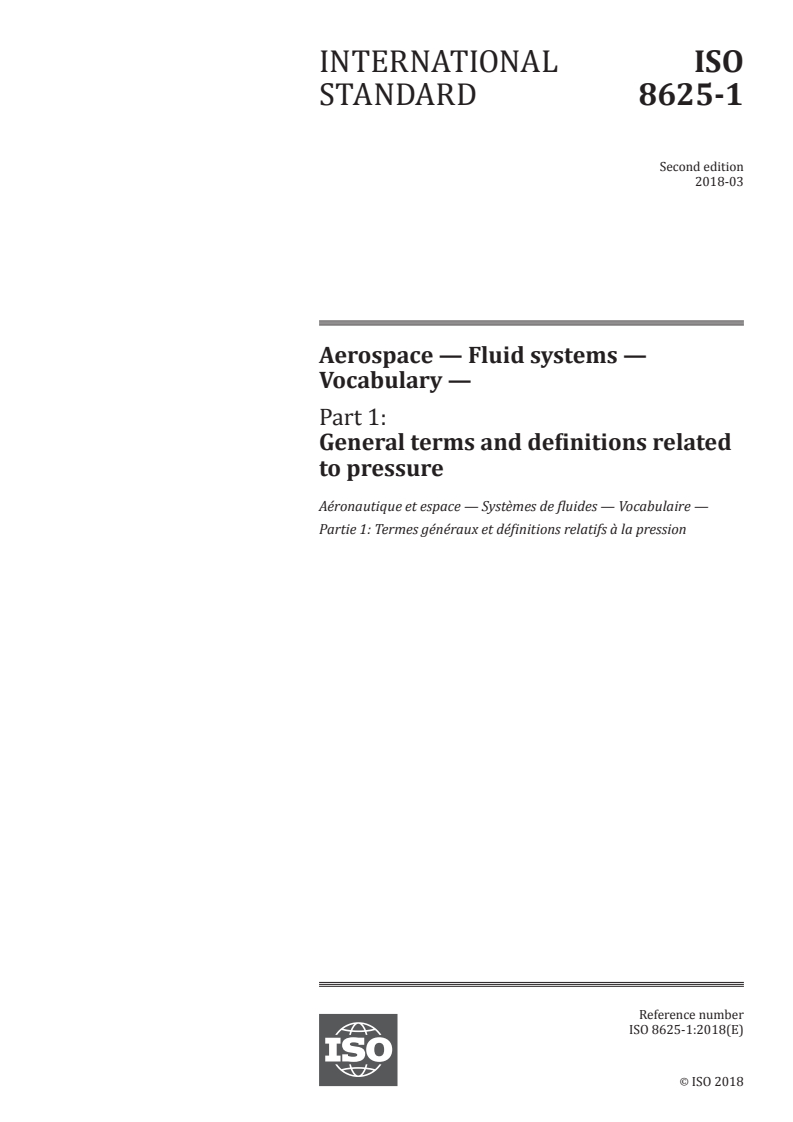
INTERNATIONAL ISO
STANDARD 8625-1
Second edition
2018-03
Aerospace — Fluid systems —
Vocabulary —
Part 1:
General terms and definitions related
to pressure
Aéronautique et espace — Systèmes de fluides — Vocabulaire —
Partie 1: Termes généraux et définitions relatifs à la pression
Reference number
©
ISO 2018
© ISO 2018
All rights reserved. Unless otherwise specified, or required in the context of its implementation, no part of this publication may
be reproduced or utilized otherwise in any form or by any means, electronic or mechanical, including photocopying, or posting
on the internet or an intranet, without prior written permission. Permission can be requested from either ISO at the address
below or ISO’s member body in the country of the requester.
ISO copyright office
CP 401 • Ch. de Blandonnet 8
CH-1214 Vernier, Geneva
Phone: +41 22 749 01 11
Fax: +41 22 749 09 47
Email: copyright@iso.org
Website: www.iso.org
Published in Switzerland
ii © ISO 2018 – All rights reserved
Contents Page
Foreword .iv
1 Scope . 1
2 Normative references . 1
3 Terms and definitions . 1
Annex A (informative) Graphical presentation of an arbitrary pressure curve .6
Bibliography . 7
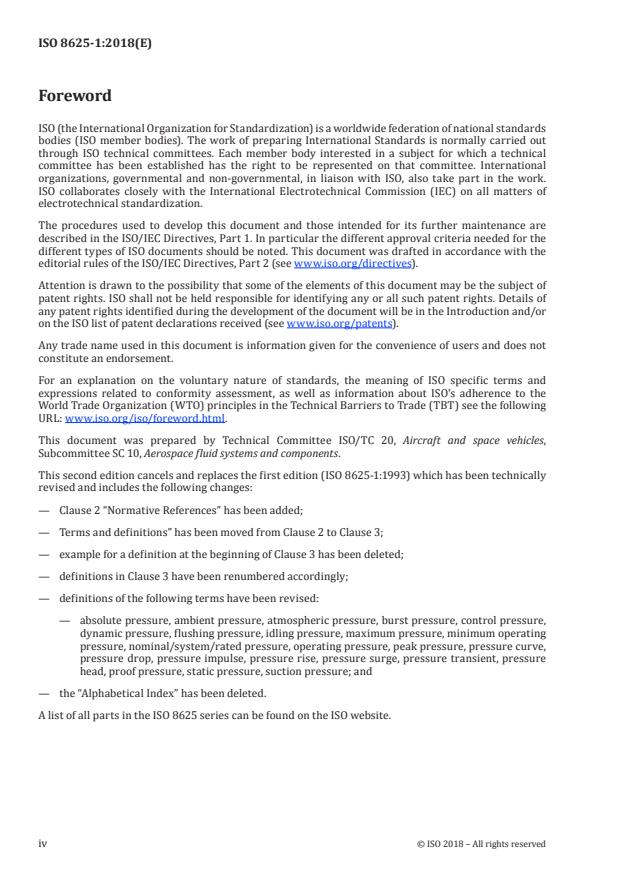
Foreword
ISO (the International Organization for Standardization) is a worldwide federation of national standards
bodies (ISO member bodies). The work of preparing International Standards is normally carried out
through ISO technical committees. Each member body interested in a subject for which a technical
committee has been established has the right to be represented on that committee. International
organizations, governmental and non-governmental, in liaison with ISO, also take part in the work.
ISO collaborates closely with the International Electrotechnical Commission (IEC) on all matters of
electrotechnical standardization.
The procedures used to develop this document and those intended for its further maintenance are
described in the ISO/IEC Directives, Part 1. In particular the different approval criteria needed for the
different types of ISO documents should be noted. This document was drafted in accordance with the
editorial rules of the ISO/IEC Directives, Part 2 (see www .iso .org/ directives).
Attention is drawn to the possibility that some of the elements of this document may be the subject of
patent rights. ISO shall not be held responsible for identifying any or all such patent rights. Details of
any patent rights identified during the development of the document will be in the Introduction and/or
on the ISO list of patent declarations received (see www .iso .org/ patents).
Any trade name used in this document is information given for the convenience of users and does not
constitute an endorsement.
For an explanation on the voluntary nature of standards, the meaning of ISO specific terms and
expressions related to conformity assessment, as well as information about ISO's adherence to the
World Trade Organization (WTO) principles in the Technical Barriers to Trade (TBT) see the following
URL: www .iso .org/ iso/ foreword .html.
This document was prepared by Technical Committee ISO/TC 20, Aircraft and space vehicles,
Subcommittee SC 10, Aerospace fluid systems and components.
This second edition cancels and replaces the first edition (ISO 8625-1:1993) which has been technically
revised and includes the following changes:
— Clause 2 “Normative References” has been added;
— Terms and definitions” has been moved from Clause 2 to Clause 3;
— example for a definition at the beginning of Clause 3 has been deleted;
— definitions in Clause 3 have been renumbered accordingly;
— definitions of the following terms have been revised:
— absolute pressure, ambient pressure, atmospheric pressure, burst pressure, control pressure,
dynamic pressure, flushing pressure, idling pressure, maximum pressure, minimum operating
pressure, nominal/system/rated pressure, operating pressure, peak pressure, pressure curve,
pressure drop, pressure impulse, pressure rise, pressure surge, pressure transient, pressure
head, proof pressure, static pressure, suction pressure; and
— the “Alphabetical Index” has been deleted.
A list of all parts in the ISO 8625 series can be found on the ISO website.
iv © ISO 2018 – All rights reserved
INTERNATIONAL STANDARD ISO 8625-1:2018(E)
Aerospace — Fluid systems — Vocabulary —
Part 1:
General terms and definitions related to pressure
1 Scope
This document defines general terms relating to pressure in fluid systems used in aerospace
construction.
2 Normative references
There are no normative references in this document.
3 Terms and definitions
For the purposes of this document, the following terms and definitions apply.
ISO and IEC maintain terminological databases for use in standardization at the following addresses:
— IEC Electropedia: available at http:// www .electropedia .org/
— ISO Online browsing platform: available at http:// www .iso .org/ obp
NOTE A graphical representation of an arbitrary pressure curve is shown in Annex A.
3.1
absolute pressure
pressure using absolute vacuum as a reference, equal to gauge pressure plus atmospheric pressure
3.2
actual pressure
pressure at a specific location, temperature and time within a system or component
3.3
ambient pressure
pressure on an object caused by its surrounding medium
3.4
atmospheric pressure
absolute pressure of the atmosphere at a specific location and time
3.5
back pressure
pressure acting against the specified direction of operation
3.6
breakout pressure
minimum pressure required to overcome static friction in a component under defined conditions
3.7
burst pressure, actual
pressure at which a component bursts or shows excessive leakage due to structural failure
3.8
burst pressure, minimum
ultimate pressure, minimum
pressure up to which no burst or rupture of components is allowed
3.9
certification pressure
authorized pressure for official acceptance tests
...
INTERNATIONAL ISO
STANDARD 8625-1
Second edition
2018-03
Aerospace — Fluid systems —
Vocabulary —
Part 1:
General terms and definitions related
to pressure
Aéronautique et espace — Systèmes de fluides — Vocabulaire —
Partie 1: Termes généraux et définitions relatifs à la pression
Reference number
©
ISO 2018
© ISO 2018
All rights reserved. Unless otherwise specified, or required in the context of its implementation, no part of this publication may
be reproduced or utilized otherwise in any form or by any means, electronic or mechanical, including photocopying, or posting
on the internet or an intranet, without prior written permission. Permission can be requested from either ISO at the address
below or ISO’s member body in the country of the requester.
ISO copyright office
CP 401 • Ch. de Blandonnet 8
CH-1214 Vernier, Geneva
Phone: +41 22 749 01 11
Fax: +41 22 749 09 47
Email: copyright@iso.org
Website: www.iso.org
Published in Switzerland
ii © ISO 2018 – All rights reserved
Contents Page
Foreword .iv
1 Scope . 1
2 Normative references . 1
3 Terms and definitions . 1
Annex A (informative) Graphical presentation of an arbitrary pressure curve .6
Bibliography . 7
Foreword
ISO (the International Organization for Standardization) is a worldwide federation of national standards
bodies (ISO member bodies). The work of preparing International Standards is normally carried out
through ISO technical committees. Each member body interested in a subject for which a technical
committee has been established has the right to be represented on that committee. International
organizations, governmental and non-governmental, in liaison with ISO, also take part in the work.
ISO collaborates closely with the International Electrotechnical Commission (IEC) on all matters of
electrotechnical standardization.
The procedures used to develop this document and those intended for its further maintenance are
described in the ISO/IEC Directives, Part 1. In particular the different approval criteria needed for the
different types of ISO documents should be noted. This document was drafted in accordance with the
editorial rules of the ISO/IEC Directives, Part 2 (see www .iso .org/ directives).
Attention is drawn to the possibility that some of the elements of this document may be the subject of
patent rights. ISO shall not be held responsible for identifying any or all such patent rights. Details of
any patent rights identified during the development of the document will be in the Introduction and/or
on the ISO list of patent declarations received (see www .iso .org/ patents).
Any trade name used in this document is information given for the convenience of users and does not
constitute an endorsement.
For an explanation on the voluntary nature of standards, the meaning of ISO specific terms and
expressions related to conformity assessment, as well as information about ISO's adherence to the
World Trade Organization (WTO) principles in the Technical Barriers to Trade (TBT) see the following
URL: www .iso .org/ iso/ foreword .html.
This document was prepared by Technical Committee ISO/TC 20, Aircraft and space vehicles,
Subcommittee SC 10, Aerospace fluid systems and components.
This second edition cancels and replaces the first edition (ISO 8625-1:1993) which has been technically
revised and includes the following changes:
— Clause 2 “Normative References” has been added;
— Terms and definitions” has been moved from Clause 2 to Clause 3;
— example for a definition at the beginning of Clause 3 has been deleted;
— definitions in Clause 3 have been renumbered accordingly;
— definitions of the following terms have been revised:
— absolute pressure, ambient pressure, atmospheric pressure, burst pressure, control pressure,
dynamic pressure, flushing pressure, idling pressure, maximum pressure, minimum operating
pressure, nominal/system/rated pressure, operating pressure, peak pressure, pressure curve,
pressure drop, pressure impulse, pressure rise, pressure surge, pressure transient, pressure
head, proof pressure, static pressure, suction pressure; and
— the “Alphabetical Index” has been deleted.
A list of all parts in the ISO 8625 series can be found on the ISO website.
iv © ISO 2018 – All rights reserved
INTERNATIONAL STANDARD ISO 8625-1:2018(E)
Aerospace — Fluid systems — Vocabulary —
Part 1:
General terms and definitions related to pressure
1 Scope
This document defines general terms relating to pressure in fluid systems used in aerospace
construction.
2 Normative references
There are no normative references in this document.
3 Terms and definitions
For the purposes of this document, the following terms and definitions apply.
ISO and IEC maintain terminological databases for use in standardization at the following addresses:
— IEC Electropedia: available at http:// www .electropedia .org/
— ISO Online browsing platform: available at http:// www .iso .org/ obp
NOTE A graphical representation of an arbitrary pressure curve is shown in Annex A.
3.1
absolute pressure
pressure using absolute vacuum as a reference, equal to gauge pressure plus atmospheric pressure
3.2
actual pressure
pressure at a specific location, temperature and time within a system or component
3.3
ambient pressure
pressure on an object caused by its surrounding medium
3.4
atmospheric pressure
absolute pressure of the atmosphere at a specific location and time
3.5
back pressure
pressure acting against the specified direction of operation
3.6
breakout pressure
minimum pressure required to overcome static friction in a component under defined conditions
3.7
burst pressure, actual
pressure at which a component bursts or shows excessive leakage due to structural failure
3.8
burst pressure, minimum
ultimate pressure, minimum
pressure up to which no burst or rupture of components is allowed
3.9
certification pressure
authorized pressure for official acceptance tests
...