

ISO 8625-3:2018
(Main)Aerospace — Fluid systems — Vocabulary — Part 3: General terms and definitions relating to temperature
General Information
- Abstract
ISO 8625-3:2018 defines general terms relating to temperature in fluid systems used in aerospace construction.
- Status
- Published
- Publication Date
- 18-Mar-2018
- Technical Committee
- ISO/TC 20/SC 10 - Aerospace fluid systems and components
- Drafting Committee
- ISO/TC 20/SC 10/WG 9 - Hydraulic power and actuation equipment
- Current Stage
- 9093 - International Standard confirmed
- Start Date
- 14-Nov-2023
- Completion Date
- 29-Aug-2026
Buy Documents


ISO 8625-3:2018 - Aerospace -- Fluid systems -- Vocabulary
ISO 8625-3:2018 - Aerospace — Fluid systems — Vocabulary — Part 3: General terms and definitions relating to temperature/19/2018
Overview
ISO 8625-3:2018 is an international standard published by the International Organization for Standardization (ISO) that focuses on the vocabulary and general terms related to temperature in fluid systems used in aerospace construction. This part of the ISO 8625 series provides standardized definitions and descriptions essential for professionals working with aerospace fluid systems to ensure clarity and consistency in communication and documentation.
The standard defines key temperature-related terms necessary for the design, operation, and maintenance of fluid systems in aerospace applications, covering everything from ambient conditions to extreme temperature tolerances.
Key Topics
- General Temperature Terms: Definitions for various temperature measures such as ambient temperature, fluid temperature, equipment temperature, and inlet and outlet temperatures.
- Critical Temperature Limits: Includes terms like autoignition temperature, flash point, fire point, and pour point which are crucial for safety and fluid handling.
- Operational Temperature Ranges: Covers normal fluid operating temperature, maximum fluid temperature, temperature range of equipment, and fluid temperature range ensuring reliable aerospace system performance.
- Extreme and Survival Conditions: Terms such as extreme operating temperature and survival temperature describe conditions that a system or component can endure without permanent degradation.
- Hydraulic System Classifications: Defines temperature-based classification for hydraulic systems used in military aircraft (Type I, II, and III), based on maximum fluid temperature ranges.
Applications
ISO 8625-3:2018 is invaluable for aerospace engineers, designers, maintenance personnel, and manufacturers involved in fluid systems where accurate understanding of temperature conditions is critical. Its practical applications include:
- Design Specification: Providing a clear vocabulary for specifying operating and environmental temperature conditions for fluid systems in aircraft and spacecraft.
- Safety Compliance: Establishing terminology for ignition and fire-related temperature thresholds, aiding in hazard analysis and prevention.
- Performance Monitoring: Standardizing temperature-related terms helps in setting consistent parameters for system monitoring and diagnostics.
- Component Testing and Validation: Ensures testing processes are aligned with universally accepted definitions to verify temperature resilience and system stability.
- Maintenance and Troubleshooting: Facilitates precise communication about temperature-related issues during maintenance and operational checks.
Related Standards
Professionals interested in fluid systems within aerospace should also consider related standards for a comprehensive understanding:
- ISO 8625 Series: Other parts of the ISO 8625 series cover additional vocabulary and specific fluid system components.
- AS5440: A military standard referenced in ISO 8625-3 for classifying hydraulic systems by maximum allowable fluid temperature, particularly relevant for aerospace fluid systems.
- IEC Electropedia and ISO Online Browsing Platform: These terminological databases maintain updated standards vocabulary applicable to electrical and fluid system components.
- ISO/IEC Directives: Provides guidance on the development, maintenance, and application of international standards, assuring consistent quality across documentation.
ISO 8625-3:2018 serves as a critical reference for establishing universal terminology related to temperature in aerospace fluid systems. By harmonizing definitions, the standard facilitates improved design, operation, safety, and global communication across aerospace industries, supporting efficient management of temperature-sensitive hydraulic and fluid systems.
Relations
- Effective Date
- 12-Feb-2014
Buy Documents
ISO 8625-3:2018 - Aerospace -- Fluid systems -- Vocabulary
ISO 8625-3:2018 - Aerospace — Fluid systems — Vocabulary — Part 3: General terms and definitions relating to temperature/19/2018
Get Certified
Connect with accredited certification bodies for this standard

BUREAU VERITAS Certification Germany
Bureau Veritas certification in Germany.

Element Materials Technology
Materials testing and product certification.

AQMS Ltd.
AQMS provides ISO certification to SMEs across the UK.
Sponsored listings
Frequently Asked Questions
ISO 8625-3:2018 is a standard published by the International Organization for Standardization (ISO). Its full title is "Aerospace — Fluid systems — Vocabulary — Part 3: General terms and definitions relating to temperature". This standard covers: ISO 8625-3:2018 defines general terms relating to temperature in fluid systems used in aerospace construction.
ISO 8625-3:2018 defines general terms relating to temperature in fluid systems used in aerospace construction.
ISO 8625-3:2018 is classified under the following ICS (International Classification for Standards) categories: 01.040.49 - Aircraft and space vehicle engineering (Vocabularies); 49.080 - Aerospace fluid systems and components. The ICS classification helps identify the subject area and facilitates finding related standards.
ISO 8625-3:2018 has the following relationships with other standards: It is inter standard links to ISO 8625-3:1991. Understanding these relationships helps ensure you are using the most current and applicable version of the standard.
ISO 8625-3:2018 is available in PDF format for immediate download after purchase. The document can be added to your cart and obtained through the secure checkout process. Digital delivery ensures instant access to the complete standard document.
Standards Content (Sample)
INTERNATIONAL ISO
STANDARD 8625-3
Second edition
2018-03
Aerospace — Fluid systems —
Vocabulary —
Part 3:
General terms and definitions relating
to temperature
Aéronautique et espace — Systèmes de fluides — Vocabulaire —
Partie 3: Termes généraux et définitions relatifs aux températures
Reference number
©
ISO 2018
© ISO 2018
All rights reserved. Unless otherwise specified, or required in the context of its implementation, no part of this publication may
be reproduced or utilized otherwise in any form or by any means, electronic or mechanical, including photocopying, or posting
on the internet or an intranet, without prior written permission. Permission can be requested from either ISO at the address
below or ISO’s member body in the country of the requester.
ISO copyright office
CP 401 • Ch. de Blandonnet 8
CH-1214 Vernier, Geneva
Phone: +41 22 749 01 11
Fax: +41 22 749 09 47
Email: copyright@iso.org
Website: www.iso.org
Published in Switzerland
ii © ISO 2018 – All rights reserved
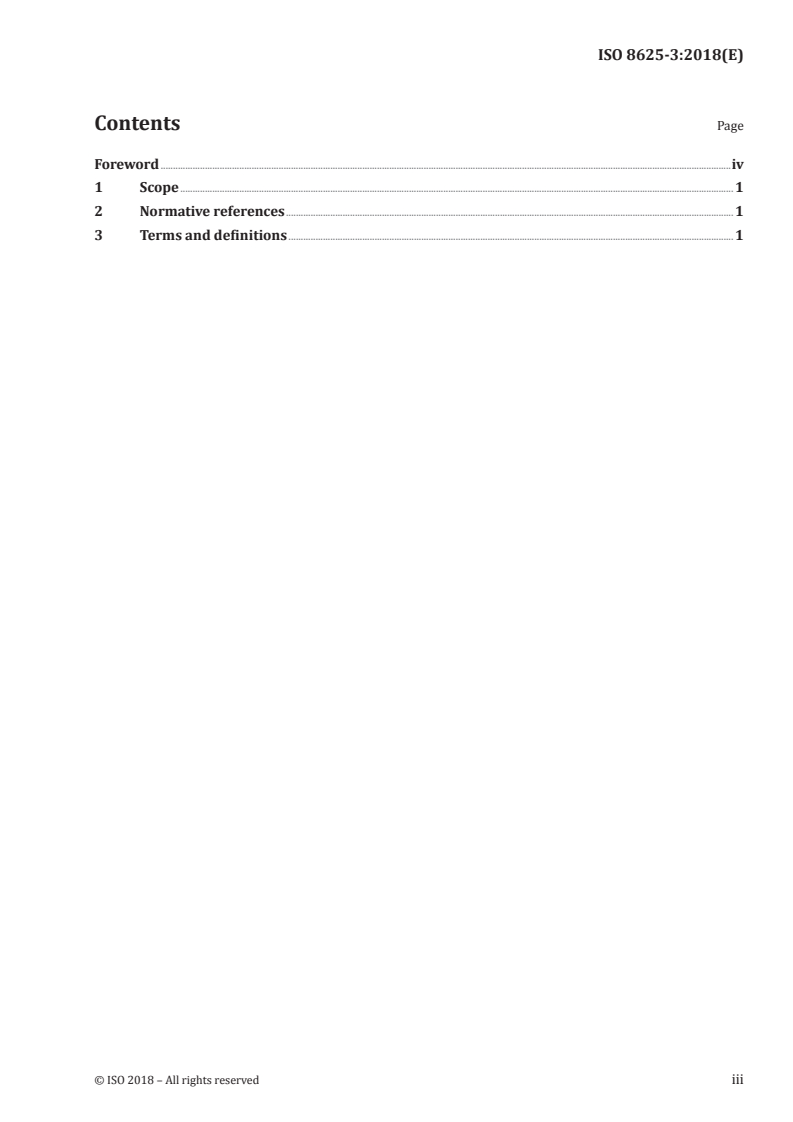
Contents Page
Foreword .iv
1 Scope . 1
2 Normative references . 1
3 Terms and definitions . 1
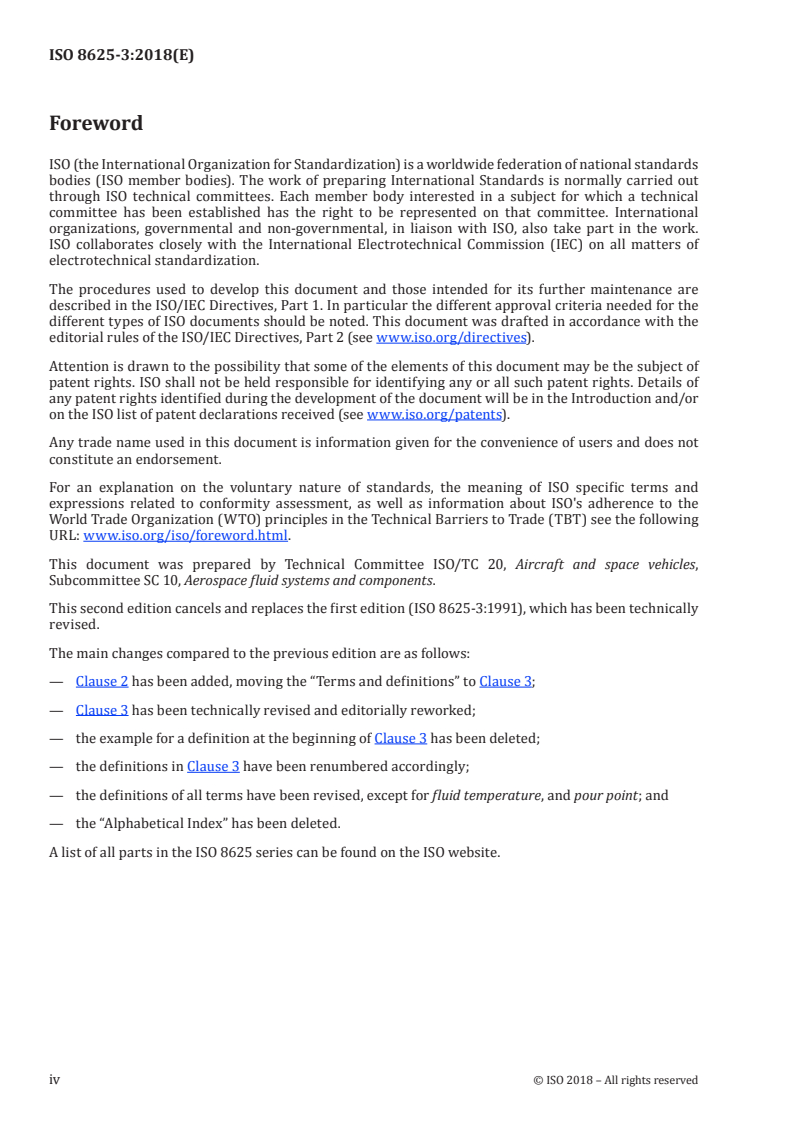
Foreword
ISO (the International Organization for Standardization) is a worldwide federation of national standards
bodies (ISO member bodies). The work of preparing International Standards is normally carried out
through ISO technical committees. Each member body interested in a subject for which a technical
committee has been established has the right to be represented on that committee. International
organizations, governmental and non-governmental, in liaison with ISO, also take part in the work.
ISO collaborates closely with the International Electrotechnical Commission (IEC) on all matters of
electrotechnical standardization.
The procedures used to develop this document and those intended for its further maintenance are
described in the ISO/IEC Directives, Part 1. In particular the different approval criteria needed for the
different types of ISO documents should be noted. This document was drafted in accordance with the
editorial rules of the ISO/IEC Directives, Part 2 (see www .iso .org/ directives).
Attention is drawn to the possibility that some of the elements of this document may be the subject of
patent rights. ISO shall not be held responsible for identifying any or all such patent rights. Details of
any patent rights identified during the development of the document will be in the Introduction and/or
on the ISO list of patent declarations received (see www .iso .org/ patents).
Any trade name used in this document is information given for the convenience of users and does not
constitute an endorsement.
For an explanation on the voluntary nature of standards, the meaning of ISO specific terms and
expressions related to conformity assessment, as well as information about ISO's adherence to the
World Trade Organization (WTO) principles in the Technical Barriers to Trade (TBT) see the following
URL: www .iso .org/ iso/ foreword .html.
This document was prepared by Technical Committee ISO/TC 20, Aircraft and space vehicles,
Subcommittee SC 10, Aerospace fluid systems and components.
This second edition cancels and replaces the first edition (ISO 8625-3:1991), which has been technically
revised.
The main changes compared to the previous edition are as follows:
— Clause 2 has been added, moving the “Terms and definitions” to Clause 3;
— Clause 3 has been technically revised and editorially reworked;
— the example for a definition at the beginning of Clause 3 has been deleted;
— the definitions in Clause 3 have been renumbered accordingly;
— the definitions of all terms have been revised, except for
...
INTERNATIONAL ISO
STANDARD 8625-3
Second edition
2018-03
Aerospace — Fluid systems —
Vocabulary —
Part 3:
General terms and definitions relating
to temperature
Aéronautique et espace — Systèmes de fluides — Vocabulaire —
Partie 3: Termes généraux et définitions relatifs aux températures
Reference number
©
ISO 2018
© ISO 2018
All rights reserved. Unless otherwise specified, or required in the context of its implementation, no part of this publication may
be reproduced or utilized otherwise in any form or by any means, electronic or mechanical, including photocopying, or posting
on the internet or an intranet, without prior written permission. Permission can be requested from either ISO at the address
below or ISO’s member body in the country of the requester.
ISO copyright office
CP 401 • Ch. de Blandonnet 8
CH-1214 Vernier, Geneva
Phone: +41 22 749 01 11
Fax: +41 22 749 09 47
Email: copyright@iso.org
Website: www.iso.org
Published in Switzerland
ii © ISO 2018 – All rights reserved
Contents Page
Foreword .iv
1 Scope . 1
2 Normative references . 1
3 Terms and definitions . 1
Foreword
ISO (the International Organization for Standardization) is a worldwide federation of national standards
bodies (ISO member bodies). The work of preparing International Standards is normally carried out
through ISO technical committees. Each member body interested in a subject for which a technical
committee has been established has the right to be represented on that committee. International
organizations, governmental and non-governmental, in liaison with ISO, also take part in the work.
ISO collaborates closely with the International Electrotechnical Commission (IEC) on all matters of
electrotechnical standardization.
The procedures used to develop this document and those intended for its further maintenance are
described in the ISO/IEC Directives, Part 1. In particular the different approval criteria needed for the
different types of ISO documents should be noted. This document was drafted in accordance with the
editorial rules of the ISO/IEC Directives, Part 2 (see www .iso .org/ directives).
Attention is drawn to the possibility that some of the elements of this document may be the subject of
patent rights. ISO shall not be held responsible for identifying any or all such patent rights. Details of
any patent rights identified during the development of the document will be in the Introduction and/or
on the ISO list of patent declarations received (see www .iso .org/ patents).
Any trade name used in this document is information given for the convenience of users and does not
constitute an endorsement.
For an explanation on the voluntary nature of standards, the meaning of ISO specific terms and
expressions related to conformity assessment, as well as information about ISO's adherence to the
World Trade Organization (WTO) principles in the Technical Barriers to Trade (TBT) see the following
URL: www .iso .org/ iso/ foreword .html.
This document was prepared by Technical Committee ISO/TC 20, Aircraft and space vehicles,
Subcommittee SC 10, Aerospace fluid systems and components.
This second edition cancels and replaces the first edition (ISO 8625-3:1991), which has been technically
revised.
The main changes compared to the previous edition are as follows:
— Clause 2 has been added, moving the “Terms and definitions” to Clause 3;
— Clause 3 has been technically revised and editorially reworked;
— the example for a definition at the beginning of Clause 3 has been deleted;
— the definitions in Clause 3 have been renumbered accordingly;
— the definitions of all terms have been revised, except for
...