

ISO/FDIS 14132-5
(Main)Optics and photonics — Vocabulary for telescopic systems — Part 5: General terms for night vision devices
- Abstract
This document gives terms and definitions for night vision devices such as binoculars, monoculars, goggles, telescopic sights and front attachments that are used under extremely low light conditions, at night or in dark rooms, for observation activities, search and rescue actions, performing urgent repairs in the dark, night‑time surveillance and security, night hunting and fishing (where legal), night driving and exploring dark spaces like caves or tunnels. This document does not cover thermal imaging technology. The definitions can be changed, if required, by introducing derivative attributes into them, revealing the meanings of the terms used, showing the objects covered by the scope of the notion being defined. These changes shall not upset the scope and contents of the notions defined.
- Status
- Not Published
- Technical Committee
- ISO/TC 172/SC 4 - Telescopic systems
- Drafting Committee
- ISO/TC 172/SC 4/WG 2 - Telescopic devices
- Current Stage
- 5000 - Final text received or FDIS registered for formal approval - 50 Approval
- Start Date
- 10-Aug-2026
- Due Date
- 28-Aug-2026
- Completion Date
- 28-Aug-2026
Buy Documents
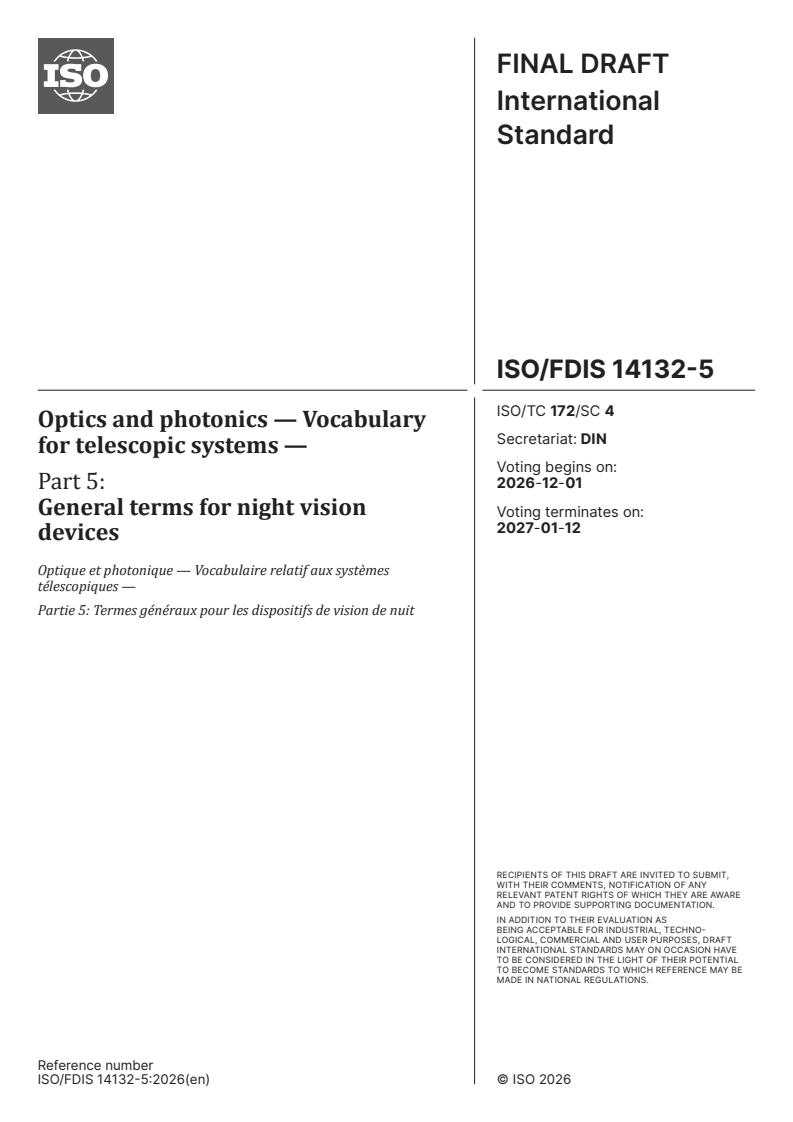

ISO/FDIS 14132-5 - Optics and photonics — Vocabulary for telescopic systems — Part 5: General terms for night vision devices
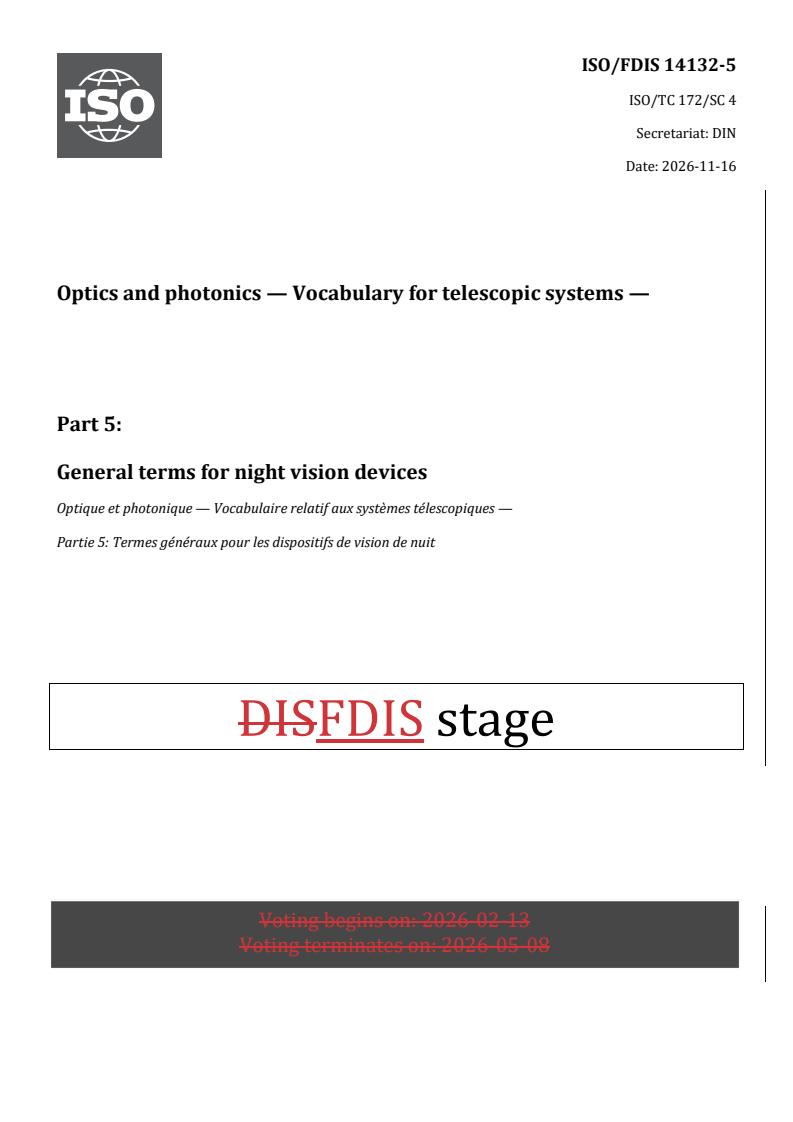
REDLINE ISO/FDIS 14132-5 - Optics and photonics — Vocabulary for telescopic systems — Part 5: General terms for night vision devices
ISO/FDIS 14132-5 is an ISO vocabulary standard for telescopic systems, focused on general terms for night vision devices. It defines the terms used for devices such as binoculars, monoculars, goggles, telescopic sights and front attachments used in extremely low light, at night, or in dark spaces. The document is intended for people who specify, describe, test or buy night vision products and need shared terminology for the same devices and performance ideas.
What does ISO/FDIS 14132-5 specify?
ISO/FDIS 14132-5 specifies terms and definitions for night vision devices used for observation, search and rescue, urgent repairs in the dark, night-time surveillance and security, night hunting and fishing where legal, night driving, and exploring caves or tunnels. ISO/FDIS 14132-5 excludes thermal imaging technology.
The document is organised into clause 1 Scope, clause 2 Normative references, and clause 3 Terms and definitions, followed by a bibliography and an index. Clause 1 also allows definitions to be refined with derivative attributes, as long as the scope and meaning of the defined notion are kept intact.
What are the key requirements of ISO/FDIS 14132-5?
ISO/FDIS 14132-5 is mainly a terminology document, so its practical value is in the way it classifies devices and defines performance language. The definitions help users describe a device in a way that is consistent across design, testing, procurement and technical documentation.
Scope and device categories
- Clause 1 limits the vocabulary to night vision use cases under extremely low light, night or dark-room conditions. In practice, this keeps the terms tied to low-light optical devices rather than other imaging technologies.
- Clause 3.2 defines a night vision device as a telescopic instrument with an image intensifier tube or a digital image sensor. This gives a common product label for equipment that forms a usable image in the dark.
- Clause 3.2 also separates passive, passive/active, active and dual action night vision devices. In practice, users can state whether the device works with ambient light, needs extra radiation, or can also be used by day.
Sensor and image-performance terms
- Clause 3.3 defines the analog night vision device and the image intensifier tube, including the tube’s internal function. This matters when comparing traditional image-intensifier systems with sensor-based systems.
- Clause 3.3 also defines resolution, signal-to-noise ratio (SNR) and figure of merit (FOM) for image intensifiers. These are key performance terms when evaluating image clarity and low-light performance.
- Clause 3.3 includes terms such as automatic luminance control, halo, scintillation, night vision device gain, spectral sensitivity, equivalent background object luminance, limit of resolution and image persistence. These terms support specification and test language for brightness control, image artifacts, usable detail and after-image behaviour.
Modern device types and operating limits
- Clause 3.4 defines the digital night vision device using a digital image sensor of CCD or CMOS type, with or without on-chip amplification. This brings modern sensor-based products into the same vocabulary set.
- Clause 3.5 defines the fusion night vision device as a device that combines image intensifier and digital sensor imagery into one visible image. This is useful for hybrid systems that merge spectral information.
- Clauses 3.6 to 3.9 define range of vision, maximum radiance, imperfections in the field of view and continuous work time. These terms help users discuss usable distance, overload conditions, image defects and endurance in a consistent way.
What terms does ISO/FDIS 14132-5 define?
- night vision - a general term for technologies that enable vision in extremely low light or darkness by amplifying low light or detecting reflected infrared radiation.
- night vision device - a telescopic instrument designed to provide observation in low-light conditions, at night, or under artificial irradiation of the object space.
- passive night vision device - a device that works at night under natural night radiation and does not need an additional radiation source.
- digital night vision device - a night vision device that uses a digital image sensor, of CCD or CMOS type, to obtain a low-light image.
- fusion night vision device - a device that combines image intensifier and digital sensor inputs to form a single visible image.
- signal-to-noise ratio (SNR) - the ratio used for image intensifier performance, linking collected radiant power to noise equivalent power.
- figure of merit (FOM) - a characteristic of an image intensifier tube calculated from resolution multiplied by SNR.
Who uses ISO/FDIS 14132-5?
ISO/FDIS 14132-5 is useful for optical engineers, product designers, test laboratories, quality managers, buyers, and technical writers working with night vision equipment. It is also relevant to organisations involved in surveillance, security, rescue, night driving support, and field equipment for legal night hunting and fishing. Anyone writing datasheets, test reports, tenders or conformity documents for binoculars, monoculars, goggles, telescopic sights or front attachments can use its terminology.
What changed in ISO/FDIS 14132-5 from the previous edition?
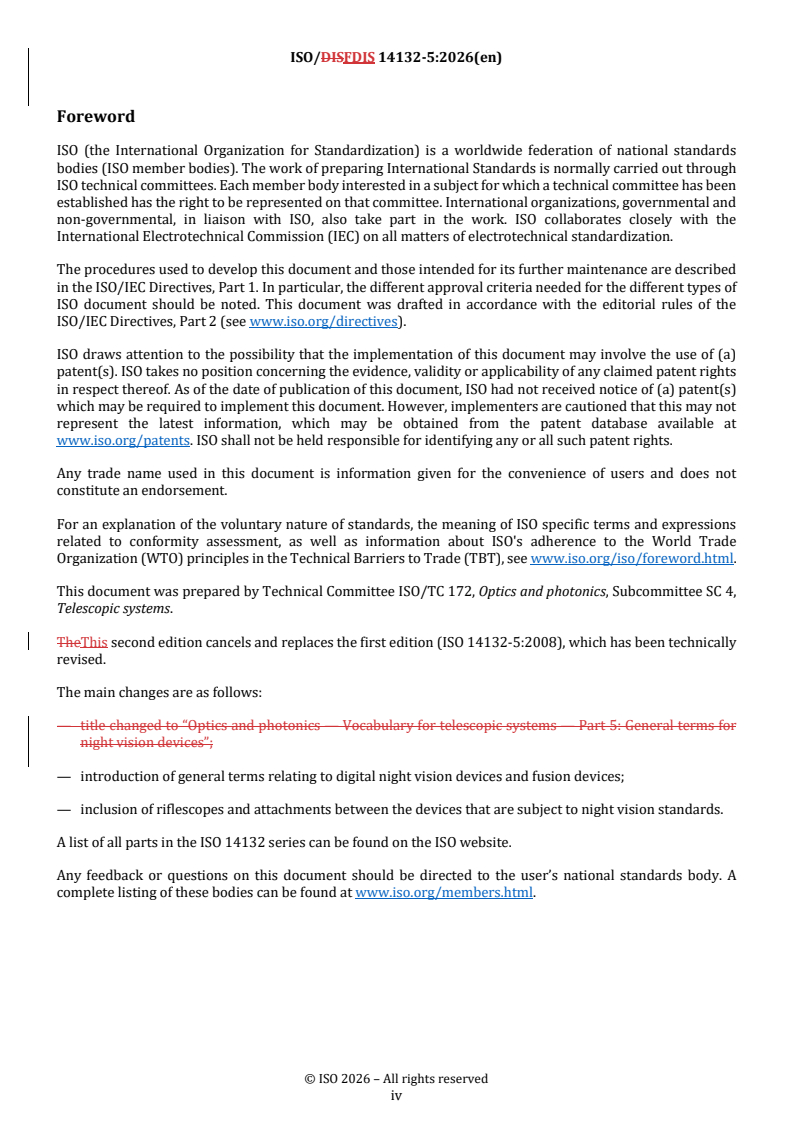
ISO/FDIS 14132-5 is the second edition and it cancels and replaces ISO 14132-5:2008. The stated changes are a new title, the introduction of general terms for digital night vision devices and fusion devices, and the inclusion of riflescopes and attachments among the devices covered by night vision standards.
Which standards are used with ISO/FDIS 14132-5?
| Standard | What it contributes |
|---|---|
| ISO 14132-1 | General telescope vocabulary and alphabetical indexes of terms in ISO 14132. |
| ISO 14132-2 | Terms for binoculars, monoculars and spotting scopes. |
| ISO 14132-3 | Terms for telescopic sights. |
| ISO 20473 | Spectral bands, cited in the definition of night vision and the NIR range. |
| EN ISO/CIE 11664-2 | CIE standard illuminants, cited for the illuminant A recommendation in the gain definition. |
What does the ISO/FDIS 14132-5 document contain?
ISO/FDIS 14132-5 contains a vocabulary structure with clause 1 scope, clause 2 normative references, and clause 3 terms and definitions, plus a bibliography and an index. Its technical content includes definitions for device categories, image intensifier terms, digital and fusion night vision terms, and operating or performance terms such as SNR, FOM, gain, spectral sensitivity and range of vision. Several definitions include notes that guide how the terms are used in measurement or description, including references to light level, eye relief, field of view and object contrast.
Relations
- Effective Date
- 03-Feb-2024
Buy Documents
ISO/FDIS 14132-5 - Optics and photonics — Vocabulary for telescopic systems — Part 5: General terms for night vision devices
REDLINE ISO/FDIS 14132-5 - Optics and photonics — Vocabulary for telescopic systems — Part 5: General terms for night vision devices
Frequently Asked Questions
ISO/FDIS 14132-5 is a draft published by the International Organization for Standardization (ISO). Its full title is "Optics and photonics — Vocabulary for telescopic systems — Part 5: General terms for night vision devices". This standard covers: This document gives terms and definitions for night vision devices such as binoculars, monoculars, goggles, telescopic sights and front attachments that are used under extremely low light conditions, at night or in dark rooms, for observation activities, search and rescue actions, performing urgent repairs in the dark, night‑time surveillance and security, night hunting and fishing (where legal), night driving and exploring dark spaces like caves or tunnels. This document does not cover thermal imaging technology. The definitions can be changed, if required, by introducing derivative attributes into them, revealing the meanings of the terms used, showing the objects covered by the scope of the notion being defined. These changes shall not upset the scope and contents of the notions defined.
This document gives terms and definitions for night vision devices such as binoculars, monoculars, goggles, telescopic sights and front attachments that are used under extremely low light conditions, at night or in dark rooms, for observation activities, search and rescue actions, performing urgent repairs in the dark, night‑time surveillance and security, night hunting and fishing (where legal), night driving and exploring dark spaces like caves or tunnels. This document does not cover thermal imaging technology. The definitions can be changed, if required, by introducing derivative attributes into them, revealing the meanings of the terms used, showing the objects covered by the scope of the notion being defined. These changes shall not upset the scope and contents of the notions defined.
ISO/FDIS 14132-5 is classified under the following ICS (International Classification for Standards) categories: 01.040.37 - Image technology (Vocabularies); 37.020 - Optical equipment. The ICS classification helps identify the subject area and facilitates finding related standards.
ISO/FDIS 14132-5 has the following relationships with other standards: It is inter standard links to ISO 14132-5:2008. Understanding these relationships helps ensure you are using the most current and applicable version of the standard.
ISO/FDIS 14132-5 is available in PDF format for immediate download after purchase. The document can be added to your cart and obtained through the secure checkout process. Digital delivery ensures instant access to the complete standard document.
Standards Content (Sample)
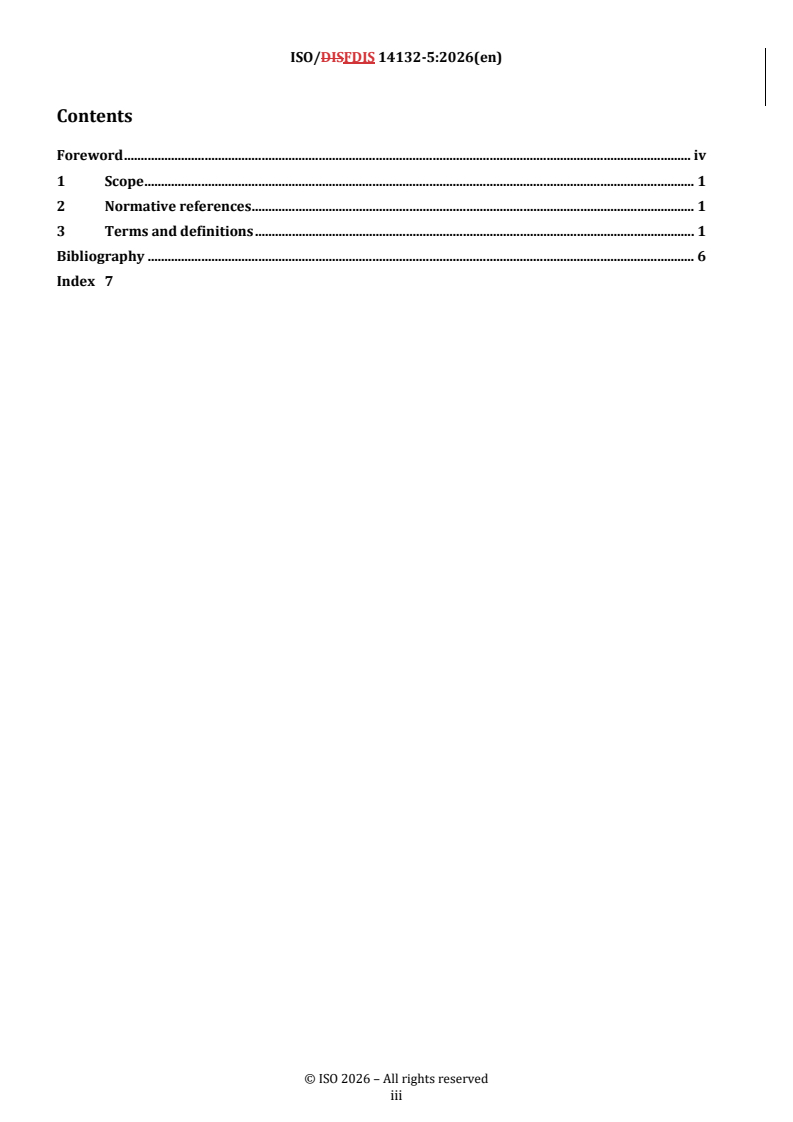
Contents
- 1 Scope
- 2 Normative references
- 3 Terms and definitions
- 3.1 night vision technologies
- 3.2 night vision device
- 3.2.1 passive night vision device
- 3.2.2 passive/active night vision device
- 3.2.3 active night vision device
- 3.2.4 dual action night vision device
- 3.3 analog night vision device
- 3.3.1 image intensifier tube
- 3.3.2 resolution of an image intensifier
- 3.3.3 signal-to-noise ratio (SNR) of an image intensifier
- 3.3.4 figure of merit of an image intensifier
- 3.3.5 automatic luminance control
- 3.3.6 halo
- 3.3.7 scintillation
- 3.3.8 night vision device gain
- 3.3.9 spectral sensitivity
- 3.3.10 equivalent background object luminance
- 3.3.11 limit of resolution
- 3.3.12 image persistence
- 3.4 digital night vision device
- 3.5 fusion night vision device
- 3.6 range of vision
- 3.7 maximum radiance
- 3.8 imperfections in the field of view
- 3.9 continuous work time
- Bibliography
1 Scope
This document gives terms and definitions for night vision devices such as binoculars, monoculars, goggles, telescopic sights and front attachments that are used under extremely low light conditions, at night or in dark rooms, for observation activities, search and rescue actions, performing urgent repairs in the dark, night-time surveillance and security, night hunting and fishing, night driving and exploring dark spaces like caves or tunnels.
This document does not cover thermal imaging technology.
The definitions can be changed, if required, by introducing derivative attributes into them, revealing the meanings of the terms used, showing the objects covered by the scope of the notion being defined. These changes cannot upset the scope and contents of the notions defined.
2 Normative references
The following documents are referred to in the text in such a way that some or all of their content constitutes requirements of this document. For dated references, only the edition cited applies. For undated references, the latest edition of the referenced document (including any amendments) applies. ISO 14132-1, Optics and photonics — Vocabulary for telescopic systems — Part 1: General terms and alphabetical indexes of terms in ISO 14132 ISO 14132-2, Optics and photonics — Vocabulary for telescopic systems — Part 2: Terms for binoculars, monoculars and spotting scopes ISO 14132-3, Optics and photonics — Vocabulary for telescopic systems — Part 3: Terms for telescopic sights
3 Terms and definitions
For the purposes of this document, the terms and definitions given in ISO 14132-1, ISO 14132-2, ISO 14132-3, as well as the following apply.
ISO and IEC maintain terminological databases for use in standardization at the following addresses:
- ISO Online browsing platform: available at https:// www .iso .org/ obp
- IEC Electropedia: available at https:// www .electropedia .org
3.1 night vision technologies
technologies that enable vision in extremely low-light conditions or in total darkness by amplification of low light or by detection of reflected infrared radiation Note 1 to entry: There are different types of night vision technologies that can be divided into analog night vision (also called traditional or image intensifier night vision) and digital night vision.
ISO/FDIS 14132-5:2026(en) Note 2 to entry: The reflected infrared radiation includes the spectral range between 780 nm and 3000 nm, therefore [1] representing the near infrared spectral band (NIR). According to ISO 20473 , NIR is subdivided into IR-A (780 nm to 1 400 nm) and IR-B (1 400 nm to 3 000 nm), including short-wave infrared (SWIR), which is very important for night vision and low-visibility applications.
3.2 night vision device
telescopic instrument, including an image intensifier tube or a digital image sensor, designed for observation in low-light conditions, at night under natural night radiation (comprising the visible spectral range and/or reflected infrared radiation) or under artificial irradiation of the object space
3.2.1 passive night vision device
device designed for observation at night under natural night radiation that does not need an associated source of additional radiation
3.2.2 passive/active night vision device
device designed for observation at night or in dark spaces, under natural and/or artificial radiation, which is equipped with an associated source of radiation and which can operate with or without a light source
3.2.3 active night vision device
device designed for observation at night or in dark spaces that needs an associated source of additional radiation
3.2.4 dual action night vision device
device enabling observation both at night and by day
3.3 analog night vision device
night vision device that uses an image intensifier tube for amplification of low light to obtain an image
...
Contents
- 1 Scope
- 2 Normative references
- 3 Terms and definitions
- 3.1 night vision
- 3.2 night vision device
- 3.2.1 passive night vision device
- 3.2.2 passive/active night vision device
- 3.2.3 active night vision device
- 3.2.4 dual action night vision device
- 3.3 analog night vision device
- 3.3.1 image intensifier tube
- 3.3.2 resolution of an image intensifier
- 3.3.3 signal-to-noise ratio (SNR) of an image intensifier
- 3.3.4 figure of merit (FOM) of an image intensifier
- 3.3.5 automatic luminance control
- 3.3.6 halo
- 3.3.7 scintillation
- 3.3.8 night vision device gain
- 3.3.9 spectral sensitivity
- 3.3.10 equivalent background object luminance
- 3.3.11 limit of resolution
- 3.3.12 image persistence
- 3.4 digital night vision device
- 3.5 fusion night vision device
- 3.6 range of vision
- 3.7 maximum radiance
- 3.8 imperfections in the field of view
- 3.9 continuous work time
- Bibliography
1 Scope
This document gives terms and definitions for night vision devices such as binoculars, monoculars, goggles, telescopic sights and front attachments that are used under extremely low light conditions, at night or in dark rooms, for observation activities, search and rescue actions, performing urgent repairs in the dark, night -time surveillance and security, night hunting and fishing, night driving and exploring dark spaces like caves or tunnels.
This document does not cover thermal imaging technology.
The definitions can be changed, if required, by introducing derivative attributes into them, revealing the meanings of the terms used, showing the objects covered by the scope of the notion being defined. These changes shall notcannot upset the scope and contents of the notions defined.
2 Normative references
The following documents are referred to in the text in such a way that some or all of their content constitutes requirements of this document. For dated references, only the edition cited applies. For undated references, the latest edition of the referenced document (including any amendments) applies. ISO 14132-1, Optics and photonics — Vocabulary for telescopic systems — Part 1: General terms and alphabetical indexes of terms in ISO 14132 ISO 14132-2, Optics and photonics — Vocabulary for telescopic systems — Part 2: Terms for binoculars, monoculars and spotting scopes ISO 14132-3, Optics and photonics — Vocabulary for telescopic systems — Part 3: Terms for telescopic sights
3 Terms and definitions
For the purposes of this document, the terms and definitions given in ISO 14132-1, ISO 14132-2, ISO 14132- 3, as well as the following apply.
ISO and IEC maintain terminological databases for use in standardization at the following addresses:
- ISO Online browsing platform: available at httphttps://www.iso.org/obp
- IEC Electropedia: available at http://www.electropedia.orghttps://www.electropedia.org
3.1 night vision
general term referring to technologies technologies that enable vision in extremely low -light conditions or in total darkness by amplification of low light or by detection of reflected infrared radiation Note 1 to entry: There are different types of night vision technologies that can be divided ininto analog night vision (also called traditional or image intensifier night vision) and digital night vision.
ISO/DISFDIS 14132-5:2026(en) Note 2 to entry: The reflected infrared radiation includes the spectral range between 780 nm and 3000 nm, therefore [1] representing the near infrared spectral band (NIR). According to ISO 20473 , NIR is subdivided into IR-A (780 nm to 14001 400 nm) and IR-B (14001 400 nm to 30003 000 nm), including the so called short-wave infrared (SWIR), which is very important for night vision and low -visibility applications.
3.2 night vision device
telescopic instrument, including an image intensifier tube or a digital image sensor, designed for observation in low -light conditions, at night under natural night radiation (comprising the visible spectral range and/or the reflected infrared radiation) or under artificial irradiation of the object space
3.2.1 passive night vision device
device designed for observation at night under natural night radiation, that does not need an associated source of additional radiation
3.2.2 passive/active night vision device
device designed for observation at night or in dark spaces, under natural and/or artificial radiation, which is equipped with an associated source of radiation and which can operate with or without a light source
3.2.3 active night vision device
device designed for observation at night or in dark spaces, that needs an associated source of additional radiation
3.2.4 dual action night vision device
device enabling observation both at night and by day
3.3 analog night vision device
night vision device, using that uses an image intensifier tube for amplification of low light to obtain an image
...