

ISO 14132-2:2015
(Main)Optics and photonics — Vocabulary for telescopic systems — Part 2: Terms for binoculars, monoculars and spotting scopes
General Information
- Abstract
ISO 14132-2:2015 gives terms, definitions and letter symbols used in relation with binoculars, monoculars, and spotting scopes. The alphabetical index of terms that are common for all published parts of ISO 14132 are published in ISO 14132‑1.
- Status
- Published
- Publication Date
- 15-Nov-2015
- Technical Committee
- ISO/TC 172/SC 4 - Telescopic systems
- Drafting Committee
- ISO/TC 172/SC 4 - Telescopic systems
- Current Stage
- 9060 - Close of review
- Completion Date
- 04-Mar-2031
Buy Documents
ISO 14132-2:2015 - Optics and photonics -- Vocabulary for telescopic systems
ISO 14132-2:2015 - Optics and photonics — Vocabulary for telescopic systems — Part 2: Terms for binoculars, monoculars and spotting scopes/16/2015
Overview
ISO 14132-2:2015 - Optics and photonics - Vocabulary for telescopic systems - Part 2: Terms for binoculars, monoculars and spotting scopes provides a standardized vocabulary, definitions and letter symbols used for binoculars, monoculars and spotting scopes. As a vocabulary standard (no normative references), it harmonizes terminology across design, testing, procurement and documentation of handheld and mounted telescopic observational instruments. The alphabetical index of shared terms is published in ISO 14132‑1.
Key topics
This part of ISO 14132 covers precise definitions and related symbols for terms such as:
- Binoculars (prism vs. lens; Galilean/all‑lens), monoculars, and spotting scopes (hand‑held vs. tripod/clamp‑mounted)
- Variable power and zoom instruments; centre, individual, and internal focusing
- Mechanical and ergonomic terms: hinge of binoculars, interpupillary distance (b’), interpupillary scale
- Optical alignment and image issues: binocular alignment, disparity of image rotations, convergence/divergence/dipvergence of axes, and relative difference in magnification
- Stereo perception metrics with formulae: specific plasticity (P), plasticity (P·Γ), range of stereoscopic vision (R0) and threshold depth of stereoscopic vision (ΔR) (includes the standard stereoscopic threshold η ≈ 10″ ≈ 5×10⁻⁵ rad)
- Environmental and optical features: waterproof vs water resistant, false pupils (spurious pupils from prism systems), binocular spotting scope, periscopic telescope
The second edition clarified terminology (introducing “telescopic system”), refined distinctions between optical base distances (b, b’, B) and added the term false pupils.
Applications and who uses it
ISO 14132-2:2015 is practical for:
- Manufacturers and designers of binoculars, monoculars and spotting scopes - to use consistent terms in specifications and drawings
- Test laboratories and QA teams - to ensure unambiguous reporting of measurement results and alignment checks
- Procurement and compliance officers - to write clear purchase specifications and acceptance criteria
- Technical authors, educators and standards committees - to produce manuals, training material and harmonized standards
- Optical engineers and product managers - when communicating product features (magnification, interpupillary distance, focusing type, etc.)
Using the standard reduces ambiguity in specifications, streamlines international communication, and improves interoperability of terms across product literature and regulatory documents.
Related standards
- ISO 14132-1 - General terms and alphabetical index for ISO 14132
- ISO 14132 series parts for other telescopic systems: Part 3 (telescopic sights), Part 4 (astronomical telescopes), Part 5 (night vision devices)
Keywords: ISO 14132-2:2015, binoculars vocabulary, monoculars, spotting scopes, telescopic systems, optics and photonics, interpupillary distance, magnification, stereoscopic vision.
Relations
- Effective Date
- 15-Mar-2014
Buy Documents
ISO 14132-2:2015 - Optics and photonics -- Vocabulary for telescopic systems
ISO 14132-2:2015 - Optics and photonics — Vocabulary for telescopic systems — Part 2: Terms for binoculars, monoculars and spotting scopes/16/2015
Frequently Asked Questions
ISO 14132-2:2015 is a standard published by the International Organization for Standardization (ISO). Its full title is "Optics and photonics — Vocabulary for telescopic systems — Part 2: Terms for binoculars, monoculars and spotting scopes". This standard covers: ISO 14132-2:2015 gives terms, definitions and letter symbols used in relation with binoculars, monoculars, and spotting scopes. The alphabetical index of terms that are common for all published parts of ISO 14132 are published in ISO 14132‑1.
ISO 14132-2:2015 gives terms, definitions and letter symbols used in relation with binoculars, monoculars, and spotting scopes. The alphabetical index of terms that are common for all published parts of ISO 14132 are published in ISO 14132‑1.
ISO 14132-2:2015 is classified under the following ICS (International Classification for Standards) categories: 01.040.37 - Image technology (Vocabularies); 37.020 - Optical equipment. The ICS classification helps identify the subject area and facilitates finding related standards.
ISO 14132-2:2015 has the following relationships with other standards: It is inter standard links to ISO 14132-2:2002. Understanding these relationships helps ensure you are using the most current and applicable version of the standard.
ISO 14132-2:2015 is available in PDF format for immediate download after purchase. The document can be added to your cart and obtained through the secure checkout process. Digital delivery ensures instant access to the complete standard document.
Standards Content (Sample)
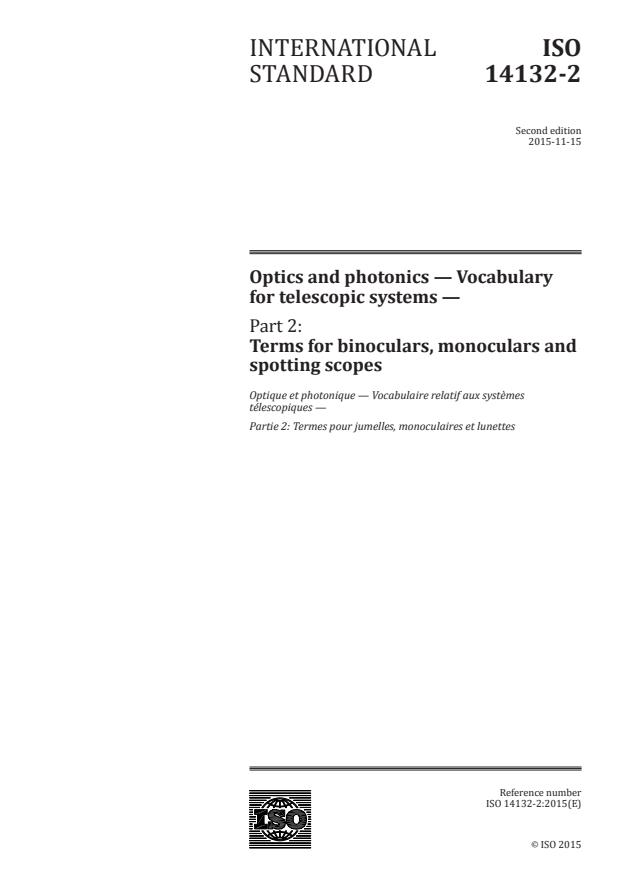
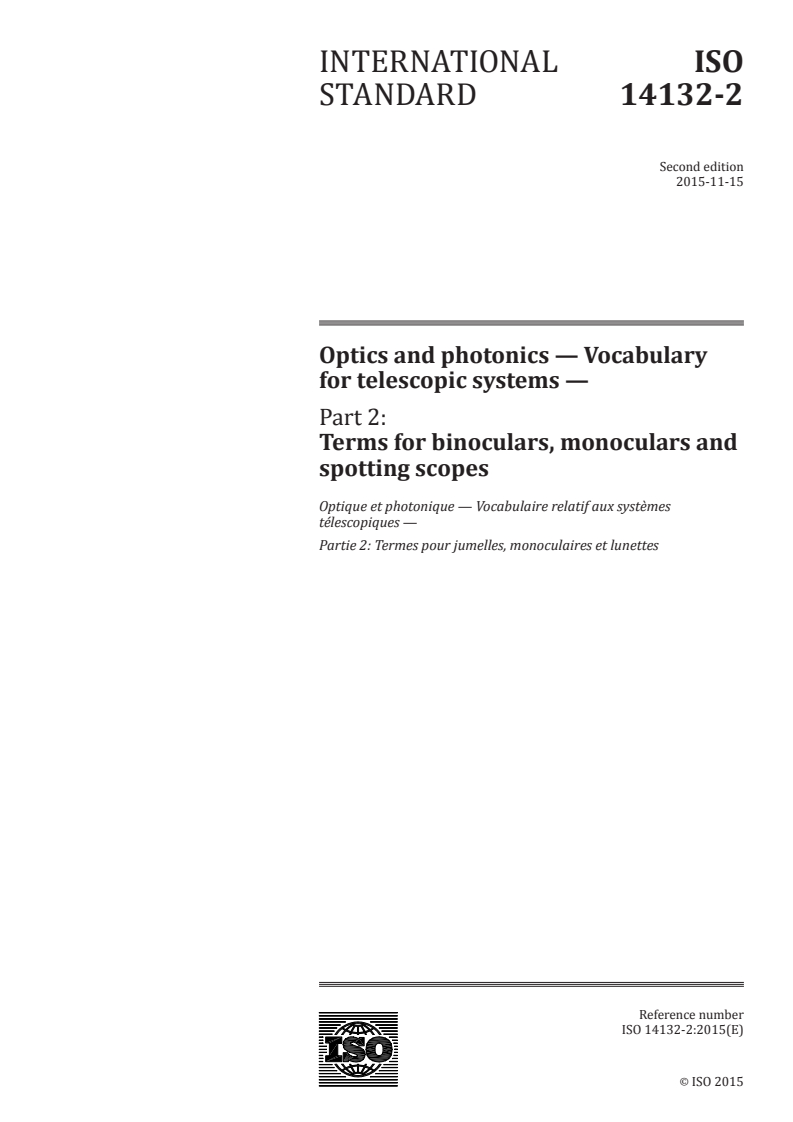
INTERNATIONAL ISO
STANDARD 14132-2
Second edition
2015-11-15
Optics and photonics — Vocabulary
for telescopic systems —
Part 2:
Terms for binoculars, monoculars and
spotting scopes
Optique et photonique — Vocabulaire relatif aux systèmes
télescopiques —
Partie 2: Termes pour jumelles, monoculaires et lunettes
Reference number
©
ISO 2015
© ISO 2015, Published in Switzerland
All rights reserved. Unless otherwise specified, no part of this publication may be reproduced or utilized otherwise in any form
or by any means, electronic or mechanical, including photocopying, or posting on the internet or an intranet, without prior
written permission. Permission can be requested from either ISO at the address below or ISO’s member body in the country of
the requester.
ISO copyright office
Ch. de Blandonnet 8 • CP 401
CH-1214 Vernier, Geneva, Switzerland
Tel. +41 22 749 01 11
Fax +41 22 749 09 47
copyright@iso.org
www.iso.org
ii © ISO 2015 – All rights reserved
Contents Page
Foreword .iv
1 Scope . 1
2 Normative references . 1
3 Terms and definitions . 1
Bibliography . 6
Foreword
ISO (the International Organization for Standardization) is a worldwide federation of national standards
bodies (ISO member bodies). The work of preparing International Standards is normally carried out
through ISO technical committees. Each member body interested in a subject for which a technical
committee has been established has the right to be represented on that committee. International
organizations, governmental and non-governmental, in liaison with ISO, also take part in the work.
ISO collaborates closely with the International Electrotechnical Commission (IEC) on all matters of
electrotechnical standardization.
The procedures used to develop this document and those intended for its further maintenance are
described in the ISO/IEC Directives, Part 1. In particular the different approval criteria needed for the
different types of ISO documents should be noted. This document was drafted in accordance with the
editorial rules of the ISO/IEC Directives, Part 2 (see www.iso.org/directives).
Attention is drawn to the possibility that some of the elements of this document may be the subject of
patent rights. ISO shall not be held responsible for identifying any or all such patent rights. Details of
any patent rights identified during the development of the document will be in the Introduction and/or
on the ISO list of patent declarations received (see www.iso.org/patents).
Any trade name used in this document is information given for the convenience of users and does not
constitute an endorsement.
For an explanation on the meaning of ISO specific terms and expressions related to conformity
assessment, as well as information about ISO’s adherence to the WTO principles in the Technical
Barriers to Trade (TBT), see the following URL: Foreword — Supplementary information.
The committee responsible for this document is ISO/TC 172, Optics and photonics, Subcommittee SC 4,
Telescopic systems.
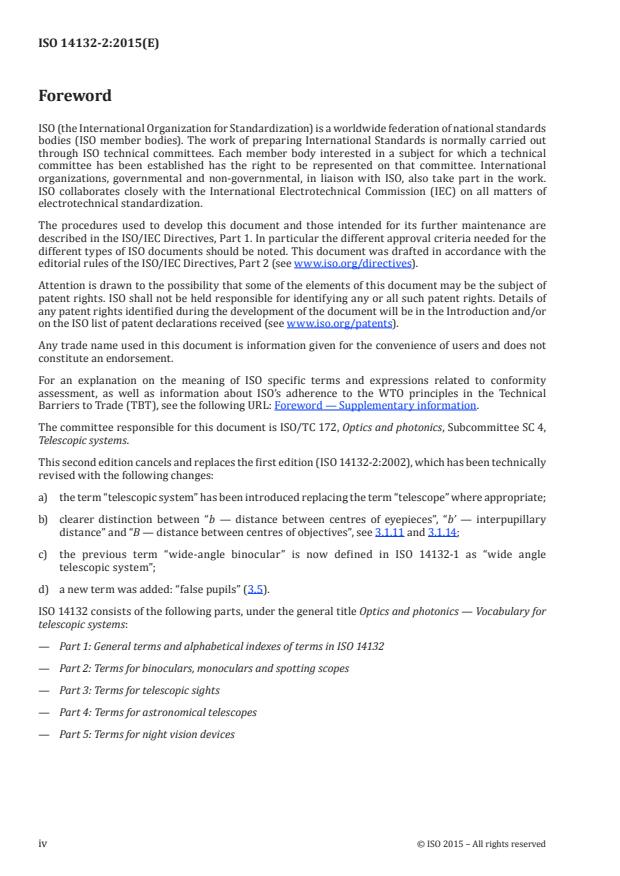
This second edition cancels and replaces the first edition (ISO 14132‑2:2002), which has been technically
revised with the following changes:
a) the term “telescopic system” has been introduced replacing the term “telescope” where appropriate;
b) clearer distinction between “b — distance between centres of eyepieces”, “b’ — interpupillary
distance” and “B — distance between centres of objectives”, see 3.1.11 and 3.1.14;
c) the previous term “wide‑angle binocular” is now defined in ISO 14132-1 as “wide angle
telescopic system”;
d) a new term was added: “false pupils” (3.5).
ISO 14132 consists of the following parts, under the general title Optics and photonics — Vocabulary for
telescopic systems:
— Part 1: General terms and alphabetical indexes of terms in ISO 14132
— Part 2: Terms for binoculars, monoculars and spotting scopes
— Part 3: Terms for telescopic sights
— Part 4: Terms for astronomical telescopes
— Part 5: Terms for night vision devices
iv © ISO 2015 – All rights reserved
INTERNATIONAL STANDARD ISO 14132-2:2015(E)
Optics and photonics — Vocabulary for telescopic systems —
Part 2:
Terms for binoculars, monoculars and spotting scopes
1 Scope
This part of ISO 14132 gives terms, definitions and letter symbols used in relation with binoculars,
monoculars, and spotting scopes.
The alphabetical index of terms that are common for all published parts of ISO 14132 are published
in ISO 14132-1.
2 Normative references
There are no normative references in this document.
3 Terms and definitions
For the purposes of this document, the following terms and definitions apply.
3.1
binoculars
telescopic observational instrument that contains two telescopic systems and is designed as two
interlinked monocular telescopic systems having parallel optical axes
3.1.1
prism binoculars
binoculars with prism erecting systems
3.1.2
lens binoculars
binoculars with lens erecting systems
Note 1 to entry: Galilean binoculars are types of all‑lens binoculars (no prisms).
3.1.3
variable power binoculars
binoculars that provide a means of changing magnification
Note 1 to e
...
INTERNATIONAL ISO
STANDARD 14132-2
Second edition
2015-11-15
Optics and photonics — Vocabulary
for telescopic systems —
Part 2:
Terms for binoculars, monoculars and
spotting scopes
Optique et photonique — Vocabulaire relatif aux systèmes
télescopiques —
Partie 2: Termes pour jumelles, monoculaires et lunettes
Reference number
©
ISO 2015
© ISO 2015, Published in Switzerland
All rights reserved. Unless otherwise specified, no part of this publication may be reproduced or utilized otherwise in any form
or by any means, electronic or mechanical, including photocopying, or posting on the internet or an intranet, without prior
written permission. Permission can be requested from either ISO at the address below or ISO’s member body in the country of
the requester.
ISO copyright office
Ch. de Blandonnet 8 • CP 401
CH-1214 Vernier, Geneva, Switzerland
Tel. +41 22 749 01 11
Fax +41 22 749 09 47
copyright@iso.org
www.iso.org
ii © ISO 2015 – All rights reserved
Contents Page
Foreword .iv
1 Scope . 1
2 Normative references . 1
3 Terms and definitions . 1
Bibliography . 6
Foreword
ISO (the International Organization for Standardization) is a worldwide federation of national standards
bodies (ISO member bodies). The work of preparing International Standards is normally carried out
through ISO technical committees. Each member body interested in a subject for which a technical
committee has been established has the right to be represented on that committee. International
organizations, governmental and non-governmental, in liaison with ISO, also take part in the work.
ISO collaborates closely with the International Electrotechnical Commission (IEC) on all matters of
electrotechnical standardization.
The procedures used to develop this document and those intended for its further maintenance are
described in the ISO/IEC Directives, Part 1. In particular the different approval criteria needed for the
different types of ISO documents should be noted. This document was drafted in accordance with the
editorial rules of the ISO/IEC Directives, Part 2 (see www.iso.org/directives).
Attention is drawn to the possibility that some of the elements of this document may be the subject of
patent rights. ISO shall not be held responsible for identifying any or all such patent rights. Details of
any patent rights identified during the development of the document will be in the Introduction and/or
on the ISO list of patent declarations received (see www.iso.org/patents).
Any trade name used in this document is information given for the convenience of users and does not
constitute an endorsement.
For an explanation on the meaning of ISO specific terms and expressions related to conformity
assessment, as well as information about ISO’s adherence to the WTO principles in the Technical
Barriers to Trade (TBT), see the following URL: Foreword — Supplementary information.
The committee responsible for this document is ISO/TC 172, Optics and photonics, Subcommittee SC 4,
Telescopic systems.
This second edition cancels and replaces the first edition (ISO 14132‑2:2002), which has been technically
revised with the following changes:
a) the term “telescopic system” has been introduced replacing the term “telescope” where appropriate;
b) clearer distinction between “b — distance between centres of eyepieces”, “b’ — interpupillary
distance” and “B — distance between centres of objectives”, see 3.1.11 and 3.1.14;
c) the previous term “wide‑angle binocular” is now defined in ISO 14132-1 as “wide angle
telescopic system”;
d) a new term was added: “false pupils” (3.5).
ISO 14132 consists of the following parts, under the general title Optics and photonics — Vocabulary for
telescopic systems:
— Part 1: General terms and alphabetical indexes of terms in ISO 14132
— Part 2: Terms for binoculars, monoculars and spotting scopes
— Part 3: Terms for telescopic sights
— Part 4: Terms for astronomical telescopes
— Part 5: Terms for night vision devices
iv © ISO 2015 – All rights reserved
INTERNATIONAL STANDARD ISO 14132-2:2015(E)
Optics and photonics — Vocabulary for telescopic systems —
Part 2:
Terms for binoculars, monoculars and spotting scopes
1 Scope
This part of ISO 14132 gives terms, definitions and letter symbols used in relation with binoculars,
monoculars, and spotting scopes.
The alphabetical index of terms that are common for all published parts of ISO 14132 are published
in ISO 14132-1.
2 Normative references
There are no normative references in this document.
3 Terms and definitions
For the purposes of this document, the following terms and definitions apply.
3.1
binoculars
telescopic observational instrument that contains two telescopic systems and is designed as two
interlinked monocular telescopic systems having parallel optical axes
3.1.1
prism binoculars
binoculars with prism erecting systems
3.1.2
lens binoculars
binoculars with lens erecting systems
Note 1 to entry: Galilean binoculars are types of all‑lens binoculars (no prisms).
3.1.3
variable power binoculars
binoculars that provide a means of changing magnification
Note 1 to e
...