

ISO 22968:2010
(Main)Forced draught oil burners
General Information
- Abstract
ISO 22968:2010 specifies the terminology, test procedures and general requirements for the construction and operation of automatic forced draught oil burners supplied with a fuel having a viscosity at the burner inlet of 1,6 mm2/s (cSt) to 6 mm2/s (cSt) at 20 °C or higher, boiling petroleum in accordance with ISO 8217-based first raffinates, and the provision of related control and safety devices. It is applicable to automatic oil burners fitted with a combustion air fan, equipped as described therein, and intended for use in appliances of different types and operated with fuel oils, single burners with a single combustion chamber, single‑fuel and dual‑fuel burners when operating only on oil, and the oil function of dual-fuel burners designed for simultaneous operation on gaseous and liquid fuels (for the former operation, see also ISO 22967). It is not applicable to burners used in direct fired processes either with defined combustion chamber applications or where the combustion chamber wall surface temperature is greater than 750 °C or the heat transfer medium temperature is greater than 500 °C.
- Status
- Published
- Publication Date
- 18-Oct-2010
- Technical Committee
- ISO/TC 109 - Oil and gas burners
- Drafting Committee
- ISO/TC 109/WG 2 - Forced draught oil burners
- Current Stage
- 9093 - International Standard confirmed
Overview
ISO 22968:2010 - Forced draught oil burners - defines terminology, test procedures and general requirements for automatic forced draught oil burners fitted with a combustion air fan. The standard covers burners designed to operate on liquid fuels with a viscosity at the burner inlet of 1.6 mm2/s (cSt) to 6 mm2/s (cSt) at 20 °C or higher, and fuels conforming to ISO 8217-based first raffinates. It specifies construction, operation, control and safety device requirements, and excludes direct-fired processes with very high combustion-chamber or heat-transfer temperatures.
Key topics and technical requirements
ISO 22968:2010 organizes requirements and test methods around practical burner performance and safety:
- Terminology and definitions for burners, combustion chambers, burner heads, mass flow rate, calorific value and more.
- Classification by atomization type, control method (single/dual fuel) and ignition means.
- Constructional and operational requirements covering mechanical design, air/fuel mixing, combustion quality and operational safety.
- Safety and control devices - requirements for flame monitoring, automatic ignition, shut-off devices and sequencing times.
- Combustion and emissions - combustion product quality, excess air ratio and measurement methods (including smoke number and FID for unburnt hydrocarbons).
- Test methods and test rig specifications - ambient conditions, combustion chambers, measuring equipment and accuracies, test programmes and electrical safety.
- Conformity evaluation, marking, labelling and documentation - data plate content, instructions for installation, commissioning and maintenance.
- Regional annexes with country-specific requirements (Europe, USA, Japan, Korea, Australia).
Applications and who uses it
ISO 22968:2010 is intended for:
- Manufacturer and design engineers developing automatic forced draught oil burners and burner heads.
- Test laboratories and certification bodies performing type tests, emission measurements and conformity evaluation.
- Appliance manufacturers and system integrators who fit burners into boilers, heat generators and other appliances.
- Service, installation and commissioning teams using the standard’s requirements for safe installation, adjustment and maintenance.
- Regulatory and compliance professionals ensuring burners meet international safety and performance expectations.
Related standards
Relevant references and related standards frequently used with ISO 22968:2010:
- ISO 8217 (marine fuel specifications)
- ISO 22967 (forced draught gas burners)
- ISO 23550 / 23552 / 23553 (safety and control devices)
- IEC/IEC-based standards for electrical safety and control systems (IEC 60204-1, IEC 60730-2-5, IEC 60335 series)
Using ISO 22968:2010 helps ensure reliable burner performance, repeatable test results and compliance with international safety, emission and operational best practices for forced draught oil burners.
Relations
- Effective Date
- 10-Feb-2026
- Consolidated By
ISO 3266:2010/Amd 1:2015 - Forged steel eyebolts grade 4 for general lifting purposes — Amendment 1 - Effective Date
- 06-Jun-2022
Get Certified
Connect with accredited certification bodies for this standard

DNV
DNV is an independent assurance and risk management provider.

Lloyd's Register
Lloyd's Register is a global professional services organisation specialising in engineering and technology.
DNV Energy Systems
Energy and renewable energy certification.
Sponsored listings
Frequently Asked Questions
ISO 22968:2010 is a standard published by the International Organization for Standardization (ISO). Its full title is "Forced draught oil burners". This standard covers: ISO 22968:2010 specifies the terminology, test procedures and general requirements for the construction and operation of automatic forced draught oil burners supplied with a fuel having a viscosity at the burner inlet of 1,6 mm2/s (cSt) to 6 mm2/s (cSt) at 20 °C or higher, boiling petroleum in accordance with ISO 8217-based first raffinates, and the provision of related control and safety devices. It is applicable to automatic oil burners fitted with a combustion air fan, equipped as described therein, and intended for use in appliances of different types and operated with fuel oils, single burners with a single combustion chamber, single‑fuel and dual‑fuel burners when operating only on oil, and the oil function of dual-fuel burners designed for simultaneous operation on gaseous and liquid fuels (for the former operation, see also ISO 22967). It is not applicable to burners used in direct fired processes either with defined combustion chamber applications or where the combustion chamber wall surface temperature is greater than 750 °C or the heat transfer medium temperature is greater than 500 °C.
ISO 22968:2010 specifies the terminology, test procedures and general requirements for the construction and operation of automatic forced draught oil burners supplied with a fuel having a viscosity at the burner inlet of 1,6 mm2/s (cSt) to 6 mm2/s (cSt) at 20 °C or higher, boiling petroleum in accordance with ISO 8217-based first raffinates, and the provision of related control and safety devices. It is applicable to automatic oil burners fitted with a combustion air fan, equipped as described therein, and intended for use in appliances of different types and operated with fuel oils, single burners with a single combustion chamber, single‑fuel and dual‑fuel burners when operating only on oil, and the oil function of dual-fuel burners designed for simultaneous operation on gaseous and liquid fuels (for the former operation, see also ISO 22967). It is not applicable to burners used in direct fired processes either with defined combustion chamber applications or where the combustion chamber wall surface temperature is greater than 750 °C or the heat transfer medium temperature is greater than 500 °C.
ISO 22968:2010 is classified under the following ICS (International Classification for Standards) categories: 27.060.10 - Liquid and solid fuel burners. The ICS classification helps identify the subject area and facilitates finding related standards.
ISO 22968:2010 has the following relationships with other standards: It is inter standard links to EN IEC 62885-5:2018, ISO 3266:2010/Amd 1:2015. Understanding these relationships helps ensure you are using the most current and applicable version of the standard.
ISO 22968:2010 is available in PDF format for immediate download after purchase. The document can be added to your cart and obtained through the secure checkout process. Digital delivery ensures instant access to the complete standard document.
Standards Content (Sample)
INTERNATIONAL ISO
STANDARD 22968
First edition
2010-11-01
Forced draught oil burners
Brûleurs à air soufflé pour combustibles liquides
Reference number
©
ISO 2010
PDF disclaimer
This PDF file may contain embedded typefaces. In accordance with Adobe's licensing policy, this file may be printed or viewed but
shall not be edited unless the typefaces which are embedded are licensed to and installed on the computer performing the editing. In
downloading this file, parties accept therein the responsibility of not infringing Adobe's licensing policy. The ISO Central Secretariat
accepts no liability in this area.
Adobe is a trademark of Adobe Systems Incorporated.
Details of the software products used to create this PDF file can be found in the General Info relative to the file; the PDF-creation
parameters were optimized for printing. Every care has been taken to ensure that the file is suitable for use by ISO member bodies. In
the unlikely event that a problem relating to it is found, please inform the Central Secretariat at the address given below.
© ISO 2010
All rights reserved. Unless otherwise specified, no part of this publication may be reproduced or utilized in any form or by any means,
electronic or mechanical, including photocopying and microfilm, without permission in writing from either ISO at the address below or
ISO's member body in the country of the requester.
ISO copyright office
Case postale 56 • CH-1211 Geneva 20
Tel. + 41 22 749 01 11
Fax + 41 22 749 09 47
E-mail copyright@iso.org
Web www.iso.org
Published in Switzerland
ii © ISO 2010 – All rights reserved
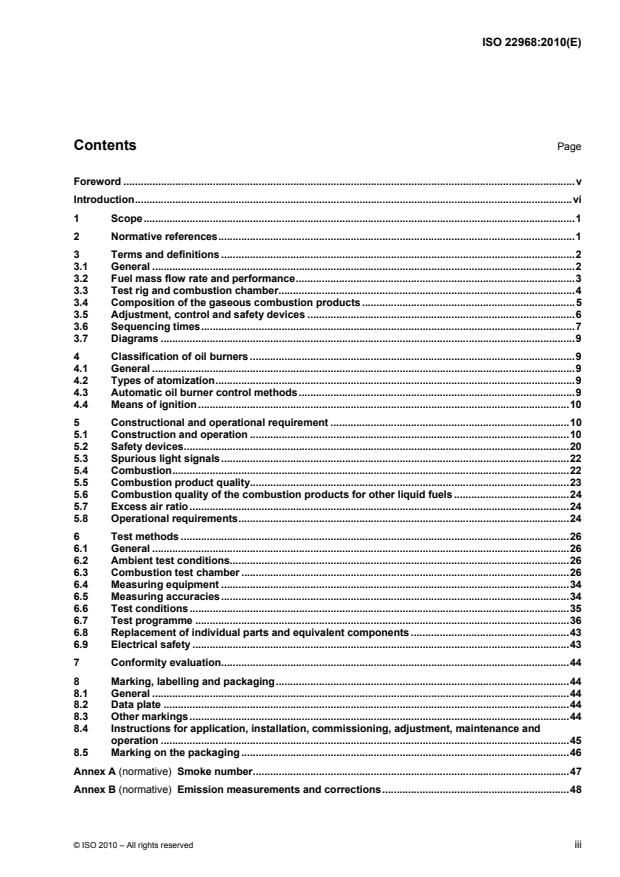
Contents Page
Foreword .v
Introduction.vi
1 Scope.1
2 Normative references.1
3 Terms and definitions .2
3.1 General .2
3.2 Fuel mass flow rate and performance.3
3.3 Test rig and combustion chamber.4
3.4 Composition of the gaseous combustion products .5
3.5 Adjustment, control and safety devices .6
3.6 Sequencing times.7
3.7 Diagrams .9
4 Classification of oil burners .9
4.1 General .9
4.2 Types of atomization.9
4.3 Automatic oil burner control methods.9
4.4 Means of ignition.10
5 Constructional and operational requirement .10
5.1 Construction and operation .10
5.2 Safety devices.20
5.3 Spurious light signals.22
5.4 Combustion.22
5.5 Combustion product quality.23
5.6 Combustion quality of the combustion products for other liquid fuels .24
5.7 Excess air ratio.24
5.8 Operational requirements.24
6 Test methods .26
6.1 General .26
6.2 Ambient test conditions.26
6.3 Combustion test chamber .26
6.4 Measuring equipment .34
6.5 Measuring accuracies.34
6.6 Test conditions .35
6.7 Test programme .36
6.8 Replacement of individual parts and equivalent components .43
6.9 Electrical safety .43
7 Conformity evaluation.44
8 Marking, labelling and packaging.44
8.1 General .44
8.2 Data plate .44
8.3 Other markings .44
8.4 Instructions for application, installation, commissioning, adjustment, maintenance and
operation .45
8.5 Marking on the packaging .46
Annex A (normative) Smoke number.47
Annex B (normative) Emission measurements and corrections.48
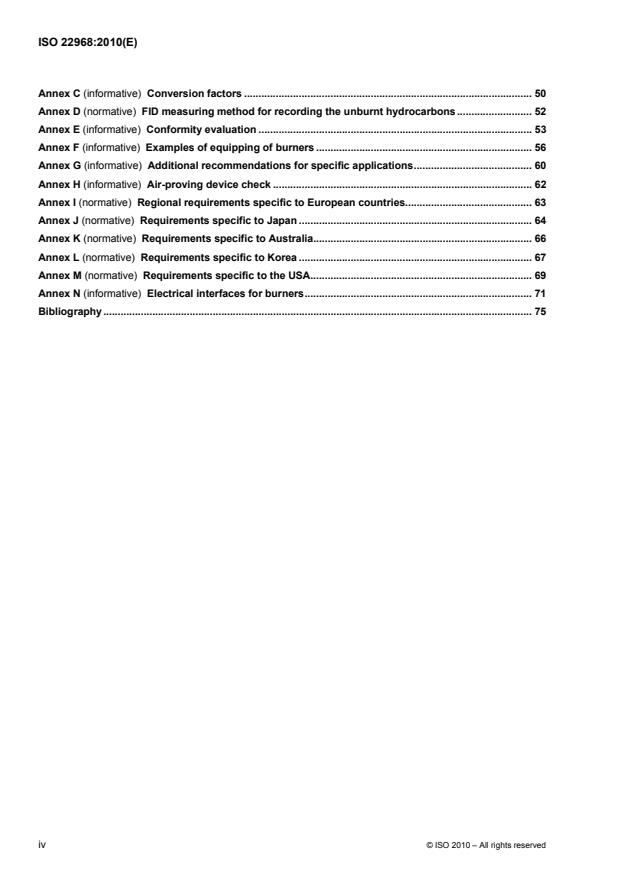
Annex C (informative) Conversion factors . 50
Annex D (normative) FID measuring method for recording the unburnt hydrocarbons. 52
Annex E (informative) Conformity evaluation . 53
Annex F (informative) Examples of equipping of burners . 56
Annex G (informative) Additional recommendations for specific applications. 60
Annex H (informative) Air-proving device check . 62
Annex I (normative) Regional requirements specific to European countries. 63
Annex J (normative) Requirements specific to Japan . 64
Annex K (normative) Requirements specific to Australia. 66
Annex L (normative) Requirements specific to Korea . 67
Annex M (normative) Requirements specific to the USA. 69
Annex N (informative) Electrical interfaces for burners. 71
Bibliography. 75
iv © ISO 2010 – All rights reserved
Foreword
ISO (the International Organization for Standardization) is a worldwide federation of national standards bodies
(ISO member bodies). The work of preparing International Standards is normally carried out through ISO
technical committees. Each member body interested in a subject for which a technical committee has been
established has the right to be represented on that committee. International organizations, governmental and
non-governmental, in liaison with ISO, also take part in the work. ISO collaborates closely with the
International Electrotechnical Commission (IEC) on all matters of electrotechnical standardization.
International Standards are drafted in accordance with the rules given in the ISO/IEC Directives, Part 2.
The main task of technical committees is to prepare International Standards. Draft International Standards
adopted by the technical committees are circulated to the member bodies for voting. Publication as an
International Standard requires approval by at least 75 % of the member bodies casting a vote.
Attention is drawn to the possibility that some of the elements of this document may be the subject of patent
rights. ISO shall not be held responsible for identifying any or all such patent rights.
ISO 22968 was prepared by Technical Committee ISO/TC 109, Oil and gas burners.
Introduction
This International Standard is primarily intended for application to automatic forced draught oil burners having
a combustion air fan, operated with liquid fuels and intended to be marketed as a complete assembly.
Many burners are designed to operate using a wide range of fuel oils with little or no modification other than
adjustment of the air supply.
When applying the requirements specific to a country or region, which are given in the various annexes, it is
essential that a level of safety be ensured that is at least equivalent to that provided for by the requirements of
the main body of this International Standard.
vi © ISO 2010 – All rights reserved
INTERNATIONAL STANDARD ISO 22968:2010(E)
Forced draught oil burners
1 Scope
This International Standard specifies the terminology, test procedures and general requirements for the
construction and operation of automatic forced draught oil burners supplied with a fuel having a viscosity at
2 2
the burner inlet of 1,6 mm /s (cSt) to 6 mm /s (cSt) at 20 °C or higher, boiling petroleum in accordance with
ISO 8217-based first raffinates, and the provision of related control and safety devices.
It is applicable to the following:
a) automatic oil burners (hereinafter called “burners”) fitted with a combustion air fan and equipped as
described in Clause 5, intended for use in appliances of different types and operated with fuel oils;
b) single burners with a single combustion chamber, for which, where such burners are fitted to a single
appliance, the requirements of the relevant appliance standard also apply;
c) single-fuel and dual-fuel burners when operating only on oil;
d) the oil function of dual-fuel burners designed to operate simultaneously on gaseous and liquid fuels,
which, for the former, the requirements of ISO 22967 also apply.
It is not applicable to burners used in direct fired processes either with defined combustion chamber
applications or where the combustion chamber wall surface temperature is greater than 750 °C or the
heat-transfer medium temperature is greater than 500 °C.
2 Normative references
The following referenced documents are indispensable for the application of this document. For dated
references only the edition cited applies. For undated references the latest edition of the referenced document
(including any amendments) applies.
ISO 7-1, Pipe threads where pressure-tight joints are made on the threads — Part 1: Dimensions, tolerances
and designation
ISO 228-1, Pipe threads where pressure-tight joints are not made on the threads — Part 1: Dimensions,
tolerances and designation
ISO 1129, Steel tubes for boilers, superheaters and heat exchangers — Dimensions, tolerances and
conventional masses per unit length
ISO 3183, Petroleum and natural gas industries — Steel pipe for pipeline transportation systems
ISO 6806, Rubber hoses and hose assemblies for use in oil burners — Specification
ISO 7005 (all parts), Pipe flanges
ISO 8217, Petroleum products — Fuels (class F) — Specifications of marine fuels
ISO 9329-1, Seamless steel tubes for pressure purposes — Technical delivery conditions — Part 1: Unalloyed
steels with specified room temperature properties
ISO 9330-1, Welded steel tubes for pressure purposes — Technical delivery conditions — Part 1: Unalloyed
steel tubes with specified room temperature properties
ISO/IEC 17025, General requirements for the competence of testing and calibration laboratories
ISO 22967, Forced draught gas burners
ISO 23550, Safety and control devices for gas burners and gas-burning appliances — General requirements
ISO 23552-1, Safety and control devices for gas and/or oil burners and gas and/or oil appliances — Particular
requirements — Part 1: Fuel/air ratio controls, electronic type
ISO 23553-1, Safety and control devices for oil burners and oil-burning appliances — Particular
requirements — Part 1: Shut-off devices for oil burners
IEC 60204-1, Safety of machinery — Electrical equipment of machines — Part 1: General requirements
IEC 60335-1:2001, Household and similar electrical appliances — Safety — Part 1: General requirements, as
amended 2004 and 2006
IEC 60335-2-102:2004, Household and similar electrical appliances — Safety — Part 2-102: Particular
requirements for gas, oil and solid-fuel burning appliances having electrical connections
IEC 60529, Degrees of protection provided by enclosures (IP code)
IEC 60730-2-5:2004, Automatic electrical controls for household and similar use — Part 2-5: Particular
requirements for automatic electrical burner control systems
IEC 60747-5-2, Discrete semiconductor devices and integrated circuits — Part 5-2: Optoelectronic devices —
Essential ratings and characteristics
IEC 60947-5-1, Low-voltage switchgear and controlgear — Part 5-1: Control circuit devices and switching
elements — Electromechanical control circuit devices
IEC 61810-1, Electromechanical elementary relays — Part 1: General requirements
3 Terms and definitions
For the purposes of this document, the following terms and definitions apply.
3.1 General
3.1.1
forced draught burner
burner in which the total air for combustion is supplied by means of a fan
3.1.2
automatic forced draught burner
burner that is fitted with an automatic ignition, flame monitoring and burner control devices where the ignition,
flame monitoring and the on/off switching of the burner occur automatically
NOTE The heat input of the burner can be adjusted during operation either automatically or manually.
2 © ISO 2010 – All rights reserved
3.1.3
dual-fuel burner
burner in which both gaseous and liquid fuels can be burnt either simultaneously or in succession
3.1.4
combustion chamber
part of the appliance in which the combustion takes place
3.1.5
burner head
device for mixing fuel and air comprising, for example, a stabilizing disc and nozzle, that keeps the flame in its
safe position during operation of the burner
3.1.6
heat-transfer medium
gaseous or liquid substance for the transport of heat energy from the appliance
3.1.7
appliance
heat generator into which the burner fires having a combustion chamber and heat exchanger used to indirectly
transmit the heat input from the burner combustion gases to the heat-transfer medium
3.2 Fuel mass flow rate and performance
3.2.1
mass flow rate
q
m
mass of oil consumed by the burner in unit time during continuous operation
NOTE It is expressed in kilograms per hour (kg/h) or grams per hour (g/h).
3.2.2
maximum mass flow rate
mass of fuel consumed during one hour at the highest mass flow rate stated by the manufacturer
NOTE It is expressed in kilograms per hour (kg/h).
3.2.3
minimum mass flow rate
mass of fuel consumed during one hour at the lowest mass flow rate stated by the manufacturer
NOTE It is expressed in kilograms per hour (kg/h).
3.2.4
calorific value
quantity of heat produced by the combustion, at a constant pressure equal to 0,101 325 MPa, of unit volume
or mass of fuel oil, the constituents of the combustible mixture being taken at reference conditions and the
products of combustion being brought back to the same conditions
NOTE 1 A distinction is made between
a) the superior calorific value (H ) in which the water produced by combustion is assumed to be condensed, and
s
b) the inferior calorific value (H ) in which the water produced by combustion is assumed to be in the vapour state.
i
NOTE 2 It is expressed in megajoules per kilogram (MJ/kg).
NOTE 3 See ISO 14532.
3.2.5
heat input
Q
F
amount of heat as a function of time released by the burner at a given mass flow rate
NOTE It is expressed in kilowatts (kW) and calculated as the oil flow rate x lower calorific value (q H ) of the fuel.
Vo i
3.2.6
maximum heat input
Q
Fmax
maximum heat input of the burner as stated by the manufacturer
NOTE It is expressed in kilowatts (kW).
3.2.7
minimum heat input
Q
Fmin
minimum heat input of the burner as stated by the manufacturer
NOTE It is expressed in kilowatts (kW).
3.2.8
start heat input
Q
s
maximum heat input at the start of ignition as a percentage of heat input (Q )
F
3.2.9
nominal heat input
Q
FN
value of the heat input declared by the manufacturer
NOTE 1 It is expressed in kilowatts (kW).
NOTE 2 Fixed heat input or range-rated burners have a single nominal heat input. Range-rated burners can be
adjusted between the maximum nominal heat input and the minimum nominal heat input declared by the manufacturer.
3.2.10
heat load rate
ratio between heat input (Q ) and volume or cross-sectional area of the combustion chamber
F
3 2
NOTE It may be expressed in kilowatt hours per cubic metre (kWh/m ) or per square metre (kWh/m ).
3.2.11
turndown rate
ratio between maximum heat input (Q ) and minimum heat input (Q )
Fmax Fmin
3.3 Test rig and combustion chamber
3.3.1
combustion chamber pressure
p
F
effective positive pressure or negative pressure relative to the atmospheric pressure prevailing in the
combustion chamber
NOTE Combustion chamber pressure is measured in kilopascals (kPa).
4 © ISO 2010 – All rights reserved
3.3.2
length of the combustion chamber
l
distance between the face of the nozzle or the fuel outlet and the rear wall of the test flame tube or
combustion chamber or any lateral contraction
NOTE The length of the combustion chamber is measured in metres (m).
3.3.3
diameter of the combustion chamber
d
inner diameter of the combustion chamber around the flame tube of the burner
NOTE The diameter of the combustion chamber is measured in metres (m).
3.3.4
burner flame tube
device which hosts the mixing device and the root of the flame
3.3.5
test flame tube
cylindrical part of the test rig where the combustion takes place
3.4 Composition of the gaseous combustion products
3.4.1
content of carbon dioxide
CO
ratio of the volume of carbon dioxide to the total volume of dry gaseous products in which it is present
NOTE The carbon dioxide content is expressed as a percentage volume fraction.
3.4.2
content of oxygen
O
ratio of the volume of oxygen to the total volume of dry gaseous products in which it is present
NOTE The oxygen content is expressed as a percentage volume fraction.
3.4.3
content of carbon monoxide
CO
ratio of the volume of carbon monoxide to the total volume of dry gaseous products in which it is present
NOTE The carbon monoxide content is expressed as a volume fraction, in units of millilitres per cubic metre (ml/m )
for measuring purposes and in milligrams per kilowatt hour (mg/kWh) related to inferior calorific value (H) for calculation
i
purposes and declaring values.
3.4.4
content of nitrogen oxides
NO
x
ratio of the combined volume of nitrogen oxides to the total volume of dry gaseous products in which they are
present
NOTE The nitrogen oxides content is expressed as a volume fraction, in units of millilitres per cubic metre (ml/m ) for
measuring purposes and in milligrams per kilowatt hour (mg/kWh) related to inferior calorific value (H) for calculation
i
purposes and declaring values.
3.4.5
content of unburnt hydrocarbons
ratio of the volume of unburnt hydrocarbons to the total volume of dry gaseous products in which they are
present
NOTE It is expressed in millilitres per cubic metre (ml/m ), calculated as C H .
3 8
3.4.6
smoke number
sample reference whose shade is closest to that of the test mark
NOTE See Annex A.
3.4.7
excess air ratio
λ
ratio between the effectively introduced quantity of air and the theoretically required quantity of air
3.5 Adjustment, control and safety devices
3.5.1
flame detector device
device by which the presence of a flame is detected and signalled
NOTE It can consist of a flame sensor, an amplifier and an element for signal transmission. These parts, with the
possible exception of the actual flame sensor, may be assembled in a single housing for use in conjunction with a
programming unit.
3.5.2
automatic burner control system
system comprising at least a programming unit and all the elements of a flame detector device
NOTE The various functions of an automatic burner control system may be in one or more housings.
3.5.3
programming unit
unit that reacts to signals from control and safety devices, gives control commands, controls the start-up
sequence, supervises the burner operation and causes controlled shut-down and, if necessary, safety
shut-down and non-volatile lock-out
NOTE The programming unit follows a predetermined sequence of actions and always operates in conjunction with a
flame detector device.
3.5.4
safe start check
procedure employing a protection circuit or circuits to establish whether or not a fault in a safety system or
flame simulating condition exists prior to start-up
3.5.5
controlled shut-down
process by which the power to the fuel shut-off valve(s) is immediately removed before any other action takes
place (e.g. as a result of activating a controlling function)
3.5.6
safety shut-down
process that is effected immediately following the response of a safety limiter or the detection of a fault in the
automatic burner control system and which puts the burner out of operation by immediately removing the
power to the fuel shut-off valve(s) and the ignition device
NOTE Safety shut-down can also occur as a result of an interruption/decrease of the power supply.
6 © ISO 2010 – All rights reserved
3.5.7
non-volatile lock-out
safety shut-down condition of the system, such that a restart can only be accomplished by a manual reset of
the system and by no other means
3.5.8
safety shut-off device
device that opens and that is held open by auxiliary energy and that closes by interruption or failure of the
auxiliary energy that automatically cuts off the fuel supply
3.5.9
reignition
operation by which the fuel is reignited after the extinction of the flame during operation without the fuel supply
being interrupted
3.5.10
recycling
process by which, after a safety shut-down, a full start-up sequence is automatically repeated
3.5.11
pressure switch
switch that compares the actual value of a pressure with the desired value, gives a signal when the actual
value exceeds or drops below the desired value and initiates the shut-off sequence
3.5.12
ignition device
any means used to ignite the fuel at the ignition burner or at the main burner
EXAMPLE Flame, electrical ignition.
3.5.13
pressure monitoring device
device which monitors the actual value of a pressure and compares with the desired value, giving a signal
when the actual value deviates from the desired value by a predetermined amount
3.5.14
output regulator
component on the burner intended to be used for adjusting the heat input, within a range of heat inputs stated
by the manufacturer, to suit actual heat requirements of the installation
NOTE This adjustment may be progressive or in discrete steps.
3.6 Sequencing times
3.6.1
total ignition time
period during which the ignition device is in operation
NOTE 1 Pre-ignition, ignition and post-ignition times make up the total ignition time.
NOTE 2 It is expressed in seconds (s).
3.6.2
pre-ignition time
period between the start of the ignition cycle and the release of the fuel
NOTE It is expressed in seconds (s).
3.6.3
ignition time
period between the release of the fuel and the first indication of the flame by the flame detector device
NOTE It is expressed in seconds (s).
3.6.4
post-ignition time
period between the first indication of the flame by the flame detector device and the ignition device shut-off
NOTE It is expressed in seconds (s).
3.6.5
safety time
t
s
duration of the maximum permissible time during which the burner control unit allows the fuel to be released
without there being a flame
NOTE It is expressed in seconds (s).
3.6.6
ignition safety time
period starting from the signal for release of the fuel and terminating at the moment at which the signal for
interrupting the fuel supply is given
NOTE It is expressed in seconds (s).
3.6.7
flame extinction safety time
period that starts with the signal that the flame has been extinguished and ends with the signal to de-energize
the safety shut-off valve of the oil supply
NOTE It is expressed in seconds (s).
3.6.8
purge time
period during which the combustion chamber is compulsorily ventilated without any fuel being supplied
NOTE It is expressed in seconds (s).
3.6.9
pre-purge time
period during which purging takes place at the proven air rate prior to energizing of the safety shut-off device
NOTE It is expressed in seconds (s).
3.6.10
post-purge time
period between any shut-down and the moment the fan is switched off
NOTE It is expressed in seconds (s).
3.6.11
flame simulation
signal indicating the existence of a flame when no flame is actually present
3.6.12
operational state
state commencing with the presence of a flame after the permissible ignition safety time has expired
NOTE It is the end of the starting process. Starting can, however, be considered not to have taken place if the fuel
release is not authorized or if it is interrupted after expiry of the safety time by the lock-out of the burner control unit.
8 © ISO 2010 – All rights reserved
3.6.13
intermittent operation
state of operation whose duration does not exceed 24 h
3.6.14
continuous operation
state of operation whose duration exceeds 24 h
3.7 Diagrams
3.7.1
working diagram
admissible range of application of the burner (pressure in the combustion chamber as a function of fuel flow)
3.7.2
test diagram
test range of the burner during the tests (pressure in the combustion chamber as a function of fuel flow)
4 Classification of oil burners
4.1 General
Oil burners are classified according to their
⎯ type of atomization,
⎯ method of control, and
⎯ means of ignition.
4.2 Types of atomization
4.2.1 Mechanical atomization by pressurization of the combustion liquid
Atomization of the fuel is obtained by means of an atomizing nozzle, through pressure release.
4.2.2 Atomization by auxiliary fluid
Atomization is obtained by the fuel flow meeting a flow of air, steam, other gas or any other fluid.
This type of burner particularly includes
⎯ emulsion burners, in which there is prior mixing of the fuel with the atomizing fluid, and
⎯ rotary cup burners, in which atomization of the fuel is obtained when the fuel leaves the edge of a rotating
cup and meets an auxiliary fluid.
Burners having other means of atomization are allowed if they comply with all other requirements and test
conditions of this International Standard.
4.3 Automatic oil burner control methods
4.3.1 On-off control (single-stage burner)
This controls whether the oil burner is either in operation at constant mass flow rate or is switched off.
4.3.2 Multi-stage control (two- and multi-stage burner)
This type of control provides several firing stages (steps) for operation. Oil burners with only two firing rates
are included in this category.
4.3.3 Modulating control (modulating burner)
This type of control provides infinite variation of the mass flow rate between the lower and the upper limits.
4.4 Means of ignition
4.4.1 Automatic electric ignition
4.4.1.1 General
These are systems in which the ignition of the fuel is brought about by means of electrical energy.
4.4.1.2 Ignition by controlled spark
In this system, fuel is released when the presence of the ignition spark has been proven.
4.4.1.3 Ignition by non-controlled spark
In this system, fuel may be released when the ignition spark is not controlled.
4.4.2 Automatic ignition with liquid or gaseous fuels
4.4.2.1 General
These are systems in which an ignition burner, using a liquid or gaseous fuel, ignites the main fuel. The
operation of the ignition burner may be either permanent or intermittent. Permanent ignition burners may be
started manually, whereas intermittent ignition burners start automatically.
4.4.2.2 Ignition by controlled ignition burner
In this system, the main fuel supply may only be released when the controlled flame of the ignition burner has
been proven.
4.4.2.3 Ignition by non-controlled ignition burner
In this system, the main fuel supply may be released when the ignition burner flame is not controlled.
5 Constructional and operational requirement
5.1 Construction and operation
5.1.1 General design
5.1.1.1 Materials
The quality and thickness of the materials used in the construction of the burner shall be selected so that the
constructional and performance characteristics of the system do not deteriorate during operation. In particular,
all burner components shall withstand the mechanical, chemical and thermal loads that may be encountered
during operation. Under normal conditions of use, maintenance and adjustment, the burner components shall
10 © ISO 2010 – All rights reserved
not show any changes that could affect their normal functioning. The influence of higher heat-transfer media
temperature shall also be considered.
If the burner housing contains any metal parts not made of corrosion-resistant material, these shall be suitably
protected with an effective anti-corrosion coating.
Asbestos or asbestos-containing materials shall not be used.
Solder that has a melting point below 450 °C after application shall not be used for fuel-carrying parts.
The pipework material shall be in accordance with ISO 3183, ISO 9329-1, ISO 9330-1 or ISO 1129, as
applicable.
In Japan and Korea, the specific requirements respectively given in normative Annexes J and L apply.
5.1.1.2 Design
The effective lifetime of a burner is primarily controlled by its operation and maintenance.
The design of the burner shall be based on its intended lifetime as declared by the manufacturer. The
intended lifetime of the equipment into which the burner is to be installed shall also be taken into account.
NOTE 1 The lifetime of components can differ from that of the burner.
The construction and design of the oil burner shall be such that the fuel oil used burns safely over the
specified input range and pressure range specified by the manufacturer and the requirements given in
Clause 6 are met.
NOTE 2 The burner head can be lengthened as long as the performance of the burner is not affected in an unsafe
manner. The geometry of the mixing device and its position in the flame tube can remain unchanged.
Oil burners that can only operate by means of permanent ignition are not permitted.
5.1.1.3 Mounting
The burner shall be designed such that it can be effectively mounted on the appliance.
The burner shall be mounted on the appliance such that no ejection of high temperature gas or flame can
occur, and such that back radiation and high refractory temperatures do not adversely affect the stability and
lifetime of the burner parts inside the combustion chamber.
The burner components shall be arranged and secured such that their correct operating position and — above
all — the correct position of the burner orifices cannot change during operation. The correct operating position
shall be maintained when accessories are removed and refitted.
Parts of the burner that are set or adjusted during manufacture and which are not intended to be manipulated
by the user or installer shall be sealed.
5.1.1.4 Accessibility for maintenance and use
Components requiring regular maintenance shall be so arranged or designed that they are easily detachable.
They shall be designed or marked such that reasonable interpretation of the manufacturer's instructions would
provide for proper reinstallation.
Constructional parts accessible during use and maintenance shall be free from sharp edges and corners that
might cause damage or personal injury. Burners that can be withdrawn or swivelled out of position without the
use of tools shall be interlocked (e.g. by means of limit switches) so that they cannot be operated in the
withdrawn or swivelled position.
The interlock device shall be fail-safe in design and, if a limit switch, shall conform with IEC 60204-1 or
IEC 60947-5-1, depending on the design.
If the burner is installed according to the manufacturer's instructions, the surface temperatures of accessible
burner parts not intended to be touched shall not exceed the ambient temperature by more than 60 K.
If, for technical reasons, these temperature limits cannot be respected, adequate warnings shall be provided.
5.1.2 Equipment
5.1.2.1 Motors, fans and pumps
Guards, grilles and shields shall be used to protect high-temperature or moving parts such that they cannot be
touched accidentally. If this protection is not possible, warning signs shall be used.
Removal of such guards, grilles and shields shall be possible only with the use of tools.
The degree of protection provided shall be at least IP 20, according to IEC 60529.
Belt drives, where used, shall be so designed or positioned as to afford protection to the operator.
Means shall be provided to facilitate adjustment of belt tension. Access to such means shall be possible only
with the use of tools.
Motors, fans and pumps shall be mounted such as to minimize noise and vibration. Lubrication points, if
provided, shall be readily accessible.
5.1.2.2 Electrical safety
5.1.2.2.1 Electrical safety of devices
Controls in accordance with the electrical requirements of IEC 60730-2-5 and ISO 23550 are considered as
fulfilling the electrical requirement of this International Standard, and thus 5.1.2.2.2 is not applicable to such
controls.
5.1.2.2.2 Electrical safety of the burner
5.1.2.2.2.1 General
The leakage current and electrical strength tests of the complete burner need not be performed if the
components and sub-assemblies have been separately tested and the interconnection is carried out in
accordance with the manufacturer's instructions.
If the measurements of the leakage current as required in IEC 60335-1:2001, 13.2 are not possible because
the protective impedance circuits or radio interference filters cannot be disconnected, then the limit specified
for leakage current shall be calculated taking into account the current through those circuits.
The electrical safety of
a) the burner,
b) those of its control devices not in accordance with IEC 60730-2-5 and ISO 23550, and
c) the interface between control devices which do fulfil the requirements of IEC 60730 and ISO 23550
shall be in accordance with IEC 60335-2-102, modified by the additions and replacements given in 5.1.2.2.2.2.
12 © ISO 2010 – All rights reserved
5.1.2.2.2.2 Modifications, additions and replacements
a) Moisture resistance
The requirements of IEC 60335-1:2001, Clause 15, apply.
IEC 60335-2-102:2004, 15.2, does not apply.
b) Leakage current and electric strength
The following replaces IEC 60335-2-102:2004, 16.2:
For oil burners, the limit is 10 mA.
The following replaces IEC 60335-2-102:2004, 16.3:
Compliance of spark ignition circuits shall be checked by inspection. In case of doubt, spark ignition
circuits or crucial parts shall be submitted to an endurance test performed under the following
conditions:
i) the maximum duration of switch-on given by the manufacturer (complete switch-on duration shall
correspond with the realistic time of use);
ii) the relation between on/off cycles as declared by the manufacturer;
iii) the maximum rated voltage;
iv) the maximum ambient temperature of all parts under test.
During this test no breakdown of other circuits or — if the limits specified in IEC 60335-2-102:2004,
8.101, are exceeded — accessible surfaces shall occur. Breakdown of conductive parts which are
connected to earth is allowed if this does not result in a critical failure of a circuit(s) with
safety-related functions.
NOTE In case of doubt, compliance can normally be achieved by increasing the clearance at any part of the
spark ignition circuit likely to cause an unacceptable breakdown.
c) Abnormal operation
In addition to the provisions of IEC 60335-2-102:2004, 19.11.2, the following failure mode applies:
Short-circuit and mechanical break-down of relay contacts in protective electronic circuits: these
failure modes need not be considered if components conform with footnote g) of IEC 60730-2-5:2004,
Table H.27.1.
The following replaces the last paragraph of IEC 60335-1:2001, 19.11.2:
In each case, the test is ended if:
i) for risks of electrical origin, interruption of the supply occurs within the appliance;
ii) for risks concerning the fuel, shut-down occurs.
The following is additional to the provisions of IEC 60335-2-102:2004, 19.11.3:
Tests are not to be repeated for protective electronic circuits conforming with the relevant control
standard according to 5.1.2.2.1.
The following replaces IEC 60335-2-102:2004, 19.13:
During the tests described in 19.11.4, the appliance shall either continue to operate normally or reach
a safe situation for risks concerning the fuel safety shut-down or non-volatile lock-out.
d) Components
The following is additional to IEC 60335-2-102:2004, 24.1.1:
Relays and optocouplers which ensure electrical isolation between live parts and accessible metal
parts shall conform with IEC 61810-1 and IEC 60747-5-2.
e) IEC 60335-2-102:2004, Annex Q
The following is additional to the provisions of the annex:
NOTE Repeat testing of a protective electronic circuit is not required where the system has already been
certified to conform with published International Standards where compliance requires that the fault behaviour of
the fail-safe system is assessed on a second fault analysis basis.
5.1.2.3 Adjustable air damper
Any adjustable air damper or similar device for controlling the airflow shall be adjustable only by means of a
tool. The adjusting positions of the air damper shall be visible (e.g. after removal of a cap).
If the burner is provided with a manual means of adjusting the combustion airflow, this means shall be
designed so that, after adjustment according to the manufacturer's instructions, it is capable of being set and
sealed.
5.1.2.4 Installation of automatic burner control unit
The automatic burner control unit shall be in accordance with IEC 60730-2-5 and, in the installed condition
(e.g. in the burner housing/control panel), shall have at least an IP 40 degree of protection as specified in
IEC 60529.
In Japan and Korea, the specific requirements respectively given in normative Annexes J and L apply.
5.1.2.5 Rubber hoses and hose assemblies
Rubber hoses and hose assemblies that have a corrosion-proof metal braiding and which meet the
requirements of ISO 6806 are permitted.
In Japan and Korea, the specific requirements respectively given in normative Annexes J and L apply.
Rubber hoses and hose assemblies shall withstand the maximum fuel oil temperature.
5.1.2.6 Connections
Inlet connections with pressure-tight joints made on the threads, connections within the burner with
pressure-tight joints made on the threads that are not loosened for maintenance, and connections for parts
that are not frequently dismantled and refitted shall be designed in accordance with ISO 7-1.
Connections which have to be loosened for maintenance purposes shall be designed in accordance with
ISO 228-1. Flange connections shall conform with ISO 7005-1, ISO 7005-2 and ISO 7005-3.
In Japan, Korea and the USA, t
...