


ISO 17842-1:2015
(Main)Safety of amusement rides and amusement devices — Part 1: Design and manufacture
Safety of amusement rides and amusement devices — Part 1: Design and manufacture
ISO 17842-1:2015 specifies the minimum requirements necessary to ensure the safe design, calculation, manufacture, and installation of the following: mobile, temporary or permanently installed machinery and structures, e.g. roundabouts, swings, boats, Ferris wheels, roller coasters, chutes, grandstands, membrane or textile structures, booths, stages, side shows, and structures for artistic aerial displays. These amusement devices are intended to be installed both repeatedly without degradation or loss of integrity, and temporarily or permanently in fairgrounds and amusement parks or any other locations. Fixed grandstands, construction site installations, scaffolding, removable agricultural structures and simple coin operated children's amusement devices intended for up to 3 children are not covered. It can nevertheless be used in the design of any similar structural or passenger-carrying device.
Sécurité des manèges et des dispositifs de divertissement — Partie 1: Conception et fabrication
General Information
- Status
- Withdrawn
- Publication Date
- 23-Jun-2015
- Technical Committee
- ISO/TC 254 - Safety of amusement rides and amusement devices
- Drafting Committee
- ISO/TC 254/WG 2 - Design, manufacture and construction
- Current Stage
- 9599 - Withdrawal of International Standard
- Start Date
- 12-Sep-2023
- Completion Date
- 12-Feb-2026
Relations
- Revised
ISO 17842-1:2023 - Safety of amusement rides and amusement devices — Part 1: Design and manufacture - Effective Date
- 31-Dec-2016

Get Certified
Connect with accredited certification bodies for this standard

NSF International
Global independent organization facilitating standards development and certification.

CIS Institut d.o.o.
Personal Protective Equipment (PPE) certification body. Notified Body NB-2890 for EU Regulation 2016/425 PPE.

Kiwa BDA Testing
Building and construction product certification.
Sponsored listings
Frequently Asked Questions
ISO 17842-1:2015 is a standard published by the International Organization for Standardization (ISO). Its full title is "Safety of amusement rides and amusement devices — Part 1: Design and manufacture". This standard covers: ISO 17842-1:2015 specifies the minimum requirements necessary to ensure the safe design, calculation, manufacture, and installation of the following: mobile, temporary or permanently installed machinery and structures, e.g. roundabouts, swings, boats, Ferris wheels, roller coasters, chutes, grandstands, membrane or textile structures, booths, stages, side shows, and structures for artistic aerial displays. These amusement devices are intended to be installed both repeatedly without degradation or loss of integrity, and temporarily or permanently in fairgrounds and amusement parks or any other locations. Fixed grandstands, construction site installations, scaffolding, removable agricultural structures and simple coin operated children's amusement devices intended for up to 3 children are not covered. It can nevertheless be used in the design of any similar structural or passenger-carrying device.
ISO 17842-1:2015 specifies the minimum requirements necessary to ensure the safe design, calculation, manufacture, and installation of the following: mobile, temporary or permanently installed machinery and structures, e.g. roundabouts, swings, boats, Ferris wheels, roller coasters, chutes, grandstands, membrane or textile structures, booths, stages, side shows, and structures for artistic aerial displays. These amusement devices are intended to be installed both repeatedly without degradation or loss of integrity, and temporarily or permanently in fairgrounds and amusement parks or any other locations. Fixed grandstands, construction site installations, scaffolding, removable agricultural structures and simple coin operated children's amusement devices intended for up to 3 children are not covered. It can nevertheless be used in the design of any similar structural or passenger-carrying device.
ISO 17842-1:2015 is classified under the following ICS (International Classification for Standards) categories: 13.110 - Safety of machinery; 97.200.40 - Playgrounds. The ICS classification helps identify the subject area and facilitates finding related standards.
ISO 17842-1:2015 has the following relationships with other standards: It is inter standard links to ISO 17842-1:2023. Understanding these relationships helps ensure you are using the most current and applicable version of the standard.
ISO 17842-1:2015 is available in PDF format for immediate download after purchase. The document can be added to your cart and obtained through the secure checkout process. Digital delivery ensures instant access to the complete standard document.
Standards Content (Sample)
INTERNATIONAL ISO
STANDARD 17842-1
First edition
2015-07-01
Safety of amusement rides and
amusement devices —
Part 1:
Design and manufacture
Sécurité des manèges et des dispositifs de divertissement —
Partie 1: Conception et fabrication
Reference number
©
ISO 2015
© ISO 2015, Published in Switzerland
All rights reserved. Unless otherwise specified, no part of this publication may be reproduced or utilized otherwise in any form
or by any means, electronic or mechanical, including photocopying, or posting on the internet or an intranet, without prior
written permission. Permission can be requested from either ISO at the address below or ISO’s member body in the country of
the requester.
ISO copyright office
Ch. de Blandonnet 8 • CP 401
CH-1214 Vernier, Geneva, Switzerland
Tel. +41 22 749 01 11
Fax +41 22 749 09 47
copyright@iso.org
www.iso.org
ii © ISO 2015 – All rights reserved
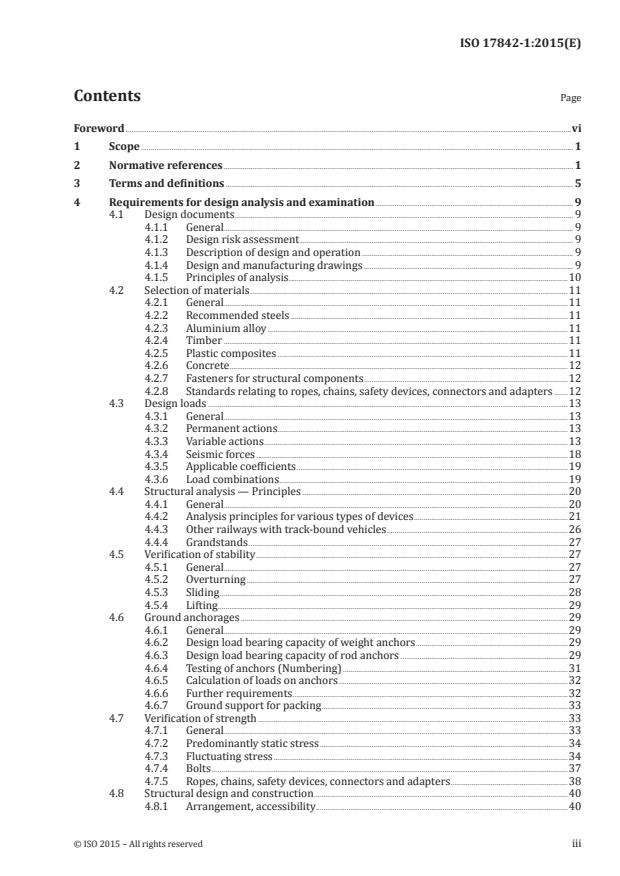
Contents Page
Foreword .vi
1 Scope . 1
2 Normative references . 1
3 Terms and definitions . 5
4 Requirements for design analysis and examination . 9
4.1 Design documents . 9
4.1.1 General. 9
4.1.2 Design risk assessment . 9
4.1.3 Description of design and operation . 9
4.1.4 Design and manufacturing drawings . 9
4.1.5 Principles of analysis .10
4.2 Selection of materials .11
4.2.1 General.11
4.2.2 Recommended steels .11
4.2.3 Aluminium alloy .11
4.2.4 Timber .11
4.2.5 Plastic composites .11
4.2.6 Concrete . .12
4.2.7 Fasteners for structural components .12
4.2.8 Standards relating to ropes, chains, safety devices, connectors and adapters .12
4.3 Design loads .13
4.3.1 General.13
4.3.2 Permanent actions.13
4.3.3 Variable actions .13
4.3.4 Seismic forces .18
4.3.5 Applicable coefficients .19
4.3.6 Load combinations .19
4.4 Structural analysis — Principles .20
4.4.1 General.20
4.4.2 Analysis principles for various types of devices .21
4.4.3 Other railways with track-bound vehicles .26
4.4.4 Grandstands .27
4.5 Verification of stability .27
4.5.1 General.27
4.5.2 Overturning .27
4.5.3 Sliding .28
4.5.4 Lifting . .29
4.6 Ground anchorages .29
4.6.1 General.29
4.6.2 Design load bearing capacity of weight anchors .29
4.6.3 Design load bearing capacity of rod anchors .29
4.6.4 Testing of anchors (Numbering) .31
4.6.5 Calculation of loads on anchors .32
4.6.6 Further requirements .32
4.6.7 Ground support for packing .33
4.7 Verification of strength .33
4.7.1 General.33
4.7.2 Predominantly static stress .34
4.7.3 Fluctuating stress .34
4.7.4 Bolts .37
4.7.5 Ropes, chains, safety devices, connectors and adapters .38
4.8 Structural design and construction .40
4.8.1 Arrangement, accessibility .40
4.8.2 Locking and safety devices for fasteners .40
4.8.3 Joints intended for regular dismantling.41
4.8.4 Designing of components subject to fluctuating loads .41
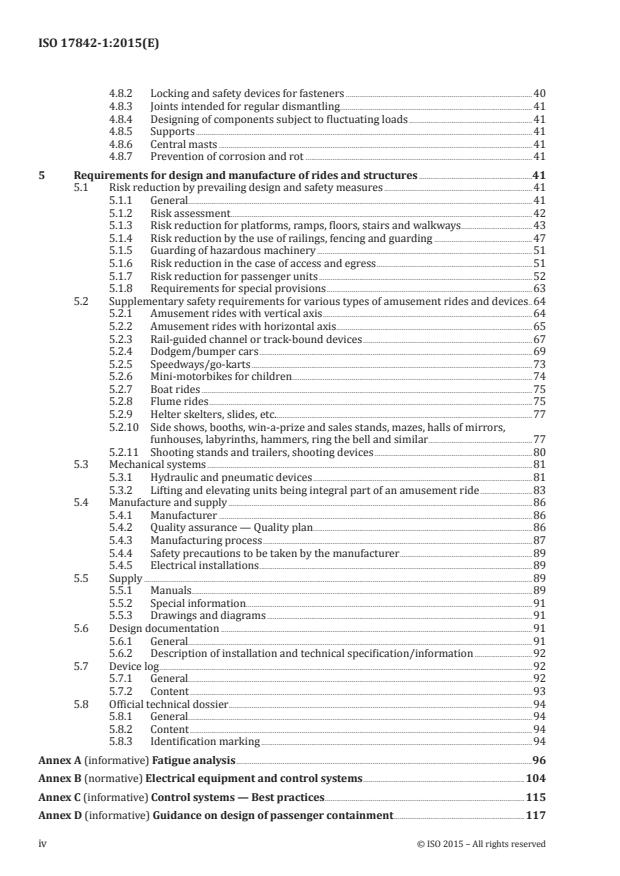
4.8.5 Supports .41
4.8.6 Central masts .41
4.8.7 Prevention of corrosion and rot .41
5 Requirements for design and manufacture of rides and structures .41
5.1 Risk reduction by prevailing design and safety measures .41
5.1.1 General.41
5.1.2 Risk assessment . .42
5.1.3 Risk reduction for platforms, ramps, floors, stairs and walkways .43
5.1.4 Risk reduction by the use of railings, fencing and guarding .47
5.1.5 Guarding of hazardous machinery .51
5.1.6 Risk reduction in the case of access and egress .51
5.1.7 Risk reduction for passenger units .52
5.1.8 Requirements for special provisions .63
5.2 Supplementary safety requirements for various types of amusement rides and devices .64
5.2.1 Amusement rides with vertical axis .64
5.2.2 Amusement rides with horizontal axis.65
5.2.3 Rail-guided channel or track-bound devices .67
5.2.4 Dodgem/bumper cars .69
5.2.5 Speedways/go-karts .73
5.2.6 Mini-motorbikes for children.74
5.2.7 Boat rides .75
5.2.8 Flume rides .75
5.2.9 Helter skelters, slides, etc.77
5.2.10 Side shows, booths, win-a-prize and sales stands, mazes, halls of mirrors,
funhouses, labyrinths, hammers, ring the bell and similar .77
5.2.11 Shooting stands and trailers, shooting devices .80
5.3 Mechanical systems .81
5.3.1 Hydraulic and pneumatic devices .81
5.3.2 Lifting and elevating units being integral part of an amusement ride .83
5.4 Manufacture and supply .86
5.4.1 Manufacturer .86
5.4.2 Quality assurance — Quality plan .86
5.4.3 Manufacturing process .87
5.4.4 Safety precautions to be taken by the manufacturer .89
5.4.5 Electrical installations .89
5.5 Supply .89
5.5.1 Manuals .89
5.5.2 Special information.91
5.5.3 Drawings and diagrams .91
5.6 Design documentation .91
5.6.1 General.91
5.6.2 Description of installation and technical specification/information .92
5.7 Device log .92
5.7.1 General.92
5.7.2 Content .93
5.8 Official technical dossier . .94
5.8.1 General.94
5.8.2 Content .94
5.8.3 Identification marking .94
Annex A (informative) Fatigue analysis .96
Annex B (normative) Electrical equipment and control systems .104
Annex C (informative) Control systems — Best practices.115
Annex D (informative) Guidance on design of passenger containment .117
iv © ISO 2015 – All rights reserved
Annex E (informative) Device log for an amusement device .122
Annex F (informative) List of hazards . 143
Annex G (informative) Guest behaviour . 147
Annex H (informative) Limited accessibility to amusement devices . 152
Annex I (informative) Safety envelope for passengers . 155
Bibliography . 158
Foreword
ISO (the International Organization for Standardization) is a worldwide federation of national standards
bodies (ISO member bodies). The work of preparing International Standards is normally carried out
through ISO technical committees. Each member body interested in a subject for which a technical
committee has been established has the right to be represented on that committee. International
organizations, governmental and non-governmental, in liaison with ISO, also take part in the work.
ISO collaborates closely with the International Electrotechnical Commission (IEC) on all matters of
electrotechnical standardization.
The procedures used to develop this document and those intended for its further maintenance are
described in the ISO/IEC Directives, Part 1. In particular the different approval criteria needed for the
different types of ISO documents should be noted. This document was drafted in accordance with the
editorial rules of the ISO/IEC Directives, Part 2. www.iso.org/directives
Attention is drawn to the possibility that some of the elements of this document may be the subject of
patent rights. ISO shall not be held responsible for identifying any or all such patent rights. Details of any
patent rights identified during the development of the document will be in the Introduction and/or on
the ISO list of patent declarations received. www.iso.org/patents
Any trade name used in this document is information given for the convenience of users and does not
constitute an endorsement.
For an explanation on the meaning of ISO specific terms and expressions related to conformity
assessment, as well as information about ISO’s adherence to the WTO principles in the Technical
Barriers to Trade (TBT) see the following URL: Foreword - Supplementary information
The committee responsible for this document is ISO/TC 254, Safety of amusement rides and amusement
devices.
ISO 17842 consists of the following parts, under the general title Safety of amusement rides and
amusement devices:
— Part 1: Design and manufacture
— Part 2: Operation and use
— Part 3: Requirements for inspection during design, manufacture, operation and use
vi © ISO 2015 – All rights reserved
INTERNATIONAL STANDARD ISO 17842-1:2015(E)
Safety of amusement rides and amusement devices —
Part 1:
Design and manufacture
1 Scope
This part of ISO 17842 specifies the minimum requirements necessary to ensure the safe design,
calculation, manufacture, and installation of the following: mobile, temporary or permanently installed
machinery and structures, e.g. roundabouts, swings, boats, Ferris wheels, roller coasters, chutes,
grandstands, membrane or textile structures, booths, stages, side shows, and structures for artistic
aerial displays. The above items, hereafter called amusement devices or simply “devices”, are intended to
be installed both repeatedly without degradation or loss of integrity, and temporarily or permanently
in fairgrounds and amusement parks or any other locations. Fixed grandstands, construction site
installations, scaffolding, removable agricultural structures and simple coin operated children’s
amusement devices intended for up to 3 children are not covered by this document.
Nevertheless this document can be used in the design of any similar structural or passenger-carrying
device not explicitly mentioned herein.
Existing national rules on workers’ safety are not concerned by this document.
This document is applicable to amusement devices and major modifications of amusement devices and
rides manufactured after the effective date of its publication.
ISO 17842-3 contains requirements for inspection during design, manufacture, operation and use.
2 Normative references
The following documents, in whole or in part, are normatively referenced in this document and are
indispensable for its application. For dated references, only the edition cited applies. For undated
references, the latest edition of the referenced document (including any amendments) applies.
EN 288-9, Specification and approval of welding procedures for metallic materials — Part 9: Welding
procedure test for pipeline welding on land and offshore site butt welding of transmission pipelines
ISO 898-1, Mechanical properties of fasteners made of carbon steel and alloy steel — Part 1: Bolts, screws
and studs with specified property classes — Coarse thread and fine pitch thread
ISO 1141, Fibre ropes — Polyester — 3-, 4-, 8- and 12-strand ropes
ISO 1181, Fibre ropes — Manila and sisal — 3-, 4- and 8-strand ropes
ISO 1346, Fibre ropes — Polypropylene split film, monofilament and multifilament (PP2) and polypropylene
high-tenacity multifilament (PP3) — 3-, 4-, 8- and 12-strand ropes
ISO 2307, Fibre ropes — Determination of certain physical and mechanical properties
ISO 3834-1, Quality requirements for fusion welding of metallic materials — Part 1: Criteria for the selection
of the appropriate level of quality requirements
ISO 3834-3, Quality requirements for fusion welding of metallic materials — Part 3: Standard quality requirements
ISO 4014, Hexagon head bolts — Product grades A and B
ISO 4016, Hexagon head bolts — Product grade C
ISO 4017, Fasteners — Hexagon head screws — Product grades A and B
ISO 4018, Hexagon head screws — Product grade C
ISO 4032, Hexagon regular nuts (style 1) — Product grades A and B
ISO 4034, Hexagon regular nuts (style 1) — Product grade C
ISO 4413, Hydraulic fluid power — General rules and safety requirements for systems and their components
ISO 4414, Pneumatic fluid power — General rules and safety requirements for systems and their components
ISO 5817:2014, Welding — Fusion-welded joints in steel, nickel, titanium and their alloys (beam welding
excluded) — Quality levels for imperfections
ISO 7250 (all parts), Basic human body measurements for technological design
ISO 9554, Fibre ropes — General specifications
ISO 9606-1, Qualification testing of welders — Fusion welding — Part 1: Steels
ISO 9606-2, Qualification test of welders — Fusion welding — Part 2: Aluminium and aluminium alloys
ISO 9692-1, Welding and allied processes — Types of joint preparation — Part 1: Manual metal arc welding,
gas-shielded metal arc welding, gas welding, TIG welding and beam welding of steels
ISO 9692-2, Welding and allied processes — Joint preparation — Part 2: Submerged arc welding of steels
ISO 9712:2012, Non-destructive testing — Qualification and certification of NDT personnel
ISO 10042:2005, Welding — Arc-welded joints in aluminium and its alloys — Quality levels for imperfections.
Corrected by ISO 10042:2005/Cor. 1:2006
ISO 10325, Fibre ropes — High modulus polyethylene — 8-strand braided ropes, 12-strand braided ropes
and covered ropes
ISO 10474:2013, Steel and steel products — Inspection documents
ISO 10547, Polyester fibre ropes — Double braid construction
ISO 10554, Polyamide fibre ropes — Double braid construction
ISO 10556, Fibre ropes of polyester/polyolefin dual fibres
ISO 10572, Mixed polyolefin fibre ropes
ISO 11666, Non-destructive testing of welds — Ultrasonic testing — Acceptance levels
ISO 12100:2010, Safety of machinery — General principles for design — Risk assessment and risk reduction
ISO 13849-1, Safety of machinery — Safety-related parts of control systems — Part 1: General principles
for design
ISO 13849-2, Safety of machinery — Safety-related parts of control systems — Part 2: Validation
ISO 13857:2008, Safety of machinery — Safety distances to prevent hazard zones being reached by upper
and lower limbs
ISO 14118, Safety of machinery — Prevention of unexpected start-up
ISO 14119, Safety of machinery — Interlocking devices associated with guards — Principles for design
and selection
2 © ISO 2015 – All rights reserved
ISO 14120, Safety of machinery — Guards — General requirements for the design and construction of fixed
and movable guards
ISO 14122-1, Safety of machinery — Permanent means of access to machinery — Part 1: Choice of fixed
means of access between two levels
ISO 14731, Welding coordination — Tasks and responsibilities
ISO 14732, Welding personnel — Qualification testing of welding operators and weld setters for mechanized
and automatic welding of metallic materials
ISO 15607, Specification and qualification of welding procedures for metallic materials — General rules
ISO 15609-1, Specification and qualification of welding procedures for metallic materials — Welding
procedure specification — Part 1: Arc welding
ISO 15610, Specification and qualification of welding procedures for metallic materials — Qualification
based on tested welding consumables
ISO 15611, Specification and qualification of welding procedures for metallic materials — Qualification
based on previous welding experience
ISO 15612, Specification and qualification of welding procedures for metallic materials — Qualification by
adoption of a standard welding procedure
ISO 15613, Specification and qualification of welding procedures for metallic materials — Qualification
based on pre-production welding test
ISO 15614-1, Specification and qualification of welding procedures for metallic materials — Welding
procedure test — Part 1: Arc and gas welding of steels and arc welding of nickel and nickel alloys
ISO 15614-2, Specification and qualification of welding procedures for metallic materials — Welding
procedure test — Part 2: Arc welding of aluminium and its alloys
ISO/IEC 17020, Conformity assessment — Requirements for the operation of various types of bodies
performing inspection
ISO/IEC 17025, General requirements for the competence of testing and calibration laboratories
ISO 17635, Non-destructive testing of welds — General rules for metallic materials
ISO 17636-1:2013, Non-destructive testing of welds — Radiographic testing — Part 1: X- and gamma-ray
techniques with film
ISO 17637, Non-destructive testing of welds — Visual testing of fusion-welded joints
ISO 17638, Non-destructive testing of welds — Magnetic particle testing
ISO 17640:2010, Non-destructive testing of welds — Ultrasonic testing — Techniques, testing levels,
and assessment
ISO/TS 17929:2014, Biomechanical effects on amusement ride passengers
ISO 23277, Non-destructive examination of welds — Penetrant testing of welds — Acceptance levels
ISO 23278, Non-destructive examination of welds — Magnetic particle testing of welds — Acceptance levels
ISO 23279, Non-destructive testing of welds — Ultrasonic testing — Characterization of indications in welds
IEC 60204-1:2005, Safety of machinery — Electrical equipment of machines — Part 1: General requirements
IEC 60204-32, Safety of machinery — Electrical equipment of machines — Part 32: Requirements for
hoisting machines
IEC 60364-4-41, Electrical installations of buildings — Part 4-41: Protection for safety —Protection against
electric shock
IEC 60364-5-54, Electrical Installation of buildings — Part 5-54: Selection and erection of electrical
equipment — Chapter 54: Earthing arrangements, protective conductors and protective bonding conductors
IEC 60364-7-740, Electrical Installation of buildings — Part 7-740: Selection and erection of electrical
equipment — Chapter 54: Requirements for special installations or locations Temporary electrical
installations for structures, amusement devices and booths at fairgrounds, amusement parks and circuses
IEC 61558-1, Safety for transformers, power supply units and similar devices
IEC 61800-5-2, Adjustable speed electrical power drive systems — Part 5-2: Safety requirements —Functional
IEC 62061, Safety of machinery — Functional safety of safety-related electrical, electronic and programmable
electronic control systems
IEC 62305 (all parts), Protection against lightning
EN 485, Aluminium and aluminium alloys — Sheet, strip and plate
EN 755, Aluminium and aluminium alloys — Extruded rod/bar, tube and profiles
EN 818 (all parts), Short link chain for lifting purposes
EN 1069-1, Water slides — Part 1: Safety requirements and test methods
EN 1176 (all parts), Playground equipment and surfacing
EN 1261, Fibre ropes for general service — Hemp
EN 1677, Components for slings — Safety
EN 1991-1-4:2005, Eurocode 1: Actions on structures — Part 1-4: General actions — Wind actions
EN 1992-1-1, Eurocode 2: Design of concrete structures — Part 1-1: General rules and rules for buildings
EN 1993-1-1, Eurocode 3: Design of steel structures — Part 1-1: General rules and rules for buildings
EN 1993-1-8, Eurocode 3: Design of steel structures — Part 1-8: Design of joints
EN 1993-1-9:2005, Eurocode 3: Design of steel structures — Part 1-9: Fatigue
EN 1995-1-1, Eurocode 5 — Design of timber structures — Part 1-1: General — Common rules and rules
for buildings
EN 1999-1-1, Eurocode 9: Design of aluminium structures - Part 1-1: General structural rules
EN 10025-1, Hot rolled products of structural steels — Part 1: General technical delivery conditions
EN 10025-2, Hot rolled products of structural steels — Part 2: Technical delivery conditions for non-alloy
structural steels
EN 10025-3, Hot rolled products of structural steels — Part 3: Technical delivery conditions for
normalized/normalized rolled weld able fine grain structural steels
EN 10160, Ultrasonic testing of steel flat product of thickness equal or greater than 6 mm (reflection method)
EN 10164, Steel products with improved deformation properties perpendicular to the surface of the product
— Technical delivery conditions
EN 10204:2004, Metallic products — Types of inspection documents
EN 10210, Hot finished structural hollow sections of non-alloy and fine grain steels (all parts)
4 © ISO 2015 – All rights reserved
EN 10219, Cold formed welded structural hollow sections of non-alloy and fine grain steels (all parts)
EN 12385 (all parts), Steel wire ropes — Safety
EN 13411 (all parts), Terminations for steel wire ropes — Safety
EN 13889, Forged steel shackles for general lifting purposes — Dee shackles and bow shackles — Grade
6 — Safety
EN 14399 (all parts), High-strength structural bolting assemblies for preloading
EN 50172, Emergency escape lighting systems
ASME Boiler and Pressure Vessel Code (BPVC). American Society of Mechanical Engineers
EEC/2009/105/EC, DIRECTIVE 2009/105/EC OF THE EUROPEAN PARLIAMENT AND OF THE COUNCIL of
16 September 2009 relating to simple pressure vessels
3 Terms and definitions
For the purposes of this document, the terms and definitions given in ISO 17842-2, ISO 17842-3,
ISO/IEC 17020 and ISO/TS 17929, and the following apply.
NOTE Any symbols connected with the respective terms or units are explained in the clauses concerned.
3.1
amusement device
arrangement of equipment that produces the desired effect of amusement or entertainment when the
patron (3.25) moves through it or on it primarily by his or her own action, or any other system that is not
covered by the term amusement ride (3.2)
Note 1 to entry: In this document, the word “device” is used to refer to an amusement device or amusement ride (3.2).
3.2
amusement ride
equipment that is designed to entertain the passengers (3.25) during motion including biomechanical effects
Note 1 to entry: In this document, the word “device” is used to refer to an amusement device (3.1) or amusement ride.
Note 2 to entry: See ISO/TS 17929 for the definition of biomechanical effect.
3.3
attendant
competent person (3.6) appointed to work under the supervision of an operator (3.23), to assist in the
operation of a device available for use by the public
3.4
clearance envelope
patron clearance envelope
passenger clearance envelope
reach envelope plus a suitable margin as defined in Annex I
3.5
closed
position in which the restraint (3.31) is intended to remain during the operation of the device
in order to restrain the passenger (3.25)
3.6
competent person
person who has acquired through training, qualifications or experience, or a combination of these, the
knowledge and skills enabling that person to perform a specified task
3.7
controller
person or organization having overall control of a device
Note 1 to entry: This may be either an individual or corporate body owning a device or the concessionaire or
lessee who has been granted control of the device, by the owner, for a specified period.
3.8
designer
engineer
person or body responsible for the design of a device (or modifications thereof), including, but not
limited to, establishing and describing the configuration of the amusement ride or device, conducting
appropriate risk assessment(s), establishing strength (including fatigue strength), designing and
specifying electrical/electronic control systems, defining inspection criteria and including the provision
of the necessary documentation
3.9
design review
document detailing the review of all the applicable design documents, to determine the suitability for
use of a device
3.10
design risk assessment
DRA
document produced by the designer (3.8) to ensure a safe design within the agreed scope of supply
3.11
device log
book or file containing all the necessary information about the use and history of any device
3.12
fail safe
characteristic of a system, component or device the failure of which results in a safe state
3.13
fence
structure designed to restrict or prevent movement across a boundary
3.14
gate
section of fencing or barrier that may be opened to provide access
3.15
guest
person who interacts with a device
Note 1 to entry: While both are guests, a passenger (3.25) is active and a spectator (3.39) is passive.
3.16
inspection body
any organization operating in accordance with ISO/IEC 17020 carrying out approval, examination and
tests of devices
3.17
initial approval
design and calculation review, verification, examinations and tests executed by the inspecting body
before a device is first made available for public use
6 © ISO 2015 – All rights reserved
3.18
latching
means of being held secure against opening except by intentional action of the passenger
(3.25), operator (3.23) or other means
Note 1 to entry: This can include restraints (e.g. drop bars) (3.31) held in place by gravity, detents or other means.
3.19
licensing body
any national authorities or bodies legally authorized to issue a permit for operation of a device and
related documents
3.20
locking
means by which a locked restraint (3.31) is held secure against opening except by intentional action of
the operator (3.23) or other means not accessible by the passenger (3.25)
3.21
manufacturer
any natural or legal person who is responsible for designing and manufacturing a product with the view
to placing it on the market under his own name
Note 1 to entry: Any commercial operator that either places a product on the market under his own name or
trademark or modifies a product in such a way that compliance with applicable requirements maybe affected
should be considered to be the manufacturer and should assume the obligations of the manufacturer.
3.22
major modification
safety-related alteration to the hardware or software of a device, including the introduction of a new
safety-related component (3.36) or the substitution of a safety-related component, which results in a
deviation from the design specification
3.23
operator
person appointed by the controller (3.7) to be in charge of the operation of a device at all times when it
is intended to be available for the public
3.24
operation and use risk assessment
OURA
document, produced by the controller, that details all of the considered risks inherent during all modes
of device operation at the particular location and the means taken to mitigate against them
3.25
passenger
patron
any person using a device
3.26
passenger containment
components (e.g. seating, foot wells, handrails, passenger restraints) designed to prevent passengers
(3.25) from moving outside a predetermined area on a ride either as a result of biomechanical effects,
the ride forces or the behaviour of the passenger
3.27
passenger unit
PU
part or parts of a device in or on which the passengers (3.25) are intended to ride
3.28
passenger safety envelope
safety envelope
motion safety envelope
passenger clearance envelope
theoretical or actual physical space that may be encroached upon by any part of a passenger (3.25) of an
amusement ride during the ride cycle
3.29
permit
authorization to operate a device granted by the licensing body after successful approval or examination
3.30
platform
horizontal or slightly inclined surface raised above the level of an adjacent area
3.31
restraint
system, device, or characteristic that is intended to inhibit or restrict the body movement and/or
maintain the body position to tolerate accelerations of the patron(s) (3.25) while on the device
3.32
reach envelope
patron reach envelope
passenger reach envelope
physical space where a passenger could reach during a ride cycle while properly positioned, as defined
by the ride analysis, in the device and limited only by the vehicle, seat geometry, and restraint system
3.33
repair
restoration of safety-related components (3.36) or assemblies to the requirement set out in the manual
3.34
reasonably foreseeable misuse
use of a machine in a way not intended by the designer (3.8), but which can result from
readily predictable human behaviour
[SOURCE: ISO 12100:2010, 3.24.]
Note 1 to entry: Annex G gives a non-exhaustive list of guest behaviour.
3.35
safe stop
stop of an amusement ride (3.2) in a safe way and in a final safe position
3.36
safety-related component
component of a device on which the safety of the passengers (3.25) is dependent
3.37
service
replacement or replenishment of components, including fluids which are designated to be replaced or
replenished at specified intervals
3.38
sideshow
booth or similar enclosed structure containing shows, activities or games for the entertainment of the
public, where the guest (3.15) is not carried in any way by the structure
8 © ISO 2015 – All rights reserved
3.39
spectator
person in the vicinity of a device, typically watching the operation of the device or waiting to gain access
to the use the device
3.40
SRCS
safety-related control system
assembly of components that may be electronic, electric, electro-mechanical, hydraulic, pneumatic or
mechanical combined to monitor and control a device so as to reduce risks to guests
3.41
sustained acceleration
acceleration with duration greater than or equal to 200 ms
3.42
temporarily installed device
device which is designed to be mounted and demounted with an installation period not more than 3 months
3.43
trial run
proving run of a device during which no passengers (3.23) are carried
4 Requirements for design analysis and examination
4.1 Design documents
4.1.1 General
The construction documents include all the documents required for the assessment of the stability and
operational safety of the device, including the Design Risk assessment (DRA). They shall be available
for any sub
...
Questions, Comments and Discussion
Ask us and Technical Secretary will try to provide an answer. You can facilitate discussion about the standard in here.
Loading comments...