

ISO/TS 6084:2022
(Main)Steel and steel products — Vocabulary relating to chemical analysis
General Information
- Abstract
This document defines terms relating to methods of the determination of the chemical composition of steel and steel products.
- Status
- Published
- Publication Date
- 06-Jun-2022
- Technical Committee
- ISO/TC 17/SC 1 - Methods of determination of chemical composition
- Drafting Committee
- ISO/TC 17/SC 1 - Methods of determination of chemical composition
- Current Stage
- 9093 - International Standard confirmed
- Start Date
- 23-Sep-2025
- Completion Date
- 29-Aug-2026


Overview
ISO/TS 6084:2022, titled "Steel and steel products - Vocabulary relating to chemical analysis," is a comprehensive technical specification published by ISO in June 2022. This document provides standardized terminology related to the chemical composition determination methods of steel and steel products. It serves as an essential reference for professionals in steel manufacturing, quality control, chemical analysis, and metallurgical laboratories, ensuring consistent and unambiguous communication.
The technical specification covers terms for analytical processes, equipment characteristics, sample preparation, and chemical analysis techniques relevant to steel and steel products. This precise vocabulary enables clear interaction among manufacturers, analysts, and researchers involved in steel chemistry.
Key Topics
- Terminology for Steel and Cast Iron Types: Definitions include alloy steel, austenitic steel, ductile iron, malleable iron, non-alloyed steel, and others, outlining their chemical characteristics and structures.
- Chemical Analysis Methods: Terms related to analysis techniques and instruments used for determining chemical composition are clearly defined, supporting accurate reporting and interpretation.
- Sample Preparation and Handling: Clear descriptions of procedures such as grinding, milling, linishing, and sampling phases like primary sample, laboratory sample, and aliquot enhance the reliability of analysis results.
- Analytical Standards and Equipment: The standard elaborates on characteristics and properties of analytical equipment and addresses potential interferences, emphasizing precision in measurements.
- Conceptual Framework: The document organizes terminology to minimize misunderstandings and improve communication within technical and scientific communities.
Applications
ISO/TS 6084:2022 is vital in various domains related to steel and metallurgical industries, including:
- Steel Manufacturing: Facilitates uniform understanding of chemical analysis terms among production engineers and quality professionals, supporting product conformity to specifications.
- Quality Assurance Laboratories: Ensures consistent use of terminology in analytical methods, sample preparation, and results evaluation, improving testing accuracy.
- Research and Development: Enables researchers to describe and interpret chemical composition methods accurately, supporting innovation and material improvements.
- International Trade and Compliance: Promotes synchronized terminology across countries and organizations, easing trade negotiations and regulatory assessments related to steel products.
- Education and Training: Acts as a resource for educating students and technicians on standardized chemical analysis vocabulary in metallurgy.
Related Standards
Professionals using ISO/TS 6084:2022 may also consider these related ISO and international standards for comprehensive guidance in steel analysis and terminology:
- ISO 4948-series: Classification and nomenclature of steels-covers naming systems related to alloy content and heat treatment.
- ISO 15156-2: Materials for use in petroleum and natural gas industries, which includes definitions of iron alloys and their chemical characteristics.
- ISO 945-1: Defines graphite forms in cast irons, essential for interpreting cast iron analysis terms.
- ISO 15193: Addresses sampling methods applicable to analytical samples preparation.
- ASTM A941: Provides related alloy steel definitions widely recognized in steel chemistry.
Summary
ISO/TS 6084:2022 standardizes the vocabulary concerning chemical analysis methods for steel and steel products, offering critical support for accurate communication and quality control in metallurgical processes. By adopting this vocabulary, industries and laboratories improve reliability in chemical composition determination, fostering excellence in steel product manufacturing and testing worldwide.
Keywords: ISO 6084:2022, steel chemical analysis, steel product vocabulary, chemical composition of steel, steel terminology, alloy steel definitions, sample preparation steel, metallurgical analysis standards, steel quality control.
Get Certified
Connect with accredited certification bodies for this standard

Element Materials Technology
Materials testing and product certification.

Inštitut za kovinske materiale in tehnologije
Institute of Metals and Technology. Materials testing, metallurgical analysis, NDT.
Sponsored listings
Frequently Asked Questions
ISO/TS 6084:2022 is a technical specification published by the International Organization for Standardization (ISO). Its full title is "Steel and steel products — Vocabulary relating to chemical analysis". This standard covers: This document defines terms relating to methods of the determination of the chemical composition of steel and steel products.
This document defines terms relating to methods of the determination of the chemical composition of steel and steel products.
ISO/TS 6084:2022 is classified under the following ICS (International Classification for Standards) categories: 01.040.77 - Metallurgy (Vocabularies); 77.080.20 - Steels. The ICS classification helps identify the subject area and facilitates finding related standards.
ISO/TS 6084:2022 is available in PDF format for immediate download after purchase. The document can be added to your cart and obtained through the secure checkout process. Digital delivery ensures instant access to the complete standard document.
Standards Content (Sample)
TECHNICAL ISO/TS
SPECIFICATION 6084
First edition
2022-06
Steel and steel products — Vocabulary
relating to chemical analysis
Reference number
© ISO 2022
All rights reserved. Unless otherwise specified, or required in the context of its implementation, no part of this publication may
be reproduced or utilized otherwise in any form or by any means, electronic or mechanical, including photocopying, or posting on
the internet or an intranet, without prior written permission. Permission can be requested from either ISO at the address below
or ISO’s member body in the country of the requester.
ISO copyright office
CP 401 • Ch. de Blandonnet 8
CH-1214 Vernier, Geneva
Phone: +41 22 749 01 11
Email: copyright@iso.org
Website: www.iso.org
Published in Switzerland
ii
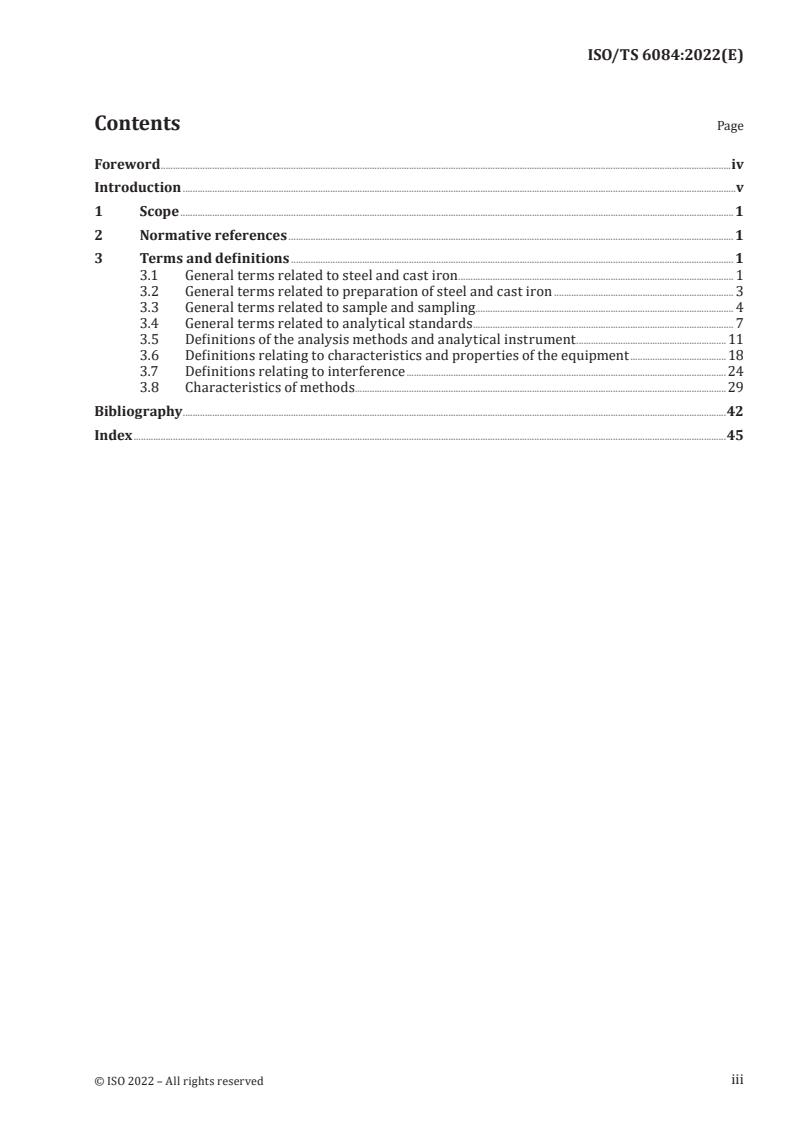
Contents Page
Foreword .iv
Introduction .v
1 Scope . 1
2 Normative references . 1
3 Terms and definitions . 1
3.1 General terms related to steel and cast iron . 1
3.2 General terms related to preparation of steel and cast iron . 3
3.3 General terms related to sample and sampling. 4
3.4 General terms related to analytical standards . 7
3.5 Definitions of the analysis methods and analytical instrument . 11
3.6 Definitions relating to characteristics and properties of the equipment . 18
3.7 Definitions relating to interference . 24
3.8 Characteristics of methods.29
Bibliography .42
Index .45
iii
Foreword
ISO (the International Organization for Standardization) is a worldwide federation of national standards
bodies (ISO member bodies). The work of preparing International Standards is normally carried out
through ISO technical committees. Each member body interested in a subject for which a technical
committee has been established has the right to be represented on that committee. International
organizations, governmental and non-governmental, in liaison with ISO, also take part in the work.
ISO collaborates closely with the International Electrotechnical Commission (IEC) on all matters of
electrotechnical standardization.
The procedures used to develop this document and those intended for its further maintenance are
described in the ISO/IEC Directives, Part 1. In particular, the different approval criteria needed for the
different types of ISO documents should be noted. This document was drafted in accordance with the
editorial rules of the ISO/IEC Directives, Part 2 (see www.iso.org/directives).
Attention is drawn to the possibility that some of the elements of this document may be the subject of
patent rights. ISO shall not be held responsible for identifying any or all such patent rights. Details of
any patent rights identified during the development of the document will be in the Introduction and/or
on the ISO list of patent declarations received (see www.iso.org/patents).
Any trade name used in this document is information given for the convenience of users and does not
constitute an endorsement.
For an explanation of the voluntary nature of standards, the meaning of ISO specific terms and
expressions related to conformity assessment, as well as information about ISO's adherence to
the World Trade Organization (WTO) principles in the Technical Barriers to Trade (TBT), see
www.iso.org/iso/foreword.html.
This document was prepared by Technical Committee ISO/TC 17, Steel, Subcommittee SC 1, Methods of
determination of chemical composition.
Any feedback or questions on this document should be directed to the user’s national standards body. A
complete listing of these bodies can be found at www.iso.org/members.html.
iv
Introduction
To ensure that communication in a particular domain is effective and that difficulties in understanding
are minimized, it is essential that the various participants use the same concepts and concept
representations. Unambiguous communication related to analytical chemistry concepts is crucial given
the implications that can arise from misunderstandings with regard to equipment.
Different levels of scientific and technical knowledge can lead to widely divergent understandings and
assumptions about concepts. The result is poor communication that can lead into an increase of the risk
of accidents and duplication of efforts as different define concepts according to their perspectives.
Conceptual arrangement of terms and definitions is based on concepts systems that show corresponding
relationships analytical chemistry concepts. Such arrangement provides users with a structured view
of the analytical methods and will facilitate common understanding of all related concepts. Besides,
concepts systems and conceptual arrangement of terminological data will be helpful to any kind of user
because it will promote clear, accurate and useful communication.
v
TECHNICAL SPECIFICATION ISO/TS 6084:2022(E)
Steel and steel products — Vocabulary relating to chemical
analysis
1 Scope
This document defines terms relating to methods of the determination of the chemical composition of
steel and steel products.
2 Normative references
There are no normative references in this document.
3 Terms and definitions
ISO and IEC maintain terminology databases for use in standardization at the following addresses:
— ISO Online browsing platform: available at https:// www .iso .org/ obp
— IEC Electropedia: available at https:// www .electropedia .org/
3.1 General terms related to steel and cast iron
3.1.1
alloy steel
steel (3.1.17), other than a stainless steel, that conforms to a specification that requires one or more of
the following elements, by mass percent, to have a minimum content equal to or greater than: 0,30 for
aluminum; 0,000 8 for boron; 0,30 for chromium; 0,30 for cobalt; 0,40 for copper; 0,40 for lead; 1,65 for
manganese; 0,08 for molybdenum; 0,30 for nickel; 0,06 for niobium (columbium); 0,60 for silicon; 0,05
for titanium; 0,30 for tungsten (wolfram); 0,10 for vanadium; 0,05 for zirconium; or 0,10 for any other
alloying element, except sulphur, phosphorus, carbon, and nitrogen
[SOURCE: ASTM A941: 2018]
3.1.2
austenitic steel
steel (3.1.17) where the structure consists of austenite (3.1.3) at ambient temperature
Note 1 to entry: Cast austenitic steels can contain up to about 20 % of ferrite (3.1.8).
3.1.3
austenite
solid solution of one or more elements in gamma iron (3.1.19)
3.1.4
boriding
thermochemical treatment of a workpiece to enrich the surface of a workpiece with boron
Note 1 to entry: The medium in which boriding takes place should be specified, e.g. pack boriding, paste boriding,
etc.
3.1.5
cast/heat analysis
chemical analysis determined by the steel producer as being representative of a specific heat of steel
(3.1.17)
Note 1 to entry: Where the analysis reported by the steel producer is not sufficiently complete for conformance
with the heat analysis (3.1.5) requirements of the applicable product specification to be fully assessed, the
manufacturer can complete the assessment of conformance with such heat analysis (3.1.5) requirements by using
a product analysis (3.1.16) for the specified elements that were not reported by the steel producer, provided that
product analysis (3.1.16) tolerances are not applied and the heat analysis (3.1.5) is not altered
[SOURCE: ASTM A941: 2018]
3.1.6
cast iron
alloy of iron, carbon and silicon where the carbon content is approximately more than 2 %
3.1.7
ductile iron
nodular cast iron
cast iron (3.1.6) that has been treated while molten with an element (usually magnesium or cerium)
that spheroidizes the graphite
[SOURCE: ISO 15156-2:2020, 3.5.4]
3.1.8
ferrite
body-centred cubic lattice structure of iron or steel (3.1.17)
3.1.9
forged steel
steel (3.1.17) product obtained by forging and that does not undergo subsequent hot conversion
Note 1 to entry: These products are mainly in the form of circles or squares.
3.1.10
grey cast iron
cast material, mainly iron and carbon based, carbon being present mainly in the form of flake (lamellar)
graphite particles
Note 1 to entry: Grey cast iron is also known as flake graphite cast iron, and less commonly as lamellar graphite
cast iron.
Note 2 to entry: Graphite form, distribution and size are specified in ISO 945-1.
[SOURCE: EN 1561:2011, 3.1]
3.1.11
killed steel
steel (3.1.17) deoxidized to such a level that essentially no reaction occurred between carbon and
oxygen during solidification
[SOURCE: ASTM A941: 2018]
3.1.12
malleable iron
white cast iron (3.1.18) that is thermally treated to convert most or all of the cementite to graphite
(temper carbon)
[SOURCE: ISO 15156-2:2020, 3.5.3]
3.1.13
martensite
(phase) formed in carbon containing steels (3.1.17) by the cooling of austenite (3.1.3) at such a high rate
that carbon atoms do not have time to diffuse out of the crystal structure in large enough quantities to
form cementite (Fe C)
3.1.14
nitriding
case-hardening process in which nitrogen is introduced into the surface of metallic materials (most
commonly ferrous alloys)
EXAMPLE Liquid nitriding, gas nitriding, ion nitriding and plasma (3.6.32) nitriding.
[SOURCE: ISO 15156-2:2020, 3.11]
3.1.15
non-alloyed steel
steel in which the percentage of each element is less than specific limiting values specified
Note 1 to entry: See Table in ISO 4948-1:1982, 3.1.2.
3.1.16
product analysis
chemical analysis carried out on a sample of the product taken after the final hot rolling operation
3.1.17
steel
ferrous material the principal element of which is iron and the carbon content of which is not more than
2 % of mass
Note 1 to entry: The presence of large quantities of carbide-forming elements can modify the upper limit of the
carbon content.
Note 2 to entry: The nomenclature for unalloyed steels suitable for heat treatment and for alloyed steels is given
in ISO 4948-1 and ISO 4948-2.
Note 3 to entry: Small amount of alloying elements added to non-alloy steels can cause the product to be defined
as a micro-alloy steel.
3.1.18
white cast iron
cast iron (3.1.6) that displays a white fracture surface due to the presence of cementite
[SOURCE: ISO 15156-2:2020, 3.5.2]
3.1.19
gamma iron
pure iron with face-centred cubic lattice structure
3.2 General terms related to preparation of steel and cast iron
3.2.1
grinding
method of preparing a sample of metal for a physical method of analysis in which the surface of the test
sample (3.3.15) is abraded using an abrasive wheel
3.2.2
linishing
method of preparing a sample of metal for a physical method of analysis in which the surface of the
test sample (3.3.15) is abraded using a flexible rotating disc or continuous belt coated with an abrasive
substance
3.2.3
milling
method of preparing sample chips or the surface of a sample for a physical method of analysis in which
the surface of the sample is machined using a rotating, multi-edged cutting tool
3.3 General terms related to sample and sampling
3.3.1
aliquot
known amount of a homogeneous material, assumed to be taken with negligible sampling error
Note 1 to entry: The term "aliquot" is usually applied to fluids.
Note 2 to entry: The term "aliquot" is usually used when the fractional part is an exact divisor of the whole; the
term "aliquant" has been used when the fractional part is not exact divisor of the whole (e.g. a 15 ml portion is an
aliquant of 100 ml).
Note 3 to entry: When a laboratory sample (3.3.7) or a test sample (3.3.15) is "aliquoted" or otherwise subdivided,
the portions have been called split samples.
3.3.2
analyte
component of a system to be analysed
[SOURCE: PAC, 1989, 61, 1657 (Nomenclature for automated and mechanised analysis (Recommendations
1989))]
3.3.3
analytical sample
sample prepared from the laboratory sample (3.3.7) and from which analytical portions can be taken
Note 1 to entry: The analytical sample can be subjected to various treatments before an analytical portion is
taken.
Note 2 to entry: Where no homogenization or subdivision is necessary, the laboratory sample (3.3.7), the test
sample (3.3.15), and, if the latter requires no further chemical or physical treatment, the analytical samples are
identical. With some homogeneous materials such as waters or oils, the laboratory sample (3.3.7) may be taken
directly from a sample unit and, if no further subdivision or homogenization is carried out, the laboratory sample
(3.3.7) is the test sample (3.3.15). Similarly, with atmospheric particulates collected on a filter, the sample unit is
the laboratory sample (3.3.7) and, if no further subdivision or homogenization is carried out, also the test sample
(3.3.15).
[SOURCE: ISO 15193:2009, 3.3, modified — Note to entry added.]
3.3.4
consignment
quantity of metal delivered at one time
3.3.5
duplicate samples
replicate samples
multiple (or two) samples taken under comparable conditions
Note 1 to entry: This selection can be accomplished by taking units adjacent in time or space. Although the
replicate samples are expected to be identical, often the only thing replicated is the act of taking the physical
sample. A duplicate sample is a replicate sample consisting of two portions. The umpire samples usually used to
settle a dispute; the replicate sample is usually used to estimate sample variability.
[SOURCE: PAC, 1990, 62, 1193 (Nomenclature for sampling in analytical chemistry (Recommendations
1990))]
3.3.6
increment
quantity of metal obtained by sampling at one time from a consignment (3.3.4)
3.3.7
laboratory sample
sample or subsample(s) (3.3.13) sent to or received by the laboratory
Note 1 to entry: When the laboratory sample is further prepared (reduced) by subdividing, mixing, grinding
(3.2.1), or by combinations of these operations, the result is the test sample (3.3.15). When no preparation of the
laboratory sample is required, the laboratory sample is the test sample (3.3.15). A test portion (3.3.14) is removed
from the test sample (3.3.15) for the performance of the test or for analysis.
Note 2 to entry: The laboratory sample is the final sample from the point of view of sample collection but it is the
initial sample from the point of view of the laboratory.
Note 3 to entry: Several laboratory samples can be prepared and sent to different laboratories or to the same
laboratory for different purposes. When sent to the same laboratory, the set is generally considered as a single
laboratory sample and is documented as a single sample.
[SOURCE: IUPAC orange book: 2002, 18.3.6, Sampling stages]
3.3.8
lot
quantity of material that is assumed to be a single population for sampling purposes
[SOURCE: PAC, 1990, 62, 1193 (Nomenclature for sampling in analytical chemistry (Recommendations
1990))]
3.3.9
matrix
components of the sample other than the analyte (3.3.2)
Note 1 to entry: to entry. In analysis.
[SOURCE: PAC, 1989, 61, 1657 (Nomenclature for automated and mechanised analysis (Recommendations
1989))]
3.3.10
primary sample
collection of one or more increments (3.3.6) or units initially taken from a population
Note 1 to entry: The portions can be either combined (composited or bulked sample) or kept separate (gross
sample). If combined and mixed to homogeneity, it is a blended bulk sample.
Note 2 to entry: The term "bulk sample" is commonly used in the sampling literature as the sample formed by
combining increments (3.3.6). The term "bulk sample" is ambiguous since it could also mean a sample from a
bulk lot (3.3.8) and it does not indicate whether the increments (3.3.6) or units are kept separate or combined.
Such use should be discouraged because less ambiguous alternative expressions (composite sample, aggregate
sample) are available.
Note 3 to entry: "Lot sample" and "batch sample" have also been used for this concept, but they are self-limiting
terms.
Note 4 to entry: The use of "primary" in this sense is not meant to imply the necessity for multistage sampling.
[SOURCE: IUPAC orange book: 2002, 18.3.6, Sampling stages]
3.3.11
representative sample
sample that has the same properties as a defined batch of material and represents the bulk material,
within a defined confidence limit
[SOURCE: ISO 14488:2007, 3.7]
3.3.12
specimen
one or more pieces taken from each product in the sample, for the purpose of producing test pieces
[SOURCE: ISO 6361-1:2011, 3.7]
3.3.13
subsample
sample obtained by procedures in which the items of interest are randomly distributed in parts of equal
or unequal size
Note 1 to entry: A sub-sample can be any of the following:
a) a portion of the sample obtained by selection or division;
b) an individual unit of the lot (3.3.8) taken as part of the sample;
c) the final unit of multistage sampling.
Note 2 to entry: The term “subsample” is used either in the sense of a “sample of a sample” or as a synonym for
“unit”. In practice, the meaning is usually apparent from the context or is defined.
[SOURCE: ISO 11074:2015, 4.1.34]
3.3.14
test portion
part of the test sample, or part of the sample taken from the melt, submitted to analysis, in certain
cases, the test portion can be selected from the sample product itself
Note 1 to entry: The following special types of test portions in the form of a solid mass obtained from a probe
sample are distinguished
— disc originating from the sampling of molten metal (from a special sampler or a small ingot), used for OES or
XRF
— test portion in the shape of a small disc, commonly described as a slug, obtained by punching,
— test portion in the form of a small appendage, commonly described as a lug,
— test portion in the form of a small-diameter rod, commonly described as a pin, obtained by cutting.
Note 2 to entry: When the test sample is in the form of chips or powder, or when a sample in the form of a solid
mass is analysed by a thermal method, the test portion (3.3.14) is obtained by weighing. In the case of a physical
method of analysis, the part actually analysed will constitute only a small mass of the test sample. In an optical
emission spectrometric method, the mass of metal consumed in an electrical discharge (3.6.14) is about 0,5 mg
to 1 mg, in an X-ray fluorescence spectrometric method, the characteristic radiation is produced from a very thin
surface layer of the sample.
3.3.15
test sample
sample taken or formed from the laboratory sample (3.3.7), by a process involving homogenization
using physical or mechanical treatments such as grinding (3.2.1), drilling, milling (3.2.3) or sieving
Note 1 to entry: The test sample is then in a form suitable for subsampling for analytical purposes, for storing for
future analysis or for using for test purposes other than analytical.
[SOURCE: IUPAC orange book: 2002, 10.3.4.9]
3.3.16
test solution
analytical solution
solution prepared by dissolving, with or without reaction, the test portion (3.3.14) in a liquid
[SOURCE: IUPAC orange book: 2002, 18.3.6 Sampling stages]
3.3.17
trace element
element having an average concentration of less than about 100 parts per million atoms (ppm) or less
than 0,01 % by weight
[SOURCE: PAC, 1979, 51, 2243 (General aspects of trace analytical methods - IV. Recommendations
for nomenclature, standard procedures and reporting of experimental data for surface analysis
techniques)]
3.4 General terms related to analytical standards
3.4.1
blank test solution
solution that contains all the chemicals except for the element to be determined in the same
concentration as required for the preparation of a reference standard solution (3.4.17) of that element
[SOURCE: OIML R 100-1:2013, 3.3.2]
3.4.2
blank reference solution
solution used to set the zero absorbance on the spectrometer (3.5.22) and that normally consists of a
pure solvent such as deionized water
[SOURCE: OIML R 100-1:2013, 3.3.1]
3.4.3
blank value
reading or result originating from the matrix (3.3.9), reagents and any residual bias (3.8.5) in the
measurement device or process, which contributes to the value obtained for the quantity in the
analytical procedure
[SOURCE: PAC, 1989, 61, 1657 (Nomenclature for automated and mechanised analysis (Recommendations
1989))]
3.4.4
bracketing technique
analytical method consisting of bracketing the measured absorption or machine reading of the sample
between two measurements made on calibration solutions (3.4.8) of neighbouring concentrations
within the optimum working range
[SOURCE: ISO 6486-2:1999, 3.3]
3.4.5
calibration
operation that, under specified conditions, in a first step, establishes a relation between the
quantity values (3.4.16) with measurement uncertainties provided by measurement standards and
corresponding indications with associated measurement uncertainties (3.8.20) and, in a second step,
uses this information to establish a relation for obtaining a measurement result from an indication
Note 1 to entry: A calibration can be expressed by a statement, calibration function, calibration diagram,
calibration curve (3.4.7), or calibration table. In some cases, it can consist of an additive or multiplicative
correction of the indication with associated measurement uncertainty (3.8.20).
Note 2 to entry: Calibration should not be confused with adjustment of a measuring system, often mistakenly
called “self-calibration”, nor with verification (3.8.47) of calibration.
[SOURCE: ISO/IEC Guide 99:2007, 2.39]
3.4.6
calibration blank solution
solution prepared in the same way as the calibration solution (3.4.8) but leaving out the analyte (3.3.2),
also called “zero member” of the calibration (3.4.5) series
[SOURCE: ISO 21400:2018, 3.8, modified]
3.4.7
calibration curve
expression of the relation between indication and corresponding measured quantity value (3.4.16.2)
Note 1 to entry: A calibration curve expresses a one-to-one relation that does not supply a measurement result as
it bears no information about the measurement uncertainty (3.8.20).
[SOURCE: ISO/IEC Guide 99:2007, 4.31]
3.4.8
calibration solution
solution used to calibrate the instrument, prepared from a stock solution (3.4.21) or a certified standard
by adding acids, buffer (3.6.5), reference element (3.7.7) and salts as needed
[SOURCE: ISO 21400:2018, 3.9]
3.4.9
certified reference material
CRM
reference material (RM) characterized by a metrologically valid procedure for one or more specified
properties, accompanied by an RM certificate that provides the value of the specified property, its
associated uncertainty (3.8.20), and a statement of metrological traceability
Note 1 to entry: The concept of value includes a nominal property or a qualitative attribute such as identity or
sequence. Uncertainties for such attributes can be expressed as probabilities or levels of confidence.
[SOURCE: ISO Guide 30:2015, 2.1.2, modified —Notes 2, 3 and 4 to entry deleted.]
3.4.10
internal standard
compound added to a sample in a fixed amount that has similar properties (spectral, physical, isobaric
etc.) to the target analyte (3.3.2) used to correct for instrument drift (3.6.15) and matrix interference
(3.7.11)
[SOURCE: ISO/TS 20593:2017, 3.6, modified]
3.4.11
internal standard line
spectral line (3.6.40) of an internal standard (3.4.10), to which the radiant energy of an analytical line is
compared
[SOURCE: ASTM E135: 2021]
3.4.12
matrix solution
synthetic solution consisting of the solvent and containing, if possible, all the constituents of the
analytical sample (3.3.3) except the analyte (3.3.2)
3.4.13
primary reference material
primary RM
high purity material of the analyte (3.3.2), certified for the mass/mole fraction of the analyte (3.3.2)
in the material, and which constitutes the realization of the International System of Units (SI) for the
analyte (3.3.2) of interest
Note 1 to entry: A primary reference material has its value assigned either directly by a primary RMP or indirectly
by determining the impurities of the material by appropriate analytical methods (e.g. mass balance method).
[SOURCE: ISO 17511:2020, 3.35]
3.4.14
reference material
RM
material, sufficiently homogeneous and stable with respect to one or more specified properties, which
has been established to be fit for its intended use in a measurement process
Note 1 to entry: RM is a generic term.
Note 2 to entry: Properties can be quantitative or qualitative, e.g. identity of substances or species.
Note 3 to entry: Uses can include the calibration (3.4.5) of a measurement system, assessment of a measurement
procedure, assigning values to other materials, and quality control (3.8.26).
Note 4 to entry: ISO/IEC Guide 99:2007, 5.13 has an analogous definition, but restricts the term “measurement”
to apply to quantitative values. However, Note 3 of ISO/IEC Guide 99:2007, 5.13, specifically includes qualitative
properties, called “nominal properties”.
[SOURCE: ISO/Guide 30:2015, 2.1.1]
3.4.15
reference method
reference measurement procedure
measurement procedure accepted as providing measurement results fit for their intended use in
assessing measurement trueness (3.8.46) of measured quantity values (3.4.16.2) obtained from other
measurement procedures for quantities of the same kind, in calibration (3.4.5), or in characterizing
reference materials (3.4.14)
Note 1 to entry: The accuracy (3.8.1) of a reference method must be demonstrated through direct comparison
with a definitive method or with a primary Reference Material (3.4.13).
[SOURCE: ISO/IEC Guide 99:2007, 2.7, modified — New preferred term added, Note to entry added.]
3.4.16
quantity value
number and reference together expressing magnitude of a quantity
[SOURCE: JCGM 200:2012 1.19]
3.4.16.1
reference quantity value
reference value
quantity value (3.4.16) used as a basis for comparison with values of quantities of the same kind
Note 1 to entry: A reference quantity value can be a true quantity value (3.8.45) of a measurand, in which case it is
unknown, or a conventional quantity value, in which case it is known.
Note 2 to entry: A reference quantity value with associated measurement uncertainty (3.8.20) is usually provided
with reference to:
a) a material, e.g. a certified reference material (3.4.9);
b) a device, e.g. a stabilized laser;
c) a reference measurement procedure (3.4.15);
d) a comparison of measurement standards.
[SOURCE: JCGM 200:2012, 5.18]
3.4.16.2
measured quantity value
value of a measured quantity
measured value
quantity value (3.4.16) representing a measurement result
[SOURCE: JCGM 200:2012, 2.10]
3.4.17
reference standard solution
solution containing an accurately known concentration of a sample element or elements of interest and
that is used for testing and calibrating the instrument
[SOURCE: OIML R 100-1:2013, 3.4]
3.4.18
spike
known quantity of determinand that is added to a sample, usually for the purpose of estimating the
systematic error (3.8.44) of an analytical system by means of a recovery exercise
Note 1 to entry: "Spiking" is a way of creating a control material (3.8.8) in which a value is assigned by a
combination of formulation and analysis. This method is feasible when a test material essentially free of the
analyte (3.3.2) is available. After exhaustive analytical checks to ensure the background level is adequately low,
the material is spiked with a known amount of analyte (3.3.2). The reference sample prepared in this way is thus
of the same matrix (3.3.9) as the test materials to be analysed and of known analyte (3.3.2) level - the uncertainty
(3.8.20) in the assigned concentration is limited only by the possible error (3.8.11) in the unspiked determination.
However, it can be difficult to ensure that the speciation, binding and physical form of the added analyte (3.3.2) is
the same as that of the native analyte (3.3.2) and that the mixing is adequate.
[SOURCE: ISO 5667-14:2014, 3.7, modified — Note to entry added.]
3.4.19
standardization
process of adjusting instrument output to a previously established calibration (3.4.5) (that is, drift
correction (3.6.16)); the experimental establishment of the concentration of a reagent solution
[SOURCE: ASTM E135: 2021]
3.4.20
standard solution
solution of accurately known concentration of an element, an ion, a compound or a group derived from
the substance used for its preparation
Note 1 to entry: Standard solutions are prepared using standard substances in one of several ways. A primary
standard is a substance of known high purity, which can be dissolved in a known volume of solvent to give a
primary standard solution. If stoichiometry is used to establish the strength of a titrant, it is called a secondary
standard solution. The term secondary standard can also be applied to a substance whose active agent contents
have been found by comparison against a primary standard.
[SOURCE: ISO 78-2:1999, 3.6, modified — Note to entry added.]
3.4.21
stock solution
solution with accurately known analyte (3.3.2) concentration(s), prepared from pure chemicals such as
a primary standard
[SOURCE: ISO 21400:2018, 3.11]
3.4.22
titration curve
plot of a variable related to a relevant concentration (activity) as the ordinate versus some measure of
the amount of titrant, usually titration volume (titre), as the abscissa
Note 1 to entry: If the variable is linearly related to concentrations, such as the electrical conductance or the
photometric absorbance, the expression "linear titration curve" is used. When a logarithmic expression of the
concentration or activity is used, such as the pH, pM, or the electrical potential in mV, the curve is referred to as a
logarithmic titration curve.
[SOURCE: IUPAC orange book: 2002]
3.4.23
working reference materials
reference materials (3.4.14) used for routine analytical control and traceable to NIST standards and
other recognized standards when appropriate standards are available
[SOURCE: ASTM A751: 2020, 3.2.6]
3.4.24
working standard solution
solution, prepared by dilution of the stock standard solution(s), that contains the analyte(s) (3.3.2)
of interest at a concentration(s) better suited to preparation of calibration solutions (3.4.8) than the
concentration(s) of the analyte(s) (3.3.2) in the stock standard solution(s)
[SOURCE: ISO 15202-3:2004, 3.2.13]
3.5 Definitions of the analysis methods and analytical instrument
3.5.1
atomic absorption spectrometry
AAS
spectroanalytical method for qualitative determination and quantitative evaluation of element
concentrations wherein the technique determines these concentrations by measuring the atomic
absorption of free atoms
Note 1 to entry: The technique of analysis by AAS falls into two main categories, according to the method of
atomization, that is, flame atomic absorption spectrometry (FAAS) (3.5.6) and electrothermal atomic absorption
(ETAAS) (3.5.5) [also called graphite furnace atomic absorption spectrometry (GFAAS)].
[SOURCE: ISO 6486-1:2019, 3.2, modified — Note to entry added.]
3.5.2
atomic emission spectrometry
AES
pertaining to emission spectrometry in the ultraviolet, visible, or infrared (3.5.16) wavelength regions
of the electromagnetic spectrum
Note 1 to entry: Atomic emission spectroscopy (3.5.26) is considered mainly in the ultraviolet and visible regions
of the spectrum, i.e. the optical range, and makes use of different sampling sources that give rise to the different
categories of optical emission spectroscopy (OES) (3.5.20), including flame, plasma (3.6.32), glow discharge, spark,
direct current arc optical emission spectroscopy (3.5.20).
[SOURCE: ASTM E135: 2021, modified — Note to entry added.]
3.5.3
atomic fluorescence spectrometry
AFS
method of determining chemical elements based on the measurement of the re-emission of characteristic
electromagnetic radiation by atoms, following the absorption of radiation in the vapour phase
Note 1 to entry: The wavelengths of the absorbed and re-emitted radiation can be identical (atomic resonance
fluorescence spectrometry) or different.
3.5.4
chemical vapour generation system
analyte (3.3.2) is separated from the sample matrix (3.3.9) by the generation of gaseous species as a
result of a chemical reaction
Note 1 to entry: This technique has received its widest application in atomic absorption spectrometry (AAS) (3.5.1)
in the forms of cold vapour AAS (CVAAS) for the determination of mercury and hydride generation AAS (HGAAS)
for elements forming gaseous covalent hydrides (As, Bi, Ge, In, Pb, Sb, Se, Sn and Te). Chemical vapour generation
is also used in combination with optical emission (3.5.20) and atomic fluorescence spectrometry (3.5.3).
[SOURCE: IUPAC orange book: 2002, 10.3.4.6]
3.5.4.1
cold vapour atomic absorption spectrometry
CVAAS
type of atomic absorption spectrometry (3.5.1) where no vaporisation step is required because the
sample is a volatile heavy metal such as mercury, which is a vapour at room temperature
3.5.4.2
hydride generation atomic absorption spectrometry
HGAAS
type of atomic absorption spectrometry (3.5.1) where metal samples such as As, Sb and Se are vaporised
by converting them into volatile hydrides
3.5.5
electrothermal atomic absorption spectrometry
ETAAS
type of spectrometry that uses a graphite-coated furnace to vaporize the sample
Note 1 to entry: This technique has largely been developed for use in atomic absorption spectrometry (3.5.1). It
has also been applied in atomic emission (3.5.2) and atomic fluorescence spectrometry (3.5.3), with appropriate
analogous phrases, such as electrothermal atomic emission spectrometry (ETAES) and electrothermal atomic
fluorescence spectrometry (ETAFS).
3.5.6
flame atomic absorption spectrometry
measurement of the absorption of electromagnetic radiation, emitted by an element at a determined
wavelength, by an absorbent medium (flame) formed of atoms of the same element that are in the
ground state
Note 1 to entry: Each element absorbs radiation of specific wavelengths and the intensity of the absorbed
radiation is proportional to the concentration of the said element.
[SOURCE: ISO 3750:2006, 3.1]
3.5.7
flame emission spectrometry
FES
chemical analysis method based on the measurement of light in a given range of wavelengths emitted
by a sample atomized in a flame according to the Beer-Lambert law
Note 1 to entry: The functions of an analytical flame spectrometer in general are:
a) Transformation of the solution to be analyzed into a vapour containing free atoms or molecular compounds
of the analyte (3.3.2) in the flame;
b) Selection and detection of the optical signal (arising from the analyte (3.3.2) vapour) which carries
information on the kind and concentration of the analyte (3.3.2);
c) Amplification and read-out of the electrical signal.
[SOURCE: ISO 9555-3:1992, 3.1.6, modified — Note to entry added.]
3.5.8
Fourier transform infrared spectrometry
FT-IR spectrometry
form of infrared spectrometry in which an interferogram is obtained; which is then subjected to a
Fourier transform to obtain an amplitude-wavenumber (or wave-length) spectrum
Note 1 to entry: The abbreviation FTIR is not recommended.
Note 2 to entry: When FT-IR spectrometers are interfaced with other instruments, a slash should be used to
denote the interface; for example, GC/FT-IR; HPLC/FT-IR, and the use of FT-IR should be explicit, that is, FT-IR not
IR.
[SOURCE: ASTM E131: 2010]
3.5.9
glow discharge spectrometry
GDS
method in which a spectrometer (3.5.22) is used to measure relevant intensities emitted from a glow
discharge generated at a surface
Note 1 to entry: This is a general term that encompasses GDOES and GDMS.
[SOURCE: ISO 18115-1:2013, 3.10]
3.5.10
glow discharge optical emission spectrometry
GDOES
method in which an optical emission spectrometer is used to measure the wavelength and intensity of
light emitted from a glow discharge (3.6.14) generated at a surface
Note 1 to entry: This method is a spectroscopic method for the quantitative analysis of metals and other non-
metallic solids. The metallic samples are used as a cathode in a direct current plasma (3.6.32). From the surface,
the sample is removed in layers by sputtering with argon ions. The removed atoms pass into the plasma (3.6.32)
by diffusion. Photons are emitted with excited waves and have characteristic wavelengths that are recorded
by means of a downstream spectrometer and subsequently quantified. Glow discharge spectroscopy (3.5.9) is an
established method for the characterization of steels (3.1.17) and varnishes.
[SOURCE: ISO 18115-1:2013, 3.9, modified — Note to entry added.]
3.5.11
gravimetry
set of methods used in analytical chemistry for the quantitative determination of an analyte (3.3.2)
based on its mass
Note 1 to entry: The four main types of this method of analysis are precipitation, volatilization, electro-
analytical and miscellaneous physical method. The methods involve changing the phase of the analyte (3.3.2) to
separate it in its pure form from the original mixture and are quantitative measurements.
3.5.12
inductively coupled plasma
ICP
high-temperature discharge (3.6.14) generated in flowing argon by an alternating magnetic field
induced by a radio frequency (RF) load coil that surrounds the tube carrying the gas
Note 1 to entry: In inductively coupled plasmas (inductively coupled RF plasmas or inductively coupled argon
plasmas), energy transfer to the gas is achieved with the help of an induction coil or inductor (the terms coil,
load coil and work coil are discouraged). The frequency at which the source operates should be given, e.g. 27 or
12 MHz, and the gas type should be defined. The plasma (3.6.32) is formed within and/or above a set of refractory
tubes arranged coaxially with the induction coil, the whole forming a plasma torch.
[SOURCE: ISO 30011:2010, 3.3.5, modified — Note to entry added.]
3.5.13
inductively coupled plasma optical emission spectrometry
ICP-OES
measurement of the intensity of electromagnetic radiation emitted by the components of a sample
when excited by a plasma (3.6.32)
Note 1 to entry: Sample atoms entering the plasma emit light radiation, whose characteristic wavelengths and
intensities are used to identify the elements and determine concentrations, respectively. Samples are usually
presented to the plasma (3.6.32) in solution form.
[SOURCE: ISO 3815-2:2005, 3.1]
3.5.14
inductively coupled plasma mass spectrometry
ICP-MS
analytical technique comprising a sample introduction system, an inductively coupled plasma (3.5.12)
source for ionization of the analytes (3.3.2), a plasma/vacuum interface and a mass spectrometer
comprising an ion focusing, separation and detection system
[SOURCE: ISO/TS 80004-6:2021, 5.23]
3.5.15
ion-selective electrode
ISE
potentiometric probe, the output potential of which, when measured against a suitable reference
electrode, is proportional to the activity of the selected ion in the solution under test
Note 1 to entry: This is an electrochemical sensor, based on a thin selective membrane or film as recognition
element and is an electrochemical half-cell equivalent to other half-cells of the zeroth (inert metal in a redox
electrolyte), 1st, 2nd and 3rd kinds. These devices are distinct for half-cells that involve electrode redox reactions
(electrodes of zeroth, 1st, 2nd and 3rd kinds), although they often contain a second kind electrode as the “inner”
or “internal” reference electrode. The potential difference is the response (i.e. that of ISE versus outer reference
electrode potentials) as its principal component of the Gibbs energy change associated with permselective mass
transfer of ions (e.g. by ion-exchange, solvent extraction or some other mechanism) across a phase boundary.
The ISE shall be used in conjunction with a reference electrode (i.e. “outer” or “external” reference electrode) to
form a complete electrochemical cell. The measured potential difference s (ISE versus outer reference electrode
potentials) are linearly dependent on the logarithm of the activity of a given ion in solution. The expression "ion-
specific electrode" is not recommended. "Specific" implies that the electrode does not respond to additional ions.
Since no electrode is truly specific for one ion, "ion-selective" is recommended as more appropriate. "Selective
ion-sensitive electrode" is rarely used to describe an ion-selective electrode. "Principal" or "primary" ions are
those for determination of which an electrode is designed. It is never certain that the ISE is more sensitive to the
"principal" ion than to interferences, e.g. nitrate ISEs.
[SOURCE: 8.3.2.1, IUPAC orange book: 2002]
3.5.16
infrared radiation
IR
infrared
optical radiation for which the wavelengths are longer than those for visible radia
...