

ISO 14122-1:2016
(Main)Safety of machinery — Permanent means of access to machinery — Part 1: Choice of fixed means and general requirements of access
General Information
- Abstract
ISO 14122-1:2016 gives general requirements for access to stationary machines and guidance about the correct choice of means of access when necessary access to the stationary machine is not possible directly from the ground level or from a floor. It is applicable to permanent means of access which are a part of a stationary machine, and also to non-powered adjustable parts (e.g. foldable, slidable) and movable parts of fixed means of access. NOTE 1 "Fixed" means of access are those mounted in such a manner (for example, by screws, nuts, welding) that they can only be removed by the use of tools. ISO 14122-1:2016 specifies minimum requirements that also apply when the same means of access is required as the part of the building or civil construction (e.g. working platforms, walkways, ladders) where the machine is installed, on condition that the main function of that part of the construction is to provide a means of access to the machine. NOTE 2 Where no local regulation or standards exist, this part of ISO 14122 can be used for means of access which are outside the scope of the standard. It is intended that this part of ISO 14122 be used with a relevant access-specific part of ISO 14122. The ISO 14122 series as a whole is applicable to both stationary and mobile machinery where fixed means of access are necessary. It is not applicable to powered means of access such as lifts, escalators, or other devices specially designed to lift persons between two levels. ISO 14122-1:2016 is not applicable to machinery manufactured before the date of its publication. For the significant hazards covered by this part of ISO 14122, see Clause 4.
- Status
- Published
- Publication Date
- 26-May-2016
- Technical Committee
- ISO/TC 199 - Safety of machinery
- Drafting Committee
- ISO/TC 199/WG 11 - Permanent means of access to machinery
- Current Stage
- 9092 - International Standard to be revised
- Start Date
- 01-Dec-2023
- Completion Date
- 29-Aug-2026
Buy Documents
ISO 14122-1:2016 - Safety of machinery -- Permanent means of access to machinery
ISO 14122-1:2016 - Safety of machinery — Permanent means of access to machinery — Part 1: Choice of fixed means and general requirements of access/27/2016
ISO 14122-1:2016 - Sécurité des machines -- Moyens d'accès permanents aux machines
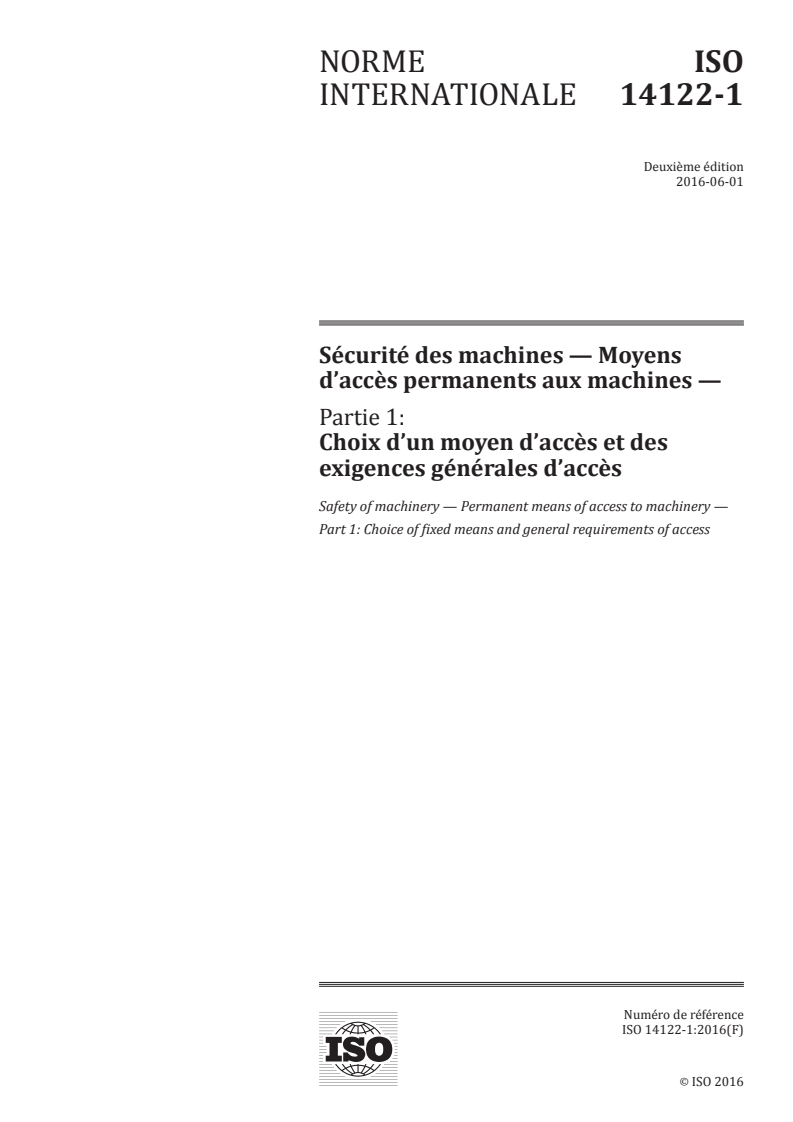
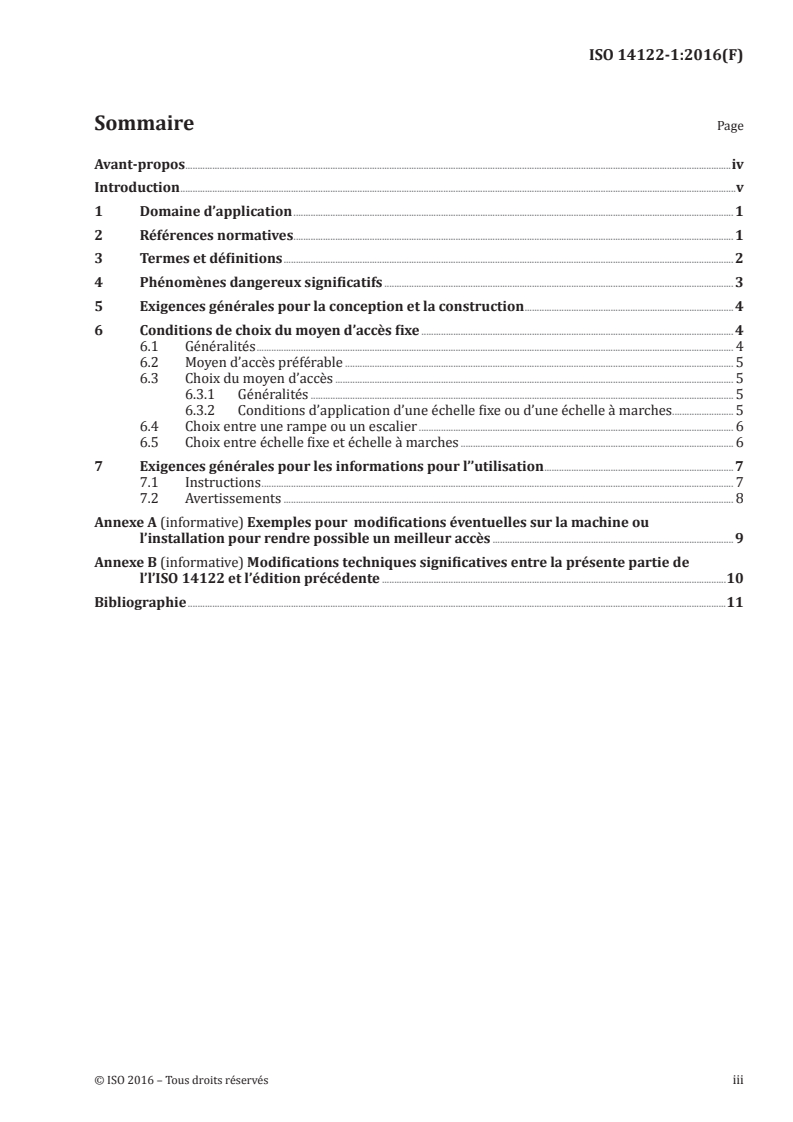
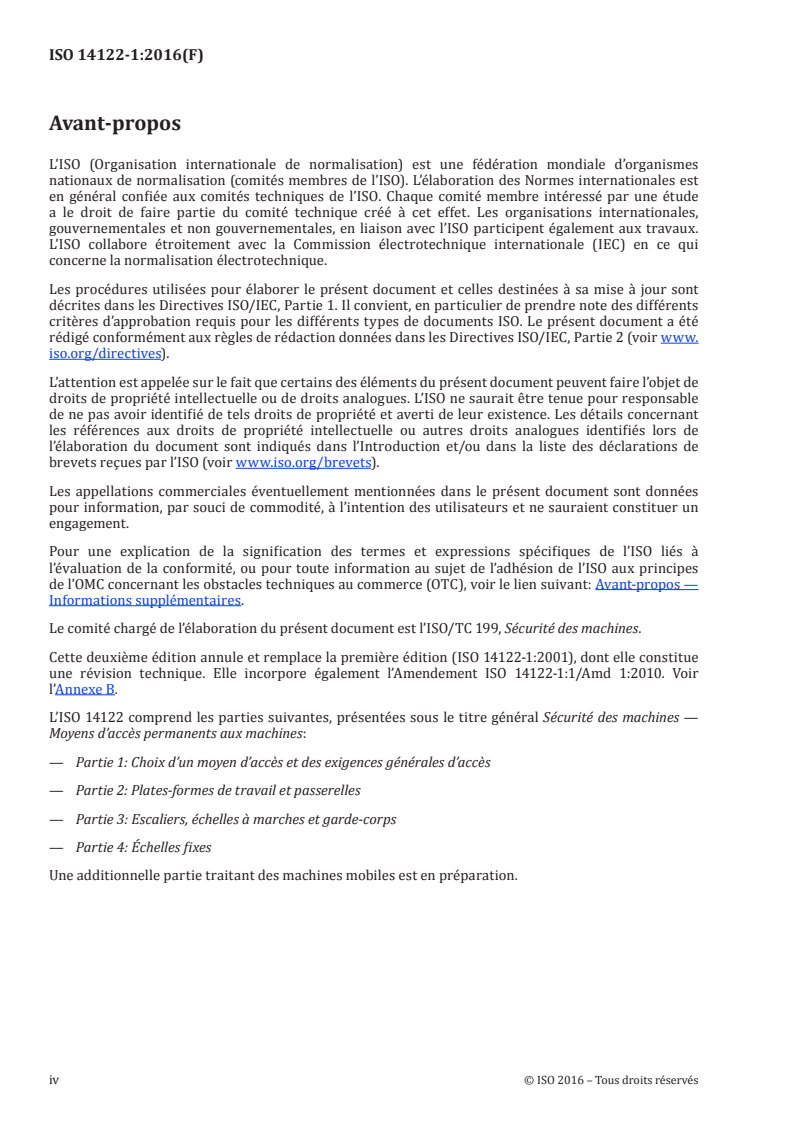
ISO 14122-1:2016 - Sécurité des machines — Moyens d'accès permanents aux machines — Partie 1: Choix d'un moyen d'accès et des exigences générales d'accès/27/2016
Overview
ISO 14122-1:2016 defines the general requirements and guidelines for providing permanent means of access to stationary machinery, ensuring safe and ergonomic entry to areas not accessible directly from ground level or floors. As part of the ISO 14122 series, this standard assists manufacturers, facility managers, and safety professionals in selecting and designing fixed access systems such as stairs, platforms, ramps, stepladders, and fixed ladders. Its requirements enhance machinery safety, minimize risk of accidents, and ensure compliance with international best practices-offering a common reference where local regulations may be lacking.
Key Topics
- Types of Permanent Access: ISO 14122-1 focuses on fixed access solutions, which are installed as integral parts of machinery (e.g., work platforms, walkways, ladders) or as non-powered movable or adjustable components (such as foldable or slidable steps).
- Design and Construction Principles: The standard outlines criteria for strength, stability, appropriate materials, environmental resistance, and ergonomics, such as slip resistance and avoidance of sharp edges and obstruction.
- Safety Considerations: The document highlights major hazards-falling, tripping, slipping, excessive physical effort, and the risk of objects falling-and supports design decisions to mitigate these through proper access selection and installation.
- Selection Process: It guides users in choosing the safest and most suitable access means, prioritizing direct access from ground or floor, then ramps or stairs, and only using ladders or stepladders when other options are impractical.
- Instructions and Information for Use: The standard mandates clear documentation for end users on the proper use, limitations, assembly, and maintenance of fixed access systems. Safety markings such as maximum load capacities are also required at access points.
Applications
ISO 14122-1:2016 is applicable to:
- Machine Designers and Manufacturers: For ensuring integrated and compliant access solutions during machinery development.
- Facility and Maintenance Managers: To assess, upgrade, or maintain access on existing machinery and installations where routine or emergency access is required.
- Health and Safety Practitioners: For performing risk assessments related to machinery accessibility and staff safety.
- Industries and Sectors: Widely used in manufacturing plants, process industries, logistics centers, and any environment where stationary machines require safe access points above or below ground level.
The standard does not cover powered means of access such as lifts and escalators, nor is it retroactively applicable to machines manufactured before its publication. It is highly useful in jurisdictions where local access standards do not exist, serving as an international benchmark for machinery access safety.
Related Standards
To fully implement safe access to machinery, consider these related ISO standards:
- ISO 14122-2: Working Platforms and Walkways – Specific requirements for the design and construction of platforms and elevated walkways.
- ISO 14122-3: Stairs, Stepladders and Guard-rails – Detailed criteria for stairs, stepladders, and associated safety features.
- ISO 14122-4: Fixed Ladders – Requirements for fixed ladder systems used as permanent access.
- ISO 12100: Safety of Machinery-General Principles for Design – Fundamental guidance on risk assessment and reduction.
- ISO 15534 Series: Ergonomic design for the safety of machinery – To ensure access systems are dimensioned according to human factors.
- Relevant EN Standards (e.g., EN 353-1, EN 795) – Address personal fall protection and related testing.
By following ISO 14122-1:2016, organizations can significantly improve machinery safety, effectively manage risk, and demonstrate compliance with internationally recognized safety standards for fixed means of access.
Relations
- Effective Date
- 01-Jul-2026
- Effective Date
- 09-Feb-2026
- Referred By
EN ISO 16089:2025 - Machine tools - Safety - Stationary grinding machines (ISO 16089:2025) - Effective Date
- 09-Feb-2026
- Effective Date
- 09-Feb-2026
- Effective Date
- 09-Feb-2026
- Effective Date
- 09-Feb-2026
- Effective Date
- 09-Feb-2026
- Effective Date
- 09-Feb-2026
- Effective Date
- 09-Feb-2026
- Referred By
EN ISO 28881:2022 - Machine tools - Safety - Electrical discharge machines (ISO 28881:2022) - Effective Date
- 09-Feb-2026
- Effective Date
- 09-Feb-2026
- Effective Date
- 09-Feb-2026
- Effective Date
- 09-Feb-2026
- Effective Date
- 09-Feb-2026
- Effective Date
- 12-Feb-2026
Buy Documents
ISO 14122-1:2016 - Safety of machinery -- Permanent means of access to machinery
ISO 14122-1:2016 - Safety of machinery — Permanent means of access to machinery — Part 1: Choice of fixed means and general requirements of access/27/2016
ISO 14122-1:2016 - Sécurité des machines -- Moyens d'accès permanents aux machines
ISO 14122-1:2016 - Sécurité des machines — Moyens d'accès permanents aux machines — Partie 1: Choix d'un moyen d'accès et des exigences générales d'accès/27/2016
Get Certified
Connect with accredited certification bodies for this standard

CIS Institut d.o.o.
Personal Protective Equipment (PPE) certification body. Notified Body NB-2890 for EU Regulation 2016/425 PPE.

Kiwa BDA Testing
Building and construction product certification.
Kmetijski inštitut Slovenije
Agricultural Institute of Slovenia. Soil testing, plant health, agricultural product analysis.
Sponsored listings
Frequently Asked Questions
ISO 14122-1:2016 is a standard published by the International Organization for Standardization (ISO). Its full title is "Safety of machinery — Permanent means of access to machinery — Part 1: Choice of fixed means and general requirements of access". This standard covers: ISO 14122-1:2016 gives general requirements for access to stationary machines and guidance about the correct choice of means of access when necessary access to the stationary machine is not possible directly from the ground level or from a floor. It is applicable to permanent means of access which are a part of a stationary machine, and also to non-powered adjustable parts (e.g. foldable, slidable) and movable parts of fixed means of access. NOTE 1 "Fixed" means of access are those mounted in such a manner (for example, by screws, nuts, welding) that they can only be removed by the use of tools. ISO 14122-1:2016 specifies minimum requirements that also apply when the same means of access is required as the part of the building or civil construction (e.g. working platforms, walkways, ladders) where the machine is installed, on condition that the main function of that part of the construction is to provide a means of access to the machine. NOTE 2 Where no local regulation or standards exist, this part of ISO 14122 can be used for means of access which are outside the scope of the standard. It is intended that this part of ISO 14122 be used with a relevant access-specific part of ISO 14122. The ISO 14122 series as a whole is applicable to both stationary and mobile machinery where fixed means of access are necessary. It is not applicable to powered means of access such as lifts, escalators, or other devices specially designed to lift persons between two levels. ISO 14122-1:2016 is not applicable to machinery manufactured before the date of its publication. For the significant hazards covered by this part of ISO 14122, see Clause 4.
ISO 14122-1:2016 gives general requirements for access to stationary machines and guidance about the correct choice of means of access when necessary access to the stationary machine is not possible directly from the ground level or from a floor. It is applicable to permanent means of access which are a part of a stationary machine, and also to non-powered adjustable parts (e.g. foldable, slidable) and movable parts of fixed means of access. NOTE 1 "Fixed" means of access are those mounted in such a manner (for example, by screws, nuts, welding) that they can only be removed by the use of tools. ISO 14122-1:2016 specifies minimum requirements that also apply when the same means of access is required as the part of the building or civil construction (e.g. working platforms, walkways, ladders) where the machine is installed, on condition that the main function of that part of the construction is to provide a means of access to the machine. NOTE 2 Where no local regulation or standards exist, this part of ISO 14122 can be used for means of access which are outside the scope of the standard. It is intended that this part of ISO 14122 be used with a relevant access-specific part of ISO 14122. The ISO 14122 series as a whole is applicable to both stationary and mobile machinery where fixed means of access are necessary. It is not applicable to powered means of access such as lifts, escalators, or other devices specially designed to lift persons between two levels. ISO 14122-1:2016 is not applicable to machinery manufactured before the date of its publication. For the significant hazards covered by this part of ISO 14122, see Clause 4.
ISO 14122-1:2016 is classified under the following ICS (International Classification for Standards) categories: 13.110 - Safety of machinery. The ICS classification helps identify the subject area and facilitates finding related standards.
ISO 14122-1:2016 has the following relationships with other standards: It is inter standard links to EN ISO 6909:2026, EN ISO 21789:2022, EN ISO 16089:2025, EN ISO 10218-2:2025, EN ISO 14122-3:2016, EN ISO 16090-1:2018, EN ISO 14122-2:2016, EN ISO 14122-4:2016, EN ISO 16092-1:2018, EN ISO 28881:2022, EN ISO 20430:2020, EN ISO 12643-1:2023, EN ISO 23063:2025, EN ISO/ASTM 52938-1:2025, EN ISO 14122-1:2016. Understanding these relationships helps ensure you are using the most current and applicable version of the standard.
ISO 14122-1:2016 is available in PDF format for immediate download after purchase. The document can be added to your cart and obtained through the secure checkout process. Digital delivery ensures instant access to the complete standard document.
Standards Content (Sample)
INTERNATIONAL ISO
STANDARD 14122-1
Second edition
2016-06-01
Safety of machinery — Permanent
means of access to machinery —
Part 1:
Choice of fixed means and general
requirements of access
Sécurité des machines — Moyens d’accès permanents aux
machines —
Partie 1: Choix d’un moyen d’accès et des exigences générales d’accès
Reference number
©
ISO 2016
© ISO 2016, Published in Switzerland
All rights reserved. Unless otherwise specified, no part of this publication may be reproduced or utilized otherwise in any form
or by any means, electronic or mechanical, including photocopying, or posting on the internet or an intranet, without prior
written permission. Permission can be requested from either ISO at the address below or ISO’s member body in the country of
the requester.
ISO copyright office
Ch. de Blandonnet 8 • CP 401
CH-1214 Vernier, Geneva, Switzerland
Tel. +41 22 749 01 11
Fax +41 22 749 09 47
copyright@iso.org
www.iso.org
ii © ISO 2016 – All rights reserved
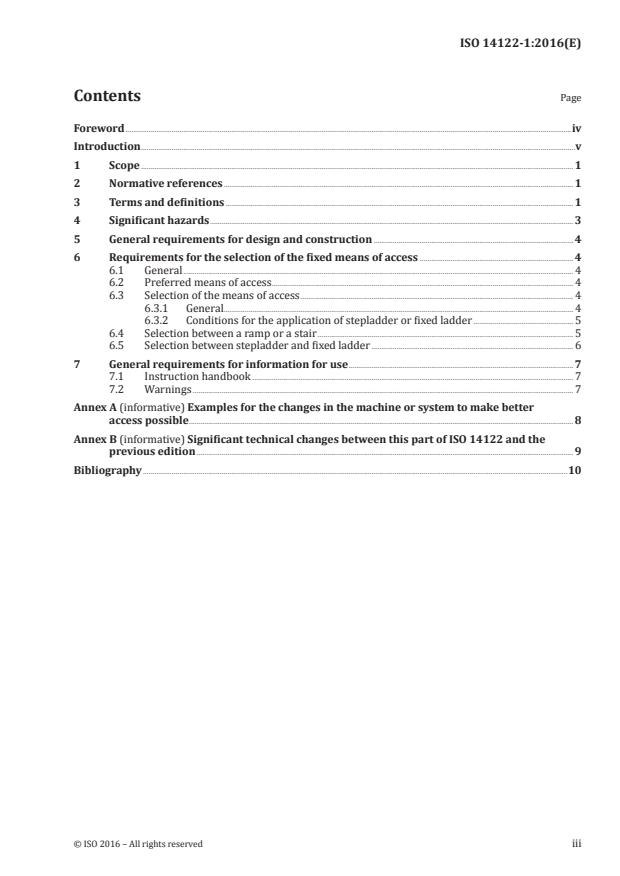
Contents Page
Foreword .iv
Introduction .v
1 Scope . 1
2 Normative references . 1
3 Terms and definitions . 1
4 Significant hazards . 3
5 General requirements for design and construction . 4
6 Requirements for the selection of the fixed means of access . 4
6.1 General . 4
6.2 Preferred means of access . 4
6.3 Selection of the means of access . 4
6.3.1 General. 4
6.3.2 Conditions for the application of stepladder or fixed ladder . 5
6.4 Selection between a ramp or a stair . 5
6.5 Selection between stepladder and fixed ladder . 6
7 General requirements for information for use . 7
7.1 Instruction handbook . 7
7.2 Warnings . 7
Annex A (informative) Examples for the changes in the machine or system to make better
access possible . 8
Annex B (informative) Significant technical changes between this part of ISO 14122 and the
previous edition . 9
Bibliography .10
Foreword
ISO (the International Organization for Standardization) is a worldwide federation of national standards
bodies (ISO member bodies). The work of preparing International Standards is normally carried out
through ISO technical committees. Each member body interested in a subject for which a technical
committee has been established has the right to be represented on that committee. International
organizations, governmental and non-governmental, in liaison with ISO, also take part in the work.
ISO collaborates closely with the International Electrotechnical Commission (IEC) on all matters of
electrotechnical standardization.
The procedures used to develop this document and those intended for its further maintenance are
described in the ISO/IEC Directives, Part 1. In particular the different approval criteria needed for the
different types of ISO documents should be noted. This document was drafted in accordance with the
editorial rules of the ISO/IEC Directives, Part 2 (see www.iso.org/directives).
Attention is drawn to the possibility that some of the elements of this document may be the subject of
patent rights. ISO shall not be held responsible for identifying any or all such patent rights. Details of
any patent rights identified during the development of the document will be in the Introduction and/or
on the ISO list of patent declarations received (see www.iso.org/patents).
Any trade name used in this document is information given for the convenience of users and does not
constitute an endorsement.
For an explanation on the meaning of ISO specific terms and expressions related to conformity
assessment, as well as information about ISO’s adherence to the WTO principles in the Technical
Barriers to Trade (TBT) see the following URL: Foreword - Supplementary information
The committee responsible for this document is ISO/TC 199, Safety of machinery.
This second edition cancels and replaces the first edition (ISO 14122-1:2001), which has been technically
revised. It also incorporates the Amendment ISO 14122-1:2001/Amd 1:2010. See Annex B.
ISO 14122 consists of the following parts, under the general title Safety of machinery — Permanent
means of access to machines:
— Part 1: Choice of fixed means and general requirements of access
— Part 2: Working platforms and walkways
— Part 3: Stairs, stepladders and guard-rails
— Part 4: Fixed ladders
An additional part, dealing with mobile machinery, is under preparation.
iv © ISO 2016 – All rights reserved
Introduction
This International Standard is a type-B standard as stated in ISO 12100.
This International Standard is of relevance, in particular, for the following stakeholder groups
representing the market players with regard to machinery safety:
— machine manufacturers (small, medium, and large enterprises);
— health and safety bodies (regulators, accident prevention organizations, market surveillance, etc.);
Others can be affected by the level of machinery safety achieved with the means of this International
Standard by the above-mentioned stakeholder groups:
— machine users/employers (small, medium, and large enterprises);
— machine users/employees (e.g. trade unions, organizations for people with special needs);
— service providers, e.g. for maintenance (small, medium, and large enterprises);
— consumers (in case of machinery intended for use by consumers).
The above mentioned stakeholder groups have been given the possibility to participate at the drafting
process of this International Standard.
In addition, this International Standard is intended for standardization bodies elaborating type-C
standards.
The requirements of this International Standard can be supplemented or modified by a type-C standard.
For machines which are covered by the scope of a type-C standard, and which have been designed and
built according to the requirements of that standard, the requirements of that type-C standard take
precedence.
The purpose of this International Standard is to define the general requirements for safe access to
machines. This part of ISO 14122 gives guidance about the correct choice of access means when the
necessary access to the machine is not possible directly from the ground level or from a floor or
platform.
Annex A is informative and contains “Examples of the possible changes in the machine or system to
make a better access possible”.
INTERNATIONAL STANDARD ISO 14122-1:2016(E)
Safety of machinery — Permanent means of access to
machinery —
Part 1:
Choice of fixed means and general requirements of access
1 Scope
This part of ISO 14122 gives general requirements for access to stationary machines and guidance about
the correct choice of means of access when necessary access to the stationary machine is not possible
directly from the ground level or from a floor.
It is applicable to permanent means of access which are a part of a stationary machine, and also to non-
powered adjustable parts (e.g. foldable, slidable) and movable parts of fixed means of access.
NOTE 1 “Fixed” means of access are those mounted in such a manner (for example, by screws, nuts, welding)
that they can only be removed by the use of tools.
This part of ISO 14122 specifies minimum requirements that also apply when the same means of access
is required as the part of the building or civil construction (e.g. working platforms, walkways, ladders)
where the machine is installed, on condition that the main function of that part of the construction is to
provide a means of access to the machine.
NOTE 2 Where no local regulation or standards exist, this part of ISO 14122 can be used for means of access
which are outside the scope of the standard.
It is intended that this part of ISO 14122 be used with a relevant access-specific part of ISO 14122.
The ISO 14122 series as a whole is applicable to both stationary and mobile machinery where fixed
means of access are necessary. It is not applicable to powered means of access such as lifts, escalators,
or other devices specially designed to lift persons between two levels.
This part of ISO 14122 is not applicable to machinery manufactured before the date of its publication.
For the significant hazards covered by this part of ISO 14122, see Clause 4.
2 Normative references
The following documents, in whole or in part, are normatively referenced in this document and are
indispensable for its application. For dated references, only the edition cited applies. For undated
references, the latest edition of the referenced document (including any amendments) applies.
ISO 12100, Safety of machinery — General principles for design — Risk assessment and risk reduction
ISO 14122-3:2016, Safety of machinery — Permanents means of access to machines — Part 3: Stairs,
stepladders and guard-rails
ISO 14122-4:2016, Safety of machinery — Permanent means of access to machine — Part 4: Fixed ladders
3 Terms and definitions
For the purposes of this document, the terms and definitions given in ISO 12100 and the following apply.
3.1
fixed ladder
fixed means of access with an angle of pitch from more than 75° up to 90°, whose horizontal elements
are rungs
Note 1 to entry: See Figure 1.
90˚
75˚
Figure 1 — 75° < angle of pitch ≤90° for a fixed ladder
3.2
stepladder
fixed means of access with an angle of pitch from more than 45° up to 75°, whose horizontal elements
are steps
Note 1 to entry: See Figure 2.
75˚
45˚
Figure 2 — 45° < angle of pitch ≤75° for a stepladder
3.3
stair
fixed means of access with an angle of pitch from more than 20° up to 45°, whose horizontal elements
are steps
Note 1 to entry: See Figure 3.
2 © ISO 2016 – All rights reserved
45˚
20˚
Figure 3 — 20° < angle of pitch ≤45° for a stair
3.4
ramp
fixed means of access, comprising a continuous inclined plane having an angle of pitch from more than
0° up to 20°
Note 1 to entry: See Figure 4.
20˚
Figure 4 — 0° < angle of pitch ≤20° for a ramp
4 Significant hazards
The most significant hazards to be considered when determining the type and location of the means of
access are the following:
a) falling;
b) falling from height;
c) slipping;
d) tripping;
e) excessive physical effort, e.g. from climbing a series of fix
...
INTERNATIONAL ISO
STANDARD 14122-1
Second edition
2016-06-01
Safety of machinery — Permanent
means of access to machinery —
Part 1:
Choice of fixed means and general
requirements of access
Sécurité des machines — Moyens d’accès permanents aux
machines —
Partie 1: Choix d’un moyen d’accès et des exigences générales d’accès
Reference number
©
ISO 2016
© ISO 2016, Published in Switzerland
All rights reserved. Unless otherwise specified, no part of this publication may be reproduced or utilized otherwise in any form
or by any means, electronic or mechanical, including photocopying, or posting on the internet or an intranet, without prior
written permission. Permission can be requested from either ISO at the address below or ISO’s member body in the country of
the requester.
ISO copyright office
Ch. de Blandonnet 8 • CP 401
CH-1214 Vernier, Geneva, Switzerland
Tel. +41 22 749 01 11
Fax +41 22 749 09 47
copyright@iso.org
www.iso.org
ii © ISO 2016 – All rights reserved
Contents Page
Foreword .iv
Introduction .v
1 Scope . 1
2 Normative references . 1
3 Terms and definitions . 1
4 Significant hazards . 3
5 General requirements for design and construction . 4
6 Requirements for the selection of the fixed means of access . 4
6.1 General . 4
6.2 Preferred means of access . 4
6.3 Selection of the means of access . 4
6.3.1 General. 4
6.3.2 Conditions for the application of stepladder or fixed ladder . 5
6.4 Selection between a ramp or a stair . 5
6.5 Selection between stepladder and fixed ladder . 6
7 General requirements for information for use . 7
7.1 Instruction handbook . 7
7.2 Warnings . 7
Annex A (informative) Examples for the changes in the machine or system to make better
access possible . 8
Annex B (informative) Significant technical changes between this part of ISO 14122 and the
previous edition . 9
Bibliography .10
Foreword
ISO (the International Organization for Standardization) is a worldwide federation of national standards
bodies (ISO member bodies). The work of preparing International Standards is normally carried out
through ISO technical committees. Each member body interested in a subject for which a technical
committee has been established has the right to be represented on that committee. International
organizations, governmental and non-governmental, in liaison with ISO, also take part in the work.
ISO collaborates closely with the International Electrotechnical Commission (IEC) on all matters of
electrotechnical standardization.
The procedures used to develop this document and those intended for its further maintenance are
described in the ISO/IEC Directives, Part 1. In particular the different approval criteria needed for the
different types of ISO documents should be noted. This document was drafted in accordance with the
editorial rules of the ISO/IEC Directives, Part 2 (see www.iso.org/directives).
Attention is drawn to the possibility that some of the elements of this document may be the subject of
patent rights. ISO shall not be held responsible for identifying any or all such patent rights. Details of
any patent rights identified during the development of the document will be in the Introduction and/or
on the ISO list of patent declarations received (see www.iso.org/patents).
Any trade name used in this document is information given for the convenience of users and does not
constitute an endorsement.
For an explanation on the meaning of ISO specific terms and expressions related to conformity
assessment, as well as information about ISO’s adherence to the WTO principles in the Technical
Barriers to Trade (TBT) see the following URL: Foreword - Supplementary information
The committee responsible for this document is ISO/TC 199, Safety of machinery.
This second edition cancels and replaces the first edition (ISO 14122-1:2001), which has been technically
revised. It also incorporates the Amendment ISO 14122-1:2001/Amd 1:2010. See Annex B.
ISO 14122 consists of the following parts, under the general title Safety of machinery — Permanent
means of access to machines:
— Part 1: Choice of fixed means and general requirements of access
— Part 2: Working platforms and walkways
— Part 3: Stairs, stepladders and guard-rails
— Part 4: Fixed ladders
An additional part, dealing with mobile machinery, is under preparation.
iv © ISO 2016 – All rights reserved
Introduction
This International Standard is a type-B standard as stated in ISO 12100.
This International Standard is of relevance, in particular, for the following stakeholder groups
representing the market players with regard to machinery safety:
— machine manufacturers (small, medium, and large enterprises);
— health and safety bodies (regulators, accident prevention organizations, market surveillance, etc.);
Others can be affected by the level of machinery safety achieved with the means of this International
Standard by the above-mentioned stakeholder groups:
— machine users/employers (small, medium, and large enterprises);
— machine users/employees (e.g. trade unions, organizations for people with special needs);
— service providers, e.g. for maintenance (small, medium, and large enterprises);
— consumers (in case of machinery intended for use by consumers).
The above mentioned stakeholder groups have been given the possibility to participate at the drafting
process of this International Standard.
In addition, this International Standard is intended for standardization bodies elaborating type-C
standards.
The requirements of this International Standard can be supplemented or modified by a type-C standard.
For machines which are covered by the scope of a type-C standard, and which have been designed and
built according to the requirements of that standard, the requirements of that type-C standard take
precedence.
The purpose of this International Standard is to define the general requirements for safe access to
machines. This part of ISO 14122 gives guidance about the correct choice of access means when the
necessary access to the machine is not possible directly from the ground level or from a floor or
platform.
Annex A is informative and contains “Examples of the possible changes in the machine or system to
make a better access possible”.
INTERNATIONAL STANDARD ISO 14122-1:2016(E)
Safety of machinery — Permanent means of access to
machinery —
Part 1:
Choice of fixed means and general requirements of access
1 Scope
This part of ISO 14122 gives general requirements for access to stationary machines and guidance about
the correct choice of means of access when necessary access to the stationary machine is not possible
directly from the ground level or from a floor.
It is applicable to permanent means of access which are a part of a stationary machine, and also to non-
powered adjustable parts (e.g. foldable, slidable) and movable parts of fixed means of access.
NOTE 1 “Fixed” means of access are those mounted in such a manner (for example, by screws, nuts, welding)
that they can only be removed by the use of tools.
This part of ISO 14122 specifies minimum requirements that also apply when the same means of access
is required as the part of the building or civil construction (e.g. working platforms, walkways, ladders)
where the machine is installed, on condition that the main function of that part of the construction is to
provide a means of access to the machine.
NOTE 2 Where no local regulation or standards exist, this part of ISO 14122 can be used for means of access
which are outside the scope of the standard.
It is intended that this part of ISO 14122 be used with a relevant access-specific part of ISO 14122.
The ISO 14122 series as a whole is applicable to both stationary and mobile machinery where fixed
means of access are necessary. It is not applicable to powered means of access such as lifts, escalators,
or other devices specially designed to lift persons between two levels.
This part of ISO 14122 is not applicable to machinery manufactured before the date of its publication.
For the significant hazards covered by this part of ISO 14122, see Clause 4.
2 Normative references
The following documents, in whole or in part, are normatively referenced in this document and are
indispensable for its application. For dated references, only the edition cited applies. For undated
references, the latest edition of the referenced document (including any amendments) applies.
ISO 12100, Safety of machinery — General principles for design — Risk assessment and risk reduction
ISO 14122-3:2016, Safety of machinery — Permanents means of access to machines — Part 3: Stairs,
stepladders and guard-rails
ISO 14122-4:2016, Safety of machinery — Permanent means of access to machine — Part 4: Fixed ladders
3 Terms and definitions
For the purposes of this document, the terms and definitions given in ISO 12100 and the following apply.
3.1
fixed ladder
fixed means of access with an angle of pitch from more than 75° up to 90°, whose horizontal elements
are rungs
Note 1 to entry: See Figure 1.
90˚
75˚
Figure 1 — 75° < angle of pitch ≤90° for a fixed ladder
3.2
stepladder
fixed means of access with an angle of pitch from more than 45° up to 75°, whose horizontal elements
are steps
Note 1 to entry: See Figure 2.
75˚
45˚
Figure 2 — 45° < angle of pitch ≤75° for a stepladder
3.3
stair
fixed means of access with an angle of pitch from more than 20° up to 45°, whose horizontal elements
are steps
Note 1 to entry: See Figure 3.
2 © ISO 2016 – All rights reserved
45˚
20˚
Figure 3 — 20° < angle of pitch ≤45° for a stair
3.4
ramp
fixed means of access, comprising a continuous inclined plane having an angle of pitch from more than
0° up to 20°
Note 1 to entry: See Figure 4.
20˚
Figure 4 — 0° < angle of pitch ≤20° for a ramp
4 Significant hazards
The most significant hazards to be considered when determining the type and location of the means of
access are the following:
a) falling;
b) falling from height;
c) slipping;
d) tripping;
e) excessive physical effort, e.g. from climbing a series of fix
...
NORME ISO
INTERNATIONALE 14122-1
Deuxième édition
2016-06-01
Sécurité des machines — Moyens
d’accès permanents aux machines —
Partie 1:
Choix d’un moyen d’accès et des
exigences générales d’accès
Safety of machinery — Permanent means of access to machinery —
Part 1: Choice of fixed means and general requirements of access
Numéro de référence
©
ISO 2016
DOCUMENT PROTÉGÉ PAR COPYRIGHT
© ISO 2016, Publié en Suisse
Droits de reproduction réservés. Sauf indication contraire, aucune partie de cette publication ne peut être reproduite ni utilisée
sous quelque forme que ce soit et par aucun procédé, électronique ou mécanique, y compris la photocopie, l’affichage sur
l’internet ou sur un Intranet, sans autorisation écrite préalable. Les demandes d’autorisation peuvent être adressées à l’ISO à
l’adresse ci-après ou au comité membre de l’ISO dans le pays du demandeur.
ISO copyright office
Ch. de Blandonnet 8 • CP 401
CH-1214 Vernier, Geneva, Switzerland
Tel. +41 22 749 01 11
Fax +41 22 749 09 47
copyright@iso.org
www.iso.org
ii © ISO 2016 – Tous droits réservés
Sommaire Page
Avant-propos .iv
Introduction .v
1 Domaine d’application . 1
2 Références normatives . 1
3 Termes et définitions . 2
4 Phénomènes dangereux significatifs . 3
5 Exigences générales pour la conception et la construction . 4
6 Conditions de choix du moyen d’accès fixe . 4
6.1 Généralités . 4
6.2 Moyen d’accès préférable . 5
6.3 Choix du moyen d’accès . 5
6.3.1 Généralités . 5
6.3.2 Conditions d’application d’une échelle fixe ou d’une échelle à marches . . 5
6.4 Choix entre une rampe ou un escalier . 6
6.5 Choix entre échelle fixe et échelle à marches . 6
7 Exigences générales pour les informations pour l’’utilisation . 7
7.1 Instructions . 7
7.2 Avertissements . 8
Annexe A (informative) Exemples pour modifications éventuelles sur la machine ou
l’installation pour rendre possible un meilleur accès . 9
Annexe B (informative) Modifications techniques significatives entre la présente partie de
l’l’ISO 14122 et l’édition précédente .10
Bibliographie .11
Avant-propos
L’ISO (Organisation internationale de normalisation) est une fédération mondiale d’organismes
nationaux de normalisation (comités membres de l’ISO). L’élaboration des Normes internationales est
en général confiée aux comités techniques de l’ISO. Chaque comité membre intéressé par une étude
a le droit de faire partie du comité technique créé à cet effet. Les organisations internationales,
gouvernementales et non gouvernementales, en liaison avec l’ISO participent également aux travaux.
L’ISO collabore étroitement avec la Commission électrotechnique internationale (IEC) en ce qui
concerne la normalisation électrotechnique.
Les procédures utilisées pour élaborer le présent document et celles destinées à sa mise à jour sont
décrites dans les Directives ISO/IEC, Partie 1. Il convient, en particulier de prendre note des différents
critères d’approbation requis pour les différents types de documents ISO. Le présent document a été
rédigé conformément aux règles de rédaction données dans les Directives ISO/IEC, Partie 2 (voir www.
iso.org/directives).
L’attention est appelée sur le fait que certains des éléments du présent document peuvent faire l’objet de
droits de propriété intellectuelle ou de droits analogues. L’ISO ne saurait être tenue pour responsable
de ne pas avoir identifié de tels droits de propriété et averti de leur existence. Les détails concernant
les références aux droits de propriété intellectuelle ou autres droits analogues identifiés lors de
l’élaboration du document sont indiqués dans l’Introduction et/ou dans la liste des déclarations de
brevets reçues par l’ISO (voir www.iso.org/brevets).
Les appellations commerciales éventuellement mentionnées dans le présent document sont données
pour information, par souci de commodité, à l’intention des utilisateurs et ne sauraient constituer un
engagement.
Pour une explication de la signification des termes et expressions spécifiques de l’ISO liés à
l’évaluation de la conformité, ou pour toute information au sujet de l’adhésion de l’ISO aux principes
de l’OMC concernant les obstacles techniques au commerce (OTC), voir le lien suivant: Avant-propos —
Informations supplémentaires.
Le comité chargé de l’élaboration du présent document est l’ISO/TC 199, Sécurité des machines.
Cette deuxième édition annule et remplace la première édition (ISO 14122-1:2001), dont elle constitue
une révision technique. Elle incorpore également l’Amendement ISO 14122-1:1/Amd 1:2010. Voir
l’Annexe B.
L’ISO 14122 comprend les parties suivantes, présentées sous le titre général Sécurité des machines —
Moyens d’accès permanents aux machines:
— Partie 1: Choix d’un moyen d’accès et des exigences générales d’accès
— Partie 2: Plates-formes de travail et passerelles
— Partie 3: Escaliers, échelles à marches et garde-corps
— Partie 4: Échelles fixes
Une additionnelle partie traitant des machines mobiles est en préparation.
iv © ISO 2016 – Tous droits réservés
Introduction
La présente Norme internationale est une norme de type B tel que stipulé dans l’ISO 12100.
La présente Norme internationale est destinée en particulier aux groupes de parties prenantes suivants,
qui représentent les acteurs du marché en matière de sécurité des machines:
— les fabricants de machines (petites, moyennes et grandes entreprises);
— les organismes d’hygiène et de sécurité (autorités réglementaires, organismes de prévention des
accidents, surveillance du marché, etc.).
D’autres personnes peuvent être concernées par le niveau de sécurité des machines obtenu par
l’intermédiaire des moyens mis en œuvre dans la présente Norme internationale par les groupes de
parties prenantes mentionnés ci-dessus:
— les utilisateurs de machines/employeurs (petites, moyennes et grandes entreprises);
— les utilisateurs de machines/employés (par exemple syndicats, organisations de personnes ayant
des besoins spécifiques);
— les prestataires de services, par exemple pour la maintenance (petites, moyennes et grandes
entreprises);
— les consommateurs (s’il est prévu que la machine soit utilisée par des consommateurs).
Les groupes de parties prenantes mentionnés ci-dessus ont eu la possibilité de participer à l’élaboration
de la présente Norme internationale.
La présente Norme internationale est en outre destinée aux organismes de normalisation élaborant des
normes de type C.
Les exigences de la présente Norme internationale peuvent être complétées ou modifiées par une
norme de type C.
Pour les machines couvertes par le domaine d’application d’une norme de type C et qui ont été conçues
et construites suivant les exigences de cette norme, les exigences de ladite norme de type C sont
prioritaires.
L’objet de la présente Norme internationale est de définir les exigences générales de sécurité d’accès aux
machines. La présente partie de l’ISO 14122 donne des lignes directrices concernant le choix approprié
des moyens d’accès lorsque l’accès nécessaire à la machine n’est pas directement possible à partir du
niveau du sol, d’un plancher ou d’une plateforme.
L’Annexe A est informative et contient «Différentes méthodes de détermination des niveaux de glissance
des sols».
NORME INTERNATIONALE ISO 14122-1:2016(F)
Sécurité des machines — Moyens d’accès permanents aux
machines —
Partie 1:
Choix d’un moyen d’accès et des exigences générales d’accès
1 Domaine d’application
La présente partie de l’ISO 14122 donne les exigences pour l’accès aux machines fixes ainsi que les lignes
directrices concernant le choix approprié des moyens d’accès lorsque l’accès nécessaire à la machine
n’est pas directement possible à partir du niveau du sol ou d’un plancher.
Elle est applicable aux moyens d’accès permanents faisant partie intégrante d’une machine fixe, aux
parties réglables non-motorisées (par exemple pliables, coulissantes) ainsi qu’aux parties mobiles de
ces systèmes d’échelles fixes.
NOTE 1 Les moyens d’accès «fixes» sont ceux montés de telle manière (par exemple par boulonnage, par
soudage) qu’ils ne puissent être ouvert ou démonté qu’à l’aide d’outils.
La présente partie de l’ISO 14122 spécifie les exigences minimales s’appliquant également aux moyens
d’accès aux parties du bâtiment ou de la construction civile (par exemple plates-formes de travail,
passerelles, échelles) où la machine est installée, à condition que la fonction principale de cette partie
de la construction soit de donner accès à la machine.
NOTE 2 Lorsqu’aucune norme nationale ou réglementation n’existe, la présente partie de l’ISO 14122 peut être
utilisée pour les moyens d’accès en dehors de son domaine d’application.
La présente partie de l’ISO 14122 est destinée à être utilisée conjointement avec une des parties de
l’ISO 14122 spécifique aux accès, selon le cas.
L’ensemble de la série de normes ISO 14122 est applicable aux machines fixes et mobiles pour lesquelles
des moyens d’accès fixes sont nécessaires. Cette série n’est pas applicable aux moyens d’accès motorisés
tels que les ascenseurs, les escalators, ou d’autres dispositifs conçus spécialement pour soulever des
personnes entre deux niveaux.
La présente partie de l’ISO 14122 n’est pas applicable aux machines fabriquées avant sa date de
publication.
Pour les phénomènes dangereux significatifs couverts par la présente partie de l’ISO 14122, voir
l’Article 4.
2 Références normatives
Les documents suivants, en tout ou partie, sont référencés de façon normative dans le présent document
et sont indispensables à son application. Pour les références datées, seule l’édition citée s’applique.
Pour les références non datées, la dernière édition du document de référence s’applique (y compris les
éventuels amendements).
ISO 12100, Sécurité des machines — Principes généraux de conception — Appréciation du risque et
réduction du risque
ISO 14122-3:2016, Safety of machinery — Permanents means of access to machines — Part 3: Stairs,
stepladders and guard-rails
ISO 14122-4:2016, Sécurité des machines — Moyens d’accès permanents aux machines — Partie 4:
Échelles fixes
3 Termes et définitions
Pour les besoins du présent document, les termes et définitions donnés dans l’ISO 12100 ainsi que les
suivants s’appliquent.
3.1
échelle fixe
moyen d’accès fixe avec un angle d’inclinaison supérieur à 75° et jusqu’à 90°, et dont les éléments
horizontaux sont des échelons
Note 1 à l’article: Voir Figure 1.
90˚
75˚
Figure 1 — 75° < angle d’inclinaison ≤ 90° pour un échelle fixe
3.2
échelle à marches
moyen d’accès fixe avec un angle d’inclinaison supérieur à 45° et jusqu’à 75°, et dont les éléments
horizontaux sont des marches
Note 1 à l’article: Voir Figure 2.
75˚
45˚
Figure 2 — 45° < angle d’inclinaison ≤ 75° pour un échelle à marches
2 © ISO 2016 – Tous droits réservés
3.3
escalier
moyen d’accès fixe avec un angle d’inclinaison supérieur à 20° et jusqu’à 45°, et dont les éléments
horizontaux sont des marches
Note 1 à l’article: Voir Figure 3.
45˚
20˚
Figure 3 — 20° < angle d’inclinaison ≤ 45° pour un escalier
3.4
rampe
moyen d’accès fixe constitué d’un plan continu incliné, avec un angle d’inclinaison supérieur à 0° et
jusqu’à 20°
Note 1 à l’article: Voir Figure 4.
20˚
Figure 4 — 0° < angle d’inclinaison ≤ 20° pour une rampe
4 Phénomènes dangereux significatifs
Les phénomènes dangereux les plus significatifs à prendre en considération lors de la définition du type
et de l’emplacement du moyen d’accès sont les suivants:
a) Risque de chute;
b) Risque de chute de hauteur;
c) Risque de glissade;
d) Risque de trébuchement;
e) Risque provoqué par un effort physique excessif, par exemple une longue volée d’échelles fixes;
f) Risques dû aux chutes de matériaux ou objets lorsque cela présente un risque pour les personnes.
NOTE 1 D’autres phénomènes dangereux engendrés par les machines et auxquelles une personne pourrait
être exposée lors de l’accès à celles-ci en utilisant des moyens d’accès considérés dans la présente norme, par
exemple causés par le fonctionnement des machines [éléments mobiles de la machine, mouvement de la machine
...
NORME ISO
INTERNATIONALE 14122-1
Deuxième édition
2016-06-01
Sécurité des machines — Moyens
d’accès permanents aux machines —
Partie 1:
Choix d’un moyen d’accès et des
exigences générales d’accès
Safety of machinery — Permanent means of access to machinery —
Part 1: Choice of fixed means and general requirements of access
Numéro de référence
©
ISO 2016
DOCUMENT PROTÉGÉ PAR COPYRIGHT
© ISO 2016, Publié en Suisse
Droits de reproduction réservés. Sauf indication contraire, aucune partie de cette publication ne peut être reproduite ni utilisée
sous quelque forme que ce soit et par aucun procédé, électronique ou mécanique, y compris la photocopie, l’affichage sur
l’internet ou sur un Intranet, sans autorisation écrite préalable. Les demandes d’autorisation peuvent être adressées à l’ISO à
l’adresse ci-après ou au comité membre de l’ISO dans le pays du demandeur.
ISO copyright office
Ch. de Blandonnet 8 • CP 401
CH-1214 Vernier, Geneva, Switzerland
Tel. +41 22 749 01 11
Fax +41 22 749 09 47
copyright@iso.org
www.iso.org
ii © ISO 2016 – Tous droits réservés
Sommaire Page
Avant-propos .iv
Introduction .v
1 Domaine d’application . 1
2 Références normatives . 1
3 Termes et définitions . 2
4 Phénomènes dangereux significatifs . 3
5 Exigences générales pour la conception et la construction . 4
6 Conditions de choix du moyen d’accès fixe . 4
6.1 Généralités . 4
6.2 Moyen d’accès préférable . 5
6.3 Choix du moyen d’accès . 5
6.3.1 Généralités . 5
6.3.2 Conditions d’application d’une échelle fixe ou d’une échelle à marches . . 5
6.4 Choix entre une rampe ou un escalier . 6
6.5 Choix entre échelle fixe et échelle à marches . 6
7 Exigences générales pour les informations pour l’’utilisation . 7
7.1 Instructions . 7
7.2 Avertissements . 8
Annexe A (informative) Exemples pour modifications éventuelles sur la machine ou
l’installation pour rendre possible un meilleur accès . 9
Annexe B (informative) Modifications techniques significatives entre la présente partie de
l’l’ISO 14122 et l’édition précédente .10
Bibliographie .11
Avant-propos
L’ISO (Organisation internationale de normalisation) est une fédération mondiale d’organismes
nationaux de normalisation (comités membres de l’ISO). L’élaboration des Normes internationales est
en général confiée aux comités techniques de l’ISO. Chaque comité membre intéressé par une étude
a le droit de faire partie du comité technique créé à cet effet. Les organisations internationales,
gouvernementales et non gouvernementales, en liaison avec l’ISO participent également aux travaux.
L’ISO collabore étroitement avec la Commission électrotechnique internationale (IEC) en ce qui
concerne la normalisation électrotechnique.
Les procédures utilisées pour élaborer le présent document et celles destinées à sa mise à jour sont
décrites dans les Directives ISO/IEC, Partie 1. Il convient, en particulier de prendre note des différents
critères d’approbation requis pour les différents types de documents ISO. Le présent document a été
rédigé conformément aux règles de rédaction données dans les Directives ISO/IEC, Partie 2 (voir www.
iso.org/directives).
L’attention est appelée sur le fait que certains des éléments du présent document peuvent faire l’objet de
droits de propriété intellectuelle ou de droits analogues. L’ISO ne saurait être tenue pour responsable
de ne pas avoir identifié de tels droits de propriété et averti de leur existence. Les détails concernant
les références aux droits de propriété intellectuelle ou autres droits analogues identifiés lors de
l’élaboration du document sont indiqués dans l’Introduction et/ou dans la liste des déclarations de
brevets reçues par l’ISO (voir www.iso.org/brevets).
Les appellations commerciales éventuellement mentionnées dans le présent document sont données
pour information, par souci de commodité, à l’intention des utilisateurs et ne sauraient constituer un
engagement.
Pour une explication de la signification des termes et expressions spécifiques de l’ISO liés à
l’évaluation de la conformité, ou pour toute information au sujet de l’adhésion de l’ISO aux principes
de l’OMC concernant les obstacles techniques au commerce (OTC), voir le lien suivant: Avant-propos —
Informations supplémentaires.
Le comité chargé de l’élaboration du présent document est l’ISO/TC 199, Sécurité des machines.
Cette deuxième édition annule et remplace la première édition (ISO 14122-1:2001), dont elle constitue
une révision technique. Elle incorpore également l’Amendement ISO 14122-1:1/Amd 1:2010. Voir
l’Annexe B.
L’ISO 14122 comprend les parties suivantes, présentées sous le titre général Sécurité des machines —
Moyens d’accès permanents aux machines:
— Partie 1: Choix d’un moyen d’accès et des exigences générales d’accès
— Partie 2: Plates-formes de travail et passerelles
— Partie 3: Escaliers, échelles à marches et garde-corps
— Partie 4: Échelles fixes
Une additionnelle partie traitant des machines mobiles est en préparation.
iv © ISO 2016 – Tous droits réservés
Introduction
La présente Norme internationale est une norme de type B tel que stipulé dans l’ISO 12100.
La présente Norme internationale est destinée en particulier aux groupes de parties prenantes suivants,
qui représentent les acteurs du marché en matière de sécurité des machines:
— les fabricants de machines (petites, moyennes et grandes entreprises);
— les organismes d’hygiène et de sécurité (autorités réglementaires, organismes de prévention des
accidents, surveillance du marché, etc.).
D’autres personnes peuvent être concernées par le niveau de sécurité des machines obtenu par
l’intermédiaire des moyens mis en œuvre dans la présente Norme internationale par les groupes de
parties prenantes mentionnés ci-dessus:
— les utilisateurs de machines/employeurs (petites, moyennes et grandes entreprises);
— les utilisateurs de machines/employés (par exemple syndicats, organisations de personnes ayant
des besoins spécifiques);
— les prestataires de services, par exemple pour la maintenance (petites, moyennes et grandes
entreprises);
— les consommateurs (s’il est prévu que la machine soit utilisée par des consommateurs).
Les groupes de parties prenantes mentionnés ci-dessus ont eu la possibilité de participer à l’élaboration
de la présente Norme internationale.
La présente Norme internationale est en outre destinée aux organismes de normalisation élaborant des
normes de type C.
Les exigences de la présente Norme internationale peuvent être complétées ou modifiées par une
norme de type C.
Pour les machines couvertes par le domaine d’application d’une norme de type C et qui ont été conçues
et construites suivant les exigences de cette norme, les exigences de ladite norme de type C sont
prioritaires.
L’objet de la présente Norme internationale est de définir les exigences générales de sécurité d’accès aux
machines. La présente partie de l’ISO 14122 donne des lignes directrices concernant le choix approprié
des moyens d’accès lorsque l’accès nécessaire à la machine n’est pas directement possible à partir du
niveau du sol, d’un plancher ou d’une plateforme.
L’Annexe A est informative et contient «Différentes méthodes de détermination des niveaux de glissance
des sols».
NORME INTERNATIONALE ISO 14122-1:2016(F)
Sécurité des machines — Moyens d’accès permanents aux
machines —
Partie 1:
Choix d’un moyen d’accès et des exigences générales d’accès
1 Domaine d’application
La présente partie de l’ISO 14122 donne les exigences pour l’accès aux machines fixes ainsi que les lignes
directrices concernant le choix approprié des moyens d’accès lorsque l’accès nécessaire à la machine
n’est pas directement possible à partir du niveau du sol ou d’un plancher.
Elle est applicable aux moyens d’accès permanents faisant partie intégrante d’une machine fixe, aux
parties réglables non-motorisées (par exemple pliables, coulissantes) ainsi qu’aux parties mobiles de
ces systèmes d’échelles fixes.
NOTE 1 Les moyens d’accès «fixes» sont ceux montés de telle manière (par exemple par boulonnage, par
soudage) qu’ils ne puissent être ouvert ou démonté qu’à l’aide d’outils.
La présente partie de l’ISO 14122 spécifie les exigences minimales s’appliquant également aux moyens
d’accès aux parties du bâtiment ou de la construction civile (par exemple plates-formes de travail,
passerelles, échelles) où la machine est installée, à condition que la fonction principale de cette partie
de la construction soit de donner accès à la machine.
NOTE 2 Lorsqu’aucune norme nationale ou réglementation n’existe, la présente partie de l’ISO 14122 peut être
utilisée pour les moyens d’accès en dehors de son domaine d’application.
La présente partie de l’ISO 14122 est destinée à être utilisée conjointement avec une des parties de
l’ISO 14122 spécifique aux accès, selon le cas.
L’ensemble de la série de normes ISO 14122 est applicable aux machines fixes et mobiles pour lesquelles
des moyens d’accès fixes sont nécessaires. Cette série n’est pas applicable aux moyens d’accès motorisés
tels que les ascenseurs, les escalators, ou d’autres dispositifs conçus spécialement pour soulever des
personnes entre deux niveaux.
La présente partie de l’ISO 14122 n’est pas applicable aux machines fabriquées avant sa date de
publication.
Pour les phénomènes dangereux significatifs couverts par la présente partie de l’ISO 14122, voir
l’Article 4.
2 Références normatives
Les documents suivants, en tout ou partie, sont référencés de façon normative dans le présent document
et sont indispensables à son application. Pour les références datées, seule l’édition citée s’applique.
Pour les références non datées, la dernière édition du document de référence s’applique (y compris les
éventuels amendements).
ISO 12100, Sécurité des machines — Principes généraux de conception — Appréciation du risque et
réduction du risque
ISO 14122-3:2016, Safety of machinery — Permanents means of access to machines — Part 3: Stairs,
stepladders and guard-rails
ISO 14122-4:2016, Sécurité des machines — Moyens d’accès permanents aux machines — Partie 4:
Échelles fixes
3 Termes et définitions
Pour les besoins du présent document, les termes et définitions donnés dans l’ISO 12100 ainsi que les
suivants s’appliquent.
3.1
échelle fixe
moyen d’accès fixe avec un angle d’inclinaison supérieur à 75° et jusqu’à 90°, et dont les éléments
horizontaux sont des échelons
Note 1 à l’article: Voir Figure 1.
90˚
75˚
Figure 1 — 75° < angle d’inclinaison ≤ 90° pour un échelle fixe
3.2
échelle à marches
moyen d’accès fixe avec un angle d’inclinaison supérieur à 45° et jusqu’à 75°, et dont les éléments
horizontaux sont des marches
Note 1 à l’article: Voir Figure 2.
75˚
45˚
Figure 2 — 45° < angle d’inclinaison ≤ 75° pour un échelle à marches
2 © ISO 2016 – Tous droits réservés
3.3
escalier
moyen d’accès fixe avec un angle d’inclinaison supérieur à 20° et jusqu’à 45°, et dont les éléments
horizontaux sont des marches
Note 1 à l’article: Voir Figure 3.
45˚
20˚
Figure 3 — 20° < angle d’inclinaison ≤ 45° pour un escalier
3.4
rampe
moyen d’accès fixe constitué d’un plan continu incliné, avec un angle d’inclinaison supérieur à 0° et
jusqu’à 20°
Note 1 à l’article: Voir Figure 4.
20˚
Figure 4 — 0° < angle d’inclinaison ≤ 20° pour une rampe
4 Phénomènes dangereux significatifs
Les phénomènes dangereux les plus significatifs à prendre en considération lors de la définition du type
et de l’emplacement du moyen d’accès sont les suivants:
a) Risque de chute;
b) Risque de chute de hauteur;
c) Risque de glissade;
d) Risque de trébuchement;
e) Risque provoqué par un effort physique excessif, par exemple une longue volée d’échelles fixes;
f) Risques dû aux chutes de matériaux ou objets lorsque cela présente un risque pour les personnes.
NOTE 1 D’autres phénomènes dangereux engendrés par les machines et auxquelles une personne pourrait
être exposée lors de l’accès à celles-ci en utilisant des moyens d’accès considérés dans la présente norme, par
exemple causés par le fonctionnement des machines [éléments mobiles de la machine, mouvement de la machine
...