

ISO 31510:2025
(Main)Cold chain logistics — Vocabulary
General Information
- Abstract
This document defines terms in the field of cold chain logistics.
- Status
- Published
- Publication Date
- 17-Sep-2025
- Technical Committee
- ISO/TC 315 - Cold chain logistics
- Drafting Committee
- ISO/TC 315 - Cold chain logistics
- Current Stage
- 9092 - International Standard to be revised
- Start Date
- 09-Dec-2025
- Completion Date
- 29-Aug-2026
Overview
ISO 31510:2025, titled Cold Chain Logistics - Vocabulary, is an international standard published by the International Organization for Standardization (ISO) that defines terminology used within the field of cold chain logistics. Released in September 2025, this document serves as an authoritative resource to establish a common language among professionals involved in the storage, handling, and transportation of temperature-sensitive goods. By providing clear and consistent definitions, ISO 31510:2025 facilitates improved communication, operational efficiency, and quality control across the cold chain industry.
The standard covers terms related to facilities, equipment, individuals and organizations, processes, logistics activities, and operational indices, ensuring comprehensive coverage of the cold chain logistics domain.
Key Topics
ISO 31510:2025 categorizes terminology into six main sections, each addressing critical aspects of cold chain logistics.
Facilities
- Cold store: Refrigerated facilities maintaining low temperatures to preserve perishable goods.
- Controlled atmosphere cold store: Stores controlling temperature and atmospheric conditions to extend product shelf life.
Equipment
- Reefer container: Shipping containers equipped with refrigeration units to maintain specific temperature ranges for perishables.
- Cold storage door: Insulated doors designed for cold storage facilities that meet insulation and hygiene standards.
- Cooling materials: Substances or units such as dry ice or eutectic plates used to lower temperatures in confined environments.
- Refrigerated vehicle: Vehicles with cooling systems for transporting temperature-sensitive goods.
- Thermally insulated container: Mobile containers with insulation to reduce heat transfer during transportation.
Individuals and Organizations
- Cold chain distribution service provider: Individuals or entities offering temperature-controlled delivery services.
- Refrigerated warehousing enterprise: Companies specializing in low-temperature storage solutions.
Processes
- Freezing: Converting liquid content of goods into solid by heat removal.
- Chilling: Cooling goods to above freezing temperatures.
- Blast freezing and slow freezing: Different freezing methods based on time and temperature control.
- Defrosting: Removing frost buildup to restore cooling efficiency.
- Temperature control: Measuring and maintaining specific temperature ranges to preserve product quality.
Logistics Activity
- Cold chain logistics: The controlled temperature management of goods from production through consumption.
- Cold chain distribution: Transporting products at required temperatures to end consumers.
- Temperature-controlled transportation: Methods using heating, cooling, or insulation to maintain required temperatures.
Operation Index
- Cooling capacity: The rate of heat removal from a confined space.
- Operational transport temperature: The defined temperature ranges within which refrigerated operations are performed.
- Core temperature: Temperature measured at the center of goods.
- Ultra-low temperature: Storage temperatures below -50 °C for highly sensitive items like some medicines or large fish.
Applications
ISO 31510:2025 is essential for professionals and organizations involved in cold chain management, including:
- Logistics companies specializing in perishable goods transport.
- Warehousing operators managing temperature-controlled storage.
- Food and pharmaceutical industries requiring strict temperature control to maintain product integrity.
- Equipment manufacturers producing refrigerated vehicles, containers, and related systems.
- Quality assurance teams ensuring compliance with cold chain standards and minimizing quality degradation caused by temperature fluctuations.
This standardized vocabulary supports the design, implementation, auditing, and optimization of cold chain systems to improve product safety, reduce spoilage, and enhance operational transparency throughout the supply chain.
Related Standards
ISO 31510:2025 complements several other international standards that address broader or related aspects of cold chain logistics and refrigeration technology, such as:
- ISO 23412: Refrigerated transport equipment terminology.
- ISO 9001: Quality management systems, applicable to cold chain quality control.
- ISO 22000: Food safety management systems, ensuring safety in temperature-controlled food logistics.
- IEC standards covering refrigeration electrical components and controls.
Implementing ISO 31510:2025 vocabulary enhances interoperability and compliance with these standards, fostering better integration of operational practices and technological solutions.
Keywords: ISO 31510:2025, cold chain logistics vocabulary, temperature-controlled transport, refrigerated storage, cold chain terminology, perishable goods logistics, refrigerated vehicles, cold storage facilities, temperature control processes, cold chain distribution.
Get Certified
Connect with accredited certification bodies for this standard

BSI Group
BSI (British Standards Institution) is the business standards company that helps organizations make excellence a habit.

Bureau Veritas
Bureau Veritas is a world leader in laboratory testing, inspection and certification services.

DNV
DNV is an independent assurance and risk management provider.
Sponsored listings
Frequently Asked Questions
ISO 31510:2025 is a standard published by the International Organization for Standardization (ISO). Its full title is "Cold chain logistics — Vocabulary". This standard covers: This document defines terms in the field of cold chain logistics.
This document defines terms in the field of cold chain logistics.
ISO 31510:2025 is classified under the following ICS (International Classification for Standards) categories: 01.040.03 - Services. Company organization, management and quality. Administration. Transport. Sociology. (Vocabularies); 03.100.10 - Purchasing. Procurement. Logistics. The ICS classification helps identify the subject area and facilitates finding related standards.
ISO 31510:2025 is available in PDF format for immediate download after purchase. The document can be added to your cart and obtained through the secure checkout process. Digital delivery ensures instant access to the complete standard document.
Standards Content (Sample)
International
Standard
ISO 31510
First edition
Cold chain logistics — Vocabulary
2025-09
Logistique de la chaîne du froid — Vocabulaire
Reference number
© ISO 2025
All rights reserved. Unless otherwise specified, or required in the context of its implementation, no part of this publication may
be reproduced or utilized otherwise in any form or by any means, electronic or mechanical, including photocopying, or posting on
the internet or an intranet, without prior written permission. Permission can be requested from either ISO at the address below
or ISO’s member body in the country of the requester.
ISO copyright office
CP 401 • Ch. de Blandonnet 8
CH-1214 Vernier, Geneva
Phone: +41 22 749 01 11
Email: copyright@iso.org
Website: www.iso.org
Published in Switzerland
ii
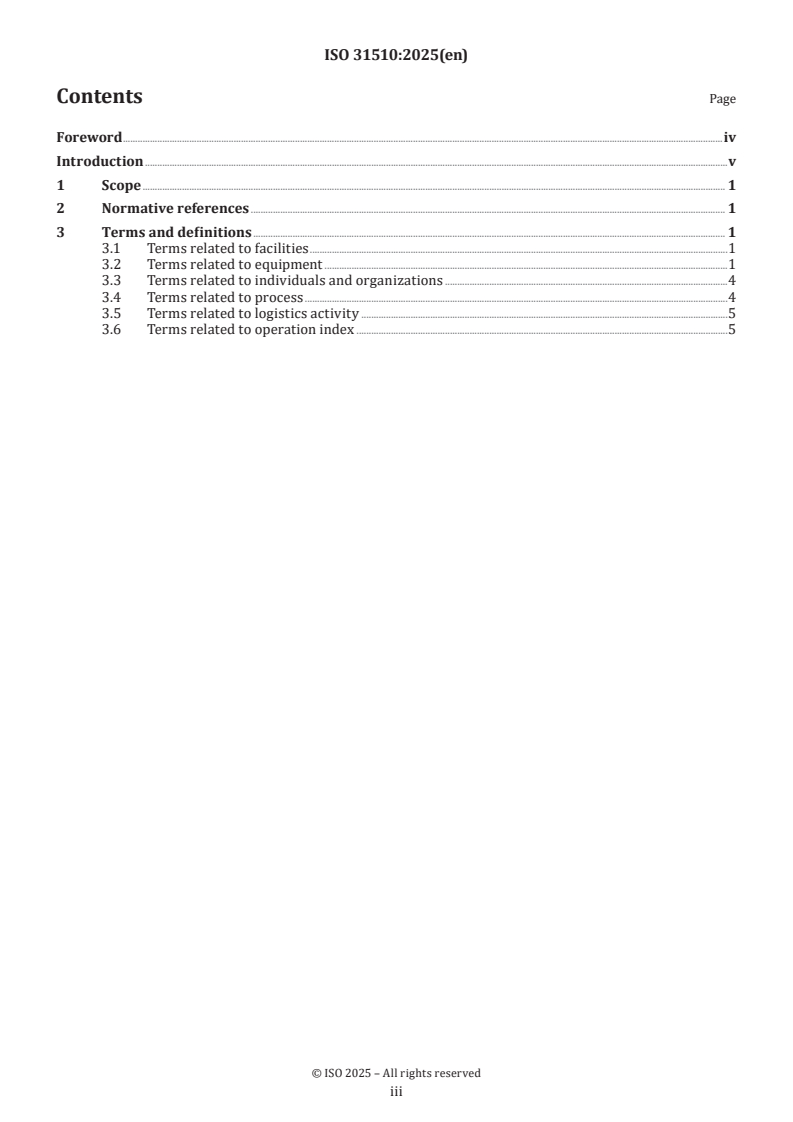
Contents Page
Foreword .iv
Introduction .v
1 Scope . 1
2 Normative references . 1
3 Terms and definitions . 1
3.1 Terms related to facilities .1
3.2 Terms related to equipment .1
3.3 Terms related to individuals and organizations .4
3.4 Terms related to process .4
3.5 Terms related to logistics activity .5
3.6 Terms related to operation index .5
iii
Foreword
ISO (the International Organization for Standardization) is a worldwide federation of national standards
bodies (ISO member bodies). The work of preparing International Standards is normally carried out through
ISO technical committees. Each member body interested in a subject for which a technical committee
has been established has the right to be represented on that committee. International organizations,
governmental and non-governmental, in liaison with ISO, also take part in the work. ISO collaborates closely
with the International Electrotechnical Commission (IEC) on all matters of electrotechnical standardization.
The procedures used to develop this document and those intended for its further maintenance are described
in the ISO/IEC Directives, Part 1. In particular, the different approval criteria needed for the different types
of ISO document should be noted. This document was drafted in accordance with the editorial rules of the
ISO/IEC Directives, Part 2 (see www.iso.org/directives).
ISO draws attention to the possibility that the implementation of this document may involve the use of (a)
patent(s). ISO takes no position concerning the evidence, validity or applicability of any claimed patent
rights in respect thereof. As of the date of publication of this document, ISO had not received notice of (a)
patent(s) which may be required to implement this document. However, implementers are cautioned that
this may not represent the latest information, which may be obtained from the patent database available at
www.iso.org/patents. ISO shall not be held responsible for identifying any or all such patent rights.
Any trade name used in this document is information given for the convenience of users and does not
constitute an endorsement.
For an explanation of the voluntary nature of standards, the meaning of ISO specific terms and expressions
related to conformity assessment, as well as information about ISO's adherence to the World Trade
Organization (WTO) principles in the Technical Barriers to Trade (TBT), see www.iso.org/iso/foreword.html.
This document was prepared by Technical Committee ISO/TC 315, Cold chain logistics.
Any feedback or questions on this document should be directed to the user’s national standards body. A
complete listing of these bodies can be found at www.iso.org/members.html.
iv
Introduction
The objective of this document is to ensure a coherent approach to the description of the cold chain logistics
activities and the use of related terminology. Its purpose is to foster mutual understanding between different
stakeholders in the field of cold chain logistics.
This document presents terms and definitions in the following areas of cold chain logistics:
— facility;
— equipment;
— individuals and organizations;
— process;
— logistics activity;
— operation index.
v
International Standard ISO 31510:2025(en)
Cold chain logistics — Vocabulary
1 Scope
This document defines terms in the field of cold chain logistics.
2 Normative references
There are no normative references in this document.
3 Terms and definitions
ISO and IEC maintain terminology databases for use in standardization at the following addresses:
— ISO Online browsing platform: available at https:// www .iso .org/ obp
— IEC Electropedia: available at https:// www .electropedia .org/
3.1 Terms related to facilities
3.1.1
cold store
refrigerated facility for storing perishable goods through maintaining controlled low temperatures to
preserve their quality and freshness
3.1.2
controlled atmosphere cold store
cold storage (3.5.3) facility that controls both the temperature and the atmosphere condition to extend the
storage life of perishable goods and maintain their quality and freshness
3.2 Terms related to equipment
3.2.1
cold storage door
special insulation door for cold storage (3.5.3) made of building steel or aluminum alloy or fibre-reinforced
plastic, and attached with insulation materials
Note 1 to entry: Insulation materials should meet the insulation performance and food hygiene standards.
3.2.2
coolant
single-phase fluid (usually a liquid) used for transferring heat from one place to another
Note 1 to entry: Coolant is sometimes referred to as either heat transfer fluid, brine, or secondary refrigerant (3.2.16).
3.2.3
cooling material
substance or unit containing a substance, capable of lowering the temperature of an enclosed environment
3.2.4
cooling material cold store
equipment having an insulated enclosure, which has an independent means of cooling, that is used for
freezing (3.4.5) and preserving cooling materials (3.2.3), for example, eutectic plates, dry ice, and that is
situated within an operation site
[SOURCE: ISO 23412:2020, 3.2.1, modified — Note 1 to entry has been deleted.]
3.2.5
core temperature thermometer
special thermometer that is introduced into the product in order to measure core temperature (3.6.2) of goods
3.2.6
dehumidifier system
set of apparatus used to remove water vapour from the air and reduce humidity
3.2.7
dock shelter
air-expandable sheet used to fill gaps when a truck makes contact with a berth
3.2.8
floor-heater
heater to be laid in cargo handling area and storerooms in refrigerated warehouses to prevent freezing
(3.4.5) and frosting of floor surfaces
3.2.9
food freezer
thermally insulated cabinet which is intended for storing of frozen food for storage application when the
food is brought in at same or lower average temperature than -18 °C
3.2.10
freezer
refrigerated chamber maintained substantially colder than the f
...