


ISO 14713-1:2009
(Main)Zinc coatings — Guidelines and recommendations for the protection against corrosion of iron and steel in structures — Part 1: General principles of design and corrosion resistance
Zinc coatings — Guidelines and recommendations for the protection against corrosion of iron and steel in structures — Part 1: General principles of design and corrosion resistance
ISO 14713-1:2009 provides guidelines and recommendations regarding the general principles of design which are appropriate for articles to be zinc coated for corrosion protection and the level of corrosion resistance provided by zinc coatings applied to iron or steel articles, exposed to a variety of environments. Initial protection is covered in relation to available standard processes, design considerations, and environments for use. ISO 14713-1:2009 applies to zinc coatings applied by the following processes: hot dip galvanized coatings (applied after fabrication); hot dip galvanized coatings (applied onto continuous sheet); sherardized coatings; thermal sprayed coatings; mechanically plated coatings; electrodeposited coatings. These guidelines and recommendations do not deal with the maintenance of corrosion protection in service for steel with zinc coatings. Guidance on this subject can be found in ISO 12944-5 and ISO 12944-8.
Revêtements de zinc — Lignes directrices et recommandations pour la protection contre la corrosion du fer et de l'acier dans les constructions — Partie 1: Principes généraux de conception et résistance à la corrosion
L'ISO 14713-1:2009 fournit des lignes directrices et des recommandations concernant les principes généraux de conception appropriés pour les pièces revêtues de zinc pour la protection contre la corrosion et le niveau de résistance à la corrosion assuré par les revêtements de zinc appliqués aux pièces en fer ou en acier, exposées à de nombreux environnements. La protection initiale est traitée en relation avec les procédés normalisés existants, les considérations théoriques, et les environnements d'utilisation. L'ISO 14713-1:2009 s'applique aux revêtements de zinc appliqués au moyen des procédés suivants: revêtements obtenus par galvanisation à chaud (appliqués après fabrication); revêtements obtenus par galvanisation à chaud (appliqués sur tôle en continu); revêtements obtenus par shérardisation; revêtements obtenus par projection thermique; revêtements obtenus par voie mécanique (matoplastie); revêtements obtenus par galvanoplastie. Ces lignes directrices et recommandations ne traitent pas de l'entretien de la protection contre la corrosion en service pour l'acier revêtu de zinc. Des lignes directrices correspondantes sont fournies dans l'ISO 12944-5 et dans l'ISO 12944-8.
General Information
- Status
- Withdrawn
- Publication Date
- 09-Dec-2009
- Withdrawal Date
- 09-Dec-2009
- Technical Committee
- ISO/TC 107/SC 4 - Hot dip coatings (galvanized, etc.)
- Drafting Committee
- ISO/TC 107/SC 4 - Hot dip coatings (galvanized, etc.)
- Current Stage
- 9599 - Withdrawal of International Standard
- Start Date
- 13-Apr-2017
- Completion Date
- 12-Feb-2026
Relations
- Effective Date
- 12-Feb-2026
- Consolidates
ISO 2836:1999 - Graphic technology — Prints and printing inks — Assessment of resistance to various agents - Effective Date
- 06-Jun-2022
- Effective Date
- 16-Apr-2016
- Effective Date
- 15-Apr-2008
ISO 14713-1:2009 - Zinc coatings -- Guidelines and recommendations for the protection against corrosion of iron and steel in structures
ISO 14713-1:2009 - Revetements de zinc -- Lignes directrices et recommandations pour la protection contre la corrosion du fer et de l'acier dans les constructions
Get Certified
Connect with accredited certification bodies for this standard

National Aerospace and Defense Contractors Accreditation Program (NADCAP)
Global cooperative program for special process quality in aerospace.
CARES (UK Certification Authority for Reinforcing Steels)
UK certification for reinforcing steels and construction.
DVS-ZERT GmbH
German welding certification society.
Sponsored listings
Frequently Asked Questions
ISO 14713-1:2009 is a standard published by the International Organization for Standardization (ISO). Its full title is "Zinc coatings — Guidelines and recommendations for the protection against corrosion of iron and steel in structures — Part 1: General principles of design and corrosion resistance". This standard covers: ISO 14713-1:2009 provides guidelines and recommendations regarding the general principles of design which are appropriate for articles to be zinc coated for corrosion protection and the level of corrosion resistance provided by zinc coatings applied to iron or steel articles, exposed to a variety of environments. Initial protection is covered in relation to available standard processes, design considerations, and environments for use. ISO 14713-1:2009 applies to zinc coatings applied by the following processes: hot dip galvanized coatings (applied after fabrication); hot dip galvanized coatings (applied onto continuous sheet); sherardized coatings; thermal sprayed coatings; mechanically plated coatings; electrodeposited coatings. These guidelines and recommendations do not deal with the maintenance of corrosion protection in service for steel with zinc coatings. Guidance on this subject can be found in ISO 12944-5 and ISO 12944-8.
ISO 14713-1:2009 provides guidelines and recommendations regarding the general principles of design which are appropriate for articles to be zinc coated for corrosion protection and the level of corrosion resistance provided by zinc coatings applied to iron or steel articles, exposed to a variety of environments. Initial protection is covered in relation to available standard processes, design considerations, and environments for use. ISO 14713-1:2009 applies to zinc coatings applied by the following processes: hot dip galvanized coatings (applied after fabrication); hot dip galvanized coatings (applied onto continuous sheet); sherardized coatings; thermal sprayed coatings; mechanically plated coatings; electrodeposited coatings. These guidelines and recommendations do not deal with the maintenance of corrosion protection in service for steel with zinc coatings. Guidance on this subject can be found in ISO 12944-5 and ISO 12944-8.
ISO 14713-1:2009 is classified under the following ICS (International Classification for Standards) categories: 25.220.40 - Metallic coatings. The ICS classification helps identify the subject area and facilitates finding related standards.
ISO 14713-1:2009 has the following relationships with other standards: It is inter standard links to EN ISO 14713-1:2009, ISO 2836:1999, ISO 14713-1:2017, ISO 14713:1999. Understanding these relationships helps ensure you are using the most current and applicable version of the standard.
ISO 14713-1:2009 is available in PDF format for immediate download after purchase. The document can be added to your cart and obtained through the secure checkout process. Digital delivery ensures instant access to the complete standard document.
Standards Content (Sample)
INTERNATIONAL ISO
STANDARD 14713-1
First edition
2009-12-15
Zinc coatings — Guidelines and
recommendations for the protection
against corrosion of iron and steel in
structures —
Part 1:
General principles of design and
corrosion resistance
Revêtements de zinc — Lignes directrices et recommandations pour la
protection contre la corrosion du fer et de l'acier dans les
constructions —
Partie 1: Principes généraux de conception et résistance à la corrosion
Reference number
©
ISO 2009
PDF disclaimer
This PDF file may contain embedded typefaces. In accordance with Adobe's licensing policy, this file may be printed or viewed but
shall not be edited unless the typefaces which are embedded are licensed to and installed on the computer performing the editing. In
downloading this file, parties accept therein the responsibility of not infringing Adobe's licensing policy. The ISO Central Secretariat
accepts no liability in this area.
Adobe is a trademark of Adobe Systems Incorporated.
Details of the software products used to create this PDF file can be found in the General Info relative to the file; the PDF-creation
parameters were optimized for printing. Every care has been taken to ensure that the file is suitable for use by ISO member bodies. In
the unlikely event that a problem relating to it is found, please inform the Central Secretariat at the address given below.
© ISO 2009
All rights reserved. Unless otherwise specified, no part of this publication may be reproduced or utilized in any form or by any means,
electronic or mechanical, including photocopying and microfilm, without permission in writing from either ISO at the address below or
ISO's member body in the country of the requester.
ISO copyright office
Case postale 56 • CH-1211 Geneva 20
Tel. + 41 22 749 01 11
Fax + 41 22 749 09 47
E-mail copyright@iso.org
Web www.iso.org
Published in Switzerland
ii © ISO 2009 – All rights reserved
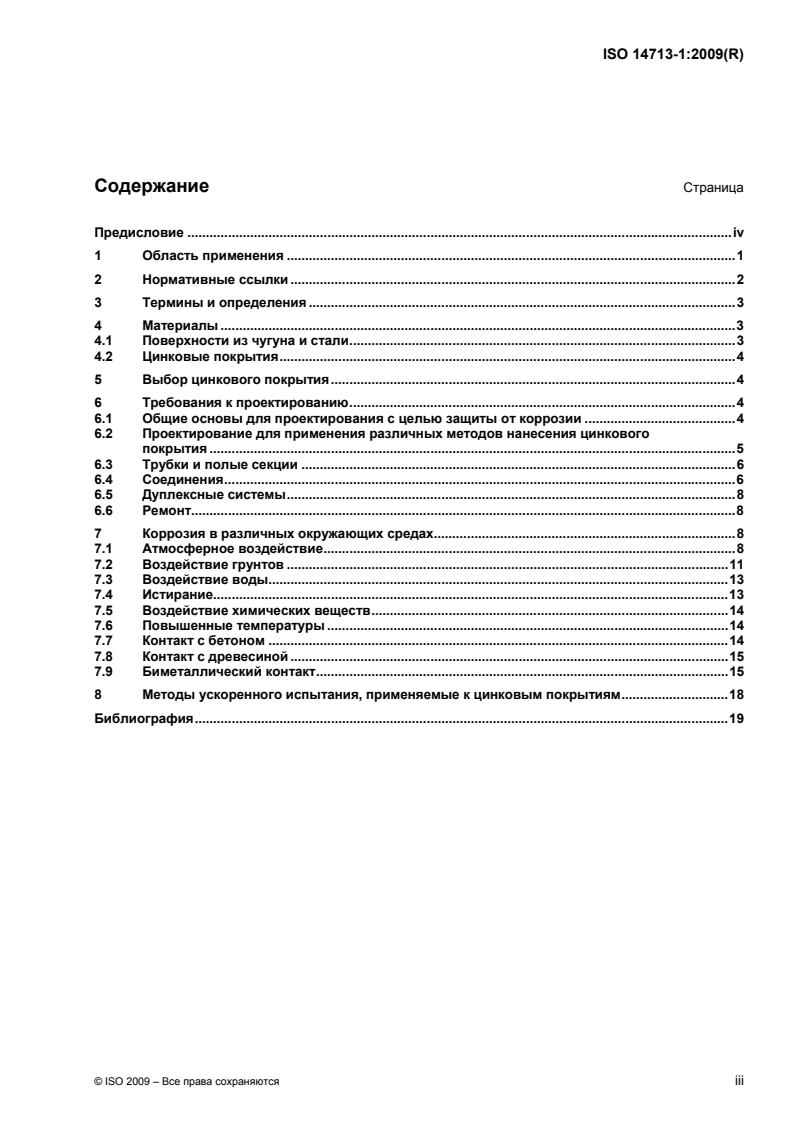
Contents Page
Foreword .iv
1 Scope.1
2 Normative references.1
3 Terms and definitions .2
4 Materials .3
4.1 Iron and steel substrates.3
4.2 Zinc coatings .3
5 Selection of zinc coating .3
6 Design requirements.4
6.1 General principles of design to avoid corrosion .4
6.2 Design for application of different zinc coating processes.5
6.3 Tubes and hollow sections.5
6.4 Connections.5
6.5 Duplex systems .6
6.6 Maintenance.7
7 Corrosion in different environments .7
7.1 Atmospheric exposure.7
7.2 Exposure to soils.10
7.3 Exposure to water .12
7.4 Abrasion .12
7.5 Exposure to chemicals .12
7.6 Elevated temperatures.13
7.7 Contact with concrete.13
7.8 Contact with wood.14
7.9 Bimetallic contact.14
8 Accelerated test methods applied to zinc coatings.16
Bibliography.17
Foreword
ISO (the International Organization for Standardization) is a worldwide federation of national standards bodies
(ISO member bodies). The work of preparing International Standards is normally carried out through ISO
technical committees. Each member body interested in a subject for which a technical committee has been
established has the right to be represented on that committee. International organizations, governmental and
non-governmental, in liaison with ISO, also take part in the work. ISO collaborates closely with the
International Electrotechnical Commission (IEC) on all matters of electrotechnical standardization.
International Standards are drafted in accordance with the rules given in the ISO/IEC Directives, Part 2.
The main task of technical committees is to prepare International Standards. Draft International Standards
adopted by the technical committees are circulated to the member bodies for voting. Publication as an
International Standard requires approval by at least 75 % of the member bodies casting a vote.
Attention is drawn to the possibility that some of the elements of this document may be the subject of patent
rights. ISO shall not be held responsible for identifying any or all such patent rights.
ISO 14713-1 was prepared by Technical Committee ISO/TC 107, Metallic and other inorganic coatings,
Subcommittee SC 4, Hot dip coatings (galvanized, etc.).
This first edition, together with ISO 14713-2 and ISO 14713-3, cancels and replaces ISO 14713:1999, which
has been technically revised.
ISO 14713 consists of the following parts, under the general title Zinc coatings — Guidelines and
recommendations for the protection against corrosion of iron and steel in structures:
⎯ Part 1: General principles of design and corrosion resistance
⎯ Part 2: Hot dip galvanizing
⎯ Part 3: Sherardizing
iv © ISO 2009 – All rights reserved
INTERNATIONAL STANDARD ISO 14713-1:2009(E)
Zinc coatings — Guidelines and recommendations for the
protection against corrosion of iron and steel in structures —
Part 1:
General principles of design and corrosion resistance
1 Scope
This part of ISO 14713 provides guidelines and recommendations regarding the general principles of design
which are appropriate for articles to be zinc coated for corrosion protection and the level of corrosion
resistance provided by zinc coatings applied to iron or steel articles, exposed to a variety of environments.
Initial protection is covered in relation to
⎯ available standard processes,
⎯ design considerations, and
⎯ environments for use.
This part of ISO 14713 applies to zinc coatings applied by the following processes:
a) hot dip galvanized coatings (applied after fabrication);
b) hot dip galvanized coatings (applied onto continuous sheet);
c) sherardized coatings;
d) thermal sprayed coatings;
e) mechanically plated coatings;
f) electrodeposited coatings.
These guidelines and recommendations do not deal with the maintenance of corrosion protection in service
for steel with zinc coatings. Guidance on this subject can be found in ISO 12944-5 and ISO 12944-8.
NOTE There are a variety of product-related standards (e.g. for nails, fasteners, ductile iron pipes, etc.) which
provide specific requirements for the applied zinc coating systems which go beyond any general guidance presented in
this part of ISO 14713. These specific product-related requirements will take precedence over these general
recommendations.
2 Normative references
The following referenced documents are indispensable for the application of this document. For dated
references, only the edition cited applies. For undated references, the latest edition of the referenced
document (including any amendments) applies.
ISO 1461, Hot dip galvanized coatings on fabricated iron and steel articles — Specifications and test methods
ISO 2063, Thermal spraying — Metallic and other inorganic coatings — Zinc, aluminium and their alloys
ISO 2064, Metallic and other inorganic coatings — Definitions and conventions concerning the measurement
of thickness
ISO 2081, Metallic and other inorganic coatings — Electroplated coatings of zinc with supplementary
treatments on iron or steel
ISO 8044:1999, Corrosion of metals and alloys — Basic terms and definitions
ISO 9223, Corrosion of metals and alloys — Corrosivity of atmospheres — Classification
ISO 9224, Corrosion of metals and alloys — Corrosivity of atmospheres — Guiding values for the corrosivity
categories
ISO 9226, Corrosion of metals and alloys — Corrosivity of atmospheres — Determination of corrosion rate of
standard specimens for the evaluation of corrosivity
ISO 11844-1, Corrosion of metals and alloys — Classification of low corrosivity of indoor atmospheres —
Determination and estimation of indoor corrosivity
ISO 12683, Mechanically deposited coatings of zinc — Specification and test methods
ISO 12944-5, Paints and varnishes — Corrosion protection of steel structures by protective paint systems —
Part 5: Protective paint systems
ISO 12944-8, Paints and varnishes — Corrosion protection of steel structures by protective paint systems —
Part 8: Development of specifications for new work and maintenance
ISO 14713-2, Zinc coatings — Guidelines and recommendations for the protection against corrosion of iron
and steel in structures — Part 2: Hot dip galvanizing
ISO 14713-3, Zinc coatings — Guidelines and recommendations for the protection against corrosion of iron
and steel in structures — Part 3: Sherardizing
EN 10240, Internal and/or external protective coatings for steel tubes — Specification for hot dip galvanized
coatings applied in automatic plants
EN 10346, Continuously hot-dip coated steel flat products — Technical delivery conditions
EN 13438, Paints and varnishes — Powder organic coatings for galvanized or sherardized steel products for
construction purposes
EN 13811, Sherardizing — Zinc diffusion coatings on ferrous products — Specification
EN 15520, Thermal spraying — Recommendations for constructional design of components with thermally
sprayed coatings
3 Terms and definitions
For the purposes of this document, the terms and definitions given in ISO 1461, ISO 2063, ISO 2064,
ISO 8044, ISO 12683, EN 13811 and the following apply.
3.1
atmospheric corrosion
corrosion with the earth’s atmosphere at ambient temperature as the corrosive environment
(see ISO 8044:1999, 3.04)
2 © ISO 2009 – All rights reserved
3.2
elevated temperatures
temperatures between + 60 °C and + 200 °C
3.3
exceptional exposure
special cases, such as exposure that substantially intensifies the corrosive exposure and/or places increased
demands on the corrosion protection system
3.4
life to first maintenance
the time interval that can elapse after initial coating before coating deterioration reaches the point when
maintenance is necessary to restore protection of the basis metal
4 Materials
4.1 Iron and steel substrates
In hot dip galvanizing, the reactivity of the steel is modified by its chemical composition, particularly by the
silicon plus phosphorus contents (see ISO 14713-2). The metallurgical and chemical nature of the steel is
irrelevant to protection by thermally sprayed or sherardized coatings.
The broad range of steels likely to be subject to zinc coating will commonly fall into the following categories:
⎯ carbon steel, composed simply of iron and carbon, accounts for 90 % of steel production [e.g.
EN 10025-2 and EN 10080 (steel reinforcement)];
⎯ high strength, low-alloy (HSLA) steels have small additions (usually < 2 % by weight) of other elements,
typically 1,5 % manganese, to provide additional strength for a modest price increase (e.g. EN 10025-6);
⎯ low-alloy steel is alloyed with other elements, usually molybdenum, manganese, chromium, or nickel, in
amounts of up to 10 % by weight to improve the hardenability of thick sections (e.g. EN 10083-1).
Steel can be hot rolled or cold formed. Hot rolling is used to produce angle, “I”, “H” and other structural
sections. Some structural sections, e.g. safety barriers, cladding rails, and cladding panels, are cold formed.
Cast and wrought irons are of various metallurgical and chemical compositions. This is irrelevant to protection
by thermally sprayed or sherardized coatings but special consideration is needed regarding the cast irons
most suitable for hot dip galvanizing (see ISO 14713-2).
4.2 Zinc coatings
The application of zinc coatings provides an effective method of retarding or preventing corrosion of ferrous
materials (see Clause 1 for the range of zinc coatings/processes covered by this part of ISO 14713). Zinc
coatings are used in this regard because they protect iron and steel both by barrier action and by galvanic
action.
5 Selection of zinc coating
The zinc coating system to be used should be selected by taking the following items into account:
a) the general environment (macro-climate) in which it is to be applied;
b) local variations in the environment (micro-climate), including anticipated future changes and any
exceptional exposure;
c) the required life to first maintenance of the zinc coating system;
d) the need for ancillary components;
e) the need for post-treatment for temporary protection;
f) the need for painting, either initially (duplex system) or when the zinc coating is approaching the end of its
life to first maintenance to achieve minimal maintenance cost;
g) the availability and cost;
h) if the life to first maintenance of the system is less than that required for the structure, its ease of
maintenance.
NOTE The life for a zinc coating in any particular atmospheric exposure condition is approximately proportional to the
thickness of the coating.
The operational sequence for applying the selected system should be determined in consultation with the
steel fabricator and the applier of the zinc coating system.
6 Design requirements
6.1 General principles of design to avoid corrosion
Design of structures and products should influence the choice of protective system. It may be appropriate and
economic to modify the design to suit the preferred protective system.
The items in a) to j) should be considered.
a) Safe and easy access for cleaning and maintenance should be provided.
b) Pockets and recesses in which water and dirt can collect should be avoided; a design with smooth
contours facilitates application of a protective coating and helps to improve corrosion resistance.
Corrosive chemicals should be directed away from structural components, e.g. drainage tubes should be
used to control de-icing salts.
c) Areas which are inaccessible after erection should be given a coating system designed to last the
required life of the structure.
d) If bimetallic corrosion (corrosion due to contact between dissimilar materials: metals and/or alloys) is
possible, additional protective measures should be considered (see ISO 14713-2).
e) Where the coated iron and steel are likely to be in contact with other building materials, special
consideration should be given to the contact area; e.g. the use of paint, tapes or plastic foils should be
considered.
f) Hot dip galvanizing, sherardizing, mechanical coating, zinc flake coating or electroplating can be provided
only in works; thermal spraying can be applied in works or on site. When paint is to be applied to a zinc
coating, the application is more readily controlled in works but, where there is a likelihood of substantial
damage occurring during transportation and erection, specifiers may prefer to apply the final paint coat on
site. The application of a powder coating on metal coated steel can only be done in works.
Where the total system is applied offsite, the specification has to cover the need for care at all stages to
prevent damage to the finished iron and steel and set out repair procedures to the coating once the
steelwork is erected.
4 © ISO 2009 – All rights reserved
g) Hot dip galvanizing (in accordance with ISO 1461), sherardizing (in accordance with EN 13811) or
thermal spraying (in accordance with ISO 2063) should take place after bending and other forms of
fabrication.
h) Methods of marking parts shall not have an influence on the quality of the pre-treatment operations prior
to coating.
i) Precautions may be required to minimize the likelihood of deformation during processing or subsequently.
j) The conditions experienced by the articles during coating application may also need to be considered.
6.2 Design for application of different zinc coating processes
The design practice for hot dip coating differs from that for other zinc coating systems. ISO 14713-2 provides
guidance on the design for hot dip coatings. This supplements the general principles of good design for steel
structures.
The design practice for sherardized coatings can be found in ISO 14713-3.
The design for zinc thermal spraying should be discussed with the thermal sprayer at an early stage so that
adequate provision is made for access to all areas of the article (see EN 15520).
The design for electroplating with zinc follows the general design principles for electroplating and these are
not given here. The design for mechanical coating is best discussed with specialist applicators; in general,
these processes are most suitable for small parts which can be tumbled in a barrel but specialist plants may
be available for other shapes.
6.3 Tubes and hollow sections
6.3.1 General
If they are dry and hermetically sealed, the internal surfaces of tubes and hollow sections will not need
protection. Where hollow sections are fully exposed to the weather, or interior environments that might give
rise to condensation, and are not hermetically sealed, consideration should be given to the need for both
internal and external protection.
6.3.2 Corrosion protection of internal and external surfaces
Hot dip galvanizing gives equal thickness internally and externally. There are some special products where
the thickness of the coating is different on internal and external surfaces, e.g. tubes for water distribution
systems (see EN 10240). When tubes and hollow sections are hot dip galvanized after assembly into
structures, drainage/venting holes should be provided for processing purposes (see ISO 14713-2).
Sherardizing gives equal thickness internally and externally. No precautions are needed for hollow sections.
When tubes are sherardized, the zinc dust and sand mixture should be loaded into the tubes before starting
the thermal diffusion process (see ISO 14713-3)
6.4 Connections
6.4.1 Fastenings to be used with hot dip galvanized, sherardized or thermal sprayed coatings
The protective treatment of bolts, nuts and other parts of the structural connections should be given careful
consideration. Ideally, their protective treatment should provide a similar performance to that specified for the
general surfaces. Specific requirements are given in the appropriate product International Standards (e.g.
ISO 10684) and in a series of International Standards for coatings on fasteners which are in the course of
preparation/publication.
Hot dip galvanized (see, for example, ISO 1461 which covers specified minimum coating thicknesses up to
55 µm), sherardized, or other coatings on steel fasteners should be considered. Alternatively, stainless steel
fasteners can be used; for precautions to take in order to minimize the potential for bimetallic corrosion,
see 7.9.
The mating surfaces of connections made with high-strength friction-grip bolts should be given special
treatment. It is not necessary to remove thermally sprayed, sheradized or hot dip coatings from such areas to
obtain an adequate coefficient of friction. However, consideration has to be given to any long-term slip or
creep-avoidance requirements and to any necessary adjustments to the assembly dimensions.
6.4.2 Welding considerations related to coatings
It is recommended to weld prior to hot dip galvanizing, sherardizing or thermal spraying. The use of welding
anti-spatter sprays that cannot be removed in the pretreatment process at the galvanizers' works should be
avoided. For this reason, where welding sprays are used, low silicone, water-soluble sprays are
recommended. After welding, the surface should be prepared to the standard specified for preparing the
steelwork overall before applying the protective coating process. Welding should be balanced (i.e. equal
amounts on each side of the main axis) to avoid introducing unbalanced stresses in a structure. Welding
residues have to be removed before coating. The normal pretreatments for thermal spraying are usually
sufficient for this purpose but extra pretreatment may be needed for hot dip galvanizing; in particular, weld
slag should be removed separately. Some forms of welding leave alkaline deposits behind. These have to be
removed by blast-cleaning followed by washing with clean water before applying thermally-sprayed coatings.
(This does not apply to hot dip galvanizing and sherardizing where the pretreatment process removes alkaline
deposits.)
It is desirable that fabrication takes place without the use of a blast primer, as this has to be removed before
hot dipping, sherardizing or thermal spraying.
Where welding takes place after hot dip galvanizing, sherardizing or thermal spraying, it is preferable, before
welding, to remove the coating locally in the area of the weld to ensure the highest quality weld. After welding,
protection should be appropriately restored locally by thermal spraying, “solder sticks” and/or zinc dust paints.
It is not recommended to weld sherardized articles, but spot-welding may be possible in certain applications.
After welding of coated steels, the surface should be prepared to the standard specified for preparing the
steelwork overall before applying paint or fusion-bonded powder coatings.
Assemblies comprising different metals needing different pretreatments should be discussed with the
processor.
Welding of zinc coated parts must be done with appropriate local air ventilation in accordance with health and
safety regulations.
6.4.3 Brazing or soldering
Soft soldered assemblies cannot be hot dip galvanized or sherardized and brazing should be avoided if
possible — many types of brazing are unsuitable for hot dip galvanizing or sherardizing. The galvanizer or
sherardizer should be consulted if brazing is being considered.
Since corrosive fluxes may be used in these processes, removal of flux residues after the coating process is
essential to avoid corrosion of the coated parts; the design of these parts should facilitate this.
6.5 Duplex systems
ISO 12944-5 and EN 13438 give information on organic coatings which are applied to hot dip galvanized or
sherardized coatings. When such an organic coating has been applied, the term “duplex system” is used to
describe the combination of coatings — historically, this term was most commonly used to describe organic
coatings on hot dip galvanized articles.
6 © ISO 2009 – All rights reserved
NOTE EN 15773 deals with quality and communications requirements in the supply chain when specifying the supply
of duplex systems.
The life of a zinc coated steel structure is longer than the life of the zinc coating system that is initially applied
to it, as some steel can be lost by corrosion before a structure becomes unserviceable. If it is necessary to
prolong the life of the zinc coating, maintenance has to take place before any steel rusting occurs and
preferably while at least 20 µm to 30 µm of zinc coating remains. This gives a maintained zinc coating plus
organic coating system a longer total life than a simple organic coating.
The total life of a zinc coating plus organic coating system is usually significantly greater than the sum of the
lives of the zinc coating and protective organic coating. There is a synergistic effect, i.e. the presence of zinc
coatings reduces under-rusting of the paint film; the paint preserves the zinc coating from early corrosion.
Where it is desired to retain a reasonably intact layer of paint as a basis for maintenance, the initially applied
paint system should have extra thickness.
Maintenance usually takes place when the zinc coating loses its appearance or becomes degraded. Zinc
coatings usually take longer to degrade than paint. Hence a zinc coating may be recommended for 20 years
or more up to first maintenance, whereas the same coating when covered by paint is, for reasons of
appearance of the paint, recommended for only 10 years up to first maintenance. It should also be noted that
an area of degraded paint can retain moisture and hence hasten the corrosion of metal, particularly on a
surface not washed by rain.
If maintenance is delayed until the zinc coating has been consumed and rusting has started, the iron and steel
have to be maintained in the same way as rusted painted steel.
6.6 Maintenance
Zinc coatings may be left unmaintained if the corrosion rate of the coating is insufficient to affect the
performance of the structure in its designed period of use. If a longer life span is required, maintenance of the
coating should be carried out by stripping and re-galvanizing (part of) the structure or by painting while some
original coating remains.
7 Corrosion in different environments
7.1 Atmospheric exposure
The corrosion rate of a zinc coating is affected by the time for which it is exposed to wetness, air pollution and
contamination of the surface, but the corrosion rates are much slower than for steel and often decrease with
time. General information on the atmospheric corrosion rate for zinc is given in ISO 9224.
Table 1 gives basic groups of environments (related to ISO 9223). Where the relative humidity is below
60 %, the corrosion rate of iron and steel is negligible and they may not require zinc coating, e.g. inside
many buildings. Zinc coating with or without painting may, however, be required for appearance or for
reasons of hygiene, e.g. in a food factory. When the relative humidity is higher than 60 % or where they
are exposed to wet or immersed conditions or prolonged condensation then, like most metals, iron and
steel are subject to more serious corrosion. Contaminants deposited on the surface, notably chlorides
and sulfates, accelerate attack. Substances that deposit on the surface of the iron and steel increase
corrosion if they absorb moisture or go into solution on the surface of the iron and steel. The temperature
also influences the corrosion rate of unprotected iron and steel and temperature fluctuations have a
stronger effect than the average temperature value.
The micro-environment, i.e. the conditions prevailing around the structure, is also important because it allows
a more precise assessment of the likely conditions than study of the basic climate alone. It is not always
known at the planning stage of a project. Every effort should be made to identify it accurately, however,
because it is an important factor in the total environment against which corrosion protection is required. An
example of a micro-climate is the underside of a bridge (particularly over water).
The corrosion of steelwork inside buildings is dependent upon the internal environment but in “normal”
atmospheres, e.g. dry and heated, it is insignificant. Steelwork in the perimeter walls of buildings is influenced
by the configuration within the perimeter wall, e.g. steelwork without direct contact with the outer leaf of a wall
comprising two parts separated by an air space is at less risk of corrosion than steelwork in contact with or
embedded in the outer leaf. Buildings containing industrial processes, chemical environments, wet or
contaminated environments should be given special consideration. Steelwork which is partially sheltered, e.g.
farm barns and aircraft hangars, should be considered as being subject to the exterior environment.
Table 1 also sets out an indication of the likely range of corrosion rates which are applicable to zinc coatings
exposed to the different types of corrosivity category dealt with in ISO 9223.
8 © ISO 2009 – All rights reserved
Table 1 — Description of typical atmospheric environments
related to the estimation of corrosivity categories
Corrosivity category C Typical environments (examples)
Corrosion rate for zinc
(based upon one year
Indoor Outdoor
−1
exposures), r (µm⋅a )
corr
and corrosion level
C1 Heated spaces with low relative humidity Dry or cold zone, atmospheric environment with very low
and insignificant pollution, e.g. offices, pollution and time of wetness, e.g. certain deserts, central
r u 0,1
corr
schools, museums Arctic/Antarctica
Very low
Unheated spaces with varying Temperate zone, atmospheric environment with low
C2
temperature and relative humidity. Low pollution (SO < 5 µg/m ), e.g.: rural areas, small towns.
0,1 < r u 0,7
corr
frequency of condensation and low Dry or cold zone, atmospheric environment with short time
Low
pollution, e.g. storage, sport halls of wetnes
...
NORME ISO
INTERNATIONALE 14713-1
Première édition
2009-12-15
Revêtements de zinc — Lignes
directrices et recommandations pour la
protection contre la corrosion du fer et de
l'acier dans les constructions —
Partie 1:
Principes généraux de conception et
résistance à la corrosion
Zinc coatings — Guidelines and recommendations for the protection
against corrosion of iron and steel in structures —
Part 1: General principles of design and corrosion resistance
Numéro de référence
©
ISO 2009
PDF – Exonération de responsabilité
Le présent fichier PDF peut contenir des polices de caractères intégrées. Conformément aux conditions de licence d'Adobe, ce fichier
peut être imprimé ou visualisé, mais ne doit pas être modifié à moins que l'ordinateur employé à cet effet ne bénéficie d'une licence
autorisant l'utilisation de ces polices et que celles-ci y soient installées. Lors du téléchargement de ce fichier, les parties concernées
acceptent de fait la responsabilité de ne pas enfreindre les conditions de licence d'Adobe. Le Secrétariat central de l'ISO décline toute
responsabilité en la matière.
Adobe est une marque déposée d'Adobe Systems Incorporated.
Les détails relatifs aux produits logiciels utilisés pour la création du présent fichier PDF sont disponibles dans la rubrique General Info
du fichier; les paramètres de création PDF ont été optimisés pour l'impression. Toutes les mesures ont été prises pour garantir
l'exploitation de ce fichier par les comités membres de l'ISO. Dans le cas peu probable où surviendrait un problème d'utilisation,
veuillez en informer le Secrétariat central à l'adresse donnée ci-dessous.
DOCUMENT PROTÉGÉ PAR COPYRIGHT
© ISO 2009
Droits de reproduction réservés. Sauf prescription différente, aucune partie de cette publication ne peut être reproduite ni utilisée sous
quelque forme que ce soit et par aucun procédé, électronique ou mécanique, y compris la photocopie et les microfilms, sans l'accord écrit
de l'ISO à l'adresse ci-après ou du comité membre de l'ISO dans le pays du demandeur.
ISO copyright office
Case postale 56 • CH-1211 Geneva 20
Tel. + 41 22 749 01 11
Fax + 41 22 749 09 47
E-mail copyright@iso.org
Web www.iso.org
Publié en Suisse
ii © ISO 2009 – Tous droits réservés
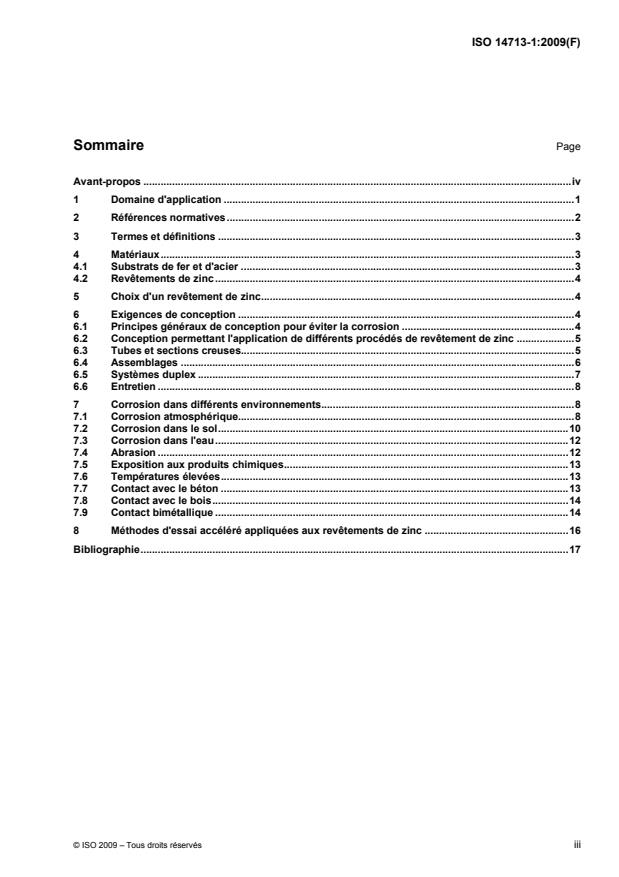
Sommaire Page
Avant-propos .iv
1 Domaine d'application .1
2 Références normatives.2
3 Termes et définitions .3
4 Matériaux.3
4.1 Substrats de fer et d'acier .3
4.2 Revêtements de zinc .4
5 Choix d'un revêtement de zinc.4
6 Exigences de conception .4
6.1 Principes généraux de conception pour éviter la corrosion .4
6.2 Conception permettant l'application de différents procédés de revêtement de zinc .5
6.3 Tubes et sections creuses.5
6.4 Assemblages .6
6.5 Systèmes duplex .7
6.6 Entretien .8
7 Corrosion dans différents environnements.8
7.1 Corrosion atmosphérique.8
7.2 Corrosion dans le sol.10
7.3 Corrosion dans l'eau.12
7.4 Abrasion .12
7.5 Exposition aux produits chimiques.13
7.6 Températures élevées.13
7.7 Contact avec le béton .13
7.8 Contact avec le bois.14
7.9 Contact bimétallique .14
8 Méthodes d'essai accéléré appliquées aux revêtements de zinc .16
Bibliographie.17
Avant-propos
L'ISO (Organisation internationale de normalisation) est une fédération mondiale d'organismes nationaux de
normalisation (comités membres de l'ISO). L'élaboration des Normes internationales est en général confiée
aux comités techniques de l'ISO. Chaque comité membre intéressé par une étude a le droit de faire partie du
comité technique créé à cet effet. Les organisations internationales, gouvernementales et non
gouvernementales, en liaison avec l'ISO participent également aux travaux. L'ISO collabore étroitement avec
la Commission électrotechnique internationale (CEI) en ce qui concerne la normalisation électrotechnique.
Les Normes internationales sont rédigées conformément aux règles données dans les Directives ISO/CEI,
Partie 2.
La tâche principale des comités techniques est d'élaborer les Normes internationales. Les projets de Normes
internationales adoptés par les comités techniques sont soumis aux comités membres pour vote. Leur
publication comme Normes internationales requiert l'approbation de 75 % au moins des comités membres
votants.
L'attention est appelée sur le fait que certains des éléments du présent document peuvent faire l'objet de
droits de propriété intellectuelle ou de droits analogues. L'ISO ne saurait être tenue pour responsable de ne
pas avoir identifié de tels droits de propriété et averti de leur existence.
L'ISO 14713-1 a été élaborée par le comité technique ISO/TC 107, Revêtements métalliques et autres
revêtements inorganiques, sous-comité SC 4, Revêtements par immersion à chaud (galvanisation, etc.).
Cette première édition, conjointement avec l'ISO 14713-2 et l'ISO 14713-3, annule et remplace
l'ISO 14713:1999, qui a fait l'objet d'une révision technique.
L'ISO 14713 comprend les parties suivantes, présentées sous le titre général Revêtements de zinc — Lignes
directrices et recommandations pour la protection contre la corrosion du fer et de l'acier dans les
constructions:
⎯ Partie 1: Principes généraux de conception et résistance à la corrosion
⎯ Partie 2: Galvanisation à chaud
⎯ Partie 3: Shérardisation
iv © ISO 2009 – Tous droits réservés
NORME INTERNATIONALE ISO 14713-1:2009(F)
Revêtements de zinc — Lignes directrices et recommandations
pour la protection contre la corrosion du fer et de l'acier dans
les constructions —
Partie 1:
Principes généraux de conception et résistance à la corrosion
1 Domaine d'application
La présente partie de l'ISO 14713 fournit des lignes directrices et des recommandations concernant les
principes généraux de conception appropriés pour les pièces revêtues de zinc pour la protection contre la
corrosion et le niveau de résistance à la corrosion assuré par les revêtements de zinc appliqués aux pièces
en fer ou en acier, exposées à de nombreux environnements. La protection initiale est traitée en relation avec
⎯ les procédés normalisés existants,
⎯ les considérations théoriques, et
⎯ les environnements d'utilisation.
La présente partie de l'ISO 14713 s'applique aux revêtements de zinc appliqués au moyen des procédés
suivants:
a) revêtements obtenus par galvanisation à chaud (appliqués après fabrication);
b) revêtements obtenus par galvanisation à chaud (appliqués sur tôle en continu);
c) revêtements obtenus par shérardisation;
d) revêtements obtenus par projection thermique;
e) revêtements obtenus par voie mécanique (matoplastie);
f) revêtements obtenus par galvanoplastie.
Ces lignes directrices et recommandations ne traitent pas de l'entretien de la protection contre la corrosion en
service pour l'acier revêtu de zinc. Des lignes directrices correspondantes sont fournies dans l'ISO 12944-5 et
dans l'ISO 12944-8.
NOTE Il existe un grand nombre de normes de produits (par exemple les clous, les éléments de fixation, les
canalisations en fonte ductile, etc.) fournissant des exigences spécifiques pour les systèmes de revêtement de zinc
appliqués qui dépassent le cadre des lignes directrices générales spécifiées dans la présente partie de l'ISO 14713. Ces
exigences spécifiques relatives aux produits prévalent sur les présentes recommandations générales.
2 Références normatives
Les documents de référence suivants sont indispensables pour l'application du présent document. Pour les
références datées, seule l'édition citée s'applique. Pour les références non datées, la dernière édition du
document de référence s'applique (y compris les éventuels amendements).
ISO 1461, Revêtements par galvanisation à chaud sur produits finis en fonte et en acier — Spécifications et
méthodes d'essai
ISO 2063, Projection thermique — Revêtements métalliques et autres revêtements inorganiques — Zinc,
aluminium et alliages de ces métaux
ISO 2064, Revêtements métalliques et autres revêtements inorganiques — Définitions et principes
concernant le mesurage de l'épaisseur
ISO 2081, Revêtements métalliques et autres revêtements inorganiques — Dépôts électrolytiques de zinc
avec traitements supplémentaires sur fer ou acier
ISO 8044:1999, Corrosion des métaux et alliages — Termes principaux et définitions
ISO 9223, Corrosion des métaux et alliages — Corrosivité des atmosphères — Classification
ISO 9224, Corrosion des métaux et alliages — Corrosivité des atmosphères — Valeurs de référence relatives
aux classes de corrosivité
ISO 9226, Corrosion des métaux et alliages — Corrosivité des atmosphères — Détermination de la vitesse de
corrosion d'éprouvettes de référence pour l'évaluation de la corrosivité
ISO 11844-1, Corrosion des métaux et alliages — Classification de la corrosivité faible des atmosphères
d'intérieur — Partie 1: Détermination et estimation de la corrosivité des atmosphères d'intérieur
ISO 12683, Dépôts de zinc par voie mécanique (matoplastie) — Spécifications et méthodes de contrôle
ISO 12944-5, Peintures et vernis — Anticorrosion des structures en acier par systèmes de peinture —
Partie 5: Systèmes de peinture
ISO 12944-8, Peintures et vernis — Anticorrosion des structures en acier par systèmes de peinture —
Partie 8: Développement de spécifications pour les travaux neufs et l'entretien
ISO 14713-2, Revêtements de zinc — Lignes directrices et recommandations pour la protection contre la
corrosion du fer et de l'acier dans les constructions — Partie 2: Galvanisation à chaud
ISO 14713-3, Revêtements de zinc — Lignes directrices et recommandations pour la protection contre la
corrosion du fer et de l'acier dans les constructions — Partie 3: Shérardisation
EN 10240, Revêtements intérieur et/ou extérieur des tubes en acier — Spécifications pour revêtements de
galvanisation à chaud sur des lignes automatiques
EN 10346, Produits plats en acier à bas carbone revêtus en continu par immersion à chaud — Conditions
techniques de livraison
EN 13438, Peintures et vernis — Revêtements de poudre organique pour produits en acier galvanisé ou
shérardisé utilisés dans la construction
EN 13811, Shérardisation — Revêtements par diffusion de zinc sur les produits ferreux — Spécifications
EN 15520, Projection thermique — Recommandations relatives à la conception des éléments de construction
comportant un revêtement déposé par projection thermique
2 © ISO 2009 – Tous droits réservés
3 Termes et définitions
Pour les besoins du présent document, les termes et définitions donnés dans l'ISO 1461, l'ISO 2063,
l'ISO 2064, l'ISO 8044, l'ISO 12683, l'EN 13811 ainsi que les suivants s'appliquent.
3.1
corrosion atmosphérique
corrosion causée par l'exposition à l'atmosphère à température ambiante
NOTE Adapté de l'ISO 8044:1999, 3.04.
3.2
température élevée
température comprise entre +60 °C et +200 °C
3.3
exposition exceptionnelle
cas particulier d'exposition qui accélère de façon significative la corrosion et/ou qui soumet le système de
protection contre la corrosion à des conditions plus sévères
3.4
durée de vie avant le premier entretien
laps de temps entre le revêtement initial et le moment où la détérioration du revêtement rend les opérations
d'entretien nécessaires pour continuer d'assurer la protection du métal de base
4 Matériaux
4.1 Substrats de fer et d'acier
En galvanisation à chaud, la réactivité de l'acier est modifiée par sa composition chimique, en particulier par
les teneurs en silicium et phosphore (voir l'ISO 14713-2). La nature métallurgique et chimique de l'acier n'a
pas d'importance vis-à-vis de la protection par projection thermique ou shérardisation.
La large gamme d'aciers auxquels il est possible d'appliquer des revêtements de zinc comprend
généralement les catégories suivantes:
⎯ l'acier au carbone, composé simplement de fer et de carbone, constitue 90 % de la production d'acier
[par exemple l'EN 10025-2 et l'EN 10080 (armature en acier)];
⎯ les aciers faiblement alliés HR comportent un faible pourcentage d'autres éléments (généralement < 2 %
en poids), généralement 1,5 % de manganèse, pour assurer une plus grande résistance à un coût
modéré [par exemple l'EN 10025-6];
⎯ l'acier faiblement allié est constitué d'autres éléments, généralement du molybdène, manganèse, chrome
ou nickel, dans des quantités jusqu'à 10 % en poids pour améliorer la trempabilité des sections épaisses
[par exemple l'EN 10083-1].
L'acier peut être laminé à chaud ou formé à froid. Le laminage à chaud est utilisé pour produire la poutrelle
courante, en «I», en «H» et d'autres profils de construction. Certains profils de construction plus petits sont
formés à froid, par exemple les barrières de sécurité, les lisses de façade et les bardages.
Les fontes et fers forgés sont de compositions métallurgique et chimique diverses. Cela est sans effet sur la
protection par projection thermique ou shérardisation, mais il faut accorder une attention particulière au choix
des fontes se prêtant le mieux à la galvanisation à chaud (voir l'ISO 14713-2).
4.2 Revêtements de zinc
L'application de revêtements de zinc est une méthode efficace pour retarder ou prévenir la corrosion des
matériaux ferreux (pour la gamme de revêtements de zinc/procédés traités par la présente partie de
l'ISO 14713, voir l'Article 1). Les revêtements de zinc sont utilisés à cet effet parce qu'ils protègent le fer et
l'acier de la corrosion non seulement en y faisant obstacle mais aussi par action galvanique.
5 Choix d'un revêtement de zinc
Il convient de sélectionner le système de revêtement de zinc en tenant compte des points suivants:
a) l'environnement général (macroclimat) dans lequel il est destiné à être utilisé;
b) les variations locales de l'environnement (microclimat), y compris tout éventuel changement et toute
exposition exceptionnelle;
c) la durée de vie requise avant les premières opérations d'entretien du système de revêtement de zinc;
d) les éléments auxiliaires éventuellement nécessaires;
e) la nécessité éventuelle d'un post-traitement assurant une protection temporaire;
f) la nécessité éventuelle d'appliquer une peinture dès le départ (systèmes duplex), ou peu avant le
moment prévu pour effectuer les premières opérations d'entretien sur le revêtement de zinc, afin de
réduire les coûts d'entretien;
g) la disponibilité et le coût;
h) dans le cas où la durée de vie du système avant les premières opérations d'entretien est inférieure à
celle requise pour la construction, la facilité de son entretien.
NOTE La durée de vie d'un revêtement de zinc dans toute condition d'exposition atmosphérique particulière est
approximativement proportionnelle à son épaisseur.
Il convient que l'ordre à respecter pour effectuer les opérations nécessaires à l'application du système
sélectionné soit déterminé conjointement par le producteur d'acier et la personne chargée de l'application du
système de revêtement de zinc.
6 Exigences de conception
6.1 Principes généraux de conception pour éviter la corrosion
Il convient que le choix du système de protection se fasse en fonction de la conception des structures et des
installations. Il peut s'avérer économique ou judicieux de modifier la conception d'une structure pour l'adapter
au système de protection choisi.
Il convient de prendre en compte les points a) à j).
a) Il convient de prévoir un accès facile et sans danger pour le nettoyage et l'entretien.
b) Il convient d'éviter les poches et cavités favorisant l'accumulation d'eau et de saleté; des contours lisses
facilitent l'application d'un revêtement protecteur et améliorent la résistance à la corrosion. Il convient
d'évacuer les produits chimiques corrosifs à distance des éléments de construction; par exemple, il
convient d'utiliser des tubes de drainage pour contrôler les sels de dégivrage.
c) Il convient de doter les zones inaccessibles après montage d'un système de revêtement conçu pour
durer aussi longtemps que la durée de vie prévue pour la structure.
4 © ISO 2009 – Tous droits réservés
d) En présence d'une corrosion bimétallique éventuelle (corrosion due au contact entre des matériaux de
nature différente: métaux et/ou alliages), il convient d'envisager des mesures de protection
supplémentaires (voir l'ISO 14713-2).
e) Lorsque le fer et l'acier revêtu sont susceptibles d'entrer en contact avec d'autres matériaux de
construction, il convient que la zone de contact fasse l'objet d'une attention particulière, par exemple il
convient d'étudier la possibilité d'utiliser de la peinture, des rubans ou des feuilles en matière plastique.
f) La galvanisation à chaud, la shérardisation, la matoplastie, le dépôt lamellaire de zinc ou la
galvanoplastie ne peuvent être réalisées qu'en atelier; la projection thermique peut se faire en atelier ou
sur site. Lorsqu'une peinture doit être appliquée à un revêtement de zinc, son application est plus facile à
contrôler en atelier, mais, si elle risque d'être abîmée pendant le transport ou le montage, les
prescripteurs peuvent choisir d'appliquer la dernière couche de peinture sur site. L'application d'un
revêtement poudre sur de l'acier revêtu de métal ne peut être réalisée qu'en atelier.
Lorsque l'ensemble du système est appliqué en atelier, les spécifications doivent faire état des
précautions qui s'imposent à toutes les étapes pour éviter d'endommager le fer et l'acier revêtu, et prévoir
des procédures de réparation du revêtement après montage de la structure en acier.
g) Il convient que la galvanisation à chaud (conformément à l'ISO 1461), la shérardisation (conformément à
l'EN 13811) ou la projection thermique (conformément à l'ISO 2063) soient effectuées après le cintrage
ou autre procédé de fabrication.
h) Les méthodes de marquage des pièces avant le revêtement ne doivent pas avoir d'incidence sur la
qualité des opérations de traitement préalable.
i) Des précautions peuvent être nécessaires pour minimiser les risques de déformation pendant ou après le
traitement.
j) Il peut être nécessaire de tenir compte des conditions d'exposition auxquelles sont soumises les pièces
pendant l'application du revêtement.
6.2 Conception permettant l'application de différents procédés de revêtement de zinc
La conception pratique pour la galvanisation à chaud diffère de celle exigée pour d'autres systèmes de
revêtement de zinc. L'ISO 14713-2 fournit des conseils sur la conception des pièces avant revêtements
appliqués par galvanisation à chaud. Ceux-ci complètent les principes généraux de bonne conception des
constructions en acier.
L'ISO 14713-3 donne des informations sur la conception pratique des pièces avant revêtements obtenus par
shérardisation.
Il convient que la projection thermique de zinc soit discutée dès le début avec le responsable de la projection
thermique afin de prévoir des dispositions appropriées donnant accès à toutes les zones de la pièce (voir
l'EN 15520).
La conception des pièces pour le zingage électrolytique suit les principes généraux de conception pour la
galvanoplastie; ces derniers ne sont pas donnés ici. La conception des pièces pour la matoplastie sera
discutée avec des spécialistes; en général, ces procédés conviennent mieux aux petites pièces pouvant être
traitées au tonneau, mais il peut exister des installations spécialisées pour d'autres formes de pièces.
6.3 Tubes et sections creuses
6.3.1 Généralités
Si elles sont sèches et hermétiquement fermées, il est en général inutile d'appliquer une protection sur les
surfaces internes des tubes et sections creuses. Si les sections creuses sont destinées à être exposées aux
conditions atmosphériques ou à des environnements intérieurs susceptibles de générer de la condensation, et
qu'elles ne sont pas hermétiquement fermées, il convient de prévoir une protection à la fois à l'intérieur et à
l'extérieur, d'éviter la formation de dépôts internes.
6.3.2 Protection contre la corrosion des surfaces intérieures et extérieures
La galvanisation à chaud dote la pièce d'un revêtement d'épaisseur égale à l'intérieur comme à l'extérieur.
Certains produits spéciaux présentent une épaisseur de revêtement différente sur les surfaces intérieures et
extérieures, par exemple les tubes de réseaux de distribution d'eau (voir l'EN 10240). Si des tubes et des
sections creuses sont galvanisés à chaud après assemblage sous forme de structure, il convient de ménager
en conséquence des orifices d'évacuation (voir l'ISO 14713-2).
La shérardisation dote la pièce d'un revêtement d'épaisseur égale à l'intérieur comme à l'extérieur. Les
sections creuses ne font l'objet d'aucune précaution particulière. Lorsque les tubes sont shérardisés, il
convient de charger dans les tubes le mélange de poussière de zinc et de sable avant de commencer le
processus de diffusion thermique (voir l'ISO 14713-3)
6.4 Assemblages
6.4.1 Éléments de fixation à utiliser avec les revêtements obtenus par galvanisation à chaud,
shérardisation ou projection thermique
Il convient d'accorder une attention particulière au traitement de protection des boulons, écrous et autres
pièces des assemblages structuraux. Dans l'idéal, il convient de les doter d'une protection similaire à celle
spécifiée pour l'ensemble des surfaces. Des exigences spécifiques sont données dans les Normes
internationales de produits correspondantes (par exemple l'ISO 10684) ainsi que dans une série de normes
relatives aux revêtements des éléments de fixation actuellement en cours de préparation/de publication.
Il convient de prendre en considération les éléments de fixation galvanisés à chaud (voir par exemple
l'ISO 1461 qui couvre les épaisseurs minimales de revêtement jusqu'à 55 µm), shérardisés ou les autres
revêtements des éléments de fixation en acier. Il est également possible d'utiliser des éléments de fixation en
acier inoxydable; pour les précautions à prendre dans le but de réduire le risque de corrosion bimétallique,
voir 7.9.
Il convient d'appliquer un traitement spécial sur les surfaces en contact des assemblages réalisés avec des
boulons H.R. travaillant au frottement. Il n'est pas nécessaire de retirer les revêtements obtenus par projection
thermique, shérardisation ou galvanisation à chaud de ces zones pour obtenir un coefficient de frottement
adéquat; cependant, il convient de tenir compte des exigences pour éviter le glissement à long terme ou le
fluage, ainsi que des ajustements nécessaires aux dimensions de l'assemblage.
6.4.2 Considérations relatives au soudage pour les revêtements
Il est recommandé de procéder au soudage avant galvanisation à chaud, shérardisation ou projection
thermique. Il convient d'éviter l'utilisation de bombes anti-projections pour le soudage, qui ne peuvent être
éliminées pendant le procédé de traitement préalable dans l'atelier du galvaniseur. Pour cette raison, si des
bombes anti-projections pour le soudage sont utilisées, les bombes à faible teneur en silicone et les bombes
hydrosolubles sont recommandées. Après le soudage, il convient de préparer la surface au niveau précisé
pour l'ensemble de la structure en acier, avant l'application du revêtement de protection. Il convient de veiller
à la symétrie du soudage (c'est-à-dire à répartir de façon égale les soudures de part et d'autre de l'axe
principal) pour éviter d'introduire des contraintes asymétriques dans la structure. Il convient d'éliminer les
résidus du soudage avant d'appliquer le revêtement. À cet effet, les traitements préalables courants pour la
projection thermique suffisent en général mais, pour ce qui concerne la galvanisation à chaud, un traitement
préalable supplémentaire peut s'avérer nécessaire; le nettoyage des scories de soudage, en particulier, fait
généralement l'objet d'une opération particulière. Certaines formes de soudage laissent des dépôts basiques.
Ceux-ci doivent être éliminés par décapage mécanique suivi d'un rinçage à l'eau claire avant application d'un
revêtement par projection thermique (cela ne s'applique pas à la galvanisation à chaud et à la shérardisation
où le traitement préalable élimine les dépôts basiques.)
Il est déconseillé d'utiliser un grenaillé prépeint en cours de fabrication, car il devra être éliminé avant
galvanisation à chaud, shérardisation ou projection thermique.
6 © ISO 2009 – Tous droits réservés
Lorsque le soudage a lieu après galvanisation à chaud, shérardisation ou projection thermique, il est
recommandé de retirer le revêtement localement sur la zone à souder, avant le soudage, pour garantir une
soudure de meilleure qualité. Après le soudage, il convient de reconditionner localement la protection par
projection thermique, utilisation de «baguettes de brasure» et/ou application de peintures riches en zinc.
Il n'est pas recommandé de souder des pièces shérardisées mais il est admis de procéder à un soudage par
points pour certaines applications.
Après le soudage d'aciers revêtus, il convient de préparer la surface au niveau de qualité spécifié pour la
préparation de l'ensemble de la structure en acier, avant d'y appliquer une peinture ou un revêtement poudre.
Il convient que les assemblages de métaux différents, exigeant des traitements préalables différents, soient
discutés avec l'applicateur.
Les parties revêtues de zinc doivent être soudées avec une ventilation locale d'air appropriée conformément
aux réglementations en matière de santé et de sécurité.
6.4.3 Brasage
Il est impossible de galvaniser à chaud ou de shérardiser les assemblages réalisés par brasage tendre; quant
au brasage fort, il convient de l'éviter dans la mesure du possible (de nombreux types de brasage sont
incompatibles avec la galvanisation à chaud ou la shérardisation). Il convient que tout brasage fort envisagé
soit soumis à l'avis d'un galvanisateur ou shérardiseur.
Ces processus pouvant faire appel à l'utilisation de flux corrosifs, il est essentiel de bien nettoyer les résidus
de flux après le processus de revêtement pour éviter la corrosion des parties revêtues. Il convient que les
pièces soient conçues pour permettre cette opération.
6.5 Systèmes duplex
L'ISO 12944-5 et l'EN 13438 donnent des informations sur l'application de revêtements organiques aux
revêtements galvanisés à chaud ou shérardisés. Dans le cas de l'application d'un revêtement organique, le
terme «système duplex» est utilisé pour décrire la combinaison de revêtements; historiquement, ce terme
était plus couramment utilisé pour décrire les revêtements organiques des pièces galvanisées à chaud.
NOTE L'EN 15773 traite des exigences de qualité et de communication applicables à la chaîne d'approvisionnement
dans le cadre des spécifications de fourniture de systèmes duplex.
La durée de vie d'une structure en acier revêtue de zinc est plus longue que la vie d'un système de
revêtement de zinc qui lui est d'abord appliqué, du fait qu'une certaine perte d'acier par corrosion est tolérée
avant de déclarer la structure hors d'usage. S'il est nécessaire de prolonger encore la durée de vie du
revêtement de zinc, il faut prévoir des opérations d'entretien avant l'apparition de rouille, et de préférence
alors qu'il reste au moins 20 µm à 30 µm de revêtement de zinc. Cela confère à un revêtement de zinc doté
d'un système de revêtement organique une durée de vie totale plus longue que celle d'un simple revêtement
organique.
La durée de vie totale d'un revêtement de zinc doté d'un système de revêtement organique est, en général,
significativement plus longue que celle obtenue en faisant la somme de la durée de vie du revêtement de zinc
d'une part, et de celle du revêtement organique protecteur, d'autre part. Il s'agit d'une synergie: le revêtement
de zinc retarde l'apparition de rouille sous la pellicule de peinture et la peinture préserve le revêtement de zinc
d'une corrosion prématurée. Lorsque l'on souhaite conserver comme base à entretenir une couche de
peinture à peu près intacte, il convient que le système de peinture appliqué soit plus épais.
Les opérations d'entretien ont généralement lieu lorsque le revêtement de zinc ou l'aspect de celui-ci se
détériore. La détérioration des revêtements de zinc est en général plus lente que celle de la peinture. C'est
pourquoi la durée de vie d'un revêtement de zinc, avant le premier entretien, peut être de 20 ans et plus, alors
que celle du même revêtement métallique peint ne sera, pour des raisons d'aspect, que de 10 ans. Il convient
également de noter qu'une zone dont la peinture s'est dégradée peut retenir l'humidité et donc accélérer la
corrosion du métal, notamment lorsque cette surface n'est pas lavée par la pluie.
Si l'entretien n'a lieu qu'après consommation du revêtement de zinc et apparition de la rouille, le fer et l'acier
doivent être entretenus de la même façon qu'un acier peint rouillé.
6.6 Entretien
Les revêtements de zinc peuvent ne pas être entretenus si la vitesse de corrosion du revêtement est trop peu
importante pour affecter la performance de la structure durant sa période d'utilisation prévue. Si une durée de
vie plus longue est exigée, il convient de procéder à l'entretien du revêtement par enlèvement du revêtement
restant et regalvanisation de tout ou partie de la structure ou par application de peinture lorsqu'il subsiste une
partie du revêtement initial.
7 Corrosion dans différents environnements
7.1 Corrosion atmosphérique
La vitesse de corrosion d'un revêtement de zinc dépend de la durée d'exposition à l'humidité, à la pollution de
l'air et à la contamination de la surface, mais sa vitesse de corrosion est bien moindre que celle de l'acier et
décroît souvent avec le temps. Des informations générales sur la vitesse de corrosion atmosphérique pour le
zinc sont données dans l'ISO 9224.
Le Tableau 1 récapitule les grandes catégories d'environnements (reprises de l'ISO 9223). Si l'humidité
relative est inférieure à 60 %, la vitesse de corrosion du fer et de l'acier est négligeable, ce qui peut rendre
l'application d'un revêtement de zinc superflu, par exemple à l'intérieur d'un grand nombre de bâtiments. Un
revêtement de zinc avec ou sans peinture peut cependant être considéré comme nécessaire pour des raisons
esthétiques ou d'hygiène, par exemple dans l'industrie agro-alimentaire. Si l'humidité relative est supérieure à
60 % ou si le fer et l'acier sont exposés à des conditions humides ou à une condensation de manière
prolongée, ils sont, comme la plupart des métaux, sujets à une corrosion plus importante. Les contaminants
déposés sur la surface, notamment les chlorures et les sulfates, accélèrent l'attaque. Les substances qui se
déposent à la surface du fer et de l'acier augmentent la corrosion si elles absorbent l'humidité ou se dissolvent
en surface. La température joue également un rôle dans la vitesse de corrosion du fer et de l'acier non
protégés, et l'effet de ses variations est encore plus prononcé que celui de la température moyenne.
L'étude du microclimat, c'est-à-dire des conditions prévalant autour de la construction, joue également un rôle
important car elle permet d'évaluer, avec une plus grande précision que ne le fait une simple étude du climat
général, les conditions susceptibles d'être rencontrées. Elles ne sont pas toujours connues au stade de la
préparation d'un projet. Il convient cependant de tout mettre en œuvre pour les identifier de façon exacte, car
il s'agit d'un élément non négligeable de l'environnement général dans lequel une protection contre la
corrosion doit être assurée. Comme exemple de microclimat, on peut citer le dessous d'un pont
(particulièrement ceux qui enjambent un cours d'eau).
La corrosion des structures en acier à l'intérieur de bâtiments est fonction des conditions environnementales
qui y prévalent, mais, dans des atmosphères dites «normales», c'est-à-dire sèches et chauffées, elle est
négligeable. Une structure en acier incluse dans les murs extérieurs des bâtiments subit l'influence de la
configuration de ces murs, par exemple pour une structure en acier sans contact direct avec la partie
extérieure d'une paroi constituée de deux parties séparées par un espace d'air, le risque de corrosion est
moindre que pour une structure en acier directement en contact avec cette partie extérieure ou encastrée
dedans. Il convient que les bâtiments abritant des procédés industriels, des environnements chimiques, des
environnements contaminés ou humides fassent l'objet d'une attention particulière. Une structure en acier qui
ne serait que partiellement sous abri, par exemple une grange de ferme, un hangar d'aviation, etc. est
considérée en général comme soumise à l'environnement extérieur.
Le Tableau 1 indique également la gamme de vitesses de corrosion applicable aux revêtements de zinc
exposés à différents types de catégorie de corrosion couverts par l'ISO 9223.
8 © ISO 2009 – Tous droits réservés
Tableau 1 — Description des conditions atmosphériques
types liées à l'estimation des catégories de corrosion
Catégorie de corrosion C Environnements types (exemples)
Vitesse de corrosion du zinc
(sur la base d'expositions
Intérieur Extérieur
−1
d'un an), r (µm⋅a )
corr
et niveau de corrosion
Espaces chauffés à faible taux d'humidité relative Zone sèche ou froide, condition atmosphérique à
C1
et pollution négligeable, par exemple bureaux, très faible niveau de pollution et période
r u 0,1
corr
écoles, musées d'humidité, par exemple certains déserts, centre
Très faible
de l'Arctique/Antarctique
Espaces non chauffés à température et humidité Zone tempérée, condition atmosphérique à faible
relative variables. Faible fréquence de conden- pollution (SO < 5 µg/m ), par exemple: zones
C2
sation et faible pollution, par exemple entrepôt, rurales, petites villes. Zone sèche ou froide,
0,1 < r u 0,7
corr
gymnases condition atmosphérique à courte période
Faible
d'humidité, par exemple déserts, régions sub-
arctique
Espaces à fréquence modérée de condensation et Zone tempérée, condition atmosphérique à
3 3
pollution modérée du fait du procédé de pollution moyenne (SO : 5 µg/m à 30 µg/m ) ou
C3
fabrication, par exemple usines de transformation influence des chlorures, par exemple zones
0,7 < r u 2
corr
alimentaire, blanchisseries, brasseries, laiteries urbaines, zones côtières à faible dépôt de
Moyen
chlorures, par exemple zones subtropicale et
tropicale, atmosphère à faible pollution
Espaces à haute fréquence de condensation et Zone tempérée, condition atmosphérique à
3 3
pollution élevée du fait de procédé de fabrication, pollution élevée (SO : 30 µg/m à 90 µg/m ) ou
par exemple usines de traitement industriel, influence substantielle des chlorures, par exemple
C4
piscines zones urbaines polluées, zones industrielles,
2 < r u 4
corr
zones côtières, sans brouillard salin, exposition
Élevé
sévère aux sels de dégivrage, par exemple zones
subtropicale et tropicale, atmosphère à pollution
moyenne
Espaces à très haute fréquence de condensation Zones tempérée et subtropicale, condition
C5
et/ou à pollution élevée du fait du procédé de atmosphérique à très forte pollution (SO :
3 3
4 < r u 8 fabrication, par exemple mines, souterrains 90 µg/m à 250 µg/m ) et/ou forte influence des
corr
d'extraction industrielle, hangars non ventilés dans chlorures, par exemple zones industrielles, zones
Très élevé
des zones subtropicales et tropicales côtières, zones côtières abritées
Espaces à condensation pratiquement permanen- Zones subtropicale et tropicale (très longue
te ou longues périodes d'exposition à des condi- période d'humidité), condition atmosphérique à
tions extrêmes d'humidité et/ou à pollution élevée pollution très élevée (SO supérieure à
CX
du fait du procédé de fabrication, par exemple 250 µg/m ), y compris pollution associée et de
8 < r u 25
corr
hangars non ventilés dans les zones tropicales production et/ou forte influence des chlorures, par
Extrême
humides avec pénétration de pollution extérieure, exemple zones industrielles sévères, zones
y compris les chlorures en suspension dans l'air et côtières et en mer, contact occasionnel de
les matières particulaires favorisant la corrosion brouillard salin
NOTE 1 Les dépôts de chlorures dans les zones côtières dépendent fortement des variables ayant une incidence sur la migration des sels marins vers
les terres, telles que direction et vitesse du vent, topographie locale, îles au large abritées du vent, distance du site à la mer, etc.
NOTE 2 La forte influence des chlorures, représentés par les embruns ou un épais brouillard salin, ne fait pas partie du domaine d'application de l'ISO 9223.
NOTE 3 La classification de corrosivité des conditions de service spécifiques, par exemple dans les industries chimiques, ne fait pas partie du domaine
d'application de l'ISO 9223.
NOTE 4 Les surfaces abritées et non lavées par la pluie dans des conditions atmosphériques marines présentant des dépôts de chlorures peuvent
relever d'une catégorie de corrosion supérieure du fait de la présence de sels hygroscopiques.
NOTE 5 Dans des environnements prévoyant la «catégorie CX», il est recommandé de déterminer la classification de corrosivité atmosphérique à partir des
pertes dues à la corrosion sur un an. L'ISO 9223 est actuellement en cours de révision — la catégorie «CX» sera incluse dans le document révisé.
NOTE 6 Il convient de déterminer la concentration de dioxyde de soufre (SO ) sur au moins 1 an et de l'exprimer en moyenne annuelle.
NOTE 7 Une description détaillée des types d'environnements intérieurs appartenant aux catégories de corrosion C1 et C2 est donnée dans
l'ISO 11844-1. Les catégories de corrosion en intérieur IC1 à IC5 sont définies et classées.
NOTE 8 Le critère de classification est fondé sur les méthodes de détermination des vitesses de corrosion des échantillons étalons utilisés pour
l'évaluation de la corrosivité (voir l'ISO 9226).
NOTE 9 Les valeurs de perte d'épaisseur sont identiques à celles données dans l'ISO 9223, sauf pour les vitesses supérieures ou égales à 2 µm
(par an) pour lesquelles les chiffres sont arrondis aux nombres entiers.
NOTE 10 Le matériau de référence pour le zinc est caractérisé dans l'ISO 9226.
NOTE 11 Les vitesses de corrosion dépassant les limites supérieures de la catégorie C5 sont considérées comme extrêmes. La catégorie de corrosion
CX fait référence aux milieux marins et aux environnements marins/industriels spécifiques.
NOTE 12 En première approximation, toutes les surfaces galvanisées se corrodent à la même vitesse dans un environnement donné. La vitesse de
corrosion du fer et de l'acier est en général 10 à 40 fois supérieure à celle du zinc, les vitesses les plus élevées étant le plus souvent rencontrées dans des
environnements à haute teneur en chlorures. Ces données sont en relation avec les résultats obtenus sur éprouvettes planes de l'ISO 9223 et de l'ISO 9224.
NOTE 13 Variations des conditions atmosphériques dans le temps. Pour de nombreuses régions, les concentrations en polluants (notamment en SO )
dans l'atmosphère ont diminué au cours du temps, ce qui a abaissé la catégorie de corrosion attribuée à ces régions, ce qui a, à son tour, conduit à des
vitesses de corrosion les plus faibles expérimentées pour les revêtements de zinc, en comparaison avec les données de performance historiques relatives
à la corrosion. Les régions présentant une augmentation de la pollution et des activités industrielles seront par conséquent amenées à développer des
environnements caractérisés par des catégories de corrosion supérieures.
NOTE 14 La vitesse de corrosion du zinc et des couches d'alliage zinc-fer est approximativement la même.
Le Tableau 2 indique la durée de vie avant le premier entretien pour les revêtements de zinc exposés à la
gamme des catégories de corrosion correspondantes. Les durées de vie escomptées minimales et maximales
sont indiquées pour chaque système choisi et classe de durabilité indiquée. La durabilité est classée selon les
classes suivantes:
a) très limitée (TL): 0 à < 2 ans
b) limitée (L): 2 à < 5 ans
c) moyenne (M): 5 à < 10 ans
d) haute (H): 10 à < 20 ans
e) très haute (TH): W 20 ans
7.2 Corrosion dans le sol
La large gamme de propriétés physiques et chimiques des sols (par exemple variation du pH de 2,6 à 12 et
résistivité d'une dizaine d'ohms à environ 100 kΩ) et l'inhomogénéité grossière des sols indiquent que la
corrosion des revêtements de zinc dans le sol est rarement uniforme dans la nature. La corrosion dans le sol
est fonct
...
МЕЖДУНАРОДНЫЙ ISO
СТАНДАРТ 14713-1
Первое издание
2009-12-15
Покрытия цинковые. Руководство и
рекомендации по защите от коррозии
конструкций из чугуна и стали.
Часть 1.
Общие основы проектирования и
устойчивости против коррозии
Zinc coating - Guidelines and recommendations for the protection
against corrosion of iron and steel in structures -
Part 1: General principles of design and corrosion resistance
Ответственность за подготовку русской версии несёт GOST R
(Российская Федерация) в соответствии со статьёй 18.1 Устава ISO
Ссылочный номер
©
ISO 2009
Отказ от ответственности при работе в PDF
Настоящий файл PDF может содержать интегрированные шрифты. В соответствии с условиями лицензирования, принятыми
фирмой Adobe, этот файл можно распечатать или смотреть на экране, но его нельзя изменить, пока не будет получена
лицензия на интегрированные шрифты и они не будут установлены на компьютере, на котором ведется редактирование. В
случае загрузки настоящего файла заинтересованные стороны принимают на себя ответственность за соблюдение
лицензионных условий фирмы Adobe. Центральный секретариат ISO не несет никакой ответственности в этом отношении.
Adobe - торговый знак фирмы Adobe Systems Incorporated.
Подробности, относящиеся к программным продуктам, использованные для создания настоящего файла PDF, можно найти в
рубрике General Info файла; параметры создания PDF были оптимизированы для печати. Были приняты во внимание все
меры предосторожности с тем, чтобы обеспечить пригодность настоящего файла для использования комитетами-членами
ISO. В редких случаях возникновения проблемы, связанной со сказанным выше, просьба проинформировать Центральный
секретариат по адресу, приведенному ниже.
ДОКУМЕНТ ЗАЩИЩЕН АВТОРСКИМ ПРАВОМ
© ISO 2009
Все права сохраняются. Если не указано иное, никакую часть настоящей публикации нельзя копировать или использовать в
какой-либо форме или каким-либо электронным или механическим способом, включая фотокопии и микрофильмы, без
предварительного письменного согласия ISO, которое должно быть получено после запроса о разрешении, направленного по
адресу, приведенному ниже, или в комитет-член ISO в стране запрашивающей стороны.
ISO copyright office
Case postale 56 • CH-1211 Geneva 20
Tel. + 41 22 749 01 11
Fax + 41 22 749 09 47
E-mail copyright@iso.org
Web www.iso.org
Опубликовано в Швейцарии
ii © ISO 2009 – Все права сохраняются
Содержание Страница
Предисловие .iv
1 Область применения .1
2 Нормативные ссылки .2
3 Термины и определения .3
4 Материалы .3
4.1 Поверхности из чугуна и стали.3
4.2 Цинковые покрытия.4
5 Выбор цинкового покрытия.4
6 Требования к проектированию.4
6.1 Общие основы для проектирования с целью защиты от коррозии .4
6.2 Проектирование для применения различных методов нанесения цинкового
покрытия .5
6.3 Трубки и полые секции .6
6.4 Соединения.6
6.5 Дуплексные системы.8
6.6 Ремонт.8
7 Коррозия в различных окружающих средах.8
7.1 Атмосферное воздействие.8
7.2 Воздействие грунтов .11
7.3 Воздействие воды.13
7.4 Истирание.13
7.5 Воздействие химических веществ.14
7.6 Повышенные температуры .14
7.7 Контакт с бетоном .14
7.8 Контакт с древесиной .15
7.9 Биметаллический контакт.15
8 Методы ускоренного испытания, применяемые к цинковым покрытиям.18
Библиография.19
Предисловие
Международная организация по стандартизации (ISO) представляет собой всемирную федерацию,
состоящую из национальных органов по стандартизации (комитеты-члены ISO). Работа по разработке
международных стандартов обычно ведется Техническими комитетами ISO. Каждый комитет-член,
заинтересованный в теме, для решения которой образован данный технический комитет, имеет право
быть представленным в этом комитете. Международные организации, правительственные и
неправительственные, поддерживающие связь с ISO, также принимают участие в работе. ISO тесно
сотрудничает с Международной электротехнической комиссией (IEC) по всем вопросам
стандартизации в области электротехники.
Международные стандарты разрабатываются в соответствии с правилами, установленными в Части 2
Директив ISO/IEC.
Основное назначение технических комитетов заключается в разработке международных стандартов.
Проекты международных стандартов, принятые Техническими комитетами, направляются комитетам-
членам на голосование. Для их опубликования в качестве международных стандартов требуется
одобрение не менее 75 % комитетов-членов, участвовавших в голосовании.
Внимание обращается на тот факт, что отдельные элементы данного документы могут составлять
предмет патентных прав. ISO не несет ответственность за идентификацию каких–либо или всех
подобных патентных прав.
ISO 14713-1 был подготовлен Техническим комитетом ISO/TC 107, Металлические и другие
неорганические покрытия, Подкомитетом SC 4, Покрытия, наносимые окунанием (гальванические
покрытия и т.д.).
Настоящее первое издание наряду с ISO 14713-2 и ISO 14713-3, отменяет и заменяет ISO 14713:1999,
после технического пересмотра.
ISO 14713 включает следующие части под общим названием Покрытия цинковые. Руководство и
рекомендации по защите от коррозии конструкций из чугуна и стали:
⎯ Часть 1. Общие основы проектирования и устойчивости против коррозии
⎯ Часть 2. Горячее цинкование погружением
⎯ Часть 3. Цинкование диффузионным способом
iv © ISO 2009 – Все права сохраняются
МЕЖДУНАРОДНЫЙ СТАНДАРТ ISO 14713-1:2009(R)
Покрытия цинковые. Руководство и рекомендации по
защите от коррозии конструкций из чугуна и стали.
Часть 1.
Общие основы проектирования и устойчивости против
коррозии
1 Область применения
Настоящая часть ISO 14713 представляет руководство и рекомендации, касающиеся общих основ для
проектирования изделий, которые для защиты от коррозии покрывают цинком, и уровня устойчивости к
коррозии, который обеспечивают цинковые покрытия, нанесенные на изделия из чугуна и стали,
подвергающиеся действию разных условий окружающей среды. Начальная защита от коррозии
описана в отношении следующего:
⎯ существующих стандартных процессов,
⎯ вопросов проектирования, и
⎯ используемой среды.
Настоящая часть ISO 14713 применяется к цинковым покрытиям, наносимым следующими методами:
a) гальваническое покрытие погружением (наносимое после изготовления);
b) гальваническое покрытие погружением (наносимое на лист материала);
c) диффузионное покрытие;
d) нанесение покрытия напылением при высокой температуре;
e) гальваническое покрытие, наносимое механическим способом;
f) покрытие электролитическим осаждением.
Данное руководство и рекомендации не связаны с поддержанием защиты от коррозии в эксплуатации
стальных изделий с цинковым покрытием. Такое руководство можно найти в ISO 12944-5 и ISO 12944-8.
ПРИМЕЧАНИЕ Существует ряд стандартов на изделия (например, стандарты на гвозди, крепежные изделия,
трубы из чугуна с шаровым графитом, и т.д.), в которых установлены конкретные требования на системы
цинковых покрытий, которые выходят за рамки общего руководства, представленного в данной части ISO 14713.
Такие требования к конкретным изделиям будут иметь приоритет перед данными общими рекомендациями.
2 Нормативные ссылки
Нижеследующие документы являются обязательными для применения данного документа. Для
датированных ссылок действительно только указанное издание. В случае недатированных ссылок
используется последняя редакция документа, на который дается ссылка (включая все изменения).
ISO 1461, Покрытия, нанесенные методом горячего цинкования на изделия из чугуна и стали.
Технические требования и методы испытания
ISO 2063, Термическое напыление. Металлические и другие неорганические покрытия. Цинк,
алюминий и их сплавы
ISO 2064, Покрытия металлические и другие неорганические покрытия. Определения и понятия,
относящиеся к измерению толщины
ISO 2081, Покрытия металлические. Электролитические покрытия цинком по железу или стали
ISO 8044:1999, Коррозия металлов и сплавов. Общие термины и определения
ISO 9223, Коррозия металлов и сплавов. Коррозионная активность атмосферы. Классификация
ISO 9224, Коррозия металлов и сплавов. Основополагающие значения категорий каррозийности
атмосферы
ISO 9226, Коррозия металлов и сплавов. Коррозийность атмосфер. Метод определения скорости
коррозии стандартных образцов, используемых для оценки коррозийности
ISO 11844-1, Коррозия металлов и сплавов. Классификация низкой коррозийной активности
атмосфер внутри помещений. Часть 1. Определение и оценка коррозийной активности внутри
помещений
ISO 12683, Цинковые покрытия, нанесенные механическим способом. Технические требования и
методы испытания
ISO 12944-5, Краски и лаки. Антикоррозионная защита стальных конструкций с помощью защитных
лакокрасочных систем. Часть 5. Защитные лакокрасочные системы
ISO 12944-8, Краски и лаки. Антикоррозийная защита стальных конструкций с помощью защитных
лакокрасочных систем. Часть 8. Разработка технических условий на новую работу и ее
обеспечение
ISO 14713-2, Покрытия цинковые. Руководство и рекомендации по защите от коррозии конструкций
из чугуна и стали. Часть 2. Горячее цинкование погружением
ISO 14713-3, Покрытия цинковые. Руководство и рекомендации по защите от коррозии конструкций
из чугуна и стали. Часть 3. Цинкование диффузионным способом
EN 10240, Покрытия защитные внутренние и/или наружные, наносимые методом горячего
цинкования на автоматических линиях, для стальных труб. Технические условия
EN 10346, Листы и полосы стальные с горячим непрерывным покрытием. Технические условия
поставки
EN 13438, Краски и лаки. Порошковые органические покрытия для оцинкованных гальваническим или
диффузионным способом стальных изделий для строительных целей
EN 13811, Цинкование диффузионным способом. Цинковые диффузионные покрытия на железных
изделиях. Технические условия
2 © ISO 2009 – Все права сохраняются
EN 15520, Термонаспыление. Рекомендации по проектированию конструкций с покрытиями,
нанесенными напылением при высокой температуре
3 Термины и определения
Применительно к данному документу используются термины и определения, приведенные в ISO 1461,
ISO 2063, ISO 2064, ISO 8044, ISO 12683, EN 13811, а также следующие.
3.1
атмосферная коррозия
atmospheric corrosion
коррозия в атмосфере Земли при температуре окружающей среды, выступающе й в качестве агрессивной
(коррозионной) среды
(см. ISO 8044:1999, 3.04)
3.2
повышенные температуры
elevated temperatures
температуры от + 60 °C до + 200 °C
3.3
необычное воздействие
exceptional exposure
особые случаи, например, воздействие, которое существенно усиливает агрессивное воздействие
и/или предъявляет повышенные требования к системе защиты от коррозии
3.4
ресурс до первого ремонта
life to first maintenance
время, которое может пройти с момента первоначального нанесения покрытия до того момента, когда
покрытие достигнет состояния, требующего ремонта, чтобы восстановить защиту основного металла
4 Материалы
4.1 Поверхности из чугуна и стали
При горячем цинковании реакционная способность стали изменяется за счет химического состава,
особенно за счет содержания кремния и фосфора (см. ISO 14713-2). Металлургические и химические
особенности стали делают неподходящей защиту ее от коррозии методом напыления покрытия при
высоких температурах или диффузионным методом.
Для широкого диапазона составов стали хорошо подходит метод горячего цинкования, обычно это
следующие категории:
⎯ углеродистая сталь, просто состоящая из железа и углерода, составляет примерно 90 %
продукции сталеварения [например, EN 10025-2 и EN 10080 (стальная арматура)];
⎯ высокопрочная, низколегированная (HSLA) сталь с незначительными добавками (обычно < 2 % по
массе) других элементов, обычно 1,5 % марганца, чтобы обеспечить дополнительную прочность
при незначительном увеличении стоимости (например, EN 10025-6);
⎯ низколегированная сталь сплавляется с другими элементами, обычно молибденом, марганцем,
хромом или никелем, в количество до 10 % по массе, чтобы улучшить прокаливаемость
толстостенных отливок (см. EN 10083-1).
Сталь может быть горячекатаной или холодногнутой. Горячий прокат используется для производства
уголков, “I”, “H” и других конструкционных профилей. Некоторые конструкционные профили, например,
защитные ограждения, рейки и плиты для обшивки каркаса, являются холодногнутыми.
Литьевой и ковкий чугун имеют разнообразный химический и металлургический состав. Это не
подходит к методам нанесения покрытия напылением при высоких температурах или диффузионным
способом, однако, требуется особый подход в отношении литьевого чугуна, который больше всего
подходит для горячего цинкования (см. ISO 14713-2).
4.2 Цинковые покрытия
Нанесение цинковых покрытий обеспечивает эффективный метод замедления или предотвращения
коррозии черных металлов (см. Раздел 1 в отношении ассортимента цинковых покрытий/процессов,
подпадающих под данную часть ISO 14713). Для этого используются цинковые покрытия, поскольку
они защищают чугун и сталь посредством барьерного действия и гальванического действия.
5 Выбор цинкового покрытия
Систему цинкового покрытия для использования следует выбирать с учетом следующих пунктов:
a) общей окружающей среды (макроклимат), в которой она будет;
b) локальных изменений в окружающей среде (микроклимат), включая предполагаемые изменения в
будущем и любое исключительное воздействие;
c) требуемого ресурса до первого ремонта системы цинкового покрытия;
d) потребности во вспомогательных компонентов;
e) необходимости последующей обработки для временной защиты;
f) необходимость в окрашивании, либо изначально (дуплексная система) либо при приближении
ресурса цинкового покрытия к состоянию первого ремонта, чтобы достичь минимальной стоимости
ремонта;
g) доступности и затрат;
h) будет ли ресурс системы до первого ремонта меньше, чем требуется для конструкции, легкость
восстановления системы.
ПРИМЕЧАНИЕ Ресурс цинкового покрытия в любых окружающих условиях примерно пропорционален толщине
этого покрытия.
Последовательность операций для нанесения выбранной системы покрытия следует определять со
специалистами-сталеварами и специалистами в области нанесения цинкового покрытия.
6 Требования к проектированию
6.1 Общие основы для проектирования с целью защиты от коррозии
На проектирование конструкций и изделий должен влиять выбор системы защиты. С экономической
стороны может оказаться выгодным внести изменения в проект, чтобы он соответствовал
предпочтительной защитной системе.
4 © ISO 2009 – Все права сохраняются
Следует рассмотреть пункты a) - j).
a) Следует обеспечить безопасный и легкий доступ для очищения и ремонта.
b) Следует избегать наличия карманов и выемок, в которых может скапливаться грязь и влага;
конструкция с гладкими контурами облегчает нанесение защитного покрытия и способствует
улучшению коррозионной стойкости. Вызывающие коррозию химические вещества необходимо не
допускать к контакту с компонентами, например, для контроля солей, используемых против
обледенения, необходимо применять дренажные трубки.
c) Участки, которые становятся недоступными после возведения конструкции, должны быть
обеспечены системой покрытия, ресурс которой соответствует требуемому ресурсу самой
конструкции.
d) В случае возможности биметаллической коррозии (коррозии, возникающей в результате контакта
двух разных материалов: металлов и/или сплавов) необходимо предусмотреть дополнительные
меры предосторожности (см. ISO 14713-2).
e) Там где чугун и сталь конструкции с цинковым покрытием могут прийти в контакт с другими
строительными материалами, необходимо особо рассмотреть участок такого контакта; например,
в отношении применения краски, пленки или пластиковой пленки.
f) Горячее цинкование погружением, диффузионное цинкование, механическое покрытие, покрытие
цинковыми чешуйками или покрытие посредством электролитического осаждения можно
выполнить только в заводских условиях; напыление при высокой температуре можно выполнить
на предприятии или на месте. Если на цинковое покрытие предполагается нанести краску,
окрашивание легче контролировать на заводе, но, при опасении нанесения значительного
повреждения при транспортировании и возведении, нормировщики могут предпочесть
окончательное нанесение краски на месте. Нанесение порошкового покрытия на сталь с
металлическим покрытием можно произвести только в заводских условиях.
Если вся система покрытия наносится на заводе, то спецификация должна учесть необходимость
мер предосторожности на всех этапах, чтобы предотвратить повреждение готовой конструкции из
чугуна и стали и предусмотреть ремонтные процедуры для восстановления покрытия при
возведении конструкции.
g) Горячее цинкование (в соответствии с ISO 1461), диффузионный метод цинкования (в
соответствии с EN 13811) или метод напыления при высокой температуре (в соответствии с
ISO 2063) следует выполнять после гибки или других форм технологического процесса.
h) Методы маркировки деталей не должны повлиять на качество операций по предварительной
обработке перед нанесением покрытия.
i) Могут потребоваться меры предосторожности, чтобы свести к минимуму возможность
деформации во время обработки или впоследствии.
j) Условия, в которых проводится нанесение покрытия на изделие, тоже требуется учесть.
6.2 Проектирование для применения различных методов нанесения цинкового
покрытия
Практика проектирования для горячего цинкования отличается от проектирования под другие системы
цинкования. ISO 14713-2 дает руководство по проектированию конструкций под цинковые покрытия,
осуществляемые погружением. Это дополняет общие принципы установившейся практики для
стальных конструкций.
Практика проектирования под покрытие, наносимое диффузионным способом, описана в ISO 14713-3.
Проектирование для цинкования при высокой температуре напылением следует обсудить с
исполнителем напыления на самой ранней стадии, так чтобы внести соответствующее положение в
отношении доступа ко всем участкам изделия (см. EN 15520).
Проектирование для нанесения цинкового покрытия электролитическим осаждением следует общим
основам проектирования таких процессов, которые здесь не приводятся. Проектирование для
механического нанесения покрытия лучше всего обсудить со специалистами; в общем, такие процессы
более всего подходят к небольшим деталям, которые можно обрабатывать в бочке, а для других форм
могут иметься специальные предприятия.
6.3 Трубки и полые секции
6.3.1 Общие положения
Если рассматриваемые изделия сухие и герметично заделанные, то внутренние поверхности трубок и
полых секций в защите не нуждаются. Там где полые секции полностью открыты для климатических
воздействий, или внутренней среды, которая может способствовать конденсации, и не полностью
герметизированы, следует рассмотреть необходимость как внешней, так и внутренней защиты.
6.3.2 Защита от коррозии внешних и внутренних поверхностей
Горячее цинкование дает одинаковую толщину наружного и внутреннего покрытия. Существуют
определенные изделия, для которых толщина покрытия отличается для наружных и внутренних
поверхностей, например, трубы для систем водоснабжения (см. EN 10240). Если трубы и полые секции
подвергают горячему цинкованию после сборки в конструкции, необходимо обеспечить
дренажные/вентиляционные отверстия для целей нанесения покрытия (см. ISO 14713-2).
Диффузионный метод нанесения покрытия дает одинаковую толщину покрытия с наружной с
внутренней стороны. Для полых секций мер предосторожности не требуется. При нанесении
диффузионным методом смесь цинковой пыли и песка следует загрузить в трубы перед началом
процесса термической диффузии (см. ISO 14713-3)
6.4 Соединения
6.4.1 Крепления для использования с покрытиями, нанесенными горячим цинкованием,
диффузионным методом или напылением при высокой температуре
Необходимо внимательно рассмотреть вопросы защитной обработки болтов, гаек и других частей
структурных соединений. В идеале их защитная обработка должна обеспечить аналогичные
характеристики, как и установленные для общих поверхностей. В соответствующих международных
стандартах на изделия предъявляются конкретные требования (например, ISO 10684) и в серии
международных стандартов на покрытия для крепежных деталей, которые находятся на стадии
разработки/публикации.
Для стальных крепежных деталей рекомендуется рассмотреть покрытия, выполненные методом
горячего цинкования (см. например, ISO 1461, который охватывает установленные минимальные
значения толщины покрытия до 55 мкм), диффузионным методом, или другие покрытия.
Альтернативно, можно использовать крепежные детали из нержавеющей стали; в отношении мер
предосторожности, которые необходимо выполнять, чтобы свести к минимуму потенциальную
биметаллическую коррозию, см. 7.9.
Сопрягающиеся поверхности соединений, выполненных с помощью высокопрочных фрикционных
болтов, необходимо подвергнуть специальной обработке. Нет необходимости удалять
термонапыленные, диффузионные или гальванические покрытия с таких участков, чтобы получить
адекватный коэффициент трения. Однако, необходимо учесть требования к долгосрочному
скольжению или избежанию ползучести, а также подгонке размеров узлов.
6 © ISO 2009 – Все права сохраняются
6.4.2 Вопросы сварки, связанной с покрытиями
Рекомендуется выполнить сварочные работы до нанесения покрытия горячим цинкованием,
диффузионным методом или напылением при высокой температуре. Следует избегать применения
при сварке спрея, уменьшающего разбрызгивание, остатки которого невозможно удалить в процессе
предварительной обработки в гальваническом цеху. По этой причине, там где используется
антибрызговый спрей при сварке, рекомендуется выбирать водорастворимые вещества с низким
содержанием кремния. После сварки поверхность следует подготовить к процессу, стандартному,
установленному для подготовки стальных деталей всей стальной конструкции, прежде чем применять
нанесение защитного покрытия. Сварка должна быть сбалансированной (т.е. в равном объеме по обе
стороны от главной оси), чтобы избежать введения неуравновешенных напряжений в конструкции.
Остатки после сварки перед нанесением покрытия необходимо удалить. Простой подготовительной
обработки для напыления при высокой температуры обычно достаточно для этой цели, но для
горячего цинкования может потребоваться дополнительная обработка; в частности, сварочный шлак
необходимо удалить отдельно. Некоторые технологии сварки могут оставить после себя щелочные
отложения. Эти отложения необходимо удалить с помощью пескоструйной очистки с последующим
промыванием чистой водой непосредственно перед нанесением защитного покрытия. (Это не
применяется к горячему цинкованию и диффузионному методу, там где предварительная подготовка
предусматривает удаление щелочных остатков.)
Желательно, чтобы изготовление происходило без применения грунтовки после пескоструйной очистки,
поскольку грунтовку придется удалять перед горячим цинкованием, диффузионным покрытием и
напылением.
Там где сварка выполняется после горячего цинкования, диффузионного покрытия и напыления при
высокой температуре, предпочтительно, перед сваркой, локально удалить покрытие на участке
сварного шва, чтобы обеспечить сварной шов высокого качества. После сварки защиту следует
соответствующим образом восстановить в этом месте методом напыления при высокой температуре,
“ прутков припоя ” и/или красок, пигментированных цинковой пылью.
Не рекомендуется выполнять сварку деталей с покрытием, выполненным диффузионным методом, но
иногда, в определенных случаях, допускается точечная сварка.
После сварки стальных деталей с покрытием поверхность следует подготовить в соответствии со
стандартными требованиями, установленными для подготовки стальной конструкции в целом перед
нанесением краски или клеевых порошковых покрытий.
Узлы, включающие различные металлы, нуждающиеся в различной обработке, необходимо обсудить
со специалистами.
Сварку деталей с цинковым покрытием требуется выполнять при соответствующей вентиляции
воздуха в соответствии с требованиями регламента по безопасности и охране здоровья.
6.4.3 Пайка твердым или мягким припоем
Узлы, паянные мягким припоем, нельзя подвергать горячему цинкованию или диффузионному
нанесению покрытия, а пайки твердым припоем следует, по возможности, избегать — большинство
типов пайки твердым припоем не подходят для горячего цинкования или диффузионного нанесения
покрытия. Необходимо проконсультироваться со специалистом в области гальванических процессов
или специалистом в области диффузионного метода, если рассматривается пайка твердым припоем.
Поскольку в этих процессах могут использоваться коррозионные флюсы, удаление остатков после
нанесения покрытия важно, чтобы избежать коррозии деталей с покрытием; проектирование этих
деталей облегчит это процесс.
6.5 Дуплексные системы
В стандартах ISO 12944-5 и EN 13438 приведена информация по органическим покрытиям, которые
наносятся на цинковые покрытия, полученные методом горячего цинкования погружением или
диффузионным методом. Если наносится такое органическое покрытие, используется термин
“дуплексная система” для описания комбинации покрытий — исторически этот термин наиболее часто
использовался для описания органических покрытий на изделиях с покрытием, нанесенным горячим
цинкованием.
ПРИМЕЧАНИЕ EN 15773 рассматривает требования к качеству и коммуникациям в цепи поставок, если
установлено применение дуплексных систем.
Срок службы стальной конструкции с цинковым покрытием будет дольше, чем срок службы системы
цинкового покрытия, изначально нанесенного на конструкцию, поскольку некоторая часть стали может
быть потеряна за счет коррозии до того, как конструкция станет непригодной к эксплуатации. Если
необходимо продлить срок службы цинкового покрытия, ремонт необходимо выполнить до того как
возникнет ржавление стали, и предпочтительно, пока остается цинковое покрытие толщиной не менее
20 мкм - 30 мкм. Это придаст восстановленному цинковому покрытию плюс системе органического
покрытия более длительный общий срок службы, чем у простого органического покрытия.
Полный ресурс системы (цинковое покрытие плюс органическое покрытие) обычно заметно превышает
сумму ресурсов цинкового покрытия и защитного органического покрытия по отдельности. Возникает
взаимоусиливающий эффект, т.е. присутствие цинковых покрытий уменьшает ржавление под пленкой
краски; а краска сохраняет цинковое покрытие от преждевременной коррозии. Если желательно
оставить слой краски практически нетронутым как основу для ремонта, первоначально нанесенная
красочная система должна иметь избыточную толщину.
Ремонт обычно производят, когда цинковое покрытие теряет внешний вид и начинает разрушаться.
Цинковые покрытия обычно разрушаются дольше, чем красочный слой. Следовательно, цинковое
покрытие можно рекомендовать на 20 лет и больше до первого ремонта, тогда как такое же покрытие,
окрашенное краской (именно в результате окрашивания) рекомендуется только на 10 лет до первого
ремонта. Также следует отметить, что площадь разрушенного красочного слоя может задерживать
влагу и, следовательно, ускорять коррозию металла, особенно на поверхностях, не омываемых
дождями.
Если ремонт отложить до того, как цинковое покрытие износится и начнет ржаветь, чугун или сталь
придется ремонтировать таким же образом, как ржавую окрашенную сталь.
6.6 Ремонт
Цинковые покрытия можно оставить без ремонта, если скорость коррозии покрытия незначительно
влияет на характеристики конструкции в течение ее расчетного срока эксплуатации. Если требуется
более длительный период, ремонт покрытия следует осуществлять посредством зачистки и
повторного цинкования конструкции (или ее части) или посредством окрашивания, пока сохраняется
часть цинкового покрытия.
7 Коррозия в различных окружающих средах
7.1 Атмосферное воздействие
Скорость коррозии цинкового покрытия подвергается влиянию времени, в течение которого на
покрытие действует сырость, загрязнение воздуха и загрязнение поверхности, но скорости коррозии
значительно меньше, чем просто для стали и часто уменьшаются со временем. Общая информация по
скорости атмосферной коррозии для цинка представлена в ISO 9224.
8 © ISO 2009 – Все права сохраняются
В Таблице 1 приведены основные группы окружающих сред (в соответствии с ISO 9223). Там где
относительная влажность меньше 60 %, скорость коррозии чугуна и стали пренебрежимо мала, и
они могут не требовать цинкового покрытия, например, внутри большинства зданий. Цинковое
покрытие с окрашиванием или без окрашивания может, однако, потребоваться для улучшения
внешнего вида или с точки зрения гигиены, например, на пищевой фабрике. Если относительная
влажность превышает 60 % или в присутствии сырости, продолжительной конденсации, или когда
конструкция просто погружена в воду, то, как большинство металлов, чугун и сталь подвергаются
более серьезной коррозии. Отложение загрязнений на поверхности, главным образом, хлоридов и
сульфатов, ускоряют коррозию. Вещества, которые откладываются на поверхности конструкции из
чугуна и стали, увеличивают коррозию, если поглощают влагу или переходят в раствор на
поверхности чугуна и стали. Температура также влияет на скорость коррозии незащищенных
чугуна и стали, а колебания температуры имеют еще больший эффект, чем среднее значение
температуры.
Микроклимат, т.е. условия, превалирующие вблизи конструкции, также имеет большое значение,
поскольку позволяет более точно оценить подобные условия, а не изучать только основной климат.
Микроклимат невсегда известен на стадии планирования проекта. Необходимо принять все меры для
точного определения климата, поскольку он является важным фактором в общих условиях
окружающей среды, в которых требуется защита от коррозии. Примером микроклимата служит нижняя
часть моста (особенно расположенная непосредственно над водой).
Коррозия стальной конструкции внутри здания зависит от внутренних условий, но в обычной
атмосфере, например, сухой и теплой, она не значительна. Стальные конструкции в стенах по
периметру зданий подвержены влиянию конфигурации стены, например, стальная конструкция,
которая непосредственно не соприкасается с наружным полотном стены, состоящей из двух частей,
разделенных воздушным пространством, подвергается меньшей коррозии, чем стальная конструкция,
контактирующая или встроенная в наружное полотно стены. Промышленные здания, химические
предприятия, окружение с повышенной влажностью, сыростью должны рассматриваться отдельно.
Стальную конструкцию, которая частично находится в укрытии, например, в сельских амбарах и
авиационных ангарах, следует рассматривать как подверженную влиянию внешних условий.
В Таблице 1 также устанавливается примерные диапазоны скорости коррозии, которые применимы к
цинковым покрытиям, подвергающимся различным типам агрессивности среды по ISO 9223.
Таблица 1 — Описание типичных окружающих условий, связанных с
оценкой категорий коррозионности среды
Категория коррозионной Типичные окружающие условия (примеры)
агрессивности C
Скорость коррозии для цинка
(на основе годового
Внутри помещения На открытом воздухе
−1
воздействия), r (мкм⋅a ) и
corr
уровень коррозии
C1 Теплые помещения с низкой относительной Зоны сухого или холодного климата, атмосферная среда с
влажностью и незначительным загрязнением, очень низким уровнем загрязнения и влажности, например,
r u 0,1
corr
например, офисы, школы, музеи некоторые пустыни, центральная Арктика/Антарктика
Очень низкий
Неотапливаемые помещения с Зона умеренного климата, атмосферная среда с низким
C2
изменяющейся температурой и уровнем загрязнения (SO < 5 мкг/м ), например: сельская
0,1 < r u 0,7 относительной влажностью. Низкая частота местность, небольшие города. Зоны сухого или холодного
corr
конденсации и низкий уровень загрязнения, климата, атмосферная среда с кратковременным
Низкий
например, склады, спортзалы увлажнением, например, пустыни, субарктические зоны
Помещения с умеренной частотой конденсации Зона умеренного климата, атмосферная среда со средним
C3
3 3
и умеренным уровнем загрязнения от уровнем загрязнения (SO : 5 мкг/м - 30 мкг/м ) или небольшое
0,7 < r u 2 промышленных предприятий, например, воздействие хлоридов, например, городские зоны, прибрежные
corr
пищевой промышленности, пивоваренных зоны с низкой концентрацией хлоридов, зоны субтропиков и
Средний
заводов, молочных заводов, прачечных тропиков с незначительным загрязнением атмосферы
Помещения с высокой частотой конденсации Зона умеренного климата, атмосферная среда с высоким
3 3
и высоким уровнем загрязнения от уровнем загрязнения (SO : 30 мкг/м - 90 мкг/м ) или
C4
промышленных предприятий, например, значительное влияние хлоридов, например, загрязненные
2 < r u 4 перерабатывающих заводов, плавательных городские зоны, промышленные зоны, прибрежные зоны
corr
бассейнов соляного тумана, сильное воздействие солей для
Высокий
антиобледенения, субтропические и тропические зоны со
средним уровнем загрязнения атмосферы
Помещения с очень высокой частотой Зона умеренного и субтропического климата, атмосферная
конденсации и/или высоким уровнем среда с очень высоким уровнем загрязнения (SO : 90 мкг/м -
C5
загрязнения от промышленных предприятий, 250 мкг/м ) и/или значительное воздействие хлоридов,
4 < r u 8
corr
например, шахт, каверн для промышленных например, промышленные зоны, береговые зоны, крытые
Очень высокий
целей, невентилируемые ангары в ангары в береговой зоне
субтропических и тропических зонах
Помещения с почти постоянной конденсацией или Субтропические и тропические зоны (очень большая
продолжительными периодами воздействия очень продолжительность влажности), очень высокая концентрация
сильной влажности и/или с высоким уровнем загрязнения (SO выше 250 мкг/м ), включая
CX 2
загрязнения от промышленных предприятий, сопровождающее и промышленное загрязнение и/или сильное
8 < r u 25
corr
например, невентилируемые ангары во влажных воздействие хлоридов, например, зоны интенсивной
Экстремальный
тропических зонах с проникновением загрязнения промышленности, береговые и прибрежные зоны с
извне, включая хлориды из воздуха и вызывающие периодическим контактом с соляным туманом
коррозию частицы
ПРИМЕЧАНИЕ 1 Отложение хлоридов в прибрежных зонах в сильной степени зависит от переменных, влияющих на перенос на землю морской соли, например, от
направления ветра, скорости ветра, топографии местности, островов, защищающих от ветра вдали от берега, расстояние по морю до места, и т.д.
ПРИМЕЧАНИЕ 2 Экстремальное влияние хлоридов, которое типично для зоны заплеска морской волны или соляного тумана, выходит за рамки действия ISO 9223.
ПРИМЕЧАНИЕ 3 Классификация коррозионной активности конкретных атмосфер эксплуатации, например, на химических предприятиях. выходит за рамки действия ISO 9223.
ПРИМЕЧАНИЕ 4 Поверхности под укрытием или не омываемые дождями, в условиях морского окружения, где имеются отложения хлоридов, могут подвергаться
воздействиям, соответствующим категории высокой коррозионной активности за счет присутствия гигроскопических солей.
ПРИМЕЧАНИЕ 5 В средах ожидаемой “категории CX”, рекомендуется определить классификацию атмосферной коррозионной активности по потерям на коррозию из
расчета на один год. ISO 9223 в настоящее время пересматривается; категория “CX” будет включена в пересмотренный документ.
ПРИМЕЧАНИЕ 6 Концентрацию диоксида серы (SO ) следует определять в течение не менее 1 года и выразить как ежегодное среднее.
ПРИМЕЧАНИЕ 7 Подробные описания типов окружающих сред внутри помещений в пределах категорий коррозионной активности C1 и C2 дается в ISO 11844-1.
Категории коррозионной активности внутри помещений IC1 - IC5 определены и классифицированы.
ПРИМЕЧАНИЕ 8 Критерий классификации основан на методах определения скоростей коррозии стандартных образцов для оценки коррозионной активности (см.
ISO 9226).
ПРИМЕЧАНИЕ 9 Значения убыли толщины идентичны значениям, приведенным в ISO 9223, за исключением значений для скоростей 2 мкм (на год) или больше,
цифры округляют до целого числа.
ПРИМЕЧАНИЕ 10 Стандартный образец цинка описан в ISO 9226.
ПРИМЕЧАНИЕ 11 Скорости коррозии, превышающие верхние пределы для категории C5 считаются экстремальными. Категория коррозионной активности CX
относится к конкретной морской и морской/промышленной окружающей среде.
ПРИМЕЧАНИЕ 12 В первом приближении, коррозия всех металлических цинковых поверхностей проходит при той же самой скорости, что и в конкретном окружении.
Сталь и чугун обычно корродируют в 10 - 40 раз быстрее, чем цинк, более высокие показатели обычно встречаются в атмосферах с высокой концентрацией хлоридов.
Эти данные относятся к плоскому листу в соответствии с ISO 9223 и ISO 9224.
ПРИМЕЧАНИЕ 13 Изменение атмосферных условий происходит со временем. Для большинства регионов концентрации загрязнителей (особенно SO ) в атмосфере
со временем уменьшаются. Это приводит к понижению категории коррозионной активности для этих регионов. Что, в свою очередь, ведет к тому, что цинковые покрытия
демонстрируют более низкую скорость коррозии по сравнению с историческими данными характеристик коррозии. В других регионов возникает повышенное загрязнение
и развитие промышленности и поэтому ожидается образование окружающей среды, более точно описываемой для категорий высокой коррозионной активности.
ПРИМЕЧАНИЕ 14 Скорость коррозии для цинка и для слоев цинково-железистых сплавов приблизительно одинакова.
10 © ISO 2009 – Все права сохраняются
В Таблице 2 показан ресурс до первого ремонта для выбора цинковых покрытий, подвергавшихся
действию в диапазоне описанных категорий коррозионной активности. Минимальный и максимальный
ожидаемый ресурс указаны для каждой выбранной системы, а также класс по устойчивости к внешним
воздействиям (прочности). Устойчивость к внешним воздействиям классифицируют по следующим
категориям - классам:
a) Очень низкая (VL): 0 - < 2 лет
b) Низкая (L): 2 - < 5 лет
c) Средняя (M): 5 - < 10 лет
d) Высокая (H): 10 - < 20 лет
e) Очень высокая (VH): W 20 лет
7.2 Воздействие грунтов
Широкий диапазон физических и химических свойств грунтов (например, изменение pH от 2,6 до 12 и
удельное электрическое сопротивление от десятков Ом до примерно 100 kОм), полная
неоднородность грунтов означает, что коррозия цинковых покрытий в грунтах редко едина по
характеру. Коррозия в грунте зависит от содержания неорганических веществ, от природы этих
неорганических веществ и от содержания органических веществ, содержания воды и содержания
кислорода (аэробная и анаэробная коррозия). Скорости коррозии в условиях грунта с нарушенной
структурой обычно выше, чем в ненарушенном грунте. Общее руководство по сходству коррозионной
активности грунтов можно также найти в EN 12501-1.
Грунты, содержащие известь, и песчаные грунты (при условии, что они не содержат хлора), в общем,
менее агрессивны, в то время как глинистые грунты и глинистые известковые грунты коррозионно
активны в ограниченной степени. В болотистых почвах и торфяных грунтах, коррозионность зависит от
общего содержания кислот.
Там где сооружения, выполненные, в основном, из чугуна и стали, такие как трубопроводы, туннели, и
резервуары, проходят через различные типы грунтов, может возникнуть повышенная коррозия
(местная) в изолированных точках (анодные участки) путем образования элементов
дифференциальной аэрации. Для некоторых задач, например, упрочнения грунта, используется
контролируемая засыпка наряду с цинковым покрытием.
Коррозионные элементы могут также образовать границы раздела грунт-воздух и грунт-уровень
грунтовых вод, что приведет к повышенной коррозии, и эти зоны следует рассматривать отдельно. В
свою очередь, применение катодной защиты для конструкций в грунте (или в воде) может изменить
требования к защитным покрытиям и продлить их срок службы. Необходимо получить консультацию
специалистов в отношении полного руководства во всех применяемых условиях.
В то время как средние скорости ежегодной коррозии для цинковых покрытий в большинстве грунтов
будет меньше 10 мкм в год, факторы, влияющие на коррозию в условиях конкретных грунтов, будут
комплексными, поэтому требуется подробная консультация специалистов в отношении отдельных
условий воздействия.
Таблица 2 — Ресурс до первого ремонта для выбора систем цинковых покрытий в диапазоне
категорий коррозионной активности
Выбранная категория коррозионной активности (ISO 9223)
Мини
...
Questions, Comments and Discussion
Ask us and Technical Secretary will try to provide an answer. You can facilitate discussion about the standard in here.
Loading comments...