

ISO 811:2018
(Main)Textiles — Determination of resistance to water penetration — Hydrostatic pressure test
General Information
- Abstract
ISO 811:2018 specifies a hydrostatic pressure method for determining the resistance of fabrics to penetration by water. The method is applicable to all types of fabrics which are intended to be water resistant whether or not they have been given a water-resistant or water-repellent finish.
- Status
- Published
- Publication Date
- 26-Mar-2018
- Technical Committee
- ISO/TC 38/SC 2 - Cleansing, finishing and water resistance tests
- Drafting Committee
- ISO/TC 38/SC 2/WG 8 - Water resistance tests
- Current Stage
- 9093 - International Standard confirmed
- Start Date
- 29-Sep-2025
- Completion Date
- 29-Aug-2026
Buy Documents


ISO 811:2018 - Textiles -- Determination of resistance to water penetration -- Hydrostatic pressure test
ISO 811:2018 - Textiles — Determination of resistance to water penetration — Hydrostatic pressure test/27/2018


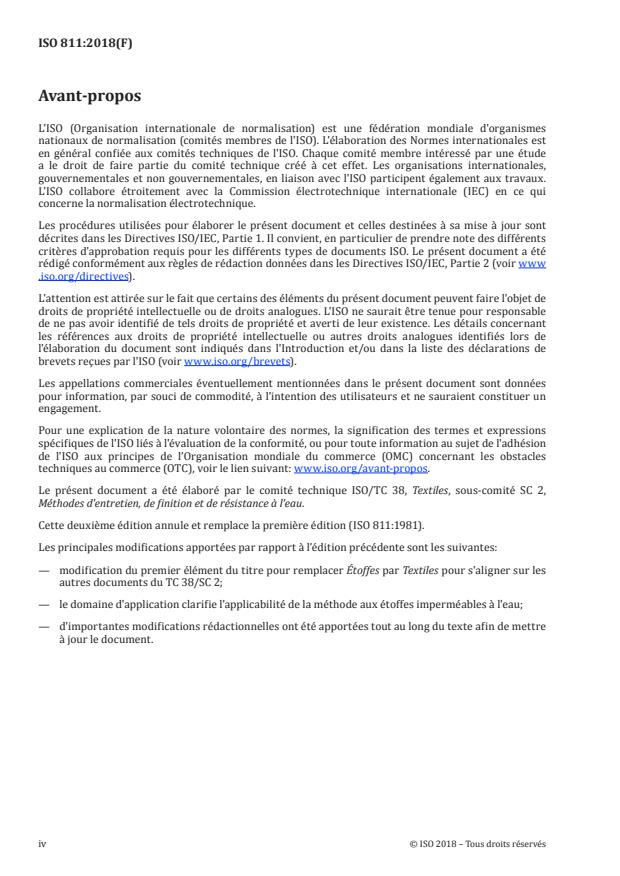
ISO 811:2018 - Textiles -- Détermination de la résistance a la pénétration de l'eau -- Essai sous pression hydrostatique
ISO 811:2018 - Textiles — Détermination de la résistance à la pénétration de l'eau — Essai sous pression hydrostatique/27/2018
Overview
ISO 811:2018, titled Textiles - Determination of resistance to water penetration - Hydrostatic pressure test, is an international standard published by the International Organization for Standardization (ISO). This standard specifies a hydrostatic pressure testing method to assess the water penetration resistance of fabrics. It applies to all textile fabrics intended to be water resistant, regardless of whether they have been treated with water-resistant or water-repellent finishes.
ISO 811:2018 provides a robust and reproducible approach to measuring how fabrics perform under water pressure, which is critical for evaluating water resistance in textiles used in outdoor apparel, protective clothing, upholstery, and technical textile products.
Key Topics
Hydrostatic Pressure Method
The test measures the water pressure a fabric can withstand before water penetrates through it at three distinct points. The pressure is gradually increased while the fabric is subjected to water, and the point of penetration determines the fabric's resistance level.Applicable Fabrics
The standard covers all fabric types intended to resist water penetration, including untreated, water-resistant, and water-repellent textiles.Test Conditions
- Testing is conducted under strictly controlled atmospheric conditions in line with ISO 139.
- Water used must meet grade 3 quality as per ISO 3696, with the test conducted at either 20 °C or 27 °C.
- The water pressure can be applied from above or below the fabric, and this must be documented in the test report.
Test Procedure Essentials
- Specimens are conditioned and clamped in a specialized fabric clamp ensuring no leakage or slippage.
- Water pressure increases steadily at specified rates (10 cm H₂O/min or 60 cm H₂O/min), with the rate explicitly noted in the results.
- Penetration is detected visually, and the pressure at which water first appears at three different points is recorded.
- Testing requires at least five specimens from different fabric areas to ensure representative results.
Result Reporting
Results include individual and mean pressures causing water penetration, expressed in centimeters or millibars of water pressure. Detailed test conditions, specimen information, and any deviations are also included in the test report for transparency and reproducibility.
Applications
ISO 811:2018 is vital for industries and professionals involved in:
Outdoor and Sportswear Manufacturing
Evaluating the water resistance of garments designed for rainwear, hiking, camping, and sports to ensure performance under wet conditions.Protective Clothing
Testing barrier fabrics for chemical protection, medical wear, and occupational safety garments where water penetration resistance is critical.Technical and Industrial Textiles
Assessing materials used in tents, tarpaulins, upholstery, and automotive textiles where water resistance impacts product durability and user comfort.Quality Control and Assurance
Using standardized test procedures to maintain consistent product performance and support product claims related to water resistance.
Related Standards
ISO 139: Textiles - Standard Atmospheres for Conditioning and Testing
Defines the environmental conditions (temperature, humidity) required for proper conditioning and testing of textile materials.ISO 3696: Water for Analytical Laboratory Use - Specification and Test Methods
Specifies the required purity and testing for water used in laboratory analyses, ensuring consistent reagent quality during testing.ISO 2859-1: Sampling Procedures for Inspection by Attributes
Provides sampling plans useful for quality control when applying ISO 811 for broader product assessment or production lot inspection.
ISO 811:2018 is an essential reference for manufacturers, testing laboratories, and quality assurance professionals seeking to accurately assess and report the water penetration resistance of textiles. Its application helps ensure product reliability, performance, and compliance with international expectations for water-resistant textiles.
Relations
- Effective Date
- 25-Aug-2026
- Effective Date
- 25-Aug-2026
- Effective Date
- 06-May-2026
- Effective Date
- 01-Apr-2026
- Effective Date
- 25-Feb-2026
- Effective Date
- 12-Feb-2026
- Effective Date
- 06-Jun-2022
- Effective Date
- 02-Nov-2013
Buy Documents
ISO 811:2018 - Textiles -- Determination of resistance to water penetration -- Hydrostatic pressure test
ISO 811:2018 - Textiles — Determination of resistance to water penetration — Hydrostatic pressure test/27/2018
ISO 811:2018 - Textiles -- Détermination de la résistance a la pénétration de l'eau -- Essai sous pression hydrostatique
ISO 811:2018 - Textiles — Détermination de la résistance à la pénétration de l'eau — Essai sous pression hydrostatique/27/2018
Get Certified
Connect with accredited certification bodies for this standard

Control Union Certifications
Global certification for agriculture and sustainability.

Hohenstein Institut
Textile testing and certification.

Bureau Veritas Bangladesh
Bureau Veritas certification services in Bangladesh.
Sponsored listings
Frequently Asked Questions
ISO 811:2018 is a standard published by the International Organization for Standardization (ISO). Its full title is "Textiles — Determination of resistance to water penetration — Hydrostatic pressure test". This standard covers: ISO 811:2018 specifies a hydrostatic pressure method for determining the resistance of fabrics to penetration by water. The method is applicable to all types of fabrics which are intended to be water resistant whether or not they have been given a water-resistant or water-repellent finish.
ISO 811:2018 specifies a hydrostatic pressure method for determining the resistance of fabrics to penetration by water. The method is applicable to all types of fabrics which are intended to be water resistant whether or not they have been given a water-resistant or water-repellent finish.
ISO 811:2018 is classified under the following ICS (International Classification for Standards) categories: 59.080.30 - Textile fabrics. The ICS classification helps identify the subject area and facilitates finding related standards.
ISO 811:2018 has the following relationships with other standards: It is inter standard links to EN 868-10:2018, EN ISO 5912:2020, EN ISO 15027-3:2026, EN ISO 24232:2025, EN ISO 20342-5:2024, EN ISO 811:2018, ISO 10456:2007, ISO 811:1981. Understanding these relationships helps ensure you are using the most current and applicable version of the standard.
ISO 811:2018 is available in PDF format for immediate download after purchase. The document can be added to your cart and obtained through the secure checkout process. Digital delivery ensures instant access to the complete standard document.
Standards Content (Sample)
INTERNATIONAL ISO
STANDARD 811
Second edition
2018-03
Textiles — Determination of
resistance to water penetration —
Hydrostatic pressure test
Textiles — Détermination de la résistance à la pénétration de l'eau —
Essai sous pression hydrostatique
Reference number
©
ISO 2018
© ISO 2018
All rights reserved. Unless otherwise specified, or required in the context of its implementation, no part of this publication may
be reproduced or utilized otherwise in any form or by any means, electronic or mechanical, including photocopying, or posting
on the internet or an intranet, without prior written permission. Permission can be requested from either ISO at the address
below or ISO’s member body in the country of the requester.
ISO copyright office
CP 401 • Ch. de Blandonnet 8
CH-1214 Vernier, Geneva
Phone: +41 22 749 01 11
Fax: +41 22 749 09 47
Email: copyright@iso.org
Website: www.iso.org
Published in Switzerland
ii © ISO 2018 – All rights reserved
Contents Page
Foreword .iv
1 Scope . 1
2 Normative references . 1
3 Terms and definitions . 1
4 Principle . 1
5 Reagents . 1
6 Apparatus . 2
7 Atmosphere for conditioning and testing . 2
8 Test specimen . 3
9 Test procedure . 3
10 Calculations and expression of results. . 4
11 Test report . 4
Bibliography . 5
Foreword
ISO (the International Organization for Standardization) is a worldwide federation of national standards
bodies (ISO member bodies). The work of preparing International Standards is normally carried out
through ISO technical committees. Each member body interested in a subject for which a technical
committee has been established has the right to be represented on that committee. International
organizations, governmental and non-governmental, in liaison with ISO, also take part in the work.
ISO collaborates closely with the International Electrotechnical Commission (IEC) on all matters of
electrotechnical standardization.
The procedures used to develop this document and those intended for its further maintenance are
described in the ISO/IEC Directives, Part 1. In particular the different approval criteria needed for the
different types of ISO documents should be noted. This document was drafted in accordance with the
editorial rules of the ISO/IEC Directives, Part 2 (see www .iso .org/ directives).
Attention is drawn to the possibility that some of the elements of this document may be the subject of
patent rights. ISO shall not be held responsible for identifying any or all such patent rights. Details of
any patent rights identified during the development of the document will be in the Introduction and/or
on the ISO list of patent declarations received (see www .iso .org/ patents).
Any trade name used in this document is information given for the convenience of users and does not
constitute an endorsement.
For an explanation on the voluntary nature of standards, the meaning of ISO specific terms and
expressions related to conformity assessment, as well as information about ISO's adherence to the
World Trade Organization (WTO) principles in the Technical Barriers to Trade (TBT) see the following
URL: www .iso .org/ iso/ foreword .html.
This document was prepared by Technical Committee ISO/TC 38, Textiles, Subcommittee SC 2, Cleansing,
finishing and water resistance tests.
This second edition cancels and replaces the first edition (ISO 811:1981).
The main changes to the previous edition are as follows:
— the first element of the title changed from Textile fabrics to Textiles to be in line with other TC 38/SC 2
documents;
— in the Scope, clarification that the applicability of the method is intended for water resistant fabrics;
— major editorial changes were made throughout the document to bring it up to date.
iv © ISO 2018 – All rights reserved
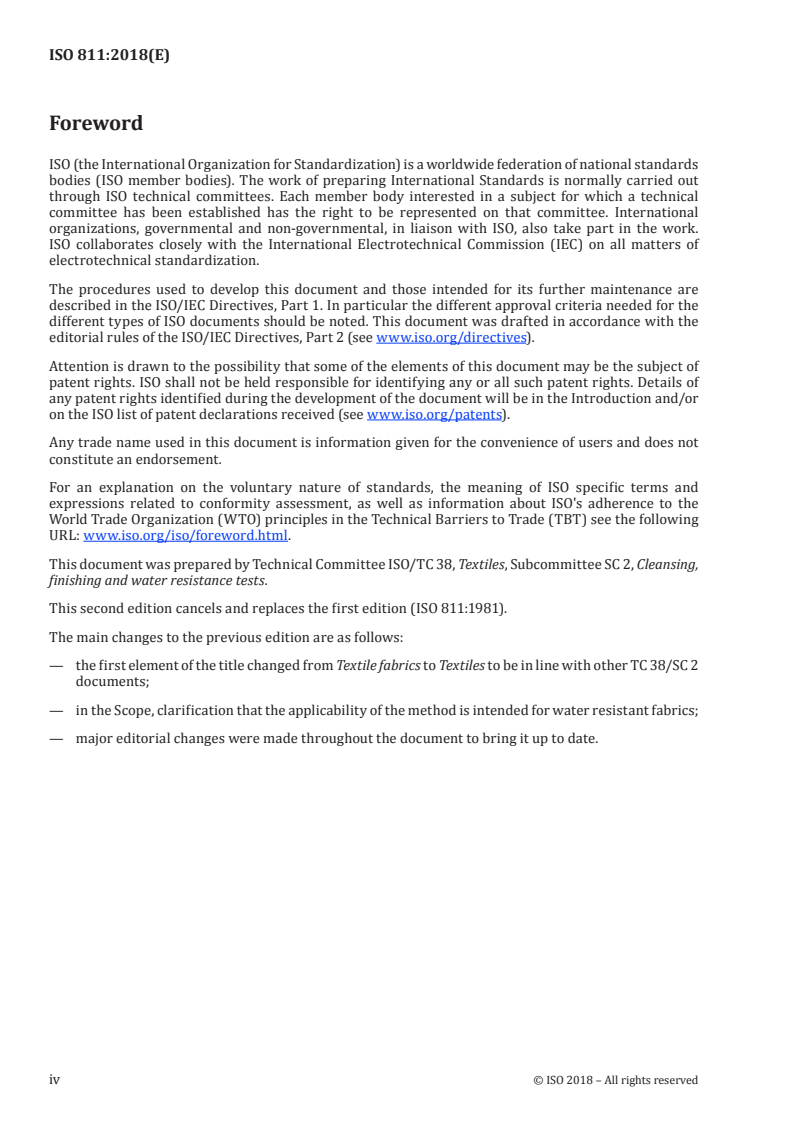
INTERNATIONAL STANDARD ISO 811:2018(E)
Textiles — Determination of resistance to water
penetration — Hydrostatic pressure test
1 Scope
This document specifies a hydrostatic pressure method for determining the resistance of fabrics to
penetration by water. The method is applicable to all types of fabrics which are intended to be water
resistant whether or not they have been given a water-resistant or water-repellent finish.
2 Normative references
The following documents are referred to in the text in such a way that some or all of their content
constitutes requirements of this document. For dated references, only the edition cited applies. For
undated references, the latest edition of the referenced document (including any amendments) applies.
ISO 139, Textiles — Standard atmospheres for conditioning and testing
ISO 3696, Water for analytical laboratory use — Specification and test methods
3 Terms and definitions
For the purposes of this document, the following terms and definitions apply.
ISO and IEC maintain terminological databases for use in standardization at the following addresses:
— ISO Online browsing platform: available at https:// www .iso .org/ obp
— IEC Electropedia: available at http:// www .electropedia .org/
3.1
face
fabric surface intended to be the outer visible side in an end product
4 Principle
The hydrostatic head supported by a fabric is a measure of the opposition to the passage of water
through the fabric. A specimen is subjected to a steadily increasing pressure of water on one side of the
fabric, under
...
INTERNATIONAL ISO
STANDARD 811
Second edition
2018-03
Textiles — Determination of
resistance to water penetration —
Hydrostatic pressure test
Textiles — Détermination de la résistance à la pénétration de l'eau —
Essai sous pression hydrostatique
Reference number
©
ISO 2018
© ISO 2018
All rights reserved. Unless otherwise specified, or required in the context of its implementation, no part of this publication may
be reproduced or utilized otherwise in any form or by any means, electronic or mechanical, including photocopying, or posting
on the internet or an intranet, without prior written permission. Permission can be requested from either ISO at the address
below or ISO’s member body in the country of the requester.
ISO copyright office
CP 401 • Ch. de Blandonnet 8
CH-1214 Vernier, Geneva
Phone: +41 22 749 01 11
Fax: +41 22 749 09 47
Email: copyright@iso.org
Website: www.iso.org
Published in Switzerland
ii © ISO 2018 – All rights reserved
Contents Page
Foreword .iv
1 Scope . 1
2 Normative references . 1
3 Terms and definitions . 1
4 Principle . 1
5 Reagents . 1
6 Apparatus . 2
7 Atmosphere for conditioning and testing . 2
8 Test specimen . 3
9 Test procedure . 3
10 Calculations and expression of results. . 4
11 Test report . 4
Bibliography . 5
Foreword
ISO (the International Organization for Standardization) is a worldwide federation of national standards
bodies (ISO member bodies). The work of preparing International Standards is normally carried out
through ISO technical committees. Each member body interested in a subject for which a technical
committee has been established has the right to be represented on that committee. International
organizations, governmental and non-governmental, in liaison with ISO, also take part in the work.
ISO collaborates closely with the International Electrotechnical Commission (IEC) on all matters of
electrotechnical standardization.
The procedures used to develop this document and those intended for its further maintenance are
described in the ISO/IEC Directives, Part 1. In particular the different approval criteria needed for the
different types of ISO documents should be noted. This document was drafted in accordance with the
editorial rules of the ISO/IEC Directives, Part 2 (see www .iso .org/ directives).
Attention is drawn to the possibility that some of the elements of this document may be the subject of
patent rights. ISO shall not be held responsible for identifying any or all such patent rights. Details of
any patent rights identified during the development of the document will be in the Introduction and/or
on the ISO list of patent declarations received (see www .iso .org/ patents).
Any trade name used in this document is information given for the convenience of users and does not
constitute an endorsement.
For an explanation on the voluntary nature of standards, the meaning of ISO specific terms and
expressions related to conformity assessment, as well as information about ISO's adherence to the
World Trade Organization (WTO) principles in the Technical Barriers to Trade (TBT) see the following
URL: www .iso .org/ iso/ foreword .html.
This document was prepared by Technical Committee ISO/TC 38, Textiles, Subcommittee SC 2, Cleansing,
finishing and water resistance tests.
This second edition cancels and replaces the first edition (ISO 811:1981).
The main changes to the previous edition are as follows:
— the first element of the title changed from Textile fabrics to Textiles to be in line with other TC 38/SC 2
documents;
— in the Scope, clarification that the applicability of the method is intended for water resistant fabrics;
— major editorial changes were made throughout the document to bring it up to date.
iv © ISO 2018 – All rights reserved
INTERNATIONAL STANDARD ISO 811:2018(E)
Textiles — Determination of resistance to water
penetration — Hydrostatic pressure test
1 Scope
This document specifies a hydrostatic pressure method for determining the resistance of fabrics to
penetration by water. The method is applicable to all types of fabrics which are intended to be water
resistant whether or not they have been given a water-resistant or water-repellent finish.
2 Normative references
The following documents are referred to in the text in such a way that some or all of their content
constitutes requirements of this document. For dated references, only the edition cited applies. For
undated references, the latest edition of the referenced document (including any amendments) applies.
ISO 139, Textiles — Standard atmospheres for conditioning and testing
ISO 3696, Water for analytical laboratory use — Specification and test methods
3 Terms and definitions
For the purposes of this document, the following terms and definitions apply.
ISO and IEC maintain terminological databases for use in standardization at the following addresses:
— ISO Online browsing platform: available at https:// www .iso .org/ obp
— IEC Electropedia: available at http:// www .electropedia .org/
3.1
face
fabric surface intended to be the outer visible side in an end product
4 Principle
The hydrostatic head supported by a fabric is a measure of the opposition to the passage of water
through the fabric. A specimen is subjected to a steadily increasing pressure of water on one side of the
fabric, under
...
NORME ISO
INTERNATIONALE 811
Deuxième édition
2018-03
Textiles — Détermination de la
résistance à la pénétration de l'eau —
Essai sous pression hydrostatique
Textiles — Determination of resistance to water penetration —
Hydrostatic pressure test
Numéro de référence
©
ISO 2018
DOCUMENT PROTÉGÉ PAR COPYRIGHT
© ISO 2018
Tous droits réservés. Sauf prescription différente ou nécessité dans le contexte de sa mise en oeuvre, aucune partie de cette
publication ne peut être reproduite ni utilisée sous quelque forme que ce soit et par aucun procédé, électronique ou mécanique,
y compris la photocopie, ou la diffusion sur l’internet ou sur un intranet, sans autorisation écrite préalable. Une autorisation peut
être demandée à l’ISO à l’adresse ci-après ou au comité membre de l’ISO dans le pays du demandeur.
ISO copyright office
Case postale 401 • Ch. de Blandonnet 8
CH-1214 Vernier, Geneva
Tél.: +41 22 749 01 11
Fax: +41 22 749 09 47
E-mail: copyright@iso.org
Web: www.iso.org
Publié en Suisse
ii © ISO 2018 – Tous droits réservés
Sommaire Page
Avant-propos .iv
1 Domaine d'application . 1
2 Références normatives . 1
3 Termes et définitions . 1
4 Principe . 1
5 Réactifs . 2
6 Appareillage . 2
7 Atmosphère de conditionnement et d'essai . 3
8 Éprouvette . 3
9 Mode opératoire d'essai . 3
10 Calculs et expression des résultats . 4
11 Rapport d'essai . 4
Bibliographie . 6
Avant-propos
L'ISO (Organisation internationale de normalisation) est une fédération mondiale d'organismes
nationaux de normalisation (comités membres de l'ISO). L'élaboration des Normes internationales est
en général confiée aux comités techniques de l'ISO. Chaque comité membre intéressé par une étude
a le droit de faire partie du comité technique créé à cet effet. Les organisations internationales,
gouvernementales et non gouvernementales, en liaison avec l'ISO participent également aux travaux.
L'ISO collabore étroitement avec la Commission électrotechnique internationale (IEC) en ce qui
concerne la normalisation électrotechnique.
Les procédures utilisées pour élaborer le présent document et celles destinées à sa mise à jour sont
décrites dans les Directives ISO/IEC, Partie 1. Il convient, en particulier de prendre note des différents
critères d'approbation requis pour les différents types de documents ISO. Le présent document a été
rédigé conformément aux règles de rédaction données dans les Directives ISO/IEC, Partie 2 (voir www
.iso .org/ directives).
L'attention est attirée sur le fait que certains des éléments du présent document peuvent faire l'objet de
droits de propriété intellectuelle ou de droits analogues. L'ISO ne saurait être tenue pour responsable
de ne pas avoir identifié de tels droits de propriété et averti de leur existence. Les détails concernant
les références aux droits de propriété intellectuelle ou autres droits analogues identifiés lors de
l'élaboration du document sont indiqués dans l'Introduction et/ou dans la liste des déclarations de
brevets reçues par l'ISO (voir www .iso .org/ brevets).
Les appellations commerciales éventuellement mentionnées dans le présent document sont données
pour information, par souci de commodité, à l’intention des utilisateurs et ne sauraient constituer un
engagement.
Pour une explication de la nature volontaire des normes, la signification des termes et expressions
spécifiques de l'ISO liés à l'évaluation de la conformité, ou pour toute information au sujet de l'adhésion
de l'ISO aux principes de l’Organisation mondiale du commerce (OMC) concernant les obstacles
techniques au commerce (OTC), voir le lien suivant: www .iso .org/ avant -propos.
Le présent document a été élaboré par le comité technique ISO/TC 38, Textiles, sous-comité SC 2,
Méthodes d'entretien, de finition et de résistance à l'eau.
Cette deuxième édition annule et remplace la première édition (ISO 811:1981).
Les principales modifications apportées par rapport à l’édition précédente sont les suivantes:
— modification du premier élément du titre pour remplacer Étoffes par Textiles pour s'aligner sur les
autres documents du TC 38/SC 2;
— le domaine d'application clarifie l'applicabilité de la méthode aux étoffes imperméables à l'eau;
— d'importantes modifications rédactionnelles ont été apportées tout au long du texte afin de mettre
à jour le document.
iv © ISO 2018 – Tous droits réservés
NORME INTERNATIONALE ISO 811:2018(F)
Textiles — Détermination de la résistance à la pénétration
de l'eau — Essai sous pression hydrostatique
1 Domaine d'application
Le présent document spécifie une méthode d’essai sous pression hydrostatique permettant de
déterminer la résistance des étoffes à la pénétration de l’eau. Cette méthode est applicable à tous les
types d’étoffes destinés à être imperméables à l'eau, qu'ils aient reçu ou non une finition imperméable à
l'eau ou déperlante.
2 Références normatives
Les documents suivants cités dans le texte constituent, pour tout ou partie de leur contenu, des
exigences du présent document. Pour les références datées, seule l’édition citée s’applique. Pour les
références non datées, la dernière édition du document de référence s'applique (y compris les éventuels
amendements).
ISO 139, Textiles — Atmosphères normales de conditionnement et d'essai
ISO 3696, Eau pour laboratoire à usage analytique — Spécification et méthodes d'essai
3 Termes et définitions
Pour les besoins du présent document, les termes et définitions suivants s'appliquent.
L'ISO et l'IEC tiennent à jour des bases de données terminologiques destinées à être utilisées en
normalisation, consultables aux adresses suivantes:
— ISO Online browsing platform: disponible à l'adresse https:// www .iso .org/ obp
— IEC Electropedia: disponible à l'adresse http:// www .electropedia .org/
3.1
face
surface de l’étoffe destinée à être la face extérieure visible d’un produit fini
4 Principe
La charge hydrostatique supportée par une étoffe est une mesure de la résistance au passage de l’eau à
travers l’étoffe. Une éprouvette est soumise à une pression d’eau qui augmente régulièrement sur une
face de l’étoffe, dans des conditions normales, jusqu’à ce que l’eau traverse en trois emplacements. La
pression au moment où l’eau traverse l’étoffe au troisième emplacement est notée. La pression d’eau
peut être appliquée depuis le dessous ou le dessus de l’éprouvette. Le sens d’application choisi doit être
consigné dans le rapport d’essai.
Le résultat est en corrélation directe avec le co
...
NORME ISO
INTERNATIONALE 811
Deuxième édition
2018-03
Textiles — Détermination de la
résistance à la pénétration de l'eau —
Essai sous pression hydrostatique
Textiles — Determination of resistance to water penetration —
Hydrostatic pressure test
Numéro de référence
©
ISO 2018
DOCUMENT PROTÉGÉ PAR COPYRIGHT
© ISO 2018
Tous droits réservés. Sauf prescription différente ou nécessité dans le contexte de sa mise en oeuvre, aucune partie de cette
publication ne peut être reproduite ni utilisée sous quelque forme que ce soit et par aucun procédé, électronique ou mécanique,
y compris la photocopie, ou la diffusion sur l’internet ou sur un intranet, sans autorisation écrite préalable. Une autorisation peut
être demandée à l’ISO à l’adresse ci-après ou au comité membre de l’ISO dans le pays du demandeur.
ISO copyright office
Case postale 401 • Ch. de Blandonnet 8
CH-1214 Vernier, Geneva
Tél.: +41 22 749 01 11
Fax: +41 22 749 09 47
E-mail: copyright@iso.org
Web: www.iso.org
Publié en Suisse
ii © ISO 2018 – Tous droits réservés
Sommaire Page
Avant-propos .iv
1 Domaine d'application . 1
2 Références normatives . 1
3 Termes et définitions . 1
4 Principe . 1
5 Réactifs . 2
6 Appareillage . 2
7 Atmosphère de conditionnement et d'essai . 3
8 Éprouvette . 3
9 Mode opératoire d'essai . 3
10 Calculs et expression des résultats . 4
11 Rapport d'essai . 4
Bibliographie . 6
Avant-propos
L'ISO (Organisation internationale de normalisation) est une fédération mondiale d'organismes
nationaux de normalisation (comités membres de l'ISO). L'élaboration des Normes internationales est
en général confiée aux comités techniques de l'ISO. Chaque comité membre intéressé par une étude
a le droit de faire partie du comité technique créé à cet effet. Les organisations internationales,
gouvernementales et non gouvernementales, en liaison avec l'ISO participent également aux travaux.
L'ISO collabore étroitement avec la Commission électrotechnique internationale (IEC) en ce qui
concerne la normalisation électrotechnique.
Les procédures utilisées pour élaborer le présent document et celles destinées à sa mise à jour sont
décrites dans les Directives ISO/IEC, Partie 1. Il convient, en particulier de prendre note des différents
critères d'approbation requis pour les différents types de documents ISO. Le présent document a été
rédigé conformément aux règles de rédaction données dans les Directives ISO/IEC, Partie 2 (voir www
.iso .org/ directives).
L'attention est attirée sur le fait que certains des éléments du présent document peuvent faire l'objet de
droits de propriété intellectuelle ou de droits analogues. L'ISO ne saurait être tenue pour responsable
de ne pas avoir identifié de tels droits de propriété et averti de leur existence. Les détails concernant
les références aux droits de propriété intellectuelle ou autres droits analogues identifiés lors de
l'élaboration du document sont indiqués dans l'Introduction et/ou dans la liste des déclarations de
brevets reçues par l'ISO (voir www .iso .org/ brevets).
Les appellations commerciales éventuellement mentionnées dans le présent document sont données
pour information, par souci de commodité, à l’intention des utilisateurs et ne sauraient constituer un
engagement.
Pour une explication de la nature volontaire des normes, la signification des termes et expressions
spécifiques de l'ISO liés à l'évaluation de la conformité, ou pour toute information au sujet de l'adhésion
de l'ISO aux principes de l’Organisation mondiale du commerce (OMC) concernant les obstacles
techniques au commerce (OTC), voir le lien suivant: www .iso .org/ avant -propos.
Le présent document a été élaboré par le comité technique ISO/TC 38, Textiles, sous-comité SC 2,
Méthodes d'entretien, de finition et de résistance à l'eau.
Cette deuxième édition annule et remplace la première édition (ISO 811:1981).
Les principales modifications apportées par rapport à l’édition précédente sont les suivantes:
— modification du premier élément du titre pour remplacer Étoffes par Textiles pour s'aligner sur les
autres documents du TC 38/SC 2;
— le domaine d'application clarifie l'applicabilité de la méthode aux étoffes imperméables à l'eau;
— d'importantes modifications rédactionnelles ont été apportées tout au long du texte afin de mettre
à jour le document.
iv © ISO 2018 – Tous droits réservés
NORME INTERNATIONALE ISO 811:2018(F)
Textiles — Détermination de la résistance à la pénétration
de l'eau — Essai sous pression hydrostatique
1 Domaine d'application
Le présent document spécifie une méthode d’essai sous pression hydrostatique permettant de
déterminer la résistance des étoffes à la pénétration de l’eau. Cette méthode est applicable à tous les
types d’étoffes destinés à être imperméables à l'eau, qu'ils aient reçu ou non une finition imperméable à
l'eau ou déperlante.
2 Références normatives
Les documents suivants cités dans le texte constituent, pour tout ou partie de leur contenu, des
exigences du présent document. Pour les références datées, seule l’édition citée s’applique. Pour les
références non datées, la dernière édition du document de référence s'applique (y compris les éventuels
amendements).
ISO 139, Textiles — Atmosphères normales de conditionnement et d'essai
ISO 3696, Eau pour laboratoire à usage analytique — Spécification et méthodes d'essai
3 Termes et définitions
Pour les besoins du présent document, les termes et définitions suivants s'appliquent.
L'ISO et l'IEC tiennent à jour des bases de données terminologiques destinées à être utilisées en
normalisation, consultables aux adresses suivantes:
— ISO Online browsing platform: disponible à l'adresse https:// www .iso .org/ obp
— IEC Electropedia: disponible à l'adresse http:// www .electropedia .org/
3.1
face
surface de l’étoffe destinée à être la face extérieure visible d’un produit fini
4 Principe
La charge hydrostatique supportée par une étoffe est une mesure de la résistance au passage de l’eau à
travers l’étoffe. Une éprouvette est soumise à une pression d’eau qui augmente régulièrement sur une
face de l’étoffe, dans des conditions normales, jusqu’à ce que l’eau traverse en trois emplacements. La
pression au moment où l’eau traverse l’étoffe au troisième emplacement est notée. La pression d’eau
peut être appliquée depuis le dessous ou le dessus de l’éprouvette. Le sens d’application choisi doit être
consigné dans le rapport d’essai.
Le résultat est en corrélation directe avec le co
...