


ISO 24359-1
(Main)Building commissioning process planning - Part 1: New buildings
Building commissioning process planning - Part 1: New buildings
This standard addresses the development of the commissioning plan at the design stage planning of commissioning activities for new construction projects. The commissioning plan incorporates commissioning activities which begin during early project stages, and continue through design, construction, project turnover, occupancy, and operation. The commissioning plan documents the intended process to verify and document that the quality of the built project in operation meets the requirements of the owner. Excluded: commissioning in existing buildings. Background: This standard applies to the development of the commissioning plan, the document which includes procedures, methods and documentation requirements that apply to the commissioning process for the building systems at each phase of the project, from pre-design through occupancy and operation. The building commissioning plan can be developed for individual, multiple or the whole building systems and assemblies. This standard applies to new building construction projects. The commissioning plan is used by the owner, commissioning provider, building developer, owner’s representative, construction manager, architect, contractor, sub-contractors and / or other consultants to determine the tasks and activities required to commission the project in accordance with the project requirements of the owner. Commissioning providers use this standard to develop a project specific commissioning plan, which includes the list of systems to be commissioned, the scope of tasks associated with the process to achieve the owner’s specific commissioning requirements, and the work plan to accomplish those tasks. Requirements for the project are established by the owner and/or commissioning provider. This standard indicates the minimum set of definitions of commissioning that can be commonly applied. The ISO time limits will not allow completion of work on the existing work item. The new work item is intended to incorporate the work to date on the existing work item, and available commissioning standards including USA’s ASHRAE Standard 202-2018, Canada’s Z5000-18, and Mexico’s NMX-C-506. Commissioning is closely related to – and must be tailored to suit – the building design and construction process for each project. As these processes differ in each country, specific commissioning planning methods shall be determined by the national standards or documents of each country.
Planification du processus du commissionnement des bâtiments — Partie 1: Nouveaux bâtiments
General Information
- Status
- Not Published
- Technical Committee
- ISO/TC 205 - Building environment design
- Drafting Committee
- ISO/TC 205/WG 10 - Commissioning
- Current Stage
- 6000 - International Standard under publication
- Start Date
- 26-Nov-2025
- Completion Date
- 10-Jan-2026
Overview
ISO 24359-1:2025, titled Building commissioning process planning - Part 1: New buildings, is an international standard published by ISO that focuses on the development of commissioning plans for new construction projects. Commissioning (Cx) is a quality-focused process that ensures building systems and assemblies are designed, installed, tested, operated, and maintained to meet the owner's project requirements (OPR). This standard facilitates effective planning of commissioning activities starting at the design stage and continuing through construction, turnover, occupancy, and the first year of operation.
This document provides a comprehensive framework for developing project-specific commissioning plans, applicable to new buildings, major renovations, and system replacements, but excludes commissioning activities in existing buildings. It supports project team collaboration-including owners, commissioning providers, architects, contractors, and consultants-to ensure the built environment achieves specified indoor environmental quality and operational goals.
Key Topics
Commissioning Plan Development
The standard outlines requirements for preparing a detailed commissioning plan that includes procedures, roles, schedules, verification methods, and documentation protocols covering all project phases: pre-design, design, construction, turnover, and initial operation.Commissioning Process Scope
Commissioning activities cover the whole lifecycle of new buildings from early planning through first-year occupancy, emphasizing continuous verification and quality assurance to align with the owner’s project requirements.Roles and Responsibilities
Defines the commissioning provider (CxP) as the party responsible for leading the commissioning process, coordinating the commissioning team, and ensuring compliance with the owner’s goals.Documentation and Reporting
Includes guidance on producing commissioning-related documents such as checklists, commissioning progress reports, final commissioning reports, and commissioned systems manuals to maintain transparency and traceability.Integration with Design and Construction
The standard stresses early initiation of commissioning and integration into design and construction workflows to reduce errors, optimize cost and time, and enhance overall project quality.Functional Performance Testing
Specifies the need for functional performance tests (FPT) to verify that building systems operate according to OPR under various conditions, including seasonal testing.Flexibility for Delivery Methods
Applicable to diverse project delivery techniques like Design-Build, Integrated Project Delivery (IPD), and traditional methods, recognizing the need for tailored commissioning planning approaches.
Applications
New Building Construction
Ensures new projects meet stringent quality, energy efficiency, and indoor environmental standards by embedding commissioning throughout the design and construction phases.Major Renovations and System Replacements
Provides a framework for commissioning significant upgrades in buildings where systems or assemblies are replaced to maintain or exceed performance expectations.Project Management and Quality Assurance
Supports project teams in planning and executing commissioning tasks for better coordination, minimized rework, cost savings, and enhanced occupant comfort and safety.Building Owner and Operator Support
Offers building owners and operators comprehensive documentation and verified system functionality to enable smooth turnover and facility management.
Related Standards
- ISO 16813:2024 – Framework for indoor environment design supporting commissioning processes.
- ISO 19455 Series – Standards related to functional performance testing for building systems.
- ISO 21105 Series – Guidance on commissioning specific building systems and components.
- ASHRAE Standard 202-2018 – A U.S. commissioning standard referenced for integration and consistency.
- Canada’s Z5000-18 and Mexico’s NMX-C-506 – Regional commissioning standards complementing ISO 24359-1 requirements.
Keywords: ISO 24359-1, building commissioning, commissioning plan, new construction, commissioning process, functional performance testing, owner’s project requirements, commissioning provider, building quality assurance, construction management, indoor environment design, project delivery methods, commissioning documentation.
ISO/FDIS 24359-1 - Building commissioning process planning — Part 1: New buildings Released:16. 09. 2025
REDLINE ISO/FDIS 24359-1 - Building commissioning process planning — Part 1: New buildings Released:16. 09. 2025
Frequently Asked Questions
ISO 24359-1 is a draft published by the International Organization for Standardization (ISO). Its full title is "Building commissioning process planning - Part 1: New buildings". This standard covers: This standard addresses the development of the commissioning plan at the design stage planning of commissioning activities for new construction projects. The commissioning plan incorporates commissioning activities which begin during early project stages, and continue through design, construction, project turnover, occupancy, and operation. The commissioning plan documents the intended process to verify and document that the quality of the built project in operation meets the requirements of the owner. Excluded: commissioning in existing buildings. Background: This standard applies to the development of the commissioning plan, the document which includes procedures, methods and documentation requirements that apply to the commissioning process for the building systems at each phase of the project, from pre-design through occupancy and operation. The building commissioning plan can be developed for individual, multiple or the whole building systems and assemblies. This standard applies to new building construction projects. The commissioning plan is used by the owner, commissioning provider, building developer, owner’s representative, construction manager, architect, contractor, sub-contractors and / or other consultants to determine the tasks and activities required to commission the project in accordance with the project requirements of the owner. Commissioning providers use this standard to develop a project specific commissioning plan, which includes the list of systems to be commissioned, the scope of tasks associated with the process to achieve the owner’s specific commissioning requirements, and the work plan to accomplish those tasks. Requirements for the project are established by the owner and/or commissioning provider. This standard indicates the minimum set of definitions of commissioning that can be commonly applied. The ISO time limits will not allow completion of work on the existing work item. The new work item is intended to incorporate the work to date on the existing work item, and available commissioning standards including USA’s ASHRAE Standard 202-2018, Canada’s Z5000-18, and Mexico’s NMX-C-506. Commissioning is closely related to – and must be tailored to suit – the building design and construction process for each project. As these processes differ in each country, specific commissioning planning methods shall be determined by the national standards or documents of each country.
This standard addresses the development of the commissioning plan at the design stage planning of commissioning activities for new construction projects. The commissioning plan incorporates commissioning activities which begin during early project stages, and continue through design, construction, project turnover, occupancy, and operation. The commissioning plan documents the intended process to verify and document that the quality of the built project in operation meets the requirements of the owner. Excluded: commissioning in existing buildings. Background: This standard applies to the development of the commissioning plan, the document which includes procedures, methods and documentation requirements that apply to the commissioning process for the building systems at each phase of the project, from pre-design through occupancy and operation. The building commissioning plan can be developed for individual, multiple or the whole building systems and assemblies. This standard applies to new building construction projects. The commissioning plan is used by the owner, commissioning provider, building developer, owner’s representative, construction manager, architect, contractor, sub-contractors and / or other consultants to determine the tasks and activities required to commission the project in accordance with the project requirements of the owner. Commissioning providers use this standard to develop a project specific commissioning plan, which includes the list of systems to be commissioned, the scope of tasks associated with the process to achieve the owner’s specific commissioning requirements, and the work plan to accomplish those tasks. Requirements for the project are established by the owner and/or commissioning provider. This standard indicates the minimum set of definitions of commissioning that can be commonly applied. The ISO time limits will not allow completion of work on the existing work item. The new work item is intended to incorporate the work to date on the existing work item, and available commissioning standards including USA’s ASHRAE Standard 202-2018, Canada’s Z5000-18, and Mexico’s NMX-C-506. Commissioning is closely related to – and must be tailored to suit – the building design and construction process for each project. As these processes differ in each country, specific commissioning planning methods shall be determined by the national standards or documents of each country.
ISO 24359-1 is classified under the following ICS (International Classification for Standards) categories: 91.010.01 - Construction industry in general; 91.040.01 - Buildings in general. The ICS classification helps identify the subject area and facilitates finding related standards.
ISO 24359-1 is available in PDF format for immediate download after purchase. The document can be added to your cart and obtained through the secure checkout process. Digital delivery ensures instant access to the complete standard document.
Standards Content (Sample)
FINAL DRAFT
International
Standard
ISO/FDIS 24359-1
ISO/TC 205
Building commissioning process
Secretariat: ANSI
planning —
Voting begins on:
2025-09-30
Part 1:
New buildings
Voting terminates on:
2025-11-25
RECIPIENTS OF THIS DRAFT ARE INVITED TO SUBMIT,
WITH THEIR COMMENTS, NOTIFICATION OF ANY
RELEVANT PATENT RIGHTS OF WHICH THEY ARE AWARE
AND TO PROVIDE SUPPOR TING DOCUMENTATION.
IN ADDITION TO THEIR EVALUATION AS
BEING ACCEPTABLE FOR INDUSTRIAL, TECHNO-
LOGICAL, COMMERCIAL AND USER PURPOSES, DRAFT
INTERNATIONAL STANDARDS MAY ON OCCASION HAVE
TO BE CONSIDERED IN THE LIGHT OF THEIR POTENTIAL
TO BECOME STAN DARDS TO WHICH REFERENCE MAY BE
MADE IN NATIONAL REGULATIONS.
Reference number
ISO/FDIS 24359-1:2025(en) © ISO 2025
FINAL DRAFT
ISO/FDIS 24359-1:2025(en)
International
Standard
ISO/FDIS 24359-1
ISO/TC 205
Building commissioning process
Secretariat: ANSI
planning —
Voting begins on:
Part 1:
New buildings
Voting terminates on:
RECIPIENTS OF THIS DRAFT ARE INVITED TO SUBMIT,
WITH THEIR COMMENTS, NOTIFICATION OF ANY
RELEVANT PATENT RIGHTS OF WHICH THEY ARE AWARE
AND TO PROVIDE SUPPOR TING DOCUMENTATION.
© ISO 2025
IN ADDITION TO THEIR EVALUATION AS
All rights reserved. Unless otherwise specified, or required in the context of its implementation, no part of this publication may
BEING ACCEPTABLE FOR INDUSTRIAL, TECHNO-
LOGICAL, COMMERCIAL AND USER PURPOSES, DRAFT
be reproduced or utilized otherwise in any form or by any means, electronic or mechanical, including photocopying, or posting on
INTERNATIONAL STANDARDS MAY ON OCCASION HAVE
the internet or an intranet, without prior written permission. Permission can be requested from either ISO at the address below
TO BE CONSIDERED IN THE LIGHT OF THEIR POTENTIAL
or ISO’s member body in the country of the requester.
TO BECOME STAN DARDS TO WHICH REFERENCE MAY BE
MADE IN NATIONAL REGULATIONS.
ISO copyright office
CP 401 • Ch. de Blandonnet 8
CH-1214 Vernier, Geneva
Phone: +41 22 749 01 11
Email: copyright@iso.org
Website: www.iso.org
Published in Switzerland Reference number
ISO/FDIS 24359-1:2025(en) © ISO 2025
ii
ISO/FDIS 24359-1:2025(en)
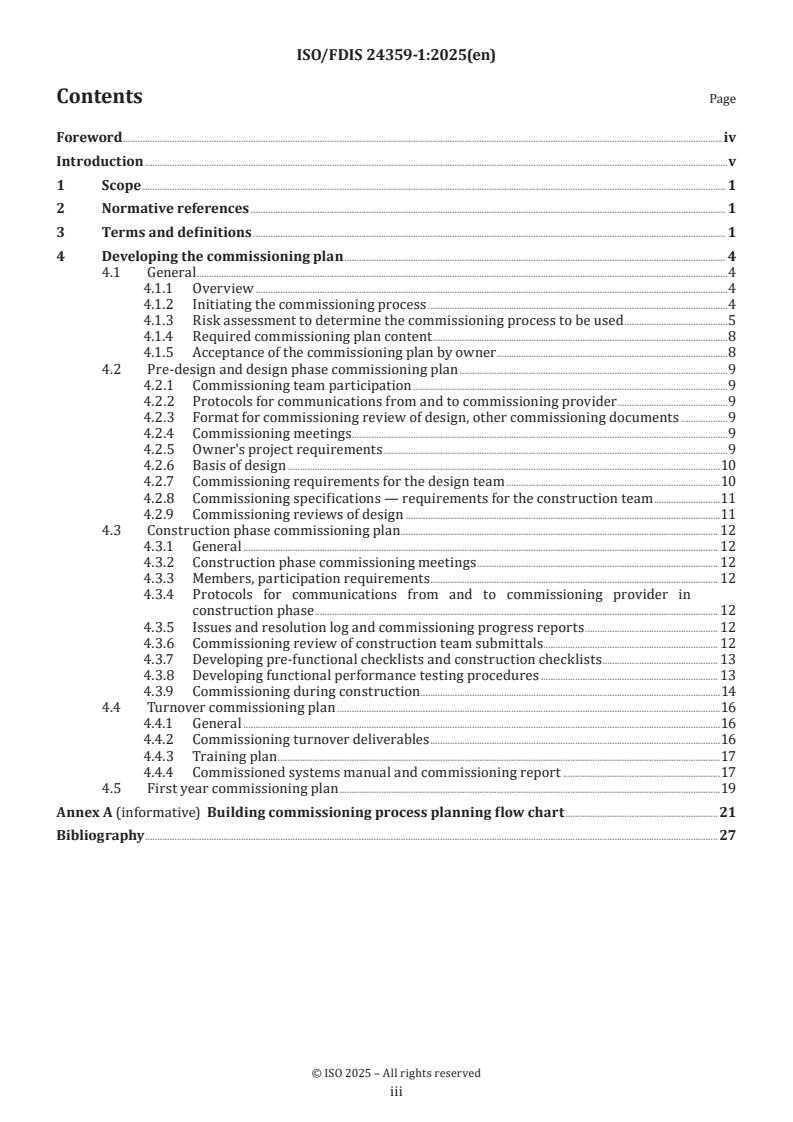
Contents Page
Foreword .iv
Introduction .v
1 Scope . 1
2 Normative references . 1
3 Terms and definitions . 1
4 Developing the commissioning plan . 4
4.1 General .4
4.1.1 Overview .4
4.1.2 Initiating the commissioning process .4
4.1.3 Risk assessment to determine the commissioning process to be used .5
4.1.4 Required commissioning plan content .8
4.1.5 Acceptance of the commissioning plan by owner .8
4.2 Pre-design and design phase commissioning plan .9
4.2.1 Commissioning team participation .9
4.2.2 Protocols for communications from and to commissioning provider .9
4.2.3 Format for commissioning review of design, other commissioning documents .9
4.2.4 Commissioning meetings.9
4.2.5 Owner's project requirements .9
4.2.6 Basis of design .10
4.2.7 Commissioning requirements for the design team .10
4.2.8 Commissioning specifications — requirements for the construction team .11
4.2.9 Commissioning reviews of design .11
4.3 Construction phase commissioning plan . 12
4.3.1 General . 12
4.3.2 Construction phase commissioning meetings . 12
4.3.3 Members, participation requirements . 12
4.3.4 Protocols for communications from and to commissioning provider in
construction phase . 12
4.3.5 Issues and resolution log and commissioning progress reports . 12
4.3.6 Commissioning review of construction team submittals . 12
4.3.7 Developing pre-functional checklists and construction checklists . 13
4.3.8 Developing functional performance testing procedures . 13
4.3.9 Commissioning during construction .14
4.4 Turnover commissioning plan .16
4.4.1 General .16
4.4.2 Commissioning turnover deliverables .16
4.4.3 Training plan .17
4.4.4 Commissioned systems manual and commissioning report .17
4.5 First year commissioning plan .19
Annex A (informative) Building commissioning process planning flow chart .21
Bibliography .27
iii
ISO/FDIS 24359-1:2025(en)
Foreword
ISO (the International Organization for Standardization) is a worldwide federation of national standards
bodies (ISO member bodies). The work of preparing International Standards is normally carried out through
ISO technical committees. Each member body interested in a subject for which a technical committee
has been established has the right to be represented on that committee. International organizations,
governmental and non-governmental, in liaison with ISO, also take part in the work. ISO collaborates closely
with the International Electrotechnical Commission (IEC) on all matters of electrotechnical standardization.
The procedures used to develop this document and those intended for its further maintenance are described
in the ISO/IEC Directives, Part 1. In particular, the different approval criteria needed for the different types
of ISO document should be noted. This document was drafted in accordance with the editorial rules of the
ISO/IEC Directives, Part 2 (see www.iso.org/directives).
ISO draws attention to the possibility that the implementation of this document may involve the use of (a)
patent(s). ISO takes no position concerning the evidence, validity or applicability of any claimed patent
rights in respect thereof. As of the date of publication of this document, ISO had not received notice of (a)
patent(s) which may be required to implement this document. However, implementers are cautioned that
this may not represent the latest information, which may be obtained from the patent database available at
www.iso.org/patents. ISO shall not be held responsible for identifying any or all such patent rights.
Any trade name used in this document is information given for the convenience of users and does not
constitute an endorsement.
For an explanation of the voluntary nature of standards, the meaning of ISO specific terms and expressions
related to conformity assessment, as well as information about ISO's adherence to the World Trade
Organization (WTO) principles in the Technical Barriers to Trade (TBT), see www.iso.org/iso/foreword.html.
This document was prepared by Technical Committee ISO/TC 205, Building environment design.
A list of all parts in the ISO 24359 series can be found on the ISO website.
Any feedback or questions on this document should be directed to the user’s national standards body. A
complete listing of these bodies can be found at www.iso.org/members.html.
iv
ISO/FDIS 24359-1:2025(en)
Introduction
This document applies to the development of the building commissioning plan, which documents the building
commissioning (Cx) process for selected systems or assemblies at each phase of the project, from pre-design
through occupancy and operation. This document establishes normative requirements for commissioning
planning during indoor environment design process in a framework consistent with ISO 16813 and the
other commissioning international standards under development for functional performance testing of
specific components relating to the indoor environment and the energy use such as the ISO 19455 series
and ISO 21105 series. While “commissioning” is used in a range of industries and contexts with different
meanings, such as a singular event at the end of an industrial construction project, this document addresses
the commissioning process that occurs throughout the design, construction, and first year of new building
or major renovation projects.
Building commissioning experience shows that early initiation of commissioning and clear communication
of the commissioning process to project team members from the beginning of design are common
characteristics of higher value commissioning processes and approaches. Therefore, this document, while
intended for use at the design stage of the project, describes requirements for the commissioning process
beyond the design stage. This allows the commissioning requirements to be appropriately embedded in the
project documents so that, as procurement proceeds, commissioning requirements are clearly conveyed to
affected members of the project team, whether owners, designers, contractors, operators, or occupants.
This document can be applied to any type of system or assembly being commissioned in new building and
major renovation or system replacement construction projects. The commissioning plan is developed by the
commissioning provider for use by project team members and other stakeholders to determine the tasks
and activities required to commission the project, including post-occupancy commissioning tasks associated
with the project, in accordance with the owner’s project requirements.
Commissioning providers use this document to develop a project-specific commissioning plan, which
documents the systems or assemblies to be commissioned, the scope of tasks associated with the process to
achieve the owner’s project requirements (OPR), and the work plan to accomplish those tasks. The systems
or assemblies to be commissioned and the commissioning requirements for the project are established by
the owner with the support of the commissioning provider. This document prescribes the minimum set
elements to be in the commissioning plan that can be commonly applied, regardless of which systems or
assemblies are being commissioned on a project.
This document establishes the requirements for the rigor and duration of the commissioning process. These
requirements range from basic commissioning with an emphasis on construction and turnover, to enhanced
commissioning with more substantial activities during design and in the first year of the building’s working
life. The framework addresses the full range of commissioned systems and building elements which impact
indoor environment. These systems and elements to be commissioned vary widely by project. This document
addresses planning activities for a wide range of project types and a variety of systems or assemblies to be
commissioned.
This framework considers different project delivery methods including those not addressed by existing
national standards. These previous standards were typically developed for older project delivery methods
where design was completed prior to the start of construction, and design was performed by a different
entity than construction. The same is true of the commissioning processes required by various green
building certification schemes in various regions around the world. The global marketplace now utilizes a
range of highly variable delivery methods such as tender offer, design-build, and integrated project delivery,
to which the building commissioning processes prescribed in this document readily apply.
This document applies to commissioning planning during design for commissioning activities through the
first year of occupancy. This planning can be impacted by the owner’s intentions for further subsequent
commissioning activities in existing buildings such as on-going commissioning, recommissioning and
retro-commissioning, but such lifecycle commissioning activities are not addressed in this document. This
document is intended to be followed by Part 2, which will provide a standard for commissioning planning
for existing buildings.
v
FINAL DRAFT International Standard ISO/FDIS 24359-1:2025(en)
Building commissioning process planning —
Part 1:
New buildings
1 Scope
This document addresses the development of a building commissioning (Cx) plan for new construction,
major renovations, or system and assembly replacement projects. The commissioning plan incorporates
commissioning activities which begin during early project stages, and continue through pre-design, design,
construction, turnover and the first year of operation. The commissioning plan is developed during the
design stage and also address later stages of the project.
The commissioning plan presents the intended process to verify and document that the quality of the built
project in operation meets the requirements of the owner. This document provides an overarching process
for planning of commissioning any aspect of a building project and is intended for use with system or
discipline specific standards. This document does not include retro-commissioning or recommissioning in
existing buildings.
2 Normative references
There are no normative references in this document.
3 Terms and definitions
For the purposes of this document, the following terms and definitions apply.
ISO and IEC maintain terminology databases for use in standardization at the following addresses:
— ISO Online browsing platform: available at https:// www .iso .org/ obp
— IEC Electropedia: available at https:// www .electropedia .org/
3.1
basis of design
BoD
document recording concepts, calculations, decisions, and product selections used to meet the owner’s
project requirements and to satisfy applicable regulatory requirements, standards, and guidelines, including
narrative descriptions and lists that support the design process
3.2
checklist
project- and element-specific document prepared or reviewed by the commissioning provider for use in all
phases of commissioning, used to identify issues and to confirm that the owner’s project requirements are
being achieved, including those for evaluation, testing, training, and other design and construction activities
3.2.1
construction checklist
document used to confirm that appropriate materials and components are on-site, ready for installation,
correctly installed, functional, and conforming to the owner’s project requirements
ISO/FDIS 24359-1:2025(en)
3.3
commissioning process
quality-focused process intended to enhance project delivery by verifying and documenting that all relevant
systems and assemblies are planned, designed, installed, tested, operated, and maintained in accordance
with the owner’s project requirements
Note 1 to entry: See ISO 21105-1 for information on the commissioning process of the building enclosure.
Note 2 to entry: See ISO/TS 21274 for information on the commissioning process of the lighting systems in buildings.
3.4
commissioning design review
review of design documents to determine conformity with the owner’s project requirements, including
coordination between commissioned systems and assemblies, and features and access for testing,
maintenance, and other activities identified in the owner’s project requirements and commissioning plan
Note 1 to entry: The following types of design review differ from commissioning design review and are not performed
as part of commissioning process unless by special contractual arrangement:
— Code or regulatory design review: a review of a document typically conducted by staff or designated entity of
an authority having jurisdiction; intended to determine whether the content of the document complies with
regulations, codes, or other standards administered by the jurisdiction.
— Constructability design review: the review of effective integration of construction knowledge into the conceptual
planning, design, construction, and field operation of a project to achieve project objectives efficiently, accurately,
and cost-effectively; intended to reduce or prevent errors, delays, and cost overruns.
— Peer review: an independent and objective comprehensive technical review of the design of the project, or a part
thereof, conducted at specified stages of design completion typically conducted by professionals with the same
qualifications as the original designers; intended to enhance the quality of the design.
3.5
commissioning plan
project-specific document describing how the commissioning process will be implemented, including
the systems and elements to be commissioned, organizational structure, schedule, resource allocation,
verification methods, and documentation requirements
3.6
commissioning provider
CxP
entity designated by the owner to lead, plan, schedule, and coordinate the commissioning team in
implementing the commissioning plan, typically independent of the owner, designers, and construction team
3.7
commissioned systems manual
composite document focused on commissioned systems or assemblies, including design and construction
documentation, facility guide, operation manual, maintenance and training information, commissioning
records, and other information useful to the owner during occupancy and operations, providing a record
of the name, scope, and location of all commissioning and related project documentation and findings, with
progress and final commissioning reports typically included in the executive summary
3.8
commissioning team
group composed of representatives from the owner, operations, occupants, design and construction teams,
and project-specific stakeholders, responsible for coordinating actions and information flows among all
personnel involved in the project and commissioning activities
3.9
commissioning report
document recording all planned commissioning activities and results, based on the final commissioning
plan and including completed commissioning documentation as appendices
ISO/FDIS 24359-1:2025(en)
3.9.1
commissioning progress report
preliminary document describing completed and ongoing commissioning activities, significant findings, and
the work plan for completing commissioning, issued during project execution
3.9.2
final commissioning report
document that, together with the commissioned systems manual, provides a comprehensive record of
commissioning activities, results, findings, and related documentation, typically issued at the end of the
contractual commissioning period
3.10
construction team
group of entities and professionals involved in constructing systems and assemblies in the project, including
contractors, suppliers, and manufacturers, and in design/build projects, typically also including licensed
design professionals who can be part of the design team
3.11
contract documents
set of documents that vary by project, owner needs, regulations, and delivery method, and that can include
price agreements, construction management procedures, subcontractor requirements, submittal and
change procedures, construction timelines, and construction documents
3.12
design team
entities contractually responsible for developing all or part of the design documents
3.13
functional performance test
FPT
test conducted to verify that commissioned systems perform in accordance with the owner’s project
requirements, with procedures developed by the commissioning provider or others, and led or witnessed by
the commissioning provider
Note 1 to entry: See ISO 19455-1 for information on how to plan functional performance tests for specific systems.
3.13.1
seasonal functional performance test
functional performance test conducted under different seasonal conditions from the original test, when
seasonal variations affect the ability of the equipment or system to meet the owner’s project requirements
3.14
issues and resolution log
formal, ongoing record of commissioning issues, responsible parties, and their resolution, typically
maintained by the commissioning provider in coordination with the owner
3.15
owner
entity that makes the decision to proceed with a project and bears the consequences of its success or failure
3.16
owner’s project requirements
OPR
document that details the owner’s requirements for the commissioned systems, including expectations for
facility use and operation, project goals, measurable performance criteria, cost considerations, benchmarks,
success criteria, training and documentation requirements, and supporting information
ISO/FDIS 24359-1:2025(en)
3.17
testing
process of verifying that a material, product, assembly or system meets defined performance criteria
Note 1 to entry: All functional performance testing is testing; not all testing performed on a project is a functional
performance testing since it can be unrelated to the commissioned systems or can fall outside the scope of the
commissioning plan for verifying and documenting that the commissioned systems meet the owner’s project
requirements.
3.18
training plan
documentation that details expectations, duration, acceptance criteria, deliverables and deadlines for
training of operations and maintenance personnel, users and occupants related to the commissioned
systems and assemblies
3.19
turnover
final step in the commissioning process prior to handover to the operators and start of first-year
commissioning activities, including training of building operators and maintenance staff, and transfer of
documentation and records to the owner and commissioning provider
4 Developing the commissioning plan
4.1 General
4.1.1 Overview
The owner shall require the development of the commissioning plan and associated documents that define:
— the project team’s roles and responsibilities;
— communication protocols;
— commissioning tasks;
— commissioning procedures;
— commissioning documentation;
— schedule of commissioning activities.
The commissioning plan shall address the following:
— each commissioned system and each mandatory element in Clause 4 of this document;
— the plan for commissioning activities throughout the entire project including the first year of operation.
The commissioning provider shall, with input from the owner’s project team, develop the initial
commissioning plan at or near the initiation of the commissioning process. The commissioning plan shall
be updated during design and construction as the project proceeds. A copy of the final commissioning plan
shall be included in the final commissioning report.
NOTE A flowchart of the commissioning process planning is shown as Annex A.
4.1.2 Initiating the commissioning process
The owner shall initiate the commissioning process by hiring or designating the commissioning provider.
The commissioning provider shall be an independent third party (or be acting independent as defined in
subclause 4.1.3.5), not affiliated with the design team or construction team.
ISO/FDIS 24359-1:2025(en)
The commissioning provider shall be hired or designated close enough to the beginning of the project’s
design to allow the development and delivery of all the design phase commissioning tasks and documents
prior to final design, building permit application and start of construction. These tasks and documents shall
include those required by this document in subclauses 4.1 through 4.2.9.
If the commissioning provider is brought in later and these tasks are still performed or is not an independent
third party (or is not acting independent as defined in subclause 4.1.3.5), conformity with this document
shall not be claimed.
Project phasing and commissioning scope shall, on some projects, result in varying requirements to conform
with this document, including starting commissioning sooner for early assemblies such as building envelope
than is required for technical building systems – if design of these systems ends later and their construction
starts later.
At the initiation of the commissioning process, the owner is responsible for determining the systems and
assemblies to be commissioned and the process scope and rigor for each commissioned system or assembly.
The owner is also responsible for selecting the commissioning provider for the project, establishing the
commissioning budget, and establishing the owner’s project requirements criteria.
The commissioning provider shall document requirements for participation in the commissioning
process, including roles and responsibilities. The owner is responsible for ensuring that requirements for
commissioning participation are incorporated into project team agreements.
The owner shall determine their owner’s project requirements. If the owner chooses to provide owner’s
project requirements documentation, then the commissioning provider shall ensure completeness and
clarity of the owner’s project requirements and develop applicable evaluation criteria and methods for
each owner’s project requirements element related to commissioned systems and assemblies. If the owner
does not provide this documentation, the commissioning provider shall be responsible for facilitating the
development of and for documenting these owner’s project requirements.
The commissioning provider directs the commissioning and shall be an objective advocate of the owner,
and an independent third party (or act independently as defined in subclause 4.1.3.5) who is not a member
of the design team or construction team. The commissioning provider shall be contracted directly or
designated by the owner. The owner and the commissioning provider shall, together, determine the specifics
of the commissioning process such as the number of site visits and meetings to be performed by the
commissioning provider. The owner shall provide direction, reviews, and acceptance as required throughout
the commissioning process.
4.1.3 Risk assessment to determine the commissioning process to be used
4.1.3.1 General
The commissioning provider with the owner shall document the systems and assemblies to be commissioned,
perform the risk assessment in this subclause, and determine the level of commissioning on a system basis.
The owner determines the scope and rigor appropriate for the commissioning process, through their choice
of commissioning provider and the contract language used to retain that provider. If the owner determines
a level of commissioning below that indicated by the risk assessment, conformity with this document cannot
be claimed.
The risk assessment shall be performed before writing the commissioning plan. This can be performed prior
to full award of the contract for commissioning services as preliminary services, or after hiring. Different
systems or aspects – or even phases – of the same project can require different levels of commissioning, at
the direction of the owner or at a minimum as determined by performing the risk assessment.
Levels of commissioning in this document are:
a) Level 1 basic: minimum;
b) Level 2 intermediate: medium;
c) Level 3 comprehensive: maximum.
ISO/FDIS 24359-1:2025(en)
Using Table 1, the owner with the assistance of the commissioning provider shall determine the appropriate
level of commissioning scope and rigor based upon the risk assessment. Table 1 applies to commercial
buildings. It can be applied to the project as a whole where risk factors are consistent across the various
project elements. Where complexity or criticality varies from system to system, it can be applied to
individual systems and assemblies, or to groups of systems and assemblies.
To use the risk assessment worksheet in Table 1, assign a point score (1, 2 or 3) adjacent to only one of the
risk factor criteria in each row. If any of the risk factors are not applicable to the specific project, leave the
points for that row blank or adapt the table to your own project.
NOTE Detailed explanations of each risk assessment factor listed in Table 1 are provided in ISO 21105-1:2019,
Annex A.
4.1.3.2 When risk assessment allows choice of level
Where there is an overlap in point ratings between levels, the owner shall choose the most appropriate level
of the commissioning program to suit their specific goals and acceptance of risk. The level of commissioning
required by the owner shall be documented and provided to the commissioning team. If the level of
commissioning is changed, the owner shall document and provide to the commissioning team.
The level of commissioning shall be at least the level indicated by use of Tables 1 and 2. Even if documented
elsewhere by the owner, the commissioning provider shall declare the level(s) of commissioning required
in the commissioning plan. The commissioning plan shall document the systems or assemblies being
commissioned and the level of commissioning being applied to each system or assembly, including any tasks
or approaches above and beyond the minimum requirements in this document.
4.1.3.3 Choice of level when some rows in Table 1 are deemed not applicable
Table 2 applies to projects where all the table rows are pertinent, the maximum point total of each of the
15 rows is assigned the highest risk factor of three, and the resulting maximum score is 45. Where fewer
rows are determined by the owner to be applicable, the following calculations shall be used to determine the
(lower) total points corresponding to each level:
a) Level 1 basic: up to the number of completed rows multiplied by 1,5;
b) Level 2 intermediate: the number of completed rows multiplied by 1,3 through the number of completed
rows multiplied by 2,3;
c) Level 3 comprehensive: the number of completed rows multiplied by 2,1 or higher.
A minimum of nine rows is required. If fewer rows are deemed applicable by the owner, then conformity
with this document shall not be claimed.
Table 1 — Risk assessment worksheet for commercial buildings
(to be completed with owner)
Low criticality Medium criticality High criticality
Points as-
Risk factor
signed
(1 point) (2 points) (3 points)
A. Owner’s risk tolerance High tolerance Medium tolerance Low tolerance
B. Cost of loss Low Moderate High
C. Building use or function Normal Important Critical
2 2 2
D. Floor area ≦ 5 000 m 5 000 to 15 000 m ≧ 15 000 m
E. Design complexity Basic Moderate Complex, custom
Environmental exposure of
F. Low Medium High
occupants
Level of innovation, perfor-
G. Basic Advanced Experimental
mance
ISO/FDIS 24359-1:2025(en)
TTabablele 1 1 ((ccoonnttiinnueuedd))
Low criticality Medium criticality High criticality
Points as-
Risk factor
signed
(1 point) (2 points) (3 points)
High, or restorative,
H. Level of sustainability Minimum Moderate regenerative, or net
zero
I. Level of resilience Minimum Moderate High
Owner’s number of prior pro-
J. 10 or more 3 to 10 Less than 3
jects
Some bid acceptance Required to take low
K. Owner’s bidding requirements Choice of bidders
restrictions bidder
Availability of owner’s rep- Significant
Sporadic involvement Little involvement in
L. resentatives throughout all involvement in
in project project
phases project
M. Schedule Basic schedule Lean or just-in-time Fast track
Design/build, cost
Construction manager
N. Project delivery method Traditional plus, or Integrated
at risk
project delivery
10 or more of 3 to 10 buildings of Less than 3 buildings
O. Experience of contractor(s) same size & com- same size & complex- of same size & com-
plexity ity plexity
Total points (45 maximum)
___________
The total of the points indicates the appropriate minimum level of commissioning for that project or
specific system, giving consideration to the owner’s goals and their risk tolerance.
Table 2 — Recommended level of commissioning
Total points: Level
1-23 1 - Basic
20-35 2 - Intermediate
32-45 3 - Comprehensive
4.1.3.4 Aggregate versus differentiated risk analysis
This risk assessment procedure shall either be applied in aggregate to the entire commissioning assignment
on a project, or one or more individual differentiated risk analyses can be applied to a particular system or
assembly or other grouping. Where applied individually, the results of each of the resulting multiple risk
assessments shall be applied to those systems or assemblies. Where multiple differentiated risk assessments
are performed, the commissioning plan shall clearly state and differentiate between the levels of rigor for
each of the commissioned systems or assemblies.
4.1.3.5 Commissioning provider level requirements
Each commissioning process level in this document requires different levels of independence of the
commissioning provider:
a) Level 1 basic: the commissioning provider shall be acting independent of the design and construction
teams and shall report directly to the owner;
b) Level 2 intermediate: the commissioning provider shall be acting independent of the design teams,
shall report directly to the owner, and shall be independent of construction team. The commissioning
provider shall not be employed by the contractor(s);
c) Level 3 comprehensive: the commissioning provider shall be independent of the design and construction
team and shall be contracted directly to or designated by the owner. The commissioning provider shall
ISO/FDIS 24359-1:2025(en)
report directly to the owner. The commissioning provider shall not be employed by neither the design
firm(s) nor the contractor(s).
4.1.3.6 Commissioning process level requirements
Each commissioning process level in this document has tasks that are required to achieve the process. These
same tasks increase in complexity with the increasing level. Additional tasks are also associated with each of
the levels. The commissioning provider shall confirm with the owner that the extent of tasks is appropriate,
relative to the initial risk assessment, and shall provide documentation of these tasks in the commissioning
plan and the owner’s project requirements.
4.1.4 Required commissioning plan content
The commissioning plan shall be based on the owner’s project requirements and shall include the following
information:
a) systems and assemblies to be commissioned;
b) risk assessment results;
1) whether a single commissioning process and level applies to all commissioned systems and
assemblies or, if varying;
2) the different process and levels for each group of systems and assemblies;
c) required level of independence of commissioning provider;
d) required level of commissioning process;
e) detailed description of commissioning activities, developed specifically for the project, and a schedule
of activities;
f) roles and responsibilities for the project team throughout the project;
g) documentation of general communication channels, including the distribution of the commissioning
plan during the design and construction process;
h) description of planned evaluation approach for each commissioned systems and assemblies;
i) the framework for procedures to follow whenever commissioning evaluation identifies issues where the
owner’s project requirements are not met;
j) documentation required from commissioning team members including owner, design, and construction
team representatives;
k) the required documentation to be submitted by the commissioning provider, both interim and final
including.
1) guidelines and format that will be used for the commissioning documentation required by the
applicable commissioning process level;
2) examples of commissioning deliverables.
4.1.5 Acceptance of the commissioning plan by owner
The commissioning plan shall be approved by the owner and shall also state the process for approval of the
subsequent revisions.
ISO/FDIS 24359-1:2025(en)
4.2 Pre-design and design phase commissioning plan
4.2.1 Commissioning team participation
The owner and all of the project team participants working on the commissioned systems and assemblies
– whether designing, installing, operating, or occupying the spaces served – are part of the commissioning
team. The commissioning plan shall document the project team members’ roles and responsibilities
and identify any known gaps in the contracts and agreements with the owner where applicable. The
commissioning plan shall document the commissioning communication protocols, commissioning activities,
their schedule, and team members’ roles in each.
4.2.2 Protocols for communications from and to commissioning provider
Communication is essential in the performance of commissioning. The commissioning plan shall include
protocols and formats. Records of communication shall be maintained.
4.2.3 Format for commissioning review of design, other commissioning documents
Commissioning design reviews and reporting shall be communicated in formats or forms compatible with
designer and owner systems and protocols, or both. Computer or hand-held applications or web-based
systems shall be utilized where these are compatible with the project development. The reporting forms or
systems to be used shall be included in the design phase commissioning plan.
4.2.4 Commissioning meetings
Commissioning meetings shall be planned, chaired and reported by the commissioning provider. The
commissioning plan shall document the following information:
a) the duration and total number of commissioning meetings;
b) the varying intervals between them as the project progresses.
4.2.5 Owner's project requirements
The owner’s project requirements that shall be documented and updated throughout the project by the
commissioning provider shall address the following for the commissioned systems:
a) facility objectives, size, location, user requirements, project delivery method, and owner directives;
b) environmental, sustainability, and efficiency goals, benchmarks, or standards above minimum legal
requirements;
c) indoor environment requirements, including temperature, humidity, ventilation and noise;
d) space use and occupancy and operations schedules;
e) critical systems, special project requirements, or special redundancy requirements, when known;
f) project schedule;
g) capital and operating budget considerations, when known;
h) turnover and training requirements, when known;
i) commissioning scope and requirements, when known;
j) operational performance requirements.
The commissioning provider shall facilitate development and documentation of the owner’s project
requirements by the owner with occupants, operations and maintenance stakeholders and in collaboration
ISO/FDIS 24359-1:2025(en)
with the design team prior to developing the commissioning plan or performing initial review of the basis of
design or design documents.
The owner’s project requirements document shall list and define the systems and assemblies to be
commissioned and the required additional rigor beyond this document’s requirements for the commissioning
process, including any sampling strategies acceptable to the owner, and to which stages of the commissioning
process they are applicable. The systems and assemblies being commissioned shall have defined project
performance and acceptance criteria.
The owner’s project requirements document shall be updated during the project. The owner’s project
requirements shall be updated at the start and end of construction as a minimum. The owner’s project
requirements shall be
...
ISO/DISFDIS 24359-1:2025(en)
ISO/TC 205/WG 10
Secretariat: ANSI
Date: 2025-08-07
Building commissioning process planning —
Part 1:
New buildings
FDIS stage
ISO/FDIS 24359-1:2025(en)
All rights reserved. Unless otherwise specified, or required in the context of its implementation, no part of this publication
may be reproduced or utilized otherwise in any form or by any means, electronic or mechanical, including photocopying,
or posting on the internet or an intranet, without prior written permission. Permission can be requested from either ISO
at the address below or ISO’s member body in the country of the requester.
ISO copyright office
CP 401 • Ch. de Blandonnet 8
CH-1214 Vernier, Geneva
Phone: + 41 22 749 01 11
EmailE-mail: copyright@iso.org
Website: www.iso.org
Published in Switzerland
ii
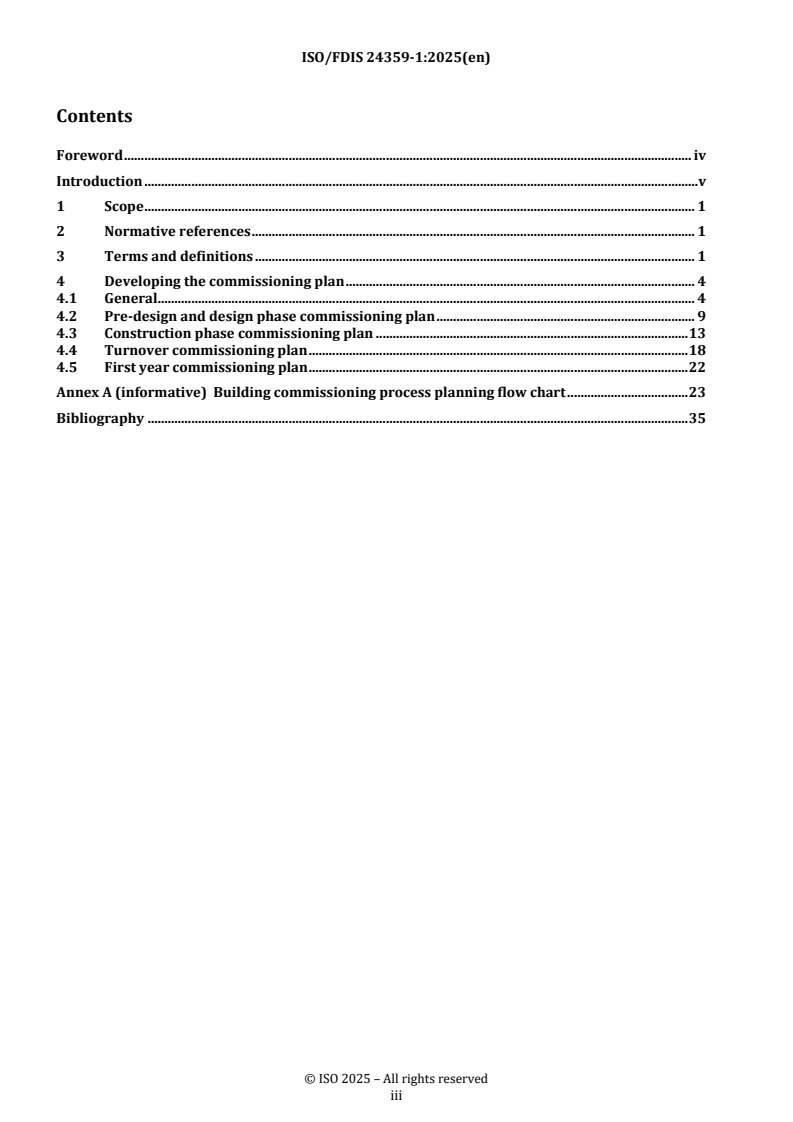
ISO/FDIS 24359-1:2025(en)
Contents
Foreword . iv
Introduction . v
1 Scope . 1
2 Normative references . 1
3 Terms and definitions . 1
4 Developing the commissioning plan . 4
4.1 General . 4
4.2 Pre-design and design phase commissioning plan . 9
4.3 Construction phase commissioning plan . 13
4.4 Turnover commissioning plan . 18
4.5 First year commissioning plan . 22
Annex A (informative) Building commissioning process planning flow chart . 23
Bibliography . 35
iii
ISO/FDIS 24359-1:2025(en)
Foreword
ISO (the International Organization for Standardization) is a worldwide federation of national standards
bodies (ISO member bodies). The work of preparing International Standards is normally carried out through
ISO technical committees. Each member body interested in a subject for which a technical committee has been
established has the right to be represented on that committee. International organizations, governmental and
non-governmental, in liaison with ISO, also take part in the work. ISO collaborates closely with the
International Electrotechnical Commission (IEC) on all matters of electrotechnical standardization.
The procedures used to develop this document and those intended for its further maintenance are described
in the ISO/IEC Directives, Part 1. In particular, the different approval criteria needed for the different types of
ISO document should be noted. This document was drafted in accordance with the editorial rules of the
ISO/IEC Directives, Part 2 (see www.iso.org/directives).
ISO draws attention to the possibility that the implementation of this document may involve the use of (a)
patent(s). ISO takes no position concerning the evidence, validity or applicability of any claimed patent rights
in respect thereof. As of the date of publication of this document, ISO had not received notice of (a) patent(s)
which may be required to implement this document. However, implementers are cautioned that this may not
represent the latest information, which may be obtained from the patent database available at
www.iso.org/patents. ISO shall not be held responsible for identifying any or all such patent rights.
Any trade name used in this document is information given for the convenience of users and does not
constitute an endorsement.
For an explanation of the voluntary nature of standards, the meaning of ISO specific terms and expressions
related to conformity assessment, as well as information about ISO's adherence to the World Trade
Organization (WTO) principles in the Technical Barriers to Trade (TBT), see www.iso.org/iso/foreword.html.
This document was prepared by Technical Committee ISO/TC 205, Building environment design.
A list of all parts in the ISO 24359 series can be found on the ISO website.
Any feedback or questions on this document should be directed to the user’s national standards body. A
complete listing of these bodies can be found at www.iso.org/members.html.
iv
ISO/FDIS 24359-1:2025(en)
Introduction
This document applies to the development of the building commissioning plan, which documents the building
commissioning (Cx) process for selected systems or assemblies at each phase of the project, from pre-design
through occupancy and operation. This document establishes normative requirements for commissioning
planning during indoor environment design process in a framework consistent with ISO 16813:2024 and the
other commissioning international standards under development for functional performance testing of
specific components relating to the indoor environment and the energy use such as the ISO 19455 series and
ISO 21105 series. While “commissioning” is used in a range of industries and contexts with different meanings,
such as a singular event at the end of an industrial construction project, this document addresses the
commissioning process that occurs throughout the design, construction, and first year of new building or
major renovation projects.
Building commissioning experience shows that early initiation of commissioning and clear communication of
the commissioning process to project team members from the beginning of design are common characteristics
of higher value commissioning processes and approaches. Therefore, this document, while intended for use at
the design stage of the project, describes requirements for the commissioning process beyond the design
stage. This allows the commissioning requirements to be appropriately embedded in the project documents
so that, as procurement proceeds, commissioning requirements are clearly conveyed to affected members of
the project team, whether owners, designers, contractors, operators, or occupants.
This document can be applied to any type of system or assembly being commissioned in new building and
major renovation or system replacement construction projects. The commissioning plan is developed by the
commissioning provider for use by project team members and other stakeholders to determine the tasks and
activities required to commission the project, including post-occupancy commissioning tasks associated with
the project, in accordance with the owner’s project requirements.
Commissioning providers use this document to develop a project-specific commissioning plan, which
documents the systems or assemblies to be commissioned, the scope of tasks associated with the process to
achieve the owner’s project requirements (OPR), and the work plan to accomplish those tasks. The systems
or assemblies to be commissioned and the commissioning requirements for the project are established by the
owner with the support of the commissioning provider. This document prescribes the minimum set elements
to be in the commissioning plan that can be commonly applied, regardless of which systems or assemblies are
being commissioned on a project.
This document establishes the requirements for the rigor and duration of the commissioning process. These
requirements range from basic commissioning with an emphasis on construction and turnover, to enhanced
commissioning with more substantial activities during design and in the first year of the building’s working
life. The framework addresses the full range of commissioned systems and building elements which impact
indoor environment. These systems and elements to be commissioned vary widely by project. This document
addresses planning activities for a wide range of project types and a variety of systems or assemblies to be
commissioned.
This framework considers different project delivery methods including those not addressed by existing
national standards. These previous standards were typically developed for older project delivery methods
where design was completed prior to the start of construction, and design was performed by a different entity
than construction. The same is true of the commissioning processes required by various green building
certification schemes in various regions around the world. The global marketplace now utilizes a range of
highly variable delivery methods such as Tender Offer, Design-Buildtender offer, design-build, and Integrated
Project Deliveryintegrated project delivery, to which the building commissioning processes prescribed in this
document readily apply.
This document applies to commissioning planning during design for commissioning activities through the first
year of occupancy. This planning can be impacted by the Owner’sowner’s intentions for further subsequent
v
ISO/FDIS 24359-1:2025(en)
commissioning activities in existing buildings such as on-going commissioning, recommissioning and retro-
commissioning, but such lifecycle commissioning activities are not addressed in this document. This document
is intended to be followed by Part 2, which will provide a standard for commissioning planning for existing
buildings.
vi
ISO/FDIS 24359-1:2025(en)
Building commissioning process planning —
Part 1:
New buildings
1 Scope
This document addresses the development of a building commissioning (Cx) plan for new construction, major
renovations, or system and assembly replacement projects. The commissioning plan incorporates
commissioning activities which begin during early project stages, and continue through pre-design, design,
construction, turnover and the first year of operation. The commissioning plan is developed during the design
stage and also address later stages of the project.
The commissioning plan presents the intended process to verify and document that the quality of the built
project in operation meets the requirements of the owner. This document provides an overarching process
for planning of commissioning any aspect of a building project and is intended for use with system or discipline
specific standards. This document does not include retro-commissioning or recommissioning in existing
buildings.
2 Normative references
There are no normative references in this document.
3 Terms and definitions
For the purposes of this document, the following terms and definitions apply.
ISO and IEC maintain terminology databases for use in standardization at the following addresses:
— — ISO Online browsing platform: available at https://www.iso.org/obp
— — IEC Electropedia: available at https://www.electropedia.org/
3.1 3.1
basis of design
(BoD)
document recording concepts, calculations, decisions, and product selections used to meet the owner’s project
requirements and to satisfy applicable regulatory requirements, standards, and guidelines, including
narrative descriptions and lists that support the design process
3.2
checklists
3.2
checklist
project- and element-specific documentsdocument prepared or reviewed by the commissioning provider for
use in all phases of commissioning, used to identify issues and to confirm that the owner’s project
requirements are being achieved, including those for evaluation, testing, training, and other design and
construction activities
3.3.13.2.1 3.2.1
construction checklistschecklist
documentsdocument used to confirm that appropriate materials and components are on-site, ready for
installation, correctly installed, functional, and conforming to the owner’s project requirements
ISO/FDIS 24359-1:2025(en)
3.43.3 3.3
commissioning process, commissioning (Cx)
quality-focused process intended to enhance project delivery by verifying and documenting that all relevant
systems and assemblies are planned, designed, installed, tested, operated, and maintained in accordance with
the owner’s project requirements
Note 1 to entry: See ISO 21105-1 for information on the commissioning process of the building enclosure.
Note 2 to entry: See ISO/TS 21274 for information on the commissioning process of the lighting systems in buildings.
3.53.4 3.4
commissioning design review
review of design documents to determine conformity with the owner’s project requirements, including
coordination between commissioned systems and assemblies, and features and access for testing,
maintenance, and other activities identified in the owner’s project requirements and commissioning plan
Note 1 to entry: The following types of design review differ from commissioning design review and are not performed as
part of commissioning process unless by special contractual arrangement:
— — Code or regulatory design review: a review of a document typically conducted by staff or designated entity of an
authority having jurisdiction; intended to determine whether the content of the document complies with regulations,
codes, or other standards administered by the jurisdiction.
— — Constructability design review: the review of effective integration of construction knowledge into the conceptual
planning, design, construction, and field operation of a project to achieve project objectives efficiently, accurately,
and cost-effectively; intended to reduce or prevent errors, delays, and cost overruns.
— — Peer review: an independent and objective comprehensive technical review of the design of the project, or a part
thereof, conducted at specified stages of design completion typically conducted by professionals with the same
qualifications as the original designers; intended to enhance the quality of the design.
3.63.5 3.5
commissioning plan
project-specific document describing how the commissioning process will be implemented, including the
systems and elements to be commissioned, organizational structure, schedule, resource allocation,
verification methods, and documentation requirements
3.73.6 3.6
commissioning provider
(CxP)
entity designated by the owner to lead, plan, schedule, and coordinate the commissioning team in
implementing the commissioning plan, typically independent of the owner, designers, and construction team
3.83.7 3.7
commissioned systems manual
composite document focused on commissioned systems or assemblies, including design and construction
documentation, facility guide, operation manual, maintenance and training information, commissioning
records, and other information useful to the owner during occupancy and operations, providing a record of
the name, scope, and location of all commissioning and related project documentation and findings, with
progress and final commissioning reports typically included in the executive summary
3.93.8 3.8
commissioning team
group composed of representatives from the owner, operations, occupants, design and construction teams,
and project-specific stakeholders, responsible for coordinating actions and information flows among all
personnel involved in the project and commissioning activities
ISO/FDIS 24359-1:2025(en)
3.103.9 3.9
commissioning report
document recording all planned commissioning activities and results, based on the final commissioning plan
and including completed commissioning documentation as appendices
3.10.13.9.1 3.9.1
commissioning progress report
preliminary document describing completed and ongoing commissioning activities, significant findings, and
the work plan for completing commissioning, issued during project execution
3.10.23.9.2 3.9.2
final commissioning report
document that, together with the commissioned systems manual, provides a comprehensive record of
commissioning activities, results, findings, and related documentation, typically issued at the end of the
contractual commissioning period
3.113.10 3.10
construction team
group of entities and professionals involved in constructing systems and assemblies in the project, including
contractors, suppliers, and manufacturers, and in design/build projects, typically also including licensed
design professionals who can be part of the design team
3.123.11 3.11
contract documents
set of documents that vary by project, owner needs, regulations, and delivery method, and that can include
price agreements, construction management procedures, subcontractor requirements, submittal and change
procedures, construction timelines, and construction documents
3.133.12 3.12
design team
entities contractually responsible for developing all or part of the design documents
3.143.13 3.13
functional performance test
(FPT )
test conducted to verify that commissioned systems perform in accordance with the owner’s project
requirements, with procedures developed by the commissioning provider or others, and led or witnessed by
the commissioning provider
Note 1 to entry: See ISO 19455-1 for information on how to plan functional performance tests for specific systems.
3.14.13.13.1 3.13.1
seasonal functional performance test
functional performance test conducted under different seasonal conditions from the original test, when
seasonal variations affect the ability of the equipment or system to meet the owner’s project requirements
3.153.14 3.14
issues and resolution log
formal, ongoing record of commissioning issues, responsible parties, and their resolution, typically
maintained by the commissioning provider in coordination with the owner
3.163.15 3.15
owner
entity that makes the decision to proceed with a project and bears the consequences of its success or failure
ISO/FDIS 24359-1:2025(en)
3.173.16 3.16
owner’s project requirements
(OPR)
document that details the owner’s requirements for the commissioned systems, including expectations for
facility use and operation, project goals, measurable performance criteria, cost considerations, benchmarks,
success criteria, training and documentation requirements, and supporting information
3.183.17 3.17
testing
process of verifying that a material, product, assembly or system meets defined performance criteria
Note 1 to entry: All functional performance testing is testing; not all testing performed on a project is a functional
performance testing since it can be unrelated to the commissioned systems or can fall outside the scope of the
commissioning plan for verifying and documenting that the commissioned systems meet the owner’s project
requirements.
3.193.18 3.18
training plan
documentation that details expectations, duration, acceptance criteria, deliverables and deadlines for training
of operations and maintenance personnel, users and occupants related to the commissioned systems and
assemblies
3.203.19 3.19
turnover
final step in the commissioning process prior to handover to the operators and start of first-year
commissioning activities, including training of building operators and maintenance staff, and transfer of
documentation and records to the owner and commissioning provider
4 Developing the commissioning plan
4.1 General
4.1.1 Overview
The owner shall require the development of the commissioning plan and associated documents that define:
— — the project team’s roles and responsibilities;
— — communication protocols;
— — commissioning tasks;
— — commissioning procedures;
— — commissioning documentation;
— — schedule of commissioning activities.
The commissioning plan shall address the following:
— — each commissioned system and each mandatory element in Clause 4clause 4 of this document;
— — the plan for commissioning activities throughout the entire project including the first year of
operation.
ISO/FDIS 24359-1:2025(en)
The commissioning provider shall, with input from the owner’s project team, develop the initial
commissioning plan at or near the initiation of the commissioning process. The commissioning plan shall be
updated during design and construction as the project proceeds. A copy of the final commissioning plan shall
be included in the final commissioning report.
Note: NOTE A flowchart of the commissioning process planning is shown as Annex AAnnex A.
4.1.14.1.2 Initiating the commissioning process
The owner shall initiate the commissioning process by hiring or designating the commissioning provider. The
commissioning provider shall be an independent third party (or be acting independent as defined in
subclause 4.1.3.5subclause 4.1.2.4),), not affiliated with the design team or construction team.
The commissioning provider shall be hired or designated close enough to the beginning of the project’s design
to allow the development and delivery of all the design phase commissioning tasks and documents prior to
final design, building permit application and start of construction. These tasks and documents shall include
those required by this document in subclauses 4.1subclauses 4.1 through 4.2.94.2.9.
If the commissioning provider is brought in later and these tasks are still performed or is not an independent
third party (or is not acting independent as defined in subclause 4.1.3.5subclause 4.1.2.4),), conformity with
this document shall not be claimed.
Project phasing and commissioning scope shall, on some projects, result in varying requirements to conform
with this document, including starting commissioning sooner for early assemblies such as building envelope
than is required for technical building systems – if design of these systems ends later and their construction
starts later.
At the initiation of the commissioning process, the owner is responsible for determining the systems and
assemblies to be commissioned and the process scope and rigor for each commissioned system or assembly.
The owner is also responsible for selecting the commissioning provider for the project, establishing the
commissioning budget, and establishing the owner’s project requirements criteria.
The commissioning provider shall document requirements for participation in the commissioning process,
including roles and responsibilities. The owner is responsible for ensuring that requirements for
commissioning participation are incorporated into project team agreements.
The owner shall determine their owner’s project requirements. If the owner chooses to provide owner’s
project requirements documentation, then the commissioning provider shall ensure completeness and clarity
of the owner’s project requirements and develop applicable evaluation criteria and methods for each owner’s
project requirements element related to commissioned systems and assemblies. If the owner does not provide
this documentation, the commissioning provider shall be responsible for facilitating the development of and
for documenting these owner’s project requirements.
The commissioning provider directs the commissioning and shall be an objective advocate of the owner, and
an independent third party (or act independently as defined in subclause 4.1.3.5subclause 4.1.2.4)) who is not
a member of the design team or construction team. The commissioning provider shall be contracted directly
or designated by the owner. The owner and the commissioning provider shall, together, determine the
specifics of the commissioning process such as the number of site visits and meetings to be performed by the
commissioning provider. The owner shall provide direction, reviews, and acceptance as required throughout
the commissioning process.
ISO/FDIS 24359-1:2025(en)
4.1.24.1.3 Risk assessment to determine the commissioning process to be used
4.1.3.1 General
The commissioning provider with the owner shall document the systems and assemblies to be commissioned,
perform the risk assessment in this subclause, and determine the level of commissioning on a system basis.
The owner determines the scope and rigor appropriate for the commissioning process, through their choice
of commissioning provider and the contract language used to retain that provider. If the owner determines a
level of commissioning below that indicated by the risk assessment, conformity with this document cannot be
claimed.
The risk assessment shall be performed before writing the commissioning plan. This can be performed prior
to full award of the contract for commissioning services as preliminary services, or after hiring. Different
systems or aspects – or even phases – of the same project can require different levels of commissioning, at the
direction of the owner or at a minimum as determined by performing the risk assessment.
Levels of commissioning in this document are:
a) Level 1 basic: minimum;
b) Level 2 intermediate: medium;
c) Level 3 comprehensive: maximum.
Using Table 1Table 1,, the owner with the assistance of the commissioning provider shall determine the
appropriate level of commissioning scope and rigor based upon the risk assessment. Table 1Table 1 applies
to commercial buildings. It can be applied to the project as a whole where risk factors are consistent across
the various project elements. Where complexity or criticality varies from system to system, it can be applied
to individual systems and assemblies, or to groups of systems and assemblies.
To use the risk assessment worksheet in Table 1Table 1,, assign a point score (1, 2 or 3) adjacent to only one
of the risk factor criteria in each row. If any of the risk factors are not applicable to the specific project, leave
the points for that row blank or adapt the table to your own project.
Note: NOTE Detailed explanations of each risk assessment factor listed in Table 1Table 1 are provided in Annex A of
ISO 21105-1:2019, Annex A.
4.1.2.14.1.3.2 When risk assessment allows choice of level
Where there is an overlap in point ratings between levels, the owner shall choose the most appropriate level
of the commissioning program to suit their specific goals and acceptance of risk. The level of commissioning
required by the owner shall be documented and provided to the commissioning team. If the level of
commissioning is changed, the owner shall document and provide to the commissioning team.
The level of commissioning shall be at least the level indicated by use of Tables 1Tables 1 and 22. Even if
documented elsewhere by the owner, the commissioning provider shall declare the level(s) of commissioning
required in the commissioning plan. The commissioning plan shall document the systems or assemblies being
commissioned and the level of commissioning being applied to each system or assembly, including any tasks
or approaches above and beyond the minimum requirements in this document.
4.1.2.24.1.3.3 Choice of level when some rows in Table 1Table 1 are deemed not applicable
Table 2Table 2 applies to projects where all the table rows are pertinent, the maximum point total of each of
the 15 rows is assigned the highest risk factor of three, and the resulting maximum score is 45. Where fewer
rows are determined by the owner to be applicable, the following calculations shall be used to determine the
(lower) total points corresponding to each level:
ISO/FDIS 24359-1:2025(en)
a) Level 1 basic: up to the number of completed rows multiplied by 1.,5;
b) Level 2 intermediate: the number of completed rows multiplied by 1.,3 through the number of completed
rows multiplied by 2.,3;
c) Level 3 comprehensive: the number of completed rows multiplied by 2.,1 or higher.
A minimum of nine rows is required. If fewer rows are deemed applicable by the owner, then conformity with
this document shall not be claimed.
Table 1 — Risk assessment worksheet for commercial buildings
(to be completed with owner)
Low criticality Medium criticality High criticality
Points
Risk factor
assigned
(1 point) (2 points) (3 points)
A. Owner’s risk tolerance High tolerance Medium tolerance Low tolerance
B. Cost of loss Low Moderate High
C. Building use or function Normal Important Critical
2 2 2
D. Floor area ≦ 5 000 m 5 000 to 15 000 m ≧ 15 000 m
E. Design complexity Basic Moderate Complex, custom
Environmental exposure of
F. Low Medium High
occupants
Level of innovation,
G. Basic Advanced Experimental
performance
High, or restorative,
H. Level of sustainability Minimum Moderate regenerative, or net
zero
I. Level of resilience Minimum Moderate High
Owner’s number of prior
J. 10 or more 3 to 10 Less than 3
projects
Choice of Some bid acceptance Required to take
K. Owner’s bidding requirements
bidders restrictions low bidder
Availability of owner’s Significant
Sporadic involvement Little involvement
L. representatives throughout all involvement in
in project in project
phases project
M. Schedule Basic schedule Lean or just-in-time Fast track
Design/build, cost
Construction
N. Project delivery method Traditional plus, or Integrated
manager at risk
project delivery
10 or more of 3 to 10 buildings of Less than 3
O. Experience of contractor(s) same size & same size & buildings of same
complexity. complexity size & complexity
Total points (45 maximum)
___________
The total of the points indicates the appropriate minimum level of commissioning for that project or
specific system, giving consideration to the owner’s goals and their risk tolerance.
ISO/FDIS 24359-1:2025(en)
Table 2 — Recommended level of commissioning
Total points: Level
1-23 1 - Basic
20-35 2 - Intermediate
32-45 3 - Comprehensive
4.1.2.34.1.3.4 Aggregate versus differentiated risk analysis
This risk assessment procedure shall either be applied in aggregate to the entire commissioning assignment
on a project, or one or more individual differentiated risk analyses can be applied to a particular system or
assembly or other grouping. Where applied individually, the results of each of the resulting multiple risk
assessments shall be applied to those systems or assemblies. Where multiple differentiated risk assessments
are performed, the commissioning plan shall clearly state and differentiate between the levels of rigor for each
of the commissioned systems or assemblies.
4.1.2.44.1.3.5 Commissioning provider level requirements
Each commissioning process level in this document requires different levels of independence of the
commissioning provider:
a) Level 1 basic: the commissioning provider shall be acting independent of the design and construction
teams and shall report directly to the owner;
b) Level 2 intermediate: the commissioning provider shall be acting independent of the design teams, shall
report directly to the owner, and shall be independent of construction team. The commissioning provider
shall not be employed by the contractor(s);
c) Level 3 comprehensive: the commissioning provider shall be independent of the design and construction
team and shall be contracted directly to or designated by the owner. The commissioning provider shall
report directly to the owner. The commissioning provider shall not be employed by neither the design
firm(s) nor the contractor(s).
4.1.2.54.1.3.6 Commissioning process level requirements
Each commissioning process level in this document has tasks that are required to achieve the process. These
same tasks increase in complexity with the increasing level. Additional tasks are also associated with each of
the levels. The commissioning provider shall confirm with the owner that the extent of tasks is appropriate,
relative to the initial risk assessment, and shall provide documentation of these tasks in the commissioning
plan and the owner’s project requirements.
4.1.34.1.4 Required commissioning plan content
The commissioning plan shall be based on the owner’s project requirements and shall include the following
information:
a) a) systems and assemblies to be commissioned;
b) b) risk assessment results;
1) — whether a single commissioning process and level applies to all commissioned systems and
assemblies or, if varying;
2) — the different process and levels for each group of systems and assemblies.;
ISO/FDIS 24359-1:2025(en)
c) c) required level of independence of commissioning provider;
d) d) required level of commissioning process;
e) e) detailed description of commissioning activities, developed specifically for the project, and a
schedule of activities;
f) f) roles and responsibilities for the project team throughout the project;
g) g) documentation of general communication channels, including the distribution of the
commissioning plan during the design and construction process;
h) h) description of planned evaluation approach for each commissioned systems and assemblies;
i) i) the framework for procedures to follow whenever commissioning evaluation identifies issues
where the owner’s project requirements isare not met;
j) j) documentation required from commissioning team members including owner, design, and
construction team representatives;
k) k) the required documentation to be submitted by the commissioning provider, both interim and
final including.
1) — guidelines and format that will be used for the commissioning documentation required by the
applicable commissioning process level;
2) — examples of commissioning deliverables.
4.1.44.1.5 Acceptance of the commissioning plan by owner
The commissioning plan shall be approved by the owner and shall also state the process for approval of the
subsequent revisions.
4.2 Pre-design and design phase commissioning plan
4.2.1 Commissioning team participation
The owner and all of the project team participants working on the commissioned systems and assemblies –
whether designing, installing, operating, or occupying the spaces served – are part of the commissioning team.
The commissioning plan shall document the project team members’ roles and responsibilities and identify any
known gaps in the contracts and agreements with the owner where applicable. The commissioning plan shall
document the commissioning communication protocols, commissioning activities, their schedule, and team
members’ roles in each.
4.2.2 Protocols for communications from and to commissioning provider
Communication is essential in the performance of commissioning. The commissioning plan shall include
protocols and formats. Records of communication shall be maintained.
4.2.3 Format for commissioning review of design, other commissioning documents
Commissioning design reviews and reporting shall be communicated in formats and/or forms compatible
with designer and owner systems and protocols, or both. Computer or hand-held applications or web-based
systems shall be utilized where these are compatible with the project development. The reporting forms or
systems to be used shall be included in the design phase commissioning plan.
ISO/FDIS 24359-1:2025(en)
4.2.4 Commissioning meetings
Commissioning meetings shall be planned, chaired and reported by the commissioning provider. The
commissioning plan shall document the following information:
a) a) the duration and total number of commissioning meetings;
b) b) the varying intervals between them as the project progresses.
4.2.5 Owner's project requirements
The owner’s project requirements that shall be documented and updated throughout the project by the
commissioning provider shall address the following for the commissioned systems:
a) a) facility objectives, size, location, user requirements, project delivery method, and owner
directives;
b) b) environmental, sustainability, and efficiency goals, benchmarks, or standards above minimum
legal requirements;
c) c) indoor environment requirements, including temperature, humidity, ventilation and noise;
d) d) space use and occupancy and operations schedules;
e) e) critical systems, special project requirements, or special redundancy requirements, when
known;
f) f) project schedule;
g) g) capital and operating budget considerations, when known;
h) h) turnover and training requirements, when known;
i) i) commissioning scope and requirements, when known;
j) j) operational performance requirements.
The commissioning provider shall facilitate development and documentation of the owner’s project
requirements by the owner with occupants, operations and maintenance stakeholders and in collaboration
with the design team prior to developing the commissioning plan or performing initial review of the basis of
design or design documents.
The owner’s project requirements document shall list and define the systems and assemblies to be
commissioned and the required additional rigor beyond this document’s requirements for the commissioning
process, including any sampling strategies acceptable to the owner, and to which stages of the commissioning
process they are applicable. The systems and assemblies being commissioned shall have defined project
performance and acceptance criteria.
The owner’s project requirements document shall be updated during the project. The owner’s project
requirements shall be updated at the start and end of construction as a minimum. The owner’s project
requirements shall be approved by the owner during predesign. Updates to the owner’s project requirements
made during subsequent project activities shall also be approved by the owner. The commissioning provider
shall transmit a final updated and approved owner’s project requirement document to the owner at the
beginning of occupancy.
ISO/FDIS 24359-1:2025(en)
4.2.6 Basis of design
The basis of design shall:
a) a) describe the building systems and assemblies the design team is proposing to meet the owner’s
project requirements for the owner’s approval;
b) b) describe the design team’s technical approach to each of the owner’s project requirements,
which are part of the commissioning scope;
c) c) provide a platform for the review of the design and changes as the project progresses.
The commissioning provider with the owner shall evaluate each basis of design submittal for the following:
a) a) design and design assumptions in agreement with the owner’s project requirements;
b) b) requirements for updating of the basis of design;
c) c) requirements for sustainable design goals and certification when required;
d) d) consideration of design alternatives at each phase;
e) e) requirements that systems, assemblies, and equipment be located and installed to be
commissionable and maintainable opportunities for improved performance.
The basis of design shall document the design team’s approach to meeting the owner’s project requirements
to provide the owner with a better understanding of design issues and secure the owner’s approval of critical
design decisions.
The basis of design shall be developed by the design team in accordance with the owner’s project
requirements. The basis of design shall be updated and expanded during design and construction as the
project proceeds. The design team shall submit the basis of design to the owner and commissioning provider
for review at each milestone defined by the owner’s project requirements and commissioning plan.
The commissioning provider shall document, and track issues related to the basis of design, including issues
identified by the owner and members of the design team. The design team shall work with the owner and
commissioning provider to resolve commissioning issues.
4.2.7 Commissioning requirements for the design team
The commissioning provider shall document the responsibilities of the design team including their
subconsultants to be incorporated into the appropriate contract documents, including commissioning process
activities and procedures defined by the commissioning plan. When the design team is responsible for
producing the tender material for contractors, the commissioning provider shall oversee that the material
contains commissioning requirements and commissioning plan.
4.2.8 Commissioning specifications –— requirements for the construction team
The commissioning provider shall develop proposed commissioning specifications that detail the
requirements for construction team activities and participation in the commissioning process. The
commissioning responsibilities of the contractors, their suppliers and manufacturers, and any suppliers and
manufacturers contracted directly to the owner, shall be incorporated into the contract documents, including
commissioning process activities and procedures defined by the commissioning specifications.
Commissioning specifications shall:
ISO/FDIS 24359-1:2025(en)
a) a) be developed for all systems and assemblies being commissioned;
b) be included in the contract documents;
c)b) — . The applicable commissioning specifications and requirements shall be included in all
contracts with contractors, subcontractors, suppliers, service providers, and manufacturers for systems
and assemblies being commissioned.;
d)c) c) specified the requirements for the construction team to complete pre-functional checklists for
commissioned systems as required and the format for the pre-functional checklists;
1) — Sampling strategies and testing participation requirements shall be specified;
2) — Any additional testing requirements necessary to implement the commissioning plan shall be
specified.
d) clearly define the contractor’s involvement in the functional performance testing as required.
e)d) — The project-specific extent of this testing shall be determined by the commissioning provider
during the design phase, based on the owner’s project requirements and clearly communicated in the
project plans and specifications.
During design, the commissioning provider verifies that contractor requirements for construction activities
conform to the owner’s project requirements. In addition, the commissioning provider evaluates the specific
testing and reporting requirements for materials, products, and equipment and identifies nonconformance or
missing requirements necessary to verify that the owner’s project requirements will be met.
4.2.9 Commissioning reviews of design
The commissioning provider shall perform commissioning review(s), maintain and circulate to the
commissioning team a record of commissioning review issues and recommended next steps for resolution
including the status and outcome of each issue. Commissioning review verifies and documents whether the
design drawings and specifica
...
Questions, Comments and Discussion
Ask us and Technical Secretary will try to provide an answer. You can facilitate discussion about the standard in here.
Loading comments...