

ISO 22366:2026
(Main)Security and resilience — Community resilience — Framework and principles for energy resilience
General Information
- Abstract
This document provides the framework and principles for the energy resilience of organizations, to help reduce impacts and ultimately achieve a build back better goal after disruptive events, including natural and human-made disruptions. It covers broad resilience engineering and management principles applicable to an energy supply network that includes social and technical considerations. This document does not provide guidance on the application of these principles for engineering design, which require specialized considerations to address risks and define resilience measures. This document is intended to be used by organizations responsible for, or participating in, energy supply networks.
- Status
- Published
- Publication Date
- 07-Jan-2026
- Technical Committee
- ISO/TC 292 - Security and resilience
- Drafting Committee
- ISO/TC 292 - Security and resilience
- Current Stage
- 6060 - International Standard published
- Start Date
- 08-Jan-2026
- Due Date
- 12-Oct-2025
- Completion Date
- 08-Jan-2026

Overview
ISO 22366:2026 - Security and resilience - Community resilience - Framework and principles for energy resilience is a key international standard developed by ISO to provide organizations with a comprehensive framework for building and enhancing energy resilience. The document outlines guiding principles that help reduce the negative impacts of disruptions, ranging from natural disasters to human-made events, on energy supply networks. It addresses the complex interplay between social and technical factors in energy resilience, aiming for a holistic and proactive approach that enables organizations to "build back better" after disruptive incidents.
This standard is essential for organizations responsible for or contributing to energy supply networks, supporting them in strengthening their capabilities to prevent, withstand, and recover from energy-related disruptions.
Key Topics
Energy Resilience Framework: Structured guidance on assessing, enhancing, and managing resilience across energy infrastructure and supply chains.
Principles for Energy Resilience: Nine foundational principles, such as recognizing system context, fostering social capital, encouraging diversity, managing connectivity, and adopting polycentric governance, promote an integrated approach to resilience.
Stakeholder Roles: Outlines the responsibilities and collaborative actions required from governments, critical industries, energy users, financial institutions, and emergency services in supporting energy resilience.
Risk Assessment and Management: Emphasizes identifying, evaluating, and mitigating risks to energy systems, incorporating both chronic and acute events that can impact supply networks.
Energy Resilience Planning: Directs organizations to develop and implement structured energy resilience plans, including communication strategies, governance, emergency response, and continual improvement.
Enhancing System Complexity: Addresses the need for solutions across different time and spatial scales, recognizing interdependencies between technical and social infrastructure.
Applications
Organizations can leverage ISO 22366:2026 to:
Strengthen Business Continuity: By developing robust energy resilience plans, organizations can minimize downtime and ensure quicker recovery following disruptions, safeguarding critical operations and public services.
Align with Global Initiatives: The framework supports objectives of major international agreements like the Sendai Framework for Disaster Risk Reduction, the Paris Agreement, and the United Nations Sustainable Development Goals.
Promote Investment in Resilient Infrastructure: Financial institutions and stakeholders use resilience principles to assess and finance infrastructure that withstands disruptions, protecting assets and investments.
Support Policy and Regulation: Governments benefit from adopting standardized resilience practices, ensuring continuity in critical services and compliance with disaster risk reduction mandates.
Engage Stakeholders: The standard encourages cross-sector collaboration, from energy suppliers to end users, fostering knowledge sharing, coordinated emergency response, and community-wide resilience.
Incorporate Sustainability: Integrates sustainability into energy system planning, ensuring that resilience measures also contribute to long-term environmental and economic objectives.
Related Standards
Organizations seeking a broader or more detailed approach to resilience and risk management in energy supply can consult the following related standards:
- ISO 22300: Security and resilience - Vocabulary
- ISO 22316: Security and resilience - Organizational resilience - Principles and attributes
- ISO 31000: Risk management - Guidelines
- ISO 14091: Adaptation to climate change - Guidelines on vulnerability, impacts and risk assessment
- ISO 22320: Security and resilience - Emergency management - Guidelines for incident management
- ISO 22361: Security and resilience - Crisis management - Guidelines
These standards provide complementary tools and guidelines that, when used alongside ISO 22366:2026, support the development of resilient, sustainable, and adaptive energy supply systems.
Keywords: energy resilience, ISO 22366, community resilience, energy supply networks, security and resilience, risk management, energy infrastructure, emergency planning, sustainable energy, disaster recovery, organizational resilience, resilience framework
Get Certified
Connect with accredited certification bodies for this standard

BSI Group
BSI (British Standards Institution) is the business standards company that helps organizations make excellence a habit.

Bureau Veritas
Bureau Veritas is a world leader in laboratory testing, inspection and certification services.

DNV
DNV is an independent assurance and risk management provider.
Sponsored listings
Frequently Asked Questions
ISO 22366:2026 is a standard published by the International Organization for Standardization (ISO). Its full title is "Security and resilience — Community resilience — Framework and principles for energy resilience". This standard covers: This document provides the framework and principles for the energy resilience of organizations, to help reduce impacts and ultimately achieve a build back better goal after disruptive events, including natural and human-made disruptions. It covers broad resilience engineering and management principles applicable to an energy supply network that includes social and technical considerations. This document does not provide guidance on the application of these principles for engineering design, which require specialized considerations to address risks and define resilience measures. This document is intended to be used by organizations responsible for, or participating in, energy supply networks.
This document provides the framework and principles for the energy resilience of organizations, to help reduce impacts and ultimately achieve a build back better goal after disruptive events, including natural and human-made disruptions. It covers broad resilience engineering and management principles applicable to an energy supply network that includes social and technical considerations. This document does not provide guidance on the application of these principles for engineering design, which require specialized considerations to address risks and define resilience measures. This document is intended to be used by organizations responsible for, or participating in, energy supply networks.
ISO 22366:2026 is classified under the following ICS (International Classification for Standards) categories: 03.100.01 - Company organization and management in general. The ICS classification helps identify the subject area and facilitates finding related standards.
ISO 22366:2026 is available in PDF format for immediate download after purchase. The document can be added to your cart and obtained through the secure checkout process. Digital delivery ensures instant access to the complete standard document.
Standards Content (Sample)
International
Standard
ISO 22366
First edition
Security and resilience —
2026-01
Community resilience —
Framework and principles for
energy resilience
Sécurité et résilience — Résilience des communautés — Cadre et
principes pour la résilience énergétique
Reference number
© ISO 2026
All rights reserved. Unless otherwise specified, or required in the context of its implementation, no part of this publication may
be reproduced or utilized otherwise in any form or by any means, electronic or mechanical, including photocopying, or posting on
the internet or an intranet, without prior written permission. Permission can be requested from either ISO at the address below
or ISO’s member body in the country of the requester.
ISO copyright office
CP 401 • Ch. de Blandonnet 8
CH-1214 Vernier, Geneva
Phone: +41 22 749 01 11
Email: copyright@iso.org
Website: www.iso.org
Published in Switzerland
ii
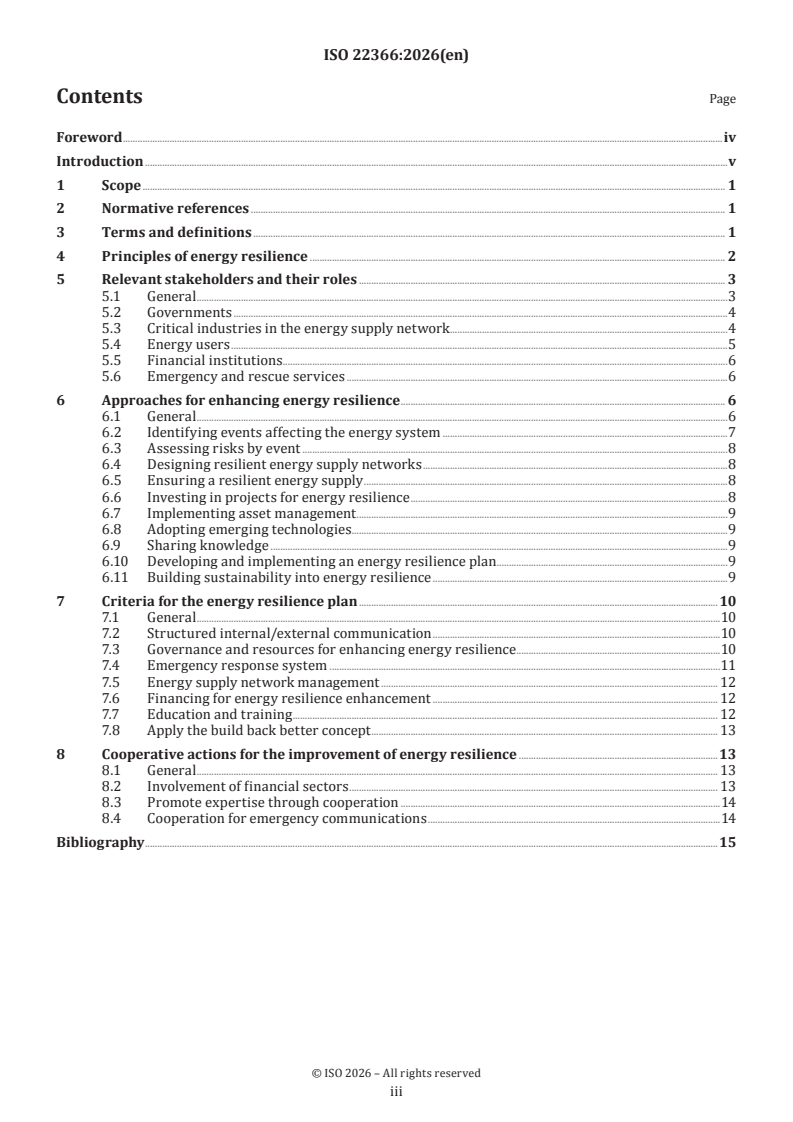
Contents Page
Foreword .iv
Introduction .v
1 Scope . 1
2 Normative references . 1
3 Terms and definitions . 1
4 Principles of energy resilience . 2
5 Relevant stakeholders and their roles . 3
5.1 General .3
5.2 Governments .4
5.3 Critical industries in the energy supply network .4
5.4 Energy users .5
5.5 Financial institutions . . .6
5.6 Emergency and rescue services .6
6 Approaches for enhancing energy resilience . 6
6.1 General .6
6.2 Identifying events affecting the energy system .7
6.3 Assessing risks by event .8
6.4 Designing resilient energy supply networks .8
6.5 Ensuring a resilient energy supply .8
6.6 Investing in projects for energy resilience .8
6.7 Implementing asset management .9
6.8 Adopting emerging technologies . .9
6.9 Sharing knowledge .9
6.10 Developing and implementing an energy resilience plan.9
6.11 Building sustainability into energy resilience .9
7 Criteria for the energy resilience plan . 10
7.1 General .10
7.2 Structured internal/external communication .10
7.3 Governance and resources for enhancing energy resilience .10
7.4 Emergency response system .11
7.5 Energy supply network management . 12
7.6 Financing for energy resilience enhancement . 12
7.7 Education and training . 12
7.8 Apply the build back better concept . 13
8 Cooperative actions for the improvement of energy resilience .13
8.1 General . 13
8.2 Involvement of financial sectors . 13
8.3 Promote expertise through cooperation .14
8.4 Cooperation for emergency communications .14
Bibliography .15
iii
Foreword
ISO (the International Organization for Standardization) is a worldwide federation of national standards
bodies (ISO member bodies). The work of preparing International Standards is normally carried out through
ISO technical committees. Each member body interested in a subject for which a technical committee
has been established has the right to be represented on that committee. International organizations,
governmental and non-governmental, in liaison with ISO, also take part in the work. ISO collaborates closely
with the International Electrotechnical Commission (IEC) on all matters of electrotechnical standardization.
The procedures used to develop this document and those intended for its further maintenance are described
in the ISO/IEC Directives, Part 1. In particular, the different approval criteria needed for the different types
of ISO document should be noted. This document was drafted in accordance with the editorial rules of the
ISO/IEC Directives, Part 2 (see www.iso.org/directives).
ISO draws attention to the possibility that the implementation of this document may involve the use of (a)
patent(s). ISO takes no position concerning the evidence, validity or applicability of any claimed patent
rights in respect thereof. As of the date of publication of this document, ISO had not received notice of (a)
patent(s) which may be required to implement this document. However, implementers are cautioned that
this may not represent the latest information, which may be obtained from the patent database available at
www.iso.org/patents. ISO shall not be held responsible for identifying any or all such patent rights.
Any trade name used in this document is information given for the convenience of users and does not
constitute an endorsement.
For an explanation of the voluntary nature of standards, the meaning of ISO specific terms and expressions
related to conformity assessment, as well as information about ISO's adherence to the World Trade
Organization (WTO) principles in the Technical Barriers to Trade (TBT), see www.iso.org/iso/foreword.html.
This document was prepared by Technical Committee ISO/TC 292, Security and Resilience.
Any feedback or questions on this document should be directed to the user’s national standards body. A
complete listing of these bodies can be found at www.iso.org/members.html.
iv
Introduction
0.1 Background
Energy systems are increasingly vulnerable to severe damage from disruptions including natural and
human-made disruptions, posing significant risks to societies. Building energy systems that are resilient
against these threats has therefore become an emerging issue.
Energy is an essential element in people’s daily lives and in business operations. When disruptive events
occur, a stable, minimum energy supply is paramount to recovering and ensuring the safety of people as well
as the resumption of economic activities.
Building resilience in the energy system benefits a wide range of stakeholders. National, sub-national and
local governments can meet their obligations to the public and support the continuity of critical services.
In this way, they can better and more effectively fulfil their responsibilities to ensure the safety of their
citizens. Resilient infrastructure allows for a faster resumption of services that support the social, economic
and environmental objectives and activities of an affected region. Financial institutions benefit from
reduced risks to their investments by engaging and encouraging their clients to enhance the resilience of
their energy supply systems.
Resilience of the energy supply networks (networks comprised of multiple interconnected and
interdependent supply chains) is achieved by designing integrated social and technical systems (a
combination of organizations and technology) that are capable of adapting to unforeseen changes in the
operating environment. In recent years, resilience principles have evolved to specifically address the need
for organizations that operate large-scale technologies to enhance resilience, reliability and continuity of
complex supply chains, including the energy supply networks.
This document is related to the following key initiatives.
[11]
— The Sendai Framework for Disaster Risk Reduction, which provides important insights and
perspectives to improve energy resilience effectively;
[12]
— The United Nations Sustainable Development Goals (SDGs). Systemic energy resilience can contribute
to achieving several of these goals, including:
— Goal 9: build resilient infrastructure, promote inclusive and sustainable industrialization, and foster
innovation;
— Goal 11: make cities and human settlements inclusive, safe, resilient and sustainable;
— Goal 13: take urgent action to combat climate change and its impacts.
[13]
— The Paris Agreement, the objectives of which envisage a resilient energy supply network that
contributes to climate change adaptation through rapid recovery from disruption.
0.2 Benefits for users
This document provides benefits to organizations such as:
— National, sub-national and local governments
Implementing energy resilience plans offers significant benefits to national, sub-national, and
local governments. By supporting private and public stakeholders and communities in enhancing
energy resilience, governments can ensure continuous critical services during disruptions. These
comprehensive plans covering disruption prevention, reduction, restoration, and information sharing
provide the benefit of minimized recovery times following incidents. Additionally, governments gain
the advantage of building more robust energy infrastructure, as resilient energy supply facilities,
systems, and organizations are designed to maintain stable minimum energy services during and after
serious system-level disruptions, ultimately leading to stronger, more reliable energy systems for their
constituents.
v
— Individual users
Implementing energy resilience initiatives offers significant benefits to individual users. By formulating
and executing personalized energy resilience plans, individuals gain the advantage of resuming their
normal activities more smoothly following disruptions. These initiatives also enhance their capabilities
for responding effectively to disruptions, providing peace of mind and practical solutions during energy
emergencies.
— Residential, industrial, commercial and institutional sectors
The residential, industrial, commercial, and institutional sectors can obtain various benefits from energy
resilience enhancement initiatives implemented by governments, energy suppliers, and industrial/
commercial energy consumers. These benefits include reduced downtime during emergencies,
protection against economic losses, maintenance of essential services, and improved operational
continuity, all contributing to greater stability and productivity across these diverse sectors.
— Financial institutions
Financial institutions benefit significantly from implementing energy resilience initiatives, including
positively evaluating, investing in, and financing both public and private projects that enhance energy
resilience. These actions allow them to reduce risk exposure to energy-related disruptions, identify
promising investment opportunities in resilient infrastructure, strengthen the sustainability of their
portfolio, and contribute to broader economic stability through support of critical energy systems.
— Energy supply networks
All stakeholders and contributors to energy supply networks benefit from adopting a common set of
resilience principles and standardized decision frameworks. This unified approach enhances energy
resilience throughout the entire supply chain, resulting in improved system reliability, more effective
coordination during emergencies, reduced vulnerability to cascading failures, and ultimately delivering
greater energy security for the benefit of society as a whole.
Additional potential benefits to all stakeholders include:
— the recognition and understanding of social and technological contexts relevant to energy supply;
— fostering social capital through building trust, broad participation and collaboration across individuals
and networks.
vi
International Standard ISO 22366:2026(en)
Security and resilience — Community resilience —
Framework and principles for energy resilience
1 Scope
This document provides the framework and principles for the energy resilience of organizations, to help
reduce impacts and ultimately achieve a build back better goal after disruptive events, including natural and
human-made disruptions.
It covers broad resilience engineering and management principles applicable to an energy supply network
that includes social and technical considerations.
This document does not provide guidance on the application of these principles for engineering design,
which require specialized considerations to address risks and define resilience measures.
This document is intended to be used by organizations responsible for, or participating in, energy supply
networks.
2 Normative references
The following documents are referred to in the text in such a way that some or all of their content constitutes
requirements of this document. For dated references, only the edition cited applies. For undated references,
the latest edition of the referenced document (including any amendments) applies.
ISO 22300, Security and resilience — Vocabulary
3 Terms and definitions
For the purposes of this document, the terms and definitions given in ISO 22300 and the following apply.
ISO and IEC maintain terminology databases for use in standardization at the following addresses:
— ISO Online browsing platform: available at https:// www .iso .org/ obp
— IEC Electropedia: available at https:// www .electropedia .org/
3.1
energy resilience
ability of the energy system or its components to absorb and adapt in a changing environment, to withstand
and quickly recover from energy disruptions and to continue essential operations with electricity and other
energy-dependent services
3.2
energy resilience plan
comprehensive strategy designed to ensure sufficient resilience capabilities are established and maintained
to sustain the required energy resilience capacity
3.3
build back better
concept of the recovery, rehabilitation and reconstruction phases after a disruption to increase the resilience
of energy supply and systems and the responsible organizations through integrating risk reduction
measures into the restoration of physical infrastructure and societal systems, and into the revitalization of
livelihoods, economies and the environment
[SOURCE: United Nations, Report of the open-ended intergovernmental expert working group on indicators
[10]
and terminology relating to disaster risk reduction, 2016, modified — definition has been adapted to
align with the scope of this document.]
3.4
energy system
complex network of components, processes and stakeholders involved in the production, transmission,
storage, transportation and distribution of energy, including end users
3.5
responsible authority
body that is responsible for the resilience of the energy supply
Note 1 to entry: The responsible authority can operate and have jurisdiction at the national, regional or local levels, as
appropriate.
Note 2 to entry: The responsible authority is expected to report to the appropriate level of government.
4 Principles of energy resilience
The organization should implement all of the following principles for energy resilience. These principles
are designed to achieve social and technical energy resilience for organizations, supply networks, energy
dependent infrastructure and networks of user organizations that depend on stable and reliable energy
supply systems during and after significant disruptions.
These principles collectively influence the state of resilience in an energy supply network. Implementing any
one principle in isolation will likely be insufficient to increase the resilience of an energy supply network
that is dependent on infrastructure.
— Principle 1: Recognizing that the energy system context matters
Energy infrastructure and its operating organization are embedded within broad and dynamically changing
social, ecological, technological, economical and geo-political contexts.
— Principle 2: Fostering social capital in the energy supply networks
Social capital includes intangible group-shared assets such as trust and collaboration that enable energy
infrastructure networks to extend capacity, self-organize and continue to function when disturbances
threaten parts of the network with catastrophic failure.
— Principle 3: Creating, maintaining and enhancing diversity
Redundancy and functional diversity in physical systems, available and usable resources, social capital and
regulatory arrangements are important for achieving energy resilience.
— Principle 4: Managing connectivity
Rapid recovery after disruptions in an energy system is facilitated by understanding and considering the
structure and strengths or weaknesses of internal and external connections (interdependencies) in energy
supply systems.
— Principle 5: Encouraging collaborative learning by doing
Learning is designed to be shared collaboratively throughout the energy supply networks and user networks
to contribute to energy resilience by reducing uncertainty.
— Principle 6: Embracing polycentric governance and control
Decision-making in the energy supply networks involves decisions made by risk owners at various locations
and points in time, as well as in various organizations. Each decision maker understands the risks from
their part of the energy supply network and collaborates with other decision makers in the energy supply
network and the broader energy distribution network.
Energy resilience considerations and decisions are most effective when made proactively rather than
reactively.
— Principle 7: Addressing the problem of fit
The structure of collaborative social or decision-making networks aligns with the structure of the energy
infrastructure system so that the whole energy supply network is governed for adequate resilience.
— Principle 8: Managing for system complexity
— Considering multiple scales and levels and their linkages
Considering time (short-, medium- or long-term) and space (local, regional or national) scales allows
the comparison of the impacts across different dimensions.
— Understanding robustness-vulnerability trade-offs
Reducing vulnerabilities in one energy supply domain can increase vulnerabilities in another energy
domain, as solving one energy problem or risk can cause a new problem or risk elsewhere.
— Paying attention to interdependencies or coupling of multiple infrastructure networks in the energy
supply network
Energy systems depend on other infrastructure systems, which in turn can be dependent on external
power supply (domino or cascading effects). A black start capability enables a part of the electrical
grid to restore operation without reliance on an external power supply to recover from a total or
partial shutdown. Understanding the interactions between systems and networks is essential to
ensure the resilience of the energy supply.
— Emerging digital enterprise technology monitoring, assessment and risk/opportunity consideration
Regular monitoring and awareness of the emergence of new technology and its application bring
opportunities and potential threats. Transparency in technology use and data management is crucial
to building trust and confidence in the technology. Information, Communication and Technology
(ICT)/ Operational Technology (OT) related policies and technical standards should be considered
to support the responsible use of this technology.
— Principle 9: Building sustainability into energy resilience
This involves recognizing the importance of building sustainability into energy resilience to create energy
systems that are both resilient and sustainable, ensuring a reliable supply of energy for current and future
generations.
5 Relevant stakeholders and their roles
5.1 General
Governments, organizations, and consumer interest groups should:
— clearly define their roles and circumstances when enhancing energy resilience;
— identify and address the risks they face;
— recognize the unique challenges encountered by different stakeholders in energy infrastructure.
When developing and implementing resilience measures, it is necessary to consider the potential risks and
impacts on the stakeholders if energy supply services are disrupted.
5.2 Governments
Governments should consult with all relevant stakeholders when developing any initiatives, requirements
or guidance related to enhancing energy resilience.
Governments should have a key role in monitoring, evaluating and enhancing energy resilience, including:
— implementing initiatives including enacting and amending energy-related regulations to support
stakeholders in enhancing energy resilience;
— establishing requirements and guidance for energy suppliers and industrial energy consumers to
formulate energy resilience plans that contain disruption prevention and reduction, restoration, build
back better and information sharing;
— ensuring energy resilience planning to identify critical infrastructure organizations that require
improvement of energy resilience;
— developing and implementing policies and measures to manage interdependencies, including self-
sufficient energy sources;
— identifying a responsible authority;
— considering the impacts of policies and decisions on energy resilience as part of standard practices;
— developing and adopting policies to consider energy resilience in investment decisions for energy
infrastructure projects.
5.3 Critical industries in the energy supply network
All energy supply-related industries, including petroleum products, electricity and gas production and
transformation, should develop and implement plans to enhance energy resilience, as appropriate to the
national and regional context.
Such plans should consider the cascading or domino effects from one part of the system failing and include
measures to secure the energy supply in the event of a significant disruption, emergency or disaster by
reducing the impact of interdependencies. In addition, energy management systems that include and support
various energy supply technologies should be prepared to respond in the event of a disruption. The key roles
of energy supply-related industries for the enhancement of energy resilience are:
— diversification of sources of energy supply in terms of fuel sources, suppliers, geography and distribution
to maintain the substitutability of energy procurements in a changing environment;
— implementation of initiatives to strengthen the energy supply networks against hazards, and developing
a recovery plan;
— increasing self-sufficient energy sources, technologies and facilities;
— increasing efficient use of natural resources in energy supply processes, for example, water used as a
heat exchange medium;
— conducting vulnerability assessments of facilities and equipment (see ISO 31000 and ISO 14091);
— selectively switching off individual facilities with high energy requirements or predefined supply areas
(load shedding);
— developing and adopting criteria to consider energy resilience in investment decisions for energy
infrastructure projects.
Precautions should be taken regarding which individual large consumers (industry or institutions) can be
selectively switched off on short notice. Alternatively, many small consumers (private households) can be
switched off, e.g. by control via “smart meters”. A risk assessment should be performed on the impacts of
load shedding and selected appropriate tools.
The organization should encourage energy customers including industrial, commercial and institutional
customers to formulate and implement energy resilience plans, secure and store additional energy
reserves, and deploy distributed energy resource (DER) systems and technologies including in-house power
generation, cogeneration, and micro-grid systems.
5.4 Energy users
Energy users play an important role in influencing and contributing to measures that support the resilience
of energy systems.
Industrial, commercial, institutional and residential energy users should be encouraged to:
— formulate and implement energy resilience plans;
— secure and safely store additional energy reserves;
— deploy distributed energy resource (DER) systems and technologies including in-house power generation,
cogeneration, and micro-grid systems;
— conduct a vulnerability assessment of physical assets and operational practices (see ISO 31000, IEC 31010
and ISO 14091);
NOTE 1 ISO 31000 provides guidelines on risk management.
NOTE 2 IEC 31010 provides techniques for risk assessment.
NOTE 3 ISO 14091 provides guidelines for assessing the risks related to the potential impacts of climate
change.
— formulate procedures to respond and recover from disruptions;
— implement asset management programmes to maintain and monitor the reliability of critical equipment;
— consider, test, ensure and adopt cutting-edge energy technologies;
— secure backup systems, such as emergency generation units and energy reserves, including those
...