

ISO/TS 22386:2024
(Main)Security and resilience — Authenticity, integrity and trust for products and documents — Guidelines for brand protection and enforcement procedures
General Information
- Abstract
This document provides guidelines for establishing and enforcing respective measures for brand protection. It supports the development of a brand protection strategy and describes a brand protection framework for the development, production, and distribution of products and documents. Applying these guidelines throughout the product lifecycle can facilitate interaction between individuals and organizations involved in brand protection activities and can make brand protection procedures more effective and efficient. This document is intended to support the brand owner’s business resilience, brand reputation, and brand value, by protecting products, documents, and associated services from counterfeiting and other infringements.
- Status
- Published
- Publication Date
- 08-Oct-2024
- Technical Committee
- ISO/TC 292 - Security and resilience
- Drafting Committee
- ISO/TC 292 - Security and resilience
- Current Stage
- 6060 - International Standard published
- Start Date
- 09-Oct-2024
- Due Date
- 19-Mar-2024
- Completion Date
- 09-Oct-2024

Overview
ISO/TS 22386:2024 - Security and resilience - Authenticity, integrity and trust for products and documents - Guidelines for brand protection and enforcement procedures - provides practical guidance for establishing and enforcing measures to protect brands, products and documents across their lifecycle. The technical specification describes a structured brand protection framework that helps brand owners and stakeholders defend against counterfeiting, infringements and associated risks to business resilience, reputation and value.
Key topics and technical guidance
This document offers guidelines (not prescriptive requirements) on essential elements of an effective brand protection program, including:
- IP portfolio management and alignment with protection strategy.
- Defining objectives, prioritization, ROI and KPI measurement for protection activities.
- Risk management and integration with organizational processes.
- Building a brand protection team: roles, expertise and external partners.
- Strategy setup and cross-functional company alignment (sales, product, IP, marketing, information security).
- Proactive actions and enforcement procedures, including guidance on product identification features, secure labels and packaging.
- Case management: evidence handling, structured data, case hubs, workflows, access control and data security.
- Data analytics and business intelligence: using intelligence for planning, detection and decision-making.
The specification also covers terms and definitions, interconnection of systems, and considerations for intelligence-led enforcement.
Practical applications
ISO/TS 22386:2024 is intended to be applied throughout the product lifecycle - from design and production to distribution and after-market monitoring - to:
- Reduce counterfeit risk and protect consumer safety.
- Improve coordination between internal teams and external enforcement partners.
- Standardize evidence collection and case workflows for investigations and legal action.
- Inform investments in authentication technologies and secure packaging.
- Enable data-driven enforcement through analytics and KPI tracking.
Who should use this standard
- Brand owners and management teams
- Brand protection managers and practitioners
- IP and trademark attorneys
- Investigators and enforcement authorities
- Authentication and online monitoring solution providers
- Business intelligence and data analysts
- Associations and consultants supporting anti-counterfeiting programs
Related standards
ISO/TS 22386:2024 is designed to be used alongside other ISO standards such as ISO 9004, ISO 31000, ISO 22384, ISO 22380, ISO 22383, ISO 22378, ISO 28000, ISO/IEC 27001, and privacy guidance ISO 31700-1/2 to support a comprehensive, risk-based approach to brand protection, authenticity, integrity and trust.
Get Certified
Connect with accredited certification bodies for this standard

BSI Group
BSI (British Standards Institution) is the business standards company that helps organizations make excellence a habit.

Bureau Veritas
Bureau Veritas is a world leader in laboratory testing, inspection and certification services.

DNV
DNV is an independent assurance and risk management provider.
Sponsored listings
Frequently Asked Questions
ISO/TS 22386:2024 is a technical specification published by the International Organization for Standardization (ISO). Its full title is "Security and resilience — Authenticity, integrity and trust for products and documents — Guidelines for brand protection and enforcement procedures". This standard covers: This document provides guidelines for establishing and enforcing respective measures for brand protection. It supports the development of a brand protection strategy and describes a brand protection framework for the development, production, and distribution of products and documents. Applying these guidelines throughout the product lifecycle can facilitate interaction between individuals and organizations involved in brand protection activities and can make brand protection procedures more effective and efficient. This document is intended to support the brand owner’s business resilience, brand reputation, and brand value, by protecting products, documents, and associated services from counterfeiting and other infringements.
This document provides guidelines for establishing and enforcing respective measures for brand protection. It supports the development of a brand protection strategy and describes a brand protection framework for the development, production, and distribution of products and documents. Applying these guidelines throughout the product lifecycle can facilitate interaction between individuals and organizations involved in brand protection activities and can make brand protection procedures more effective and efficient. This document is intended to support the brand owner’s business resilience, brand reputation, and brand value, by protecting products, documents, and associated services from counterfeiting and other infringements.
ISO/TS 22386:2024 is classified under the following ICS (International Classification for Standards) categories: 03.100.01 - Company organization and management in general. The ICS classification helps identify the subject area and facilitates finding related standards.
ISO/TS 22386:2024 is available in PDF format for immediate download after purchase. The document can be added to your cart and obtained through the secure checkout process. Digital delivery ensures instant access to the complete standard document.
Standards Content (Sample)
Technical
Specification
ISO/TS 22386
First edition
Security and resilience —
2024-10
Authenticity, integrity and trust
for products and documents —
Guidelines for brand protection and
enforcement procedures
Sécurité et résilience — Authenticité, intégrité et confiance
pour les produits et les documents — Lignes directrices pour la
protection des marques et les procédures de mise en application
Reference number
© ISO 2024
All rights reserved. Unless otherwise specified, or required in the context of its implementation, no part of this publication may
be reproduced or utilized otherwise in any form or by any means, electronic or mechanical, including photocopying, or posting on
the internet or an intranet, without prior written permission. Permission can be requested from either ISO at the address below
or ISO’s member body in the country of the requester.
ISO copyright office
CP 401 • Ch. de Blandonnet 8
CH-1214 Vernier, Geneva
Phone: +41 22 749 01 11
Email: copyright@iso.org
Website: www.iso.org
Published in Switzerland
ii
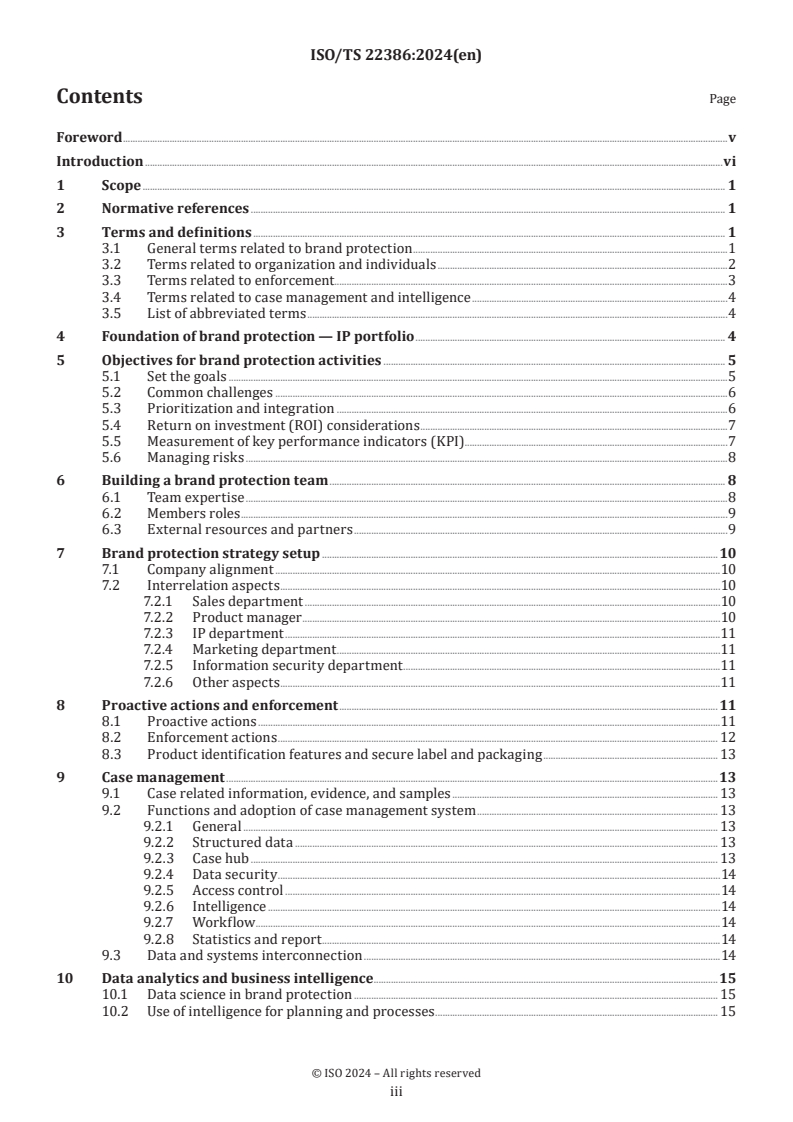
Contents Page
Foreword .v
Introduction .vi
1 Scope . 1
2 Normative references . 1
3 Terms and definitions . 1
3.1 General terms related to brand protection .1
3.2 Terms related to organization and individuals .2
3.3 Terms related to enforcement.3
3.4 Terms related to case management and intelligence .4
3.5 List of abbreviated terms .4
4 Foundation of brand protection — IP portfolio . 4
5 O bjectives for brand protection activities . 5
5.1 Set the goals .5
5.2 Common challenges .6
5.3 Prioritization and integration .6
5.4 Return on investment (ROI) considerations .7
5.5 Measurement of key performance indicators (KPI).7
5.6 Managing risks .8
6 Building a brand protection team . 8
6.1 Team expertise .8
6.2 Members roles .9
6.3 External resources and partners .9
7 Brand protection strategy setup .10
7.1 Company alignment .10
7.2 Interrelation aspects .10
7.2.1 Sales department .10
7.2.2 Product manager .10
7.2.3 IP department .11
7.2.4 Marketing department .11
7.2.5 Information security department .11
7.2.6 Other aspects .11
8 Proactive actions and enforcement .11
8.1 Proactive actions .11
8.2 Enforcement actions . 12
8.3 Product identification features and secure label and packaging . 13
9 Case management .13
9.1 Case related information, evidence, and samples . 13
9.2 Functions and adoption of case management system . 13
9.2.1 General . 13
9.2.2 Structured data . 13
9.2.3 Case hub . 13
9.2.4 Data security .14
9.2.5 Access control .14
9.2.6 Intelligence .14
9.2.7 Workflow .14
9.2.8 Statistics and report .14
9.3 Data and systems interconnection .14
10 Data analytics and business intelligence . .15
10.1 Data science in brand protection . 15
10.2 Use of intelligence for planning and processes . 15
iii
Bibliography . 17
iv
Foreword
ISO (the International Organization for Standardization) is a worldwide federation of national standards
bodies (ISO member bodies). The work of preparing International Standards is normally carried out through
ISO technical committees. Each member body interested in a subject for which a technical committee
has been established has the right to be represented on that committee. International organizations,
governmental and non-governmental, in liaison with ISO, also take part in the work. ISO collaborates closely
with the International Electrotechnical Commission (IEC) on all matters of electrotechnical standardization.
The procedures used to develop this document and those intended for its further maintenance are described
in the ISO/IEC Directives, Part 1. In particular, the different approval criteria needed for the different types
of ISO document should be noted. This document was drafted in accordance with the editorial rules of the
ISO/IEC Directives, Part 2 (see www.iso.org/directives).
ISO draws attention to the possibility that the implementation of this document may involve the use of (a)
patent(s). ISO takes no position concerning the evidence, validity or applicability of any claimed patent
rights in respect thereof. As of the date of publication of this document, ISO had not received notice of (a)
patent(s) which may be required to implement this document. However, implementers are cautioned that
this may not represent the latest information, which may be obtained from the patent database available at
www.iso.org/patents. ISO shall not be held responsible for identifying any or all such patent rights.
Any trade name used in this document is information given for the convenience of users and does not
constitute an endorsement.
For an explanation of the voluntary nature of standards, the meaning of ISO specific terms and expressions
related to conformity assessment, as well as information about ISO's adherence to the World Trade
Organization (WTO) principles in the Technical Barriers to Trade (TBT), see www.iso.org/iso/foreword.html.
This document was prepared by Technical Committee ISO/TC 292, Security and resilience.
Any feedback or questions on this document should be directed to the user’s national standards body. A
complete listing of these bodies can be found at www.iso.org/members.html.
v
Introduction
The value of brands to a brand owner is both intangible and tangible. Brands are built as part of the
intellectual property rights (IPR) of the brand owner and enhance its related innovations. Brand reputation
relies on the brand owner’s investment and often leads to brand equity, including consumer trust and
confidence.
In recent years, counterfeiting activities have become increasingly aggressive, causing harm to brands.
Besides damages to a brand owner’s intangible and tangible assets, such activities also pose a threat
to the global economy and critical infrastructure assets, while endangering consumer health and safety.
Those responsible for counterfeiting products are solely seeking self-benefit, which means that they are
likely to provide poor working conditions, use child labour, contribute to human trafficking and criminal
organizations. They also do not invest in research and design; instead, they exist by plagiarizing others’
creations and innovations. This harms the entire IPR intensive industry.
NOTE For more information on IPR intensive industry, see EPO/EUIPO (October 2022), IPR-intensive industries
[17]
and economic performance in the European Union Industry-level analysis report, fourth edition October 2022.
Counterfeiting activities also have a negative environmental impact during and after the manufacturing of
counterfeit goods, such as the release of toxic waste into the environment.
Brand protection activities, therefore, are meaningful. By the protection of brands and their related brand
reputation/image, sales and revenues are increased, IP assets are also protected, and their consumers’
benefits are ultimately protected.
Therefore, brand owners can utilize this document to make their brand protection activities efficient,
effective, professional and valuable. This document is designed to provide guidelines for brand protection
activities, aiming to build a unified terminology and set of activity elements.
Online enforcement is becoming an increasingly important element in brand protection. However, online
enforcement is not detailed in this document and will be left for future development.
The following relevant international standards can be used in conjunction with this document.
— ISO 9004, which gives guidelines for enhancing an organization's ability to achieve sustained success.
— ISO 31000, which provides principles, a framework and a process for managing risk.
— ISO 22384, which sets up a process to assess risks, and to select and combine individual measures for
developing a product protection plan. It includes consideration of impacts and modifications to, for
example, product lifecycle, supply chain, manufacturing, data management, brand perception and costs
so as to adapt the protection plan accordingly.
— ISO 28000, which specifies requirements for a security management system, including aspects relevant
to the supply chain.
— ISO 22380, which provides guidance on how organizations can establish strategic, business
countermeasures to prevent or reduce any harm, tangible or intangible loss and cost from such fraudulent
attacks in a cost-effective manner.
— ISO 22383, which gives guidelines for performance criteria and an evaluation methodology for
authentication solutions that aim to unambiguously establish material good authenticity and integrity
throughout an entire material good's lifecycle.
— ISO 22378, which describes framework for identification and authentication systems.
— ISO/IEC 27001, which provides companies of any size and from all sectors of activity with guidance
for establishing, implementing, maintaining and continually improving an information security
management system.
— ISO 31700-1, which establishes high-level requirements for privacy by design to protect privacy
throughout the lifecycle of a consumer product, including data processed by the consumer.
vi
— ISO/TR 31700-2, which provides illustrative use cases, with associated analysis, chosen to assist in
understanding the requirements of ISO 31700-1.
This document provides guidance for professionals within brand protection including, but not limited to:
— a management team of brand owners
— brand protection managers and practitioners
— IP and trademark attorneys
— investigators
— online monitoring solution providers
— authentication solution providers
— business intelligence and data analysts
— inspection and enforcement authorities
— associations for brand protection
vii
Technical Specification ISO/TS 22386:2024(en)
Security and resilience — Authenticity, integrity and trust for
products and documents — Guidelines for brand protection
and enforcement procedures
1 Scope
This document provides guidelines for establishing and enforcing respective measures for brand protection.
It supports the development of a brand protection strategy and describes a brand protection framework for
the development, production, and distribution of products and documents.
Applying these guidelines throughout the product lifecycle can facilitate interaction between individuals
and organizations involved in brand protection activities and can make brand protection procedures more
effective and efficient.
This document is intended to support the brand owner’s business resilience, brand reputation, and
brand value, by protecting products, documents, and associated services from counterfeiting and other
infringements.
2 Normative references
The following documents are referred to in the text in such a way that some or all of their content constitutes
requirements of this document. For dated references, only the edition cited applies. For undated references,
the latest edition of the referenced document (including any amendments) applies.
ISO 22300, Security and resilience — Vocabulary
3 Terms and definitions
For the purposes of this document, the terms and definitions given in ISO 22300 and the following apply.
ISO and IEC maintain terminology databases for use in standardization at the following addresses:
— ISO Online browsing platform: available at https:// www .iso .org/ obp
— IEC Electropedia: available at https:// www .electropedia .org/
3.1 General terms related to brand protection
3.1.1
anti-counterfeiting
process of either combating counterfeiting activities or counterfeit products, or both
3.1.2
brand protection
process of either protecting brands against counterfeiting or other infringement acts, or both
3.1.3
brand protection activity
event undertaken by a right owner (or on its behalf) for the purpose of brand protection (3.1.2)
3.1.4
case
series of events or persons being dealt with by brand protection (3.1.2) teams
3.1.5
customs training
training provided to customs authorities for the learning and development of knowledge, skills and abilities,
of the intellectual property rights and products of a specific company or companies
3.1.6
genuine product
product that is manufactured by, or authorized to be manufactured by, the brand owner, used as reference
for identifying suspect counterfeit products
3.1.7
infringing product
product that is made without licensing or authorization
3.1.8
intellectual property
IP
output of creative human thought process that has some intellectual or informational value
[SOURCE: ISO/IEC/IEEE 26511:2018, 3.1.19]
3.1.9
intellectual property infringement
unauthorized use, reproduction, distribution, or violation of intellectual property (3.1.8) rights
3.1.10
intellectual property portfolio
collection of intellectual property (3.1.8) rights owned by one entity
3.1.11
key performance indicator
KPI
quantifiable measure that an organization uses to gauge or compare performance in terms of meeting its
strategic and operational objectives
3.1.12
product identification
product verification
product authentication
process to determine whether a product is counterfeit or not
3.1.13
return on investment
ROI
measure of performance represented in the form of a ratio calculated by the benefit of an investment divided
by the cost of an investment, which is used to evaluate the profitability of an investment
3.2 Terms related to organization and individuals
3.2.1
brand protection manager
individual who is responsible for strategizing, planning, conducting and evaluating brand protection
activities (3.1.3)
3.2.2
infringer
individual or company who has infringed the intellectual property (3.1.8) rights of third parties
3.2.3
leads
source of information that can lead to brand protection activities (3.1.3)
3.2.4
online marketplace
e-commerce site where multiple parties (3.2.6) advertise and sell their products/services
3.2.5
party
person or group related to a brand protection (3.1.2) case, who is concerned with or affected by the activities
of a case (3.1.4)
3.2.6
product expert
individual who has expertise on the products of a company, and can provide knowledge in the identification
of counterfeit products
3.2.7
suspect
individual or company whose history or any other information leads to a suspicion that it can be an infringer
(3.2.3) to intellectual property (3.1.8) rights
3.3 Terms related to enforcement
3.3.1
customs recordal
application for action
registration of the intellectual property (3.1.8) rights with customs authorities that allows customs to
monitor shipments and exclude, detain or seize goods that are suspected of being counterfeit or infringing
the recorded intellectual property rights
3.3.2
cease and desist letter
C and D letter
request sent to an individual or company to stop an activity (“cease”) and refrain from doing it again
(“desist”)
3.3.3
ex officio
procedure for carrying out customs controls, whereby customs can come across goods that can be infringing
rights but for which no application for action (3.3.1) has been submitted
Note 1 to entry: Customs can also suspend the release of these goods, or detain them.
3.3.4
market sweep
action or process to take down counterfeiting products or online product listings in one market at one time
3.3.5
raid
action to seize all infringing items and collect evidence on location
3.3.6
settlement
agreement between the infringed and infringing parties without depending on a court decision or other
enforcement actions
3.3.7
test purchase
buying products from a suspect shop anonymously so as to identify the products, and to collect information
and evidence about the suspected counterfeiting activities
3.4 Terms related to case management and intelligence
3.4.1
application programming interface
API
collection of invocation methods and associated parameters used by one piece of software to request actions
from another piece of software
[SOURCE: ISO/IEC 18012-1:2004, 3.1.1]
3.4.2
case management
management of cases (3.1.4) and their related tasks, workflows, documents, reports and statistics, etc.
3.4.3
case management system
software system that supports the management of cases (3.1.4) and their related tasks, workflows,
documents, reports and statistics, etc.
3.4.4
product library
library of products of brand owners, which are used as reference for identifying suspect counterfeiting
products
3.4.5
heat map
display of geographical coverage of suspects/infringements that depicts the areas on which brand protection
activities (3.1.3) focus
3.4.6
data analytics
composite concept consisting of data acquisition, data collection, data validation, data processing, including
data quantification, data visualization, and data interpretation
[SOURCE: ISO/IEC 20546:2019, 3.1.6]
3.5 List of abbreviated terms
API application programming interface
BI business intelligence
IP intellectual property
IPR intellectual property rights
KPI key performance indicator
ROI return on investment
4 Foundation of brand protection — IP portfolio
IPR registration provides a legal basis for the protection of a brand. The relevant IPR can be in particular:
— Trademark
— Design
— Copyright
— Patent
— Domain name
— Trade name
— Utility patent
A broad IP portfolio helps to enhance and expand the company’s brand protection. Broad coverage for the IP
rights related to the brand should be acquired within a reasonable budget.
A brand owner should identify the elements eligible for IP protection and identify those that are of the
most value. This includes obtaining IP rights that provide the most beneficial, sustainable and long-term
protection.
The brand owner should identify the IP that has suffered the most infringements. A large amount of
infringement causes huge damages, and thus registration for such IP rights would serve as a basis for legal
action to mitigate potential damages.
The brand owner should determine markets, regions, or countries where counterfeiting activities are
most prevalent or cause the most damage. The brand owner should establish exclusive and comprehensive
coverage by securing a wide class of goods and services for the IP rights in those regions/countries.
The brand owner should consider market forces, such as:
— Market regions and countries, especially where the products have a competitive edge; IP rights to be
protected in the locations where the products are sold.
— Products that are most commonly infringed/counterfeited. Such products should be covered with IP rights.
— Enforcement ease (refer to the effort required to demonstrate the counterfeit character of a product and,
the validity of the legal basis).
— Alignment between IP rights with business goals.
— Legislative and enforcement procedures in different regions and countries.
— The legal framework of the country where the most infringements occur or where damages are the
highest.
— Costs (for registration, IP procedures, and maintenance).
— Time limitation of IP rights versus a lifetime of the product.
— IPR that should be registered and applied before the products are put on the market.
5 Ob jectives for brand protection activities
5.1 Set the goals
The brand owner should consider the following aspects to ensure the appropriate protection of the brand:
— safeguarding the safety of consumers and patients;
— safeguarding the brand’s reputation;
— safeguarding the integrity of the product, including its packaging;
— ensuring freedom of operation, i.e. by not infringing another party’s IP rights;
— enforcing its own IP rights against infringement;
— ensuring the authorized use of trademark in accordance with the right holder's guidelines;
— supporting sales and after-sales activities;
— supporting dealer network management and supply chain management;
— protecting substantial revenue through law enforcement activities.
Depending on the different stages of the business and the industry, the goal of brand protection activities
can be reactive actions or preventive actions. It can cover the entire product lifecycle. The brand owner
should truly understand the actual business needs before setting the goals.
5.2 Common challenges
This subclause presents the role of brand protection activities for handling the most common challenges
that businesses can face. Some of the commonly encountered challenges include the following:
— Market share is or will be taken by a counterfeit product sold online or in physical stores offline.
— A product is copied before the official release.
— Consumers cannot differentiate between genuine and counterfeit products.
— Internal employees cannot distinguish between genuine and counterfeit products.
— Facing a large number of consumer complaints about counterfeit products on the market.
— Consumers knowingly buy counterfeit products.
— Consumers associate low-quality counterfeit products with genuine products.
— Genuine products in the market can infringe other party’s IP rights.
— The research and development/design department lacks a process for evaluating other party’s IP rights.
— The research and development/design department lacks have a process for following company brand
guidelines.
— Dealers or distributors are unaware of or ignore company brand guidelines within the authorized scope.
— Dealers or distributors misuse the brand outside the authorized scope.
— End consumer/client suffers from damages due to counterfeit products.
— The infringer forges the brand owner’s identity to conduct illegal business.
— Illegitimate reuse of packaging materials such as bottles, disposed products, etc.
5.3 Prioritization and integration
The brand owners can be aware of, or can have encountered, most of the scenarios specified in 5.2. However,
it is still an important question of how to prioritize them. Brand protection teams can be easily flooded with
thousands of interesting potential leads or pieces of information from both external and internal sources
but end up with nothing being conclusive. The brand owner should prioritize the known challenges. This
ensures that everyone in the brand protection team cooperates with each other and aims towards the same
direction.
In most multinational organizations, brand protection teams are not always the closest to the business, but
still must meet the expectations of the business and support company goals. As the first step in setting goals,
after identifying all stakeholders, brand protection teams should find all possible ways to fully understand
the company strategy. This information will not come solely from the department head. It is essential to
also identify the links and dependencies between departments in order to understand other departments’
goals. Special consideration should be given to supporting of and collaborating with the marketing, sales,
aftersales, and research and development/design departments.
As a second step, it is recommended to make a list of all the needs and challenges specific to each department.
Examination of this information can provide insight into why the issues exist and potential causal links
between issues. This work can then guide brand protection efforts to contribute to their resolution.
As a third step, if budget allows, conducting key market research is another way to verify if the known
information is still up to date and accurate, especially when there are no local partners to support the
information collection.
As a last step, prioritize the list by considering the importance and urgency of each potential goal. This can
be achieved by considering the following:
— If this challenge is solved, how much will it contribute to reaching the company strategy? This enables
the "importance" to be determined.
— If this topic is strongly connected to consumer safety, current sales targets, or high-risk lawsuits, then it
is absolutely urgent.
Using a 5-level ranking system, such as “very high, high, medium, low, very low” should be sufficient to
illustrate the final prioritization in a simple way. In the end, the ranking results will show which goal is the
most important to be attended to first, before the other goals are attended to.
5.4 Return on investment (ROI) considerations
The brand owner should calculate the ROI calculations by dividing the net benefit by the cost of the
investment. The measurements include both hard ROI indicators, i.e. indicators that tend to be easy to
quantify, and soft ROI indicators, i.e. indicators that are intangible, such as brand reputation or consumer
awareness. Brand protection teams can interpret the value of seized counterfeit goods as the net benefit.
The cost of investment can be the sum of internal and external costs of brand protection activities.
NOTE Using the prevention value as the “net benefit” can be challenged by the business, on the grounds that the
seized goods or removed listings are not necessarily equal to sold genuine goods.
Brand protection is not only about preventing losses and damages. The brand owner should consider
generating recovery income as well. For example, when a civil litigation judgment is in favour of the brands,
or a settlement is reached between the brand and the infringer, these should be directly calculated into net
benefits.
As many brand protection teams may have already experienced, it is almost impossible to calculate a desired
brand protection ROI in general. Instead, it would be more feasible to set up specific evaluation methods for
specific enforcement activities. Given that high priority goals usually require more attention and resources,
it is worth investing additional effort in measuring them. Therefore, it makes sense to focus on improving
the efficiency of utilizing resources and try to find what is “small but beautiful”.
For example, many consumer brands that enforce their rights through customs action want to improve
the ROI on this particular topic. This raises the following questions: “Do customs actually improve their
performance after a brand's investment? Which customs brings the best result, which is the most active, and
the most accurate in detaining goods that are also subsequently identified as counterfeit?”
To be able to answer these questions, the team needs a tool or system to collect case data and figures
for statistical analytics. For example, among all customs cases in a specific time frame, it is important to
determine the number of products are seized, the number of products released, and the costs of handling
these cases. Then it becomes possible to calculate the costs and benefits, compare different countries, and
analyse historical performance. This includes identifying products that are reported by customs but the
majority of them are genuine. Only after being aware of those issues, it is possible to determine a goal for
general and regional customs enforcement.
5.5 Measurement of key performance indicators (KPI)
The brand owner should use key performance indicators (KPI), objectives and key results (OKR), or similar
methods to help measure the efficiency of brand protection activities and to achieve key business objectives.
It is recommended that the KPIs are measured in the following way:
— List the goals with the brand protection team.
— List the possible measures to reach those goals, these are the KPIs to measure brand protection activity
effectiveness.
— Set a plan for enforcing these goals that will be directly related to the brand protection team’s performance.
— Let the brand protection team takes responsibility for monitoring their own performance and reporting
statistics.
Table 1 shows some examples of brand protection KPI metrics.
Table 1 — Common brand protection goals and associated metrics
Goals Metrics Resources Responsible
Number of customs trainings, seizure quanti- Law enforcement au- Regional brand protec-
Customs seizure
ty and seizure values thorities, law firms tion managers
Online monitoring
Online monitor- Web monitoring solution implementation,
software and service Core team
ing delisting success rate, amount of take-downs
provider
Number and types of customer complaints; Internal departments
Regional brand protec-
Market control number of raids, investigation, market sur- and external service
tion managers
vey providers
Improved product identification solution, im- Internal departments
Internal security plementation of security labels, internal audit and external service Brand protection team
on supply chain and distribution channel providers
Consulting service
Team manage- Workflow, intelligence sharing, communica- provider and case
Brand protection team
ment tion efficiency, statistic, report management soft-
ware
5.6 Managing risks
The brand owner should ensure the management of risks and issues that are detrimental to brand protection
goals by:
— establishing the context;
— assessing, treating, monitoring, reviewing, recording, and reporting;
— communicating and discussing the risks.
Appropriate risk assessment should be conducted for each goal to determine how it can be impacted by a risk
event. Risk assessment includes risk identification, risk analysis, and risk evaluation. Each planned action to
mitigate risks should be monitored, reviewed, reported, and communicated by the brand protection team.
These risks can impact the achievement of goals.
6 Building a brand protection team
6.1 Team expertise
The brand owner should set up a brand protection team with the relevant expertise.
The brand protection team should consist of members with the following expertise:
— Team manager
— IP specialist
— Legal counsel
— Security specialist
— Product expert who can distinguish between genuine and counterfeit products
— Experts who provide input and expertise throughout the product lifecycle
The team should be engaged in new product development, potential retrofitting existing products, as well
as the assessment of technologies that best fit the product design and intended markets. A robust product
design with layered techniques utilizing covert or overt technologies (or both) will inherently reduce
counterfeiting, enhance the market detections of counterfeit products and improve enforcement activities.
Brand protection team members perform all the daily operations related to counterfeiting cases including
assigning tasks, test purchases, interacting with external counsel, web monitoring, investigating, as well as
liaison with law enforcement authorities. They also help to enforce actions against the counterfeiters.
6.2 Members roles
The brand protection team should consist of members who can handle multi-functional tasks and multiple
projects at the same time. The different roles they play can include:
— Team leader, who is responsible for leading the internal brand protection team or service provider
to reach the goals, setting up strategies, recruitment and allocation of human resources and budget,
and delivery of status/issues/progress reports to corporate management. The team leader should be
experienced in brand protection procedures and have knowledge about the brand owner’s products,
industry, and organization.
— Investigator, who is responsible for gathering intelligence and carrying out investigations against those
who infringe intellectual property rights and other related interests.
— Legal counsel, who possesses a legal background, provides legal opinions and performs tasks related not
only to Intellectual Property law but also to other legal matters such as civil proceedings and criminal
proceedings.
— IP specialist, who is in charge of application, opposition, and renewal of trademark, patents and other IP
rights, provides internal knowledge about the brand owner’s current portfolio and future IP strategy.
— Product expert, who acquires the resources and knowledge about how to distinguish between genuine
and counterfeit products. The individual in this role should be capable of serving as an expert witness in
court cases or providing affidavit evidence.
6.3 External resources and partners
When an in-house brand protection team takes the responsibility of setting the goals and strategy, as
well as coordinating global brand protection activities, external resources can greatly assist in providing
professional advice or handling local actions. The following external resources can be engaged from time to
time by the brand owner:
— Law firm, which works with one or several brands; can be the contact point for local law enforcement
authorities, customs; prepares anti-counterfeit investigations; and takes legal actions. An in-house team
can partner with a law firm to serve as global counsel for running global IP profile and coordinating
enforcement actions in different countries, and also keep communication with local law firms or service
providers. The in-house team can also give instructions directly to local law firms.
— Investigator, who investigates and registers suspected counterfeit cases for clients. Investigators can
handle test purchases, market surveys or field investigations, help with identification of counterfeiters
in targeted markets, and collect evidence to arrange further actions, such as raids or lawsuits.
— Online-monitoring service provider, who provides its software solution and services; and detects and
removes IP infringements, unauthorized listings from marketplaces, websites, social media and domains.
— Anti-counterfeit alliance, which is an industry association that combines the forces of multiple brand
owners who share similar brand protection issues and provides enforcement solutions.
— Data and other software service provider. The brand protection team is advised to research available
data providers that can be used to facilitate investigation or intelligence analyses. For example, global
shipments via customs are public information that is available on a number of platforms with search and
ranking functionalities. The case management solution, IP search, and portfolio management solution
provide unique features that make brand protection work much more efficient and data-driven.
— Certification bodies that have authorized the use of their marks on the brand owner’s products.
7 Brand protection strategy setup
7.1 Company alignment
Before setting a brand protection strategy, the brand protection strategy should be aligned with the overall
company strategy and that of connecting various departments. The team should collaborate with other
departments and work together toward a common goal.
7.2 Interrelation aspects
7.2.1 Sales department
The brand protection team should work closely with the sales department. The following aspects should be
considered for alignment:
— market priority, i.e. country or region priority, and consumer profile prio
...