

ISO 22371:2024
(Main)Security and resilience — Community resilience — Principles, framework and guidelines on urban resilience
General Information
- Abstract
This document provides principles, framework and guidelines on how to enhance urban resilience to protect communities, people and organizations and improve residents' quality of life. It describes: a) how to build capacity to better manage change and disruptive events, minimizing the impacts on the residents, including the most disadvantaged and vulnerable persons; b) the benefits of urban resilience; c) how to organize, assess, plan, implement and continually improve urban resilience. This document is applicable to all urban contexts, governance structures and stakeholders for all identified levels of risk. It is intended to be used by all organizations that have accountability for resilience of services in urban communities.
- Status
- Published
- Publication Date
- 08-Dec-2024
- Technical Committee
- ISO/TC 292 - Security and resilience
- Drafting Committee
- ISO/TC 292 - Security and resilience
- Current Stage
- 6060 - International Standard published
- Start Date
- 09-Dec-2024
- Due Date
- 27-Apr-2025
- Completion Date
- 09-Dec-2024

Overview
ISO 22371:2024 - Security and resilience - Community resilience - Principles, framework and guidelines on urban resilience - provides a structured, practical approach to strengthen urban resilience across communities, services and infrastructure. The standard explains how to build capacity to anticipate, prepare for, respond to and recover from disruptive events while protecting vulnerable people and improving residents’ quality of life. It is applicable to all urban contexts, governance structures and identified risk levels and is intended for any organization accountable for resilience of urban services.
Key topics and technical requirements
ISO 22371 defines a principles-based urban resilience framework and provides guidance on how to organize, assess, plan, implement and continually improve resilience efforts. Major technical topics include:
- Principles for urban resilience - foundational concepts such as inclusivity, adaptation, prevention and whole-of-society approaches.
- Governance, leadership and policy - establishing commitment, governance structures and an urban resilience policy.
- Vision, objectives and benefits - setting measurable resilience objectives and articulating social, economic and service continuity benefits.
- Stakeholder mapping and community engagement - identification, communication and outreach strategies to include vulnerable groups.
- Data, assessment and system mapping - data collection, system definition, interdependency analysis and baseline resilience assessment.
- Risk identification and prioritization - risk assessment, gap analysis, scenario planning and urban resilience testing.
- Strategy development and treatment options - risk appetite, adaptation pathways, initiative development and prioritization (including cost/benefit considerations).
- Implementation and financing - programme/project management, procurement, partnerships, business cases and financing mechanisms.
- Monitoring and continual improvement - real‑time situational awareness, performance monitoring, horizon scanning, learning and re-measurement.
These topics are arranged to support a lifecycle approach: Organize → Assess → Strategy → Implement → Continual improvement.
Practical applications
ISO 22371 is practical guidance for:
- Municipal governments and city administrations designing resilience strategies.
- Urban planners and infrastructure operators assessing system interdependencies.
- Emergency management and public health agencies coordinating preparedness and response.
- Utilities, transport authorities and private-sector service providers ensuring continuity of critical services.
- NGOs, community groups and investors aligning projects with resilience objectives.
Typical uses include creating urban resilience policies, conducting system baseline assessments, prioritizing resilience projects, developing business cases for resilience investment, and establishing monitoring frameworks.
Benefits
Implementing ISO 22371 helps reduce social and economic impacts of shocks, protect vulnerable populations, strengthen service continuity, support sustainable urban development and attract investment by demonstrating robust resilience planning.
Related standards
ISO 22371 was developed by ISO/TC 292 (Security and resilience). Organizations should consider this document alongside other ISO guidance on community resilience, business continuity and risk management when designing integrated resilience programs.
Get Certified
Connect with accredited certification bodies for this standard

BSI Group
BSI (British Standards Institution) is the business standards company that helps organizations make excellence a habit.

Bureau Veritas
Bureau Veritas is a world leader in laboratory testing, inspection and certification services.

DNV
DNV is an independent assurance and risk management provider.
Sponsored listings
Frequently Asked Questions
ISO 22371:2024 is a standard published by the International Organization for Standardization (ISO). Its full title is "Security and resilience — Community resilience — Principles, framework and guidelines on urban resilience". This standard covers: This document provides principles, framework and guidelines on how to enhance urban resilience to protect communities, people and organizations and improve residents' quality of life. It describes: a) how to build capacity to better manage change and disruptive events, minimizing the impacts on the residents, including the most disadvantaged and vulnerable persons; b) the benefits of urban resilience; c) how to organize, assess, plan, implement and continually improve urban resilience. This document is applicable to all urban contexts, governance structures and stakeholders for all identified levels of risk. It is intended to be used by all organizations that have accountability for resilience of services in urban communities.
This document provides principles, framework and guidelines on how to enhance urban resilience to protect communities, people and organizations and improve residents' quality of life. It describes: a) how to build capacity to better manage change and disruptive events, minimizing the impacts on the residents, including the most disadvantaged and vulnerable persons; b) the benefits of urban resilience; c) how to organize, assess, plan, implement and continually improve urban resilience. This document is applicable to all urban contexts, governance structures and stakeholders for all identified levels of risk. It is intended to be used by all organizations that have accountability for resilience of services in urban communities.
ISO 22371:2024 is classified under the following ICS (International Classification for Standards) categories: 03.100.01 - Company organization and management in general. The ICS classification helps identify the subject area and facilitates finding related standards.
ISO 22371:2024 is available in PDF format for immediate download after purchase. The document can be added to your cart and obtained through the secure checkout process. Digital delivery ensures instant access to the complete standard document.
Standards Content (Sample)
International
Standard
ISO 22371
First edition
Security and resilience —
2024-12
Community resilience — Principles,
framework and guidelines on urban
resilience
Reference number
© ISO 2024
All rights reserved. Unless otherwise specified, or required in the context of its implementation, no part of this publication may
be reproduced or utilized otherwise in any form or by any means, electronic or mechanical, including photocopying, or posting on
the internet or an intranet, without prior written permission. Permission can be requested from either ISO at the address below
or ISO’s member body in the country of the requester.
ISO copyright office
CP 401 • Ch. de Blandonnet 8
CH-1214 Vernier, Geneva
Phone: +41 22 749 01 11
Email: copyright@iso.org
Website: www.iso.org
Published in Switzerland
ii
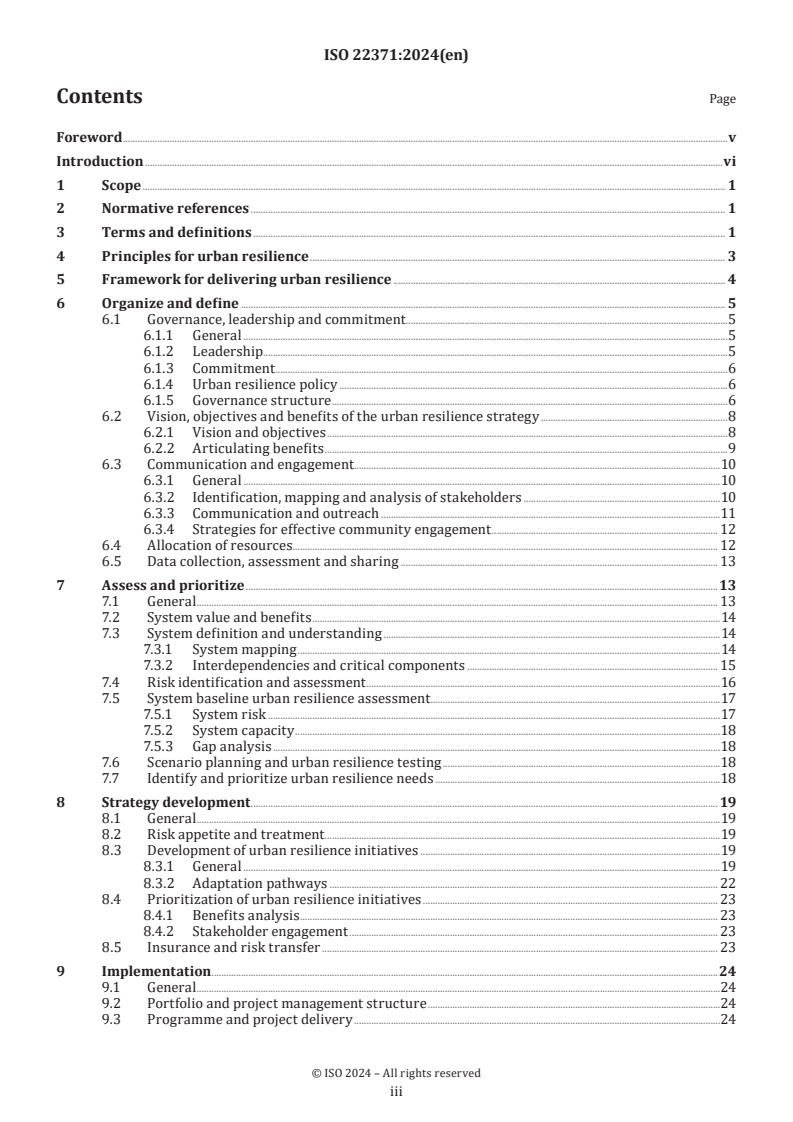
Contents Page
Foreword .v
Introduction .vi
1 Scope . 1
2 Normative references . 1
3 Terms and definitions . 1
4 Principles for urban resilience . 3
5 Framework for delivering urban resilience . 4
6 Organize and define . 5
6.1 Governance, leadership and commitment .5
6.1.1 General .5
6.1.2 L eadership.5
6.1.3 Commitment .6
6.1.4 Urban resilience policy .6
6.1.5 Governance structure .6
6.2 Vision, objectives and benefits of the urban resilience strategy .8
6.2.1 Vision and objectives .8
6.2.2 Articulating benefits .9
6.3 Communication and engagement .10
6.3.1 General .10
6.3.2 Identification, mapping and analysis of stakeholders .10
6.3.3 Communication and outreach .11
6.3.4 Strategies for effective community engagement . 12
6.4 Allocation of resources. 12
6.5 Data collection, assessment and sharing . 13
7 A ssess and prioritize .13
7.1 General . 13
7.2 System value and benefits .14
7.3 System definition and understanding .14
7.3.1 System mapping .14
7.3.2 Interdependencies and critical components . 15
7.4 Risk identification and assessment .16
7.5 System baseline urban resilience assessment .17
7.5.1 System risk .17
7.5.2 System capacity .18
7.5.3 Gap analysis .18
7.6 Scenario planning and urban resilience testing .18
7.7 Identify and prioritize urban resilience needs .18
8 Strategy development . 19
8.1 General .19
8.2 Risk appetite and treatment .19
8.3 Development of urban resilience initiatives .19
8.3.1 General .19
8.3.2 Adaptation pathways . 22
8.4 Prioritization of urban resilience initiatives . 23
8.4.1 Benefits analysis . 23
8.4.2 Stakeholder engagement . 23
8.5 Insurance and risk transfer . 23
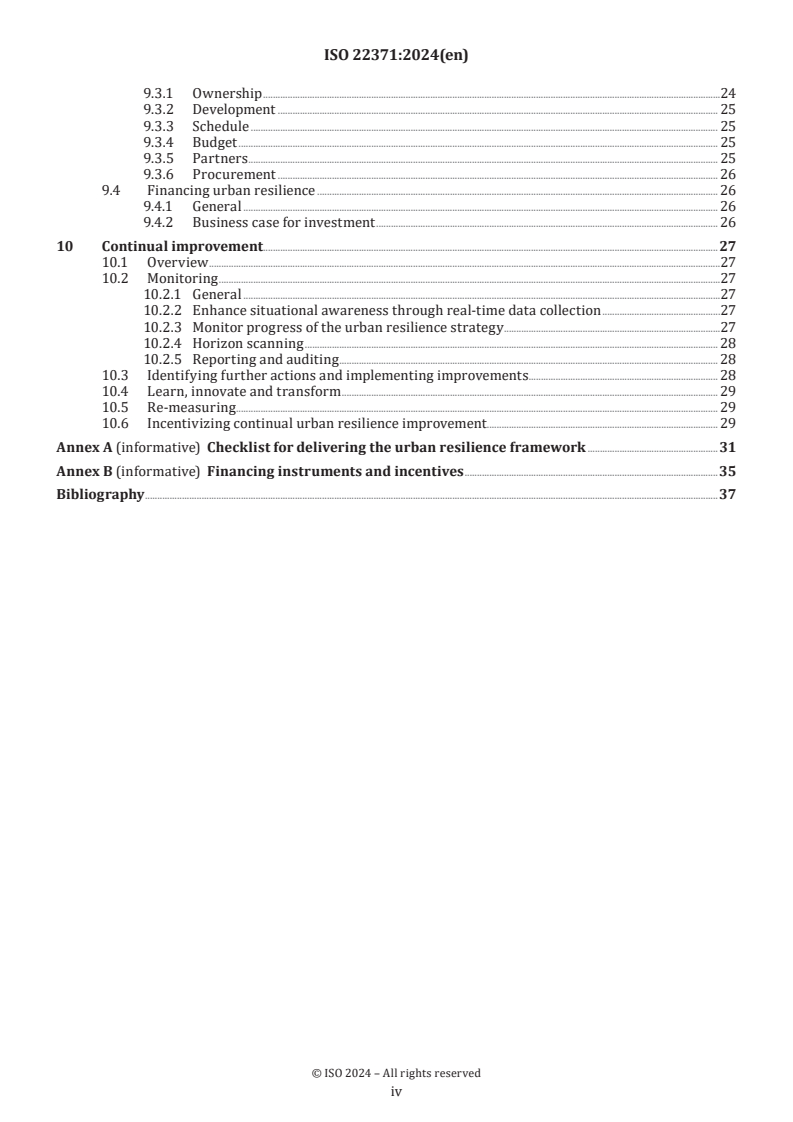
9 Implementation . .24
9.1 General .24
9.2 Portfolio and project management structure .24
9.3 Programme and project delivery .24
iii
9.3.1 Ownership .24
9.3.2 Development . 25
9.3.3 Schedule . 25
9.3.4 Budget . 25
9.3.5 Partners . 25
9.3.6 Procurement . 26
9.4 Financing urban resilience . 26
9.4.1 General . 26
9.4.2 Business case for investment . 26
10 C ont i nu a l i mpr ovement . .27
10.1 Overview .27
10.2 Monitoring .27
10.2.1 General .27
10.2.2 Enhance situational awareness through real-time data collection .27
10.2.3 Monitor progress of the urban resilience strategy .27
10.2.4 Horizon scanning . 28
10.2.5 Reporting and auditing . 28
10.3 Identifying further actions and implementing improvements . . 28
10.4 Learn, innovate and transform . 29
10.5 Re-measuring. 29
10.6 Incentivizing continual urban resilience improvement . 29
Annex A (informative) Checklist for delivering the urban resilience framework .31
Annex B (informative) Financing instruments and incentives .35
Bibliography .37
iv
Foreword
ISO (the International Organization for Standardization) is a worldwide federation of national standards
bodies (ISO member bodies). The work of preparing International Standards is normally carried out through
ISO technical committees. Each member body interested in a subject for which a technical committee
has been established has the right to be represented on that committee. International organizations,
governmental and non-governmental, in liaison with ISO, also take part in the work. ISO collaborates closely
with the International Electrotechnical Commission (IEC) on all matters of electrotechnical standardization.
The procedures used to develop this document and those intended for its further maintenance are described
in the ISO/IEC Directives, Part 1. In particular, the different approval criteria needed for the different types
of ISO document should be noted. This document was drafted in accordance with the editorial rules of the
ISO/IEC Directives, Part 2 (see www.iso.org/directives).
ISO draws attention to the possibility that the implementation of this document may involve the use of (a)
patent(s). ISO takes no position concerning the evidence, validity or applicability of any claimed patent
rights in respect thereof. As of the date of publication of this document, ISO had not received notice of (a)
patent(s) which may be required to implement this document. However, implementers are cautioned that
this may not represent the latest information, which may be obtained from the patent database available at
www.iso.org/patents. ISO shall not be held responsible for identifying any or all such patent rights.
Any trade name used in this document is information given for the convenience of users and does not
constitute an endorsement.
For an explanation of the voluntary nature of standards, the meaning of ISO specific terms and expressions
related to conformity assessment, as well as information about ISO's adherence to the World Trade
Organization (WTO) principles in the Technical Barriers to Trade (TBT), see www.iso.org/iso/foreword.html.
This document was prepared by Technical Committee ISO/TC 292, Security and resilience.
Any feedback or questions on this document should be directed to the user’s national standards body. A
complete listing of these bodies can be found at www.iso.org/members.html.
v
Introduction
Urban resilience is vital for protecting, sustaining and enhancing economic, social, physical, technical and
environmental value. Resilience is defined as the ability to absorb and adapt in a changing environment.
Urban resilience is the ability of any urban system, with its inhabitants, in a changing environment, to
anticipate, prepare, respond to and absorb shocks, positively adapt and transform in the face of stress
and uncertainty, while facilitating inclusive and sustainable development. This relies on the shared
understanding and awareness of risks, ensuring prevention rather than cure and adopting a whole of society
approach to resilience, where everyone plays their part.
Urban resilience includes the resilience of:
a) People and communities
b) Governance and public services
c) Trade and business services
d) Environment, infrastructure and resources
In an increasingly complex and changing world, urban areas are becoming ever more dynamic and influential.
Concurrently, as urban environments evolve and grow in complexity, so do the risks and challenges they
face, such as those due to climate change, increased reliance on technology and global supply chains.
Urban areas that are more resilient can better realize their strategic ambitions, protect their critical
resources, capitalize on investment, create and sustain opportunities for enterprise, and empower
individuals, communities, institutions and businesses to not only survive, but to adapt and prosper.
[1]
With 68 % of the global population set to be urban dwelling by 2050, urban resilience is becoming ever
more essential in meeting the increasing social, economic and environmental challenges that come with this
level of growth.
[1]
In order to meet Goal 11 of the United Nations Sustainable Development Goals – to make cities inclusive,
safe, resilient and sustainable – urban areas should adopt strategies that:
— take a proactive and integrated approach to resilience;
— transcend departmental and organizational boundaries; and
— are grounded in a comprehensive understanding of the challenges facing the urban environment.
Urban resilience requires an integrated, system-based approach, drawing on the knowledge contained
across a broad range of disciplines. This approach facilitates shared understanding and learning for adapting
in complex and dynamic environments, promoting a collective and inclusive approach to change.
Urban resilience is a collective responsibility and is enhanced when the whole of society is enabled and
empowered to act and engage in support of those in a decision-making capacity, such as local government
and communities.
This document has been developed in response to increasing global demand for guidance on the
development and implementation of strategies which seek to improve urban resilience in the face of the
social, environmental, technical and economic challenges the world faces, now and in the future.
vi
International Standard ISO 22371:2024(en)
Security and resilience — Community resilience — Principles,
framework and guidelines on urban resilience
1 Scope
This document provides principles, framework and guidelines on how to enhance urban resilience to protect
communities, people and organizations and improve residents' quality of life. It describes:
a) how to build capacity to better manage change and disruptive events, minimizing the impacts on the
residents, including the most disadvantaged and vulnerable persons;
b) the benefits of urban resilience;
c) how to organize, assess, plan, implement and continually improve urban resilience.
This document is applicable to all urban contexts, governance structures and stakeholders for all identified
levels of risk. It is intended to be used by all organizations that have accountability for resilience of services
in urban communities.
2 Normative references
The following documents are referred to in the text in such a way that some or all of their content constitutes
requirements of this document. For dated references, only the edition cited applies. For undated references,
the latest edition of the referenced document (including any amendments) applies.
ISO 22300, Security and resilience — Vocabulary
3 Terms and definitions
For the purposes of this document, the terms and definitions given in ISO 22300 and the following apply.
ISO and IEC maintain terminology databases for use in standardization at the following addresses:
— ISO Online browsing platform: available at https:// www .iso .org/ obp
— IEC Electropedia: available at https:// www .electropedia .org/
3.1
capacity
combination of all the strengths, capabilities and resources available within an organization, community
or society that can reduce the level of risk or the effects of a crisis and that has the ability to deal with
uncertainty and adapt to change
Note 1 to entry: Capacity can include physical, institutional, social, technical or economic means as well as skilled
personnel or attributes such as leadership and management.
[SOURCE: ISO 22300:2021, 3.1.25, modified — added “capabilities” and “and that has the ability to deal with
uncertainty and adapt to change” to the definition.]
3.2
resilience
ability to absorb and adapt in a changing environment
Note 1 to entry: Urban resilience is the ability of any urban system, with its inhabitants, in a changing environment, to
anticipate, prepare, respond to and absorb shocks, positively adapt and transform in the face of stress and uncertainty,
while facilitating inclusive and sustainable development.
[SOURCE: ISO 22300:2021, 3.1.206, modified — the note 1 to entry has been modified to reflect the scope of
this document.]
3.3
shock
abrupt or acute event that has the potential to impact upon the purpose or objectives of an urban system
Note 1 to entry: Table 2 addresses the evaluation of shocks, stresses and trends.
[SOURCE: ISO 22300:2021, 3.1.263, modified — “uncertain” deleted; “long onset” changed to “acute”; note 1
to entry has been added.]
3.4
stakeholder
interested party
person or organization that can affect, be affected by, or perceives itself to be affected by a decision or
activity
[SOURCE: ISO 31073:2022, 3.3.2]
3.5
stress
chronic and ongoing dynamic pressure with the potential for cumulative impacts on the ability and capacity
of the system to achieve its objectives
Note 1 to entry: Table 2 addresses the evaluation of shocks, stresses and trends.
[SOURCE: ISO 22300:2021, 3.1.269, modified — “originated within an urban system” deleted; note 1 to entry
has been added.]
3.6
urban area
geographic area containing a populated, built environment
Note 1 to entry: Urban areas usually include cities or towns and their outlying suburbs.
3.7
urban resilience
ability of any urban system, with its inhabitants, in a changing environment, to anticipate, prepare, respond
to and absorb shocks, positively adapt and transform in the face of stress and uncertainty, while facilitating
inclusive and sustainable development
Note 1 to entry: A more resilient urban system is characterized by its ability to continue providing services through
disruption in the short- to medium-term, combined with a capacity to reduce pressures and adapt to changes, risks
and opportunities. Urban resilience, therefore, is dependent upon the ability of urban systems not just to deal with
shocks, but also with chronic stresses, uncertainties and change.
Note 2 to entry: Urban resilience is dependent upon the individual and collective resilience of the separate components
of a complex urban system. Although a city, town or community within an urban area can individually demonstrate
enhanced resilience within its respective boundaries, urban resilience encompasses the broader geographic scope
of urban agglomeration. Resilience of an urban system is measured by the capacity for resilience of each individual
system component and dependent upon the resilience of the weakest performer among the urban agglomeration
within the system scope.
Note 3 to entry: In order to assess, plan and act accordingly in the face of shocks, stresses and uncertainty, an urban
system’s resilience capacity should be measured and analysed through qualitative and quantitative data.
[SOURCE: ISO 22300:2021, 3.1.284, modified — notes 1 to 3 to entry have been modified]
3.8
urban system
human settlement, integrated and complex set of system components, characterized by physical, functional,
organizational and spatial dimensions; comprised of people, processes and assets managed through effective
governance mechanisms in order to deliver the urban societal objectives
Note 1 to entry: Being dynamic, the composition and elements of an urban system changes with time.
Note 2 to entry: Every urban area has characteristics of an urban system, regardless of its size, culture, location,
economy and/or political environment.
Note 3 to entry: Characterized as urban systems, urban areas have the objectives of managing the complex interactions
and interdependencies among its multiple components, with the purpose of fulfilling a variety of functionalities
including social, economic, technical, cultural and environmental.
[SOURCE: ISO 22300:2021, 3.1.285, modified — deleted “universal and interdependent”; “in order to deliver
the urban societal objectives” has been added to the definition]
3.9
vulnerable group
individuals who share one or several characteristics that are the basis of discrimination or adverse social,
economic, cultural, political or health circumstances and that cause them to lack the means to achieve their
rights or, otherwise, enjoy equal opportunities
[SOURCE: ISO 22300:2021, 3.1.292]
3.10
vulnerable person
individual who is less able to anticipate, prepare, respond to and absorb shocks, or positively adapt and
transform in the face of stress and uncertainty
Note 1 to entry: In this document, a vulnerable person is not defined by the nature of the vulnerability but by their
personal circumstances.
[SOURCE: ISO 22300:2021, 3.1.293, modified —definition and note 1 have been modified]
4 Principles for urban resilience
In order to improve urban resilience, the responsible body and stakeholders should be guided by the
principles listed in Table 1 that underpin resilient urban systems. The responsible body is the council,
governing body, board or the person or body with ultimate decision-making authority in regard to urban
resilience. They should be at the core of all resilience behaviours, strategies and outcomes.
Table 1 — Principles
Principles Description
Accountable Upholding methods for effective governance that promote clear responsibilities, accounta-
bility, unity of vision and transparency; delivering long-lasting urban resilience benefits that
go beyond short-term decision-making cycles (for example, electoral cycles, annual budgets,
short-term investment plans and programmes) and avoid fragmentation, ensuring that there
are long-term, sustained financing mechanisms in place to provide ongoing support to urban
resilience-building projects.
Adaptive Building flexibility and resourcefulness; creating urban systems that can evolve and manoeuvre
quickly in a changing landscape – addressing risks and capitalizing on opportunities. Accepting
of ever-increasing uncertainty and change and having the ability to apply existing resources to
new purposes. Rapidly finding different ways to achieve desired outcomes or meet needs during
a shock or when under stress, mobilising human, financial, technical and material resources
inside or outside of traditional response structures to deliver innovative solutions in the face of
adversity.
Aware Gathering information, harnessing real-time data and conducting horizon scanning to improve
awareness, anticipate change and inform evidence-based decision-making. Assessing, building
knowledge capital, learning and continually improving for better future outcomes.
Inclusive Conducting broad consultation and co-creating with communities, including those which are
identified as vulnerable – creating community cohesion, strengthening social contracts and
empowering people to participate and create a whole society approach to resilience. All parts of
the community agree on a vision for its future and are aware of the shocks and stresses it faces
and their respective and complementary roles in protecting and strengthening urban resilience.
Benefits and impacts are distributed justly and equitably across urban networks; reducing
social stresses and disproportionately poor outcomes for vulnerable groups.
Integrated Integrating and aligning urban systems to reduce silos and bring together decision makers, sec-
tors, departments, budgets, activities, and agendas. Maintaining a systems-thinking approach,
looking at the whole system rather than focusing on its individual parts to better understand
the complexity and interdependencies between multiple stakeholders with divergent perspec-
tives, allowing for solutions that provide multiple benefits and prevent cascading and dispro-
portionate failures across the system.
Prepared Addressing identified system vulnerabilities through robust design, redundancy, spare capacity
and fail-safe measures, balancing risk, performance and cost. Responding quickly to mitigate
adverse impacts of events and to accelerate recovery.
Sustainable Pursuing and committing to sustainable, resource efficient solutions for long-term, whole
system urban resilience that do not compromise the well-being and quality of life for future gen-
erations and ecosystems – building on the recommendations of the United Nations Sustainable
Development Goals.
Transformative Bouncing forward following disasters so that systems can thrive, not just survive. Rapidly
finding different ways to achieve their goals or meet their needs under changing circumstances.
Transcending traditional ideas, roles, and patterns to create something new by using originality
of thought and demonstrating imagination.
5 Framework for delivering urban resilience
This framework provides the foundation for successful urban resilience, and is iterative and continuous.
Urban areas will be at various stages of maturity and development with regard to the steps laid out in this
section. Existing local and international initiatives should be aligned with and integrated into the urban
resilience strategy. The framework’s five key steps are set out in the following clauses:
a) Organize and define: Establishing governance structures, engaging key stakeholders, developing a
shared vision, objectives and goals and data collection for managing urban resilience (Clause 6).
b) Assess and prioritize: Performing a systems-based urban resilience assessment and prioritizing urban
resilience needs (Clause 7).
c) Strategy development: Developing (Clause 8) and maintaining a prioritized schedule of urban resilience
initiatives needed to achieve goals and objectives.
d) Implementation: Developing detailed resilience projects, and managing their delivery (Clause 9).
e) Continual improvement: Monitoring, measuring, analysing, adjusting, learning and innovating
continuously (Clause 10).
The responsible body should:
— follow the framework described in the five steps above [a) to e)], along with the activities described in
Figure 1 under each step when developing strategies for and delivering urban resilience;
— consider the principles specified in Table 1 in every step of the process.
Figure 1 — Framework for urban resilience showing steps and associated activities
Annex A provides a checklist of the expected activities for developing and implementing the urban resilience
strategy, which sit within the framework given in Figure 1.
6 Organize and define
6.1 Governance, leadership and commitment
6.1.1 General
To enable responsible authorities to support the enhancement of urban resilience, adequate governance
arrangements should be established to build an environment of trust, transparency and accountability to
deliver the activities outlined in the urban resilience policy and strategy.
Entities may use existing governance frameworks or apply the governance structure outlined in this
document.
6.1.2 Leadership
To enhance urban resilience capacity, a mandate or “authority to act” should be provided by the responsible
body (see 6.1.5.2) which has the authority to appoint an urban resilience lead. A clear definition for this role
should be created reflecting the appropriate qualifications, life experiences and capabilities to ensure an
appropriately competent person is selected to hold this position.
To demonstrate the importance of this role, this appointment should be formally recognized through a
public announcement, launch event and strategic social media campaign to spread the message across the
community.
6.1.3 Commitment
The responsible body should:
a) demonstrate a strong and sustained commitment to urban resilience;
b) appoint and support the urban resilience lead;
c) mobilize the support of all other responsible parties who take on formal roles and responsibilities
within the strategy and implementation team.
6.1.4 Urban resilience policy
The responsible body should:
a) develop an urban resilience policy that sets out the rules of engagement, expectations, and governance
structure for the urban resilience process;
b) use the policy as a central resource and agreed code of conduct to guide the organizations and
individuals who engage in urban resilience.
6.1.5 Governance structure
6.1.5.1 General
Figure 2 provides a model governance structure for delivering urban resilience; it can vary depending on
the size and resources of the urban area.
Figure 2 — Model governance structure
NOTE ISO 37000 gives guidance for the effective delivery of governance of organizations.
6.1.5.2 Responsible body
The responsible body (the council, governing body, board, or the person or body with ultimate decision-
making authority in regard to urban resilience) should:
a) develop, adopt and perform the champion role for the development and implementation of the urban
resilience policy and strategy;
b) remove barriers and facilitate the implementation of the urban resilience strategy;
c) provide regular updates, both formal and informal, across various media channels to encourage the
development of an overall urban resilience culture.
6.1.5.3 Steering committee
The steering committee (a cross-sectoral stakeholder group that participates in the development and
delivery of the urban resilience strategy) should:
a) be diverse and represent all significant aspects of the community it serves through a balanced and
appropriate representation from the community;
b) have the appropriate experience, skills and knowledge to give the programme the effective direction it
requires;
c) employ effective governance practices.
6.1.5.4 Urban resilience lead
The urban resilience lead (programme leader and facilitator who acts on behalf of the responsible body in
respect to all aspects of the urban resilience strategy and its implementation) should:
a) report to the responsible body (6.1.5.2) and the steering committee (6.1.5.3);
b) propose an urban resilience strategy developed through a process involving official members of the
programme team, key organizations and stakeholders from across the urban community;
c) propose a plan of action to seek the agreement of a diverse representation of the urban community for
successful programme and project delivery;
d) establish key performance targets and indicators (KPIs) and regularly assess and report the
performance of the urban resilience programme against expectations, objectives and agreed milestones
while responding to changing risks and requirements;
e) act as the conduit and engage all formal team members to provide regular feedback to adapt, improve
and continue positively supporting the strategy;
f) prepare and manage a central remedial action register to guide the performance improvement process
as the programme progresses from the formal start to conclusion.
6.1.5.5 Advisory board
The urban resilience lead should:
a) assemble an advisory board of subject matter experts responsible for providing governance and
scrutiny of the strategy and its implementation;
b) consider including representatives from other urban areas that have implemented urban resilience
programmes.
6.1.5.6 Strategy team
The urban resilience lead should assemble a strategy team to manage, develop and lead the development of
the urban resilience strategy.
The strategy team should:
a) be accountable for developing and leading the strategy;
b) assemble an inclusive steering committee (see 6.1.5.3) to participate in the development and
implementation of the urban resilience strategy;
c) create an advisory board to support the development and implementation of the urban resilience
strategy (see 6.1.5.5);
d) assemble an implementation team (see 6.1.5.7) to deliver the suite of urban resilience projects and
programmes.
6.1.5.7 Implementation team
The implementation team is responsible for delivering the urban resilience strategy. It should be structured
to support moving programmes and projects through the stages of implementation. Implementation
can be achieved through existing networks and structures if they have sufficient resources, support and
accountability.
6.2 Vision, objectives and benefits of the urban resilience strategy
6.2.1 Vision and objectives
The urban resilience lead, strategy team and steering committee should:
a) engage the community to determine a shared vision and objectives which are important to the urban area;
b) identify the shared and individual benefits to foster alignment and engagement between stakeholders;
c) develop measures for monitoring and evaluating the benefits and outcomes of the urban resilience
strategy.
The urban resilience strategy is intended to protect the systems that deliver benefits to the residents of
the urban area and seek opportunities to increase these benefits within a changing context. A broad scope
should be defined encompassing social, economic, environmental, governance, technical and physical
systems, and maximizing the beneficiaries of the programme, particularly underrepresented and vulnerable
groups. Figure 3 provides examples of urban societal objectives.
Figure 3 — Example of urban societal objectives
6.2.2 Articulating benefits
The urban resilience lead should clearly articulate the benefits that the urban resilience strategy will deliver
and whom it would benefit, focusing on those areas and communities most in need. Benefits can include:
a) stronger evidence backing investment decisions and better return on investments by providing a
holistic understanding of cost/risk benefit of urban resilience initiatives;
b) improved urban economic performance through increased productivity, reduced down time and losses
following a disruption;
c) increased public participation in planning for urban resilience at the household, community and local
government levels;
d) improved transparency and accountability of responsible body in charge of planning, implementing,
monitoring and analysing the urban resilience strategy;
e) increased social trust and confidence amongst urban area stakeholders;
f) improved awareness and understanding of the urban area’s strengths, weaknesses opportunities and
threats;
g) shared commitments and performance metrics that are actively monitored, to demonstrate progress;
h) improved community cohesion and urban support networks; sharing resources across households,
communities, organizations, and networks;
i) a culture of resilience at all levels of the urban system, through increased awareness, effective planning,
public engagement and improved ownership of resilience;
j) increased connection to place, sense of belonging and community pride;
k) improved living standards and meeting of basic needs of urban area residents;
l) improved well-being and quality of life.
The urban resilience lead should articulate the types and consequences of risks in the urban area and their
potential impacts on inhabitants, assets and processes in the absence of an urban resilience strategy.
6.3 Communication and engagement
6.3.1 General
Inclusive community engagement helps to provide for a comprehensive community assessment, more
effective awareness of urban resilience strategies, better prioritization of resources and opportunities to
build advocates and champions.
The responsible body should develop an engagement plan using existing stakeholder forums or structures,
tailoring or modifying them to include a focus on urban resilience.
The engagement plan should include:
a) objectives for the engagement and level of engagement required;
b) identification, mapping and analysis of stakeholders (see 6.3.3);
c) methods of engagement;
d) communication plan for exchanging information and raising awareness of the strategy;
e) key messages for communicating with each stakeholder group and their intermediaries;
f) opportunities for participation in community events to raise awareness;
g) social or digital media tools and activities;
h) cultural and language considerations to reflect community diversity.
An engagement plan can be made available in both a detailed version and a condensed version for the benefit
of
...