

ISO/TS 42502:2022
(Main)Sharing economy — Guidance for provider verification on digital platforms
General Information
- Abstract
This document provides guidelines for sharing economy platform operators when verifying providers, including on-boarding, maintenance, and deactivation. This document applies to both digital platform operators and providers within the sharing economy.
- Status
- Published
- Publication Date
- 04-Oct-2022
- Technical Committee
- ISO/TC 324 - Sharing economy
- Drafting Committee
- ISO/TC 324/AHG 1 - Options for operationalization
- Current Stage
- 9092 - International Standard to be revised
- Start Date
- 27-Jun-2025
- Completion Date
- 26-Sep-2026
Overview
ISO/TS 42502:2022 - "Sharing economy - Guidance for provider verification on digital platforms" gives practical guidance to digital platform operators and providers on verifying providers throughout their lifecycle: on‑boarding, maintaining verification, and deactivation. The technical specification complements ISO 42500 and ISO/TS 42501 by focusing on verification principles and processes that build trust, safety and transparency in sharing‑economy platforms.
Key topics and requirements
- Scope and applicability: Applies to both platform operators and providers in the sharing economy; covers identity, background and capability checks.
- Specific verification principles:
- Protection of intellectual property - platforms should prohibit and address IP infringement.
- Protection of security and privacy - collect and process only required personal data; ensure confidentiality and lawful handling.
- Efficiency - balance timely user experience with robust verification to limit fraud.
- Continual improvement - use feedback and evolving laws/standards to update verification processes.
- Provider on‑boarding:
- Steps include application, acceptance of terms/privacy statements, eligibility checks, and notification of approval or decline.
- Platforms should verify identity (e.g., government ID for individuals, proof of establishment for organizations) and authenticate contact/access credentials (email, phone, social account, or advanced measures such as cryptographic keys or biometrics as noted).
- Risk‑based acceptance criteria: providers are verified to a level commensurate with the public‑health/safety risk of their activities.
- Use of outsourcing vendors and public records databases for background checks is acknowledged.
- Maintaining verification:
- Periodic review, transaction‑based checks, monitoring user‑generated content, and continual updates to provider records.
- Deactivation: Guidance for removing or suspending providers whose verification fails or who pose risk.
- Accountability: Platforms should document procedures and base decisions on objective resources (e.g., insurance claims, public records).
Applications - who uses this standard
- Digital platform operators (marketplaces, ride‑share, accommodation, asset‑sharing platforms) designing or auditing provider verification programs.
- Platform policy and compliance teams establishing terms of use, privacy policies, and risk‑based acceptance criteria.
- Third‑party verification vendors and background‑check providers aligning services to platform requirements.
- Regulators and consumer protection bodies evaluating platform safeguards and transparency.
Related standards
- ISO 42500 - Sharing economy: General principles
- ISO/TS 42501 - Sharing economy: General trustworthiness and safety requirements for digital platforms
Keywords: sharing economy, provider verification, ISO/TS 42502, digital platforms, on‑boarding, identity verification, background checks, privacy, continual improvement.
Get Certified
Connect with accredited certification bodies for this standard

BSI Group
BSI (British Standards Institution) is the business standards company that helps organizations make excellence a habit.

Great Wall Tianjin Quality Assurance Center
Established 1993, first batch to receive national accreditation with IAF recognition.
Hong Kong Quality Assurance Agency (HKQAA)
Hong Kong's leading certification body.
Sponsored listings
Frequently Asked Questions
ISO/TS 42502:2022 is a technical specification published by the International Organization for Standardization (ISO). Its full title is "Sharing economy — Guidance for provider verification on digital platforms". This standard covers: This document provides guidelines for sharing economy platform operators when verifying providers, including on-boarding, maintenance, and deactivation. This document applies to both digital platform operators and providers within the sharing economy.
This document provides guidelines for sharing economy platform operators when verifying providers, including on-boarding, maintenance, and deactivation. This document applies to both digital platform operators and providers within the sharing economy.
ISO/TS 42502:2022 is classified under the following ICS (International Classification for Standards) categories: 03.080.01 - Services in general; 35.240.63 - IT applications in trade. The ICS classification helps identify the subject area and facilitates finding related standards.
ISO/TS 42502:2022 is available in PDF format for immediate download after purchase. The document can be added to your cart and obtained through the secure checkout process. Digital delivery ensures instant access to the complete standard document.
Standards Content (Sample)
TECHNICAL ISO/TS
SPECIFICATION 42502
First edition
2022-10
Sharing economy — Guidance for
provider verification on digital
platforms
Économie du partage — Lignes directrices pour la vérification du
fournisseur sur les plateformes numériques
Reference number
© ISO 2022
All rights reserved. Unless otherwise specified, or required in the context of its implementation, no part of this publication may
be reproduced or utilized otherwise in any form or by any means, electronic or mechanical, including photocopying, or posting on
the internet or an intranet, without prior written permission. Permission can be requested from either ISO at the address below
or ISO’s member body in the country of the requester.
ISO copyright office
CP 401 • Ch. de Blandonnet 8
CH-1214 Vernier, Geneva
Phone: +41 22 749 01 11
Email: copyright@iso.org
Website: www.iso.org
Published in Switzerland
ii
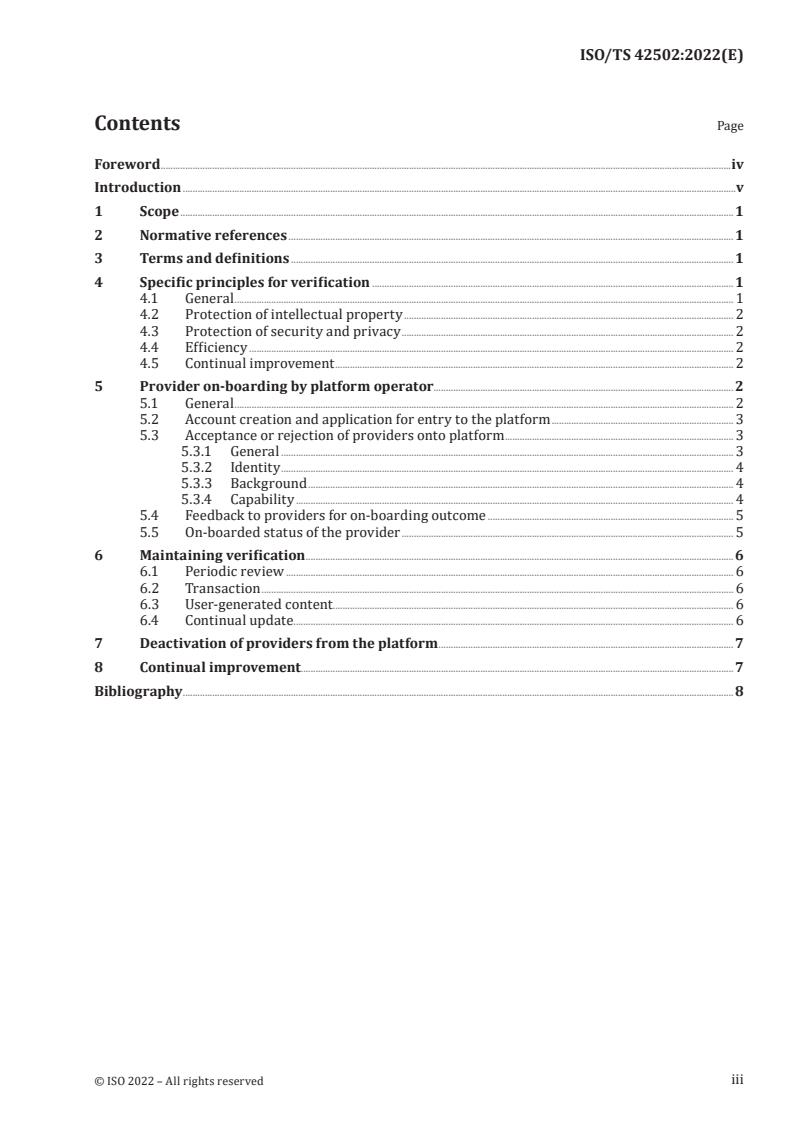
Contents Page
Foreword .iv
Introduction .v
1 Scope . 1
2 Normative references . 1
3 Terms and definitions . 1
4 Specific principles for verification .1
4.1 General . 1
4.2 Protection of intellectual property . 2
4.3 Protection of security and privacy . 2
4.4 Efficiency . 2
4.5 Continual improvement . 2
5 Provider on-boarding by platform operator . 2
5.1 General . 2
5.2 Account creation and application for entry to the platform . 3
5.3 Acceptance or rejection of providers onto platform . 3
5.3.1 General . 3
5.3.2 Identity . 4
5.3.3 Background . 4
5.3.4 Capability . 4
5.4 Feedback to providers for on-boarding outcome . 5
5.5 On-boarded status of the provider . 5
6 Maintaining verification .6
6.1 Periodic review . 6
6.2 Transaction . 6
6.3 User-generated content . 6
6.4 Continual update. 6
7 Deactivation of providers from the platform . 7
8 Continual improvement . .7
Bibliography . 8
iii
Foreword
ISO (the International Organization for Standardization) is a worldwide federation of national standards
bodies (ISO member bodies). The work of preparing International Standards is normally carried out
through ISO technical committees. Each member body interested in a subject for which a technical
committee has been established has the right to be represented on that committee. International
organizations, governmental and non-governmental, in liaison with ISO, also take part in the work.
ISO collaborates closely with the International Electrotechnical Commission (IEC) on all matters of
electrotechnical standardization.
The procedures used to develop this document and those intended for its further maintenance are
described in the ISO/IEC Directives, Part 1. In particular, the different approval criteria needed for the
different types of ISO documents should be noted. This document was drafted in accordance with the
editorial rules of the ISO/IEC Directives, Part 2 (see www.iso.org/directives).
Attention is drawn to the possibility that some of the elements of this document may be the subject of
patent rights. ISO shall not be held responsible for identifying any or all such patent rights. Details of
any patent rights identified during the development of the document will be in the Introduction and/or
on the ISO list of patent declarations received (see www.iso.org/patents).
Any trade name used in this document is information given for the convenience of users and does not
constitute an endorsement.
For an explanation of the voluntary nature of standards, the meaning of ISO specific terms and
expressions related to conformity assessment, as well as information about ISO's adherence to
the World Trade Organization (WTO) principles in the Technical Barriers to Trade (TBT), see
www.iso.org/iso/foreword.html.
This document was prepared by Technical Committee ISO/TC 324, Sharing economy.
Any feedback or questions on this document should be directed to the user’s national standards body. A
complete listing of these bodies can be found at www.iso.org/members.html.
iv
Introduction
The sharing economy represents a new way of engaging in interactions about products and assets
creating a new economic model. Although there are thousands of sharing economy digital platforms
operating in almost every industry, and the global sharing economy industry generates hundreds of
millions of transactions every day, many people still feel unsafe using online sharing services.
The last decade has witnessed a significant number of incidents in which many sharing platform
operators failed to keep their promises of meticulous and authentic identity verification of platform
providers and users, causing a negative social impact. The urgent problem facing the development of
sharing economy is whether users can trust providers to provide safe and effective products and assets.
It’s crucial to clarify the responsibilities of providers and platform operators and strengthen the
platform operators' verification of identity and credentials of providers, which will better maintain
the stable, healthy, and sustainable development of the sharing economy. This requires higher and
consistent verifying standards in the filtering and screening of the identity of the provider, and the
quality of products or assets.
This document aims to:
— fill in the lack of market access systems related to the sharing economy, improve the qualifications
for entry into the sharing economy digital platform, and promote the healthy and sustainable
development of the sharing economy;
— effectively define the main responsibilities of platform operators, ensure that platform operators
build a reasonable verification mechanism to assess the specific qualifications of providers;
— clarify the access conditions for providers of the sharing economy platform, promote the transparency
of providers' information, the safe and reliable platform operation, and provide guidance for the
platform operator to formulate internal platform entry standards;
— protect the interests of consumers, and promote the establishment of a mutual trust mechanism
between providers, platform operators, and users.
v
TECHNICAL SPECIFICATION ISO/TS 42502:2022(E)
Sharing economy — Guidance for provider verification on
digital platforms
1 Scope
This document provides guidelines for sharing economy platform operators when verifying providers,
including on-boarding, maintenance, and deactivation.
This document applies to both digital platform operators and providers within the sharing economy.
2 Normative references
The following documents are referred to in the text in such a way that some or all of their content
constitutes requirements of this document. For dated references, only the edition cited applies. For
undated references, the latest edition of the referenced document (including any amendments) applies.
ISO 42500, Sharing economy — General principles
ISO/TS 42501, Sharing economy — General trustworthiness and safety requirements for digital platforms
3 Terms and definitions
For the purposes of this document, the terms and definitions given in ISO 42500 and the following apply.
ISO and IEC maintain terminology databases for use in standardization at the following addresses:
— ISO Online browsing platform: available at https:// www .iso .org/ obp
— IEC Electropedia: available at https:// www .electropedia .org/
3.1
identity
information or documents validating who an individual or organization claims to be
3.2
background
information originally collected or held by public authorities that is notably related to records of
criminal convictions or arrests
3.3
qualifications
ability to provide products or assets reliably and consistently with specific principles
Note 1 to entry: The principles are given in Clause 4.
4 Specific principles for verification
4.1 General
In additional to the general principles in ISO 42500 and the general requirements in ISO/TS 42501, the
following additional specific principles should be followed by the platform operator when verifying the
provider’s information and how provider activities on the platform are conducted.
a) protection of intellectual property;
b) protection of security and privacy;
c) efficiency;
d) continual improvement.
4.2 Protection of intellectual property
In addition to the requirements set out in ISO/TS 42501:2022, 6.3.3, the platform operator should be
aware of intellectual property protection laws, closely cooperate with intellectual property owners and
protect intellectual property rights. The platform operator should specify in their terms of use that
infringement of intellectual property rights by the provider (or the user) is prohibited.
4.3 Protection of security and privacy
In addition to the requirements set out in ISO/TS 42501:2022, 6.6.1, 6.6.2 and 6.6.15, the platform
operator should establish mechanisms to maintain the security and privacy of information security
in all phases of its operation, including during the verification process and process only the required
personal data and information. The platform operator should treat personal information with
confidentiality confidentially, and observe the privacy of providers and users, especially with regard to
the collection, use, storage and disclosure of personal information.
4.4 Efficiency
In addition to the requirements set out in ISO/TS 42501:2022, 6.5.6, the platform operator should
develop viable technical verification mechanisms that balance the desired user experience in a timely
manner with the proper verification process to prevent entry to the platform by suspicious or confirmed
fraudulent actors.
4.5 Continual improvement
The platform operator’s processes should include means for continuous improvement in meeting the
needs and interests of the provider and user based on the following factors.
a) feedback from interested parties;
b) evolving laws and standards.
5 Provider on-boarding by platform operator
5.1 General
The general process of provider on-boarding by the platform operator involves the following steps.
a) the provider applies to enter the platform;
b) the provider agrees to the terms of use and data and privacy statements;
c) the platform operator confirm that the provider applicant has met the eligibility criteria. The
platform operator may enlist outsourcing vendors to access public records databases as part of this
process;
d) in addition to the requirements set out in ISO/TS 42501:2022, 6.4.1, the platform operator informs
the provider applicant of approval or declination on to the platform;
e) on the basis of the foregoing conclusion, the provider is then either approved onto the platform, e.g.
are on- boarded by the platform operator, or declined from the platform operator.
Consistent with the principle of accountability, the platform operator should consult objective resources
(including insurance claims) and establish procedures for assessing the risk arising from the products
and assets made available on the platform, as well as from their relative diversification or concentration.
In addition to the requirements set out in ISO/TS 42501:2022, 6.2.3, the platform operator should
consider these risks in the establishment of its acceptance or on-boarding criteria. Where the associated
risks to public health and safety require higher levels of skills or heightened assurances of identity
and background, the platform operator may impose additional or more stringent acceptance criteria.
However, the platform operator should also consider the availability of reliable information to provide
these assurances. In addition to the requirements set out in ISO/TS 42501:2022, 6.2.3, in all instances,
the platform operator should request documentation, which, if authentic would suffice to prove the
identity of the applying provider.
In addition to the requirements set out in ISO/TS 42501:2022, 6.2.3 and 6.4.5, the platform operator
should verify the identity, background and capability of providers to a degree commensurate with
the level of risk associated with their operations, such as: where the opera
...