

ISO/TR 42507:2025
(Main)Sharing economy — Use cases of sharing economy platforms in the public sector
General Information
- Abstract
This document provides use cases of sharing economy platforms in the public sector, aiming to support municipalities and administrations to apply suitable models of sharing economy platforms for increasing public values and the efficiency of public services.
- Status
- Published
- Publication Date
- 23-Jan-2025
- Technical Committee
- ISO/TC 324 - Sharing economy
- Drafting Committee
- ISO/TC 324 - Sharing economy
- Current Stage
- 6060 - International Standard published
- Start Date
- 24-Jan-2025
- Due Date
- 01-Jun-2025
- Completion Date
- 24-Jan-2025

Overview
ISO/TR 42507:2025 (Technical Report) presents practical use cases of sharing economy platforms in the public sector. Published by ISO in 2025, the document is designed to help municipalities and public administrations adopt suitable sharing-economy models to increase public value and improve the efficiency of public services. It organizes case studies, objectives, models and implementation considerations to make the sharing economy actionable for government contexts.
Key topics
- Scope and objectives: clarifies how sharing platforms can address social challenges (e.g., resource scarcity, ageing populations, disaster response) and support sustainable public systems.
- Use case models: describes model types used by public bodies, including Owner model, Partner model, Aggregator model, and Intergovernment model.
- Structured use cases: detailed cases (A–I) such as shared gardening/urban farming, food drives, room sharing after hospitalization, working opportunities, local tourism, family support, car sharing, healthcare digital service and data platforms, and shared mobility places.
- Implementation elements: each case includes overview, challenges, initiatives, results and remaining issues - useful for planning, risk assessment and stakeholder engagement.
- Terms and normative references: includes definitions and references to support consistent understanding.
Practical applications
ISO/TR 42507 is primarily a guidance resource (not a normative standard) and is useful for:
- Municipalities and local governments assessing which sharing-economy model fits local policy goals.
- Public administrators and service designers seeking concrete examples to implement community resource-sharing programs.
- Policy makers evaluating social, economic and operational impacts of platform-based public services.
- Urban planners and social service agencies exploring collaborative solutions for food security, mobility, housing and care.
- Platform operators and NGOs partnering with government to scale civic sharing projects.
Use cases support decision-making on platform governance, stakeholder roles, service outcomes and unresolved issues that require local adaptation.
Related standards (if applicable)
ISO/TR 42507 is a Technical Report prepared by ISO/TC 324 (Sharing economy). Users should consult national guidance and related ISO documents on digital platforms, data governance and public procurement when designing or procuring sharing-economy solutions for the public sector.
Keywords: ISO/TR 42507, sharing economy, public sector, sharing economy platforms, municipalities, local government, public services, use cases.
Get Certified
Connect with accredited certification bodies for this standard

BSI Group
BSI (British Standards Institution) is the business standards company that helps organizations make excellence a habit.

Great Wall Tianjin Quality Assurance Center
Established 1993, first batch to receive national accreditation with IAF recognition.
Hong Kong Quality Assurance Agency (HKQAA)
Hong Kong's leading certification body.
Sponsored listings
Frequently Asked Questions
ISO/TR 42507:2025 is a technical report published by the International Organization for Standardization (ISO). Its full title is "Sharing economy — Use cases of sharing economy platforms in the public sector". This standard covers: This document provides use cases of sharing economy platforms in the public sector, aiming to support municipalities and administrations to apply suitable models of sharing economy platforms for increasing public values and the efficiency of public services.
This document provides use cases of sharing economy platforms in the public sector, aiming to support municipalities and administrations to apply suitable models of sharing economy platforms for increasing public values and the efficiency of public services.
ISO/TR 42507:2025 is classified under the following ICS (International Classification for Standards) categories: 03.080.01 - Services in general; 35.240.63 - IT applications in trade. The ICS classification helps identify the subject area and facilitates finding related standards.
ISO/TR 42507:2025 is available in PDF format for immediate download after purchase. The document can be added to your cart and obtained through the secure checkout process. Digital delivery ensures instant access to the complete standard document.
Standards Content (Sample)
Technical
Report
ISO/TR 42507
First edition
Sharing economy — Use cases of
2025-01
sharing economy platforms in the
public sector
Économie du partage — Cas d'utilisation de plateformes de
l'économie du partage dans le secteur public
Reference number
© ISO 2025
All rights reserved. Unless otherwise specified, or required in the context of its implementation, no part of this publication may
be reproduced or utilized otherwise in any form or by any means, electronic or mechanical, including photocopying, or posting on
the internet or an intranet, without prior written permission. Permission can be requested from either ISO at the address below
or ISO’s member body in the country of the requester.
ISO copyright office
CP 401 • Ch. de Blandonnet 8
CH-1214 Vernier, Geneva
Phone: +41 22 749 01 11
Email: copyright@iso.org
Website: www.iso.org
Published in Switzerland
ii
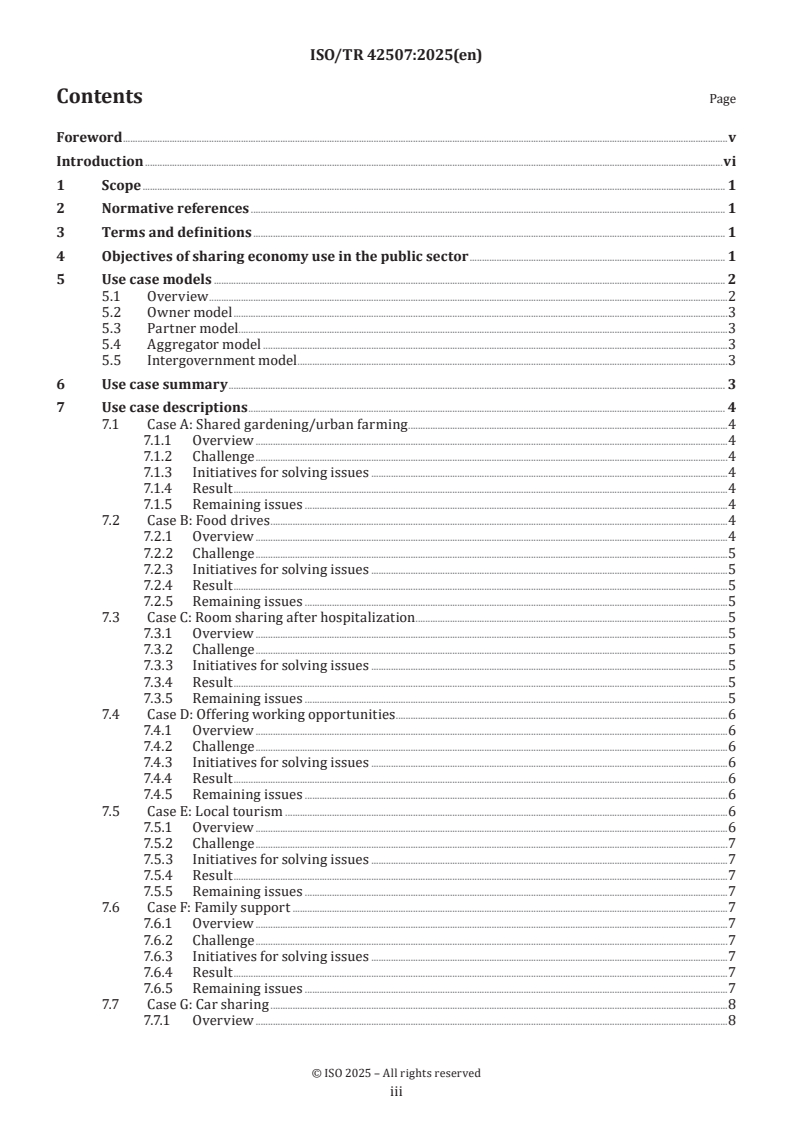
Contents Page
Foreword .v
Introduction .vi
1 Scope . 1
2 Normative references . 1
3 Terms and definitions . 1
4 Objectives of sharing economy use in the public sector . 1
5 Use case models . 2
5.1 Overview .2
5.2 Owner model .3
5.3 Partner model . .3
5.4 Aggregator model .3
5.5 Intergovernment model .3
6 Use case summary . 3
7 Use case descriptions . 4
7.1 Case A: Shared gardening/urban farming .4
7.1.1 Overview .4
7.1.2 Challenge .4
7.1.3 Initiatives for solving issues .4
7.1.4 Result .4
7.1.5 Remaining issues .4
7.2 Case B: Food drives .4
7.2.1 Overview .4
7.2.2 Challenge .5
7.2.3 Initiatives for solving issues .5
7.2.4 Result .5
7.2.5 Remaining issues .5
7.3 Case C: Room sharing after hospitalization .5
7.3.1 Overview .5
7.3.2 Challenge .5
7.3.3 Initiatives for solving issues .5
7.3.4 Result .5
7.3.5 Remaining issues .5
7.4 Case D: Offering working opportunities .6
7.4.1 Overview .6
7.4.2 Challenge .6
7.4.3 Initiatives for solving issues .6
7.4.4 Result .6
7.4.5 Remaining issues .6
7.5 Case E: Local tourism .6
7.5.1 Overview .6
7.5.2 Challenge .7
7.5.3 Initiatives for solving issues .7
7.5.4 Result .7
7.5.5 Remaining issues .7
7.6 Case F: Family support .7
7.6.1 Overview .7
7.6.2 Challenge .7
7.6.3 Initiatives for solving issues .7
7.6.4 Result .7
7.6.5 Remaining issues .7
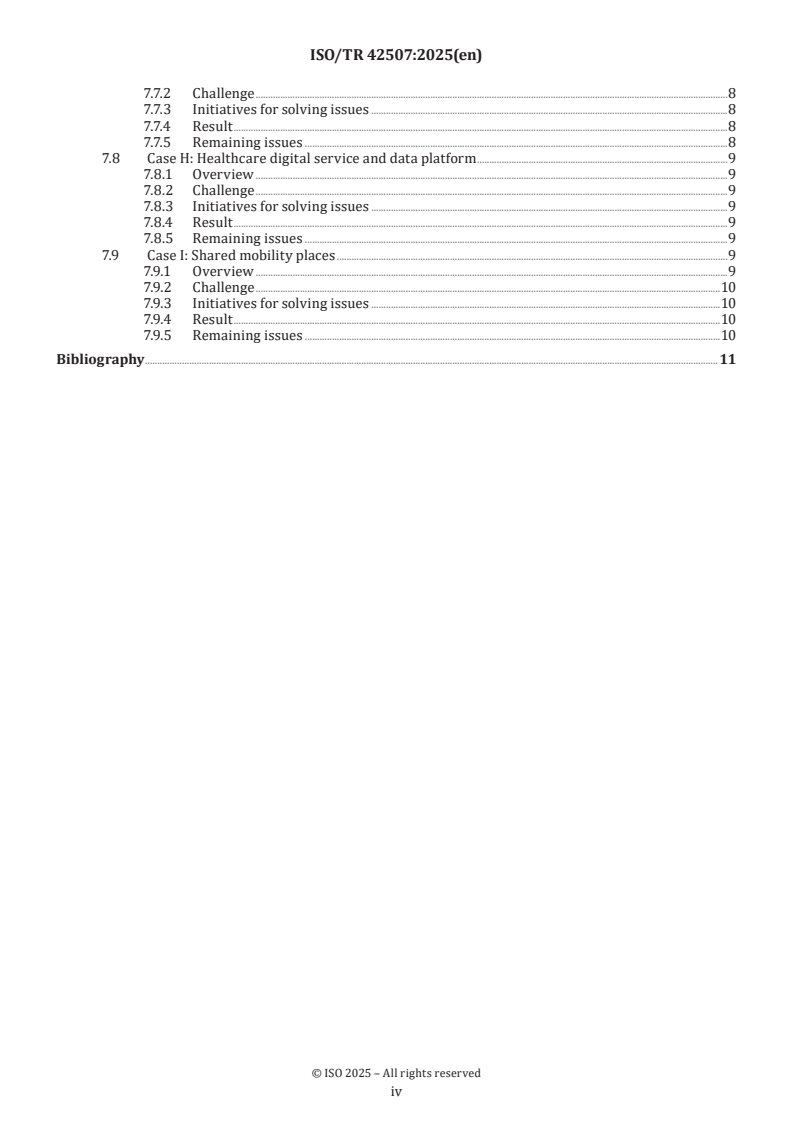
7.7 Case G: Car sharing .8
7.7.1 Overview .8
iii
7.7.2 Challenge .8
7.7.3 Initiatives for solving issues .8
7.7.4 Result .8
7.7.5 Remaining issues .8
7.8 Case H: Healthcare digital service and data platform .9
7.8.1 Overview .9
7.8.2 Challenge .9
7.8.3 Initiatives for solving issues .9
7.8.4 Result .9
7.8.5 Remaining issues .9
7.9 Case I: Shared mobility places .9
7.9.1 Overview .9
7.9.2 Challenge .10
7.9.3 Initiatives for solving issues .10
7.9.4 Result .10
7.9.5 Remaining issues .10
Bibliography .11
iv
Foreword
ISO (the International Organization for Standardization) is a worldwide federation of national standards
bodies (ISO member bodies). The work of preparing International Standards is normally carried out through
ISO technical committees. Each member body interested in a subject for which a technical committee
has been established has the right to be represented on that committee. International organizations,
governmental and non-governmental, in liaison with ISO, also take part in the work. ISO collaborates closely
with the International Electrotechnical Commission (IEC) on all matters of electrotechnical standardization.
The procedures used to develop this document and those intended for its further maintenance are described
in the ISO/IEC Directives, Part 1. In particular, the different approval criteria needed for the different types
of ISO document should be noted. This document was drafted in accordance with the editorial rules of the
ISO/IEC Directives, Part 2 (see www.iso.org/directives).
ISO draws attention to the possibility that the implementation of this document may involve the use of (a)
patent(s). ISO takes no position concerning the evidence, validity or applicability of any claimed patent
rights in respect thereof. As of the date of publication of this document, ISO had not received notice of (a)
patent(s) which may be required to implement this document. However, implementers are cautioned that
this may not represent the latest information, which may be obtained from the patent database available at
www.iso.org/patents. ISO shall not be held responsible for identifying any or all such patent rights.
Any trade name used in this document is information given for the convenience of users and does not
constitute an endorsement.
For an explanation of the voluntary nature of standards, the meaning of ISO specific terms and expressions
related to conformity assessment, as well as information about ISO’s adherence to the World Trade
Organization (WTO) principles in the Technical Barriers to Trade (TBT), see www.iso.org/iso/foreword.html.
This document was prepared by Technical Committee ISO/TC 324, Sharing economy.
Any feedback or questions on this document should be directed to the user’s national standards body. A
complete listing of these bodies can be found at www.iso.org/members.html.
v
Introduction
Social challenges such as energy shortages, falling birth-rates, ageing populations, poverty issues, food
shortages and catastrophic disasters are having a serious impact on people’s lives. The public sector has
traditionally played a major role in addressing these challenges. Specifically, it is required to address these
challenges by promoting the establishment of sustainable social systems through public services and by
effectively allocating resources among stakeholders. However, it is becoming increasingly difficult for
the public sector to address these challenges alone, given the complexity and diversity of the issues to be
addressed.
Therefore, methods to utilize unused resources within the framework of the sharing economy to solve these
issues are attracting attention. In cities, for example, the sharing economy is used to make more efficient use
of underutilized goods (e.g. food) and energy, or to provide individual social support to diverse populations.
In rural areas, on the other hand, sharing economy initiatives are aimed at facilitating mutual aid and
inducing external resources in the face of a lack of public budgets and private resources. Furthermore, in the
COVID-19 pandemic, the sharing economy was highly effective as a safety net at the private level.
The sharing economy is showing its effectiveness in the public sector domain and interest is growing.
However, knowledge on how municipalities and public administrations can best utilize the sharing economy
is not well organized.
This document provides examples of the use of the sharing economy for public purposes. By linking each
case study to a model for the use of the sharing economy by local governments and administrations, the
document shows, in an easy-to-understand way, how it can be used to achieve the desired effects.
vi
Technical Report ISO/TR 42507:2025(en)
Sharing economy — Use cases of sharing economy platforms
in the public sector
1 Scope
This document provides use cases of sharing economy platforms in the public sector, aiming to support
municipalities and administrations to apply suitable models of sharing economy platforms for increasing
public values and the efficiency of public services.
2 Normative references
The following documents are referred to in the text in such a way that some or all of their content constitutes
requirements of this document. For dated references, only the edition cited applies. For undated references,
the latest edition of the referenced document (including any amendments) applies.
ISO 42500, Sharing economy — General principles
3 Terms and definitions
For the purposes of this document, the terms and definitions given in ISO 42500 apply.
ISO and IEC maintain terminology databases for use in standardization at the following addresses:
— ISO Online browsing platform: available at https:// www .iso .org/ obp
— IEC Electropedia: available at https:// www .electropedia .org/
4 Objectives of sharing economy use in the public sector
The sharing economy is expected to help tackle the challenges listed in the United Nations Sustainable
[1]
Development Goals (SDGs) more efficiently. Among the SDGs, the following goals are specifically relevant
to sharing economy use in the public sector:
a) No poverty (SDG 1): The sharing economy has a redistribution mechanism of unused resources which
can support those in poverty.
b) Zero hunger (SDG 2): The sharing economy contributes to redistribution of food beyond the framework
of normal market routes, enabling the reduction of food loss and the improvement of food access.
c) Good health and well-being (SDG 3): The sharing economy contributes to improved well-being through
the sharing of medical and health support skills and resources, including by medical and non-medical
practitioners.
d) Quality education (SDG 4): The sharing economy provides learning opportunities outside of public
education (e.g. schools) such as social skills.
e) Affordable and clean energy (SDG 7): The sharing economy supports unused energy redistribution
beyond the existing energy management mechanisms.
f) Decent work and economic growth (SDG 8): The sharing economy provides work opportunities for those
who have difficulty entering the existing labour market.
g) Reduced inequalities (SDG 10): The sharing economy connects people with social support needs
regarding inequality to ensure they receive appropriate support.
h) Sustainable cities and communities (SDG 11): The sharing economy can be a mechanism to maintain
support communities and improve the living environments of regions.
i) Responsible consumption and production (SDG 12): The sharing economy drives the circulation of
products and assets that are underutilized or not in use, which leads to sustainable consumption and
production.
j) Climate action (SDG 13): The sharing economy can reduce the use of natural resources through the
circulation of resources that are underutilized or not in use.
Specific challenges related to these goals vary depending on the societal, economic and cultural contexts.
Hence, the identification of objectives for using a sharing economy platform in the public sector is important.
5 Use case models
5.1 Overview
Figure 1 shows four use case models of sharing economy platforms in the public sector:
— owner model (see 5.2);
— partner model (see 5.3);
— aggregator model (see 5.4);
— intergovernment model (see 5.5).
The adoption of a model can change in response to the needs o
...