

ISO 3572:1976
(Main)Textiles — Weaves — Definitions of general terms and basic weaves
General Information
- Abstract
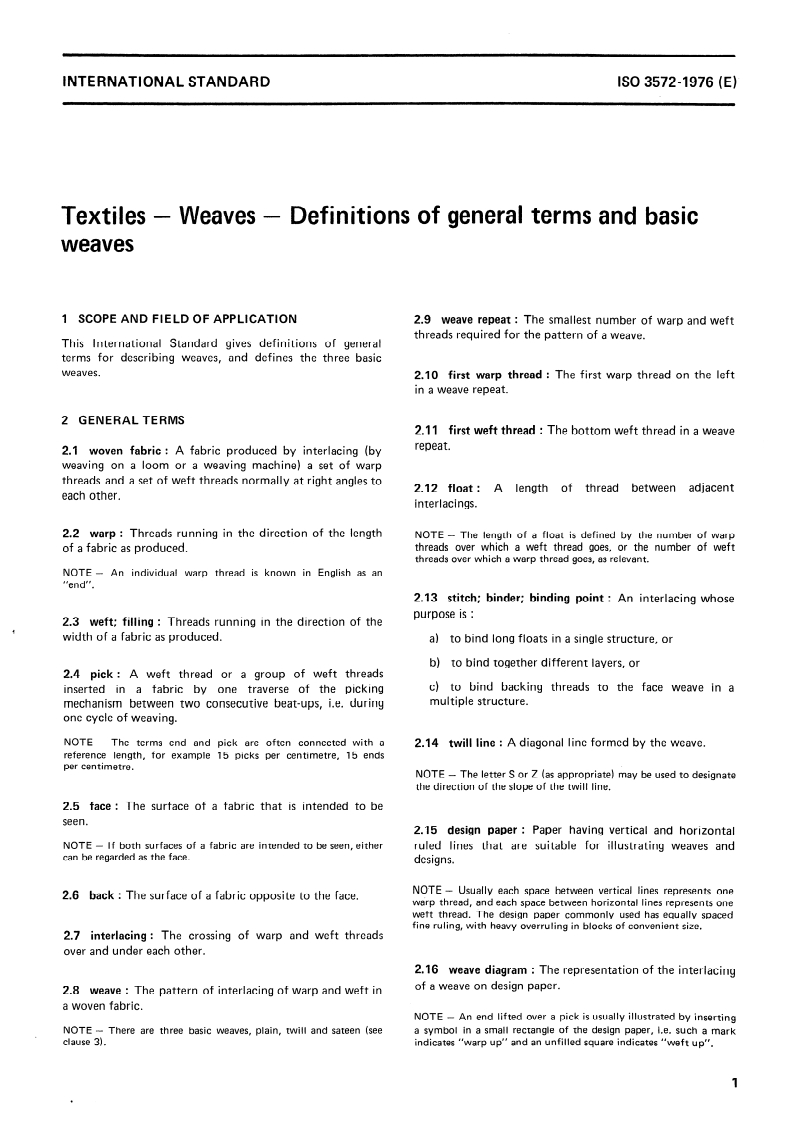
Definitions of general terms for describing weaves (for example, warp, weft (filling), pick, face, back, interlacing, weave, float, design paper, etc.) are given and the three basic weaves are described.
- Status
- Published
- Publication Date
- 31-Jan-1976
- Technical Committee
- ISO/TC 38/SC 20 - Fabric descriptions
- Drafting Committee
- ISO/TC 38/SC 20 - Fabric descriptions
- Current Stage
- 9020 - International Standard under periodical review
- Start Date
- 15-Jul-2026
- Completion Date
- 15-Jul-2026
Buy Documents

ISO 3572:1976 - Textiles -- Weaves -- Definitions of general terms and basic weaves
ISO 3572:1976 - Textiles — Weaves — Definitions of general terms and basic weaves/1/1976

ISO 3572:1976 - Textiles -- Armures -- Définitions des termes généraux et des armures de base
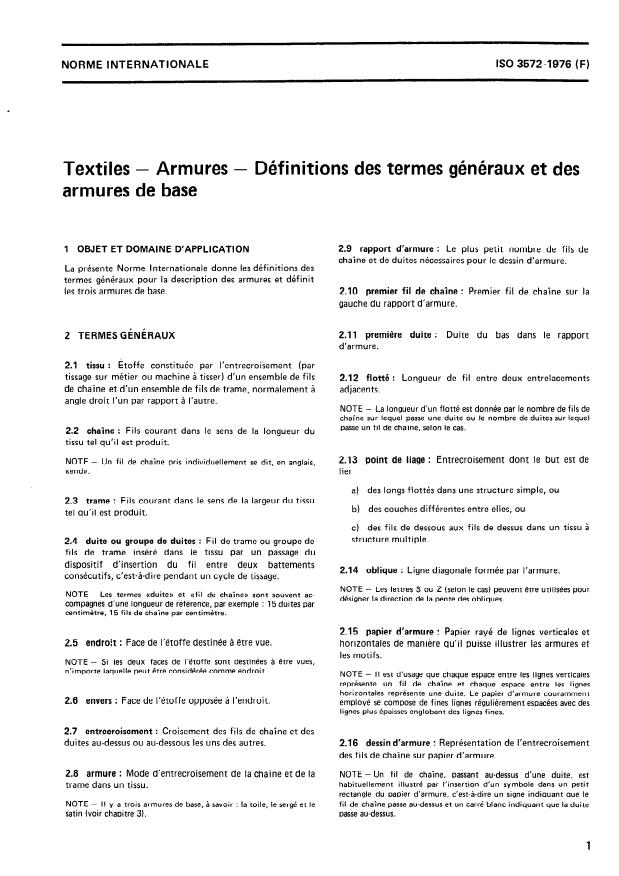

ISO 3572:1976 - Textiles -- Armures -- Définitions des termes généraux et des armures de base
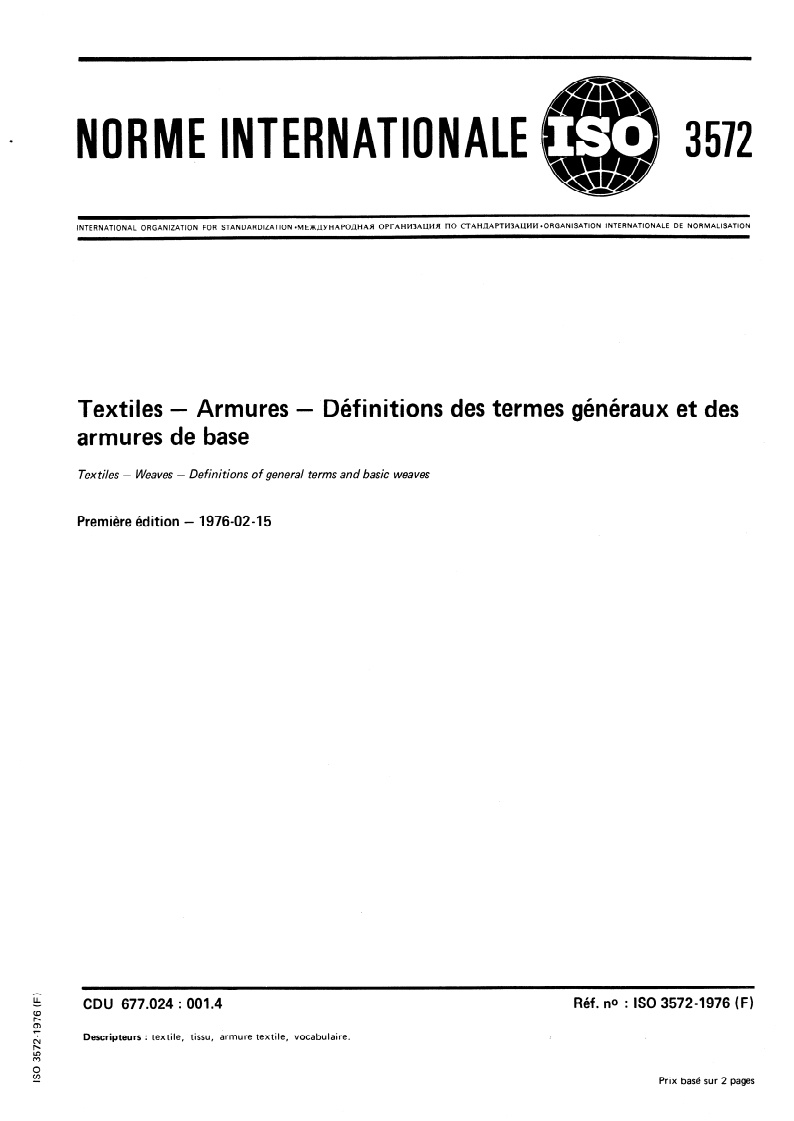
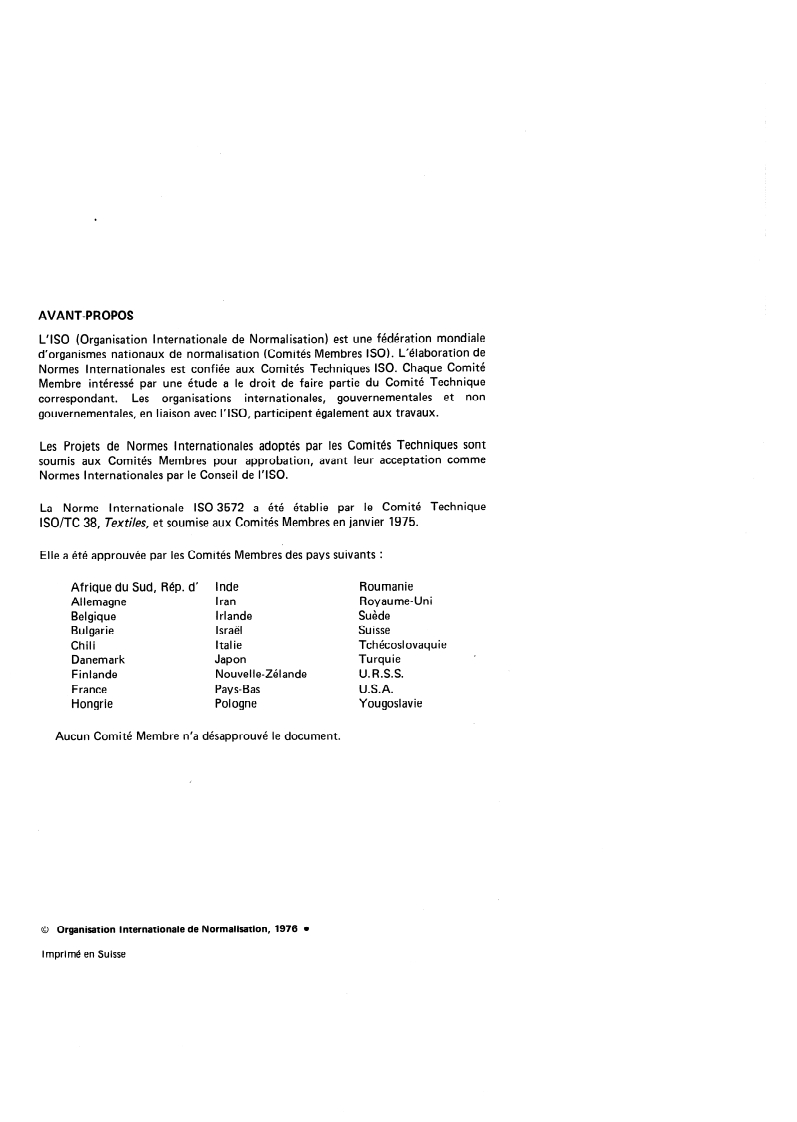
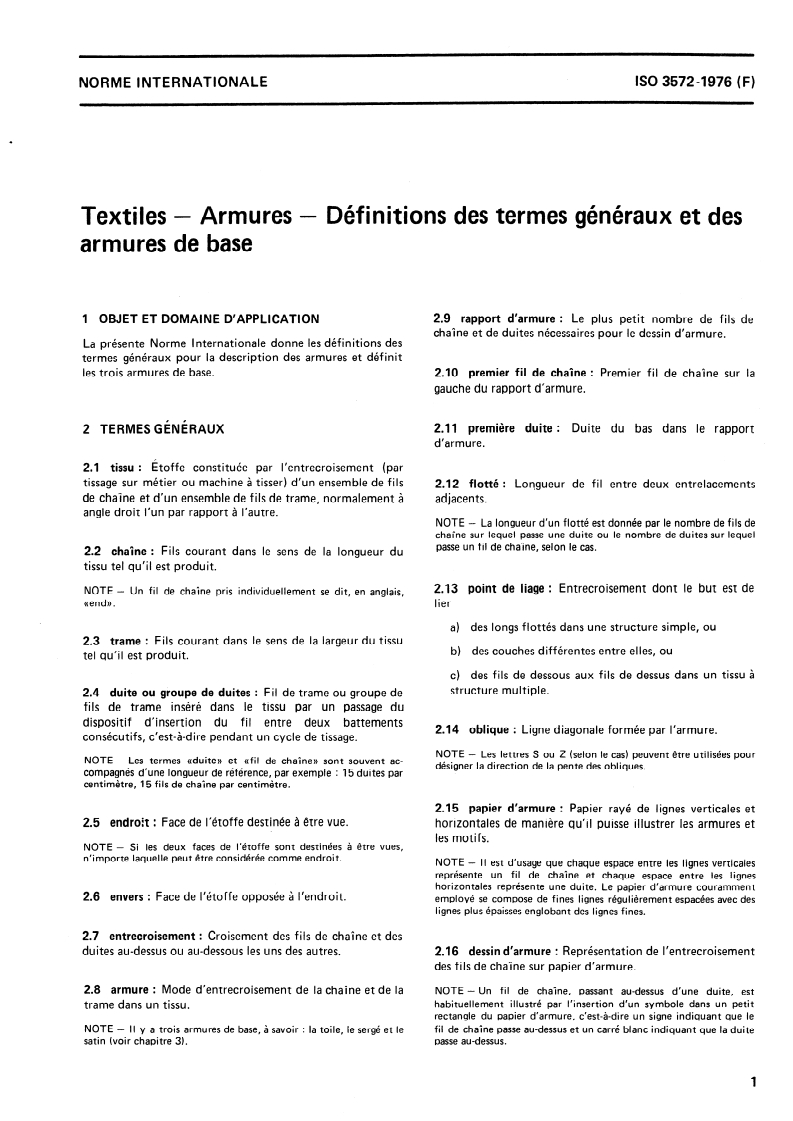
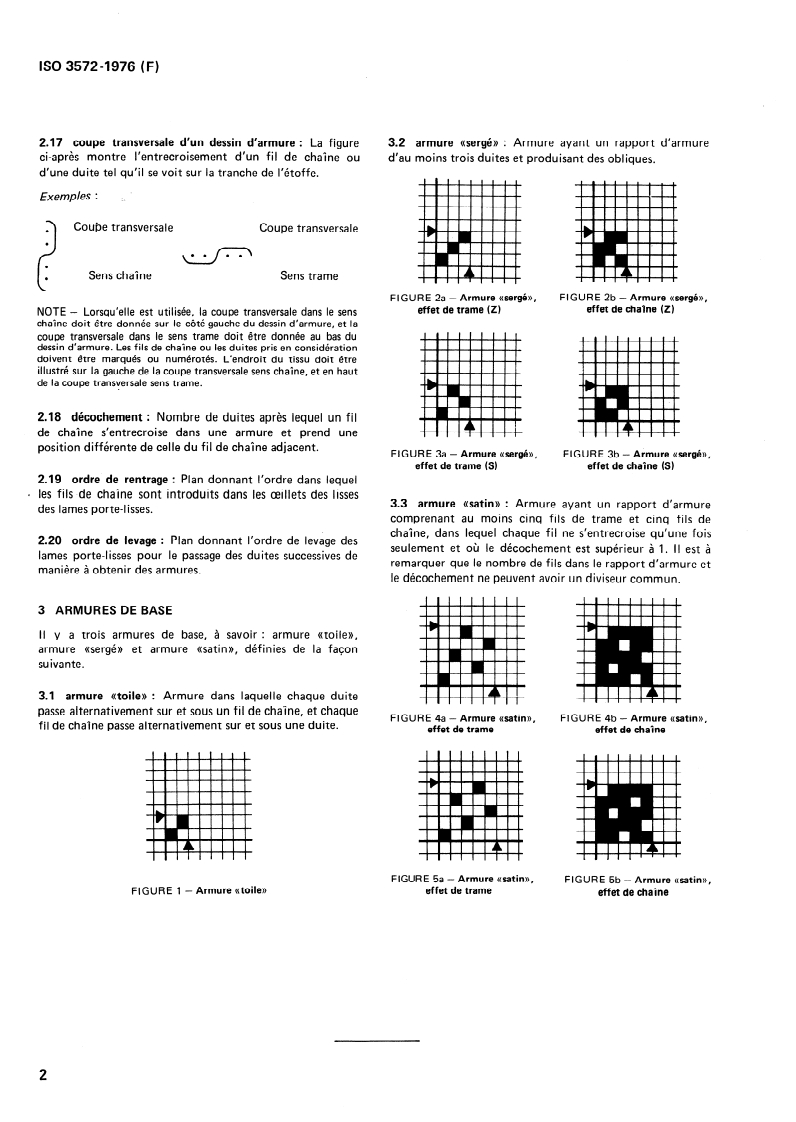
ISO 3572:1976 - Textiles — Armures — Définitions des termes généraux et des armures de base/1/1976
ISO 3572:1976 - Textiles — Armures — Définitions des termes généraux et des armures de base/1/1976
Overview
ISO 3572:1976 is an International Standard developed by the International Organization for Standardization (ISO), focused on textiles and their woven structures. This standard provides precise definitions of general terms and basic weaves used in the textile industry. It facilitates clear communication and understanding in textile manufacturing, quality control, research, and education by standardizing terminology related to weave patterns.
The scope of ISO 3572:1976 covers fundamental concepts such as warp, weft, interlacing, float, and key fabric surfaces (face and back). Importantly, the standard describes the three basic weave structures-plain weave, twill weave, and sateen weave-which form the foundation for all woven fabrics.
Key Topics
- Woven Fabric: A fabric made by interlacing warp (lengthwise) and weft (crosswise) threads at right angles.
- Warp and Weft: Warp threads run lengthwise; weft threads run widthwise.
- Pick: A weft thread inserted across warp threads during one cycle of weaving.
- Interlacing: Points where warp and weft threads cross over and under each other.
- Face and Back: The visible surface intended for display is the face, while the opposite is the back.
- Float: Sections where a thread crosses over multiple threads without interlacing, affecting texture and sheen.
- Design Paper and Weave Diagrams: Tools for visually representing weave patterns in vertical and horizontal threads.
- Weave Repeat: The smallest pattern unit of warp and weft threads that repeats to form the fabric design.
- Basic Weaves:
- Plain Weave: Each weft crosses alternately over and under each warp thread, creating a simple crisscross pattern.
- Twill Weave: Characterized by diagonal lines (twill lines), with a weave repeat including at least three weft threads; promotes durability and drape.
- Sateen Weave: Has a longer float with a weave repeat involving five or more threads, producing a smoother, lustrous surface ideal for satin fabrics.
Applications
ISO 3572:1976 serves multiple practical purposes across the textile industry and allied fields:
- Textile Manufacturing: Standardizes terminology to ensure consistent production of woven fabrics, helping manufacturers communicate fabric specifications clearly.
- Quality Control and Inspection: Allows for accurate description and classification of fabric weaves for quality assessment and certification.
- Design and Development: Provides designers and engineers with foundational knowledge to create new fabric structures and innovate within established weave categories.
- Technical Training and Education: Acts as a reference for educating students and professionals about basic textile construction and terminology.
- Research and Documentation: Offers a globally accepted framework for reporting on textile experiments, fabric tests, and academic papers relating to woven fabrics.
- Supply Chain Communication: Enables textile suppliers and buyers across different countries to use common definitions, reducing misunderstandings and facilitating trade.
Related Standards
ISO 3572:1976 complements and connects with other relevant textile standards, including but not limited to:
- ISO 9001: Quality management systems relevant for textile production.
- ISO 105 Series: Testing of textiles for colorfastness which depends on fabric types and weave structure.
- ISO 811: Specifies test methods for waterproof textiles often influenced by weave tightness.
- ISO 1833: Deals with identification of fiber composition in fabrics where understanding weave construction aids analysis.
- ISO 7211: Pertains to fabrics of plain weave – specifications and test methods that complement weave definitions.
Keywords: ISO 3572, textile weaves, woven fabrics, plain weave, twill weave, sateen weave, fabric weave definitions, warp, weft, textile terminology, textile standards, fabric construction, weave diagrams.
Relations
- Effective Date
- 25-Aug-2026
Buy Documents
ISO 3572:1976 - Textiles -- Weaves -- Definitions of general terms and basic weaves
ISO 3572:1976 - Textiles — Weaves — Definitions of general terms and basic weaves/1/1976
ISO 3572:1976 - Textiles -- Armures -- Définitions des termes généraux et des armures de base
ISO 3572:1976 - Textiles -- Armures -- Définitions des termes généraux et des armures de base
ISO 3572:1976 - Textiles — Armures — Définitions des termes généraux et des armures de base/1/1976
ISO 3572:1976 - Textiles — Armures — Définitions des termes généraux et des armures de base/1/1976
Get Certified
Connect with accredited certification bodies for this standard

Control Union Certifications
Global certification for agriculture and sustainability.

Hohenstein Institut
Textile testing and certification.

Bureau Veritas Bangladesh
Bureau Veritas certification services in Bangladesh.
Sponsored listings
Frequently Asked Questions
ISO 3572:1976 is a standard published by the International Organization for Standardization (ISO). Its full title is "Textiles — Weaves — Definitions of general terms and basic weaves". This standard covers: Definitions of general terms for describing weaves (for example, warp, weft (filling), pick, face, back, interlacing, weave, float, design paper, etc.) are given and the three basic weaves are described.
Definitions of general terms for describing weaves (for example, warp, weft (filling), pick, face, back, interlacing, weave, float, design paper, etc.) are given and the three basic weaves are described.
ISO 3572:1976 is classified under the following ICS (International Classification for Standards) categories: 01.040.59 - Textile and leather technology (Vocabularies); 59.080.30 - Textile fabrics. The ICS classification helps identify the subject area and facilitates finding related standards.
ISO 3572:1976 has the following relationships with other standards: It is inter standard links to EN 2833-005:2013. Understanding these relationships helps ensure you are using the most current and applicable version of the standard.
ISO 3572:1976 is available in PDF format for immediate download after purchase. The document can be added to your cart and obtained through the secure checkout process. Digital delivery ensures instant access to the complete standard document.
Standards Content (Sample)
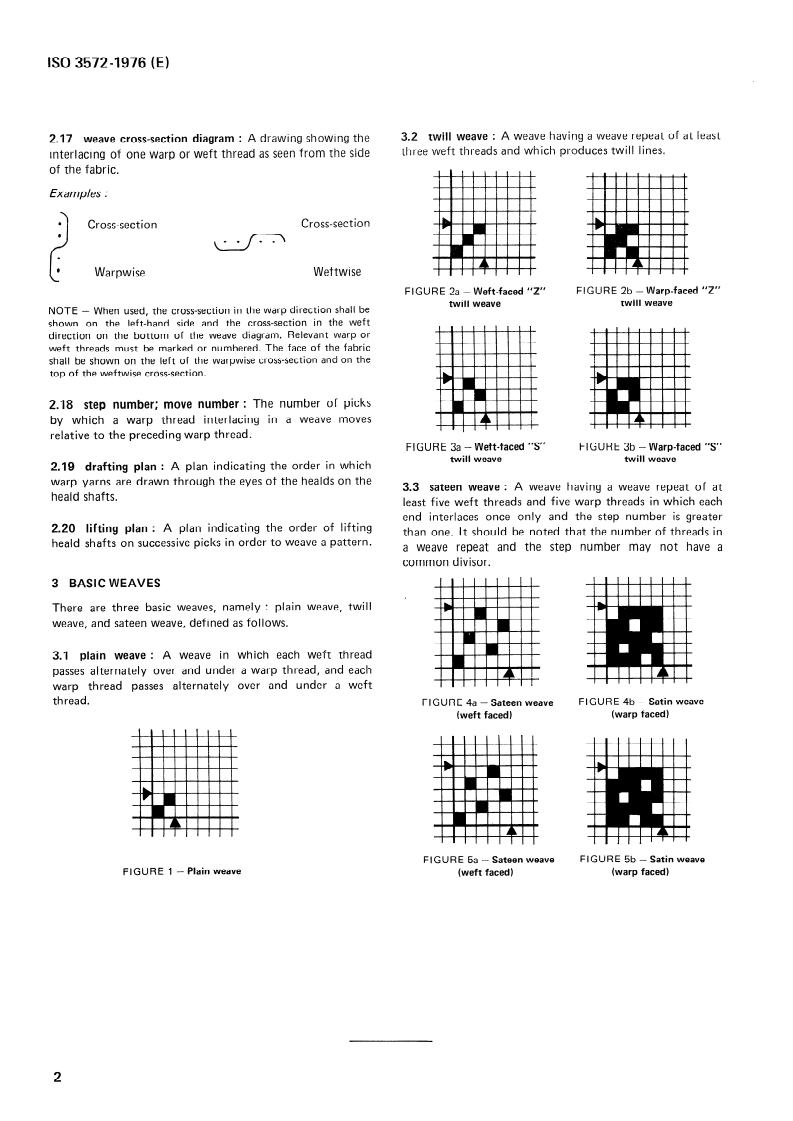
INTERNATION
DAR
INTERNATIONAL ORGANIZATION FOR STANDARDIZATION drvl[ XJL’t-iAtW.‘~lHAJl OPI-AHM3AUMII no CTAHAAPTM3AUMM*ORGANISATION INTERNATIONALE DE NORMALISATION
Textiles - Weaves - Definitions of general terms and basic
weaves
Textiles - Armures - Dkfinitions des termes gh&aux et des armures de base
First edition - 1976-02-15
UDC 677.024 : 001.4
Ref. No. ISO 3572-1976 (E)
Descriptors : textiles, woven fabrics, weave, vocabulary.
Price based on 2 pages
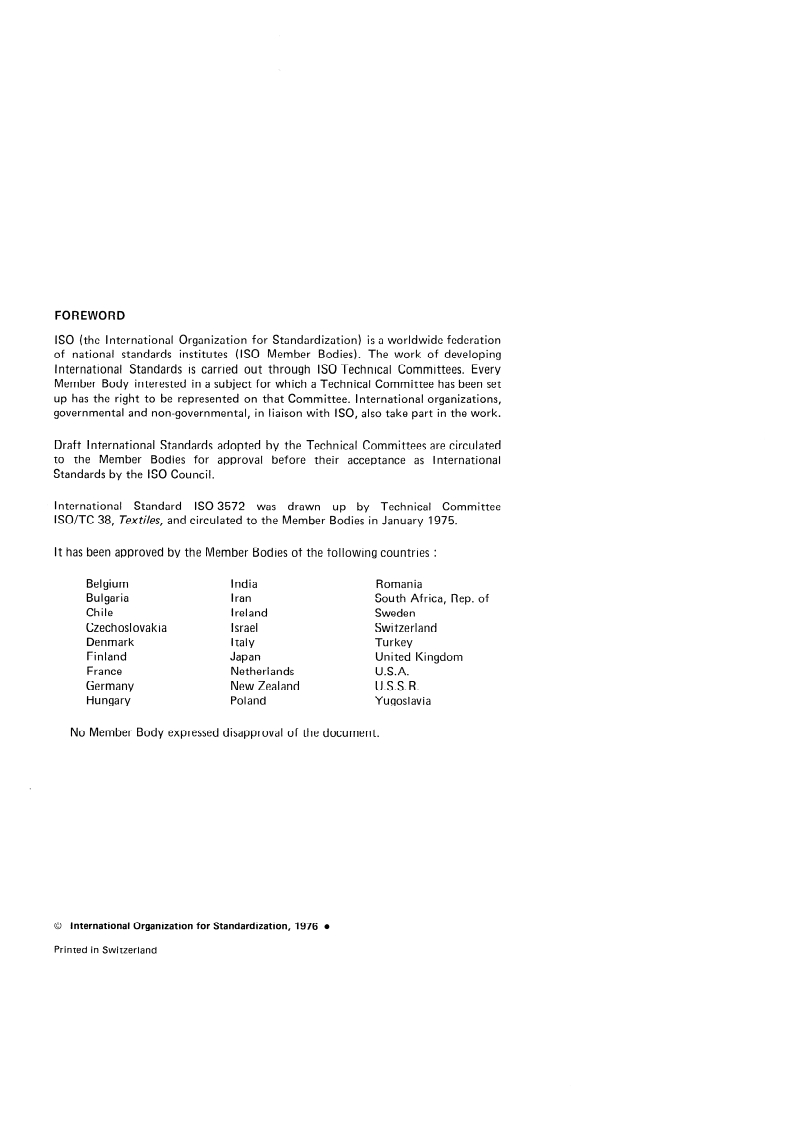
FOREWORD
ISO (the International Organization for Standardization) is a worldwide federation
of national Standards institutes (ISO Member Bodies). The work of developing
International Standards is carried out through ISO Technical Committees. Every
Member Body interested in a subject for which a Technical Committee has been set
up has the right to be represented on that Committee. International organizations,
governmental and non-governmental, in liaison with ISO, also take part in the work.
Draft International Standards adopted by the Technical Committees are circulated
to the Member Bodies for approval before their acceptance as International
Standards by the ISO Council.
International Standard ISO 3572 was drawn up by Technical Committee
ISO/TC 38, Textiles, and circulated to the Member Bodies in January 1975.
lt has been approved by the Member Bodies of the following countries :
Belgium India Romania
Bulgaria Iran South Africa, Rep. of
Chile Ireland Sweden
Czechoslovakia Israel Switzerland
Denmark I taly Turkey
Finland Japan United Kingdom
France Netheriands U.S.A.
Germany New Zealand U.S.S. R.
Hungary Poland Yugoslavia
No Member Body expressed disapproval of the document.
0 International Organkation for Standardkation, 1976 l
Printed in Switzerland
INTERNATIONAL STANDARD ISO 35724976 (E)
Textiles - Weaves - Definitions of general terms and basic
weaves
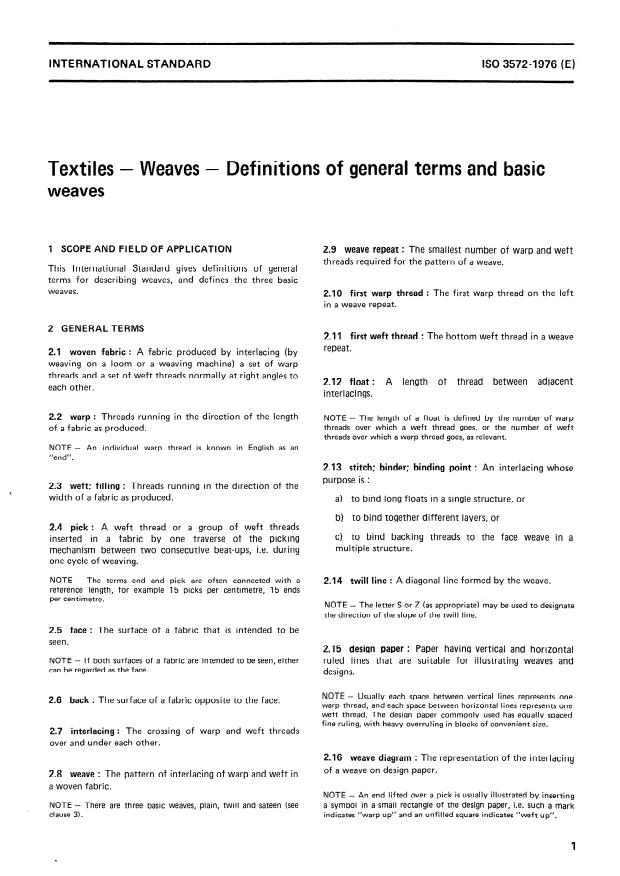
1 SCOPE AND FIELD OF APPLICATION 2.9 weave repeat : The smallest number of warp and weft
threads required for the Pattern of a weave.
This International Standard gives definitions of general
terms for describing weaves, and defines the three basic
weaves.
2.10 first warp thread : The first warp thread on the left
in a weave repeat.
2 GENERAL TERMS
2.11 first weft thread : The bottom weft thread in a weave
repeat.
2.1 woven fabric : A fabric produced by interlacing (by
weaving on a loom or a weaving machine) a set of Warp
threads and a set of weft threads normally at right angles to
A length of thread between adjacent
2.12 float :
each other.
interlacings.
2.2 warp : Threads running in the direction of the length
NOTE - The length of a float is defined by the number of warp
threads over which a weft thread goes, or the number of weft
of a fabric as produced.
threads over which a warp thread goes, as relevant.
NOTE - An individual warp thread is known in English as an
“end”.
2.13 stitch; binder; binding Point : An interlacing whose
purpose is :
2.3 Weft; filling : Threads running in the direction of the
width of a fabric as produced.
a) to bind long floats in a Single structure, or
b) to bind together different I ayers, or
2.4 pick : A weft thread or a group of weft threads
c) to bind backing threads to the face weave in a
inserted in a fabric by one traverse of the picking
multiple structure.
mechanism between two consecutive beat-ups, i.e. during
one cycle of weaving.
NOTE -
The terms end and pick are often connected with
...
INTERNATION
DAR
INTERNATIONAL ORGANIZATION FOR STANDARDIZATION drvl[ XJL’t-iAtW.‘~lHAJl OPI-AHM3AUMII no CTAHAAPTM3AUMM*ORGANISATION INTERNATIONALE DE NORMALISATION
Textiles - Weaves - Definitions of general terms and basic
weaves
Textiles - Armures - Dkfinitions des termes gh&aux et des armures de base
First edition - 1976-02-15
UDC 677.024 : 001.4
Ref. No. ISO 3572-1976 (E)
Descriptors : textiles, woven fabrics, weave, vocabulary.
Price based on 2 pages
FOREWORD
ISO (the International Organization for Standardization) is a worldwide federation
of national Standards institutes (ISO Member Bodies). The work of developing
International Standards is carried out through ISO Technical Committees. Every
Member Body interested in a subject for which a Technical Committee has been set
up has the right to be represented on that Committee. International organizations,
governmental and non-governmental, in liaison with ISO, also take part in the work.
Draft International Standards adopted by the Technical Committees are circulated
to the Member Bodies for approval before their acceptance as International
Standards by the ISO Council.
International Standard ISO 3572 was drawn up by Technical Committee
ISO/TC 38, Textiles, and circulated to the Member Bodies in January 1975.
lt has been approved by the Member Bodies of the following countries :
Belgium India Romania
Bulgaria Iran South Africa, Rep. of
Chile Ireland Sweden
Czechoslovakia Israel Switzerland
Denmark I taly Turkey
Finland Japan United Kingdom
France Netheriands U.S.A.
Germany New Zealand U.S.S. R.
Hungary Poland Yugoslavia
No Member Body expressed disapproval of the document.
0 International Organkation for Standardkation, 1976 l
Printed in Switzerland
INTERNATIONAL STANDARD ISO 35724976 (E)
Textiles - Weaves - Definitions of general terms and basic
weaves
1 SCOPE AND FIELD OF APPLICATION 2.9 weave repeat : The smallest number of warp and weft
threads required for the Pattern of a weave.
This International Standard gives definitions of general
terms for describing weaves, and defines the three basic
weaves.
2.10 first warp thread : The first warp thread on the left
in a weave repeat.
2 GENERAL TERMS
2.11 first weft thread : The bottom weft thread in a weave
repeat.
2.1 woven fabric : A fabric produced by interlacing (by
weaving on a loom or a weaving machine) a set of Warp
threads and a set of weft threads normally at right angles to
A length of thread between adjacent
2.12 float :
each other.
interlacings.
2.2 warp : Threads running in the direction of the length
NOTE - The length of a float is defined by the number of warp
threads over which a weft thread goes, or the number of weft
of a fabric as produced.
threads over which a warp thread goes, as relevant.
NOTE - An individual warp thread is known in English as an
“end”.
2.13 stitch; binder; binding Point : An interlacing whose
purpose is :
2.3 Weft; filling : Threads running in the direction of the
width of a fabric as produced.
a) to bind long floats in a Single structure, or
b) to bind together different I ayers, or
2.4 pick : A weft thread or a group of weft threads
c) to bind backing threads to the face weave in a
inserted in a fabric by one traverse of the picking
multiple structure.
mechanism between two consecutive beat-ups, i.e. during
one cycle of weaving.
NOTE -
The terms end and pick are often connected with
...
NORME INTERNATIONALE.
INTERNATIONAL ORGANIZATION FOR STANDARDIZATION l MEXflYHAPOAHAfi OPTAHM3AUMfi I-l0 CTAHLIAPTM3AUMM*ORGANISATlON INTERNATIONALE DE NORMALISATION
Textiles - Armures - Définitions des termes généraux et des
armures de base
Textiles - Weaves - Definitions of general terms and basic weaves
Première édition - 1976-02-15
Réf. no : ISO 3572-1976 (F)
CDU 677.024 : 001.4
Descripteurs : textile, tissu, armure textile, vocabulaire.
Prix basé sur 2 pages
AVANT-PROPOS
L’ISO (Organisation Internationale de Normalisation) est une fédération mondiale
d’organismes nationaux de normalisation (Comités Membres KO). L’élaboration de
Normes Internationales est confiée aux Comités Techniques ISO. Chaque Comité
Membre intéressé par une étude a le droit de faire partie du Comité Technique
correspondant. Les organisations internationales, gouvernementales et non
gouvernementales, en liaison avec I’ISO, participent également aux travaux.
Les Projets de Normes Internationales adoptés par les Comités Techniques sont
soumis aux Comités Membres pour approbation, avant leur acceptation comme
Normes Internationales par le Conseil de I’ISO,
La Norme Internationale ISO 3572 a été établie par le Comité Technique
lSO/TC 38, Textiles, et soumise aux Comités Membres en janvier 1975.
Elle a été approuvée par les Comités Membres des pays suivants :
Afrique du Sud, Rép. d’ Inde Roumanie
Allemagne Iran Royaume-Uni
Belgique Irlande Suède
Bulgarie Israël Suisse
Chili Italie Tchécoslovaquie
Danemark Japon Turquie
Finlande Nouvelle-Zélande U.R.S.S.
France Pays-Bas U.S.A.
Hongrie Pologne Yougoslavie
Aucun Comité Membre n’a désapprouvé le document.
0 Organisation Internationale de Normalisation, 1976 l
Imprimé en Suisse
ISO 35724976 (F)
NORME INTERNATIONALE
- Définitions des termes généraux et des
Textiles - Armures
armures de base
1 OBJET ET DOMAINE D’APPLICATION 2.9 rapport d’armure : Le plus petit nombre de fils de
chaîne et de duites nécessaires pour le dessin d’armure.
La présente Norme Internationale donne les définitions des
termes généraux pour la description des armures et définit
les trois armures de base. 2.10 premier fil de chaîne : Premier fil de chaîne sur la
gauche du rapport d’armure.
2.11 première duite : Duite du bas dans le rapport
2 TERMES GÉNÉRAUX
d’armure.
2.1 tissu : Étoffe constituée par l’entrecroisement (par
tissage sur métier ou machine à tisser) d’un ensemble de fils
2.12 flotté : Longueur de fil entre deux entrelacements
de chaîne et d’un ensemble de fils de trame, normalement à adjacents.
angle droit l’un par rapport à l’autre.
NOTE - La longueur d’un flotté est donnée par le nombre de fils de
chaîne sur lequel passe une duite ou le nombre de duites sur lequel
passe un fil de chaîne, selon le cas.
2.2 chaîne : Fils courant dans le sens de la longueur du
tissu tel qu’il est produit.
2.13 point de Iiage : Entrecroisement dont le but est de
NOTE - Un fil de chaîne pris individuellement se dit, en anglais,
a e n d )) .
lier
a) des longs flottés dans une structure simple, ou
2.3 trame : Fils courant dans le sens de la largeur du tissu
b) des couches différentes entre elles, ou
tel qu’il est produit.
c) des fils de dessous aux fils de dessus dans un tissu à
structure multiple.
2.4 duite ou groupe de duites : Fil de trame ou groupe de
fils de trame inséré dans le tissu par un passage du
dispositif d’insertion du fil entre deux battements
2.14 oblique : Ligne diagonale formée par l’armure.
consécutifs, c’est-à-dire pendant un cycle de tissage.
NOTE - Les lettres S ou Z (selon le cas) peuvent être utilisées pour
NOTE - Les termes ((duite)) et «fil de chaîne)) sont souvent ac-
désigner la direction de la pente des obliques.
compagnés d’une longueur de référence, par exemple : 15 duites par
centimètre, 15 fils
...
NORME INTERNATIONALE.
INTERNATIONAL ORGANIZATION FOR STANDARDIZATION l MEXflYHAPOAHAfi OPTAHM3AUMfi I-l0 CTAHLIAPTM3AUMM*ORGANISATlON INTERNATIONALE DE NORMALISATION
Textiles - Armures - Définitions des termes généraux et des
armures de base
Textiles - Weaves - Definitions of general terms and basic weaves
Première édition - 1976-02-15
Réf. no : ISO 3572-1976 (F)
CDU 677.024 : 001.4
Descripteurs : textile, tissu, armure textile, vocabulaire.
Prix basé sur 2 pages
AVANT-PROPOS
L’ISO (Organisation Internationale de Normalisation) est une fédération mondiale
d’organismes nationaux de normalisation (Comités Membres KO). L’élaboration de
Normes Internationales est confiée aux Comités Techniques ISO. Chaque Comité
Membre intéressé par une étude a le droit de faire partie du Comité Technique
correspondant. Les organisations internationales, gouvernementales et non
gouvernementales, en liaison avec I’ISO, participent également aux travaux.
Les Projets de Normes Internationales adoptés par les Comités Techniques sont
soumis aux Comités Membres pour approbation, avant leur acceptation comme
Normes Internationales par le Conseil de I’ISO,
La Norme Internationale ISO 3572 a été établie par le Comité Technique
lSO/TC 38, Textiles, et soumise aux Comités Membres en janvier 1975.
Elle a été approuvée par les Comités Membres des pays suivants :
Afrique du Sud, Rép. d’ Inde Roumanie
Allemagne Iran Royaume-Uni
Belgique Irlande Suède
Bulgarie Israël Suisse
Chili Italie Tchécoslovaquie
Danemark Japon Turquie
Finlande Nouvelle-Zélande U.R.S.S.
France Pays-Bas U.S.A.
Hongrie Pologne Yougoslavie
Aucun Comité Membre n’a désapprouvé le document.
0 Organisation Internationale de Normalisation, 1976 l
Imprimé en Suisse
ISO 35724976 (F)
NORME INTERNATIONALE
- Définitions des termes généraux et des
Textiles - Armures
armures de base
1 OBJET ET DOMAINE D’APPLICATION 2.9 rapport d’armure : Le plus petit nombre de fils de
chaîne et de duites nécessaires pour le dessin d’armure.
La présente Norme Internationale donne les définitions des
termes généraux pour la description des armures et définit
les trois armures de base. 2.10 premier fil de chaîne : Premier fil de chaîne sur la
gauche du rapport d’armure.
2.11 première duite : Duite du bas dans le rapport
2 TERMES GÉNÉRAUX
d’armure.
2.1 tissu : Étoffe constituée par l’entrecroisement (par
tissage sur métier ou machine à tisser) d’un ensemble de fils
2.12 flotté : Longueur de fil entre deux entrelacements
de chaîne et d’un ensemble de fils de trame, normalement à adjacents.
angle droit l’un par rapport à l’autre.
NOTE - La longueur d’un flotté est donnée par le nombre de fils de
chaîne sur lequel passe une duite ou le nombre de duites sur lequel
passe un fil de chaîne, selon le cas.
2.2 chaîne : Fils courant dans le sens de la longueur du
tissu tel qu’il est produit.
2.13 point de Iiage : Entrecroisement dont le but est de
NOTE - Un fil de chaîne pris individuellement se dit, en anglais,
a e n d )) .
lier
a) des longs flottés dans une structure simple, ou
2.3 trame : Fils courant dans le sens de la largeur du tissu
b) des couches différentes entre elles, ou
tel qu’il est produit.
c) des fils de dessous aux fils de dessus dans un tissu à
structure multiple.
2.4 duite ou groupe de duites : Fil de trame ou groupe de
fils de trame inséré dans le tissu par un passage du
dispositif d’insertion du fil entre deux battements
2.14 oblique : Ligne diagonale formée par l’armure.
consécutifs, c’est-à-dire pendant un cycle de tissage.
NOTE - Les lettres S ou Z (selon le cas) peuvent être utilisées pour
NOTE - Les termes ((duite)) et «fil de chaîne)) sont souvent ac-
désigner la direction de la pente des obliques.
compagnés d’une longueur de référence, par exemple : 15 duites par
centimètre, 15 fils
...
NORME INTERNATIONALE.
INTERNATIONAL ORGANIZATION FOR STANDARDIZATION l MEXflYHAPOAHAfi OPTAHM3AUMfi I-l0 CTAHLIAPTM3AUMM*ORGANISATlON INTERNATIONALE DE NORMALISATION
Textiles - Armures - Définitions des termes généraux et des
armures de base
Textiles - Weaves - Definitions of general terms and basic weaves
Première édition - 1976-02-15
Réf. no : ISO 3572-1976 (F)
CDU 677.024 : 001.4
Descripteurs : textile, tissu, armure textile, vocabulaire.
Prix basé sur 2 pages
AVANT-PROPOS
L’ISO (Organisation Internationale de Normalisation) est une fédération mondiale
d’organismes nationaux de normalisation (Comités Membres KO). L’élaboration de
Normes Internationales est confiée aux Comités Techniques ISO. Chaque Comité
Membre intéressé par une étude a le droit de faire partie du Comité Technique
correspondant. Les organisations internationales, gouvernementales et non
gouvernementales, en liaison avec I’ISO, participent également aux travaux.
Les Projets de Normes Internationales adoptés par les Comités Techniques sont
soumis aux Comités Membres pour approbation, avant leur acceptation comme
Normes Internationales par le Conseil de I’ISO,
La Norme Internationale ISO 3572 a été établie par le Comité Technique
lSO/TC 38, Textiles, et soumise aux Comités Membres en janvier 1975.
Elle a été approuvée par les Comités Membres des pays suivants :
Afrique du Sud, Rép. d’ Inde Roumanie
Allemagne Iran Royaume-Uni
Belgique Irlande Suède
Bulgarie Israël Suisse
Chili Italie Tchécoslovaquie
Danemark Japon Turquie
Finlande Nouvelle-Zélande U.R.S.S.
France Pays-Bas U.S.A.
Hongrie Pologne Yougoslavie
Aucun Comité Membre n’a désapprouvé le document.
0 Organisation Internationale de Normalisation, 1976 l
Imprimé en Suisse
ISO 35724976 (F)
NORME INTERNATIONALE
- Définitions des termes généraux et des
Textiles - Armures
armures de base
1 OBJET ET DOMAINE D’APPLICATION 2.9 rapport d’armure : Le plus petit nombre de fils de
chaîne et de duites nécessaires pour le dessin d’armure.
La présente Norme Internationale donne les définitions des
termes généraux pour la description des armures et définit
les trois armures de base. 2.10 premier fil de chaîne : Premier fil de chaîne sur la
gauche du rapport d’armure.
2.11 première duite : Duite du bas dans le rapport
2 TERMES GÉNÉRAUX
d’armure.
2.1 tissu : Étoffe constituée par l’entrecroisement (par
tissage sur métier ou machine à tisser) d’un ensemble de fils
2.12 flotté : Longueur de fil entre deux entrelacements
de chaîne et d’un ensemble de fils de trame, normalement à adjacents.
angle droit l’un par rapport à l’autre.
NOTE - La longueur d’un flotté est donnée par le nombre de fils de
chaîne sur lequel passe une duite ou le nombre de duites sur lequel
passe un fil de chaîne, selon le cas.
2.2 chaîne : Fils courant dans le sens de la longueur du
tissu tel qu’il est produit.
2.13 point de Iiage : Entrecroisement dont le but est de
NOTE - Un fil de chaîne pris individuellement se dit, en anglais,
a e n d )) .
lier
a) des longs flottés dans une structure simple, ou
2.3 trame : Fils courant dans le sens de la largeur du tissu
b) des couches différentes entre elles, ou
tel qu’il est produit.
c) des fils de dessous aux fils de dessus dans un tissu à
structure multiple.
2.4 duite ou groupe de duites : Fil de trame ou groupe de
fils de trame inséré dans le tissu par un passage du
dispositif d’insertion du fil entre deux battements
2.14 oblique : Ligne diagonale formée par l’armure.
consécutifs, c’est-à-dire pendant un cycle de tissage.
NOTE - Les lettres S ou Z (selon le cas) peuvent être utilisées pour
NOTE - Les termes ((duite)) et «fil de chaîne)) sont souvent ac-
désigner la direction de la pente des obliques.
compagnés d’une longueur de référence, par exemple : 15 duites par
centimètre, 15 fils
...
NORME INTERNATIONALE.
INTERNATIONAL ORGANIZATION FOR STANDARDIZATION l MEXflYHAPOAHAfi OPTAHM3AUMfi I-l0 CTAHLIAPTM3AUMM*ORGANISATlON INTERNATIONALE DE NORMALISATION
Textiles - Armures - Définitions des termes généraux et des
armures de base
Textiles - Weaves - Definitions of general terms and basic weaves
Première édition - 1976-02-15
Réf. no : ISO 3572-1976 (F)
CDU 677.024 : 001.4
Descripteurs : textile, tissu, armure textile, vocabulaire.
Prix basé sur 2 pages
AVANT-PROPOS
L’ISO (Organisation Internationale de Normalisation) est une fédération mondiale
d’organismes nationaux de normalisation (Comités Membres KO). L’élaboration de
Normes Internationales est confiée aux Comités Techniques ISO. Chaque Comité
Membre intéressé par une étude a le droit de faire partie du Comité Technique
correspondant. Les organisations internationales, gouvernementales et non
gouvernementales, en liaison avec I’ISO, participent également aux travaux.
Les Projets de Normes Internationales adoptés par les Comités Techniques sont
soumis aux Comités Membres pour approbation, avant leur acceptation comme
Normes Internationales par le Conseil de I’ISO,
La Norme Internationale ISO 3572 a été établie par le Comité Technique
lSO/TC 38, Textiles, et soumise aux Comités Membres en janvier 1975.
Elle a été approuvée par les Comités Membres des pays suivants :
Afrique du Sud, Rép. d’ Inde Roumanie
Allemagne Iran Royaume-Uni
Belgique Irlande Suède
Bulgarie Israël Suisse
Chili Italie Tchécoslovaquie
Danemark Japon Turquie
Finlande Nouvelle-Zélande U.R.S.S.
France Pays-Bas U.S.A.
Hongrie Pologne Yougoslavie
Aucun Comité Membre n’a désapprouvé le document.
0 Organisation Internationale de Normalisation, 1976 l
Imprimé en Suisse
ISO 35724976 (F)
NORME INTERNATIONALE
- Définitions des termes généraux et des
Textiles - Armures
armures de base
1 OBJET ET DOMAINE D’APPLICATION 2.9 rapport d’armure : Le plus petit nombre de fils de
chaîne et de duites nécessaires pour le dessin d’armure.
La présente Norme Internationale donne les définitions des
termes généraux pour la description des armures et définit
les trois armures de base. 2.10 premier fil de chaîne : Premier fil de chaîne sur la
gauche du rapport d’armure.
2.11 première duite : Duite du bas dans le rapport
2 TERMES GÉNÉRAUX
d’armure.
2.1 tissu : Étoffe constituée par l’entrecroisement (par
tissage sur métier ou machine à tisser) d’un ensemble de fils
2.12 flotté : Longueur de fil entre deux entrelacements
de chaîne et d’un ensemble de fils de trame, normalement à adjacents.
angle droit l’un par rapport à l’autre.
NOTE - La longueur d’un flotté est donnée par le nombre de fils de
chaîne sur lequel passe une duite ou le nombre de duites sur lequel
passe un fil de chaîne, selon le cas.
2.2 chaîne : Fils courant dans le sens de la longueur du
tissu tel qu’il est produit.
2.13 point de Iiage : Entrecroisement dont le but est de
NOTE - Un fil de chaîne pris individuellement se dit, en anglais,
a e n d )) .
lier
a) des longs flottés dans une structure simple, ou
2.3 trame : Fils courant dans le sens de la largeur du tissu
b) des couches différentes entre elles, ou
tel qu’il est produit.
c) des fils de dessous aux fils de dessus dans un tissu à
structure multiple.
2.4 duite ou groupe de duites : Fil de trame ou groupe de
fils de trame inséré dans le tissu par un passage du
dispositif d’insertion du fil entre deux battements
2.14 oblique : Ligne diagonale formée par l’armure.
consécutifs, c’est-à-dire pendant un cycle de tissage.
NOTE - Les lettres S ou Z (selon le cas) peuvent être utilisées pour
NOTE - Les termes ((duite)) et «fil de chaîne)) sont souvent ac-
désigner la direction de la pente des obliques.
compagnés d’une longueur de référence, par exemple : 15 duites par
centimètre, 15 fils
...