

ISO 32120:2024
(Main)Transaction assurance in E-commerce — Guidelines on sharing goods quality assurance traceability information in E-commerce supply chains
General Information
- Abstract
This document provides guidelines for sharing traceability information related to goods quality assurance in E-commerce. This document illustrates the generic process for establishing traceability for goods quality assurance, addresses critical tracking events (CTEs) and key traceability information in the E-commerce context and provides methods for sharing the collected traceability information. This document is intended to be applied to E-commerce supply chains only.
- Status
- Published
- Publication Date
- 10-Sep-2024
- Technical Committee
- ISO/TC 321 - Transaction assurance in E-commerce
- Drafting Committee
- ISO/TC 321 - Transaction assurance in E-commerce
- Current Stage
- 6060 - International Standard published
- Start Date
- 11-Sep-2024
- Due Date
- 15-Nov-2024
- Completion Date
- 11-Sep-2024

Overview
ISO 32120:2024 - Transaction assurance in E-commerce - Guidelines on sharing goods quality assurance traceability information in E-commerce supply chains provides practical guidance for sharing traceability data that supports goods quality assurance within E‑commerce supply chains. The standard outlines a generic process for establishing and sharing traceability information, identifies critical tracking events (CTEs) and key traceability information in the E‑commerce context, and describes methods and technical considerations for safe, interoperable data exchange. ISO 32120 applies specifically to E‑commerce supply chains.
Key topics and technical requirements
- General principles for traceability and information exchange: covers compliance, transparency, unambiguous identification, competent documentation, sustainability considerations, information integrity, authenticity, interoperability, scalability, security and privacy.
- Participants and roles: defines relevant stakeholders in E‑commerce traceability (platform operators, sellers, regulators, quality service providers, logistics and others).
- Generic process for establishing traceability:
- selecting traceable objects;
- identifying goods quality statements to track;
- determining verification criteria and methods for quality statements;
- identifying CTEs and data collection criteria;
- implementation, verification and delivery of traceability/verification results to requesters.
- Critical tracking events (CTEs): identifies business traceability events that are primary sources of traceability data and how to capture them for quality assurance.
- Traceability information model:
- structuring basic information (key identifiers and minimal data) and additional information (detailed quality assurance entities);
- linking traceability data across events and participants.
- Sharing and technical solutions: guidelines for sharing basic vs. additional information, considerations for data quality, technical approaches for data exchange, information security and privacy safeguards.
- Verification and documentation: verification of quality statements and providing verifiable results to information requesters.
Practical applications and intended users
ISO 32120 is aimed at organizations involved in E‑commerce supply chains that need reliable, auditable goods quality information, including:
- E‑commerce platform operators and marketplaces
- Online sellers and brands
- Logistics and fulfillment providers
- Quality assurance and inspection services
- Regulatory agencies and customs authorities
- IT architects and data providers implementing traceability systems
Typical use cases: improving consumer transparency, supporting compliance and regulatory reporting, enabling anti‑counterfeiting measures, managing product recalls, and standardizing interoperable data sharing across E‑commerce ecosystems.
Related standards
- ISO 32110 (Transaction assurance in E‑commerce - Vocabulary) - referenced for terminology.
- ISO 9000 series - source for the traceability concept used in definitions.
- ISO 32120 also references existing international standards for data models and data sharing methods to support implementation.
Get Certified
Connect with accredited certification bodies for this standard

BSI Group
BSI (British Standards Institution) is the business standards company that helps organizations make excellence a habit.

Great Wall Tianjin Quality Assurance Center
Established 1993, first batch to receive national accreditation with IAF recognition.
Hong Kong Quality Assurance Agency (HKQAA)
Hong Kong's leading certification body.
Sponsored listings
Frequently Asked Questions
ISO 32120:2024 is a standard published by the International Organization for Standardization (ISO). Its full title is "Transaction assurance in E-commerce — Guidelines on sharing goods quality assurance traceability information in E-commerce supply chains". This standard covers: This document provides guidelines for sharing traceability information related to goods quality assurance in E-commerce. This document illustrates the generic process for establishing traceability for goods quality assurance, addresses critical tracking events (CTEs) and key traceability information in the E-commerce context and provides methods for sharing the collected traceability information. This document is intended to be applied to E-commerce supply chains only.
This document provides guidelines for sharing traceability information related to goods quality assurance in E-commerce. This document illustrates the generic process for establishing traceability for goods quality assurance, addresses critical tracking events (CTEs) and key traceability information in the E-commerce context and provides methods for sharing the collected traceability information. This document is intended to be applied to E-commerce supply chains only.
ISO 32120:2024 is classified under the following ICS (International Classification for Standards) categories: 03.080.30 - Services for consumers; 35.240.63 - IT applications in trade. The ICS classification helps identify the subject area and facilitates finding related standards.
ISO 32120:2024 is available in PDF format for immediate download after purchase. The document can be added to your cart and obtained through the secure checkout process. Digital delivery ensures instant access to the complete standard document.
Standards Content (Sample)
International
Standard
ISO 32120
First edition
Transaction assurance in
2024-09
E-commerce — Guidelines on
sharing goods quality assurance
traceability information in
E-commerce supply chains
Assurance des transactions de commerce électronique — Lignes
directrices relatives au partage des informations concernant
l'assurance qualité et à la traçabilité des marchandises dans les
chaînes d'approvisionnement du commerce électronique
Reference number
© ISO 2024
All rights reserved. Unless otherwise specified, or required in the context of its implementation, no part of this publication may
be reproduced or utilized otherwise in any form or by any means, electronic or mechanical, including photocopying, or posting on
the internet or an intranet, without prior written permission. Permission can be requested from either ISO at the address below
or ISO’s member body in the country of the requester.
ISO copyright office
CP 401 • Ch. de Blandonnet 8
CH-1214 Vernier, Geneva
Phone: +41 22 749 01 11
Email: copyright@iso.org
Website: www.iso.org
Published in Switzerland
ii
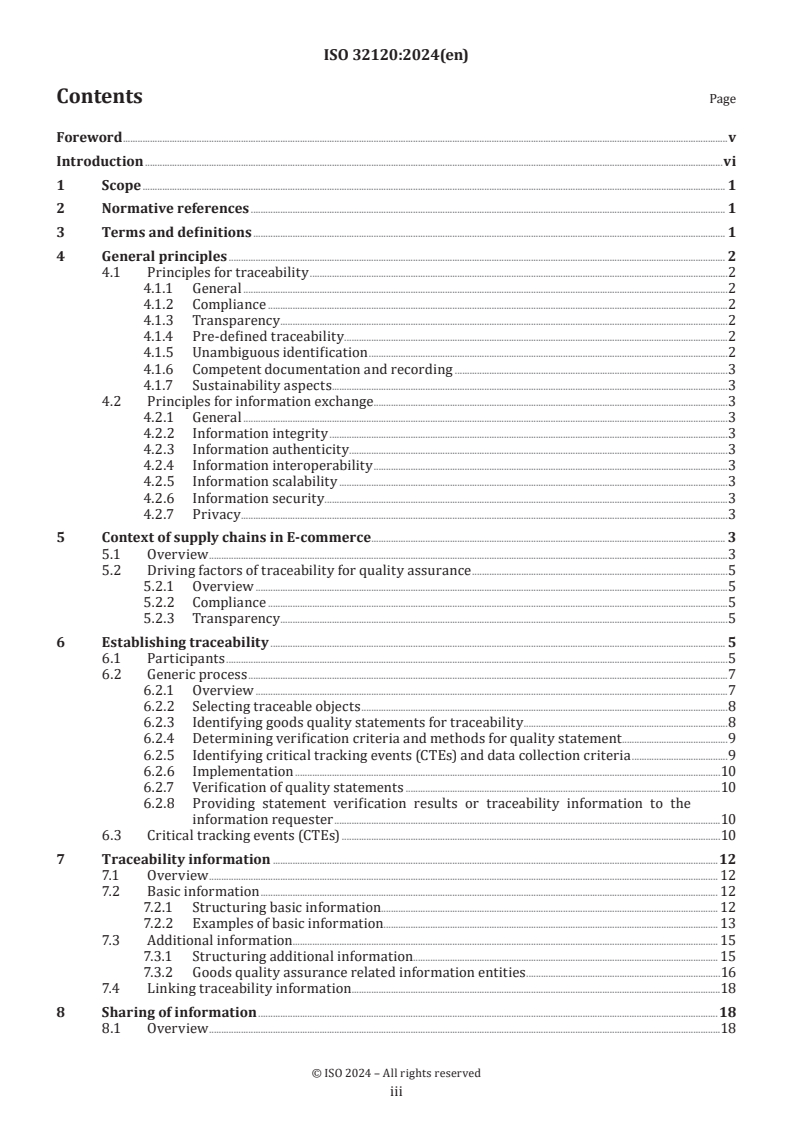
Contents Page
Foreword .v
Introduction .vi
1 Scope . 1
2 Normative references . 1
3 Terms and definitions . 1
4 General principles . 2
4.1 Principles for traceability .2
4.1.1 General .2
4.1.2 Compliance .2
4.1.3 Transparency . . .2
4.1.4 Pre-defined traceability .2
4.1.5 Unambiguous identification .2
4.1.6 Competent documentation and recording .3
4.1.7 Sustainability aspects . . .3
4.2 Principles for information exchange . .3
4.2.1 General .3
4.2.2 Information integrity .3
4.2.3 Information authenticity . . .3
4.2.4 Information interoperability .3
4.2.5 Information scalability .3
4.2.6 Information security . .3
4.2.7 Privacy .3
5 Context of supply chains in E-commerce . 3
5.1 Overview .3
5.2 Driving factors of traceability for quality assurance .5
5.2.1 Overview .5
5.2.2 Compliance .5
5.2.3 Transparency . . .5
6 Establishing traceability . 5
6.1 Participants .5
6.2 Generic process .7
6.2.1 Overview .7
6.2.2 Selecting traceable objects .8
6.2.3 Identifying goods quality statements for traceability .8
6.2.4 Determining verification criteria and methods for quality statement .9
6.2.5 Identifying critical tracking events (CTEs) and data collection criteria .9
6.2.6 Implementation .10
6.2.7 Verification of quality statements .10
6.2.8 Providing statement verification results or traceability information to the
information requester .10
6.3 Critical tracking events (CTEs) .10
7 Traceability information .12
7.1 Overview . 12
7.2 Basic information . 12
7.2.1 Structuring basic information. 12
7.2.2 Examples of basic information. 13
7.3 Additional information. 15
7.3.1 Structuring additional information. 15
7.3.2 Goods quality assurance related information entities .16
7.4 Linking traceability information .18
8 Sharing of information .18
8.1 Overview .18
iii
8.2 Sharing basic information .18
8.3 Sharing additional information .19
8.4 Technical solutions for data sharing . 20
8.5 Data quality . 20
8.6 Information security . 20
8.7 Privacy . 20
Annex A (informative) Examples of technical solutions for data sharing .22
Bibliography .23
iv
Foreword
ISO (the International Organization for Standardization) is a worldwide federation of national standards
bodies (ISO member bodies). The work of preparing International Standards is normally carried out through
ISO technical committees. Each member body interested in a subject for which a technical committee
has been established has the right to be represented on that committee. International organizations,
governmental and non-governmental, in liaison with ISO, also take part in the work. ISO collaborates closely
with the International Electrotechnical Commission (IEC) on all matters of electrotechnical standardization.
The procedures used to develop this document and those intended for its further maintenance are described
in the ISO/IEC Directives, Part 1. In particular, the different approval criteria needed for the different types
of ISO document should be noted. This document was drafted in accordance with the editorial rules of the
ISO/IEC Directives, Part 2 (see www.iso.org/directives).
ISO draws attention to the possibility that the implementation of this document may involve the use of (a)
patent(s). ISO takes no position concerning the evidence, validity or applicability of any claimed patent
rights in respect thereof. As of the date of publication of this document, ISO had not received notice of (a)
patent(s) which may be required to implement this document. However, implementers are cautioned that
this may not represent the latest information, which may be obtained from the patent database available at
www.iso.org/patents. ISO shall not be held responsible for identifying any or all such patent rights.
Any trade name used in this document is information given for the convenience of users and does not
constitute an endorsement.
For an explanation of the voluntary nature of standards, the meaning of ISO specific terms and expressions
related to conformity assessment, as well as information about ISO's adherence to the World Trade
Organization (WTO) principles in the Technical Barriers to Trade (TBT), see www.iso.org/iso/foreword.html.
This document was prepared by Technical Committee ISO/TC 321, Transaction assurance in E-commerce.
Any feedback or questions on this document should be directed to the user’s national standards body. A
complete listing of these bodies can be found at www.iso.org/members.html.
v
Introduction
E-commerce has evolved rapidly and flourished globally in recent years. Due to its global and complex supply
chains, it brings new challenges to goods quality compliance, anti-counterfeiting, goods recalls and more. As
such, buyers, E-commerce platform operators and government agencies, etc., increasingly demand clarity
about goods in E-commerce supply chains. The increasing global demand for both proven goods compliance
and greater transparency on goods information provenance is best supported by establishing suitable goods
traceability and linking appropriate quality assurance information throughout the supply chain.
A shared view of traceability and related goods quality information can provide reliable and sufficient
information about the goods quality statements to all relevant participants of E-commerce. Buyers can
be enabled to make better informed consumption choices. E-commerce platforms operators, government
agencies and other relevant stakeholders can be empowered to better manage goods quality risks.
NOTE For the purposes of the complete coverage of the activities of traceability information sharing, this
document includes some participants that are not mentioned within ISO 32111, such as regulatory agencies, quality
service providers and customs brokers, etc.
This document focuses on the general process of sharing traceability information related to goods quality
assurance in E-commerce. This document makes reference to existing international standards for data
models and means of data sharing. To establish effective and resilient traceability in E-commerce supply
chains for quality assurance, the specific requirements for data capture and data sharing are developed by
consensus with agreed terminology and methodology.
vi
International Standard ISO 32120:2024(en)
Transaction assurance in E-commerce — Guidelines on
sharing goods quality assurance traceability information in
E-commerce supply chains
1 Scope
This document provides guidelines for sharing traceability information related to goods quality assurance
in E-commerce.
This document illustrates the generic process for establishing traceability for goods quality assurance,
addresses critical tracking events (CTEs) and key traceability information in the E-commerce context and
provides methods for sharing the collected traceability information.
This document is intended to be applied to E-commerce supply chains only.
2 Normative references
The following documents are referred to in the text in such a way that some or all of their content constitutes
requirements of this document. For dated references, only the edition cited applies. For undated references,
the latest edition of the referenced document (including any amendments) applies.
ISO 32110, Transaction assurance in E-commerce — Vocabulary
3 Terms and definitions
For the purposes of this document, the terms and definitions given in ISO 32110 and the following apply.
ISO and IEC maintain terminology databases for use in standardization at the following addresses:
— ISO Online browsing platform: available at https:// www .iso .org/ obp
— IEC Electropedia: available at https:// www .electropedia .org/
3.1
goods quality statement
statement that declares that the quality of goods conforms with specific requirements
3.2
traceability
ability to either trace or track, or both, the history, application, or location of an object in the supply chain
[SOURCE: ISO 9000:2015, 3.6.13, modified — "either . or track, or both,” and "in the supply chain” added,
notes to entry removed.]
3.3
critical tracking event
CTE
critical business traceability event which is the source of traceability data
3.4
identifier
ID
unambiguous, unique and linguistically neutral value resulting from the application of a rule-based
identification process
Note 1 to entry: Identifiers shall be unique within one identification scheme. In case of more than one applied
identification scheme, linkages between the identifiers should be created. More details are discussed within 7.4.
Note 2 to entry: An identifier is a linguistically independent sequence of characters capable of uniquely and
permanently identifying that with which it is associated.
[SOURCE: ISO/IEC 15944-1:2011, 3.27, modified —”ID” added, Note 1 to entry modified to include information
about linkages and replace "must" with "shall".]
3.5
business information entity
piece of business data or a group of pieces of business data with a unique business semantic definition
Note 1 to entry: A business information entity can contain one or more entities.
[SOURCE: ISO 15000-5:2014, 3.12, modified — The original notes to entry deleted, a new note to entry added.]
4 General principles
4.1 Principles for traceability
4.1.1 General
Adherence to the basic principles of traceability in 4.1.2 to 4.1.6 can assist participants to obtain precise and
sufficient information about goods quality statement(s).
4.1.2 Compliance
Collection, retention, use and sharing of traceability data should fulfil considerations of all applicable
requirements.
4.1.3 Transparency
The traceability data should be enabled, open, comprehensive and in an understandable format for all
participants.
4.1.4 Pre-defined traceability
The criteria, methods and procedures for the implementation of traceability should be agreed upon and
communicated amongst traceability participants to ensure the accurate and timely collection, recording
and sharing of necessary information.
4.1.5 Unambiguous identification
All traceable objects should be identified uniquely and permanently to provide certainty and precision for
traceability.
The identifiers of these traceable objects should provide necessary references to each other to establish
traceability chain.
4.1.6 Competent documentation and recording
All information related to significant traceability events and verification of the quality statement should be
recorded according to agreed rules and procedures.
4.1.7 Sustainability aspects
Should sustainability related concerns, such as carbon emissions associated with the logistics process,
recycling of the goods or goods materials, be considered, related information should be taken into account.
4.2 Principles for information exchange
4.2.1 General
Adherence to basic principles for information exchange in 4.2.2 to 4.2.5 can assist efficient and effective
sharing of traceability information among all participants.
4.2.2 Information integrity
All information should be accurate, complete and consistent.
4.2.3 Information authenticity
All information should be verifiable and consistent with what it claims to be.
4.2.4 Information interoperability
All information should be exchangeable among participants as long as they are predefined, structured and
processable by applications.
4.2.5 Information scalability
The related technologies, solutions and systems should be compatible with the future change of data types,
formats and granularity, applications in various scenarios, or other factors that can affect the information
for exchange.
4.2.6 Information security
Requirements and procedures for accessibility, use and protection of information, as agreed among
participants, should be followed in traceability implementation.
4.2.7 Privacy
Personally identifiable information for traceability purposes should be protected to avoid any unauthorized
collection, use, retention or disclosure.
5 Context of supply chains in E-commerce
5.1 Overview
E-commerce supply chains mainly consist of the following key processes:
— upstream supply, in which upstream suppliers (e.g. manufacturers, distributors, wholesalers, retailers,
sellers) provide goods or goods information to E-commerce operators for sale;
— goods transaction, in which buyers purchase goods from sellers via E-commerce platforms, which can
involve goods information release, order placement, order confirmation, payment, etc.;
— logistics, in which logistics service providers provide transportation services for supplied goods and can
include non-cross-border transportation, cross-border transportation and delivery, etc.;
— customs clearance, in which imported or exported goods are processed through customs authorities in
accordance with required procedures;
NOTE Customs clearance can involve customs declaration, inspection clearance, and dialogue with customs
authorities.
— warehousing, in which either the exporting or importing country warehousing service provider, or both,
store goods for transportation and can involve picking, packing, distributing, inventory management, etc.;
— after-order-placement, in which E-commerce operators provide services and supports to buyers after
the order placement and can involve cancellation of orders, returns, refunds, etc.
Figure 1 provides a generic picture of the E-commerce supply chains. Different paths can be followed going
from upstream to downstream in E-commerce transactions.
Key
physical flow of goods
information flow
Figure 1 — E-commerce supply chains
Goods information is provided by upstream suppliers to E-commerce sellers, who release the information on
the E-commerce platform. Buyers place orders according to the goods information released. When the order
information is received by the sellers, sellers arrange the goods shipment. Depending on the availability
of goods, sellers can arrange direct delivery to buyers from an exporting country or importing country
warehouse, while buyers should be able to track their order information in a timely manner.
Goods are transported by the logistics service provider from upstream suppliers either to the warehouse or
delivered to buyers, or both. For cross-border E-commerce, shipments should be cleared at customs before
they can be delivered to buyers.
The information flow generated by the online transaction and physical flow of goods provides information
on the business events to be tracked and traced. When an after-order-placement service is provided,
additional information can be generated as traceability information.
5.2 Driving factors of traceability for quality assurance
5.2.1 Overview
Compliance and transparency are two major driving factors of E-commerce supply chain demands on goods
traceability for quality assurance.
5.2.2 Compliance
A large variety of goods traded on E-commerce platforms should meet the goods traceability requirements
of countries or regions, such as food, cosmetics and toys. Meanwhile, small-in-size E-commerce, comprised
primarily of large volumes of small packaged, low-value, direct-to-buyer goods, poses greater challenges
to the regulatory compliance of goods, e.g. inspection resource constraints, data limitation, responsibility
identification. All relevant parties in E-commerce supply chains demand availability and accessibility of
information for goods compliance. In E-commerce supply chains, the compliance requirements can include:
a) Requirements of local market access: The goods should comply with local requirements regarding
quality and traceability, in accordance with those specified by the producing or exporting countries or
regions.
b) Requirements of contracts or agreements: The goods should fulfil the quality requirements agreed
between goods supplier and buyer as specified in the supplier code of conduct contract or agreement.
c) Platform requirements: The goods should meet the quality requirements set up by the E-commerce
platform operators as a prerequisite for online sale.
d) Consistency requirements: The goods should be consistent with all information published on the
E-commerce platform and all statements made by the sellers under every circumstance.
5.2.3 Transparency
The virtual environment of E-commerce with the online-presence of some elements (e.g. goods, seller)
increases the need for information transparency for all participants of E-commerce supply chains. In the
E-commerce context, transparency requirements can include:
a) Data visibility: Participants need a clear view and reliable updates of the conditions of the goods sold
online, including but not limited to, where they are or have been, under whose custody they are or have
been, when and why certain business process happens, etc.
b) Data availability: Information should be collected, recorded and retained, using open standards, or the
format agreed upon within the participants to make it exchangeable for relevant participants.
c) Data accessibility: Authorized participants should be able to accurately obtain and use information to
meet their needs of goods quality assurance.
d) Data connectivity: Necessary links should be established among related information in order to enable
easy identification and retrieval.
Analysis of compliance and transparency requirements on supply chains in E-commerce can provide
guidance to formulate and determine goods quality statements for establishing traceability.
6 Establishing traceability
6.1 Participants
Figure 2 gives a generic picture of participants for establishing traceability in E-commerce. They are
grouped as:
a) traceability partners, who can directly or indirectly participate in E-commerce traceability;
b) information partners, who can participate in sharing of traceability information.
A traceability partner can be different information partners depending on their roles in traceability.
a
Traceability initiator in E-commerce.
Figure 2 — Participants for establishing traceability in E-commerce
Table 1 lists information partners with description of their roles in traceability.
Table 1 — Information partners
Participants Description
Traceability information A party who collects, records, stores and provides traceability information upon request.
provider It can be any traceability partner in E-commerce supply chains.
Traceability information A party who needs traceability information about the traceable objects for its quality
requester statement, e.g. seller, E-commerce platform operator, regulatory agency, buyer.
Repository party A party who is authorized to manage a traceability system or database, in which the trace-
ability information can be stored and retrieved. This can be any traceability partner in the
E-commerce supply chains or an authorized third-party.
Table 2 lists traceability partners with descriptions of their roles in traceability.
Table 2 — Traceability partners
Roles and responsibilities in infor-
Participants Description
mation sharing
Traceability initi- A party that requests that a traceability process be im- Organizing traceability activities
ator plemented. This can be any traceability partner in the
E-commerce supply chain that wants to make a quality
statement to its clients or buyers, such as an E-com-
merce platform operator, seller, regulatory agency, etc.
Upstream supplier An organization or individual that provides goods Traceability information provider,
to be sold online, which includes but is not limited to data source for goods information, e.g.
manufacturers, vendors, individual sellers, third-party goods ID, goods quality characteristics,
suppliers, etc. country of origin.
E-commerce plat- An organization who operates an E-commerce plat- Traceability initiator, repository party,
form operator form traceability information requester or
traceability information provider, data
source for, e.g. order information.
Seller An individual or organization who sells goods online Traceability initiator, repository party,
traceability information requester
or traceability information provider,
data source for, e.g. quality statement
information.
Logistics service An organization that provides services of warehous- Traceability information provider, data
provider ing, transport, distribution of goods traded online, e.g. source for, e.g. waybill information,
exporting country warehouse, cross-border logistics, logistics tracking information.
importing country warehouse and local delivery
Quality service A third party who provides goods quality assur- Repository party, or traceability infor-
provider ance related services, such as certification, testing, mation provider, data source for, e.g.
pre-shipment inspection, field verification, third-party goods certificates, testing or inspec-
traceability, etc. A neutral party in ISO 32111 tion reports.
Regulatory agency A government or government supported regulatory Traceability initiator, traceability in-
authority authorized to supervise and manage im- formation requester,
ported and exported goods based on the relevant laws or traceability information provider,
and administrative regulations, e.g. customs, market data source for, e.g. customs clearance
surveillance agencies. A neutral party in ISO 32111 information.
Other third-party A party provides other third-party services for E-com- Traceability information provider, data
service providers merce supply chains, e.g. customs declaration service, source for, e.g. payment information.
payment service
Buyer An individual or organization who purchases goods Traceability information requester,
online or traceability information provider,
data source for, e.g. receipt informa-
tion, after-order-placement informa-
tion.
6.2 Generic process
6.2.1 Overview
There are seven generic processes to establish a traceability system for E-commerce, as illustrated in
Figure 3. These processes are applicable across different goods. On this basis, the interested parties are
enabled to determine the specific tracking and tracing processes according to specific goods traceability
demands.
Figure 3 — Illustration diagram for establishing traceability system
6.2.2 Selecting traceable objects
A traceable object in E-commerce is the goods sold online. The objects that can be tracked or traced can be
determined by the traceability initiators, such as E-commerce platform operators, sellers and regulatory
agencies.
In distribution and logistics, the traceable object in E-commerce can be grouped, packaged and loaded with
other objects, which can lead to new traceable objects being tracked and traced (e.g. logistics units, transport
vehicles). In such case, the links should be established and recorded between the various aggregation levels.
6.2.3 Identifying goods quality statements for traceability
Goods quality statements are considered to be made when goods quality related information is released and
published on an E-commerce platform. A goods quality statement can be a regulatory, policy compliance
statement, a consistency statement or the combination of both. A regulatory, policy compliance statement
indicates that the goods conform to relevant compliance requirements (see 5.2.2). A consistency statement
indicates that the quality characteristics of the goods are consistent with the information displayed. To
establish traceability in E-commerce, a quality statement should be identified in order to decide what data is
needed and how they are needed to support or verify the statements.
Quality statements for traceability can be determined by the traceability initiator, such as E-commerce
platform operators, sellers, regulatory agencies, possibly in consultation with other traceability partners,
such as quality service providers.
An example of quality statements is given in Table 3.
Table 3 — Example of quality statements
Goods information published Quality statements
Pasteurized milk imported from country A 1. This milk is in compliance with market access
to country B requirements of country B and relevant technical
standards or specifications for pasteurized milk
(e.g. production, storage)
2. Country of origin for this milk is country A
6.2.4 Determining verification criteria and methods for quality statement
Verification criteria and methods provide rules for data selection in the traceability process.
Verification criteria set up the standard and key performance indicator that the traceable objects should meet.
Verification methods provide measures to obtain integral and valid data as proof for verification of quality
statement. In the E-commerce supply chains, the following measures can be applied:
a) Certification: Certification can be applied to either goods or relevant organizations, or both, to give
assurance that goods quality conforms to the specified requirements.
b) Inspection: Inspection can be executed for goods or batches of goods (e.g. pre-shipment inspection,
customs inspection), a location (e.g. inspection of production facility, warehouse), or a process (e.g.
production process, transport movement). Inspection provides evidence of quality compliance by
identifying the actual status of goods via observation and judgement, which can involve visual check,
testing, measurement, etc.
c) Testing: Testing can determine one or more goods quality characteristics according to predetermined
requirements and procedures.
d) Verification: Verification involves evaluation of goods quality compliance through the provision of object
evidence, e.g. documents check, records review.
The verification criteria and methods for quality statement can be determined by the traceability initiator
and traceability information provider, possibly in consultation with other traceability partners, such as
quality service providers.
Table 4 elaborates examples of verification criteria and methods.
Table 4 — Examples of verification criteria and methods
Quality statement Verification criteria Possible verification methods
This milk is in compliance 1. Production meets relevant stand- Certification scheme applied to
with market access require- ards or specification requirements either pasteurized milk or the
ments of country B and rele- milk producer, or both,
2. Storage and transport meet rele-
vant technical standards or
vant requirements Check of temperature records
specifications for pasteur-
ized milk
Country of origin for this 1. The milk is produced and imported Either:
milk is country A from country A
1. check of import, export doc-
uments; or
2. field verification of produc-
tion site; or
3. both.
6.2.5 Identifying critical tracking events (CTEs) and data collection criteria
The entry and exit points of the traceability chain are not always the start and end of the goods supply chain.
Depending on quality statements, the entry and exit point can vary even for the same goods as in example in
Table 5. For implementation of traceability, the participants should decide on:
a) CTEs from entry point to exit point to be recorded (see 6.3);
b) who collects which data;
c) how to record such data.
Data collected in each CTE includes basic information to maintain goods traceability (see 7.2) and additional
information related to goods quality assurance (see 7.3).
Table 5 provides examples of entry and exit points.
Table 5 — Examples of entry and exit points
Quality statement Entry point Exit point
This milk is in compliance with Production of milk Consumption of milk
market access requirements of
country B and relevant technical
standards or specification for pas-
teurized milk
Country of origin for this milk is Export port Import port
country A
The traceability initiator decides on CTEs and the data collection requirements with the repository party
and the traceability information providers.
6.2.6 Implementation
At the entry point of the traceability chain, a traceable object is given a unique identifier and collection
of traceability data is conducted according to the decided requirements or criteria. When a traceable
object moves along the supply chain, the information recorded at the entry point of the traceability chain
is associated with the traceability information recorded in each CTE (see 6.3) by this unique identifier.
When the recorded traceability information can fully verify the quality statement of the goods and meet
the requirements of traceability information requester, the traceable objects can reach the exit point of the
traceability chain.
Traceability partners can directly or indirectly participate in the process of traceability implementation.
6.2.7 Verification of quality statements
Quality statements are verified at the exit point of the traceability chain. Verification is done by retrieval of
necessary data with the agreed methods (see 8.2 and 8.3). When necessary data is not available, measures
listed in 6.2.4 can be applied.
The traceability information requester makes requests to either the repository party or the traceability
information provider, or both, to retrieve necessary data for quality statement verification.
6.2.8 Providing statement verification results or traceability information to the information
requester
Verification results can be communicated to the information requester, e.g. buyers, regulatory agencies, via
goods traceability tags, websites, social media. Verification results can be presented in the form of a quality
statement and its supporting information.
The traceability initiator and traceability information requester can decide together what and how to present
this information. It is important to ensure that the message communicated is factual and the reliability of
the quality statement can be proven.
6.3 Critical tracking events (CTEs)
A critical tracking event (CTE) is an active step in the E-commerce business process. CTEs provide an
accurate and detailed view of the actual events that occur to the goods to be traced. In each CTE, necessary
information should be recorded and shared.
CTEs are goods and process specific. Table 6 gives examples of possible CTEs and their descriptions in a
common E-commerce business process, in which goods transacted on a platform are dispatched from
upstream suppliers to overseas buyers through warehouse and logistics.
Table 6 — Examples of CTE and descriptions in the E-commerce supply chains
Key business
CTEs Notes Reference to
process
Upstream supply commissioning business step of associating an identifier with goods to ISO/IEC 19988
be sold
a tag can be encoded and applied in this step, or previ-
ously encoded
stocking business step of making goods available for order fulfil- ISO/IEC 19988
ment
loading business step of loading goods into a shipping convey- ISO/IEC 19988
ance
consigning business step of shipping goods with a change of posses- ISO/IEC 19988
sion or ownership at the outbound side
Platform trans- goods information business step of releasing goods information by e-com-
action releasing merce operator
ordering business step of buyer placing an order in an e-shop
paying business step of buyer making payment through the
internet via various ways
Warehousing arriving business step of goods arriving at a location ISO/IEC 19988
unloading business step of unloading goods from a shipping con- ISO/IEC 19988
veyance
storing business step of moving goods to a storage location ISO/IEC 19988
picking business step of picking goods for shipment to fulfil an ISO/IEC 19988
order
collecting business step of collecting goods picked up for next ISO/IEC 19988
disposal
packing business step of putting goods into a larger contain- ISO/IEC 19988
er-usually for shipping
unpacking business step of removing goods or batches of goods ISO/IEC 19988
from a larger container, usually after receiving or accept-
ing
loading see above ISO/IEC 19988
cycle-counting business step of counting objects in order to obtain an ISO/IEC 19988
accurate inventory
staging outbound business step of moving goods from a facility to an area ISO/IEC 19988
awaiting transport pick-up
Logistics departing business step of goods leaving a location on their way to ISO/IEC 19988
a destination
transporting business step of moving goods from one location to an- ISO/IEC 19988
other by logistic provider
arriving see above ISO/IEC 19988
delivering business step of sending goods to an intended destina-
...