


ISO/TS 24929-4
(Main)Child care articles - General safety - Part 4: Thermal hazards
Child care articles - General safety - Part 4: Thermal hazards
Development of deliverables on general and common safety aspects on thermal hazards for child care articles
Articles de puériculture — Sécurité générale — Partie 4: Dangers thermiques
General Information
- Status
- Not Published
- Technical Committee
- ISO/TC 310 - Child care articles
- Current Stage
- 6000 - International Standard under publication
- Start Date
- 17-Oct-2025
- Completion Date
- 10-Jan-2026
Overview
ISO/TS 24929-4, titled Child Care Articles – General Safety – Part 4: Thermal Hazards, is an international technical specification developed by ISO Technical Committee ISO/TC 310. Scheduled for publication in 2025, this standard addresses the thermal safety aspects critical to child care products. Its primary aim is to guide manufacturers, regulators, and child safety professionals in identifying and mitigating risks related to thermal hazards, thereby enhancing the safety and well-being of children using these articles.
The standard focuses on thermal hazards including flammability, contact with hot or cold surfaces and liquids, exposure to flames, and risks associated with abnormal body temperatures (hyperthermia and hypothermia). It offers both requirements and practical recommendations for testing, design, labeling, and product information disclosure concerning thermal safety to protect infants and young children.
Key Topics
Thermal Hazards Definition: Hazards arising from extremes of temperature impacting child care articles.
Flammability and Burning:
- Standards for material flammability reference ISO 8124-2:2023, which governs flame spread rates and prohibits surface flash for pile textiles.
- Prohibits use of volatile and highly flammable materials such as celluloid and flammable gases or liquids in child care products.
- Emphasizes slow flame propagation rates to allow removal of the child if ignition occurs.
Hot and Cold Surface Contact:
- Addresses the risk of burns or frostbite from touching surfaces that are excessively hot or cold.
- Recognizes children’s limited ability to react to thermal contact, especially infants under 24 months, necessitating protective designs or warnings.
Hot and Cold Liquids or Food:
- Warns of scald risks from hot liquids or foods accessible to children, recommending appropriate safety information on products.
Contact with Flames:
- Stipulates protective measures on products intended to prevent child access to open flames.
Hyperthermia and Hypothermia Risks:
- Highlights risks of overheating-linked to sudden infant death syndrome-and overcooling due to environmental exposures or thermal insulation by bedding, clothing, or the product itself.
- Requires clear warnings to caregivers about these temperature-related hazards.
Safety Philosophy:
- Supports a chemical-free approach, avoiding flame retardants due to their potential chemical hazards.
- Encourages selecting inherent flame-resistant materials or design features rather than relying on additive flame retardants.
Applications
ISO/TS 24929-4 is essential for the design, manufacturing, testing, and certification of a wide range of child care articles such as:
- Baby seats, strollers, and carriers
- Feeding bottles and accessories
- Bedding and sleep environment products
- Protective covers and barriers to heat sources
- Child garments and textiles with potential thermal concerns
This technical specification helps manufacturers ensure compliance with global safety expectations while enabling regulators to establish consistent requirements. Childcare product designers can integrate this guidance early in development to minimize thermal risks, avoid hazardous materials, and provide clear safety information.
Safety assessors and testing laboratories will use ISO/TS 24929-4 to establish criteria for thermal hazard tests aligned with ISO 8124-2 fire safety measures and IEC ergonomics guidance.
Related Standards
ISO 8124-2:2023 – Safety of Toys – Part 2: Flammability
Governs flammability testing procedures and limits, directly referenced for flame spread and surface flash tests.ISO 13732-1 – Ergonomics of the Thermal Environment – Methods for Assessment of Human Response to Surfaces
Provides temperature limits and assessment methods for heated surfaces relevant in evaluating child care articles.IEC Guide 117:2010 – Temperatures of Touchable Hot Surfaces
Offers guidance on hot surface temperatures to prevent burns, supporting temperature limit recommendations.
These related documents complement ISO/TS 24929-4 by providing detailed testing protocols and ergonomic data essential for comprehensive thermal hazard evaluation in child care articles.
Keywords: child care safety, thermal hazards, flammability, child safety standards, burns prevention, hot surface safety, cold surface safety, hyperthermia, hypothermia, ISO 24929-4, child care products, thermal risk management, toy flammability standard, safety warnings, product safety testing.

ISO/DTS 24929-4 - Child care articles — General safety — Part 4: Thermal hazards Released:7. 08. 2025
REDLINE ISO/DTS 24929-4 - Child care articles — General safety — Part 4: Thermal hazards Released:7. 08. 2025
Frequently Asked Questions
ISO/TS 24929-4 is a draft published by the International Organization for Standardization (ISO). Its full title is "Child care articles - General safety - Part 4: Thermal hazards". This standard covers: Development of deliverables on general and common safety aspects on thermal hazards for child care articles
Development of deliverables on general and common safety aspects on thermal hazards for child care articles
ISO/TS 24929-4 is classified under the following ICS (International Classification for Standards) categories: 97.190 - Equipment for children. The ICS classification helps identify the subject area and facilitates finding related standards.
ISO/TS 24929-4 is available in PDF format for immediate download after purchase. The document can be added to your cart and obtained through the secure checkout process. Digital delivery ensures instant access to the complete standard document.
Standards Content (Sample)
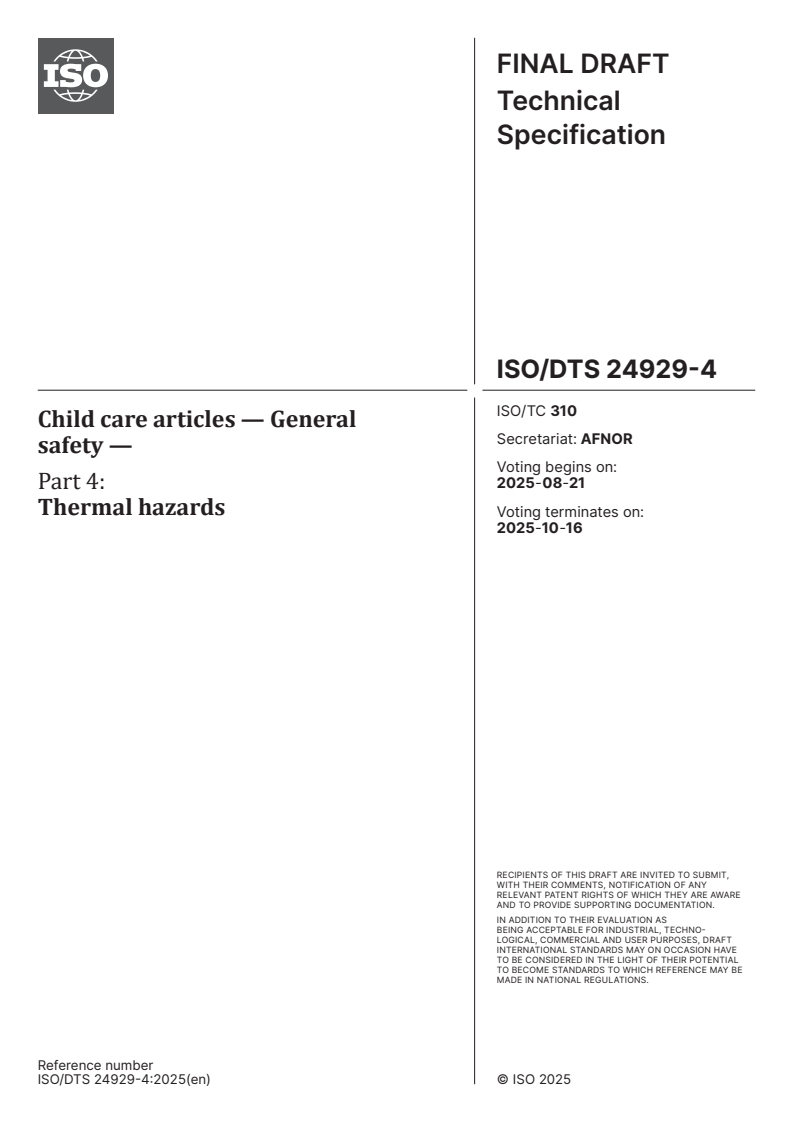
FINAL DRAFT
Technical
Specification
ISO/DTS 24929-4
ISO/TC 310
Child care articles — General
Secretariat: AFNOR
safety —
Voting begins on:
2025-08-21
Part 4:
Thermal hazards
Voting terminates on:
2025-10-16
RECIPIENTS OF THIS DRAFT ARE INVITED TO SUBMIT,
WITH THEIR COMMENTS, NOTIFICATION OF ANY
RELEVANT PATENT RIGHTS OF WHICH THEY ARE AWARE
AND TO PROVIDE SUPPOR TING DOCUMENTATION.
IN ADDITION TO THEIR EVALUATION AS
BEING ACCEPTABLE FOR INDUSTRIAL, TECHNO-
LOGICAL, COMMERCIAL AND USER PURPOSES, DRAFT
INTERNATIONAL STANDARDS MAY ON OCCASION HAVE
TO BE CONSIDERED IN THE LIGHT OF THEIR POTENTIAL
TO BECOME STAN DARDS TO WHICH REFERENCE MAY BE
MADE IN NATIONAL REGULATIONS.
Reference number
ISO/DTS 24929-4:2025(en) © ISO 2025
FINAL DRAFT
ISO/DTS 24929-4:2025(en)
Technical
Specification
ISO/DTS 24929-4
ISO/TC 310
Child care articles — General
Secretariat: AFNOR
safety —
Voting begins on:
Part 4:
Thermal hazards
Voting terminates on:
RECIPIENTS OF THIS DRAFT ARE INVITED TO SUBMIT,
WITH THEIR COMMENTS, NOTIFICATION OF ANY
RELEVANT PATENT RIGHTS OF WHICH THEY ARE AWARE
AND TO PROVIDE SUPPOR TING DOCUMENTATION.
© ISO 2025
IN ADDITION TO THEIR EVALUATION AS
All rights reserved. Unless otherwise specified, or required in the context of its implementation, no part of this publication may
BEING ACCEPTABLE FOR INDUSTRIAL, TECHNO-
LOGICAL, COMMERCIAL AND USER PURPOSES, DRAFT
be reproduced or utilized otherwise in any form or by any means, electronic or mechanical, including photocopying, or posting on
INTERNATIONAL STANDARDS MAY ON OCCASION HAVE
the internet or an intranet, without prior written permission. Permission can be requested from either ISO at the address below
TO BE CONSIDERED IN THE LIGHT OF THEIR POTENTIAL
or ISO’s member body in the country of the requester.
TO BECOME STAN DARDS TO WHICH REFERENCE MAY BE
MADE IN NATIONAL REGULATIONS.
ISO copyright office
CP 401 • Ch. de Blandonnet 8
CH-1214 Vernier, Geneva
Phone: +41 22 749 01 11
Email: copyright@iso.org
Website: www.iso.org
Published in Switzerland Reference number
ISO/DTS 24929-4:2025(en) © ISO 2025
ii
ISO/DTS 24929-4:2025(en)
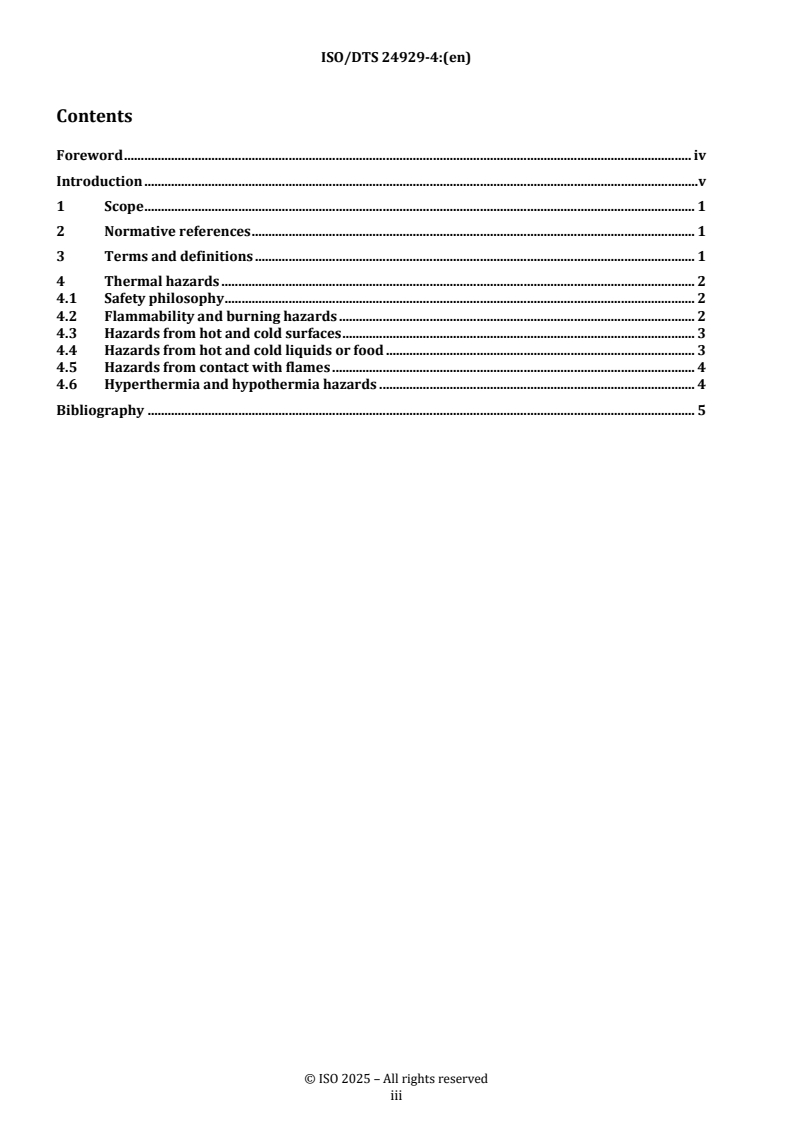
Contents Page
Foreword .iv
Introduction .v
1 Scope . 1
2 Normative references . 1
3 Terms and definitions . 1
4 Thermal hazards . 2
4.1 Safety philosophy .2
4.2 Flammability and burning hazards .2
4.2.1 General .2
4.2.2 Rationale .2
4.2.3 Requirements .3
4.3 Hazards from hot and cold surfaces .3
4.3.1 Rationale .3
4.3.2 Requirements .3
4.4 Hazards from hot and cold liquids or food .3
4.4.1 Rationale .3
4.4.2 Requirements .3
4.5 Hazards from contact with flames .4
4.5.1 Rationale .4
4.5.2 Requirements .4
4.6 Hyperthermia and hypothermia hazards .4
4.6.1 Rationale .4
4.6.2 Requirements .4
Bibliography . 5
iii
ISO/DTS 24929-4:2025(en)
Foreword
ISO (the International Organization for Standardization) is a worldwide federation of national standards
bodies (ISO member bodies). The work of preparing International Standards is normally carried out through
ISO technical committees. Each member body interested in a subject for which a technical committee
has been established has the right to be represented on that committee. International organizations,
governmental and non-governmental, in liaison with ISO, also take part in the work. ISO collaborates closely
with the International Electrotechnical Commission (IEC) on all matters of electrotechnical standardization.
The procedures used to develop this document and those intended for its further maintenance are described
in the ISO/IEC Directives, Part 1. In particular, the different approval criteria needed for the different types
of ISO document should be noted. This document was drafted in accordance with the editorial rules of the
ISO/IEC Directives, Part 2 (see www.iso.org/directives).
ISO draws attention to the possibility that the implementation of this document may involve the use of (a)
patent(s). ISO takes no position concerning the evidence, validity or applicability of any claimed patent
rights in respect thereof. As of the date of publication of this document, ISO had not received notice of (a)
patent(s) which may be required to implement this document. However, implementers are cautioned that
this may not represent the latest information, which may be obtained from the patent database available at
www.iso.org/patents. ISO shall not be held responsible for identifying any or all such patent rights.
Any trade name used in this document is information given for the convenience of users and does not
constitute an endorsement.
For an explanation of the voluntary nature of standards, the meaning of ISO specific terms and expressions
related to conformity assessment, as well as information about ISO's adherence to the World Trade
Organization (WTO) principle
...
ISO/TSDTS 24929-4
ISO/TC 310
Secretariat: AFNOR
Date: 2025-05-0508-07
Child care articles — General safety —
Part 24:
Thermal hazards
ISO/DTS 24929-4:(en)
All rights reserved. Unless otherwise specified, or required in the context of its implementation, no part of this publication
may be reproduced or utilized otherwise in any form or by any means, electronic or mechanical, including photocopying,
or posting on the internet or an intranet, without prior written permission. Permission can be requested from either ISO
at the address below or ISO’s member body in the country of the requester.
ISO copyright office
CP 401 • Ch. de Blandonnet 8
CH-1214 Vernier, Geneva
Phone: + 41 22 749 01 11
E-mail: copyright@iso.org
Website: www.iso.org
Published in Switzerland
ii
ISO/DTS 24929-4:(en)
Contents
Foreword . iv
Introduction . v
1 Scope . 1
2 Normative references . 1
3 Terms and definitions . 1
4 Thermal hazards . 2
4.1 Safety philosophy . 2
4.2 Flammability and burning hazards . 2
4.3 Hazards from hot and cold surfaces . 3
4.4 Hazards from hot and cold liquids or food . 3
4.5 Hazards from contact with flames . 4
4.6 Hyperthermia and hypothermia hazards . 4
Bibliography . 5
iii
ISO/DTS 24929-4:(en)
Foreword
ISO (the International Organization for Standardization) is a worldwide federation of national standards
bodies (ISO member bodies). The work of preparing International Standards is normally carried out through
ISO technical committees. Each member body interested in a subject for which a technical committee has been
established has the right to be represented on that committee. International organizations, governmental and
non-governmental, in liaison with ISO, also take part in the work. ISO collaborates closely with the
International Electrotechnical Commission (IEC) on all matters of electrotechnical standardization.
The procedures used to develop this document and those intended for its further maintenance are described
in the ISO/IEC Directives, Part 1. In particular, the different approval criteria needed for the different types of
ISO documentsdocument should be noted. This document was drafted in accordance with the editorial rules
of the ISO/IEC Directives, Part 2 (see www.iso.org/directives).
Attention is drawnISO draws attention to the possibility that some of the elementsimplementation of this
document may beinvolve the subjectuse of (a) patent(s). ISO takes no position concerning the evidence,
validity or applicability of any claimed patent rights in respect thereof. As of the date of publication of this
document, ISO had not received notice of (a) patent(s) which may be required to implement this document.
However, implementers are cautioned that this may not represent the latest information, which may be
obtained from the patent database available at www.iso.org/patents. ISO shall not be held responsible for
identifying any or all such patent rights. Details of any patent rights identified during the development of the
document will be in the Introduction and/or on the ISO list of patent declarations received (see ).
Any trade name used in this document is information given for the convenience of users and does not
constitute an endorsement.
For an explanation of the voluntary nature of standards, the meaning of ISO specific terms and expressions
related to conformity assessment, as well as information about ISO's adherence to the World Trade
Organization (WTO) principles in the Technical Barriers to Trade (TBT), see www.iso.org/iso/foreword.html.
This document was prepared by Technical Committee ISO/TC 310, Child care articles.
A list of all parts in the ISO 24929 series can be found on the ISO website.
Any feedback or questions on this document should be directed to the user’s national standards body. A
complete listing of these bodies can be found at www.iso.org/members.html.
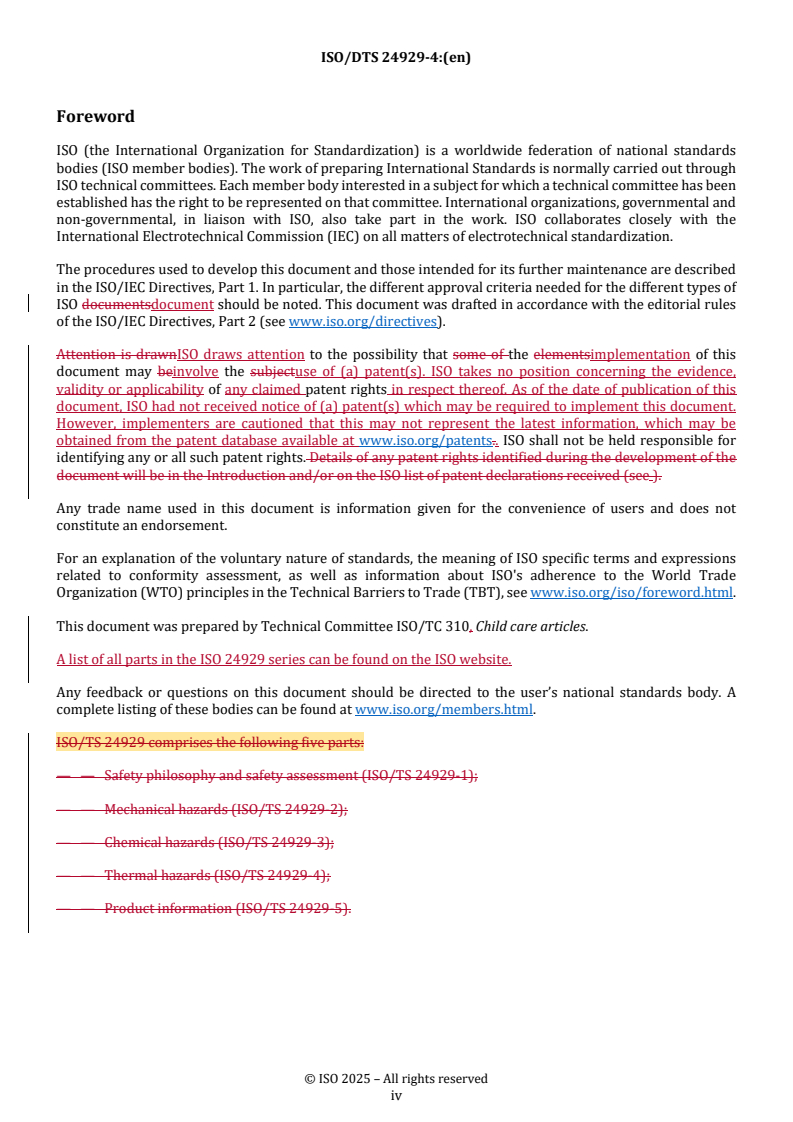
ISO/TS 24929 comprises the following five parts:
— — Safety philosophy and safety assessment (ISO/TS 24929-1);
— — Mechanical hazards (ISO/TS 24929-2);
— — Chemical hazards (ISO/TS 24929-3);
— — Thermal hazards (ISO/TS 24929-4);
— — Product information (ISO/TS 24929-5).
iv
ISO/DTS 24929-4:(en)
Introduction
develop safety standards, these guidelines this document can assist those with a general professional interest
in child safety.
v
ISO/DTS 24929-4:(en)
Child care articles — General safety —
Part 4:
Thermal hazards
1 Scope
This document providesspecifies requirements and gives guidance information on thermal hazards that
should be taken into consideration whenfor developing safety standards for child care articles. In addition,
these guidelines can assist those with a general professional interest in child safety.
2 Normative references
The following documents are referred to in the text in such a way that some or all of their content constitutes
requirements of this document. For dated references, only the edition cited applies. For undated references,
the latest edition of the referenced document (including any amendments) applies.
ISO 8124-2:2023, Safety of toys –— Part 2: Flammability
3 Terms and definitions
For the purposes of this document, the following terms and definitions apply.
ISO and IEC maintain terminology databases for use in standardization at the following addresses:
— ISO Online browsing platform: available at https://www.iso.org/obp
— IEC Electropedia: available at https://www.electropedia.org/
3.1
flammability
ability of material to burn with a
...
Questions, Comments and Discussion
Ask us and Technical Secretary will try to provide an answer. You can facilitate discussion about the standard in here.
Loading comments...