

ISO/IEC Guide 50:2014
(Main)Safety aspects — Guidelines for child safety in standards and other specifications
General Information
- Abstract
ISO/IEC Guide 50:2014 provides guidance to experts who develop and revise standards, specifications and similar publications. It aims to address potential sources of bodily harm to children from products that they use, or with which they are likely to come into contact, even if not specifically intended for children. ISO/IEC Guide 50:2014 does not provide guidance on the prevention of intentional harm (e.g. child abuse) or non-physical forms of harm, such as psychological harm (e.g. intimidation). ISO/IEC Guide 50:2014 does not address the economic consequences of the above.
- Status
- Published
- Publication Date
- 07-Dec-2014
- Technical Committee
- ISO/COPOLCO - Committee on consumer policy
- Drafting Committee
- ISO/COPOLCO - Committee on consumer policy
- Current Stage
- 9093 - International Standard confirmed
- Start Date
- 22-Sep-2023
- Completion Date
- 29-Aug-2026
Buy Documents

ISO/IEC Guide 50:2014 - Safety aspects -- Guidelines for child safety in standards and other specifications

ISO/IEC Guide 50:2014 - Safety aspects — Guidelines for child safety in standards and other specifications/8/2014

ISO/IEC Guide 50:2014 - Aspects liés a la sécurité -- Principes directeurs pour la sécurité des enfants dans les normes et autres spécifications

ISO/IEC Guide 50:2014 - Aspects liés à la sécurité — Principes directeurs pour la sécurité des enfants dans les normes et autres spécifications/6/2015


ISO/IEC Guide 50:2014 - Safety aspects — Guidelines for child safety in standards and other specifications/11/2017
Overview
ISO/IEC Guide 50:2014 - Safety aspects - Guidelines for child safety in standards and other specifications provides guidance for experts who develop or revise standards, specifications and similar publications. The Guide helps identify and address potential sources of bodily harm to children from products, packaging, built environments, services and processes they use or are likely to encounter - even if those items are not specifically intended for children. It does not cover prevention of intentional harm (e.g., abuse), non‑physical harms (e.g., psychological harm), or economic consequences.
Key topics and technical focus
ISO/IEC Guide 50:2014 organizes practical guidance around child‑relevant safety considerations rather than prescriptive test methods. Core topics include:
- Child definition and age descriptors (the Guide defines “child” as under 14 years while noting local variations).
- General approach and risk assessment: systematic assessment of hazards and reasonably foreseeable use.
- Child development, behaviour and vulnerability: anthropometry, motor, physiological and cognitive development; how developmental age differs from chronological age.
- Safe environments: physical, social and sleep environments that influence child safety.
- Hazard taxonomy: structured treatment of hazards relevant to children, including mechanical and fall hazards, drowning, suffocation, strangulation, small-object and suction hazards, fire and explosion, thermal, chemical, electrical, radiation, noise and biological hazards.
- Adequacy of safeguards: considerations for product, installation, personal, behavioural and instructional safeguards.
- Supporting materials: Annex A (assessment checklist) and Annex B (information on injury databases) to assist standards developers and safety assessors.
Practical applications and users
Who benefits from using this Guide:
- Standards developers and technical committees - integrate child‑centred safety guidance into product, packaging and environment standards.
- Designers and manufacturers - apply child‑safety principles during design, materials selection and packaging decisions.
- Regulators, policy makers and safety inspectors - use the Guide as background when specific standards are absent.
- Architects, service providers and educators - evaluate environments and services (including sleep spaces) for child risk.
- Auditors and product‑safety professionals - use Annex A checklist and hazard lists for conformity assessment and risk mitigation.
Practical uses include hazard identification, drafting age‑appropriate safety requirements, informing instructions and warnings, and assessing adequacy of engineered and behavioral safeguards.
Related standards and resources
- ISO/IEC Guide 51 - general principles for risk assessment and risk reduction; Guide 50 complements Guide 51 by focusing on child‑specific considerations.
- WHO/UNICEF reports on child injury prevention are useful context for prevalence and public‑health priorities.
Keywords: ISO/IEC Guide 50:2014, child safety in standards, hazard assessment, product safety, risk assessment, child development, safeguards, standards developers.
Relations
- Effective Date
- 11-May-2013
Buy Documents
ISO/IEC Guide 50:2014 - Safety aspects -- Guidelines for child safety in standards and other specifications
ISO/IEC Guide 50:2014 - Safety aspects — Guidelines for child safety in standards and other specifications/8/2014
ISO/IEC Guide 50:2014 - Aspects liés a la sécurité -- Principes directeurs pour la sécurité des enfants dans les normes et autres spécifications
ISO/IEC Guide 50:2014 - Aspects liés à la sécurité — Principes directeurs pour la sécurité des enfants dans les normes et autres spécifications/6/2015
ISO/IEC Guide 50:2014 - Safety aspects — Guidelines for child safety in standards and other specifications/11/2017
Frequently Asked Questions
ISO/IEC Guide 50:2014 is a guide published by the International Organization for Standardization (ISO). Its full title is "Safety aspects — Guidelines for child safety in standards and other specifications". This standard covers: ISO/IEC Guide 50:2014 provides guidance to experts who develop and revise standards, specifications and similar publications. It aims to address potential sources of bodily harm to children from products that they use, or with which they are likely to come into contact, even if not specifically intended for children. ISO/IEC Guide 50:2014 does not provide guidance on the prevention of intentional harm (e.g. child abuse) or non-physical forms of harm, such as psychological harm (e.g. intimidation). ISO/IEC Guide 50:2014 does not address the economic consequences of the above.
ISO/IEC Guide 50:2014 provides guidance to experts who develop and revise standards, specifications and similar publications. It aims to address potential sources of bodily harm to children from products that they use, or with which they are likely to come into contact, even if not specifically intended for children. ISO/IEC Guide 50:2014 does not provide guidance on the prevention of intentional harm (e.g. child abuse) or non-physical forms of harm, such as psychological harm (e.g. intimidation). ISO/IEC Guide 50:2014 does not address the economic consequences of the above.
ISO/IEC Guide 50:2014 is classified under the following ICS (International Classification for Standards) categories: 01.120 - Standardization. General rules; 97.190 - Equipment for children. The ICS classification helps identify the subject area and facilitates finding related standards.
ISO/IEC Guide 50:2014 has the following relationships with other standards: It is inter standard links to ISO/IEC Guide 50:2002. Understanding these relationships helps ensure you are using the most current and applicable version of the standard.
ISO/IEC Guide 50:2014 is available in PDF format for immediate download after purchase. The document can be added to your cart and obtained through the secure checkout process. Digital delivery ensures instant access to the complete standard document.
Standards Content (Sample)
GUIDE 50
Third edition
2014-12-15
Safety aspects — Guidelines for
child safety in standards and other
specifications
Aspects liés à la sécurité — Principes directeurs pour la sécurité des
enfants dans les normes et autres spécifications
Reference number
©
ISO/IEC 2014
© ISO/IEC 2014
All rights reserved. Unless otherwise specified, no part of this publication may be reproduced or utilized otherwise in any form
or by any means, electronic or mechanical, including photocopying, or posting on the internet or an intranet, without prior
written permission. Permission can be requested from either ISO at the address below or ISO’s member body in the country of
the requester.
ISO copyright office
Case postale 56 • CH-1211 Geneva 20
Tel. + 41 22 749 01 11
Fax + 41 22 749 09 47
E-mail copyright@iso.org
Web www.iso.org
Published in Switzerland
ii © ISO/IEC 2014 – All rights reserved
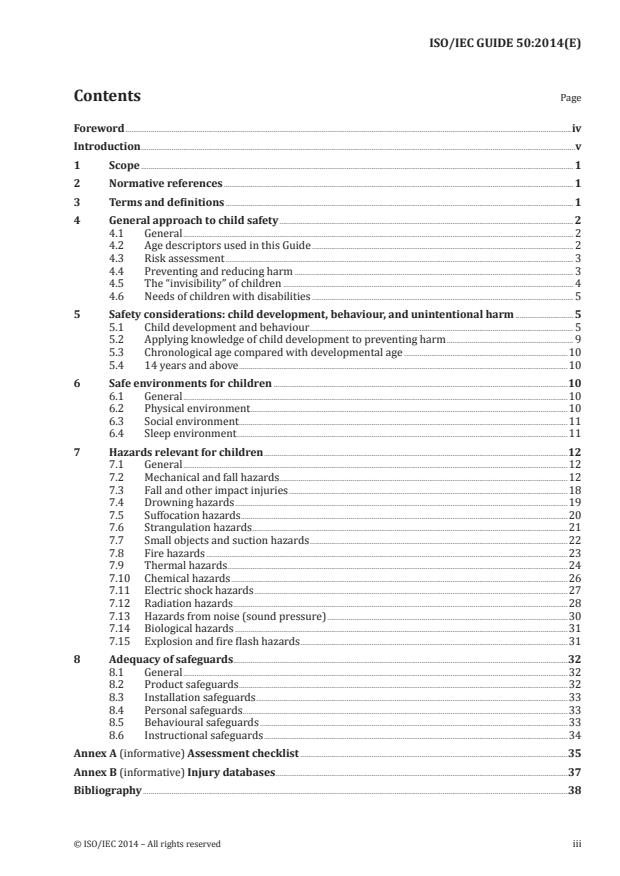
Contents Page
Foreword .iv
Introduction .v
1 Scope . 1
2 Normative references . 1
3 Terms and definitions . 1
4 General approach to child safety . 2
4.1 General . 2
4.2 Age descriptors used in this Guide . 2
4.3 Risk assessment . 3
4.4 Preventing and reducing harm . 3
4.5 The “invisibility” of children . 4
4.6 Needs of children with disabilities . 5
5 Safety considerations: child development, behaviour, and unintentional harm .5
5.1 Child development and behaviour . 5
5.2 Applying knowledge of child development to preventing harm . 9
5.3 Chronological age compared with developmental age .10
5.4 14 years and above .10
6 Safe environments for children .10
6.1 General .10
6.2 Physical environment .10
6.3 Social environment .11
6.4 Sleep environment .11
7 Hazards relevant for children .12
7.1 General .12
7.2 Mechanical and fall hazards.12
7.3 Fall and other impact injuries .18
7.4 Drowning hazards .19
7.5 Suffocation hazards .20
7.6 Strangulation hazards .21
7.7 Small objects and suction hazards .22
7.8 Fire hazards .23
7.9 Thermal hazards .24
7.10 Chemical hazards .26
7.11 Electric shock hazards .27
7.12 Radiation hazards .28
7.13 Hazards from noise (sound pressure) .30
7.14 Biological hazards .31
7.15 Explosion and fire flash hazards .31
8 Adequacy of safeguards .32
8.1 General .32
8.2 Product safeguards .32
8.3 Installation safeguards .33
8.4 Personal safeguards .33
8.5 Behavioural safeguards .33
8.6 Instructional safeguards .34
Annex A (informative) Assessment checklist .35
Annex B (informative) Injury databases .37
Bibliography .38
© ISO/IEC 2014 – All rights reserved iii
Foreword
ISO (the International Organization for Standardization) and IEC (the International Electrotechnical
Commission) are worldwide federations of national standards bodies (ISO member bodies and IEC
national committees). The work of preparing International Standards is normally carried out through
ISO and IEC technical committees. Each member body interested in a subject for which a technical
committee has been established has the right to be represented on that committee. International
organizations, governmental and non-governmental, in liaison with ISO or IEC, also take part in the
work. ISO collaborates closely with IEC on all matters of electrotechnical standardization.
International Standards are drafted in accordance with the rules given in the ISO/IEC Directives, Part 2.
Draft Guides adopted by the responsible Committee or Group are circulated to the member bodies for
voting. Publication as a Guide requires approval by at least 75 % of the member bodies casting a vote.
Attention is drawn to the possibility that some of the elements of this document may be the subject of
patent rights. ISO and IEC shall not be held responsible for identifying any or all such patent rights.
ISO/IEC Guide 50 was prepared by a Joint Working Group of the ISO Committee on Consumer Policy
(COPOLCO) and the IEC Advisory Committee on Safety (ACOS). This third edition cancels and replaces
the second edition (ISO/IEC Guide 50:2002), which has been technically revised.
The main changes compared with the second edition are as follows:
— close alignment of the title and scope with the title and scope of ISO/IEC Guide 51;
— additional clarification that ISO/IEC Guide 50 is intended for standards developers, but that it can
also be used by other stakeholders;
— expansion of Clause 5 outlining the relationship between child development, behaviour and
unintentional harm;
— new structure of Clause 7 on hazards, and inclusion of new hazards that were not included in the
previous edition;
— addition of new Clause 8 dealing with the adequacy of safeguards.
iv © ISO/IEC 2014 – All rights reserved
Introduction
0.1 Intended users of this Guide
This Guide provides guidance to those developing and revising standards, specifications and similar
publications. However, it contains important information that can be useful as background information
for, amongst others, designers, architects, manufacturers, service providers, educators, communicators
and policy makers.
This Guide provides useful information for auditors and safety inspectors in the absence of a specific
standard.
0.2 The reason for this Guide
Preventing injuries is a shared responsibility. The challenge is to develop products, including
manufactured articles, including their packaging, processes, structures, installations, services, built
environments or a combination of any of these which minimize the potential for causing deaths or
serious injuries to children. A significant aspect of this challenge is to balance safety with the need of
children to explore a stimulating environment and learn. Injury prevention can be addressed through
design, engineering, manufacturing controls, legislation, education and raising awareness.
0.3 Relevance of child safety
Child safety is a major concern for society, because child and adolescent injuries are a major cause of
[26]
death and disability in most countries. The joint WHO/UNICEF World Report on Child Injury Prevention
identifies unintentional injury as the leading cause of death for children over the age of 5. More than
830 000 children die each year from road traffic crashes, drowning, burns, falls and poisoning.
Children are born into an adult world, without experience or appreciation of risk, but with a natural
desire to explore. They can use products or interact with environments in ways not necessarily intended,
which are not necessarily regarded as “misuse”. Consequently, the potential for injury is particularly
great during childhood. Supervision might not always prevent or minimize significant injury. Therefore,
additional injury prevention strategies are often necessary.
Intervention strategies aimed at protecting children recognize that children are not little adults.
Children’s susceptibility to injury and the nature of their injuries differ from those of adults. Such
intervention strategies ideally also consider reasonably foreseeable use of products or surroundings.
Children interact with them in ways that reflect characteristics of child behaviour, which will vary
according to the child’s age and level of development. Intervention strategies intended to protect children
therefore often differ from those intended to protect adults.
0.4 Role of standards
Standards can play a key role in reducing and preventing injury because they have the unique potential
to:
— draw on technical expertise for design, manufacturing controls and testing,
— specify critical safety requirements, and
— inform through provisions for instructions, warnings, illustrations, symbols, etc.
NOTE In this Guide, the term “standard” includes other ISO/IEC publications, e.g. Technical Specifications
and Guides.
0.5 Structure of this Guide
This Guide provides additional information to ISO/IEC Guide 51. Whereas ISO/IEC Guide 51 provides
a structured approach to risk reduction within a general safety context, this Guide focuses on the
© ISO/IEC 2014 – All rights reserved v
relationships between child development and harm from unintentional injury, and provides advice on
addressing hazards that children might encounter. This Guide is structured as follows:
a) Clause 4 describes a general approach to child safety, including the principles for a systematic way
to address hazards;
b) Clause 5 covers the relationship between child development and behaviour and unintentional
injury, including children’s anthropometry (see 5.1.2), motor (see 5.1.3), physiological (see 5.1.4) and
cognitive (see 5.1.5) development, and exploration strategies (see 5.1.6); the importance of applying
knowledge of child development to preventing harm is covered in 5.2; children’s development age
compared with chronological age is covered in 5.3;
c) Clause 6 covers the relevance of the child’s physical and social environments and special
considerations relating to the child’s sleeping environment;
d) Clause 7 describes hazards to which children might be exposed during their use of, or interaction
with, a product, along with specific suggestions for addressing those hazards;
e) Clause 8 describes a structured means of considering the adequacy of safeguards.
In addition, Annex A contains a checklist for assessing a standard. It provides an overview of hazards,
potential injuries and structured approaches to solutions. However, it is essential that it be read in
conjunction with the main body of this Guide, as it only gives a few examples of structured approaches.
Annex B lists some information on injury databases.
vi © ISO/IEC 2014 – All rights reserved
GUIDE ISO/IEC GUIDE 50:2014(E)
Safety aspects — Guidelines for child safety in standards
and other specifications
1 Scope
This Guide provides guidance to experts who develop and revise standards, specifications and similar
publications. It aims to address potential sources of bodily harm to children from products that they
use, or with which they are likely to come into contact, even if not specifically intended for children.
This Guide does not provide guidance on the prevention of intentional harm (e.g. child abuse) or non-
physical forms of harm, such as psychological harm (e.g. intimidation).
This Guide does not address the economic consequences of the above.
NOTE The term “product” is defined in 3.5.
2 Normative references
There are no normative references.
3 Terms and definitions
For the purposes of this document, the following terms and definitions apply.
3.1
carer
person who exercises responsibility, however temporarily, for an individual child’s safety (3.7)
Note 1 to entry: A carer is sometimes referred to as a “caregiver”.
EXAMPLE Parents; grandparents; siblings who have been given a limited responsibility over a child;
other relatives; adult acquaintances; babysitters; teachers; child-minders; youth leaders; sports coaches; camp
counsellors; day care workers.
3.2
child
person aged under 14 years
Note 1 to entry: Ages may vary according to local legislation; some standards may use different age limits.
Note 2 to entry: See 4.2 for more information.
3.3
harm
injury or damage to the health of people, or damage to property or the environment
[SOURCE: ISO/IEC Guide 51:2014, 3.1]
3.4
hazard
potential source of harm (3.3)
[SOURCE: ISO/IEC Guide 51:2014, 3.2]
© ISO/IEC 2014 – All rights reserved 1
3.5
product
manufactured article, process, structure, installation, service, built environment or a combination of
any of these
Note 1 to entry: In the case of consumer goods, packaging (whether or not it is intended or likely to be retained as
part of the product) is considered an integral part of the product (see also 7.1).
3.6
risk
combination of the probability of occurrence of harm (3.3) and the severity of that harm
[SOURCE: ISO/IEC Guide 51:2014, 3.9, modified — Note 1 to entry has been deleted.]
3.7
safety
freedom from risk (3.6) which is not tolerable
[SOURCE: ISO/IEC Guide 51:2014, 3.14]
3.8
tolerable risk
level of risk (3.6) that is accepted in a given context based on the current values of society
[SOURCE: ISO/IEC Guide 51:2014, 3.15, modified — Note 1 to entry has been deleted.]
4 General approach to child safety
4.1 General
When developing or revising a standard for a product, standards developers should consider if and how
children are likely to interact with the products the standard is addressing, regardless of whether those
products are aimed specifically at children. The safety concepts that distinguish child safety from safety
in general are explained in this clause. These concepts are additional to the contents of ISO/IEC Guide 51.
4.2 Age descriptors used in this Guide
A number of age related terms referencing child development are in common use. They are not mutually
exclusive and, depending on context, may be used loosely or with precise meaning, as follows.
— The terms “babies” or “infants” usually refer to those not yet walking.
— The term “toddlers” usually refers to children who can walk, but whose ambulatory skills are not
fully developed and exhibit strong exploratory behaviour.
— The term “young children” often refers to those past the toddler stage, but still developing basic
skills, such as those aged 3 to 8 years. They are likely to have well-developed gross motor skills, are
beginning to perform some basic adult tasks, and are gradually subject to less supervision, but their
behaviour might still be impulsive and unpredictable. It is important to remember that there will
be significant differences between the skills and behaviours of children at the extremes of this age
range.
— The term “older children” refers to those who are not yet adolescents: the upper age limit can vary,
so the term can refer to those from approximately age 9 to age 12, 13 or 14. It is an age group that
is increasingly independent, is capable of performing most adult tasks (albeit with varying degrees
of competence) although they might still not act consistently and predictably, might react to peer
pressure, and might not fully understand the consequences of their actions. It is a period when there
can be an emotional conflict of wanting both security and independence. At the upper end of this age
group, children have a strong drive for independence and are likely to seek new experiences.
2 © ISO/IEC 2014 – All rights reserved
4.3 Risk assessment
Risk assessment is an important step in any injury prevention strategy. It is critical to identify all events
or event chains that could result in harm for each hazard.
A general approach is outlined in ISO/IEC Guide 51, which defines the risk associated with a particular
hazardous situation as a function of the severity of harm that can result from the hazard, and the
probability of occurrence of that harm. Severity of harm and, in particular, probability of occurrence,
should be objectively determined and based on relevant facts that demonstrate causation, instead
of arbitrary and intuitive decision-making. When addressing child safety, the following factors need
special attention related to the risks for children:
a) their interactions with persons and products;
b) their development and behaviour;
c) degree of awareness, knowledge and experience of child and carer;
d) social, economic, and environmental factors; likelihood of being injured related to their physical
characteristics and behaviour;
e) degree of supervision by carer.
4.4 Preventing and reducing harm
4.4.1 Harm can result from hazards such as deprivation of vital needs, (e.g. oxygen, such as by drowning
or suffocation), transfer of energy (e.g. mechanical, thermal, electrical, radiation), or exposure to agents
(e.g. chemical, biological) greater than the body’s capacity to withstand (see Clause 7). It can be prevented
or reduced by intervening in the chain of events leading to, or following, their occurrence. Designing safe
products generally results in primary prevention.
4.4.2 Strategies may include one or more of the following:
— eliminating the hazard and/or exposure to the hazard (primary prevention, e.g. designing safer
products); for example, substituting non-flammable liquid for a flammable one);
— eliminating exposure to the hazard (primary prevention);
— reducing the probability of exposure to the hazard (secondary prevention, e.g. using child-resistant
packaging);
— reducing the severity of harm (secondary prevention, e.g. use of personal protective equipment or
reduction of temperature of domestic hot water);
— reducing the long-term effects of harm through approaches such as rescue, treatment or rehabilitation
(tertiary prevention).
NOTE An approach to risk reduction is also presented in ISO/IEC Guide 51:2014, 6.3.
4.4.3 In addition, strategies can be passive or active. Passive strategies work without the individual
having to take any action to be protected, whereas active strategies require the individual to take some
action to minimize the harm. Passive strategies that eliminate or guard against a hazard ensure a greater
likelihood of success than active strategies.
Improving product safety, i.e. eliminating or minimizing risks that may lead to significant injuries,
should start at the product design stage, aiming to incorporate a primary prevent approach or, if this
is not possible, a secondary prevent approach. Secondary prevention can include the provision of
© ISO/IEC 2014 – All rights reserved 3
information for users about residual risks, those that might have to be addressed by users. Whenever
possible, product design should aim to incorporate passive prevention strategies.
NOTE An approach to risk reduction is also presented in ISO/IEC Guide 51:2014, 6.3.
Various sources can be used to identify the potential for harm associated with a product. These include,
but are not limited to:
— injury statistics;
— detailed information available from injury surveillance systems;
— research results;
— test data (although passing a test does not necessarily mean a product is free of hazards);
— investigations of case reports;
— complaint data;
— extrapolation of relevant data about hazardous characteristics from other types of products.
Surveillance data, recalls, and other similar actions in other jurisdictions should be considered.
CAUTION — The absence of reported harm does not necessarily mean that there is no hazard.
As harm to children is generally closely related to their developmental stage and their exposure to
hazards at various ages, it is important to sort child injury data by age group to identify the patterns
that emerge.
EXAMPLE 1 The number of burns from oven doors, scalds, poisoning by medicines and household chemicals,
and drowning peaks among children under 5 years of age.
EXAMPLE 2 Injuries associated with falls from playground equipment peak at 5 to 9 years.
EXAMPLE 3 Injuries associated with falls and impacts related to sports peak at 10 to 14 years.
The identification of countermeasures results from research and evaluation, particularly based on
injury data, child behaviour, engineering and biomechanics. Feedback, e.g. from consumers, can provide
valuable information about the need to redesign products.
When choosing preventive measures, it is important to recognize that tolerable risk for adults might
not apply to children. When introducing measures designed to protect adults it is essential to consider
increased and/or additional risks for children (e.g. passenger side air bags in cars).
Further information on injury surveillance systems is given in Annex B.
4.5 The “invisibility” of children
4.5.1 Children are “invisible”, i.e. their presence is difficult to detect, for several reasons:
— their small body size makes them less visible to adults;
— their lack of judgment to understand dangers and their unpredictable behaviour can place them in
hazardous situations that adults do not anticipate.
4.5.2 Human eyesight has limitations, such as limits in peripheral vision. Children out of the field of
vision of adults are at risk of being involved in serious accidents. For example:
— a child near a vehicle might be in the driver’s blind spot and be inadvertently hit by the vehicle;
— a child might jump out in front of a moving vehicle and be hit;
— a child might not be visible when another person opens or closes a door.
4 © ISO/IEC 2014 – All rights reserved
4.5.3 Possible strategies to avoid or alleviate risks in blind spots should be considered, for example:
— preventing children from entering high-risk locations, such as driveways, by installing barriers or
swing-arm barriers to prevent them from crossing in front of a school bus without being seen by the
bus driver;
— eliminating blind spots on a vehicle by mounting a mirror or recognition system;
— extending a transparent window in a door to a lower level.
4.6 Needs of children with disabilities
A small but significant proportion of children have disabilities. Some children are born with a disabling
health condition or impairment, while others experience disability as a result of illness, injury or poor
nutrition. A number of children have a single impairment while others experience multiple impairments.
For example, a child with cerebral palsy might have mobility, communication and intellectual
impairments. The complex interaction between a health condition or impairment and environmental
and personal factors means that each child’s experience of disability is different.
IMPORTANT — For these reasons, advice from specialists should be sought.
For children with disabilities, requirements to meet their needs, in addition to those outlined in this
Guide, might be appropriate, although there might be situations when generic approaches are not
possible and individual approaches are required.
The term “disabilities” includes a wide range of conditions, varying in their nature, severity and impact.
Disabilities include, but are not limited to:
— behavioural and learning impairments;
— physical and growth impairments;
— sensory impairments;
— motor skill impairment.
This Guide does not provide detailed advice on how to minimize the risk and/or severity of unintentional
injuries among children with disabilities.
NOTE ISO/IEC Guide 71 addresses the needs of persons with disabilities in broad terms, but does not
specifically cover guidance relating to children with disabilities.
5 Safety considerations: child development, behaviour, and unintentional harm
5.1 Child development and behaviour
5.1.1 General
Children are not small adults. Inherent characteristics of children, including their stage of development,
together with their exposure to hazards, puts them at risk in ways different from adults. Developmental
stage broadly encompasses children’s size, shape, physiology, physical and cognitive ability, emotional
development and behaviour. These characteristics change quickly as children develop. Consequently,
parents and other carers often overestimate or underestimate children’s abilities at different stages of
development, thus exposing them to hazards. This situation is compounded by the fact that much of the
environment that surrounds children is designed for adults.
© ISO/IEC 2014 – All rights reserved 5
All the childhood characteristics described in this section need to be considered in determining potential
hazards associated with products. Keep in mind these characteristics can act in combination, increasing
the child’s risk. For example:
— exploratory behaviour might lead a child to climb a ladder;
— limited cognitive skills might prevent the child from recognizing that the ladder might be too high
or unstable;
— limited motor control might result in the child losing grip and falling.
The way children use and interact with products should be considered normal childhood behaviour. The
term “misuse” is misleading, and can lead to inappropriate decision-making regarding child hazards.
Survey evidence shows that children regularly use products that were not designed for them, such as
microwave ovens. When a child interacts with a product, it is difficult to make a distinction between
play, active learning or intended use. For safety reasons, it is not constructive to attempt to distinguish
between such interactions.
Safety considerations should provide an appropriate balance between risk and freedom for children
to explore a stimulating environment and to learn. The goal is to reduce the risk of harm by design in
accordance with their level of development.
5.1.2 Children’s body size and anthropometric data
Certain characteristics of children’s size and weight distribution make them particularly vulnerable to
harm. The nature of this harm might also be different from that experienced by adults.
Children’s size in relation to their surroundings makes it necessary to examine their anthropometry,
including overall heights as well as body part lengths, widths and circumferences. Anthropometric data
should be consulted in order to establish the normal distribution and safety margins. Children, like
adults, do not necessarily have consistent measurements for different parts of their bodies. For example,
a child measuring in the 95th percentile in height may have a head that is in the 50th percentile and hand
length in the 25th percentile. Children within an age group can have major differences in development
and size. The sexes experience growth spurts at different ages.
NOTE For useful references on anthropometric data, see Bibliography.
The following are examples where body size and weight distribution, as compared to adults, are factors
in harm.
a) In the case of thermal injuries, a given area of contact is typically a larger proportion of a child’s
surface area than is the case for an adult. In addition, children’s overall larger surface-area-to-body
mass ratio can result in a greater proportion of body fluids being lost from the burnt area.
b) Young children have a large head compared with their body size. Their high centre of mass increases
the likelihood of falls, e.g. from furniture or structures on which children might be sitting, climbing
or standing. Children often fall directly onto their head.
c) Another effect of the high centre of mass is that it also increases the likelihood of falling into pools,
buckets, toilets, bathtubs, etc., into which children are bending or reaching, thereby increasing the
risk of drowning.
d) The relatively large head size means that it requires a much larger space to pass through than the
rest of the body. Entrapment can occur when the body passes, feet first, through a gap through
which the head cannot.
e) The relatively large mass of the head increases the likelihood and severity of whiplash.
f) Children might be able to insert their fingers, hands or other parts of their body into small openings
and gaps to access rotating and moving parts or electrical and other hazards.
6 © ISO/IEC 2014 – All rights reserved
g) Small quantities of substances that would not harm an adult can harm a child. They might be more
strongly affected than adults by exposure to chemical and radiation hazards due to their large
surface to mass ratio as well as their small body size.
5.1.3 Motor development
Motor development refers to the maturation process of gross and fine movements and coordination.
Understanding the development of children’s motor skills is essential to the design of products to
eliminate or mitigate harm.
The development process includes changes from primary involuntary reflex actions to deliberate,
goal-directed actions. Milestone achievements in the process include acquiring the strength and skill
to support the head, crouch, sit up, roll over, crawl, stand, climb, rock, walk and run, and the ability
to manipulate objects with hands and fingers. Until balance, control and strength have sufficiently
developed, children are particularly at risk of falling and getting into unsafe positions from which they
cannot escape.
EXAMPLE 1 When lying down, babies can move to the edge of a surface and roll off, but be unable to lift
themselves up. As a result, they can become wedged between products and suffer positional or compression
asphyxia.
EXAMPLE 2 Standing babies and toddlers can become entangled in cords, ribbons, or window dressings within
their reach. When they sit or slump, the cords can tighten around their neck, resulting in strangulation.
EXAMPLE 3 Climbing children can get clothing, accessories, and anything they wear (e.g. backpack, hair
accessory) caught in furniture items or protrusions. If they cannot extricate themselves, they can hang.
EXAMPLE 4 Children can fall from heights because they lose their balance or grip.
EXAMPLE 5 From about age three months, infants placed to sleep on their backs can turn over and suffocate if
the mattress or bedding is too soft.
5.1.4 Physiological development
In addition to their body size and motor functions, there are many other physiological functions that
are developing in children. These include sensory functions, biomechanical properties, reaction time,
metabolism and organ development.
Sensory development of children occurs over time. Visual development is slower than development of
other senses. Even at the stage when most children have vision similar to that of adults, they might
have narrower vision or have difficulty with depth perception. As a result, children will have difficulty
recognizing hazardous situations.
The following are examples where incomplete physiological development can be a factor in injuries:
a) children’s small body size and faster breathing rates result in their being particularly susceptible to
potentially toxic substances such as medications, chemicals and plants;
b) children’s biochemistry makes them susceptible to toxicity of chemicals, medications and plants not
toxic to adults;
c) the characteristics of children’s skin, including its thinness, make it more vulnerable to thermal
injury;
d) children’s bones are not fully developed, resulting in different responses to mechanical forces;
e) children are more susceptible to harm from intense light sources;
f) children are more sensitive to sound pressure.
© ISO/IEC 2014 – All rights reserved 7
5.1.5 Cognitive development
Children’s stage of cognitive development determines their ability or inability to understand the
consequences of their actions. Young children have limited ability to recognize hazards and they do not
consistently and reliably anticipate or respond to harmful consequences of hazardous conditions. Thus,
hazards obvious to adults are not so obvious for children.
At some stage in childhood, experience and teaching from parents and other carers begin to influence
the child’s behaviour, but this should not be relied upon when developing a product.
5.1.6 Exploration strategies
From early infancy, children are driven by an inborn drive to explore. Children’s exploration behaviour
can be classified in terms of basic strategies which correspond to their emerging abilities. Since children
experience a somewhat predictable sequence of physical and mental maturation, they also employ
predictable patterns of exploratory behaviour. These exploratory behaviours can result in the child
using products in ways that were not intended by the manufacturer.
One of the most frequently observed exploration strategies is object manipulation. In infancy, this often
involves handling and mouthing objects simultaneously. Exploratory mouthing is not just about eating.
Children’s mouths are relatively sensitive and mouthing provides children with feelings of pleasure
as well as alleviation of pain associated with teething. Exploratory mouthing requires basic motor
coordination (e.g. bringing one’s hand to the mouth). Children begin to explore objects in ways that
allow them to learn about their physical properties. With the emergence of more complex two-handed
coordination and other exploration strategies such as rotating, dropping, banging and throwing objects,
exploratory mouthing declines proportionally. However, some mouthing behaviour continues well
beyond the early stages of exploration.
As children’s sensory, motor, and cognitive skills improve, exploration of the environment gradually
becomes more sophisticated. Children continue to explore objects including their own bodies. Inserting
themselves into a large object or inserting small objects into their body cavities are common. Over time,
social play becomes a primary exploratory strategy for many children. Choices made by peers become
important motivating factors shaping exploration.
Adults understand that exploration is a process of “discovering the unknown” that involves risk. Children
of every age face additional risk, due to their limited risk perception and decision-making ability, poor
understanding of their own limitations and their physical and cognitive immaturity, all of which impact
their capacity to avoid danger. While children are capable of perceiving some risk, they are not able to
assess the risk involved in a potentially hazardous situation until they are capable of understanding
consequences (cause and effect) at around 7 to 8 years old.
Table 1 provides examples of children’s typical exploration strategies.
Table 1 — Examples of children’s typical exploration strategies
Exploration strategies Examples Age peak Illustrative examples
Mouthing Biting, sucking, gnawing, chewing, Birth to 3 years of age Soother (or pacifier), wooden blocks,
licking. washcloths, clothing, food made of
an inedible substance, teethers, toys,
button/coin batteries furniture,
window sills.
Rotating Children rotate an object as they visu- 6 months to 2 years of age Rattles, toys with water/beads in
ally inspect it. them, blocks, toys that make noise
when turned over.
Transferring hand to With increased motor co-ordination, 9 months to 2 years of age Balls, drumsticks, blocks, stacking
hand children become able to use both hands toys, plastic building blocks.
to rotate an object. This strategy allows
children to turn the object around
completely by passing it from one hand
to the other.
8 © ISO/IEC 2014 – All rights reserved
Table 1 (continued)
Exploration strategies Examples Age peak Illustrative examples
Insertion (body into Begins when children become capable 6 months to 10 years of age Zipper pulls/loops, electrical outlets,
object) of isolating one finger. That is, when plastic tubes, openings of bottles,
they are able to extend one finger with- cardboard boxes, dog cages, railings
out all of their other fingers extending. and barrier slats.
Children then begin to explore objects
by putting their finger inside the
objects or running their finger along
the outside of the object. As children
grow, they will begin to insert other
body parts (hands, feet, legs, head, etc.)
and their entire bodies into objects as
they explore.
Insertion (object into Children explore the objects within 2 to 6 years of age Beads, stickers, peas, cotton buds,
body) their environments, as well as their buttons, modelling clay, modelling
own bodies, by placing objects into compound, small parts from toys.
their own body cavity.
Banging Children may bang objects to hear what 9 months to 5 years of age Pots and pans with wooden spoons,
sounds different objects can make. blocks, crayons, stacking toys,
It may also give feedback to children toys that make noise when banged
about the weight of the object. together or on hard surface.
Dropping Dropping of objects begins extremely 6 months to 3 years of age Feeding utensil, pacifier, balls, small
early in the life of a child. This type of toys, toys that bounce or make noise
exploration allows children to begin when dropped.
learning that objects continue to exist
even when out of their sight and that
they can have a certain level of control
over the actions of their parents or
caregivers.
Throwing Children begin throwing whatever they 1 to 4 years of a
...
GUIDE 50
Third edition
2014-12-15
Safety aspects — Guidelines for
child safety in standards and other
specifications
Aspects liés à la sécurité — Principes directeurs pour la sécurité des
enfants dans les normes et autres spécifications
Reference number
©
ISO/IEC 2014
© ISO/IEC 2014
All rights reserved. Unless otherwise specified, no part of this publication may be reproduced or utilized otherwise in any form
or by any means, electronic or mechanical, including photocopying, or posting on the internet or an intranet, without prior
written permission. Permission can be requested from either ISO at the address below or ISO’s member body in the country of
the requester.
ISO copyright office
Case postale 56 • CH-1211 Geneva 20
Tel. + 41 22 749 01 11
Fax + 41 22 749 09 47
E-mail copyright@iso.org
Web www.iso.org
Published in Switzerland
ii © ISO/IEC 2014 – All rights reserved
Contents Page
Foreword .iv
Introduction .v
1 Scope . 1
2 Normative references . 1
3 Terms and definitions . 1
4 General approach to child safety . 2
4.1 General . 2
4.2 Age descriptors used in this Guide . 2
4.3 Risk assessment . 3
4.4 Preventing and reducing harm . 3
4.5 The “invisibility” of children . 4
4.6 Needs of children with disabilities . 5
5 Safety considerations: child development, behaviour, and unintentional harm .5
5.1 Child development and behaviour . 5
5.2 Applying knowledge of child development to preventing harm . 9
5.3 Chronological age compared with developmental age .10
5.4 14 years and above .10
6 Safe environments for children .10
6.1 General .10
6.2 Physical environment .10
6.3 Social environment .11
6.4 Sleep environment .11
7 Hazards relevant for children .12
7.1 General .12
7.2 Mechanical and fall hazards.12
7.3 Fall and other impact injuries .18
7.4 Drowning hazards .19
7.5 Suffocation hazards .20
7.6 Strangulation hazards .21
7.7 Small objects and suction hazards .22
7.8 Fire hazards .23
7.9 Thermal hazards .24
7.10 Chemical hazards .26
7.11 Electric shock hazards .27
7.12 Radiation hazards .28
7.13 Hazards from noise (sound pressure) .30
7.14 Biological hazards .31
7.15 Explosion and fire flash hazards .31
8 Adequacy of safeguards .32
8.1 General .32
8.2 Product safeguards .32
8.3 Installation safeguards .33
8.4 Personal safeguards .33
8.5 Behavioural safeguards .33
8.6 Instructional safeguards .34
Annex A (informative) Assessment checklist .35
Annex B (informative) Injury databases .37
Bibliography .38
© ISO/IEC 2014 – All rights reserved iii
Foreword
ISO (the International Organization for Standardization) and IEC (the International Electrotechnical
Commission) are worldwide federations of national standards bodies (ISO member bodies and IEC
national committees). The work of preparing International Standards is normally carried out through
ISO and IEC technical committees. Each member body interested in a subject for which a technical
committee has been established has the right to be represented on that committee. International
organizations, governmental and non-governmental, in liaison with ISO or IEC, also take part in the
work. ISO collaborates closely with IEC on all matters of electrotechnical standardization.
International Standards are drafted in accordance with the rules given in the ISO/IEC Directives, Part 2.
Draft Guides adopted by the responsible Committee or Group are circulated to the member bodies for
voting. Publication as a Guide requires approval by at least 75 % of the member bodies casting a vote.
Attention is drawn to the possibility that some of the elements of this document may be the subject of
patent rights. ISO and IEC shall not be held responsible for identifying any or all such patent rights.
ISO/IEC Guide 50 was prepared by a Joint Working Group of the ISO Committee on Consumer Policy
(COPOLCO) and the IEC Advisory Committee on Safety (ACOS). This third edition cancels and replaces
the second edition (ISO/IEC Guide 50:2002), which has been technically revised.
The main changes compared with the second edition are as follows:
— close alignment of the title and scope with the title and scope of ISO/IEC Guide 51;
— additional clarification that ISO/IEC Guide 50 is intended for standards developers, but that it can
also be used by other stakeholders;
— expansion of Clause 5 outlining the relationship between child development, behaviour and
unintentional harm;
— new structure of Clause 7 on hazards, and inclusion of new hazards that were not included in the
previous edition;
— addition of new Clause 8 dealing with the adequacy of safeguards.
iv © ISO/IEC 2014 – All rights reserved
Introduction
0.1 Intended users of this Guide
This Guide provides guidance to those developing and revising standards, specifications and similar
publications. However, it contains important information that can be useful as background information
for, amongst others, designers, architects, manufacturers, service providers, educators, communicators
and policy makers.
This Guide provides useful information for auditors and safety inspectors in the absence of a specific
standard.
0.2 The reason for this Guide
Preventing injuries is a shared responsibility. The challenge is to develop products, including
manufactured articles, including their packaging, processes, structures, installations, services, built
environments or a combination of any of these which minimize the potential for causing deaths or
serious injuries to children. A significant aspect of this challenge is to balance safety with the need of
children to explore a stimulating environment and learn. Injury prevention can be addressed through
design, engineering, manufacturing controls, legislation, education and raising awareness.
0.3 Relevance of child safety
Child safety is a major concern for society, because child and adolescent injuries are a major cause of
[26]
death and disability in most countries. The joint WHO/UNICEF World Report on Child Injury Prevention
identifies unintentional injury as the leading cause of death for children over the age of 5. More than
830 000 children die each year from road traffic crashes, drowning, burns, falls and poisoning.
Children are born into an adult world, without experience or appreciation of risk, but with a natural
desire to explore. They can use products or interact with environments in ways not necessarily intended,
which are not necessarily regarded as “misuse”. Consequently, the potential for injury is particularly
great during childhood. Supervision might not always prevent or minimize significant injury. Therefore,
additional injury prevention strategies are often necessary.
Intervention strategies aimed at protecting children recognize that children are not little adults.
Children’s susceptibility to injury and the nature of their injuries differ from those of adults. Such
intervention strategies ideally also consider reasonably foreseeable use of products or surroundings.
Children interact with them in ways that reflect characteristics of child behaviour, which will vary
according to the child’s age and level of development. Intervention strategies intended to protect children
therefore often differ from those intended to protect adults.
0.4 Role of standards
Standards can play a key role in reducing and preventing injury because they have the unique potential
to:
— draw on technical expertise for design, manufacturing controls and testing,
— specify critical safety requirements, and
— inform through provisions for instructions, warnings, illustrations, symbols, etc.
NOTE In this Guide, the term “standard” includes other ISO/IEC publications, e.g. Technical Specifications
and Guides.
0.5 Structure of this Guide
This Guide provides additional information to ISO/IEC Guide 51. Whereas ISO/IEC Guide 51 provides
a structured approach to risk reduction within a general safety context, this Guide focuses on the
© ISO/IEC 2014 – All rights reserved v
relationships between child development and harm from unintentional injury, and provides advice on
addressing hazards that children might encounter. This Guide is structured as follows:
a) Clause 4 describes a general approach to child safety, including the principles for a systematic way
to address hazards;
b) Clause 5 covers the relationship between child development and behaviour and unintentional
injury, including children’s anthropometry (see 5.1.2), motor (see 5.1.3), physiological (see 5.1.4) and
cognitive (see 5.1.5) development, and exploration strategies (see 5.1.6); the importance of applying
knowledge of child development to preventing harm is covered in 5.2; children’s development age
compared with chronological age is covered in 5.3;
c) Clause 6 covers the relevance of the child’s physical and social environments and special
considerations relating to the child’s sleeping environment;
d) Clause 7 describes hazards to which children might be exposed during their use of, or interaction
with, a product, along with specific suggestions for addressing those hazards;
e) Clause 8 describes a structured means of considering the adequacy of safeguards.
In addition, Annex A contains a checklist for assessing a standard. It provides an overview of hazards,
potential injuries and structured approaches to solutions. However, it is essential that it be read in
conjunction with the main body of this Guide, as it only gives a few examples of structured approaches.
Annex B lists some information on injury databases.
vi © ISO/IEC 2014 – All rights reserved
GUIDE ISO/IEC GUIDE 50:2014(E)
Safety aspects — Guidelines for child safety in standards
and other specifications
1 Scope
This Guide provides guidance to experts who develop and revise standards, specifications and similar
publications. It aims to address potential sources of bodily harm to children from products that they
use, or with which they are likely to come into contact, even if not specifically intended for children.
This Guide does not provide guidance on the prevention of intentional harm (e.g. child abuse) or non-
physical forms of harm, such as psychological harm (e.g. intimidation).
This Guide does not address the economic consequences of the above.
NOTE The term “product” is defined in 3.5.
2 Normative references
There are no normative references.
3 Terms and definitions
For the purposes of this document, the following terms and definitions apply.
3.1
carer
person who exercises responsibility, however temporarily, for an individual child’s safety (3.7)
Note 1 to entry: A carer is sometimes referred to as a “caregiver”.
EXAMPLE Parents; grandparents; siblings who have been given a limited responsibility over a child;
other relatives; adult acquaintances; babysitters; teachers; child-minders; youth leaders; sports coaches; camp
counsellors; day care workers.
3.2
child
person aged under 14 years
Note 1 to entry: Ages may vary according to local legislation; some standards may use different age limits.
Note 2 to entry: See 4.2 for more information.
3.3
harm
injury or damage to the health of people, or damage to property or the environment
[SOURCE: ISO/IEC Guide 51:2014, 3.1]
3.4
hazard
potential source of harm (3.3)
[SOURCE: ISO/IEC Guide 51:2014, 3.2]
© ISO/IEC 2014 – All rights reserved 1
3.5
product
manufactured article, process, structure, installation, service, built environment or a combination of
any of these
Note 1 to entry: In the case of consumer goods, packaging (whether or not it is intended or likely to be retained as
part of the product) is considered an integral part of the product (see also 7.1).
3.6
risk
combination of the probability of occurrence of harm (3.3) and the severity of that harm
[SOURCE: ISO/IEC Guide 51:2014, 3.9, modified — Note 1 to entry has been deleted.]
3.7
safety
freedom from risk (3.6) which is not tolerable
[SOURCE: ISO/IEC Guide 51:2014, 3.14]
3.8
tolerable risk
level of risk (3.6) that is accepted in a given context based on the current values of society
[SOURCE: ISO/IEC Guide 51:2014, 3.15, modified — Note 1 to entry has been deleted.]
4 General approach to child safety
4.1 General
When developing or revising a standard for a product, standards developers should consider if and how
children are likely to interact with the products the standard is addressing, regardless of whether those
products are aimed specifically at children. The safety concepts that distinguish child safety from safety
in general are explained in this clause. These concepts are additional to the contents of ISO/IEC Guide 51.
4.2 Age descriptors used in this Guide
A number of age related terms referencing child development are in common use. They are not mutually
exclusive and, depending on context, may be used loosely or with precise meaning, as follows.
— The terms “babies” or “infants” usually refer to those not yet walking.
— The term “toddlers” usually refers to children who can walk, but whose ambulatory skills are not
fully developed and exhibit strong exploratory behaviour.
— The term “young children” often refers to those past the toddler stage, but still developing basic
skills, such as those aged 3 to 8 years. They are likely to have well-developed gross motor skills, are
beginning to perform some basic adult tasks, and are gradually subject to less supervision, but their
behaviour might still be impulsive and unpredictable. It is important to remember that there will
be significant differences between the skills and behaviours of children at the extremes of this age
range.
— The term “older children” refers to those who are not yet adolescents: the upper age limit can vary,
so the term can refer to those from approximately age 9 to age 12, 13 or 14. It is an age group that
is increasingly independent, is capable of performing most adult tasks (albeit with varying degrees
of competence) although they might still not act consistently and predictably, might react to peer
pressure, and might not fully understand the consequences of their actions. It is a period when there
can be an emotional conflict of wanting both security and independence. At the upper end of this age
group, children have a strong drive for independence and are likely to seek new experiences.
2 © ISO/IEC 2014 – All rights reserved
4.3 Risk assessment
Risk assessment is an important step in any injury prevention strategy. It is critical to identify all events
or event chains that could result in harm for each hazard.
A general approach is outlined in ISO/IEC Guide 51, which defines the risk associated with a particular
hazardous situation as a function of the severity of harm that can result from the hazard, and the
probability of occurrence of that harm. Severity of harm and, in particular, probability of occurrence,
should be objectively determined and based on relevant facts that demonstrate causation, instead
of arbitrary and intuitive decision-making. When addressing child safety, the following factors need
special attention related to the risks for children:
a) their interactions with persons and products;
b) their development and behaviour;
c) degree of awareness, knowledge and experience of child and carer;
d) social, economic, and environmental factors; likelihood of being injured related to their physical
characteristics and behaviour;
e) degree of supervision by carer.
4.4 Preventing and reducing harm
4.4.1 Harm can result from hazards such as deprivation of vital needs, (e.g. oxygen, such as by drowning
or suffocation), transfer of energy (e.g. mechanical, thermal, electrical, radiation), or exposure to agents
(e.g. chemical, biological) greater than the body’s capacity to withstand (see Clause 7). It can be prevented
or reduced by intervening in the chain of events leading to, or following, their occurrence. Designing safe
products generally results in primary prevention.
4.4.2 Strategies may include one or more of the following:
— eliminating the hazard and/or exposure to the hazard (primary prevention, e.g. designing safer
products); for example, substituting non-flammable liquid for a flammable one);
— eliminating exposure to the hazard (primary prevention);
— reducing the probability of exposure to the hazard (secondary prevention, e.g. using child-resistant
packaging);
— reducing the severity of harm (secondary prevention, e.g. use of personal protective equipment or
reduction of temperature of domestic hot water);
— reducing the long-term effects of harm through approaches such as rescue, treatment or rehabilitation
(tertiary prevention).
NOTE An approach to risk reduction is also presented in ISO/IEC Guide 51:2014, 6.3.
4.4.3 In addition, strategies can be passive or active. Passive strategies work without the individual
having to take any action to be protected, whereas active strategies require the individual to take some
action to minimize the harm. Passive strategies that eliminate or guard against a hazard ensure a greater
likelihood of success than active strategies.
Improving product safety, i.e. eliminating or minimizing risks that may lead to significant injuries,
should start at the product design stage, aiming to incorporate a primary prevent approach or, if this
is not possible, a secondary prevent approach. Secondary prevention can include the provision of
© ISO/IEC 2014 – All rights reserved 3
information for users about residual risks, those that might have to be addressed by users. Whenever
possible, product design should aim to incorporate passive prevention strategies.
NOTE An approach to risk reduction is also presented in ISO/IEC Guide 51:2014, 6.3.
Various sources can be used to identify the potential for harm associated with a product. These include,
but are not limited to:
— injury statistics;
— detailed information available from injury surveillance systems;
— research results;
— test data (although passing a test does not necessarily mean a product is free of hazards);
— investigations of case reports;
— complaint data;
— extrapolation of relevant data about hazardous characteristics from other types of products.
Surveillance data, recalls, and other similar actions in other jurisdictions should be considered.
CAUTION — The absence of reported harm does not necessarily mean that there is no hazard.
As harm to children is generally closely related to their developmental stage and their exposure to
hazards at various ages, it is important to sort child injury data by age group to identify the patterns
that emerge.
EXAMPLE 1 The number of burns from oven doors, scalds, poisoning by medicines and household chemicals,
and drowning peaks among children under 5 years of age.
EXAMPLE 2 Injuries associated with falls from playground equipment peak at 5 to 9 years.
EXAMPLE 3 Injuries associated with falls and impacts related to sports peak at 10 to 14 years.
The identification of countermeasures results from research and evaluation, particularly based on
injury data, child behaviour, engineering and biomechanics. Feedback, e.g. from consumers, can provide
valuable information about the need to redesign products.
When choosing preventive measures, it is important to recognize that tolerable risk for adults might
not apply to children. When introducing measures designed to protect adults it is essential to consider
increased and/or additional risks for children (e.g. passenger side air bags in cars).
Further information on injury surveillance systems is given in Annex B.
4.5 The “invisibility” of children
4.5.1 Children are “invisible”, i.e. their presence is difficult to detect, for several reasons:
— their small body size makes them less visible to adults;
— their lack of judgment to understand dangers and their unpredictable behaviour can place them in
hazardous situations that adults do not anticipate.
4.5.2 Human eyesight has limitations, such as limits in peripheral vision. Children out of the field of
vision of adults are at risk of being involved in serious accidents. For example:
— a child near a vehicle might be in the driver’s blind spot and be inadvertently hit by the vehicle;
— a child might jump out in front of a moving vehicle and be hit;
— a child might not be visible when another person opens or closes a door.
4 © ISO/IEC 2014 – All rights reserved
4.5.3 Possible strategies to avoid or alleviate risks in blind spots should be considered, for example:
— preventing children from entering high-risk locations, such as driveways, by installing barriers or
swing-arm barriers to prevent them from crossing in front of a school bus without being seen by the
bus driver;
— eliminating blind spots on a vehicle by mounting a mirror or recognition system;
— extending a transparent window in a door to a lower level.
4.6 Needs of children with disabilities
A small but significant proportion of children have disabilities. Some children are born with a disabling
health condition or impairment, while others experience disability as a result of illness, injury or poor
nutrition. A number of children have a single impairment while others experience multiple impairments.
For example, a child with cerebral palsy might have mobility, communication and intellectual
impairments. The complex interaction between a health condition or impairment and environmental
and personal factors means that each child’s experience of disability is different.
IMPORTANT — For these reasons, advice from specialists should be sought.
For children with disabilities, requirements to meet their needs, in addition to those outlined in this
Guide, might be appropriate, although there might be situations when generic approaches are not
possible and individual approaches are required.
The term “disabilities” includes a wide range of conditions, varying in their nature, severity and impact.
Disabilities include, but are not limited to:
— behavioural and learning impairments;
— physical and growth impairments;
— sensory impairments;
— motor skill impairment.
This Guide does not provide detailed advice on how to minimize the risk and/or severity of unintentional
injuries among children with disabilities.
NOTE ISO/IEC Guide 71 addresses the needs of persons with disabilities in broad terms, but does not
specifically cover guidance relating to children with disabilities.
5 Safety considerations: child development, behaviour, and unintentional harm
5.1 Child development and behaviour
5.1.1 General
Children are not small adults. Inherent characteristics of children, including their stage of development,
together with their exposure to hazards, puts them at risk in ways different from adults. Developmental
stage broadly encompasses children’s size, shape, physiology, physical and cognitive ability, emotional
development and behaviour. These characteristics change quickly as children develop. Consequently,
parents and other carers often overestimate or underestimate children’s abilities at different stages of
development, thus exposing them to hazards. This situation is compounded by the fact that much of the
environment that surrounds children is designed for adults.
© ISO/IEC 2014 – All rights reserved 5
All the childhood characteristics described in this section need to be considered in determining potential
hazards associated with products. Keep in mind these characteristics can act in combination, increasing
the child’s risk. For example:
— exploratory behaviour might lead a child to climb a ladder;
— limited cognitive skills might prevent the child from recognizing that the ladder might be too high
or unstable;
— limited motor control might result in the child losing grip and falling.
The way children use and interact with products should be considered normal childhood behaviour. The
term “misuse” is misleading, and can lead to inappropriate decision-making regarding child hazards.
Survey evidence shows that children regularly use products that were not designed for them, such as
microwave ovens. When a child interacts with a product, it is difficult to make a distinction between
play, active learning or intended use. For safety reasons, it is not constructive to attempt to distinguish
between such interactions.
Safety considerations should provide an appropriate balance between risk and freedom for children
to explore a stimulating environment and to learn. The goal is to reduce the risk of harm by design in
accordance with their level of development.
5.1.2 Children’s body size and anthropometric data
Certain characteristics of children’s size and weight distribution make them particularly vulnerable to
harm. The nature of this harm might also be different from that experienced by adults.
Children’s size in relation to their surroundings makes it necessary to examine their anthropometry,
including overall heights as well as body part lengths, widths and circumferences. Anthropometric data
should be consulted in order to establish the normal distribution and safety margins. Children, like
adults, do not necessarily have consistent measurements for different parts of their bodies. For example,
a child measuring in the 95th percentile in height may have a head that is in the 50th percentile and hand
length in the 25th percentile. Children within an age group can have major differences in development
and size. The sexes experience growth spurts at different ages.
NOTE For useful references on anthropometric data, see Bibliography.
The following are examples where body size and weight distribution, as compared to adults, are factors
in harm.
a) In the case of thermal injuries, a given area of contact is typically a larger proportion of a child’s
surface area than is the case for an adult. In addition, children’s overall larger surface-area-to-body
mass ratio can result in a greater proportion of body fluids being lost from the burnt area.
b) Young children have a large head compared with their body size. Their high centre of mass increases
the likelihood of falls, e.g. from furniture or structures on which children might be sitting, climbing
or standing. Children often fall directly onto their head.
c) Another effect of the high centre of mass is that it also increases the likelihood of falling into pools,
buckets, toilets, bathtubs, etc., into which children are bending or reaching, thereby increasing the
risk of drowning.
d) The relatively large head size means that it requires a much larger space to pass through than the
rest of the body. Entrapment can occur when the body passes, feet first, through a gap through
which the head cannot.
e) The relatively large mass of the head increases the likelihood and severity of whiplash.
f) Children might be able to insert their fingers, hands or other parts of their body into small openings
and gaps to access rotating and moving parts or electrical and other hazards.
6 © ISO/IEC 2014 – All rights reserved
g) Small quantities of substances that would not harm an adult can harm a child. They might be more
strongly affected than adults by exposure to chemical and radiation hazards due to their large
surface to mass ratio as well as their small body size.
5.1.3 Motor development
Motor development refers to the maturation process of gross and fine movements and coordination.
Understanding the development of children’s motor skills is essential to the design of products to
eliminate or mitigate harm.
The development process includes changes from primary involuntary reflex actions to deliberate,
goal-directed actions. Milestone achievements in the process include acquiring the strength and skill
to support the head, crouch, sit up, roll over, crawl, stand, climb, rock, walk and run, and the ability
to manipulate objects with hands and fingers. Until balance, control and strength have sufficiently
developed, children are particularly at risk of falling and getting into unsafe positions from which they
cannot escape.
EXAMPLE 1 When lying down, babies can move to the edge of a surface and roll off, but be unable to lift
themselves up. As a result, they can become wedged between products and suffer positional or compression
asphyxia.
EXAMPLE 2 Standing babies and toddlers can become entangled in cords, ribbons, or window dressings within
their reach. When they sit or slump, the cords can tighten around their neck, resulting in strangulation.
EXAMPLE 3 Climbing children can get clothing, accessories, and anything they wear (e.g. backpack, hair
accessory) caught in furniture items or protrusions. If they cannot extricate themselves, they can hang.
EXAMPLE 4 Children can fall from heights because they lose their balance or grip.
EXAMPLE 5 From about age three months, infants placed to sleep on their backs can turn over and suffocate if
the mattress or bedding is too soft.
5.1.4 Physiological development
In addition to their body size and motor functions, there are many other physiological functions that
are developing in children. These include sensory functions, biomechanical properties, reaction time,
metabolism and organ development.
Sensory development of children occurs over time. Visual development is slower than development of
other senses. Even at the stage when most children have vision similar to that of adults, they might
have narrower vision or have difficulty with depth perception. As a result, children will have difficulty
recognizing hazardous situations.
The following are examples where incomplete physiological development can be a factor in injuries:
a) children’s small body size and faster breathing rates result in their being particularly susceptible to
potentially toxic substances such as medications, chemicals and plants;
b) children’s biochemistry makes them susceptible to toxicity of chemicals, medications and plants not
toxic to adults;
c) the characteristics of children’s skin, including its thinness, make it more vulnerable to thermal
injury;
d) children’s bones are not fully developed, resulting in different responses to mechanical forces;
e) children are more susceptible to harm from intense light sources;
f) children are more sensitive to sound pressure.
© ISO/IEC 2014 – All rights reserved 7
5.1.5 Cognitive development
Children’s stage of cognitive development determines their ability or inability to understand the
consequences of their actions. Young children have limited ability to recognize hazards and they do not
consistently and reliably anticipate or respond to harmful consequences of hazardous conditions. Thus,
hazards obvious to adults are not so obvious for children.
At some stage in childhood, experience and teaching from parents and other carers begin to influence
the child’s behaviour, but this should not be relied upon when developing a product.
5.1.6 Exploration strategies
From early infancy, children are driven by an inborn drive to explore. Children’s exploration behaviour
can be classified in terms of basic strategies which correspond to their emerging abilities. Since children
experience a somewhat predictable sequence of physical and mental maturation, they also employ
predictable patterns of exploratory behaviour. These exploratory behaviours can result in the child
using products in ways that were not intended by the manufacturer.
One of the most frequently observed exploration strategies is object manipulation. In infancy, this often
involves handling and mouthing objects simultaneously. Exploratory mouthing is not just about eating.
Children’s mouths are relatively sensitive and mouthing provides children with feelings of pleasure
as well as alleviation of pain associated with teething. Exploratory mouthing requires basic motor
coordination (e.g. bringing one’s hand to the mouth). Children begin to explore objects in ways that
allow them to learn about their physical properties. With the emergence of more complex two-handed
coordination and other exploration strategies such as rotating, dropping, banging and throwing objects,
exploratory mouthing declines proportionally. However, some mouthing behaviour continues well
beyond the early stages of exploration.
As children’s sensory, motor, and cognitive skills improve, exploration of the environment gradually
becomes more sophisticated. Children continue to explore objects including their own bodies. Inserting
themselves into a large object or inserting small objects into their body cavities are common. Over time,
social play becomes a primary exploratory strategy for many children. Choices made by peers become
important motivating factors shaping exploration.
Adults understand that exploration is a process of “discovering the unknown” that involves risk. Children
of every age face additional risk, due to their limited risk perception and decision-making ability, poor
understanding of their own limitations and their physical and cognitive immaturity, all of which impact
their capacity to avoid danger. While children are capable of perceiving some risk, they are not able to
assess the risk involved in a potentially hazardous situation until they are capable of understanding
consequences (cause and effect) at around 7 to 8 years old.
Table 1 provides examples of children’s typical exploration strategies.
Table 1 — Examples of children’s typical exploration strategies
Exploration strategies Examples Age peak Illustrative examples
Mouthing Biting, sucking, gnawing, chewing, Birth to 3 years of age Soother (or pacifier), wooden blocks,
licking. washcloths, clothing, food made of
an inedible substance, teethers, toys,
button/coin batteries furniture,
window sills.
Rotating Children rotate an object as they visu- 6 months to 2 years of age Rattles, toys with water/beads in
ally inspect it. them, blocks, toys that make noise
when turned over.
Transferring hand to With increased motor co-ordination, 9 months to 2 years of age Balls, drumsticks, blocks, stacking
hand children become able to use both hands toys, plastic building blocks.
to rotate an object. This strategy allows
children to turn the object around
completely by passing it from one hand
to the other.
8 © ISO/IEC 2014 – All rights reserved
Table 1 (continued)
Exploration strategies Examples Age peak Illustrative examples
Insertion (body into Begins when children become capable 6 months to 10 years of age Zipper pulls/loops, electrical outlets,
object) of isolating one finger. That is, when plastic tubes, openings of bottles,
they are able to extend one finger with- cardboard boxes, dog cages, railings
out all of their other fingers extending. and barrier slats.
Children then begin to explore objects
by putting their finger inside the
objects or running their finger along
the outside of the object. As children
grow, they will begin to insert other
body parts (hands, feet, legs, head, etc.)
and their entire bodies into objects as
they explore.
Insertion (object into Children explore the objects within 2 to 6 years of age Beads, stickers, peas, cotton buds,
body) their environments, as well as their buttons, modelling clay, modelling
own bodies, by placing objects into compound, small parts from toys.
their own body cavity.
Banging Children may bang objects to hear what 9 months to 5 years of age Pots and pans with wooden spoons,
sounds different objects can make. blocks, crayons, stacking toys,
It may also give feedback to children toys that make noise when banged
about the weight of the object. together or on hard surface.
Dropping Dropping of objects begins extremely 6 months to 3 years of age Feeding utensil, pacifier, balls, small
early in the life of a child. This type of toys, toys that bounce or make noise
exploration allows children to begin when dropped.
learning that objects continue to exist
even when out of their sight and that
they can have a certain level of control
over the actions of their parents or
caregivers.
Throwing Children begin throwing whatever they 1 to 4 years of a
...
GUIDE 50
Troisième édition
2014-12-15
Aspects liés à la sécurité — Principes
directeurs pour la sécurité des
enfants dans les normes et autres
spécifications
Safety aspects — Guidelines for child safety in standards and other
specifications
Numéro de référence
ISO/CEI GUIDE 50:2014(F)
©
ISO/CEI 2014
ISO/CEI GUIDE 50:2014(F)
DOCUMENT PROTÉGÉ PAR COPYRIGHT
© ISO/IEC 2014
Droits de reproduction réservés. Sauf indication contraire, aucune partie de cette publication ne peut être reproduite ni utilisée
sous quelque forme que ce soit et par aucun procédé, électronique ou mécanique, y compris la photocopie, l’affichage sur
l’internet ou sur un Intranet, sans autorisation écrite préalable. Les demandes d’autorisation peuvent être adressées à l’ISO à
l’adresse ci-après ou au comité membre de l’ISO dans le pays du demandeur.
ISO copyright office
Case postale 56 • CH-1211 Geneva 20
Tel. + 41 22 749 01 11
Fax + 41 22 749 09 47
E-mail copyright@iso.org
Web www.iso.org
Publié en Suisse
ii © ISO/IEC 2014 – Tous droits réservés
ISO/CEI GUIDE 50:2014(F)
Sommaire Page
Avant-propos .v
Introduction .vi
1 Domaine d’application . 1
2 Références normatives . 1
3 Termes et définitions . 1
4 Approche générale de la sécurité des enfants . 2
4.1 Généralités . 2
4.2 Descripteurs d’âge utilisés dans le présent Guide . 2
4.3 Évaluation du risque . 3
4.4 Prévention et réduction des dommages . 3
4.5 «Invisibilité» des enfants . 5
4.6 Besoins des enfants handicapés . 5
5 Considérations relatives à la sécurité: développement et comportement de l’enfant,
et dommages involontaires . 6
5.1 Développement et comportement de l’enfant . 6
5.1.1 Généralités . 6
5.1.2 Dimensions corporelles des enfants et données anthropométriques . 7
5.1.3 Développement moteur . 7
5.1.4 Développement physiologique . 8
5.1.5 Développement cognitif . . 8
5.1.6 Stratégies d’exploration . 9
5.2 Application des connaissances en matière de développement de l’enfant pour la
prévention des dommages .11
5.3 Comparaison entre âge chronologique et âge de développement .12
5.4 14 ans et plus .12
6 Environnements sûrs pour les enfants .12
6.1 Généralités .12
6.2 Environnement physique .12
6.3 Environnement social .13
6.4 Environnement de sommeil .13
7 Dangers spécifiques aux enfants .14
7.1 Généralités .14
7.2 Dangers mécaniques et dangers de chute .15
7.2.1 Espaces et ouvertures . .15
7.2.2 Parties saillantes .16
7.2.3 Arêtes vives et pointes acérées .16
7.2.4 Stabilité .18
7.2.5 Intégrité structurelle (résistance mécanique) .18
7.2.6 Projectiles et objets mobiles/tournants .19
7.3 Blessures dues à des chutes et autres chocs .20
7.4 Dangers de noyade .21
7.5 Dangers de suffocation.23
7.5.1 Généralités .23
7.5.2 Matériaux souples .23
7.5.3 Espaces confinés .23
7.5.4 Masques et objets hémisphériques et similaires .24
7.5.5 Asphyxie due à la position .24
7.6 Dangers de strangulation .24
7.7 Dangers dus aux objets de petite taille et de succion .25
7.7.1 Objets de petite taille .25
7.7.2 Succion.26
© ISO/IEC 2014 – Tous droits réservés iii
ISO/CEI GUIDE 50:2014(F)
7.8 Dangers d’incendie .26
7.8.1 Flammes nues .26
7.8.2 Inflammabilité et caractéristiques de combustion .27
7.9 Dangers thermiques .27
7.9.1 Dangers dus aux surfaces chaudes et froides .27
7.9.2 Dangers dus aux fluides chauds.28
7.9.3 Dangers dus au comportement thermoplastique .29
7.9.4 Dangers d’hyperthermie et d’hypothermie .29
7.10 Dangers chimiques .30
7.11 Dangers de choc électrique .31
7.12 Dangers des rayonnements .32
7.12.1 Rayonnements ionisants .32
7.12.2 Rayons ultraviolets .32
7.12.3 Lumière de haute intensité, à faisceau concentré ou scintillant .33
7.12.4 Rayonnement électromagnétique .33
7.13 Dangers du bruit (pression acoustique) .34
7.14 Dangers biologiques .35
7.15 Dangers d’explosion et d’embrasement éclair .36
8 Adéquation des moyens de protection .36
8.1 Généralités .36
8.2 Moyens de protection inclus dans le produit .37
8.3 Moyens de protection inclus dans l’installation .37
8.4 Moyens de protection individuelle .37
8.5 Protection par sa conduite ou son comportement . .38
8.6 Consignes de sécurité .38
Annexe A (informative) Liste de contrôle pour l’évaluation .40
Annexe B (informative) Bases de données relatives aux blessures.42
Bibliographie .43
iv © ISO/IEC 2014 – Tous droits réservés
ISO/CEI GUIDE 50:2014(F)
Avant-propos
L’ISO (Organisation internationale de normalisation) et l’IEC sont des fédérations mondiales d’organismes
nationaux de normalisation (comités membres de l’ISO et comités nationaux de l’IEC). L’élaboration
des Normes internationales est en général confiée aux comités techniques de l’ISO et de l’IEC. Chaque
comité membre intéressé par une étude a le droit de faire partie du comité technique créé à cet effet. Les
organisations internationales, gouvernementales et non gouvernementales, en liaison avec l’ISO ou l’IEC
participent également aux travaux. L’ISO collabore étroitement avec la Commission électrotechnique
internationale (IEC) en ce qui concerne la normalisation électrotechnique.
Les Normes internationales sont rédigées conformément aux règles données dans les Directives
ISO/IEC, Partie 2.
Les projets de Guides adoptés par le comité ou le groupe responsable sont soumis aux comités membres pour
vote. Leur publication comme Guides requiert l’approbation de 75 % au moins des comités membres votants.
L’attention est appelée sur le fait que certains des éléments du présent document peuvent faire l’objet
de droits de propriété intellectuelle ou de droits analogues. L’ISO et l’IEC ne sauraient être tenus pour
responsables de ne pas avoir identifié de tels droits de propriété et averti de leur existence.
Le Guide ISO/IEC 50 a été élaboré par un groupe de travail mixte du comité de l’ISO pour la politique en
matière de consommation (COPOLCO) et du comité consultatif de l’IEC pour la sécurité (ACOS). Cette
troisième édition annule et remplace la deuxième édition (Guide ISO/IEC 50:2002), qui a fait l’objet d’une
révision technique.
Les principales modifications par rapport à la deuxième édition sont les suivantes:
— un alignement étroit du titre et du domaine d’application sur le titre et le domaine d’application du
Guide ISO/IEC 51;
— l’ajout d’une précision sur le fait que le Guide ISO/IEC 50 est destiné aux rédacteurs de normes, mais
qu’il peut également être utilisé par d’autres parties prenantes;
— l’extension de l’Article 5 pour décrire la relation entre le développement de l’enfant, son comportement
et les dommages non intentionnels;
— une nouvelle structure de l’Article 7 relatif aux dangers, et l’inclusion de nouveaux dangers qui
n’étaient pas inclus dans l’édition précédente;
— l’ajout d’un nouvel Article 8 traitant de l’adéquation des moyens de protection.
© ISO/IEC 2014 – Tous droits réservés v
ISO/CEI GUIDE 50:2014(F)
Introduction
0.1 Utilisateurs prévus du présent Guide
Le présent Guide fournit des lignes directrices aux personnes concernées par l’élaboration et la révision
de normes, de spécifications et de publications similaires. Il contient toutefois des informations
importantes qui peuvent être utiles, à titre d’informations de base, notamment aux concepteurs,
architectes, fabricants, prestataires de services, éducateurs, communicants, ainsi qu’aux personnes
chargées de définir les politiques en matière de sécurité.
En l’absence de norme spécifique, le présent Guide fournit des informations utiles aux auditeurs et aux
inspecteurs de la sécurité.
0.2 Motif du présent Guide
La prévention des blessures est une responsabilité partagée. Le défi est de développer des produits,
comprenant des articles manufacturés, y compris leur emballage, des processus, des structures, des
installations, des services, des environnements construits ou toute combinaison de ceux-ci permettant
de réduire au minimum la possibilité de provoquer le décès ou de graves blessures chez les enfants. Un
aspect important de ce défi est de trouver un équilibre entre la sécurité et le besoin pour les enfants
d’explorer un environnement stimulant et d’apprendre. La prévention des blessures peut être traitée
par la conception, la technique, la maîtrise de la fabrication, la législation, l’éducation et en augmentant
la prise de conscience.
0.3 Importance de la sécurité des enfants
La sécurité des enfants est une préoccupation majeure de la société dans la mesure où, chez l’enfant et
l’adolescent, les blessures sont l’une des principales causes de décès et d’invalidité dans la plupart des
pays. Le rapport conjoint de l’OMS et de l’UNICEF, Rapport mondial sur la prévention des traumatismes
[26]
chez l’enfant identifie les blessures involontaires comme la principale cause de décès chez les enfants
de plus de 5 ans. Plus de 830 000 enfants meurent chaque année par suite d’accidents de la circulation,
de noyades, de brûlures, de chutes et d’empoisonnements.
Les enfants naissent dans un monde d’adultes, sans expérience ni appréciation du risque, mais avec un
désir naturel d’exploration. Ils peuvent utiliser des produits ou interagir avec des environnements d’une
manière qui n’était pas nécessairement prévue, mais qui n’est pas nécessairement considérée comme un
«mauvais usage». Il en résulte que le risque de blessure est particulièrement grand au cours de l’enfance.
La surveillance ne permet pas toujours d’éviter ou minimiser les blessures importantes. Par conséquent,
des stratégies complémentaires de prévention des blessures sont souvent nécessaires.
Les stratégies d’intervention visant à la protection des enfants reconnaissent que les enfants ne sont pas
de petits adultes. La vulnérabilité des enfants aux blessures et la nature de leurs blessures diffèrent de
celles des adultes. Idéalement, de telles stratégies d’intervention tiennent également compte de l’usage
raisonnablement prévisible des produits ou de l’environnement. Les enfants interagissent avec ceux-
ci d’une manière qui reflète les caractéristiques de leur comportement, qui varieront en fonction de
leur âge et de leur niveau de développement. Par conséquent, les stratégies d’intervention destinées à
protéger les enfants diffèrent souvent de celles destinées à protéger les adultes.
0.4 Rôle des normes
Les normes peuvent jouer un rôle fondamental dans la réduction et la prévention des blessures dans la
mesure où elles ont le potentiel unique:
— de s’appuyer sur l’expertise technique pour la conception, la maîtrise de la fabrication et les essais,
— de spécifier des exigences critiques pour la sécurité, et
— d’informer par le biais de dispositions d’instructions, d’avertissements, d’illustrations, de symboles, etc.
NOTE Dans le présent Guide, le terme «norme» inclut d’autres publications de l’ISO ou de l’IEC, telles que les
Spécifications techniques et les Guides.
vi © ISO/IEC 2014 – Tous droits réservés
ISO/CEI GUIDE 50:2014(F)
0.5 Structure du présent Guide
Le présent Guide fournit des informations venant en complément du Guide ISO/IEC 51. Alors que le
Guide ISO/IEC 51 fournit une approche structurée de la réduction du risque dans un contexte général
de sécurité, le présent Guide se concentre sur les relations entre le développement de l’enfant et les
dommages causés par un traumatisme involontaire, et donne des conseils sur le traitement des dangers
auxquels peuvent être confrontés les enfants. Le présent Guide est organisé comme suit:
a) l’Article 4 décrit une approche générale de la sécurité des enfants, y compris les principes d’un
traitement systématique des dangers;
b) l’Article 5 traite de la relation entre le développement et le comportement de l’enfant et les
blessures involontaires, y compris l’anthropométrie des enfants (voir 5.1.2), leur développement
moteur (voir 5.1.3), physiologique (voir 5.1.4) et cognitif (voir 5.1.5) et les stratégies d’exploration
(voir 5.1.6); l’importance de l’application des connaissances en matière de développement de l’enfant
pour la prévention des dommages est traitée en 5.2; la comparaison entre l’âge de développement
des enfants et l’âge chronologique est traitée en 5.3;
c) l’Article 6 traite de la pertinence des environnements physique et social de l’enfant ainsi que des
considérations particulières relatives à l’environnement de sommeil de l’enfant;
d) l’Article 7 décrit les dangers auxquels les enfants peuvent être exposés lors de l’utilisation ou de
l’interaction avec un produit, ainsi que les suggestions spécifiques pour la prise en compte de ces dangers;
e) l’Article 8 décrit une méthode structurée permettant d’évaluer l’adéquation des moyens de protection.
En outre, l’Annexe A contient une liste de contrôle pour l’évaluation d’une norme. Elle offre une vision
globale des dangers, des blessures potentielles et des approches structurées de solutions. Cependant,
il est essentiel de la lire conjointement avec le texte principal du présent Guide car seuls quelques
exemples d’approches structurées y sont donnés. L’Annexe B donne certaines informations sur les bases
de données relatives aux blessures.
© ISO/IEC 2014 – Tous droits réservés vii
GUIDE ISO/CEI GUIDE 50:2014(F)
Aspects liés à la sécurité — Principes directeurs pour
la sécurité des enfants dans les normes et autres
spécifications
1 Domaine d’application
Le présent Guide fournit des lignes directrices aux experts concernés par l’élaboration et la révision
de normes, de spécifications et de publications similaires. Il vise à traiter des sources potentielles de
dommages corporels pour les enfants, présentes dans les produits qu’ils utilisent ou avec lesquels ils
sont susceptibles d’entrer en contact, même s’ils ne sont pas spécifiquement destinés à des enfants.
Le présent Guide ne fournit pas de lignes directrices concernant la prévention des dommages
intentionnels (par exemple, violence faite aux enfants) ou de formes non physiques de dommages, telles
que les dommages psychologiques (par exemple, intimidation).
Le présent Guide ne traite pas des conséquences économiques de ce qui précède.
NOTE Le terme «produit» est défini en 3.5.
2 Références normatives
Il n’y a pas de références normatives.
3 Termes et définitions
Pour les besoins du présent document, les termes et définitions suivants s’appliquent.
3.1
personne qui s’occupe des enfants
personne ayant la responsabilité, même temporaire, de la sécurité (3.7) d’un enfant
Note 1 à l’article: La personne qui s’occupe des enfants est parfois appelée « garde d’enfant ».
EXEMPLE Parents, grands-parents, frères ou sœurs auxquels on a attribué de façon limitée la responsabilité
d’un enfant, autres parents, proches adultes, gardes d’enfants, enseignants, assistantes maternelles, animateurs,
entraîneurs sportifs, moniteurs de camp de vacances, employés de crèches.
3.2
enfant
personne de moins de 14 ans
Note 1 à l’article: L’âge peut varier selon la législation locale; certaines normes peuvent utiliser des limites
d’âge différentes.
Note 2 à l’article: Voir 4.2 pour de plus amples informations.
3.3
dommage
blessure physique ou atteinte à la santé des personnes, ou atteinte aux biens ou à l’environnement
[SOURCE: Guide ISO/IEC 51:2014, 3.1]
ISO/CEI GUIDE 50:2014(F)
3.4
danger
source potentielle de dommage (3.3)
[SOURCE: Guide ISO/IEC 51:2014, 3.2]
3.5
produit
article manufacturé, processus, structure, installation, service, environnement construit ou toute
combinaison de ceux-ci
Note 1 à l’article: Dans le cas des produits de consommation, l’emballage (qu’il soit ou non destiné ou susceptible
d’être conservé comme une partie du produit) est considéré comme faisant partie intégrante du produit (voir
également 7.1).
3.6
risque
combinaison de la probabilité de la survenue d’un dommage (3.3) et de sa gravité
[SOURCE: Guide ISO/IEC Guide 51:2014, 3.9, modifié — La Note 1 à l’article a été supprimée.]
3.7
sécurité
absence de risque (3.6) intolérable
[SOURCE: Guide ISO/IEC Guide 51:2014, 3.14]
3.8
risque tolérable
niveau de risque (3.6) accepté dans un contexte donné et fondé sur les valeurs admises par la société
[SOURCE: Guide ISO/IEC 51:2014, 3.15, modifié — La Note 1 à l’article a été supprimée.]
4 Approche générale de la sécurité des enfants
4.1 Généralités
Lors de l’élaboration ou de la révision d’une norme relative à un produit, il convient que les rédacteurs de
la norme considèrent si et comment les enfants sont susceptibles d’interagir avec les produits couverts
par la norme, que ces produits soient ou non spécifiquement destinés aux enfants. Les concepts de
sécurité qui distinguent la sécurité des enfants de la sécurité en général sont explicités dans le présent
article. Ces concepts viennent s’ajouter au contenu du Guide ISO/IEC 51.
4.2 Descripteurs d’âge utilisés dans le présent Guide
De nombreux termes liés à l’âge se rapportant au développement de l’enfant sont d’usage courant. Ils
ne sont pas mutuellement exclusifs et, selon le contexte, peuvent être utilisés au sens large ou avec une
signification précise, comme suit.
— Les termes «bébés» et «nourrissons» se rapportent généralement aux enfants qui ne marchent pas
encore.
— Le terme «tout-petits» se rapporte généralement à des enfants capables de marcher, mais dont
les compétences en termes de marche ne sont pas entièrement développées et qui présentent un
comportement exploratoire marqué.
— Le terme «jeunes enfants» se rapporte souvent à des enfants tels que les enfants de 3 ans à 8 ans
ayant dépassé le stade de tout-petit, mais développant encore leur adresse. Il est probable qu’ils
présentent une motricité globale bien développée, commencent à accomplir certaines tâches
élémentaires d’adulte et fassent progressivement l’objet de moins de surveillance, mais leur
2 © ISO/IEC 2014 – Tous droits réservés
ISO/CEI GUIDE 50:2014(F)
comportement peut encore être impulsif et imprévisible. Il est important de se rappeler qu’il y aura
des différences significatives entre l’adresse et les comportements des enfants situés aux extrémités
de cette tranche d’âge.
— Le terme «grands enfants» se rapporte aux enfants qui ne sont pas encore des adolescents: la limite
supérieure d’âge pouvant varier, le terme peut se rapporter aux enfants approximativement âgés
de 9 ans à 12, 13 ou 14 ans. Il s’agit d’un groupe d’âge dans lequel les enfants sont de plus en plus
indépendants, sont capables de réaliser la plupart des tâches d’adulte (mais avec des degrés variables
de compétence) bien qu’ils puissent encore ne pas agir de façon cohérente et prévisible, réagir à la
pression de leurs camarades et ne pas comprendre totalement les conséquences de leurs actes. Il
s’agit d’une période où il peut y avoir un conflit émotionnel entre vouloir la sécurité et l’indépendance.
À l’extrémité supérieure de ce groupe d’âge, les enfants ont une grande soif d’indépendance et sont
susceptibles de rechercher de nouvelles expériences.
4.3 Évaluation du risque
L’évaluation du risque est une étape importante de toute stratégie de prévention des blessures. Elle est
essentielle pour identifier pour chaque danger tous les événements ou chaînes d’événements pouvant
provoquer des dommages.
Une approche générale est esquissée dans le Guide ISO/IEC 51, qui définit le risque associé à une
situation dangereuse particulière comme une combinaison de la gravité du dommage pouvant résulter
du danger et de la probabilité de survenue de ce dommage. Il convient que la gravité d’un dommage et, en
particulier, sa probabilité de survenue soient déterminées objectivement sur la base de faits pertinents
démontrant la causalité, plutôt que d’une décision prise de façon arbitraire et intuitive. Lorsque l’on
traite de la sécurité des enfants, les facteurs suivants nécessitent une attention particulière en ce qui
concerne les risques pour les enfants:
a) leurs interactions avec les personnes et les produits;
b) leur développement et leur comportement;
c) le degré de conscience, de connaissance et d’expérience de l’enfant et de la personne qui s’occupe de
l’enfant;
d) les facteurs sociaux, économiques et environnementaux; la probabilité d’être blessés en raison de
leurs caractéristiques physiques et de leur comportement;
e) le niveau de surveillance par la personne qui s’occupe de l’enfant.
4.4 Prévention et réduction des dommages
4.4.1 Les dommages peuvent résulter d’une privation d’éléments vitaux (par exemple, oxygène en cas
de noyade ou de suffocation), du transfert d’énergie (par exemple, mécanique, thermique, électrique,
rayonnement) ou d’une exposition à des agents (par exemple, chimiques, biologiques) supérieure
à la capacité de résistance du corps (voir Article 7). Ces dommages peuvent être évités ou réduits en
intervenant dans la chaîne des événements à la source ou consécutifs à la survenue. La conception de
produits sûrs aboutit généralement à une prévention primaire.
4.4.2 Les stratégies peuvent inclure un ou plusieurs des éléments suivants:
— élimination du danger et/ou exposition au danger (prévention primaire, par exemple, la conception
de produits sûrs); par exemple, par la substitution de liquide inflammable par un liquide
ininflammable;
— élimination de l’exposition au danger (prévention primaire);
— réduction de la probabilité d’exposition au danger (prévention secondaire, par exemple, utilisation
d’un emballage à l’épreuve des enfants);
© ISO/IEC 2014 – Tous droits réservés 3
ISO/CEI GUIDE 50:2014(F)
— réduction de la gravité des dommages (prévention secondaire, par exemple, utilisation d’un
équipement de protection individuelle ou réduction de la température de l’eau chaude sanitaire);
— réduction des effets à long terme du dommage par des approches telles qu’un sauvetage, un
traitement ou une rééducation (prévention tertiaire).
NOTE Une approche de la réduction du risque est également présentée dans le Guide ISO/IEC 51:2014, 6.3.
4.4.3 Les stratégies peuvent, en outre, être passives ou actives. Les stratégies passives ne nécessitent
aucune action de la part de l’individu à protéger alors que les stratégies actives nécessitent une certaine
action de l’individu pour réduire les dommages. Les stratégies passives qui éliminent ou qui assurent une
protection contre le danger garantissent généralement une plus grande probabilité de réussite que les
stratégies actives.
Il convient que l’amélioration de la sécurité du produit, par exemple, en éliminant ou en réduisant les
risques pouvant conduire à des blessures très graves, débute dès le stade de la conception du produit,
visant à incorporer une approche de la prévention primaire ou, si cela n’est pas possible, une approche de
la prévention secondaire. La prévention secondaire peut comprendre la fourniture d’informations aux
utilisateurs concernant les risques résiduels, ceux qui sont susceptibles d’être traités par les utilisateurs.
Chaque fois que possible, il convient que la conception du produit vise à incorporer les stratégies de
prévention passives.
NOTE Une approche de la réduction des risques est également présentée dans l’ISO/IEC Guide 51:2014, 6.3.
Différentes sources peuvent être utilisées pour identifier le potentiel de dommage associé à un produit.
Ces sources incluent, sans toutefois s’y limiter:
— les statistiques disponibles sur les blessures;
— les informations détaillées fournies par les systèmes de surveillance des traumatismes;
— les résultats de recherche;
— les données d’essai (bien que le fait de réussir un essai ne signifie pas nécessairement qu’un produit
est exempt de dangers);
— les enquêtes sur des affaires;
— les données relatives aux plaintes signalées;
— l’extrapolation des données pertinentes sur les caractéristiques dangereuses provenant d’autres
types de produits. Il convient de prendre en compte les données de surveillance, les rappels et
autres actions similaires engagées dans d’autres juridictions.
ATTENTION — L’absence de rapports sur les dommages ne signifie pas nécessairement qu’il y a
absence de danger.
Dans la mesure où les dommages subis par les enfants sont en général étroitement liés à leur stade de
développement et à leur exposition à des âges différents aux dangers, il est important de trier les données
relatives aux blessures subies par les enfants par groupe d’âge afin d’identifier les scénarii émergents.
EXEMPLE 1 Le nombre de brûlures dues aux portes de fours, les brûlures occasionnées par l’eau bouillante,
l’empoisonnement par des médicaments et des produits chimiques ménagers, ainsi que la noyade, présentent des
taux maximaux chez les enfants de moins de 5 ans.
EXEMPLE 2 Les blessures dues aux chutes du haut d’un équipement d’aire de jeux présentent un taux maximal
chez les enfants de 5 à 9 ans.
EXEMPLE 3 Les blessures résultant de chutes et de chocs associés à la pratique des sports présentent un taux
maximal chez les enfants de 10 à 14 ans.
L’identification de contre-mesures est le résultat d’une recherche et d’une évaluation, particulièrement
sur la base des données relatives aux traumatismes, du comportement des enfants, de l’ingénierie et
4 © ISO/IEC 2014 – Tous droits réservés
ISO/CEI GUIDE 50:2014(F)
de la biomécanique. Le retour d’informations, par exemple, des consommateurs, peut fournir des
informations intéressantes sur la nécessité de revoir la conception des produits.
Lors du choix des mesures de prévention, il est important de reconnaître qu’un risque tolérable pour
les adultes peut ne pas s’appliquer aux enfants. En introduisant des mesures destinées à protéger les
adultes, il est essentiel de prendre en considération des risques accrus et/ou supplémentaires pour les
enfants (par exemple, les sacs gonflables (airbags) de voitures du côté du passager).
Des informations supplémentaires sur les systèmes de surveillance des traumatismes sont données
à l’Annexe B.
4.5 «Invisibilité» des enfants
4.5.1 Les enfants sont «invisibles», c’est-à-dire que leur présence est difficile à détecter, pour
plusieurs raisons:
— leurs petites dimensions corporelles les rendent moins visibles par les adultes;
— leur manque de jugement dans la compréhension des dangers et leur comportement imprévisible
peuvent les placer dans des situations dangereuses non anticipées par les adultes.
4.5.2 La vision humaine est limitée, notamment la vision périphérique. Les enfants se trouvant hors du
champ de vision des adultes risquent d’être impliqués dans des accidents graves, par exemple:
— un enfant se trouvant à proximité d’un véhicule peut se trouver dans l’angle mort du conducteur et
être heurté accidentellement par le véhicule;
— un enfant peut surgir face à un véhicule en mouvement et être heurté;
— un enfant peut ne pas être visible lorsqu’une autre personne ouvre ou ferme une porte.
4.5.3 Il convient d’étudier les stratégies possibles pour éviter ou réduire les risques dans les angles
morts, par exemple:
— empêcher les enfants de pénétrer dans des zones à risque élevé, telles que des voies d’accès, en
installant des barrières ou des barrières à bras oscillant pour les empêcher de traverser devant un
bus scolaire sans être vus par le conducteur du bus;
— supprimer les angles morts sur un véhicule en montant un miroir ou un système de reconnaissance;
— étendre la vitre transparente d’une porte jusqu’à un niveau plus bas.
4.6 Besoins des enfants handicapés
Une proportion faible, mais significative, des enfants présente un handicap. Certains enfants sont nés
avec une maladie invalidante ou un handicap, alors que d’autres sont devenus handicapés à la suite d’une
maladie, d’un traumatisme ou de malnutrition. De nombreux enfants ne présentent qu’un seul handicap,
mais d’autres présentent de multiples handicaps. Par exemple, un enfant atteint de paralysie cérébrale
peut présenter des troubles moteurs, des troubles de la communication et une déficience intellectuelle.
L’interaction complexe entre l’état de santé ou le handicap et les facteurs environnementaux et personnels
signifie que le vécu du handicap est différent pour chaque enfant.
IMPORTANT — Pour ces raisons, il convient de demander conseil à des spécialistes.
En ce qui concerne les enfants handicapés, des exigences visant à répondre à leurs besoins peuvent
être appropriées, en complément de celles spécifiées dans le présent Guide, bien qu’il puisse exister des
situations dans lesquelles les approches générales ne sont pas possibles et des approches individuelles
sont requises.
© ISO/IEC 2014 – Tous droits réservés 5
ISO/CEI GUIDE 50:2014(F)
Le terme «handicap» couvre un large éventail d’états, dont la nature, la gravité et l’impact sont variables.
Les handicaps comprennent, sans toutefois s’y limiter:
— les troubles du comportement et de l’apprentissage;
— les handicaps physiques et les retards de croissance;
— les déficiences sensorielles;
— les déficiences de la motricité.
Le présent Guide ne fournit pas de conseils détaillés sur la façon de réduire au minimum le risque et/ou
la gravité des blessures involontaires des enfants handicapés.
NOTE Le Guide ISO/IEC 71 traite de façon générale les besoins des personnes handicapées, mais ne fournit
pas spécifiquement de lignes directrices concernant les enfants handicapés.
5 Considérations relatives à la sécurité: développement et comportement de
l’enfant, et dommages involontaires
5.1 Développement et comportement de l’enfant
5.1.1 Généralités
Les enfants ne sont pas de petits adultes. Les caractéristiques intrinsèques des enfants, y compris leur
stade de développement ainsi que leur exposition aux dangers, leur font courir des risques différents de
ceux auxquels sont exposés les adultes. Le stade de développement englobe généralement la taille et la
constitution de l’enfant, sa physiologie, sa capacité physique et cognitive, son développement affectif et
son comportement. Ces caractéristiques varient rapidement à mesure du développement de l’enfant. Par
conséquent, les parents et autres personnes qui s’occupent des enfants surestiment ou sous-estiment
souvent les capacités des enfants à différents stades de développement, les exposant ainsi à des dangers.
Cette situation est aggravée par le fait qu’une grande partie de l’environnement des enfants est conçue
pour les adultes.
Pour la détermination des dangers potentiels associés aux produits, toutes les caractéristiques de l’enfance
décrites dans le présent article doivent être prises en considération. Il faut garder à l’esprit le fait que ces
caractéristiques peuvent se combiner entre elles, accroissant par là le risque pour l’enfant. Par exemple:
— un comportement exploratoire peut amener un enfant à grimper sur une échelle;
— une habileté cognitive limitée peut empêcher l’enfant de s’apercevoir de la hauteur excessive de
l’échelle ou de son instabilité;
— un contrôle moteur insuffisant peut lui faire lâcher prise et entraîner la chute.
Il convient de considérer la façon dont les enfants utilisent et interagissent avec les produits comme un
comportement normal d’enfant. Le terme « mauvaise utilisation » prête à confusion et peut entraîner
une prise de décision inappropriée par rapport aux risques encourus par l’enfant. Les études montrent
clairement que les enfants utilisent régulièrement des produits qui ne leur étaient pas destinés, tels
que les fours à micro-ondes. Lorsqu’un enfant interagit avec un produit, il est difficile de faire une
distinction entre le jeu, l’apprentissage actif ou l’utilisation prévue. Tenter de faire une différence entre
ces interactions n’est pas constructif pour des raisons de sécurité.
Il convient que les considérations de sécurité garantissent un équilibre entre le risque et la liberté pour
les enfants d’explorer un environnement stimulant et d’apprendre. L’objectif, par le biais de la conception,
est de réduire le risque de dommage en fonction du niveau de développement de l’enfant.
6 © ISO/IEC 2014 – Tous droits réservés
ISO/CEI GUIDE 50:2014(F)
5.1.2 Dimensions corporelles des enfants et données anthropométriques
Certaines caractéristiques des enfants, touchant la taille et la distribution de la masse corporelle, les
rendent particulièrement vulnérables aux dommages. La nature de ces dommages peut également être
différente de celle éprouvée par les adultes.
La taille des enfants par rapport à leur environnement rend nécessaire l’examen de leur anthropométrie,
y compris la hauteur totale ainsi que les longueurs, largeurs et circonférences des parties du corps.
À cet égard, il convient de consulter les données anthropométriques en vue d’établir la distribution
normale et les marges de sécurité. Les enfants, comme les adultes, n’ont pas nécessairement des mesures
cohérentes pour différentes parties de leur corps. Par exemple, la mesure d’un enfant peut se situer
dans les 95 premiers centiles pour sa hauteur, dans les 50 premiers centiles pour sa tête et dans les 25
premiers centiles pour sa longueur de main. Des enfants au sein d’un groupe d’âge, peuvent présenter
des différences majeures dans le développement et la taille.-La différence de croissance entre les sexes
s’accentue avec l’âge.
NOTE Voir la Bibliographie pour des références utiles concernant les données anthropométriques.
Ci-après sont cités quelques exemples où la taille et la distribution de la masse corporelle, par comparaison
à celles des adultes, sont des facteurs de dommage.
a) Dans le cas de lésions dues à la chaleur, une zone de contact donnée est généralement plus grande
proportionnellement sur le corps d’un enfant que sur celle d’un adulte. En outre, le rapport entre la
surface corporelle totale et la m
...
GUIDE 50
Troisième édition
2014-12-15
Aspects liés à la sécurité — Principes
directeurs pour la sécurité des
enfants dans les normes et autres
spécifications
Safety aspects — Guidelines for child safety in standards and other
specifications
Numéro de référence
ISO/CEI GUIDE 50:2014(F)
©
ISO/CEI 2014
ISO/CEI GUIDE 50:2014(F)
DOCUMENT PROTÉGÉ PAR COPYRIGHT
© ISO/IEC 2014
Droits de reproduction réservés. Sauf indication contraire, aucune partie de cette publication ne peut être reproduite ni utilisée
sous quelque forme que ce soit et par aucun procédé, électronique ou mécanique, y compris la photocopie, l’affichage sur
l’internet ou sur un Intranet, sans autorisation écrite préalable. Les demandes d’autorisation peuvent être adressées à l’ISO à
l’adresse ci-après ou au comité membre de l’ISO dans le pays du demandeur.
ISO copyright office
Case postale 56 • CH-1211 Geneva 20
Tel. + 41 22 749 01 11
Fax + 41 22 749 09 47
E-mail copyright@iso.org
Web www.iso.org
Publié en Suisse
ii © ISO/IEC 2014 – Tous droits réservés
ISO/CEI GUIDE 50:2014(F)
Sommaire Page
Avant-propos .v
Introduction .vi
1 Domaine d’application . 1
2 Références normatives . 1
3 Termes et définitions . 1
4 Approche générale de la sécurité des enfants . 2
4.1 Généralités . 2
4.2 Descripteurs d’âge utilisés dans le présent Guide . 2
4.3 Évaluation du risque . 3
4.4 Prévention et réduction des dommages . 3
4.5 «Invisibilité» des enfants . 5
4.6 Besoins des enfants handicapés . 5
5 Considérations relatives à la sécurité: développement et comportement de l’enfant,
et dommages involontaires . 6
5.1 Développement et comportement de l’enfant . 6
5.1.1 Généralités . 6
5.1.2 Dimensions corporelles des enfants et données anthropométriques . 7
5.1.3 Développement moteur . 7
5.1.4 Développement physiologique . 8
5.1.5 Développement cognitif . . 8
5.1.6 Stratégies d’exploration . 9
5.2 Application des connaissances en matière de développement de l’enfant pour la
prévention des dommages .11
5.3 Comparaison entre âge chronologique et âge de développement .12
5.4 14 ans et plus .12
6 Environnements sûrs pour les enfants .12
6.1 Généralités .12
6.2 Environnement physique .12
6.3 Environnement social .13
6.4 Environnement de sommeil .13
7 Dangers spécifiques aux enfants .14
7.1 Généralités .14
7.2 Dangers mécaniques et dangers de chute .15
7.2.1 Espaces et ouvertures . .15
7.2.2 Parties saillantes .16
7.2.3 Arêtes vives et pointes acérées .16
7.2.4 Stabilité .18
7.2.5 Intégrité structurelle (résistance mécanique) .18
7.2.6 Projectiles et objets mobiles/tournants .19
7.3 Blessures dues à des chutes et autres chocs .20
7.4 Dangers de noyade .21
7.5 Dangers de suffocation.23
7.5.1 Généralités .23
7.5.2 Matériaux souples .23
7.5.3 Espaces confinés .23
7.5.4 Masques et objets hémisphériques et similaires .24
7.5.5 Asphyxie due à la position .24
7.6 Dangers de strangulation .24
7.7 Dangers dus aux objets de petite taille et de succion .25
7.7.1 Objets de petite taille .25
7.7.2 Succion.26
© ISO/IEC 2014 – Tous droits réservés iii
ISO/CEI GUIDE 50:2014(F)
7.8 Dangers d’incendie .26
7.8.1 Flammes nues .26
7.8.2 Inflammabilité et caractéristiques de combustion .27
7.9 Dangers thermiques .27
7.9.1 Dangers dus aux surfaces chaudes et froides .27
7.9.2 Dangers dus aux fluides chauds.28
7.9.3 Dangers dus au comportement thermoplastique .29
7.9.4 Dangers d’hyperthermie et d’hypothermie .29
7.10 Dangers chimiques .30
7.11 Dangers de choc électrique .31
7.12 Dangers des rayonnements .32
7.12.1 Rayonnements ionisants .32
7.12.2 Rayons ultraviolets .32
7.12.3 Lumière de haute intensité, à faisceau concentré ou scintillant .33
7.12.4 Rayonnement électromagnétique .33
7.13 Dangers du bruit (pression acoustique) .34
7.14 Dangers biologiques .35
7.15 Dangers d’explosion et d’embrasement éclair .36
8 Adéquation des moyens de protection .36
8.1 Généralités .36
8.2 Moyens de protection inclus dans le produit .37
8.3 Moyens de protection inclus dans l’installation .37
8.4 Moyens de protection individuelle .37
8.5 Protection par sa conduite ou son comportement . .38
8.6 Consignes de sécurité .38
Annexe A (informative) Liste de contrôle pour l’évaluation .40
Annexe B (informative) Bases de données relatives aux blessures.42
Bibliographie .43
iv © ISO/IEC 2014 – Tous droits réservés
ISO/CEI GUIDE 50:2014(F)
Avant-propos
L’ISO (Organisation internationale de normalisation) et l’IEC sont des fédérations mondiales d’organismes
nationaux de normalisation (comités membres de l’ISO et comités nationaux de l’IEC). L’élaboration
des Normes internationales est en général confiée aux comités techniques de l’ISO et de l’IEC. Chaque
comité membre intéressé par une étude a le droit de faire partie du comité technique créé à cet effet. Les
organisations internationales, gouvernementales et non gouvernementales, en liaison avec l’ISO ou l’IEC
participent également aux travaux. L’ISO collabore étroitement avec la Commission électrotechnique
internationale (IEC) en ce qui concerne la normalisation électrotechnique.
Les Normes internationales sont rédigées conformément aux règles données dans les Directives
ISO/IEC, Partie 2.
Les projets de Guides adoptés par le comité ou le groupe responsable sont soumis aux comités membres pour
vote. Leur publication comme Guides requiert l’approbation de 75 % au moins des comités membres votants.
L’attention est appelée sur le fait que certains des éléments du présent document peuvent faire l’objet
de droits de propriété intellectuelle ou de droits analogues. L’ISO et l’IEC ne sauraient être tenus pour
responsables de ne pas avoir identifié de tels droits de propriété et averti de leur existence.
Le Guide ISO/IEC 50 a été élaboré par un groupe de travail mixte du comité de l’ISO pour la politique en
matière de consommation (COPOLCO) et du comité consultatif de l’IEC pour la sécurité (ACOS). Cette
troisième édition annule et remplace la deuxième édition (Guide ISO/IEC 50:2002), qui a fait l’objet d’une
révision technique.
Les principales modifications par rapport à la deuxième édition sont les suivantes:
— un alignement étroit du titre et du domaine d’application sur le titre et le domaine d’application du
Guide ISO/IEC 51;
— l’ajout d’une précision sur le fait que le Guide ISO/IEC 50 est destiné aux rédacteurs de normes, mais
qu’il peut également être utilisé par d’autres parties prenantes;
— l’extension de l’Article 5 pour décrire la relation entre le développement de l’enfant, son comportement
et les dommages non intentionnels;
— une nouvelle structure de l’Article 7 relatif aux dangers, et l’inclusion de nouveaux dangers qui
n’étaient pas inclus dans l’édition précédente;
— l’ajout d’un nouvel Article 8 traitant de l’adéquation des moyens de protection.
© ISO/IEC 2014 – Tous droits réservés v
ISO/CEI GUIDE 50:2014(F)
Introduction
0.1 Utilisateurs prévus du présent Guide
Le présent Guide fournit des lignes directrices aux personnes concernées par l’élaboration et la révision
de normes, de spécifications et de publications similaires. Il contient toutefois des informations
importantes qui peuvent être utiles, à titre d’informations de base, notamment aux concepteurs,
architectes, fabricants, prestataires de services, éducateurs, communicants, ainsi qu’aux personnes
chargées de définir les politiques en matière de sécurité.
En l’absence de norme spécifique, le présent Guide fournit des informations utiles aux auditeurs et aux
inspecteurs de la sécurité.
0.2 Motif du présent Guide
La prévention des blessures est une responsabilité partagée. Le défi est de développer des produits,
comprenant des articles manufacturés, y compris leur emballage, des processus, des structures, des
installations, des services, des environnements construits ou toute combinaison de ceux-ci permettant
de réduire au minimum la possibilité de provoquer le décès ou de graves blessures chez les enfants. Un
aspect important de ce défi est de trouver un équilibre entre la sécurité et le besoin pour les enfants
d’explorer un environnement stimulant et d’apprendre. La prévention des blessures peut être traitée
par la conception, la technique, la maîtrise de la fabrication, la législation, l’éducation et en augmentant
la prise de conscience.
0.3 Importance de la sécurité des enfants
La sécurité des enfants est une préoccupation majeure de la société dans la mesure où, chez l’enfant et
l’adolescent, les blessures sont l’une des principales causes de décès et d’invalidité dans la plupart des
pays. Le rapport conjoint de l’OMS et de l’UNICEF, Rapport mondial sur la prévention des traumatismes
[26]
chez l’enfant identifie les blessures involontaires comme la principale cause de décès chez les enfants
de plus de 5 ans. Plus de 830 000 enfants meurent chaque année par suite d’accidents de la circulation,
de noyades, de brûlures, de chutes et d’empoisonnements.
Les enfants naissent dans un monde d’adultes, sans expérience ni appréciation du risque, mais avec un
désir naturel d’exploration. Ils peuvent utiliser des produits ou interagir avec des environnements d’une
manière qui n’était pas nécessairement prévue, mais qui n’est pas nécessairement considérée comme un
«mauvais usage». Il en résulte que le risque de blessure est particulièrement grand au cours de l’enfance.
La surveillance ne permet pas toujours d’éviter ou minimiser les blessures importantes. Par conséquent,
des stratégies complémentaires de prévention des blessures sont souvent nécessaires.
Les stratégies d’intervention visant à la protection des enfants reconnaissent que les enfants ne sont pas
de petits adultes. La vulnérabilité des enfants aux blessures et la nature de leurs blessures diffèrent de
celles des adultes. Idéalement, de telles stratégies d’intervention tiennent également compte de l’usage
raisonnablement prévisible des produits ou de l’environnement. Les enfants interagissent avec ceux-
ci d’une manière qui reflète les caractéristiques de leur comportement, qui varieront en fonction de
leur âge et de leur niveau de développement. Par conséquent, les stratégies d’intervention destinées à
protéger les enfants diffèrent souvent de celles destinées à protéger les adultes.
0.4 Rôle des normes
Les normes peuvent jouer un rôle fondamental dans la réduction et la prévention des blessures dans la
mesure où elles ont le potentiel unique:
— de s’appuyer sur l’expertise technique pour la conception, la maîtrise de la fabrication et les essais,
— de spécifier des exigences critiques pour la sécurité, et
— d’informer par le biais de dispositions d’instructions, d’avertissements, d’illustrations, de symboles, etc.
NOTE Dans le présent Guide, le terme «norme» inclut d’autres publications de l’ISO ou de l’IEC, telles que les
Spécifications techniques et les Guides.
vi © ISO/IEC 2014 – Tous droits réservés
ISO/CEI GUIDE 50:2014(F)
0.5 Structure du présent Guide
Le présent Guide fournit des informations venant en complément du Guide ISO/IEC 51. Alors que le
Guide ISO/IEC 51 fournit une approche structurée de la réduction du risque dans un contexte général
de sécurité, le présent Guide se concentre sur les relations entre le développement de l’enfant et les
dommages causés par un traumatisme involontaire, et donne des conseils sur le traitement des dangers
auxquels peuvent être confrontés les enfants. Le présent Guide est organisé comme suit:
a) l’Article 4 décrit une approche générale de la sécurité des enfants, y compris les principes d’un
traitement systématique des dangers;
b) l’Article 5 traite de la relation entre le développement et le comportement de l’enfant et les
blessures involontaires, y compris l’anthropométrie des enfants (voir 5.1.2), leur développement
moteur (voir 5.1.3), physiologique (voir 5.1.4) et cognitif (voir 5.1.5) et les stratégies d’exploration
(voir 5.1.6); l’importance de l’application des connaissances en matière de développement de l’enfant
pour la prévention des dommages est traitée en 5.2; la comparaison entre l’âge de développement
des enfants et l’âge chronologique est traitée en 5.3;
c) l’Article 6 traite de la pertinence des environnements physique et social de l’enfant ainsi que des
considérations particulières relatives à l’environnement de sommeil de l’enfant;
d) l’Article 7 décrit les dangers auxquels les enfants peuvent être exposés lors de l’utilisation ou de
l’interaction avec un produit, ainsi que les suggestions spécifiques pour la prise en compte de ces dangers;
e) l’Article 8 décrit une méthode structurée permettant d’évaluer l’adéquation des moyens de protection.
En outre, l’Annexe A contient une liste de contrôle pour l’évaluation d’une norme. Elle offre une vision
globale des dangers, des blessures potentielles et des approches structurées de solutions. Cependant,
il est essentiel de la lire conjointement avec le texte principal du présent Guide car seuls quelques
exemples d’approches structurées y sont donnés. L’Annexe B donne certaines informations sur les bases
de données relatives aux blessures.
© ISO/IEC 2014 – Tous droits réservés vii
GUIDE ISO/CEI GUIDE 50:2014(F)
Aspects liés à la sécurité — Principes directeurs pour
la sécurité des enfants dans les normes et autres
spécifications
1 Domaine d’application
Le présent Guide fournit des lignes directrices aux experts concernés par l’élaboration et la révision
de normes, de spécifications et de publications similaires. Il vise à traiter des sources potentielles de
dommages corporels pour les enfants, présentes dans les produits qu’ils utilisent ou avec lesquels ils
sont susceptibles d’entrer en contact, même s’ils ne sont pas spécifiquement destinés à des enfants.
Le présent Guide ne fournit pas de lignes directrices concernant la prévention des dommages
intentionnels (par exemple, violence faite aux enfants) ou de formes non physiques de dommages, telles
que les dommages psychologiques (par exemple, intimidation).
Le présent Guide ne traite pas des conséquences économiques de ce qui précède.
NOTE Le terme «produit» est défini en 3.5.
2 Références normatives
Il n’y a pas de références normatives.
3 Termes et définitions
Pour les besoins du présent document, les termes et définitions suivants s’appliquent.
3.1
personne qui s’occupe des enfants
personne ayant la responsabilité, même temporaire, de la sécurité (3.7) d’un enfant
Note 1 à l’article: La personne qui s’occupe des enfants est parfois appelée « garde d’enfant ».
EXEMPLE Parents, grands-parents, frères ou sœurs auxquels on a attribué de façon limitée la responsabilité
d’un enfant, autres parents, proches adultes, gardes d’enfants, enseignants, assistantes maternelles, animateurs,
entraîneurs sportifs, moniteurs de camp de vacances, employés de crèches.
3.2
enfant
personne de moins de 14 ans
Note 1 à l’article: L’âge peut varier selon la législation locale; certaines normes peuvent utiliser des limites
d’âge différentes.
Note 2 à l’article: Voir 4.2 pour de plus amples informations.
3.3
dommage
blessure physique ou atteinte à la santé des personnes, ou atteinte aux biens ou à l’environnement
[SOURCE: Guide ISO/IEC 51:2014, 3.1]
ISO/CEI GUIDE 50:2014(F)
3.4
danger
source potentielle de dommage (3.3)
[SOURCE: Guide ISO/IEC 51:2014, 3.2]
3.5
produit
article manufacturé, processus, structure, installation, service, environnement construit ou toute
combinaison de ceux-ci
Note 1 à l’article: Dans le cas des produits de consommation, l’emballage (qu’il soit ou non destiné ou susceptible
d’être conservé comme une partie du produit) est considéré comme faisant partie intégrante du produit (voir
également 7.1).
3.6
risque
combinaison de la probabilité de la survenue d’un dommage (3.3) et de sa gravité
[SOURCE: Guide ISO/IEC Guide 51:2014, 3.9, modifié — La Note 1 à l’article a été supprimée.]
3.7
sécurité
absence de risque (3.6) intolérable
[SOURCE: Guide ISO/IEC Guide 51:2014, 3.14]
3.8
risque tolérable
niveau de risque (3.6) accepté dans un contexte donné et fondé sur les valeurs admises par la société
[SOURCE: Guide ISO/IEC 51:2014, 3.15, modifié — La Note 1 à l’article a été supprimée.]
4 Approche générale de la sécurité des enfants
4.1 Généralités
Lors de l’élaboration ou de la révision d’une norme relative à un produit, il convient que les rédacteurs de
la norme considèrent si et comment les enfants sont susceptibles d’interagir avec les produits couverts
par la norme, que ces produits soient ou non spécifiquement destinés aux enfants. Les concepts de
sécurité qui distinguent la sécurité des enfants de la sécurité en général sont explicités dans le présent
article. Ces concepts viennent s’ajouter au contenu du Guide ISO/IEC 51.
4.2 Descripteurs d’âge utilisés dans le présent Guide
De nombreux termes liés à l’âge se rapportant au développement de l’enfant sont d’usage courant. Ils
ne sont pas mutuellement exclusifs et, selon le contexte, peuvent être utilisés au sens large ou avec une
signification précise, comme suit.
— Les termes «bébés» et «nourrissons» se rapportent généralement aux enfants qui ne marchent pas
encore.
— Le terme «tout-petits» se rapporte généralement à des enfants capables de marcher, mais dont
les compétences en termes de marche ne sont pas entièrement développées et qui présentent un
comportement exploratoire marqué.
— Le terme «jeunes enfants» se rapporte souvent à des enfants tels que les enfants de 3 ans à 8 ans
ayant dépassé le stade de tout-petit, mais développant encore leur adresse. Il est probable qu’ils
présentent une motricité globale bien développée, commencent à accomplir certaines tâches
élémentaires d’adulte et fassent progressivement l’objet de moins de surveillance, mais leur
2 © ISO/IEC 2014 – Tous droits réservés
ISO/CEI GUIDE 50:2014(F)
comportement peut encore être impulsif et imprévisible. Il est important de se rappeler qu’il y aura
des différences significatives entre l’adresse et les comportements des enfants situés aux extrémités
de cette tranche d’âge.
— Le terme «grands enfants» se rapporte aux enfants qui ne sont pas encore des adolescents: la limite
supérieure d’âge pouvant varier, le terme peut se rapporter aux enfants approximativement âgés
de 9 ans à 12, 13 ou 14 ans. Il s’agit d’un groupe d’âge dans lequel les enfants sont de plus en plus
indépendants, sont capables de réaliser la plupart des tâches d’adulte (mais avec des degrés variables
de compétence) bien qu’ils puissent encore ne pas agir de façon cohérente et prévisible, réagir à la
pression de leurs camarades et ne pas comprendre totalement les conséquences de leurs actes. Il
s’agit d’une période où il peut y avoir un conflit émotionnel entre vouloir la sécurité et l’indépendance.
À l’extrémité supérieure de ce groupe d’âge, les enfants ont une grande soif d’indépendance et sont
susceptibles de rechercher de nouvelles expériences.
4.3 Évaluation du risque
L’évaluation du risque est une étape importante de toute stratégie de prévention des blessures. Elle est
essentielle pour identifier pour chaque danger tous les événements ou chaînes d’événements pouvant
provoquer des dommages.
Une approche générale est esquissée dans le Guide ISO/IEC 51, qui définit le risque associé à une
situation dangereuse particulière comme une combinaison de la gravité du dommage pouvant résulter
du danger et de la probabilité de survenue de ce dommage. Il convient que la gravité d’un dommage et, en
particulier, sa probabilité de survenue soient déterminées objectivement sur la base de faits pertinents
démontrant la causalité, plutôt que d’une décision prise de façon arbitraire et intuitive. Lorsque l’on
traite de la sécurité des enfants, les facteurs suivants nécessitent une attention particulière en ce qui
concerne les risques pour les enfants:
a) leurs interactions avec les personnes et les produits;
b) leur développement et leur comportement;
c) le degré de conscience, de connaissance et d’expérience de l’enfant et de la personne qui s’occupe de
l’enfant;
d) les facteurs sociaux, économiques et environnementaux; la probabilité d’être blessés en raison de
leurs caractéristiques physiques et de leur comportement;
e) le niveau de surveillance par la personne qui s’occupe de l’enfant.
4.4 Prévention et réduction des dommages
4.4.1 Les dommages peuvent résulter d’une privation d’éléments vitaux (par exemple, oxygène en cas
de noyade ou de suffocation), du transfert d’énergie (par exemple, mécanique, thermique, électrique,
rayonnement) ou d’une exposition à des agents (par exemple, chimiques, biologiques) supérieure
à la capacité de résistance du corps (voir Article 7). Ces dommages peuvent être évités ou réduits en
intervenant dans la chaîne des événements à la source ou consécutifs à la survenue. La conception de
produits sûrs aboutit généralement à une prévention primaire.
4.4.2 Les stratégies peuvent inclure un ou plusieurs des éléments suivants:
— élimination du danger et/ou exposition au danger (prévention primaire, par exemple, la conception
de produits sûrs); par exemple, par la substitution de liquide inflammable par un liquide
ininflammable;
— élimination de l’exposition au danger (prévention primaire);
— réduction de la probabilité d’exposition au danger (prévention secondaire, par exemple, utilisation
d’un emballage à l’épreuve des enfants);
© ISO/IEC 2014 – Tous droits réservés 3
ISO/CEI GUIDE 50:2014(F)
— réduction de la gravité des dommages (prévention secondaire, par exemple, utilisation d’un
équipement de protection individuelle ou réduction de la température de l’eau chaude sanitaire);
— réduction des effets à long terme du dommage par des approches telles qu’un sauvetage, un
traitement ou une rééducation (prévention tertiaire).
NOTE Une approche de la réduction du risque est également présentée dans le Guide ISO/IEC 51:2014, 6.3.
4.4.3 Les stratégies peuvent, en outre, être passives ou actives. Les stratégies passives ne nécessitent
aucune action de la part de l’individu à protéger alors que les stratégies actives nécessitent une certaine
action de l’individu pour réduire les dommages. Les stratégies passives qui éliminent ou qui assurent une
protection contre le danger garantissent généralement une plus grande probabilité de réussite que les
stratégies actives.
Il convient que l’amélioration de la sécurité du produit, par exemple, en éliminant ou en réduisant les
risques pouvant conduire à des blessures très graves, débute dès le stade de la conception du produit,
visant à incorporer une approche de la prévention primaire ou, si cela n’est pas possible, une approche de
la prévention secondaire. La prévention secondaire peut comprendre la fourniture d’informations aux
utilisateurs concernant les risques résiduels, ceux qui sont susceptibles d’être traités par les utilisateurs.
Chaque fois que possible, il convient que la conception du produit vise à incorporer les stratégies de
prévention passives.
NOTE Une approche de la réduction des risques est également présentée dans l’ISO/IEC Guide 51:2014, 6.3.
Différentes sources peuvent être utilisées pour identifier le potentiel de dommage associé à un produit.
Ces sources incluent, sans toutefois s’y limiter:
— les statistiques disponibles sur les blessures;
— les informations détaillées fournies par les systèmes de surveillance des traumatismes;
— les résultats de recherche;
— les données d’essai (bien que le fait de réussir un essai ne signifie pas nécessairement qu’un produit
est exempt de dangers);
— les enquêtes sur des affaires;
— les données relatives aux plaintes signalées;
— l’extrapolation des données pertinentes sur les caractéristiques dangereuses provenant d’autres
types de produits. Il convient de prendre en compte les données de surveillance, les rappels et
autres actions similaires engagées dans d’autres juridictions.
ATTENTION — L’absence de rapports sur les dommages ne signifie pas nécessairement qu’il y a
absence de danger.
Dans la mesure où les dommages subis par les enfants sont en général étroitement liés à leur stade de
développement et à leur exposition à des âges différents aux dangers, il est important de trier les données
relatives aux blessures subies par les enfants par groupe d’âge afin d’identifier les scénarii émergents.
EXEMPLE 1 Le nombre de brûlures dues aux portes de fours, les brûlures occasionnées par l’eau bouillante,
l’empoisonnement par des médicaments et des produits chimiques ménagers, ainsi que la noyade, présentent des
taux maximaux chez les enfants de moins de 5 ans.
EXEMPLE 2 Les blessures dues aux chutes du haut d’un équipement d’aire de jeux présentent un taux maximal
chez les enfants de 5 à 9 ans.
EXEMPLE 3 Les blessures résultant de chutes et de chocs associés à la pratique des sports présentent un taux
maximal chez les enfants de 10 à 14 ans.
L’identification de contre-mesures est le résultat d’une recherche et d’une évaluation, particulièrement
sur la base des données relatives aux traumatismes, du comportement des enfants, de l’ingénierie et
4 © ISO/IEC 2014 – Tous droits réservés
ISO/CEI GUIDE 50:2014(F)
de la biomécanique. Le retour d’informations, par exemple, des consommateurs, peut fournir des
informations intéressantes sur la nécessité de revoir la conception des produits.
Lors du choix des mesures de prévention, il est important de reconnaître qu’un risque tolérable pour
les adultes peut ne pas s’appliquer aux enfants. En introduisant des mesures destinées à protéger les
adultes, il est essentiel de prendre en considération des risques accrus et/ou supplémentaires pour les
enfants (par exemple, les sacs gonflables (airbags) de voitures du côté du passager).
Des informations supplémentaires sur les systèmes de surveillance des traumatismes sont données
à l’Annexe B.
4.5 «Invisibilité» des enfants
4.5.1 Les enfants sont «invisibles», c’est-à-dire que leur présence est difficile à détecter, pour
plusieurs raisons:
— leurs petites dimensions corporelles les rendent moins visibles par les adultes;
— leur manque de jugement dans la compréhension des dangers et leur comportement imprévisible
peuvent les placer dans des situations dangereuses non anticipées par les adultes.
4.5.2 La vision humaine est limitée, notamment la vision périphérique. Les enfants se trouvant hors du
champ de vision des adultes risquent d’être impliqués dans des accidents graves, par exemple:
— un enfant se trouvant à proximité d’un véhicule peut se trouver dans l’angle mort du conducteur et
être heurté accidentellement par le véhicule;
— un enfant peut surgir face à un véhicule en mouvement et être heurté;
— un enfant peut ne pas être visible lorsqu’une autre personne ouvre ou ferme une porte.
4.5.3 Il convient d’étudier les stratégies possibles pour éviter ou réduire les risques dans les angles
morts, par exemple:
— empêcher les enfants de pénétrer dans des zones à risque élevé, telles que des voies d’accès, en
installant des barrières ou des barrières à bras oscillant pour les empêcher de traverser devant un
bus scolaire sans être vus par le conducteur du bus;
— supprimer les angles morts sur un véhicule en montant un miroir ou un système de reconnaissance;
— étendre la vitre transparente d’une porte jusqu’à un niveau plus bas.
4.6 Besoins des enfants handicapés
Une proportion faible, mais significative, des enfants présente un handicap. Certains enfants sont nés
avec une maladie invalidante ou un handicap, alors que d’autres sont devenus handicapés à la suite d’une
maladie, d’un traumatisme ou de malnutrition. De nombreux enfants ne présentent qu’un seul handicap,
mais d’autres présentent de multiples handicaps. Par exemple, un enfant atteint de paralysie cérébrale
peut présenter des troubles moteurs, des troubles de la communication et une déficience intellectuelle.
L’interaction complexe entre l’état de santé ou le handicap et les facteurs environnementaux et personnels
signifie que le vécu du handicap est différent pour chaque enfant.
IMPORTANT — Pour ces raisons, il convient de demander conseil à des spécialistes.
En ce qui concerne les enfants handicapés, des exigences visant à répondre à leurs besoins peuvent
être appropriées, en complément de celles spécifiées dans le présent Guide, bien qu’il puisse exister des
situations dans lesquelles les approches générales ne sont pas possibles et des approches individuelles
sont requises.
© ISO/IEC 2014 – Tous droits réservés 5
ISO/CEI GUIDE 50:2014(F)
Le terme «handicap» couvre un large éventail d’états, dont la nature, la gravité et l’impact sont variables.
Les handicaps comprennent, sans toutefois s’y limiter:
— les troubles du comportement et de l’apprentissage;
— les handicaps physiques et les retards de croissance;
— les déficiences sensorielles;
— les déficiences de la motricité.
Le présent Guide ne fournit pas de conseils détaillés sur la façon de réduire au minimum le risque et/ou
la gravité des blessures involontaires des enfants handicapés.
NOTE Le Guide ISO/IEC 71 traite de façon générale les besoins des personnes handicapées, mais ne fournit
pas spécifiquement de lignes directrices concernant les enfants handicapés.
5 Considérations relatives à la sécurité: développement et comportement de
l’enfant, et dommages involontaires
5.1 Développement et comportement de l’enfant
5.1.1 Généralités
Les enfants ne sont pas de petits adultes. Les caractéristiques intrinsèques des enfants, y compris leur
stade de développement ainsi que leur exposition aux dangers, leur font courir des risques différents de
ceux auxquels sont exposés les adultes. Le stade de développement englobe généralement la taille et la
constitution de l’enfant, sa physiologie, sa capacité physique et cognitive, son développement affectif et
son comportement. Ces caractéristiques varient rapidement à mesure du développement de l’enfant. Par
conséquent, les parents et autres personnes qui s’occupent des enfants surestiment ou sous-estiment
souvent les capacités des enfants à différents stades de développement, les exposant ainsi à des dangers.
Cette situation est aggravée par le fait qu’une grande partie de l’environnement des enfants est conçue
pour les adultes.
Pour la détermination des dangers potentiels associés aux produits, toutes les caractéristiques de l’enfance
décrites dans le présent article doivent être prises en considération. Il faut garder à l’esprit le fait que ces
caractéristiques peuvent se combiner entre elles, accroissant par là le risque pour l’enfant. Par exemple:
— un comportement exploratoire peut amener un enfant à grimper sur une échelle;
— une habileté cognitive limitée peut empêcher l’enfant de s’apercevoir de la hauteur excessive de
l’échelle ou de son instabilité;
— un contrôle moteur insuffisant peut lui faire lâcher prise et entraîner la chute.
Il convient de considérer la façon dont les enfants utilisent et interagissent avec les produits comme un
comportement normal d’enfant. Le terme « mauvaise utilisation » prête à confusion et peut entraîner
une prise de décision inappropriée par rapport aux risques encourus par l’enfant. Les études montrent
clairement que les enfants utilisent régulièrement des produits qui ne leur étaient pas destinés, tels
que les fours à micro-ondes. Lorsqu’un enfant interagit avec un produit, il est difficile de faire une
distinction entre le jeu, l’apprentissage actif ou l’utilisation prévue. Tenter de faire une différence entre
ces interactions n’est pas constructif pour des raisons de sécurité.
Il convient que les considérations de sécurité garantissent un équilibre entre le risque et la liberté pour
les enfants d’explorer un environnement stimulant et d’apprendre. L’objectif, par le biais de la conception,
est de réduire le risque de dommage en fonction du niveau de développement de l’enfant.
6 © ISO/IEC 2014 – Tous droits réservés
ISO/CEI GUIDE 50:2014(F)
5.1.2 Dimensions corporelles des enfants et données anthropométriques
Certaines caractéristiques des enfants, touchant la taille et la distribution de la masse corporelle, les
rendent particulièrement vulnérables aux dommages. La nature de ces dommages peut également être
différente de celle éprouvée par les adultes.
La taille des enfants par rapport à leur environnement rend nécessaire l’examen de leur anthropométrie,
y compris la hauteur totale ainsi que les longueurs, largeurs et circonférences des parties du corps.
À cet égard, il convient de consulter les données anthropométriques en vue d’établir la distribution
normale et les marges de sécurité. Les enfants, comme les adultes, n’ont pas nécessairement des mesures
cohérentes pour différentes parties de leur corps. Par exemple, la mesure d’un enfant peut se situer
dans les 95 premiers centiles pour sa hauteur, dans les 50 premiers centiles pour sa tête et dans les 25
premiers centiles pour sa longueur de main. Des enfants au sein d’un groupe d’âge, peuvent présenter
des différences majeures dans le développement et la taille.-La différence de croissance entre les sexes
s’accentue avec l’âge.
NOTE Voir la Bibliographie pour des références utiles concernant les données anthropométriques.
Ci-après sont cités quelques exemples où la taille et la distribution de la masse corporelle, par comparaison
à celles des adultes, sont des facteurs de dommage.
a) Dans le cas de lésions dues à la chaleur, une zone de contact donnée est généralement plus grande
proportionnellement sur le corps d’un enfant que sur celle d’un adulte. En outre, le rapport entre la
surface corporelle totale et la m
...
GUIDE 50
Третье издание
2014-12-15
Аспекты безопасности. Руководящие
указания по обеспечению безопасности
детей в стандартах и других
спецификациях
Safety aspects — Guidelines for child safety in standards and other
specifications
Ссылочный номер
©
ISO/IEC 2014
ДОКУМЕНТ ЗАЩИЩЕН АВТОРСКИМ ПРАВОМ
© ISO/IEC 2014
Все права сохраняются. Если не указано иное, никакую часть настоящей публикации нельзя копировать или использовать в
какой-либо форме или каким-либо электронным или механическим способом, включая фотокопии и микрофильмы, без
предварительного письменного согласия ISO, которое должно быть получено после запроса о разрешении, направленного по
адресу, приведенному ниже, или в комитет-член ISO в стране запрашивающей стороны.
ISO copyright office
Case postale 56 CH-1211 Geneva 20
Tel. + 41 22 749 01 11
Fax + 41 22 749 09 47
E-mail copyright@iso.org
Web www.iso.org
Опубликовано в Швейцарии
ii
Содержание
Страница
Предисловие . iv
Введение . v
1 Область применения . 1
2 Нормативные ссылки . 1
3 Термины и определения . 1
4 Общий подход к обеспечению безопасности детей . 2
4.1 Общие положения . 2
4.2 Описание возрастных категорий, используемых в настоящем Руководстве . 2
4.3 Оценка рисков . 3
4.4 Предотвращение и снижение вреда . 3
4.5 “Незаметность” детей . 5
4.6 Потребности детей с ограниченными возможностями . 5
5 Аспекты, связанные с безопасностью: развитие ребенка, поведение ребенка и
непредумышленный вред . 6
5.1 Развитие и поведение ребенка . 6
5.2 Применение знаний о развитии ребенка для предотвращения травм . 11
5.3 Биологический возраст по сравнению с возрастным развитием . 12
5.4 От 14 лет и старше . 12
6 Безопасная среда для детей . 12
6.1 Общие положения . 12
6.2 Физическая среда . 12
6.3 Социальная среда . 13
6.4 Среда для сна . 13
7 Опасности, подстерегающие детей . 14
7.1 Общие положения . 14
7.2 Механические опасности и опасности, связанные с падением продуктов . 15
7.3 Травмы, вызванные падением с высоты и другими столкновениями . 21
7.4 Опасности утопления . 23
7.5 Опасности, связанные с удушьем . 24
7.6 Опасности, связанные со стеснением дыхания . 25
7.7 Опасности, связанные с маленькими предметами и присасыванием . 26
7.8 Опасности, вызываемые огнем . 28
7.9 Термические опасности . 29
7.10 Химические опасности . 31
7.11 Опасности удара током . 33
7.12 Опасности, вызываемые радиационным излучением . 34
7.13 Опасности, вызываемые шумом (звуковым давлением) . 36
7.14 Биологические опасности . 37
7.15 Опасности, вызываемые взрывами и воспламенениями . 38
8 Адекватность средств защиты . 39
8.1 Общие положения . 39
8.2 Средства защиты в составе продукта . 39
8.3 Средства защиты при монтаже . 40
8.4 Средства индивидуальной защиты . 40
8.5 Правильное поведение как средство защиты . 41
8.6 Учебные средства защиты . 41
Приложение А (информативное) Перечень контрольных вопросов для оценки . 42
Приложение В (информативное) Базы данных по травмам . 44
Библиография . 45
iii
Предисловие
Международная организация по стандартизации (ISO) и Международная электротехническая комиссия
(IEC) являются всемирными федерациями национальных учреждений по стандартизации (комитетов-
членов ISO и национальных комитетов IEC). Разработка Международных стандартов обычно проводится
техническими комитетами ISO и IEC. Каждый член комитета, имеющий интерес к тематической области,
для которой установлен технический комитет, имеет право быть представленным в этом комитете.
Сотрудничающие с ISO или с Международной электротехнической комиссией (IEC) международные
организации, как правительственные, так и неправительственные также принимают участие в работе.
ISO тесно сотрудничает с IEC по всем вопросам стандартизации в области электротехники.
Международные стандарты разрабатываются в соответствии с правилами, установленными в Части 2
Директив ISO/IEC.
Проекты Руководств (Guides), принятые соответствующими Комитетом или Группой, рассылаются
комитетам- членам на голосование. Для их опубликования в качестве Руководства требуется одобрение
не менее 75 % комитетов- членов, принявших участие в голосовании.
Следует обратить внимание на то, что некоторые элементы настоящего документа могут быть
предметом патентных прав. ISO и IEC не несут ответственности за обнаружение какой-либо части или
всех таких патентных прав.
ISO/IEC Guide 50 было подготовлено Совместной Рабочей группой комитета ISO по потребительской
политике (COPOLCО) и Консультативным комитетом IEC по безопасности (ACOS). Настоящее третье
издание отменяет и заменяет второе издание (ISO/IEC Guide 50:2002), которое было технически
переработано.
Главные изменения по сравнению со второй редакцией состоят в следующем:
— обеспечение лучшей согласованности названия и области применения настоящего документа с
названием и областью применения ISO/IEC Guide 51;
— дополнительное пояснение того, что ISO/IEC Guide 50 предназначен для разработчиков стандартов,
но при этом он может также использоваться и другими заинтересованными сторонами;
— расширение Раздела 5, описывающего в общих чертах связь между развитием ребенка, его
поведением и непреднамеренным травматизмом;
— новая структура Раздела 7 об опасностях и включение новых опасностей, которые не
рассматривались в предыдущем издании;
— включение нового Раздела 8 по адекватности защитных мер.
iv
Введение
0.1 Целевая аудитория настоящего Руководства
Настоящее руководство содержит практические указания для тех, кто занимается разработкой и
пересмотром стандартов, спецификаций (ТУ) и других изданий подобного типа. При этом он содержит
важную информацию, которая может оказаться полезной для проектировщиков, архитекторов,
производителей, поставщиков услуг, специалистов по обучению, специалистов по связям и лиц,
разрабатывающих политики.
В Настоящем Руководстве содержится полезная информация для аудиторов и инспекторов по
безопасности за неимением специального стандарта.
0.2 Обоснование разработки настоящего Руководства
Предупреждение травматизма – обязанность каждого. Задача заключается в том, чтобы разрабатывать
такие продукты, включающие произведенные изделия, в том числе их упаковку, процессы, конструкции,
монтажные работы, услуги, созданные условия или любую комбинацию из них, которые позволят свести
к минимуму возможность серьезных травм у детей или травм, несовместимых с жизнью ребенка. Важная
сторона этой задачи состоит в соблюдении баланса между обеспечением безопасности детей и
присущей детям потребности познавать окружающий мир и учиться на собственном опыте.
Предотвратить травматизм можно на этапе проектирования и внедрения технологий, управления
производственными процессами, а также путем разработки соответствующих законов, организации
обучения и повышения уровня знаний.
0.3 Актуальность обеспечения безопасности детей
Безопасность детей должна быть главной заботой общества, так как детский и подростковый
травматизм являются основной причиной смерти и инвалидности во многих странах. В Совместном
[ ]
докладе ВОЗ/ЮНИСЭФ о предотвращении детского травматизма определяется, что
непреднамеренный травматизм является основной причиной детской смертности в возрасте до 5 лет.
Каждый год более 830 000 детей погибают в результате дорожно-транспортных происшествий, утонув в
водоемах, из-за ожогов, падений и отравлений.
Дети входят во взрослый мир, не имея ни опыта, ни способности оценить риск, но с врожденным
желанием познания всего, что их окружает. Они могут использовать продукт или окружающую среду не
по назначению, что не обязательно должно рассматриваться как “неправильное употребление”. Поэтому
вероятность травматизма в детском возрасте особенно высока. Присмотр за детьми может не всегда
предотвратить или минимизировать серьезные травмы. Следовательно, зачастую необходимы новые
стратегии по предотвращению травматизма.
Стратегии, предполагающие вмешательство взрослых и направленные на защиту детей, должны
учитывать тот факт, что дети – это не маленькие взрослые. Предрасположенность детей к травмам и
природа этих травм отличаются от тех, которые бывают у взрослых людей. Такие стратегии должны
также учитывать возможное предсказуемое использование продуктов или окружающей среды. Дети
взаимодействуют с ними такими способами, которые отражают их обычное поведение и которые
изменяются в зависимости от возраста ребенка и уровня его развития. Поэтому стратегии,
предполагающие вмешательство взрослых и направленные на защиту детей, часто отличаются от
стратегий, направленных на защиту взрослых людей.
0.4 Роль стандартов
Стандарты могут играть важную роль в снижении и предупреждении травматизма, так как они дают
уникальную возможность:
— проводить техническую экспертизу проекта, средств управления производством и испытаний,
v
— устанавливать важнейшие требования к безопасности, и
— обучать с помощью инструкций, предупреждений, иллюстраций, символов и т.д.
ПРИМЕЧАНИЕ В настоящем Руководстве термин “стандарт” охватывает и другие публикации ISO/IEC,
например, Технические Условия и Руководства.
0.5 Структура настоящего Руководства
Настоящее Руководство содержит информацию, дополнительную по отношению к ISO/IEC Guide 51. В то
время как ISO/IEC Guide 51 содержит структурный подход к снижению рисков в контексте обеспечения
общей безопасности, настоящее Руководство сфокусировано на взаимосвязи между развитием детей и
ущербом от непреднамеренного травматизма. Настоящее Руководство содержит рекомендации в связи
с опасностями, с которыми могут столкнуться дети. Оно имеет следующую структуру:
a) в Разделе 4 дается описание общего подхода к обеспечению безопасности детей, включая
принципы системного подхода применительно к опасностям;
b) в Разделе 5 речь идет о взаимосвязи между развитием ребенка, его поведением и
непредумышленным травматизмом, включая антропометрические данные детей (см. 5.1.2),
развитие двигательных способностей (см. 5.1.3), физиологическое развитие (см. 5.1.4), развитие
способности к познанию (см. 5.1.5) и исследовательское поведение (см. 5.1.6); в 5.2 говорится о
важности применения знаний о развитии ребенка для предотвращения травм; в 5.3
рассматривается биологический возраст по сравнению с возрастным развитием ребенка.
c) в Разделе 6 рассмотрены аспекты физической и социальной среды для детей, а также уделено
особое внимание аспектам, связанным с обеспечением безопасной среды для сна ребенка;
d) в Разделе 7 дается описание опасностей, которым могут подвергаться дети в процессе
использования продукта или контакта с ним, вместе со специальными предложениями в отношении
этих опасностей;
e) в Разделе 8 описываются структурированные способы рассмотрения адекватности средств защиты.
Кроме того, Приложение А содержит перечень контрольных вопросов для оценки стандартов. В нем
затрагиваются опасности, потенциальные травмы и структурированные подходы к решению вопросов
безопасности. Однако это приложение следует применять вместе с основным текстом Руководства, так
как в нем приводятся только несколько примеров структурированных подходов. Приложение B содержит
информацию о базах данных по травмам.
vi
МЕЖДУНАРОДНЫЙ СТАНДАРТ ISO/IEC GUIDE 50:2014(R)
Аспекты безопасности. Руководящие указания по
обеспечению безопасности детей в стандартах и других
спецификациях
1 Область применения
Настоящее Руководство дает указания специалистам, которые занимаются разработкой и пересмотром
стандартов, спецификаций (ТУ) и других изданий подобного типа. Оно ставит своей целью рассмотрение
потенциальных источников физического вреда для детей от продуктов, которыми они пользуются или с
которыми они могут контактировать, даже если эти продукты специально не предназначены для детей.
Настоящее Руководство не содержит указаний по предотвращению преднамеренного вреда (например,
насильственных действий над ребенком) или вреда, который не носит физического характера, такого как
психологический вред (например, страх).
Настоящее Руководство не рассматривает экономические последствия вышеперечисленного.
ПРИМЕЧАНИЕ 1 Определение для термина “продукт” приводится в 3.5.
2 Нормативные ссылки
Нормативные ссылки не приводятся.
3 Термины и определения
В настоящем Руководстве используются следующие термины и определения.
3.1
опекающее лицо
человек, выполняющий, пусть и временно, функцию по обеспечению личной безопасности (3.7) ребенка
Примечание 1: Опекающее лицо иногда называют “попечителем”.
ПРИМЕР Родители; бабушки и дедушки; старшие братья и сестры, которым поручено присматривать за
ребенком; другие родственники; взрослые знакомые; сиделки; учителя; няни; вожатые; спортивные тренеры;
воспитатели детских лагерей; работники, нанятые на дневное время для ухода за ребенком.
3.2
ребенок
человек в возрасте до 14 лет
Примечание 1: Возрастные пределы могут быть разными в соответствии с законодательством на местах; в
некоторых стандартах могут использоваться различные возрастные пределы.
Примечание 2: См. 4.2 для получения более подробной информации.
3.3
вред
травма или ущерб здоровью людей или ущерб имуществу или окружающей среде
[ИСТОЧНИК: ISO/IEC Guide 51:2014, 3.1]
3.4
опасность
потенциальный источник вреда (3.3)
[ИСТОЧНИК: ISO/IEC Guide 51:2014, 3.2]
3.5
продукт
произведенное изделие, процесс, конструкция, работа по монтажу, услуга, созданные условия или
любая комбинация из них
Примечание 1: В случае товаров народного потребления упаковку (предусмотренную или нет или же сохраненную
как часть продукта) считают неотъемлемой частью продукта (см. также 7.1).
3.6
риск
сочетание вероятности причинения вреда (3.3) и тяжести этого вреда
[ИСТОЧНИК: ISO/IEC Guide 51:2014, 3.9, со следующим изменением – Примечание 1 было удалено]
3.7
безопасность
отсутствие недопустимого риска (3.6)
[ИСТОЧНИК: ISO/IEC Guide 51:2014, 3.14]
3.8
допустимый риск
уровень риска (3.6), который в рассматриваемой области считается допустимым при современных
общественных ценностях
[ИСТОЧНИК: ISO/IEC Guide 51:2014, 3.15, со следующим изменением – Примечание 1 было удалено.]
4 Общий подход к обеспечению безопасности детей
4.1 Общие положения
При разработке или пересмотре стандарта на продукцию, разработчиками стандартов должно
учитываться: будут или нет и если да, то каким образом дети будут контактировать с продуктами,
рассматриваемыми в данном стандарте, независимо от того, предназначены ли данные продукты
специально для детей. Принципы и подходы к обеспечению безопасности детей, отличные от
обеспечения безопасности взрослых, объясняются в настоящем разделе. Эти принципы являются
дополнительными по отношению к тому, что содержится в ISO/IEC Guide 51.
4.2 Описание возрастных категорий, используемых в настоящем Руководстве
Ряд терминов, связанных с возрастом, упоминаемых в связи с развитием детей, являются
общеупотребительными. В зависимости от контекста они могут быть использованы в широком смысле
или в точном значении согласно следующему.
— Термин “младенцы” обычно относится к детям, которые еще не начали ходить.
— Термин “начинающие ходить дети” обычно относится к детям, которые научились ходить, но чьи
навыки еще не до конца развиты, и которые проявляют повышенный интерес ко всему, что их
окружает.
— Термин “младшие дети” часто относится к детям, которые уже давно ходят и могут иметь достаточно
развитые двигательные способности, однако их базовые навыки все еще находятся в стадии
формирования, как например, дети в возрасте от 3 до 8 лет. Они начинают справляться с простыми
задачами, выполняемые взрослыми, и постепенно требуют меньшего надзора, но их поведение
может оставаться импульсивным и непредсказуемым. Важно помнить, что навыки и поведение
детей на противоположных концах этой возрастной категории будут значительно различаться.
— Термин “старшие дети” относится к детям, кто еще не достигли юношеского возраста: верхняя
граница этой возрастной категории может варьироваться, так что этот термин может относиться к
детям в возрасте приблизительно от 9 до 12, 13 или 14 лет. В этом возрасте, характеризующимся
растущей самостоятельностью, дети способны выполнять большинство задач, посильных взрослым
(хотя и с разными уровнями способностей), но при этом их поведение все еще может оставаться
непредсказуемым и нелогичным, они могут поддаваться влиянию сверстников и не в полной мере
понимать последствия своих поступков. В этом возрасте может возникать эмоциональный конфликт
на почве желания быть защищенным и в то же время быть независимым. На верхнем конце этой
возрастной категории дети стремятся к самостоятельности и обретению нового опыта.
4.3 Оценка рисков
Оценка риска – важный шаг в любой стратегии предупреждения травматизма. Крайне важно
идентифицировать все события или цепочки событий, которые могут привести к причинению вреда для
каждой опасности.
Общий подход описан в Руководстве 51 ISO/IEC, определяющий риски, связанные с определенной
опасной ситуацией как функции серьезности ущерба, который может быть происходить в результате
этой опасности и вероятности возникновения данного ущерба. Серьезность ущерба и особенно
вероятность возникновения должны быть объективным образом определены и основываться на
соответствующих фактах с установлением причин, а не на произвольных и интуитивных решениях. При
рассмотрении аспектов, связанных с обеспечением безопасности детей, нужно уделять особое
внимание следующим факторам в связи с рисками для детей:
a) взаимодействие детей с людьми и продуктами;
b) развитие детей и их поведение;
c) степень осведомленности, знаний и опыта ребенка и опекающего лица;
d) социальный, экономический и экологический факторы; вероятность получения травмы в связи с
физическими характеристиками и поведением детей;
e) степень надзора опекающим лицом.
4.4 Предотвращение и снижение вреда
4.4.1 Вред может происходить от таких опасностей, как лишение жизненно важных веществ
(например, кислорода при погружении в воду или при удушье), передача энергии (например,
механической, тепловой, электрической, радиации) или воздействие веществ (например, химических,
биологических), которое больше, чем способен выдержать человек (см. Раздел 7). Их можно
предотвратить или уменьшить, вмешавшись в цепь событий, ведущих к их появлению или следующих за
ними. Проектирование безопасной продукции, как правило, имеет своим результатом изначальное
предупреждение опасностей.
4.4.2 Стратегии могут включать один или несколько нижеперечисленных вариантов:
— исключение опасности и/или ее воздействия (предупредительная мера первой степени, например,
проектирование безопасной продукции); например, замена воспламеняющейся на
невоспламеняющуюся жидкость);
— исключение воздействия опасности (предупредительная мера первой степени);
— снижение вероятности воздействия опасности (предупредительная мера второй степени, например,
использование прочной упаковки, способной выдержать воздействие со стороны ребенка;
— уменьшение тяжести травм (предупредительная мера второй степени, например, использование
средств индивидуальной защиты или снижение температуры горячей воды, подаваемой в жилые
помещения);
— снижение долговременного воздействия травмы в результате спасения, лечения или реабилитации
(предупредительная мера третьей степени).
ПРИМЕЧАНИЕ Подход, направленный на снижение рисков, также представлен в ISO/IEC Guide 51:2014, п.6.3.
4.4.3 Кроме того, стратегии могут быть пассивными или активными. Пассивные стратегии не требуют
от человека предпринимать какие-либо действия для своей защиты, в то время как активные стратегии
требуют участия человека в каком-либо действии, чтобы минимизировать ущерб. Реализация пассивной
стратегии, которая исключает или обеспечивает защиту от какой-либо опасности, гарантирует большую
вероятность успеха, чем активные стратегии.
Повышение безопасности продукции, т.е. исключение или минимизация рисков, которые могут
приводить к серьезным повреждениям, нужно начинать со стадии проектирования, имея в виду
обеспечение безопасности на самой ранней стадии (предупредительная мера первой степени), или же
если это не представляется возможным, обеспечение безопасности на стадии использования продукта
(предупредительная мера второй степени), что может предусматривать информирование пользователей
об остаточных рисках, которые им следует учитывать. Во всех случаях, когда это возможно, проект
продукта должен иметь своей целью воплощение пассивных стратегий.
ПРИМЕЧАНИЕ Подход, направленный на снижение рисков, также представлен в ISO/IEC Guide 51:2014, 6.3.
Для определения вероятности травматизма, связанного с продуктом, могут использоваться разные
источники. Они включают, не ограничиваясь при этом, следующее:
— статистику травм;
— подробную информацию, полученную от систем надзора за травмами;
— результаты научно-исследовательской деятельности;
— данные испытаний (хотя прохождение испытания не обязательно означает, что продукт не несет
никакой опасности);
— изучение отчетов об имевших место случаях;
— сведения о жалобах;
— экстраполяцию релевантных данных об опасных характеристиках от других типов продукции.
Необходимо рассматривать данные по надзору, отзывам продукции и другие аналогичные
действия в других юрисдикциях.
ВНИМАНИЕ — Отсутствие зарегистрированных травм не всегда означает отсутствие опасности.
Так как детский травматизм тесно связан с этапами развития детей и их подверженностью опасностям в
разном возрасте, важно классифицировать данные о детском травматизме в соответствии с возрастной
группой, чтобы определить характерные модели.
ПРИМЕР 1 Ожоги от дверцы печи, ошпаривание, отравление лекарствами и бытовыми химикатами, а также
утопление чаще всего случаются с детьми в возрасте до 5 лет.
ПРИМЕР 2 Травмы, связанные с падением с оборудования детских игровых площадок, достигают пика у детей
в возрасте от 5 до 9 лет.
ПРИМЕР 3 Травмы в результате падений и ударов при занятиях спортом обычно велики в возрасте от 10 до 14
лет.
Разработать соответствующие меры противодействия можно на основе результатов исследований и
анализа, в первую очередь на основе сведений о травмах, поведении детей, инженерии и биомеханики.
Обратная связь, например, от потребителей, может помогать получить ценную информацию о
необходимости улучшения проекта продукции.
При выборе превентивных мер важно осознавать, что допустимые уровни риска для взрослых могут
быть неприменимы к детям. При введении в действие мер, предназначенных для защиты взрослых,
необходимо учитывать увеличившиеся и/или новые риски для детей (например, пневмоподушка сидений
пассажира в автомобилях).
Подробные сведения по системам мониторинга травм представлены в Приложении В.
4.5 “Незаметность” детей
4.5.1 Дети “незаметны”, т.е. выявление их присутствия сопряжено с трудностями по нескольким
причинам:
— их маленький рост делает их малозаметными для взрослых;
— из-за непонимания ими опасностей и непредсказуемости поведения они могут попадать в опасные
ситуации, которые взрослые не могут предвидеть.
4.5.2 Зрение человека ограничено, как например, пределы периферического зрения. Дети,
находящиеся вне поля зрения взрослых, рискуют получить серьезные травмы. Например:
— ребенок вблизи транспортного средства может оказаться вне зоны видимости для водителя и быть
нечаянно сбитым;
— ребенок может выбежать на дорогу перед движущимся транспортным средством и быть сбитым;
— ребенка можно не заметить при открытии или закрытии двери.
4.5.3 Необходимо рассматривать возможные подходы, позволяющие исключить или уменьшить риски
вне зоны видимости для водителя, например:
— предотвращение попадания детей в места повышенного риска, такие как проезжие части дорог,
путем установления препятствий или барьеров типа шлагбаума таким образом, чтобы не допустить
выхода детей на проезжую часть перед автомобилем так, чтобы водитель этого не заметил;
— устранение слепых зон для видимости водителя транспортного средства с помощью установки
зеркал или систем опознавания присутствия;
— расширение оконного проема дверей до более низкого уровня.
4.6 Потребности детей с ограниченными возможностями
У малой, но существенной части от общего количества детей имеются серьезные нарушения здоровья,
обуславливающие ограничения их дееспособности. Некоторые дети уже рождаются с заболеваниями, в
то время как у других детей проблемы со здоровьем возникают в результате болезней, травм или
плохого питания. Одни дети имеют единственное нарушение или отклонение от нормы, а другие
страдают сразу от нескольких нарушений. Например, ребенок, страдающий церебральным параличом,
может иметь нарушения, связанные с развитием двигательных, речевых и интеллектуальных
способностей. Сложность взаимного влияния факторов, связанных с плохим состоянием здоровья, а
также экологических и индивидуальных факторов, обуславливает индивидуальную специфику каждого
случая, связанного с инвалидностью ребенка.
ВАЖНО — В связи с этим необходимо консультироваться со специалистами.
Для детей с ограниченными возможностями может оказаться подходящим вариант с добавлением
требований для удовлетворения их потребностей к тем требованиям, которые изложены в настоящем
Руководстве, хотя могут быть ситуации, когда общие универсальные подходы будут неприменимы, и
потребуются индивидуальные подходы и методики.
Термин “ограничения дееспособности” включает широкий спектр условий, различающихся по своей
природе, серьезности и последствиям. Они включают, но не ограничиваются, следующее:
— отклонения, связанные с поведением и познавательными способностями;
— отклонения в физическом развитии;
— нарушения сенсорики;
— нарушения моторики.
Настоящее руководство не содержит подробных рекомендаций о том, каким образом минимизировать
риск и/или серьезность непреднамеренных травм для детей с ограниченными возможностями.
ПРИМЕЧАНИЕ В ISO/IEC Guide 71 рассмотрены потребности лиц с ограниченными возможностями, но оно не
содержит специальных рекомендаций, относящихся к детям с ограниченными возможностями.
5 Аспекты, связанные с безопасностью: развитие ребенка, поведение ребенка и
непредумышленный вред
5.1 Развитие и поведение ребенка
5.1.1 Общие положения
Дети – это не маленькие взрослые. Свойственные детям черты характера, включая степень их развития,
вместе с подверженностью опасностям, ставят их перед риском травматизма в таких случаях, которые
отличаются от взрослых. Степень развития детей в широком смысле включает их размер,
телосложение, физиологию, физические и познавательные способности, эмоциональное развитие и
поведение. Эти характеристики быстро меняются по мере роста ребенка. Следовательно, родители и
другие опекуны часто переоценивают или недооценивают способности детей на разных этапах их
развития, что подвергает их различным опасностям. Эта ситуация осложняется тем, что часто
окружающая детей среда спланирована для взрослых людей.
Все характеристики детей, описанные в настоящем разделе, требуют рассмотрения при определении
потенциальных опасностей, связанных с продуктами. Следует учитывать, что эти характеристики могут
действовать в сочетании, повышая риск травматизма. Например,
— исследовательское поведение может заставить ребенка забраться на лестницу;
— ограниченные познавательные навыки не позволяют ребенку осознать, что лестница может
оказаться слишком высокой или неустойчивой;
— ограниченные двигательные способности могут привести к ослаблению захвата и падению.
То, как дети используют и взаимодействуют с этими продуктами, должно рассматриваться как
нормальное поведение детей. Что касается детей, то термин “неправильное использование” обманчив и
его неправильное толкование может привести к несоответствующему принятию решения об опасностях,
грозящих детям. Исследования показывают, что дети регулярно используют продукты, которые не
предназначены для них, например, микроволновые печи. Когда ребенок взаимодействует с продуктом,
часто бывает трудно провести четкое разделение между игрой, активным познаванием или
предполагаемым использованием. В целях безопасности не следует пытаться проводить различия
между этими взаимодействия.
В то время как обеспечение безопасности должно предусматривать определенный баланс между риском
травматизма и свободой детей в процессе исследования и изучения стимулирующей к познанию среды,
цель состоит в том, чтобы снизить риск детского травматизма на стадии проектирования в соответствии
с уровнем их развития.
5.1.2 Размер тела и антропометрические данные детей
Некоторые характеристики размера тела детей и распределение веса делают их уязвимыми к травмам.
Характер этих травм может также отличаться от характера травм взрослых людей.
Размер детей в сравнении с размером окружающих их предметов вызывает необходимость проведения
антропометрии, включая общий рост, а также длину, ширину и окружность частей тела.
Антропометрические данные необходимо учитывать, чтобы установить нормальное распределение и
пороги безопасности. Размеры различных частей тела детей, также, как и у взрослых, могут быть
несоразмерными. Дети в пределах одной возрастной группы могут иметь существенные различия в
развитии и размерах. Половое влечение может начинаться в разное время.
ПРИМЕЧАНИЕ В Библиографии даются ссылки на документы, содержащие информацию об антропометрических
данных.
Ниже даны примеры того, в каких случаях размер тела и распределение массы, по сравнению со
взрослыми, являются факторами риска травматизма.
a) В случае термических травм относительно небольшая зона контакта может затронуть большую
часть поверхности тела, чем в случае с взрослым человеком. Кроме того, большая поверхность
поражения по отношению к малой массе тела может привести к большой потере жидкости с
обожженного участка тела.
b) Маленькие дети имеют большую голову по сравнению с размером их туловища. Высокий центр
тяжести увеличивает вероятность падения, например, с мебели или конструкций, на которые
дети могут садиться, влезать или стоять. Часто дети падают прямо на голову, не защищаясь от
падения руками.
c) Другим эффектом высокого центра тяжести является увеличение риска падения в бассейны,
ведра, туалеты и т.д., над которыми они наклоняются или до которых они достают, что повышает
риск утопления.
d) Относительно большой размер головы означает, что в отличие от остального туловища для нее
требуется гораздо больше пространства, чтобы ребенок мог пролезть через какое-то отверстие.
Может произойти защемление в тех случаях, когда ребенок пролезает ногами вперед через
отверстие, в которое не может пройти голова.
e) Относительно большая масса головы увеличивает вероятность и тяжесть травмы спины, шеи,
позвоночника.
f) Дети могут засунуть пальцы, руки или другие части тела в маленькие отверстия, чтобы
добраться до вращающихся и движущихся частей, электропроводки или до других опасных
предметов.
g) Малые дозы веществ, безвредные для взрослого человека, могут причинить вред ребенку. Дети
могут быть гораздо сильнее взрослых подвержены воздействию химических или радиационных
опасностей из-за того, что воздействие вредных факторов будет приходиться на меньшую массу
и размеры тела.
5.1.3 Развитие двигательных способностей
Развитие двигательных способностей относится к развитию грубой и мелкой моторики, а также
координации. Понимание аспектов, связанных с детской моторикой, необходимо для проектирования
продукции таким образом, чтобы устранить или снизить угрозу травматизма.
Этот процесс включает изменения от первоначальных непроизвольных рефлекторных действий до
умышленных целенаправленных действий. Главными достижениями этого процесса являются
приобретение силы и навыков, чтобы поддерживать голову, наклоняться, сидеть прямо,
переворачиваться, ползать, стоять, карабкаться, раскачиваться, ходить и бежать, а также способности
манипулировать предметами руками и пальцами. До тех пор, пока не будут достаточно развитыми
равновесие, контроль и сила, дети рискуют упасть и оказаться в небезопасном положении, из которого
они не смогут выбраться.
ПРИМЕР 1 Лежа, младенцы могут доползти до края поверхности и скатиться с нее, но не в состоянии
взобраться обратно. В результате, они могут оказаться зажатыми между вещами и получить позиционную или
компрессионную асфиксию.
ПРИМЕР 2 Вставая, младенцы и дети раннего возраста, могут запутаться в шнурах, лентах или повязках, до
которых они дотягиваются. Когда они сидят или внезапно падают, шнуры могут затянуться вокруг шеи, что приводит
к удушью.
ПРИМЕР 3 У ползающих детей одежда и надетые на них вещи (например, рюкзак, принадлежность для волос)
может зацепиться за предметы мебели или за выступы. Если они будут не в состоянии освободиться, они могут
оказаться в подвешенном состоянии.
ПРИМЕР 4 Дети падают с высоты, потому что они теряют равновесие или ослабляют захват.
ПРИМЕР 5 Начиная примерно с трехмесячного возраста, младенцы, которых уложили спать на спину, могут
перевернуться и задохнуться, если матрац или постельное ложе будут слишком мягкими.
5.1.4 Физиологическое развитие
Кроме размера тела и двигательных функций, у детей есть много других физиологических функций,
которые находятся в стадии формирования. К ним относятся сенсорная деятельность, биомеханические
свойства, время реакции, метаболизм и развитие органов.
Развитие сенсорной деятельности происходит поэтапно. Зрительное восприятие развивается
медленнее, чем другие чувства. Даже тогда, когда у большинства детей зрительное восприятие
сопоставимо со зрительным восприятием взрослых, их поле зрения может быть более узким или они
могут испытывать трудности с восприятием глубины. Поэтому детям будет сложно распознать опасные
ситуации.
Ниже даны примеры, показывающие, в каком случае несовершенное физиологическое развитие может
стать фактором риска получения травм:
a) маленький размер тела и более быстрое дыхание детей делают их особенно восприимчивыми к
потенциально токсичным веществам, таким как лекарства, химикаты и растения;
b) дети подвержены отравлению, так как лекарства, химикаты и растения могут быть токсичными для
детей в гораздо меньших дозах, чем для взрослых;
c) детская кожа по своим качествам, включая ее тонкость, более подвержена термическим травмам;
d) кости у детей недостаточно развиты, поэтому они подвергаются различным механическим травмам;
e) дети более чувствительны к источникам яркого света;
f) дети более чувствительны к звуковой мощности.
5.1.5 Развитие способности к познанию
Стадии развития способности к познанию у детей определяют их способность или неспособность
понимать последствия своих действий. Недостаточно развитые познавательные функции выражаются в
отсутствии у маленьких детей способности оценивать ситуацию, в которой они оказываются, и спасать
себя от опасностей. Таким образом, опасности, очевидные для взрослых людей, могут быть не
настолько очевидными для детей.
В раннем детстве на некоторых этапах развития предшествующий опыт и участие родителей и других
опекающих лиц в обучении детей начинает влиять на их поведение, но на это не следует полагаться в
ходе разработки продукта.
5.1.6 Исследовательское поведение
С младенческого возраста у детей присутствует врожденное стремление исследовать и познавать
окружающие их предметы. Поведение детей может быть классифицировано в виде стандартных
способов поведения, которое соответствует активизирующимся у них способностям. Поскольку манера
их поведения и навыки развиваются по мере их физического и умственного развития, которое может
быть прогнозируемо, их исследовательская манера поведения может также укладываться в рамки
прогнозируемых моделей. Такое поведение может приводить к такому использованию продуктов,
которое не предусматривалось их производителем.
Одним из наиболее часто наблюдаемых способов исследования является манипулирование
предметами. В младенческом возрасте это обычно включает одновременно взятие предметов руками и
засовывание их в рот. Засовывание и держание предмета во рту - это не просто что-то похожее на еду.
Рот у детей – это достаточно чувствительный орган и держание во рту предметов доставляет детям
удовольствие, а также облегчает боль, связанную с прорезыванием зубов. Держание во рту требует
элементарной координации движений (например, поднесение ко рту одной руки). Дети начинают
исследование предметов способами, позволяющими им узнать об их физических свойствах. С
развитием более сложной координации действий двумя руками и других исследовательских способов
поведения, таких как поворачивание, выпускание из рук предметов, стук и бросание предметов,
пропорциональным образом снижается исследовательское поведение, связанное с засовыванием и
держанием во рту предметов. Однако некоторая его часть продолжает присутствовать и в более
позднем возрасте.
По мере того как улучшаются сенсорные, двигательные и познавательные навыки, исследование
окружающей среды постепенно становится более осмысленным. Дети продолжают исследовать
объекты, включая собственное тело. Часто они пролезают в большие объекты или засовывают
маленькие предметы в полости своего тела. Со временем на поведение детей начинает влиять
социальная среда, в которой они находятся. Поведение их сверстников становится важным фактором,
стимулирующим детей к совместным игровым формам поведения.
Взрослые люди понимают, что исследовательское поведение – это процесс “открытия неизвестного”, что
сопряжено с риском. Дети любого возраста сталкиваются с дополнительным риском вследствие
ограниченного понимания ситуаций, связанных с рисками, и адекватного реагирования, слабого
понимания границ своих собственных возможностей, а также незрелости, связанной с физическим и
познавательным развитием, все это влияет на способность детей избежать опасности. Когда дети
способны осознавать некоторую степень риска, они не могут оценить риск, связанный с потенциально
опасной ситуацией до тех пор, пока они не будут способны понимать вытекающие последствия
(причинно- следственную связь), что происходит примерно в возрасте от 7 до 8 лет.
Таблица 1 содержит примеры типичных способов исследовательского поведения детей.
Таблица 1 — Примеры типичных способов исследовательского поведения детей
Способы Примеры Возрастные рамки Наглядные примеры
исследовательского
поведения
Засовывание и Надкусывание, сосание, грызение, от рождения до 3 лет Соска (или пустышка),
держание предметов жевание, лизание. деревянные кубики, тряпки,
в рот одежда, несъедобные пищевые
предметы, грызунки, игрушки,
батарейки, предметы мебели,
подоконники.
Поворачивание Дети поворачивают объект в от 6 месяцев до 2 лет Погремушки, игрушки с
процессе его визуального изучения. водой/шариками, кубики,
игрушки, издающие при
переворачивании шум.
Перекладывание в С улучшением координации от 9 месяцев до 2 лет Мячи, деревянные п
...
GUIDE 50
Третье издание
2014-12-15
Аспекты безопасности. Руководящие
указания по обеспечению безопасности
детей в стандартах и других
спецификациях
Safety aspects — Guidelines for child safety in standards and other
specifications
Ссылочный номер
©
ISO/IEC 2014
ДОКУМЕНТ ЗАЩИЩЕН АВТОРСКИМ ПРАВОМ
© ISO/IEC 2014
Все права сохраняются. Если не указано иное, никакую часть настоящей публикации нельзя копировать или использовать в
какой-либо форме или каким-либо электронным или механическим способом, включая фотокопии и микрофильмы, без
предварительного письменного согласия ISO, которое должно быть получено после запроса о разрешении, направленного по
адресу, приведенному ниже, или в комитет-член ISO в стране запрашивающей стороны.
ISO copyright office
Case postale 56 CH-1211 Geneva 20
Tel. + 41 22 749 01 11
Fax + 41 22 749 09 47
E-mail copyright@iso.org
Web www.iso.org
Опубликовано в Швейцарии
ii
Содержание
Страница
Предисловие . iv
Введение . v
1 Область применения . 1
2 Нормативные ссылки . 1
3 Термины и определения . 1
4 Общий подход к обеспечению безопасности детей . 2
4.1 Общие положения . 2
4.2 Описание возрастных категорий, используемых в настоящем Руководстве . 2
4.3 Оценка рисков . 3
4.4 Предотвращение и снижение вреда . 3
4.5 “Незаметность” детей . 5
4.6 Потребности детей с ограниченными возможностями . 5
5 Аспекты, связанные с безопасностью: развитие ребенка, поведение ребенка и
непредумышленный вред . 6
5.1 Развитие и поведение ребенка . 6
5.2 Применение знаний о развитии ребенка для предотвращения травм . 11
5.3 Биологический возраст по сравнению с возрастным развитием . 12
5.4 От 14 лет и старше . 12
6 Безопасная среда для детей . 12
6.1 Общие положения . 12
6.2 Физическая среда . 12
6.3 Социальная среда . 13
6.4 Среда для сна . 13
7 Опасности, подстерегающие детей . 14
7.1 Общие положения . 14
7.2 Механические опасности и опасности, связанные с падением продуктов . 15
7.3 Травмы, вызванные падением с высоты и другими столкновениями . 21
7.4 Опасности утопления . 23
7.5 Опасности, связанные с удушьем . 24
7.6 Опасности, связанные со стеснением дыхания . 25
7.7 Опасности, связанные с маленькими предметами и присасыванием . 26
7.8 Опасности, вызываемые огнем . 28
7.9 Термические опасности . 29
7.10 Химические опасности . 31
7.11 Опасности удара током . 33
7.12 Опасности, вызываемые радиационным излучением . 34
7.13 Опасности, вызываемые шумом (звуковым давлением) . 36
7.14 Биологические опасности . 37
7.15 Опасности, вызываемые взрывами и воспламенениями . 38
8 Адекватность средств защиты . 39
8.1 Общие положения . 39
8.2 Средства защиты в составе продукта . 39
8.3 Средства защиты при монтаже . 40
8.4 Средства индивидуальной защиты . 40
8.5 Правильное поведение как средство защиты . 41
8.6 Учебные средства защиты . 41
Приложение А (информативное) Перечень контрольных вопросов для оценки . 42
Приложение В (информативное) Базы данных по травмам . 44
Библиография . 45
iii
Предисловие
Международная организация по стандартизации (ISO) и Международная электротехническая комиссия
(IEC) являются всемирными федерациями национальных учреждений по стандартизации (комитетов-
членов ISO и национальных комитетов IEC). Разработка Международных стандартов обычно проводится
техническими комитетами ISO и IEC. Каждый член комитета, имеющий интерес к тематической области,
для которой установлен технический комитет, имеет право быть представленным в этом комитете.
Сотрудничающие с ISO или с Международной электротехнической комиссией (IEC) международные
организации, как правительственные, так и неправительственные также принимают участие в работе.
ISO тесно сотрудничает с IEC по всем вопросам стандартизации в области электротехники.
Международные стандарты разрабатываются в соответствии с правилами, установленными в Части 2
Директив ISO/IEC.
Проекты Руководств (Guides), принятые соответствующими Комитетом или Группой, рассылаются
комитетам- членам на голосование. Для их опубликования в качестве Руководства требуется одобрение
не менее 75 % комитетов- членов, принявших участие в голосовании.
Следует обратить внимание на то, что некоторые элементы настоящего документа могут быть
предметом патентных прав. ISO и IEC не несут ответственности за обнаружение какой-либо части или
всех таких патентных прав.
ISO/IEC Guide 50 было подготовлено Совместной Рабочей группой комитета ISO по потребительской
политике (COPOLCО) и Консультативным комитетом IEC по безопасности (ACOS). Настоящее третье
издание отменяет и заменяет второе издание (ISO/IEC Guide 50:2002), которое было технически
переработано.
Главные изменения по сравнению со второй редакцией состоят в следующем:
— обеспечение лучшей согласованности названия и области применения настоящего документа с
названием и областью применения ISO/IEC Guide 51;
— дополнительное пояснение того, что ISO/IEC Guide 50 предназначен для разработчиков стандартов,
но при этом он может также использоваться и другими заинтересованными сторонами;
— расширение Раздела 5, описывающего в общих чертах связь между развитием ребенка, его
поведением и непреднамеренным травматизмом;
— новая структура Раздела 7 об опасностях и включение новых опасностей, которые не
рассматривались в предыдущем издании;
— включение нового Раздела 8 по адекватности защитных мер.
iv
Введение
0.1 Целевая аудитория настоящего Руководства
Настоящее руководство содержит практические указания для тех, кто занимается разработкой и
пересмотром стандартов, спецификаций (ТУ) и других изданий подобного типа. При этом он содержит
важную информацию, которая может оказаться полезной для проектировщиков, архитекторов,
производителей, поставщиков услуг, специалистов по обучению, специалистов по связям и лиц,
разрабатывающих политики.
В Настоящем Руководстве содержится полезная информация для аудиторов и инспекторов по
безопасности за неимением специального стандарта.
0.2 Обоснование разработки настоящего Руководства
Предупреждение травматизма – обязанность каждого. Задача заключается в том, чтобы разрабатывать
такие продукты, включающие произведенные изделия, в том числе их упаковку, процессы, конструкции,
монтажные работы, услуги, созданные условия или любую комбинацию из них, которые позволят свести
к минимуму возможность серьезных травм у детей или травм, несовместимых с жизнью ребенка. Важная
сторона этой задачи состоит в соблюдении баланса между обеспечением безопасности детей и
присущей детям потребности познавать окружающий мир и учиться на собственном опыте.
Предотвратить травматизм можно на этапе проектирования и внедрения технологий, управления
производственными процессами, а также путем разработки соответствующих законов, организации
обучения и повышения уровня знаний.
0.3 Актуальность обеспечения безопасности детей
Безопасность детей должна быть главной заботой общества, так как детский и подростковый
травматизм являются основной причиной смерти и инвалидности во многих странах. В Совместном
[ ]
докладе ВОЗ/ЮНИСЭФ о предотвращении детского травматизма определяется, что
непреднамеренный травматизм является основной причиной детской смертности в возрасте до 5 лет.
Каждый год более 830 000 детей погибают в результате дорожно-транспортных происшествий, утонув в
водоемах, из-за ожогов, падений и отравлений.
Дети входят во взрослый мир, не имея ни опыта, ни способности оценить риск, но с врожденным
желанием познания всего, что их окружает. Они могут использовать продукт или окружающую среду не
по назначению, что не обязательно должно рассматриваться как “неправильное употребление”. Поэтому
вероятность травматизма в детском возрасте особенно высока. Присмотр за детьми может не всегда
предотвратить или минимизировать серьезные травмы. Следовательно, зачастую необходимы новые
стратегии по предотвращению травматизма.
Стратегии, предполагающие вмешательство взрослых и направленные на защиту детей, должны
учитывать тот факт, что дети – это не маленькие взрослые. Предрасположенность детей к травмам и
природа этих травм отличаются от тех, которые бывают у взрослых людей. Такие стратегии должны
также учитывать возможное предсказуемое использование продуктов или окружающей среды. Дети
взаимодействуют с ними такими способами, которые отражают их обычное поведение и которые
изменяются в зависимости от возраста ребенка и уровня его развития. Поэтому стратегии,
предполагающие вмешательство взрослых и направленные на защиту детей, часто отличаются от
стратегий, направленных на защиту взрослых людей.
0.4 Роль стандартов
Стандарты могут играть важную роль в снижении и предупреждении травматизма, так как они дают
уникальную возможность:
— проводить техническую экспертизу проекта, средств управления производством и испытаний,
v
— устанавливать важнейшие требования к безопасности, и
— обучать с помощью инструкций, предупреждений, иллюстраций, символов и т.д.
ПРИМЕЧАНИЕ В настоящем Руководстве термин “стандарт” охватывает и другие публикации ISO/IEC,
например, Технические Условия и Руководства.
0.5 Структура настоящего Руководства
Настоящее Руководство содержит информацию, дополнительную по отношению к ISO/IEC Guide 51. В то
время как ISO/IEC Guide 51 содержит структурный подход к снижению рисков в контексте обеспечения
общей безопасности, настоящее Руководство сфокусировано на взаимосвязи между развитием детей и
ущербом от непреднамеренного травматизма. Настоящее Руководство содержит рекомендации в связи
с опасностями, с которыми могут столкнуться дети. Оно имеет следующую структуру:
a) в Разделе 4 дается описание общего подхода к обеспечению безопасности детей, включая
принципы системного подхода применительно к опасностям;
b) в Разделе 5 речь идет о взаимосвязи между развитием ребенка, его поведением и
непредумышленным травматизмом, включая антропометрические данные детей (см. 5.1.2),
развитие двигательных способностей (см. 5.1.3), физиологическое развитие (см. 5.1.4), развитие
способности к познанию (см. 5.1.5) и исследовательское поведение (см. 5.1.6); в 5.2 говорится о
важности применения знаний о развитии ребенка для предотвращения травм; в 5.3
рассматривается биологический возраст по сравнению с возрастным развитием ребенка.
c) в Разделе 6 рассмотрены аспекты физической и социальной среды для детей, а также уделено
особое внимание аспектам, связанным с обеспечением безопасной среды для сна ребенка;
d) в Разделе 7 дается описание опасностей, которым могут подвергаться дети в процессе
использования продукта или контакта с ним, вместе со специальными предложениями в отношении
этих опасностей;
e) в Разделе 8 описываются структурированные способы рассмотрения адекватности средств защиты.
Кроме того, Приложение А содержит перечень контрольных вопросов для оценки стандартов. В нем
затрагиваются опасности, потенциальные травмы и структурированные подходы к решению вопросов
безопасности. Однако это приложение следует применять вместе с основным текстом Руководства, так
как в нем приводятся только несколько примеров структурированных подходов. Приложение B содержит
информацию о базах данных по травмам.
vi
МЕЖДУНАРОДНЫЙ СТАНДАРТ ISO/IEC GUIDE 50:2014(R)
Аспекты безопасности. Руководящие указания по
обеспечению безопасности детей в стандартах и других
спецификациях
1 Область применения
Настоящее Руководство дает указания специалистам, которые занимаются разработкой и пересмотром
стандартов, спецификаций (ТУ) и других изданий подобного типа. Оно ставит своей целью рассмотрение
потенциальных источников физического вреда для детей от продуктов, которыми они пользуются или с
которыми они могут контактировать, даже если эти продукты специально не предназначены для детей.
Настоящее Руководство не содержит указаний по предотвращению преднамеренного вреда (например,
насильственных действий над ребенком) или вреда, который не носит физического характера, такого как
психологический вред (например, страх).
Настоящее Руководство не рассматривает экономические последствия вышеперечисленного.
ПРИМЕЧАНИЕ 1 Определение для термина “продукт” приводится в 3.5.
2 Нормативные ссылки
Нормативные ссылки не приводятся.
3 Термины и определения
В настоящем Руководстве используются следующие термины и определения.
3.1
опекающее лицо
человек, выполняющий, пусть и временно, функцию по обеспечению личной безопасности (3.7) ребенка
Примечание 1: Опекающее лицо иногда называют “попечителем”.
ПРИМЕР Родители; бабушки и дедушки; старшие братья и сестры, которым поручено присматривать за
ребенком; другие родственники; взрослые знакомые; сиделки; учителя; няни; вожатые; спортивные тренеры;
воспитатели детских лагерей; работники, нанятые на дневное время для ухода за ребенком.
3.2
ребенок
человек в возрасте до 14 лет
Примечание 1: Возрастные пределы могут быть разными в соответствии с законодательством на местах; в
некоторых стандартах могут использоваться различные возрастные пределы.
Примечание 2: См. 4.2 для получения более подробной информации.
3.3
вред
травма или ущерб здоровью людей или ущерб имуществу или окружающей среде
[ИСТОЧНИК: ISO/IEC Guide 51:2014, 3.1]
3.4
опасность
потенциальный источник вреда (3.3)
[ИСТОЧНИК: ISO/IEC Guide 51:2014, 3.2]
3.5
продукт
произведенное изделие, процесс, конструкция, работа по монтажу, услуга, созданные условия или
любая комбинация из них
Примечание 1: В случае товаров народного потребления упаковку (предусмотренную или нет или же сохраненную
как часть продукта) считают неотъемлемой частью продукта (см. также 7.1).
3.6
риск
сочетание вероятности причинения вреда (3.3) и тяжести этого вреда
[ИСТОЧНИК: ISO/IEC Guide 51:2014, 3.9, со следующим изменением – Примечание 1 было удалено]
3.7
безопасность
отсутствие недопустимого риска (3.6)
[ИСТОЧНИК: ISO/IEC Guide 51:2014, 3.14]
3.8
допустимый риск
уровень риска (3.6), который в рассматриваемой области считается допустимым при современных
общественных ценностях
[ИСТОЧНИК: ISO/IEC Guide 51:2014, 3.15, со следующим изменением – Примечание 1 было удалено.]
4 Общий подход к обеспечению безопасности детей
4.1 Общие положения
При разработке или пересмотре стандарта на продукцию, разработчиками стандартов должно
учитываться: будут или нет и если да, то каким образом дети будут контактировать с продуктами,
рассматриваемыми в данном стандарте, независимо от того, предназначены ли данные продукты
специально для детей. Принципы и подходы к обеспечению безопасности детей, отличные от
обеспечения безопасности взрослых, объясняются в настоящем разделе. Эти принципы являются
дополнительными по отношению к тому, что содержится в ISO/IEC Guide 51.
4.2 Описание возрастных категорий, используемых в настоящем Руководстве
Ряд терминов, связанных с возрастом, упоминаемых в связи с развитием детей, являются
общеупотребительными. В зависимости от контекста они могут быть использованы в широком смысле
или в точном значении согласно следующему.
— Термин “младенцы” обычно относится к детям, которые еще не начали ходить.
— Термин “начинающие ходить дети” обычно относится к детям, которые научились ходить, но чьи
навыки еще не до конца развиты, и которые проявляют повышенный интерес ко всему, что их
окружает.
— Термин “младшие дети” часто относится к детям, которые уже давно ходят и могут иметь достаточно
развитые двигательные способности, однако их базовые навыки все еще находятся в стадии
формирования, как например, дети в возрасте от 3 до 8 лет. Они начинают справляться с простыми
задачами, выполняемые взрослыми, и постепенно требуют меньшего надзора, но их поведение
может оставаться импульсивным и непредсказуемым. Важно помнить, что навыки и поведение
детей на противоположных концах этой возрастной категории будут значительно различаться.
— Термин “старшие дети” относится к детям, кто еще не достигли юношеского возраста: верхняя
граница этой возрастной категории может варьироваться, так что этот термин может относиться к
детям в возрасте приблизительно от 9 до 12, 13 или 14 лет. В этом возрасте, характеризующимся
растущей самостоятельностью, дети способны выполнять большинство задач, посильных взрослым
(хотя и с разными уровнями способностей), но при этом их поведение все еще может оставаться
непредсказуемым и нелогичным, они могут поддаваться влиянию сверстников и не в полной мере
понимать последствия своих поступков. В этом возрасте может возникать эмоциональный конфликт
на почве желания быть защищенным и в то же время быть независимым. На верхнем конце этой
возрастной категории дети стремятся к самостоятельности и обретению нового опыта.
4.3 Оценка рисков
Оценка риска – важный шаг в любой стратегии предупреждения травматизма. Крайне важно
идентифицировать все события или цепочки событий, которые могут привести к причинению вреда для
каждой опасности.
Общий подход описан в Руководстве 51 ISO/IEC, определяющий риски, связанные с определенной
опасной ситуацией как функции серьезности ущерба, который может быть происходить в результате
этой опасности и вероятности возникновения данного ущерба. Серьезность ущерба и особенно
вероятность возникновения должны быть объективным образом определены и основываться на
соответствующих фактах с установлением причин, а не на произвольных и интуитивных решениях. При
рассмотрении аспектов, связанных с обеспечением безопасности детей, нужно уделять особое
внимание следующим факторам в связи с рисками для детей:
a) взаимодействие детей с людьми и продуктами;
b) развитие детей и их поведение;
c) степень осведомленности, знаний и опыта ребенка и опекающего лица;
d) социальный, экономический и экологический факторы; вероятность получения травмы в связи с
физическими характеристиками и поведением детей;
e) степень надзора опекающим лицом.
4.4 Предотвращение и снижение вреда
4.4.1 Вред может происходить от таких опасностей, как лишение жизненно важных веществ
(например, кислорода при погружении в воду или при удушье), передача энергии (например,
механической, тепловой, электрической, радиации) или воздействие веществ (например, химических,
биологических), которое больше, чем способен выдержать человек (см. Раздел 7). Их можно
предотвратить или уменьшить, вмешавшись в цепь событий, ведущих к их появлению или следующих за
ними. Проектирование безопасной продукции, как правило, имеет своим результатом изначальное
предупреждение опасностей.
4.4.2 Стратегии могут включать один или несколько нижеперечисленных вариантов:
— исключение опасности и/или ее воздействия (предупредительная мера первой степени, например,
проектирование безопасной продукции); например, замена воспламеняющейся на
невоспламеняющуюся жидкость);
— исключение воздействия опасности (предупредительная мера первой степени);
— снижение вероятности воздействия опасности (предупредительная мера второй степени, например,
использование прочной упаковки, способной выдержать воздействие со стороны ребенка;
— уменьшение тяжести травм (предупредительная мера второй степени, например, использование
средств индивидуальной защиты или снижение температуры горячей воды, подаваемой в жилые
помещения);
— снижение долговременного воздействия травмы в результате спасения, лечения или реабилитации
(предупредительная мера третьей степени).
ПРИМЕЧАНИЕ Подход, направленный на снижение рисков, также представлен в ISO/IEC Guide 51:2014, п.6.3.
4.4.3 Кроме того, стратегии могут быть пассивными или активными. Пассивные стратегии не требуют
от человека предпринимать какие-либо действия для своей защиты, в то время как активные стратегии
требуют участия человека в каком-либо действии, чтобы минимизировать ущерб. Реализация пассивной
стратегии, которая исключает или обеспечивает защиту от какой-либо опасности, гарантирует большую
вероятность успеха, чем активные стратегии.
Повышение безопасности продукции, т.е. исключение или минимизация рисков, которые могут
приводить к серьезным повреждениям, нужно начинать со стадии проектирования, имея в виду
обеспечение безопасности на самой ранней стадии (предупредительная мера первой степени), или же
если это не представляется возможным, обеспечение безопасности на стадии использования продукта
(предупредительная мера второй степени), что может предусматривать информирование пользователей
об остаточных рисках, которые им следует учитывать. Во всех случаях, когда это возможно, проект
продукта должен иметь своей целью воплощение пассивных стратегий.
ПРИМЕЧАНИЕ Подход, направленный на снижение рисков, также представлен в ISO/IEC Guide 51:2014, 6.3.
Для определения вероятности травматизма, связанного с продуктом, могут использоваться разные
источники. Они включают, не ограничиваясь при этом, следующее:
— статистику травм;
— подробную информацию, полученную от систем надзора за травмами;
— результаты научно-исследовательской деятельности;
— данные испытаний (хотя прохождение испытания не обязательно означает, что продукт не несет
никакой опасности);
— изучение отчетов об имевших место случаях;
— сведения о жалобах;
— экстраполяцию релевантных данных об опасных характеристиках от других типов продукции.
Необходимо рассматривать данные по надзору, отзывам продукции и другие аналогичные
действия в других юрисдикциях.
ВНИМАНИЕ — Отсутствие зарегистрированных травм не всегда означает отсутствие опасности.
Так как детский травматизм тесно связан с этапами развития детей и их подверженностью опасностям в
разном возрасте, важно классифицировать данные о детском травматизме в соответствии с возрастной
группой, чтобы определить характерные модели.
ПРИМЕР 1 Ожоги от дверцы печи, ошпаривание, отравление лекарствами и бытовыми химикатами, а также
утопление чаще всего случаются с детьми в возрасте до 5 лет.
ПРИМЕР 2 Травмы, связанные с падением с оборудования детских игровых площадок, достигают пика у детей
в возрасте от 5 до 9 лет.
ПРИМЕР 3 Травмы в результате падений и ударов при занятиях спортом обычно велики в возрасте от 10 до 14
лет.
Разработать соответствующие меры противодействия можно на основе результатов исследований и
анализа, в первую очередь на основе сведений о травмах, поведении детей, инженерии и биомеханики.
Обратная связь, например, от потребителей, может помогать получить ценную информацию о
необходимости улучшения проекта продукции.
При выборе превентивных мер важно осознавать, что допустимые уровни риска для взрослых могут
быть неприменимы к детям. При введении в действие мер, предназначенных для защиты взрослых,
необходимо учитывать увеличившиеся и/или новые риски для детей (например, пневмоподушка сидений
пассажира в автомобилях).
Подробные сведения по системам мониторинга травм представлены в Приложении В.
4.5 “Незаметность” детей
4.5.1 Дети “незаметны”, т.е. выявление их присутствия сопряжено с трудностями по нескольким
причинам:
— их маленький рост делает их малозаметными для взрослых;
— из-за непонимания ими опасностей и непредсказуемости поведения они могут попадать в опасные
ситуации, которые взрослые не могут предвидеть.
4.5.2 Зрение человека ограничено, как например, пределы периферического зрения. Дети,
находящиеся вне поля зрения взрослых, рискуют получить серьезные травмы. Например:
— ребенок вблизи транспортного средства может оказаться вне зоны видимости для водителя и быть
нечаянно сбитым;
— ребенок может выбежать на дорогу перед движущимся транспортным средством и быть сбитым;
— ребенка можно не заметить при открытии или закрытии двери.
4.5.3 Необходимо рассматривать возможные подходы, позволяющие исключить или уменьшить риски
вне зоны видимости для водителя, например:
— предотвращение попадания детей в места повышенного риска, такие как проезжие части дорог,
путем установления препятствий или барьеров типа шлагбаума таким образом, чтобы не допустить
выхода детей на проезжую часть перед автомобилем так, чтобы водитель этого не заметил;
— устранение слепых зон для видимости водителя транспортного средства с помощью установки
зеркал или систем опознавания присутствия;
— расширение оконного проема дверей до более низкого уровня.
4.6 Потребности детей с ограниченными возможностями
У малой, но существенной части от общего количества детей имеются серьезные нарушения здоровья,
обуславливающие ограничения их дееспособности. Некоторые дети уже рождаются с заболеваниями, в
то время как у других детей проблемы со здоровьем возникают в результате болезней, травм или
плохого питания. Одни дети имеют единственное нарушение или отклонение от нормы, а другие
страдают сразу от нескольких нарушений. Например, ребенок, страдающий церебральным параличом,
может иметь нарушения, связанные с развитием двигательных, речевых и интеллектуальных
способностей. Сложность взаимного влияния факторов, связанных с плохим состоянием здоровья, а
также экологических и индивидуальных факторов, обуславливает индивидуальную специфику каждого
случая, связанного с инвалидностью ребенка.
ВАЖНО — В связи с этим необходимо консультироваться со специалистами.
Для детей с ограниченными возможностями может оказаться подходящим вариант с добавлением
требований для удовлетворения их потребностей к тем требованиям, которые изложены в настоящем
Руководстве, хотя могут быть ситуации, когда общие универсальные подходы будут неприменимы, и
потребуются индивидуальные подходы и методики.
Термин “ограничения дееспособности” включает широкий спектр условий, различающихся по своей
природе, серьезности и последствиям. Они включают, но не ограничиваются, следующее:
— отклонения, связанные с поведением и познавательными способностями;
— отклонения в физическом развитии;
— нарушения сенсорики;
— нарушения моторики.
Настоящее руководство не содержит подробных рекомендаций о том, каким образом минимизировать
риск и/или серьезность непреднамеренных травм для детей с ограниченными возможностями.
ПРИМЕЧАНИЕ В ISO/IEC Guide 71 рассмотрены потребности лиц с ограниченными возможностями, но оно не
содержит специальных рекомендаций, относящихся к детям с ограниченными возможностями.
5 Аспекты, связанные с безопасностью: развитие ребенка, поведение ребенка и
непредумышленный вред
5.1 Развитие и поведение ребенка
5.1.1 Общие положения
Дети – это не маленькие взрослые. Свойственные детям черты характера, включая степень их развития,
вместе с подверженностью опасностям, ставят их перед риском травматизма в таких случаях, которые
отличаются от взрослых. Степень развития детей в широком смысле включает их размер,
телосложение, физиологию, физические и познавательные способности, эмоциональное развитие и
поведение. Эти характеристики быстро меняются по мере роста ребенка. Следовательно, родители и
другие опекуны часто переоценивают или недооценивают способности детей на разных этапах их
развития, что подвергает их различным опасностям. Эта ситуация осложняется тем, что часто
окружающая детей среда спланирована для взрослых людей.
Все характеристики детей, описанные в настоящем разделе, требуют рассмотрения при определении
потенциальных опасностей, связанных с продуктами. Следует учитывать, что эти характеристики могут
действовать в сочетании, повышая риск травматизма. Например,
— исследовательское поведение может заставить ребенка забраться на лестницу;
— ограниченные познавательные навыки не позволяют ребенку осознать, что лестница может
оказаться слишком высокой или неустойчивой;
— ограниченные двигательные способности могут привести к ослаблению захвата и падению.
То, как дети используют и взаимодействуют с этими продуктами, должно рассматриваться как
нормальное поведение детей. Что касается детей, то термин “неправильное использование” обманчив и
его неправильное толкование может привести к несоответствующему принятию решения об опасностях,
грозящих детям. Исследования показывают, что дети регулярно используют продукты, которые не
предназначены для них, например, микроволновые печи. Когда ребенок взаимодействует с продуктом,
часто бывает трудно провести четкое разделение между игрой, активным познаванием или
предполагаемым использованием. В целях безопасности не следует пытаться проводить различия
между этими взаимодействия.
В то время как обеспечение безопасности должно предусматривать определенный баланс между риском
травматизма и свободой детей в процессе исследования и изучения стимулирующей к познанию среды,
цель состоит в том, чтобы снизить риск детского травматизма на стадии проектирования в соответствии
с уровнем их развития.
5.1.2 Размер тела и антропометрические данные детей
Некоторые характеристики размера тела детей и распределение веса делают их уязвимыми к травмам.
Характер этих травм может также отличаться от характера травм взрослых людей.
Размер детей в сравнении с размером окружающих их предметов вызывает необходимость проведения
антропометрии, включая общий рост, а также длину, ширину и окружность частей тела.
Антропометрические данные необходимо учитывать, чтобы установить нормальное распределение и
пороги безопасности. Размеры различных частей тела детей, также, как и у взрослых, могут быть
несоразмерными. Дети в пределах одной возрастной группы могут иметь существенные различия в
развитии и размерах. Половое влечение может начинаться в разное время.
ПРИМЕЧАНИЕ В Библиографии даются ссылки на документы, содержащие информацию об антропометрических
данных.
Ниже даны примеры того, в каких случаях размер тела и распределение массы, по сравнению со
взрослыми, являются факторами риска травматизма.
a) В случае термических травм относительно небольшая зона контакта может затронуть большую
часть поверхности тела, чем в случае с взрослым человеком. Кроме того, большая поверхность
поражения по отношению к малой массе тела может привести к большой потере жидкости с
обожженного участка тела.
b) Маленькие дети имеют большую голову по сравнению с размером их туловища. Высокий центр
тяжести увеличивает вероятность падения, например, с мебели или конструкций, на которые
дети могут садиться, влезать или стоять. Часто дети падают прямо на голову, не защищаясь от
падения руками.
c) Другим эффектом высокого центра тяжести является увеличение риска падения в бассейны,
ведра, туалеты и т.д., над которыми они наклоняются или до которых они достают, что повышает
риск утопления.
d) Относительно большой размер головы означает, что в отличие от остального туловища для нее
требуется гораздо больше пространства, чтобы ребенок мог пролезть через какое-то отверстие.
Может произойти защемление в тех случаях, когда ребенок пролезает ногами вперед через
отверстие, в которое не может пройти голова.
e) Относительно большая масса головы увеличивает вероятность и тяжесть травмы спины, шеи,
позвоночника.
f) Дети могут засунуть пальцы, руки или другие части тела в маленькие отверстия, чтобы
добраться до вращающихся и движущихся частей, электропроводки или до других опасных
предметов.
g) Малые дозы веществ, безвредные для взрослого человека, могут причинить вред ребенку. Дети
могут быть гораздо сильнее взрослых подвержены воздействию химических или радиационных
опасностей из-за того, что воздействие вредных факторов будет приходиться на меньшую массу
и размеры тела.
5.1.3 Развитие двигательных способностей
Развитие двигательных способностей относится к развитию грубой и мелкой моторики, а также
координации. Понимание аспектов, связанных с детской моторикой, необходимо для проектирования
продукции таким образом, чтобы устранить или снизить угрозу травматизма.
Этот процесс включает изменения от первоначальных непроизвольных рефлекторных действий до
умышленных целенаправленных действий. Главными достижениями этого процесса являются
приобретение силы и навыков, чтобы поддерживать голову, наклоняться, сидеть прямо,
переворачиваться, ползать, стоять, карабкаться, раскачиваться, ходить и бежать, а также способности
манипулировать предметами руками и пальцами. До тех пор, пока не будут достаточно развитыми
равновесие, контроль и сила, дети рискуют упасть и оказаться в небезопасном положении, из которого
они не смогут выбраться.
ПРИМЕР 1 Лежа, младенцы могут доползти до края поверхности и скатиться с нее, но не в состоянии
взобраться обратно. В результате, они могут оказаться зажатыми между вещами и получить позиционную или
компрессионную асфиксию.
ПРИМЕР 2 Вставая, младенцы и дети раннего возраста, могут запутаться в шнурах, лентах или повязках, до
которых они дотягиваются. Когда они сидят или внезапно падают, шнуры могут затянуться вокруг шеи, что приводит
к удушью.
ПРИМЕР 3 У ползающих детей одежда и надетые на них вещи (например, рюкзак, принадлежность для волос)
может зацепиться за предметы мебели или за выступы. Если они будут не в состоянии освободиться, они могут
оказаться в подвешенном состоянии.
ПРИМЕР 4 Дети падают с высоты, потому что они теряют равновесие или ослабляют захват.
ПРИМЕР 5 Начиная примерно с трехмесячного возраста, младенцы, которых уложили спать на спину, могут
перевернуться и задохнуться, если матрац или постельное ложе будут слишком мягкими.
5.1.4 Физиологическое развитие
Кроме размера тела и двигательных функций, у детей есть много других физиологических функций,
которые находятся в стадии формирования. К ним относятся сенсорная деятельность, биомеханические
свойства, время реакции, метаболизм и развитие органов.
Развитие сенсорной деятельности происходит поэтапно. Зрительное восприятие развивается
медленнее, чем другие чувства. Даже тогда, когда у большинства детей зрительное восприятие
сопоставимо со зрительным восприятием взрослых, их поле зрения может быть более узким или они
могут испытывать трудности с восприятием глубины. Поэтому детям будет сложно распознать опасные
ситуации.
Ниже даны примеры, показывающие, в каком случае несовершенное физиологическое развитие может
стать фактором риска получения травм:
a) маленький размер тела и более быстрое дыхание детей делают их особенно восприимчивыми к
потенциально токсичным веществам, таким как лекарства, химикаты и растения;
b) дети подвержены отравлению, так как лекарства, химикаты и растения могут быть токсичными для
детей в гораздо меньших дозах, чем для взрослых;
c) детская кожа по своим качествам, включая ее тонкость, более подвержена термическим травмам;
d) кости у детей недостаточно развиты, поэтому они подвергаются различным механическим травмам;
e) дети более чувствительны к источникам яркого света;
f) дети более чувствительны к звуковой мощности.
5.1.5 Развитие способности к познанию
Стадии развития способности к познанию у детей определяют их способность или неспособность
понимать последствия своих действий. Недостаточно развитые познавательные функции выражаются в
отсутствии у маленьких детей способности оценивать ситуацию, в которой они оказываются, и спасать
себя от опасностей. Таким образом, опасности, очевидные для взрослых людей, могут быть не
настолько очевидными для детей.
В раннем детстве на некоторых этапах развития предшествующий опыт и участие родителей и других
опекающих лиц в обучении детей начинает влиять на их поведение, но на это не следует полагаться в
ходе разработки продукта.
5.1.6 Исследовательское поведение
С младенческого возраста у детей присутствует врожденное стремление исследовать и познавать
окружающие их предметы. Поведение детей может быть классифицировано в виде стандартных
способов поведения, которое соответствует активизирующимся у них способностям. Поскольку манера
их поведения и навыки развиваются по мере их физического и умственного развития, которое может
быть прогнозируемо, их исследовательская манера поведения может также укладываться в рамки
прогнозируемых моделей. Такое поведение может приводить к такому использованию продуктов,
которое не предусматривалось их производителем.
Одним из наиболее часто наблюдаемых способов исследования является манипулирование
предметами. В младенческом возрасте это обычно включает одновременно взятие предметов руками и
засовывание их в рот. Засовывание и держание предмета во рту - это не просто что-то похожее на еду.
Рот у детей – это достаточно чувствительный орган и держание во рту предметов доставляет детям
удовольствие, а также облегчает боль, связанную с прорезыванием зубов. Держание во рту требует
элементарной координации движений (например, поднесение ко рту одной руки). Дети начинают
исследование предметов способами, позволяющими им узнать об их физических свойствах. С
развитием более сложной координации действий двумя руками и других исследовательских способов
поведения, таких как поворачивание, выпускание из рук предметов, стук и бросание предметов,
пропорциональным образом снижается исследовательское поведение, связанное с засовыванием и
держанием во рту предметов. Однако некоторая его часть продолжает присутствовать и в более
позднем возрасте.
По мере того как улучшаются сенсорные, двигательные и познавательные навыки, исследование
окружающей среды постепенно становится более осмысленным. Дети продолжают исследовать
объекты, включая собственное тело. Часто они пролезают в большие объекты или засовывают
маленькие предметы в полости своего тела. Со временем на поведение детей начинает влиять
социальная среда, в которой они находятся. Поведение их сверстников становится важным фактором,
стимулирующим детей к совместным игровым формам поведения.
Взрослые люди понимают, что исследовательское поведение – это процесс “открытия неизвестного”, что
сопряжено с риском. Дети любого возраста сталкиваются с дополнительным риском вследствие
ограниченного понимания ситуаций, связанных с рисками, и адекватного реагирования, слабого
понимания границ своих собственных возможностей, а также незрелости, связанной с физическим и
познавательным развитием, все это влияет на способность детей избежать опасности. Когда дети
способны осознавать некоторую степень риска, они не могут оценить риск, связанный с потенциально
опасной ситуацией до тех пор, пока они не будут способны понимать вытекающие последствия
(причинно- следственную связь), что происходит примерно в возрасте от 7 до 8 лет.
Таблица 1 содержит примеры типичных способов исследовательского поведения детей.
Таблица 1 — Примеры типичных способов исследовательского поведения детей
Способы Примеры Возрастные рамки Наглядные примеры
исследовательского
поведения
Засовывание и Надкусывание, сосание, грызение, от рождения до 3 лет Соска (или пустышка),
держание предметов жевание, лизание. деревянные кубики, тряпки,
в рот одежда, несъедобные пищевые
предметы, грызунки, игрушки,
батарейки, предметы мебели,
подоконники.
Поворачивание Дети поворачивают объект в от 6 месяцев до 2 лет Погремушки, игрушки с
процессе его визуального изучения. водой/шариками, кубики,
игрушки, издающие при
переворачивании шум.
Перекладывание в С улучшением координации от 9 месяцев до 2 лет Мячи, деревянные п
...