

ISO 23645:2025
(Main)Child care articles — Baby walking frames — Safety requirements and test methods
General Information
- Abstract
This document specifies safety requirements and test methods for baby walking frames into which a child is placed, and which are intended to be used from when the child is able to sit up unaided (around six months), until the child is able to walk independently or weighs more than 12 kg. This document does not apply to: — baby walking frames: — for therapeutic and curative purposes; — that rely on inflatable parts to support the child; — toys (e.g. ride on toys and push-along toys usually intended for children able to walk unaided). If a baby walking frame has several functions or can be converted into another function, then the relevant International Standards apply to it. For example, if a baby walking frame is equipped with toys, the requirements of the ISO 8124 series apply to the toys.
- Status
- Published
- Publication Date
- 06-Jul-2025
- Technical Committee
- ISO/TC 310 - Child care articles
- Drafting Committee
- ISO/TC 310 - Child care articles
- Current Stage
- 6060 - International Standard published
- Start Date
- 07-Jul-2025
- Due Date
- 24-Oct-2025
- Completion Date
- 07-Jul-2025
Overview
ISO 23645:2025 - Child care articles - Baby walking frames - Safety requirements and test methods is the first edition international standard that specifies safety requirements and test methods for baby walking frames. It applies to walking frames designed to carry a child placed into the frame from when the child can sit unaided (around six months) until the child can walk independently or weighs more than 12 kg. The standard excludes devices for therapeutic/curative use, inflatable-supported frames, and toys (e.g., ride-on or push-along toys). Where a walking frame includes toys or multiple functions, relevant standards such as the ISO 8124 series apply to those parts.
Key Topics and Technical Requirements
ISO 23645:2025 covers both chemical and physical safety risks and describes the required test equipment and procedures. Major technical topics include:
- Scope and definitions: intended use, age/weight limits, exclusions.
- Test equipment: standardized test masses, probes for finger entrapment, stability and dynamic test rigs.
- Chemical hazards (Clause 6): migration of certain elements, phthalates, azo colourants, formaldehyde, flame retardants and related sampling/testing requirements.
- Thermal hazards (Clause 7): assessment and test methods for heat-related risks.
- Mechanical hazards (Clause 8): entrapment, moving parts (compression/shear), edges and protrusions, choking/ingestion risks, suffocation from packaging.
- Structural integrity and stability: static and dynamic strength tests, tip-over and fall-down-steps tests, parking device performance.
- Protective functions: seat restraint features (crotch straps), removable seats and seat height considerations.
- Product information (Clause 9): marking, purchase information, and instructions for safe use.
Annexes provide further information on chemicals (Annex A), hazard background (Annex B), and a normative test platform for tip-over testing (Annex C).
Practical Applications and Who Uses the Standard
ISO 23645:2025 is intended for stakeholders involved in the design, manufacture, testing, regulation and sale of baby walking frames:
- Manufacturers and product designers - to design compliant, safe walking frames and validate performance during development.
- Testing laboratories and conformity assessment bodies - to execute standardized mechanical, chemical and stability tests for certification and market access.
- Regulators and safety authorities - to reference a harmonized basis for consumer safety requirements, recalls and compliance enforcement.
- Retailers and procurement teams - to set purchase specifications and assess supplier compliance.
- Safety engineers and risk assessors - to evaluate hazards (entrapment, choking, tipping, chemical exposure) and create mitigation measures.
Using ISO 23645 supports market access, reduces liability risk, and helps ensure baby walking frames meet internationally recognized safety and test method benchmarks.
Related Standards
- ISO 8124 series - Safety of toys (applies when walking frames incorporate toys).
- ISO/TC 310 - Technical Committee for child care articles (developer of this standard).
Keywords: ISO 23645, baby walking frames, safety requirements, test methods, child care articles, ISO 23645:2025.
Frequently Asked Questions
ISO 23645:2025 is a standard published by the International Organization for Standardization (ISO). Its full title is "Child care articles — Baby walking frames — Safety requirements and test methods". This standard covers: This document specifies safety requirements and test methods for baby walking frames into which a child is placed, and which are intended to be used from when the child is able to sit up unaided (around six months), until the child is able to walk independently or weighs more than 12 kg. This document does not apply to: — baby walking frames: — for therapeutic and curative purposes; — that rely on inflatable parts to support the child; — toys (e.g. ride on toys and push-along toys usually intended for children able to walk unaided). If a baby walking frame has several functions or can be converted into another function, then the relevant International Standards apply to it. For example, if a baby walking frame is equipped with toys, the requirements of the ISO 8124 series apply to the toys.
This document specifies safety requirements and test methods for baby walking frames into which a child is placed, and which are intended to be used from when the child is able to sit up unaided (around six months), until the child is able to walk independently or weighs more than 12 kg. This document does not apply to: — baby walking frames: — for therapeutic and curative purposes; — that rely on inflatable parts to support the child; — toys (e.g. ride on toys and push-along toys usually intended for children able to walk unaided). If a baby walking frame has several functions or can be converted into another function, then the relevant International Standards apply to it. For example, if a baby walking frame is equipped with toys, the requirements of the ISO 8124 series apply to the toys.
ISO 23645:2025 is classified under the following ICS (International Classification for Standards) categories: 97.190 - Equipment for children. The ICS classification helps identify the subject area and facilitates finding related standards.
ISO 23645:2025 is available in PDF format for immediate download after purchase. The document can be added to your cart and obtained through the secure checkout process. Digital delivery ensures instant access to the complete standard document.
Standards Content (Sample)
International
Standard
ISO 23645
First edition
Child care articles — Baby walking
2025-07
frames — Safety requirements and
test methods
Articles de puériculture — Chariots de marche pour bébé —
Exigences de sécurité et méthodes d'essai
Reference number
© ISO 2025
All rights reserved. Unless otherwise specified, or required in the context of its implementation, no part of this publication may
be reproduced or utilized otherwise in any form or by any means, electronic or mechanical, including photocopying, or posting on
the internet or an intranet, without prior written permission. Permission can be requested from either ISO at the address below
or ISO’s member body in the country of the requester.
ISO copyright office
CP 401 • Ch. de Blandonnet 8
CH-1214 Vernier, Geneva
Phone: +41 22 749 01 11
Email: copyright@iso.org
Website: www.iso.org
Published in Switzerland
ii
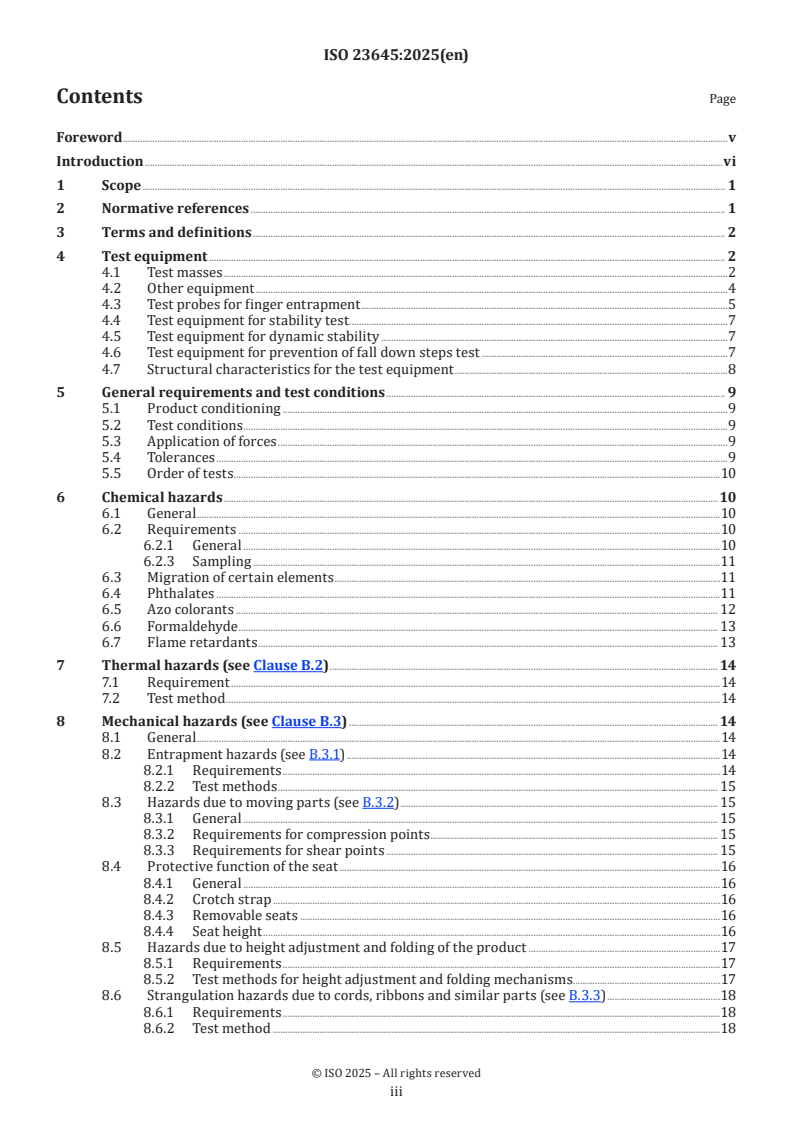
Contents Page
Foreword .v
Introduction .vi
1 Scope . 1
2 Normative references . 1
3 Terms and definitions . 2
4 Test equipment . 2
4.1 Test masses .2
4.2 Other equipment .4
4.3 Test probes for finger entrapment .5
4.4 Test equipment for stability test .7
4.5 Test equipment for dynamic stability .7
4.6 Test equipment for prevention of fall down steps test .7
4.7 Structural characteristics for the test equipment .8
5 General requirements and test conditions . 9
5.1 Product conditioning .9
5.2 Test conditions .9
5.3 Application of forces .9
5.4 Tolerances .9
5.5 Order of tests.10
6 Chemical hazards . 10
6.1 General .10
6.2 Requirements .10
6.2.1 General .10
6.2.3 S ampling .11
6.3 Migration of certain elements .11
6.4 Phthalates .11
6.5 Azo colorants . 12
6.6 Formaldehyde . 13
6.7 Flame retardants . 13
7 Thermal hazards (see Clause B.2) . 14
7.1 Requirement .14
7.2 Test method .14
8 Mechanical hazards (see Clause B.3) . 14
8.1 General .14
8.2 Entrapment hazards (see B.3.1) .14
8.2.1 Requirements .14
8.2.2 Test methods . 15
8.3 Hazards due to moving parts (see B.3.2) . 15
8.3.1 General . 15
8.3.2 Requirements for compression points . 15
8.3.3 Requirements for shear points . 15
8.4 Protective function of the seat .16
8.4.1 General .16
8.4.2 Crotch strap .16
8.4.3 Removable seats .16
8.4.4 Seat height .16
8.5 Hazards due to height adjustment and folding of the product .17
8.5.1 Requirements .17
8.5.2 Test methods for height adjustment and folding mechanisms.17
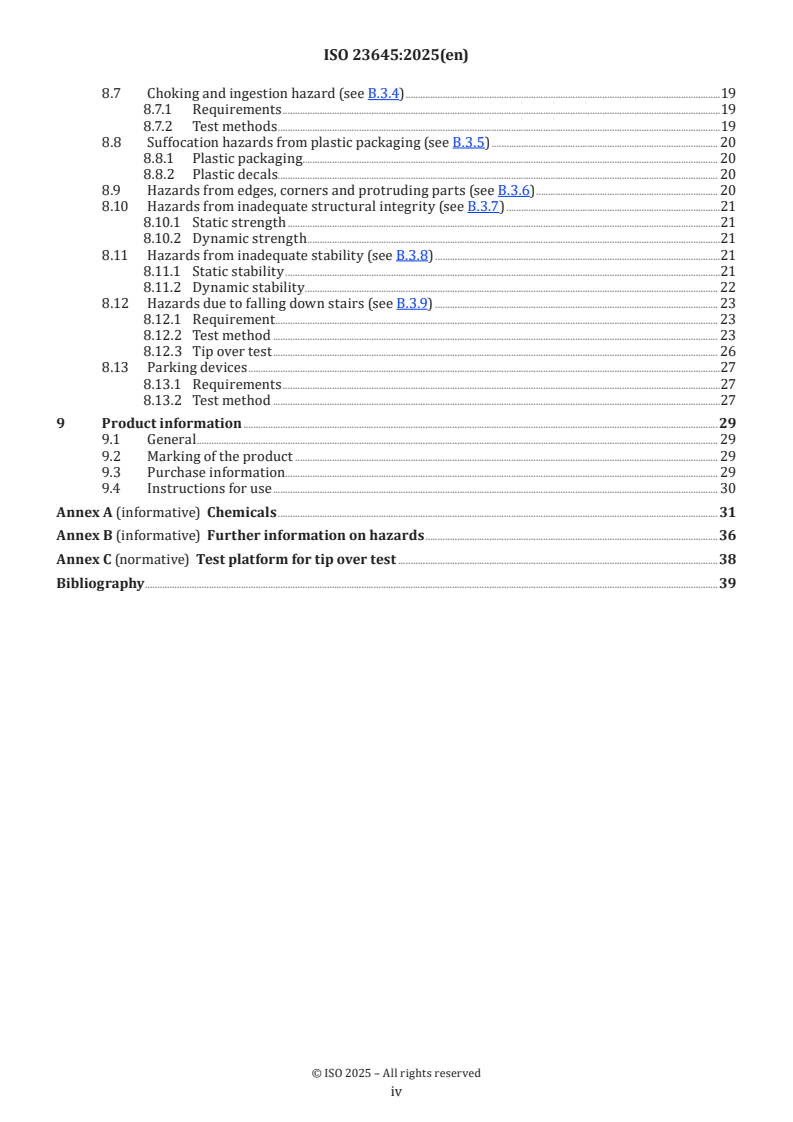
8.6 Strangulation hazards due to cords, ribbons and similar parts (see B.3.3) .18
8.6.1 Requirements .18
8.6.2 Test method .18
iii
8.7 Choking and ingestion hazard (see B.3.4) .19
8.7.1 Requirements .19
8.7.2 Test methods .19
8.8 Suffocation hazards from plastic packaging (see B.3.5) . 20
8.8.1 Plastic packaging. 20
8.8.2 Plastic decals. 20
8.9 Hazards from edges, corners and protruding parts (see B.3.6) . 20
8.10 Hazards from inadequate structural integrity (see B.3.7) .21
8.10.1 Static strength .21
8.10.2 Dynamic strength .21
8.11 Hazards from inadequate stability (see B.3.8) .21
8.11.1 Static stability .21
8.11.2 Dynamic stability . . . 22
8.12 Hazards due to falling down stairs (see B.3.9) . 23
8.12.1 Requirement . 23
8.12.2 Test method . 23
8.12.3 Tip over test . 26
8.13 Parking devices .27
8.13.1 Requirements .27
8.13.2 Test method .27
9 Product information .29
9.1 General . 29
9.2 Marking of the product . 29
9.3 Purchase information . . 29
9.4 Instructions for use . 30
Annex A (informative) Chemicals .31
Annex B (informative) Further information on hazards .36
Annex C (normative) Test platform for tip over test .38
Bibliography .39
iv
Foreword
ISO (the International Organization for Standardization) is a worldwide federation of national standards
bodies (ISO member bodies). The work of preparing International Standards is normally carried out through
ISO technical committees. Each member body interested in a subject for which a technical committee
has been established has the right to be represented on that committee. International organizations,
governmental and non-governmental, in liaison with ISO, also take part in the work. ISO collaborates closely
with the International Electrotechnical Commission (IEC) on all matters of electrotechnical standardization.
The procedures used to develop this document and those intended for its further maintenance are described
in the ISO/IEC Directives, Part 1. In particular, the different approval criteria needed for the different types
of ISO document should be noted. This document was drafted in accordance with the editorial rules of the
ISO/IEC Directives, Part 2 (see www.iso.org/directives).
ISO draws attention to the possibility that the implementation of this document may involve the use of (a)
patent(s). ISO takes no position concerning the evidence, validity or applicability of any claimed patent
rights in respect thereof. As of the date of publication of this document, ISO had not received notice of (a)
patent(s) which may be required to implement this document. However, implementers are cautioned that
this may not represent the latest information, which may be obtained from the patent database available at
www.iso.org/patents. ISO shall not be held responsible for identifying any or all such patent rights.
Any trade name used in this document is information given for the convenience of users and does not
constitute an endorsement.
For an explanation of the voluntary nature of standards, the meaning of ISO specific terms and expressions
related to conformity assessment, as well as information about ISO’s adherence to the World Trade
Organization (WTO) principles in the Technical Barriers to Trade (TBT), see www.iso.org/iso/foreword.html.
This document was prepared by Technical Committee ISO/TC 310, Child care articles.
Any feedback or questions on this document should be directed to the user’s national standards body. A
complete listing of these bodies can be found at www.iso.org/members.html.
v
Introduction
The purpose of this document is to reduce the risk of death and injury when using baby walking frames. It
is stressed that this document cannot eliminate all possible risks to children using such a product and that
carer control is of paramount importance.
Conformity to the requirements of this document will minimize potential hazards associated with using
baby walking frames.
This document is largely based on the existing European standard EN 1273:2020+A1:2023. The differences
between EN 1273:2020+A1:2023 and this document are as follows:
— chemical requirements in Clause 6;
— product information requirements in 9.1 and 9.4.
vi
International Standard ISO 23645:2025(en)
Child care articles — Baby walking frames — Safety
requirements and test methods
1 Scope
This document specifies safety requirements and test methods for baby walking frames into which a child is
placed, and which are intended to be used from when the child is able to sit up unaided (around six months),
until the child is able to walk independently or weighs more than 12 kg.
This document does not apply to:
— baby walking frames:
— for therapeutic and curative purposes;
— that rely on inflatable parts to support the child;
— toys (e.g. ride on toys and push-along toys usually intended for children able to walk unaided).
If a baby walking frame has several functions or can be converted into another function, then the relevant
International Standards apply to it. For example, if a baby walking frame is equipped with toys, the
requirements of the ISO 8124 series apply to the toys.
2 Normative references
The following documents are referred to in the text in such a way that some or all of their content constitutes
requirements of this document. For dated references, only the edition cited applies. For undated references,
the latest edition of the referenced document (including any amendments) applies.
ISO 2439:2008, Flexible cellular polymeric materials — Determination of hardness (indentation technique)
ISO 2813, Paints and varnishes — Determination of gloss value at 20°, 60° and 85°
ISO 8124-2:2023, Safety of toys — Part 2: Flammability
ISO 8124-3:2020, Safety of toys — Part 3: Migration of certain elements
ISO 8124-6:2023, Safety of toys — Part 6: Certain phthalate esters
ISO 14184-1, Textiles — Determination of formaldehyde — Part 1: Free and hydrolysed formaldehyde (water
extraction method)
ISO 14362-1, Textiles — Methods for determination of certain aromatic amines derived from azo colorants —
Part 1: Detection of the use of certain azo colorants accessible with and without extracting the fibres
ISO 14362-3, Textiles — Methods for determination of certain aromatic amines derived from azo colorants —
Part 3: Detection of the use of certain azo colorants, which may release 4-aminoazobenzene
ISO 17226-1, Leather — Chemical determination of formaldehyde content — Part 1: Method using high-
performance liquid chromatography
ISO 17234-1, Leather — Chemical tests for the determination of certain azo colourants in dyed leathers — Part
1: Determination of certain aromatic amines derived from azo colourants
ISO 17234-2, Leather — Chemical tests for the determination of certain azo colorants in dyed leathers — Part 2:
Determination of 4-aminoazobenzene
3 Terms and definitions
For the purposes of this document, the following terms and definitions apply.
ISO and IEC maintain terminology databases for use in standardization at the following addresses:
— ISO Online browsing platform: available at https:// www .iso .org/ obp
— IEC Electropedia: available at https:// www .electropedia .org/
3.1
baby walking frame
structure with a seat in which a child is placed in a sitting or standing position, which allows the child to
move around with the aid of the support offered by the frame
3.2
crotch strap
device which passes between a child’s legs to prevent the child from slipping out of the seat
3.3
base
lower part of the frame where castors or wheels can be attached
3.4
parking device
device to maintain a baby walking frame (3.1) in a stationary position
3.5
placed in the mouth
portion of the baby walking frame (3.1) that is able to be brought to the mouth by a child so that it can be
sucked and chewed
Note 1 to entry: If the portion can only be licked, it is not deemed able to be placed in the mouth. If one dimension of a
portion is smaller than 5 cm, it can be placed in the mouth (e.g. surface of the tray).
Note 2 to entry: Figure A.1 shows examples of what can be placed in the mouth.
4 Test equipment
4.1 Test masses
4.1.1 Test mass A, comprising a rigid cylinder (160 ± 5) mm in diameter and (280 ± 5) mm in height,
+01,
having a mass of 12 kg and with its centre of gravity in the centre of the cylinder. All edges shall have a
radius of (20 ± 1) mm. See Figure 1.
4.1.2 Test mass B, comprising a rigid cylinder (160 ± 5) mm in diameter and (280 ± 5) mm in height,
+01,
having a mass of 76, 5 kg and with its centre of gravity in the centre of the cylinder. All edges shall have
a radius of (20 ± 1) mm. See Figure 1.
4.1.3 Test mass C, comprising a rigid cylinder (160 ± 5) mm in diameter and (280 ± 5) mm in height,
+01,
having a mass of 12,6 kg and with its centre of gravity in the centre of the cylinder. All edges shall have
a radius of (20 ± 1) mm. See Figure 1.
Dimensions in millimetres
Key
1 radius: (20 ± 1) mm
+01,
Test mass A
Mass 12 kg
+01,
Test mass B
Mass 76, 5 kg
+01,
Test mass C
Mass 12,6 kg
Figure 1 — Test masses A, B and C
+01,
4.1.4 Test mass D, comprising a rigid cylinder of 36, kg with a flat bottom surface. See Figure 2.
Figure 2 — Test mass D
4.2 Other equipment
4.2.1 Small parts cylinder, for the assessment of small components, with dimensions in accordance with
Figure 3.
Dimension in millimetres
Figure 3 — Small parts cylinder
4.2.2 Feeler gauge, with a thickness of (0,4 ± 0,02) mm and an insertion edge radius of (3 ± 0,5) mm (see
Figure 4).
Dimensions in millimetres
Figure 4 — Feeler gauge
4.2.3 Foam, comprising a polyurethane foam sheet with a thickness of (60 ± 5) mm, a bulk density of
35 kg/m with a tolerance of 10 % or an indentation hardness index of (170 ± 40) N in accordance with
ISO 2439:2008, A.40.
4.3 Test probes for finger entrapment
4.3.1 Test probes with hemispherical end, made from plastic or other hard, smooth material of
0 +01,
diameters 7 mm and 12 mm with a full hemispherical end that can be mounted on a force-measuring
−01,
device, see Figure 5.
Mesh probe made from plastic or other hard, smooth material as shown in Figure 6.
Dimensions in millimetres
Key
Probe type 7 mm probe 12 mm probe
0 +01,
Diameter A
7 12
−01,
Radius RB half of diameter A half of diameter A
1 line scribed around circumference showing depth of penetration
Figure 5 — Test probes with hemispherical end
Dimensions in millimetres
Key
Probe type mesh probe
Diameter A
−01,
Diameter B
56,
−01,
Radius RB half of diameter B
Figure 6 — Test probe for mesh
4.3.2 Shape assessment probe, made from plastics or other hard, smooth material, which can be
mounted on a force-measuring device, with the dimensions shown in Figure 7.
Dimensions in millimetres
a) front view b) top view
c) side view d) 3D view
Figure 7 — Shape assessment probe
4.4 Test equipment for stability test
4.4.1 Test platform for stability test, comprising a sloping platform inclined at an angle of 30° to the
horizontal with a 100 mm stop fitted to the lower edge of the slope (Figure 8).
Key
1 stop
2 platform
Figure 8 — Test platform for stability test
4.5 Test equipment for dynamic stability
4.5.1 Test platform, comprising the test platform of 4.6.1 with an aluminium stop with a height of 40 mm
and thickness of at least 10 mm at its front edge.
4.5.2 Spacer, comprising a squared sectioned piece of aluminium 40 mm × 40 mm with a minimum length
of 200 mm.
4.6 Test equipment for prevention of fall down steps test
4.6.1 Test platform, comprising a horizontal test platform as shown in Figure C.1 with a flat smooth
surface made of beech wood with a minimum thickness of 18 mm.
The front edge shall be straight cut, without any radius (see Figure 9).
Figure 9 — Front edge of the test platform
The grain of the wooden surface shall be orientated in line with the longitudinal axis of the test platform and
there shall not be any joints perpendicular to the longitudinal axis of the test platform (see Figure 10).
The top shall be pre-finished with wood floor polyurethane varnish with a nominal gloss of (75 ± 5) gloss
units measured with an angle of 60° in accordance with ISO 2813.
The wooden surface shall be fixed to the frame to avoid deformation of the wooden surface during the tests.
If variations in temperature and/or humidity in the laboratory cause the wooden surface to deform, the
fixing shall be adjusted to ensure the wooden surface is flat.
Key
1 direction of the baby walking frame movement
Figure 10 — Orientation of the wooden surface
4.6.2 Steel cable, comprising a galvanised steel cable with a nominal diameter of (2 ± 0,1) mm.
4.6.3 Pulley, comprising a stainless-steel ball-bearing pulley with the functional diameter of 80 mm with
a rounded groove suitable for the cable. The centre of the pulley is positioned at a minimum distance of
510 mm from the platform edge. The height of the pulley shall be adjustable.
4.6.4 Aluminium angle, comprising a 25 mm × 25 mm rigid aluminium angle with a thickness of
(2 ± 0,5) mm and a length of (1,5 ± 0,1) m.
4.6.5 Rigid plate, of dimensions of (50 ± 2) mm × (50 ± 2) mm.
4.7 Structural characteristics for the test equipment
The different parts of the test equipment shall fulfil the following (see Figure 11):
— have a maximum vertical displacement of 1 mm when a force of 400 N is applied over a diameter of
100 mm flush on the centre of the front edge of the platform (point a);
— have a maximum horizontal displacement of 1 mm when a force of 200 N is applied over a diameter of
100 mm on the edge parallel to the longitudinal axis of the platform at the following points: (b) front
edge, (c) middle point, (d) rear edge;
— have a maximum horizontal displacement of 1 mm when a force of 200 N is applied over a diameter of
100 mm in the middle of the front or rear edge along the longitudinal axis of the platform (point e);
— have a maximum vertical displacement of 1 mm when a 20 kg mass is hung on the pulley.
Key
a the centre of the front edge of the platform
b front edge
c middle point
d rear edge
e the longitudinal axis of the platform
Figure 11 — Application of forces on the platform
5 General requirements and test conditions
5.1 Product conditioning
Before testing, any fabrics used shall be cleaned or washed and dried twice in accordance with the
manufacturer’s instructions.
5.2 Test conditions
The tests shall be carried out in ambient conditions of (20 ± 5) °C.
The tests are designed to be applied to baby walking frames that are fully assembled and ready for use in
accordance with the manufacturer’s instructions. If the baby walking frame can be assembled or adjusted in
different ways in accordance with the manufacturer’s instructions, the most onerous combinations shall be
used for each test, unless otherwise specified in the test method.
5.3 Application of forces
The forces in the static load tests shall be applied sufficiently slowly to ensure that negligible dynamic effect
is applied.
5.4 Tolerances
Unless otherwise stated, the accuracy of the test equipment shall be as follows:
— Forces: ±5 % of the nominal force.
— Masses: ±0,5 % of the nominal mass.
— Dimensions: ±0,5 mm of the nominal dimension.
— Angles: ±0,5° of the nominal angle.
— Duration: ±1 s of the nominal duration.
The tests are described in terms of the application of forces. Masses can, however, be used. The relationship
10 N = 1 kg may be used for this purpose.
Unless otherwise specified, the test forces may be applied by any suitable device which does not adversely
affect the results.
5.5 Order of tests
Unless otherwise stated in the test methods, the tests shall be carried out on the same baby walking frame
in the order listed in this document.
6 Chemical hazards
6.1 General
Additional information on the background and rationale for various requirements is given in Annex A. In
general, the main materials used in baby walking frames are plastics or polymers, coatings, rubber, fabrics,
leather and artificial leather.
6.2 Requirements
6.2.1 General
The chemicals presented by material in Table 1 shall conform to the requirements in 6.3 to 6.7.
Table 1 — Chemicals by material
Materials Migration of Phthalates Azo colorants Formaldehyde Flame
certain elements retardants
(see 6.3) (see 6.4) (see 6.5) (see 6.6) (see 6.7)
Plastics X X X
Coating X X
Rubber X X
Artificial
X X X X
leather
Fabric X X X X
Leather X X X
Fibreboard X X
Other materials X
NOTE Other materials (e.g. paper and paperboard, wood, bamboo) are included, but metal, glass and ceramic are excluded.
6.2.3 S ampling
The sample for testing shall be representative of the material used in mass production. Identical materials
may be combined and treated as a single test portion. Test portions may be composed of more than one
material or colour only if physical separation, such as dot printing, patterned textiles or mass limitation
reasons, precludes the formation of discrete specimens.
The above sample requirement does not preclude the testing of materials before they are used to manufacture
(raw materials from manufacturing process).
The manufacturing process should ensure that it does not increase prohibited risk to the materials.
Where a surface is coated with a multi-layer of paint or similar coating, the test sample shall not include
any of the base material. Paint and other similar surface-coating material means a fluid, semi-fluid or other
material, with or without a suspension of finely divided colouring matter, which changes to a solid film when
a thin layer is applied to a metal, wood, leather, cloth, plastic or another surface.
NOTE If the composite materials (e.g. coated fabric) can be mechanically separated, the coating and fabric are
tested separately.
For migration of certain elements and phthalates tests, a test portion of less than 10 mg from a single
laboratory sample shall not be tested.
If the mass of the test portion from a single sample is greater than 10 mg but less than the normal mass for
testing, it is recommended to supplement the test materials as follows:
a) identical material from other locations of the same sample should be supplemented;
b) when sampling from raw materials: if raw materials are used instead of finished product, this should be
noted in the test report.
6.3 Migration of certain elements
The migration of elements from materials (see Table 1) on exterior surfaces shall not exceed the limits listed
in Table 2, considering the correction factor when tested in accordance with ISO 8124-3:2020.
Components under the base (e.g. castors or wheels, braking pads) are excluded from these requirements.
Table 2 — Maximum acceptable element migration from baby walking frames
Element Sb As Ba Cd Cr Pb Hg Se
Limit (mg/kg) 60 25 1 000 75 60 90 60 500
6.4 Phthalates
All accessible plasticized materials should not contain phthalates exceeding the limits in Table 3.
The test procedure given in ISO 8124-6:2023 shall be used.
Table 3 — Maximum acceptable phthalates in baby walking frames
®a
Material Substance CAS Registry Number Limit
Bis (2-ethylhexyl)
117-81-7
phthalate (DEHP)
Plastic or polymer, coating, Concentrations equal to
artificial leather and rubber or less than 0,1 % by mass
Dibutyl phthalate (DBP) 84-74-2
Benzyl butyl phthalate (BBP) 85-68-7
Di-n-octyl phthalate (DNOP) 117-84-0
Plastic or polymer, coating,
28553-12-0
Di-’isononyl’ phthalate
artificial leather and rubber Concentrations equal to
(DINP)
68515-48-0
that can be placed in the or less than 0,1 % by mass
26761-40-0
mouth by children
Di-’isodecyl’ phthalate (DIDP)
68515-49-1
a ®
CAS Registry Number is a trademark of the American Chemical Society (ACS). This information is given for the convenience
of users of this document and does not constitute an endorsement by ISO of the product named. Equivalent products may be used
if they can be shown to lead to the same results.
6.5 Azo colorants
All accessible coloured fabrics, leather and artificial leather shall not contain aromatic amines as given in
Table 4, which can be released by reductive cleavage of one or more azo groups in excess of 30 mg/kg.
Table 4 — Limits of aromatic amines in baby walking frames ®
Material Substance CAS Registry Number Limit
(mg/kg)
4-aminobiphenyl 92-67-1 30
benzidine 92-87-5 30
4-chloro-o-toluidine 95-69-2 30
2-naphthylamine 91-59-8 30
o-aminoazotoluene 97-56-3 30
5-nitro-o-toluidine 99-55-8 30
4-chloroaniline 106-47-8 30
4-methoxy-m-phenylenediamine 615-05-4 30
4,4′-diaminodiphenylmethane 101-77-9 30
3,3′-dichlorobenzidine 91-94-1 30
3,3′-dimethoxybenzidine 119-90-4 30
3,3′-dimethoxybenzidine 119-93-7 30
Fabrics, leather
4,4′-methylenedi-o-toluidine 838-88-0 30
(including artificial)
P-cresidine 120-71-8 30
4,4′-methylene-bis-
101-14-4 30
(2-chloro-ani-line)
4,4′-oxydianiline 101-80-4 30
4,4′-thiodianiline 139-65-1 30
o-toluidine 93-53-4 30
4-methyl-m-phenylenediamine 95-80-7 30
2,4,5-trimethylaniline 137-17-7 30
2-methoxyaniline 90-04-0 30
4-aminoazobenzene 60-09-03 30
2,4-xylidine 95-68-1 30
2,6-xylidine 87-62-7 30
The test procedure given in ISO 14362-1 and ISO 14362-3 for fabric and ISO 17234-1 and ISO 17234-2 for
leather shall be used.
A test portion below 0,2 g in a single laboratory sample shall be exempted from test. All colours shall be
tested. Up to three colours may be combined as one specimen. ®
Azo colorants that are able to form 4-aminoazobenzene generate amines aniline (CAS Registry Number
62-53-3) and 1,4-phenylenediamine (CAS number 106-50-3) under the conditions of ISO 14362-1 and
ISO 17234-1. Due to detection limits, it is possible that only aniline is detected. If aniline of above 5 mg/kg
is detected, then the presence of these colorants shall be tested in accordance with ISO 14362-3 for fabric or
ISO 17234-2 for leather, which can release 4-aminoazobenzene.
So-called “white” and uncoloured fibres, threads or fabrics are not considered to contain azo colorants and,
therefore, these parts may be used without being tested. But attention should be paid to so-called “pale
printed” materials as they can contain azo colorants.
6.6 Formaldehyde
All accessible fabric and leather materials shall not release formaldehyde in excess of 20 mg/kg (see Table 5).
All fibreboard shall not release formaldehyde in excess of 0,124 mg/m (see Table 5).
Table 5 — Maximum acceptable formaldehyde in baby walking frames ®
Material Substance CAS Registry Number Limit
Fabric and leather 20 mg/kg
Formaldehyde 50-00-0
Fibreboard 0,124 mg/m
For formaldehyde released from fabric and leather, the test procedure given in ISO 14184-1 for fabric and
ISO 17226-1 for leather shall be used.
Different types of fabrics shall be tested separately but the colour difference can be ignored. A test portion
below 1,0 g in a single laboratory sample shall be exempted from the test.
For formaldehyde released from fibreboard, the test procedure is defined in ISO 12460-1.
6.7 Flame retardants
Accessible plastics, artificial leather and fabrics of baby walking frames, which are not treated with flame
retardant, shall be exempted from flame-retardant testing. Only a declaration of conformity document is
required. The template of declaration of conformity for flame retardants defined in ISO 31110:2020 (see
Clause A.5) can be used for reference.
Accessible plastics, artificial leather and fabrics in the baby walking frames, which are treated with flame
retardant, shall not contain the flame retardants listed in Table 6 according to the limits given in Table 6.
Table 6 — Flame retardants concerned in baby walking frames ®
CAS Registry Number Substance Limit
a
25637-99-4 Hexabromocyclododecane (HBCDD) < 100 ppm
a
5436-43-1 Tetrabromodiphenyl ether (tetra-BDE) < 10 ppm
a
32534-81-9 Pentabromodiphenyl ether (penta-BDE) < 10 ppm
a
36483-60-0 Hexabromodiphenyl ether(hexa-BDE) < 10 ppm
a
189084-68-2 Heptabromodiphenyl ether (hepta-BDE) < 10 ppm
32536-52-0 Octabromodiphenyl ether(octa-BDE) < 0,1 %
NOTE Relevant regulations include REACH, RoHS, POPs and TSD in the European Union (EU), etc.
a
1 ppm = 1 mg/kg.
TTabablele 6 6 ((ccoonnttiinnueuedd)) ®
CAS Registry Number Substance Limit
1163-19-5 Decabromodiphenyl ether (deca-BDE) < 0,1 %
59536-65-1 Polibrominated biphenyl (PBB) Not used
126-72-7 Tri-(2,3_dibromopropyl)-phosphate (TRIS) Not used
545-55-1 Tris-(aziridinyl)-phosphinoxide (TEPA) Not used
a
115-96-8 Tris(2-chloroethl) phosphate (TCEP) < 5 ppm
a
13674-87-8 Tris-Diclorpropylphosphat (TDCPP) < 5 ppm
a
13674-84-5 Tris-Chlorpropylphosphat (TCPP) < 5 ppm
NOTE Relevant regulations include REACH, RoHS, POPs and TSD in the European Union (EU), etc.
a
1 ppm = 1 mg/kg.
7 Thermal hazards (see Clause B.2)
7.1 Requirement
The rationale for requirements on thermal hazards is given in Annex B. When tested in accordance with
7.2, there shall not be a surface flash and the rate of spread of flame on textile materials shall not exceed
50 mm/s.
These tests can be performed on a separate sample, conditioned according to 5.1, or at the end of the test
sequence.
7.2 Test method
To verify the surface flash effect, apply the test flame defined in ISO 8124-2:2023, 5.5, for (3 ± 0,5) s to the
baby walking frame in different places likely to cause surface flash.
To verify rate of spread of flame, apply the test flame defined in ISO 8124-2:2023, 5.4.
8 Mechanical hazards (see Clause B.3)
8.1 General
The background information and rationales for various requirements on mechanical hazards are given in
Annex B.
8.2 Entrapment hazards (see B.3.1)
8.2.1 Requirements
When tested in accordance with 8.2.2, there shall not be any completely bounded openings between 7 mm
and 12 mm unless the depth is less than 10 mm or unless the shape assessment probe (4.3.2) enters when
tested in accordance with 8.2.2.
When tested in accordance with 8.2.2, there shall not be any openings in mesh that allow the test probe for
mesh (4.3.1) to penetrate to the 7 mm diameter section.
The test shall be carried out with the product in any intended position of use.
This requirement does not apply to the castors, wheels, the whole base of the baby walking frame, and to
any other part of the underside of the tray more than 100 mm from the vertical projection of the outer edge
(see Figure 12).
Dimensions in millimetres
Key
100 mm distance from the edge
Figure 12 — Underside of the tray
8.2.2 Test methods
Check whether the 7 mm probe (4.3.1), with an applied force of up to 30 N, enters 10 mm or more into any
accessible completely bounded opening in any possible orientation.
If the 7 mm probe enters 10 mm or more, then the 12 mm probe (4.3.1) shall also enter 10 mm or more with
an applied force of up to 5 N.
If
...