

ISO/TS 8000-311:2012
(Main)Data quality — Part 311: Guidance for the application of product data quality for shape (PDQ-S)
General Information
- Abstract
ISO/TS 8000-311:2012 provides guidance for the application of product data quality for shape, as described in ISO 10303-59.
- Status
- Published
- Publication Date
- 11-Apr-2012
- Technical Committee
- ISO/TC 184/SC 4 - Industrial data
- Drafting Committee
- ISO/TC 184/SC 4/WG 13 - Industrial Data Quality
- Current Stage
- 9093 - International Standard confirmed
- Start Date
- 06-Dec-2023
- Completion Date
- 29-Aug-2026

Overview
ISO/TS 8000-311:2012 - "Data quality - Part 311: Guidance for the application of product data quality for shape (PDQ‑S)" provides guidance for applying product data quality principles specifically to three‑dimensional shape data as described in ISO 10303‑59. It is part of the ISO 8000 product data quality series and explains how to describe, check, declare and improve the quality of product shape data used across CAD/CAM/PLM and manufacturing processes.
Key topics and requirements
- Scope and definitions: precise terms for product data, product shape data, quality criteria, thresholds, inspection and measurement requirements.
- PDQ‑S schema structure: guidance on the structure and relationship of PDQ‑S schemas to product model schemas (see Figures and schema diagrams in the document).
- Target shape model: how PDQ‑S targets nominal shape representations (B‑rep and related models) for quality assessment.
- Quality criteria for 3D shape data: classification of shape data quality issues and criteria used for checking (accuracy, erroneous_data, short/long edge, gaps, self‑intersections, etc.).
- Conformance and usage methods: two supported methods for applying PDQ‑S, procedures to modify existing Application Protocols (APs) for PDQ‑S conformance, and recommended steps to promote PDQ activities.
- Interaction with checking and healing systems: PDQ‑S as an enabler for standardizing external specifications of quality‑checking algorithms and improved association between checking and data‑healing tools.
- Extensibility and examples: example instantiations, usage scenarios (exchange, assembly, die development) and annexes comparing related specifications.
Practical applications
- Ensuring reliable CAD model exchange between OEMs, suppliers and subcontractors.
- Defining measurable product data quality requirements for digital manufacturing, digital assembly and collaborative engineering.
- Automating and standardizing quality checks in PLM workflows and CAX pipelines.
- Guiding development of PDQ checking and healing tools to produce interoperable quality reports and corrective actions.
Who should use this standard
- CAD/CAM/CAE and PLM software vendors implementing PDQ checks and data exchange.
- Manufacturing engineers, CAD modelers and quality engineers responsible for model readiness for downstream processes.
- Suppliers and OEMs defining contractual data quality requirements for part and assembly geometry.
- Standards developers and integrators aligning application protocols with ISO 10303 (STEP).
Related standards
- ISO 10303‑59 (target representation for PDQ‑S)
- ISO/TS 8000 series (product data quality framework) and ISO/TS 8000‑1
- Comparison material with ISO/PAS 26183 (see Annex C)
Keywords: ISO/TS 8000‑311:2012, PDQ‑S, product data quality for shape, ISO 10303‑59, CAD data quality, PLM, shape data validation.
Get Certified
Connect with accredited certification bodies for this standard

DVS-ZERT GmbH
German welding certification society.
CARES (UK Certification Authority for Reinforcing Steels)
UK certification for reinforcing steels and construction.
EWF/IIW (European/International Welding Federation)
International welding personnel certification.
Sponsored listings
Frequently Asked Questions
ISO/TS 8000-311:2012 is a technical specification published by the International Organization for Standardization (ISO). Its full title is "Data quality — Part 311: Guidance for the application of product data quality for shape (PDQ-S)". This standard covers: ISO/TS 8000-311:2012 provides guidance for the application of product data quality for shape, as described in ISO 10303-59.
ISO/TS 8000-311:2012 provides guidance for the application of product data quality for shape, as described in ISO 10303-59.
ISO/TS 8000-311:2012 is classified under the following ICS (International Classification for Standards) categories: 01.040.25 - Manufacturing engineering (Vocabularies); 25.040.40 - Industrial process measurement and control. The ICS classification helps identify the subject area and facilitates finding related standards.
ISO/TS 8000-311:2012 is available in PDF format for immediate download after purchase. The document can be added to your cart and obtained through the secure checkout process. Digital delivery ensures instant access to the complete standard document.
Standards Content (Sample)
TECHNICAL ISO/TS
SPECIFICATION 8000-311
First edition
2012-04-15
Data quality —
Part 311:
Guidance for the application of product
data quality for shape (PDQ-S)
Qualité des données —
Partie 311: Directives pour l'application de la qualité des données de
produit pour les formes (PDQ-S)
Reference number
©
ISO 2012
© ISO 2012
All rights reserved. Unless otherwise specified, no part of this publication may be reproduced or utilized in any form or by any means,
electronic or mechanical, including photocopying and microfilm, without permission in writing from either ISO at the address below or
ISO's member body in the country of the requester.
ISO copyright office
Case postale 56 CH-1211 Geneva 20
Tel. + 41 22 749 01 11
Fax + 41 22 749 09 47
E-mail copyright@iso.org
Web www.iso.org
Published in Switzerland
ii © ISO 2012 – All rights reserved
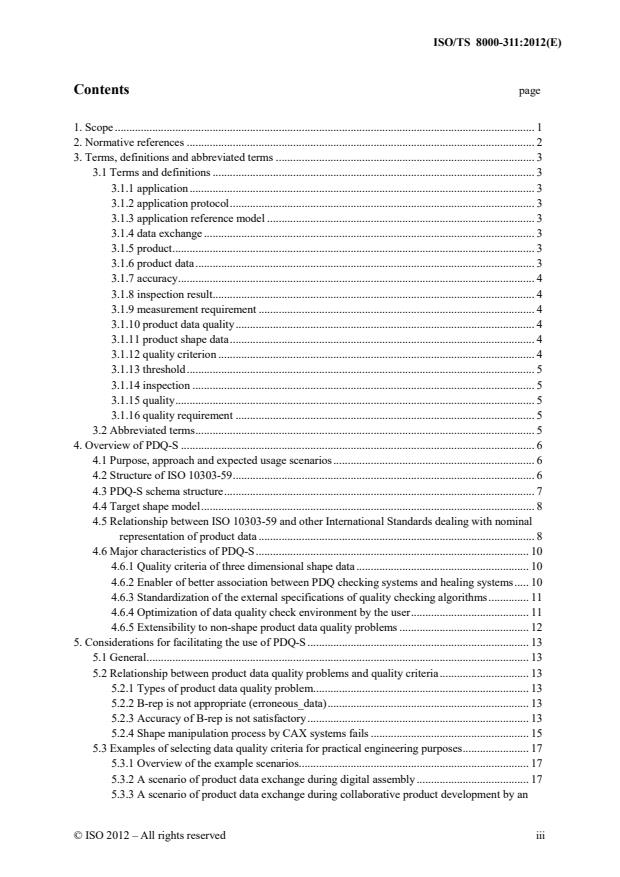
Contents page
1. Scope . 1
2. Normative references . 2
3. Terms, definitions and abbreviated terms . 3
3.1 Terms and definitions . 3
3.1.1 application . 3
3.1.2 application protocol . 3
3.1.3 application reference model . 3
3.1.4 data exchange . 3
3.1.5 product . 3
3.1.6 product data . 3
3.1.7 accuracy . 4
3.1.8 inspection result . 4
3.1.9 measurement requirement . 4
3.1.10 product data quality . 4
3.1.11 product shape data . 4
3.1.12 quality criterion . 4
3.1.13 threshold . 5
3.1.14 inspection . 5
3.1.15 quality . 5
3.1.16 quality requirement . 5
3.2 Abbreviated terms . 5
4. Overview of PDQ-S . 6
4.1 Purpose, approach and expected usage scenarios . 6
4.2 Structure of ISO 10303-59 . 6
4.3 PDQ-S schema structure . 7
4.4 Target shape model . 8
4.5 Relationship between ISO 10303-59 and other International Standards dealing with nominal
representation of product data . 8
4.6 Major characteristics of PDQ-S . 10
4.6.1 Quality criteria of three dimensional shape data . 10
4.6.2 Enabler of better association between PDQ checking systems and healing systems . 10
4.6.3 Standardization of the external specifications of quality checking algorithms . 11
4.6.4 Optimization of data quality check environment by the user . 11
4.6.5 Extensibility to non-shape product data quality problems . 12
5. Considerations for facilitating the use of PDQ-S . 13
5.1 General . 13
5.2 Relationship between product data quality problems and quality criteria . 13
5.2.1 Types of product data quality problem . 13
5.2.2 B-rep is not appropriate (erroneous_data) . 13
5.2.3 Accuracy of B-rep is not satisfactory . 13
5.2.4 Shape manipulation process by CAX systems fails . 15
5.3 Examples of selecting data quality criteria for practical engineering purposes . 17
5.3.1 Overview of the example scenarios . 17
5.3.2 A scenario of product data exchange during digital assembly . 17
5.3.3 A scenario of product data exchange during collaborative product development by an
assembly manufacturer and parts suppliers . 18
5.3.4 A scenario of product data exchange during production equipment/die development
aiming at machining dies . 18
5.4 Recommended procedure for promoting PDQ activity . 20
6. Ensuring conformance with PDQ-S . 22
6.1 General . 22
6.2 Underlying concepts of PDQ-S . 22
6.2.1 Usage scenarios of PDQ-S . 22
6.2.2 Relationship between a product data and its data quality information . 23
6.3 Two methods of using PDQ-S . 25
6.4 Modifying existing APs in order to make them PDQ-S conformant . 26
6.4.1 General . 26
6.4.2 Extension of an existing AP with PDQ-S modules . 26
6.4.3 PDQ-S modules . 26
6.4.4 Proposed procedure for creating a PDQ-S conformant AP . 27
Annex A (normative) Information object registration . 29
A.1 Document identification. 29
Annex B (informative) Technical discussion . 30
B.1 Background . 30
B.2 Definition of product data quality . 30
Annex C (informative) Comparison of ISO 10303-59 and ISO/PAS 26183 . 32
C.1 Similarity . 32
C.2 Difference . 32
C.1.1 Representation method . 32
C.1.2 Target industry . 32
C.1.3 Target data type . 32
Annex D (informative) Instantiation examples . 33
D.1 General . 33
D.2 Graphical notation for instances . 33
D.3 Instances for short_length_edge . 34
D.4 Instances for gap_between_edge_and_base_surface . 55
Bibliography . 59
Index . 61
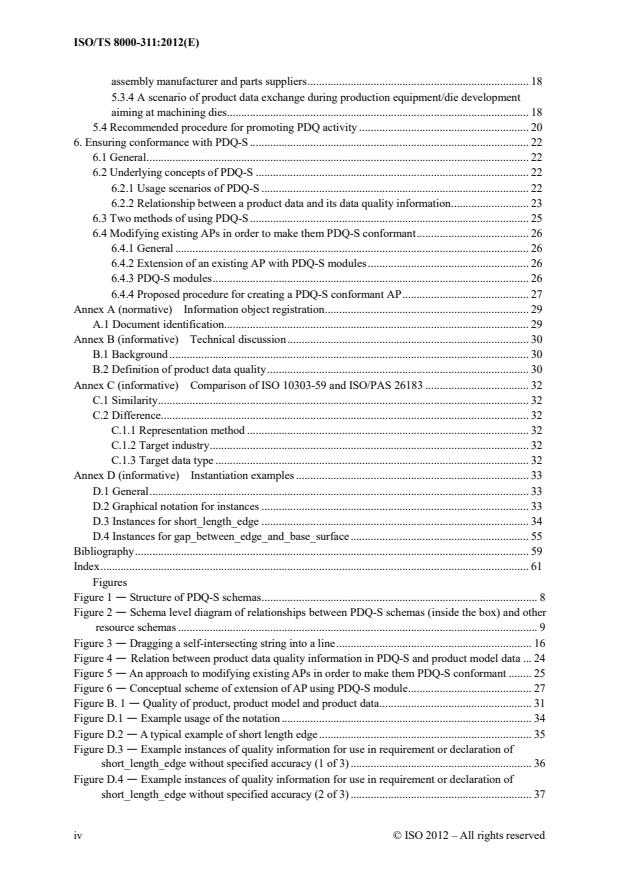
Figures
Figure 1 — Structure of PDQ-S schemas . 8
Figure 2 — Schema level diagram of relationships between PDQ-S schemas (inside the box) and other
resource schemas . 9
Figure 3 — Dragging a self-intersecting string into a line . 16
Figure 4 — Relation between product data quality information in PDQ-S and product model data . 24
Figure 5 — An approach to modifying existing APs in order to make them PDQ-S conformant . 25
Figure 6 — Conceptual scheme of extension of AP using PDQ-S module . 27
Figure B. 1 — Quality of product, product model and product data . 31
Figure D.1 — Example usage of the notation . 34
Figure D.2 — A typical example of short length edge . 35
Figure D.3 — Example instances of quality information for use in requirement or declaration of
short_length_edge without specified accuracy (1 of 3) . 36
Figure D.4 — Example instances of quality information for use in requirement or declaration of
short_length_edge without specified accuracy (2 of 3) . 37
iv © ISO 2012 – All rights reserved
Figure D.5 — Example instances of quality information for use in requirement or declaration of
short_length_edge without specified accuracy (3 of 3) . 38
Figure D.6 — Example instances of quality information for use in the improvement of quality of
short_length_edge (1 of 8) . 44
Figure D.7 — Example instances of quality information for use in the improvement of quality of
short_length_edge (2 of 8) . 45
Figure D.8 — Example instances of quality information for use in the improvement of quality of
short_length_edge (3 of 8) . 46
Figure D.9 — Example instances of quality information for use in the improvement of quality of
short_length_edge (4 of 8) . 47
Figure D.10 — Example instances of quality information for use in the improvement of quality of
short_length_edge (5 of 8) . 48
Figure D.11 — Example instances of quality information for use in the improvement of quality of
short_length_edge (6 of 8) . 49
Figure D.12 — Example instances of quality information for use in the improvement of quality of
short_length_edge (7 of 8) . 50
Figure D.13 — Example instances of quality information for use in the improvement of quality of
short_length_edge (8 of 8) . 51
Foreword
ISO (the International Organization for Standardization) is a worldwide federation of national
standards bodies (ISO member bodies). The work of preparing International Standards in normally
carried out through ISO technical committees. Each member body interested in a subject for which a
technical committee has been established has the right to be represented on that committee.
International organizations, governmental and non-governmental, in liaison with ISO, also take part in
the work. ISO collaborates closely with the International Electrotechnical Commission (IEC) on all
matters of electrotechnical standardization.
International Standards are drafted in accordance with the rules given in the ISO/IEC Directives, Part
2.
The main task of technical committees is to prepare International Standards. Draft International
Standards adopted by the technical committees are circulated to the member bodies for voting.
Publication as an International Standard requires approval by at least 75% of the member bodies
casting a vote.
In other circumstances, particularly when there is an urgent market requirement for such documents, a
technical committee may decide to publish other types of normative documents:
— an ISO Publicly Available Specification(ISO/PAS) represents an agreement between technical
experts in an ISO working group and is accepted for publication if it is approved by more than 50% of
the members of the parent committee casing a vote;
— an ISO Technical Specification(ISO/TS) represents an agreement between the members of a
technical committee and is accepted for publication if it is approved by 2/3 of the members of the
committee casting a vote.
An ISO/PAS or ISO/TS is reviewed every three years with a view to deciding whether it can be
transformed into an International Standard.
Attention is drawn to the possibility that some of the elements of this part of ISO 8000 may be the
subject of patent rights. ISO shall not be held responsible for identifying any or all such patent rights.
ISO/TS 8000-311 was prepared by Technical Committee ISO/TC184, Automation systems and
integration, Subcommittee SC4, Industrial data.
ISO 8000 is organized as a series of parts, each published separately. The structure of ISO 8000 is
described in ISO/TS 8000-1.
Each part of ISO 8000 is a member of one of the following series: general data quality, master data
quality, transactional data quality and product data quality. This part of ISO 8000 is a member of the
product data quality series.
A complete list of parts of ISO 8000 is available from the Internet:
vi © ISO 2012 – All rights reserved
Introduction
The ability to create, collect, store, maintain, transfer, process and present data to support business
processes in a timely and cost effective manner requires both an understanding of the characteristics of
the data that determine its quality, and an ability to measure, manage and report on data quality.
ISO 8000 defines characteristics that can be tested by any organization in the data supply chain to
objectively determine conformance of the data to ISO 8000.
ISO 8000 provides a framework for improving data quality that can be used independently or in
conjunction with quality management systems.
ISO 8000 covers industrial data quality characteristics throughout the product life cycle from
conception to disposal. ISO 8000 addresses specific kinds of data including, but not limited to, master
data, transaction data, and product data.
Assets can be grouped into real and intellectual property. Information is intellectual property. Data is a
prerequisite to information. Thus, the quality of data is a key determiner of an organization’s ability to
preserve and transfer intellectual property.
A characteristic of data is its portability from one system to another. Syntax and semantics encoding
determine whether data is portable in a reliable way. ISO 8000 specifies requirements for the
declaration of syntax and semantic encoding. This allows the user to determine the limitations of data
portability. By requesting data that conforms to ISO 8000, the user is able to manage data portability
and protect its intellectual property assets.
Data quality is the degree to which data meets user requirements. ISO 8000 contains specifications for
the declaration of the conformance to stated data requirements. This allows the user to request data
that meets its requirements and to determine if the data received meets its requirements.
This part of ISO 8000 is a member of the product data quality series and aims at facilitating effective
use of product data quality for shape (PDQ-S), as described in ISO 10303-59.
Since the publication of ISO 10303-59, the worldwide automotive industry has made use of PDQ-S in
ISO/PAS 26183, whilst the joint automotive and aerospace project, ISO 10303-242, will make use of
the PDQ modules, which are a modular version of PDQ-S.
NOTE The first edition of ISO 10303-59, published in 2008, provides general specifications for the
representation of quality criteria, quality measurement requirements, quality assessment specifications and
quality inspection results for product data. These specifications are provided so that PDQ-S can be extended to
deal with the quality of non-shape product data in the future. Extensions to externally conditioned data quality
and geometric dimensioning and tolerance (GD&T) data quality, which are currently under development in the
revision of ISO 10303-59, are examples of such extension. By focusing on three dimensional shape data, PDQ-S
also provides detailed specifications for the representation of shape data quality criteria, together with associated
measurement requirements, shape data quality assessment specifications and detailed results of shape data
quality inspections.
PDQ-S is applicable to any International Standard dealing with product data. In order to further extend
its usage, this part of ISO 8000 provides the necessary background knowledge to enable the effective
use of PDQ-S in various circumstances.
Clause 4 provides a condensed description of PDQ-S.
Clause 5 facilitates the use of PDQ-S.
Clause 6 focuses on ensuring conformance with PDQ-S.
viii © ISO 2012 – All rights reserved
TECHNICAL SPECIFICATION ISO/TS 8000-311:2012(E)
Data quality —
Part 311:
Guidance for the application of product data quality for shape
(PDQ-S)
1. Scope
This part of ISO 8000 provides guidance for the application of product data quality for shape (PDQ-S),
as described in ISO 10303-59.
The following are within the scope of this part of ISO 8000:
— purpose, approach and expected usage scenarios;
— the structure of PDQ-S;
— PDQ-S schema structure;
— target shape model;
— the relationship between ISO 10303-59 and other International Standards dealing with the
nominal representation of product data;
— the major characteristics of PDQ-S;
— the relationship between product data quality problems and quality criteria in PDQ-S;
— some examples for selecting appropriate quality criteria;
— ensuring conformance with PDQ-S.
The following is outside the scope of this part of ISO 8000:
— guidance relating to the quality of product data other than shape data.
2. Normative references
The following referenced documents are indispensable for the application of this document. For dated
reference, only the edition cited applies. For undated references, the latest edition of the referenced
document (including any amendments) applies.
ISO 10303-42, Industrial automation systems and integration — Product data representation and
exchange — Part 42: Integrated generic resource: Geometric and topological representation
ISO 10303-59, Industrial automation systems and integration — Product data representation and
exchange — Part 59: Integrated generic resource: Quality of product shape data
ISO 8000-2, Data quality — Part 2: Vocabulary
2 © ISO 2012 – All rights reserved
3. Terms, definitions and abbreviated terms
3.1 Terms and definitions
For the purposes of this document, the terms and definitions given in ISO 8000-2 and the following
apply.
3.1.1
application
group of one or more processes creating or using product data
[ISO 10303-1:1994, definition 3.2.2]
3.1.2
application protocol
AP
part of ISO 10303 that specifies an application interpreted model satisfying the scope and information
requirements for a specific application
NOTE Adapted from ISO 10303-1:1994, definition 3.2.7
3.1.3
application reference model
ARM
information model that describes the information requirements and constraints of a specific application
context
[ISO 10303-1: 1994, definition 3.2.8]
3.1.4
data exchange
storing, accessing, transferring and archiving of data
[ISO 10303-1:1994, definition 3.2.15]
3.1.5
product
thing or substance produced by a natural or artificial process
[ISO 10303-1:1994, definition 3.2.26]
3.1.6
product data
representation of information about a product in a formal manner suitable for communication,
interpretation or processing by human beings or by computers
[ISO 10303-1:1994, definition 3.2.27]
3.1.7
accuracy
specification to control precision of approximate solution
NOTE The intended interpretation of the accuracy is that an approximate solution is acceptable if the difference
between that approximate solution and any other approximate solution obtained by calculation with a finer
distribution of sampling points is smaller than the given accuracy. There are two types of accuracy:
— general accuracy applied to all the measurement, and
— specific accuracy applied only to specified measurement.
3.1.8
inspection result
result of inspection which indicates whether, or not, the product shape data inspected contains quality
defects
NOTE Such results can also include detailed information on what type of quality defects exist, and how serious
the defect is, together with the shape element data where the problem is detected.
3.1.9
measurement requirement
textual description of how a criterion is measured, including any necessary additional attributes and
rules to control the test and the element or elements to be tested, and which plays the role of an
external specification for reliable measurement algorithm
NOTE It is important to take care that the measurement requirement does not provide an algorithm for the
measurement process, since it is understood that algorithm development is a competitive arena for engineering
system vendors and cannot be standardized by an International Standard.
3.1.10
product data quality
consistency, completeness, and suitability for its purpose of the product data
[ISO 10303-59:2008, definition 3.5.2]
3.1.11
product shape data
data representing product shape with geometric and topological information in accordance with
ISO 10303-42
[ISO 10303-59:2008, definition 3.5.4]
3.1.12
quality criterion
criterion for evaluating product data quality
4 © ISO 2012 – All rights reserved
3.1.13
threshold
allowance used for the assessment of shape data quality by numerical test
NOTE An example of a typical threshold is distance threshold for evaluating the gap between a base surface
and bounding curves for trimming the effective portion of the surface. That distance threshold implies that if the
maximum distance between the surface and the curves is greater than or equal to the specified minimum value,
then the gap is understood as a quality defect.
3.1.14
inspection
conformity evaluation by observation and judgement accompanied as appropriate by measurement,
testing or gauging
[ISO 9000:2005, definition 3.8.2]
3.1.15
quality
degree to which a set of inherent characteristics fulfils requirements
NOTE 1 The term “quality” can be used with adjectives such as poor, good or excellent.
NOTE 2 “Inherent” as opposed to “assigned” means existing in something, especially as a permanent
characteristic.
[ISO 9000:2005, definition 3.1.1]
3.1.16
quality requirement
need or expectation that is stated, generally implied or obligatory
NOTE Adapted from ISO 9000:2005, definition 3.1.2.
3.2 Abbreviated terms
AP application protocol
ARM application reference model
AM application module
B-rep boundary representation
IR integrated resource (of ISO 10303)
PDQ-S product data quality for shape (as described in ISO 10303-59)
4. Overview of PDQ-S
4.1 Purpose, approach and expected usage scenarios
The purpose of PDQ-S, as described in ISO 10303-59, is to eliminate inadequate quality product data
which is a major reason for rework and repair of data by the data receiver. The approach of PDQ-S is
to enumerate concrete measures for eliminating inadequate quality product data.
Amongst the expected scenarios for the use of PDQ-S are as follows.
— Requirement of quality: The company placing an order requires the company receiving the order
to create product data that satisfies prescribed quality requirements. Examples are exclusion of
infinitesimal geometry smaller than the given tolerance and exclusion of redundant geometry not
contributing to the representation of product shape. Very limited information, namely relevant
criteria together with required thresholds from those provided in PDQ-S, is necessary in this
scenario. The information is transferred together with the order.
— Declaration of quality: The creator of a product data uses quality information for explicitly
declaring the quality level satisfied by the product model. Depending on the design method and
the CAD system used, the quality of the product data can be unambiguously declared without any
inspection. Selective criteria and thresholds for which the model is judged to be free from quality
defects are required information in this scenario. The quality information is transferred together
with the corresponding product model data.
— Assurance of quality: A quality assurance organization uses quality information for representing
the results of quality inspection for a particular product model. This scenario will require inspected
quality criteria together with thresholds used, measurement requirements deployed and inspection
results obtained. The accuracies used can also be included. The information is transferred together
with the corresponding product model data.
— Quality information for use in quality improvement: If a quality defect is detected by quality
inspection, necessary actions for improving critical data will be required. For that purpose,
information on the nature and severity of any quality defects is provided. Therefore, this scenario
will require a detailed inspection result report at the level of geometric entity instances. The
information is transferred together with the corresponding product model data.
— Long-term archiving of product data: It is desirable that a detailed record of product model data
quality is archived with product data. The data requirement for this purpose is similar to that
needed for assurance of quality.
4.2 Structure of ISO 10303-59
Terminology specific to ISO 10303-59:2008 is described in Clause 3. The main body of ISO 10303-59
contains the following schemas:
— Clause 4: Product data quality definition schema;
— Clause 5: Product data quality criteria schema;
— Clause 6: Product data quality inspection result schema;
— Clause 7: Shape data quality criteria schema;
— Clause 8: Shape data quality inspection result schema.
Appendices include EXPRESS-G diagrams, graphical notation of EXPRESS schemas to ease
understanding of structure and relationships of entity data types, technical discussion that summarizes
6 © ISO 2012 – All rights reserved
basic understanding of standard developers on key technical issues, expected usage scenarios and
some examples in entity instance level.
4.3 PDQ-S schema structure
PDQ-S consists of five mutually related schemas. Each schema is a collection concepts, functions and
entities.
Product data quality definition schema defines high-level data elements for managing product data
quality information.
Product data quality criteria schema provides general specifications for the representation of quality
criteria, quality measurement requirements and quality assessment specifications for product data.
Product data quality inspection result schema provides general specifications for the representation
of quality inspection results for a particular product data.
Shape data quality criteria schema provides representations of shape data quality criteria together
with corresponding measurement requirements, thresholds for judging the existence or absence of
quality defects and assessment specifications for product shape data.
Shape data quality inspection result schema provides representations of quality inspection results
for a particular product shape data with regard to specified quality criteria. Detailed information on
what type of quality defect is existing, and how serious the defect is, together with the shape element
data where the problem is detected can also be represented.
These schemas are related as depicted in Figure 1 where the number in each block indicates the
relevant clause number in ISO 10303-59:2008. The product data quality definition schema plays the
role of a root node for a set of quality information. The shape data quality criteria schema is a
specialization of the product data quality criteria schema to three dimensional shape data. In the same
way, the shape data quality inspection result schema is a specialization of the product data quality
inspection result schema to three dimensional shape data.
4. Product data quality definition
5. Product data quality criteria 7. Shape data quality criteria
6. Product data quality inspection 8. Shape data quality inspection
result result
Elements of quality information
Specialization to shape
Figure 1 — Structure of PDQ-S schemas
In ISO 10303-59:2008, each schema is structured in the following way, where X is a schema number:
X.1: Introduction
X.2: Fundamental concepts and assumptions
X.3: Type definitions
X.4: Entity definitions
X.5: Function definitions
X.2 describes the basic concepts and assumptions of schema-X. X.3 defines schema-X specific data
type definitions that are used in the EXPRESS specifications in X.4. X.4 is the main body of
schema-X where criteria are described as entity data types. Functions used in the EXPRESS
specifications of X.4 are described in X.5.
4.4 Target shape model
The target shape model of PDQ-S is a boundary representation (B-rep) model conformant to the
manifold_solid_brep entity definition in ISO 10303-42. Such models are implemented in many of
today’s commercial CAD system for representing product shape. In APs and modules they typically
form part of an advanced_brep_shape_representation.
4.5 Relationship between ISO 10303-59 and other International Standards dealing with
nominal representation of product data
The direct relationship between PDQ-S schemas and other resource schemas is depicted in Figure 2.
A major difference between PDQ-S and other International Standards dealing with nominal
representation of product data is that PDQ-S deals with quality aspect of instanced data. The major
reason why data exchange between two IT systems which claim STEP conformance(such as CAD
systems), frequently fails due to instanced data quality problems is that the implementation of B-rep
model and the guaranteed numerical accuracy guaranteed are IT system dependent. Therefore, STEP
conformance is not a sufficient condition for successful data exchange or sharing but it is also
necessary that the quality of instanced data should be satisfactory.
8 © ISO 2012 – All rights reserved
ssuppupporortt_r_reessourourccee__ pprroodduucct_t_ddeeffininitioitionn__
rrepeprresesenenttatatiioonn__sschchememaa
sscchheemama sscchheemama
prprooducductt__dadattaa_q_quaualliittyy__
dedeffiininittiionon_s_scchehemmaa
prprooducductt__dadattaa_q_quaualliittyy__
prprooducductt__dadattaa_q_quaualliittyy__
iinsnspepeccttiioon_rn_reessulultt
prprooducductt__prproopeperrttyy__
crcriittereriia_a_sschcheemmaa
__sschchememaa
dedeffiininittiionon_s_scchehemmaa
qquuaaliflifieiedd__
mmeaseasuurre_e_
sscchheemama
prprooducductt__prproopeperrttyy__
sshahapepe_da_dattaa__quaqualliittyy__
rrepeprresesenenttatatiioonn__sschchememaa
sshahapepe_da_dattaa__quaqualliittyy__
iinsnspepeccttiioon_rn_reessulultt__
crcriittereriia_a_sschcheemmaa
sscchheemama
mmeaseasuurre_e_sschcheemmaa
ggeoeommetetrriic_c_mmooddelel__ ttopopolologogyy__ ggeoeommetetrryy__
sscchheemama sscchheemama sscchheemama
Figure 2 — Schema level diagram of relationships between PDQ-S schemas (inside the box) and
other resource schemas
The schemas occurring in Figure 2 are components of ISO 10303 integrated generic resources, and
they are specified in the following resource parts:
measure_schema ISO 10303-41
product_definition_schema ISO 10303-41
product_property_definition_schema ISO 10303-41
product_property_representation_schema ISO 10303-41
support_resource_schema ISO 10303-41
geometric_model_schema ISO 10303-42
geometry_schema ISO 10303-42
topology_schema ISO 10303-42
representation_schema ISO 10303-43
qualified_measure_schema ISO 10303-45
4.6 Major characteristics of PDQ-S
4.6.1 Quality criteria of three dimensional shape data
Quality criteria of three-dimensional shape data fall into the following classes:
— Erroneous data;
— Inapt data;
Each of these classes is further categorized into the following sub-classes:
— Geometry specific issue;
— Topology specific issue;
— Combined geometry and topology issue;
— Geometric model issue.
‘Erroneous data’ implies a mathematically invalid product shape data. Typical examples are erroneous
b_spline surface definition, open edge loop and inconsistent face and underlying surface normals. An
example of an erroneous instance of a b_spline_surface is one in which there is an inconsistency
between the degrees, the number of knots, the knot multiplicities and the number of control points.
Such an instance will violate one, or more, of the WHERE rules in the definition of the corresponding
b_spline_surface_with_knots entity. The judgement of erroneous data is generally a binary decision as
to whether or not rules in the entity definition are broken and does not involve a numerical threshold
value.
‘Inapt data’ implies data inappropriate for some applications though it is not necessarily
mathematically incorrect. Amongst examples are self-intersecting curve, excessively high curve
degree, surface with small radii of curvature and narrow width surface patches. Even when shape data
have acceptable quality in the senses described above, there exists a number of cases where engineers
in downstream processes have to rework the data so that it can be effectively used.
For example, mould design engineers have to modify a product shape data if an appropriate draft angle
is not taken into account in the data. The knowledge as to whether various manufacturing requirements
are incorporated into the data or not may save the cost of rework.
4.6.2 Enabler of better association between PDQ checking systems and healing systems
There is basically no association between separate PDQ checking and healing systems. Lack of
reliable inspection result representation at the entity instance level is the major reason of this non
association. Even when results of a PDQ check by some checking system exist, any separate PDQ
healing system tends to check data quality again for obtaining reliable check results before starting the
healing process. Inspection result representation at the entity instance level provided by PDQ-S may
10 © ISO 2012 – All rights reserved
be used to resolve this redundant check situation.
The shape data quality inspection result schema provides representation of quality inspection results
for specific product shape data with regard to specified quality criteria. The inspection result indicates
whether or not the product shape data inspected contains quality defects. It may also include detailed
information on what type of quality defect exists, and how serious the defect is, together with the
shape element data where the problem is detected. This information is expected to be useful for quality
healing processes and to help efficient cooperation between quality checking systems and healing
systems for product shape data.
4.6.3 Standardization of the external specifications of quality checking algorithms
Two different PDQ checking systems may produce different check results for inspection of the same
product data where the same criteria and the same thresholds are specified for the check, which
deteriorates reliability of PDQ checking systems. The reason why this problem occurs is that the
quality check algorithm for each quality criterion is left to the PDQ checking system vendor’s freedom
and there is no guideline for acceptable quality check algorithm.
The solution by PDQ-S to this problem is the introduction of a concept named ‘measurement
requirement’, which is an external specification of an acceptable algorithm. Each shape quality
criterion includes a pertaining measurement requirement, which is a textual description of how the
criterion is to be measured and may have additional attributes and rules to control the test and the
element or elements to be tested. It is expected that the dependence of check results on individual PDQ
checking systems be drastically reduced if developers of a PDQ checking system review their system
as to whether or not they satisfy the requested measurement requirements and improve the system as
necessary
NOTE Measurement algorithms are outside the scope of PDQ-S since it is understood that algorithm
development is a competitive arena for engineering system vendors and cannot be standardized by an
international standard.
4.6.4 Optimization of data quality check environment by the user
Data quality requirements, thresholds to be applied for quality test and numerical calculation
accuracies to be applied in the quality test algorithm are obviously dependent on the target
design/manufacturing object and/or design/manufacturing activity. Therefore, these should be user
definable. PDQ-S provides sufficient resources for the users to select the most appropriate quality
criteria together with thresholds to be applied for the 3D shape data under development. Assuming that
some users may even want to specify the accuracy of numerical calculations, the accuracy to be
applied in a quality test by PDQ checking systems is also user definable. This standard provides some
examples and suggestions for selecting appropriate criteria in Clause 5.
User definable thresholds from application protocols supporting shape models, such as ISO 10303-203
and ISO 10303-214, play a key role in the assessment of shape data quality by numerical test. An
example of a typical threshold is a distance threshold for evaluating a gap between a base surface and
bounding curves for trimming the effective portion of the surface. That distance threshold implies that
if the maximum distance between the surface and the curves is greater than or equal to the specified
minimum value, then the gap should be understood as a quality defect. Appropriate thresholds depend
on many factors such as the size of a product, design requirements and the sensitivity of engineering
systems to nume
...