

ISO 8000-2:2022
(Main)Data quality — Part 2: Vocabulary
General Information
- Abstract
This document defines terms relating to data quality. These terms are used by the parts in the ISO 8000 series.
- Status
- Published
- Publication Date
- 21-Sep-2022
- Technical Committee
- ISO/TC 184/SC 4 - Industrial data
- Drafting Committee
- ISO/TC 184/SC 4 - Industrial data
- Current Stage
- 9092 - International Standard to be revised
- Start Date
- 16-May-2025
- Completion Date
- 29-Aug-2026

Overview
ISO 8000-2:2022 - "Data quality - Part 2: Vocabulary" is the fifth edition of the ISO vocabulary that defines the terms used across the ISO 8000 series on data quality. The document establishes a single, common vocabulary for data quality topics so that organizations, implementers and standards writers share a consistent language for data quality, data governance and related processes.
Why it matters: consistent terminology is foundational for data quality management, governance, interoperability and for applying other ISO 8000 parts across information systems and supply chains.
Key topics
ISO 8000-2:2022 organizes and standardizes terms across many topic areas, including:
- Terms relating to quality (e.g., process, requirement, quality management)
- Terms relating to data and information (structure, semantics, pragmatics)
- Identifiers and measurement (identifier concepts, measurement definitions)
- Industrial and product data (industrial data, characteristic data, product/master data)
- Data dictionary and syntax/semantics (data dictionaries, syntax, semantics)
- Data quality lifecycle and governance (data quality roles, data governance, process assessment)
- Transaction and master data (transactional records, master data concepts)
The standard also documents normative references and provides an informative Annex for document identification. It aligns terminology where possible with ISO 9000 and other ISO 8000 parts to improve consistency.
Practical applications
ISO 8000-2:2022 is primarily a reference vocabulary to be used when implementing or assessing data quality practices. Typical use cases:
- Creating data governance frameworks and policies with consistent definitions
- Developing data quality management systems and maturity assessments
- Writing or mapping data dictionaries, metadata catalogs, and master data specifications
- Enabling interoperability in supply chains by ensuring shared meaning for identifiers and product data
- Supporting audits, compliance assessments and contractual requirements that reference data quality terms
Who benefits:
- Data managers, data stewards and chief data officers
- Quality managers and process owners
- System integrators, software developers and solution architects
- Procurement, supply chain and product lifecycle teams
- Regulators and auditors requiring consistent terminology
Related standards
ISO 8000-2:2022 is part of the ISO 8000 series and works alongside:
- ISO 8000-1 (series structure and scope)
- ISO 8000-8 (measuring information and data quality)
- ISO 8000-61 (data quality management process model)
- ISO 8000-110 and other parts that address characteristic, master and product data
Using ISO 8000-2:2022 ensures consistent terminology for successful data quality, governance and interoperability initiatives.
Relations
- Effective Date
- 06-Jun-2022
- Effective Date
- 06-Jun-2022
Get Certified
Connect with accredited certification bodies for this standard

DVS-ZERT GmbH
German welding certification society.
CARES (UK Certification Authority for Reinforcing Steels)
UK certification for reinforcing steels and construction.
EWF/IIW (European/International Welding Federation)
International welding personnel certification.
Sponsored listings
Frequently Asked Questions
ISO 8000-2:2022 is a standard published by the International Organization for Standardization (ISO). Its full title is "Data quality — Part 2: Vocabulary". This standard covers: This document defines terms relating to data quality. These terms are used by the parts in the ISO 8000 series.
This document defines terms relating to data quality. These terms are used by the parts in the ISO 8000 series.
ISO 8000-2:2022 is classified under the following ICS (International Classification for Standards) categories: 01.040.25 - Manufacturing engineering (Vocabularies); 25.040.40 - Industrial process measurement and control. The ICS classification helps identify the subject area and facilitates finding related standards.
ISO 8000-2:2022 has the following relationships with other standards: It is inter standard links to ISO 8000-2:2020, ISO 8000-2:2020/Amd 1:2021. Understanding these relationships helps ensure you are using the most current and applicable version of the standard.
ISO 8000-2:2022 is available in PDF format for immediate download after purchase. The document can be added to your cart and obtained through the secure checkout process. Digital delivery ensures instant access to the complete standard document.
Standards Content (Sample)
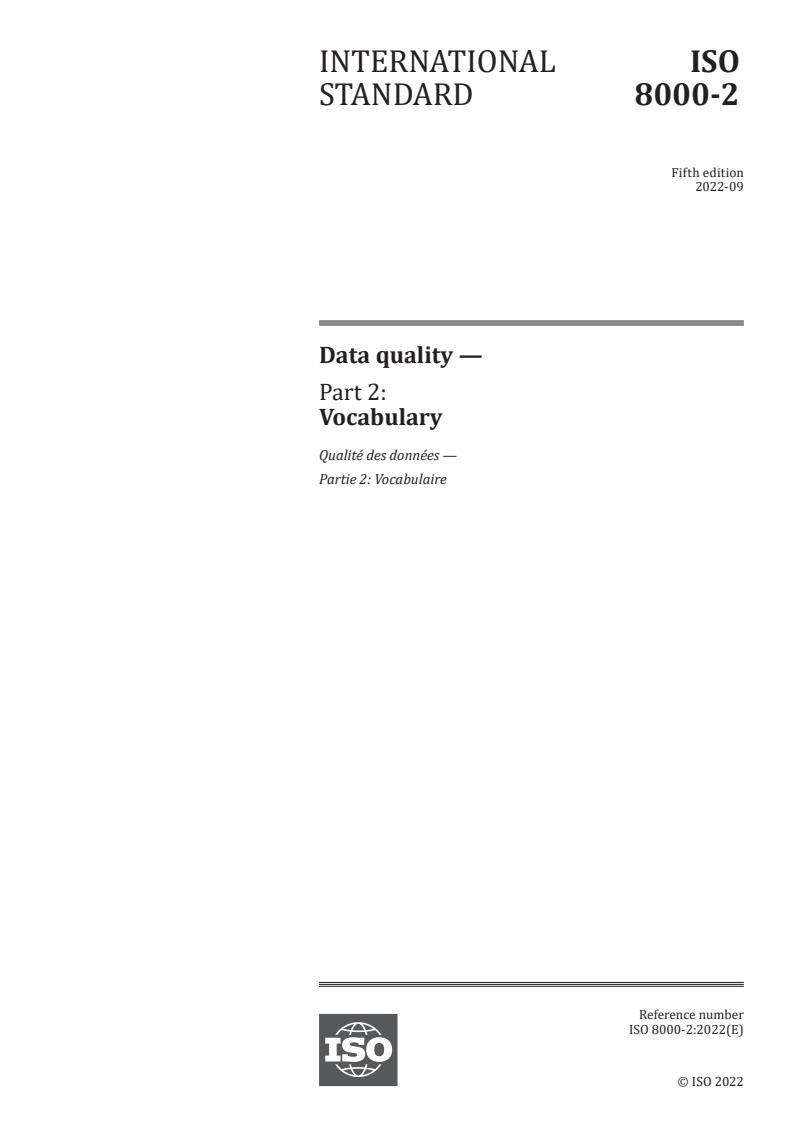
INTERNATIONAL ISO
STANDARD 8000-2
Fifth edition
2022-09
Data quality —
Part 2:
Vocabulary
Qualité des données —
Partie 2: Vocabulaire
Reference number
© ISO 2022
All rights reserved. Unless otherwise specified, or required in the context of its implementation, no part of this publication may
be reproduced or utilized otherwise in any form or by any means, electronic or mechanical, including photocopying, or posting on
the internet or an intranet, without prior written permission. Permission can be requested from either ISO at the address below
or ISO’s member body in the country of the requester.
ISO copyright office
CP 401 • Ch. de Blandonnet 8
CH-1214 Vernier, Geneva
Phone: +41 22 749 01 11
Email: copyright@iso.org
Website: www.iso.org
Published in Switzerland
ii
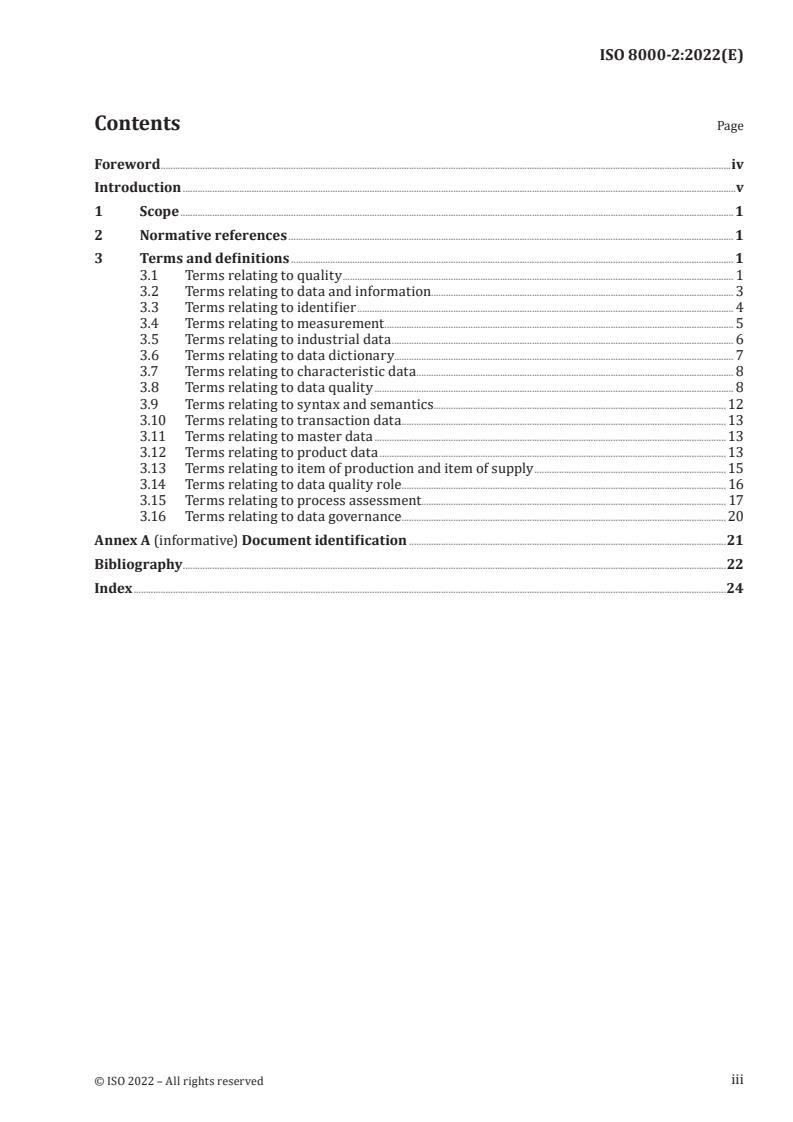
Contents Page
Foreword .iv
Introduction .v
1 Scope . 1
2 Normative references . 1
3 Terms and definitions . 1
3.1 Terms relating to quality . 1
3.2 Terms relating to data and information . 3
3.3 Terms relating to identifier . 4
3.4 Terms relating to measurement . 5
3.5 Terms relating to industrial data . 6
3.6 Terms relating to data dictionary. 7
3.7 Terms relating to characteristic data . 8
3.8 Terms relating to data quality . 8
3.9 Terms relating to syntax and semantics.12
3.10 Terms relating to transaction data . 13
3.11 Terms relating to master data .13
3.12 Terms relating to product data . 13
3.13 Terms relating to item of production and item of supply . 15
3.14 Terms relating to data quality role . 16
3.15 Terms relating to process assessment. 17
3.16 Terms relating to data governance . 20
Annex A (informative) Document identification .21
Bibliography .22
Index .24
iii
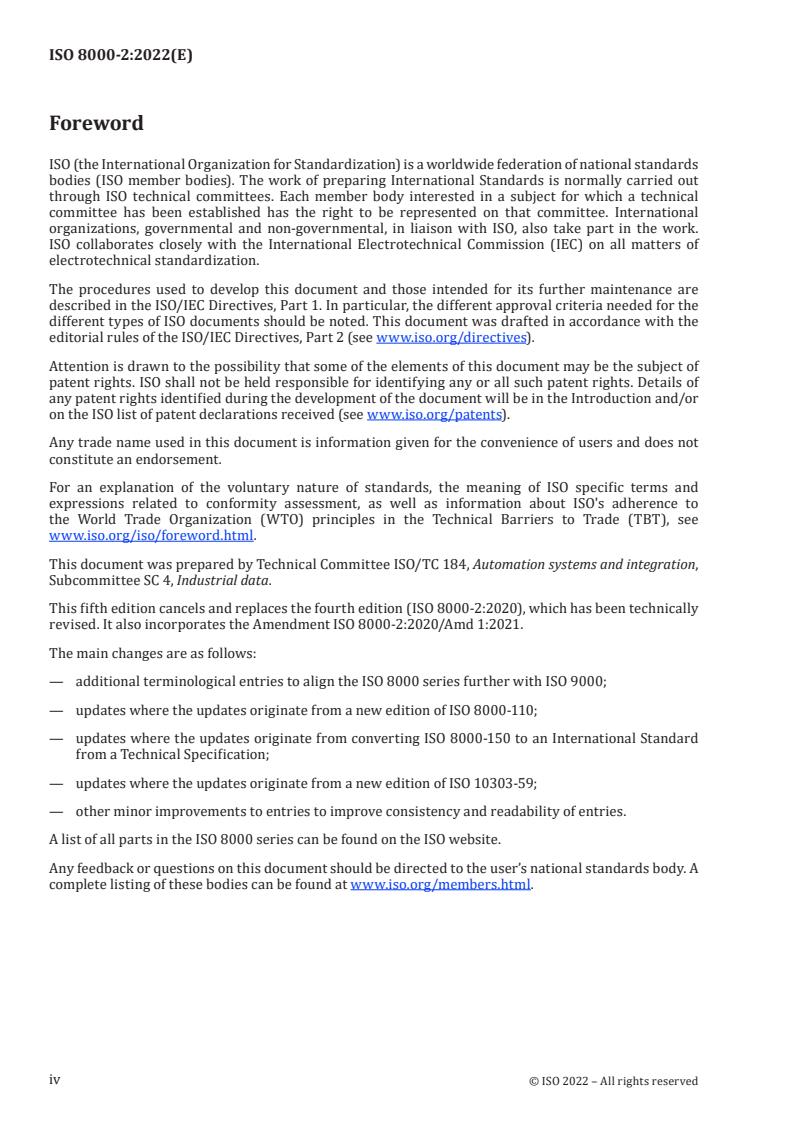
Foreword
ISO (the International Organization for Standardization) is a worldwide federation of national standards
bodies (ISO member bodies). The work of preparing International Standards is normally carried out
through ISO technical committees. Each member body interested in a subject for which a technical
committee has been established has the right to be represented on that committee. International
organizations, governmental and non-governmental, in liaison with ISO, also take part in the work.
ISO collaborates closely with the International Electrotechnical Commission (IEC) on all matters of
electrotechnical standardization.
The procedures used to develop this document and those intended for its further maintenance are
described in the ISO/IEC Directives, Part 1. In particular, the different approval criteria needed for the
different types of ISO documents should be noted. This document was drafted in accordance with the
editorial rules of the ISO/IEC Directives, Part 2 (see www.iso.org/directives).
Attention is drawn to the possibility that some of the elements of this document may be the subject of
patent rights. ISO shall not be held responsible for identifying any or all such patent rights. Details of
any patent rights identified during the development of the document will be in the Introduction and/or
on the ISO list of patent declarations received (see www.iso.org/patents).
Any trade name used in this document is information given for the convenience of users and does not
constitute an endorsement.
For an explanation of the voluntary nature of standards, the meaning of ISO specific terms and
expressions related to conformity assessment, as well as information about ISO's adherence to
the World Trade Organization (WTO) principles in the Technical Barriers to Trade (TBT), see
www.iso.org/iso/foreword.html.
This document was prepared by Technical Committee ISO/TC 184, Automation systems and integration,
Subcommittee SC 4, Industrial data.
This fifth edition cancels and replaces the fourth edition (ISO 8000-2:2020), which has been technically
revised. It also incorporates the Amendment ISO 8000-2:2020/Amd 1:2021.
The main changes are as follows:
— additional terminological entries to align the ISO 8000 series further with ISO 9000;
— updates where the updates originate from a new edition of ISO 8000-110;
— updates where the updates originate from converting ISO 8000-150 to an International Standard
from a Technical Specification;
— updates where the updates originate from a new edition of ISO 10303-59;
— other minor improvements to entries to improve consistency and readability of entries.
A list of all parts in the ISO 8000 series can be found on the ISO website.
Any feedback or questions on this document should be directed to the user’s national standards body. A
complete listing of these bodies can be found at www.iso.org/members.html.
iv
Introduction
0.1 Foundations of the ISO 8000 series
Digital data deliver value by enhancing all aspects of organizational performance including:
— operational effectiveness and efficiency;
— safety and security;
— reputation with customers and the wider public;
— compliance with statutory regulations;
— innovation;
— consumer costs, revenues and stock prices.
In addition, many organizations are now addressing these considerations with reference to the United
1)
Nations Sustainable Development Goals .
The influence on performance originates from data being the formalized representation of
2)
information . This information enables organizations to make reliable decisions. Such decision making
can be performed by human beings directly and also by automated data processing including artificial
intelligence systems.
Through widespread adoption of digital computing and associated communication technologies,
organizations become dependent on digital data. This dependency amplifies the negative consequences
of lack of quality in these data. These consequences are the decrease of organizational performance.
The biggest impact of digital data comes from two key factors:
— the data having a structure that reflects the nature of the subject matter;
EXAMPLE 1 A research scientist writes a report using a software application for word processing. This report
includes a table that uses a clear, logical layout to show results from an experiment. These results indicate how
material properties vary with temperature. The report is read by a designer, who uses the results to create a
product that works in a range of different operating temperatures.
— the data being computer processable (machine readable) rather than just being for a person to read
and understand.
EXAMPLE 2 A research scientist uses a database system to store the results of experiments on a material.
This system controls the format of different values in the data set. The system generates an output file of digital
data. This file is processed by a software application for engineering analysis. The application determines the
optimum geometry when using the material to make a product.
ISO 9000 explains that quality is not an abstract concept of absolute perfection. Quality is actually
the conformance of characteristics to requirements. This actuality means that any item of data can
be of high quality for one purpose but not for a different purpose. The quality is different because the
requirements are different between the two purposes.
EXAMPLE 3 Time data are processed by calendar applications and also by control systems for propulsion
units on spacecraft. These data include start times for meetings in a calendar application and activation times in
a control system. These start times require less precision than the activation times.
1) https://sdgs.un.org/goals
2) This document defines information as “knowledge concerning objects, such as facts, events, things, processes,
or ideas, including concepts, that within a certain context has a particular meaning”.
v
The nature of digital data is fundamental to establishing requirements that are relevant to the specific
decisions made by an organization.
EXAMPLE 4 ISO 8000-1 identifies that data have syntactic (format), semantic (meaning) and pragmatic
(usefulness) characteristics.
To support the delivery of high-quality data, the ISO 8000 series addresses:
— data governance, data quality management and maturity assessment;
EXAMPLE 5 ISO 8000-61 specifies a process reference model for data quality management.
— creating and applying requirements for data and information;
EXAMPLE 6 ISO 8000-110 specifies how to exchange characteristic data that are master data.
— monitoring and measuring information and data quality;
EXAMPLE 7 ISO 8000-8 specifies approaches to measuring information and data quality.
— improving data and, consequently, information quality;
EXAMPLE 8 ISO/TS 8000-81 specifies an approach to data profiling, which identifies opportunities to improve
data quality.
— issues that are specific to the type of content in a data set.
EXAMPLE 9 ISO/TS 8000-311 specifies how to address quality considerations for product shape data.
Data quality management covers all aspects of data processing, including creating, collecting, storing,
maintaining, transferring, exploiting and presenting data to deliver information.
Effective data quality management is systemic and systematic, requiring an understanding of the
root causes of data quality issues. This understanding is the basis for not just correcting existing
nonconformities but also implementing solutions that prevent future reoccurrence of those
nonconformities.
EXAMPLE 10 If a data set includes dates in multiple formats including “yyyy-mm-dd”, “mm-dd-yy” and
“dd-mm-yy”, then data cleansing can correct the consistency of the values. Such cleansing requires additional
information, however, to resolve ambiguous entries (such as, “04-05-20”). The cleansing also cannot address any
process issues and people issues, including training, that have caused the inconsistency.
0.2 Understanding more about the ISO 8000 series
ISO 8000-1 provides a detailed explanation of the structure and scope of the whole ISO 8000 series.
3)
ISO has identified this document, ISO 8000-1 and ISO 8000-8 as horizontal deliverables .
0.3 Role of this document
As a contribution to the capability of the ISO 8000 series, this document specifies the single, common
vocabulary for the ISO 8000 series. This vocabulary is ideal reading material by which to understand
the overall subject matter of data quality. This document presents the vocabulary structured by a series
of topic areas (for example, terms relating to quality and terms relating to data and information).
This document supports activities that affect:
— one or more information systems;
— data flows within the organization and with external organizations;
— any phase of the data life cycle.
3) A horizontal deliverable is a deliverable dealing with a subject relevant to a number of committees or sectors or
of crucial importance to ensure coherence across standardization deliverables.
vi
Organizations can use this document on its own or in conjunction with other parts of the ISO 8000
series.
Annex A contains an identifier that conforms to ISO/IEC 8824-1. The identifier unambiguously identifies
this document in an open information system.
0.4 Benefits of the ISO 8000 series
By implementing parts of the ISO 8000 series to improve organizational performance, an organization
achieves the following benefits:
— objective validation of the foundations for digital transformation of the organization;
— a sustainable basis for data in digital form becoming a fundamental asset class the organization
relies on to deliver value;
— securing evidence-based trust from other parties (including supply chain partners and regulators)
about the repeatability and reliability of data and information processing in the organization;
— portability of data with resulting protection against loss of intellectual property and reusability
across the organization and applications;
— effective and efficient interoperability between all parties in a supply chain to achieve traceability
of data back to original sources;
— readiness to acquire or supply services where the other party expects to work with common
understanding of explicit data requirements.
vii
INTERNATIONAL STANDARD ISO 8000-2:2022(E)
Data quality —
Part 2:
Vocabulary
1 Scope
This document defines terms relating to data quality. These terms are used by the parts in the ISO 8000
series.
2 Normative references
There are no normative references in this document.
3 Terms and definitions
ISO and IEC maintain terminology databases for use in standardization at the following addresses:
— ISO Online browsing platform: available at https:// www .iso .org/ obp
— IEC Electropedia: available at https:// www .electropedia .org/
3.1 Terms relating to quality
3.1.1
process, noun
set of interrelated or interacting activities that use inputs to deliver an intended result
[SOURCE: ISO 9000:2015, 3.4.1, modified — Notes to entry have been removed.]
3.1.2
requirement
need or expectation that is stated, generally implied or obligatory
[SOURCE: ISO 9000:2015, 3.6.4, modified — Notes to entry have been removed.]
3.1.3
quality
degree to which a set of inherent characteristics of an object fulfils requirements (3.1.2)
Note 1 to entry: The term “quality” can be used with adjectives such as poor, good or excellent.
Note 2 to entry: “Inherent”, as opposed to “assigned”, means existing in the object.
[SOURCE: ISO 9000:2015, 3.6.2]
3.1.4
quality management system
part of a management system with regard to quality (3.1.3)
[SOURCE: ISO 9000:2015, 3.5.4]
3.1.5
nonconformity
non-fulfilment of a requirement (3.1.2)
[SOURCE: ISO 9000:2015, 3.6.9, modified — Note 1 to entry has been removed.]
3.1.6
defect
nonconformity (3.1.5) related to an intended or specified use
Note 1 to entry: The distinction between the concepts defect and nonconformity is important as it has legal
connotations, particularly those associated with product (3.5.2) and service liability issues.
Note 2 to entry: The intended use as intended by the customer can be affected by the nature of the information
(3.2.1), such as operating or maintenance instructions, provided by the provider.
[SOURCE: ISO 9000:2015, 3.6.10]
3.1.7
quality management
management with regard to quality (3.1.3)
Note 1 to entry: Quality management can include establishing quality policies and quality objectives, and
processes (3.1.1) to achieve these quality objectives through quality planning (3.1.8), quality control (3.1.9), quality
assurance (3.1.10) and quality improvement (3.1.11).
[SOURCE: ISO 9000:2015, 3.3.4]
3.1.8
quality planning
part of quality management (3.1.7) focused on setting quality (3.1.3) objectives and specifying necessary
operational processes (3.1.1) and related resources to achieve the quality objectives
Note 1 to entry: Establishing quality plans can be part of quality planning.
[SOURCE: ISO 9000:2015, 3.3.5]
3.1.9
quality control
part of quality management (3.1.7) focused on fulfilling quality (3.1.3) requirements (3.1.2)
[SOURCE: ISO 9000:2015, 3.3.7]
3.1.10
quality assurance
part of quality management (3.1.7) focused on providing confidence that quality (3.1.3) requirements
(3.1.2) will be fulfilled
[SOURCE: ISO 9000:2015, 3.3.6]
3.1.11
quality improvement
part of quality management (3.1.7) focused on increasing the ability to fulfil quality (3.1.3) requirements
(3.1.2)
Note 1 to entry: The quality requirements can be related to any aspect such as effectiveness, efficiency or
traceability.
[SOURCE: ISO 9000:2015, 3.3.8]
3.1.12
inspection
determination of conformity to specified requirements (3.1.2)
[SOURCE: ISO 9000:2015, 3.11.7, modified — Notes to entry have been removed.]
3.2 Terms relating to data and information
3.2.1
information
knowledge concerning objects, such as facts, events, things, processes (3.1.1), or ideas, including
concepts, that within a certain context has a particular meaning
[SOURCE: ISO/IEC 2382:2015, 2121271, modified — Field of application and notes to entry have been
removed.]
3.2.2
data
reinterpretable representation of information (3.2.1) in a formalized manner suitable for communication,
interpretation, or processing
[SOURCE: ISO/IEC 2382:2015, 2121272, modified — Notes to entry have been removed.]
3.2.3
data exchange
storing, accessing, transferring, and archiving of data (3.2.2)
[SOURCE: ISO 10303-1:2021, 3.1.31]
3.2.4
data set
logically meaningful grouping of data (3.2.2)
EXAMPLE 1 Computer-aided design (CAD) files.
EXAMPLE 2 Electronic data interchange (EDI) transactions.
3.2.5
metadata
data (3.2.2) defining and describing other data
[SOURCE: ISO/IEC 11179-1:2015, 3.2.16, modified — The words “that defines and describes” have been
replaced with “defining and describing”.]
3.2.6
objective evidence
data (3.2.2) supporting the existence or verity of something
Note 1 to entry: Objective evidence can be obtained through observing, measuring (3.4.1), testing or other means.
[SOURCE: ISO 9000:2015, 3.8.3, modified — Note 1 to entry has been modified and Note 2 to entry has
been removed.]
3.2.7
data element
unit of data (3.2.2) that is considered in context to be indivisible
Note 1 to entry: The definition states that a data element is “indivisible” in some context. This means it is possible
that a data element considered indivisible in one context (e.g. telephone number) can be divisible in another
context (e.g. country code, area code, local number).
[SOURCE: ISO/IEC 11179-1:2015, 3.3.8, modified — The abbreviated term “DE” has been removed and
the word “may” has been replaced by “can” in Note 1 to entry.]
3.2.8
value domain
set of permissible values
Note 1 to entry: The permissible values in a value domain can either be enumerated or expressed via a description.
[SOURCE: ISO/IEC 11179-1:2015, 3.3.31, modified — The abbreviated term “VD” has been removed and
the word “may” has been replaced by “can” in Note 1 to entry.]
3.2.9
data element concept
concept that is an association of a property with an object class
Note 1 to entry: A data element concept is implicitly associated with both the property and the object class whose
combination it expresses.
Note 2 to entry: A data element concept can also be associated with zero or more conceptual domains, each of
which expresses its value meanings.
Note 3 to entry: A data element concept can also be associated with zero or more data elements (3.2.7) each, of
which provides representation for the data element concept via its associated value domain (3.2.8).
[SOURCE: ISO/IEC 11179-1:2015, 3.3.9, modified — The abbreviated term “DEC” has been removed and
the word “may” has been replaced by “can” in Notes 2 and 3 to entry.]
3.3 Terms relating to identifier
3.3.1
identifier
string of characters created by an organization to reference a data set (3.2.4)
3.3.2
identifier resolution
process (3.1.1) that, when applied to an identifier (3.3.1), returns an associated data set (3.2.4)
3.3.3
entity
concrete or abstract thing in the domain under consideration
[SOURCE: ISO 19439:2006, 3.29, modified — The word “any” has been removed at the start of the
definition.]
3.3.4
organization identifier
reference that can be resolved unambiguously to the legal name, the location and the administrator of
the organization
3.3.5
legal entity
physical or juridical person granted legal status by the governing body of a nation, state or community
3.3.6
authoritative identifier
identifier (3.3.1) issued by an organization that is the originator of the object identified or that is a legal
authority
EXAMPLE The original part manufacturer issues the authoritative identifier for that part. Distributors can
also assign identifiers, which are proxy identifiers (3.3.8) (not authoritative identifiers).
Note 1 to entry: An authoritative legal entity identifier (3.3.7) is an authoritative identifier issued by an
organization that is a legal authority.
3.3.7
authoritative legal entity identifier
ALEI
identifier (3.3.1) that identifies a legal entity (3.3.5) and is issued by the administrative agency for a
governing body of the nation, state, or community with the authority to grant legal status
EXAMPLE For the State of Delaware (in the United States), the Division of Corporations is the administrative
agency that issues identifiers for juridical persons represented on documents of formation. This agency issued
the authoritative legal entity identifier “3031657” to identify the formation of the Code Management Association
as a legal entity.
3.3.8
proxy identifier
identifier (3.3.1) issued by an organization that is not the originator of the object identified
3.3.9
proxy legal entity identifier
identifier (3.3.1) that identifies a legal entity (3.3.5) and is issued by an organization that is not the
administrative agency for a government and, thus, has no authority to grant legal status
3.3.10
vital record
record of life events kept under governmental authority
EXAMPLE Birth certificates, marriage licenses and death certificates.
3.3.11
free decoding
identifier resolution (3.3.2) that, without the need to pay a fee, returns an associated data set (3.2.4)
3.3.12
fee-based decoding
identifier resolution (3.3.2) that, only after paying a fee, returns an associated data set (3.2.4)
3.3.13
free encoding
without the need to pay a fee, using terms and definitions to discover concept identifiers (3.3.1)
3.4 Terms relating to measurement
3.4.1
measure, verb
ascertain or determine the magnitude or quantity of something
3.4.2
measurement
result of measuring (3.4.1) something
3.4.3
measurement data
data (3.2.2) representing a measurement (3.4.2)
3.4.4
unit of measurement
measurement unit
unit
real scalar quantity, defined and adopted by convention, with which any other quantity of the same
kind can be compared to express the ratio of the second quantity to the first one as a number
[SOURCE: ISO 80000-1:2009, 3.9, modified — Notes to entry have been removed.]
3.4.5
qualifier of measurement
indication of a value not being an actual, exact representation of a single instance of a measurement
(3.4.2)
EXAMPLE Qualifiers can include “nominal”, “maximum”, “minimum” and “typical”.
3.5 Terms relating to industrial data
3.5.1
industrial data
data (3.2.2) representing information (3.2.1) that enables and supports the life-cycle of goods and
services
EXAMPLE 1 Industrial data includes data about: products (3.5.2); life-cycle processes (3.1.1), including
manufacturing, distribution and maintenance; facilities that are used by life-cycle processes; digital twins;
product geometry, topology and visualization; technical dictionaries; and parts catalogues.
EXAMPLE 2 The ISO 10303 series, the ISO 13584 series, the ISO 15926 series, the ISO 22745 series and the
ISO/TS 29002 series each specifies requirements (3.1.2) applicable to industrial data.
EXAMPLE 3 The term “industrial” is distinct from the terms “agricultural” and “commercial”.
Note 1 to entry: Supporting the life-cycle includes supporting the processes of the life-cycle and the facilities that
are used by those processes.
Note 2 to entry: Although the ISO 8000 series is developed by ISO/TC 184/SC 4 (Industrial Data), most parts in
the series are applicable to all types of data.
3.5.2
product
thing or substance produced by a natural or artificial process (3.1.1)
[SOURCE: ISO 10303-1:2021, 3.1.49, modified — Note 1 to entry has been removed.]
3.5.3
product data
data that is a representation of product (3.5.2) information (3.2.1)
[SOURCE: ISO 10303-1:2021, 3.1.50]
3.5.4
application
one or more processes (3.1.1) creating or using product data (3.5.3)
[SOURCE: ISO 10303-1:2021, 3.1.5]
3.5.5
application protocol
AP
part of ISO 10303 that specifies an application interpreted model satisfying the scope and information
(3.2.1) requirements (3.1.2) for a specific application (3.5.4)
Note 1 to entry: This definition differs from the definition used in open system interconnection (OSI) standards.
No part of the ISO 8000 series, however, contains content referring specifically to OSI communication, so this
definition applies in all parts of the ISO 8000 series.
[SOURCE: ISO 10303-1:2021, 3.1.17, modified — Note 1 to entry has been modified.]
3.5.6
application reference model
ARM
information (3.2.1) model that describes the information requirements (3.1.2) and constraints of an
application (3.5.4) within an application protocol (3.5.5) or module
[SOURCE: ISO 10303-1:2021, 3.1.18]
3.5.7
application software
application program
software or program that is specific to the solution of an application (3.5.4) problem
[SOURCE: ISO/IEC 2382:2015, 2121364, modified — Notes to entry have been removed.]
3.6 Terms relating to data dictionary
3.6.1
data dictionary entry
description of an entity (3.3.3) type containing, at a minimum, an unambiguous identifier (3.3.1), a term
and a definition
Note 1 to entry: In the data (3.2.2) architecture specified by the ISO 8000 series, a property need not be associated
with a specific data type in a data dictionary (3.6.2). The association between a property and a data type can be
made in a data specification (3.6.3).
Note 2 to entry: In order to exchange a value corresponding to a data dictionary entry, more information (3.2.1)
than an identifier, a name and a definition can be needed. For a property, a data type is needed. Depending on the
kind of property, other data items (e.g. unit of measurement (3.4.4), language) can also be needed. These elements
can be given in the data dictionary, in a data specification that references the data dictionary entry, or directly
associated with the data.
Note 3 to entry: In the data architecture of the ISO 13584 series, the dictionary entry for a property is required
to reference a specific data type. Thus, a dictionary entry in the ISO 13584 series is a special case of the more
general concept, as it includes elements of a data specification.
[SOURCE: ISO 22745-2:2010, B.2.17, modified — The notes to entry have been replaced.]
3.6.2
data dictionary
collection of data dictionary entries (3.6.1) that allows lookup by entity (3.3.3) identifier (3.3.1)
[SOURCE: ISO 22745-2:2010, B.2.16]
3.6.3
data specification
set of requirements (3.1.2) covering the characteristics of data (3.2.2) being fit for one or more particular
purposes
Note 1 to entry: ISO 8000-110 requires a data specification to describe how items belong to a particular class by
using entries from a data dictionary (3.6.2).
Note 2 to entry: In collaborative relationships, the supplier of data and the user of that data agree the content
of the data specification in order to ensure the collaboration will be successful (i.e. the supplier can supply
conforming data and the user is able to exploit the data for the intended purposes).
Note 3 to entry: An effective data specification is one where the creator of the specification intends for the
requirements to be necessary and sufficient for the data to meet the particular purposes.
Note 4 to entry: All stakeholders will be able to understand the data specification more effectively if there is an
explicit statement of the intended purposes for the data.
3.7 Terms relating to characteristic data
3.7.1
property-value tuple
property-value pair
instance of a value tuple together with an identifier (3.3.1) for a data dictionary entry (3.6.1) that defines
a property
EXAMPLE 1 ISO 8000-110 specifies requirements (3.1.2) on property-value tuples when exchanging master
data (3.11.1).
EXAMPLE 2 A flat washer has a property value “bolt thread diameter for which designed = 10 mm nominal”.
This property value is represented by the property-value tuple that consists of the identifier of the data dictionary
entry for “bolt thread diameter for which designed” and the value tuple “10 mm nominal”.
Note 1 to entry: The value tuple consists of a data (3.2.2) value, indication (if applicable) of the unit of measurement
(3.4.4) for the value and indication (if applicable) of a qualifier of measurement (3.4.5) for the value.
3.7.2
characteristic data
description of an entity (3.3.3) by the class to which it belongs and a set of property values
EXAMPLE 1 The ISO 13584 series, the ISO 15926 series, the ISO 22745 series, the ISO 13399 series and the
ISO/TS 29002 series all include characteristic data in their data (3.2.2) models.
EXAMPLE 2 The item “O-ring — 100,00x2,65. NBR 70” appears in a manufacturer's catalogue. It can be
described as:
— class: O-ring;
— property values: [material specification, nitrile-butadiene rubber (NBR)]; [inner diameter, 100
millimetres]; [cross section, 2,65 millimetres]; [Shore hardness rating, 70 durometer]; [colour,
black]; [operating temperature range, −30 °C to +100 °C].
In actual characteristic data, the first element of each bracketed pair would be an identifier (3.3.1) for a data
dictionary entry (3.6.1). The elements are shown decoded here for clarity.
3.8 Terms relating to data quality
3.8.1
data quality
degree to which a set of inherent characteristics of data (3.2.2) fulfils requirements (3.1.2)
Note 1 to entry: See also quality (3.1.3).
3.8.2
data quality management
coordinated activities to direct and control an organization with regard to data quality (3.8.1)
3.8.3
data error
non-fulfilment of a data (3.2.2) requirement (3.1.2)
Note 1 to entry: In this term, “error” is synonymous with nonconformity (3.1.5).
3.8.4
data provenance record
record of the ultimate derivation and passage of a piece of data (3.2.2) through its various owners or
custodians
Note 1 to entry: A data provenance record can include information (3.2.1) about creation, update, transcription,
abstraction, validation (3.8.6), and transferring ownership of data.
3.8.5
verification
confirmation, through the provision of objective evidence (3.2.6), that specified requirements (3.1.2)
have been fulfilled
[SOURCE: ISO 9000:2015, 3.8.12, modified — Notes to entry have been removed.]
3.8.6
validation
confirmation, through the provision of objective evidence (3.2.6), that the requirements (3.1.2) for a
specific intended use or application (3.5.4) have been fulfilled
[SOURCE: ISO 9000:2015, 3.8.13, modified — Notes to entry have been removed.]
3.8.7
authoritative data source
owner of a process (3.1.1) that creates data (3.2.2)
EXAMPLE The Department of Transportation of the Commonwealth of Pennsylvania, USA, is the
authoritative data source for Pennsylvania motor vehicle registration records.
3.8.8
accepted reference value
value that serves as an agreed-upon reference for comparison
Note 1 to entry: The accepted reference value is derived as:
a) a theoretical or established value, based on scientific principles;
b) an assigned or certified value, based on experimental work of some national or international organization;
c) a consensus or certified value, based on collaborative experimental work under the auspices of a scientific or
technical group;
d) the expectation, i.e. the mean of a specified set of measurements (3.4.2), when a), b) and c) are not available.
[SOURCE: ISO 3534-2:2006, 3.2.7]
3.8.9
true value
value that characterizes a characteristic perfectly defined in the conditions that exist when the
characteristic is considered
Note 1 to entry: The true value is a theoretical concept and, in general, cannot be known exactly.
[SOURCE: ISO 3534-2:2006, 3.2.5 modified — "quantity or quantitative" has been removed in the
definition and Note 1 to entry. Note 2 to entry was removed.]
3.8.10
data accuracy
accuracy
quality (3.1.3) of data (3.2.2) in respect of the represented value agreeing with the corresponding true
value (3.8.9) to a degree necessary for an intended purpose
EXAMPLE 1 When creating a data specification (3.6.3) to address data accuracy considerations, an
organization decides to include in the specification a requirement (3.1.2) for a length value to have three decimal
places.
EXAMPLE 2 An inherent characteristic of some data is the use of three decimal places to represent a length
value.
Note 1 to entry: For data accuracy, the relevant inherent characteristics of the data are those that determine how
to interpret the value.
Note 2 to entry: No universal specification for data accuracy exists. Data accuracy depends on the details of the
data representation, the subject matter of the data and the purpose to which the user intends to put the data.
Note 3 to entry: In practice, when assessing data accuracy, an organization can make use of an accepted reference
value (3.8.8) rather than the true value.
Note 4 to entry: Not all aspects of data accuracy can be verified (3.8.5) by just assessing, as a closed system, the
consistency of the data and the applicable data specification. If the data, for example, represents the length of a
particular screw in a warehouse then the screw is in the real world, requiring an appropriate test to look beyond
the content of the data set (3.2.4) and the data specification. Such testing is addressed by ISO 8000-8.
Note 5 to entry: ISO 8000-130 specifies the mechanisms by which an organization can state the accuracy of
data (including identification of the method that has assessed the data) or assert the accuracy of data (including
identification of the remediation that the organization will perform if the data in fact fails to meet the asserted
level of accuracy).
3.8.11
data accuracy record
record of the information (3.2.1) provided about the data accuracy (3.8.10) of a specified data set (3.2.4)
Note 1 to entry: A data accuracy record can include representations and warranties of the data's accuracy.
3.8.12
data completeness
completeness
quality (3.1.3) of a data set (3.2.4) in respect of the content being all that is necessary for an intended
purpose
EXAMPLE 1 When creating a data specification (3.6.3) that addresses data completeness considerations, an
organization includes in the specification a requirement (3.1.2) for a data set to identify explicitly the applicable
unit of measurement (3.4.4) for each physical quantity in the set.
EXAMPLE 2 When calculating the average speed of a journey, a user decides to use the start and end times
of the journey and the total distance travelled. This decision determines the basis for data completeness of the
required data set.
EXAMPLE 3 When calculating the maximum speed during a journey, a user decides to use a list of points in
time and, for each point, the distance travelled to that point. The user decides an appropriate duration between
each point in time. This duration being longer makes the calculation less accurate but prevents the data set
becoming inappropriately large. These decisions determine the basis for data completeness of the required data
set.
EXAMPLE 4 A buyer wants a supplier to send a list of all products (3.5.2) that are available for purchase. The
supplier uses ISO 8000-140, which specifies how to provide a statement to confirm the supplier has created a
data set representing a list that meets the buyer’s requirement.
Note 1 to entry: For data completeness, the relevant inherent characteristics of the data set are those that
determine which data (3.2.2) exist as part of the data set.
Note 2 to entry: No universal specification for data completeness exists. Data completeness depends on the
content of the data set, the subject matter of the data and the purpose to which the user intends to put the data
set.
Note 3 to entry: Not all aspects of data completeness can be verified (3.8.5) by just assessing, as a closed system,
the consistency of the data set and the applicable data specification. If the data set claims, for example, to be a
complete list of the employees of an organization then the actual human beings are in the real world, requiring an
appropriate test to look beyond the content of the data set and the data specification. Such testing is addressed
by ISO 8000-8.
Note 4 to entry: ISO 8000-140 specifies the mechanisms by which an organization can state the completeness of
a data set (including identification of the method that has assessed the data) or assert the completeness of a data
set (including identification of the remediation that the organization will perform if the data in fact fails to meet
the asserted level of completeness).
3.8.13
data completeness record
record of the information (3.2.1) provided about the data completeness (3.8.12) of a specified data set
(3.2.4)
Note 1 to entry: A data completeness record can include representations and warranties of the data completeness.
3.8.14
data quality issue
issue where data (3.2.2) is either a nonconformity (3.1.5) or a defect (3.1.6)
3.8.15
data quality planning
part of data quality management (3.8.2) focused on setting data quality (3.8.1) objectives and specifying
necessary operational processes (3.1.1) and related resources to achieve the quality objectives
EXAMPLE The process reference model in ISO 8000-61 specifies more detail as to the purpose, outcomes
and activities of data quality planning.
3.8.16
data quality control
part of data quality management (3.8.2) focused on fulfilling data quality (3.8.1) requirements (3.1.2)
EXAMPLE The process (3.1.1) reference model in ISO 8000-61 specifies more detail as to the purpose,
outcomes and activities of data quality control.
3.8.17
data quality assurance
part of data quality management (3.8.2) focused on providing confidence that data quality (3.8.1)
requirements (3.1.2) will be fulfilled
EXAMPLE The process (3.1.1) reference model in ISO 8000-61 specifies more detail as to the purpose,
outcomes and activities of data quality assurance.
3.8.18
data quality improvement
part of data quality management (3.8.2) focused on increasing the ability to fulfil data quality (3.8.1)
requirements (3.1.2)
EXAMPLE The process (3.1.1) reference model in ISO 8000-61 specifies more detail as to the purpose,
outcomes and activities of data quality improvement.
3.9 Terms relating to syntax and semantics
3.9.1
formal syntax
specification of the valid sentences of a formal language using a formal grammar
EXAMPLE 1 An Extensible Markup Language (XML) document type definition (DTD) is a formal syntax.
EXAMPLE 2 ISO 10303-21 contains a formal syntax in Wirth Syntax Notation (WSN) for ISO 10303 physical
files.
EXAMPLE 3 When exchanging master data (3.11.1) using messages, ISO 8000-110 specifies requirements
(3.1.2) on each message identifying the formal syntax to which the message conforms.
Note 1 to entry: A formal language is computer-interpretable.
Note 2 to entry: Formal grammars are usually Chomsky context-free grammars.
Note 3 to entry: Variants of Backus-Naur Form (BNF) such as Augmented Backus-Naur Form (ABNF) and Wirth
Syntax Notation (WSN) are often used to specify the syntax of computer programming languages and data
(3.2.2) languages.
3.9.2
semantic encoding
concept encoding
technique of replacing natural language terms in a message with identifiers (3.3.1) that reference data
dictionary entries (3.6.1)
EXAMPLE ISO 8000-110 specifies how semantic encoding supports the exchange of master data (3.11.1) that
is characteristic data (3.7.2).
Note 1 to entry: By applying semantic encoding to data (3.2.2), an organization creates a basis for portable data
(3.9.4) by ensuring the semantics of the data are explicit.
Note 2 to entry: Semantic encoding is necessary to cr
...