

ISO/PAS 5929:2025
(Main)Corrosion of metals and alloys — Test and evaluation method for the corrosion of steel bar embedded in concrete structure exposed to total corrosion zones in marine environments
General Information
- Abstract
This document specifies the apparatus, materials, specimen preparation, procedures, results and reports for testing the corrosion test of steel bars. This document includes an evaluation method. This document applies to reinforced concrete structures exposed simultaneously to atmospheric, splash, tidal, immersion, and buried zones in marine environments. NOTE Annex A provides test apparatus examples. Annex B illustrates test results.
- Status
- Published
- Publication Date
- 14-Aug-2025
- Technical Committee
- ISO/TC 156 - Corrosion of metals and alloys
- Drafting Committee
- ISO/TC 156 - Corrosion of metals and alloys
- Current Stage
- 6060 - International Standard published
- Start Date
- 15-Aug-2025
- Due Date
- 13-Sep-2025
- Completion Date
- 15-Aug-2025
Buy Documents
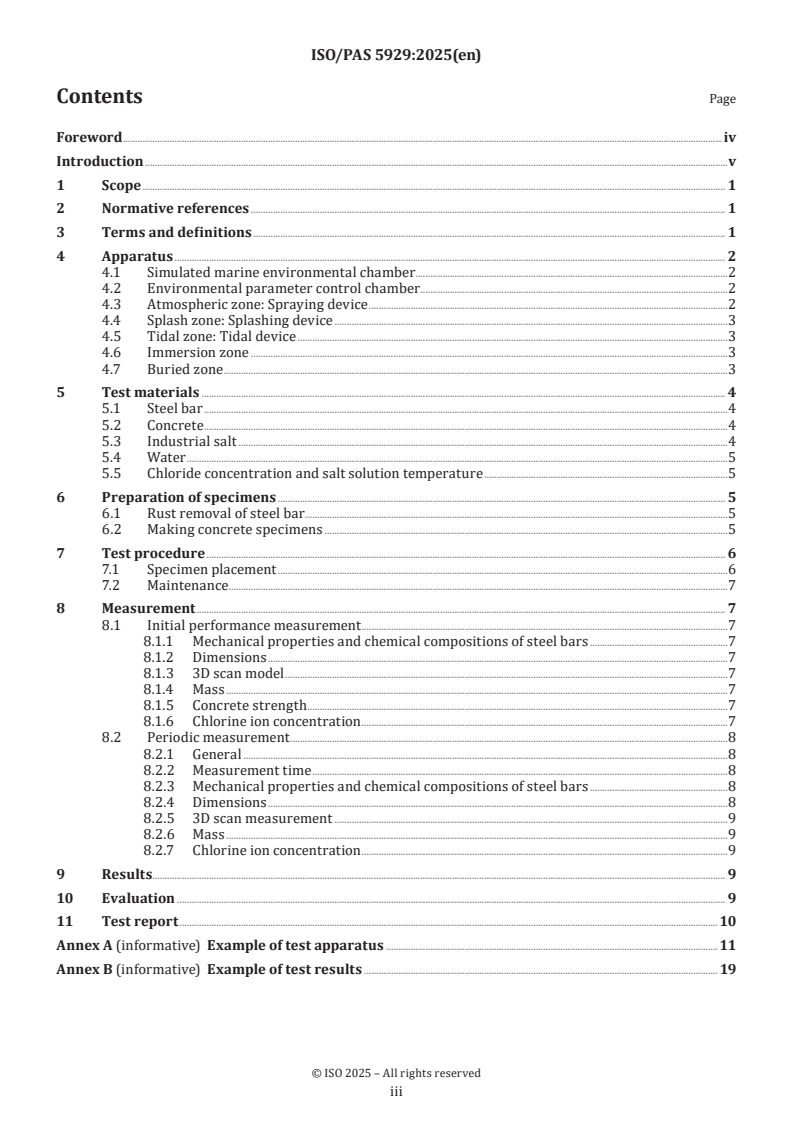

ISO/PAS 5929:2025 - Corrosion of metals and alloys — Test and evaluation method for the corrosion of steel bar embedded in concrete structure exposed to total corrosion zones in marine environments Released:15. 08. 2025
Overview
ISO/PAS 5929:2025 - "Corrosion of metals and alloys - Test and evaluation method for the corrosion of steel bar embedded in concrete structure exposed to total corrosion zones in marine environments" - is a publicly available specification that defines a unified laboratory method to simulate and evaluate chloride-induced corrosion of steel reinforcement in reinforced concrete spanning all marine exposure zones (atmospheric, splash, tidal, immersion and buried). The document details required apparatus, test materials, specimen preparation, procedures, measurements, evaluation methods and reporting. Annex A provides example test apparatus; Annex B shows example results.
Key topics and technical requirements
- Scope and purpose: Controlled simulation of multi-zone marine exposure to reproduce realistic vertical and horizontal chloride migration along steel bars in concrete.
- Apparatus: Specifications for a simulated marine environmental chamber and an environmental parameter control chamber, plus dedicated devices for atmospheric (spray), splash, tidal, immersion and buried zones. Test cells require monitoring of temperature, humidity, salt spray concentration, solution chloride concentration, pH and liquid level.
- Materials & specimens: Requirements for steel reinforcement, concrete mixes, industrial salt and water, including guidance on chloride concentration and salt solution temperature.
- Specimen preparation: Procedures for rust removal, concrete casting, and positioning of reinforced specimens to represent multiple corrosion zones.
- Test procedure & maintenance: Placement, environmental control, monitoring and maintenance steps for long-term or accelerated testing.
- Measurements: Initial and periodic measurements including mechanical properties, chemical composition, dimensions, mass, concrete strength and chloride ion concentration; recommended use of 3D scanning for non‑destructive 3D corrosion mapping.
- Evaluation & reporting: Methods to record results, assess corrosion distribution and produce standardized test reports for comparison and decision-making.
Applications and users
This standard is intended for:
- Corrosion and materials engineers performing durability testing of reinforced concrete components.
- Testing laboratories developing accelerated marine exposure tests and comparing materials.
- Bridge, port, pier and coastal infrastructure designers and asset owners seeking reliable service-life and repair strategy data.
- Researchers and product developers evaluating concrete mixes, corrosion protection measures, coatings or alternative reinforcement. Practical benefits include improved material selection, accurate chloride ingress mapping, cost-effective protection/repair strategies, and avoidance of overdesign.
Related standards
Relevant cross-references in ISO/PAS 5929:2025 include:
- ISO 21062 - Determination of corrosion rates of embedded steel reinforcement in simulated marine environments
- ISO 8044 - Vocabulary on corrosion of metals and alloys
- ISO 1920‑4 - Testing of concrete - Strength of hardened concrete Other referenced standards cover reinforcement bars, concrete specification and corrosion-product removal.
Keywords: ISO/PAS 5929:2025, corrosion testing, steel reinforcement, reinforced concrete, marine environments, chloride-induced corrosion, simulated marine environmental chamber, tidal zone, splash zone, 3D scanning, test apparatus.
Buy Documents
ISO/PAS 5929:2025 - Corrosion of metals and alloys — Test and evaluation method for the corrosion of steel bar embedded in concrete structure exposed to total corrosion zones in marine environments Released:15. 08. 2025
Get Certified
Connect with accredited certification bodies for this standard

Element Materials Technology
Materials testing and product certification.

Inštitut za kovinske materiale in tehnologije
Institute of Metals and Technology. Materials testing, metallurgical analysis, NDT.
Sponsored listings
Frequently Asked Questions
ISO/PAS 5929:2025 is a technical specification published by the International Organization for Standardization (ISO). Its full title is "Corrosion of metals and alloys — Test and evaluation method for the corrosion of steel bar embedded in concrete structure exposed to total corrosion zones in marine environments". This standard covers: This document specifies the apparatus, materials, specimen preparation, procedures, results and reports for testing the corrosion test of steel bars. This document includes an evaluation method. This document applies to reinforced concrete structures exposed simultaneously to atmospheric, splash, tidal, immersion, and buried zones in marine environments. NOTE Annex A provides test apparatus examples. Annex B illustrates test results.
This document specifies the apparatus, materials, specimen preparation, procedures, results and reports for testing the corrosion test of steel bars. This document includes an evaluation method. This document applies to reinforced concrete structures exposed simultaneously to atmospheric, splash, tidal, immersion, and buried zones in marine environments. NOTE Annex A provides test apparatus examples. Annex B illustrates test results.
ISO/PAS 5929:2025 is classified under the following ICS (International Classification for Standards) categories: 77.060 - Corrosion of metals. The ICS classification helps identify the subject area and facilitates finding related standards.
ISO/PAS 5929:2025 is available in PDF format for immediate download after purchase. The document can be added to your cart and obtained through the secure checkout process. Digital delivery ensures instant access to the complete standard document.
Standards Content (Sample)
Publicly
Available
Specification
ISO/PAS 5929
First edition
Corrosion of metals and alloys —
2025-08
Test and evaluation method for the
corrosion of steel bar embedded
in concrete structure exposed to
total corrosion zones in marine
environments
Corrosion des métaux et alliages — Méthode d'essai et
d'évaluation de la corrosion des barres en acier encastrées dans
des structures en béton exposées à des zones de corrosion totale
dans des environnements marins
Reference number
© ISO 2025
All rights reserved. Unless otherwise specified, or required in the context of its implementation, no part of this publication may
be reproduced or utilized otherwise in any form or by any means, electronic or mechanical, including photocopying, or posting on
the internet or an intranet, without prior written permission. Permission can be requested from either ISO at the address below
or ISO’s member body in the country of the requester.
ISO copyright office
CP 401 • Ch. de Blandonnet 8
CH-1214 Vernier, Geneva
Phone: +41 22 749 01 11
Email: copyright@iso.org
Website: www.iso.org
Published in Switzerland
ii
Contents Page
Foreword .iv
Introduction .v
1 Scope . 1
2 Normative references . 1
3 Terms and definitions . 1
4 Apparatus . 2
4.1 Simulated marine environmental chamber .2
4.2 Environmental parameter control chamber .2
4.3 Atmospheric zone: Spraying device .2
4.4 Splash zone: Splashing device .3
4.5 Tidal zone: Tidal device .3
4.6 Immersion zone .3
4.7 Buried zone .3
5 Test materials . 4
5.1 Steel bar .4
5.2 Concrete .4
5.3 Industrial salt .4
5.4 Water .5
5.5 Chloride concentration and salt solution temperature .5
6 Preparation of specimens . 5
6.1 Rust removal of steel bar.5
6.2 Making concrete specimens .5
7 Test procedure . 6
7.1 Specimen placement .6
7.2 Maintenance .7
8 Measurement . 7
8.1 Initial performance measurement .7
8.1.1 Mechanical properties and chemical compositions of steel bars .7
8.1.2 Dimensions .7
8.1.3 3D scan model .7
8.1.4 Mass .7
8.1.5 Concrete strength . .7
8.1.6 Chlorine ion concentration .7
8.2 Periodic measurement .8
8.2.1 General .8
8.2.2 Measurement time .8
8.2.3 Mechanical properties and chemical compositions of steel bars .8
8.2.4 Dimensions .8
8.2.5 3D scan measurement .9
8.2.6 Mass .9
8.2.7 Chlorine ion concentration .9
9 Results . . 9
10 Evaluation . 9
11 Test report . 10
Annex A (informative) Example of test apparatus .11
Annex B (informative) Example of test results . 19
iii
Foreword
ISO (the International Organization for Standardization) is a worldwide federation of national standards
bodies (ISO member bodies). The work of preparing International Standards is normally carried out through
ISO technical committees. Each member body interested in a subject for which a technical committee
has been established has the right to be represented on that committee. International organizations,
governmental and non-governmental, in liaison with ISO, also take part in the work. ISO collaborates closely
with the International Electrotechnical Commission (IEC) on all matters of electrotechnical standardization.
The procedures used to develop this document and those intended for its further maintenance are described
in the ISO/IEC Directives, Part 1. In particular, the different approval criteria needed for the different types
of ISO document should be noted. This document was drafted in accordance with the editorial rules of the
ISO/IEC Directives, Part 2 (see www.iso.org/directives).
ISO draws attention to the possibility that the implementation of this document may involve the use of (a)
patent(s). ISO takes no position concerning the evidence, validity or applicability of any claimed patent
rights in respect thereof. As of the date of publication of this document, ISO had not received notice of (a)
patent(s) which may be required to implement this document. However, implementers are cautioned that
this may not represent the latest information, which may be obtained from the patent database available at
www.iso.org/patents. ISO shall not be held responsible for identifying any or all such patent rights.
Any trade name used in this document is information given for the convenience of users and does not
constitute an endorsement.
For an explanation of the voluntary nature of standards, the meaning of ISO specific terms and expressions
related to conformity assessment, as well as information about ISO's adherence to the World Trade
Organization (WTO) principles in the Technical Barriers to Trade (TBT), see www.iso.org/iso/foreword.html.
This document was prepared by Technical Committee ISO/TC 156, Corrosion of metals and alloys.
Any feedback or questions on this document should be directed to the user’s national standards body. A
complete listing of these bodies can be found at www.iso.org/members.html.
iv
Introduction
Reinforced concrete structures worldwide face increasing durability deterioration, primarily driven by
environmental factors. In the marine environment, chloride-induced steel corrosion causes significant
structural damage. This phenomenon occurs across multiple exposure zones defined by elevation:
atmospheric, splash, tidal, immersion, and buried zones. Coastal infrastructure (e.g. docks, bridges, piers)
typically spans several such zones simultaneously.
Existing corrosion testing methods focus on single-directional chloride penetration within isolated zones
like the splash zone. While moisture fluctuations here accelerate corrosion, such unidirectional models
fail to replicate real-world multi-zone interactions. This oversight leads to incomplete corrosion resistance
assessments during material selection.
This document establishes a testing methodology that vertically and horizontally simulates chloride
migration along steel bars. By simulating worst-case conditions in all corrosion zones, the method facilitates
accurate corrosion distribution mapping (particularly chloride ingress), data-driven material selection for
extended service life, cost-effective design that avoids overprotection (e.g. excessive component thickness)
and accurate protection and repair along the length of concrete piers and columns. 3D scanning supplements
traditional measurements and enables non-destructive 3D corrosion mapping without structural
compromise.
This document proposes a device and a procedure to test the corrosion of steel bars in marine environments
at all corrosion zones. The method describes the dimensions, standard configuration methods and test
standard processes of standard components. The method should simulate the impact of different chloride
salt environments along the length of steel bars in reinforced concrete components. However, the actual
environment and test conditions differ widely, and this document cannot cover all possible scenarios. The
objectives of testing can be achieved according to the parameters set out in this document. However, other
methods exist, and users can choose test parameters based on their own situation.
v
Publicly Available Specification ISO/PAS 5929:2025(en)
Corrosion of metals and alloys — Test and evaluation method
for the corrosion of steel bar embedded in concrete structure
exposed to total corrosion zones in marine environments
1 Scope
This document specifies the apparatus, materials, specimen preparation, procedures, results and reports
for testing the corrosion test of steel bars. This document includes an evaluation method.
This document applies to reinforced concrete structures exposed simultaneously to atmospheric, splash,
tidal, immersion, and buried zones in marine environments.
NOTE Annex A provides test apparatus examples. Annex B illustrates test results.
2 Normative references
The following documents are referred to in the text in such a way that some or all of their content constitutes
requirements of this document. For dated references, only the edition cited applies. For undated references,
the latest edition of the referenced document (including any amendments) applies.
ISO 1920-4, Testing of concrete — Part 4: Strength of hardened concrete
ISO 6935-2, Steel for the reinforcement of concrete — Part 2: Ribbed bars
ISO 8407, Corrosion of metals and alloys — Removal of corrosion products from corrosion test specimens
ISO 22965-1, Concrete — Part 1: Methods of specifying and guidance for the specifier
ISO 22965-2, Concrete — Part 2: Specification of constituent materials, production of concrete and compliance
of concrete
EN 197-1, Cement — Part 1: Composition, specifications, and conformity criteria for common cements
ISO 8044, Corrosion of metals and alloys — Vocabulary
ISO 21062, Corrosion of metals and alloys — Determination of the corrosion rates of embedded steel
reinforcement in concrete exposed to simulated marine environments
3 Terms and definitions
For the purposes of this document, the terms and definitions given in ISO 8044 and the following apply.
ISO and IEC maintain terminology databases for use in standardization at the following addresses:
— ISO Online browsing platform: available at https:// www .iso .org/ obp
— IEC Electropedia: available at https:// www .electropedia .org/
3.1
simulated marine environmental chamber
sealed enclosure simulating all marine corrosion zones through controlled parameters
3.2
environmental parameter control chamber
auxiliary chamber regulating temperature, humidity, and chloride concentration
4 Apparatus
4.1 Simulated marine environmental chamber
The simulated marine environmental chamber shall be designed to simulate a marine environment with
all corrosion zones at different depths and heights, including the atmospheric zone, splash zone, tidal zone,
immersion zone and buried zone. The environmental parameters shall be set, monitored and adjusted.
The size and quantity of the test cells shall be
...