

ISO 18971:2026
(Main)Corrosion of metals and alloys — Monitoring method for corrosion states of stainless steel in industrial cooling water
General Information
- Abstract
This document specifies the method and criteria for monitoring corrosion states of heat exchange tubes, heat exchange plates and other components made of stainless steel in industrial cooling water by combination of polarization resistance and corrosion potential. This document is applicable to the monitoring of the corrosion states of stainless steel in industrial cooling water or similar media, as well as the monitoring of the corrosiveness of industrial cooling water. The cooling water is generally taken from natural water, tap water and reclaimed water. It is applicable to industrial cooling water with pH value of 5,0 to 11,0, temperature of 0 °C to 60 °C, and conductivity higher than 20 μS/cm.
- Status
- Published
- Publication Date
- 27-Jan-2026
- Technical Committee
- ISO/TC 156 - Corrosion of metals and alloys
- Drafting Committee
- ISO/TC 156 - Corrosion of metals and alloys
- Current Stage
- 6060 - International Standard published
- Start Date
- 28-Jan-2026
- Due Date
- 21-Nov-2025
- Completion Date
- 28-Jan-2026
Buy Documents
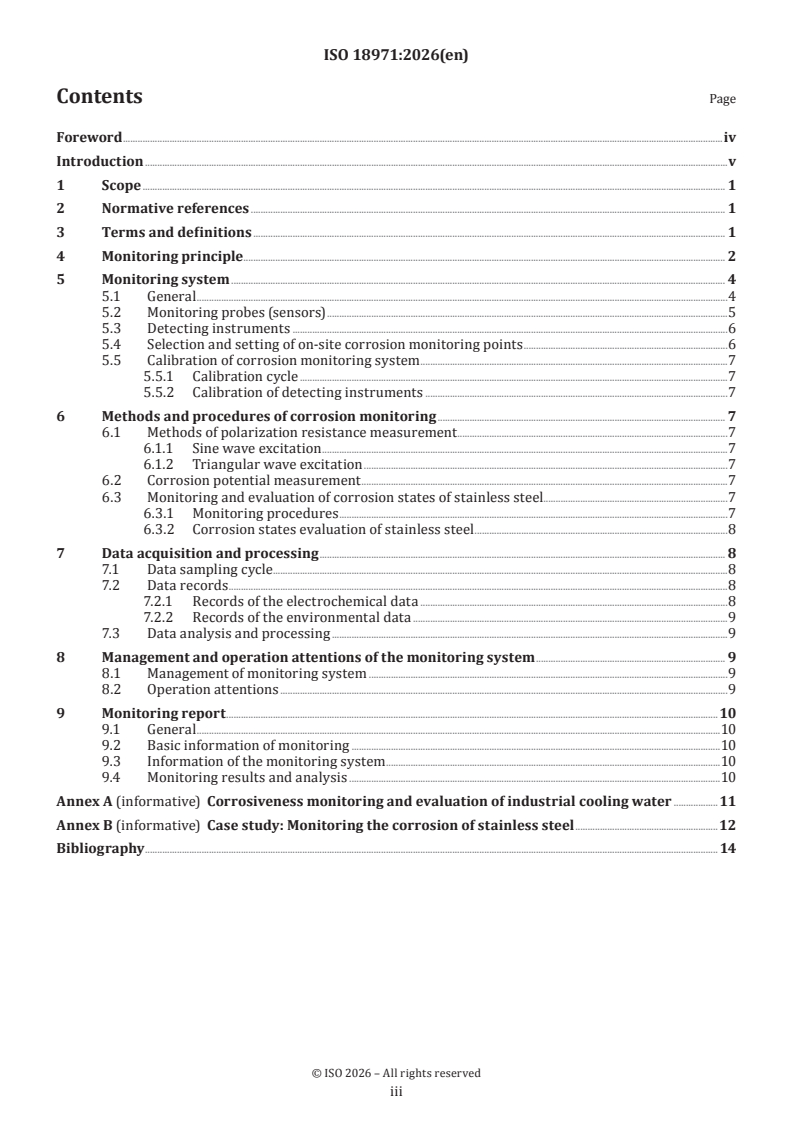

ISO 18971:2026 - Corrosion of metals and alloys — Monitoring method for corrosion states of stainless steel in industrial cooling water Released:28. 01. 2026
ISO 18971:2026 - Corrosion des métaux et alliages — Méthode de surveillance de l'état de corrosion de l'acier inoxydable dans les eaux de refroidissement industrielles
Overview
ISO 18971:2026 - Corrosion of Metals and Alloys - Monitoring Method for Corrosion States of Stainless Steel in Industrial Cooling Water specifies robust methods for monitoring and evaluating the corrosion behavior of stainless steel components used in industrial cooling water systems. By combining polarization resistance and corrosion potential measurements, this standard provides clear criteria for detecting corrosion states such as passivation, active corrosion, pitting, and transpassivation. ISO 18971:2026 is essential for ensuring the longevity and safety of heat exchange tubes, plates, and other stainless steel components exposed to cooling water sourced from natural, tap, or reclaimed water.
Key Topics
Corrosion State Monitoring
Guidance on identifying corrosion states of stainless steel by measuring polarization resistance and corrosion potential, with specific attention to passive, active, pitting, and transpassive conditions.System Requirements
Specification for monitoring systems, including three-electrode probes (working, reference, and counter electrodes) and detecting instruments capable of accurate signal measurement and data recording.Procedures and Criteria
Standardized procedures for probe installation, location selection, calibration cycles, and methods for sine wave and triangular wave excitation for polarization resistance measurement.Data Collection and Analysis
Defined intervals and protocols for collecting electrochemical and environmental data; recommendations for frequency and formatting to ensure correct trend analysis and evaluation.Operational and Management Guidance
Requirements for regular calibration, maintenance, data analysis, and corrosion management system oversight, including staff qualifications and preventive actions when corrosion is detected.
Applications
Industries with Cooling Water Systems
Widely used in power generation, chemical processing, manufacturing, and industries reliant on heat exchangers, where corrosion of stainless steel can significantly impact performance, safety, and maintenance costs.Corrosiveness Evaluation
Enables routine monitoring of industrial cooling water’s corrosiveness, facilitating proactive maintenance and timely interventions to avoid equipment failure and costly downtime.Quality Assurance and Compliance
Assists organizations in meeting regulatory and operational standards for material integrity, especially where cooling water parameters (pH 5.0 - 11.0, temperature 0–60 °C, conductivity >20 µS/cm) affect corrosion behavior of stainless steel components.Predictive Maintenance
Early identification of corrosion risks through standardized monitoring supports predictive maintenance strategies, reducing emergency repairs and extending asset service life.
Related Standards
ISO 8044: Corrosion of metals and alloys - Vocabulary
Provides definitions for terms used in corrosion monitoring.ISO 15510: Stainless steels - Chemical composition
Details chemical composition requirements for stainless steels.ASTM G59-97:2020: Standard test method for conducting potentiodynamic polarization resistance
Referenced for calibration procedures and measurement methods.ISO 17475: Corrosion of metals and alloys - Electrochemical test methods
Supports methodologies for corrosion potential measurement.
These standards collectively underpin reliable corrosion monitoring, data integrity, and the adoption of international best practices for stainless steel maintenance in cooling water systems.
By implementing ISO 18971:2026, organizations benefit from a scientifically sound, internationally recognized approach to corrosion monitoring. This leads to improved equipment reliability, optimized maintenance planning, and enhanced operational safety in industrial cooling water environments.
Buy Documents
ISO 18971:2026 - Corrosion of metals and alloys — Monitoring method for corrosion states of stainless steel in industrial cooling water Released:28. 01. 2026
ISO 18971:2026 - Corrosion des métaux et alliages — Méthode de surveillance de l'état de corrosion de l'acier inoxydable dans les eaux de refroidissement industrielles
Get Certified
Connect with accredited certification bodies for this standard

Element Materials Technology
Materials testing and product certification.

Inštitut za kovinske materiale in tehnologije
Institute of Metals and Technology. Materials testing, metallurgical analysis, NDT.
Sponsored listings
Frequently Asked Questions
ISO 18971:2026 is a standard published by the International Organization for Standardization (ISO). Its full title is "Corrosion of metals and alloys — Monitoring method for corrosion states of stainless steel in industrial cooling water". This standard covers: This document specifies the method and criteria for monitoring corrosion states of heat exchange tubes, heat exchange plates and other components made of stainless steel in industrial cooling water by combination of polarization resistance and corrosion potential. This document is applicable to the monitoring of the corrosion states of stainless steel in industrial cooling water or similar media, as well as the monitoring of the corrosiveness of industrial cooling water. The cooling water is generally taken from natural water, tap water and reclaimed water. It is applicable to industrial cooling water with pH value of 5,0 to 11,0, temperature of 0 °C to 60 °C, and conductivity higher than 20 μS/cm.
This document specifies the method and criteria for monitoring corrosion states of heat exchange tubes, heat exchange plates and other components made of stainless steel in industrial cooling water by combination of polarization resistance and corrosion potential. This document is applicable to the monitoring of the corrosion states of stainless steel in industrial cooling water or similar media, as well as the monitoring of the corrosiveness of industrial cooling water. The cooling water is generally taken from natural water, tap water and reclaimed water. It is applicable to industrial cooling water with pH value of 5,0 to 11,0, temperature of 0 °C to 60 °C, and conductivity higher than 20 μS/cm.
ISO 18971:2026 is classified under the following ICS (International Classification for Standards) categories: 77.060 - Corrosion of metals. The ICS classification helps identify the subject area and facilitates finding related standards.
ISO 18971:2026 is available in PDF format for immediate download after purchase. The document can be added to your cart and obtained through the secure checkout process. Digital delivery ensures instant access to the complete standard document.
Standards Content (Sample)
International
Standard
ISO 18971
First edition
Corrosion of metals and alloys —
2026-01
Monitoring method for corrosion
states of stainless steel in industrial
cooling water
Corrosion des métaux et alliages — Méthode de surveillance
de l'état de corrosion de l'acier inoxydable dans les eaux de
refroidissement industrielles
Reference number
© ISO 2026
All rights reserved. Unless otherwise specified, or required in the context of its implementation, no part of this publication may
be reproduced or utilized otherwise in any form or by any means, electronic or mechanical, including photocopying, or posting on
the internet or an intranet, without prior written permission. Permission can be requested from either ISO at the address below
or ISO’s member body in the country of the requester.
ISO copyright office
CP 401 • Ch. de Blandonnet 8
CH-1214 Vernier, Geneva
Phone: +41 22 749 01 11
Email: copyright@iso.org
Website: www.iso.org
Published in Switzerland
ii
Contents Page
Foreword .iv
Introduction .v
1 Scope . 1
2 Normative references . 1
3 Terms and definitions . 1
4 Monitoring principle . . 2
5 Monitoring system . 4
5.1 General .4
5.2 Monitoring probes (sensors) .5
5.3 Detecting instruments .6
5.4 Selection and setting of on-site corrosion monitoring points .6
5.5 Calibration of corrosion monitoring system .7
5.5.1 Calibration cycle .7
5.5.2 Calibration of detecting instruments .7
6 Methods and procedures of corrosion monitoring . 7
6.1 Methods of polarization resistance measurement .7
6.1.1 Sine wave excitation .7
6.1.2 Triangular wave excitation .7
6.2 Corrosion potential measurement .7
6.3 Monitoring and evaluation of corrosion states of stainless steel.7
6.3.1 Monitoring procedures .7
6.3.2 Corrosion states evaluation of stainless steel .8
7 Data acquisition and processing . 8
7.1 Data sampling cycle .8
7.2 Data records .8
7.2.1 Records of the electrochemical data .8
7.2.2 Records of the environmental data .9
7.3 Data analysis and processing .9
8 Management and operation attentions of the monitoring system . 9
8.1 Management of monitoring system .9
8.2 Operation attentions .9
9 Monitoring report . 10
9.1 General .10
9.2 Basic information of monitoring .10
9.3 Information of the monitoring system .10
9.4 Monitoring results and analysis .10
Annex A (informative) Corrosiveness monitoring and evaluation of industrial cooling water .11
Annex B (informative) Case study: Monitoring the corrosion of stainless steel .12
Bibliography . 14
iii
Foreword
ISO (the International Organization for Standardization) is a worldwide federation of national standards
bodies (ISO member bodies). The work of preparing International Standards is normally carried out through
ISO technical committees. Each member body interested in a subject for which a technical committee
has been established has the right to be represented on that committee. International organizations,
governmental and non-governmental, in liaison with ISO, also take part in the work. ISO collaborates closely
with the International Electrotechnical Commission (IEC) on all matters of electrotechnical standardization.
The procedures used to develop this document and those intended for its further maintenance are described
in the ISO/IEC Directives, Part 1. In particular, the different approval criteria needed for the different types
of ISO document should be noted. This document was drafted in accordance with the editorial rules of the
ISO/IEC Directives, Part 2 (see www.iso.org/directives).
ISO draws attention to the possibility that the implementation of this document may involve the use of (a)
patent(s). ISO takes no position concerning the evidence, validity or applicability of any claimed patent
rights in respect thereof. As of the date of publication of this document, ISO had not received notice of (a)
patent(s) which may be required to implement this document. However, implementers are cautioned that
this may not represent the latest information, which may be obtained from the patent database available at
www.iso.org/patents. ISO shall not be held responsible for identifying any or all such patent rights.
Any trade name used in this document is information given for the convenience of users and does not
constitute an endorsement.
For an explanation of the voluntary nature of standards, the meaning of ISO specific terms and expressions
related to conformity assessment, as well as information about ISO's adherence to the World Trade
Organization (WTO) principles in the Technical Barriers to Trade (TBT), see www.iso.org/iso/foreword.html.
This document was prepared by ISO/TC 156, Corrosion of metals and alloys.
Any feedback or questions on this document should be directed to the user’s national standards body. A
complete listing of these bodies can be found at www.iso.org/members.html.
iv
Introduction
Cooling water is widely used in industrial production. In the industrial cooling water system, the use of
stainless steel tubes in heat exchangers is very common. It generally accounts for over 60 %, but some
countries have accounted for over 90 %. The corrosion of stainless steel in industrial cooling water is mainly
localized corrosion dominated by pitting, which is invisible, fast-acting and difficult to prevent. When
localized corrosion causes perforation in stainless steel, this can have disastrous consequences.
The polarization resistance method is widely used to monitor the uniform corrosion rate of metals. This
document describes the method of using polarization resistance and corrosion potential to monitor
the corrosion states of stainless steel in industrial cooling water. It can be used to monitor the corrosion
tendency of stainless steel. It can also be used to indicate the change of corrosiveness of cooling water (see
Annex A). Protective measures can be taken in timely manner to prevent the occurrence of accidents caused
by corrosion perforation of stainless steel tubes.
v
International Standard ISO 18971:2026(en)
Corrosion of metals and alloys — Monitoring method for
corrosion states of stainless steel in industrial cooling water
1 Scope
This document specifies the method and criteria for monitoring corrosion states of heat exchange tubes, heat
exchange plates and other components made of stainless steel in industrial cooling water by combination of
polarization resistance and corrosion potential.
This document is applicable to the monitoring of the corrosion states of stainless steel in industrial cooling
water or similar media, as well as the monitoring of the corrosiveness of industrial cooling water. The cooling
water is generally taken from natural water, tap water and reclaimed water. It is applicable to industrial
cooling water with pH value of 5,0 to 11,0, temperature of 0 °C to 60 °C, and conductivity higher than 20 μS/
cm.
2 Normative references
The following documents are referred to in the text in such a way that some or all of their content constitutes
requirements of this document. For dated references, only the edition cited applies. For undated references,
the latest edition of the referenced document (including any amendments) applies.
ISO 8044, Corrosion of metals and alloys — Vocabulary
ISO 15510, Stainless steels — Chemical composition
ASTM G59 -97: 2020, Standard test method for conducting potentiodynamic polarization resistance
3 Terms and definitions
For the purposes of this document, the terms and definitions given in ISO 8044, ISO 15510 and the following
apply.
ISO and IEC maintain terminology databases for use in standardization at the following addresses:
— ISO Online browsing platform: available at https:// www .iso .org/ obp
— IEC Electropedia: available at https:// www .electropedia .org/
3.1
cooling water
water which is used to absorb and remove heat
[SOURCE: ISO 6107:2021, 3.140]
3.2
natural water
water that exists in nature, including surface water (e.g. water from rivers, lakes and seas) and groundwater
3.3
reclaimed water
wastewater that has been treated to meet specific water quality for intended beneficial use
[SOURCE: ISO 20670:2023, 3.81]
4 Monitoring principle
In general, when a stainless-steel electrode is anodized in industrial cooling water, it has the anodic
polarization curve A1 as shown in Figure 1. The potential range of E to E is the active dissolution region
eM p
(Z1), where the stainless-steel surface is in a corrosion state. The potential range of E to E is the pre-
p pp
passivation region (Z2), where the stainless-steel surface is in an unstable state. The potential range of E
pp
to E is the stable passivation region (Z3), where the stainless-steel surface is in a passivation state. The
tp
potential range higher than E is the transpassivation region (Z4), where the stainless-steel surface is also
tp
in a corrosion state (excluding those generated by new anodic reactions, e.g. water oxidation). When the
polarization current increases sharply at a low potential (E ), the potential range of the passivation region
b
(Z3) of the polarization curve is shortened to E to E , and localized corrosion such as pitting can occur on
pp b
the surface of the stainless steel when the potential is higher than E (Z5) (see ISO 11463 and ISO 15158).
b
Key
i current density
E electrode potential
A1 anodic polarization curve of stainless steel electrode in cooling water
A2 anodic polarization curve of stainless steel electrode in aggressive cooling water
C1 cathodic polarization curve of depolarizer reduction in cooling water
C2 cathodic polarization curve in cooling water with weak oxidation
C3 cathodic polarization curve in cooling water with too strong oxidation
E equilibrium potential of metal electrode in cooling water
eM
E equilibrium potential of cathode in cooling water
eC1
E equilibrium potential of cathode in cooling water with weak oxidation
eC2
E equilibrium potential of cathode in cooling water with too strong oxidation
eC3
E passivation potential
p
E the lowest potential of the passivation region
pp
E transpassivation potential
tp
E pitting potential
b
E corrosion potential of stainless steel in a passive state
corr1
E corrosion potentials of stainless steel in an active state
corr2
E corrosion potentials of stainless steel in a pitting state
corr3
E corrosion potentials of stainless steel in a transpassive state
corr4
Z1 active dissolution zone
Z2 pre-passivation zone
Z3 passivation zone
Z4 transpassivation zone
Z5 pitting zone
S1 passivation state
S2 active state
S3 pitting state
S4 transpassivation state
Figure 1 — Schematic diagram of different corrosion states of stainless steel
The corrosion state of stainless steel in industrial cooling water is related to the anodic polarization curve
of the stainless-steel electrode. It is also related to the cathodic polarization curve that corresponds to
the reduction reaction of depolarizers such as dissolved oxygen in the cooling water. The intersection of
the anodic and the cathodic polarization curves determines the corrosion potential and corrosion current
density of the corrosion system composed of these two reactions (see Figure 1). Changes in the anodic and
cathodic polarization curves, and thus in the corrosion state of stainless steel, occur due to changes in the
cooling water, such as:
— the concentration of dissolved oxygen, additives and aggressive substances;
— the pH value;
— the temperature.
The surface of stainless steel in industrial cooling water is typically in a passive state with high polarization
resistance and the corrosion potential is in the passivation region (see S1 in Figure 1).
When the corrosiveness of the cooling water is enhanced (e.g. when the concentration of aggressive chloride
ions or reducing substances increases or the cooling water gets warmer), the passive film on the surface
of stainless steel can be damaged. This results in a sharp drop in polarization resistance. Under these
conditions, the surface of stainless steel will be in the following three corrosion states:
a) When the oxygen concentration of the cooling water is reduced or the water is contaminated by reducing
substances, the corrosion potential shifts negatively to E which is lower than the passivation
corr2
potential E , and the stainless steel surface can be in an active state (see S2 in Figure 1).
p
b) When the concentration of aggressive ions such as chloride ions increases in the cooling water, the
passive film breakdown potential (pitting potential) E of the stainless steel shifts negatively and the
b
range of the passivation region is reduced. The stainless steel will be in the pitting state when the pitting
potential E is lower than the corrosion potential E (see S3 in Figure 1).
b corr3
c) When the oxidability of the cooling water is enhanced, the corrosion potential of the stainless steel
shifts positively. If the E appears on the anode polarization curve and the corrosion potential is higher
b
than E , the stainless steel is in a state of pitting. If the transpassivation potential E appears on the
b tp
anode polarization curve and the corrosion potential is higher than E , the stainless steel will be in an
tp
unstable transpassive state (see S4 in Figure 1).
The four states of stainless steel in cooling water show different polarization resistance and corrosion
potential. The stainless steel in State 1 has a large polarization resistance, while the polarization resistances
of the stainless steel in State 2, State 3 and State 4 are all small. However, the corrosion potentials
corresponding to the latter three states are significantly different. Therefore, the corrosion states of
stainless steel can be judged by monitoring the polarization resistance and corrosion potential. In most
cases, the state of stainless steel in cooling water is State 1 or State 3.
5 Monitoring system
5.1 General
The corrosion monitoring system, shown in Figure 2, includes mon
...
Norme
internationale
ISO 18971
Première édition
Corrosion des métaux et alliages —
2026-01
Méthode de surveillance de l'état
de corrosion de l'acier inoxydable
dans les eaux de refroidissement
industrielles
Corrosion of metals and alloys — Monitoring method for
corrosion states of stainless steel in industrial cooling water
Numéro de référence
DOCUMENT PROTÉGÉ PAR COPYRIGHT
© ISO 2026
Tous droits réservés. Sauf prescription différente ou nécessité dans le contexte de sa mise en œuvre, aucune partie de cette
publication ne peut être reproduite ni utilisée sous quelque forme que ce soit et par aucun procédé, électronique ou mécanique,
y compris la photocopie, ou la diffusion sur l’internet ou sur un intranet, sans autorisation écrite préalable. Une autorisation peut
être demandée à l’ISO à l’adresse ci-après ou au comité membre de l’ISO dans le pays du demandeur.
ISO copyright office
Case postale 401 • Ch. de Blandonnet 8
CH-1214 Vernier, Genève
Tél.: +41 22 749 01 11
E-mail: copyright@iso.org
Web: www.iso.org
Publié en Suisse
ii
Sommaire Page
Avant-propos .iv
Introduction .v
1 Domaine d'application . 1
2 Références normatives . 1
3 Termes et définitions . 1
4 Principe de surveillance . 2
5 Système de surveillance. 4
5.1 Généralités .4
5.2 Sondes de surveillance (capteurs).5
5.3 Instruments de détection .6
5.4 Sélection et réglage des points de surveillance de la corrosion sur site .6
5.5 Étalonnage du système de surveillance de la corrosion .7
5.5.1 Cycle d'étalonnage .7
5.5.2 Étalonnage des instruments de détection .7
6 Méthodes et modes opératoires de surveillance de la corrosion . 7
6.1 Méthodes de mesure de la résistance de polarisation .7
6.1.1 Excitation par onde sinusoïdale .7
6.1.2 Excitation par onde triangulaire .7
6.2 Mesurage du potentiel de corrosion .7
6.3 Surveillance et évaluation des états de corrosion de l'acier inoxydable .8
6.3.1 Modes opératoires de surveillance .8
6.3.2 Évaluation des états de corrosion de l'acier inoxydable .8
7 Acquisition et traitement des données . 8
7.1 Cycle d'échantillonnage des données .8
7.2 Enregistrements des données .9
7.2.1 Enregistrements des données électrochimiques .9
7.2.2 Enregistrements des données environnementales .9
7.3 Traitement et analyse des données .9
8 Consignes de gestion et d'exploitation du système de surveillance . 9
8.1 Gestion du système de surveillance .9
8.2 Consignes de fonctionnement .9
9 Rapport de surveillance . 10
9.1 Généralités .10
9.2 Informations de base sur la surveillance .10
9.3 Informations sur le système de surveillance .10
9.4 Résultats de surveillance et analyse .10
Annexe A (informative) Surveillance et évaluation de la corrosivité de l'eau de refroidissement
industrielle.11
Annexe B (informative) Étude de cas: surveillance de la corrosion de l'acier inoxydable .12
Bibliographie . 14
iii
Avant-propos
L'ISO (Organisation internationale de normalisation) est une fédération mondiale d'organismes nationaux
de normalisation (comités membres de l'ISO). L'élaboration des Normes internationales est en général
confiée aux comités techniques de l'ISO. Chaque comité membre intéressé par une étude a le droit de faire
partie du comité technique créé à cet effet. Les organisations internationales, gouvernementales et non
gouvernementales, en liaison avec l'ISO participent également aux travaux. L'ISO collabore étroitement avec
la Commission électrotechnique internationale (IEC) en ce qui concerne la normalisation électrotechnique.
Les procédures utilisées pour élaborer le présent document et celles destinées à sa mise à jour sont
décrites dans les Directives ISO/IEC, Partie 1. Il convient, en particulier, de prendre note des différents
critères d'approbation requis pour les différents types de documents ISO. Le présent document a
été rédigé conformément aux règles de rédaction données dans les Directives ISO/IEC, Partie 2 (voir
www.iso.org/directives).
L'ISO attire l'attention sur le fait que la mise en application du présent document peut entraîner l'utilisation
d'un ou de plusieurs brevets. L'ISO ne prend pas position quant à la preuve, à la validité et à l'applicabilité de
tout droit de brevet revendiqué à cet égard. À la date de publication du présent document, l'ISO n'avait pas
reçu notification qu'un ou plusieurs brevets pouvaient être nécessaires à sa mise en application. Toutefois,
il convient d'avertir les responsables de la mise en application du présent document que des informations
plus récentes sont susceptibles de figurer dans la base de données de brevets, disponible à l'adresse
www.iso.org/brevets. L'ISO ne saurait être tenue pour responsable de ne pas avoir identifié tout ou partie de
tels droits de brevet.
Les appellations commerciales éventuellement mentionnées dans le présent document sont données pour
information, par souci de commodité, à l'intention des utilisateurs et ne sauraient constituer un engagement.
Pour une explication de la nature volontaire des normes, la signification des termes et expressions
spécifiques de l'ISO liés à l'évaluation de la conformité, ou pour toute information au sujet de l'adhésion de
l'ISO aux principes de l'Organisation mondiale du commerce (OMC) concernant les obstacles techniques au
commerce (OTC), voir le lien suivant: www.iso.org/iso/fr/avant-propos.html.
Le présent document a été élaboré par l'ISO/TC 156, Corrosion des métaux et alliages.
Il convient que l'utilisateur adresse tout retour d'information ou toute question concernant le présent
document à l'organisme national de normalisation de son pays. Une liste exhaustive desdits organismes se
trouve à l'adresse www.iso.org/fr/members.html.
iv
Introduction
L'eau de refroidissement est largement utilisée dans la production industrielle. Dans un système d'eau de
refroidissement industrielle, l'utilisation de tubes en acier inoxydable dans les échangeurs de chaleur est
très courante. Elle représente généralement plus de 60 %, mais dépasse les 90 % dans certains pays. La
corrosion de l'acier inoxydable dans l'eau de refroidissement industrielle est principalement une corrosion
localisée dominée par la piqûration, qui est invisible, rapide et difficile à prévenir. Lorsque la corrosion
localisée provoque une perforation dans l'acier inoxydable, cela peut avoir des conséquences désastreuses.
La méthode de la résistance de polarisation est largement utilisée pour surveiller la vitesse de corrosion
uniforme des métaux. Le présent document décrit la méthode utilisant la résistance de polarisation et
le potentiel de corrosion pour surveiller les états de corrosion de l'acier inoxydable dans les eaux de
refroidissement industrielles. Cette méthode peut être utilisée pour surveiller la tendance à la corrosion de
l'acier inoxydable. Elle peut également être utilisée pour indiquer le changement de corrosivité de l'eau de
refroidissement (voir Annexe A). Des mesures de protection peuvent être prises en temps opportun pour
éviter les accidents causés par la perforation par corrosion des tubes en acier inoxydable.
v
Norme internationale ISO 18971:2026(fr)
Corrosion des métaux et alliages — Méthode de surveillance
de l'état de corrosion de l'acier inoxydable dans les eaux de
refroidissement industrielles
1 Domaine d'application
Le présent document spécifie la méthode et les critères de surveillance des états de corrosion des tubes
et plaques d'échange de chaleur et d'autres composants en acier inoxydable dans l'eau de refroidissement
industrielle par combinaison de la résistance de polarisation et du potentiel de corrosion.
Le présent document s'applique à la surveillance des états de corrosion de l'acier inoxydable dans les eaux de
refroidissement industrielles ou des milieux similaires, ainsi qu'à la surveillance de la corrosivité des eaux de
refroidissement industrielles. L'eau de refroidissement est généralement prélevée dans l'eau naturelle, l'eau
du robinet et l'eau régénérée. Le présent document est applicable aux eaux de refroidissement industrielles
avec un pH compris entre 5,0 et 11,0, une température comprise entre 0 °C et 60 °C et une conductivité
supérieure à 20 μS/cm.
2 Références normatives
Les documents suivants sont cités dans le texte de sorte qu'ils constituent, pour tout ou partie de leur
contenu, des exigences du présent document. Pour les références datées, seule l'édition citée s'applique. Pour
les références non datées, la dernière édition du document de référence s'applique (y compris les éventuels
amendements).
ISO 8044, Corrosion des métaux et alliages — Vocabulaire
ISO 15510, Aciers inoxydables — Composition chimique
A S T M G59 -97: 2020, Standard test method for conducting potentiodynamic polarization resistance
3 Termes et définitions
Pour les besoins du présent document, les termes et définitions donnés dans l'ISO 8044, l'ISO 15510 ainsi
que les suivants, s'appliquent.
L'ISO et l'IEC tiennent à jour des bases de données terminologiques destinées à être utilisées en normalisation,
consultables aux adresses suivantes:
— ISO Online browsing platform: disponible à l'adresse https:// www .iso .org/ obp
— IEC Electropedia: disponible à l'adresse https:// www .electropedia .org/
3.1
eau de refroidissement
eau utilisée pour absorber et transférer la chaleur
[SOURCE: ISO 6107:2021, 3.140]
3.2
eau naturelle
eau qui existe dans la nature, y compris les eaux de surface (par exemple, l'eau des rivières, des lacs et des
mers) et les eaux souterraines
3.3
eau régénérée
eaux usées ayant subi un traitement pour satisfaire à un niveau particulier de qualité de l'eau en vue d'un
usage bénéfique prévu
[SOURCE: ISO 20670:2023, 3.81]
4 Principe de surveillance
En général, lorsqu'une électrode en acier inoxydable est anodisée dans de l'eau de refroidissement industrielle,
elle présente la courbe de polarisation anodique A1 illustrée à la Figure 1. Le domaine de potentiel de E
eM
à E correspond à la région de dissolution active (Z1), où la surface de l'acier inoxydable est dans un état de
p
corrosion. Le domaine de potentiel de E à E correspond à la région de pré-passivation (Z2), où la surface
p pp
de l'acier inoxydable est dans un état instable. Le domaine de potentiel de E à E correspond à la région de
pp tp
passivation stable (Z3), où la surface de l'acier inoxydable est en état de passivation. Le domaine de potentiel
supérieur à E correspond à la région de transpassivation (Z4), où la surface de l'acier inoxydable est
tp
également dans un état de corrosion (à l'exclusion des états générés par de nouvelles réactions anodiques,
par exemple l'oxydation de l'eau). Lorsque le courant de polarisation augmente fortement à un potentiel bas
(E ), le domaine de potentiel de la région de passivation (Z3) de la courbe de polarisation est réduit de E
b pp
à E , et une corrosion localisée telle qu’une piqûration peut se produire à la surface de l'acier inoxydable
b
lorsque le potentiel est supérieur à E (Z5) (voir l'ISO 11463 et l'ISO 15158).
b
Légende
i densité de courant
E potentiel d'électrode
A1 courbe de polarisation anodique de l'électrode en acier inoxydable dans l'eau de refroidissement
A2 courbe de polarisation anodique de l'électrode en acier inoxydable dans l'eau de refroidissement agressive
C1 courbe de polarisation cathodique de la réduction du dépolarisant dans l'eau de refroidissement
C2 courbe de polarisation cathodique dans l'eau de refroidissement avec une faible oxydation
C3 courbe de polarisation cathodique dans l'eau de refroidissement avec une oxydation trop forte
E potentiel d'équilibre de l'électrode métallique dans l'eau de refroidissement
eM
E potentiel d'équilibre de la cathode dans l'eau de refroidissement
eC1
E potentiel d'équilibre de la cathode dans l'eau de refroidissement avec une faible oxydation
eC2
E potentiel d'équilibre de la cathode dans l'eau de refroidissement avec une oxydation trop forte
eC3
E potentiel de passivation
p
E potentiel le plus bas de la région de passivation
pp
E potentiel de transpassivation
tp
E potentiel de piqûration
b
E potentiel de corrosion de l'acier inoxydable à l'état passif
corr1
E potentiel de corrosion de l'acier inoxydable à l'état actif
corr2
E potentiel de corrosion de l'acier inoxydable à l'état de piqûration
corr3
E potentiel de corrosion de l'acier inoxydable à l'état transpassif
corr4
Z1 zone de dissolution active
Z2 zone de pré-passivation
Z3 zone de passivation
Z4 zone de transpassivation
Z5 zone de piqûration
S1 état de passivation
S2 état actif
S3 état de piqûration
S4 état de transpassivation
Figure 1 — Représentation schématique des différents états de corrosion de l'acier inoxydable
L'état de corrosion de l'acier inoxydable dans l'eau de refroidissement industrielle est lié à la courbe de
polarisation anodique de l'électrode en acier inoxydable. Il est également lié à la courbe de polarisation
cathodique qui correspond à la réaction de réduction des dépolarisants tels que l'oxygène dissous dans l'eau
de refroidissement. L'intersection des courbes de polarisation anodique et cathodique détermine le potentiel
de corrosion et la densité de courant de corrosion du système de corrosion composé de ces deux réactions
(voir Figure 1). Des changements dans les courbes de polarisation anodique et cathodique, et donc dans l'état
de corrosion de l'acier inoxydable, se produisent en raison de changements dans l'eau de refroidissement,
tels que:
— la concentration d'oxygène dissous, d'additifs et de substances agressives;
— le pH;
— la température.
La surface de l'acier inoxydable dans l'eau de refroidissement industrielle est généralement dans un état
passif avec une résistance de polarisation élevée et le potentiel de corrosion est dans la région de passivation
(voir S1 à la Figure 1).
Lorsque la corrosivité de l'eau de refroidissement augmente (par exemple, lorsque la concentration d'ions
chlorure agressifs ou de substances réductrices augmente ou lorsque l'eau de refroidissement se réchauffe),
le film passif à la surface de l'acier inoxydable peut être endommagé. Il en résulte une forte baisse de la
résistance de polarisation. Dans ces conditions, la surface de l'acier inoxydable sera dans les trois états de
corrosion suivants:
a) Lorsque la concentration en oxygène de l'eau de refroidissement est réduite ou que l'eau est contaminée
par des substances réductrices, le potentiel de corrosion se décale vers des valeurs inférieures à E ,
corr2
qui est inférieur au potentiel de passivation E , et la surface de l'acier inoxydable peut être dans un état
p
actif (voir S2 à la Figure 1).
b) Lorsque la concentration en ions agressifs, tels que les ions chlorure, augmente dans l'eau de
refroidissement, le potentiel de dégradation du film passif (potentiel de piqûration) E de l'acier
b
inoxydable se décale vers des valeurs inférieures et la plage de la région de passivation est réduite. L'acier
inoxydable sera à l'état de piqûration lorsque le potentiel de piqûration E est inférieur au potentiel de
b
corrosion E (voir S3 à la Figure 1).
corr3
c) Lorsque l'oxydabilité de l'eau de refroidissement augmente, le potentiel de corrosion de l'acier inoxydable
se décale vers des valeurs supérieures. Si E apparaît sur la courbe de polarisation anodique et que le
b
potentiel de corrosion est supérieur à E , l'acier inoxydable est en état de piqûration. Si le potentiel de
b
transpassivation E apparaît sur la courbe de polarisation anodique et que le potentiel de corrosion est
tp
supérieur à E , l'acier inoxydable sera dans un état transpassif instable (voir S4 à la Figure 1).
tp
Les quatre états de l'acier inoxydable dans l'eau de refroidissement présentent une résistance de polarisation
et un potentiel de corrosion différents. L'acier inoxydable dans l'état 1 a une grande résistance de polarisation,
tandis que les résistances de polarisation de l'acier inoxydable dans les états 2, 3 et 4 sont toutes faibles.
Cependant, les potentiels de corrosion correspondant à ces trois derniers états sont significativement
différents. Par conséquent, les états de corrosion de l'acier inoxydable peuvent être évalués en surveillant
la résistance de polarisation et le potentiel de corrosion. Dans la plupart des cas, l'état de l'acier inoxydable
dans l'eau de refroidissement est l'état 1 ou l'état 3.
5 Système de surveillance
5.1 Généralités
Le système de surveillance de la corrosion, illustré à la Figure 2, comprend des sondes de surveillance
(capteurs) et des instruments de détection (par exemple, des générateurs de signaux, des dispositifs
d'acquisition de données et des dispositifs de stockage de données) qui peuvent mesurer et enregistrer le
potentiel de corrosion et la résistance de polarisation. L'analyse et le traitement des données peuvent être
effectués automatiquement par un logiciel de surveillance de la corrosion ou par d'autres moyens.
Légende
WE électrode de travail
RE électrode de référence
CE contre-électrode
Figure 2 — Représentation schématique du système de surveillance de la corrosion
5.
...