

ISO 9350:2025
(Main)Corrosion of metals and alloys — Testing method of corrosion resistance for hafnium at high temperature and pressure
General Information
- Abstract
This document specifies: a) the determination of mass gain; b) the surface inspection of products of hafnium when corrosion tested in water at 360 °C. This document is applicable to hot-work or cold-work hafnium rods, wires, plates, sheets and strips. This method has been widely used in the development of hafnium products. It is applicable for use in its entirety to the extent specified for a product acceptance test, rather than merely a means of assessing performance in service of pressurized water reactor.
- Status
- Published
- Publication Date
- 27-Aug-2025
- Technical Committee
- ISO/TC 156 - Corrosion of metals and alloys
- Drafting Committee
- ISO/TC 156 - Corrosion of metals and alloys
- Current Stage
- 6060 - International Standard published
- Start Date
- 28-Aug-2025
- Due Date
- 10-Oct-2025
- Completion Date
- 28-Aug-2025
Overview
ISO 9350:2025 - Corrosion of metals and alloys - Testing method of corrosion resistance for hafnium at high temperature and pressure - defines a standardized laboratory method to evaluate hafnium corrosion in high-temperature, high-pressure water. The method specifies exposure at 360 °C and nominal 18.7 MPa for 672 hours, with corrosion assessed by mass gain and surface (oxide film) inspection. It applies to hot‑ or cold‑worked hafnium rods, wires, plates, sheets and strips and is intended for product acceptance testing as well as performance evaluation related to nuclear applications (e.g., pressurized water reactors).
Key topics and requirements
- Test principle: Controlled autoclave exposure of hafnium specimens in water; primary metrics are mass gain and visual surface appearance.
- Specimens: Individual identification, options for etched or as‑manufactured surfaces; guidance on coupon preparation (see Annex A).
- Test conditions: Temperature 360 °C, test pressure ~18.7 MPa, duration 672 h (document allows contractor‑specified pressure variations as required).
- Water quality: Grade A (≥ 1 MΩ·cm) or Grade B (≥ 0.5 MΩ·cm) purified/deionized water; only analytical‑grade reagents otherwise.
- Reagents & gases: Etching involves acids (HF, HNO3); argon gas of high purity (999.9 ml/l) is referenced.
- Apparatus: Autoclaves constructed from type 300 series stainless steel or specified nickel‑base alloys; equipment for precise measurement of mass (0.1 mg), dimensions (20 µm), temperature and pressure control.
- Calibration & control: Use of control coupons to validate test runs; procedures for autoclave cleaning, calibration and venting methods.
- Safety: Hazards from concentrated acids, high‑pressure/high‑temperature operations, and handling of hafnium products are highlighted; follow manufacturer and regulatory safety practices.
Applications and users
- Primary applications: Product acceptance testing, quality control, material development and performance prediction of hafnium used as a neutron absorber in nuclear reactors.
- Who uses it: Materials testing laboratories, nuclear component manufacturers, quality assurance engineers, R&D teams developing hafnium rods/plates/strips, and regulatory bodies overseeing nuclear materials.
- Practical value: Provides consistent, repeatable criteria for comparing hafnium corrosion resistance across suppliers and labs and for verifying conformity to purchaser requirements.
Related standards
- Prepared by ISO/TC 156 (Corrosion of metals and alloys). While ISO 9350:2025 contains no normative references, users commonly consult other ISO corrosion and materials test standards and national regulations for complementary procedures, safety and conformity assessment.
Keywords: ISO 9350:2025, hafnium corrosion test, high temperature high pressure, autoclave testing, mass gain measurement, control coupon, corrosion resistance, pressurized water reactor, specimen preparation.
Get Certified
Connect with accredited certification bodies for this standard

Element Materials Technology
Materials testing and product certification.

Inštitut za kovinske materiale in tehnologije
Institute of Metals and Technology. Materials testing, metallurgical analysis, NDT.
Sponsored listings
Frequently Asked Questions
ISO 9350:2025 is a standard published by the International Organization for Standardization (ISO). Its full title is "Corrosion of metals and alloys — Testing method of corrosion resistance for hafnium at high temperature and pressure". This standard covers: This document specifies: a) the determination of mass gain; b) the surface inspection of products of hafnium when corrosion tested in water at 360 °C. This document is applicable to hot-work or cold-work hafnium rods, wires, plates, sheets and strips. This method has been widely used in the development of hafnium products. It is applicable for use in its entirety to the extent specified for a product acceptance test, rather than merely a means of assessing performance in service of pressurized water reactor.
This document specifies: a) the determination of mass gain; b) the surface inspection of products of hafnium when corrosion tested in water at 360 °C. This document is applicable to hot-work or cold-work hafnium rods, wires, plates, sheets and strips. This method has been widely used in the development of hafnium products. It is applicable for use in its entirety to the extent specified for a product acceptance test, rather than merely a means of assessing performance in service of pressurized water reactor.
ISO 9350:2025 is classified under the following ICS (International Classification for Standards) categories: 77.060 - Corrosion of metals. The ICS classification helps identify the subject area and facilitates finding related standards.
ISO 9350:2025 is available in PDF format for immediate download after purchase. The document can be added to your cart and obtained through the secure checkout process. Digital delivery ensures instant access to the complete standard document.
Standards Content (Sample)
International
Standard
ISO 9350
First edition
Corrosion of metals and alloys —
2025-08
Testing method of corrosion
resistance for hafnium at high
temperature and pressure
Corrosion des métaux et alliages — Méthode d'essai de la
résistance à la corrosion du hafnium à haute température et
pression
Reference number
© ISO 2025
All rights reserved. Unless otherwise specified, or required in the context of its implementation, no part of this publication may
be reproduced or utilized otherwise in any form or by any means, electronic or mechanical, including photocopying, or posting on
the internet or an intranet, without prior written permission. Permission can be requested from either ISO at the address below
or ISO’s member body in the country of the requester.
ISO copyright office
CP 401 • Ch. de Blandonnet 8
CH-1214 Vernier, Geneva
Phone: +41 22 749 01 11
Email: copyright@iso.org
Website: www.iso.org
Published in Switzerland
ii
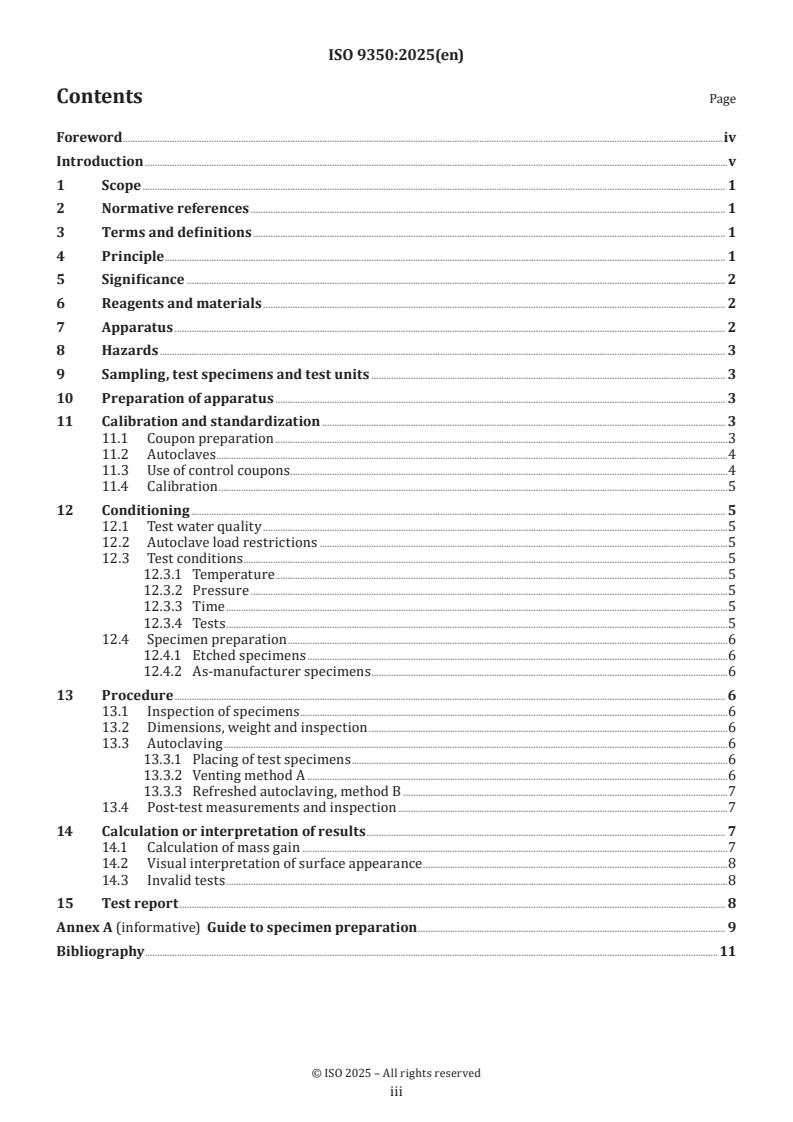
Contents Page
Foreword .iv
Introduction .v
1 Scope . 1
2 Normative references . 1
3 Terms and definitions . 1
4 Principle . 1
5 Significance . 2
6 Reagents and materials . 2
7 Apparatus . 2
8 Hazards . 3
9 Sampling, test specimens and test units . 3
10 Preparation of apparatus . 3
11 Calibration and standardization . 3
11.1 Coupon preparation .3
11.2 Autoclaves .4
11.3 Use of control coupons.4
11.4 Calibration .5
12 Conditioning . 5
12.1 Test water quality .5
12.2 Autoclave load restrictions .5
12.3 Test conditions .5
12.3.1 Temperature .5
12.3.2 Pressure .5
12.3.3 Time .5
12.3.4 Tests .5
12.4 Specimen preparation .6
12.4.1 Etched specimens .6
12.4.2 As-manufacturer specimens .6
13 Procedure . 6
13.1 Inspection of specimens . .6
13.2 Dimensions, weight and inspection .6
13.3 Autoclaving .6
13.3.1 Placing of test specimens .6
13.3.2 Venting method A .6
13.3.3 Refreshed autoclaving, method B .7
13.4 Post-test measurements and inspection .7
14 Calculation or interpretation of results . 7
14.1 Calculation of mass gain .7
14.2 Visual interpretation of surface appearance .8
14.3 Invalid tests .8
15 Test report . 8
Annex A (informative) Guide to specimen preparation . 9
Bibliography .11
iii
Foreword
ISO (the International Organization for Standardization) is a worldwide federation of national standards
bodies (ISO member bodies). The work of preparing International Standards is normally carried out through
ISO technical committees. Each member body interested in a subject for which a technical committee
has been established has the right to be represented on that committee. International organizations,
governmental and non-governmental, in liaison with ISO, also take part in the work. ISO collaborates closely
with the International Electrotechnical Commission (IEC) on all matters of electrotechnical standardization.
The procedures used to develop this document and those intended for its further maintenance are described
in the ISO/IEC Directives, Part 1. In particular, the different approval criteria needed for the different types
of ISO document should be noted. This document was drafted in accordance with the editorial rules of the
ISO/IEC Directives, Part 2 (see www.iso.org/directives).
ISO draws attention to the possibility that the implementation of this document may involve the use of (a)
patent(s). ISO takes no position concerning the evidence, validity or applicability of any claimed patent
rights in respect thereof. As of the date of publication of this document, ISO had not received notice of (a)
patent(s) which may be required to implement this document. However, implementers are cautioned that
this may not represent the latest information, which may be obtained from the patent database available at
www.iso.org/patents. ISO shall not be held responsible for identifying any or all such patent rights.
Any trade name used in this document is information given for the convenience of users and does not
constitute an endorsement.
For an explanation of the voluntary nature of standards, the meaning of ISO specific terms and expressions
related to conformity assessment, as well as information about ISO's adherence to the World Trade
Organization (WTO) principles in the Technical Barriers to Trade (TBT), see www.iso.org/iso/foreword.html.
This document was prepared by Technical Committee ISO/TC 156, Corrosion of metals and alloys.
Any feedback or questions on this document are directed to the user’s national standards body. A complete
listing of these bodies can be found at www.iso.org/members.html.
iv
Introduction
Hafnium has a high-capture cross section for thermal energy. It is used in nuclear reactors. Hafnium is
typically manufactured into rods, plates, sheets and strips. It is used as a neutron absorption material.
This document establishes a test method for the corrosion of hafnium. The water corrosion test is a useful
way to evaluate the properties of hafnium. The corrosion test can determine the performance of hafnium
products in reactors. The parameters of the corrosion test are different to the parameters of tests for other
materials. This is why a test method for the corrosion of hafnium is necessary.
This document establishes a corrosion test and requirements for hafnium material and provides a basis for
consistency across different laboratories. This document also gives the performance prediction of hafnium
products in service.
v
International Standard ISO 9350:2025(en)
Corrosion of metals and alloys — Testing method of corrosion
resistance for hafnium at high temperature and pressure
WARNING — The use of this document can involve hazardous materials, operations and equipment
(see Clause 8). It is the responsibility of the user of this document to consult and establish appropriate
safety and health practices and determine the applicability of regulatory limitations prior to use.
1 Scope
This document specifies:
a) the determination of mass gain;
b) the surface inspection of products of hafnium when corrosion tested in water at 360 °C.
This document is applicable to hot-work or cold-work hafnium rods, wires, plates, sheets and strips.
This method has been widely used in the development of hafnium products. It is applicable for use in its
entirety to the extent specified for a product acceptance test, rather than merely a means of assessing
performance in service of pressurized water reactor.
2 Normative references
There are no normative references in this document.
3 Terms and definitions
For the purposes of this document, the following terms and definitions apply.
ISO and IEC maintain terminological databases for use in standardization at the following addresses:
— ISO Online browsing platform: available at https:// www .iso .org/ obp
— IEC Electropedia: available at https:// www .electropedia .org/
3.1
etching
process to remove surface metal by action of acids in water
3.2
control coupon
hafnium specimen of known performance used to monitor the validity of the test
4 Principle
Specimens of hafnium are exposed to high-pressure water at 360 °C for 672 h. The corrosion is normally
measured by the gain in mass of the specimens and inspected by the appearance of an oxide film on the
specimen surfaces. The test pressure in water is 18,7 MPa. The pressure is also determined by the contractor
requirements.
5 Significance
Specimens are normally tested after careful etching and rinsing. Specimens with as-manufactured surfaces
may also be tested without further surface removal.
6 Reagents and materials
During the test, unless otherwise stated, only reagents of recognized analytical grade and only water as
described in 6.1 or 6.2 are used.
6.1 Grade A water, purified water having an electrical resistivity of not less than 1 MΩ·cm at 25 °C as
measured before the start of the test.
6.2 Grade B water, deionized or demineralized water having an electrical resistivity of not less than
0,5 MΩ·cm at 25 °C. Grade A water can be used instead of grade B water.
6.3 Detergents and solvents for specimen cleaning including ethanol and acetone.
6.4 Concentrated hydrofluoric acid (HF).
6.5 Concentrated nitric acid (HNO ).
6.6 Control coupon.
6.7 Argon gas, of purity 999,9 ml/l or higher.
7 Apparatus
The apparatus consists of equipment for:
a) etching the specimen when required;
b) measuring the specimens’ surface area and mass, the water resistivity and pH, the test temperature and
pressure, the etch and rinse temperature;
c) performing the water corrosion tests at elevated temperatures and pressures.
7.1 Etching equipment, comprising an acid bath, a running water rinse and a deionized water rinse for
proper metal removal and stain-free rinsing. Polyethylene or polypropylene tanks are commonly used with
a bottom feed for running water rinses. Polytetrafluoroethylene (PTFE) tank can also be used for running
water rinses. Specimen hangers are generally made of type 300 series stainless steel. When many specimens
are processed, a mechanical dipper for the etching process is useful.
7.2 Autoclaves, constructed of type 300 series stainless steel or nickel base alloys such as W. Nr.2.4816 or
W.Nr.2.4642. The autoclave is fitted with devices for measurement and control of pressure and temperature,
safety devices and venting valves. Control systems for pressure and temperature are adequate to meet the
requirements of this document. Sample holders and other internal accessories are also constructed of type
300 or type 400 series stainless steel, or nickel-base alloys such as W. Nr.2.4816 or W.Nr.2.4642.
7.3 Specimen size measuring equipment, accurate to 20 μm.
7.4 Analytical balance, accurate to 0,1 mg.
8 Hazards
The chemicals used in preparing specimens for this test are hazardous. Detailed information on the safe
handling of organic compounds, acids and products of hafnium are obtained from the commercial market.
High-temperature, high-pressure autoclave operation is in accordance with the manufacturer's instructions.
Cold water is not added directly to the autoclave vessel in order to accelerate cooling upon the completion of
testing.
9 Sampling, test specimens and test units
The size and the quantity of the test specimens, the method of selection, surface preparation and test
acceptance criteria are specified in the product specification or by agreement between the purchaser and
the seller as stated in the purchase contract.
Each specimen and control coupon is individually identified.
10 Preparation of apparatus
10.1 General requirements for new or reworked autoclaves (7.2) and parts of autoclaves previously used
for testing materials other than in accordance with this document are as follows:
a) Before specimens are tested in a new or reworked autoclave, or in one having new valves, tubing,
gaskets, etc. which are in contact with the test specimen, clean the apparatus thoroughly, wipe with
ethanol or acetone (6.3) and rinse twice with grade B water (6.2).
b) Dry the autoclave or auxiliary equipment by vacuum cleaning, or drain and wipe with a clean, lint-free
cloth. Inspect carefully to ensure freedom from contamination. Visible contamination includes lubricant,
residues, dust or dirt, loose oxides or rust, or an oil or grease film on the water surface, internal surface,
gasket or
...