

ISO 9226:2012
(Main)Corrosion of metals and alloys — Corrosivity of atmospheres — Determination of corrosion rate of standard specimens for the evaluation of corrosivity
General Information
- Abstract
ISO 9226:2012 specifies methods which can be used for the determination of corrosion rate with standard specimens. The values obtained from the measurements (corrosion rates for the first year of exposure) are intended to be used as classification criteria for the evaluation of atmospheric corrosivity according to ISO 9223. They can also be used for informative evaluation of atmospheric corrosivity beyond the scope of ISO 9223.
- Status
- Published
- Publication Date
- 26-Jan-2012
- Technical Committee
- ISO/TC 156 - Corrosion of metals and alloys
- Current Stage
- 9093 - International Standard confirmed
- Start Date
- 16-Sep-2022
- Completion Date
- 29-Aug-2026
Buy Documents
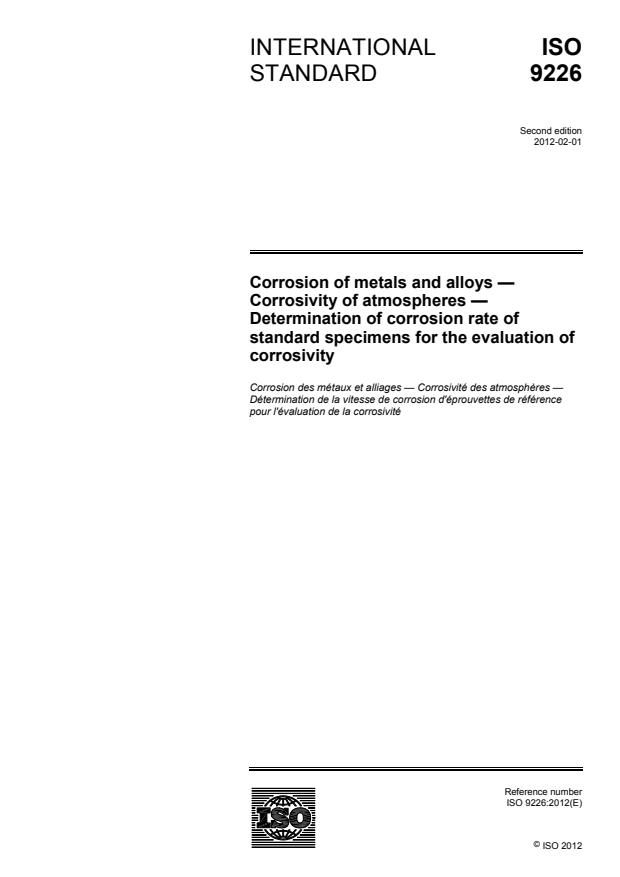
ISO 9226:2012 - Corrosion of metals and alloys — Corrosivity of atmospheres — Determination of corrosion rate of standard specimens for the evaluation of corrosivity Released:1/27/2012
ISO 9226:2012 - Corrosion des métaux et alliages — Corrosivité des atmospheres — Détermination de la vitesse de corrosion d'éprouvettes de référence pour l'évaluation de la corrosivité Released:1/27/2012
Overview
ISO 9226:2012 is an essential international standard published by the International Organization for Standardization (ISO) that specifies methods for determining the corrosion rate of standard metal and alloy specimens. Focused on atmospheric conditions, the standard enables the evaluation of atmospheric corrosivity by measuring corrosion rates on standardized test specimens exposed to the environment over one year. These corrosion rates provide crucial classification criteria in accordance with ISO 9223 for assessing the corrosivity of various atmospheres.
This standardized method offers a practical, economical approach to characterize corrosion levels at different locations or industrial sites by using standard specimens made from typical structural metals. The primary metals covered include steel, zinc, copper, and aluminium, with carefully controlled specimen preparation, exposure, and evaluation procedures.
Key Topics
Scope and Purpose
ISO 9226:2012 specifies test methods to determine corrosion rates based on mass loss of metal specimens after exposure to atmospheric conditions. The resulting data categorize atmospheric corrosivity following ISO 9223, and can also inform on corrosivity beyond ISO 9223’s scope.Standard Specimens
Specimens are flat plates, typically 100 mm × 150 mm and about 1 mm thick, composed of:- Carbon steel (unalloyed, Cu 0.03%-0.10%, P < 0.07%)
- Zinc (minimum 98.5% purity)
- Copper (minimum 99.5% purity)
- Aluminium (minimum 99.5% purity)
Prior to exposure, specimens must be degreased and free of any visible corrosion products to ensure accurate corrosion rate measurement.
Exposure Protocol
Three specimens of each metal are exposed outdoors for one year at specified locations, starting during the period with the highest expected corrosivity (e.g., spring or autumn). Specimens are weighed before and after exposure to determine mass loss.Corrosion Rate Calculation
Corrosion rates are calculated based on mass loss per unit area per exposure time, expressed in grams per square meter per year [g/(m²·a)]. Alternatively, rates can be expressed as thickness reduction in micrometers per year (µm/a), using known metal densities.Cleaning Procedures
After exposure, corrosion products are removed following ISO 8407 cleaning methods. Annex A provides detailed chemical cleaning procedures specific to each metal type, emphasizing safety due to the hazardous chemicals involved.Reporting and Evaluation
Test results include individual specimen values and mean corrosion rates, with documentation of any anomalies that could affect data integrity. These values serve as a foundation for classifying atmospheric corrosivity categories.
Applications
ISO 9226:2012 is widely applied in industries where understanding environmental corrosivity impacts materials selection, asset maintenance, and durability forecasting. Key applications include:
Infrastructure and Construction
Assessing corrosion risks on structural metals exposed to local atmospheres assists engineers in selecting protective coatings and maintenance schedules.Industrial Sites and Environmental Monitoring
Classification of atmospheric corrosivity helps predict corrosion behavior in highly contaminated or industrial areas, facilitating better corrosion management strategies.Quality Control and Material Testing
Manufacturers use ISO 9226 to evaluate the performance of metals and alloys under real-world atmospheric conditions as part of product qualification.Research and Environmental Studies
Provides standardized data for scientists studying the effects of pollution, climate, and environmental factors on metal corrosion rates.
Related Standards
ISO 9226:2012 is part of a series of related standards dealing with corrosion and atmospheric corrosivity:
ISO 9223 – Corrosion of metals and alloys – Corrosivity of atmospheres – Classification, determination and estimation
Defines atmospheric corrosivity categories based on data such as corrosion rates determined by ISO 9226.ISO 9224 – Corrosion of metals and alloys – Corrosivity of atmospheres – Guiding values for the corrosivity categories
Provides reference values for classifying atmospheric corrosivity.ISO 8407 – Corrosion of metals and alloys – Removal of corrosion products from corrosion test specimens
Specifies procedures for cleaning specimens after exposure, integral to the accurate measurement in ISO 9226.ISO 8565 – Metals and alloys – Atmospheric corrosion testing – General requirements
Details general requirements for outdoor exposure tests consistent with ISO 9226 methods.
By following ISO 9226:2012, professionals can reliably quantify atmospheric corrosion rates, enabling consistent classification and evaluation that support material selection, risk assessment, and corrosion mitigation strategies under diverse environmental conditions.
Relations
- Effective Date
- 12-Feb-2026
- Effective Date
- 28-Feb-2009
Buy Documents
ISO 9226:2012 - Corrosion of metals and alloys — Corrosivity of atmospheres — Determination of corrosion rate of standard specimens for the evaluation of corrosivity Released:1/27/2012
ISO 9226:2012 - Corrosion des métaux et alliages — Corrosivité des atmospheres — Détermination de la vitesse de corrosion d'éprouvettes de référence pour l'évaluation de la corrosivité Released:1/27/2012
Get Certified
Connect with accredited certification bodies for this standard

Element Materials Technology
Materials testing and product certification.

Inštitut za kovinske materiale in tehnologije
Institute of Metals and Technology. Materials testing, metallurgical analysis, NDT.
Sponsored listings
Frequently Asked Questions
ISO 9226:2012 is a standard published by the International Organization for Standardization (ISO). Its full title is "Corrosion of metals and alloys — Corrosivity of atmospheres — Determination of corrosion rate of standard specimens for the evaluation of corrosivity". This standard covers: ISO 9226:2012 specifies methods which can be used for the determination of corrosion rate with standard specimens. The values obtained from the measurements (corrosion rates for the first year of exposure) are intended to be used as classification criteria for the evaluation of atmospheric corrosivity according to ISO 9223. They can also be used for informative evaluation of atmospheric corrosivity beyond the scope of ISO 9223.
ISO 9226:2012 specifies methods which can be used for the determination of corrosion rate with standard specimens. The values obtained from the measurements (corrosion rates for the first year of exposure) are intended to be used as classification criteria for the evaluation of atmospheric corrosivity according to ISO 9223. They can also be used for informative evaluation of atmospheric corrosivity beyond the scope of ISO 9223.
ISO 9226:2012 is classified under the following ICS (International Classification for Standards) categories: 77.060 - Corrosion of metals. The ICS classification helps identify the subject area and facilitates finding related standards.
ISO 9226:2012 has the following relationships with other standards: It is inter standard links to EN ISO 9226:2012, ISO 9226:1992. Understanding these relationships helps ensure you are using the most current and applicable version of the standard.
ISO 9226:2012 is available in PDF format for immediate download after purchase. The document can be added to your cart and obtained through the secure checkout process. Digital delivery ensures instant access to the complete standard document.
Standards Content (Sample)
INTERNATIONAL ISO
STANDARD 9226
Second edition
2012-02-01
Corrosion of metals and alloys —
Corrosivity of atmospheres —
Determination of corrosion rate of
standard specimens for the evaluation of
corrosivity
Corrosion des métaux et alliages — Corrosivité des atmosphères —
Détermination de la vitesse de corrosion d'éprouvettes de référence
pour l'évaluation de la corrosivité
Reference number
©
ISO 2012
© ISO 2012
All rights reserved. Unless otherwise specified, no part of this publication may be reproduced or utilized in any form or by any means,
electronic or mechanical, including photocopying and microfilm, without permission in writing from either ISO at the address below or
ISO's member body in the country of the requester.
ISO copyright office
Case postale 56 CH-1211 Geneva 20
Tel. + 41 22 749 01 11
Fax + 41 22 749 09 47
E-mail copyright@iso.org
Web www.iso.org
Published in Switzerland
ii © ISO 2012 – All rights reserved
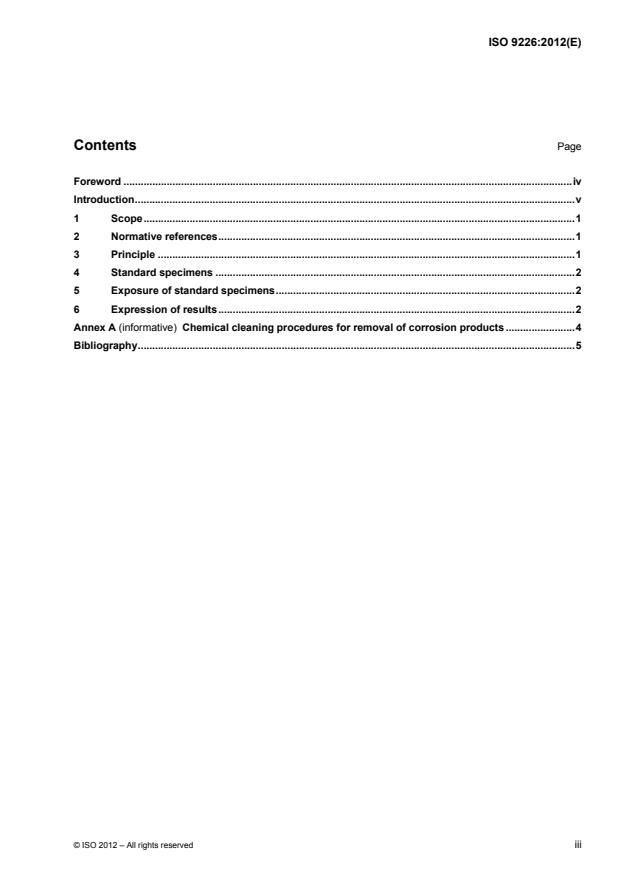
Contents Page
Foreword . iv
Introduction . v
1 Scope . 1
2 Normative references . 1
3 Principle . 1
4 Standard specimens . 2
5 Exposure of standard specimens . 2
6 Expression of results . 2
Annex A (informative) Chemical cleaning procedures for removal of corrosion products . 4
Bibliography . 5
Foreword
ISO (the International Organization for Standardization) is a worldwide federation of national standards bodies
(ISO member bodies). The work of preparing International Standards is normally carried out through ISO
technical committees. Each member body interested in a subject for which a technical committee has been
established has the right to be represented on that committee. International organizations, governmental and
non-governmental, in liaison with ISO, also take part in the work. ISO collaborates closely with the
International Electrotechnical Commission (IEC) on all matters of electrotechnical standardization.
International Standards are drafted in accordance with the rules given in the ISO/IEC Directives, Part 2.
The main task of technical committees is to prepare International Standards. Draft International Standards
adopted by the technical committees are circulated to the member bodies for voting. Publication as an
International Standard requires approval by at least 75 % of the member bodies casting a vote.
Attention is drawn to the possibility that some of the elements of this document may be the subject of patent
rights. ISO shall not be held responsible for identifying any or all such patent rights.
ISO 9226 was prepared by Technical Committee ISO/TC 156, Corrosion of metals and alloys.
This second edition cancels and replaces the first edition (ISO 9226:1992), which has been technically revised.
In particular, the use of helix specimens as standard specimens is no longer prescribed and Annex A has
been updated.
iv © ISO 2012 – All rights reserved
Introduction
The characterization of an atmospheric corrosion test site or of a service location with respect to its corrosivity
can be accomplished by determining the corrosion rate of standard specimens exposed for one year to the
atmosphere at the respective location (corrosivity determination). The standard specimens are flat plate
specimens of the four standard structural materials: aluminium, copper, steel and zinc. This method
represents an economical way of evaluating corrosivity, taking into account all local environmental influences.
INTERNATIONAL STANDARD ISO 9226:2012(E)
Corrosion of metals and alloys — Corrosivity of atmospheres —
Determination of corrosion rate of standard specimens for the
evaluation of corrosivity
WARNING — Some of the procedures included in this International Standard entail the use of
potentially hazardous chemicals. lt is emphasized that all appropriate safety precautions should be
taken.
1 Scope
This International Standard specifies methods which can be used for the determination of corrosion rate with
standard specimens. The values obtained from the measurements (corrosion rates for the first year of
exposure) are intended to be used as classification criteria for the evaluation of atmospheric corrosivity
according to ISO 9223. They can also be used for informative evaluation of atmospheric corrosivity beyond
the scope of ISO 9223.
2 Normative references
The following referenced documents are indispensable for the application of this document. For dated
references, only the edition cited applies. For undated references, the latest edition of the referenced
document (including any amendments) applies.
ISO 8407, Corrosion of metals and alloys — Removal of corrosion products from c
...
NORME ISO
INTERNATIONALE 9226
Deuxième édition
2012-02-01
Corrosion des métaux et alliages —
Corrosivité des atmosphères —
Détermination de la vitesse de corrosion
d'éprouvettes de référence pour
l'évaluation de la corrosivité
Corrosion of metals and alloys — Corrosivity of atmospheres —
Determination of corrosion rate of standard specimens for the
evaluation of corrosivity
Numéro de référence
©
ISO 2012
DOCUMENT PROTÉGÉ PAR COPYRIGHT
© ISO 2012
Droits de reproduction réservés. Sauf prescription différente, aucune partie de cette publication ne peut être reproduite ni utilisée sous
quelque forme que ce soit et par aucun procédé, électronique ou mécanique, y compris la photocopie et les microfilms, sans l'accord écrit
de l'ISO à l'adresse ci-après ou du comité membre de l'ISO dans le pays du demandeur.
ISO copyright office
Case postale 56 CH-1211 Geneva 20
Tel. + 41 22 749 01 11
Fax + 41 22 749 09 47
E-mail copyright@iso.org
Web www.iso.org
Publié en Suisse
ii © ISO 2012 – Tous droits réservés
Sommaire Page
Avant-propos . iv
Introduction . v
1 Domaine d'application . 1
2 Références normatives . 1
3 Principe . 1
4 Éprouvettes de référence . 2
5 Exposition des éprouvettes de référence . 2
6 Expression des résultats . 2
Annexe A (informative) Méthodes chimiques de nettoyage destinées à éliminer les produits de
corrosion . 4
Bibliographie . 5
Avant-propos
L'ISO (Organisation internationale de normalisation) est une fédération mondiale d'organismes nationaux de
normalisation (comités membres de l'ISO). L'élaboration des Normes internationales est en général confiée
aux comités techniques de l'ISO. Chaque comité membre intéressé par une étude a le droit de faire partie du
comité technique créé à cet effet. Les organisations internationales, gouvernementales et non
gouvernementales, en liaison avec l'ISO participent également aux travaux. L'ISO collabore étroitement avec
la Commission électrotechnique internationale (CEI) en ce qui concerne la normalisation électrotechnique.
Les Normes internationales sont rédigées conformément aux règles données dans les Directives ISO/CEI,
Partie 2.
La tâche principale des comités techniques est d'élaborer les Normes internationales. Les projets de Normes
internationales adoptés par les comités techniques sont soumis aux comités membres pour vote. Leur
publication comme Normes internationales requiert l'approbation de 75 % au moins des comités membres
votants.
L'attention est appelée sur le fait que certains des éléments du présent document peuvent faire l'objet de
droits de propriété intellectuelle ou de droits analogues. L'ISO ne saurait être tenue pour responsable de ne
pas avoir identifié de tels droits de propriété et averti de leur existence.
L'ISO 9226 a été élaborée par le comité technique ISO/TC 156, Corrosion des métaux et alliages.
Cette deuxième édition annule et remplace la première édition (ISO 9226:1992), qui a fait l'objet d'une
révision technique. En particulier, il n'est plus exigé d'utiliser des éprouvettes hélicoïdales comme éprouvettes
de référence et l'Annexe A a fait l'objet d'une mise à jour.
iv © ISO 2012 – Tous droits réservés
Introduction
La caractérisation d'un site d'essai de corrosion atmosphérique ou d'un emplacement de service vis-à-vis de
sa corrosivité repose sur la détermination de la vitesse de corrosion d'éprouvettes de référence exposées
pendant une année à l'atmosphère dans le lieu considéré (détermination de la corrosivité). Ces éprouvettes
de référence sont des éprouvettes plates en quatre matériaux de construction de référence: aluminium, cuivre,
acier et zinc. Cette méthode constitue un moyen économique d'évaluation de la corrosivité tenant compte de
tous les facteurs influant sur l'environnement local.
NORME INTERNATIONALE ISO 9226:2012(F)
Corrosion des métaux et alliages — Corrosivité des
atmosphères — Détermination de la vitesse de corrosion
d'éprouvettes de référence pour l'évaluation de la corrosivité
AVERTISSEMENT — Certains modes opératoires spécifiés dans la présente Norme internationale font
appel à l'utilisation de produits chimiques potentiellement dangereux. Il est souligné qu’il convient de
prendre toutes les mesures de sécurité qui s'imposent.
1 Domaine d'application
La présente Norme internationale spécifie les méthodes utilisables pour déterminer la vitesse de corrosion
d'éprouvettes de référence. Les valeurs obtenues par mesurage (vitesses de corrosion pour la première
année d'exposition) sont destinées à servir de critères de classification pour l'évaluation de la corrosivité des
atmosphères conformément à l'ISO 9223. Elles peuvent également servir pour l'évaluation informative de la
corrosivité atmosphérique ne relevant pas du domaine d'application de l'ISO 9223.
2 Références normatives
Les documents de référence suivants sont indispensables pour l'application du présent document. Pour les
références datées, seule l'édition citée s'applique. Pour les références non datées, la dernière édition du
document de référence (y compris les éventuels amendements) s'applique.
ISO 8407, Corrosion des métaux et alliages — Élimination des produits de corrosion sur les éprouvette
...