

ISO 3409:1975
(Main)Passenger cars — Lateral spacing of foot controls
General Information
- Abstract
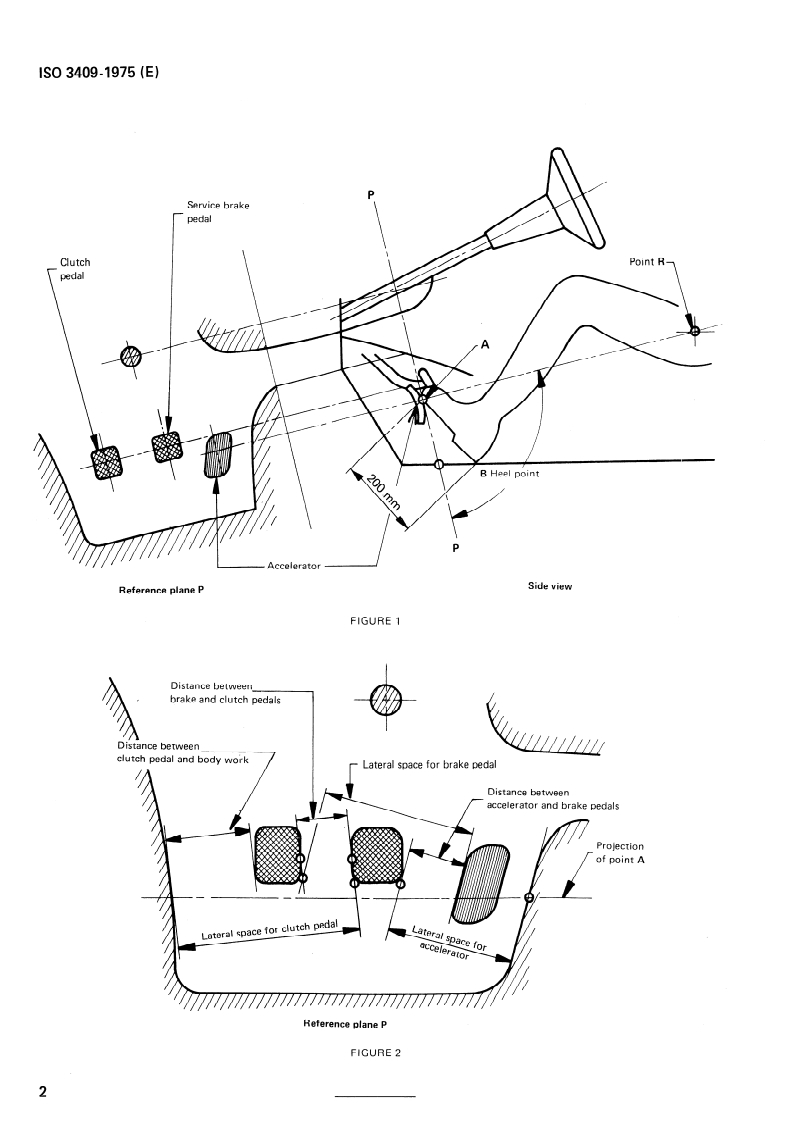
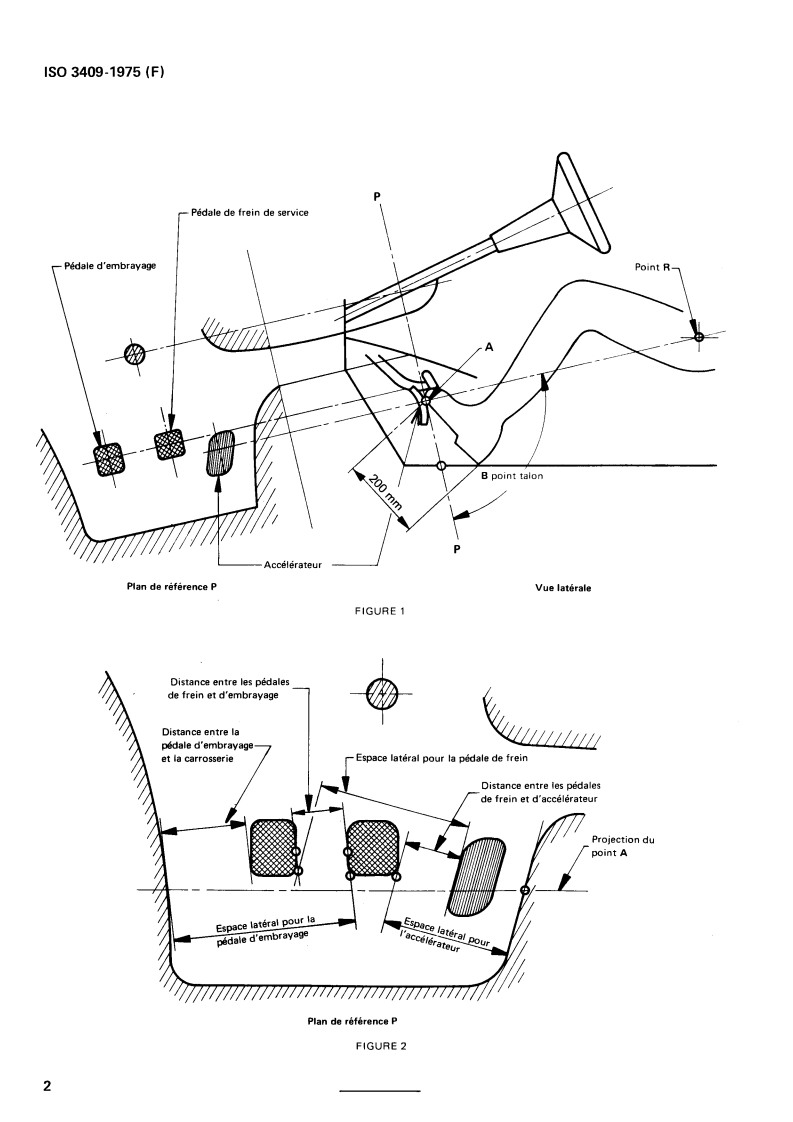
Establishes required characteristics concerning the positions and distances necessary to ensure sufficient lateral spacing for the operation of controls. Applies only to the accelerator, service brake, and clutch pedals for passenger cars and their derivatives. Two figures illustrate shapes and reference quantities of concern.
- Status
- Published
- Publication Date
- 30-Jun-1975
- Technical Committee
- ISO/TC 22/SC 39 - Ergonomics
- Drafting Committee
- ISO/TC 22/SC 39 - Ergonomics
- Current Stage
- 9093 - International Standard confirmed
- Start Date
- 05-Oct-2023
- Completion Date
- 29-Aug-2026
Buy Documents

ISO 3409:1975 - Passenger cars -- Lateral spacing of foot controls
ISO 3409:1975 - Passenger cars — Lateral spacing of foot controls/1/1975


ISO 3409:1975 - Voitures particulieres -- Positionnement transversal des commandes au pied

ISO 3409:1975 - Voitures particulieres -- Positionnement transversal des commandes au pied
ISO 3409:1975 - Voitures particulières — Positionnement transversal des commandes au pied/1/1975
ISO 3409:1975 - Voitures particulières — Positionnement transversal des commandes au pied/1/1975
Overview
ISO 3409:1975 is an international standard developed by the International Organization for Standardization (ISO) that specifies the lateral spacing requirements for foot controls in passenger cars. This standard focuses on the accelerator, service brake, and clutch pedals, ensuring their positions and distances provide sufficient space for safe and effective operation. Established in 1975, ISO 3409 aims to improve vehicle control ergonomics by standardizing pedal layout, enhancing driver comfort and safety.
This standard applies primarily to passenger cars and their derivatives. It lays down detailed dimensional requirements and includes illustrative figures demonstrating the shapes and reference points critical for measurement and design compliance.
Key Topics
Scope and Application
ISO 3409 specifically covers lateral spacing for three main foot controls in passenger cars:- Accelerator pedal
- Service brake pedal
- Clutch pedal
The standard ensures pedals are arranged and spaced properly from left to right, viewed from the driver’s perspective.
Pedal Arrangement
The order of pedals from left to right is defined as: clutch pedal, service brake pedal, and accelerator pedal. This arrangement promotes intuitive and comfortable driver operation.Minimum Lateral Distances
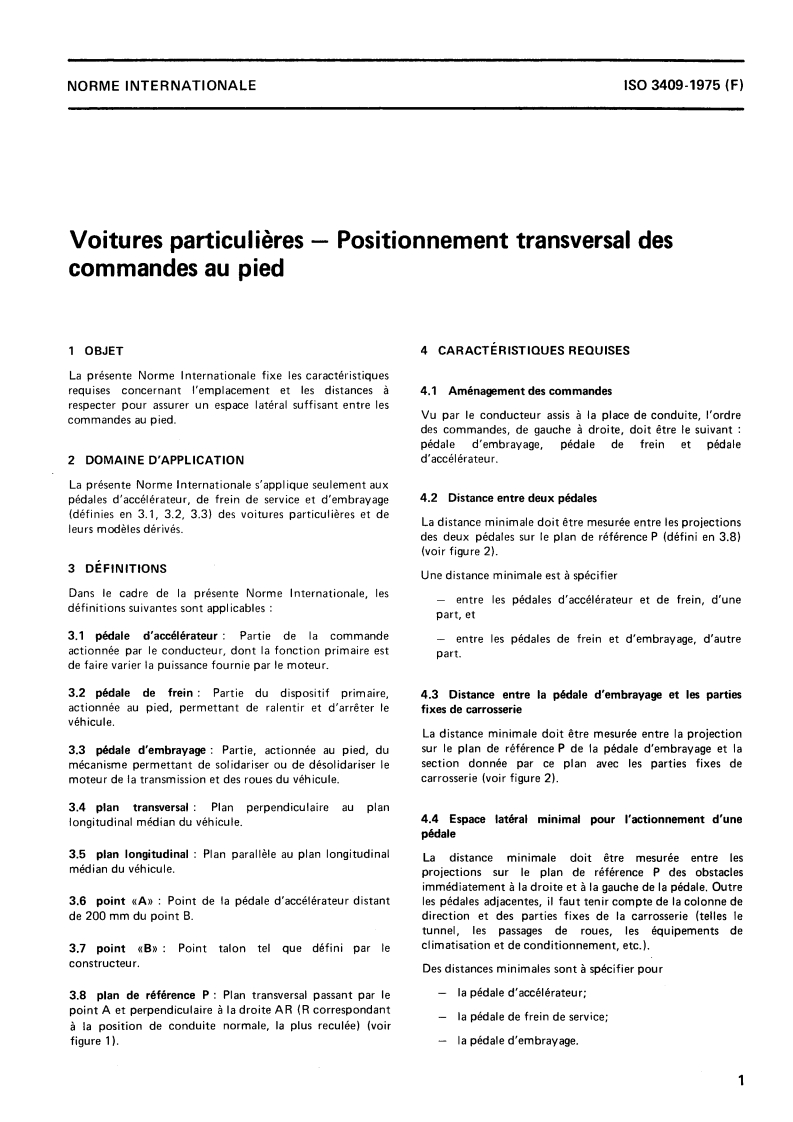
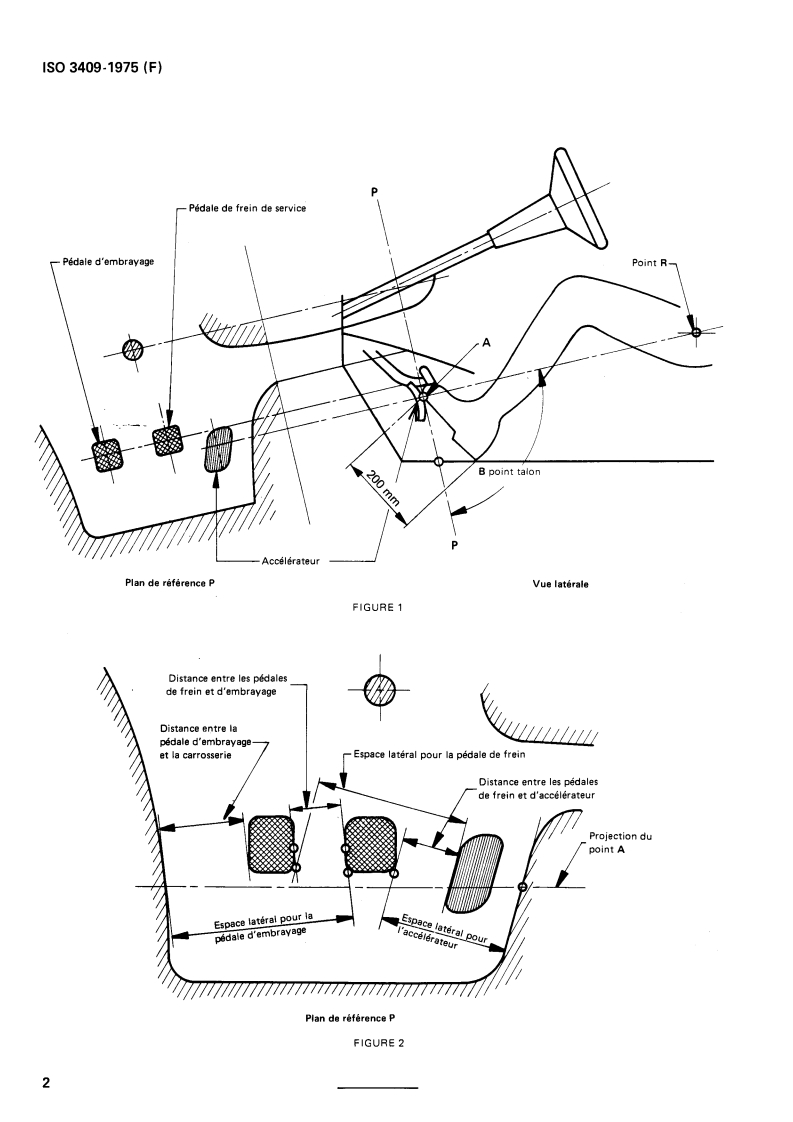
- The minimum distances between pedals are measured by projecting pedal positions onto a reference plane perpendicular to the vehicle's longitudinal axis.
- Clearance is also required between the clutch pedal and fixed body parts such as trim panels and tunnels.
- Space is prescribed to allow for unobstructed actuation of each pedal, considering adjacent pedals and fixed components including the steering column and ventilation systems.
Definitions and Reference Points
Key terms like "accelerator pedal," "service brake pedal," "clutch pedal," and geometric references such as "reference plane P" and points A and B, are precisely defined to ensure uniform measurements and application.Illustrations
The standard includes two figures that depict foot control shapes and layout dimensions, aiding designers and engineers in visualizing and implementing the requirements.
Applications
Vehicle Design and Engineering
Automotive manufacturers utilize ISO 3409 to design driver foot control layouts that meet ergonomic and safety standards. Proper pedal spacing reduces the risk of accidental pressing and ensures drivers of varying sizes can operate pedals comfortably and safely.Safety Compliance and Regulation
Compliance with this standard aids in meeting regional and international vehicle safety regulations, providing a benchmark for foot control arrangement in passenger cars.Ergonomics Optimization
By standardizing lateral pedal spacing, designers can optimize cockpit ergonomics, enhancing driver comfort and reducing fatigue during vehicle operation.Aftermarket Modifications
Car modification specialists and parts suppliers can refer to ISO 3409 requirements to maintain safety when customizing pedals or installing replacement components.
Related Standards
ISO/TC 22 - Road Vehicles Technical Committees
ISO 3409 was developed under Technical Committee 22, which oversees standards related to road vehicles, including controls and ergonomic interfaces.Other Pedal and Control Standards
ISO 3911 - Road vehicles - Pedal controls: Dimensions and resistance
ISO 15037 - Vehicle seating standards (relevant to driver position and pedal reach)Vehicle Safety Standards
ISO 26262 - Functional safety for road vehicles (indirectly related to controls safety)
UNECE Regulations on vehicle control systems
Keywords: ISO 3409, lateral spacing, foot controls, passenger cars, accelerator pedal, brake pedal, clutch pedal, vehicle ergonomics, automotive standards, pedal layout, driver safety, vehicle pedal spacing, ISO standards for vehicles
Buy Documents
ISO 3409:1975 - Passenger cars -- Lateral spacing of foot controls
ISO 3409:1975 - Passenger cars — Lateral spacing of foot controls/1/1975
ISO 3409:1975 - Voitures particulieres -- Positionnement transversal des commandes au pied
ISO 3409:1975 - Voitures particulieres -- Positionnement transversal des commandes au pied
ISO 3409:1975 - Voitures particulières — Positionnement transversal des commandes au pied/1/1975
ISO 3409:1975 - Voitures particulières — Positionnement transversal des commandes au pied/1/1975
Get Certified
Connect with accredited certification bodies for this standard

TÜV Rheinland
TÜV Rheinland is a leading international provider of technical services.

TÜV SÜD
TÜV SÜD is a trusted partner of choice for safety, security and sustainability solutions.

DEKRA Certification Inc.
DEKRA US certification services.
Sponsored listings
Frequently Asked Questions
ISO 3409:1975 is a standard published by the International Organization for Standardization (ISO). Its full title is "Passenger cars — Lateral spacing of foot controls". This standard covers: Establishes required characteristics concerning the positions and distances necessary to ensure sufficient lateral spacing for the operation of controls. Applies only to the accelerator, service brake, and clutch pedals for passenger cars and their derivatives. Two figures illustrate shapes and reference quantities of concern.
Establishes required characteristics concerning the positions and distances necessary to ensure sufficient lateral spacing for the operation of controls. Applies only to the accelerator, service brake, and clutch pedals for passenger cars and their derivatives. Two figures illustrate shapes and reference quantities of concern.
ISO 3409:1975 is classified under the following ICS (International Classification for Standards) categories: 43.040.30 - Indicating and control devices. The ICS classification helps identify the subject area and facilitates finding related standards.
ISO 3409:1975 is available in PDF format for immediate download after purchase. The document can be added to your cart and obtained through the secure checkout process. Digital delivery ensures instant access to the complete standard document.
Standards Content (Sample)
/
INTERNATIONAL STANDARD
INTERNATIONAL ORGANIZATION FOR STANDARDIZATION l MEXAYHAPOAHAJi OPTAHM3AUMJi I-IO CTAHAAPTM3A~MM -ORGANISATION INTERNATIONALE DE NORMALISATION
Passenger cars - Lateral spacing of foot controls
Voitures particulikes - Positionnement transversal des commandes au pied
First edition - 1975-07-15
UDC 629.113 Ref. No. ISO 34094975 (Ej
Descriptors : road vehicles, motor vehicles, automobiles, control equipment, foot controls, layout.
Price based on 2 pages
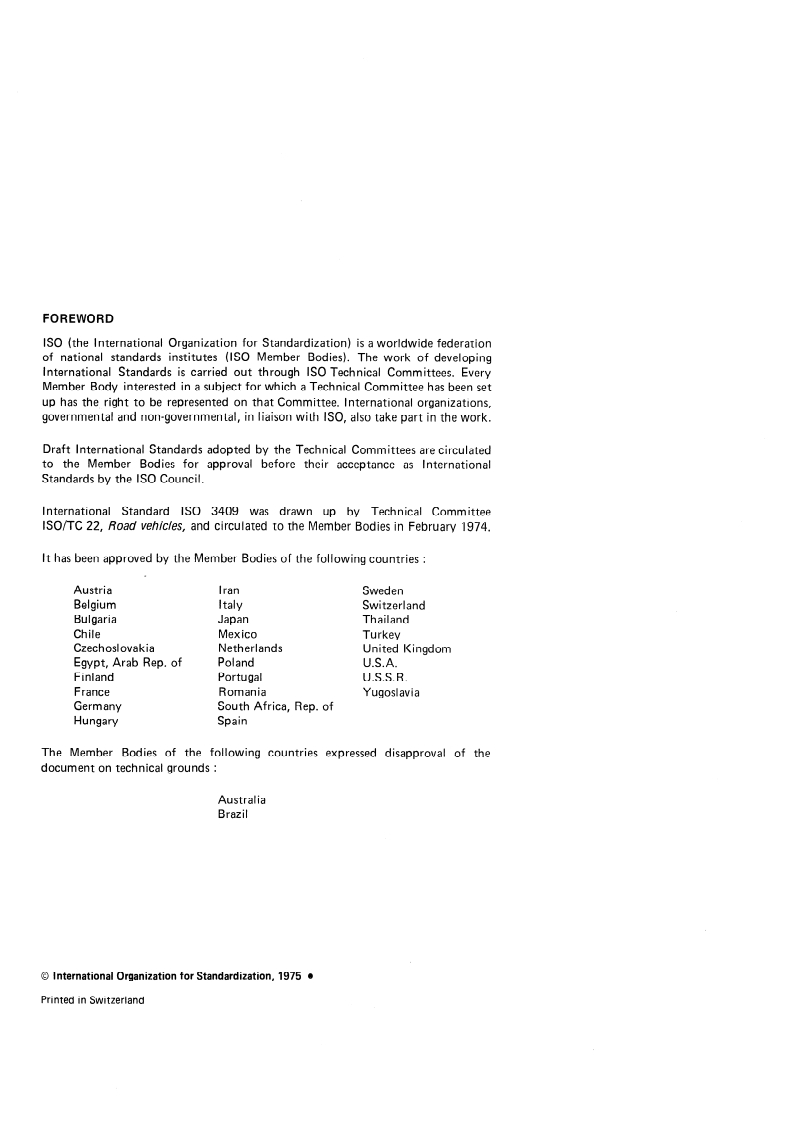
FOREWORD
ISO (the International Organization for Standardization) is a worldwide federation
of national Standards institutes (ISO Member Bodies). The work of developing
International Standards is carried out through ISO Technical Committees. Every
Member Body interested in a subject for which a Technical Committee has been set
up has the right to be represented on that Committee. International organizations,
governmental and non-governmental, in liaison with ISO, also take part in the work.
Draft International Standards adopted by the Technical Committees are circulated
to the Member Bodies for approval before their acceptance as International
Standards by the ISO Council.
International Standard ISO 3409 was drawn up by Technical Committee
ISO/TC 22, Road vehicles, and circulated to the Member Bodies in February 1974.
lt has been approved by the Member Bodies of the following countries :
Austria Iran Sweden
Belgium I taly Switzerland
Bulgaria Japan Thailand
Chile Mexico Turkey
Czechoslovakia Netherlands United Kingdom
Egypt, Arab Rep. of Poland U.S.A.
Portugal
Finland U.S.S.R.
France Romania Yugoslavia
South Africa, Rep. of
Germany
Spain
Hungary
The Member Bod ies of the fol Iowing countries expressed disapproval of the
document on technical ounds :
Y
Austral ia
Brazil
0 International Organkation for Standardkation, 1975 0
Printed in Switzerland
ISO 3409-1975 (E)
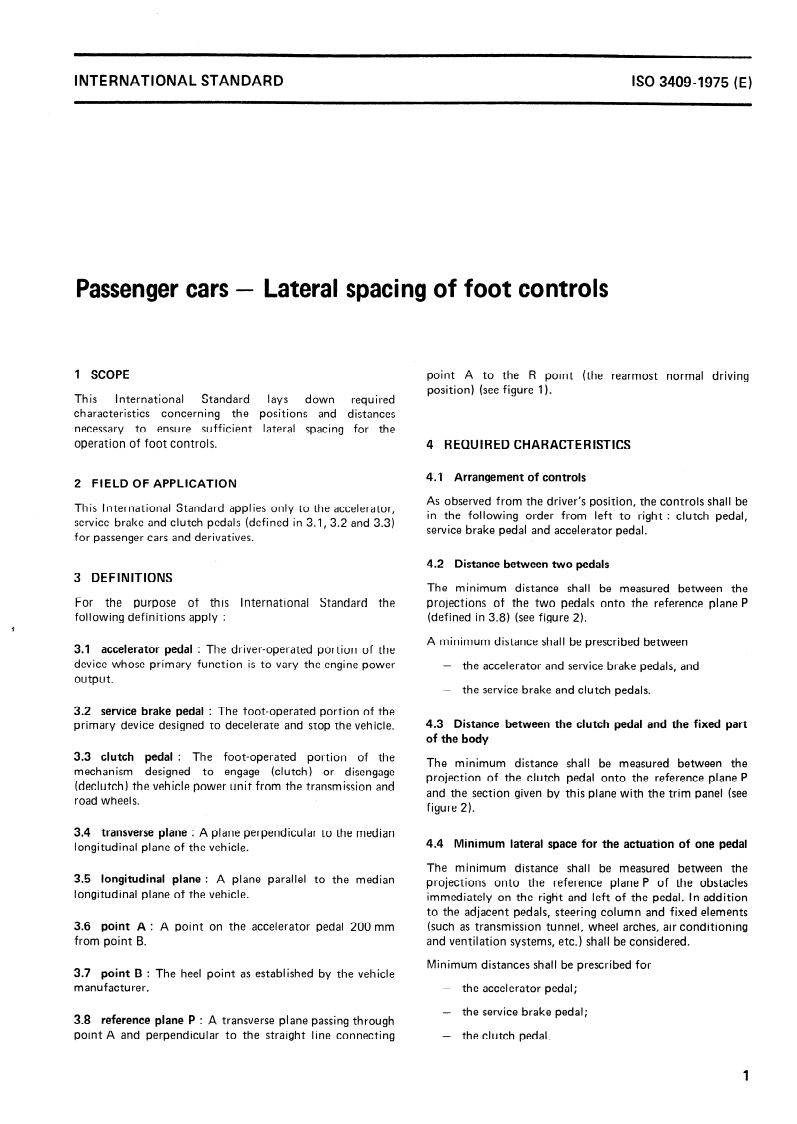
INTERNATIONAL STANDARD
Passenger cars - Lateral spacing of foot controls
Point A to the R pornt (the rearmost normal driving
1 SCOPE
Position) (see figure 1).
International Standard lays down required
This
characteristics concerning the positions and distances
necessary to ensure sufficient lateral spacing for the
Operation of foot controls. 4 REQUIRED CHARACTERISTICS
4.1 Arrangement of controls
2 FIELD OF APPLICATION
As observed from the driver’s Position, the controls shall be
This International Standard applies only to the accelerator,
in the followin
...
/
INTERNATIONAL STANDARD
INTERNATIONAL ORGANIZATION FOR STANDARDIZATION l MEXAYHAPOAHAJi OPTAHM3AUMJi I-IO CTAHAAPTM3A~MM -ORGANISATION INTERNATIONALE DE NORMALISATION
Passenger cars - Lateral spacing of foot controls
Voitures particulikes - Positionnement transversal des commandes au pied
First edition - 1975-07-15
UDC 629.113 Ref. No. ISO 34094975 (Ej
Descriptors : road vehicles, motor vehicles, automobiles, control equipment, foot controls, layout.
Price based on 2 pages
FOREWORD
ISO (the International Organization for Standardization) is a worldwide federation
of national Standards institutes (ISO Member Bodies). The work of developing
International Standards is carried out through ISO Technical Committees. Every
Member Body interested in a subject for which a Technical Committee has been set
up has the right to be represented on that Committee. International organizations,
governmental and non-governmental, in liaison with ISO, also take part in the work.
Draft International Standards adopted by the Technical Committees are circulated
to the Member Bodies for approval before their acceptance as International
Standards by the ISO Council.
International Standard ISO 3409 was drawn up by Technical Committee
ISO/TC 22, Road vehicles, and circulated to the Member Bodies in February 1974.
lt has been approved by the Member Bodies of the following countries :
Austria Iran Sweden
Belgium I taly Switzerland
Bulgaria Japan Thailand
Chile Mexico Turkey
Czechoslovakia Netherlands United Kingdom
Egypt, Arab Rep. of Poland U.S.A.
Portugal
Finland U.S.S.R.
France Romania Yugoslavia
South Africa, Rep. of
Germany
Spain
Hungary
The Member Bod ies of the fol Iowing countries expressed disapproval of the
document on technical ounds :
Y
Austral ia
Brazil
0 International Organkation for Standardkation, 1975 0
Printed in Switzerland
ISO 3409-1975 (E)
INTERNATIONAL STANDARD
Passenger cars - Lateral spacing of foot controls
Point A to the R pornt (the rearmost normal driving
1 SCOPE
Position) (see figure 1).
International Standard lays down required
This
characteristics concerning the positions and distances
necessary to ensure sufficient lateral spacing for the
Operation of foot controls. 4 REQUIRED CHARACTERISTICS
4.1 Arrangement of controls
2 FIELD OF APPLICATION
As observed from the driver’s Position, the controls shall be
This International Standard applies only to the accelerator,
in the followin
...
NORME INTERNATIONALE 3409
~~
INTERNATIONAL ORGANIZATION FOR STANDARDIZATION .MEXnYHAPOnHAn OPrAHH3AUHX IT0 CTAHLlAPTH3AUHH.ORGANlSATlON INTERNATIONALE DE NORMALISATION
Voitures particulières - Positionnement transversal des
commandes au pied
Passenger cars - Lateral spacing of foot controls
Première édition - 1975-07-15
I
LL
- CDU 629.113
Réf. no : IS0 3409-1975 (F)
m
PI
Derripteurs : véhicule routier, véhicule a moteur. automobile, matériel de commande, commande au pied, disposition.
h
:
s Prix basé sur 2 pages
AVANT-PROPOS
L’ISO (Organisation Internationale de Normalisation) est une fédération mondiale
d’organismes nationaux de normalisation (Comités Membres ISO). L‘élaboration de
Normes Internationales est confiée aux Comités Techniques ISO. Chaque Comité
Membre intéressé par une étude a le droit de faire partie du Comité Technique
correspondant. Les organisations internationales, gouvernementales et non
gouvernementales, en liaison avec I’ISO, participent également aux travaux.
Les Projets de Normes Internationales adoptés par les Comités Techniques sont
soumis aux Comités Membres pour approbation, avant leur acceptation comme
Normes Internationales par le Conseil de I’ISO.
La Norme Internationale IS0 3409 a été établie par le Comité Technique
ISO/TC 22, Véhicules routiers, et soumise aux Comités Membres en février 1974.
Elle a été approuvée par les Comités Membres des pays suivants :
Afrique du Sud, Rép. d’ Hongrie
Suède
Allemagne
Iran Suisse
Autriche Italie Tchécoslovaquie
Belgique Japon Th a’il ande
Bu1 garie Mexique Turquie
Chili Pays-Bas U.R.S.S.
Egypte, Rép. arabe d’ Pologne U.S.A.
Espagne Portugal Yougoslavie
Finlande Roumanie
France Royaume- Uni
Les Comités Membres des pays suivants ont désapprouvé le document pour des
raisons techniques :
Australie
Brésil
O Organisation Internationale de Normalisation, 1975 O
Imprime en Suisse
IS0 3409-1975 (F)
NORME INTERNATIONALE
Voitures particulières - Positionnement transversal des
commandes au pied
4 CAR ACTÉR ISTIQUES REQUISES
1 OBJET
La présente Norme Internationale fixe les caractéristiques
requises concernant l'emplacement et les distances à
4.1 Aménagement des commandes
respecter pour assurer un espace latéral suffisant entre les
Vu par le conducteur assis à la place de conduite, l'ordre
commandes au pied.
des commandes, de gauche a droite, doit être le suivant :
pédale d'embrayage, pédale de frein et pédale
d'accélérateur.
2 DOMAINE D'APPLICATION
La présente Norme Internationale s'applique seulement aux
4.2 Distance entre deux pédales
pédales d'accélérateur, de frein de se
...
NORME INTERNATIONALE 3409
~ ~~
INTERNATIONAL ORGANIZATION FOR STANDARDIZATION eMEXnYHAPOnHAR OPrAHM3AUMR II0 CTAHLlAPTM3AUMH.ORGANISATION INTERNATIONALE DE NORMALISATION
Voitures particulières - Positionnement transversal des
commandes au pied
Passenger cars - Lateral spacing of foot controls
Premiere édition - 1975-07-15
I
LL
CDU 629.113 Réf. no : IS0 3409-1975 (FI
-
Descripteurs : véhicule routier, véhicule a moteur, automobile, matériel de commande, commande au pied, disposition.
Prix basé sur 2 pages
;
AVANT-PROPOS
L’ISO (Organisation Internationale de Normalisation) est une fédération mondiale
d’organismes nationaux de normalisation (Comités Membres ISO). L’élaboration de
Normes Internationales est confiée aux Comités Techniques ISO. Chaque Comité
Membre intéressé par une étude a le droit de faire partie du Comité Technique
correspondant. Les organisations internationales, gouvernementales et non
gouvernementales, en liaison avec I’ISO, participent également aux travaux.
. .-
Les Projets de Normes Internationales adoptés par les Comités Techniques sont
soumis aux Comités Membres pour approbation, avant leur acceptation comme
Normes Internationales par le Conseil de I’ISO.
La Norme Internationale IS0 3409 a été établie par le Comité Technique
ISO/TC 22, Véhicules routiers, et soumise aux Comités Membres en février 1974.
Elle a été approuvée par les Comités Membres des pays suivants :
Afrique du Sud, Rép. d’ Hongrie Suède
Allemagne I ran
Suisse
Autriche Italie
Tchécoslovaquie
Belgique
Japon Thaïlande
Bulgarie Mexique
Tu rqu ie
Chili
Pays- Bas U.R.S.S.
Egypte, Rép. arabe d’
Pologne U.S.A.
Espagne Portugal Yougoslavie
Finlande Roumanie
France Royaume- Uni
Les Comités Membres des pays suivants ont désapprouvé le document pour des
raisons techniques :
Australie
Brésil
Q Organisation Internationale de Normalisation, 1975 0
Imprim6 en Suisse
NORME INTERNATIONALE IS0 3409-1975 (F)
Voitures particulières - Positionnement transversal des
commandes au pied
1 OBJET 4 CARACTÉRISTIQUES REQUISES
La présente Norme Internationale fixe les caractéristiques
requises concernant l'emplacement et les distances à
4.1 Aménagement'des commandes
respecter pour assurer un espace latéral suffisant entre les
Vu par le conducteur assis à la place de conduite, l'ordre
commandes au pied.
---
des commandes, de gauche a droite, doit être le suivant :
pédale d'embrayage, pédale de frein et pédale
d'accél Bra teu r.
2 DOMAINE D'APPLICATION
La présente Norme Internationale s'applique seulement aux
4.2 Di
...
NORME INTERNATIONALE 3409
~~
INTERNATIONAL ORGANIZATION FOR STANDARDIZATION .MEXnYHAPOnHAn OPrAHH3AUHX IT0 CTAHLlAPTH3AUHH.ORGANlSATlON INTERNATIONALE DE NORMALISATION
Voitures particulières - Positionnement transversal des
commandes au pied
Passenger cars - Lateral spacing of foot controls
Première édition - 1975-07-15
I
LL
- CDU 629.113
Réf. no : IS0 3409-1975 (F)
m
PI
Derripteurs : véhicule routier, véhicule a moteur. automobile, matériel de commande, commande au pied, disposition.
h
:
s Prix basé sur 2 pages
AVANT-PROPOS
L’ISO (Organisation Internationale de Normalisation) est une fédération mondiale
d’organismes nationaux de normalisation (Comités Membres ISO). L‘élaboration de
Normes Internationales est confiée aux Comités Techniques ISO. Chaque Comité
Membre intéressé par une étude a le droit de faire partie du Comité Technique
correspondant. Les organisations internationales, gouvernementales et non
gouvernementales, en liaison avec I’ISO, participent également aux travaux.
Les Projets de Normes Internationales adoptés par les Comités Techniques sont
soumis aux Comités Membres pour approbation, avant leur acceptation comme
Normes Internationales par le Conseil de I’ISO.
La Norme Internationale IS0 3409 a été établie par le Comité Technique
ISO/TC 22, Véhicules routiers, et soumise aux Comités Membres en février 1974.
Elle a été approuvée par les Comités Membres des pays suivants :
Afrique du Sud, Rép. d’ Hongrie
Suède
Allemagne
Iran Suisse
Autriche Italie Tchécoslovaquie
Belgique Japon Th a’il ande
Bu1 garie Mexique Turquie
Chili Pays-Bas U.R.S.S.
Egypte, Rép. arabe d’ Pologne U.S.A.
Espagne Portugal Yougoslavie
Finlande Roumanie
France Royaume- Uni
Les Comités Membres des pays suivants ont désapprouvé le document pour des
raisons techniques :
Australie
Brésil
O Organisation Internationale de Normalisation, 1975 O
Imprime en Suisse
IS0 3409-1975 (F)
NORME INTERNATIONALE
Voitures particulières - Positionnement transversal des
commandes au pied
4 CAR ACTÉR ISTIQUES REQUISES
1 OBJET
La présente Norme Internationale fixe les caractéristiques
requises concernant l'emplacement et les distances à
4.1 Aménagement des commandes
respecter pour assurer un espace latéral suffisant entre les
Vu par le conducteur assis à la place de conduite, l'ordre
commandes au pied.
des commandes, de gauche a droite, doit être le suivant :
pédale d'embrayage, pédale de frein et pédale
d'accélérateur.
2 DOMAINE D'APPLICATION
La présente Norme Internationale s'applique seulement aux
4.2 Distance entre deux pédales
pédales d'accélérateur, de frein de se
...
NORME INTERNATIONALE 3409
~ ~~
INTERNATIONAL ORGANIZATION FOR STANDARDIZATION eMEXnYHAPOnHAR OPrAHM3AUMR II0 CTAHLlAPTM3AUMH.ORGANISATION INTERNATIONALE DE NORMALISATION
Voitures particulières - Positionnement transversal des
commandes au pied
Passenger cars - Lateral spacing of foot controls
Premiere édition - 1975-07-15
I
LL
CDU 629.113 Réf. no : IS0 3409-1975 (FI
-
Descripteurs : véhicule routier, véhicule a moteur, automobile, matériel de commande, commande au pied, disposition.
Prix basé sur 2 pages
;
AVANT-PROPOS
L’ISO (Organisation Internationale de Normalisation) est une fédération mondiale
d’organismes nationaux de normalisation (Comités Membres ISO). L’élaboration de
Normes Internationales est confiée aux Comités Techniques ISO. Chaque Comité
Membre intéressé par une étude a le droit de faire partie du Comité Technique
correspondant. Les organisations internationales, gouvernementales et non
gouvernementales, en liaison avec I’ISO, participent également aux travaux.
. .-
Les Projets de Normes Internationales adoptés par les Comités Techniques sont
soumis aux Comités Membres pour approbation, avant leur acceptation comme
Normes Internationales par le Conseil de I’ISO.
La Norme Internationale IS0 3409 a été établie par le Comité Technique
ISO/TC 22, Véhicules routiers, et soumise aux Comités Membres en février 1974.
Elle a été approuvée par les Comités Membres des pays suivants :
Afrique du Sud, Rép. d’ Hongrie Suède
Allemagne I ran
Suisse
Autriche Italie
Tchécoslovaquie
Belgique
Japon Thaïlande
Bulgarie Mexique
Tu rqu ie
Chili
Pays- Bas U.R.S.S.
Egypte, Rép. arabe d’
Pologne U.S.A.
Espagne Portugal Yougoslavie
Finlande Roumanie
France Royaume- Uni
Les Comités Membres des pays suivants ont désapprouvé le document pour des
raisons techniques :
Australie
Brésil
Q Organisation Internationale de Normalisation, 1975 0
Imprim6 en Suisse
NORME INTERNATIONALE IS0 3409-1975 (F)
Voitures particulières - Positionnement transversal des
commandes au pied
1 OBJET 4 CARACTÉRISTIQUES REQUISES
La présente Norme Internationale fixe les caractéristiques
requises concernant l'emplacement et les distances à
4.1 Aménagement'des commandes
respecter pour assurer un espace latéral suffisant entre les
Vu par le conducteur assis à la place de conduite, l'ordre
commandes au pied.
---
des commandes, de gauche a droite, doit être le suivant :
pédale d'embrayage, pédale de frein et pédale
d'accél Bra teu r.
2 DOMAINE D'APPLICATION
La présente Norme Internationale s'applique seulement aux
4.2 Di
...