

ISO 2575:2021
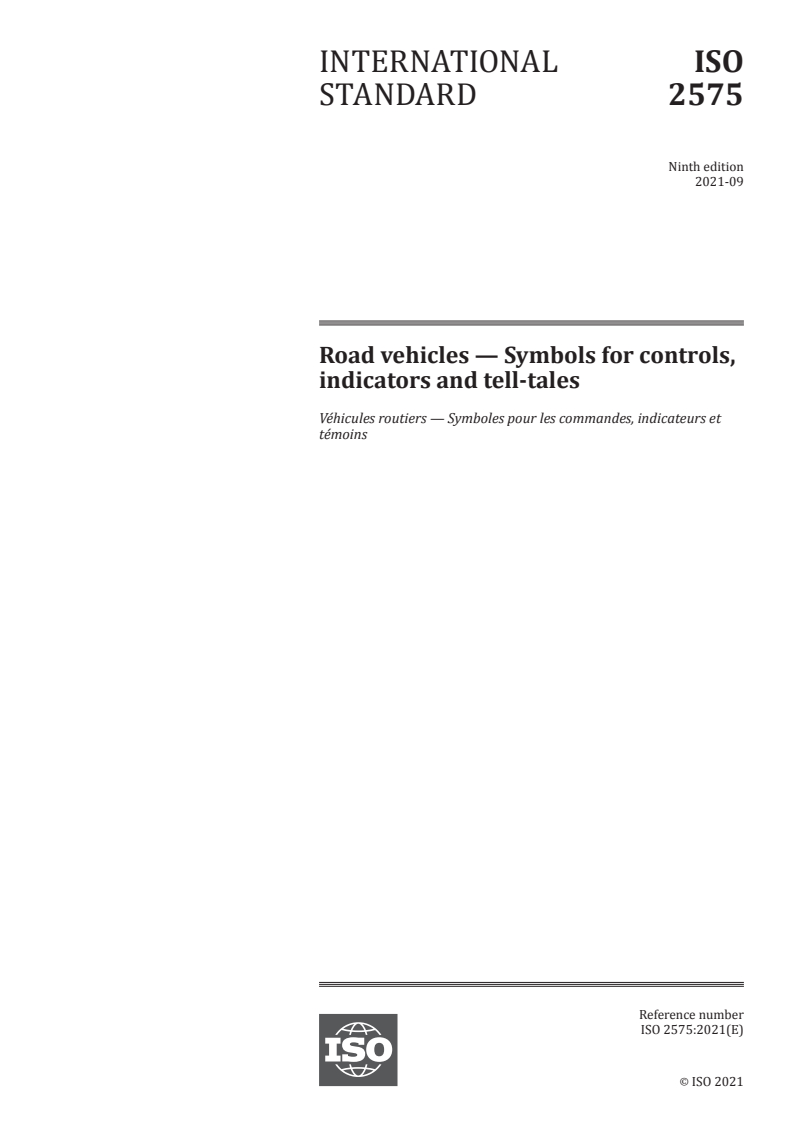
(Main)Road vehicles — Symbols for controls, indicators and tell-tales
General Information
- Abstract
This document specifies symbols (i.e. conventional signs) for use on controls, indicators and tell-tales applying to passenger cars, light and heavy commercial vehicles and buses, to ensure identification and facilitate use. This document additionally describes the purpose and application for the symbols. It also indicates the colours of possible optical tell-tales, which inform the driver of either correct operation or malfunctioning of the related devices.
- Status
- Published
- Publication Date
- 06-Sep-2021
- Technical Committee
- ISO/TC 22/SC 39 - Ergonomics
- Drafting Committee
- ISO/TC 22/SC 39/WG 5 - Symbols
- Current Stage
- 9020 - International Standard under periodical review
- Start Date
- 15-Jul-2026
- Completion Date
- 15-Jul-2026
Buy Documents
ISO 2575:2021 - Road vehicles -- Symbols for controls, indicators and tell-tales
ISO 2575:2021 - Road vehicles — Symbols for controls, indicators and tell-tales/7/2021
Overview
ISO 2575:2021 - "Road vehicles - Symbols for controls, indicators and tell‑tales" defines standardized graphical symbols for use on vehicle controls, indicators and tell‑tales for passenger cars, light and heavy commercial vehicles and buses. The ninth edition specifies the purpose and application for each symbol and the colour conventions for optical tell‑tales so drivers can quickly identify normal operation or malfunctioning systems. This automotive symbols standard improves usability, safety and international consistency across dashboards and vehicle controls.
Key topics and requirements
- Scope and terminology: Defines terms such as symbol, tell‑tale, sign and application to ensure consistent use.
- Symbol catalogue: Normative annexes list symbols grouped by function (lighting & signalling, braking, visibility, cab comfort, engine, fuel, transmission, safety systems, electric functions, information/communication, etc.).
- Purpose/application descriptions: Each symbol includes a short description of intended use and installation context.
- Colour coding for tell‑tales:
- Red - danger or imminent serious damage
- Yellow/amber - caution or system malfunction
- Green - normal/safe operating condition
- Blue - reserved uses (e.g., main beam)
- White - when none of the above applies
- Heating/cooling: red = hot, blue = cold
- Legibility and reproduction rules: Guidance on line thickness, rounding, outline vs solid rendering, contrast (prefer light symbol on dark background for controls), sizing (see IEC 80416-3), and pixel matrix requirements (see ISO 15008).
- Permitted modifications: Minor adaptations for technology or aesthetics are allowed provided essential graphical characteristics are preserved.
- Normative vs informative content: Annexes A–N and P are normative; some annexes (I, R) are informative.
Applications - who uses ISO 2575:2021
- Automotive OEMs and design teams for dashboard, switchgear and HUD iconography
- Human‑machine interface (HMI) and UX designers implementing consistent controls and tell‑tales
- Tier‑1 suppliers producing instrument clusters, switches and displays
- Regulatory bodies and type‑approval authorities referencing standardized symbols
- Service and repair manuals, training materials and fleet operators
- Electric vehicle designers (see Annex M for electric functions)
Related standards
- ISO 15008 - in‑vehicle visual presentation / pixel matrix requirements
- IEC 80416 series - graphic symbol design and legibility guidance
- ISO 7000 / IEC 60417 - graphical symbols databases referenced for registration
- ISO Online Browsing Platform (OBP) - official symbol registry
Keywords: ISO 2575:2021, road vehicle symbols, dashboard tell‑tales, controls indicators, automotive HMI, vehicle symbol colours, ISO automotive standard.
Relations
- Effective Date
- 25-Aug-2026
- Referred By
EN 16186-7:2025 - Railway applications - Driver's cab - Part 7: Design of displays for tram vehicles - Effective Date
- 27-May-2026
- Effective Date
- 06-Jun-2022
- Effective Date
- 23-Apr-2020
- Effective Date
- 23-Apr-2020
- Effective Date
- 23-Apr-2020
- Effective Date
- 23-Apr-2020
- Effective Date
- 23-Apr-2020
- Effective Date
- 05-Nov-2015
Buy Documents
ISO 2575:2021 - Road vehicles -- Symbols for controls, indicators and tell-tales
ISO 2575:2021 - Road vehicles — Symbols for controls, indicators and tell-tales/7/2021
Get Certified
Connect with accredited certification bodies for this standard

TÜV Rheinland
TÜV Rheinland is a leading international provider of technical services.

TÜV SÜD
TÜV SÜD is a trusted partner of choice for safety, security and sustainability solutions.

DEKRA Certification Inc.
DEKRA US certification services.
Sponsored listings
Frequently Asked Questions
ISO 2575:2021 is a standard published by the International Organization for Standardization (ISO). Its full title is "Road vehicles — Symbols for controls, indicators and tell-tales". This standard covers: This document specifies symbols (i.e. conventional signs) for use on controls, indicators and tell-tales applying to passenger cars, light and heavy commercial vehicles and buses, to ensure identification and facilitate use. This document additionally describes the purpose and application for the symbols. It also indicates the colours of possible optical tell-tales, which inform the driver of either correct operation or malfunctioning of the related devices.
This document specifies symbols (i.e. conventional signs) for use on controls, indicators and tell-tales applying to passenger cars, light and heavy commercial vehicles and buses, to ensure identification and facilitate use. This document additionally describes the purpose and application for the symbols. It also indicates the colours of possible optical tell-tales, which inform the driver of either correct operation or malfunctioning of the related devices.
ISO 2575:2021 is classified under the following ICS (International Classification for Standards) categories: 01.080.20 - Graphical symbols for use on specific equipment; 43.040.30 - Indicating and control devices. The ICS classification helps identify the subject area and facilitates finding related standards.
ISO 2575:2021 has the following relationships with other standards: It is inter standard links to EN 16186-3:2022, EN 16186-7:2025, ISO 2575:2021/Amd 1:2024, ISO 2575:2010/Amd 6:2017, ISO 2575:2010/Amd 5:2016, ISO 2575:2010/Amd 1:2011, ISO 2575:2010/Amd 7:2017, ISO 2575:2010/Amd 3:2014, ISO 2575:2010. Understanding these relationships helps ensure you are using the most current and applicable version of the standard.
ISO 2575:2021 is available in PDF format for immediate download after purchase. The document can be added to your cart and obtained through the secure checkout process. Digital delivery ensures instant access to the complete standard document.
Standards Content (Sample)
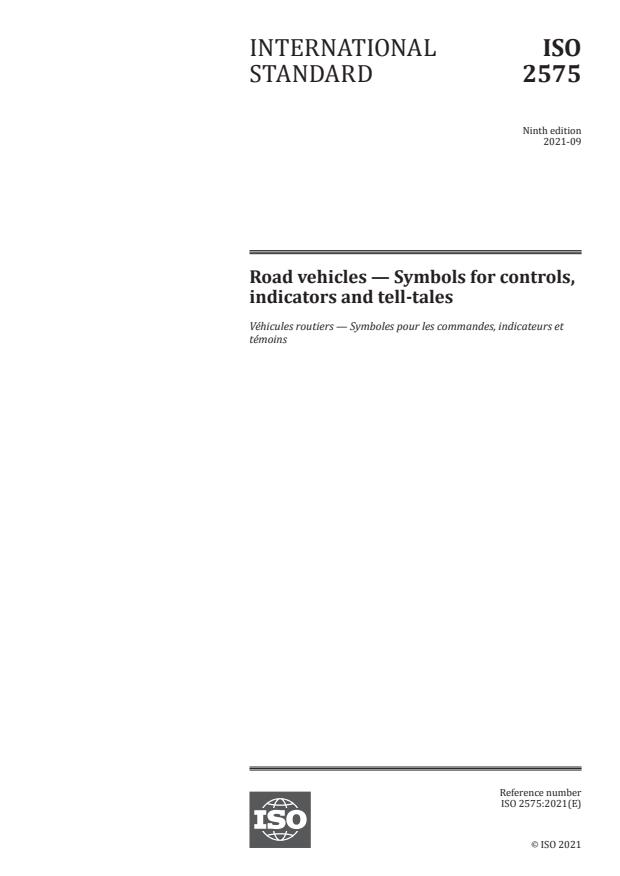
INTERNATIONAL ISO
STANDARD 2575
Ninth edition
2021-09
Road vehicles — Symbols for controls,
indicators and tell-tales
Véhicules routiers — Symboles pour les commandes, indicateurs et
témoins
Reference number
©
ISO 2021
© ISO 2021
All rights reserved. Unless otherwise specified, or required in the context of its implementation, no part of this publication may
be reproduced or utilized otherwise in any form or by any means, electronic or mechanical, including photocopying, or posting
on the internet or an intranet, without prior written permission. Permission can be requested from either ISO at the address
below or ISO’s member body in the country of the requester.
ISO copyright office
CP 401 • Ch. de Blandonnet 8
CH-1214 Vernier, Geneva
Phone: +41 22 749 01 11
Email: copyright@iso.org
Website: www.iso.org
Published in Switzerland
ii © ISO 2021 – All rights reserved
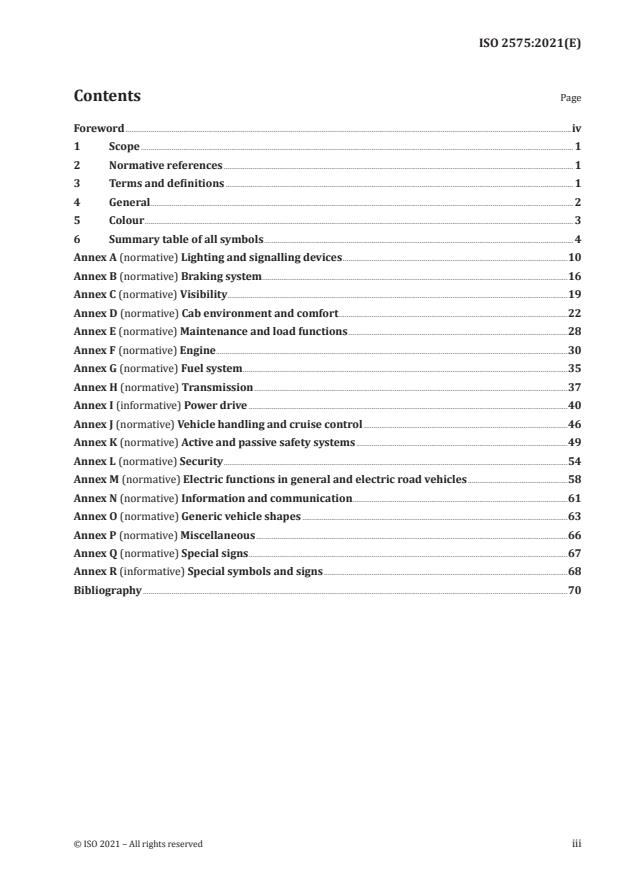
Contents Page
Foreword .iv
1 Scope . 1
2 Normative references . 1
3 Terms and definitions . 1
4 General . 2
5 Colour . 3
6 Summary table of all symbols . 4
Annex A (normative) Lighting and signalling devices .10
Annex B (normative) Braking system .16
Annex C (normative) Visibility.19
Annex D (normative) Cab environment and comfort .22
Annex E (normative) Maintenance and load functions .28
Annex F (normative) Engine .30
Annex G (normative) Fuel system .35
Annex H (normative) Transmission .37
Annex I (informative) Power drive .40
Annex J (normative) Vehicle handling and cruise control .46
Annex K (normative) Active and passive safety systems .49
Annex L (normative) Security .54
Annex M (normative) Electric functions in general and electric road vehicles .58
Annex N (normative) Information and communication.61
Annex O (normative) Generic vehicle shapes .63
Annex P (normative) Miscellaneous .66
Annex Q (normative) Special signs .67
Annex R (informative) Special symbols and signs .68
Bibliography .70
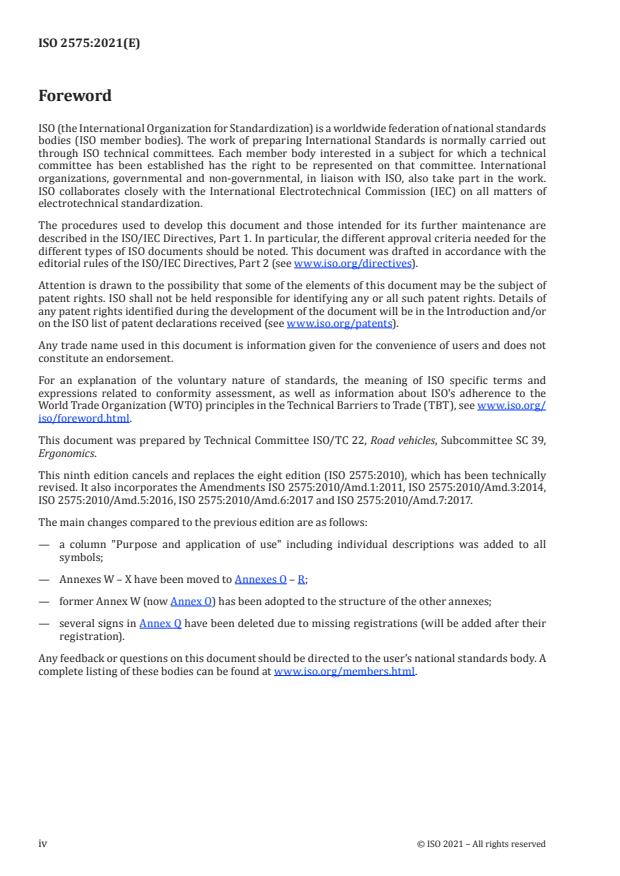
Foreword
ISO (the International Organization for Standardization) is a worldwide federation of national standards
bodies (ISO member bodies). The work of preparing International Standards is normally carried out
through ISO technical committees. Each member body interested in a subject for which a technical
committee has been established has the right to be represented on that committee. International
organizations, governmental and non-governmental, in liaison with ISO, also take part in the work.
ISO collaborates closely with the International Electrotechnical Commission (IEC) on all matters of
electrotechnical standardization.
The procedures used to develop this document and those intended for its further maintenance are
described in the ISO/IEC Directives, Part 1. In particular, the different approval criteria needed for the
different types of ISO documents should be noted. This document was drafted in accordance with the
editorial rules of the ISO/IEC Directives, Part 2 (see www .iso .org/ directives).
Attention is drawn to the possibility that some of the elements of this document may be the subject of
patent rights. ISO shall not be held responsible for identifying any or all such patent rights. Details of
any patent rights identified during the development of the document will be in the Introduction and/or
on the ISO list of patent declarations received (see www .iso .org/ patents).
Any trade name used in this document is information given for the convenience of users and does not
constitute an endorsement.
For an explanation of the voluntary nature of standards, the meaning of ISO specific terms and
expressions related to conformity assessment, as well as information about ISO's adherence to the
World Trade Organization (WTO) principles in the Technical Barriers to Trade (TBT), see www .iso .org/
iso/ foreword .html.
This document was prepared by Technical Committee ISO/TC 22, Road vehicles, Subcommittee SC 39,
Ergonomics.
This ninth edition cancels and replaces the eight edition (ISO 2575:2010), which has been technically
revised. It also incorporates the Amendments ISO 2575:2010/Amd.1:2011, ISO 2575:2010/Amd.3:2014,
ISO 2575:2010/Amd.5:2016, ISO 2575:2010/Amd.6:2017 and ISO 2575:2010/Amd.7:2017.
The main changes compared to the previous edition are as follows:
— a column "Purpose and application of use" including individual descriptions was added to all
symbols;
— Annexes W – X have been moved to Annexes O – R;
— former Annex W (now Annex O) has been adopted to the structure of the other annexes;
— several signs in Annex Q have been deleted due to missing registrations (will be added after their
registration).
Any feedback or questions on this document should be directed to the user’s national standards body. A
complete listing of these bodies can be found at www .iso .org/ members .html.
iv © ISO 2021 – All rights reserved
INTERNATIONAL STANDARD ISO 2575:2021(E)
Road vehicles — Symbols for controls, indicators and tell-
tales
IMPORTANT — The electronic file of this document contains colours which are considered to be
useful for the correct understanding of the document. Users should therefore consider printing
this document using a colour printer.
1 Scope
This document specifies symbols (i.e. conventional signs) for use on controls, indicators and tell-tales
applying to passenger cars, light and heavy commercial vehicles and buses, to ensure identification and
facilitate use. This document additionally describes the purpose and application for the symbols.
It also indicates the colours of possible optical tell-tales, which inform the driver of either correct
operation or malfunctioning of the related devices.
2 Normative references
The following documents are referred to in the text in such a way that some or all of their content
constitutes requirements of this document. For dated references, only the edition cited applies. For
undated references, the latest edition of the referenced document (including any amendments) applies.
ISO 15008, Road vehicles — Ergonomic aspects of transport information and control systems —
Specifications and test procedures for in-vehicle visual presentation
3 Terms and definitions
For the purposes of this document, the following terms and definitions apply.
ISO and IEC maintain terminological databases for use in standardization at the following addresses:
— ISO Online browsing platform: available at https:// www .iso .org/ obp
— IEC Electropedia: available at http:// www .electropedia .org/
3.1
symbol
visually perceptible figure used to transmit information independently of language, produced by
drawing, printing or other means
3.2
tell-tale
display that indicates, by means of a light-emitting device, the actuation of a device, a correct or
defective functioning or condition, or a failure to function
3.3
sign
visually perceptible graphic, generally larger in size than a symbol (3.1), designed for a label, tag or
sticker
3.4
application
modification of symbol (3.1) originals in order to maintain visual clarity and overall consistency
4 General
4.1 The symbols and signs shall be as given in Annexes A to N and Annex P. Additional symbols and
signs are given in Annexes O, Q and R. Minor deviations to the symbols and signs are permitted, provided
they are necessary to reproduce an accurate representation to the driver's line of sight.
NOTE Additional annexes can be included in future editions of this document if necessary.
4.2 In developing the symbols and signs shown in Annex A to Annex R, legibility factors such as line
thickness, gaps between lines, symbol and arrow shapes, etc. were carefully considered. Modifications
that improve legibility are permitted in the circumstances specified in 4.2.1, 4.2.2 and 4.2.3. When
modifying symbol elements, the graphic designer should consult IEC 80416-1, IEC 80416-2, IEC 80416-3,
and IEC 80416-4.
4.2.1 Limitations inherent in some reproduction and display technologies can require increased line
thickness or other minor modifications of symbols. Such modifications are acceptable, provided the
symbol remains unchanged in its basic graphical elements and is easily discernible by the operator.
4.2.2 Additionally, to improve the appearance and perceptibility of a graphical symbol or to coordinate
with the design of the equipment to which it is applied, it can be necessary to change the line thickness
or to round off the corners of the symbol. The graphic designer is normally free to make such changes,
provided that the essential perceptible characteristics of the symbol are maintained.
4.2.3 The graphic designer may render a symbol in either outline or solid form unless this is otherwise
prohibited by the symbol description.
4.3 The shapes of the vehicle, seat and steering wheel shown in this document are not intended to
be restrictive but are the recommended shapes. Modifications to these shapes may be introduced by
designers in order to better represent the true shape of a given element. Except for the aforementioned
shapes, no other symbol elements shall be changed, except as provided in 4.2 or in the specific symbol's
description.
4.4 If a symbol shows a vehicle or parts of a vehicle in a side view, a vehicle moving from right to left in
the symbol area shall be assumed. If a symbol shows a vehicle or parts of a vehicle in a top, plan view, a
vehicle moving from bottom to top in the symbol area shall be assumed.
4.5 For actual use, all symbols shall be reproduced large enough to be easily discernible by the operator.
See IEC 80416-3 for guidelines on the proper sizing of symbols. Symbols shall be used in the orientations
shown in this document unless otherwise noted for individual symbols.
4.6 Symbols on controls and displays shall contrast well with their background. For most controls,
a light symbol on a dark background is preferred. Displays may use either a light symbol on a dark
background or a dark symbol on a light background, depending on which alternative provides the best
visual perception. When a symbol image is reversed (for example black to white and vice versa), it shall
be done for the entire symbol.
4.7 For symbols that are displayed using pixel matrices, the character matrix shall be as stipulated in
ISO 15008.
4.8 Letters and numerals may be used as symbols. For example, the letters P, R, N, D, have the meaning
indicated when used in association with transmission gear controls and displays on road vehicles. The
fonts shown in this document are not intended to be restrictive; other fonts may be substituted provided
that legibility is maintained.
2 © ISO 2021 – All rights reserved
4.9 “Failure” or “malfunction” may be conveyed in two ways:
a) base symbol combined with a colour code according to 5.1;
b) base symbol combined with failure symbol P.08; optionally, an appropriate colour code in
accordance with 5.1 may be added.
4.10 ISO/IEC registration numbers are shown for symbols in this document where applicable.
Registration numbers below 5000 refer to ISO 7000. Registration numbers above 5000 refer to
IEC 60417. Artwork in this document might differ from the artwork shown in IEC 60417, ISO 7000 or the
ISO Online Browsing Platform (OBP) database on graphical symbols for use on equipment. In this case,
the artwork in this document shall be used. If a symbol is illustrated in this document differs from the
one shown in the ISO OBP, it will be referenced as “Application of…”
4.11 The symbol numbers not represented are reserved for those symbols still under consideration at
the time of publication of this edition of ISO 2575. It is envisaged that the status of these symbols and the
numbers will be resolved by the next revision of this document.
4.12 Symbols in the annexes (except Annex Q and partly Annex R) of this document are presented at
32 % of original size. The grid marks “∟” denote the corners of the original 75 mm square. The grid marks
are not part of the symbol but are provided to ensure consistent presentation of all symbol graphics.
4.13 New symbols for functions not yet covered in this document should be constructed using symbols
or elements of symbols from this document in a logical manner, keeping the coherence with other
symbols already published.
5 Colour
5.1 When used on optical indicators or tell-tales, the following colours have the meanings indicated:
— red: danger to persons or very serious damage to equipment, immediate or imminent;
— yellow or amber: caution, outside normal operating limits, vehicle system malfunction, damage to
vehicle likely, or other condition which can produce hazard in the longer term;
— green: safe, normal operating condition (where blue or yellow is not required).
5.2 Certain colours are used for specific tell-tales (refer to “symbol description/application” column in
the annexes):
— blue: e.g. high beam, main beam;
— green: e.g. turn signals, low beam;
— yellow or amber: e.g. failure of anti-lock brake system;
— red: e.g. hazard warning.
5.3 If colour is used on symbols for heating and/or cooling systems, the colour red shall be used to
indicate hot, and the colour blue shall be used to indicate cold.
5.4 The colour white may be used where none of the above conditions applies.
5.5 A given symbol may be shown in more than one of the colours specified in 5.1 in order to convey a
change in the operating condition.
6 Summary table of all symbols
Table 1 provides a pictorial summary. The purpose and application of the symbols are provided in each
annex.
4 © ISO 2021 – All rights reserved
Table 1 — Summary of all symbols
a
Annex
Symbol No.
A B C D E F G H I J K L M N O P Q R
6 © ISO 2021 – All rights reserved
Table 1 (continued)
a
Annex
Symbol No.
A B C D E F G H I J K L M N O P Q R
Table 1 (continued)
a
Annex
Symbol No.
A B C D E F G H I J K L M N O P Q R
8 © ISO 2021 – All rights reserved
Table 1 (continued)
a
Annex
Symbol No.
A B C D E F G H I J K L M N O P Q R
Table 1 (continued)
a
Annex
Symbol No.
A B C D E F G H I J K L M N O P Q R
a
A = Lighting and signalling devices
B = Braking systems
C = Visibility
D = Cab environment and comfort
E = Maintenance and load functions
F = Engine
G = Fuel system
H = Transmission
I = Power drive
J = Vehicle handling and cruise control
K = Active and passive safety systems
L = Security
M = Electric functions in general and electric road vehicles
N = Information and communication
O = Generic vehicle shapes
P = Miscellaneous
Q = Special symbols
R = Special signs
S = Additional informative symbols
Annex A
(normative)
Lighting and signalling devices
Table A.1 — Symbols for lighting and signalling devices
Symbol ISO/IEC
Symbol form/
num- Symbol title Purpose and application of use registration
shape
ber number
A.01 High beam, main To identify the control that operates the high ISO 7000-
beam intensity, forward illumination. To indicate the 0082
operational status of the high beam function.
1) When used as a status indicator the symbol
shall be steady blue.
2) Framed areas of this symbol may be solid.
3) The control operating alternately the high beam
and the low beam may include two symbols, one
for each of the positions: high beam, low beam.
A.02 Low beam, dipped To identify the control that operates the moderate ISO 7000-
beam intensity, forward illumination. To indicate the 0083
operational status of the low beam function.
1) Framed areas of this symbol may be solid.
2) The control operating alternately the high beam
and the low beam may include two symbols, one
for each of the positions: high beam, low beam.
A.03 Headlamp cleaner To identify the control that operates the wipers ISO 7000-
located near the high (main)/low (dipped) beams 0250
and dispenses washing fluid, initiating a sweeping
motion and fluid spray to clear the high (main)/
low (dipped) beams. To identify the headlamp
cleaner filler cap or fill point.
A.04 Headlamp level- To identify the control which allows up or down ISO 7000-
ling control adjustment to the forward facing high (main) or 0151
low (dipped) beam.
A.05 Front fog light To identify the control that operates a special light ISO 7000-
located in the front of the vehicle to aid forward 0633
illumination in foggy conditions. To indicate the
operational status of the front fog light.
NOTE If one symbol is used for both front and
rear fog lights, this symbol is used.
A.06 Rear fog light To identify the control that operates a special light ISO 7000-
located in the rear of the vehicle to aid with vehicle 0634
identification in foggy conditions. To indicate the
operational status of the rear fog light.
NOTE If one symbol is used for both front and
rear fog lights, the symbol for front fog light (A.05)
is used.
10 © ISO 2021 – All rights reserved
Table A.1 (continued)
Symbol ISO/IEC
Symbol form/
num- Symbol title Purpose and application of use registration
shape
ber number
A.07 Long-range lamp To identify the control that operates high intensity ISO 7000-
forward illumination that enables the driver to 0639
see at longer than normal range. To indicate the
operational status of the long-range lamp.
Applicable to those controls which are fitted on
the instrument panel, or in the near vicinity of
the driver.
A.08 Parking lights To identify the control that operates low intensity ISO 7000-
illumination (typically located on the sides of the 0240
vehicle). To indicate the operational status of the
parking lights.
A.09 Position lights, To identify the control that operates low intensity ISO 7000-
side lights illumination (typically located on the sides, front 0456
and rear of the vehicle). To indicate the operational
status of the position lights or side lights.
A.10 Loading light To identify the control that operates a light source ISO 7000-2457
located near or at the vehicle roofline, illuminating
the rear of the vehicle. To indicate the operational
status of the loading light.
A.11 Elevated head- To identify the control that operates a light ISO 7000-
lights source located in the front of the vehicle above 2458
normal headlamp height. To indicate the op-
erational status of the elevated headlights.
Loading platform and rear axle may be omitted
if it is not needed.
A.12 Roof sign illumi- To identify the control that operates a sign located ISO 7000-2459
nation on the roof of the vehicle. To indicate the opera-
tional status of the roof sign.
Loading platform and rear axle may be omitted
if it is not needed.
A.13 Master lighting To identify the control or group of controls that Application of
switch operates the exterior lighting devices. IEC 60417-
A.14 Exterior bulb fail- To indicate that the exterior bulb has failed to ISO 7000-1555
ure illuminate.
Table A.1 (continued)
Symbol ISO/IEC
Symbol form/
num- Symbol title Purpose and application of use registration
shape
ber number
A.15 Instrument panel To identify the control that adjusts the brightness ISO 7000-
illumination of the displays on the instrument panel. 1556B
A.16 Turn signals To identify the control that operates the visual ISO 7000-
indicators to signal the intended turning direction 0084
(left or right) of the machine or road vehicle. To
indicate the operational status of the turn signal
and the selected turning direction.
1) Tell-tale shall be flashing green.
2) Framed areas of this symbol may be solid.
3) It is permissible to separate the left and right
arrows.
A.17 Turn signal, trail- When used as an indicator on commercial road Application of
er vehicles: the square element indicates the func- ISO 7000-
tioning of the trailer's turn signal lamps. The 2664
arrows indicate the functioning of the cab's turn
signal lamps.
NOTE Trailer shape can be omitted. If trailer
shape is omitted, arrows can be separated; how-
ever, the square element is included with each
separate arrow.
A.19 Hazard warning To identify the control that operates all side mark- ISO 7000-
ers and turn lights in a predetermined flashing 0085
pattern. To indicate the operational status of the
hazard warning.
1) Simultaneous operation of either green turn
signal tell-tales, or separate red signal.
2) Framed areas of this symbol may be solid.
A.20 Signal horn To identify the control for the horn which emits ISO 7000-
a sound, usually intended to alert persons in the 0244
vicinity to the presence of the vehicle.
A.21 Interior com- To identify the control that operates the inte- ISO 7000-
partment rior compartment illumination. To indicate the 1421A
illumination operational status of the interior compartment
illumination.
NOTE As a minimum the illumination is pro-
vided by an overhead (dome) lamp.
A.22 Interior direct- To identify the control that operates an interior, ISO 7000-
ed illumination operator-controlled light source focusing light 2550
(re a d in g/ m a p on a defined area.
light)
NOTE Symbol allows for mirror image.
12 © ISO 2021 – All rights reserved
Table A.1 (continued)
Symbol ISO/IEC
Symbol form/
num- Symbol title Purpose and application of use registration
shape
ber number
A.23 Work light To identify the control that operates the work ISO 7000-1204
light. To indicate the operational status of the
work light.
A.24 Beacon To identify the control for operation of the rotating ISO 7000-
and/or blinking light attached to equipment. To 1141A
indicate the operational status of the identification
or beacon light.
A.25 Taxi sign light To identify the control that operates a sign reading ISO 7000-2551
TAXI located on the roof of the vehicle. To indicate
the operational status of the TAXI light.
A.26 Medical assis- To identify the control that operates a sign dis- ISO 7000-2552
tance sign light playing a medical cross located on the roof of the
vehicle to indicate the operational status of the
medical assistance light.
A.27 Daytime running To identify the control that operates lower inten- Application of
lights sity low beam headlights, for better visibility. To ISO 7000-2611
indicate the operational status of the lights.
A.28 Night vision To identify the control that operates an infrared Application of
or similar technology that displays a forward ISO 7000-
roadway scene beyond the typical headlight beam. 2665
As a tell-tale: it indicates operational status.
A.29 Footwell illumi- To identify the control that operates the lighting Application of
nation that illuminates the floor area only, separate from ISO 7000-
overhead compartment lighting. To indicate the 2666
operational status of the footwell illumination
system.
A.30 Low-level interi- To identify the control that operates interior Application of
or illumination compartment lighting (typically a red lens) used ISO 7000-
(night driving) to assist in maintaining the dark adaptation of 2667
the driver while providing illumination to the
interior. To indicate the operational status of the
low-level interior illumination system.
Table A.1 (continued)
Symbol ISO/IEC
Symbol form/
num- Symbol title Purpose and application of use registration
shape
ber number
A.31 Sleeper com - To identify the control that operates the illumi- Application of
partment nation of only the sleeping area, separate from ISO 7000-
illumination overhead compartment lighting. To indicate the 2668
operational status of the sleeper compartment
illumination system.
A.32 Bend lighting To identify the control that operates the lighting Application of
function that provides enhanced illumination ISO 7000-
for driving though curved roadway segments 2669
(bends). To indicate the operational status of the
bend lighting system.
A.33 Position lights, To identify the control or the indicator for the ISO 7000-
trailer trailer position (clearance) lights in a tractor/ 2953
trailer vehicle when separate controls or separate
indicators are provided for the tractor and trailer
position lights.
A.34 Interior light, To identify the control or the indicator for the ISO 7000-
trailer trailer interior lights in a tractor/trailer vehicle 2954
when separate controls or separate indicators are
provided for the tractor and trailer interior lights.
A.35 S n o w pl ou g h To identify the control or the indicator for forward ISO 7000-
lights headlights that are separate from the normal 2955
vehicle headlights (which are blocked by the
snowplough blade).
A.36 Automatic high To identify the control for the automatic high ISO 7000-
beam beam function, which automatically switches the 2956
high beam on and off as necessary. To indicate the
current activation mode or operational status of
the system.
NOTE It is possible to position the letter “A”
or alternatively the symbol R.02 (AUTO) on or
adjacent to the outline of the symbol.
A.37 Automatic low To identify the control for the automatic low beam ISO 7000-2957
beam function, which automatically switches the low
beam on and off as necessary. To indicate the
current activation mode or operational status
of the system.
NOTE It is possible to position the letter “A”
or alternatively the symbol R.02 (AUTO) on or
adjacent to the outline of the symbol.
A.38 Acoustic vehicle To identify the control that operates the system ISO 7000-3197
alerting system that generates a sound to indicate to road users
(AVAS) for quiet that a quiet vehicle is operational in the vicinity. To
vehicles indicate the operational status of the sound device.
14 © ISO 2021 – All rights reserved
Table A.1 (continued)
Symbol ISO/IEC
Symbol form/
num- Symbol title Purpose and application of use registration
shape
ber number
A.39 Exterior lights, To identify the control that operates the exterior Application
activation for lights in a pre-defined sequence while the vehi- of ISO 7000-
inspection cle is parked so the vehicle operator can inspect 3604
exterior lights for proper functioning. To indicate
the status of the system.
Annex B
(normative)
Braking system
Table B.1 — Symbols for braking systems
Symbol ISO/IEC
Symbol form/
num- Symbol title Purpose and application of use registration
shape
ber number
B.01 Brake failure To indicate that the primary braking function has Application of
malfunctioned. ISO 7000-
1) The tell-tale shall be red.
2) In the case where a single tell-tale indicates
more than one brake system condition, this symbol
shall be used.
B.02 Parking brake To identify the pedal or control that operates the Application of
parking brake. To indicate the operational status ISO 7000-
of the parking brake. 0238
1) The tell-tale shall be red.
2) In the case where a single tell-tale indicates
more than one brake system condition, the symbol
for brake failure (B.01) shall be used.
B.03 Brake system, To indicate the operational status of the primary Application of
first circuit (first) circuit in a dual-circuit air brake system. ISO 7000-1405
Dual circuit systems have a primary and redundant
(secondary) brake circuit. The two circuits back
feed each other in case of a failure.
NOTE Typically, this symbol is used on brake
system air pressure gauges, and not as a malfunc-
tion indicator. B.01 and B.12 are used to indicate
malfunction.
B.04 Brake system, To indicate the operational status of the secondary Application of
second circuit (second) circuit in a dual-circuit air brake system. ISO 7000-1406
Dual circuit systems have a primary and re-
dundant (secondary) brake circuit. The two cir-
cuits back feed each other in case of a failure.
Typically, this symbol is used on brake system air
pressure gauges, and not as a malfunction indicator.
B.01 and B.12 are used to indicate malfunction.
B.05 Anti-lock brake To indicate that the anti-lock brake system has Application of
system, failure failed or is outside normal operating parameters. ISO 7000-1407
The tell-tale shall be yellow.
16 © ISO 2021 – All rights reserved
Table B.1 (continued)
Symbol ISO/IEC
Symbol form/
num- Symbol title Purpose and application of use registration
shape
ber number
B.06 Anti-lock brake To indicate the operational status of the trailer Application of
system (ABS), anti-lock brake system. ISO 7000-2670
trailer
NOTE If a second trailer designation is required,
a "2" can be added to the right side of the ABS
brake graphic.
B.08 Anti-lock brake To indicate that the trailer anti-lock brake system, Application of
system (ABS) off is off or not available. ISO 7000-2671
or not available,
NOTE 1 If a second trailer designation is required,
trailer
a "2" can be added to the right side of the ABS
brake graphic.
NOTE 2 Alternatively, the symbol "OFF" (R.01)
can be used on or adjacent to the symbol instead
of the prohibition slash.
B.10 Worn brake lin- To indicate that the brake linings are worn, which Application of
ings may cause a malfunction of the brake system. ISO 7000-1408
B.11 Brake system To identify the display that provides information Application of
temperature about the brake system temperature. To indicate ISO 7000-
the brake system temperature is overheating or 1403B
falls outside of normal operating parameters.
NOTE The symbol can be used to indicate the
temperature of either the brake fluid or the brake
lining.
B.12 Brake system To identify the display that provides information Application of
pressure about the brake system pressure. To indicate the ISO 7000-1402
brake system pressure falls outside of normal
operating parameters.
B.13 Brake fluid level To indicate the quantity (level) of brake fluid in Application of
the reservoir. To indicate that the brake fluid is ISO 7000-1401
low or fails outside of specified parameters. To
identify the brake fluid filler cap or fill point.
B.14 Retarder To identify the control that operates the retarder Application of
as a supplemental to the brake system. ISO 7000-2574
NOTE The retarder decelerates the vehicle
without using mechanical friction in order to
avoid overheating the brake system.
Table B.1 (continued)
Symbol ISO/IEC
Symbol form/
num- Symbol title Purpose and application of use registration
shape
ber number
B.15 Spring brake re- To identify the control or indicator associated ISO 7000-
lease with the system that releases the spring brake 2448
in a truck.
NOTE In application, the indication of this
function is the opposite of the parking brake
being set; thus only the parking brake symbol is
typically used.
B.16 Exhaust gas brake To identify the control that decelerates the vehicle Application of
by increasing the engine's internal resistance to ISO 7000-2593
motion.
B.17 Retarder failure To indicate that the retarder has failed or is outside Application of
normal operating parameters. ISO 7000-2622
B.18 Anti-lock brake To indicate that the anti-lock braking system is Application of
system off or not off or not available. To identify the control that ISO 7000-2623
available disables the anti-lock braking system.
NOTE Alternatively "off" or "not available" can
be indicated by the use of the base symbol B.05
with an amber or yellow tell-tale, or by the base
symbol (B.05) plus OFF (R.01).
B.19 Trailer brake To identify the control that operates the braking Application of
function specific to the trailer. To indicate oper- ISO 7000-2672
ational status of the trailer brake.
NOTE If a second trailer is required, the num-
ber "2" can be added to the right side of the brake
graphic.
B.20 Hill holding To identify the control which operates a system Application of
which assists a vehicle stopped on a hill (brake ISO 7000-2624
and clutch pedal is pressed down).
When starting, the brake pedal can be released
and the vehicle starts to move when the clutch
pedal is released and the accelerator is pressed
down at the same time.
18 © ISO 2021 – All rights reserved
Annex C
(normative)
Visibility
Table C.1 — Symbols for visibility
Symbol ISO/IEC
Symbol form/
num- Symbol title Purpose and application of use registration
shape
ber number
C.01 W i n d s c r e e n To identify the control which operates the front ISO 7000-
wiper wipers and initiates a sweeping motion to clear 0086
the windscreen/windshield.
C.02 W i n d s c r e e n To identify the control or control setting that in- ISO 7000-
wiper, intermit- termittently, at specified time intervals, operates 0647
tent the wiper to clear water from the windscreen
(windshield).
C.03 W i n d s c r e e n To identify the control that dispenses washing ISO 7000-
washer fluid to the windscreen/windshield. 0088
C.04 W i n d s c r e e n To identify the control that operates the front ISO 7000-
washer and wiper wipers and dispenses washing fluid, initiating 0087
a sweeping motion and fluid spray to clear the
windscreen/windshield.
C.05 W i n d s c r e e n To identify the filler cap, fill point, or container ISO 7000-1422
washer fluid for the windscreen (windshield) washer fluid. To
indicate a low level of windscreen (windshield)
washer fluid.
C.06 Windscreen de- To identify the control or control setting that dis- ISO 7000-
misting and tributes air flow to the windscreen and front-side 0635A
defrosting windows to aid in removing frost, fog and mist.
To indicate the operational status of windscreen
demisting and defrosting system.
C.07 Windscreen, elec- To identify the control that operates electrically ISO 7000-2575
trically heated heated wires to remove frost or ice from the
windscreen. To indicate the operational status
of the system.
Table C.1 (continued)
Symbol ISO/IEC
Symbol form/
num- Symbol title Purpose and application of use registration
shape
ber number
C.08 R e a r - w i ndo w To identify the control or control setting for ac- ISO 7000-
wiper tivating the rear wipers to clear water from the 0097
rear window.
C.09 R ea r - w i n - To identify the control or control setting that inter- ISO 7000-1424
dow wiper, mittently, at specified time intervals, operates the
intermittent rear wiper to clear water from the rear window.
C.10 R e a r - w i ndo w To identify the control which dispenses washing ISO 7000-
washer fluid to the rear window. 0099
C.11 R e a r - w i ndo w To identify the control which activates the rear ISO 7000-
washer and wiper wipers and dispenses washing fluid, initiating 0098
a sweeping motion and fluid spray to clear the
rear window.
C.12 R e a r - w i ndo w To identify the filler cap, fill point, or container ISO 7000-1423
washer fluid for the rear window washer fluid. To indicate a
low level of rear window washer fluid.
C.13 R e a r - w i ndo w To identify the control that distributes air flow or ISO 7000-
demisting and a low electrical current to the rear window to aid 0636
defrosting in removing frost, fog and mist. To indicate the
operational status of rear windscreen demisting
and defrosting.
C.14 S i de - w i ndo w To identify the control that distributes air flow ISO 7000-1425
demisting and to the side windows to aid in removing frost, fog
defrosting and mist. To indicate the operational status of
side window demisting/defrosting.
C.15 Exterior rear- To identify the control for adjusting the aim (view) ISO 7000-1427
view-mirror of the exterior rear-view mirrors.
adjustment, hori-
NOTE 1 Arrows can be omitted, if that function
zontal type
does not exist.
NOTE 2 Symbol allows for mirror image.
C.16 Exterior rear- To identify the control for adjusting the aim (view) ISO 7000-
view-mirror of the exterior rear-view mirrors. 2469
adjustment, ver-
NOTE 1 Arrows can be omitted, if that function
tical type
does not exist.
NOTE 2 Symbol allows for mirror image.
20 © ISO 2021 – All rights reserved
Table C.1 (continued)
Symbol ISO/IEC
Symbol form/
num- Symbol title Purpose and application of use registration
shape
ber number
C.17 Exterior rear- To identify the control that heats the exterior ISO 7000-1426
view-mirror rear-view mirrors to aid in removing frost, fog
heating, horizon- and mist. To indicate the operational status of
tal type the exterior rear-view mirror heating.
NOTE Symbol allows for mirror image.
C.18 Exterior rear- To identify the control that heats the exterior ISO 7000-2470
view-mirror rear-view mirrors to aid in removing frost, fog
heating, vertical and mist. To indicate the operational status of
type the exterior rear-view mirror heating.
NOTE Symbol allows for mirror image.
C.19 Exterior rear To identify the control that folds or unfolds the ISO 7000-
view mirror, exterior mirror. 2553
power-folding,
NOTE Symbol allows for mirror image.
horizontal type
C.20 Exterior rear To identify the control that folds or unfolds the ISO 7000-
view mirror, exterior mirror. 2584
power-folding,
NOTE Symbol allows for mirror image.
vertical type
C.21 Exterior rear view To identify the control that reduces the glare Application of
mirror, glare pre- or reflection in exterior rear-view mirrors. To ISO 7000-2674
vention exterior indicate the operational status of the glare pre-
mirror, horizon- vention system.
tal type
NOTE Symbol allows for mirror image.
C.22 Exterior rear view To identify the control that reduces the glare Application of
mirror, glare pre- or reflection in exterior rear-view mirrors. To ISO 7000-2673
vention exterior indicate the operational status of the glare pre-
mirror, vertical vention system.
type
NOTE Symbol allows for mirror image.
C.23 Front wiper de- To identify the control that operates the front Application of
ice electric windscreen wiper electrical heating system for ISO 7000-
heating system de-icing wipers and freeing the blade. To identify 2841
the operational status (for example, on, off, mal-
function) of the function.
C.24 W i n d s c r e e n To identify the control that operates the system Application of
washer fluid that heats windscreen (windshield) wiper fluid ISO 7000-
heating to aid in clearing the windshield in cold weather. 2839
To indicate the operational status (for example,
on, off, malfunction) of the function.
Annex D
(normative)
Cab environment and comfort
Table D.1 —
...
INTERNATIONAL ISO
STANDARD 2575
Ninth edition
2021-09
Road vehicles — Symbols for controls,
indicators and tell-tales
Véhicules routiers — Symboles pour les commandes, indicateurs et
témoins
Reference number
©
ISO 2021
© ISO 2021
All rights reserved. Unless otherwise specified, or required in the context of its implementation, no part of this publication may
be reproduced or utilized otherwise in any form or by any means, electronic or mechanical, including photocopying, or posting
on the internet or an intranet, without prior written permission. Permission can be requested from either ISO at the address
below or ISO’s member body in the country of the requester.
ISO copyright office
CP 401 • Ch. de Blandonnet 8
CH-1214 Vernier, Geneva
Phone: +41 22 749 01 11
Email: copyright@iso.org
Website: www.iso.org
Published in Switzerland
ii © ISO 2021 – All rights reserved
Contents Page
Foreword .iv
1 Scope . 1
2 Normative references . 1
3 Terms and definitions . 1
4 General . 2
5 Colour . 3
6 Summary table of all symbols . 4
Annex A (normative) Lighting and signalling devices .10
Annex B (normative) Braking system .16
Annex C (normative) Visibility.19
Annex D (normative) Cab environment and comfort .22
Annex E (normative) Maintenance and load functions .28
Annex F (normative) Engine .30
Annex G (normative) Fuel system .35
Annex H (normative) Transmission .37
Annex I (informative) Power drive .40
Annex J (normative) Vehicle handling and cruise control .46
Annex K (normative) Active and passive safety systems .49
Annex L (normative) Security .54
Annex M (normative) Electric functions in general and electric road vehicles .58
Annex N (normative) Information and communication.61
Annex O (normative) Generic vehicle shapes .63
Annex P (normative) Miscellaneous .66
Annex Q (normative) Special signs .67
Annex R (informative) Special symbols and signs .68
Bibliography .70
Foreword
ISO (the International Organization for Standardization) is a worldwide federation of national standards
bodies (ISO member bodies). The work of preparing International Standards is normally carried out
through ISO technical committees. Each member body interested in a subject for which a technical
committee has been established has the right to be represented on that committee. International
organizations, governmental and non-governmental, in liaison with ISO, also take part in the work.
ISO collaborates closely with the International Electrotechnical Commission (IEC) on all matters of
electrotechnical standardization.
The procedures used to develop this document and those intended for its further maintenance are
described in the ISO/IEC Directives, Part 1. In particular, the different approval criteria needed for the
different types of ISO documents should be noted. This document was drafted in accordance with the
editorial rules of the ISO/IEC Directives, Part 2 (see www .iso .org/ directives).
Attention is drawn to the possibility that some of the elements of this document may be the subject of
patent rights. ISO shall not be held responsible for identifying any or all such patent rights. Details of
any patent rights identified during the development of the document will be in the Introduction and/or
on the ISO list of patent declarations received (see www .iso .org/ patents).
Any trade name used in this document is information given for the convenience of users and does not
constitute an endorsement.
For an explanation of the voluntary nature of standards, the meaning of ISO specific terms and
expressions related to conformity assessment, as well as information about ISO's adherence to the
World Trade Organization (WTO) principles in the Technical Barriers to Trade (TBT), see www .iso .org/
iso/ foreword .html.
This document was prepared by Technical Committee ISO/TC 22, Road vehicles, Subcommittee SC 39,
Ergonomics.
This ninth edition cancels and replaces the eight edition (ISO 2575:2010), which has been technically
revised. It also incorporates the Amendments ISO 2575:2010/Amd.1:2011, ISO 2575:2010/Amd.3:2014,
ISO 2575:2010/Amd.5:2016, ISO 2575:2010/Amd.6:2017 and ISO 2575:2010/Amd.7:2017.
The main changes compared to the previous edition are as follows:
— a column "Purpose and application of use" including individual descriptions was added to all
symbols;
— Annexes W – X have been moved to Annexes O – R;
— former Annex W (now Annex O) has been adopted to the structure of the other annexes;
— several signs in Annex Q have been deleted due to missing registrations (will be added after their
registration).
Any feedback or questions on this document should be directed to the user’s national standards body. A
complete listing of these bodies can be found at www .iso .org/ members .html.
iv © ISO 2021 – All rights reserved
INTERNATIONAL STANDARD ISO 2575:2021(E)
Road vehicles — Symbols for controls, indicators and tell-
tales
IMPORTANT — The electronic file of this document contains colours which are considered to be
useful for the correct understanding of the document. Users should therefore consider printing
this document using a colour printer.
1 Scope
This document specifies symbols (i.e. conventional signs) for use on controls, indicators and tell-tales
applying to passenger cars, light and heavy commercial vehicles and buses, to ensure identification and
facilitate use. This document additionally describes the purpose and application for the symbols.
It also indicates the colours of possible optical tell-tales, which inform the driver of either correct
operation or malfunctioning of the related devices.
2 Normative references
The following documents are referred to in the text in such a way that some or all of their content
constitutes requirements of this document. For dated references, only the edition cited applies. For
undated references, the latest edition of the referenced document (including any amendments) applies.
ISO 15008, Road vehicles — Ergonomic aspects of transport information and control systems —
Specifications and test procedures for in-vehicle visual presentation
3 Terms and definitions
For the purposes of this document, the following terms and definitions apply.
ISO and IEC maintain terminological databases for use in standardization at the following addresses:
— ISO Online browsing platform: available at https:// www .iso .org/ obp
— IEC Electropedia: available at http:// www .electropedia .org/
3.1
symbol
visually perceptible figure used to transmit information independently of language, produced by
drawing, printing or other means
3.2
tell-tale
display that indicates, by means of a light-emitting device, the actuation of a device, a correct or
defective functioning or condition, or a failure to function
3.3
sign
visually perceptible graphic, generally larger in size than a symbol (3.1), designed for a label, tag or
sticker
3.4
application
modification of symbol (3.1) originals in order to maintain visual clarity and overall consistency
4 General
4.1 The symbols and signs shall be as given in Annexes A to N and Annex P. Additional symbols and
signs are given in Annexes O, Q and R. Minor deviations to the symbols and signs are permitted, provided
they are necessary to reproduce an accurate representation to the driver's line of sight.
NOTE Additional annexes can be included in future editions of this document if necessary.
4.2 In developing the symbols and signs shown in Annex A to Annex R, legibility factors such as line
thickness, gaps between lines, symbol and arrow shapes, etc. were carefully considered. Modifications
that improve legibility are permitted in the circumstances specified in 4.2.1, 4.2.2 and 4.2.3. When
modifying symbol elements, the graphic designer should consult IEC 80416-1, IEC 80416-2, IEC 80416-3,
and IEC 80416-4.
4.2.1 Limitations inherent in some reproduction and display technologies can require increased line
thickness or other minor modifications of symbols. Such modifications are acceptable, provided the
symbol remains unchanged in its basic graphical elements and is easily discernible by the operator.
4.2.2 Additionally, to improve the appearance and perceptibility of a graphical symbol or to coordinate
with the design of the equipment to which it is applied, it can be necessary to change the line thickness
or to round off the corners of the symbol. The graphic designer is normally free to make such changes,
provided that the essential perceptible characteristics of the symbol are maintained.
4.2.3 The graphic designer may render a symbol in either outline or solid form unless this is otherwise
prohibited by the symbol description.
4.3 The shapes of the vehicle, seat and steering wheel shown in this document are not intended to
be restrictive but are the recommended shapes. Modifications to these shapes may be introduced by
designers in order to better represent the true shape of a given element. Except for the aforementioned
shapes, no other symbol elements shall be changed, except as provided in 4.2 or in the specific symbol's
description.
4.4 If a symbol shows a vehicle or parts of a vehicle in a side view, a vehicle moving from right to left in
the symbol area shall be assumed. If a symbol shows a vehicle or parts of a vehicle in a top, plan view, a
vehicle moving from bottom to top in the symbol area shall be assumed.
4.5 For actual use, all symbols shall be reproduced large enough to be easily discernible by the operator.
See IEC 80416-3 for guidelines on the proper sizing of symbols. Symbols shall be used in the orientations
shown in this document unless otherwise noted for individual symbols.
4.6 Symbols on controls and displays shall contrast well with their background. For most controls,
a light symbol on a dark background is preferred. Displays may use either a light symbol on a dark
background or a dark symbol on a light background, depending on which alternative provides the best
visual perception. When a symbol image is reversed (for example black to white and vice versa), it shall
be done for the entire symbol.
4.7 For symbols that are displayed using pixel matrices, the character matrix shall be as stipulated in
ISO 15008.
4.8 Letters and numerals may be used as symbols. For example, the letters P, R, N, D, have the meaning
indicated when used in association with transmission gear controls and displays on road vehicles. The
fonts shown in this document are not intended to be restrictive; other fonts may be substituted provided
that legibility is maintained.
2 © ISO 2021 – All rights reserved
4.9 “Failure” or “malfunction” may be conveyed in two ways:
a) base symbol combined with a colour code according to 5.1;
b) base symbol combined with failure symbol P.08; optionally, an appropriate colour code in
accordance with 5.1 may be added.
4.10 ISO/IEC registration numbers are shown for symbols in this document where applicable.
Registration numbers below 5000 refer to ISO 7000. Registration numbers above 5000 refer to
IEC 60417. Artwork in this document might differ from the artwork shown in IEC 60417, ISO 7000 or the
ISO Online Browsing Platform (OBP) database on graphical symbols for use on equipment. In this case,
the artwork in this document shall be used. If a symbol is illustrated in this document differs from the
one shown in the ISO OBP, it will be referenced as “Application of…”
4.11 The symbol numbers not represented are reserved for those symbols still under consideration at
the time of publication of this edition of ISO 2575. It is envisaged that the status of these symbols and the
numbers will be resolved by the next revision of this document.
4.12 Symbols in the annexes (except Annex Q and partly Annex R) of this document are presented at
32 % of original size. The grid marks “∟” denote the corners of the original 75 mm square. The grid marks
are not part of the symbol but are provided to ensure consistent presentation of all symbol graphics.
4.13 New symbols for functions not yet covered in this document should be constructed using symbols
or elements of symbols from this document in a logical manner, keeping the coherence with other
symbols already published.
5 Colour
5.1 When used on optical indicators or tell-tales, the following colours have the meanings indicated:
— red: danger to persons or very serious damage to equipment, immediate or imminent;
— yellow or amber: caution, outside normal operating limits, vehicle system malfunction, damage to
vehicle likely, or other condition which can produce hazard in the longer term;
— green: safe, normal operating condition (where blue or yellow is not required).
5.2 Certain colours are used for specific tell-tales (refer to “symbol description/application” column in
the annexes):
— blue: e.g. high beam, main beam;
— green: e.g. turn signals, low beam;
— yellow or amber: e.g. failure of anti-lock brake system;
— red: e.g. hazard warning.
5.3 If colour is used on symbols for heating and/or cooling systems, the colour red shall be used to
indicate hot, and the colour blue shall be used to indicate cold.
5.4 The colour white may be used where none of the above conditions applies.
5.5 A given symbol may be shown in more than one of the colours specified in 5.1 in order to convey a
change in the operating condition.
6 Summary table of all symbols
Table 1 provides a pictorial summary. The purpose and application of the symbols are provided in each
annex.
4 © ISO 2021 – All rights reserved
Table 1 — Summary of all symbols
a
Annex
Symbol No.
A B C D E F G H I J K L M N O P Q R
6 © ISO 2021 – All rights reserved
Table 1 (continued)
a
Annex
Symbol No.
A B C D E F G H I J K L M N O P Q R
Table 1 (continued)
a
Annex
Symbol No.
A B C D E F G H I J K L M N O P Q R
8 © ISO 2021 – All rights reserved
Table 1 (continued)
a
Annex
Symbol No.
A B C D E F G H I J K L M N O P Q R
Table 1 (continued)
a
Annex
Symbol No.
A B C D E F G H I J K L M N O P Q R
a
A = Lighting and signalling devices
B = Braking systems
C = Visibility
D = Cab environment and comfort
E = Maintenance and load functions
F = Engine
G = Fuel system
H = Transmission
I = Power drive
J = Vehicle handling and cruise control
K = Active and passive safety systems
L = Security
M = Electric functions in general and electric road vehicles
N = Information and communication
O = Generic vehicle shapes
P = Miscellaneous
Q = Special symbols
R = Special signs
S = Additional informative symbols
Annex A
(normative)
Lighting and signalling devices
Table A.1 — Symbols for lighting and signalling devices
Symbol ISO/IEC
Symbol form/
num- Symbol title Purpose and application of use registration
shape
ber number
A.01 High beam, main To identify the control that operates the high ISO 7000-
beam intensity, forward illumination. To indicate the 0082
operational status of the high beam function.
1) When used as a status indicator the symbol
shall be steady blue.
2) Framed areas of this symbol may be solid.
3) The control operating alternately the high beam
and the low beam may include two symbols, one
for each of the positions: high beam, low beam.
A.02 Low beam, dipped To identify the control that operates the moderate ISO 7000-
beam intensity, forward illumination. To indicate the 0083
operational status of the low beam function.
1) Framed areas of this symbol may be solid.
2) The control operating alternately the high beam
and the low beam may include two symbols, one
for each of the positions: high beam, low beam.
A.03 Headlamp cleaner To identify the control that operates the wipers ISO 7000-
located near the high (main)/low (dipped) beams 0250
and dispenses washing fluid, initiating a sweeping
motion and fluid spray to clear the high (main)/
low (dipped) beams. To identify the headlamp
cleaner filler cap or fill point.
A.04 Headlamp level- To identify the control which allows up or down ISO 7000-
ling control adjustment to the forward facing high (main) or 0151
low (dipped) beam.
A.05 Front fog light To identify the control that operates a special light ISO 7000-
located in the front of the vehicle to aid forward 0633
illumination in foggy conditions. To indicate the
operational status of the front fog light.
NOTE If one symbol is used for both front and
rear fog lights, this symbol is used.
A.06 Rear fog light To identify the control that operates a special light ISO 7000-
located in the rear of the vehicle to aid with vehicle 0634
identification in foggy conditions. To indicate the
operational status of the rear fog light.
NOTE If one symbol is used for both front and
rear fog lights, the symbol for front fog light (A.05)
is used.
10 © ISO 2021 – All rights reserved
Table A.1 (continued)
Symbol ISO/IEC
Symbol form/
num- Symbol title Purpose and application of use registration
shape
ber number
A.07 Long-range lamp To identify the control that operates high intensity ISO 7000-
forward illumination that enables the driver to 0639
see at longer than normal range. To indicate the
operational status of the long-range lamp.
Applicable to those controls which are fitted on
the instrument panel, or in the near vicinity of
the driver.
A.08 Parking lights To identify the control that operates low intensity ISO 7000-
illumination (typically located on the sides of the 0240
vehicle). To indicate the operational status of the
parking lights.
A.09 Position lights, To identify the control that operates low intensity ISO 7000-
side lights illumination (typically located on the sides, front 0456
and rear of the vehicle). To indicate the operational
status of the position lights or side lights.
A.10 Loading light To identify the control that operates a light source ISO 7000-2457
located near or at the vehicle roofline, illuminating
the rear of the vehicle. To indicate the operational
status of the loading light.
A.11 Elevated head- To identify the control that operates a light ISO 7000-
lights source located in the front of the vehicle above 2458
normal headlamp height. To indicate the op-
erational status of the elevated headlights.
Loading platform and rear axle may be omitted
if it is not needed.
A.12 Roof sign illumi- To identify the control that operates a sign located ISO 7000-2459
nation on the roof of the vehicle. To indicate the opera-
tional status of the roof sign.
Loading platform and rear axle may be omitted
if it is not needed.
A.13 Master lighting To identify the control or group of controls that Application of
switch operates the exterior lighting devices. IEC 60417-
A.14 Exterior bulb fail- To indicate that the exterior bulb has failed to ISO 7000-1555
ure illuminate.
Table A.1 (continued)
Symbol ISO/IEC
Symbol form/
num- Symbol title Purpose and application of use registration
shape
ber number
A.15 Instrument panel To identify the control that adjusts the brightness ISO 7000-
illumination of the displays on the instrument panel. 1556B
A.16 Turn signals To identify the control that operates the visual ISO 7000-
indicators to signal the intended turning direction 0084
(left or right) of the machine or road vehicle. To
indicate the operational status of the turn signal
and the selected turning direction.
1) Tell-tale shall be flashing green.
2) Framed areas of this symbol may be solid.
3) It is permissible to separate the left and right
arrows.
A.17 Turn signal, trail- When used as an indicator on commercial road Application of
er vehicles: the square element indicates the func- ISO 7000-
tioning of the trailer's turn signal lamps. The 2664
arrows indicate the functioning of the cab's turn
signal lamps.
NOTE Trailer shape can be omitted. If trailer
shape is omitted, arrows can be separated; how-
ever, the square element is included with each
separate arrow.
A.19 Hazard warning To identify the control that operates all side mark- ISO 7000-
ers and turn lights in a predetermined flashing 0085
pattern. To indicate the operational status of the
hazard warning.
1) Simultaneous operation of either green turn
signal tell-tales, or separate red signal.
2) Framed areas of this symbol may be solid.
A.20 Signal horn To identify the control for the horn which emits ISO 7000-
a sound, usually intended to alert persons in the 0244
vicinity to the presence of the vehicle.
A.21 Interior com- To identify the control that operates the inte- ISO 7000-
partment rior compartment illumination. To indicate the 1421A
illumination operational status of the interior compartment
illumination.
NOTE As a minimum the illumination is pro-
vided by an overhead (dome) lamp.
A.22 Interior direct- To identify the control that operates an interior, ISO 7000-
ed illumination operator-controlled light source focusing light 2550
(re a d in g/ m a p on a defined area.
light)
NOTE Symbol allows for mirror image.
12 © ISO 2021 – All rights reserved
Table A.1 (continued)
Symbol ISO/IEC
Symbol form/
num- Symbol title Purpose and application of use registration
shape
ber number
A.23 Work light To identify the control that operates the work ISO 7000-1204
light. To indicate the operational status of the
work light.
A.24 Beacon To identify the control for operation of the rotating ISO 7000-
and/or blinking light attached to equipment. To 1141A
indicate the operational status of the identification
or beacon light.
A.25 Taxi sign light To identify the control that operates a sign reading ISO 7000-2551
TAXI located on the roof of the vehicle. To indicate
the operational status of the TAXI light.
A.26 Medical assis- To identify the control that operates a sign dis- ISO 7000-2552
tance sign light playing a medical cross located on the roof of the
vehicle to indicate the operational status of the
medical assistance light.
A.27 Daytime running To identify the control that operates lower inten- Application of
lights sity low beam headlights, for better visibility. To ISO 7000-2611
indicate the operational status of the lights.
A.28 Night vision To identify the control that operates an infrared Application of
or similar technology that displays a forward ISO 7000-
roadway scene beyond the typical headlight beam. 2665
As a tell-tale: it indicates operational status.
A.29 Footwell illumi- To identify the control that operates the lighting Application of
nation that illuminates the floor area only, separate from ISO 7000-
overhead compartment lighting. To indicate the 2666
operational status of the footwell illumination
system.
A.30 Low-level interi- To identify the control that operates interior Application of
or illumination compartment lighting (typically a red lens) used ISO 7000-
(night driving) to assist in maintaining the dark adaptation of 2667
the driver while providing illumination to the
interior. To indicate the operational status of the
low-level interior illumination system.
Table A.1 (continued)
Symbol ISO/IEC
Symbol form/
num- Symbol title Purpose and application of use registration
shape
ber number
A.31 Sleeper com - To identify the control that operates the illumi- Application of
partment nation of only the sleeping area, separate from ISO 7000-
illumination overhead compartment lighting. To indicate the 2668
operational status of the sleeper compartment
illumination system.
A.32 Bend lighting To identify the control that operates the lighting Application of
function that provides enhanced illumination ISO 7000-
for driving though curved roadway segments 2669
(bends). To indicate the operational status of the
bend lighting system.
A.33 Position lights, To identify the control or the indicator for the ISO 7000-
trailer trailer position (clearance) lights in a tractor/ 2953
trailer vehicle when separate controls or separate
indicators are provided for the tractor and trailer
position lights.
A.34 Interior light, To identify the control or the indicator for the ISO 7000-
trailer trailer interior lights in a tractor/trailer vehicle 2954
when separate controls or separate indicators are
provided for the tractor and trailer interior lights.
A.35 S n o w pl ou g h To identify the control or the indicator for forward ISO 7000-
lights headlights that are separate from the normal 2955
vehicle headlights (which are blocked by the
snowplough blade).
A.36 Automatic high To identify the control for the automatic high ISO 7000-
beam beam function, which automatically switches the 2956
high beam on and off as necessary. To indicate the
current activation mode or operational status of
the system.
NOTE It is possible to position the letter “A”
or alternatively the symbol R.02 (AUTO) on or
adjacent to the outline of the symbol.
A.37 Automatic low To identify the control for the automatic low beam ISO 7000-2957
beam function, which automatically switches the low
beam on and off as necessary. To indicate the
current activation mode or operational status
of the system.
NOTE It is possible to position the letter “A”
or alternatively the symbol R.02 (AUTO) on or
adjacent to the outline of the symbol.
A.38 Acoustic vehicle To identify the control that operates the system ISO 7000-3197
alerting system that generates a sound to indicate to road users
(AVAS) for quiet that a quiet vehicle is operational in the vicinity. To
vehicles indicate the operational status of the sound device.
14 © ISO 2021 – All rights reserved
Table A.1 (continued)
Symbol ISO/IEC
Symbol form/
num- Symbol title Purpose and application of use registration
shape
ber number
A.39 Exterior lights, To identify the control that operates the exterior Application
activation for lights in a pre-defined sequence while the vehi- of ISO 7000-
inspection cle is parked so the vehicle operator can inspect 3604
exterior lights for proper functioning. To indicate
the status of the system.
Annex B
(normative)
Braking system
Table B.1 — Symbols for braking systems
Symbol ISO/IEC
Symbol form/
num- Symbol title Purpose and application of use registration
shape
ber number
B.01 Brake failure To indicate that the primary braking function has Application of
malfunctioned. ISO 7000-
1) The tell-tale shall be red.
2) In the case where a single tell-tale indicates
more than one brake system condition, this symbol
shall be used.
B.02 Parking brake To identify the pedal or control that operates the Application of
parking brake. To indicate the operational status ISO 7000-
of the parking brake. 0238
1) The tell-tale shall be red.
2) In the case where a single tell-tale indicates
more than one brake system condition, the symbol
for brake failure (B.01) shall be used.
B.03 Brake system, To indicate the operational status of the primary Application of
first circuit (first) circuit in a dual-circuit air brake system. ISO 7000-1405
Dual circuit systems have a primary and redundant
(secondary) brake circuit. The two circuits back
feed each other in case of a failure.
NOTE Typically, this symbol is used on brake
system air pressure gauges, and not as a malfunc-
tion indicator. B.01 and B.12 are used to indicate
malfunction.
B.04 Brake system, To indicate the operational status of the secondary Application of
second circuit (second) circuit in a dual-circuit air brake system. ISO 7000-1406
Dual circuit systems have a primary and re-
dundant (secondary) brake circuit. The two cir-
cuits back feed each other in case of a failure.
Typically, this symbol is used on brake system air
pressure gauges, and not as a malfunction indicator.
B.01 and B.12 are used to indicate malfunction.
B.05 Anti-lock brake To indicate that the anti-lock brake system has Application of
system, failure failed or is outside normal operating parameters. ISO 7000-1407
The tell-tale shall be yellow.
16 © ISO 2021 – All rights reserved
Table B.1 (continued)
Symbol ISO/IEC
Symbol form/
num- Symbol title Purpose and application of use registration
shape
ber number
B.06 Anti-lock brake To indicate the operational status of the trailer Application of
system (ABS), anti-lock brake system. ISO 7000-2670
trailer
NOTE If a second trailer designation is required,
a "2" can be added to the right side of the ABS
brake graphic.
B.08 Anti-lock brake To indicate that the trailer anti-lock brake system, Application of
system (ABS) off is off or not available. ISO 7000-2671
or not available,
NOTE 1 If a second trailer designation is required,
trailer
a "2" can be added to the right side of the ABS
brake graphic.
NOTE 2 Alternatively, the symbol "OFF" (R.01)
can be used on or adjacent to the symbol instead
of the prohibition slash.
B.10 Worn brake lin- To indicate that the brake linings are worn, which Application of
ings may cause a malfunction of the brake system. ISO 7000-1408
B.11 Brake system To identify the display that provides information Application of
temperature about the brake system temperature. To indicate ISO 7000-
the brake system temperature is overheating or 1403B
falls outside of normal operating parameters.
NOTE The symbol can be used to indicate the
temperature of either the brake fluid or the brake
lining.
B.12 Brake system To identify the display that provides information Application of
pressure about the brake system pressure. To indicate the ISO 7000-1402
brake system pressure falls outside of normal
operating parameters.
B.13 Brake fluid level To indicate the quantity (level) of brake fluid in Application of
the reservoir. To indicate that the brake fluid is ISO 7000-1401
low or fails outside of specified parameters. To
identify the brake fluid filler cap or fill point.
B.14 Retarder To identify the control that operates the retarder Application of
as a supplemental to the brake system. ISO 7000-2574
NOTE The retarder decelerates the vehicle
without using mechanical friction in order to
avoid overheating the brake system.
Table B.1 (continued)
Symbol ISO/IEC
Symbol form/
num- Symbol title Purpose and application of use registration
shape
ber number
B.15 Spring brake re- To identify the control or indicator associated ISO 7000-
lease with the system that releases the spring brake 2448
in a truck.
NOTE In application, the indication of this
function is the opposite of the parking brake
being set; thus only the parking brake symbol is
typically used.
B.16 Exhaust gas brake To identify the control that decelerates the vehicle Application of
by increasing the engine's internal resistance to ISO 7000-2593
motion.
B.17 Retarder failure To indicate that the retarder has failed or is outside Application of
normal operating parameters. ISO 7000-2622
B.18 Anti-lock brake To indicate that the anti-lock braking system is Application of
system off or not off or not available. To identify the control that ISO 7000-2623
available disables the anti-lock braking system.
NOTE Alternatively "off" or "not available" can
be indicated by the use of the base symbol B.05
with an amber or yellow tell-tale, or by the base
symbol (B.05) plus OFF (R.01).
B.19 Trailer brake To identify the control that operates the braking Application of
function specific to the trailer. To indicate oper- ISO 7000-2672
ational status of the trailer brake.
NOTE If a second trailer is required, the num-
ber "2" can be added to the right side of the brake
graphic.
B.20 Hill holding To identify the control which operates a system Application of
which assists a vehicle stopped on a hill (brake ISO 7000-2624
and clutch pedal is pressed down).
When starting, the brake pedal can be released
and the vehicle starts to move when the clutch
pedal is released and the accelerator is pressed
down at the same time.
18 © ISO 2021 – All rights reserved
Annex C
(normative)
Visibility
Table C.1 — Symbols for visibility
Symbol ISO/IEC
Symbol form/
num- Symbol title Purpose and application of use registration
shape
ber number
C.01 W i n d s c r e e n To identify the control which operates the front ISO 7000-
wiper wipers and initiates a sweeping motion to clear 0086
the windscreen/windshield.
C.02 W i n d s c r e e n To identify the control or control setting that in- ISO 7000-
wiper, intermit- termittently, at specified time intervals, operates 0647
tent the wiper to clear water from the windscreen
(windshield).
C.03 W i n d s c r e e n To identify the control that dispenses washing ISO 7000-
washer fluid to the windscreen/windshield. 0088
C.04 W i n d s c r e e n To identify the control that operates the front ISO 7000-
washer and wiper wipers and dispenses washing fluid, initiating 0087
a sweeping motion and fluid spray to clear the
windscreen/windshield.
C.05 W i n d s c r e e n To identify the filler cap, fill point, or container ISO 7000-1422
washer fluid for the windscreen (windshield) washer fluid. To
indicate a low level of windscreen (windshield)
washer fluid.
C.06 Windscreen de- To identify the control or control setting that dis- ISO 7000-
misting and tributes air flow to the windscreen and front-side 0635A
defrosting windows to aid in removing frost, fog and mist.
To indicate the operational status of windscreen
demisting and defrosting system.
C.07 Windscreen, elec- To identify the control that operates electrically ISO 7000-2575
trically heated heated wires to remove frost or ice from the
windscreen. To indicate the operational status
of the system.
Table C.1 (continued)
Symbol ISO/IEC
Symbol form/
num- Symbol title Purpose and application of use registration
shape
ber number
C.08 R e a r - w i ndo w To identify the control or control setting for ac- ISO 7000-
wiper tivating the rear wipers to clear water from the 0097
rear window.
C.09 R ea r - w i n - To identify the control or control setting that inter- ISO 7000-1424
dow wiper, mittently, at specified time intervals, operates the
intermittent rear wiper to clear water from the rear window.
C.10 R e a r - w i ndo w To identify the control which dispenses washing ISO 7000-
washer fluid to the rear window. 0099
C.11 R e a r - w i ndo w To identify the control which activates the rear ISO 7000-
washer and wiper wipers and dispenses washing fluid, initiating 0098
a sweeping motion and fluid spray to clear the
rear window.
C.12 R e a r - w i ndo w To identify the filler cap, fill point, or container ISO 7000-1423
washer fluid for the rear window washer fluid. To indicate a
low level of rear window washer fluid.
C.13 R e a r - w i ndo w To identify the control that distributes air flow or ISO 7000-
demisting and a low electrical current to the rear window to aid 0636
defrosting in removing frost, fog and mist. To indicate the
operational status of rear windscreen demisting
and defrosting.
C.14 S i de - w i ndo w To identify the control that distributes air flow ISO 7000-1425
demisting and to the side windows to aid in removing frost, fog
defrosting and mist. To indicate the operational status of
side window demisting/defrosting.
C.15 Exterior rear- To identify the control for adjusting the aim (view) ISO 7000-1427
view-mirror of the exterior rear-view mirrors.
adjustment, hori-
NOTE 1 Arrows can be omitted, if that function
zontal type
does not exist.
NOTE 2 Symbol allows for mirror image.
C.16 Exterior rear- To identify the control for adjusting the aim (view) ISO 7000-
view-mirror of the exterior rear-view mirrors. 2469
adjustment, ver-
NOTE 1 Arrows can be omitted, if that function
tical type
does not exist.
NOTE 2 Symbol allows for mirror image.
20 © ISO 2021 – All rights reserved
Table C.1 (continued)
Symbol ISO/IEC
Symbol form/
num- Symbol title Purpose and application of use registration
shape
ber number
C.17 Exterior rear- To identify the control that heats the exterior ISO 7000-1426
view-mirror rear-view mirrors to aid in removing frost, fog
heating, horizon- and mist. To indicate the operational status of
tal type the exterior rear-view mirror heating.
NOTE Symbol allows for mirror image.
C.18 Exterior rear- To identify the control that heats the exterior ISO 7000-2470
view-mirror rear-view mirrors to aid in removing frost, fog
heating, vertical and mist. To indicate the operational status of
type the exterior rear-view mirror heating.
NOTE Symbol allows for mirror image.
C.19 Exterior rear To identify the control that folds or unfolds the ISO 7000-
view mirror, exterior mirror. 2553
power-folding,
NOTE Symbol allows for mirror image.
horizontal type
C.20 Exterior rear To identify the control that folds or unfolds the ISO 7000-
view mirror, exterior mirror. 2584
power-folding,
NOTE Symbol allows for mirror image.
vertical type
C.21 Exterior rear view To identify the control that reduces the glare Application of
mirror, glare pre- or reflection in exterior rear-view mirrors. To ISO 7000-2674
vention exterior indicate the operational status of the glare pre-
mirror, horizon- vention system.
tal type
NOTE Symbol allows for mirror image.
C.22 Exterior rear view To identify the control that reduces the glare Application of
mirror, glare pre- or reflection in exterior rear-view mirrors. To ISO 7000-2673
vention exterior indicate the operational status of the glare pre-
mirror, vertical vention system.
type
NOTE Symbol allows for mirror image.
C.23 Front wiper de- To identify the control that operates the front Application of
ice electric windscreen wiper electrical heating system for ISO 7000-
heating system de-icing wipers and freeing the blade. To identify 2841
the operational status (for example, on, off, mal-
function) of the function.
C.24 W i n d s c r e e n To identify the control that operates the system Application of
washer fluid that heats windscreen (windshield) wiper fluid ISO 7000-
heating to aid in clearing the windshield in cold weather. 2839
To indicate the operational status (for example,
on, off, malfunction) of the function.
Annex D
(normative)
Cab environment and comfort
Table D.1 —
...