

ISO 21723:2019
(Main)Buildings and civil engineering works — Modular coordination — Module
General Information
- Abstract
This document establishes the values of basic module, multimodules for horizontal coordinating dimensions and sub-modular increments for use in modular coordination of buildings. This document also specifies preferred vertical modular dimensions, series of preferred multimodular sizes for horizontal dimensions for all types in accordance with general principles and rules for modular coordination.
- Status
- Published
- Publication Date
- 02-Sep-2019
- Technical Committee
- ISO/TC 59 - Buildings and civil engineering works
- Drafting Committee
- ISO/TC 59 - Buildings and civil engineering works
- Current Stage
- 9060 - Close of review
- Completion Date
- 04-Mar-2030
Buy Documents


ISO 21723:2019 - Buildings and civil engineering works -- Modular coordination -- Module

ISO 21723:2019 - Buildings and civil engineering works — Modular coordination — Module/3/2019
Overview
ISO 21723:2019 - Buildings and civil engineering works - Modular coordination - Module defines the standardized module system used to coordinate dimensions in building design and construction. The standard establishes the basic module (M = 100 mm), a set of preferred multimodules for horizontal coordination, preferred vertical modular dimensions, and sub‑modular increments. It is intended to harmonize sizing of components, spaces and building systems to improve interchangeability, economy and clarity in design and production.
Key topics and technical requirements
- Basic module
- 1 M = 100 mm (international metric value). Annex A gives the imperial equivalent (4 in = 101.6 mm) for countries using imperial units.
- Multimodules for horizontal coordination
- Standard multimodules: 3 M, 6 M, 12 M, 30 M, 60 M.
- 15 M may be used for special applications.
- A series of preferred multimodular sizes (Table 1) guides selection; preference is given to the largest multimodule compatible with function and economy.
- Vertical modular dimensions
- Modular storey and room heights use defined increment steps: up to 36 M in 1 M steps; 36–48 M in 3 M steps; above 48 M in 6 M steps.
- The relationship between modular storey height, modular floor height and modular room height is specified (modular floor plane positions illustrated).
- Sub‑modular increments
- Standard value: M/2 = 50 mm.
- Allowed for sizing components smaller than 1 M or for finer increments when needed. Not permitted to define distances between primary modular reference planes but may be used to displace modular grids for whole‑project alignment.
Applications and users
ISO 21723:2019 is practical for:
- Architects and building designers applying modular coordination to layouts and room planning.
- Structural and MEP engineers for consistent component sizing and clear interface dimensions.
- Manufacturers of building components and prefabricated systems to ensure products fit modular spaces.
- Contractors and fabricators using modular grids for efficient assembly and offsite construction.
- BIM modelers, planners and standards bodies seeking standardized dimensional rules for interoperability.
Benefits include improved coordination, reduced waste, simplified manufacturing tolerances, and easier integration of prefabricated elements.
Related standards
- ISO 2848 - Modular coordination: principles and rules
- ISO 8560 - Representation of modular sizes, lines and grids (technical drawings)
- ISO 6707-1 - Building vocabulary (terms)
- ISO 1791 (legacy vocabulary source referenced)
ISO 21723:2019 consolidates earlier ISO modular standards into a single, practical reference for dimension coordination in building and civil engineering works.
Relations
- Effective Date
- 04-Jun-2016
- Effective Date
- 04-Jun-2016
- Revises
ISO 6512:1982 - Building construction — Modular coordination — Storey heights and room heights - Effective Date
- 04-Jun-2016
- Effective Date
- 04-Jun-2016
- Effective Date
- 04-Jun-2016
Buy Documents
ISO 21723:2019 - Buildings and civil engineering works -- Modular coordination -- Module
ISO 21723:2019 - Buildings and civil engineering works — Modular coordination — Module/3/2019
Get Certified
Connect with accredited certification bodies for this standard

DIBt (Deutsches Institut für Bautechnik)
German Institute for Building Technology.
DIN CERTCO
DIN Group product certification.

Aboma Certification B.V.
Specialized in construction, metal, and transport sectors.
Sponsored listings
Frequently Asked Questions
ISO 21723:2019 is a standard published by the International Organization for Standardization (ISO). Its full title is "Buildings and civil engineering works — Modular coordination — Module". This standard covers: This document establishes the values of basic module, multimodules for horizontal coordinating dimensions and sub-modular increments for use in modular coordination of buildings. This document also specifies preferred vertical modular dimensions, series of preferred multimodular sizes for horizontal dimensions for all types in accordance with general principles and rules for modular coordination.
This document establishes the values of basic module, multimodules for horizontal coordinating dimensions and sub-modular increments for use in modular coordination of buildings. This document also specifies preferred vertical modular dimensions, series of preferred multimodular sizes for horizontal dimensions for all types in accordance with general principles and rules for modular coordination.
ISO 21723:2019 is classified under the following ICS (International Classification for Standards) categories: 91.010.30 - Technical aspects. The ICS classification helps identify the subject area and facilitates finding related standards.
ISO 21723:2019 has the following relationships with other standards: It is inter standard links to ISO 6513:1982, ISO 1040:1983, ISO 6512:1982, ISO 1006:1983, ISO 6514:1982. Understanding these relationships helps ensure you are using the most current and applicable version of the standard.
ISO 21723:2019 is available in PDF format for immediate download after purchase. The document can be added to your cart and obtained through the secure checkout process. Digital delivery ensures instant access to the complete standard document.
Standards Content (Sample)
INTERNATIONAL ISO
STANDARD 21723
First edition
2019-08
Buildings and civil engineering
works — Modular coordination —
Module
Bâtiments et ouvrages de génie civil — Coordination modulaire —
Module
Reference number
©
ISO 2019
© ISO 2019
All rights reserved. Unless otherwise specified, or required in the context of its implementation, no part of this publication may
be reproduced or utilized otherwise in any form or by any means, electronic or mechanical, including photocopying, or posting
on the internet or an intranet, without prior written permission. Permission can be requested from either ISO at the address
below or ISO’s member body in the country of the requester.
ISO copyright office
CP 401 • Ch. de Blandonnet 8
CH-1214 Vernier, Geneva
Phone: +41 22 749 01 11
Fax: +41 22 749 09 47
Email: copyright@iso.org
Website: www.iso.org
Published in Switzerland
ii © ISO 2019 – All rights reserved
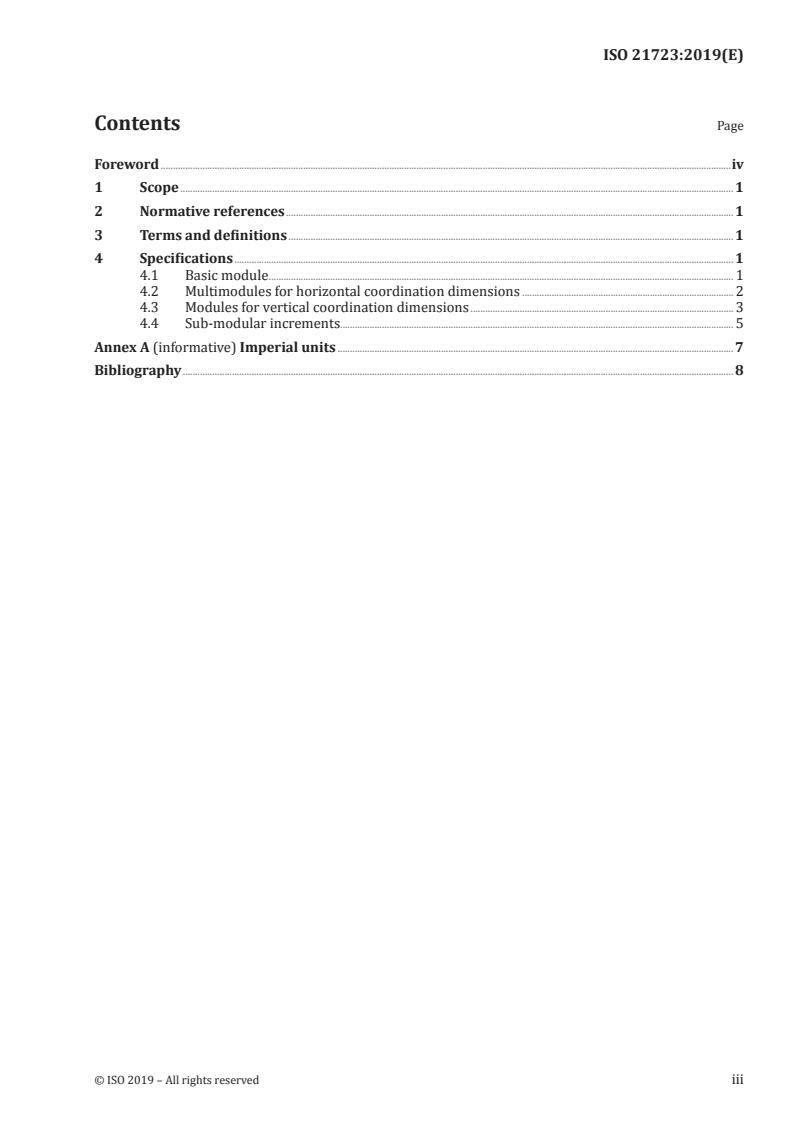
Contents Page
Foreword .iv
1 Scope . 1
2 Normative references . 1
3 Terms and definitions . 1
4 Specifications . 1
4.1 Basic module . 1
4.2 Multimodules for horizontal coordination dimensions . 2
4.3 Modules for vertical coordination dimensions . 3
4.4 Sub-modular increments. 5
Annex A (informative) Imperial units . 7
Bibliography . 8
Foreword
ISO (the International Organization for Standardization) is a worldwide federation of national standards
bodies (ISO member bodies). The work of preparing International Standards is normally carried out
through ISO technical committees. Each member body interested in a subject for which a technical
committee has been established has the right to be represented on that committee. International
organizations, governmental and non-governmental, in liaison with ISO, also take part in the work.
ISO collaborates closely with the International Electrotechnical Commission (IEC) on all matters of
electrotechnical standardization.
The procedures used to develop this document and those intended for its further maintenance are
described in the ISO/IEC Directives, Part 1. In particular, the different approval criteria needed for the
different types of ISO documents should be noted. This document was drafted in accordance with the
editorial rules of the ISO/IEC Directives, Part 2 (see www .iso .org/directives).
Attention is drawn to the possibility that some of the elements of this document may be the subject of
patent rights. ISO shall not be held responsible for identifying any or all such patent rights. Details of
any patent rights identified during the development of the document will be in the Introduction and/or
on the ISO list of patent declarations received (see www .iso .org/patents).
Any trade name used in this document is information given for the convenience of users and does not
constitute an endorsement.
For an explanation of the voluntary nature of standards, the meaning of ISO specific terms and
expressions related to conformity assessment, as well as information about ISO's adherence to the
World Trade Organization (WTO) principles in the Technical Barriers to Trade (TBT) see www .iso
.org/iso/foreword .html.
This document was prepared by Technical Committee ISO/TC 59, Buildings and civil engineering works.
This first edition cancels and replaces ISO 1006:1983, ISO 1040:1983, ISO 6512:1982, ISO 6513:1982
and ISO 6514:1982, which have now been merged into one document with a new logical structuring.
There is no technical change compared with the previous versions.
Any feedback or questions on this document should be directed to the user’s national standards body. A
complete listing of these bodies can be found at www .iso .org/members .html.
iv © ISO 2019 – All rights reserved
INTERNATIONAL STANDARD ISO 21723:2019(E)
Buildings and civil engineering works — Modular
coordination — Module
1 Scope
This document establishes the values of basic module, multimodules for horizontal coordinating
dimensions and sub-modular increments for use in modular coordination of buildings. This document
also specifies preferred vertical modular dimensions, series of preferred multimodular sizes for
horizontal dimensions for all types in accordance with general principles and rules for modular
coordination.
2 Normative references
The following documents are referred to in the text in such a way that some or all of their content
constitutes requirements of this document. For dated references, only the edition cited applies. For
undated references, the latest edition of the referenced document (including any amendments) applies.
ISO 6707-1, Buildings and civil engineering works — Vocabulary — Part 1: General terms
3 Terms and definitions
For the purposes of this document, the terms and definitions given in ISO 6707-1 and the following apply.
ISO and IEC maintain terminological databases for use in standardization at the following addresses:
— ISO Online browsing p
...
INTERNATIONAL ISO
STANDARD 21723
First edition
2019-08
Buildings and civil engineering
works — Modular coordination —
Module
Bâtiments et ouvrages de génie civil — Coordination modulaire —
Module
Reference number
©
ISO 2019
© ISO 2019
All rights reserved. Unless otherwise specified, or required in the context of its implementation, no part of this publication may
be reproduced or utilized otherwise in any form or by any means, electronic or mechanical, including photocopying, or posting
on the internet or an intranet, without prior written permission. Permission can be requested from either ISO at the address
below or ISO’s member body in the country of the requester.
ISO copyright office
CP 401 • Ch. de Blandonnet 8
CH-1214 Vernier, Geneva
Phone: +41 22 749 01 11
Fax: +41 22 749 09 47
Email: copyright@iso.org
Website: www.iso.org
Published in Switzerland
ii © ISO 2019 – All rights reserved
Contents Page
Foreword .iv
1 Scope . 1
2 Normative references . 1
3 Terms and definitions . 1
4 Specifications . 1
4.1 Basic module . 1
4.2 Multimodules for horizontal coordination dimensions . 2
4.3 Modules for vertical coordination dimensions . 3
4.4 Sub-modular increments. 5
Annex A (informative) Imperial units . 7
Bibliography . 8
Foreword
ISO (the International Organization for Standardization) is a worldwide federation of national standards
bodies (ISO member bodies). The work of preparing International Standards is normally carried out
through ISO technical committees. Each member body interested in a subject for which a technical
committee has been established has the right to be represented on that committee. International
organizations, governmental and non-governmental, in liaison with ISO, also take part in the work.
ISO collaborates closely with the International Electrotechnical Commission (IEC) on all matters of
electrotechnical standardization.
The procedures used to develop this document and those intended for its further maintenance are
described in the ISO/IEC Directives, Part 1. In particular, the different approval criteria needed for the
different types of ISO documents should be noted. This document was drafted in accordance with the
editorial rules of the ISO/IEC Directives, Part 2 (see www .iso .org/directives).
Attention is drawn to the possibility that some of the elements of this document may be the subject of
patent rights. ISO shall not be held responsible for identifying any or all such patent rights. Details of
any patent rights identified during the development of the document will be in the Introduction and/or
on the ISO list of patent declarations received (see www .iso .org/patents).
Any trade name used in this document is information given for the convenience of users and does not
constitute an endorsement.
For an explanation of the voluntary nature of standards, the meaning of ISO specific terms and
expressions related to conformity assessment, as well as information about ISO's adherence to the
World Trade Organization (WTO) principles in the Technical Barriers to Trade (TBT) see www .iso
.org/iso/foreword .html.
This document was prepared by Technical Committee ISO/TC 59, Buildings and civil engineering works.
This first edition cancels and replaces ISO 1006:1983, ISO 1040:1983, ISO 6512:1982, ISO 6513:1982
and ISO 6514:1982, which have now been merged into one document with a new logical structuring.
There is no technical change compared with the previous versions.
Any feedback or questions on this document should be directed to the user’s national standards body. A
complete listing of these bodies can be found at www .iso .org/members .html.
iv © ISO 2019 – All rights reserved
INTERNATIONAL STANDARD ISO 21723:2019(E)
Buildings and civil engineering works — Modular
coordination — Module
1 Scope
This document establishes the values of basic module, multimodules for horizontal coordinating
dimensions and sub-modular increments for use in modular coordination of buildings. This document
also specifies preferred vertical modular dimensions, series of preferred multimodular sizes for
horizontal dimensions for all types in accordance with general principles and rules for modular
coordination.
2 Normative references
The following documents are referred to in the text in such a way that some or all of their content
constitutes requirements of this document. For dated references, only the edition cited applies. For
undated references, the latest edition of the referenced document (including any amendments) applies.
ISO 6707-1, Buildings and civil engineering works — Vocabulary — Part 1: General terms
3 Terms and definitions
For the purposes of this document, the terms and definitions given in ISO 6707-1 and the following apply.
ISO and IEC maintain terminological databases for use in standardization at the following addresses:
— ISO Online browsing p
...