

ISO 9311-2:2011
(Main)Adhesives for thermoplastic piping systems — Part 2: Determination of shear strength
General Information
- Abstract
ISO 9311-2:2011 specifies a method for the determination of the shear strength of joints made with adhesives for thermoplastic piping systems.
- Status
- Published
- Publication Date
- 08-Aug-2011
- Current Stage
- 9093 - International Standard confirmed
- Start Date
- 14-Mar-2022
- Completion Date
- 29-Aug-2026
Buy Documents

ISO 9311-2:2011 - Adhesives for thermoplastic piping systems — Part 2: Determination of shear strength Released:8/9/2011
ISO 9311-2:2011 - Adhésifs pour réseaux de tuyauteries en matieres thermoplastiques — Partie 2: Détermination de la résistance au cisaillement Released:8/9/2011
Overview
ISO 9311-2:2011 - Adhesives for thermoplastic piping systems - Part 2: Determination of shear strength - specifies a laboratory test method to measure the shear strength of adhesive-bonded joints used in thermoplastic piping systems. The standard defines the specimen preparation, conditioning, test apparatus and procedure, calculation of shear strength and the required test report content. It is intended for characterizing adhesives under controlled conditions; results are not directly extrapolable to every in-service joint.
Key topics and requirements
- Scope and intent: Method to determine shear strength of joints bonded with adhesives for thermoplastic piping systems (ISO 9311-2:2011).
- Sampling and preparation: Follow ISO 15605 for sampling and EN 1067 for sample preparation; use manufacturer surface-preparation recommendations.
- Test specimens: Typical assemblies use a pipe length of 75 mm, external diameter 40 mm and a fitting with at least 20 mm joint contact depth. Diametrical clearance is specified per referenced product standards.
- Conditioning: Condition test pieces at (23 ± 2) °C and (50 ± 5) % RH for at least 6 hours; maintain curing under the same conditions and vertical position.
- Apparatus and loading: Use a tensile or press testing machine with a jaw movement rate of (5 ± 0.5) mm/min and an appropriate jig to connect the assembly.
- Failure and area reduction: Record maximum force at failure. If the required force exceeds machine capacity, reduce bonded area by cutting a 10 mm ring from the bond (per standard).
- Calculation: Shear strength (MPa) is calculated from the failure force divided by the bonded area (F / (π · d · l)) where d = internal fitting diameter and l = joint length.
- Test series and reporting: Test five assemblies and report individual results and arithmetic mean. Test report must reference ISO 9311-2:2011 and include adhesive ID, specimen prep, diametrical clearance, curing and test temperatures, joint dimensions, and any deviations.
Applications and users
ISO 9311-2:2011 is used for:
- Quality control and batch verification by adhesive manufacturers.
- Product development and comparative testing in R&D labs.
- Compliance testing for pipe and fitting manufacturers and certification bodies.
- Material selection and specification by engineers and consultants designing thermoplastic piping systems.
Practical applications include performance benchmarking, validation of bonding procedures, and supporting product specifications for pressure and non-pressure thermoplastic piping systems.
Related standards
- ISO 9311-1: Determination of film properties
- ISO 9311-3: Test method for resistance to internal pressure
- ISO 15605 (sampling), EN 1067 (sample prep), EN 923 (terms)
- EN 14680 and EN 14814 (product specifications referencing this test method)
Keywords: ISO 9311-2:2011, shear strength, adhesives for thermoplastic piping systems, bonded joint testing, test method, diametrical clearance, curing conditions.
Relations
- Effective Date
- 12-Feb-2026
- Effective Date
- 20-Jun-2008
Buy Documents
ISO 9311-2:2011 - Adhesives for thermoplastic piping systems — Part 2: Determination of shear strength Released:8/9/2011
ISO 9311-2:2011 - Adhésifs pour réseaux de tuyauteries en matieres thermoplastiques — Partie 2: Détermination de la résistance au cisaillement Released:8/9/2011
Get Certified
Connect with accredited certification bodies for this standard

DIN CERTCO
DIN Group product certification.
Institut za varilstvo d.o.o. (Welding Institute)
Slovenia's leading welding institute since 1952. ISO 3834, EN 1090, pressure equipment certification, NDT personnel, welder qualification. Only IIW Au

Smithers Quality Assessments
US management systems and product certification.
Sponsored listings
Frequently Asked Questions
ISO 9311-2:2011 is a standard published by the International Organization for Standardization (ISO). Its full title is "Adhesives for thermoplastic piping systems — Part 2: Determination of shear strength". This standard covers: ISO 9311-2:2011 specifies a method for the determination of the shear strength of joints made with adhesives for thermoplastic piping systems.
ISO 9311-2:2011 specifies a method for the determination of the shear strength of joints made with adhesives for thermoplastic piping systems.
ISO 9311-2:2011 is classified under the following ICS (International Classification for Standards) categories: 23.040.01 - Pipeline components and pipelines in general; 83.180 - Adhesives. The ICS classification helps identify the subject area and facilitates finding related standards.
ISO 9311-2:2011 has the following relationships with other standards: It is inter standard links to EN ISO 9311-2:2011, ISO 9311-2:2002. Understanding these relationships helps ensure you are using the most current and applicable version of the standard.
ISO 9311-2:2011 is available in PDF format for immediate download after purchase. The document can be added to your cart and obtained through the secure checkout process. Digital delivery ensures instant access to the complete standard document.
Standards Content (Sample)
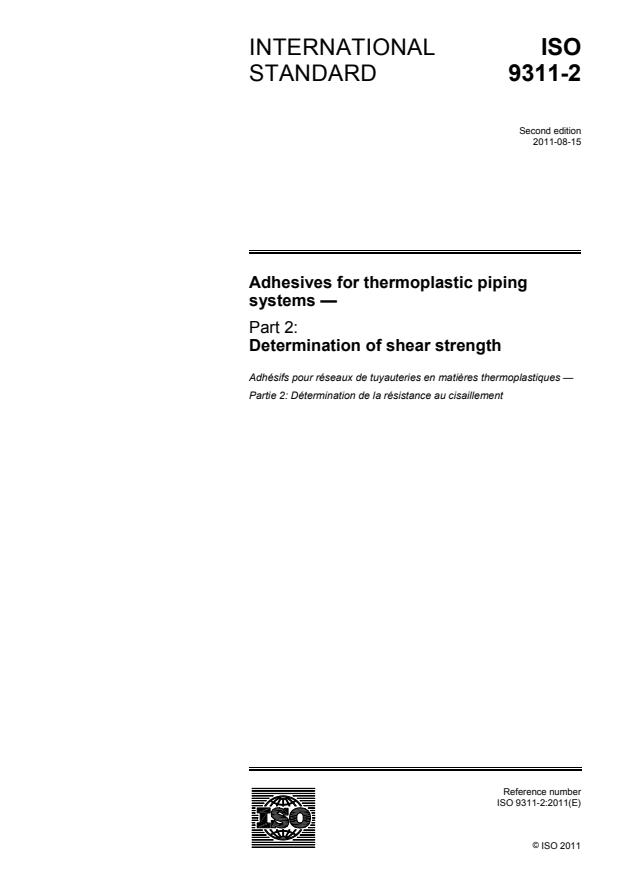
INTERNATIONAL ISO
STANDARD 9311-2
Second edition
2011-08-15
Adhesives for thermoplastic piping
systems —
Part 2:
Determination of shear strength
Adhésifs pour réseaux de tuyauteries en matières thermoplastiques —
Partie 2: Détermination de la résistance au cisaillement
Reference number
©
ISO 2011
© ISO 2011
All rights reserved. Unless otherwise specified, no part of this publication may be reproduced or utilized in any form or by any means,
electronic or mechanical, including photocopying and microfilm, without permission in writing from either ISO at the address below or
ISO's member body in the country of the requester.
ISO copyright office
Case postale 56 • CH-1211 Geneva 20
Tel. + 41 22 749 01 11
Fax + 41 22 749 09 47
E-mail copyright@iso.org
Web www.iso.org
Published in Switzerland
ii © ISO 2011 – All rights reserved
Foreword
ISO (the International Organization for Standardization) is a worldwide federation of national standards bodies
(ISO member bodies). The work of preparing International Standards is normally carried out through ISO
technical committees. Each member body interested in a subject for which a technical committee has been
established has the right to be represented on that committee. International organizations, governmental and
non-governmental, in liaison with ISO, also take part in the work. ISO collaborates closely with the
International Electrotechnical Commission (IEC) on all matters of electrotechnical standardization.
International Standards are drafted in accordance with the rules given in the ISO/IEC Directives, Part 2.
The main task of technical committees is to prepare International Standards. Draft International Standards
adopted by the technical committees are circulated to the member bodies for voting. Publication as an
International Standard requires approval by at least 75 % of the member bodies casting a vote.
Attention is drawn to the possibility that some of the elements of this document may be the subject of patent
rights. ISO shall not be held responsible for identifying any or all such patent rights.
ISO 9311-2 was prepared by the European Committee for Standardization (CEN) Technical Committee
CEN/TC 193, Adhesives, in collaboration with Technical Committee ISO/TC 138, Plastics pipes, fittings and
valves for the transport of fluids, Subcommittee SC 5, General properties of pipes, fittings and valves of plastic
materials and their accessories — Test methods and basic specifications, in accordance with the Agreement
on technical cooperation between ISO and CEN (Vienna Agreement).
This second edition cancels and replaces the first edition (ISO 9311-2:2002), which has been technically
revised.
ISO 9311 consists of the following parts, under the general title Adhesives for thermoplastic piping systems:
⎯ Part 1: Determination of film properties
⎯ Part 2: Determination of shear strength
⎯ Part 3: Test method for the determination of resistance to internal pressure
Introduction
The aim of this part of ISO 9311 is to describe a method to characterize adhesives for thermoplastic piping
systems by measuring the shear strength of a bonded joint using a test specimen prepared as described. The
results obtained with this method cannot be extrapolated into the resistance of a different specimen – perhaps
the real life article – to destructive shear forces.
iv © ISO 2011 – All rights reserved
INTERNATIONAL STANDARD ISO 9311-2:2011(E)
Adhesives for thermoplastic piping systems —
Part 2:
Determination of shear strength
SAFETY PRECAUTIONS — Persons using this document should be familiar with the normal laboratory
practice, if applicable. This document does not purport to address all of the safety problems, if any,
associated with its use. It is the responsibility of the user to establish appropriate safety and health
practices and to ensure compliance with any regulatory conditions.
CAUTION — It is understood that some of the material permitted in this standard may have negative
environmental impact. As technological advantages lead to acceptable alternatives for these materials,
they will be eliminated from this standard to the extent possible.
At the end of the test, the user of the standard shall take care to carry out an appropriate disposal of
the wastes, according to local regulation.
1 Scope
This part of ISO 9311 specifies a method for the determination of the shear strength of joints made with
adhesives for thermoplastic piping systems.
2 Normative references
The following referenced documents are indispensable for the application of this document. For dated
references, only the edition cited applies. For undated references, the latest edition of the referenced
document (including any amendments) applies.
ISO 15605, Adhesives — Sampling
EN 923, Adhesives — Terms and definitions
EN 1067, Adhesives — Examination and preparation of samples for testing
3 Terms and definitions
For the purposes of this document, the terms and definitions given in EN 923 and the following apply.
3.1
diametrical clearance
difference between the mean outside diameter of the pipe and the mean inside diameter of the socket
...
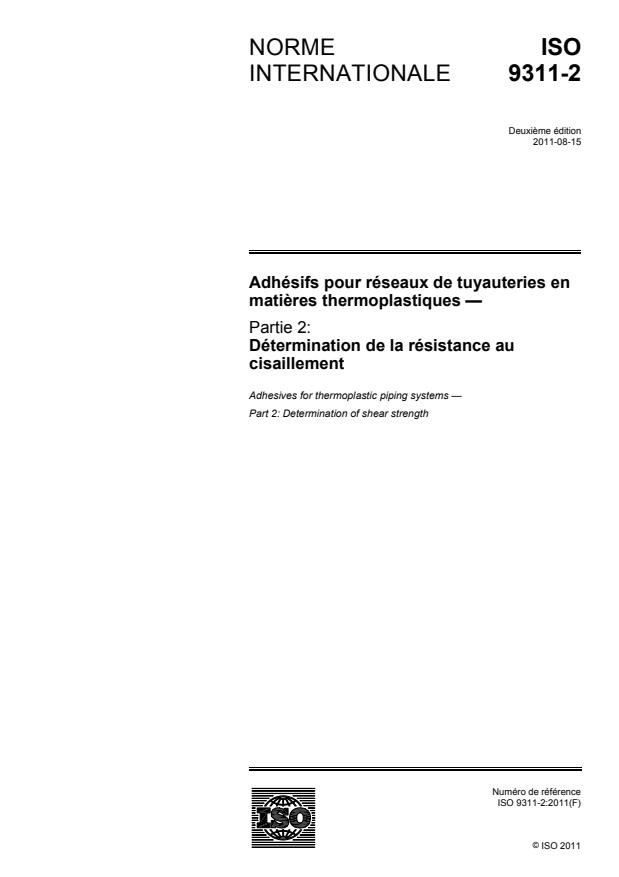
NORME ISO
INTERNATIONALE 9311-2
Deuxième édition
2011-08-15
Adhésifs pour réseaux de tuyauteries en
matières thermoplastiques —
Partie 2:
Détermination de la résistance au
cisaillement
Adhesives for thermoplastic piping systems —
Part 2: Determination of shear strength
Numéro de référence
©
ISO 2011
DOCUMENT PROTÉGÉ PAR COPYRIGHT
© ISO 2011
Droits de reproduction réservés. Sauf prescription différente, aucune partie de cette publication ne peut être reproduite ni utilisée sous
quelque forme que ce soit et par aucun procédé, électronique ou mécanique, y compris la photocopie et les microfilms, sans l'accord écrit
de l'ISO à l'adresse ci-après ou du comité membre de l'ISO dans le pays du demandeur.
ISO copyright office
Case postale 56 • CH-1211 Geneva 20
Tel. + 41 22 749 01 11
Fax + 41 22 749 09 47
E-mail copyright@iso.org
Web www.iso.org
Publié en Suisse
ii © ISO 2011 – Tous droits réservés
Avant-propos
L'ISO (Organisation internationale de normalisation) est une fédération mondiale d'organismes nationaux de
normalisation (comités membres de l'ISO). L'élaboration des Normes internationales est en général confiée
aux comités techniques de l'ISO. Chaque comité membre intéressé par une étude a le droit de faire partie du
comité technique créé à cet effet. Les organisations internationales, gouvernementales et non
gouvernementales, en liaison avec l'ISO participent également aux travaux. L'ISO collabore étroitement avec
la Commission électrotechnique internationale (CEI) en ce qui concerne la normalisation électrotechnique.
Les Normes internationales sont rédigées conformément aux règles données dans les Directives ISO/CEI,
Partie 2.
La tâche principale des comités techniques est d'élaborer les Normes internationales. Les projets de Normes
internationales adoptés par les comités techniques sont soumis aux comités membres pour vote. Leur
publication comme Normes internationales requiert l'approbation de 75 % au moins des comités membres
votants.
L'attention est appelée sur le fait que certains des éléments du présent document peuvent faire l'objet de
droits de propriété intellectuelle ou de droits analogues. L'ISO ne saurait être tenue pour responsable de ne
pas avoir identifié de tels droits de propriété et averti de leur existence.
L'ISO 9311-2 a été élaborée par le comité technique CEN/TC 193, Adhésifs, du Comité européen de
normalisation (CEN) en collaboration avec le comité technique ISO/TC 138, Tubes, raccords et robinetterie en
matières plastiques pour le transport des fluides, sous-comité SC 5, Propriétés générales des tubes, raccords
et robinetteries en matières plastiques et leurs accessoires — Méthodes d'essais et spécifications de base,
conformément à l’Accord de coopération technique entre l'ISO et le CEN (Accord de Vienne).
Cette deuxième édition annule et remplace la première édition (ISO 9311-2:2002), qui a fait l'objet d'une
révision technique.
L'ISO 9311 comprend les parties suivantes, présentées sous le titre général Adhésifs pour réseaux de
tuyauteries en matières thermoplastiques:
⎯ Partie 1: Détermination des propriétés des films
⎯ Partie 2: Détermination de la résistance au cisaillement
⎯ Partie 3: Méthode d'essai de détermination de la résistance à la pression interne
Introduction
Le but de la présente partie de l'ISO 9311 est de décrire une méthode permettant de caractériser les adhésifs
pour réseaux de tuyauteries en matières thermoplastiques en mesurant la résistance au cisaillement d'un joint
collé, à l'aide d'une éprouvette préparée selon la description. Les résultats obtenus avec cette méthode ne
peuvent pas être extrapolés en résistance d'une éprouvette différente – peut-être l'article réel – à des forces
de cisaillement destructrices.
iv © ISO 2011 – Tous droits réservés
NORME INTERNATIONALE ISO 9311-2:2011(F)
Adhésifs pour réseaux de tuyauteries en matières
thermoplastiques —
Partie 2:
Détermination de la résistance au cisaillement
PRÉCAUTIONS DE SÉCURITÉ — Il convient que l'utilisateur du présent document soit familier des
pratiques courantes de laboratoire, le cas échéant. Le présent document n'a pas pour but de traiter
tous les problèmes de sécurité qui sont, le cas échéant, liés à son utilisation. Il incombe à l'utilisateur
d'établir des pratiques appropriées en matière d'hygiène et de sécurité et de s'assurer de la
conformité à la réglementation en vigueur.
ATTENTION — Il est entendu que certains des matériaux autorisés dans le présent document peuvent
avoir des effets néfastes sur l'environnement. Les progrès techniques menant à des alternatives
acceptables, ces matériaux seront éliminés du présent document dans la mesure du possible.
À l'issue de l'essai, l'utilisateur du présent document doit prendre soin de procéder à une élimination
appropriée des déchets, conformément à la réglementation locale.
1 Domaine d'application
La présente partie de l'ISO 9311 spécifie une méthode de détermination de la résistance au cisaillement de
joints constitués d'adhésifs pour réseaux de tuyauteries en matières thermoplastiques.
2 Références normatives
Les documents de référence suivants sont indispensables pour l'application du présent document. Pour les
références datées, seule l'édition citée s'applique. Pour les références non datées, la dernière édition de la
publication à laquelle il est fait référence s'applique (y compris tous les amendements).
ISO 15605, Adhésifs — Échantillonnage
EN 923, Adhésifs — Termes et définitions
EN 1067, Adhésifs — Examen et préparation des échantillons pour essais
3 Termes et définitions
Pour les besoins du présent document, les termes et définitions donnés dans l'EN 923 ainsi que les suivants
s'appliquent.
3.1
jeu diamétral
différence de diamètre entre le diamètre extérieur moyen du tube et le diamètre intérieur moyen de
l'emboîture
...