

ISO 4926:2020
(Main)Road vehicles — Hydraulic braking systems — Non-petroleum-based reference fluid
General Information
- Abstract
This document specifies the composition and characteristics of a reference fluid used for the compatibility testing of hydraulic braking systems and components mounted on road vehicles.
- Status
- Published
- Publication Date
- 07-Jul-2020
- Technical Committee
- ISO/TC 22/SC 33 - Vehicle dynamics and chassis components
- Drafting Committee
- ISO/TC 22/SC 33/WG 14 - Brake fluids
- Current Stage
- 9093 - International Standard confirmed
- Start Date
- 23-Dec-2025
- Completion Date
- 29-Aug-2026
Buy Documents

ISO 4926:2020 - Road vehicles -- Hydraulic braking systems -- Non-petroleum-based reference fluid
ISO 4926:2020 - Road vehicles — Hydraulic braking systems — Non-petroleum-based reference fluid/8/2020
Overview
ISO 4926:2020 is an international standard that specifies the composition and characteristics of a non-petroleum-based reference fluid used for compatibility testing of hydraulic braking systems and their components in road vehicles. Published by the International Organization for Standardization (ISO), this third edition replaces the 2006 version with significant technical revisions aimed at improving fluid formulation and compliance with related standards.
The standard ensures consistent testing conditions by defining a precise chemical makeup of the reference fluid, which plays a crucial role in evaluating hydraulic brake system performance, safety, and component compatibility. This reference fluid is essential for manufacturers and testing laboratories involved in hydraulic brake system development and certification.
Key Topics
Reference Fluid Composition
The fluid is composed of specific glycol ethers and additives in defined mass fractions:- Borate of triethylene glycol monomethyl ether (around 50%)
- Triethylene glycol monomethyl ether (27.5%)
- Tetraethylene glycol monomethyl ether (10%)
- Triethylene glycol monobutyl ether (10%)
- Diisopropanolamine (2%)
- Tolyltriazole (0.5%)
This precise formulation enhances testing reliability and safety.
Chemical and Physical Requirements
- Water content: ≤ 0.20% measured per ASTM D 6304 (Coulometric Karl Fischer Titration)
- Reserve alkalinity: 15.5 ml according to ASTM D 1121
These parameters ensure the fluid maintains stability and compatibility during testing.
Compliance with ISO 4925
The reference fluid complies with ISO 4925, the specification for non-petroleum-based brake fluids, reinforcing standardized quality for hydraulic braking applications.Application Scope
ISO 4926 targets compatibility testing of hydraulic braking systems, crucial for verifying brake fluid behavior with system seals, metals, elastomers, and other components in road vehicles.
Applications
Hydraulic Brake System Development
Automotive engineers and manufacturers use the ISO 4926 reference fluid to assess material compatibility and fluid performance during product development cycles.Component Testing and Quality Assurance
Testing laboratories apply this reference fluid in standardized procedures to validate seals, hoses, valves, and master cylinders for tolerance to brake fluids and environmental factors.Regulatory and Certification Processes
Compliance with ISO 4926 supports regulatory approval by providing a recognized benchmark fluid for compatibility tests, facilitating safer and more efficient hydraulic braking systems.Research and Innovation
Researchers developing new non-petroleum-based brake fluids and additives leverage this standard’s defined fluid composition to benchmark and compare novel formulations.
Related Standards
ISO 4925: Specification of non-petroleum-based brake fluids for hydraulic systems, setting broader quality criteria for brake fluids used in road vehicles.
ASTM D 6304: Standard Test Method for Determination of Water in Petroleum Products, Lubricating Oils, and Additives by Coulometric Karl Fischer Titration, referenced for water content measurement.
ASTM D 1121: Standard Test Method for Reserve Alkalinity of Engine Coolants and Antirusts, referenced for reserve alkalinity determination critical to brake fluid stability.
Summary
ISO 4926:2020 ensures reliable compatibility testing of hydraulic braking systems through a clearly defined, non-petroleum-based reference fluid formulation. By adhering to this standard, manufacturers, testers, and certifiers ensure hydraulic brake system components meet crucial safety, performance, and durability requirements. This contributes to improved vehicle braking safety standards worldwide while supporting innovation in eco-friendly brake fluid technologies.
Relations
- Consolidated By
ISO 3170:2025 - Hydrocarbon Liquids — Manual sampling - Effective Date
- 09-Dec-2023
- Revises
ISO 4926:2006 - Road vehicles — Hydraulic braking systems — Non-petroleum-base reference fluids - Effective Date
- 23-Apr-2020
Buy Documents
ISO 4926:2020 - Road vehicles -- Hydraulic braking systems -- Non-petroleum-based reference fluid
ISO 4926:2020 - Road vehicles — Hydraulic braking systems — Non-petroleum-based reference fluid/8/2020
Get Certified
Connect with accredited certification bodies for this standard

TÜV Rheinland
TÜV Rheinland is a leading international provider of technical services.

TÜV SÜD
TÜV SÜD is a trusted partner of choice for safety, security and sustainability solutions.

DEKRA Certification Inc.
DEKRA US certification services.
Sponsored listings
Frequently Asked Questions
ISO 4926:2020 is a standard published by the International Organization for Standardization (ISO). Its full title is "Road vehicles — Hydraulic braking systems — Non-petroleum-based reference fluid". This standard covers: This document specifies the composition and characteristics of a reference fluid used for the compatibility testing of hydraulic braking systems and components mounted on road vehicles.
This document specifies the composition and characteristics of a reference fluid used for the compatibility testing of hydraulic braking systems and components mounted on road vehicles.
ISO 4926:2020 is classified under the following ICS (International Classification for Standards) categories: 43.040.40 - Braking systems; 75.120 - Hydraulic fluids. The ICS classification helps identify the subject area and facilitates finding related standards.
ISO 4926:2020 has the following relationships with other standards: It is inter standard links to ISO 3170:2025, ISO 4926:2006. Understanding these relationships helps ensure you are using the most current and applicable version of the standard.
ISO 4926:2020 is available in PDF format for immediate download after purchase. The document can be added to your cart and obtained through the secure checkout process. Digital delivery ensures instant access to the complete standard document.
Standards Content (Sample)
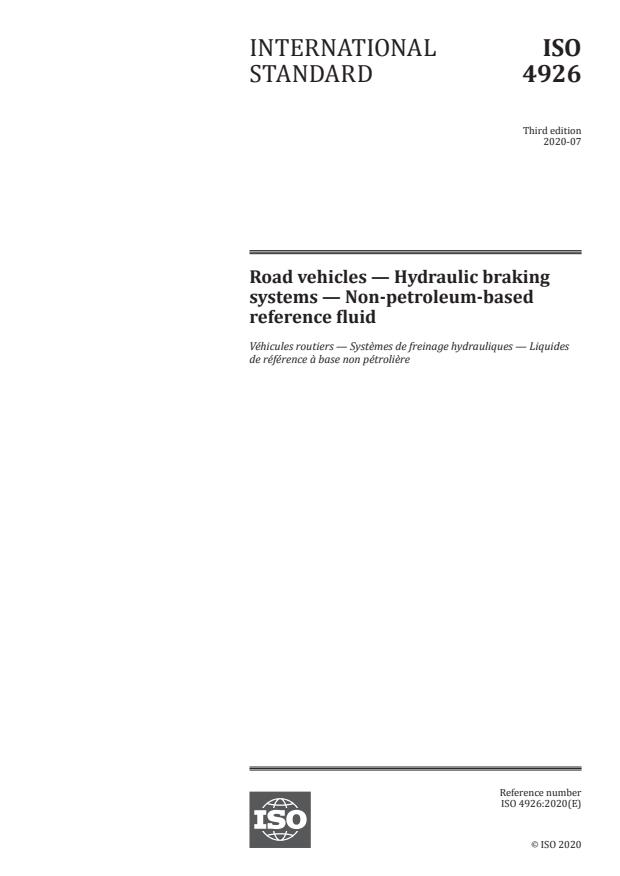
INTERNATIONAL ISO
STANDARD 4926
Third edition
2020-07
Road vehicles — Hydraulic braking
systems — Non-petroleum-based
reference fluid
Véhicules routiers — Systèmes de freinage hydrauliques — Liquides
de référence à base non pétrolière
Reference number
©
ISO 2020
© ISO 2020
All rights reserved. Unless otherwise specified, or required in the context of its implementation, no part of this publication may
be reproduced or utilized otherwise in any form or by any means, electronic or mechanical, including photocopying, or posting
on the internet or an intranet, without prior written permission. Permission can be requested from either ISO at the address
below or ISO’s member body in the country of the requester.
ISO copyright office
CP 401 • Ch. de Blandonnet 8
CH-1214 Vernier, Geneva
Phone: +41 22 749 01 11
Email: copyright@iso.org
Website: www.iso.org
Published in Switzerland
ii © ISO 2020 – All rights reserved
Contents Page
Foreword .iv
1 Scope . 1
2 Normative references . 1
3 Terms and definitions . 1
4 ISO reference fluid for compatibility testing . 1
Foreword
ISO (the International Organization for Standardization) is a worldwide federation of national standards
bodies (ISO member bodies). The work of preparing International Standards is normally carried out
through ISO technical committees. Each member body interested in a subject for which a technical
committee has been established has the right to be represented on that committee. International
organizations, governmental and non-governmental, in liaison with ISO, also take part in the work.
ISO collaborates closely with the International Electrotechnical Commission (IEC) on all matters of
electrotechnical standardization.
The procedures used to develop this document and those intended for its further maintenance are
described in the ISO/IEC Directives, Part 1. In particular, the different approval criteria needed for the
different types of ISO documents should be noted. This document was drafted in accordance with the
editorial rules of the ISO/IEC Directives, Part 2 (see www .iso .org/ directives).
Attention is drawn to the possibility that some of the elements of this document may be the subject of
patent rights. ISO shall not be held responsible for identifying any or all such patent rights. Details of
any patent rights identified during the development of the document will be in the Introduction and/or
on the ISO list of
...
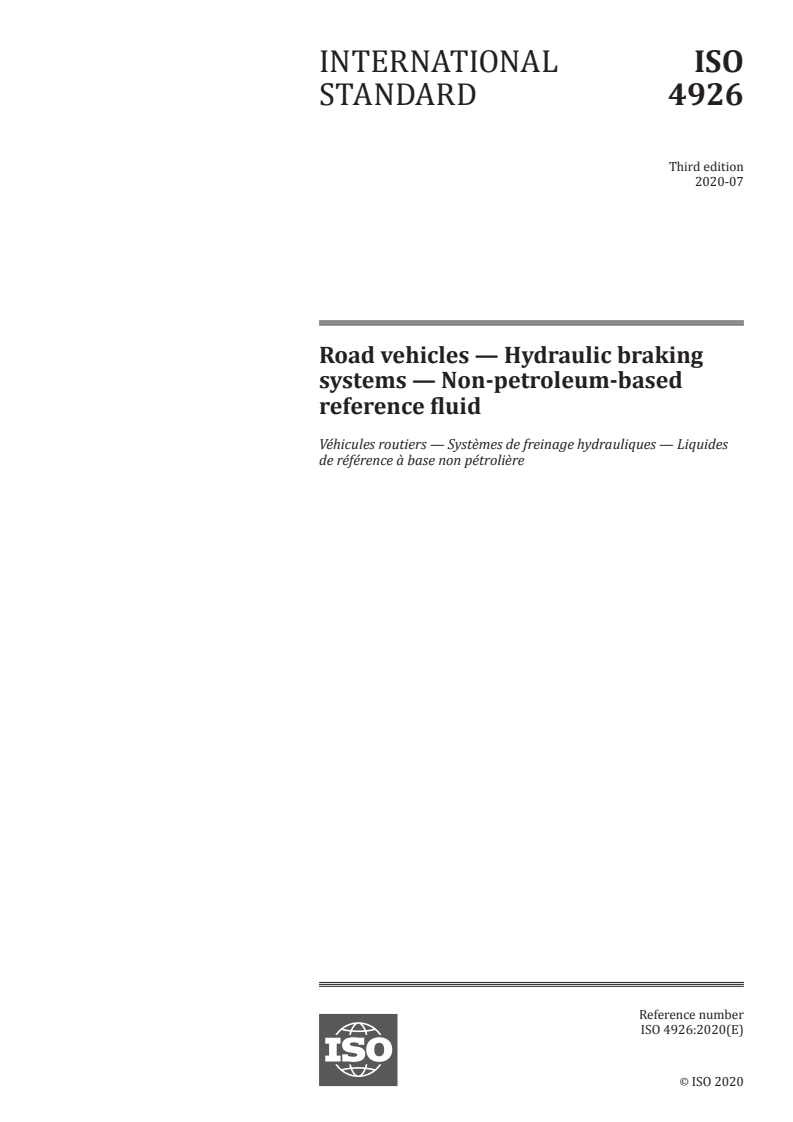
INTERNATIONAL ISO
STANDARD 4926
Third edition
2020-07
Road vehicles — Hydraulic braking
systems — Non-petroleum-based
reference fluid
Véhicules routiers — Systèmes de freinage hydrauliques — Liquides
de référence à base non pétrolière
Reference number
©
ISO 2020
© ISO 2020
All rights reserved. Unless otherwise specified, or required in the context of its implementation, no part of this publication may
be reproduced or utilized otherwise in any form or by any means, electronic or mechanical, including photocopying, or posting
on the internet or an intranet, without prior written permission. Permission can be requested from either ISO at the address
below or ISO’s member body in the country of the requester.
ISO copyright office
CP 401 • Ch. de Blandonnet 8
CH-1214 Vernier, Geneva
Phone: +41 22 749 01 11
Email: copyright@iso.org
Website: www.iso.org
Published in Switzerland
ii © ISO 2020 – All rights reserved
Contents Page
Foreword .iv
1 Scope . 1
2 Normative references . 1
3 Terms and definitions . 1
4 ISO reference fluid for compatibility testing . 1
Foreword
ISO (the International Organization for Standardization) is a worldwide federation of national standards
bodies (ISO member bodies). The work of preparing International Standards is normally carried out
through ISO technical committees. Each member body interested in a subject for which a technical
committee has been established has the right to be represented on that committee. International
organizations, governmental and non-governmental, in liaison with ISO, also take part in the work.
ISO collaborates closely with the International Electrotechnical Commission (IEC) on all matters of
electrotechnical standardization.
The procedures used to develop this document and those intended for its further maintenance are
described in the ISO/IEC Directives, Part 1. In particular, the different approval criteria needed for the
different types of ISO documents should be noted. This document was drafted in accordance with the
editorial rules of the ISO/IEC Directives, Part 2 (see www .iso .org/ directives).
Attention is drawn to the possibility that some of the elements of this document may be the subject of
patent rights. ISO shall not be held responsible for identifying any or all such patent rights. Details of
any patent rights identified during the development of the document will be in the Introduction and/or
on the ISO list of
...