

ISO/CD 13208.3
(Main)Biodiversity — Vocabulary
- Abstract
This document defines the terms in the field of biodiversity. These include terms related to: — the drivers of biodiversity loss; — quantification; — impact on species or ecosystems; — the means of action to protect biodiversity to create a regenerative and resilient ecosystem. The components of biodiversity covered within this document are genetic, species, ecosystem and functional diversity. This document is applicable to entities either working directly in the field of biodiversity or whose work involves considerations related to biodiversity.
- Status
- Not Published
- Technical Committee
- ISO/TC 331 - Biodiversity
- Drafting Committee
- ISO/TC 331/WG 1 - Terminology
- Current Stage
- 3099 - CD approved for registration as DIS - 30 Committee
- Start Date
- 12-Nov-2026
ISO/CD 13208.3, published by ISO, is a draft vocabulary standard for biodiversity. It defines the terms used in ISO/TC 331 work on biodiversity, including drivers of biodiversity loss, measurement and assessment, restoration and protection, and sustainable use. It is intended for organizations and other entities that work directly with biodiversity or need to consider biodiversity in their activities.
What does ISO/CD 13208.3 specify?
ISO/CD 13208.3 specifies the vocabulary for biodiversity work, with coverage of genetic, species, ecosystem and functional diversity. It gives a common terminology for use in technical, environmental, conservation and management contexts, so different teams can describe biodiversity-related topics in the same way.
The document is organized as follows:
| Annex | What it covers |
|---|---|
| Annex A (informative) | Alphabetical index of the terms defined in Clause 3 |
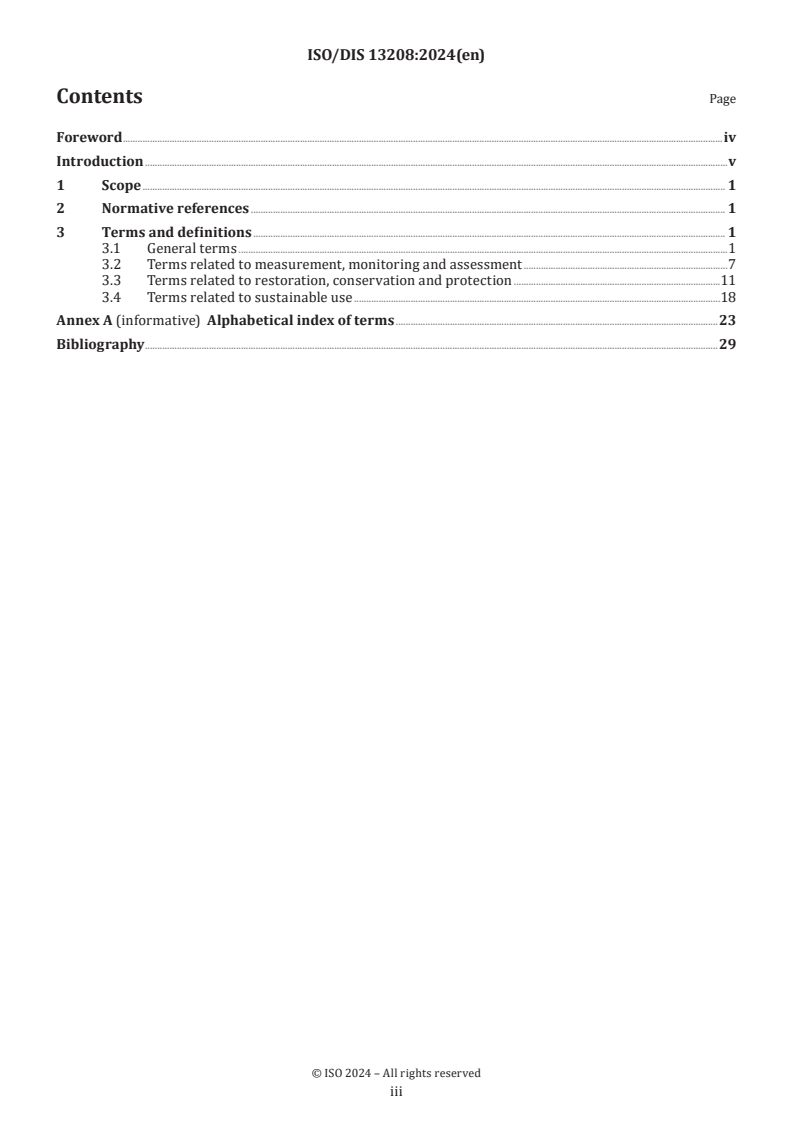
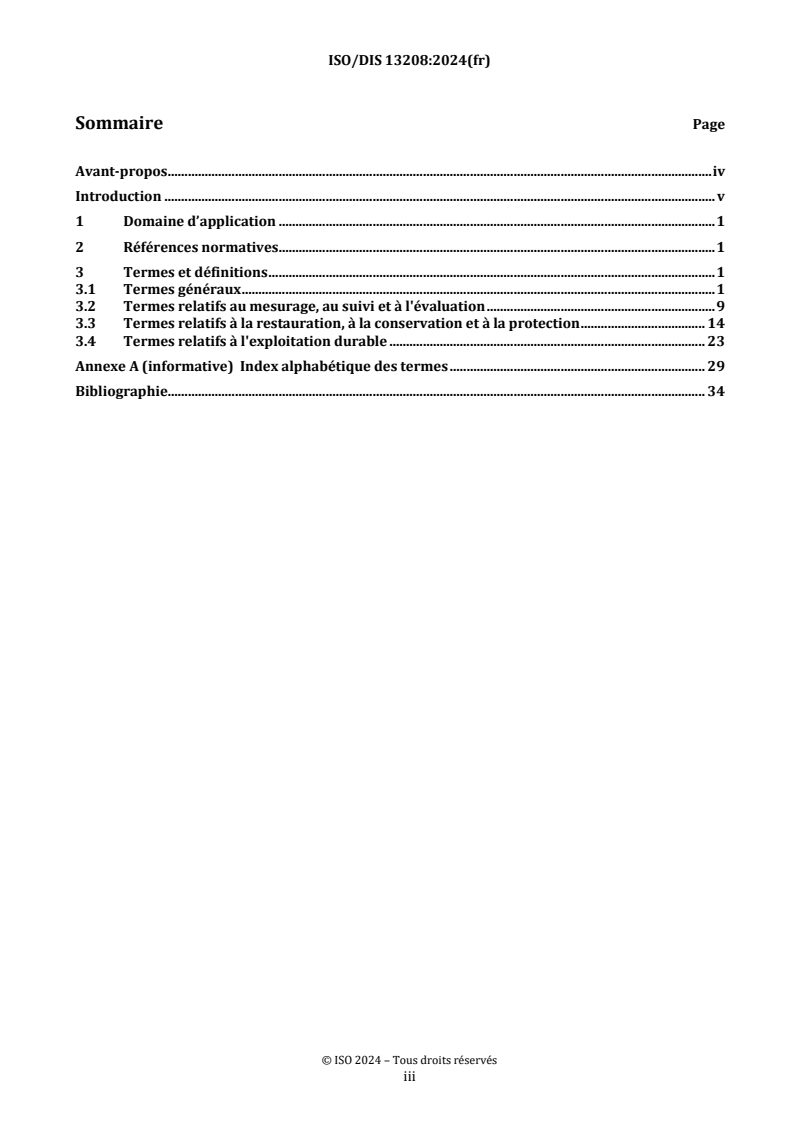
Clause 1 states the scope, Clause 2 covers normative references, and Clause 3 contains the terms and definitions. Clause 3 is split into general terms, measurement/monitoring/assessment terms, restoration/conservation/protection terms, and sustainable use terms. That structure matters because readers can move quickly from a broad concept to the specific vocabulary used in reporting, surveys, restoration planning or impact work.
What are the key requirements of ISO/CD 13208.3?
ISO/CD 13208.3 is a vocabulary document, so its main purpose is to define terms and organize them consistently. The practical value is that it reduces ambiguity when organizations describe biodiversity loss, ecosystem condition, monitoring results or conservation actions.
How the terminology is selected
The Introduction explains a source hierarchy used to choose definitions. ISO standards are preferred first, then CBD and equivalent UN sources, then IPBES, then other sources, and finally new drafting where needed. In practice, that tells users the document is trying to harmonize terms across established biodiversity references rather than inventing a separate wording system.
What Clause 1 and Clause 2 do
Clause 1 sets the document’s scope around biodiversity terminology for ISO/TC 331. Clause 2 states that there are no normative references. For users, that means the document stands on its own as a vocabulary reference rather than as a requirement standard that depends on other normative documents.
What Clause 3 covers
Clause 3.1 gives the core biodiversity vocabulary, including biological diversity / biodiversity, ecosystem, habitat, species, genetic diversity, biodiversity loss, and related ecological concepts. These terms are the base language for describing what is being affected and at what biological level.
Clause 3.2 covers measurement, monitoring and assessment terms such as biodiversity monitoring, biodiversity survey, indicator, metric, sample, alpha diversity, beta diversity and gamma diversity. In practice, these terms are the language of field work, surveys, trend tracking and reporting.
Clause 3.3 covers restoration, conservation and protection. It includes ecological restoration, ecological connectivity, ecological corridor, protected area, in-situ conservation, ex-situ conservation, habitat degradation, habitat fragmentation, invasive species and biodiversity protection terms. This is the part used when planning conservation actions, restoration projects and protected-area management.
Clause 3.4 covers sustainable use and value concepts, including impact, mitigation hierarchy, biodiversity offset, ecosystem services, nature based solutions (NBS), sustainable use, natural capital and use value. These terms matter when organizations assess trade-offs, justify actions, or describe how land, resources and ecosystems are being managed.
Why the annex matters
Annex A is an alphabetical index of terms. It does not add new definitions, but it makes the vocabulary easier to search in practice when teams need to check wording quickly during drafting, audits, reports or training.
What terms does ISO/CD 13208.3 define?
ISO/CD 13208.3 defines the core language of biodiversity, from basic biological concepts to conservation and value terms. These definitions are the part most readers will use day to day.
- biological diversity / biodiversity - the variability among living organisms on Earth, including variation within species and between species and ecosystems.
- impact - a measurable change to the properties of an ecosystem caused by an action, event or entity.
- biodiversity monitoring - systematic observation and measurement of changes in biodiversity across genes, taxa, structures, functions and ecosystems.
- ecological restoration - an activity or process that helps recover the health, structure, integrity, resilience and stability of a degraded, damaged or destroyed ecosystem or habitat.
- mitigation hierarchy - a stepwise decision framework that starts with avoiding impacts, then minimizing unavoidable impacts, then restoring on-site, and finally using biodiversity offsets where needed.
- sustainable use - use of components of biological diversity in a way and at a rate that does not cause long-term decline.
- nature based solutions (NBS) - actions that protect, conserve, restore, sustainably use and manage ecosystems while addressing social, economic and environmental challenges.
- key biodiversity area (KBA) - an area that contributes significantly to the global persistence of biodiversity.
Who uses ISO/CD 13208.3?
ISO/CD 13208.3 is for anyone who needs consistent biodiversity language in specifications, assessments or management work. It is especially useful for people who must align technical writing with conservation and sustainability terminology.
Typical users include:
- environmental managers and sustainability teams
- ecologists, conservation practitioners and restoration specialists
- consultants preparing biodiversity assessments or monitoring reports
- public authorities and regulators dealing with land use, protection or impact topics
- buyers and suppliers that need to discuss biodiversity in projects or supply chains
- researchers and standardization teams working in ISO/TC 331 related areas
In practice, they use it to define terms in reports, compare monitoring results, describe habitat and species conditions, and communicate actions such as restoration, offsetting or sustainable use.
Which standards are used with ISO/CD 13208.3?
ISO/CD 13208.3 has no normative references. The bibliography shows the related ISO standards and other references that support its terminology.
- ISO 14050:2020 - supplies environmental management vocabulary used for terms such as biodiversity, pollution and climate-related wording.
- ISO 14008:2019 - supports monetary valuation terms such as use value, non-use value and existence value.
- ISO 14044:2006 - provides the source for output.
- ISO 6107:2021 - contributes wording used for pollution.
- ISO 14002-2:2023 - supports the wording for ecosystem services.
- ISO 2859-1:1999 - is cited for sample.
- ISO 14064-1 - is cited in relation to natural capital.
- ISO Guide 82:2019 - is cited for sustainable development wording used in the document.
What does the ISO/CD 13208.3 document contain?
ISO/CD 13208.3 contains a scope, a short clause on references, and a large Clause 3 of terms and definitions arranged by topic. Many entries include notes to entry, examples, and source citations that show where the wording comes from or how it was adapted.
It also contains an informative alphabetical index in Annex A for fast lookup, plus a bibliography of the external standards, glossaries and publications used as sources. The Introduction explains the source hierarchy behind the definitions, which is useful when two biodiversity terms overlap or different organizations use slightly different wording.
Get Certified
Connect with accredited certification bodies for this standard

BSI Group
BSI (British Standards Institution) is the business standards company that helps organizations make excellence a habit.

Bureau Veritas
Bureau Veritas is a world leader in laboratory testing, inspection and certification services.

DNV
DNV is an independent assurance and risk management provider.
Sponsored listings
Frequently Asked Questions
ISO/CD 13208.3 is a draft published by the International Organization for Standardization (ISO). Its full title is "Biodiversity — Vocabulary". This standard covers: This document defines the terms in the field of biodiversity. These include terms related to: — the drivers of biodiversity loss; — quantification; — impact on species or ecosystems; — the means of action to protect biodiversity to create a regenerative and resilient ecosystem. The components of biodiversity covered within this document are genetic, species, ecosystem and functional diversity. This document is applicable to entities either working directly in the field of biodiversity or whose work involves considerations related to biodiversity.
This document defines the terms in the field of biodiversity. These include terms related to: — the drivers of biodiversity loss; — quantification; — impact on species or ecosystems; — the means of action to protect biodiversity to create a regenerative and resilient ecosystem. The components of biodiversity covered within this document are genetic, species, ecosystem and functional diversity. This document is applicable to entities either working directly in the field of biodiversity or whose work involves considerations related to biodiversity.
ISO/CD 13208.3 is classified under the following ICS (International Classification for Standards) categories: 01.040.13 - Environment. Health protection. Safety (Vocabularies); 13.020.20 - Environmental economics. Sustainability. The ICS classification helps identify the subject area and facilitates finding related standards.
ISO/CD 13208.3 is available in PDF format for immediate download after purchase. The document can be added to your cart and obtained through the secure checkout process. Digital delivery ensures instant access to the complete standard document.
Standards Content (Sample)
Contents
- Introduction
- 1 Scope
- 2 Normative references
- 3 Terms and definitions
- 3.1 General terms
- 3.1.1 abiotic factor
- 3.1.2 artificial ecosystem
- 3.1.3 biodiversity footprint
- 3.1.4 biodiversity Hot Spot
- 3.1.5 biodiversity loss
- 3.1.6 biological diversity
- 3.1.7 biotic factor
- 3.1.8 biotope
- 3.1.9 deoxynucleic acid
- 3.1.10 ecological engineering
- 3.1.11 ecological niche
- 3.1.12 ecosystem collapse
- 3.1.13 ecosystem diversity
- 3.1.14 ecosystem function
- 3.1.15 ecosystem structure
- 3.1.16 ecosystem
- 3.1.17 endemic species
- 3.1.18 environment
- 3.1.19 exome
- 3.1.20 exon
- 3.1.21 extinction debt
- 3.1.22 functional diversity
- 3.1.23 genetic diversity
- 3.1.24 genetic material
- 3.1.25 genetic resources
- 3.1.26 genome
- 3.1.27 genotype
- 3.1.28 habitat
- 3.1.29 habitat loss
- 3.1.30 habitat specialist
- 3.1.31 intron
- 3.1.32 landscape
- 3.1.33 micro-organism
- 3.1.34 mutation
- 3.1.35 native species
- 3.1.36 nature
- 3.1.37 natural resource
- 3.1.38 phenotype
- 3.1.39 phylogenetic diversity
- 3.1.40 phylogenetic tree
- 3.1.41 species
- 3.1.42 species diversity
- 3.1.43 taxon
- 3.1.44 taxonomic diversity
- 3.2 Terms related to measurement, monitoring and assessment
- 3.2.1 area of habitat
- 3.2.2 area of occupancy
- 3.2.3 assessment
- 3.2.4 belt transect
- 3.2.5 biodiversity monitoring
- 3.2.6 biodiversity survey
- 3.2.7 biomass
- 3.2.8 biome
- 3.2.9 DNA sequencing
- 3.2.10 dominant species
- 3.2.11 extent of occurrence
- 3.2.12 generation length
- 3.2.13 indicator
- 3.2.14 key biodiversity area
- 3.2.15 keystone species
- 3.2.16 line transect
- 3.2.17 metric
- 3.2.18 quadrat sampling
- 3.2.19 reproductive capacity
- 3.2.20 reproductive unit
- 3.2.21 sample
- 3.2.22 species evenness
- 3.2.23 visual encounter survey
- 3.2.24 α(alpha)- diversity
- 3.2.25 β(beta)- diversity
- 3.2.26 γ (gamma)- diversity
- 3.3 Terms related to restoration, conservation and protection
- 3.3.1 active day-to-day management system
- 3.3.2 alien species
- 3.3.3 climate change
Introduction
ISO/TC 331 committee started in 2020 due to an extensive pressing need for standardisation concerning biodiversity. The work scope of ISO/TC 331 is standardization in the field of biodiversity to develop principles, framework, requirements, guidance, and supporting tools in a holistic and global approach for all organizations, to enhance their contribution to sustainable development. Creating a common terminology is the foundation for effective standardisation (which is the focus of ISO) and more effective communication.
However, creating a complete list of terms before understanding the needs of specific terminology is challenging, and new needs and standards will develop continuously requiring new terminology. This document intends to align terminology between the different areas of biodiversity standardization. This document will be revised as needed.
In drafting this standard, terms and definitions have been determined in accordance with a source hierarchy method developed in a drafting team. The intention was to follow a decision scheme when selecting source references for terms posts. The hierarchy served as guidance when choosing sources to which we refer when numerous definitions are available. As specified in ISO Directives x, paragraph y, referencing ISO standards is preferred. However, when ISO reference is not available, the hierarchy method was applied. The hierarchy may be subject for revision in future versions of this document. Terms and definitions are determined in accordance with the following source hierarchy method:
- Level 1: definition given in an ISO standard (https://www.iso.org/obp/ui)
- Level 2: definition given by "The Convention on Biological Diversity (CBD)" (https://www.cbd.int/convention/articles/?a=cbd-02) and other equivalent relevant UN documents (IPCC, Nagoya, etc.)
- Level 3: definition given by "The Intergovernmental Science-Policy Platform on Biodiversity and Ecosystem Services (IPBES)" (https://www.ipbes.net/glossary)
- Level 4: other data source
- Level 5: drafting new definitions.
Terms and definitions are listed in alphabetical order within the subsections.
DRAFT International Standard ISO/DIS 13208:2024(en) Biodiversity — Vocabulary
1 Scope
This document defines the terms and definitions related to the work of the ISO/TC 331. It includes terms related to the drivers of biodiversity loss (climate change, pollution, invasive species, erosion, soil degradation, deforestation, etc.). It also includes technical terms for quantification (measurement, monitoring, methods, and assessment), impact (on species or ecosystems), the means of action to protect biodiversity (conserve, restore, and use sustainably) to create a regenerative and resilient ecosystem. The components of biodiversity covered within this document are genetic, species, ecosystem and functional diversity.
This document is applicable to any entity working directly with or needs to consider biodiversity for any reason or aspect.
2 Normative references
There are no normative references in this document.
3 Terms and definitions
For the purposes of this document, the following terms and definitions apply. ISO and IEC maintain terminology databases for use in standardization at the following addresses:
- ISO Online browsing platform: available at https:// www .iso .org/ obp
- IEC Electropedia: available at https:// www .electropedia .org/
3.1 General terms
3.1.1 abiotic factor
any of the non-living factors that make up the abiotic environment (3.1.18) in which living organisms occur Note 1 to entry: They include all the aspects of climate, geology, and atmosphere that may affect the biotic environment. [SOURCE: Oxford Dictionary of Biology]
3.1.2 artificial ecosystem
ecosystem (3.1.16) dominated by human artifacts or human-induced material and energy flows Note 1 to entry: Examples include heathland, quarry lakes.
[SOURCE: Gadgil M (2001). Poverty and Biodiversity. In: Levin SA (editor, 2013). Encyclopedia of Biodiversity, Second Edition, pp. 845-856, modified - Note 1 to entry was added.]
3.1.3 biodiversity footprint
potential impact (3.4.16) of a good, service, organization, person, or community on biodiversity, measured in terms of biodiversity change, as a result (3.4.26) of the associated production or consumption Note 1 to entry: Ecological footprint is understood to be a kind of biodiversity footprint.
ISO/DIS 13208:2024(en) [SOURCE: IEEP. Nigel Dudley, Marianne Kettunen, Giulia Costa Domingo. Biodiversity footprints in policy [24] and decision-making: State of play and future opportunities. 2021, modified - Note 1 to entry was added.]
3.1.4 biodiversity Hot Spot
regions with at least 1500 vascular plants as endemics and has only 30 % or less of its natural vegetation
3.1.5 biodiversity loss
reduction or degradation (3.3.7) of any aspect of biological diversity (3.1.5) Note 1 to entry: The main causes of biodiversity loss include human activities, such as land use change (3.3.37), habitat loss (3.1.29) and fragmentation, overexploitation of biodiversity, pollution (3.3.46), introduction of an alien species (3.3.32) that might become invasive, and climate change (3.3.4). [SOURCE: IPBES, Core Glossary, modified - "or degradation" was added after "reduction", "(i.e. diversity at the genetic, species and ecosystem levels) is lost in a particular area through death (including extinction), destruction or manual removal; it can refer to many scales, from global extinctions to population extinctions, resulting in decreased total diversity at the same scale" was deleted, and Note 1 to entry was added.]
3.1.6 biological diversity
biodiversity variability among living organisms on the earth, including the variability within and between species (3.1.45), and within and between ecosystems (3.1.16) [SOURCE: ISO 14050:2020, 3.8.22]
3.1.7 biotic factor
any of the factors of an organism’s environment (3.1.18) that consist of other living organisms and together make up the biotic environment [SOURCE: Oxford Dictionary of Biology. Available at Biotic factor - Oxford Reference. “These factors may affect an organism in many ways, for example, as competitors, predators, parasites, prey, or symbionts. In time, the distribution and abundance of the organism will be affected by its interrelationships with the biotic environment.” was deleted]
3.1.8 biotope
area of uniform environmental conditions providing a living place and is inhabited by specific community of living organisms [SOURCE: ISO 6107:2021,3.77, modified - "for a specific assemblage of plants and animals" was replaced by "and is inhabited by specific community of living organisms", Note 1 to entry was deleted.]
3.1.9 deoxynucleic acid
DNA carrier of genetic information Note 1 to entry: It is made up of four types of nucleotide bases, adenine A, cytosine C, guanine G and thymine T, and a backbone of alternating phosphate and sugar, 2-deoxyribose, groups. [SOURCE: Roth SC. What is genomic medicine? Journal of Medical Library Association, 2019, 107(3), pp. 442-448]
3.1.10 ecological engineering
management of systems of human and environmental self-design or light management that joins human design and environmental self-design Note 1 to entry: The design of sustainable ecosystems that integrate human society with its environment for the benefit of both.
ISO/DIS 13208:2024(en) [SOURCE: IUCN 2016 Publication on Nature based Solutions (Odum, 1996) & (Mitsch, 2012)]
3.1.11 ecological niche
position of a species (3.1.41) within an ecosystem (3.1.16), describing both the range of conditions necessary for the persistence of the species and its ecological role in the ecosystem Note 1 to entry: It subsumes all the interaction between species and the biotic and abiotic environment. [SOURCE: Jitka Polechová, David Storch. Ecological niche. Encyclopedia of Ecology (2nd Ed.) 2008, pp. 1088-1097]
3.1.12 ecosystem collapse
transformation of identity, a loss of defining features, and a replacement by a different ecosystem (3.1.16) type [SOURCE: IUCN Red List OF Ecosystems glossary]
3.1.13 ecosystem diversity
variability of ecosystems (3.1.16) that occurs in a given area [SOURCE: Frits Hesselink et al. Communication, Education and Public Awareness, a toolkit for the Convention [27] on Biological Diversity, Montreal 2007 c - "within a larger landscape, ranging from biome (the largest ecological unit) to microhabitat" was replaced by "in a given area".]
3.1.14 ecosystem function
flow of energy and materials through the biotic and abiotic components of an ecosystems (3.1.16) Note 1 to entry: It includes many processes such as biomass production, trophic transfer through fauna, flora, fungi, algae and microbial species (3.1.45) , nutrient cycling, water dynamics and heat transfer. [SOURCE: IPBES, Core Glossary, modified - Note 1 to entry was added.]
3.1.15 ecosystem structure
composition of an ecosystem (3.1.16) including the living and the non-living components, their age and spatial distribution
3.1.16 ecosystem
ecological system dynamic complex of plants, animals, and micro-organisms communities, and their non-living environment (3.1.18) interacting as a functional entity EXAMPLE Deserts, coral reefs, wetlands, rain forests, boreal forests, grasslands, urban parks, cultivated farmlands.
Note 1 to entry: Ecosystems can be influenced by human activity. Note 2 to entry: Examples include heathland, quarry lakes.
[SOURCE: ISO 14008:2019, 3.1.6]
3.1.17 endemic species
species (3.1.41) for which the entire global range is strictly limited to a specified region or locality [SOURCE: Food and Agriculture Organization of the United Nations. Reducing Emissions from Deforestation and Forest Degradation (UN-REDD), modified - "restricted to the site, the region or the country (the level of endemicity must be defined)" was replaced by "strictly limited to a specified region or locality".]
ISO/DIS 13208:2024(en)
3.1.18 environment
surroundings in which an organization operates, including air, water, land, natural resources (3.1.40), species (3.1.45) , and their interrelation [1] [SOURCE: ISO/Guide 64:2008, 2.1, modified - “human” and Note 1 to entry were deleted, "flora, fauna" was replaced by "species (3.1.45)".]
3.1.19 exome
entirety of exons (3.1.20) Note 1 to entry: approximately 1 % of the genome (3.1.26).
[SOURCE: Roth SC. What is genomic medicine? Journal of Medical Library Association, 2019, 107(3), pp. 442-448.]
3.1.20 exon
protein-coding sequence of the DNA (3.1.9) Note 1 to entry: Examples include heathland, quarry lakes.
[SOURCE: Roth SC. What is genomic medicine? Journal of Medical Library Association, 2019, 107(3), pp. 442-448.]
3.1.21 extinction debt
future biodiversity loss (3.1.4) that current or past damage (3.3.5) will incur but which have yet to be realized because of time delays in extinction [SOURCE: Wearn OR, Reuman DC, Ewers RM. Extinction Debt and Windows of Conservation Opportunity in the Brazilian Amazon. Science, 2012, 337(6091), pp. 228-232.]
3.1.22 functional diversity
component of biodiversity (3.1.5) that generally concerns the range of things that organisms do in communities and ecosystems (3.1.16) [SOURCE: Petchey and Gaston 2006. Ecol Lett 9:741-758.]
3.1.23 genetic diversity
gene diversity level of variety of genetic data within a sample (3.2.21) or population, species (3.1.45) , variety, or breed, commonly measured through metrics (3.2.17) such as heterozygosity and allelic richness [SOURCE: Frits Hesselink et al. Communication, Education and Public Awareness, a toolkit for the Convention on Biological Diversity, Montreal 2007.]
3.1.24 genetic material
any material of plant, animal, microbial, or other biotic origin containing nucleotide units which can have function on heredity [13], [SOURCE: Convention on Biological Diversity, article 2, use of terms modified - ”or other related” was deleted.]
3.1.25 genetic resources
genetic material (3.1.24) of actual or potential value Note 1 to entry: The value goes beyond value for humanity (as specified in biological resources) to avoid confusion. [SOURCE: Convention on Biological Diversity, article 2, use of terms.]
ISO/DIS 13208:2024(en)
3.1.26 genome
genetic content contained within an organism Note 1 to entry: Examples include heathland, quarry lakes.
[SOURCE: Roth SC. What is genomic medicine? Journal of Medical Library Association, 2019, 107(3), pp. 442-448.]
3.1.27 genotype
entire genetic constitution of an organism, or the genetic composition at a specific gene locus or set of loci [SOURCE: European Environment Agency (EEA) Glossary]
3.1.28 habitat
species habitat area, characterized by its abiotic and biotic properties, that is habitable by a particular species (3.1.45) [32] [SOURCE: IUCN 2019; https:// www .iucnredlist .org/ resources/ redlistguidelines ]
3.1.29 habitat loss
outcome (3.4.24) of a process of land use change (3.3.37) in which a habitat-type is removed and replaced by another habitat-type Note 1 to entry: For example, habitat loss can occur when converting natural areas to production sites. [SOURCE: Frits Hesselink et al. Communication, Education and Public Awareness, a toolkit for the Convention on Biological Diversity, Montreal 2007.]
3.1.30 habitat specialist
species (3.1.41) that tend to show relatively narrow habitat (3.1.28) preferences and therefore depend on such habitat for their life cycle and are susceptible to being impacted by habitat change [SOURCE: Frits Hesselink et al. Communication, Education and Public Awareness, a toolkit for the Convention on Biological Diversity, Montreal 2007.]
3.1.31 intron
non-protein sequence of the DNA (3.1.9) [SOURCE: Roth SC. What is genomic medicine? Journal of Medical Library Association, 2019, 107(3), pp. 442-448.]
3.1.32 landscape
area as perceived by people whose character is the result (3.4.26) of the action and interaction of natural and/or human factors [SOURCE: article 1 of the Council of Europe Landscape Convention – Definitions Recommendation CM/Rec (2008)3 of the Committee of Ministers to member states on the guidelines for the implementation of the European Landscape Convention.]
3.1.33 micro-organism
organism of microscopic size Note 1 to entry: Microorganism can be, among other, bacteria, fungi, algae, archaea or protists. Note 2 to entry: The term does not include viruses or prions, which are generally classified as non-living.
ISO/DIS 13208:2024(en)
3.1.34 mutation
change in the DNA sequence (3.2.9) of an organism [SOURCE: https:// www .genome .gov/ genetics -glossary/ Mutation]
3.1.35 native species
indigenous species fauna, flora, fungi, algae, and other microbial species (3.1.41) that occur naturally in a given area [SOURCE: Frits Hesselink et al. Communication, Education and Public Awareness, a toolkit for the Convention on Biological Diversity, Montreal 2007, modified - "flora and fauna species" was replaced by "fauna, flora, fungi, algae, and other microbial species" and "or region" was deleted.]
3.1.36 nature
All species and abiotic features forces and processes of the world coexisting with humanity
3.1.37 natural resource
part of nature (3.1.36) which provides benefits to humans and underpins human well-being Note 1 to entry: natural resources include both living and non-living components. [SOURCE: ISO 14008:2019, 3.1.5, modified - "or" was replaced by "and".]
3.1.38 phenotype
observable physical properties of an organism Note 1 to entry: This includes the organism’s appearance, development, and behaviour. Note 2 to entry: It is determined by the organism’s genotype as well as by environmental influences on these genes. [SOURCE: Citable by Nature Education]
3.1.39 phylogenetic diversity
minimum total length of all the phylogenetic branches required to span a given set of taxa on the phylogenetic tree (3.1.43), usually measures in units of time [SOURCE: Faith DP, Baker, AM. Phylogenetic diversity (PD) and biodiversity conservation: some bioinformatics challenges. Evolutionary Bioinformatics Online, 2006, (2), pp. 121-128.]
3.1.40 phylogenetic tree
phylogeny diagram that depicts the lines of evolutionary descent of different species (3.1.45) , organisms, or genes from a common ancestor [SOURCE: Baum D. Reading a Phylogenetic Tree: The Meaning of Monophyletic Groups. Nature Education, 2008, 1(1), pp. 190.]
3.1.41 species
distinct group of organisms that have a high level of genetic (genomic) similarity and are capable of interbreeding or exchanging genetic material to produce viable and fertile offspring (often containing, e.g. subspecies, varieties or races) Note 1 to entry: This definition encompasses the diversity of organisms, including micro-organisms, and acknowledges the various mechanisms of reproduction and genetic exchange that may occur in different taxa.
ISO/DIS 13208:2024(en) Note 2 to entry: A species is designated in italics by the genus name follows by the specific name, e.g. Ananas comonus
3.1.42 species diversity
number and relative abundance of species (3.1.41) found in a given area Note 1 to entry: Examples include heathland, quarry lakes.
[SOURCE: Frits Hesselink et al. Communication, Education and Public Awareness, a toolkit for the Convention on Biological Diversity, Montreal 2007.]
3.1.43 taxon
population, or group of populations of organisms whether named or not that are usually inferred to be phylogenetically related, and which have characters in common that differentiate the population or group (e.g. a geographic population, a genus, a family, an order) from other such populations or groups Note 1 to entry: Adapted from glossary of the International Code of Zoological Nomenclature 2012.
3.1.44 taxonomic diversity
genetic and taxonomic relationship between different groups of species (3.1.41) in a given area
3.2 Terms related to measurement, monitoring and assessment
3.2.1 area of habitat
habitat (3.1.28) available to a species (3.1.45) , that is, habitat within its range [SOURCE: https:// www .cell .com/ trends/ ecology -evolution/ fulltext/ S0169 -5347(19)30189 -2]
3.2.2 area of occupancy
any of the non-living factors that make up the abiotic environment (3.1.18) in which living organisms occur [SOURCE: IUCN Red List categories and criteria, version 3.1, second edition. 2012. Gland, Switzerland and Cambridge, UK]
3.2.3 assessment
environmental assessment critical appraisal of the likely impacts (3.4.16), both beneficial and adverse, of a proposed project, activity, or policy on the human health and nature Note 1 to entry: Environmental assessment can be conducted ex ante (future likely impacts of a proposed project, activity or policy) or ex post (looking back at the effects of a project, activity or policy). [SOURCE: Business and Biodiversity Offsets Program (BBOP) Glossary, modified - Note 1 to entry and “both beneficial and adverse,” was added, "effects" was replaced by "impacts", and "environment, both positive and negative" was replaced by "human health and nature"]
3.2.4 belt transect
strip that is marked out across a habitat (3.1.28) and within which species (3.1.41) are then recorded to determine their distribution in the habitat [SOURCE: Michael Allaby. A Dictionary of Zoology dictionary. Oxford University Press. 2009]
ISO/DIS 13208:2024(en)
3.2.5 biodiversity monitoring
monitoring systematic and focused observation and measurement of present changes of biodiversity (3.1.5) in its various forms (genes, taxa, structures, functions, ecosystems) usually within a defined context [SOURCE: Barthlott, et al. (2009). Biodiversity: Structure and Function-Volume II (Vol. 2). EOLSS Publications]
...
Contents
- Introduction
- 1 Domaine d’application
- 2 Références normatives
- 3 Termes et définitions
- 3.1 Termes généraux
- 3.1.1 facteur abiotique
- 3.1.2 écosystème artificiel
- 3.1.3 empreinte biodiversité
- 3.1.4 point chaud de biodiversité
- 3.1.5 perte de biodiversité
- 3.1.6 diversité biologique
- 3.1.7 facteur biotique
- 3.1.8 biotope
- 3.1.9 acide désoxybonucléique
- 3.1.10 génie écologique
- 3.1.11 niche écologique
- 3.1.12 effondrement d'écosystème
- 3.1.13 diversité de l'écosystème
- 3.1.14 fonction de l'écosystème
- 3.1.15 structure de l'écosystème
- 3.1.16 écosystème
- 3.1.17 espèce endémique
- 3.1.18 environnement
- 3.1.19 exome
- 3.1.20 exon
- 3.1.21 dette d'extinction
- 3.1.22 diversité fonctionnelle
- 3.1.23 diversité génétique
- 3.1.24 matériel génétique
- 3.1.25 ressources génétiques
- 3.1.26 génome
- 3.1.27 génotype
- 3.1.28 habitat
- 3.1.29 perte d'habitat
- 3.1.30 spécialiste de l'habitat
- 3.1.31 intron
- 3.1.32 paysage
- 3.1.33 micro-organisme
- 3.1.34 mutation
- 3.1.35 espèce autochtone
- 3.1.36 nature
- 3.1.37 ressource naturelle
- 3.1.38 phénotype
- 3.1.39 diversité phylogénétique
- 3.1.40 arbre phylogénétique
- 3.1.41 espèce
- 3.1.42 diversité des espèces
- 3.1.43 taxon
- 3.1.44 diversité taxonomique
- 3.2 Termes relatifs au mesurage, au suivi et à l'évaluation
- 3.2.1 zone d'habitat
- 3.2.2 zone d'occupation
- 3.2.3 évaluation
- 3.2.4 transect en bande
- 3.2.5 suivi de la biodiversité
- 3.2.6 étude de la biodiversité
- 3.2.7 biomasse
- 3.2.8 biome
- 3.2.9 séquençage de l'ADN
- 3.2.10 espèce dominante
- 3.2.11 étendue d'occurrence
- 3.2.12 longueur de génération
- 3.2.13 indicateur
- 3.2.14 zone clé pour la biodiversité
- 3.2.15 espèce clé
- 3.2.16 transect linéaire
- 3.2.17 métrique
- 3.2.18 échantillonnage du quadrat
- 3.2.19 capacité reproductive
- 3.2.20 unité reproductive
- 3.2.21 échantillon
- 3.2.22 équitabilité des espèces
- 3.2.23 étude de rencontre visuelle
- 3.2.24 diversité α (alpha)
- 3.2.25 diversité β (beta)
- 3.2.26 diversité γ (gamma)
- 3.3 Termes relatifs à la restauration, à la conservation et à la protection
- 3.3.1 système de gestion au jour le jour actif
- 3.3.2 espèce allochtone
- 3.3.3 changement climatique
Introduction
Le comité ISO/TC 331 a été créé en 2020 en raison d'un important besoin urgent de normalisation en matière de biodiversité. Le domaine d'application de l'ISO/TC 331 est la normalisation dans le domaine de la biodiversité afin d'élaborer des principes, un cadre, des exigences, des recommandations et des outils de support dans le cadre d'une approche holistique et globale pour tous les organismes, afin d'améliorer leur contribution au développement durable.
L'élaboration d'une terminologie commune constitue le fondement d'une normalisation efficace (ce qui représente l'objectif de l'ISO) et d'une communication plus efficace. Cependant, la création d'une liste de termes complète avant de comprendre les besoins de terminologie spécifique est un défi, et de nouveaux besoins et de nouvelles normes se développeront sans cesse, nécessitant ainsi une nouvelle terminologie. Le présent document vise à aligner la terminologie entre les différents domaines de la normalisation de la biodiversité. Le présent document sera révisé selon les besoins.
Lors de la rédaction de la présente norme, les termes et définitions ont été déterminés conformément à une méthode de hiérarchie des sources élaborée au sein d'une équipe de rédaction. L'intention était de suivre une procédure de décision lors de la sélection des références sources pour les entrées de termes. La hiérarchie a servi de guide lors du choix des sources auxquelles nous nous référons lorsque de nombreuses définitions sont disponibles. Comme spécifié dans les Directives ISO x, paragraphe y, il est préférable de faire référence aux normes ISO. Cependant, lorsque la référence ISO n'est pas disponible, la méthode de hiérarchie a été appliquée.
La hiérarchie peut faire l'objet d'une révision dans les futures versions du présent document. Les termes et définitions sont déterminés conformément à la méthode de hiérarchie des sources suivante :
- Niveau 1 : définition donnée dans une norme ISO (https://www.iso.org/obp/ui) ;
- Niveau 2 : définition donnée par la « Convention sur la diversité biologique (CBD) » (https://www.cbd.int/convention/articles/?a=cbd-02) et d'autres documents équivalents pertinents de l'ONU (GIEC, Nagoya, etc.) ;
- Niveau 3 : définition donnée par la « Plateforme intergouvernementale scientifique et politique sur la biodiversité et les services écosystémiques (IPBES) » (https://www.ipbes.net/glossary) ;
- Niveau 4 : autre source de données ;
- Niveau 5 : rédaction de nouvelles définitions.
Les termes et définitions sont énumérés dans l'ordre alphabétique dans les paragraphes.
PROJET de Norme internationale ISO/DIS 13208:2024(fr)
Biodiversité — Vocabulaire
1 Domaine d’application
Le présent document définit les termes et définitions relatifs aux travaux de l'ISO/TC 331. Il comprend des termes relatifs aux facteurs de perte de biodiversité (changement climatique, pollution, espèces envahissantes, érosion, dégradation des sols, déforestation, etc.). Il comprend également des termes techniques pour la quantification (mesurage, suivi, méthodes et évaluation), l'impact (sur les espèces ou les écosystèmes), les moyens d'action pour protéger la biodiversité (conservation, restauration et utilisation de manière durable) pour créer un écosystème régénératif et résilient. Les composantes de la biodiversité couvertes dans le présent document sont la diversité génétique, des espèces, de l'écosystème et fonctionnelle.
Le présent document s'applique à toute entité travaillant directement avec la biodiversité ou devant prendre en compte la biodiversité pour toute raison ou tout aspect.
2 Références normatives
Le présent document ne contient aucune référence normative.
3 Termes et définitions
Pour les besoins du présent document, les termes et définitions suivants s'appliquent. L'ISO et l'IEC tiennent à jour des bases de données terminologiques destinées à être utilisées en normalisation, consultables aux adresses suivantes :
- ISO Online browsing platform : disponible à l'adresse https://www.iso.org/obp
- IEC Electropedia : disponible à l'adresse https://www.electropedia.org/
3.1 Termes généraux
3.1.1 facteur abiotique
tout facteur non vivant qui constitue l'environnement abiotique (3.1.18) dans lequel apparaissent les organismes vivants Note 1 à l'article : Ces facteurs comprennent tous les aspects climatiques, géologiques et atmosphériques qui peuvent avoir une influence sur l'environnement biotique.
[SOURCE : Oxford Dictionary of Biology]
ISO/DIS 13208:2024(fr)
3.1.2 écosystème artificiel
écosystème (3.1.16) dominé par des artéfacts humains ou des flux de matières et d'énergie induits par l'homme Note 1 à l'article : Par exemple, les landes, les lacs de carrière. [SOURCE : Gadgil M (2001). Poverty and Biodiversity. Dans : Levin SA (éditeur, 2013). Encyclopedia of Biodiversity, Seconde édition, pp. 845-856, modifié — La Note 1 à l’article a été ajoutée.]
3.1.3 empreinte biodiversité
impact (3.4.16) potentiel d'un bien, d'un service, d'un organisme, d'une personne ou d'une communauté sur la biodiversité, mesuré en termes de changement dans la biodiversité, en tant que résultat (3.4.26) de la production ou de la consommation associée Note 1 à l'article : L'empreinte écologique est considérée comme un type d'empreinte biodiversité. [SOURCE : IEEP. Nigel Dudley, Marianne Kettunen, Giulia Costa Domingo. Biodiversity footprints in policy [24] and decision-making: State of play and future opportunities. 2021 , modifié — La Note 1 à l'article a été ajoutée.]
3.1.4 point chaud de biodiversité
régions comptant au moins 1500 plantes vasculaires comme espèces endémiques et n'ayant que 30 % ou moins de sa végétation naturelle
3.1.5 perte de biodiversité
réduction ou dégradation (3.3.7) de tout aspect de diversité biologique (3.1.5) Note 1 à l'article : Les principales causes de la perte de biodiversité sont les activités humaines, telles que le changement d'usage des sols (3.3.37), la perte d'habitat (3.1.29) et la fragmentation, la surexploitation de la biodiversité, la pollution (3.3.46), l'introduction d'une espèce exotique (3.3.32) susceptible de devenir envahissante, et le changement climatique (3.3.4).
[SOURCE : IPBES, Core Glossary, modifié — « ou dégradation » a été ajouté après « réduction », « (c'est-à-dire diversité au niveau génétique, de l'espèce et de l'écosystème) est perdu dans une zone particulière via la mort (y compris l'extinction), la destruction ou le retrait manuel ; il peut faire référence à de nombreuses échelles, allant des extinctions globales aux extinctions de population, entraînant une diminution de la diversité totale à la même échelle » a été supprimé, et la Note 1 à l'article a été ajoutée.]
3.1.6 diversité biologique
biodiversité variabilité entre les organismes vivants sur terre, incluant la variabilité dans et entre les espèces (3.1.45) et dans et entre les écosystèmes (3.1.16) [SOURCE : ISO 14050:2020, 3.8.22, modifié]
ISO/DIS 13208:2024(fr)
3.1.7 facteur biotique
l’un des facteurs de l'environnement (3.1.18) d'un organisme constitué d'autres organismes vivants et formant ensemble l'environnement biotique [SOURCE : Oxford Dictionary of Biology. Disponible à Biotic factor — Oxford Reference. « Ces facteurs peuvent avoir une influence sur un organisme de plusieurs façons, par exemple en tant que concurrents, prédateurs, parasites, proies ou symbiotes. Avec le temps, la distribution et l'abondance de l'organisme seront affectées par ses interrelations avec l'environnement biotique. » a été supprimé.]
3.1.8 biotope
zone avec des (ou aux) conditions environnementales uniformes fournissant un habitat et est habitée par une communauté spécifique d'organismes vivants [SOURCE : ISO 6107:2021, 3.77, modifié — « pour un assemblage spécifique de plantes et d'animaux » a été remplacé par « et est habitée par une communauté spécifique d'organismes vivants », la Note 1 à l'article a été supprimée.]
3.1.9 acide désoxybonucléique
ADN vecteur d'information génétique Note 1 à l'article : Il est composé de quatre types de bases de nucléotides, l'adénine A, la cytosine C, la guanine G et la thymine T, et d'une colonne vertébrale composée d'alternance de groupes phosphate et sucre, 2-désoxyribose. [SOURCE : Roth SC. What is genomic medicine? Journal of Medical Library Association, 2019, 107(3), pp. 442-448]
3.1.10 génie écologique
gestion de systèmes d'auto-conception humaine et environnementale ou de gestion légère qui associe la conception humaine et l'auto-conception environnementale Note 1 à l'article : La conception d'écosystèmes durables qui intègrent la société humaine à son environnement pour le bénéfice des deux.
[SOURCE : IUCN 2016 Publication on Nature based Solutions (Odum, 1996) & (Mitsch, 2012)]
3.1.11 niche écologique
position d'une espèce (3.1.41) au sein d'un écosystème (3.1.16), décrivant à la fois l'étendue des conditions nécessaires à la persistance de l'espèce et son rôle écologique au sein de l'écosystème Note 1 à l'article : Elle comprend toute l'interaction entre l'espèce et l'environnement biotique et abiotique. [SOURCE : Jitka Polechová, David Storch. Ecological niche. Encyclopedia of Ecology (2e éd.) 2008, pp. 1088-1097]
ISO/DIS 13208:2024(fr)
3.1.12 effondrement d'écosystème
transformation de l'identité, perte de traits caractéristiques et remplacement par un autre type d'écosystème (3.1.16) [SOURCE : Glossaire de l'IUCN Red List OF Ecosystems]
3.1.13 diversité de l'écosystème
variabilité des écosystèmes (3.1.16) qui se produit dans une zone donnée [SOURCE : Frits Hesselink et al. Communication, Education and Public Awareness, a toolkit for the [27] Convention on Biological Diversity, Montréal 2007 c - « dans un paysage plus vaste, allant du biome (la plus grande unité écologique) au microhabitat » a été remplacé par « dans une zone donnée ».]
3.1.14 fonction de l'écosystème
flux d'énergie et de matériaux à travers les composants biotiques et abiotiques d'un écosystème (3.1.16) Note 1 à l'article : Elle comprend de nombreux processus tels que la production de biomasse, le transfert trophique à travers la faune, la flore, les champignons, les algues et les espèces microbiennes (3.1.45), le cycle nutritif, la dynamique de l'eau et le transfert thermique.
[SOURCE : IPBES, Core Glossary, modifié — La Note 1 à l'article a été ajoutée.]
3.1.15 structure de l'écosystème
composition d'un écosystème (3.1.16) comprenant les composants vivants et non vivants, leur âge et leur distribution spatiale
3.1.16 écosystème
système écologique complexe dynamique formé de communautés de plantes, d’animaux et de micro-organismes et de leur environnement (3.1.18) non vivant, interagissant en tant qu'entité fonctionnelle. EXEMPLE : Déserts, récifs coralliens, zones humides, forêts tropicales, forêts boréales, prairies, parcs urbains, terres agricoles cultivées.
Note 1 à l'article : Les écosystèmes peuvent être influencés par l’activité humaine. Note 2 à l'article : Par exemple, les landes, les lacs de carrière. [SOURCE : ISO 14008:2019, 3.1.6, modifié]
3.1.17 espèce endémique
espèce (3.1.41) dont l’aire de répartition globale totale est strictement limitée à une région ou une localité spécifiée [SOURCE : Organisation des Nations unies pour l'alimentation et l'agriculture Réduction des émissions liées à la déforestation et à la dégradation des forêts (UN-REDD), modifié — « restreinte au site, à la région ou au pays (le niveau d'endémie doit être défini) » a été remplacé par « strictement limitée à une région ou une localité spécifiée ».]
ISO/DIS 13208:2024(fr)
3.1.18 environnement
milieu dans lequel un organisme fonctionne, incluant l’air, l’eau, le sol, les ressources naturelles (3.1.40), les espèces (3.1.45) et leurs interrelations [1] [SOURCE : ISO/Guide 64:2008, 2.1 , modifié — « les êtres humains » et la Note 1 à l'article ont été supprimés, « la flore, la faune » a été remplacé par « les espèces (3.1.45) ».]
3.1.19 exome
ensemble des exons (3.1.20) Note 1 à l'article : environ 1 % du génome (3.1.26).
[SOURCE : Roth SC. What is genomic medicine? Journal of Medical Library Association, 2019, 107(3), pp. 442-448]
3.1.20 exon
séquence codante de protéines de l'ADN (3.1.9) Note 1 à l'article : Par exemple, les landes, les lacs de carrière. [SOURCE : Roth SC. What is genomic medicine? Journal of Medical Library Association, 2019, 107(3), pp. 442-448]
3.1.21 dette d'extinction
future perte de biodiversité (3.1.4) que les dommages (3.3.5) actuels ou passés entraîneront, mais qui n'a pas encore été réalisée en raison des délais dans l'extinction [SOURCE : Wearn OR, Reuman DC, Ewers RM. Extinction Debt and Windows of Conservation Opportunity in the Brazilian Amazon. Science, 2012, 337(6091), pp. 228-232]
3.1.22 diversité fonctionnelle
composant de biodiversité (3.1.5) qui concerne généralement la gamme d'activités que les organismes pratiquent dans les communautés et les écosystèmes (3.1.16) [SOURCE : Petchey and Gaston 2006. Ecol Lett 9:741-758]
3.1.23 diversité génétique
diversité génique niveau de variété de données génétiques au sein d'un échantillon (3.2.21) ou d'une population, espèce (3.1.45), variété ou race, généralement mesuré par des métriques (3.2.17) telles que l'hétérozygosité et la richesse allélique [SOURCE : Frits Hesselink et al. Communication, Education and Public Awareness, a toolkit for the Convention on Biological Diversity, Montréal 2007]
ISO/DIS 13208:2024(fr)
3.1.24 matériel génétique
tout matériel d'origine végétale, animale, microbienne ou toute autre origine biotique contenant des unités nucléotidiques qui peuvent avoir une fonction sur l'hérédité [13] [SOURCE : Convention sur la diversité biologique, Article 2. Emploi des termes , modifié — « ou autre » a été supprimé.]
3.1.25 ressources génétiques
matériel génétique (3.1.24) de valeur effective ou potentielle Note 1 à l'article : La valeur va au-delà de la valeur pour l'humanité (comme spécifié dans les ressources biologiques) pour éviter toute confusion.
[SOURCE : Convention sur la diversité biologique, Article 2. Emploi des termes]
3.1.26 génome
contenu génétique au sein d'un organisme Note 1 à l'article : Par exemple, les landes, les lacs de carrière. [SOURCE : Roth SC. What is genomic medicine? Journal of Medical Library Association, 2019, 107(3), pp. 442-448]
3.1.27 génotype
constitution génétique complète d'un organisme ou composition génétique au niveau d'un locus ou d'un ensemble de locus génétiques spécifiques [SOURCE : Glossaire de l'Agence européenne pour l'environnement (AEE)]
3.1.28 habitat
habitat de l'espèce zone, caractérisée par ses propriétés abiotiques et biotiques, habitable par une espèce particulière (3.1.45) [32] [SOURCE : IUCN 2019; https://www.iucnredlist.org/resources/redlistguidelines ]
3.1.29 perte d'habitat
conséquence (3.4.24) d'un processus de changement d'usage des sols (3.3.37) dans lequel un type d'habitat est éliminé et remplacé par un autre type d'habitat Note 1 à l'article : Par exemple, la perte d'habitat peut se produire lors de la conversion de zones naturelles en sites de production.
[SOURCE : Frits Hesselink et al. Communication, Education and Public Awareness, a toolkit for the Convention on Biological Diversity, Montréal 2007]
ISO/DIS 13208:2024(fr)
3.1.30 spécialiste de l'habitat
espèce (3.1.41) qui a tendance à présenter des préférences relativement étroites en termes d'habitat (3.1.28) et qui dépend donc de cet habitat pour son cycle de vie et qui est susceptible d'être affectée par le changement d'habitat [SOURCE : Frits Hesselink et al. Communication, Education and Public Awareness, a toolkit for the Convention on Biological Diversity, Montréal 2007]
3.1.31 intron
séquence sans protéine de l'ADN (3.1.9) [SOURCE : Roth SC. What is genomic medicine? Journal of Medical Library Association, 2019, 107(3), pp. 442-448]
3.1.32 paysage
zone, telle que perçue par les populations, dont le caractère est le résultat (3.4.26) de l'action et de l’interaction de facteurs naturels et/ou humains [SOURCE : Article 1 de la Convention du Conseil de l'Europe sur le paysage — Définitions Recommandation CM/Rec (2008) 3 du Comité des Ministres aux États membres sur les lignes directrices pour la mise en œuvre de la Convention européenne du paysage, modifié]
3.1.33 micro-organisme
organisme de taille microscopique Note 1 à l'article : Les micro-organismes peuvent être, entre autres, des bactéries, des champignons, des algues, des archées ou des protistes.
Note 2 à l'article : Le terme n'inclut pas les virus ou les prions, qui sont généralement classés comme non vivants.
3.1.34 mutation
modification de la séquence d'ADN (3.2.9) d'un organisme [SOURCE : https://www.genome.gov/genetics-glossary/Mutation]
3.1.35 espèce autochtone
espèce indigène faune, flore, champignons, algues et autres espèces (3.1.41) microbiennes présents naturellement dans une zone donnée [SOURCE : Frits Hesselink et al. Communication, Education and Public Awareness, a toolkit for the Convention on Biological Diversity, Montréal 2007, modifié — « flore et faune » a été remplacé par « faune, flore, champignons, algues et autres espèces microbiennes » et « ou région » a été supprimé.]
3.1.36 nature
toutes les espèces et entités, forces et processus abiotiques du monde coexistant avec l'humanité
ISO/DIS 13208:2024(fr)
3.1.37 ressource naturelle
partie de la nature (3.1.36) qui est bénéfique pour les êtres humains et qui contribue à leur bien-être Note 1 à l'article : les ressources naturelles comprennent à la fois des éléments vivants et des éléments non vivants. [SOURCE : ISO 14008:2019, 3.1.5, modifié – remplacement de « ou » par « et ».]
3.1.38 phénotype
propriétés physiques observables d'un organisme Note 1 à l'article : Cela comprend l'aspect, le développement et le comportement de l'organisme. Note 2 à l'article : Il est déterminé par le génotype de l'organisme ainsi que par les influences environnementales sur ces gènes.
[SOURCE : Citable by Nature Education]
3.1.39 diversité phylogénétique
longueur totale minimale de toutes les branches phylogénétiques requises pour couvrir un ensemble donné de taxons sur l'arbre phylogénétique (3.1.43), généralement mesurée en unités de temps [SOURCE : Faith DP, Baker, AM. Phylogenetic diversity (PD) and biodiversity conservation: some bioinformatics challenges. Evolutionary Bioinformatics Online, 2006, (2), pp. 121-128]
3.1.40 arbre phylogénétique
phylogénie diagramme qui représente les lignes de descendance évolutive de différentes espèces (3.1.45), organismes ou gènes provenant d'un ancêtre commun [SOURCE : Baum D. Reading a Phylogenetic Tree: The Meaning of Monophyletic Groups. Nature Education, 2008, 1(1), pp. 190]
3.1.41 espèce
groupe distinct d'organismes qui présentent un haut niveau de similitude génétique (génomique) et qui sont capables de se reproduire ou d'échanger du matériel génétique pour produire une progéniture viable et féconde (souvent contenant, par exemple, des sous-espèces, des variétés ou des races) Note 1 à l'article : Cette définition englobe la diversité des organismes, y compris les micro-organismes, et reconnaît les divers mécanismes de reproduction et d'échange génétique qui peuvent se produire dans différents taxons. Note 2 à l'article : Une espèce est désignée en italique par le nom du genre suivi par le nom spécifique, par exemple Ananas comonus.
ISO/DIS 13208:2024(fr)
3.1.42 diversité des espèces
nombre et abondance relative d'espèces (3.1.41) trouvées dans une zone donnée Note 1 à l'article : Par exemple, les landes, les lacs de carrière. [SOURCE : Frits Hesselink et al. Communication, Education and Public Awareness, a toolkit for the Convention on Biological Diversity, Montréal 2007]
...