

ISO 28927-5:2009/Amd 1:2015
(Amendment)Hand-held portable power tools — Test methods for evaluation of vibration emission — Part 5: Drills and impact drills — Amendment 1: Feed force
General Information
- Abstract
- Status
- Published
- Publication Date
- 09-Aug-2015
- Technical Committee
- ISO/TC 118/SC 3 - Pneumatic tools and machines
- Drafting Committee
- ISO/TC 118/SC 3/WG 3 - Vibrations in hand-held tools
- Current Stage
- 6060 - International Standard published
- Start Date
- 10-Aug-2015
- Due Date
- 10-Nov-2015
- Completion Date
- 10-Nov-2015
Buy Documents

ISO 28927-5:2009/Amd 1:2015 - Hand-held portable power tools — Test methods for evaluation of vibration emission — Part 5: Drills and impact drills — Amendment 1: Feed force Released:8/10/2015

ISO 28927-5:2009/Amd 1:2015 - Machines a moteur portatives — Méthodes d'essai pour l'évaluation de l'émission de vibrations — Partie 5: Perceuses et perceuses a percussion — Amendement 1: Force d'avance Released:8/10/2015
Overview
ISO 28927-5:2009/Amd 1:2015 is an amendment to the international standard that specifies test methods for evaluating vibration emissions from hand-held portable power tools, specifically drills and impact drills. This amendment introduces detailed criteria for feed force during vibration testing, enhancing the accuracy and consistency of vibration emission measurements. Developed by ISO/TC 118, Subcommittee SC 3, this standard supports safer and more ergonomic tool design by providing reliable methods for assessing vibration exposure.
Key Topics
- Vibration Emission Testing: Defines procedures for measuring the vibration generated by drills and impact drills during operation, focusing on real-world handling conditions.
- Feed Force Specification: Introduces targeted feed force values based on drill type (pistol grip, straight, angle) and corresponding drill diameter to ensure consistent testing conditions.
- Rotational Speed Categories: Specifies feed force variations tailored to drill speeds, segmented into four speed ranges (below 1,000 rpm, 1,000–3,099 rpm, 3,100–5,499 rpm, and 5,500–10,000 rpm).
- Test Method Standardization: Enhances comparability of test results by harmonizing the force applied during vibration emission measurements, which is critical for safety evaluations and user risk assessment.
- Tool Classification: Differentiates between drills with and without impact action, focusing primarily on conventional drills to assess vibration accurately.
Applications
- Manufacturers of Portable Power Tools: Utilize the standardized test methods to design drills and impact drills that comply with health and safety regulations related to hand-arm vibration exposure.
- Occupational Safety Assessors: Rely on this standard to evaluate the vibration risks of power tools used in construction, manufacturing, and maintenance, helping to prevent occupational vibration syndrome.
- Certification Bodies and Test Laboratories: Implement the amendment to produce certified test results that meet international requirements, ensuring consistent tool performance claims.
- Ergonomic Tool Development: Supports tool designers in optimizing the feed force and operational ergonomics to reduce operator fatigue and vibration-related health risks.
- Regulatory Compliance: Assists companies in meeting international workplace safety standards and regulations concerning vibration exposure limits.
Related Standards
- ISO 28927 Series: A collection of standards that comprehensively define test methods for vibration emission evaluation across various types of hand-held power tools beyond drills, such as grinders and saws.
- ISO 5349: Pertains to measurement and evaluation of human exposure to hand-transmitted vibration, complementing ISO 28927-5 by focusing on health risk assessment.
- ISO/IEC Directives, Part 2: Governs the editorial and technical development of ISO standards, ensuring a harmonized approach to standardization.
- IEC Technical Standards: Often aligned with ISO standards, IEC documents covering electrical safety and tool performance form a parallel framework for power tool testing.
ISO 28927-5:2009/Amd 1:2015 is essential for ensuring consistent, reliable assessment of vibration exposure from drills and impact drills, fostering safer tool use and innovation in ergonomics. This amendment’s focus on feed force standardization significantly improves the quality of vibration testing results, benefiting manufacturers, safety professionals, and end-users worldwide.
Relations
- Effective Date
- 25-Aug-2026
- Effective Date
- 12-Feb-2026
- Effective Date
- 06-Jun-2022
- Effective Date
- 14-Jul-2018
Buy Documents
ISO 28927-5:2009/Amd 1:2015 - Hand-held portable power tools — Test methods for evaluation of vibration emission — Part 5: Drills and impact drills — Amendment 1: Feed force Released:8/10/2015
ISO 28927-5:2009/Amd 1:2015 - Machines a moteur portatives — Méthodes d'essai pour l'évaluation de l'émission de vibrations — Partie 5: Perceuses et perceuses a percussion — Amendement 1: Force d'avance Released:8/10/2015
Get Certified
Connect with accredited certification bodies for this standard

DVS-ZERT GmbH
German welding certification society.
CARES (UK Certification Authority for Reinforcing Steels)
UK certification for reinforcing steels and construction.
CIS Institut d.o.o.
Personal Protective Equipment (PPE) certification body. Notified Body NB-2890 for EU Regulation 2016/425 PPE.
Sponsored listings
Frequently Asked Questions
ISO 28927-5:2009/Amd 1:2015 is a standard published by the International Organization for Standardization (ISO). Its full title is "Hand-held portable power tools — Test methods for evaluation of vibration emission — Part 5: Drills and impact drills — Amendment 1: Feed force". This standard covers: Hand-held portable power tools — Test methods for evaluation of vibration emission — Part 5: Drills and impact drills — Amendment 1: Feed force
Hand-held portable power tools — Test methods for evaluation of vibration emission — Part 5: Drills and impact drills — Amendment 1: Feed force
ISO 28927-5:2009/Amd 1:2015 is classified under the following ICS (International Classification for Standards) categories: 13.160 - Vibration and shock with respect to human beings; 25.140.10 - Pneumatic tools. The ICS classification helps identify the subject area and facilitates finding related standards.
ISO 28927-5:2009/Amd 1:2015 has the following relationships with other standards: It is inter standard links to EN ISO 28927-13:2022, EN ISO 28927-5:2009/A1:2015, ISO/IEC 9075-1:1999/Cor 2:2003, ISO 28927-5:2009. Understanding these relationships helps ensure you are using the most current and applicable version of the standard.
ISO 28927-5:2009/Amd 1:2015 is available in PDF format for immediate download after purchase. The document can be added to your cart and obtained through the secure checkout process. Digital delivery ensures instant access to the complete standard document.
Standards Content (Sample)
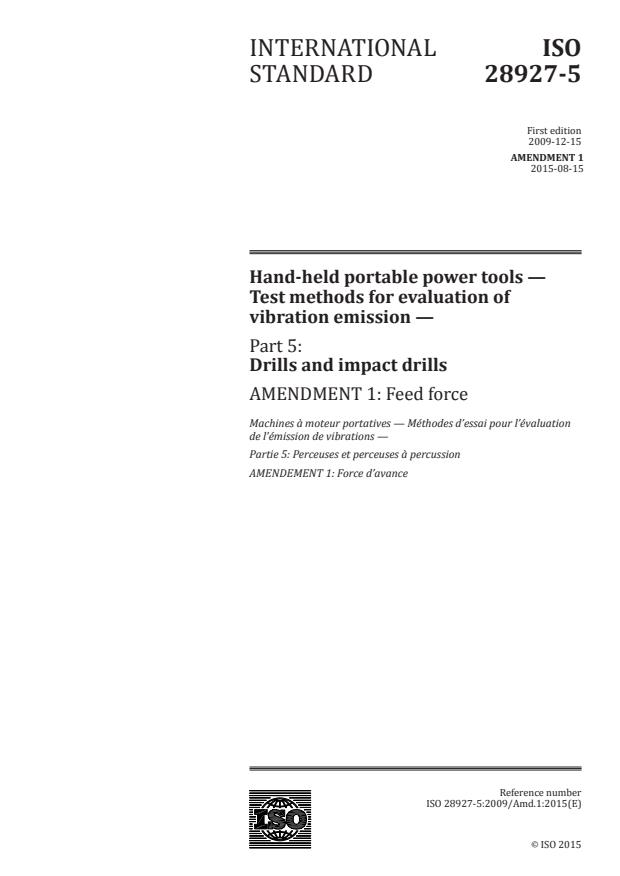
INTERNATIONAL ISO
STANDARD 28927-5
First edition
2009-12-15
AMENDMENT 1
2015-08-15
Hand-held portable power tools —
Test methods for evaluation of
vibration emission —
Part 5:
Drills and impact drills
AMENDMENT 1: Feed force
Machines à moteur portatives — Méthodes d’essai pour l’évaluation
de l’émission de vibrations —
Partie 5: Perceuses et perceuses à percussion
AMENDEMENT 1: Force d’avance
Reference number
ISO 28927-5:2009/Amd.1:2015(E)
©
ISO 2015
ISO 28927-5:2009/Amd.1:2015(E)
© ISO 2015, Published in Switzerland
All rights reserved. Unless otherwise specified, no part of this publication may be reproduced or utilized otherwise in any form
or by any means, electronic or mechanical, including photocopying, or posting on the internet or an intranet, without prior
written permission. Permission can be requested from either ISO at the address below or ISO’s member body in the country of
the requester.
ISO copyright office
Ch. de Blandonnet 8 • CP 401
CH-1214 Vernier, Geneva, Switzerland
Tel. +41 22 749 01 11
Fax +41 22 749 09 47
copyright@iso.org
www.iso.org
ii © ISO 2015 – All rights reserved
ISO 28927-5:2009/Amd.1:2015(E)
Foreword
ISO (the International Organization for Standardization) is a worldwide federation of national standards
bodies (ISO member bodies). The work of preparing International Standards is normally carried out
through ISO technical committees. Each member body interested in a subject for which a technical
committee has been established has the right to be represented on that committee. International
organizations, governmental and non-governmental, in liaison with ISO, also take part in the work.
ISO collaborates closely with the International Electrotechnical Commission (IEC) on all matters of
electrotechnical standardization.
The procedures used to develop this document and those intended for its further maintenance are
described in the ISO/IEC Directives, Part 1. In particular the different approval
...
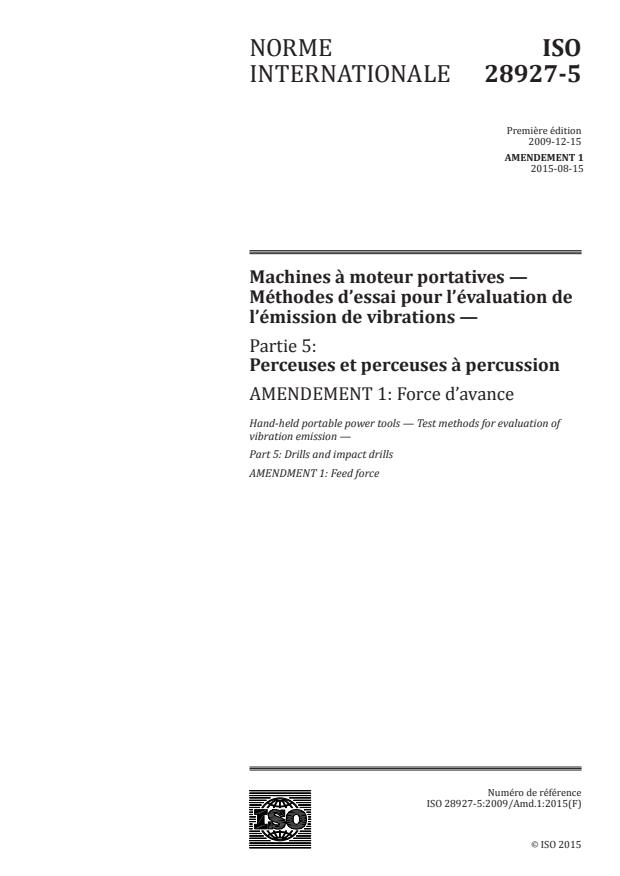
NORME ISO
INTERNATIONALE 28927-5
Première édition
2009-12-15
AMENDEMENT 1
2015-08-15
Machines à moteur portatives —
Méthodes d’essai pour l’évaluation de
l’émission de vibrations —
Partie 5:
Perceuses et perceuses à percussion
AMENDEMENT 1: Force d’avance
Hand-held portable power tools — Test methods for evaluation of
vibration emission —
Part 5: Drills and impact drills
AMENDMENT 1: Feed force
Numéro de référence
ISO 28927-5:2009/Amd.1:2015(F)
©
ISO 2015
ISO 28927-5:2009/Amd.1:2015(F)
DOCUMENT PROTÉGÉ PAR COPYRIGHT
© ISO 2015, Publié en Suisse
Droits de reproduction réservés. Sauf indication contraire, aucune partie de cette publication ne peut être reproduite ni utilisée
sous quelque forme que ce soit et par aucun procédé, électronique ou mécanique, y compris la photocopie, l’affichage sur
l’internet ou sur un Intranet, sans autorisation écrite préalable. Les demandes d’autorisation peuvent être adressées à l’ISO à
l’adresse ci-après ou au comité membre de l’ISO dans le pays du demandeur.
ISO copyright office
Ch. de Blandonnet 8 • CP 401
CH-1214 Vernier, Geneva, Switzerland
Tel. +41 22 749 01 11
Fax +41 22 749 09 47
copyright@iso.org
www.iso.org
ii © ISO 2015 – Tous droits réservés
ISO 28927-5:2009/Amd.1:2015(F)
Avant-propos
L’ISO (Organisation internationale de normalisation) est une fédération mondiale d’organismes
nationaux de normalisation (comités membres de l’ISO). L’élaboration des Normes internationales est
en général confiée aux comités techniques de l’ISO. Chaque comité membre intéressé par une étude
a le droit de faire partie du comité technique créé à cet effet. Les organisations internationales,
gouvernementales et non gouvernementales, en liaison avec l’ISO participent également aux travaux.
L’ISO collabore étroitement avec la Commission électrotechnique internationale (IEC) en ce qui concerne
la normalisation électrotechnique.
Les procédures utilisées pour élaborer le présent document et celles destinées à sa mise à jour sont
décrites dans les Directives ISO/IEC, Partie 1. Il convient, en particulier de prendre note des différents
critères d’approbation requis pour les différents types de documents ISO. Le présent document a été
rédigé conformément aux règles de rédaction données dans les Directives ISO/IEC, Partie 2 (voir www.
iso.
...