

ISO 16180:2013
(Main)Small craft — Navigation lights — Installation, placement and visibility
General Information
- Abstract
ISO 16180:2013 specifies requirements and gives guidelines for the placement, installation and visibility of navigation lights as described in COLREG for recreational craft of less than 24 m in length of hull, as described in ISO 8666. Annex A of ISO 16180:2013 lists additional information to be included in the owner's manual.
- Status
- Published
- Publication Date
- 28-Feb-2013
- Technical Committee
- ISO/TC 188 - Small craft
- Drafting Committee
- ISO/TC 188 - Small craft
- Current Stage
- 9093 - International Standard confirmed
- Start Date
- 20-Feb-2023
- Completion Date
- 29-Aug-2026
Buy Documents
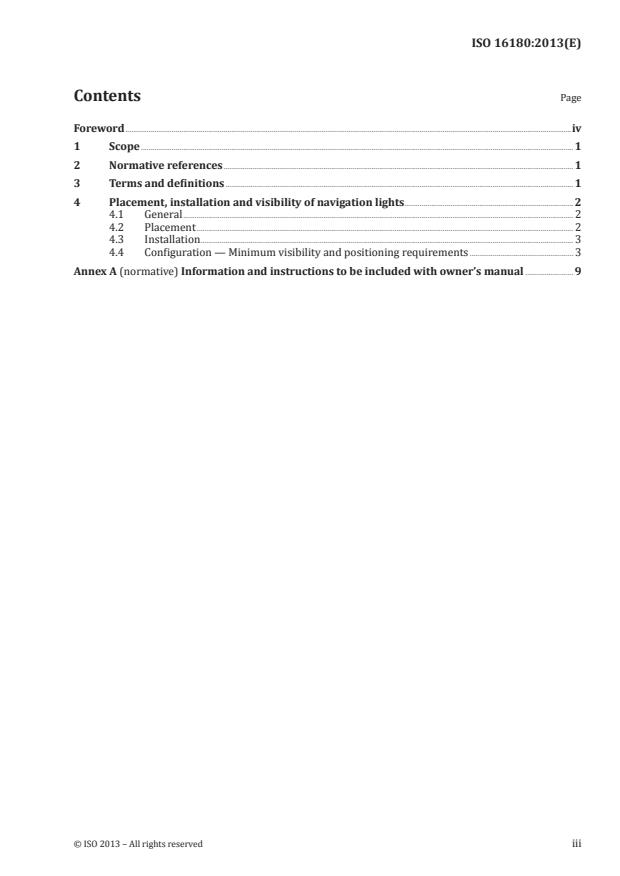
ISO 16180:2013 - Small craft — Navigation lights — Installation, placement and visibility Released:3/1/2013
ISO 16180:2013 - Petits navires — Feux de navigation — Installation, positionnement et visibilité Released:3/1/2013
Overview
ISO 16180:2013 - Small craft - Navigation lights - Installation, placement and visibility - provides requirements and guidance for placing, installing and ensuring visibility of navigation lights on recreational craft less than 24 m in hull length (per ISO 8666). The standard aligns navigation-light arrangements with the COLREG (Convention on the International Regulations for Preventing Collisions at Sea) and describes visibility ranges, mounting practices, electrical installation constraints and owner‑manual information (Annex A).
Key topics and technical requirements
- Scope and applicability: Recreational craft < 24 m; national regulations may add requirements.
- Light types and definitions: sidelights, stern light, masthead light, all‑round light, combination sidelight, tricolour - with sector angles (e.g., sidelights and combination sidelight sectors of 112.5°, masthead 225°, stern 135°).
- Visibility ranges by craft size: examples from the standard include:
- Craft < 12 m: sidelights ≥ 1 NM, masthead/all‑round ≥ 2 NM, stern ≥ 2 NM.
- Craft 12 m to < 20 m: sidelights ≥ 2 NM, masthead ≥ 3 NM, stern ≥ 2 NM.
- Craft ≥ 20 m (up to 24 m scope): masthead visibility up to 5 NM with specific height requirements.
- Configuration rules: permitted combinations (separate sidelights, combination sidelight, tricolour for sailing craft under sail alone), vertical/horizontal placement constraints (e.g., 1 m minimum height differences, optional second masthead light spacing rules).
- Mounting and visibility: lights must not be obscured in normal trim, must avoid operator glare, must meet vertical separation and arc coverage when craft is fully loaded (per ISO 8666). All‑round lights must not be shadowed by structural sectors > 6° unless mitigated.
- Electrical installation: comply with ISO 10133 or ISO 13297 (or equivalent); conductors sized for no more than 3% voltage drop; metallic enclosures on DC systems mounted on nonconductive surfaces; polarity observed.
- Owner’s manual: Annex A (normative) requires navigation‑light information/instructions to be included (see ISO 10240).
Practical applications and users
Who uses ISO 16180:
- Boat designers and naval architects - for integrating compliant light arrangements in new designs.
- Boat builders and manufacturers - to ensure factory‑fitted lights meet COLREG and ISO placement/visibility requirements.
- Marine electricians and installers - for wiring, conductor sizing and safe installation per ISO 10133/13297.
- Surveyors, flag‑state inspectors and classification bodies - to verify compliance.
- Owners/operators - for retrofits, safe operation and understanding required display configurations (including anchor, towing and sail/power conditions).
Practical benefits:
- Improved collision prevention and maritime safety through standardized light placement and visibility.
- Clear installation and wiring guidance to reduce maintenance issues and operator glare.
- Consistent owner‑manual content for safe operation and regulatory compliance.
Related standards
- ISO 8666 - Small craft - Principal data
- ISO 10133 - Small craft - Electrical systems - Extra‑low‑voltage DC installations
- ISO 13297 - Small craft - Electrical systems - AC installations
- ISO 10240 - Small craft - Owner’s manual
- COLREG - International Regulations for Preventing Collisions at Sea
Keywords: ISO 16180, navigation lights, small craft, COLREG, installation, placement, visibility, masthead light, sidelights, stern light, tricolour, owner’s manual.
Relations
- Effective Date
- 26-Jul-2010
- Effective Date
- 01-Jul-2026
- Effective Date
- 12-Feb-2026
Buy Documents
ISO 16180:2013 - Small craft — Navigation lights — Installation, placement and visibility Released:3/1/2013
ISO 16180:2013 - Petits navires — Feux de navigation — Installation, positionnement et visibilité Released:3/1/2013
Get Certified
Connect with accredited certification bodies for this standard

DNV
DNV is an independent assurance and risk management provider.

Lloyd's Register
Lloyd's Register is a global professional services organisation specialising in engineering and technology.

FSC International
Forest Stewardship Council certification.
Sponsored listings
Frequently Asked Questions
ISO 16180:2013 is a standard published by the International Organization for Standardization (ISO). Its full title is "Small craft — Navigation lights — Installation, placement and visibility". This standard covers: ISO 16180:2013 specifies requirements and gives guidelines for the placement, installation and visibility of navigation lights as described in COLREG for recreational craft of less than 24 m in length of hull, as described in ISO 8666. Annex A of ISO 16180:2013 lists additional information to be included in the owner's manual.
ISO 16180:2013 specifies requirements and gives guidelines for the placement, installation and visibility of navigation lights as described in COLREG for recreational craft of less than 24 m in length of hull, as described in ISO 8666. Annex A of ISO 16180:2013 lists additional information to be included in the owner's manual.
ISO 16180:2013 is classified under the following ICS (International Classification for Standards) categories: 47.080 - Small craft. The ICS classification helps identify the subject area and facilitates finding related standards.
ISO 16180:2013 has the following relationships with other standards: It is inter standard links to ISO/FDIS 16180, EN ISO 20650:2026, EN ISO 16180:2013. Understanding these relationships helps ensure you are using the most current and applicable version of the standard.
ISO 16180:2013 is available in PDF format for immediate download after purchase. The document can be added to your cart and obtained through the secure checkout process. Digital delivery ensures instant access to the complete standard document.
Standards Content (Sample)
INTERNATIONAL ISO
STANDARD 16180
First edition
2013-03-01
Small craft — Navigation lights —
Installation, placement and visibility
Petits navires — Feux de navigation — Installation, positionnement
et visibilité
Reference number
©
ISO 2013
© ISO 2013
All rights reserved. Unless otherwise specified, no part of this publication may be reproduced or utilized otherwise in any form
or by any means, electronic or mechanical, including photocopying, or posting on the internet or an intranet, without prior
written permission. Permission can be requested from either ISO at the address below or ISO’s member body in the country of
the requester.
ISO copyright office
Case postale 56 • CH-1211 Geneva 20
Tel. + 41 22 749 01 11
Fax + 41 22 749 09 47
E-mail copyright@iso.org
Web www.iso.org
Published in Switzerland
ii © ISO 2013 – All rights reserved
Contents Page
Foreword .iv
1 Scope . 1
2 Normative references . 1
3 Terms and definitions . 1
4 Placement, installation and visibility of navigation lights. 2
4.1 General . 2
4.2 Placement . 2
4.3 Installation . 3
4.4 Configuration — Minimum visibility and positioning requirements . 3
Annex A (normative) Information and instructions to be included with owner’s manual .9
Foreword
ISO (the International Organization for Standardization) is a worldwide federation of national standards
bodies (ISO member bodies). The work of preparing International Standards is normally carried out
through ISO technical committees. Each member body interested in a subject for which a technical
committee has been established has the right to be represented on that committee. International
organizations, governmental and non-governmental, in liaison with ISO, also take part in the work.
ISO collaborates closely with the International Electrotechnical Commission (IEC) on all matters of
electrotechnical standardization.
International Standards are drafted in accordance with the rules given in the ISO/IEC Directives, Part 2.
The main task of technical committees is to prepare International Standards. Draft International
Standards adopted by the technical committees are circulated to the member bodies for voting.
Publication as an International Standard requires approval by at least 75 % of the member bodies
casting a vote.
Attention is drawn to the possibility that some of the elements of this document may be the subject of
patent rights. ISO shall not be held responsible for identifying any or all such patent rights.
ISO 16180 was prepared by Technical Committee ISO/TC 188, Small craft.
iv © ISO 2013 – All rights reserved
INTERNATIONAL STANDARD ISO 16180:2013(E)
Small craft — Navigation lights — Installation, placement
and visibility
1 Scope
This International Standard specifies requirements and gives guidelines for the placement, installation
and visibility of navigation lights as described in COLREG for recreational craft of less than 24 m in
length of hull, as described in ISO 8666. Annex A lists additional information to be included in the
owner’s manual.
NOTE Other national regulations may apply for craft on certain waters.
2 Normative references
The following referenced documents are indispensable for the application of this document. For dated
references, only the edition cited applies. For undated references, the latest edition of the referenced
document (including any amendments) applies.
ISO 8666, Small craft — Principal data
ISO 10133, Small craft — Electrical systems — Extra-low-voltage d.c. installations
ISO 10240, Small craft — Owner’s manual
ISO 13297, Small craft — Electrical systems — Alternating current installations
The Convention on the International Regulations for Preventing Collisions at Sea, 1972, as amended (COLREG)
3 Terms and definitions
For the purposes of this document, the terms and definitions given in ISO 8666 and the following apply.
3.1
navigation light
coloured source of illumination on recreational craft used to signal a craft’s position, heading, and status
Note 1 to entry: The International Maritime Organization (IMO) has clarified the use of “lantern,” as in “combined
lantern,” and “light,” as in “sidelight,” as being the same. “Light” and “lantern,” in this context, are the same and
interchangeable with the term “navigation light”, and refers to the whole assembly and all of its parts.
3.2
all-round light
unbroken light over an arc of the horizon of 360°
3.3
combination sidelight
single navigation light where sidelights are combined into one lantern showing green to starboard and
red to port from straight ahead to 22,5° abaft the beam (90° + 22, 5° = 112,5°) on their respective sides
carried on the fore and aft centre line
3.4
masthead light
white light placed over the fore and aft centreline showing an unbroken light over an arc of the horizon
of 225°, fixed to show the light from straight ahead to 22,5° abaft the beam (90° + 22,5° = 112,5°) on
either side of the craft
3.5
sidelight
starboard sidelight showing green, and the port sidelight showing red, from straight ahead to 22,5°
abaft the beam (90° + 22,5° = 112,5°) on their respective sides
3.6
stern light
white light placed as close as possible to the stern showing an unbroken light over an arc of the horizon
of 135°, and fixed to show the light 67,5° from straight aft on each side of the craft
3.7
tricolour light
single navigation light where sidelights and a stern light are combined in a single lantern carried at or
near the top of a mast where it can best be seen
Note 1 to entry: A tricolour light may only be displayed by a sailing craft of less than 20 m in length of hull that is
underway under sail alone.
4 Placement, installation and visibility of navigation lights
4.1 General
COLREG requirements specify the type and placement of navigation lights. National governments may
determine that a craft of any special construction which flies its flag, and which cannot comply with
these requirements with respect to number, position, range or arc of visibility, shall comply with other
provisions determined to be the closest possible compliance with this International Standard.
The construction and installation of lights shall be approved by the state whose flag the craft is entitled to fly.
4.2 Placement
4.2.1 Navigation lights shall comply with the positioning and technical requirements of COLREG with
regard to the distances from which various lights are visible, where each light is to be placed on a craft,
the arcs of visibility, and chromaticity.
4.2.2 Navigation lights shall be visible under normal operating trim conditions.
4.2.3 Navigation lights shall not be obscured by fixed structures or optional equipment under normal
operating conditions.
NOTE In accordance with the COLREG, all-round lights may not be obscured by masts, topmasts, or structure’s
angular sectors of more than 6°, except anchor lights, which need not be placed at an impracticable height above the
hull. This may require the fitting of more than one all-round light if there is an obstruction of greater than 6° of arc.
4.2.4 Navigation lights shall be mounted to prevent the lights from shining into the operators’ eyes.
This applies when the operator is in the normal operating position and shall prevent reflection of a craft’s
structure within the operator’s field of vision.
4.2.5 Navigation lights shall be mounted to ensure that the light shows over the required arcs of
visibility, and shall satisfy the required vertical separation and location requirements when the craft is
in the fully loaded, ready-to-use condition as specified in ISO 8666, with special consideration given for
normal operating trim angle when underway.
4.2.6 All craft for which navigation lights are provided shall incorporate a provision for displaying
an anchor light. When in use, one operation, such as one switch or one position of a multiple position
switch, shall display the complete navigation light configuration as required for the craft while underway.
Another switch or switch position shall display the anchor light only.
2 © ISO 2013 – All rights reserved
4.2.7 Navigation lights shall be mounted so as to minimize damage caused by contact with other objects
under normal operating conditions.
4.3 Installation
4.3.1 Navigation lights shall be installed in accordance with the manufacturers’ instructions.
4.3.2 Electric navigation lights shall be installed in accordance with ISO 10133 or ISO 13297, or an
equivalent electrical safety
...
NORME ISO
INTERNATIONALE 16180
Première édition
2013-03-01
Petits navires — Feux de navigation —
Installation, positionnement et visibilité
Small craft — Navigation lights — Installation, placement and visibility
Numéro de référence
©
ISO 2013
DOCUMENT PROTÉGÉ PAR COPYRIGHT
© ISO 2013
Droits de reproduction réservés. Sauf indication contraire, aucune partie de cette publication ne peut être reproduite ni utilisée
sous quelque forme que ce soit et par aucun procédé, électronique ou mécanique, y compris la photocopie, l’affichage sur
l’internet ou sur un Intranet, sans autorisation écrite préalable. Les demandes d’autorisation peuvent être adressées à l’ISO à
l’adresse ci-après ou au comité membre de l’ISO dans le pays du demandeur.
ISO copyright office
Case postale 56 • CH-1211 Geneva 20
Tel. + 41 22 749 01 11
Fax + 41 22 749 09 47
E-mail copyright@iso.org
Web www.iso.org
Publié en Suisse
ii © ISO 2013 – Tous droits réservés
Sommaire Page
Avant-propos .iv
1 Domaine d’application . 1
2 Références normatives . 1
3 Termes et définitions . 1
4 Positionnement, installation et visibilité des feux de navigation .2
4.1 Exigences générales . 2
4.2 Positionnement . 2
4.3 Installation . 3
4.4 Configuration — Exigences relatives à la visibilité minimale et au positionnement . 3
Annexe A (normative) Informations et instructions à inclure dans le manuel du propriétaire .9
Avant-propos
L’ISO (Organisation internationale de normalisation) est une fédération mondiale d’organismes
nationaux de normalisation (comités membres de l’ISO). L’élaboration des Normes internationales est
en général confiée aux comités techniques de l’ISO. Chaque comité membre intéressé par une étude
a le droit de faire partie du comité technique créé à cet effet. Les organisations internationales,
gouvernementales et non gouvernementales, en liaison avec l’ISO participent également aux travaux.
L’ISO collabore étroitement avec la Commission électrotechnique internationale (CEI) en ce qui concerne
la normalisation électrotechnique.
Les Normes internationales sont rédigées conformément aux règles données dans les Directives
ISO/CEI, Partie 2.
La tâche principale des comités techniques est d’élaborer les Normes internationales. Les projets de
Normes internationales adoptés par les comités techniques sont soumis aux comités membres pour vote.
Leur publication comme Normes internationales requiert l’approbation de 75 % au moins des comités
membres votants.
L’attention est appelée sur le fait que certains des éléments du présent document peuvent faire l’objet de
droits de propriété intellectuelle ou de droits analogues. L’ISO ne saurait être tenue pour responsable de
ne pas avoir identifié de tels droits de propriété et averti de leur existence.
L’ISO 16180 a été élaborée par le comité technique ISO/TC 188, Petits navires.
iv © ISO 2013 – Tous droits réservés
NORME INTERNATIONALE ISO 16180:2013(F)
Petits navires — Feux de navigation — Installation,
positionnement et visibilité
1 Domaine d’application
La présente Norme internationale spécifie des exigences et fournit des lignes directrices relatives au
positionnement, à l’installation et à la visibilité des feux de navigation, tels que décrits dans le RIPAM,
sur les bateaux de plaisance d’une longueur de coque, tel que décrite dans l’ISO 8666, inférieure ou égale
à 24 m. L’annexe A fournit les instructions supplémentaires à inclure dans le manuel du propriétaire.
NOTE D’autres règlementations nationales peuvent s’appliquer pour les bateaux navigant sur certaines eaux.
2 Références normatives
Les documents ci-après, dans leur intégralité ou non, sont des références normatives indispensables
à l’application du présent document. Pour les références datées, seule l’édition citée s’applique. Pour
les références non datées, la dernière édition du document de référence s’applique (y compris les
amendements).
SO 8666, Petits navires — Données principales
ISO 10133, Petits navires — Systèmes électriques — Installations à très basse tension à courant continu
ISO 10240, Petits navires — Manuel du propriétaire
ISO 13297, Petits navires — Systèmes électriques — Installations à courant alternatif
Règlement international pour prévenir les abordages en mer, 1972, amendé (RIPAM, ou Collision
Regulations, COLREG)
3 Termes et définitions
Pour les besoins du présent document, les termes et définitions donnés dans l’ISO 8666 ainsi que les
suivants s’appliquent.
3.1
feu de navigation
source lumineuse colorée installée sur un bateau de plaisance utilisée pour signaler la position du
bateau, son cap et son statut
Note 1 à l’article: L’Organisation Maritime Internationale (OMI) a clarifié l’utilisation des mots «fanal», comme
dans «fanal combiné», et «feu», comme dans «feu de côté», comme étant identiques. Dans ce contexte, «feu» et
«fanal» sont identiques et interchangeables avec le terme «feu de navigation», et signifient le système complet,
comprenant tous ses éléments.
3.2
feu visible sur tout l’horizon
feu projetant une lumière visible horizontalement sur 360°
3.3
feu de côté combiné
feu de navigation unique, combinant les feux de côté en un seul fanal montrant un feu vert à tribord et un
feu rouge à bâbord, depuis l’avant et jusqu’à 22,5° sur l’arrière du travers (90°+22,5°=112,5°) sur leurs
bords respectifs, et placé sur l’axe longitudinal
3.4
feu de tête de mât
feu blanc placé sur l’axe longitudinal, projetant une lumière ininterrompue sur tout le parcours d’un arc
d’horizon de 225°, et disposé de manière à projeter cette lumière depuis l’avant jusqu’à 22,5° sur l’arrière
du travers (90°+22,5°=112,5°) sur chaque côté du bateau
3.5
feux de côté
feu de côté vert placé à tribord et feu de côté rouge placé à bâbord, projetant chacun une lumière depuis
l’avant jusqu’à 22,5° sur l’arrière du travers (90°+22,5°=112,5°) de leur côté respectif
3.6
feu de poupe
feu blanc placé aussi près que possible de l’arrière, projetant une lumière ininterrompue sur tout le
parcours d’un arc d’horizon de 135°, et disposé de manière à projeter cette lumière sur 67,5° de chaque
bord du bateau à partir de l’arrière
3.7
feu tricolore
feux de navigation unique dans lequel les feux de côté et le feu de poupe sont combinés dans un seul fanal
placé en tête d’un mât ou à proximité afin d’être vu au mieux
Note 1 à l’article: Un feu tricolore peut uniquement être montré à bord des voiliers de moins de 20 m de longueur
de coque faisant route uniquement à la voile.
4 Positionnement, installation et visibilité des feux de navigation
4.1 Exigences générales
Les exigences du RIPAM spécifient le type et le positionnement des feux de navigation. Un gouvernement
national peut déterminer si un bateau d’une construction particulière, portant son pavillon et ne pouvant
pas respecter ces exigences en ce qui concerne le nombre, la position, la portée ou les arcs de visibilité,
doit être conforme à d’autres dispositions, déterminées de façon à être aussi proches que possible de la
présente Norme internationale.
La construction et de l’installation des feux de navigation doit être approuvée par l’état dont le navire
porte le pavillon.
4.2 Positionnement
4.2.1 Les feux de navigation doivent être conformes aux exigences techniques et de positionnement
du RIPAM en ce qui concerne les distances de visibilité (portées lumineuses) des divers feux, leurs
emplacements sur un bateau, leurs arcs de visibilité et leurs chromaticités.
4.2.2 Les feux de navigation doivent être visibles dans des conditions d’assiette normales.
4.2.3 Les feux de navigation ne doivent pas être masqués par des structures fixes ni par des équipements
optionnels dans les conditions normales de fonctionnement.
NOTE Conformément au RIPAM, les feux visibles sur tout l’horizon ne doivent pas être masqués par des mâts,
des mâts de hune ou des structures sur des secteurs angulaires supérieurs à 6°, à l’exception des feux de mouillage,
qui n’ont pas besoin d’être placés à une hauteur excessive au-dessus de la coque. Cela peut nécessiter l’installation
de plusieurs feux tout horizon s’il y a un arc d’obstruction supérieur à 6° d’arc.
4.2.4 Les feux de navigation doivent être installés de sorte que les feux n’éblouissent pas l’opérateur.
Cela s’applique lorsque l’opérateur se trouve dans la position normale d’utilisation, et de manière à
empêcher tout reflet d’une structure du bateau dans le champ de vision de l’opérateur.
2 © ISO 2013 – Tous droits réservés
4.2.5 Les feux de navigation doivent être montés de manière à garantir que le feu porte selon les arcs
de visibilité requis et qu’ils satisfont aux exigences d’emplacement et de séparation verticale lorsque le
bateau est en condition de charge maximale prêt à l’utilisation, comme spécifié dans l’ISO 8666, en tenant
particulièrement compte de l’angle normal d’assiette lorsque le bateau fait route.
4.2.6 Tous les bateaux équipés de feux de navigation doivent comporter un dispositif permettant de
présenter un feu de mouillage. Lorsque le bateau est doté d’équipements électriques, une seule opération,
comme la manœuvre d’un seul commutateur ou une seule position d’un commutateur à positions
multiples, doit présenter la configuration complète des feux de navigation nécessaires au bateau lorsqu’il
fait route. Un autre commutateur ou une autre position du commutateur doit montrer uniquement le feu
de mouillage.
4.2.7 Les feux de navigation doivent être montés de manière à minimiser tout endommagement par
contact avec d’autres objets dans les conditions normales de fonctionnement.
4.3 Installation
4.3.1 Les feux de navigation doivent être installés conformément aux instructions de leur fabricant.
4.3.2 Les feux de navigation électriques doivent être installés conformément à l’ISO 10133 ou à
l’ISO 13297 ou à un
...