

ISO 11956:2025
(Main)Adventure tourism — Cyclotourism — Requirements and recommendations
General Information
- Abstract
This document establishes requirements and recommendations for adventure tourism involving cyclotourism [e.g. road bike, mountain bike, gravel bike, bikepacking or fatbike, including electrically power assisted cycles (EPAC) and mountain EPAC], relating to the safety of participants, leaders and assistants. This document also establishes criteria relating to characteristics and difficulty levels for cyclotourism route classification. This document applies to cyclotourism offered as a tourism product. Tourism product design involves a product planning and development phase that is not covered in this document. Some tourism products include cyclotourism combined with other tourism services (e.g. transfers, meals, lodging), but this document applies only to cyclotourism. Additional tourism services are excluded from the scope. This document is applicable to any kind of adventure tourism activity provider that offers tourism products consisting of cyclotourism. This document is not applicable to sportive cycling activities (including mountain biking in bike parks or in ski areas), bicycle rentals or bicycle sharing use (i.e. bicycle rental for urban or rural mobility) with no adventure tourism purposes. This document does not cover the maintenance and repair work of the bicycle.
- Status
- Published
- Publication Date
- 18-May-2025
- Technical Committee
- ISO/TC 228 - Tourism and related services
- Drafting Committee
- ISO/TC 228 - Tourism and related services
- Current Stage
- 6060 - International Standard published
- Start Date
- 19-May-2025
- Due Date
- 12-Jan-2025
- Completion Date
- 19-May-2025

Overview
ISO 11956:2025 - Adventure tourism - Cyclotourism - Requirements and recommendations sets out safety-focused requirements and practical recommendations for cyclotourism offered as a tourism product. It covers guided, assisted and self-guided cyclotourism using road bikes, mountain bikes, gravel bikes, bikepacking setups, fatbikes and electrically power-assisted cycles (EPAC and mountain EPAC). The standard focuses on participant safety, leader/assistant competence and route classification - not on product planning, general tour services (meals, transfers, lodging) or bicycle maintenance/repair.
Key topics and requirements
ISO 11956:2025 addresses the full delivery lifecycle of cyclotourism services with emphasis on safety management and operational controls. Major technical topics include:
- Service requirements for safe cyclotourism delivery and scope limitations (applies to tourism products, excludes sportive events and urban rentals).
- Leadership and assistants - competence, qualifications and staffing models for operations with or without support vehicles.
- Participant management - profile collection, information analysis and participant briefing to match abilities to route difficulty.
- Equipment - collective and individual equipment availability, quantities, maintenance, cleaning and sanitizing.
- Participant preparation and instruction - pre-tour information, risk awareness and participant responsibilities.
- Safety, insurance and communications - prevention, emergency preparedness, response and requirements for self-guided routes.
- Overnight products - specific requirements where cyclotourism includes multi-day or overnight elements.
- Risk management - hazard identification, risk assessment, treatment and emergency response procedures.
- Service control and records - incident recording, feedback, procedures and critical service review.
- Social and environmental mitigation - conservation and sustainable practices for adventure tourism.
- Cyclotourism route classification - criteria and procedures to classify routes by environment severity, navigation/orientation, terrain conditions and physical exertion, plus communication of route difficulty.
Practical applications and who uses it
This standard is intended for:
- Adventure tourism operators and tour providers that sell cyclotourism products.
- Tour leaders, guides and assistant staff responsible for on-route safety and participant supervision.
- Destination managers, route planners and trail agencies involved in classifying and communicating route difficulty.
- Risk managers and safety officers implementing operational procedures, emergency plans and insurance compliance.
ISO 11956 helps providers design safer experiences, match participant capability to route difficulty, document procedures and meet industry best practice for cyclotourism safety.
Related standards
- ISO 20611 - sustainability for adventure tourism
- ISO 21101 - adventure tourism safety management systems (normative reference)
- ISO 21102 - leader competencies for adventure activities
- ISO 21103 - participant information requirements
Keywords: ISO 11956:2025, adventure tourism, cyclotourism, route classification, EPAC, safety management, leader qualifications, risk management.
Get Certified
Connect with accredited certification bodies for this standard

Great Wall Tianjin Quality Assurance Center
Established 1993, first batch to receive national accreditation with IAF recognition.
Hong Kong Quality Assurance Agency (HKQAA)
Hong Kong's leading certification body.

Innovative Quality Certifications Pvt. Ltd. (IQCPL)
Known for integrity, providing ethical & impartial Assessment & Certification. CMMI Institute Partner.
Sponsored listings
Frequently Asked Questions
ISO 11956:2025 is a standard published by the International Organization for Standardization (ISO). Its full title is "Adventure tourism — Cyclotourism — Requirements and recommendations". This standard covers: This document establishes requirements and recommendations for adventure tourism involving cyclotourism [e.g. road bike, mountain bike, gravel bike, bikepacking or fatbike, including electrically power assisted cycles (EPAC) and mountain EPAC], relating to the safety of participants, leaders and assistants. This document also establishes criteria relating to characteristics and difficulty levels for cyclotourism route classification. This document applies to cyclotourism offered as a tourism product. Tourism product design involves a product planning and development phase that is not covered in this document. Some tourism products include cyclotourism combined with other tourism services (e.g. transfers, meals, lodging), but this document applies only to cyclotourism. Additional tourism services are excluded from the scope. This document is applicable to any kind of adventure tourism activity provider that offers tourism products consisting of cyclotourism. This document is not applicable to sportive cycling activities (including mountain biking in bike parks or in ski areas), bicycle rentals or bicycle sharing use (i.e. bicycle rental for urban or rural mobility) with no adventure tourism purposes. This document does not cover the maintenance and repair work of the bicycle.
This document establishes requirements and recommendations for adventure tourism involving cyclotourism [e.g. road bike, mountain bike, gravel bike, bikepacking or fatbike, including electrically power assisted cycles (EPAC) and mountain EPAC], relating to the safety of participants, leaders and assistants. This document also establishes criteria relating to characteristics and difficulty levels for cyclotourism route classification. This document applies to cyclotourism offered as a tourism product. Tourism product design involves a product planning and development phase that is not covered in this document. Some tourism products include cyclotourism combined with other tourism services (e.g. transfers, meals, lodging), but this document applies only to cyclotourism. Additional tourism services are excluded from the scope. This document is applicable to any kind of adventure tourism activity provider that offers tourism products consisting of cyclotourism. This document is not applicable to sportive cycling activities (including mountain biking in bike parks or in ski areas), bicycle rentals or bicycle sharing use (i.e. bicycle rental for urban or rural mobility) with no adventure tourism purposes. This document does not cover the maintenance and repair work of the bicycle.
ISO 11956:2025 is classified under the following ICS (International Classification for Standards) categories: 03.080.30 - Services for consumers; 03.200.10 - Adventure tourism. The ICS classification helps identify the subject area and facilitates finding related standards.
ISO 11956:2025 is available in PDF format for immediate download after purchase. The document can be added to your cart and obtained through the secure checkout process. Digital delivery ensures instant access to the complete standard document.
Standards Content (Sample)
International
Standard
ISO 11956
First edition
Adventure tourism —
2025-05
Cyclotourism — Requirements and
recommendations
Tourisme d'aventure — Cyclotourisme — Exigences et
recommandations
Reference number
© ISO 2025
All rights reserved. Unless otherwise specified, or required in the context of its implementation, no part of this publication may
be reproduced or utilized otherwise in any form or by any means, electronic or mechanical, including photocopying, or posting on
the internet or an intranet, without prior written permission. Permission can be requested from either ISO at the address below
or ISO’s member body in the country of the requester.
ISO copyright office
CP 401 • Ch. de Blandonnet 8
CH-1214 Vernier, Geneva
Phone: +41 22 749 01 11
Email: copyright@iso.org
Website: www.iso.org
Published in Switzerland
ii
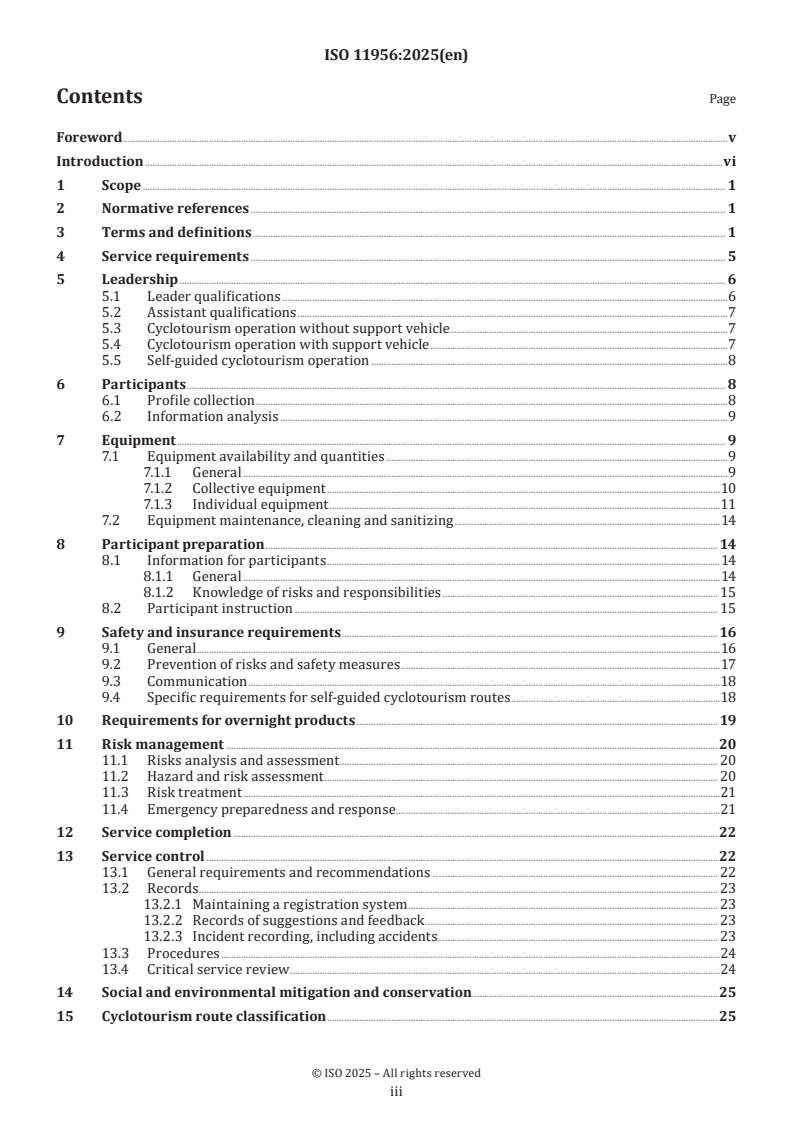
Contents Page
Foreword .v
Introduction .vi
1 Scope . 1
2 Normative references . 1
3 Terms and definitions . 1
4 Service requirements . 5
5 Leadership . 6
5.1 Leader qualifications .6
5.2 Assistant qualifications .7
5.3 Cyclotourism operation without support vehicle .7
5.4 Cyclotourism operation with support vehicle .7
5.5 Self-guided cyclotourism operation .8
6 Participants . 8
6.1 Profile collection .8
6.2 Information analysis .9
7 Equipment . 9
7.1 Equipment availability and quantities .9
7.1.1 General .9
7.1.2 Collective equipment .10
7.1.3 Individual equipment .11
7.2 Equipment maintenance, cleaning and sanitizing .14
8 Participant preparation . 14
8.1 Information for participants .14
8.1.1 General .14
8.1.2 Knowledge of risks and responsibilities . 15
8.2 Participant instruction . 15
9 Safety and insurance requirements .16
9.1 General .16
9.2 Prevention of risks and safety measures .17
9.3 Communication .18
9.4 Specific requirements for self-guided cyclotourism routes .18
10 Requirements for overnight products . 19
11 Risk management .20
11.1 Risks analysis and assessment. 20
11.2 Hazard and risk assessment . 20
11.3 Risk treatment .21
11.4 Emergency preparedness and response .21
12 Service completion .22
13 Service control .22
13.1 General requirements and recommendations . 22
13.2 Records . 23
13.2.1 Maintaining a registration system . 23
13.2.2 Records of suggestions and feedback . 23
13.2.3 Incident recording, including accidents . . 23
13.3 Procedures .24
13.4 Critical service review .24
14 Social and environmental mitigation and conservation .25
15 Cyclotourism route classification .25
iii
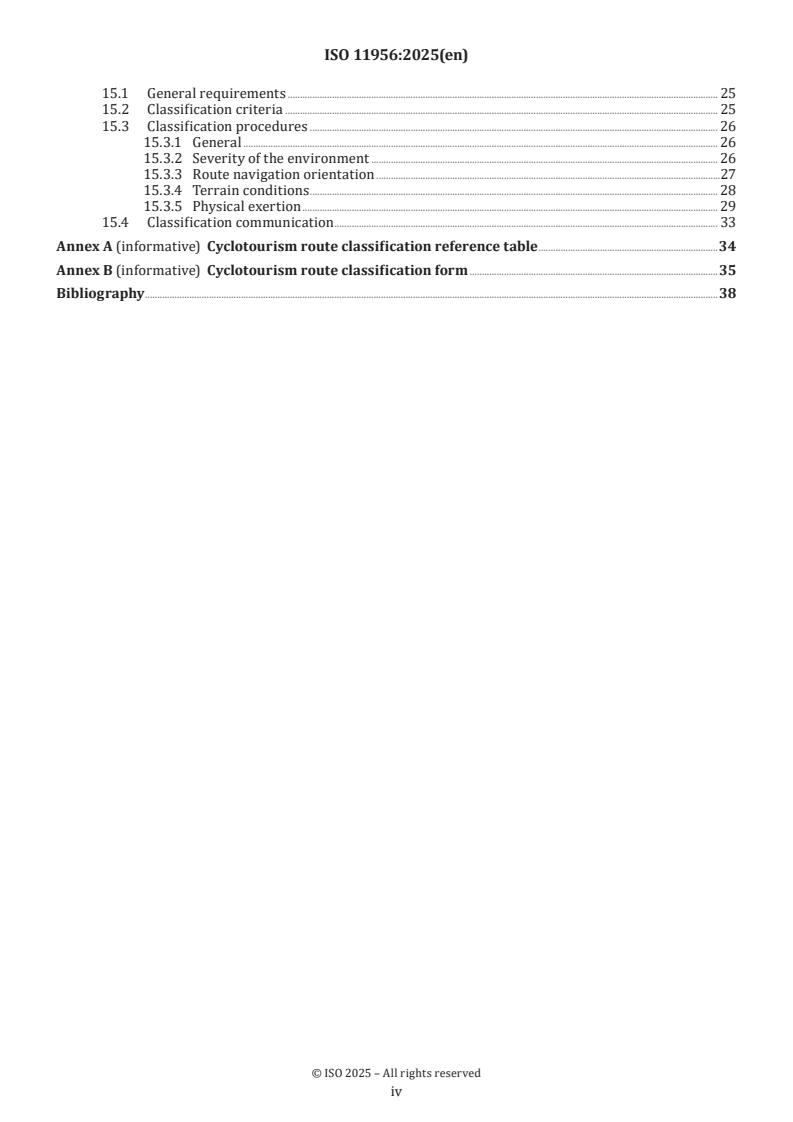
15.1 General requirements . 25
15.2 Classification criteria . 25
15.3 Classification procedures . 26
15.3.1 General . 26
15.3.2 Severity of the environment . 26
15.3.3 Route navigation orientation .27
15.3.4 Terrain conditions . 28
15.3.5 Physical exertion . 29
15.4 Classification communication . 33
Annex A (informative) Cyclotourism route classification reference table .34
Annex B (informative) Cyclotourism route classification form .35
Bibliography .38
iv
Foreword
ISO (the International Organization for Standardization) is a worldwide federation of national standards
bodies (ISO member bodies). The work of preparing International Standards is normally carried out through
ISO technical committees. Each member body interested in a subject for which a technical committee
has been established has the right to be represented on that committee. International organizations,
governmental and non-governmental, in liaison with ISO, also take part in the work. ISO collaborates closely
with the International Electrotechnical Commission (IEC) on all matters of electrotechnical standardization.
The procedures used to develop this document and those intended for its further maintenance are described
in the ISO/IEC Directives, Part 1. In particular, the different approval criteria needed for the different types
of ISO document should be noted. This document was drafted in accordance with the editorial rules of the
ISO/IEC Directives, Part 2 (see www.iso.org/directives).
ISO draws attention to the possibility that the implementation of this document may involve the use of (a)
patent(s). ISO takes no position concerning the evidence, validity or applicability of any claimed patent
rights in respect thereof. As of the date of publication of this document, ISO had not received notice of (a)
patent(s) which may be required to implement this document. However, implementers are cautioned that
this may not represent the latest information, which may be obtained from the patent database available at
www.iso.org/patents. ISO shall not be held responsible for identifying any or all such patent rights.
Any trade name used in this document is information given for the convenience of users and does not
constitute an endorsement.
For an explanation of the voluntary nature of standards, the meaning of ISO specific terms and expressions
related to conformity assessment, as well as information about ISO's adherence to the World Trade
Organization (WTO) principles in the Technical Barriers to Trade (TBT), see www.iso.org/iso/foreword.html.
This document was prepared by Technical Committee ISO/TC 228, Tourism and related services.
Any feedback or questions on this document should be directed to the user’s national standards body. A
complete listing of these bodies can be found at www.iso.org/members.html.
v
Introduction
0.1 Adventure tourism
Adventure tourism is a global industry that is growing in importance. Whether provided on a commercial,
not-for-profit or charitable basis, adventure tourism activities involve an accepted, inherent element of
risk and challenge. Taking risks brings rewards but also brings dangers. In order to maximize the rewards,
adventure tourism activity providers should operate as safely as practicable.
ISO 20611, ISO 21101, ISO 21102 and ISO 21103 provide a basis for adventure tourism activity providers to
plan, deliver and inform people about adventure tourism activities as safely as practicable.
Effective implementation of these documents will help consumers and other participants to make informed
choices about activities and providers.
0.2 Adventure tourism InternationalStandards
The purpose of ISO 20611, ISO 21101, ISO 21102 and ISO 21103 is to establish the minimum requirements
for safety management systems and information for participants.
These documents are independent of one another since they apply to different aspects of adventure tourism.
— ISO 20611 provides requirements and recommendations for good practice in sustainability for adventure
tourism activities (environmental, social and economic aspects);
— ISO 21101 specifies how the adventure tourism activity provider manages its operations in terms of safety.
NOTE Reference [9] is a handbook that offers step-by-step guidance and examples to help small and medium-
sized adventure tourism operators to develop, implement and continually improve a safety management system
following the requirements of ISO 21101.
— ISO 21102 specifies the minimum requirements and recommendations for competencies and the related
expected results of competencies for adventure tourism activity leaders common to any adventure
tourism activity.
— ISO 21103 specifies the minimum information that shall be communicated to participants and potential
participants before, during and after a given activity.
0.3 Purpose of this document
This document specifies service requirements and route classifications in adventure tourism involving
cyclotourism, with the purpose of facilitating the safe delivery of these activities.
vi
International Standard ISO 11956:2025(en)
Adventure tourism — Cyclotourism — Requirements and
recommendations
1 Scope
This document establishes requirements and recommendations for adventure tourism involving
cyclotourism [e.g. road bike, mountain bike, gravel bike, bikepacking or fatbike, including electrically power
assisted cycles (EPAC) and mountain EPAC], relating to the safety of participants, leaders and assistants.
This document also establishes criteria relating to characteristics and difficulty levels for cyclotourism
route classification.
This document applies to cyclotourism offered as a tourism product. Tourism product design involves
a product planning and development phase that is not covered in this document. Some tourism products
include cyclotourism combined with other tourism services (e.g. transfers, meals, lodging), but this
document applies only to cyclotourism. Additional tourism services are excluded from the scope.
This document is applicable to any kind of adventure tourism activity provider that offers tourism products
consisting of cyclotourism.
This document is not applicable to sportive cycling activities (including mountain biking in bike parks or
in ski areas), bicycle rentals or bicycle sharing use (i.e. bicycle rental for urban or rural mobility) with no
adventure tourism purposes.
This document does not cover the maintenance and repair work of the bicycle.
2 Normative references
The following documents are referred to in the text in such a way that some or all of their content constitutes
requirements of this document. For dated references, only the edition cited applies. For undated references,
the latest edition of the referenced document (including any amendments) applies.
ISO 21101, Adventure tourism — Safety management systems — Requirements
ISO 21102, Adventure tourism — Leaders — Personnel competence
ISO 21103, Adventure tourism — Information for participants
EN 1078, Helmets for pedal cyclists and for users of skateboards and roller skates
3 Terms and definitions
For the purposes of this document, the following terms and definitions apply.
ISO and IEC maintain terminology databases for use in standardization at the following addresses:
— ISO Online browsing platform: available at https:// www .iso .org/ obp
— IEC Electropedia: available at https:// www .electropedia .org/
3.1
adventure tourism activity
adventure activity for tourism purposes that involves a degree of instruction or leadership, safety
management and an accepted inherent risk (3.20)
Note 1 to entry: An accepted inherent risk means that the participant (3.19) has a reasonable understanding of the risk
involved.
[SOURCE: ISO 21101:2014, 3.35, modified — in the definition, "safety management" has been added and
"deliberate accepted element of risk" has been replaced by "an accepted inherent risk"; in Note 1 to entry, "an
accepted element of risk" has been replaced by "an accepted inherent risk" and "minimum understanding
about" has been replaced by "reasonable understanding of".]
3.2
adventure tourism activity provider
individual or organization having overall responsibility for all aspects of the provision of adventure tourism
activities (3.1)
Note 1 to entry: Adventure tourism activities can be provided free of charge or in return for payment.
[SOURCE: ISO 21101:2014, 3.36]
3.3
altimetric variation
altitude variation between two waypoints
3.4
assistant
competent person who is able to assist and support the leader (3.17)
3.5
cycle
any vehicle which has at least two wheels and is propelled by the muscular energy of the person on that
vehicle, in particular by means of pedalling, but also with the possibility of adding assistance provided by
electric motor when pedalling
Note 1 to entry: Pedalling also refers to use of hand cranks or other similar devices.
3.6
cyclotourism
adventure tourism activity (3.1) involving riding a bicycle
Note 1 to entry: The activity can involve an overnight stay.
3.7
cyclotourism activity provider
adventure tourism activityprovider (3.2) responsible for the provision of cyclotourism (3.6)
3.8
difficulty level
rating or degree of physical and psychological exertion expected to be encountered while participating in an
adventure tourism activity (3.1), based on factors such as required technical capacity, terrain, altitude or climate
Note 1 to entry: Annex A includes criteria indicating difficulty levels of the activity.
3.9
disability
umbrella term for impairments, activity limitations and participation restrictions denoting the negative
aspects of the interaction between an individual (with a health condition) and that individual’s contextual
factors (environmental and personal factors)
[SOURCE: ISO 9999:2022, 3.6]
3.10
electrically power assisted cycle
EPAC
cycle (3.5) equipped with pedals and an auxiliary electric motor, which cannot be propelled exclusively by
means of this auxiliary electric motor, except in the walk assistance mode
Note 1 to entry: This type of bicycle is commonly referred to as an e-bike.
[SOURCE: ISO/TS 4210-10:2020, 3.2, modified — Note 1 to entry has been added.]
3.11
exertion index in cyclotourism
estimate of the exertion required by a person to complete a journey
3.12
emergency
serious situation requiring immediate action
[SOURCE: ISO 21101:2014, 3.43]
3.13
first aid
emergency (3.12) procedures aimed at maintaining vital functions while ensuring that the condition of a
casualty who is injured or unconscious or whose life is in danger is not aggravated, until they receive more
qualified assistance for further treatment
[SOURCE: ISO 21102:2020, 3.7, modified — "person" has been replaced by "casualty", "he or she" has been
replaced by "they" and "for further treatment" has been added at the end of the definition.]
3.14
gap
steep incline or decline, or distance between one cyclist and another, on a cyclotourism (3.6) route (3.21)
Note 1 to entry: Used as a verb, gap can be considered a technical skill using the bicycle to jump or drop an obstacle in
the terrain
3.15
interested party
person or organization that can affect, be affected by, or perceive itself to be affected by a decision or activity
Note 1 to entry: Sometimes, interested party can be considered as a stakeholder.
[SOURCE: ISO 3163:2022, 3.21, modified — Note 1 to entry has been added.]
3.16
itinerary
description of the component parts involved in the adventure tourism activity (3.1), listing times, locations
and activities
3.17
leader
competent person who takes responsibility for people, and is able to lead, guide and supervise an assigned
activity
Note 1 to entry: A leader can also be referred to as a "guide", "monitor" or similar.
[SOURCE: ISO 21102:2020, 3.8]
3.18
mountain EPAC
electrically power assisted cycle (EPAC) (3.10) designed for use off-road on rough terrain, on public roads,
and on public pathways, equipped with a suitably strengthened frame and other components, and, typically,
with wide-section tyres with coarse tread patterns and a wide range of transmission gears
[SOURCE: ISO/TS 4210-10:2020, 3.3]
3.19
participant
person taking part in the adventure tourism activity (3.1) but not a member of the leadership team
Note 1 to entry: A participant can also be referred to as a "client", "customer" or similar.
Note 2 to entry: A leadership team comprises several leaders (3.17).
[SOURCE: ISO 21101:2014, 3.37]
3.20
risk
effect of uncertainty on objectives
Note 1 to entry: An effect is a deviation from the expected. It can be positive, negative or both, and can address, create
or result in opportunities and threats.
Note 2 to entry: Objectives can have different aspects, categories and can be applied at different levels.
Note 3 to entry: Risk is usually expressed in terms of risk sources, potential events, their consequences and
their likelihood.
[SOURCE: ISO 31000:2018, 3.1]
3.21
route
course from the beginning of the adventure tourism activity (3.1) to its end
Note 1 to entry: In some routes, the start and end points are the same.
Note 2 to entry: Routes can be a trail (3.27), a single-track trail (3.23) and include other types, such as, cobbled sectors,
rural roads, park trails, cyclotourism (3.6) routes.
3.22
self-rescue
specific techniques implemented by a person on their own, to manage adverse situations without external
intervention
Note 1 to entry: In some situations, there can be more than one person engaged in self-rescue.
3.23
single-track trail
trail (3.27) where only one person or bicycle can pass at a time
3.24
support vehicle
vehicle intended for logistical support during the course of the journey, except for the
removal of an injured person
3.25
sustainability
state of the global system, including environmental, social and economic aspects, in which the needs of the
present are met without compromising the ability of future generations to meet their own needs
Note 1 to entry: The environmental, social and economic aspects interact, are interdependent and are often referred
to as the three dimensions of sustainability.
Note 2 to entry: Sustainability is the goal of sustainable development.
[SOURCE: ISO Guide 82:2019, 3.1]
3.26
third-party provider
external organization or individual that provides services to the adventure tourism activity provider (3.2)
3.27
trail
narrow road, track or pathway, usually unpaved, in natural surroundings
4 Service requirements
The cyclotourism product shall be designed and provided in such a way that the safety of the participants,
leader and personnel involved in providing the product is assured and the inherent risk is communicated to
all interested parties.
The cyclotourism activity provider responsible for operation shall:
a) ensure that leaders meet the qualification requirements set out in this document;
b) maintain records of the leaders’ continual development of competencies;
c) ensure that any service contracted to third-party providers that affects the quality and safety of the
tourism product meets the requirements of this document and any others that the cyclotourism activity
provider establishes;
d) ensure there are plans and procedures for safety checks of the equipment, gear and supplies necessary
for use during the adventure tourism activities. These safety checks shall be conducted prior to, during
and after the activities. The results shall be recorded and made available for review;
e) adhere to the existing stipulations of use for the visited environment;
f) adopt the use plans or ecological area plans available when the attraction is in a conservation area or in
an area with some environmental restrictions;
g) introduce measures to implement and improve hygiene care, to prevent contamination to workers,
participants and the visited communities, and to enhance health conditions in the adventure tourism
destination;
h) ensure that weather forecasts and any hazardous conditions are taken into account before starting and
during the activities.
The cyclotourism activity provider should monitor available information from pertinent institutions
regarding hazard assessment. For more information, see Clause 11.
A maximum number of participants per activity shall be established according to the characteristics of the
place of operation and the offered tourism product. When planning and operating the cyclotourism activity,
the cyclotourism activity provider shall adopt responsible environmental and social practices, such as the
recommendations for conscious conduct in a natural environment (see ISO 20611 for further information).
The cyclotourism activity provider shall consider official health recommendations regarding sanitary
measures at the time throughout all the operation (e.g. during the briefing or the cyclotourism activity) to
define a safe number of participants.
When planning the cyclotourism product, the cyclotourism activity provider shall consider the carrying
capacity of the tourist attraction where the activity takes place. This can include consideration of the
characteristics of each specific route and definition of protocols for the flow path of participants and the use
of common spaces. It can also entail a reduction of the number of participants.
For tourism products with cyclotourism, the minimum age of the participants is determined by regulatory
authorities. If the cyclotourism activity provider offers tourism products to children under the minimum
age or to participants with disabilities, such products shall be subject to planning that considers the
characteristics, procedures and equipment necessary to ensure the safety of those specific participants.
These products can require professionals, equipment and specific conditions other than those provided for
in this document.
The measures adopted shall be validated, technically justified and documented.
The route shall have been previously established and the itinerary shall be documented.
Cyclotourism routes should be classified. Classification shall be in accordance with Clause 15 and shall be
known to the leader, participants (and assistants, if applicable) and other interested parties involved in the
operation.
5 Leadership
5.1 Leader qualifications
The operating team of cyclotourism leaders, except in the case of self-guided routes, which are covered
in 9.4, shall be composed of leaders who meet the requirements of ISO 21102. In addition, the operating
team of cyclotourism leaders shall meet, at least, the following requirements:
a) have basic knowledge of bicycle mechanics to provide support in adverse situations, at least:
1) tire, steel cables or chain change;
2) inflation of tire(s);
3) inner tube patch and tubeless;
4) wheels, chain, gearbox or brake adjust or repair;
5) bicycle saddle, pedals, clips (and shoes) and derailleur repairs or adjustments;
6) safety back or front lights.
NOTE It is recommended that the cyclotourism leader has additional specific knowledge, for example,
adjustment of the steering mechanism.
b) have knowledge of bicycle handling techniques, body positioning in different progression situations;
c) have knowledge of bicycle ergonomics and saddle and handlebar adjustment for different participants
and progression situations;
d) have knowledge of defensive driving;
e) have a physical fitness level consistent with the route;
f) have notions of evaluation of routes and cyclotourism maps.
In handbike cyclotourism operation, the cyclotourism leader should have additional competencies in this
specific field.
The cyclotourism activity provider shall determine the minimum number of leaders and assistants to ensure
the safety of the group. The number of assistants (if applicable), participants and leaders shall be recorded,
in accordance with ISO 21101.
Environmental concerns, including sanitary considerations, can require a reduction in the maximum
number of participants per group. Where environmental concerns necessitate certain actions, minimum
impact practices should be taken into account.
5.2 Assistant qualifications
The assistant shall have sufficient knowledge to be able to act as support to the leader. At a minimum, this
shall include knowledge of the region, main route and alternative routes.
The assistant shall be able to:
a) instruct participants about cyclotourism techniques and the use of equipment;
b) ensure the smooth progress, pace and cohesion of the group, including controlling participant well-being;
c) support the leader in emergency situations;
d) use different communication systems [e.g. satellite phones, global positioning system (GPS), radio];
e) instruct participants about technical, hygiene and sanitary measures to improve safety throughout all
operations.
5.3 Cyclotourism operation without support vehicle
In operations without a support vehicle, the cyclotourism activity provider shall ensure that there are two
leaders for one subgroup of up to six participants and, additionally, one more leader for each new subgroup
of up to six participants, limited to a total group of eighteen participants.
In case of a quantity above the limit established for a group, a new group shall be created, following the same
numbers of leaders and participants as shown in Table 1.
Table 1 — Cyclotourism operation ratio without support vehicle
Leaders, Assistants,
Participant quantity
minimum quantity minimum quantity
1 to 6 1 1
7 to 12 2 1
13 to 18 3 1
In the case of groups with 1 to 6 participants, the cyclotourism activity provider can consider using only
one leader, according to the risk analysis of each cyclotourism operation. This analysis shall be documented
in accordance with ISO 21101 and ISO 21102. The cyclotourism activity provider shall assure, at least, one
leader in command of each group. The analysis shall be recorded and evaluated, taking into consideration
the difficulty of the route and its remoteness and any other factors considered relevant, for example, access
to mobile services for an emergency call, cyclotourism in high-altitude routes, or icy or snowy conditions.
The cyclotourism activity provider can consider adding one or more extra persons (leader or assistant) to
the group, in such situations.
5.4 Cyclotourism operation with support vehicle
In operations with a support vehicle, the cyclotourism activity provider shall ensure that there is at least
one leader for a subgroup of up to five participants and, additionally, one more leader for each new subgroup
of up to five participants, limited to a total group of 15 participants.
In case of a quantity above the limit established for a group, a new group shall be created, following the same
numbers of leaders and participants as shown in Table 2.
Table 2 — Cyclotourism operation ratio with support vehicle
Participant quantity Leaders, minimum quantity Assistants, minimum quantity
1 to 5 1 —
6 to 10 1 1
11 to 15 2 1
The cyclotourism activity provider can consider using one assistant instead of one leader, according to
the risk analysis of each cyclotourism operation. This analysis shall be documented in accordance with
ISO 21101 and ISO 21102. The cyclotourism activity provider shall assure, at least, one leader in command of
each group.
5.5 Self-guided cyclotourism operation
Self-guided cyclotourism operations (i.e. without the guidance of a cyclotourism leader) can be carried out,
provided that the hazard and risk assessment of the operation is carried out and included in the adventure
tourism safety management system, as detailed in 11.3.
The cyclotourism activity provider shall assure participants in self-guide cyclotourism operations have
access to information regarding help and saving in emergency situations.
6 Participants
6.1 Profile collection
The cyclotourism activity provider shall obtain at least the following information from each participant
(including self-guided route participants):
a) name;
b) telephone number;
c) document number (ID or passport);
d) email address;
e) emergency contact;
f) specific health or medical conditions, such as those related to allergies, surgery, diabetes, epilepsy,
cardiovascular disease, joints, bones, muscles, respiratory illness, depression, phobias or pregnancy;
g) known medical conditions of the participants relevant to higher altitudes when the tour includes areas
at elevated altitudes, if applicable;
h) medicines used;
i) age;
j) previous experience with the activity;
k) insurance coverage applicable to the activity and location, including rescue operations;
l) fitness level for the activity;
m) parental or responsible person consent letter, if applicable;
n) disabilities (if any) relevant to the activity.
In routes where there is the possibility of submersion in water, requiring that the bicycle be carried above
the head, information about the participant’s swimming skills shall be requested.
Participants shall be advised to have an optional insurance appropriate to the adventure tourism activity.
The cyclotourism activity provider shall:
— encourage participants to provide detailed information to facilitate responses to potential emergencies;
— ensure the confidentiality of participant information, except under emergency response circumstances.
6.2 Information analysis
The cyclotourism activity provider shall do the following:
a) define criteria for handling the minimum information of participants. The criteria shall be technically
justified;
b) critically review the information provided to analyse whether a participant is able to perform the
activities. There shall be a record of this analysis. If a participant has a health condition that can
potentially put them or others (e.g. workers, leaders, assistants or the local community) at risk, this
participant shall not be permitted to undertake the activities;
NOTE Simply having a disability is not sufficient grounds for denying participation in cyclotourism activities.
It is important to critically review whether a person is physically able to undertake the activities.
c) ensure that participants who do not meet the established criteria do not perform the activities;
d) ensure that relevant participant profile information is provided in advance to the leaders and assistants
involved in the activity.
7 Equipment
7.1 Equipment availability and quantities
7.1.1 General
The cyclotourism activity provider shall ensure that all leaders, assistants (if applicable) and participants
involved have all the necessary equipment in accordance with the requirements of this document.
Participants shall not use any equipment that has not been properly inspected and authorized by the
cyclotourism activity provider. People with disabilities who need to use their own customized equipment to
be able to participate in the activity can be authorized as well, according to the risk analysis of the specific
operation, based on ISO 21101 and ISO 21103.
If the cyclotourism activity provider offers equipment to a group of participants, it shall be in good working
condition and clean. To maintain hygiene before, during or after each operation, the cyclotourism activity
provider shall implement cleaning procedures to mitigate potential contamination of people using the
equipment.
NOTE 1 It can be convenient to have some spare equipment according to experience of use on the specific route.
NOTE 2 Special consideration can be given to participants about sharing of equipment, for example, not sharing
equipment to avoid infectious diseases.
In cyclotourism routes during night operation, the cyclotourism activity provider shall keep all bicycles
provided with an artificial light source (front and rear lanterns). It is also recommended to use reflective
equipment on the bodies of leaders (or assistants, if applicable) and participants (e.g. reflective vests
or straps, sneakers or jackets with reflective strips). Even during cyclotourism daylight activities that
pass through routes where the environment has insufficient light (e.g. passages through tunnels), the
cyclotourism activity provider should suggest the use of this equipment.
It is recommended that, even in cases of cyclotourism operations during daylight on lanes with a flow of
vehicles, leaders and participants use equipment with safety light gears (e.g. rear lanterns).
7.1.2 Collective equipment
7.1.2.1 General requirements
The cyclotourism activity provider shall perform cyclotourism operations using at least the following
collective equipment:
a) guidance equipment (e.g. map, compass, GPS), where applicable;
b) a first aid kit that enables a leader to give first aid;
c) means of communication (e.g. radio, cell phone) with the group;
d) bicycle pumps;
e) tyre repair kits;
f) a support vehicle (if applicable, see 7.1.2.2).
Collective equipment shall be available to the group throughout the journey, carried by leaders or assistants
(if applicable), the participants or a support vehicle. In the latter case, the equipment shall be available to the
group when needed.
According to safety management system analysis of risks (e.g. flat tyre, broken gearshift, spare light stick,
low battery), the adventure tourism service provider should add other specific equipment, such as:
1) gearshift cables;
2) brake cables;
3) rays;
4) screws and nuts;
5) lubricant oil (or similar, e.g. lubricant wax);
6) valve adapter for air chambers;
7) flares;
8) chamber valve switch;
9) cutting pliers.
NOTE In self-guided cyclotourism operations, rescue triggering equipment (such as a satellite tracking system) or
communication with the operating base can be used.
For equipment that uses batteries, the cyclotourism activity provider shall have the respective spare
batteries, according to the history of use. The cyclotourism activity provider should dispose of used batteries
in appropriate places for this purpose.
The cyclotourism activity provider shall assess the number of these items (collective equipment or other
specific equipment) according to the number of leaders, participants and assistants (if applicable) in the
group. This procedure shall be documented.
In the case of self-guided cyclotourism operations, the collective equipment can be in an operation base and,
in the case of operation with a support vehicle, the collective equipment can be inside it.
Collective equipment shall be available to the group throughout the journey, carried by leaders or assistants (if
applicable), the participants or a support vehicle. In the latter case, it shall be available to the group when needed.
7.1.2.2 Cyclotourism support vehicle
...