

ISO 16792:2021
(Main)Technical product documentation — Digital product definition data practices
General Information
- Abstract
This document specifies requirements for the preparation, revision and presentation of digital product definition data, hereafter referred to as data sets, complementing existing standards. It supports two methods of application: 3D model-only and 3D model with 2D drawing in digital format. The structure of this document presents requirements common to both methods followed by clauses providing for any essential, differing requirements for each method. Additionally, its use in conjunction with computer-aided design (CAD) systems can assist in the progression towards improved modelling and annotation practices for CAD and engineering disciplines, as well as serving as a guideline for CAx software developers. The actual definitions for the interpretation, in particular the ISO TPD and ISO GPS rules, are taken from the original definition standards, e.g. ISO 129-1 and ISO 1101. When the term model is used in this document it applies to both design models and annotated models.
- Status
- Published
- Publication Date
- 06-Apr-2021
- Technical Committee
- ISO/TC 10 - Technical product documentation
- Drafting Committee
- ISO/TC 10/WG 16 - 3D models: Presentation of product definition data
- Current Stage
- 9092 - International Standard to be revised
- Start Date
- 11-Dec-2023
- Completion Date
- 29-Aug-2026
Buy Documents
ISO 16792:2021 - Technical product documentation -- Digital product definition data practices
ISO 16792:2021 - Technical product documentation — Digital product definition data practices/7/2021
Overview
ISO 16792:2021 - Technical product documentation: Digital product definition data practices defines requirements for preparing, revising and presenting digital product definition data (data sets). It supports two application methods: 3D model‑only and 3D model with 2D drawing in digital format, and complements existing technical product documentation standards. The standard is intended to improve CAD modelling and annotation practices and to guide CAx software developers and engineering disciplines in consistent digital product definition practices.
Key topics and requirements
ISO 16792:2021 covers practical and technical requirements, including:
- Data set identification and control: traceability, related data links and data management principles for digital data sets.
- Data set requirements: fundamental model requirements, model completeness and handling of supplemental geometry.
- Model and method specifics: rules for the model‑only method vs. model + drawing method, including management data and protection marking.
- Associativity and attributes: use of associativity between geometry, annotations and model features; attribute handling and annotation planes.
- Annotations and dimensions: saved views, leader lines, direction‑dependent specifications, model value queries and resolved dimensions (including Theoretically Exact Dimensions where applicable).
- Datum and tolerance practices: datum system identification, datum targets, multiple feature datums, and geometric tolerancing practices for digital models.
- Special topics: drawing requirements (orthographic and axonometric views), welds, installation and assembly model completeness, and query/inspection support.
- Guidance for CAD/CAx software developers to support digital product definition (DPD) workflows and interoperability.
Applications and users
ISO 16792:2021 is practical for:
- CAD designers and mechanical engineers creating annotated 3D models and digital 2D deliverables.
- Technical authors and documentation teams standardizing digital product definition data.
- Manufacturing, quality and inspection teams using model queries, saved views and datum/tolerance data for inspection and production.
- PLM/PDM administrators implementing data management and configuration control for digital data sets.
- CAx and CAD software developers implementing features for model annotations, associativity, and data export/import consistent with ISO GPS/TPD rules.
Benefits include clearer digital product definition, reduced ambiguity in manufacturing and inspection, and improved interoperability across CAD/PLM/inspection tools.
Related standards
- ISO 129‑1 (drawing and notation principles referenced for ISO TPD)
- ISO 1101 (geometrical product specifications - form, orientation, location, run‑out)
- ISO technical product documentation (TPD) and ISO GPS rules referenced throughout ISO 16792:2021
Keywords: ISO 16792:2021, digital product definition, technical product documentation, 3D model-only, CAD, CAx, ISO GPS, ISO TPD.
Relations
- Effective Date
- 25-Aug-2026
- Effective Date
- 25-Aug-2026
- Effective Date
- 25-Aug-2026
- Effective Date
- 03-Jun-2017
Buy Documents
ISO 16792:2021 - Technical product documentation -- Digital product definition data practices
ISO 16792:2021 - Technical product documentation — Digital product definition data practices/7/2021
Get Certified
Connect with accredited certification bodies for this standard

BSI Group
BSI (British Standards Institution) is the business standards company that helps organizations make excellence a habit.

NYCE
Mexican standards and certification body.
Sponsored listings
Frequently Asked Questions
ISO 16792:2021 is a standard published by the International Organization for Standardization (ISO). Its full title is "Technical product documentation — Digital product definition data practices". This standard covers: This document specifies requirements for the preparation, revision and presentation of digital product definition data, hereafter referred to as data sets, complementing existing standards. It supports two methods of application: 3D model-only and 3D model with 2D drawing in digital format. The structure of this document presents requirements common to both methods followed by clauses providing for any essential, differing requirements for each method. Additionally, its use in conjunction with computer-aided design (CAD) systems can assist in the progression towards improved modelling and annotation practices for CAD and engineering disciplines, as well as serving as a guideline for CAx software developers. The actual definitions for the interpretation, in particular the ISO TPD and ISO GPS rules, are taken from the original definition standards, e.g. ISO 129-1 and ISO 1101. When the term model is used in this document it applies to both design models and annotated models.
This document specifies requirements for the preparation, revision and presentation of digital product definition data, hereafter referred to as data sets, complementing existing standards. It supports two methods of application: 3D model-only and 3D model with 2D drawing in digital format. The structure of this document presents requirements common to both methods followed by clauses providing for any essential, differing requirements for each method. Additionally, its use in conjunction with computer-aided design (CAD) systems can assist in the progression towards improved modelling and annotation practices for CAD and engineering disciplines, as well as serving as a guideline for CAx software developers. The actual definitions for the interpretation, in particular the ISO TPD and ISO GPS rules, are taken from the original definition standards, e.g. ISO 129-1 and ISO 1101. When the term model is used in this document it applies to both design models and annotated models.
ISO 16792:2021 is classified under the following ICS (International Classification for Standards) categories: 01.110 - Technical product documentation; 35.240.10 - Computer-aided design (CAD). The ICS classification helps identify the subject area and facilitates finding related standards.
ISO 16792:2021 has the following relationships with other standards: It is inter standard links to EN 9300-121:2023, EN 9300-120:2023, EN 9300-125:2023, ISO 16792:2015. Understanding these relationships helps ensure you are using the most current and applicable version of the standard.
ISO 16792:2021 is available in PDF format for immediate download after purchase. The document can be added to your cart and obtained through the secure checkout process. Digital delivery ensures instant access to the complete standard document.
Standards Content (Sample)
INTERNATIONAL ISO
STANDARD 16792
Third edition
2021-04
Technical product documentation —
Digital product definition data
practices
Documentation technique de produits — Pratiques pour les données
numériques de la définition d’un produit
Reference number
©
ISO 2021
© ISO 2021
All rights reserved. Unless otherwise specified, or required in the context of its implementation, no part of this publication may
be reproduced or utilized otherwise in any form or by any means, electronic or mechanical, including photocopying, or posting
on the internet or an intranet, without prior written permission. Permission can be requested from either ISO at the address
below or ISO’s member body in the country of the requester.
ISO copyright office
CP 401 • Ch. de Blandonnet 8
CH-1214 Vernier, Geneva
Phone: +41 22 749 01 11
Email: copyright@iso.org
Website: www.iso.org
Published in Switzerland
ii © ISO 2021 – All rights reserved
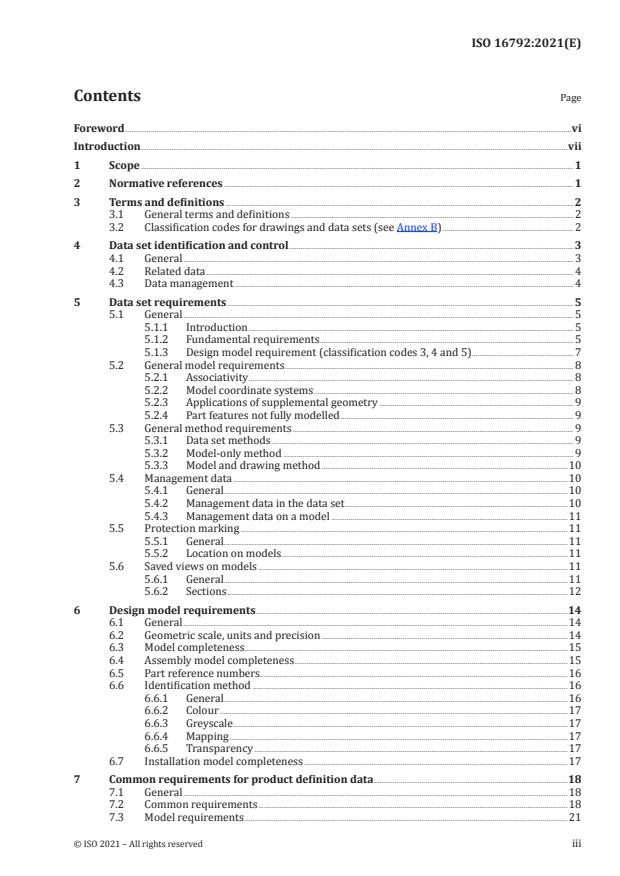
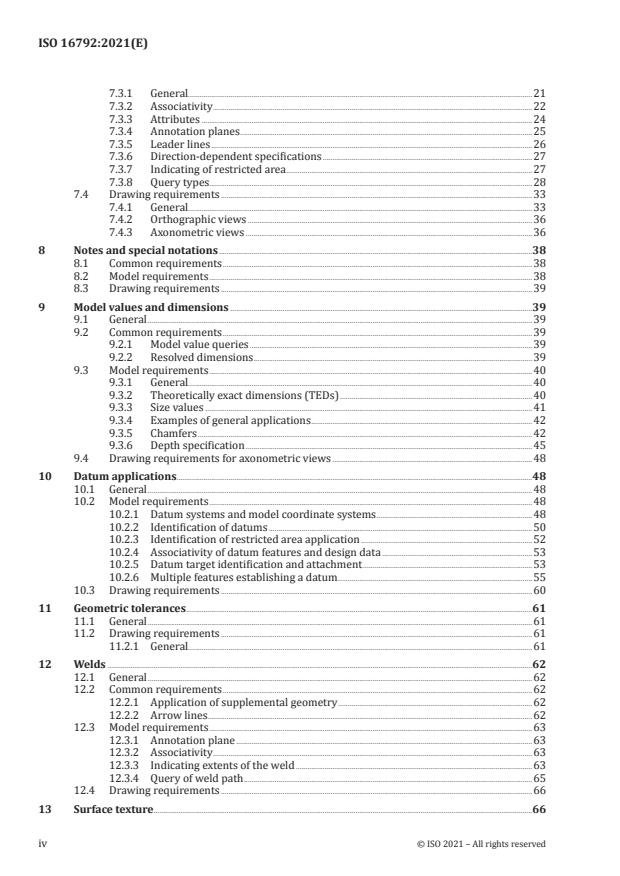
Contents Page
Foreword .vi
Introduction .vii
1 Scope . 1
2 Normative references . 1
3 Terms and definitions . 2
3.1 General terms and definitions . 2
3.2 Classification codes for drawings and data sets (see Annex B) . 2
4 Data set identification and control . 3
4.1 General . 3
4.2 Related data . 4
4.3 Data management . 4
5 Data set requirements . 5
5.1 General . 5
5.1.1 Introduction . 5
5.1.2 Fundamental requirements . 5
5.1.3 Design model requirement (classification codes 3, 4 and 5). 7
5.2 General model requirements . 8
5.2.1 Associativity . 8
5.2.2 Model coordinate systems . 8
5.2.3 Applications of supplemental geometry . 9
5.2.4 Part features not fully modelled . 9
5.3 General method requirements . 9
5.3.1 Data set methods . 9
5.3.2 Model-only method . 9
5.3.3 Model and drawing method .10
5.4 Management data .10
5.4.1 General.10
5.4.2 Management data in the data set .10
5.4.3 Management data on a model .11
5.5 Protection marking .11
5.5.1 General.11
5.5.2 Location on models.11
5.6 Saved views on models .11
5.6.1 General.11
5.6.2 Sections .12
6 Design model requirements .14
6.1 General .14
6.2 Geometric scale, units and precision .14
6.3 Model completeness .15
6.4 Assembly model completeness .15
6.5 Part reference numbers .16
6.6 Identification method .16
6.6.1 General.16
6.6.2 Colour .17
6.6.3 Greyscale .17
6.6.4 Mapping .17
6.6.5 Transparency .17
6.7 Installation model completeness .17
7 Common requirements for product definition data .18
7.1 General .18
7.2 Common requirements .18
7.3 Model requirements .21
7.3.1 General.21
7.3.2 Associativity .22
7.3.3 Attributes .24
7.3.4 Annotation planes .25
7.3.5 Leader lines .26
7.3.6 Direction-dependent specifications .27
7.3.7 Indicating of restricted area .27
7.3.8 Query types.28
7.4 Drawing requirements .33
7.4.1 General.33
7.4.2 Orthographic views .36
7.4.3 Axonometric views .36
8 Notes and special notations .38
8.1 Common requirements .38
8.2 Model requirements .38
8.3 Drawing requirements .39
9 Model values and dimensions .39
9.1 General .39
9.2 Common requirements .39
9.2.1 Model value queries .39
9.2.2 Resolved dimensions . .39
9.3 Model requirements .40
9.3.1 General.40
9.3.2 Theoretically exact dimensions (TEDs) .40
9.3.3 Size values .41
9.3.4 Examples of general applications .42
9.3.5 Chamfers .42
9.3.6 Depth specification .45
9.4 Drawing requirements for axonometric views .48
10 Datum applications .48
10.1 General .48
10.2 Model requirements .48
10.2.1 Datum systems and model coordinate systems .48
10.2.2 Identification of datums .50
10.2.3 Identification of restricted area application .52
10.2.4 Associativity of datum features and design data .53
10.2.5 Datum target identification and attachment .53
10.2.6 Multiple features establishing a datum .55
10.3 Drawing requirements .60
11 Geometric tolerances .61
11.1 General .61
11.2 Drawing requirements .61
11.2.1 General.61
12 Welds .62
12.1 General .62
12.2 Common requirements .62
12.2.1 Application of supplemental geometry .62
12.2.2 Arrow lines.62
12.3 Model requirements .63
12.3.1 Annotation plane .63
12.3.2 Associativity .63
12.3.3 Indicating extents of the weld .63
12.3.4 Query of weld path .65
12.4 Drawing requirements .66
13 Surface texture .66
iv © ISO 2021 – All rights reserved
13.1 General .66
13.2 Common requirements .66
13.3 Model requirements .66
13.3.1 Display techniques .66
13.3.2 Associativity .66
Annex A (informative) Former practices .67
Annex B (informative) Classification codes for drawings and data sets .69
Annex C (informative) Examples .71
Bibliography .76
Foreword
ISO (the International Organization for Standardization) is a worldwide federation of national standards
bodies (ISO member bodies). The work of preparing International Standards is normally carried out
through ISO technical committees. Each member body interested in a subject for which a technical
committee has been established has the right to be represented on that committee. International
organizations, governmental and non-governmental, in liaison with ISO, also take part in the work.
ISO collaborates closely with the International Electrotechnical Commission (IEC) on all matters of
electrotechnical standardization.
The procedures used to develop this document and those intended for its further maintenance are
described in the ISO/IEC Directives, Part 1. In particular, the different approval criteria needed for the
different types of ISO documents should be noted. This document was drafted in accordance with the
editorial rules of the ISO/IEC Directives, Part 2 (see www .iso .org/ directives).
Attention is drawn to the possibility that some of the elements of this document may be the subject of
patent rights. ISO shall not be held responsible for identifying any or all such patent rights. Details of
any patent rights identified during the development of the document will be in the Introduction and/or
on the ISO list of patent declarations received (see www .iso .org/ patents).
Any trade name used in this document is information given for the convenience of users and does not
constitute an endorsement.
For an explanation of the voluntary nature of standards, the meaning of ISO specific terms and
expressions related to conformity assessment, as well as information about ISO's adherence to the
World Trade Organization (WTO) principles in the Technical Barriers to Trade (TBT), see www .iso .org/
iso/ foreword .html.
This document was prepared by Technical Committee ISO/TC 10, Technical product documentation.
This third edition cancels and replaces the second edition (ISO 16792:2015), which has been technically
revised.
The main changes to the previous edition are as follows:
— information on assembly part identification added;
— information on movable parts in assemblies added;
— figures updated to reflect current International Standards,
— content which is authored in other documents removed;
— former practices moved to Annex A;
— Annex C with additional examples of applying this document added.
Any feedback or questions on this document should be directed to the user’s national standards body. A
complete listing of these bodies can be found at www .iso .org/ members .html.
vi © ISO 2021 – All rights reserved
Introduction
Every effort was made during the preparation of this document, adapted from ASME Y14.41:2012, to
apply existing requirements developed for two-dimensional (2D) presentation equally to the output
from three-dimensional (3D) models. Where new geometrical product specification (GPS) rules have
proved essential, these have been drafted with a view to their being equally applicable to both 2D
and 3D. Therefore, in order to maintain the integrity of a single system, these new rules are being
incorporated in the relevant existing International Standards for cross-reference. Application examples
have been included where, due to the specific requirements of 3D modelling in support of model-based
definition (MBD), additional guidance was deemed beneficial.
It is recognized that there is a need to support drawings in conjunction with 3D models now and for
the foreseeable future. This need has been addressed in this document through the definition of the
two methods for documenting digital models and specification of requirements to ensure that the
information in a data set is consistent between the model and the drawing.
The figures in this document are intended only as illustrations to aid the user in understanding the
practices elaborated in the text. In some cases, figures show a level of detail as needed for emphasis; in
others, they are only complete enough to illustrate a concept or facet thereof, including the associativity
of annotations in the design model. The absence of figures has no bearing on the applicability of the
specified requirement or practice.
Most figures are illustrations of models in a 3D environment. Figures illustrating drawings in digital
format include a drawing sheet border.
This document describes general requirements and practices for digital product definition applied for 3D
mechanical engineering (MCAD) but which can be also applied to other disciplines and trades (e.g. ECAD).
For former practices, see Annex A.
INTERNATIONAL STANDARD ISO 16792:2021(E)
Technical product documentation — Digital product
definition data practices
1 Scope
This document specifies requirements for the preparation, revision and presentation of digital product
definition data, hereafter referred to as data sets, complementing existing standards. It supports two
methods of application: 3D model-only and 3D model with 2D drawing in digital format. The structure
of this document presents requirements common to both methods followed by clauses providing for any
essential, differing requirements for each method. Additionally, its use in conjunction with computer-
aided design (CAD) systems can assist in the progression towards improved modelling and annotation
practices for CAD and engineering disciplines, as well as serving as a guideline for CAx software
developers.
The actual definitions for the interpretation, in particular the ISO TPD and ISO GPS rules, are taken
from the original definition standards, e.g. ISO 129-1 and ISO 1101.
When the term model is used in this document it applies to both design models and annotated models.
2 Normative references
The following documents are referred to in the text in such a way that some or all of their content
constitutes requirements of this document. For dated references, only the edition cited applies. For
undated references, the latest edition of the referenced document (including any amendments) applies.
ISO 128-2, Technical product documentation (TPD) — General principles of representation — Part 2: Basic
conventions for lines
ISO 128-3:2020, Technical product documentation (TPD) — General principles of representation — Part 3:
Views, sections and cuts
ISO 129-1, Technical product documentation (TPD) — Presentation of dimensions and tolerances — Part 1:
General principles
ISO 1101, Geometrical product specifications (GPS) — Geometrical tolerancing — Tolerances of form,
orientation, location and run-out
ISO 2553, Welding and allied processes — Symbolic representation on drawings — Welded joints
ISO 3098-1, Technical product documentation — Lettering — Part 1: General requirements
ISO 3098-5, Technical product documentation — Lettering — Part 5: CAD lettering of the Latin alphabet,
numerals and marks
ISO 5457, Technical product documentation — Sizes and layout of drawing sheets
ISO 5459, Geometrical product specifications (GPS) — Geometrical tolerancing — Datums and datum systems
ISO 7200, Technical product documentation — Data fields in title blocks and document headers
ISO 8015, Geometrical product specifications (GPS) — Fundamentals — Concepts, principles and rules
ISO 10209:2012, Technical product documentation — Vocabulary — Terms relating to technical drawings,
product definition and related documentation
ISO 11442, Technical product documentation — Document management
1)
ISO 21920-1 , Geometrical product specifications (GPS) — Surface texture: Profile —Part 1:Indication of
surface texture
ISO 25178-1, Geometrical product specifications (GPS) — Surface texture: Areal — Part 1: Indication of
surface texture
ISO 80000-1, Quantities and units — Part 1: General
IEC 82045-2, Document management — Part 2: Metadata elements and information reference model
3 Terms and definitions
For the purposes of this document, the terms and definitions given in ISO 10209 and the following apply.
ISO and IEC maintain terminological databases for use in standardization at the following addresses:
— ISO Online browsing platform: available at https:// www .iso .org/ obp
— IEC Electropedia: available at http:// www .electropedia .org/
3.1 General terms and definitions
3.1.1
absolute coordinate system
initial model coordinate system in the active CAD model used to define the location of digital elements
in that CAD model
Note 1 to entry: The active CAD model may be a part, subassembly or assembly.
Note 2 to entry: This absolute coordinate system has absolute origin of 0,0,0.
3.1.2
offset section
stepped cutting plane to include features not located in a straight cutting plane
Note 1 to entry: 2D offset section views are drawn as if the offsets were in one plane, and the offsets are not
indicated in any manner in the section views. 3D offset section views are shown by cutting through the part in an
offset manner.
3.1.3
product definition data set
data set
collection of one or more computer files that discloses (directly or by reference), by means of graphic or
textual presentations, or combinations of both, the physical and functional requirements of a product
3.1.4
user-defined coordinate system
model coordinate system which is created in the CAD model by the user in addition to the absolute
coordinate system
3.2 Classification codes for drawings and data sets (see Annex B)
3.2.1
classification code
designation assigned to product definition data that defines what data are included within the drawing,
data set or both
Note 1 to entry: A drawing can be in either physical or electronic format.
1) Under preparation. Stage at the time of publication: ISO/DIS 21920-1:2021.
2 © ISO 2021 – All rights reserved
3.2.2
classification code 1
drawing with optional data set
Note 1 to entry: Classification code 1 identifies that the data elements are located on the drawing and the drawing
is the original.
3.2.3
classification code 2
data set with design model and drawing containing specifications
Note 1 to entry: Classification code 2 identifies that data elements are located on a drawing and the drawing is
the original. A computer is used as a tool to prepare the drawing graphics sheet and the model. Data elements are
located in the digital data and the drawing. The model when provided is supplementary to the drawing.
3.2.4
classification code 3
data set with design model or annotated model and simplified drawing
Note 1 to entry: Classification code 3 identifies a model with a simplified drawing used to expedite communication
of common part features and to define non-geometric part definitions. The data set is the original. For example,
the model and the drawing must be used together to satisfy this requirement.
Note 2 to entry: When used, annotated models under classification code 3 are partially annotated.
3.2.5
classification code 4
data set with annotated model and drawing
Note 1 to entry: Classification code 4 identifies that all data elements are located in both the digital data and the
drawing. The data set is the original. For example, the model or the drawing can be used individually to satisfy
this requirement.
3.2.6
classification code 5
data set with annotated model
Note 1 to entry: Classification code 5 identifies that all data elements are located in the data set with model. No
drawing exists.
4 Data set identification and control
4.1 General
Actual data sets shall meet the requirements of this document.
Data sets for which conformity with this document is claimed shall include a reference to this document
either in the data set itself or in a document referenced by the data set (see 5.4.3).
The current revision of the data and the computer application(s) and version(s) used to develop the data
set shall be specified with other management data (see 5.4).
The data set identifier shall be unique and shall consist of numeric, alphabetic or special characters in
any combination. Spaces are not permitted between any of the characters of the data set identifier.
The length of the data set identifier may be a direct function of the computer system and the operating
system. When the part or identifying number is used as the data set identifier, the length shall be
compatible with recognized limitations on number length in accordance with ISO 7200 and IEC 82045-2.
Special characters, such as hyphen (-), slash (/) or asterisk (*), shall be selected in a manner that does
not hinder data set identification or have an adverse effect on the computer system operation.
A recognizable prefix or suffix may be included as part of the identifier to associate files and sets of
related data.
The classification codes given in Annex B can be used to identify the content of the data sets and define
the hierarchal relationships when applicable.
4.2 Related data
Related data shall be integral to, or referenced in, the data set. Examples of related data include
analytical data, parts lists, test requirements, material specifications, process and finish requirements
(see Figure 1).
4.3 Data management
The following specifies the structure and control requirements for data management:
a) The data management system shall meet the requirements of ISO 11442, providing information to
enable the control and tracking of data sets throughout the life cycle of the product to which each
relates. The system may include work in process, data review status, model checked status, release
status, design tool and version and libraries.
b) Revision history information in accordance with ISO 11442 shall be contained in the data set.
a
Related data (as applicable) required for complete definition may be integral to or referenced in the product
definition data set. Data not integral to the product definition data set may be revised independently.
b
A drawing is not required for model only data sets.
c
Related data may be manually or computer generated.
Figure 1 — Content of a product definition data set
4 © ISO 2021 – All rights reserved
A model in a product definition data set contains annotations, attributes and the CAD design model,
which typically comprises model geometry, geometric elements and supplemental geometry
(see Figure 2).
Figure 2 — Content of a model
5 Data set requirements
5.1 General
5.1.1 Introduction
The data set shall provide complete product definition, for example, a design model, its annotation and
related documentation.
5.1.2 Fundamental requirements
5.1.2.1 General
The following are the fundamental requirements and other provisions applicable to both annotated
models and drawings, specific to annotated models and specific to drawings.
The integrity of product definition data should be ensured at all times, i.e. the information presented
shall not be conflicting.
5.1.2.2 Common to annotated models and drawings
— All model values and resolved dimensions shall be obtained from the model.
— Rounding requirements for resolved dimensions shall conform with 9.2.2.
— The ability to query the model shall be available (see 7.3.8).
— All angular values shall be queried from the model (see 9.2). Exceptions to this are model coordinate
system(s), planes and axes in a datum system and orthographic views.
— When query is required, a notation stating the requirement for query of the model or associated
data shall be added to the drawing or in the general notes. See Figure 26 for an example.
— Values obtained from the model for any feature(s) which are not covered by any tolerance, specify
the location of a datum target, or the location and extent of a restricted portion of a feature, shall be
auxiliary dimensions.
— The legibility requirements of ISO 3098-1 and ISO 3098-5 shall apply when the annotation is viewed
perpendicular to the annotation plane.
— Annotation in any given annotation plane shall not overlap other annotation in the same annotation
plane when the model is viewed perpendicular to the annotation plane.
— Annotation text within any given annotation plane shall not be placed over the design model when
the model is viewed perpendicular to the annotation plane. Where this is unavoidable the legibility
shall not be compromised.
— On spherical surfaces tolerance indicators shall be placed on an annotation plane containing its
centre point.
5.1.2.3 Applicable only to models
— An annotation shall be specified in an annotation plane. Several annotations can belong to the same
annotation plane. When the model-only method (classification code 5) is used, the CAD software
shall support maintenance of annotation plane orientation relative to the model (see 7.3.4).
— The associated entities, annotation and attributes shall be in agreement.
— Resolved dimensions created from queried model values are considered the same as dimensions
displayed on a model (see 9.2.2).
— Display of centre lines or centre planes for features of size is optional.
— To ensure that the annotation is readable – the text, for example, can be upside down or backwards
following rotation of the model – one of the following techniques shall be used:
a) ensuring that the reading direction is updated after rotation of a model;
b) inclusion of means of determining the correct reading direction in each annotation plane
applied to a model;
c) when using saved views, ensuring that the model is orientated in the intended view direction, for
example by including a means of determining the correct reading direction in the view;
d) when the orientation of the annotation is part of the specification, the relationship to the
geometry shall be maintained regardless of the viewing direction.
— Dimensions, tolerances and datums to internal features can be shown without the use of a section
as long as the specification is unambiguous.
— Utilizing an annotation plane on the design model, the method to indicate annotations is as follows:
a) The annotation plane shall be parallel to the orthogonal coordinate surface of the absolute
coordinate system or a user-defined coordinate system of the 3D model. In addition, it is
acceptable to set an annotation plane in a discretionary direction as needed (see Figure 3).
b) Indicate so that the relationship between the annotation and the design model portion
indicating the annotation can be maintained through a dimension line, projection line and
leader line.
c) The colour of the annotation should be set to a colour which can be clearly identified against
the colour of the design model, the annotation plane and the background.
6 © ISO 2021 – All rights reserved
d) It is acceptable to be able to switch between displaying and hiding annotations as needed on a
computer monitor.
Key
1 front annotation plane in direction of absolute coordinate system
2 back annotation plane in direction of absolute coordinate system
3 annotation plane with a direction which is not parallel to the absolute coordinate system
Figure 3 — Example of displaying annotation plane on design model
5.1.2.4 Applicable only to drawings accompanied by 3D models
— Annotation may be applied to orthographic or axonometric views.
— For axonometric views, the orientation of the annotation shall be parallel to, normal to or coincident
with the surface to which it applies. Where legibility is compromised, the annotation shall be
orientated to the viewing plane of the drawing. One annotation shall not overlap another or the
geometrical representation of the part.
5.1.3 Design model requirement (classification codes 3, 4 and 5)
A design model is required and shall be in accordance with 5.2 and Clause 6.
5.2 General model requirements
5.2.1 Associativity
The ability to associate digital elements shall be available and maintained. Associativity information
shall be electronically accessible.
5.2.2 Model coordinate systems
A design model shall contain one or more model coordinate systems. A model coordinate system shall
be depicted by three mutually perpendicular line segments with its origin located at the intersection of
the three axes. Each axis shall be labelled, and the positive direction shown. Model coordinate systems
shall be right-handed unless otherwise specified (see Figure 4).
The CAD model shall establish a link between the absolute coordinate system and the model coordinate
system(s). The technical product documentation shall establish a link between the model coordinate
system(s) and the datum system(s) for geometrical specifications.
a) Mirror-image relationship
8 © ISO 2021 – All rights reserved
b) Recognizing the right-hand coordinate system
Key
1 left-hand coordinates
2 right-hand coordinates
3 mirror transform
NOTE The right-hand coordinates system when observed in the Z direction, with positive Y ascending,
shows positive X is directed to the right-hand side of the observer.
Figure
...
INTERNATIONAL ISO
STANDARD 16792
Third edition
2021-04
Technical product documentation —
Digital product definition data
practices
Documentation technique de produits — Pratiques pour les données
numériques de la définition d’un produit
Reference number
©
ISO 2021
© ISO 2021
All rights reserved. Unless otherwise specified, or required in the context of its implementation, no part of this publication may
be reproduced or utilized otherwise in any form or by any means, electronic or mechanical, including photocopying, or posting
on the internet or an intranet, without prior written permission. Permission can be requested from either ISO at the address
below or ISO’s member body in the country of the requester.
ISO copyright office
CP 401 • Ch. de Blandonnet 8
CH-1214 Vernier, Geneva
Phone: +41 22 749 01 11
Email: copyright@iso.org
Website: www.iso.org
Published in Switzerland
ii © ISO 2021 – All rights reserved
Contents Page
Foreword .vi
Introduction .vii
1 Scope . 1
2 Normative references . 1
3 Terms and definitions . 2
3.1 General terms and definitions . 2
3.2 Classification codes for drawings and data sets (see Annex B) . 2
4 Data set identification and control . 3
4.1 General . 3
4.2 Related data . 4
4.3 Data management . 4
5 Data set requirements . 5
5.1 General . 5
5.1.1 Introduction . 5
5.1.2 Fundamental requirements . 5
5.1.3 Design model requirement (classification codes 3, 4 and 5). 7
5.2 General model requirements . 8
5.2.1 Associativity . 8
5.2.2 Model coordinate systems . 8
5.2.3 Applications of supplemental geometry . 9
5.2.4 Part features not fully modelled . 9
5.3 General method requirements . 9
5.3.1 Data set methods . 9
5.3.2 Model-only method . 9
5.3.3 Model and drawing method .10
5.4 Management data .10
5.4.1 General.10
5.4.2 Management data in the data set .10
5.4.3 Management data on a model .11
5.5 Protection marking .11
5.5.1 General.11
5.5.2 Location on models.11
5.6 Saved views on models .11
5.6.1 General.11
5.6.2 Sections .12
6 Design model requirements .14
6.1 General .14
6.2 Geometric scale, units and precision .14
6.3 Model completeness .15
6.4 Assembly model completeness .15
6.5 Part reference numbers .16
6.6 Identification method .16
6.6.1 General.16
6.6.2 Colour .17
6.6.3 Greyscale .17
6.6.4 Mapping .17
6.6.5 Transparency .17
6.7 Installation model completeness .17
7 Common requirements for product definition data .18
7.1 General .18
7.2 Common requirements .18
7.3 Model requirements .21
7.3.1 General.21
7.3.2 Associativity .22
7.3.3 Attributes .24
7.3.4 Annotation planes .25
7.3.5 Leader lines .26
7.3.6 Direction-dependent specifications .27
7.3.7 Indicating of restricted area .27
7.3.8 Query types.28
7.4 Drawing requirements .33
7.4.1 General.33
7.4.2 Orthographic views .36
7.4.3 Axonometric views .36
8 Notes and special notations .38
8.1 Common requirements .38
8.2 Model requirements .38
8.3 Drawing requirements .39
9 Model values and dimensions .39
9.1 General .39
9.2 Common requirements .39
9.2.1 Model value queries .39
9.2.2 Resolved dimensions . .39
9.3 Model requirements .40
9.3.1 General.40
9.3.2 Theoretically exact dimensions (TEDs) .40
9.3.3 Size values .41
9.3.4 Examples of general applications .42
9.3.5 Chamfers .42
9.3.6 Depth specification .45
9.4 Drawing requirements for axonometric views .48
10 Datum applications .48
10.1 General .48
10.2 Model requirements .48
10.2.1 Datum systems and model coordinate systems .48
10.2.2 Identification of datums .50
10.2.3 Identification of restricted area application .52
10.2.4 Associativity of datum features and design data .53
10.2.5 Datum target identification and attachment .53
10.2.6 Multiple features establishing a datum .55
10.3 Drawing requirements .60
11 Geometric tolerances .61
11.1 General .61
11.2 Drawing requirements .61
11.2.1 General.61
12 Welds .62
12.1 General .62
12.2 Common requirements .62
12.2.1 Application of supplemental geometry .62
12.2.2 Arrow lines.62
12.3 Model requirements .63
12.3.1 Annotation plane .63
12.3.2 Associativity .63
12.3.3 Indicating extents of the weld .63
12.3.4 Query of weld path .65
12.4 Drawing requirements .66
13 Surface texture .66
iv © ISO 2021 – All rights reserved
13.1 General .66
13.2 Common requirements .66
13.3 Model requirements .66
13.3.1 Display techniques .66
13.3.2 Associativity .66
Annex A (informative) Former practices .67
Annex B (informative) Classification codes for drawings and data sets .69
Annex C (informative) Examples .71
Bibliography .76
Foreword
ISO (the International Organization for Standardization) is a worldwide federation of national standards
bodies (ISO member bodies). The work of preparing International Standards is normally carried out
through ISO technical committees. Each member body interested in a subject for which a technical
committee has been established has the right to be represented on that committee. International
organizations, governmental and non-governmental, in liaison with ISO, also take part in the work.
ISO collaborates closely with the International Electrotechnical Commission (IEC) on all matters of
electrotechnical standardization.
The procedures used to develop this document and those intended for its further maintenance are
described in the ISO/IEC Directives, Part 1. In particular, the different approval criteria needed for the
different types of ISO documents should be noted. This document was drafted in accordance with the
editorial rules of the ISO/IEC Directives, Part 2 (see www .iso .org/ directives).
Attention is drawn to the possibility that some of the elements of this document may be the subject of
patent rights. ISO shall not be held responsible for identifying any or all such patent rights. Details of
any patent rights identified during the development of the document will be in the Introduction and/or
on the ISO list of patent declarations received (see www .iso .org/ patents).
Any trade name used in this document is information given for the convenience of users and does not
constitute an endorsement.
For an explanation of the voluntary nature of standards, the meaning of ISO specific terms and
expressions related to conformity assessment, as well as information about ISO's adherence to the
World Trade Organization (WTO) principles in the Technical Barriers to Trade (TBT), see www .iso .org/
iso/ foreword .html.
This document was prepared by Technical Committee ISO/TC 10, Technical product documentation.
This third edition cancels and replaces the second edition (ISO 16792:2015), which has been technically
revised.
The main changes to the previous edition are as follows:
— information on assembly part identification added;
— information on movable parts in assemblies added;
— figures updated to reflect current International Standards,
— content which is authored in other documents removed;
— former practices moved to Annex A;
— Annex C with additional examples of applying this document added.
Any feedback or questions on this document should be directed to the user’s national standards body. A
complete listing of these bodies can be found at www .iso .org/ members .html.
vi © ISO 2021 – All rights reserved
Introduction
Every effort was made during the preparation of this document, adapted from ASME Y14.41:2012, to
apply existing requirements developed for two-dimensional (2D) presentation equally to the output
from three-dimensional (3D) models. Where new geometrical product specification (GPS) rules have
proved essential, these have been drafted with a view to their being equally applicable to both 2D
and 3D. Therefore, in order to maintain the integrity of a single system, these new rules are being
incorporated in the relevant existing International Standards for cross-reference. Application examples
have been included where, due to the specific requirements of 3D modelling in support of model-based
definition (MBD), additional guidance was deemed beneficial.
It is recognized that there is a need to support drawings in conjunction with 3D models now and for
the foreseeable future. This need has been addressed in this document through the definition of the
two methods for documenting digital models and specification of requirements to ensure that the
information in a data set is consistent between the model and the drawing.
The figures in this document are intended only as illustrations to aid the user in understanding the
practices elaborated in the text. In some cases, figures show a level of detail as needed for emphasis; in
others, they are only complete enough to illustrate a concept or facet thereof, including the associativity
of annotations in the design model. The absence of figures has no bearing on the applicability of the
specified requirement or practice.
Most figures are illustrations of models in a 3D environment. Figures illustrating drawings in digital
format include a drawing sheet border.
This document describes general requirements and practices for digital product definition applied for 3D
mechanical engineering (MCAD) but which can be also applied to other disciplines and trades (e.g. ECAD).
For former practices, see Annex A.
INTERNATIONAL STANDARD ISO 16792:2021(E)
Technical product documentation — Digital product
definition data practices
1 Scope
This document specifies requirements for the preparation, revision and presentation of digital product
definition data, hereafter referred to as data sets, complementing existing standards. It supports two
methods of application: 3D model-only and 3D model with 2D drawing in digital format. The structure
of this document presents requirements common to both methods followed by clauses providing for any
essential, differing requirements for each method. Additionally, its use in conjunction with computer-
aided design (CAD) systems can assist in the progression towards improved modelling and annotation
practices for CAD and engineering disciplines, as well as serving as a guideline for CAx software
developers.
The actual definitions for the interpretation, in particular the ISO TPD and ISO GPS rules, are taken
from the original definition standards, e.g. ISO 129-1 and ISO 1101.
When the term model is used in this document it applies to both design models and annotated models.
2 Normative references
The following documents are referred to in the text in such a way that some or all of their content
constitutes requirements of this document. For dated references, only the edition cited applies. For
undated references, the latest edition of the referenced document (including any amendments) applies.
ISO 128-2, Technical product documentation (TPD) — General principles of representation — Part 2: Basic
conventions for lines
ISO 128-3:2020, Technical product documentation (TPD) — General principles of representation — Part 3:
Views, sections and cuts
ISO 129-1, Technical product documentation (TPD) — Presentation of dimensions and tolerances — Part 1:
General principles
ISO 1101, Geometrical product specifications (GPS) — Geometrical tolerancing — Tolerances of form,
orientation, location and run-out
ISO 2553, Welding and allied processes — Symbolic representation on drawings — Welded joints
ISO 3098-1, Technical product documentation — Lettering — Part 1: General requirements
ISO 3098-5, Technical product documentation — Lettering — Part 5: CAD lettering of the Latin alphabet,
numerals and marks
ISO 5457, Technical product documentation — Sizes and layout of drawing sheets
ISO 5459, Geometrical product specifications (GPS) — Geometrical tolerancing — Datums and datum systems
ISO 7200, Technical product documentation — Data fields in title blocks and document headers
ISO 8015, Geometrical product specifications (GPS) — Fundamentals — Concepts, principles and rules
ISO 10209:2012, Technical product documentation — Vocabulary — Terms relating to technical drawings,
product definition and related documentation
ISO 11442, Technical product documentation — Document management
1)
ISO 21920-1 , Geometrical product specifications (GPS) — Surface texture: Profile —Part 1:Indication of
surface texture
ISO 25178-1, Geometrical product specifications (GPS) — Surface texture: Areal — Part 1: Indication of
surface texture
ISO 80000-1, Quantities and units — Part 1: General
IEC 82045-2, Document management — Part 2: Metadata elements and information reference model
3 Terms and definitions
For the purposes of this document, the terms and definitions given in ISO 10209 and the following apply.
ISO and IEC maintain terminological databases for use in standardization at the following addresses:
— ISO Online browsing platform: available at https:// www .iso .org/ obp
— IEC Electropedia: available at http:// www .electropedia .org/
3.1 General terms and definitions
3.1.1
absolute coordinate system
initial model coordinate system in the active CAD model used to define the location of digital elements
in that CAD model
Note 1 to entry: The active CAD model may be a part, subassembly or assembly.
Note 2 to entry: This absolute coordinate system has absolute origin of 0,0,0.
3.1.2
offset section
stepped cutting plane to include features not located in a straight cutting plane
Note 1 to entry: 2D offset section views are drawn as if the offsets were in one plane, and the offsets are not
indicated in any manner in the section views. 3D offset section views are shown by cutting through the part in an
offset manner.
3.1.3
product definition data set
data set
collection of one or more computer files that discloses (directly or by reference), by means of graphic or
textual presentations, or combinations of both, the physical and functional requirements of a product
3.1.4
user-defined coordinate system
model coordinate system which is created in the CAD model by the user in addition to the absolute
coordinate system
3.2 Classification codes for drawings and data sets (see Annex B)
3.2.1
classification code
designation assigned to product definition data that defines what data are included within the drawing,
data set or both
Note 1 to entry: A drawing can be in either physical or electronic format.
1) Under preparation. Stage at the time of publication: ISO/DIS 21920-1:2021.
2 © ISO 2021 – All rights reserved
3.2.2
classification code 1
drawing with optional data set
Note 1 to entry: Classification code 1 identifies that the data elements are located on the drawing and the drawing
is the original.
3.2.3
classification code 2
data set with design model and drawing containing specifications
Note 1 to entry: Classification code 2 identifies that data elements are located on a drawing and the drawing is
the original. A computer is used as a tool to prepare the drawing graphics sheet and the model. Data elements are
located in the digital data and the drawing. The model when provided is supplementary to the drawing.
3.2.4
classification code 3
data set with design model or annotated model and simplified drawing
Note 1 to entry: Classification code 3 identifies a model with a simplified drawing used to expedite communication
of common part features and to define non-geometric part definitions. The data set is the original. For example,
the model and the drawing must be used together to satisfy this requirement.
Note 2 to entry: When used, annotated models under classification code 3 are partially annotated.
3.2.5
classification code 4
data set with annotated model and drawing
Note 1 to entry: Classification code 4 identifies that all data elements are located in both the digital data and the
drawing. The data set is the original. For example, the model or the drawing can be used individually to satisfy
this requirement.
3.2.6
classification code 5
data set with annotated model
Note 1 to entry: Classification code 5 identifies that all data elements are located in the data set with model. No
drawing exists.
4 Data set identification and control
4.1 General
Actual data sets shall meet the requirements of this document.
Data sets for which conformity with this document is claimed shall include a reference to this document
either in the data set itself or in a document referenced by the data set (see 5.4.3).
The current revision of the data and the computer application(s) and version(s) used to develop the data
set shall be specified with other management data (see 5.4).
The data set identifier shall be unique and shall consist of numeric, alphabetic or special characters in
any combination. Spaces are not permitted between any of the characters of the data set identifier.
The length of the data set identifier may be a direct function of the computer system and the operating
system. When the part or identifying number is used as the data set identifier, the length shall be
compatible with recognized limitations on number length in accordance with ISO 7200 and IEC 82045-2.
Special characters, such as hyphen (-), slash (/) or asterisk (*), shall be selected in a manner that does
not hinder data set identification or have an adverse effect on the computer system operation.
A recognizable prefix or suffix may be included as part of the identifier to associate files and sets of
related data.
The classification codes given in Annex B can be used to identify the content of the data sets and define
the hierarchal relationships when applicable.
4.2 Related data
Related data shall be integral to, or referenced in, the data set. Examples of related data include
analytical data, parts lists, test requirements, material specifications, process and finish requirements
(see Figure 1).
4.3 Data management
The following specifies the structure and control requirements for data management:
a) The data management system shall meet the requirements of ISO 11442, providing information to
enable the control and tracking of data sets throughout the life cycle of the product to which each
relates. The system may include work in process, data review status, model checked status, release
status, design tool and version and libraries.
b) Revision history information in accordance with ISO 11442 shall be contained in the data set.
a
Related data (as applicable) required for complete definition may be integral to or referenced in the product
definition data set. Data not integral to the product definition data set may be revised independently.
b
A drawing is not required for model only data sets.
c
Related data may be manually or computer generated.
Figure 1 — Content of a product definition data set
4 © ISO 2021 – All rights reserved
A model in a product definition data set contains annotations, attributes and the CAD design model,
which typically comprises model geometry, geometric elements and supplemental geometry
(see Figure 2).
Figure 2 — Content of a model
5 Data set requirements
5.1 General
5.1.1 Introduction
The data set shall provide complete product definition, for example, a design model, its annotation and
related documentation.
5.1.2 Fundamental requirements
5.1.2.1 General
The following are the fundamental requirements and other provisions applicable to both annotated
models and drawings, specific to annotated models and specific to drawings.
The integrity of product definition data should be ensured at all times, i.e. the information presented
shall not be conflicting.
5.1.2.2 Common to annotated models and drawings
— All model values and resolved dimensions shall be obtained from the model.
— Rounding requirements for resolved dimensions shall conform with 9.2.2.
— The ability to query the model shall be available (see 7.3.8).
— All angular values shall be queried from the model (see 9.2). Exceptions to this are model coordinate
system(s), planes and axes in a datum system and orthographic views.
— When query is required, a notation stating the requirement for query of the model or associated
data shall be added to the drawing or in the general notes. See Figure 26 for an example.
— Values obtained from the model for any feature(s) which are not covered by any tolerance, specify
the location of a datum target, or the location and extent of a restricted portion of a feature, shall be
auxiliary dimensions.
— The legibility requirements of ISO 3098-1 and ISO 3098-5 shall apply when the annotation is viewed
perpendicular to the annotation plane.
— Annotation in any given annotation plane shall not overlap other annotation in the same annotation
plane when the model is viewed perpendicular to the annotation plane.
— Annotation text within any given annotation plane shall not be placed over the design model when
the model is viewed perpendicular to the annotation plane. Where this is unavoidable the legibility
shall not be compromised.
— On spherical surfaces tolerance indicators shall be placed on an annotation plane containing its
centre point.
5.1.2.3 Applicable only to models
— An annotation shall be specified in an annotation plane. Several annotations can belong to the same
annotation plane. When the model-only method (classification code 5) is used, the CAD software
shall support maintenance of annotation plane orientation relative to the model (see 7.3.4).
— The associated entities, annotation and attributes shall be in agreement.
— Resolved dimensions created from queried model values are considered the same as dimensions
displayed on a model (see 9.2.2).
— Display of centre lines or centre planes for features of size is optional.
— To ensure that the annotation is readable – the text, for example, can be upside down or backwards
following rotation of the model – one of the following techniques shall be used:
a) ensuring that the reading direction is updated after rotation of a model;
b) inclusion of means of determining the correct reading direction in each annotation plane
applied to a model;
c) when using saved views, ensuring that the model is orientated in the intended view direction, for
example by including a means of determining the correct reading direction in the view;
d) when the orientation of the annotation is part of the specification, the relationship to the
geometry shall be maintained regardless of the viewing direction.
— Dimensions, tolerances and datums to internal features can be shown without the use of a section
as long as the specification is unambiguous.
— Utilizing an annotation plane on the design model, the method to indicate annotations is as follows:
a) The annotation plane shall be parallel to the orthogonal coordinate surface of the absolute
coordinate system or a user-defined coordinate system of the 3D model. In addition, it is
acceptable to set an annotation plane in a discretionary direction as needed (see Figure 3).
b) Indicate so that the relationship between the annotation and the design model portion
indicating the annotation can be maintained through a dimension line, projection line and
leader line.
c) The colour of the annotation should be set to a colour which can be clearly identified against
the colour of the design model, the annotation plane and the background.
6 © ISO 2021 – All rights reserved
d) It is acceptable to be able to switch between displaying and hiding annotations as needed on a
computer monitor.
Key
1 front annotation plane in direction of absolute coordinate system
2 back annotation plane in direction of absolute coordinate system
3 annotation plane with a direction which is not parallel to the absolute coordinate system
Figure 3 — Example of displaying annotation plane on design model
5.1.2.4 Applicable only to drawings accompanied by 3D models
— Annotation may be applied to orthographic or axonometric views.
— For axonometric views, the orientation of the annotation shall be parallel to, normal to or coincident
with the surface to which it applies. Where legibility is compromised, the annotation shall be
orientated to the viewing plane of the drawing. One annotation shall not overlap another or the
geometrical representation of the part.
5.1.3 Design model requirement (classification codes 3, 4 and 5)
A design model is required and shall be in accordance with 5.2 and Clause 6.
5.2 General model requirements
5.2.1 Associativity
The ability to associate digital elements shall be available and maintained. Associativity information
shall be electronically accessible.
5.2.2 Model coordinate systems
A design model shall contain one or more model coordinate systems. A model coordinate system shall
be depicted by three mutually perpendicular line segments with its origin located at the intersection of
the three axes. Each axis shall be labelled, and the positive direction shown. Model coordinate systems
shall be right-handed unless otherwise specified (see Figure 4).
The CAD model shall establish a link between the absolute coordinate system and the model coordinate
system(s). The technical product documentation shall establish a link between the model coordinate
system(s) and the datum system(s) for geometrical specifications.
a) Mirror-image relationship
8 © ISO 2021 – All rights reserved
b) Recognizing the right-hand coordinate system
Key
1 left-hand coordinates
2 right-hand coordinates
3 mirror transform
NOTE The right-hand coordinates system when observed in the Z direction, with positive Y ascending,
shows positive X is directed to the right-hand side of the observer.
Figure
...