

ISO/FDIS 23638
(Main)Food products — Quality requirements for processed food products for food emergency situations
- Abstract
This document specifies the quality characteristics for food products that can be stored in room temperature and consumed in an extra-ordinary condition. The target consumers for this document includes not only those suffering in the disaster area and those engaged in rescue operations, but also those who need to have their meals in an environment that differs from that of their ordinary lives.
- Status
- Not Published
- Technical Committee
- ISO/TC 34 - Food products
- Drafting Committee
- ISO/TC 34/WG 25 - Food security in emergency or crisis situation
- Current Stage
- 5020 - Proof sent to secretariat or FDIS ballot initiated: 8 weeks - 50 Approval
- Start Date
- 11-Nov-2026
- Due Date
- 11-Nov-2026
- Completion Date
- 11-Nov-2026
Buy Documents
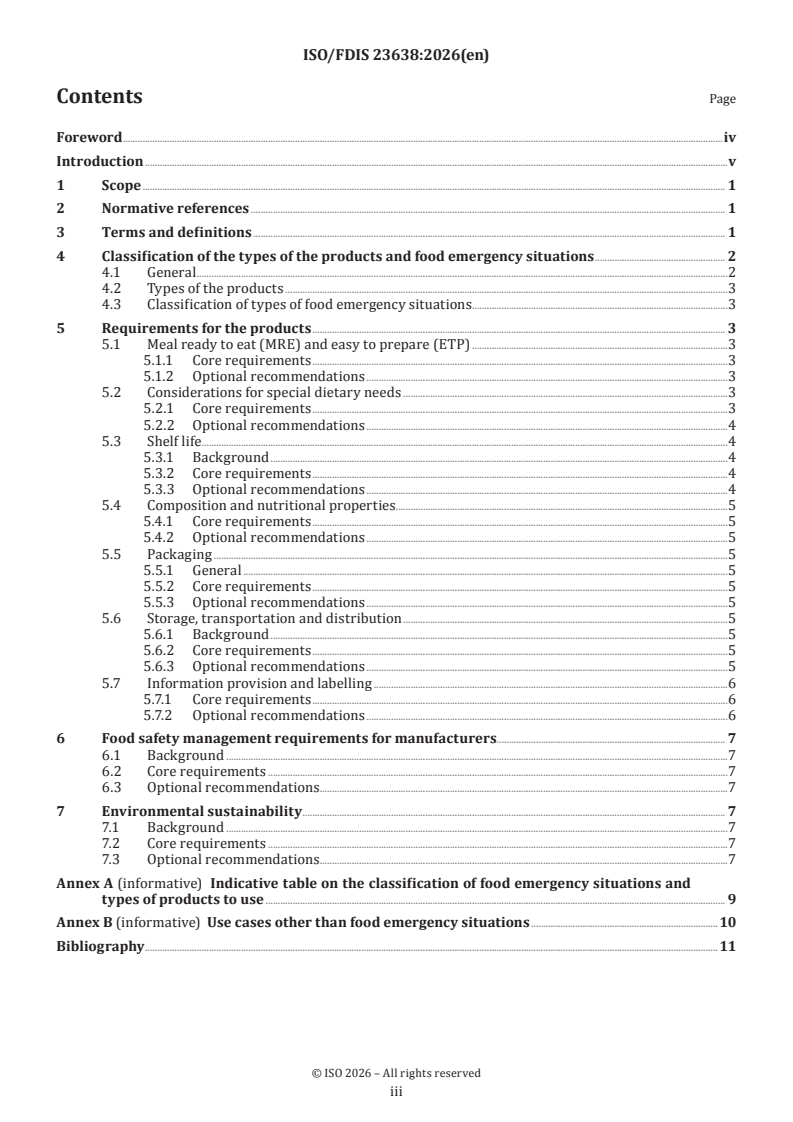
ISO/FDIS 23638 - Food products — Quality requirements for processed food products for food emergency situations

REDLINE ISO/FDIS 23638 - Food products — Quality requirements for processed food products for food emergency situations
ISO/FDIS 23638 is an ISO document on processed food products for food emergency situations. It specifies quality and safety characteristics for products stored at ambient temperature and intended for people affected by disasters, rescue operations, or other unusual living conditions.
It is written for manufacturers, emergency planners, buyers, and users who need to select, supply, stockpile, or label these foods. The document separates products into Meal Ready to Eat (MRE) and Easy to Prepare (ETP), so readers can match the product to the level of access to food, water, and basic facilities.
What does ISO/FDIS 23638 specify?
ISO/FDIS 23638 specifies requirements and recommendations for processed food products with an appropriate shelf life when stored at ambient temperature for use in food emergency situations. It also excludes food for special medical purposes such as ready to use therapeutic food (RUTF).
The document is organized into:
- Clause 4 - classification of product types and food emergency situations
- Clause 5 - product requirements
- Clause 6 - food safety management requirements for manufacturers
- Clause 7 - environmental sustainability
- Annex A - indicative selection examples
- Annex B - other use cases
| Annex | What it covers |
|---|---|
| Annex A | Indicative table linking emergency situation levels to suitable product types |
| Annex B | Use cases other than food emergency situations |
What are the key requirements of ISO/FDIS 23638?
ISO/FDIS 23638 focuses on choosing the right product type, proving shelf life, matching nutrition to the user group, and making the food safe and usable in difficult conditions. The requirements are practical: they affect product design, validation, packaging, transport, labelling, and manufacturer controls.
Product type and emergency situation level
Clause 4 classifies the products as MRE or ETP, and it classifies food emergency situations into three levels: Survival, Crisis, and Stabilization. In practice, this helps a manufacturer or buyer match the product to the available water, cooking facilities, and degree of disruption.
Annex A gives indicative examples for selecting products at each level. That means a purchaser can use the table as a selection aid when planning emergency stock.
MRE and ETP design
Clause 5.1 requires MRE to be ready to eat directly from the package without cooking, heating, reconstitution, or utensils. ETP products must need only minimum preparation, such as adding water or heating.
If ETP needs utensils or tableware, the document recommends providing them with the product. That matters because people in emergency settings may have no cooking equipment or dishes.
Shelf life and validation
Clause 5.3 requires shelf life to be validated using food safety parameters and quality parameters throughout the declared shelf life. The validation can be done with a documented protocol based on realistic conditions, or with a scientifically supported rationale using literature or validated predictive models.
If a shorter test period is used, the justification for the acceleration factor must be documented. In practice, this means shelf life claims need evidence, not just a target date on the label.
Composition, packaging, and logistics
Clause 5.4 requires composition and nutritional properties to match the target population and the intended use context. Clause 5.5 requires packaging that protects against temperature and humidity variations, and MRE packaging must be easy to open without tools.
Clause 5.6 requires storage, transport, and distribution to maintain product stability and safety. If extreme temperature zones are claimed, the claim must be backed by a rationale. For buyers and logistics teams, this links the product claim to real transport and storage conditions.
Labelling and manufacturer controls
Clause 5.7 requires labelling in line with CXS 1-1985 or applicable national rules. The label must show composition and nutritional information, safe-use instructions, and the best before date, and the secondary packaging must show product identification and special dietary information where relevant.
Clause 6 requires manufacturers, including those of packaged potable water, to implement and regularly validate appropriate food safety management processes. Clause 7 adds sustainability recommendations covering food loss, packaging waste, energy and resource use, and ingredient choice.
What terms does ISO/FDIS 23638 define?
- Food - any substance intended for human consumption, including drinks and chewing gum.
- Potable water - water suitable for human consumption.
- Containerized potable water - potable water packaged in containers for alternative water service provision.
- Processed food product - a product made by physical, chemical, or biological processing of a primary food commodity.
- Ambient temperature - the unregulated temperature of the surrounding air.
- Meal ready to eat (MRE) - food ready for consumption without preparation.
- Easy to prepare (ETP) - food that can be consumed with minimum preparation.
- Shelf life - the period during which the product remains safe and keeps its quality under stated storage conditions.
Who uses ISO/FDIS 23638?
ISO/FDIS 23638 is used by food manufacturers, emergency food suppliers, and packaging and logistics teams that prepare stock for disasters or disrupted supply chains. It is also relevant to local communities, governments, non-governmental organizations, and rescue organizations that buy food for evacuees.
The document also helps individuals who want emergency preparedness food at home, and people planning food for travel, trekking, boating, vehicles, food deserts, or space-related activities.
Which standards are used with ISO/FDIS 23638?
- CXS 1-1985, General Standard for the Labelling of Pre-packaged Foods - the normative reference for product labelling.
- ISO 22000 - suggested as a recognized food safety management standard for manufacturers.
- ISO 22002-2:2025 - used in the definition of potable water.
- ISO 24527:2020 - used in the definition of containerized potable water.
- CXA 4-1989 - used in the definition of processed food product.
- CXG 2-1985 - cited for nutrition labelling practice.
- CXG 95-2022 - cited in the note on ready-to-use therapeutic foods.
- Codex Alimentarius Commission Procedural Manual - source of the definition of food.
What does the ISO/FDIS 23638 document contain?
ISO/FDIS 23638 contains classification rules, product requirements, labelling requirements, and management expectations for manufacturers. Clause 5 is the main technical section, covering MRE, ETP, shelf life, nutrition, packaging, storage, and information provision.
Annex A gives an indicative matrix for choosing product types by emergency situation level and access conditions. Annex B expands the document beyond disasters by listing other situations where these processed foods can be useful, such as travel, mountain activities, boating, vehicle storage, food deserts, and space.
Buy Documents
ISO/FDIS 23638 - Food products — Quality requirements for processed food products for food emergency situations
REDLINE ISO/FDIS 23638 - Food products — Quality requirements for processed food products for food emergency situations
Get Certified
Connect with accredited certification bodies for this standard

BSI Group
BSI (British Standards Institution) is the business standards company that helps organizations make excellence a habit.

Bureau Veritas
Bureau Veritas is a world leader in laboratory testing, inspection and certification services.

DNV
DNV is an independent assurance and risk management provider.
Sponsored listings
Frequently Asked Questions
ISO/FDIS 23638 is a draft published by the International Organization for Standardization (ISO). Its full title is "Food products — Quality requirements for processed food products for food emergency situations". This standard covers: This document specifies the quality characteristics for food products that can be stored in room temperature and consumed in an extra-ordinary condition. The target consumers for this document includes not only those suffering in the disaster area and those engaged in rescue operations, but also those who need to have their meals in an environment that differs from that of their ordinary lives.
This document specifies the quality characteristics for food products that can be stored in room temperature and consumed in an extra-ordinary condition. The target consumers for this document includes not only those suffering in the disaster area and those engaged in rescue operations, but also those who need to have their meals in an environment that differs from that of their ordinary lives.
ISO/FDIS 23638 is classified under the following ICS (International Classification for Standards) categories: 67.230 - Prepackaged and prepared foods. The ICS classification helps identify the subject area and facilitates finding related standards.
ISO/FDIS 23638 is available in PDF format for immediate download after purchase. The document can be added to your cart and obtained through the secure checkout process. Digital delivery ensures instant access to the complete standard document.
Standards Content (Sample)
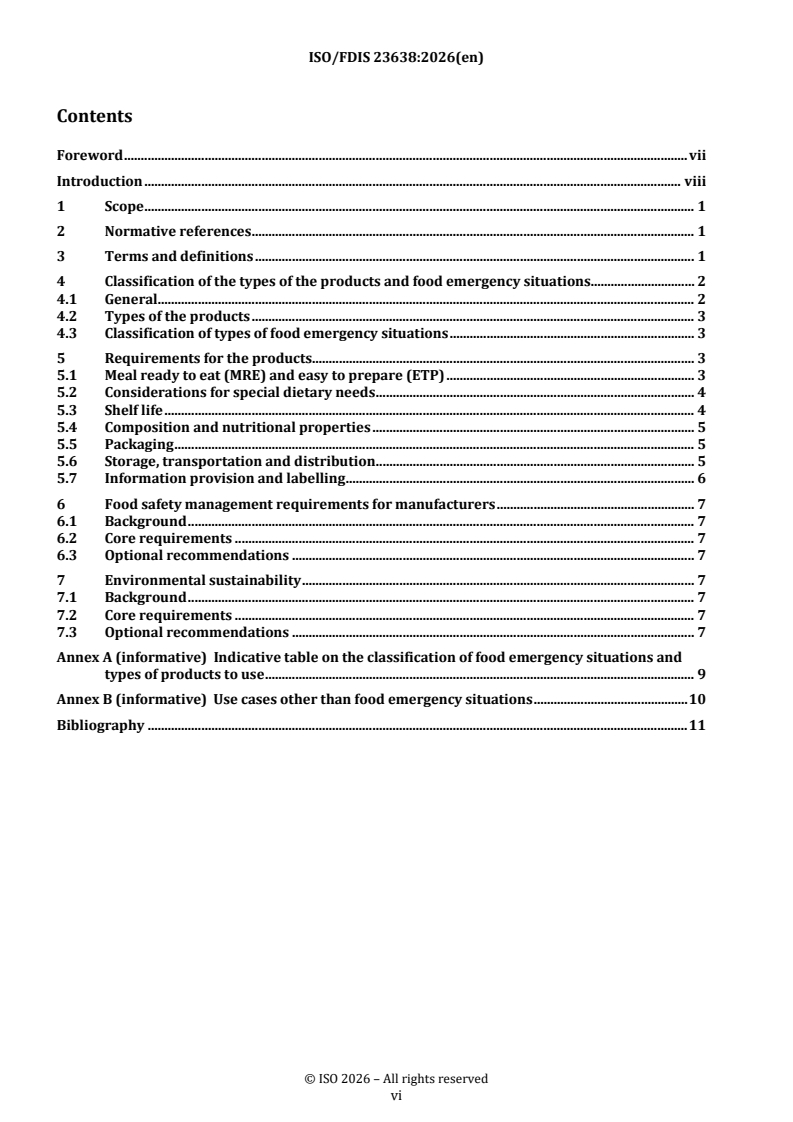
Contents
- Introduction
- 0.1 Background
- 0.2 Purpose of this document
- 1 Scope
- 2 Normative references
- 3 Terms and definitions
- 3.1 food
- 3.2 potable water
- 3.3 containerized potable water
- 3.4 processed food product
- 3.5 ambient temperature
- 3.6 meal ready to eat
- 3.7 easy to prepare
- 3.8 food emergency situation
- 3.9 shelf life
- 3.10 best before date
- 4 Classification of the types of the products and food emergency situations
- 4.1 General
- 4.2 Types of the products
- 4.3 Classification of types of food emergency situations
- 5 Requirements for the products
- 5.1 Meal ready to eat (MRE) and easy to prepare (ETP)
- 5.2 Considerations for special dietary needs
- 5.3 Shelf life
- 5.4 Composition and nutritional properties
- 5.5 Packaging
- 5.6 Storage, transportation and distribution
- 5.7 Information provision and labelling
- 6 Food safety management requirements for manufacturers
- 6.1 Background
- 6.2 Core requirements
- 6.3 Optional recommendations
- 7 Environmental sustainability
- 7.1 Background
- 7.2 Core requirements
- 7.3 Optional recommendations
- Annex A
- Annex B
- Bibliography
Introduction
0.1 Background
The occurrence of disasters is increasing throughout the world. However, with adequate preparation in advance, nations, private organizations, communities and individuals can respond effectively. Examples of disasters include rainstorms, heatwaves and earthquakes. In addition to disasters, recent crises include pandemics such as COVID-19. The recurring occurrence of disasters creates damage to housing, infrastructure and lifelines (e.g. electricity, gas, water), supply disruptions or distribution disruptions, which can hinder the ability to obtain food and prepare a meal. [1] According to a survey conducted after the Great East Japan Earthquake in 2011, the need for food ranked the highest among the human resources needed, which are categorized as supplies (food, fuel, water, etc.), systems (delivery logistics, support for people in need, etc.) and information. This situation seems to be the same all over the world. Persistent food shortages (particularly of dairy products, meat, vegetables, beans and seafood) for several months after a disaster cause malnutrition, resulting in an insufficient [2] intake of nutrients such as proteins and vitamins. Therefore, nutritious food is important in emergencies. [3] Furthermore, if the food is not stored in appropriate conditions, it causes serious health problems due [4] to quality deterioration and hygiene problems. Moreover, food is not only for nutritional needs but also for maintaining the mental and physical condition of the affected population. Therefore, it is desirable that the food has a good taste and variety in order to maintain the quality of life (QOL) for all types of people including evacuees and rescue operators, etc.
Although the issue of food supply in emergency areas is often misunderstood to be only a matter of quantity, [5] quality is equally crucial. In affected areas, the target population often lacks access to basic facilities such as clean water and cooking equipment, making it essential that food is easy to prepare. Additionally, when [6] [7] providing food to specific groups such as infants and older people, special attention must be given to ensuring balanced nutrition. The Sendai Framework for Disaster Risk Reduction, which was adopted at the [8] World Conference on Disaster Risk Reduction , also suggests that reliable and high quality food is essential for disaster preparedness.
To address these challenges effectively, harmonizing and disseminating a global quality standard for such food represents one of the most impactful strategies. This document can contribute not only to disaster and emergency responses, but also to food preparation in situations of immediate need and within special [9] environments.
0.2 Purpose of this document
The primary purpose of this document is to specify requirements for manufacturers of foods for food emergency situations. These requirements will assist users in deciding how to select food products, supply and stockpile them against emergency situations such as disasters.
FINAL DRAFT International Standard ISO/FDIS 23638:2026(en) Food products — Quality requirements for processed food products for food emergency situations
1 Scope
This document specifies requirements and recommendations for the quality and safety characteristics of processed food products with an appropriate shelf life when stored at an ambient temperature to be used in food emergency situations (hereafter referred to as “the products”). This document does not apply to food for special medical purposes such as ready to use therapeutic food [10] (RUTF).
2 Normative references
The following documents are referred to in the text in such a way that some or all of their content constitutes requirements of this document. For dated references, only the edition cited applies. For undated references, the latest edition of the referenced document (including any amendments) applies. CXS 1-1985 (revised in 2024), General Standard for the Labelling of Pre-packaged Foods
3 Terms and definitions
For the purposes of this document, the following terms and definitions apply. ISO and IEC maintain terminology databases for use in standardization at the following addresses:
- ISO Online browsing platform: available at https:// www .iso .org/ obp
- IEC Electropedia: available at https:// www .electropedia .org/
3.1 food
any substance, whether processed, semi-processed or raw, which is intended for human consumption, and includes drinks, chewing gum and any substance which has been used in the manufacture, preparation or treatment of “food” but does not include cosmetics, tobacco or substances used only as drugs [11] [SOURCE: Codex Alimentarius, Codex Alimentarius Commission Procedural Manual ]
3.2 potable water
water that is suitable for human consumption [12] [SOURCE: ISO 22002-2:2025 , 3.4, modified — Note 1 to entry deleted.]
3.3 containerized potable water
packaged potable water potable water (3.2) deployed in containers for alternative potable water service provision [13] [SOURCE: ISO 24527:2020 , 3.2, modified — “drinking” replaced by “potable” in the term and definition. Admitted term “packaged wter” replaced by “packaged potable water”. Examples deleted.]
ISO/FDIS 23638:2026(en)
3.4 processed food product
product resulting from the application of physical, chemical or biological processes or combinations of these to a “primary food commodity” [14] [SOURCE: CXA 4-1989 , modified — “intended for direct sale to the consumer, for direct use as an ingredient in manufacture of food or for further processing” deleted.]
3.5 ambient temperature
unregulated temperature of the surrounding air Note 1 to entry: The ambient temperature can reach extreme temperatures from arctic to tropical climatic zone.
3.6 meal ready to eat
MRE food (3.1) that is ready for consumption without preparation
3.7 easy to prepare
ETP food (3.1) that can be consumed with minimum preparation EXAMPLE Preparation by adding water.
3.8 food emergency situation
disruptive situation where people do not have access to food or water as usual, or are unable to prepare food (3.1) due to the unavailability of basic facilities and resources
3.9 shelf life
period during which a processed food product (3.4) remains safe and maintains its quality when stored under conditions indicated by the manufacturer
3.10 best before date
date which signifies the end of the period, under any stated storage conditions, during which the unopened processed food product (3.4) will retain any specific qualities for which implied or express claims have been made while beyond the date the food can still be acceptable for consumption
4 Classification of the types of the products and food emergency situations
4.1 General
The products are used in exceptional circumstances where there is no possibility of preparing ordinary food under normal conditions.
These types of products should be adapted to the different levels of access to food or water and basic facilities to cook in accordance with the classification described in this clause. A typical use case for these products is that local communities, governments, non-governmental organizations or similar rescue organizations purchase them to supply food to evacuees. Another potential use case is for individuals who can purchase the products for emergency preparedness at their home or as an alternative to regular food, provided that the products meet the requirements specified in this document. This latter use case can also contribute to expanding the overall market for such products. See Annex A for indicative examples on how to select appropriate products. See Annex B for use cases other than food emergency situations.
ISO/FDIS 23638:2026(en)
4.2 Types of the products
The products are classified into two categories:
- meal ready to eat (MRE);
- easy to prepare (ETP).
These products can be used in exceptional circumstances where there is no possibility of preparing ordinary food under normal conditions. See 5.1 for details.
Under those circumstances, it is crucial whether the supply of MRE or ETP is possible. This simplified categorization facilitates the selection and provision of suitable food for all in the current and future scenarios.
4.3 Classification of types of food emergency situations
Food emergency situations comprise three levels as follows:
...
Contents
- Introduction
- 0.1 Background
- 0.2 Purpose of this document
- 1 Scope
- 2 Normative references
- 3 Terms and definitions
- 3.1 food
- 3.2 potable water
- 3.3 containerized potable water
- 3.4 processed food product
- 3.5 ambient temperature
- 3.6 meal ready to eat
- 3.7 easy to prepare
- 3.8 food emergency situation
- 3.9 shelf life
- 3.10 best before date
- 4 Classification of the types of the products and food emergency situations
- 4.1 General
- 4.2 Types of the products
- 4.3 Classification of types of food emergency situations
- 5 Requirements for the products
- 5.1 Meal ready to eat (MRE) and easy to prepare (ETP)
- 5.2 Consideration onConsiderations for special dietary needs
- 5.3 Shelf life
- 5.4 Composition and nutritional properties
- 5.5 Packaging
- 5.6 Storage, transportation and distribution
- 5.7 Information provision and labelling
- 6 Food safety management requirements for manufacturers
- 6.1 Background
- 6.2 Core requirements
- 6.3 Optional recommendations
- 7 Environmental sustainability
- 7.1 Background
- 7.2 Core requirements
- 7.3 Optional recommendations
- Annex A
- Annex B
- Bibliography
Introduction
0.1 Background
The occurrence of disasters is increasing throughout the world. However, with adequate preparation in advance, nations, private organizations, communities and individuals can respond effectively. Examples of disasters include rainstorms, heat waves,heatwaves and earthquakes. In addition to disasters, recent crises include pandemics such as COVID-19. The recurring occurrence of disasters creates damage to housing, infrastructure and lifelines (e.g. electricity, gas, water), supply disruptions, or distribution disruptions, which can hinder the ability to obtain food and prepare a meal.
[1] According to a survey conducted after the Great East Japan Earthquake in 2011, the need for food ranked the highest among the human resources needed, which are categorized as supplies (food, fuel, water, etc.), systems (delivery logistics, support for people in need, etc.) and information. This situation seems to be the same all over the world. Persistent food shortages (particularly of dairy products, meat, vegetables, beans, and seafood) for several months after a disaster cause malnutrition, resulting in an insufficient intake of nutrients [2] [10] [3] such as proteins and vitamins. Therefore, nutritious food is important in emergencies .. Furthermore, if the food is not stored in appropriate conditions, it causes serious health problems due to quality [3] [4] deterioration and hygiene problems. . Moreover, food is not only for nutritional needs but also for maintaining the mental and physical condition of the affected population. Therefore, it is desirable that the food has a good taste and variety in order to maintain the quality of life (QOL) for all types of people including evacuees and rescue operators, etc.
Although the issue of food supply in emergency areas is often misunderstood to be only a matter of quantity, [4] [5] quality is equally crucial. . In affected areas, the target population often lacks access to basic facilities such as clean water and cooking equipment, making it essential that food is easy to prepare. Additionally, when [6][5] [6] [7] providing food to specific groups such as infants and older people ,, special attention must be given to ensuring balanced nutrition. The Sendai Framework for Disaster Risk Reduction, which was adopted at the [8] [7] World Conference on Disaster Risk Reduction , also suggests that reliable and high quality food is essential for disaster preparedness.
To address these challenges effectively, harmonizing and disseminating a global quality standard for such food represents one of the most impactful strategies. This document can contribute not only to disaster and emergency responses, but also to food preparation in situations of immediate need and within special [8] [9] environments. .
0.2 Purpose of this document
The primary purpose of this document is to specify requirements for manufacturers of foods for food emergency situations. These requirements will assist users in deciding how to select food products, supply and stockpile them against emergency situations such as disasters.
Food products — Quality requirements for processed food products for food emergency situations
1 Scope
This document specifies requirements and recommendations for the quality and safety characteristics of processed food products with an appropriate shelf life when stored at an ambient temperature (3.5) to be used in food emergency situations (hereafter referred to as “the products”). This document does not apply to food for special medical purposes such as ready to use therapeutic food [9] [10] (RUTF) .).
2 Normative references
The following documents are referred to in the text in such a way that some or all of their content constitutes requirements of this document. For dated references, only the edition cited applies. For undated references, the latest edition of the referenced document (including any amendments) applies. CXS 1-1985 (revised in 2024), General Standard for the Labelling of Pre-packaged Foods
3 Terms and definitions
For the purposes of this document, the following terms and definitions apply. ISO and IEC maintain terminology databases for use in standardization at the following addresses:
- ISO Online browsing platform: available at https://www.iso.org/obp
- IEC Electropedia: available at https://www.electropedia.org/
3.1 food
any substance, whether processed, semi-processed or raw, which is intended for human consumption, and includes drinks, chewing gum and any substance which has been used in the manufacture, preparation or treatment of “food” but does not include cosmetics, tobacco or substances used only as drugs [11] [SOURCE: Codex Alimentarius, Codex Alimentarius Commission Procedural Manual ]
3.2 potable water
water that is suitable for human consumption [12] [SOURCE: ISO 22002-2:2025 , 3.4], modified — Note 1 to entry deleted.]
3.3 containerized potable water
packaged potable water potable water (3.2) deployed in containers for alternative potable water service provision [13] [SOURCE: ISO 24527:2020 , 3.2, modified — Examples deleted and “drinking” is changed toreplaced by “potable”, and” in the term and definition. Admitted term “packaged water” is changed towter” replaced by “packaged potable water”.]”. Examples deleted.]
ISO/FDIS 23638:2026(en)
3.4 processed food product
product resulting from the application of physical, chemical or biological processes or combinations of these to a “primary food commodity” [14] [13] [SOURCE: CXA 4-1989 , modified — “intended for direct sale to the consumer, for direct use as an ingredient in manufacture of food or for further processing” deleted.]
3.5 ambient temperature
unregulated temperature of the surrounding air Note 1 to entry: The ambient temperature can reach extreme temperatures from arctic to tropical climatic zone.
3.6 meal ready to eat
MRE food (3.1) that is ready for consumption without preparation
3.7 easy to prepare
ETP food (3.1) that can be consumed with minimum preparation EXAMPLE Preparation by adding water.
3.8 food emergency situation
disruptive situation where people do not have access to food or water as usual, or are unable to prepare food (3.1) due to the unavailability of basic facilities and resources
3.9 shelf life
period during which a processed food product (3.4) remains safe and maintains its quality when stored under conditions indicated by the manufacturer
3.10 best before date
date which signifies the end of the period, under any stated storage conditions, during which the unopened processed food product (3.4) will retain any specific qualities for which implied or express claims have been made while beyond the date the food can still be acceptable for consumption
4 Classification of the types of the products and food emergency situations
4.1 General
The products are used in exceptional circumstances where there is no possibility of preparing ordinary food under normal conditions.
These types of the products should be adapted to the different levels of access to food or water and basic facilities to cook in accordance with the classification described in this clause. A typical use case for these products is that local communities, governments, non-governmental organizations or similar rescue organizations purchase them to supply food to evacuees. Another potential use case is for individuals who can purchase the products for emergency preparedness at their home or as an alternative to
ISO/FDIS 23638:2026(en) regular food, provided that the products meet the requirements specified in this document. This latter use case can also contribute to expanding the overall market for such products. See Annex A for indicative examples on how to select appropriate products. See Annex B for use cases other than food emergency situations.
4.2 Types of the products
The products are classified into two categories:
- meal ready to eat (MRE) );
- easy to prepare (ETP)).
ThoseThese products can be used in exceptional circumstances where there is no possibility of preparing ordinary food under normal conditions. See 5.1 for details.
Under those circumstances, it is crucial whether the supply of MRE or ETP is possible. This simplified categorization facilitates the selection and provision of suitable food for all in the current and future scenarios.
4.3 Classification of types of food emergency situations
Food emergency situations comprise three levels as follows:
...